
A complete issue · 16 pages · 1907
Judge — February 2, 1907
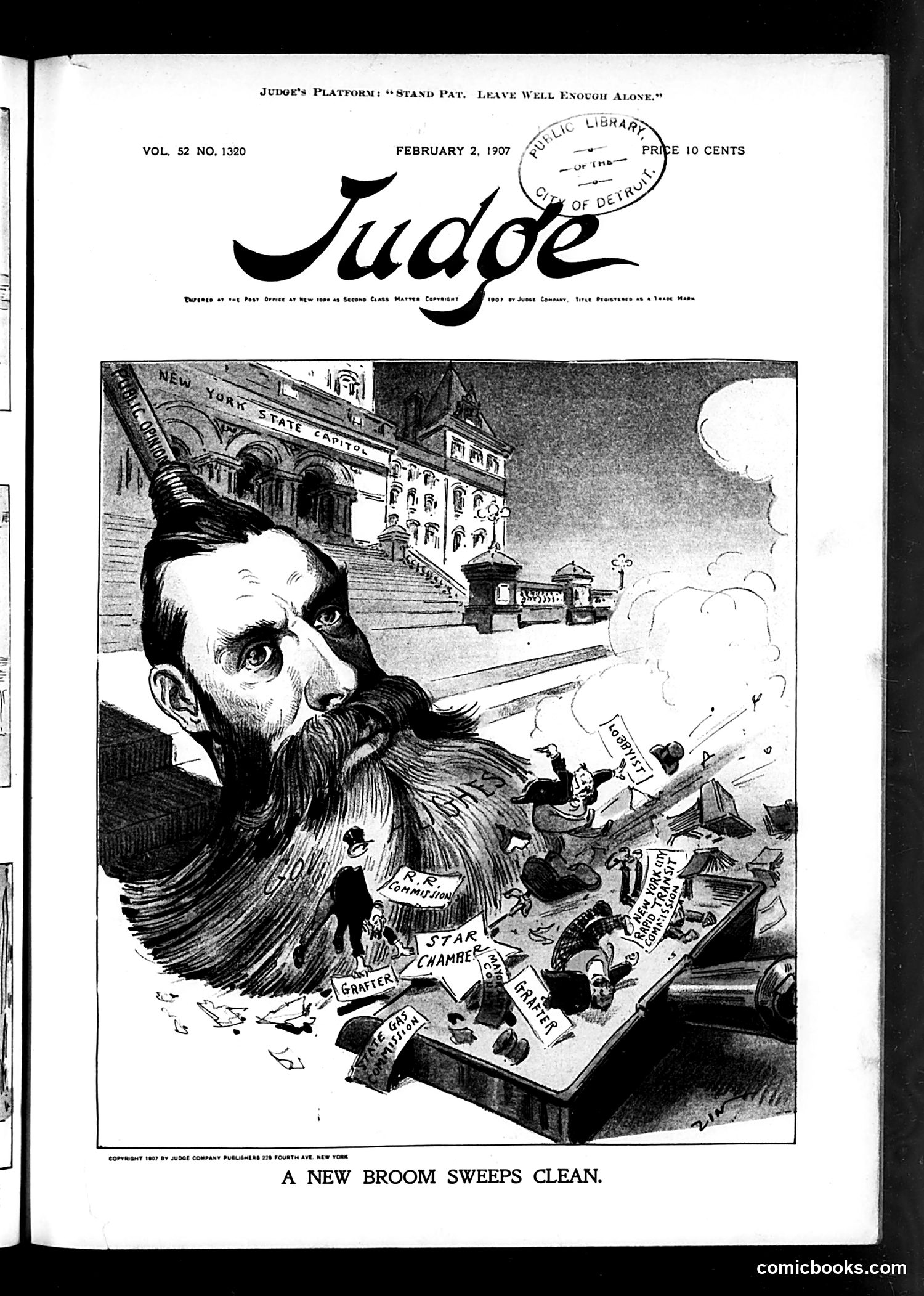
This political cartoon depicts a bearded figure (likely a newly elected official or reformer) as a giant broom sweeping debris from the steps of the New York State Capitol building. The scattered papers labeled with terms like "Grafitti" (likely "Graft"), "Star Chamber," and other corrupt practices represent the political corruption and misconduct being swept away. The caption "A New Broom Sweeps Clean" invokes the proverb about fresh leadership bringing reform. The image satirizes optimism about institutional cleaning-up, possibly referencing New York state political reforms around 1907. The exaggerated caricature and dramatic scale emphasize either sincere hope for reform or, more likely given Judge's satirical nature, skepticism about whether one person can truly eliminate entrenched political corruption.
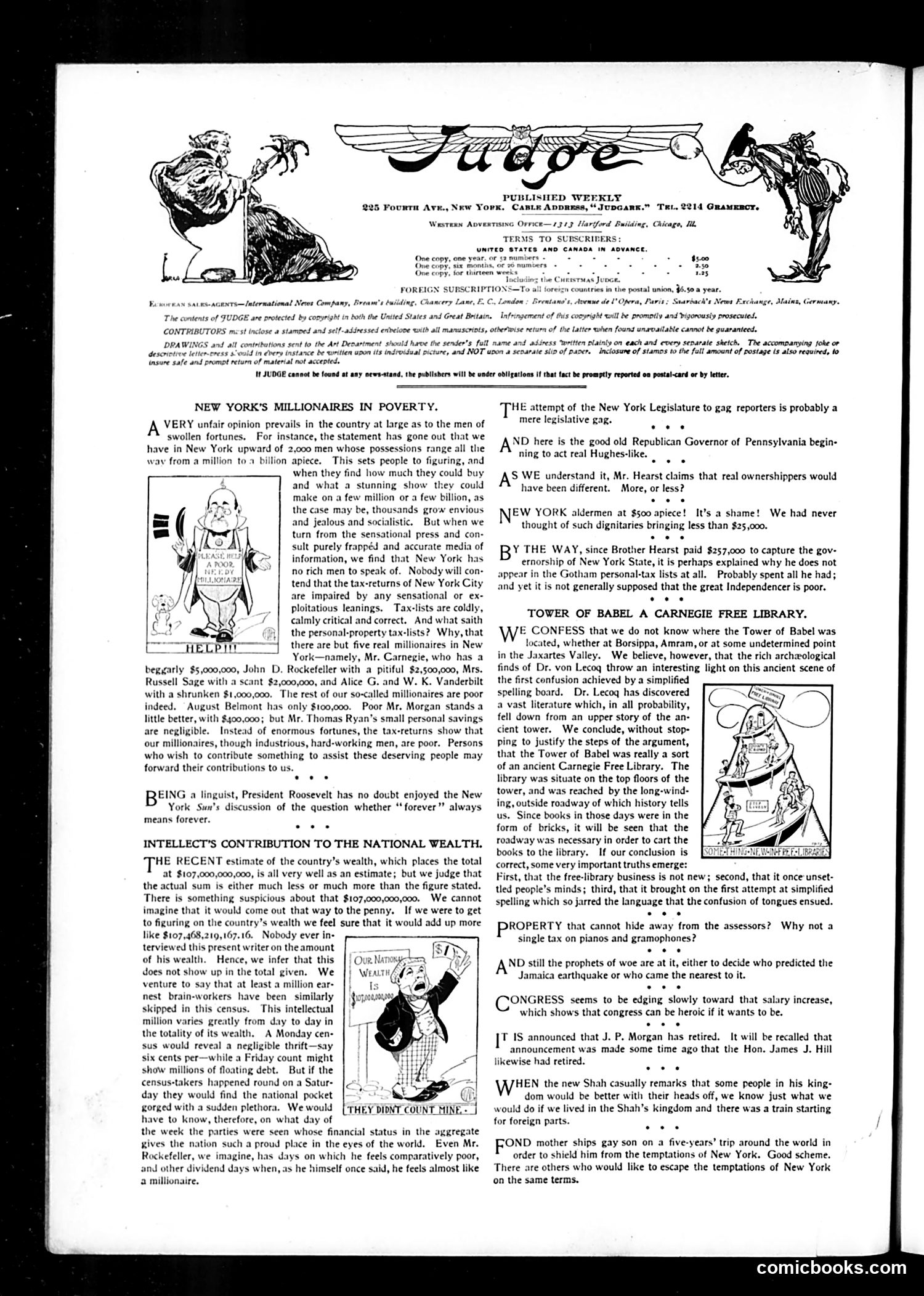
This page satirizes **New York's wealthy millionaires amid poverty**. The left cartoon depicts a rotund figure labeled "HELP!!!" representing the supposedly struggling rich—a mockery of their claims of financial hardship despite enormous wealth. The text ridicules the disconnect between New York's billionaires (naming Russell Sage, W.K. Vanderbilt, and J.P. Morgan) and the city's poor. It sarcastically notes that even Morgan's "small personal savings are negligible" and critiques how the wealthy claim poverty while sitting on fortunes exceeding $100 million. The right section discusses Carnegie's Tower of Babel library proposal, apparently a failed architectural scheme. The magazine's intent is clearly satirical—exposing the absurdity of plutocrats' self-pity.
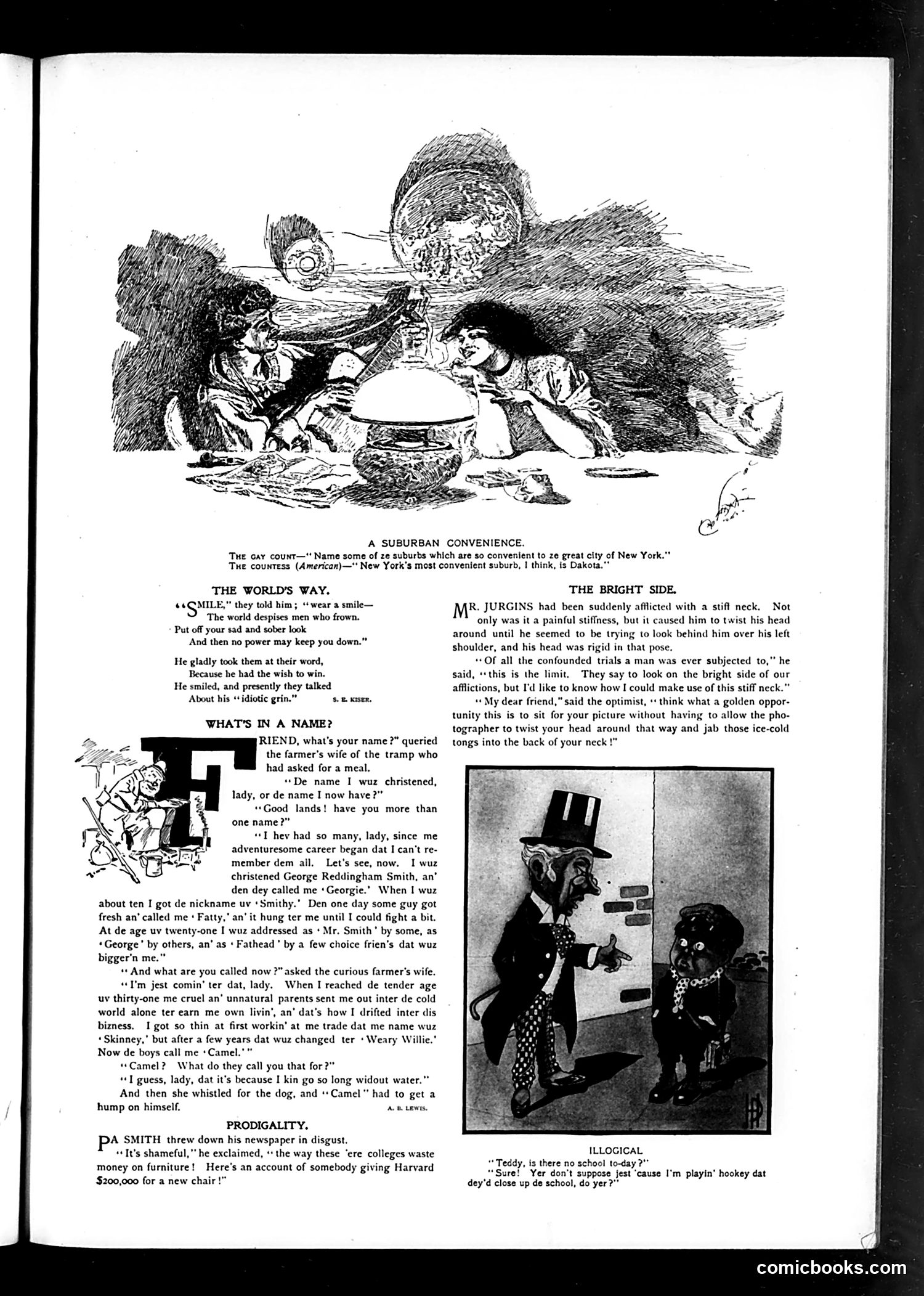
**Top Cartoon: "A Suburban Convenience"** This satirizes New York suburbs as inconvenient despite claims otherwise. The dialogue quotes a "Gay Count" naming suburbs convenient to New York City, while "The Countess (American)" counters that Dakota is more convenient—likely mocking wealthy European aristocrats' confused perspectives on American geography. **Text Stories Below:** Multiple humorous anecdotes follow, including "What's in a Name?" about a tramp acquiring many nicknames throughout life, and "Prodigality," where a character decries wasteful college spending ($200,000 for furniture). **Right Panel: "Illogical"** A brief dialogue joke about school hockey practice. The page demonstrates Judge's characteristic style: satirizing social pretension, immigrant/class humor, and absurdist situations.
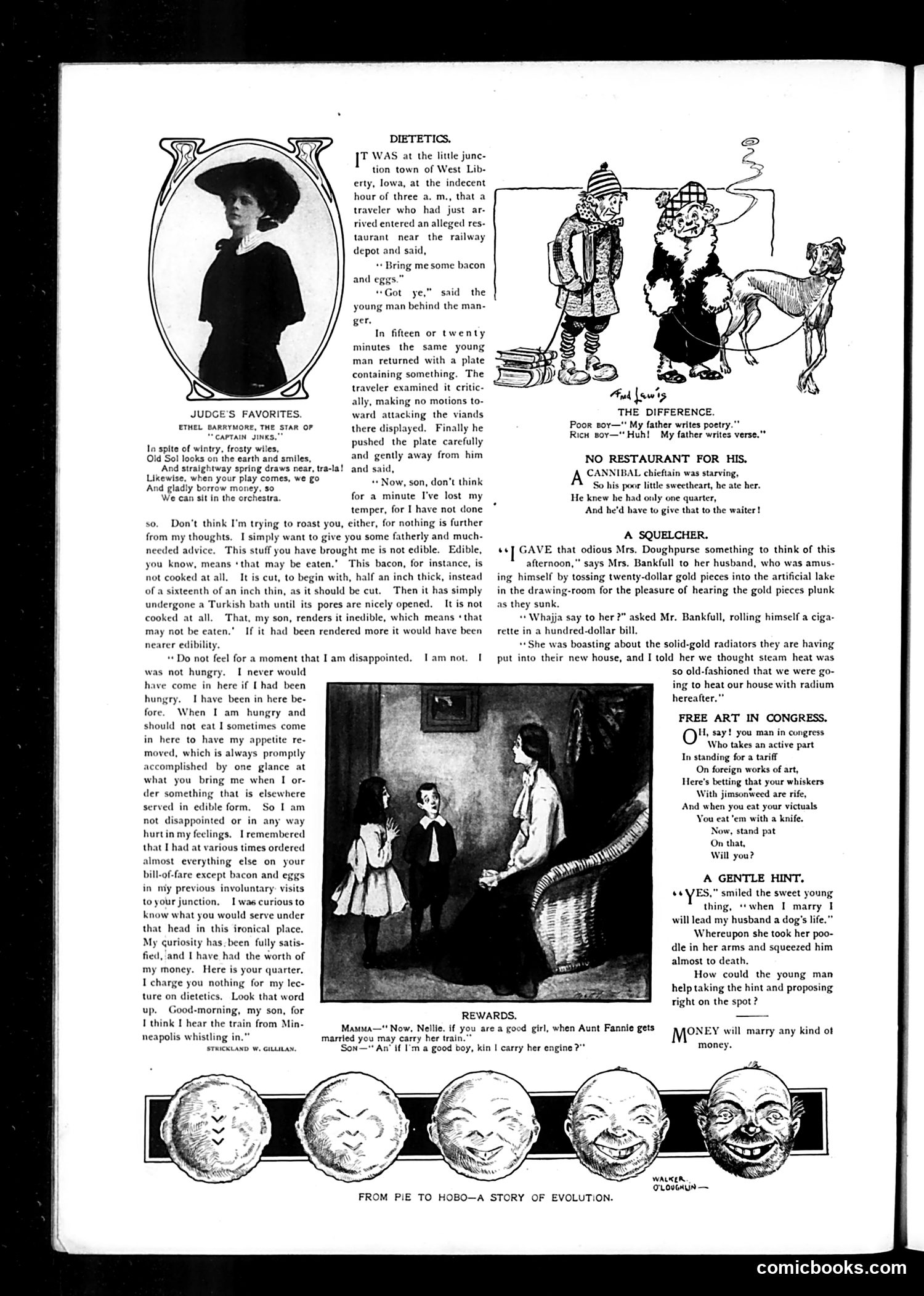
This page from the satirical magazine *Judge* contains several humor pieces rather than focused political cartoons: **"Dietetics"** mocks a pretentious young man advising someone on proper nutrition, suggesting he's insufferable and pedantic about food choices. **"The Difference"** jokes about class distinctions—one boy's father writes "poetry," the other "verse," implying hierarchy in literary accomplishment. **"Rewards"** presents a domestic humor sketch about marriage expectations, with a mother warning her daughter about what husbands will demand. **"From Pie to Hobo"** shows a humorous evolutionary sequence of faces, likely satirizing pseudo-scientific ideas about human development that were popular in this era. The page emphasizes social comedy and domestic satire rather than explicit political commentary. The cartoons target pretension, class consciousness, and gender relations typical of early 20th-century *Judge* content.
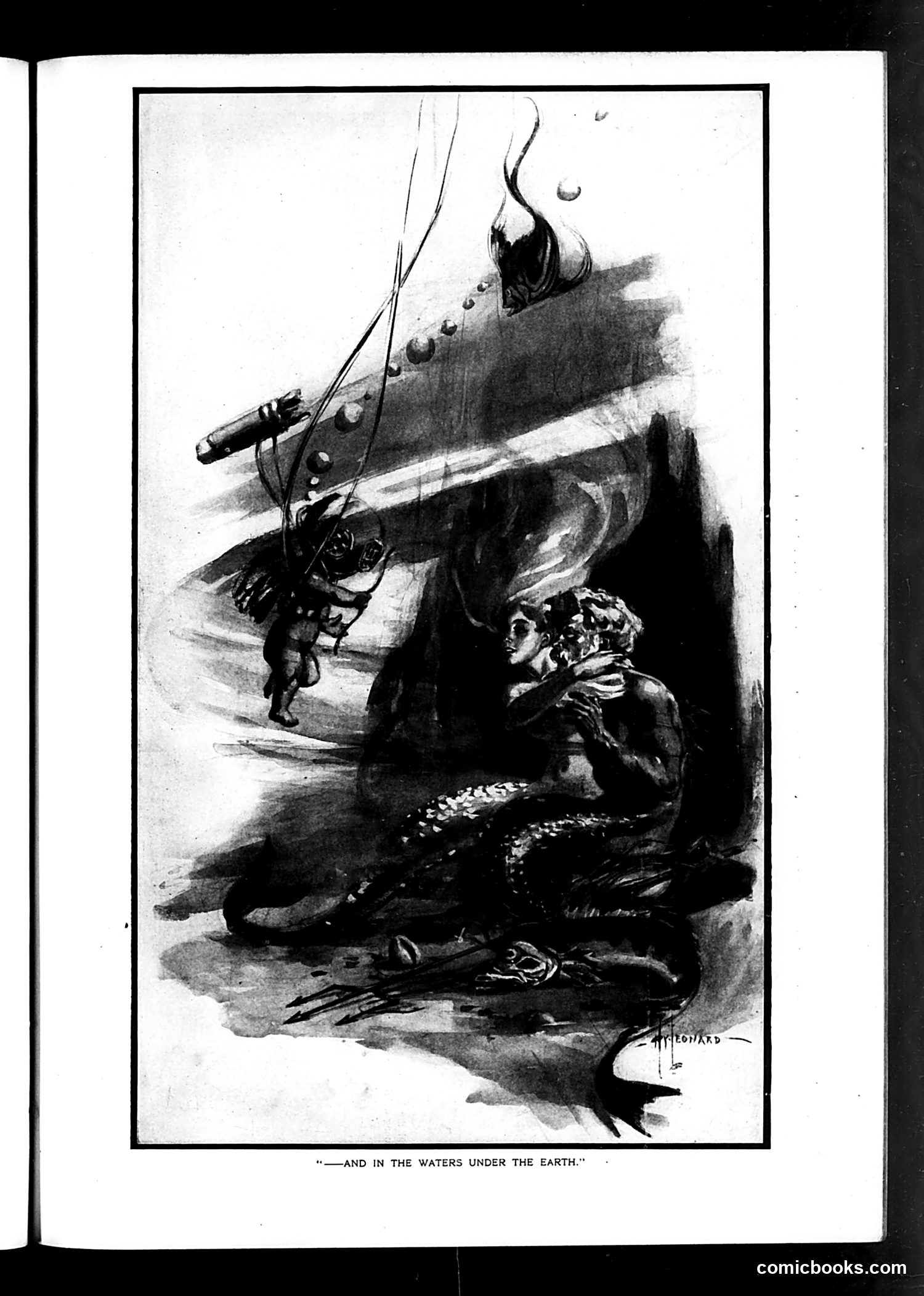
The caption reads "—AND IN THE WATERS UNDER THE EARTH," suggesting an underground or subterranean setting. The image depicts a grotesque creature (possibly representing a demon or monster) looming over a smaller human figure who appears frightened or cowering. Without additional context from the magazine's date or surrounding text, I cannot definitively identify which specific political figure or event this satirizes. The style and subject matter suggest it may reference: - A political threat or danger lurking "beneath" society - A supernatural or "demonic" political opponent - Possibly fears about underground labor movements or radical organizations The artistic technique—dramatic shadows and exaggerated features—typifies Judge's satirical approach to political commentary. However, the specific satirical target remains unclear without publication details.
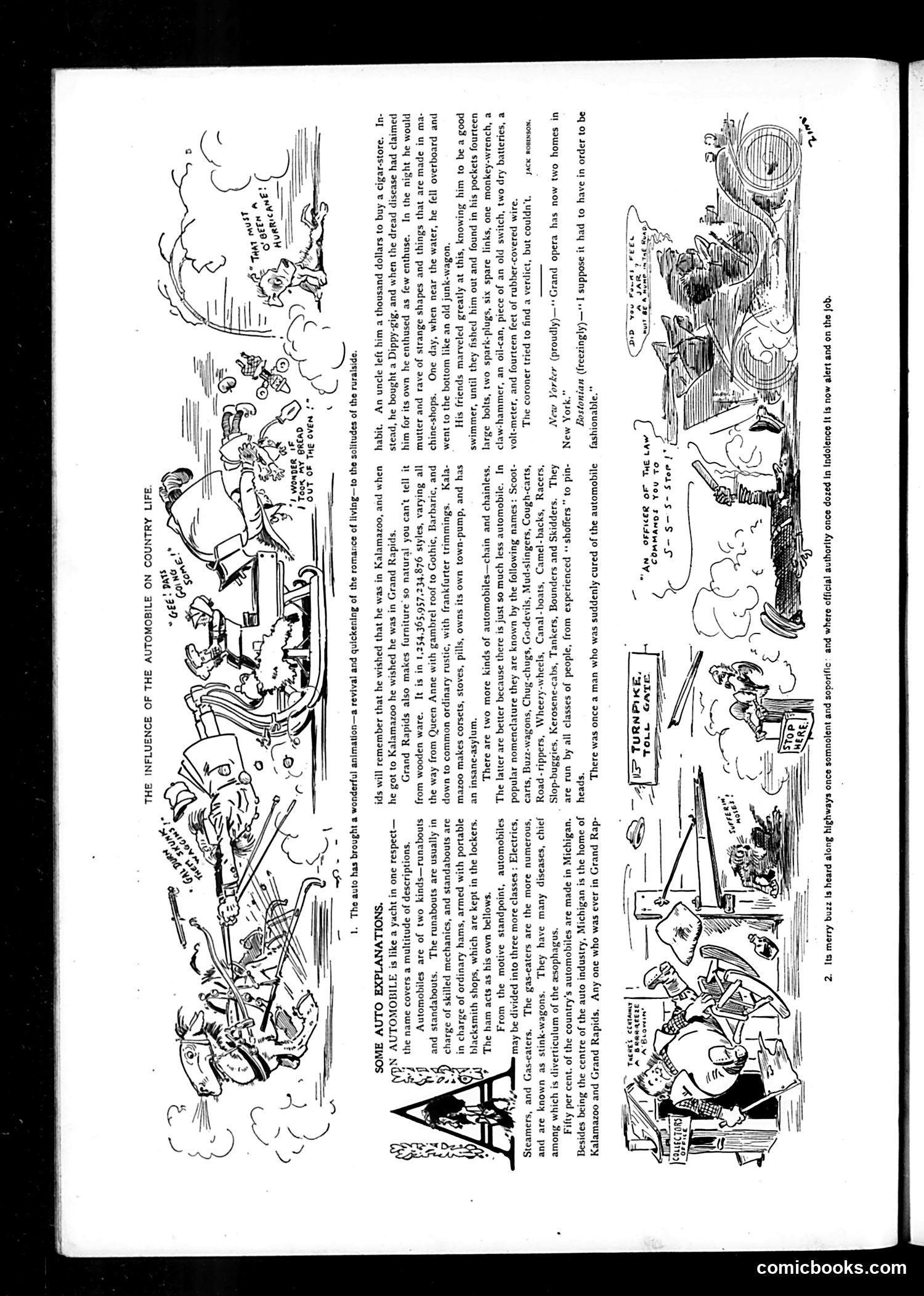
This page contains political cartoons satirizing **automobile industry influences on American life and politics** (circa early 1900s, based on the style). The main cartoon titled "THE INFLUENCE OF THE AUTOMOBILE ON COUNTRY LIFE" depicts a chaotic rural scene where automobiles have disrupted traditional farm life—vehicles scatter livestock, damage property, and create general mayhem. The satire critiques how rapidly industrialization and automobile culture are invading and transforming the countryside. The secondary cartoon "SOME AUTO EXHORTATIONS" appears to mock safety warnings or promotional messages from the automobile industry, using humorous commandments or rules about car ownership. The text discusses various automobile-related social changes: impacts on farming, property damage disputes, insurance issues, and the cultural clash between old rural traditions and new automotive technology. **The core joke**: Automobiles promised progress but instead brought chaos, accidents, and conflict to American communities unprepared for mechanized transportation.
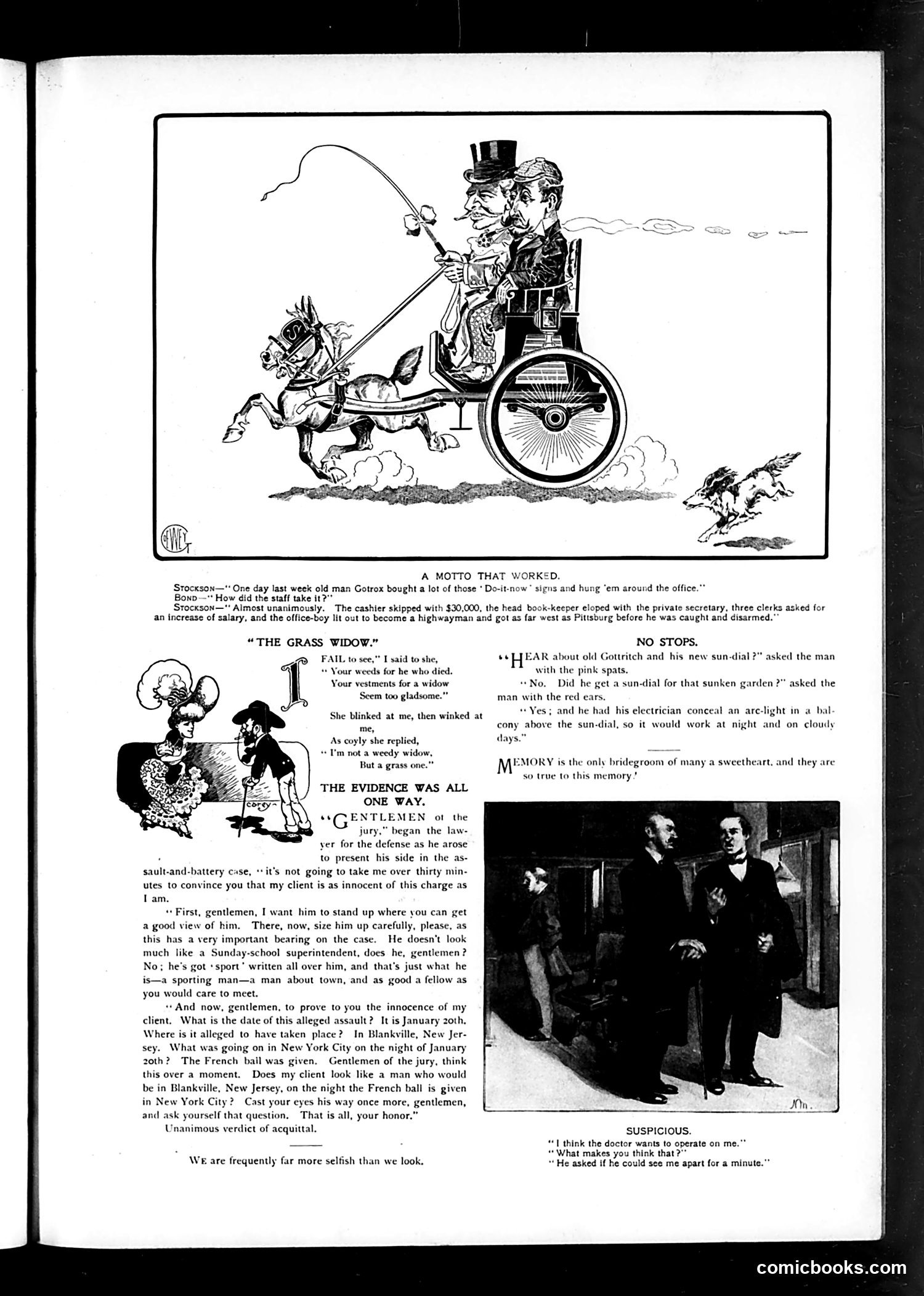
This page contains three satirical pieces targeting workplace and social behavior of the era: **"A Motto That Worked"** mocks the motivational "Do-it-now" trend. When a boss posts these signs, the staff's immediate response is chaos: embezzlement, elopement, salary demands, and a clerk fleeing to become a criminal. The joke satirizes how such corporate slogans backfire when applied indiscriminately. **"The Grass Widow"** plays on the period term for a woman separated from her husband. The woman rejects sympathy about wearing widow's weeds (mourning clothes), claiming she's a "grass widow"—implying her separation is temporary or she's not genuinely grieving—with a wink suggesting impropriety. **"The Evidence Was All One Way"** ridicules a defense lawyer's absurd logic. He argues his client couldn't have committed an assault in New Jersey because the prestigious French ball was occurring in New York City that night, then asks the jury to judge innocence based solely on the defendant's disreputable appearance. The jury's acquittal despite overwhelming evidence reveals the system's absurdity. The page satirizes institutional incompetence, social hypocrisy, and judicial injustice.
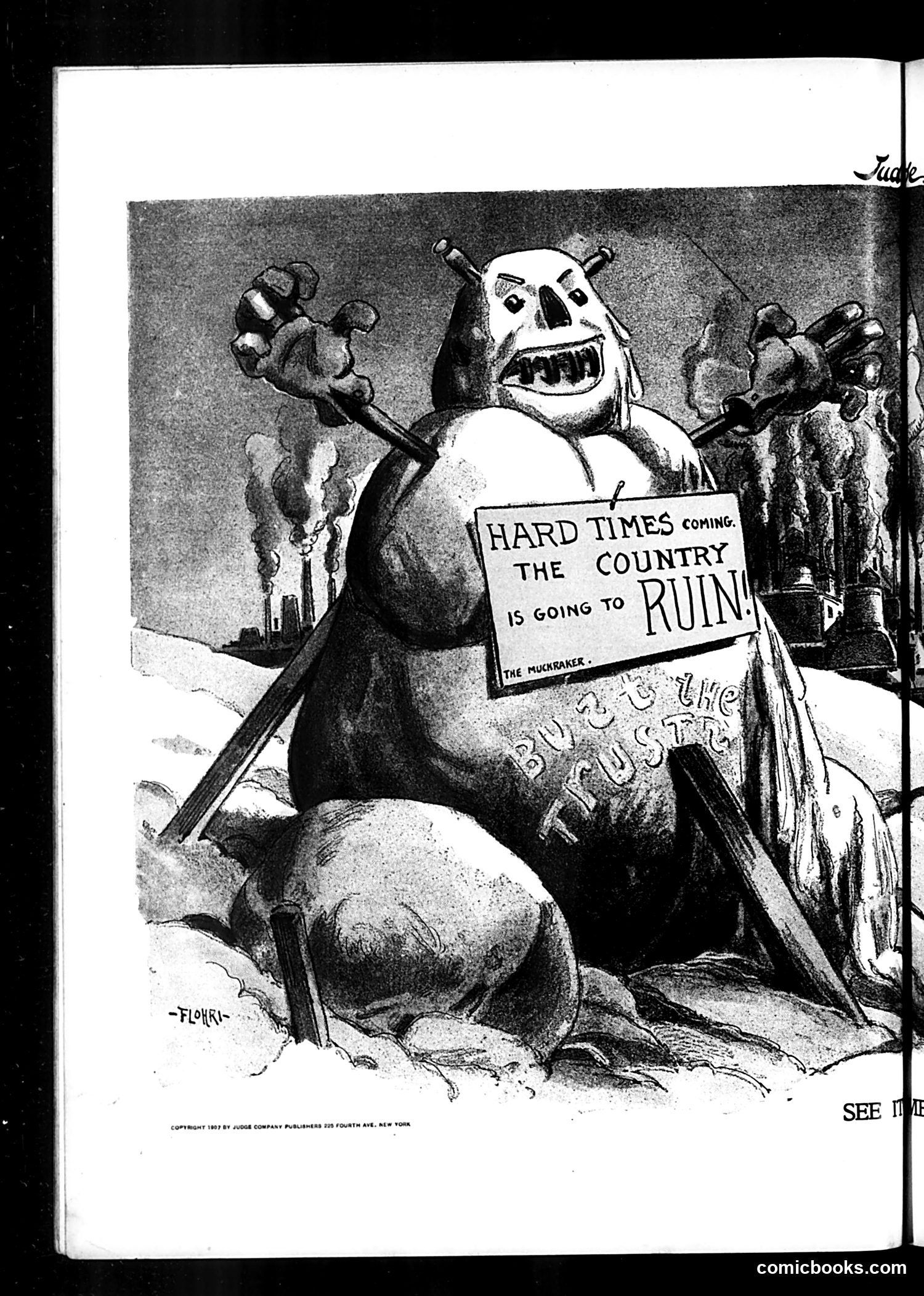
This 1907 Judge magazine cartoon depicts a grotesque demon or monster figure labeled "The Muckraker" holding a sign reading "Hard Times Coming, The Country Is Going to Ruin!" The creature carries a club and appears menacing, surrounded by fearful figures in the background. The cartoon satirizes **muckraking journalists**—investigative reporters exposing corporate corruption and social problems during the Progressive Era. The artist portrays muckrakers as destructive fear-mongers whose relentless criticism of American institutions spreads alarm and pessimism rather than constructive reform. This represents a **conservative critique** of muckraking journalism: that sensationalized exposés of wrongdoing, while perhaps containing truth, were exaggerated and demoralizing to public confidence in the nation's future. The cartoon's hostile imagery suggests Judge magazine opposed aggressive investigative reporting.
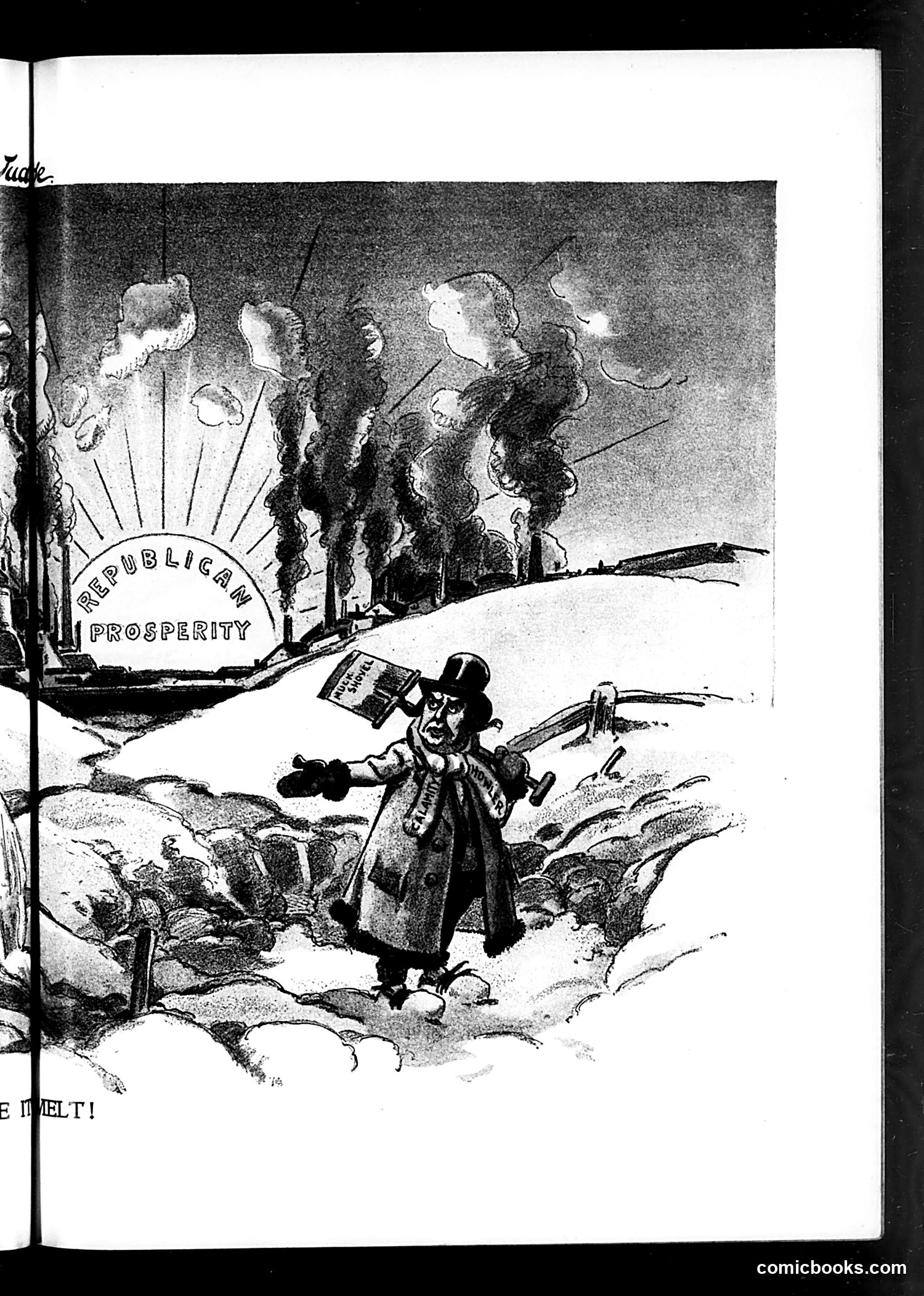
This Judge magazine cartoon depicts **Uncle Sam** (identifiable by his characteristic top hat and star-spangled outfit) standing amid a devastated landscape of broken weapons and rubble. He holds a banner reading "Republican Prosperity" while gesturing toward industrial smokestacks billowing in the distance—likely representing factories and industrial production. The satire appears to critique the disconnect between **Republican claims of prosperity** and the **visible destruction and warfare** surrounding the figure. The contrast between the optimistic banner and the wreckage suggests the cartoonist is sarcastically questioning whether industrial growth truly represents genuine prosperity, or whether it masks the costs of militarism and conflict. The OCR text is too garbled to confirm publication date or cartoonist attribution with certainty.
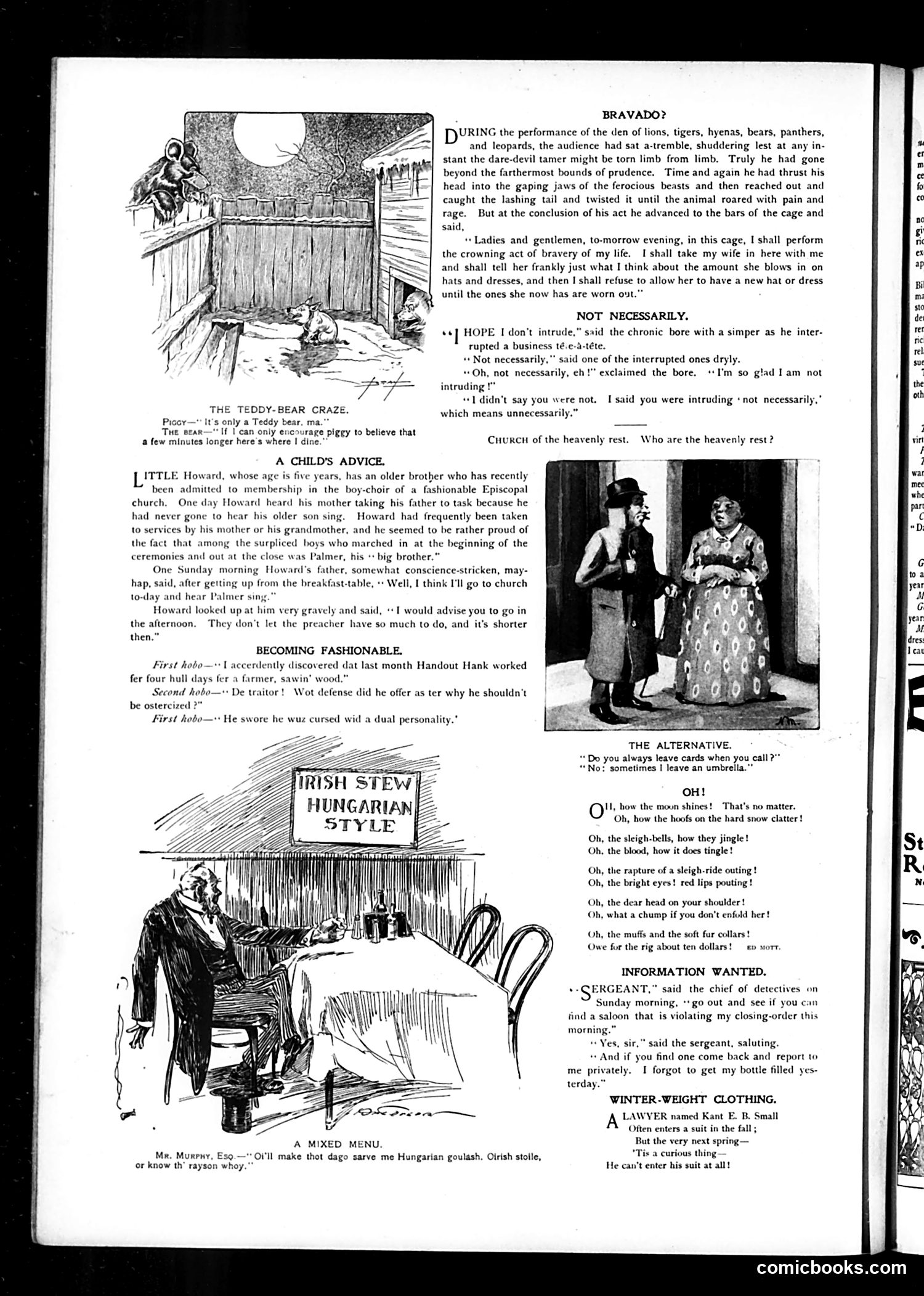
This page contains several unrelated satirical pieces typical of early 20th-century American humor. The lead story mocks masculine bravado: a daredevil lion tamer brags about his next grand act—not circus heroics, but *arguing with his wife about her spending on hats and dresses*. The joke targets both reckless showmanship and marital tensions over women's fashion expenditures. Other sketches satirize social conventions: a chronic bore interrupts colleagues but misinterprets being told he's "intruding unnecessarily"; a father finally attends his son's church performance in the afternoon to avoid the preacher working too hard; a prohibition-era police chief orders raids on illegal saloons but asks his sergeant to find one so he can refill his bottle. The humor relies on ironic reversals and commentary on contemporary social hypocrisy.
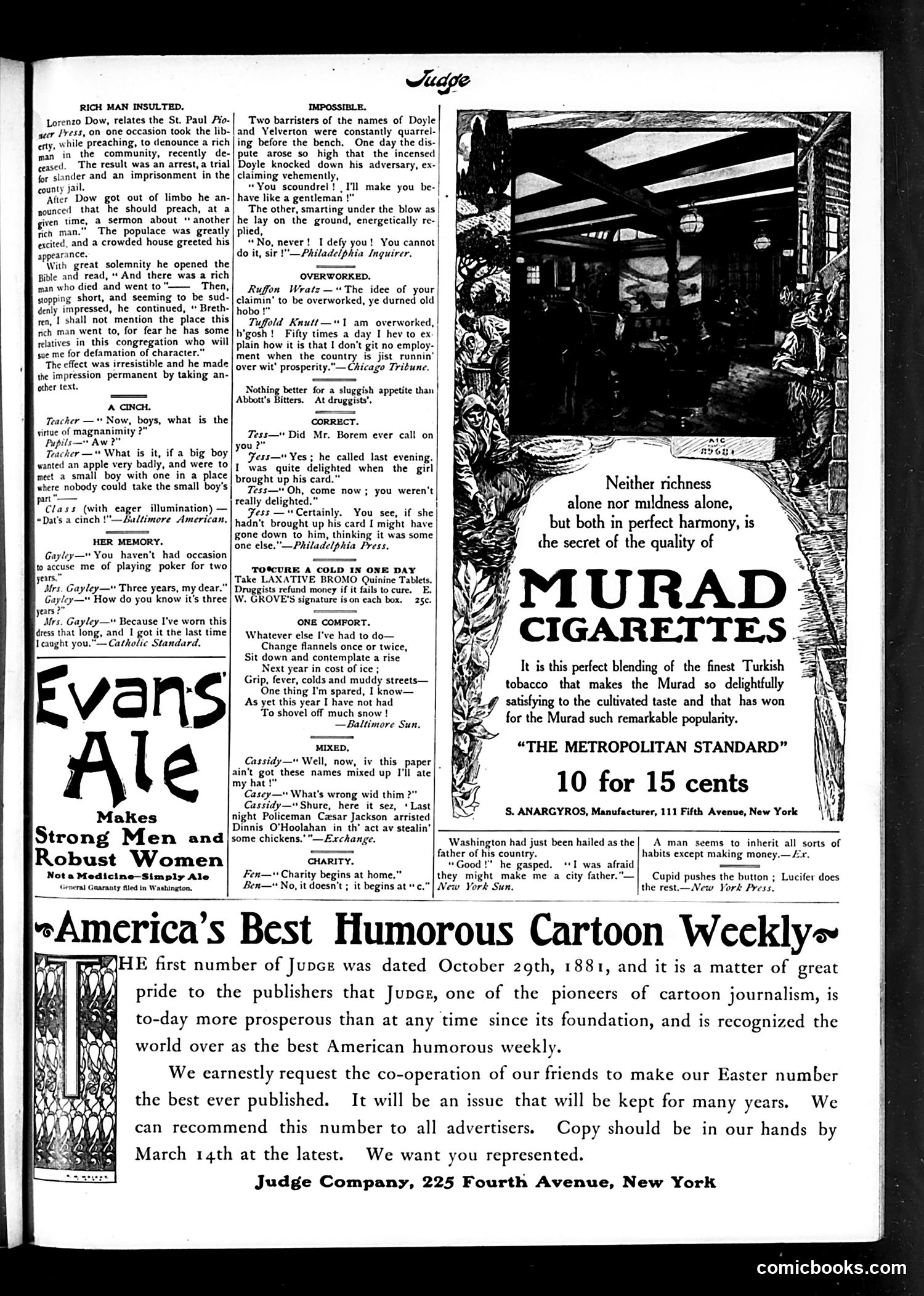
This is primarily an **advertising and humor compilation page** from Judge magazine, not a single political cartoon. The page contains multiple brief humorous anecdotes and jokes typical of the publication's format. The main content includes: **Anecdotes satirizing social hypocrisy and human nature:** - A preacher (Lorenzo Dow) cleverly avoids legal trouble by refusing to describe where a rich man went after death, implying hell while avoiding slander charges - Various short jokes about magnanimity, poker accusations, overwork, and social pretense **Key satirical targets:** wealth/class relations, pompous legal proceedings, marital memory, unemployment despite claimed prosperity, and social pretense masquerading as politeness. The page also features **period advertisements** for Evans Ale and Murad Cigarettes, plus a promotional notice for Judge's Easter issue. The humor reflects turn-of-the-century American sensibilities—working-class vernacular ("b'gosh"), gender dynamics in marriage, and working-poor perspectives on employment and survival.
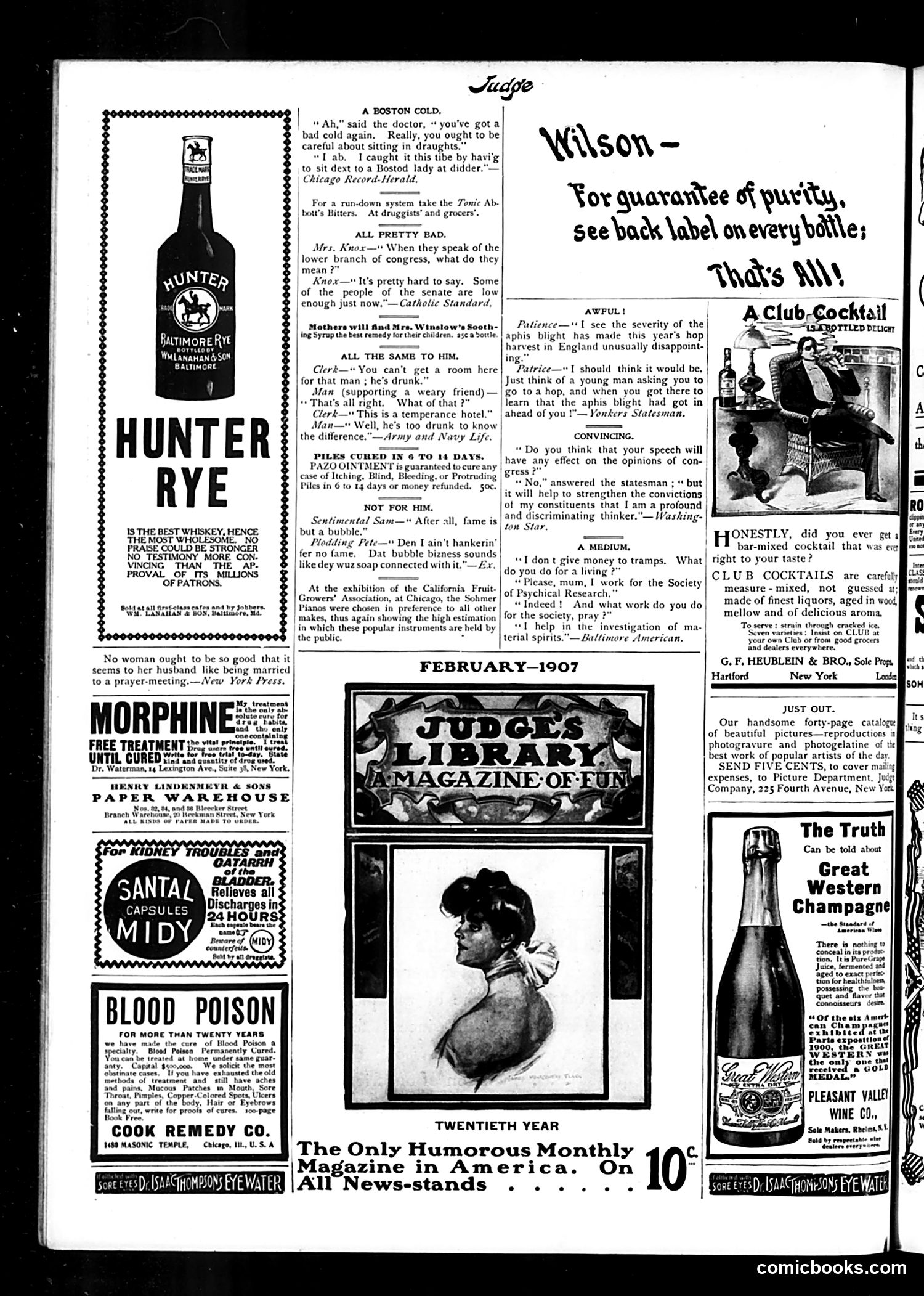
This page is primarily **advertisements and short humor pieces**, typical of Judge's satirical format. The main content includes: **Advertisements** dominate: Hunter Rye whiskey, morphine treatments, blood poison cures, and Santa Midy capsules—reflecting early 1900s patent medicine culture when unregulated substances were openly advertised. **Short jokes** mock contemporary targets: - A "Boston cold" joke plays on Boston's reputation for pretentiousness - Congress humor about the "lower branch" suggests partisan criticism - A "temperance hotel" joke satirizes Prohibition-era tensions - References to hop blight and "aphis" (an agricultural pest) indicate farming concerns **Social commentary**: One joke mocks a statesman who uses verbose speeches to convince constituents he's intelligent—typical Gilded Age criticism of politicians. The page also advertises **Judge's Library Magazine** (10 cents) and promotes Wilson champagne and other products. Rather than a coherent political cartoon, this is a typical Judge page—a mix of advertising revenue and bite-sized satirical humor targeting politics, social pretension, and contemporary concerns.
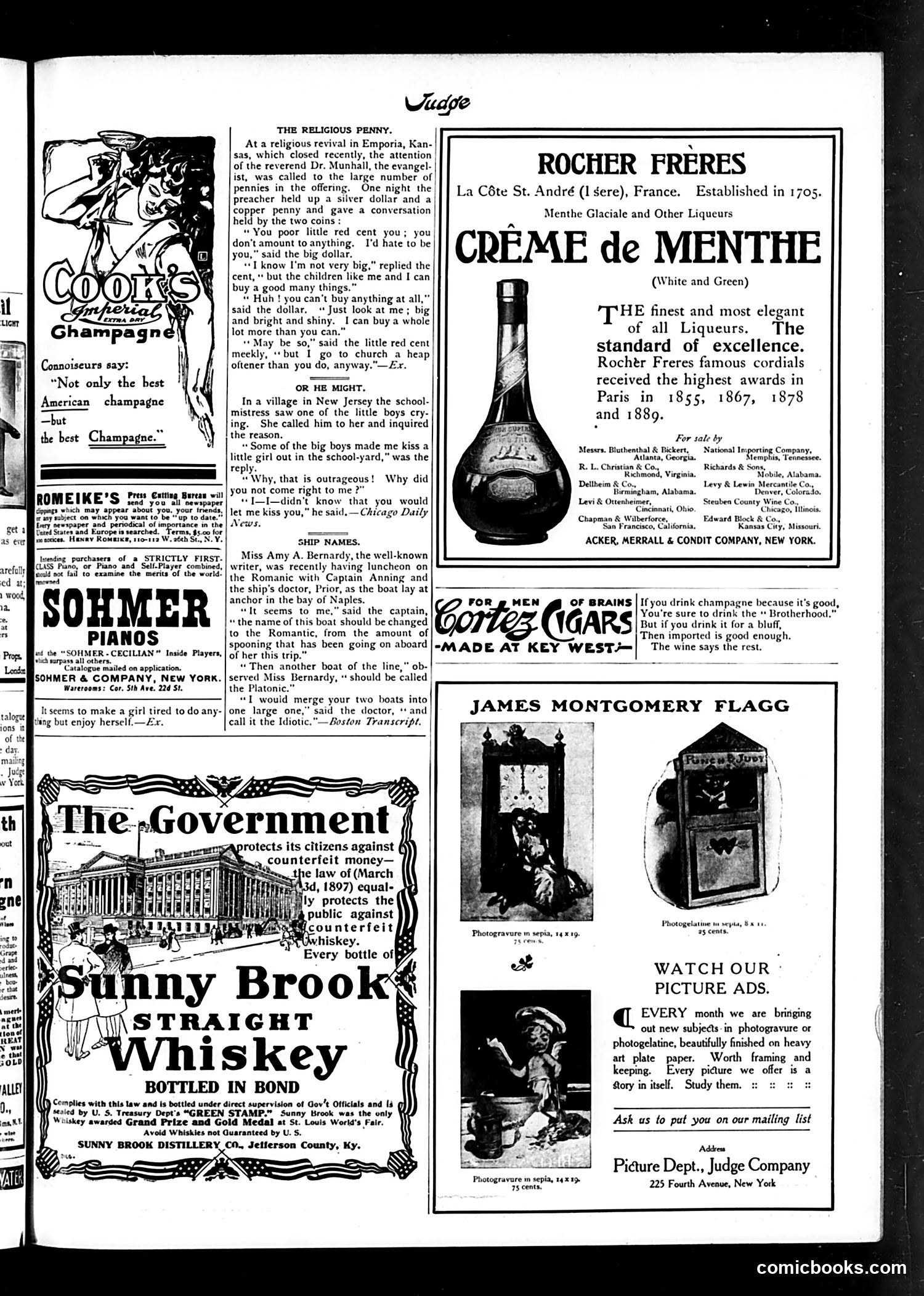
This page is primarily **advertising** for luxury goods (champagne, liqueurs, whiskey, pianos) interspersed with brief humorous anecdotes. The small editorial jokes include: **"The Religious Penny"**: A dialogue between a silver dollar and copper penny at a Kansas revival, where the humble penny boasts it attends church more faithfully than the showy dollar—satirizing materialism versus genuine piety. **"Or He Might"**: A New Jersey schoolboy's innocent misunderstanding, thinking the teacher wouldn't permit him to kiss a girl—gentle satire on childhood naiveté. **"Ship Names"**: A joke about vessels named *Romanic* and *Platonic*, with a doctor suggesting merging them into "the Idiotic"—wordplay mocking shipboard romance. The page reflects early 1900s *Judge* content: light social satire mixed with commercial messaging, targeting affluent readers of refined tastes (champagne connoisseurs, piano buyers). The humor is genteel and moralistic rather than politically sharp.
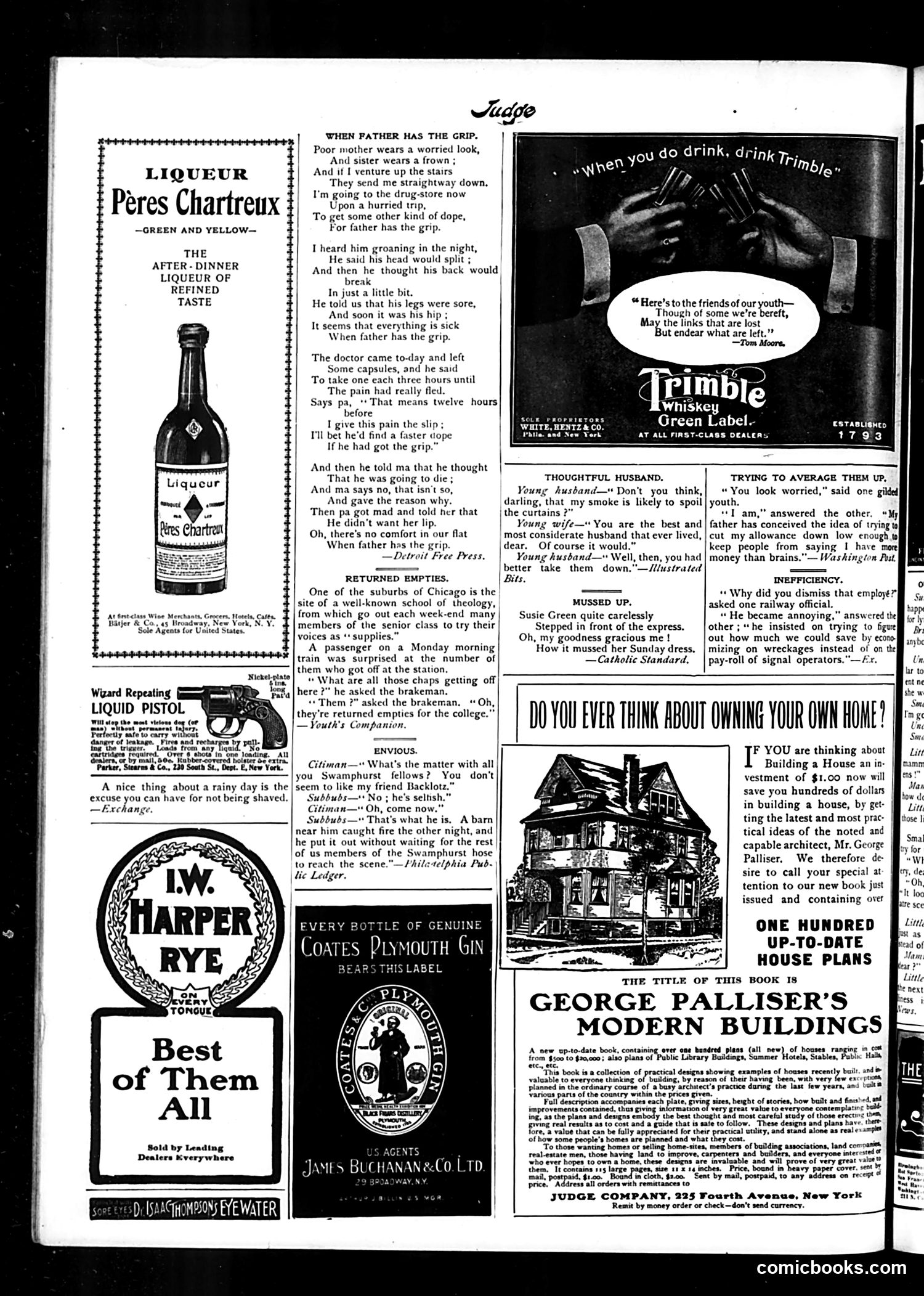
This page consists primarily of **advertisements and humorous filler content** rather than political satire. The main elements are: **Advertisements:** Liqueur, whiskey, and a "Liquid Pistol" toy dominate the layout, typical of Judge's revenue model. **Humor Columns:** The text includes several brief, unrelated jokes and anecdotes: - "When Father Has the Grip" — a domestic comedy about a man with influenza complaining excessively while his family suffers - "Returned Empties" — a pun about theology students as "empty" supplies - "Envious" — a man jealously wants credit for putting out a fire - Several other one-liners about marriage, smoking, and employment These represent **general-interest humor** for early-1900s readers—no specific political figures or events are targeted. The satire is gentle, focused on everyday domestic life, workplace dynamics, and social pretension rather than politics or current events.
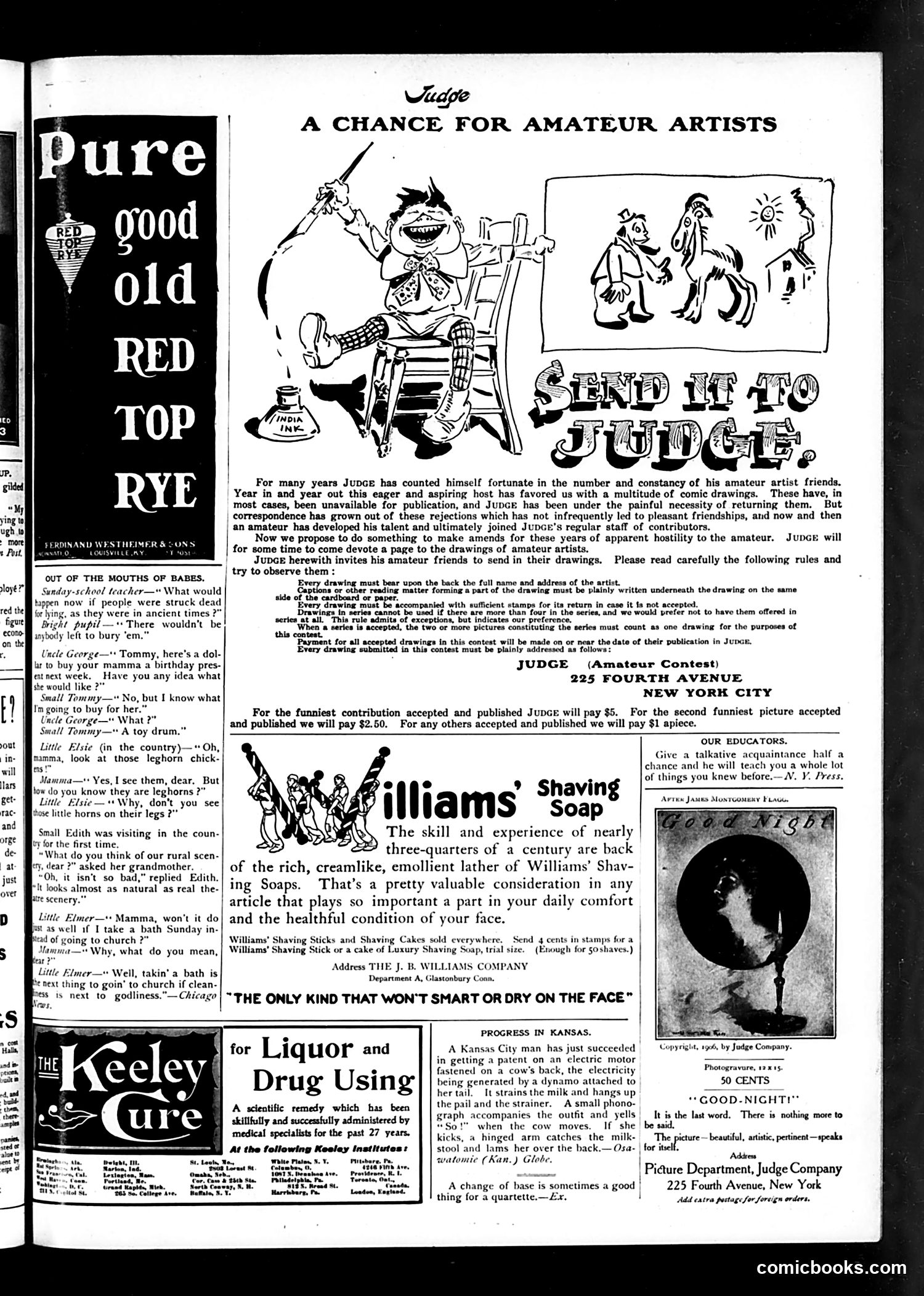
This page primarily showcases **"A Chance for Amateur Artists,"** Judge's invitation for readers to submit comic drawings for publication and prizes ($5 for the funniest, $2.50 for second place, $1 for others). The upper portion contains several **brief jokes**—"Out of the Mouths of Babes"—exploiting children's innocent misunderstandings: a Sunday school pupil's dark quip about lying, a child confusing leghorn chickens' legs with horns, and another equating bathing with church attendance. The main cartoon depicts an exaggerated artist-figure painting stick figures, captioned "Send It to Judge," encouraging amateur submissions. The page is primarily **advertising and editorial content** rather than political satire. It advertises Red Top Rye whiskey, Williams' Shaving Soap, and The Keeley Cure (for alcohol/drug addiction). **Historical context:** This reflects Judge's open-submission policy and early 20th-century magazine culture. The jokes reflect period attitudes—religious irreverence was considered humorous, and children's innocent remarks amusing to adult readers.
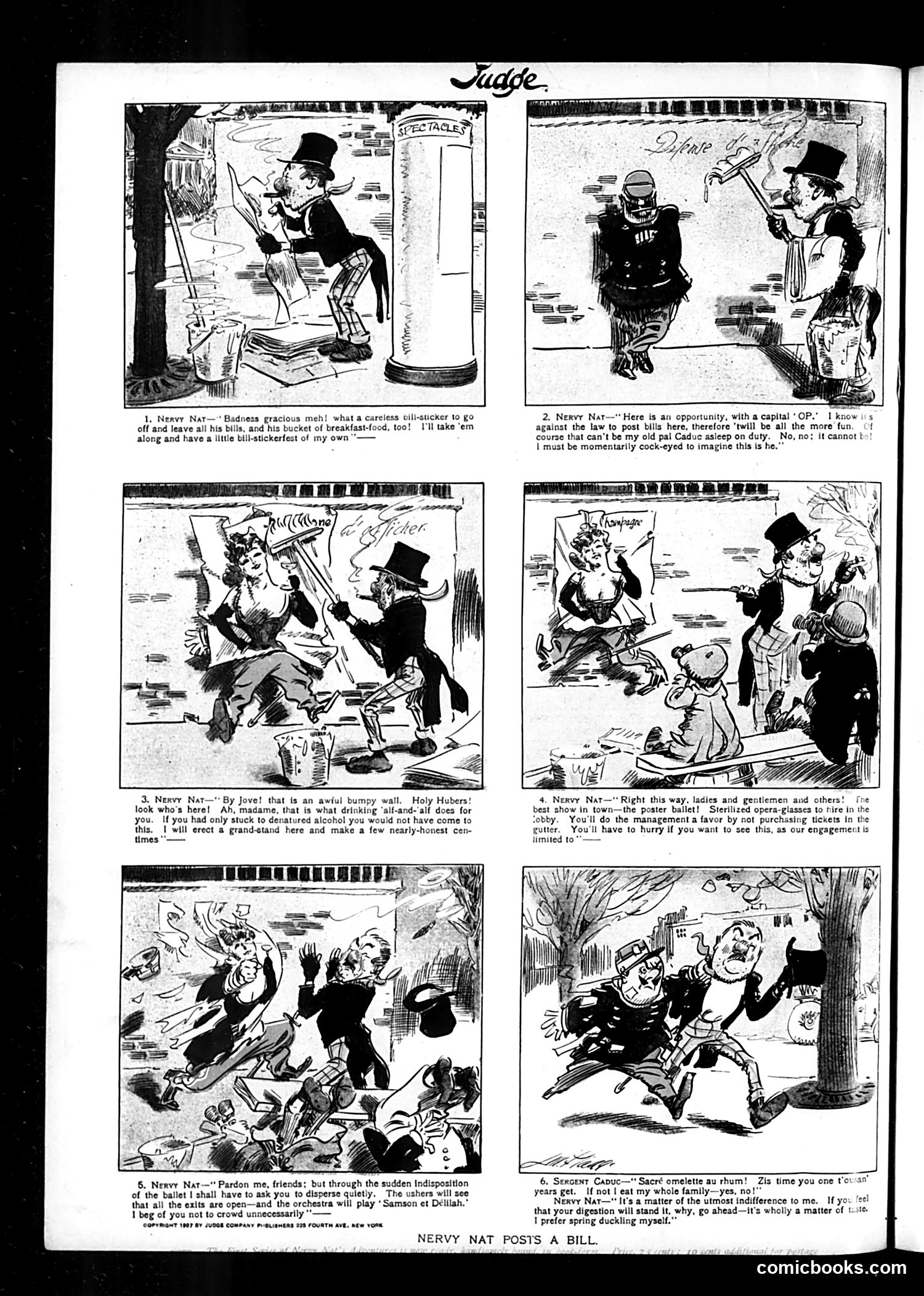
This six-panel comic strip follows the character Nervy Nat, a mischievous con artist, as he exploits various situations for petty profit. The satire targets early 20th-century urban hustles: Nat steals an oil-sticker's abandoned bills and bucket to create fake "bill-sticking" jobs; he mocks a drunk woman on a wall; he illegally posts advertisements; and he exploits a theater evacuation by charging admission to view posters as impromptu "ballet." The final panel introduces Sergeant Cadic, a presumably corrupt policeman asleep on duty, whom Nat claims not to recognize—suggesting police negligence enables such street-level scams. The ending joke involves absurd French exclamations and a casual exchange about eating one's family. The overall satire mocks both small-time urban con artists and the municipal incompetence that allowed them to operate unchecked on city streets.