
A complete issue · 19 pages · 1906
Judge — December 29, 1906
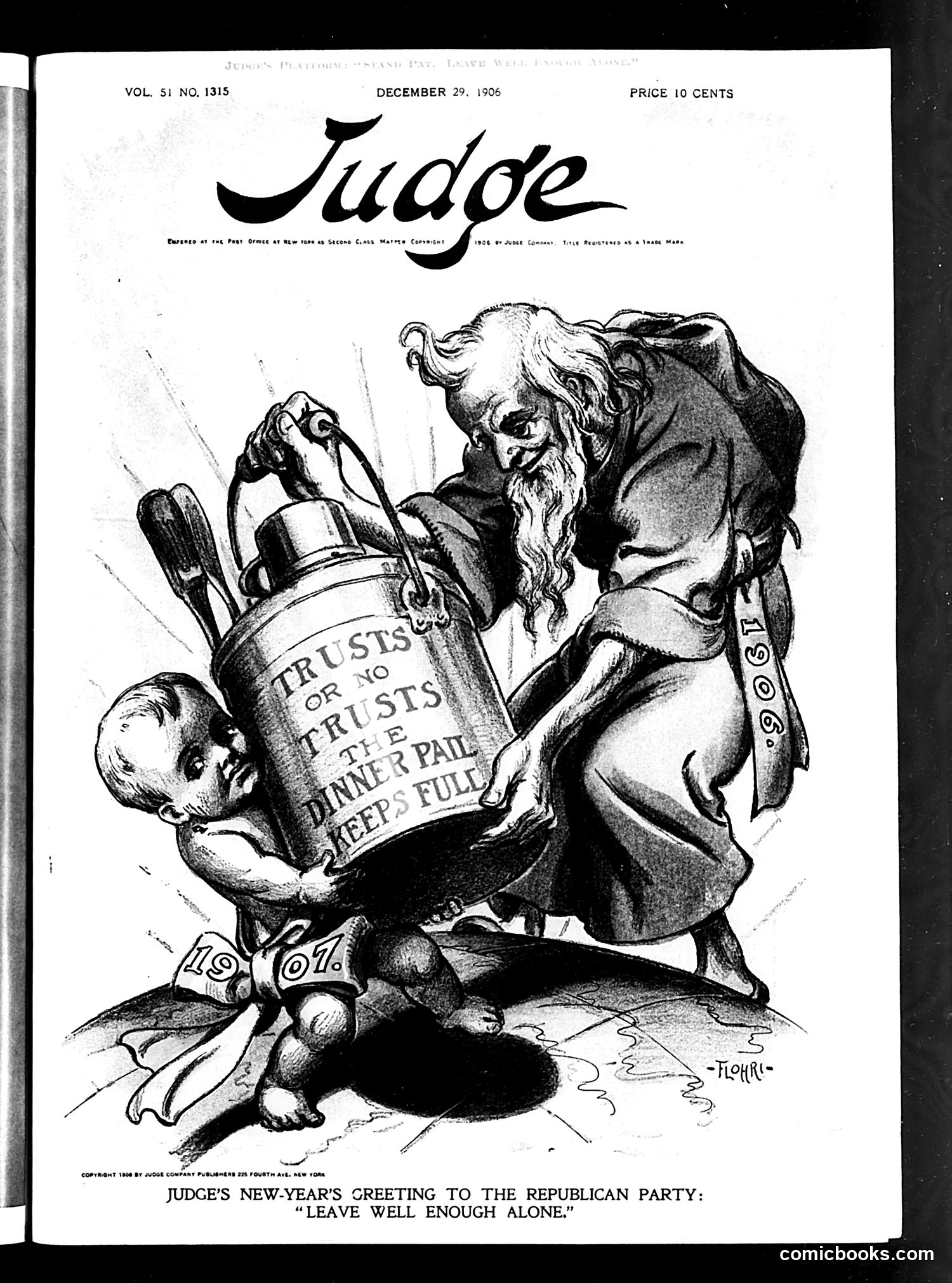
**Date & Context:** December 29, 1906 **The Cartoon:** A bearded wizard-like figure (likely representing Judge magazine's editorial voice or a personified concept) addresses a small cherub labeled "1906," offering a large cauldron inscribed "TRUSTS OR NO TRUSTS / THE DINNER PAIL KEEPS FULL." **Meaning:** This is satirical commentary on the Republican Party's New Year's greeting. The cartoon suggests that despite ongoing debates about trust-busting and corporate monopolies—major political issues of the Progressive Era under President Theodore Roosevelt—ordinary Americans' economic welfare (symbolized by the "dinner pail," representing working-class livelihood) remains secure and unaffected by these political controversies. **The Satire:** Judge mocks the Republican Party's confidence that economic prosperity will insulate them from criticism about their handling of trusts, regardless of political rhetoric.
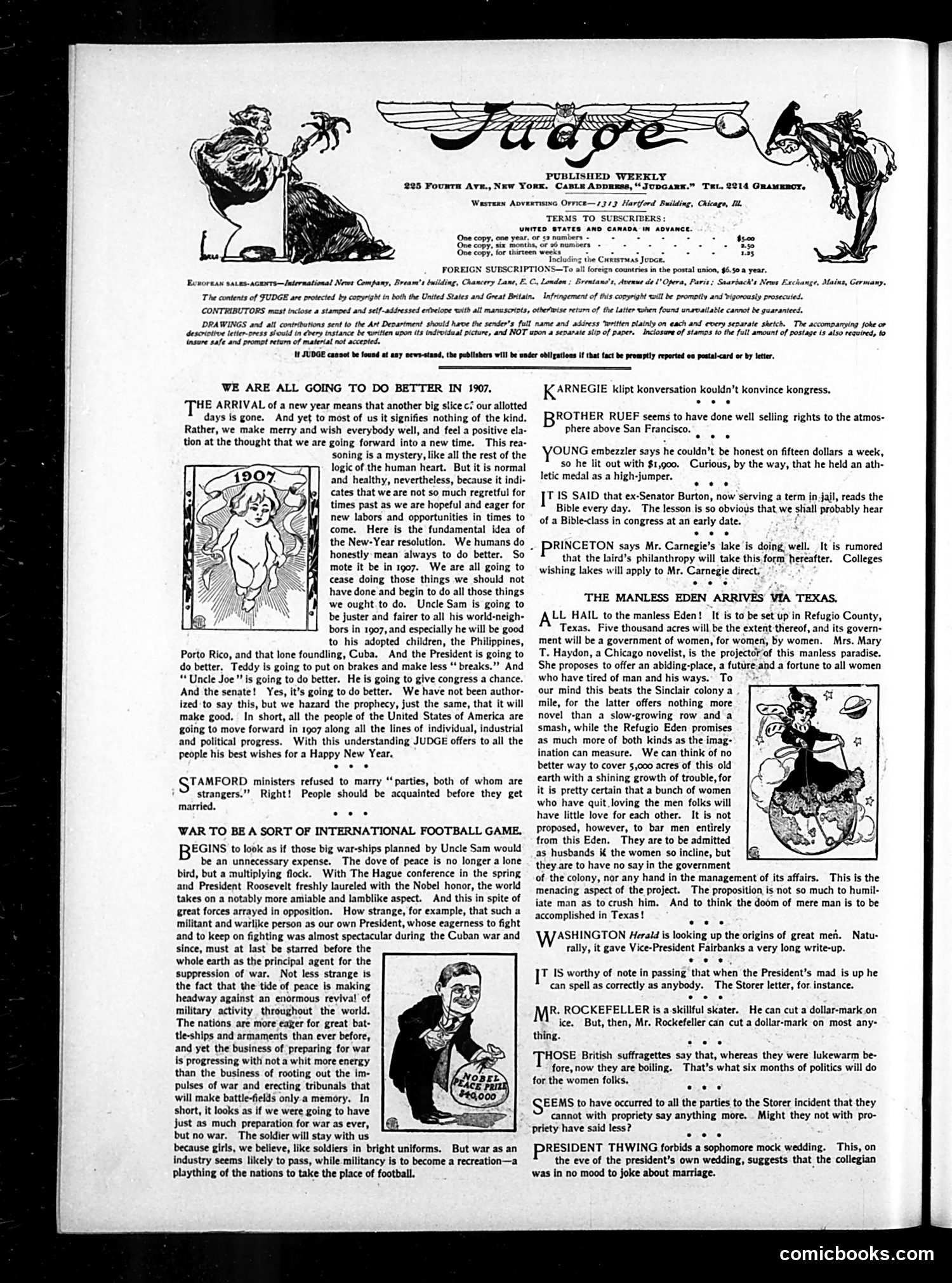
This 1907 issue opens with New Year's commentary. The left cartoon depicts a rotund figure labeled "1907" kicking out the previous year, a standard holiday trope. The main text "WE ARE ALL GOING TO DO BETTER IN 1907" satirizes optimistic New Year's resolutions while listing ongoing problems: Uncle Sam will improve Cuba, Puerto Rico will flourish, President Roosevelt will solve labor disputes, and Congress will finally function properly. The satire undercuts each claim with skepticism about actual reform. Side items mock contemporary figures: Carnegie's philanthropy, a manless Eden colony in Texas, Vice-President Fairbanks, Rockefeller's skating abilities, and British suffragettes. The "Storer incident" appears to reference a diplomatic controversy. Overall, the page expresses cynicism about government effectiveness and wealthy industrialists' sincerity.
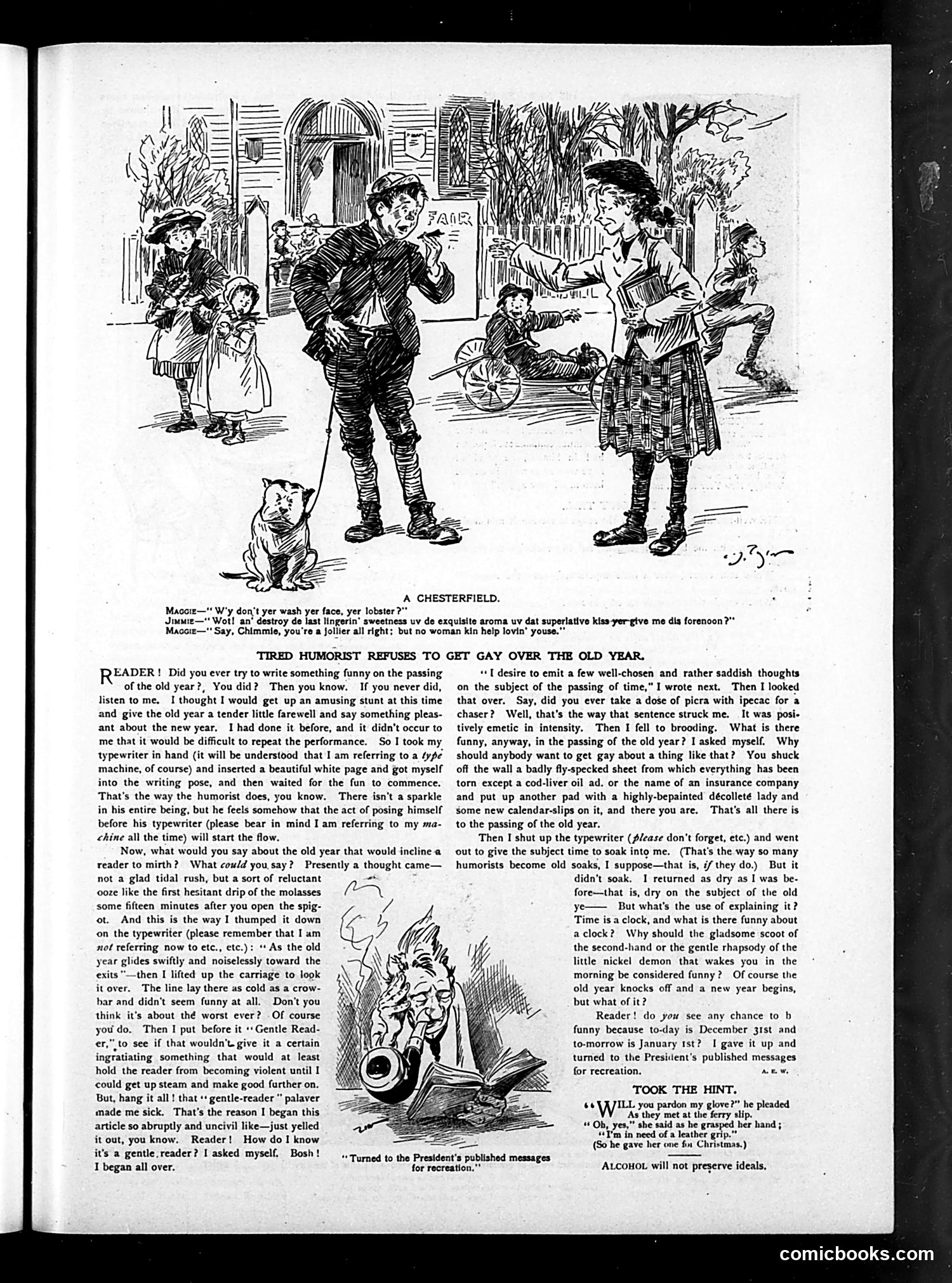
This page features a satirical essay mocking the tired tradition of writing humorous New Year's pieces. The author complains that creating "funny" Year's End content feels obligatory and exhausted—the same stale jokes recycled annually by lazy humorists. The illustration shows a street scene labeled "A Chesterfield," depicting everyday urban life with children and a dog, serving as visual contrast to the forced gaiety expected in holiday writing. The essay argues that humor about time passing and new beginnings has become clichéd. The author deliberately refuses to participate in this worn-out convention, instead offering straightforward, "saddish thoughts" rather than manufactured hilarity—a meta-joke about the predictability of holiday humor itself.
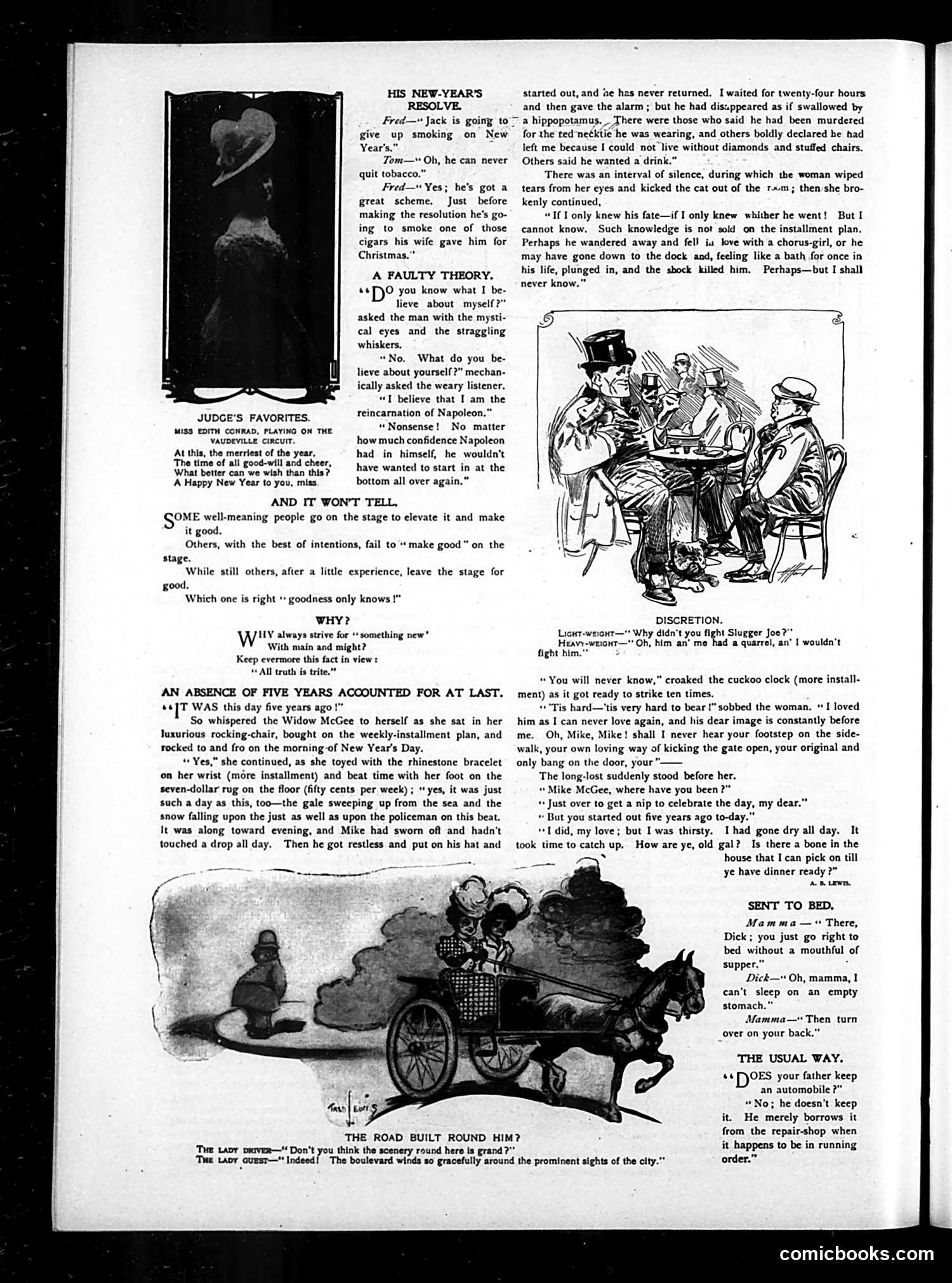
This page contains several satirical pieces and illustrations typical of early 20th-century humor journalism: **"His New Year's Resolve"** depicts a man's failed promise to quit smoking—a common New Year's joke format. **"A Faulty Theory"** features a man claiming to be "the reincarnation of Napoleon," which the other character dismisses. This satirizes pretentious self-aggrandizement. **"The Road Built Round Him"** shows a horse-drawn cart navigating around a sleeping figure, captioning a conversation about city scenery. It's visual humor about urban indifference. **"Discretion"** and **"Sent to Bed"** are brief domestic comedies about relationships and parenting. The page lacks overt political content; instead, it offers gentle social satire on human nature, vanity, and domestic life—typical Judge fare focused on universal human foibles rather than specific contemporary events.
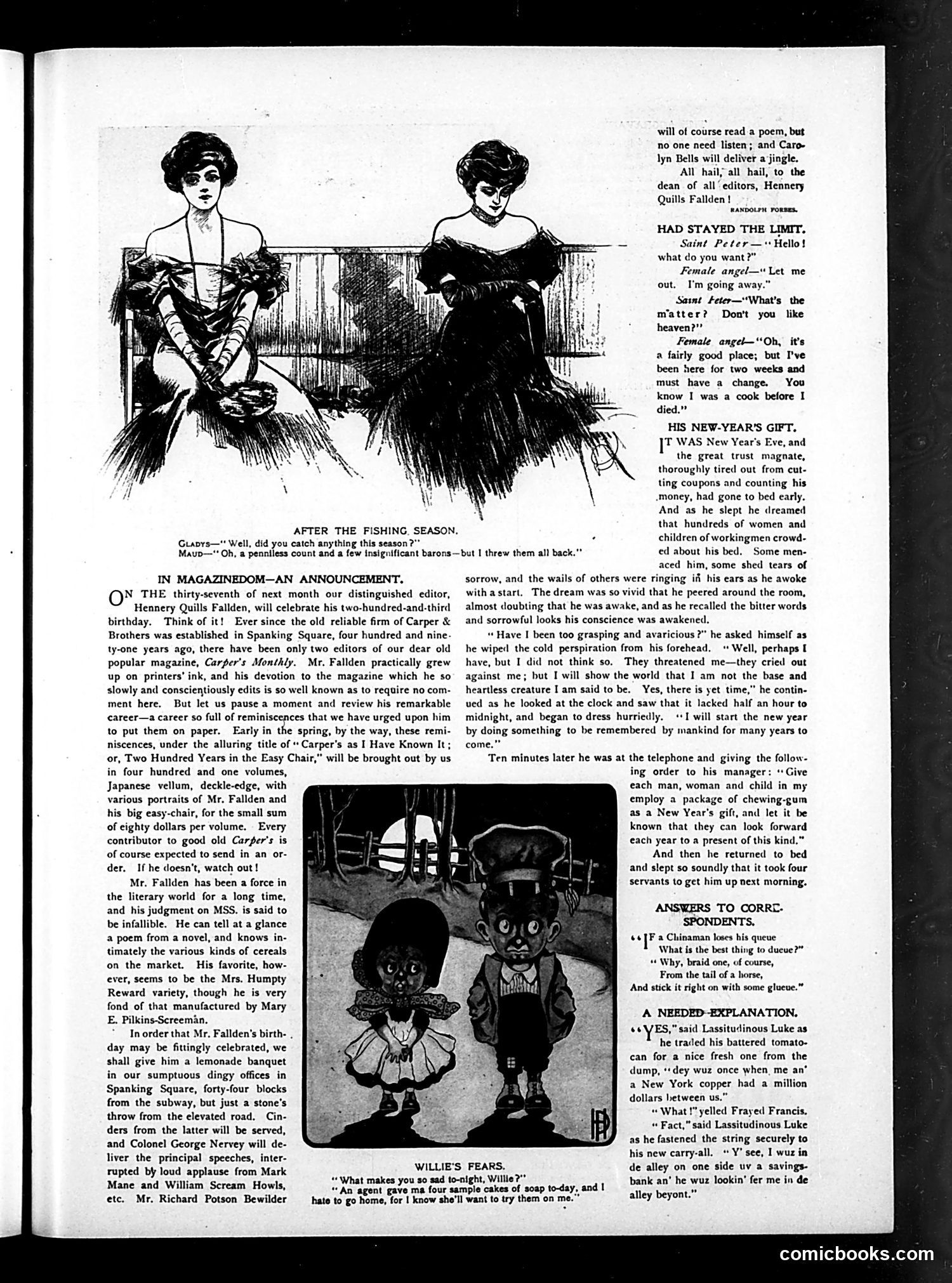
This page contains several distinct pieces rather than a unified cartoon: **"After the Fishing Season"** shows two women in conversation, likely satirizing social gossip or domestic life. **"In Magazinedom—An Announcement"** is primarily text celebrating Henery Quills Fallden's birthday and his editorial career at *Carper's* magazine. It humorously catalogs his knowledge (cereals, horse tails, etc.) and announces an upcoming special issue. **"Willie's Fears"** features an illustration of distressed children, with dialogue about a crying child and cakes. **"His New-Year's Gift"** describes a wealthy man's philanthropic gesture—giving employees chewing gum packages as New Year's gifts—mocking perhaps both ostentatious charity and meager corporate generosity. The page primarily contains light satirical commentary on magazine culture, domestic life, and social pretension rather than pointed political criticism.
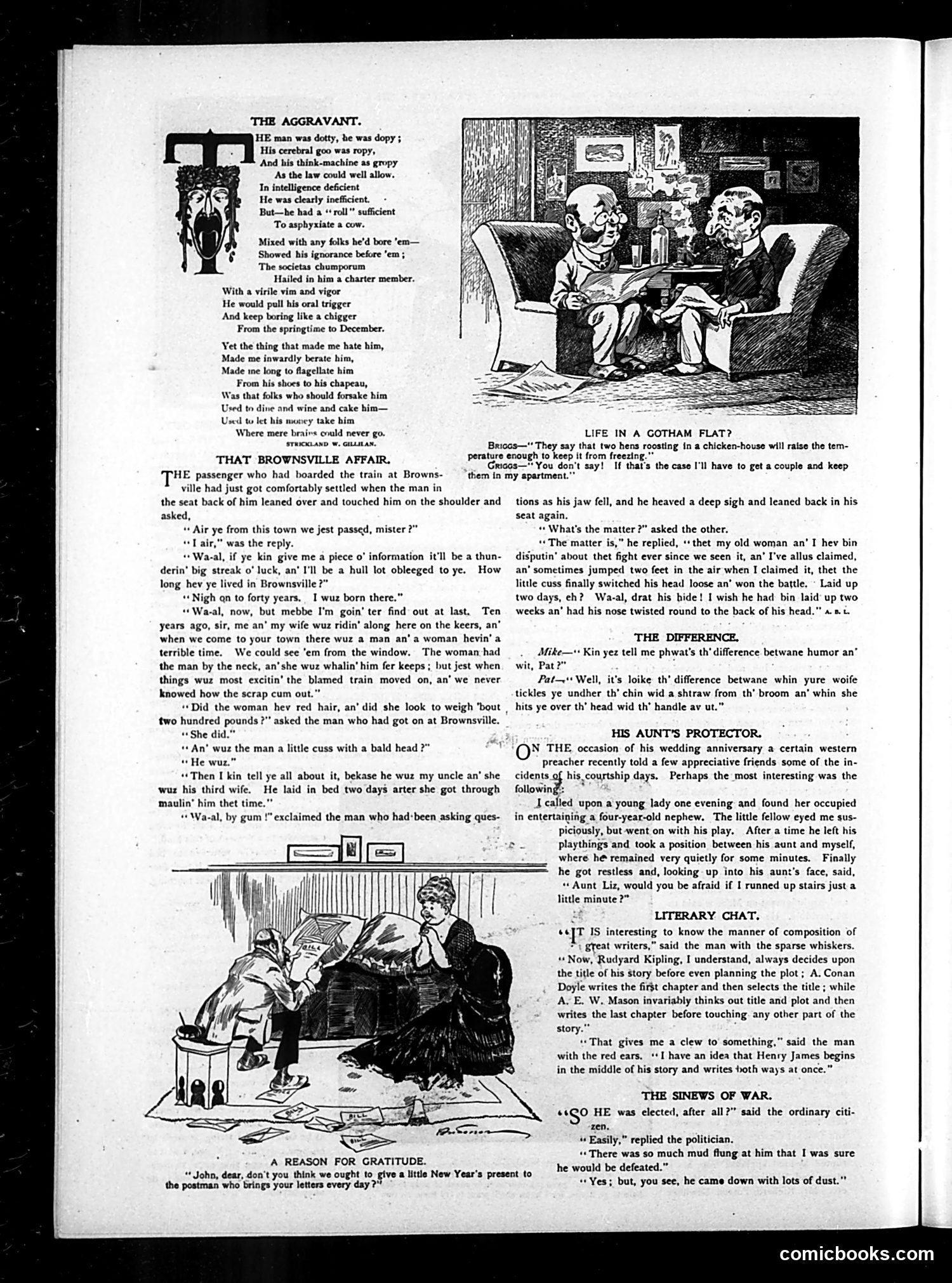
This page from Judge contains several satirical pieces targeting common social types and situations of the era. **"The Aggravant"** is a poem mocking wealthy but intellectually vapid men whose money compensates for their stupidity. The satire criticizes society for tolerating and entertaining such bores simply because they're rich—"mere brains could never go" where money takes them. **"That Brownsville Affair"** is a humorous dialect story about a train passenger seeking resolution to a long-standing dispute about whether a man or woman "won" a domestic fight he witnessed years earlier. The joke trades on rural vernacular and anticlimactic revelation. **"Life in a Gotham Flat"** is a brief joke about urban apartment living, using pseudoscientific logic (hens generating heat) for comedic effect. **"The Difference"** contrasts humor and pain through Irish dialect humor, using physical comedy imagery. **"His Aunt's Protector"** begins an anecdote about courtship (text cuts off). The page reflects Judge's typical mix of social satire, vernacular humor, and domestic comedy popular in early 20th-century American magazines.
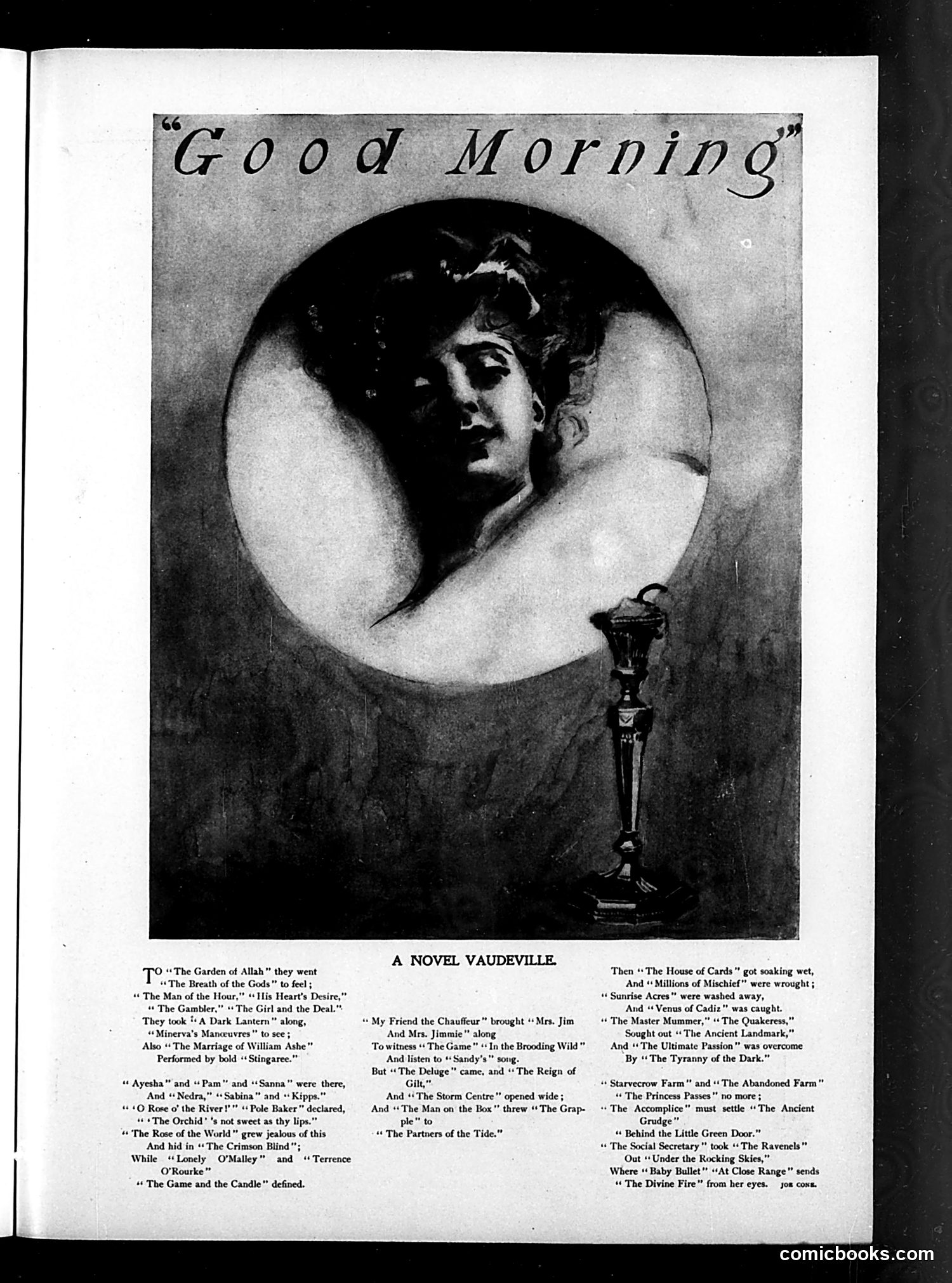
This page satirizes the proliferation of popular theatrical productions and novels of the era (titles appear to be from early 1900s plays and books). The central image—a woman's face emerging from a glowing circle above a candlestick—likely represents theatrical artifice or the mesmerizing but insubstantial nature of popular entertainment. The text is a mock-poetic catalog that strings together dozens of real play and novel titles in absurd, nonsensical combinations. The satire mocks audiences who mindlessly consume entertainment regardless of quality or coherence, treating disparate works as interchangeable spectacles. By presenting these titles as a "vaudeville" where plots collapse into each other ("The House of Cards got soaking wet"), Judge ridicules both the endless stream of forgettable productions and the public's undiscriminating appetite for them. It's social commentary on mass entertainment culture.
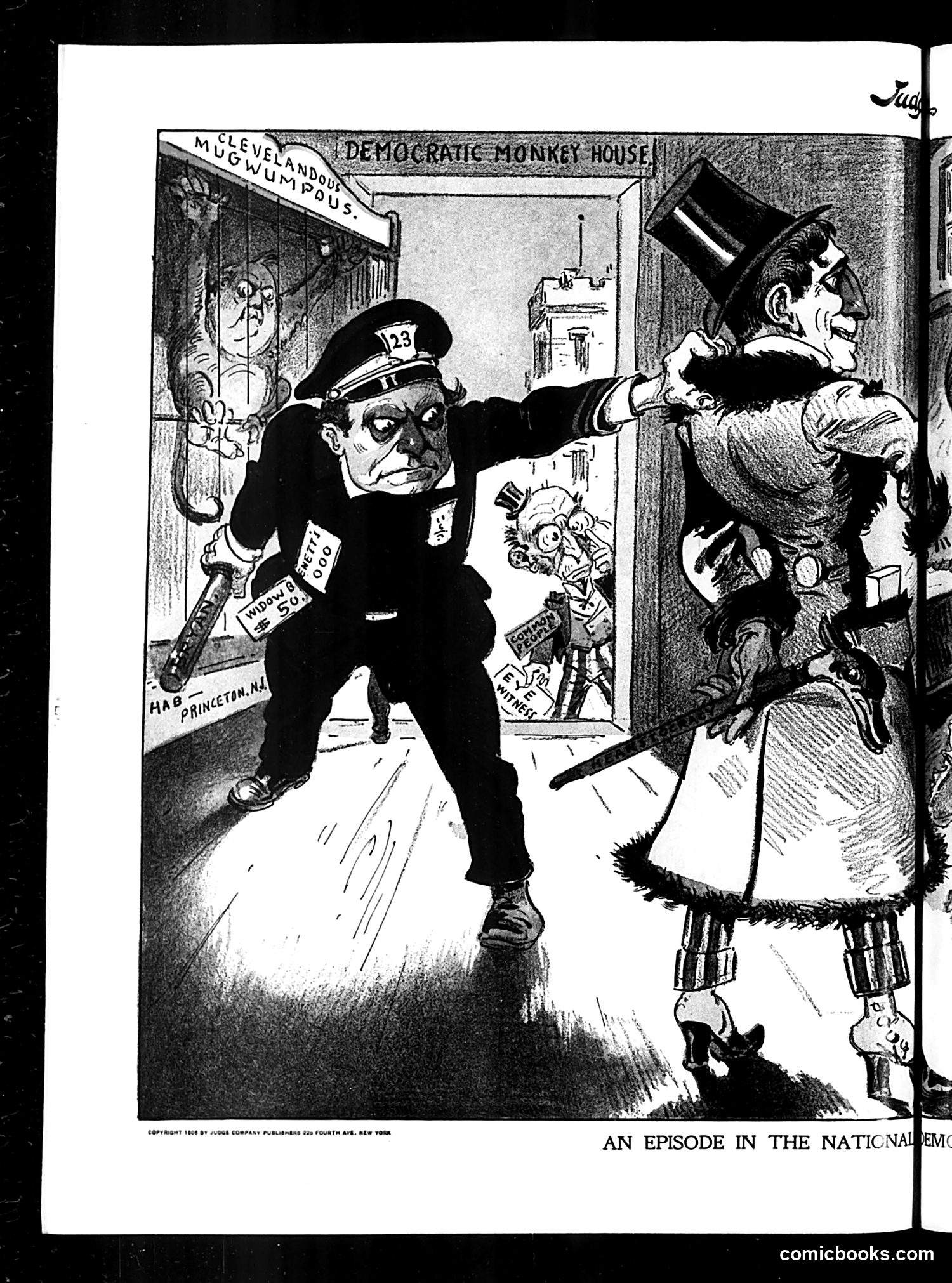
This political cartoon satirizes the Democratic Party as a chaotic "monkey house." The figure on the left—wearing a conductor's cap marked "123"—appears to be a Democratic political operative or leader attempting to control the scene with a baton. He's gesturing toward a well-dressed gentleman on the right (wearing a top hat), who seems to be either entering or leaving the Democratic establishment. The sign visible reads "Cleveland & Muwwudous," likely referencing President Grover Cleveland. The cartoon mocks Democratic Party management and internal disorder during this period (copyright 1898). The "monkey house" metaphor suggests the cartoonist viewed Democratic politics as chaotic and animalistic, a common partisan attack in Gilded Age satire.
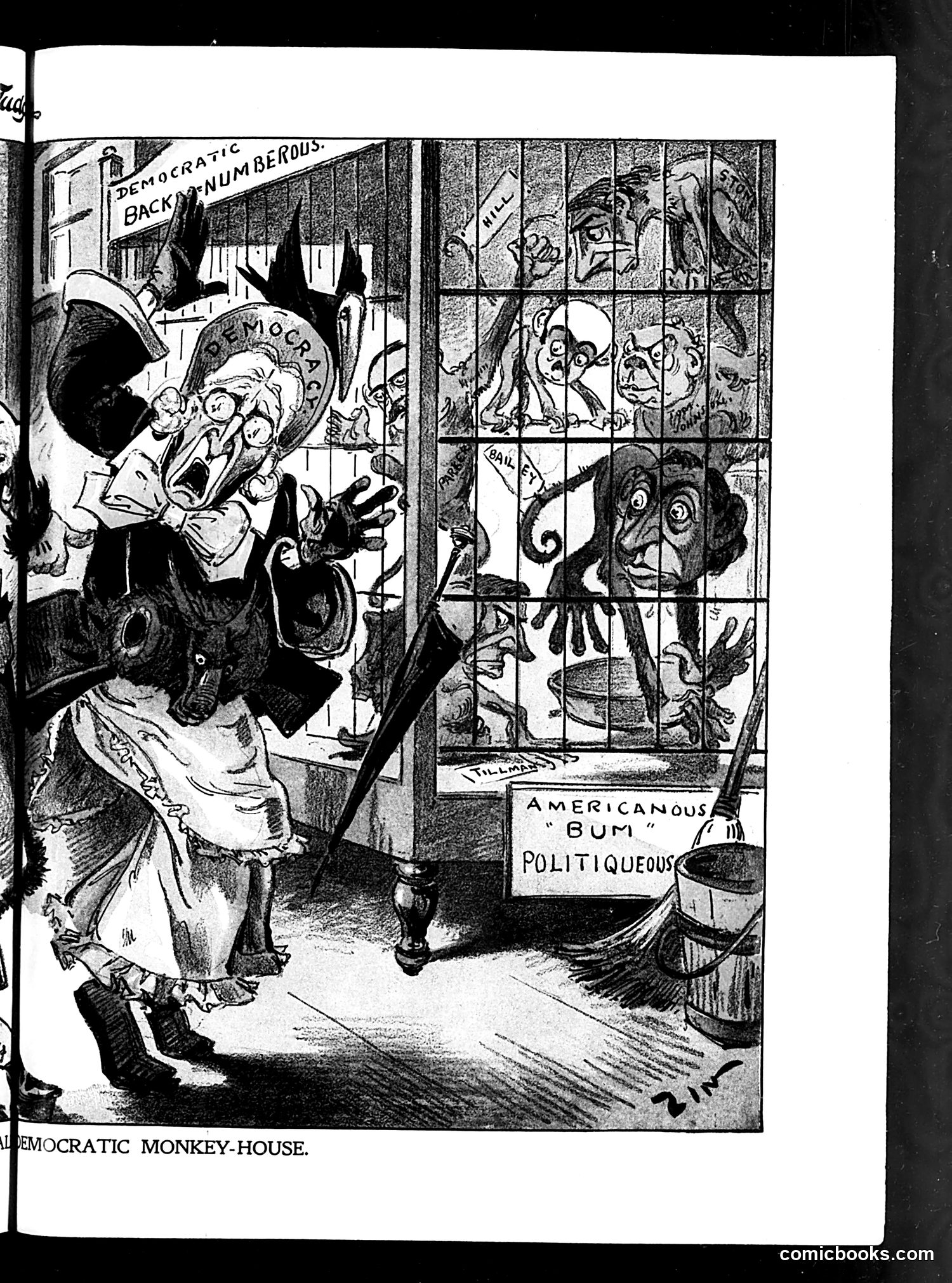
This is a satirical cartoon titled "Democratic Monkey-House," depicting the Democratic Party as a chaotic animal enclosure. On the left, a figure labeled "Democratic" (represented as a woman or personified entity) struggles to control the "Back Number Berous" creatures. On the right, caged monkeys behind bars are labeled with references to "Will" and "Ball," appearing to represent Democratic politicians or factions in disarray. The cartoon satirizes internal Democratic Party conflict and dysfunction, portraying party members as uncontrollable, primitive animals. The "Americanous Bum Politiqueous" label at bottom suggests mocking commentary on American democratic politics as chaotic and corrupt. This reflects Judge magazine's typical conservative stance, using animal imagery to demean political opponents—a common satirical technique of the era.
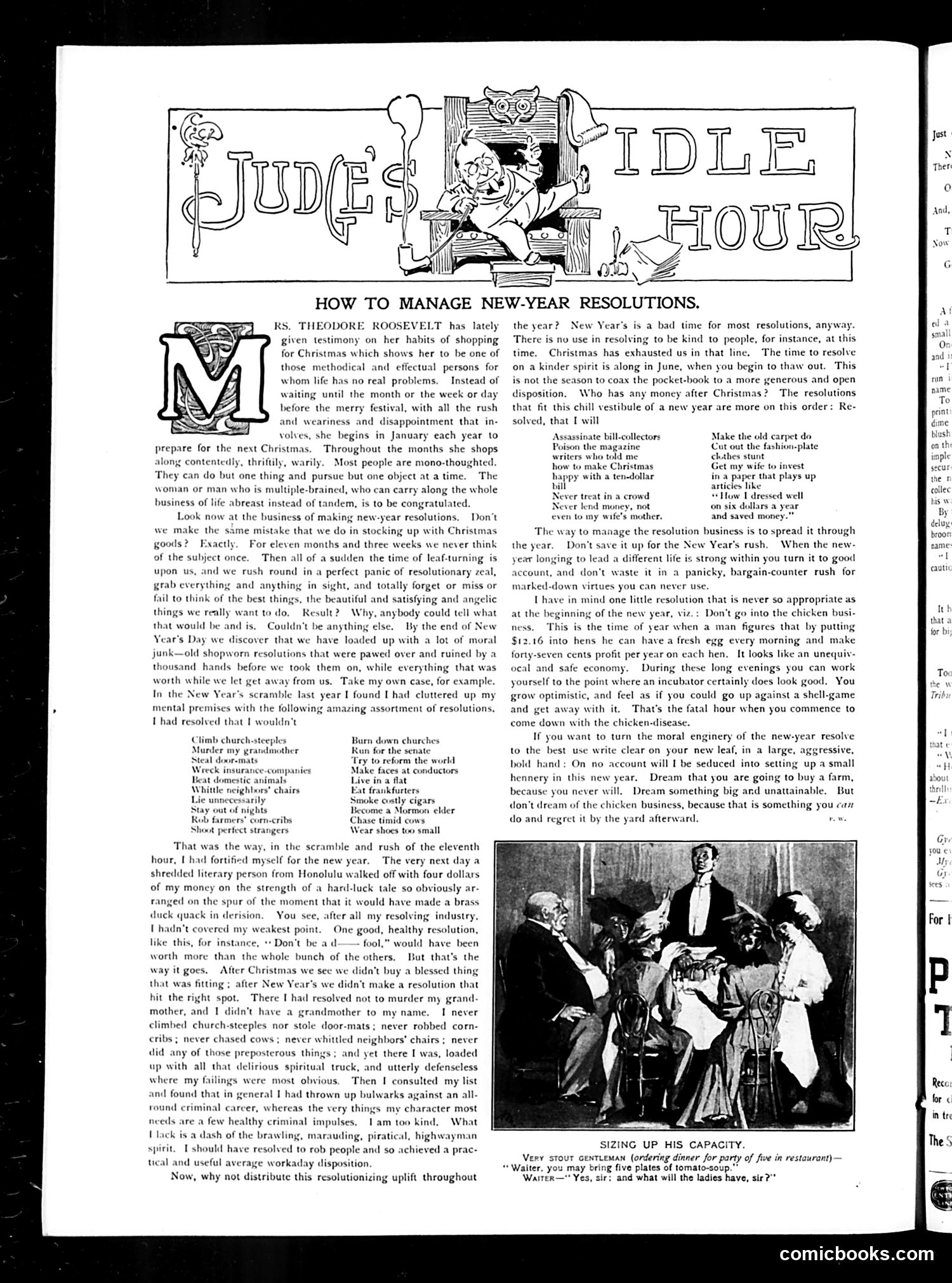
This page from *Judge* magazine satirizes the American habit of making ineffective New Year's resolutions. The article, attributed to Theodore Roosevelt (who was famous for his vigorous, action-oriented personality), uses his voice ironically to mock the rushed, thoughtless way people approach self-improvement. The satire's core argument: people postpone resolution-making until the last minute, then frantically grab whatever moral platitudes are handy—like "old shopworn resolutions"—rather than identifying what they actually need to change. The author's example list (murdering his grandmother, stealing doormats, wearing too-small shoes) is absurdist humor highlighting how ridiculous and impractical typical resolutions become. The real point: one genuine resolution ("Don't be a fool") beats dozens of meaningless ones. The accompanying cartoon (bottom) shows a stout gentleman calculating his capacity for dinner—a visual joke about self-indulgence conflicting with self-improvement. This mocks both the superficiality of New Year's culture and Americans' general inability to sustain meaningful personal change.
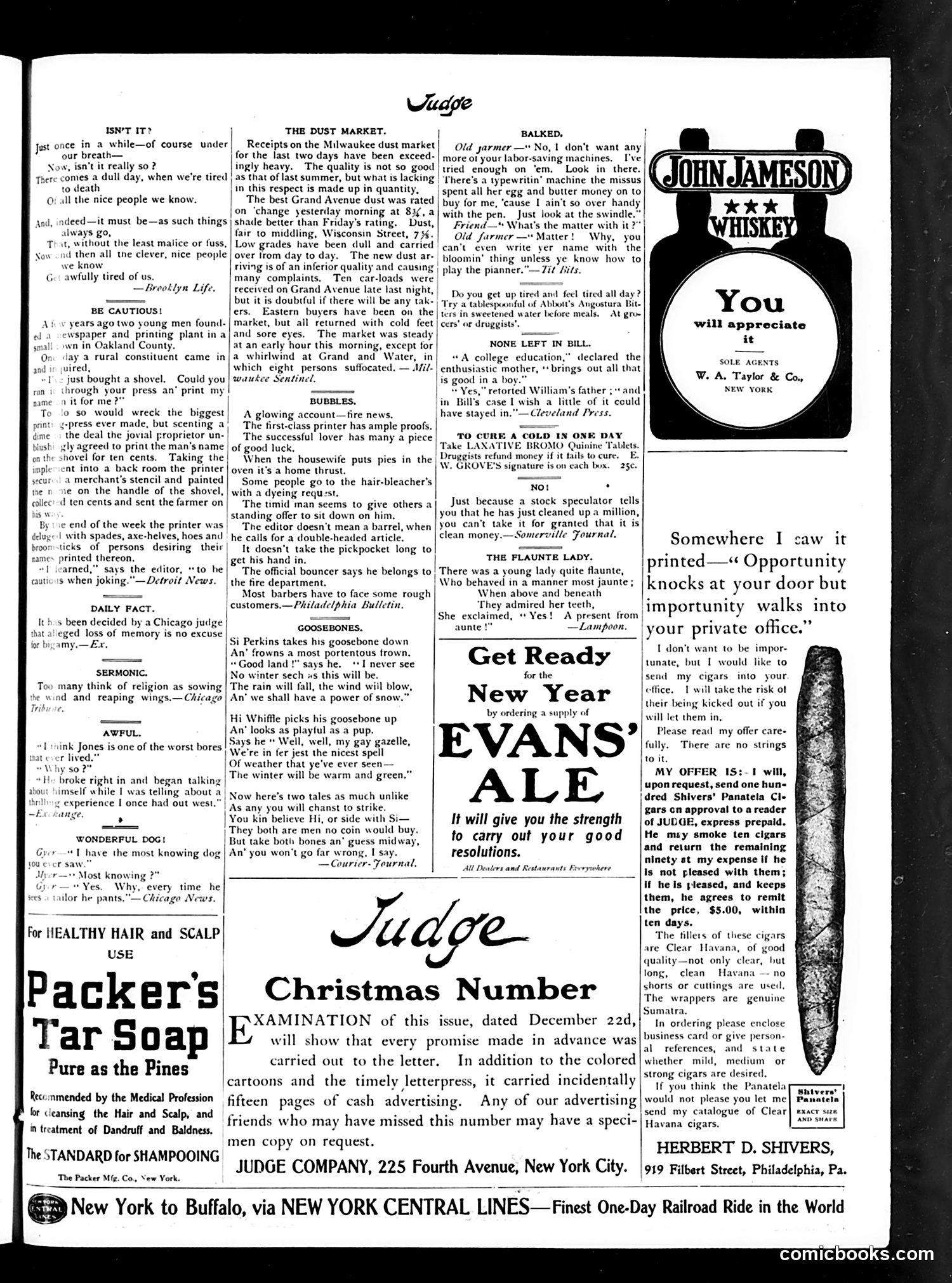
This is primarily a **satirical humor and advertising page** from Judge's Christmas issue (December 22nd). The content consists of short comic anecdotes and wordplay rather than traditional political cartoons. **Key satirical pieces:** - **"The Dust Market"** mocks financial reporting by treating worthless dust as a commodity with price fluctuations—satire on speculative markets and sensationalist journalism. - **"Bubbles"** offers cynical one-liners about human nature (e.g., "The successful lover has many a piece of good luck"). - **"Goosebones"** features two rural characters interpreting animal bones as weather predictors—satire on folk superstition and conflicting opinions presented as fact. - Various short jokes mock human pretension, journalistic excess, and social absurdity. **Advertising dominates the page**, including prominent ads for John Jameson Whiskey, Evans' Ale, Packer's Tar Soap, and cigars—typical of Judge's revenue model. The overall tone reflects turn-of-century American humor: cynical about institutions, mocking rural credulity, and relying on gentle social observation rather than pointed political commentary.
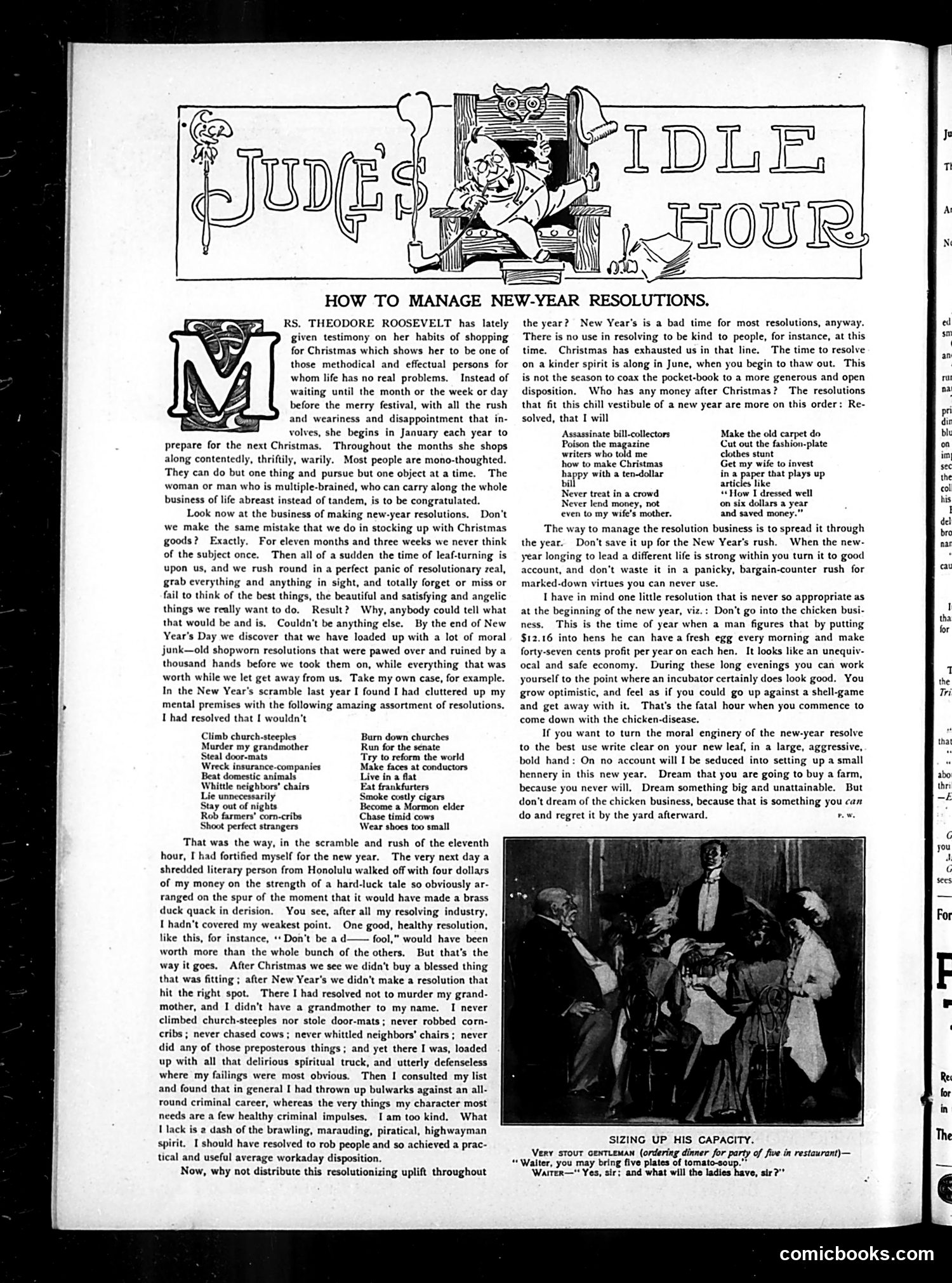
This satirical piece critiques the American habit of making hasty, ill-considered New Year's resolutions. The author uses Mrs. Theodore Roosevelt as a counterexample—she shops for Christmas methodically throughout the year rather than in a last-minute panic. The satire argues that people make the same mistake with resolutions: cramming them all in at year's end without thought. The author's own resolution list exemplifies this absurdity—he resolved not to commit crimes he'd never commit (murder his grandmother, steal doormats, chase cows) while ignoring his actual weakness: gullibility that led him to be swindled by a con artist from Honolulu. The joke is that elaborate moral resolutions prove worthless when they don't address real character flaws. The piece advocates distributing resolutions throughout the year and focusing on practical self-improvement rather than grand but meaningless pledges.
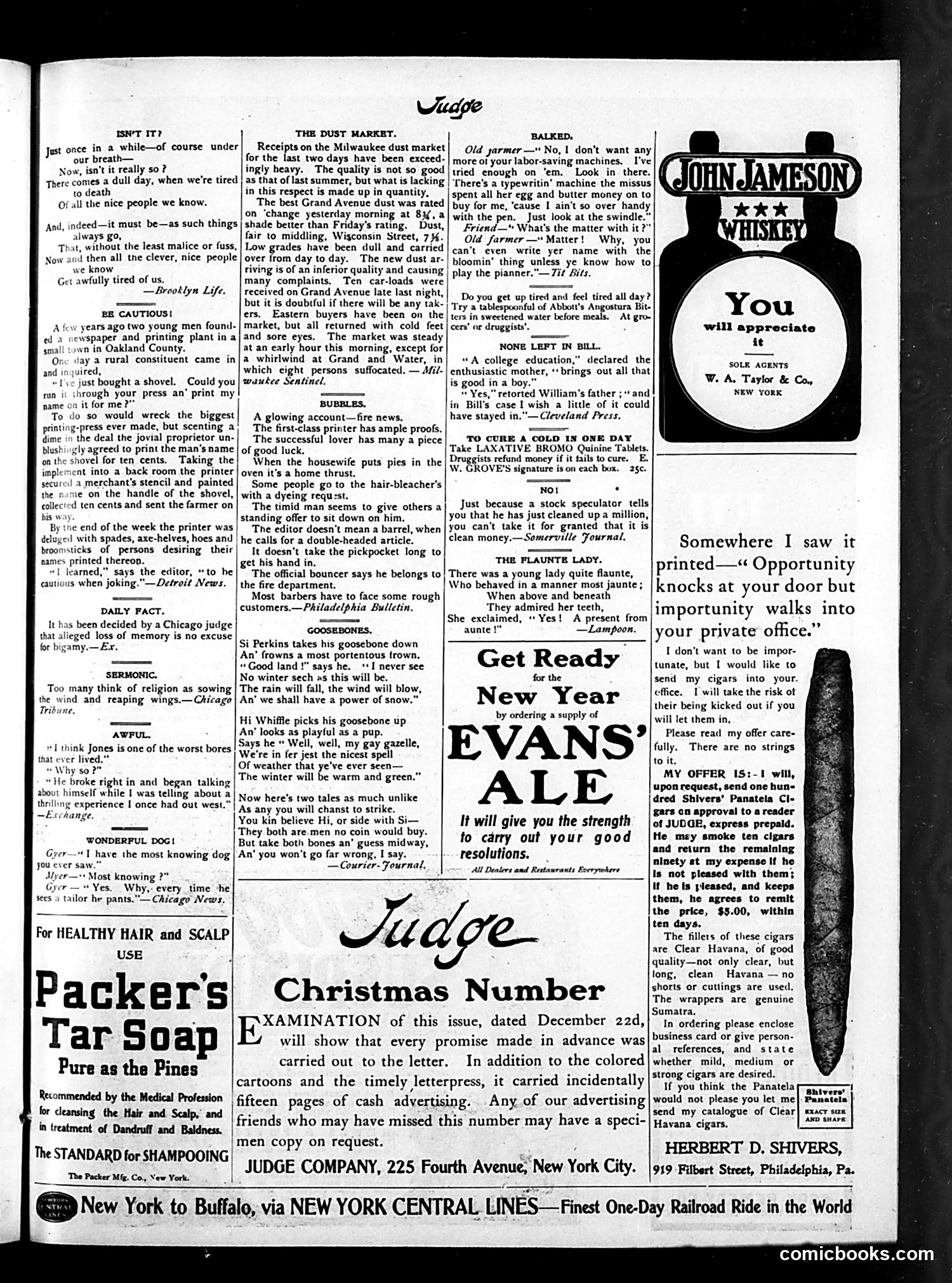
This page from Judge magazine (dated December 22nd, based on the footer) is primarily **advertising and humorous short jokes**, not political cartoons. The main content consists of: **Satirical humor pieces** mocking everyday situations: people getting tired of each other socially ("Isn't It?"), a printer being pestered after printing one customer's shovel, a judge ruling that claiming memory loss doesn't excuse bigamy, and puns about professions (tailors making dogs "pant"). **Notable advertising** includes John Jameson Whiskey, Packer's Tar Soap for hair/scalp treatment, and Evans Ale ("for the New Year"). **The "Dust Market" piece** appears to be satire mocking commodity market reporting—treating dust like a traded good with prices, quality grades, and market activity. It's wordplay humor rather than social commentary. **The magazine itself**: Judge was a weekly satirical publication featuring light humor, jokes, and advertising aimed at middle-class readers. This particular page lacks serious political cartoons, instead offering the magazine's trademark witty one-liners and domestic humor typical of early 20th-century American comedy.
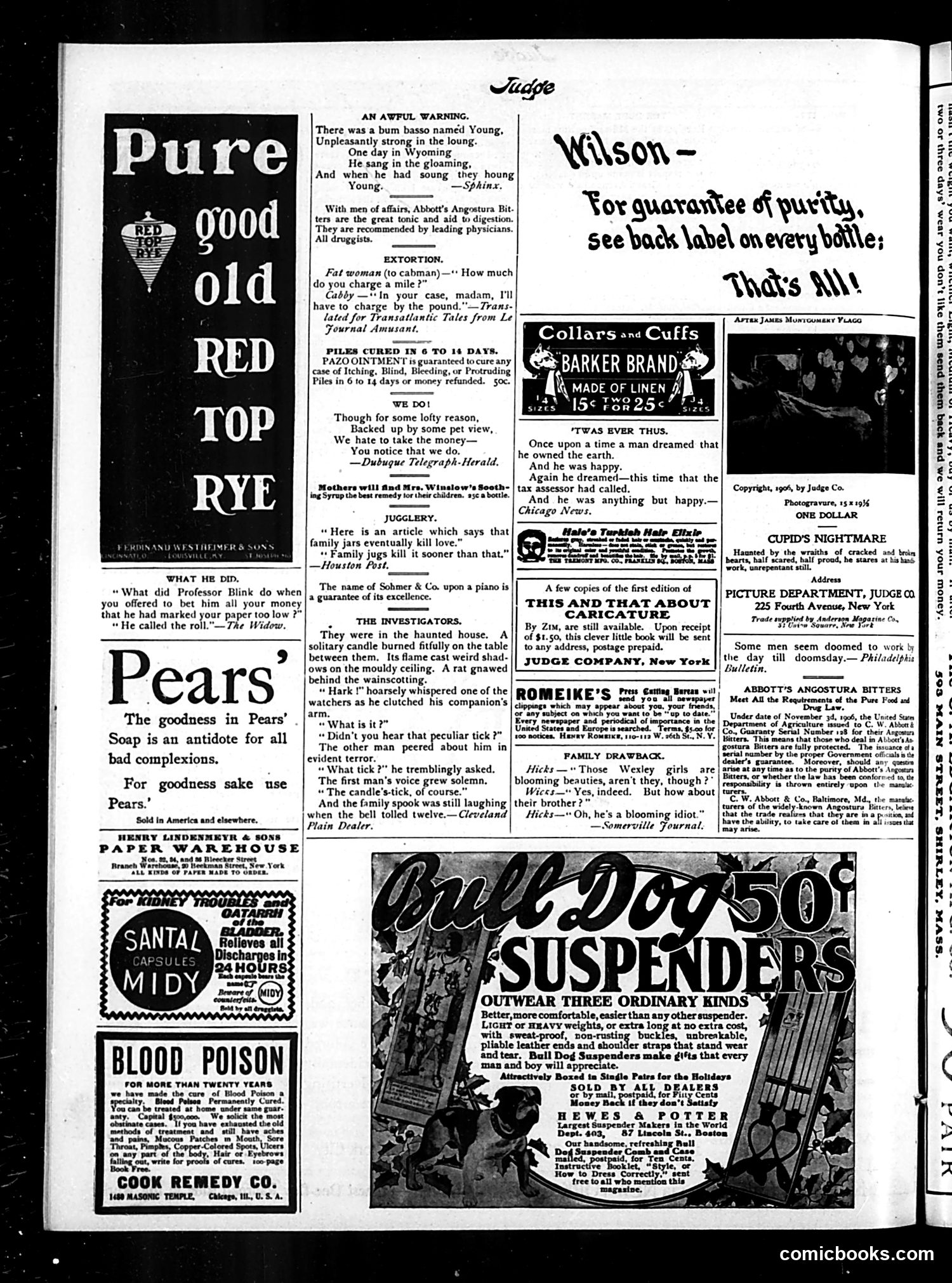
This page is primarily a collection of advertisements and satirical short jokes rather than a single cartoon. The content includes: **Satirical pieces:** - "What He Did": A brief joke mocking absentminded professors - "Extortion": A joke about a cabman overcharging a heavy woman by weight rather than distance - "The Investigators": A humorous ghost-story spoof where the "haunting" is just a ticking candle - "Family Drawback": A pun-based joke about the unattractive brother of pretty girls **Advertisements** dominate the page, promoting various products (Pears' Soap, medical remedies, paper, suspenders) typical of early 1900s publishing. The single illustration appears to be a character study labeled "Cupid's Nightmare," showing a remorseful figure haunted by broken relationships. Overall, this is a typical page from *Judge* magazine circa 1906—mixing light humor, wordplay, and commercial advertising with minimal political satire.
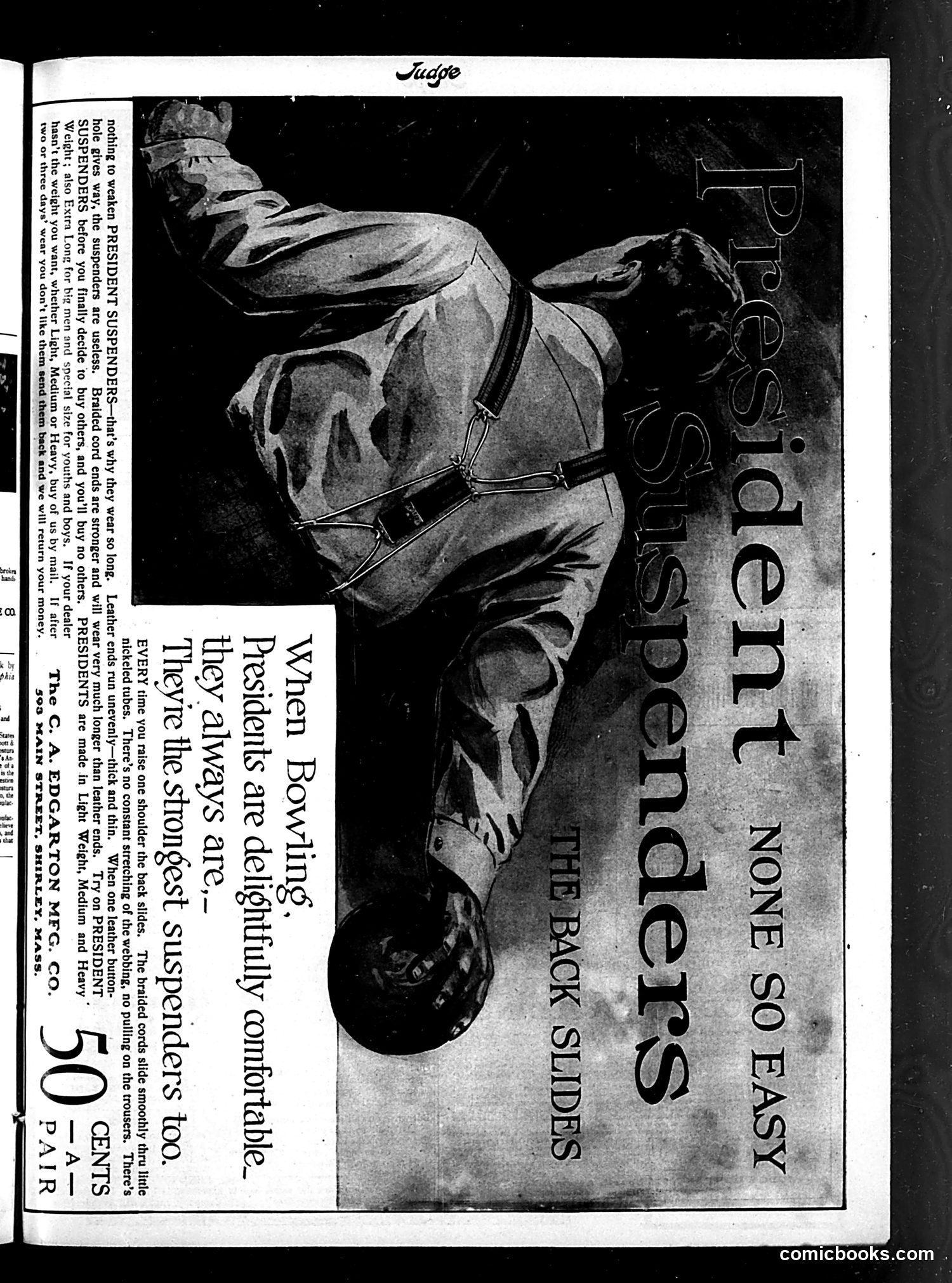
This is primarily an **advertisement for President Suspenders**, not a political cartoon or satire. The page uses the word "President" as a brand name for men's suspenders (shoulder straps). The ad features an illustration of a man bowling to demonstrate the product's comfort and durability during physical activity. The marketing pitch emphasizes that President Suspenders use "braided cord ends" rather than leather, which wear longer and don't stretch the webbing or pull on trousers. The joke or appeal is simply a play on the brand name—calling suspenders "President" suggests they're the superior choice, the "president" of suspenders. There's no political reference; it's purely commercial wordplay typical of early 20th-century advertising in *Judge* magazine. The ad includes a money-back guarantee and manufacturer information (C.A. Edgarton Mfg. Co., Shirley, Massachusetts), pricing it at 50 cents.
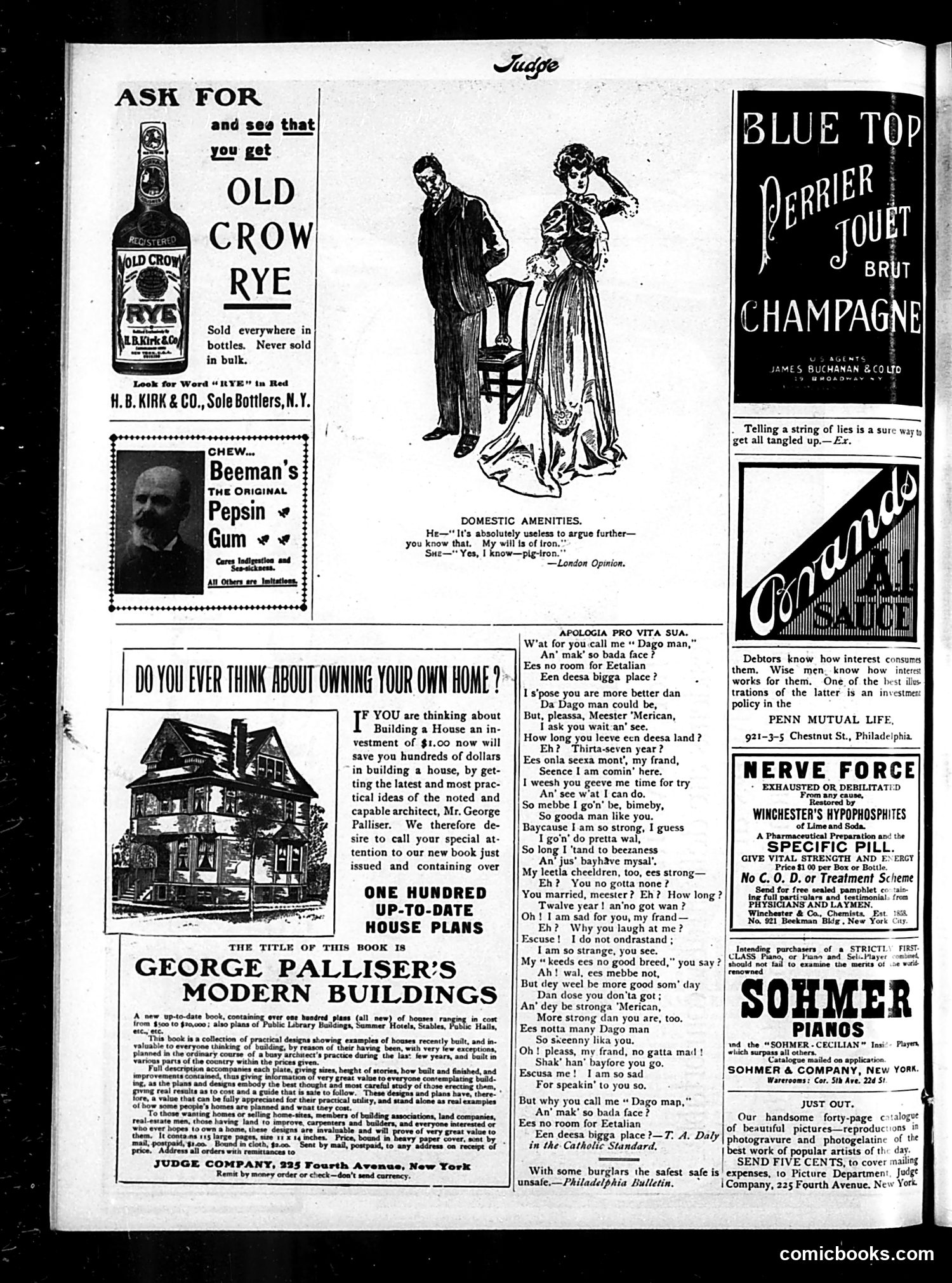
This page is primarily **advertisements and filler content** typical of Judge magazine's commercial sections, with one notable satirical poem. The main editorial content is **"Apologia Pro Vita Sua,"** a poem in exaggerated Italian-American dialect about an Italian immigrant defending himself against American prejudice. The speaker asks why he's called a "Dago" (a slur) and argues he deserves respect: he works hard, his children will be strong Americans, and he's been here only six months while native-born Americans like his questioner have produced nothing valuable. **The satire's point:** Judge uses the immigrant's own words to expose American hypocrisy and xenophobia. The Italian man's humble dignity—contrasted with the native American's apparent laziness and mockery—implicitly criticizes anti-immigrant attitudes. This appears sympathetic to Italian immigrants, unusual for the era's mainstream press. The rest of the page consists of period advertisements (whiskey, gum, champagne, real estate books, patent medicines) with no satirical content.
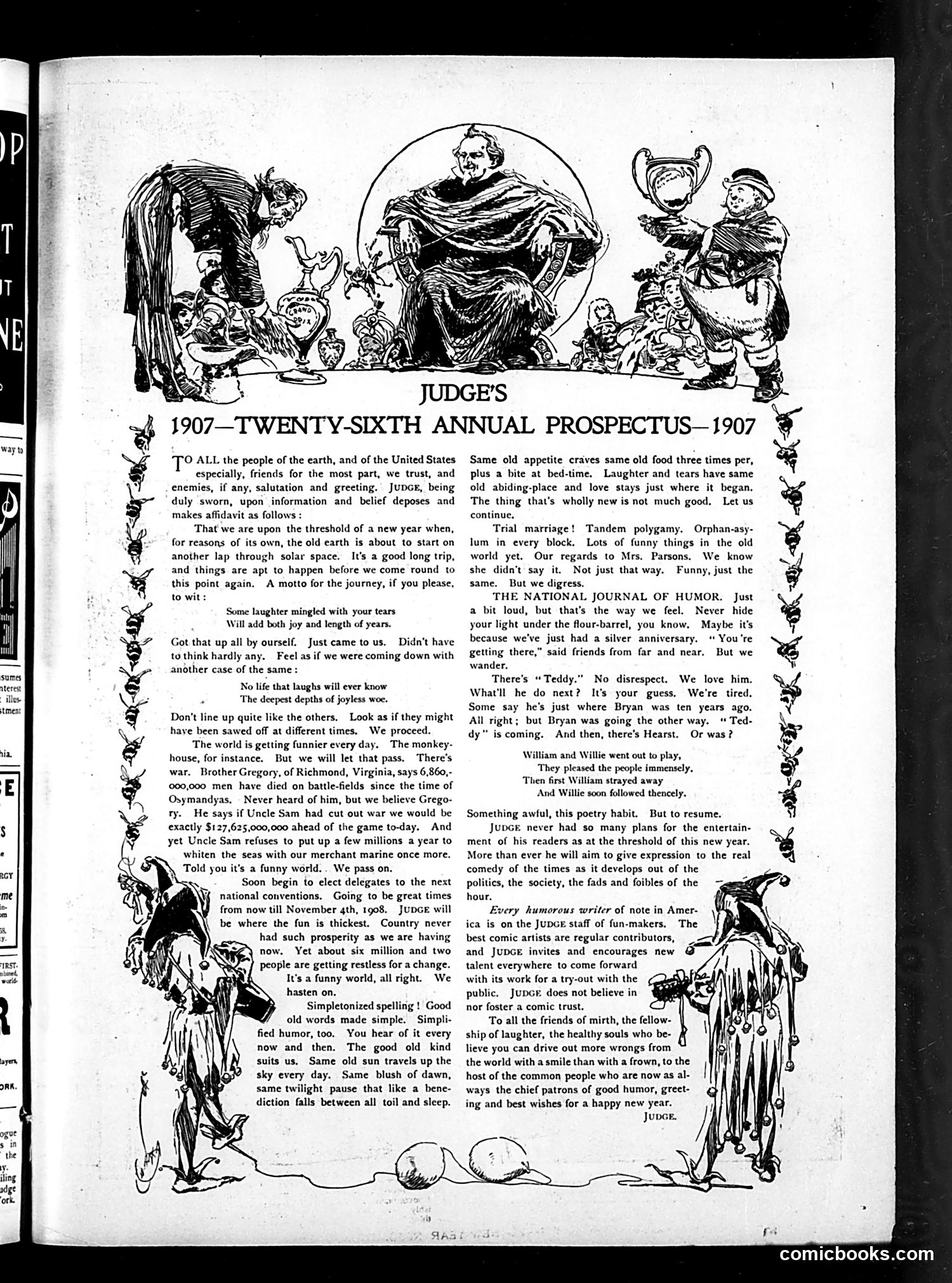
This is Judge's annual New Year's address to readers, not a political cartoon per se. The decorative illustrations frame editorial commentary on contemporary issues. The text references "Teddy" (Theodore Roosevelt) and compares him to William Jennings Bryan, suggesting Roosevelt—like Bryan before him—represents change or disruption. There's wordplay about "William and Willie" (possibly Roosevelt variants) and Hearst, indicating political and journalistic rivalries of the era. The editorial mocks "trial marriage," "simplified spelling" reforms, and recent social movements while celebrating humor as antidote to social change. It notes six million people "restless for a change" despite prosperity—likely Progressive Era reformers and labor activists demanding political reform. Judge positions itself as chronicler of contemporary absurdity, promising satirical coverage of the 1908 election conventions. The overall tone: bemused observation that the world grows increasingly strange, but laughter endures.
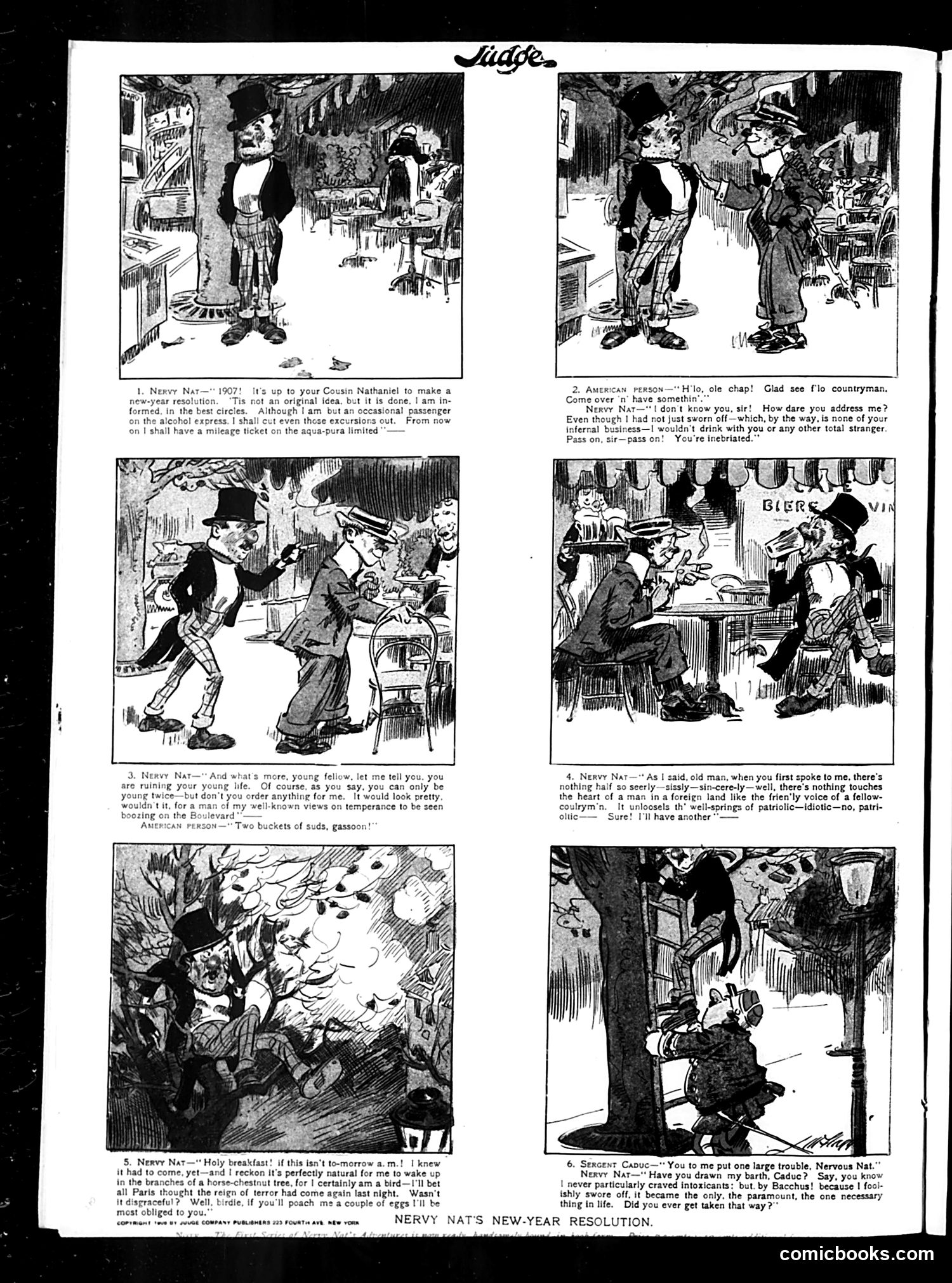
This six-panel comic satirizes the hypocrisy of New Year's pledges, specifically abstinence from alcohol. "Nervy Nat," an American abroad in Paris, makes a solemn vow to quit drinking. However, each subsequent panel shows his rapid backsliding: He rebuffs a friendly countryman's invitation to drink, claiming moral superiority. Yet when the man calls him "inebriated," Nat's resolve immediately crumbles. By panel four, he's accepting "another" drink while romanticizing alcohol as a patriotic comfort. Panels five and six show complete dissolution—he wakes in a tree, then desperately rationalizes why breaking his oath has made drinking irresistibly appealing. The satire targets the common American practice of making grand New Year's resolutions knowing they'll be abandoned. The joke lies in Nat's self-aware weakness: the very act of swearing off alcohol paradoxically intensifies his craving for it. His flimsy excuses and rationalization demonstrate how people subvert their own pledges.
I can see this is a page from Judge magazine, but the image is almost entirely black with only a white margin visible on the left edge and the comicbooks.com watermark at bottom right. The OCR text provides no substantive content beyond the website attribution. Without legible cartoon imagery or readable text, I cannot identify specific figures, political references, or the satirical intent of this page. The darkness makes it impossible to discern whether this is an advertisement, cartoon, article, or other content type. To provide an accurate historical analysis as requested, I would need a clearer or properly scanned version of this Judge magazine page.