
Judge, 1906-12-29 · page 6 of 19
Judge — December 29, 1906 — page 6: what you’re looking at
What you’re looking at
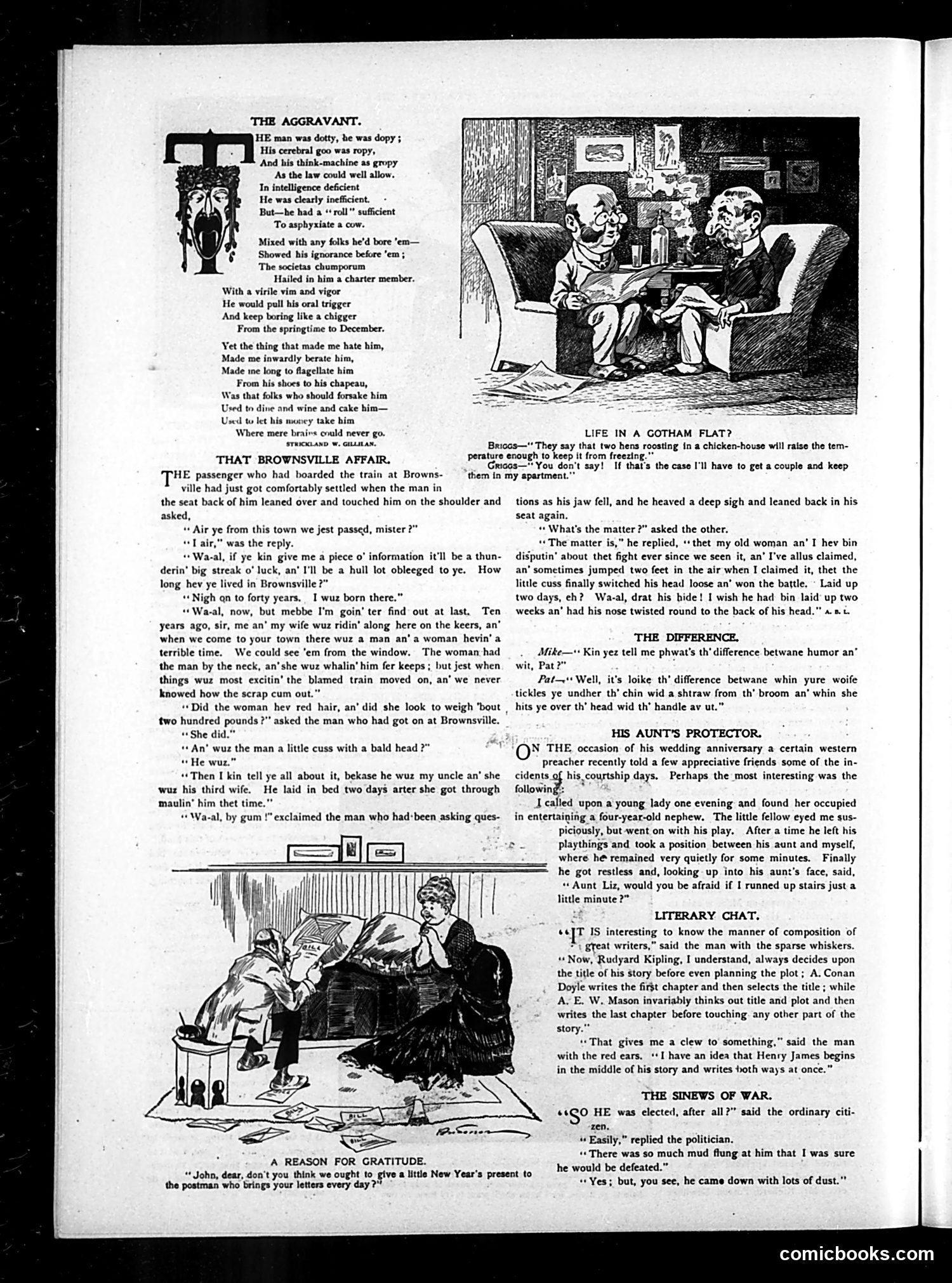
This page from Judge contains several satirical pieces targeting common social types and situations of the era. **"The Aggravant"** is a poem mocking wealthy but intellectually vapid men whose money compensates for their stupidity. The satire criticizes society for tolerating and entertaining such bores simply because they're rich—"mere brains could never go" where money takes them. **"That Brownsville Affair"** is a humorous dialect story about a train passenger seeking resolution to a long-standing dispute about whether a man or woman "won" a domestic fight he witnessed years earlier. The joke trades on rural vernacular and anticlimactic revelation. **"Life in a Gotham Flat"** is a brief joke about urban apartment living, using pseudoscientific logic (hens generating heat) for comedic effect. **"The Difference"** contrasts humor and pain through Irish dialect humor, using physical comedy imagery. **"His Aunt's Protector"** begins an anecdote about courtship (text cuts off). The page reflects Judge's typical mix of social satire, vernacular humor, and domestic comedy popular in early 20th-century American magazines.
📄 Transcribed text from this page (OCR, searchable)
Machine-transcribed from the original scan — historical spelling and the odd misread are preserved.
‘THE AGGRAVANT. HE man was dotty, he was dopy ; His cerebral goo was ropy, And his think-machine as gropy As the law could well allow. In intelligence deficient He was clearly inefficient. But—he had a “roll” sufficient To asphyxiate a cow. Mixed with any folks he'd bore ’em— Showed his ignorance before ‘em ; ‘The societas chumporum Hailed in him a charter member. With a virile vim and vigor He would pull his oral trigger And keep boring like a chigger From the springtime to December. Yet the thing that made me hate him, Made me inwardly berate him, Made ine long to flagellate him From his shoes to his chapeau, Was that folks who should forsake him Used to dine and wine and cake him— Used tu let his money take him Where mere brains could never go. STRICKLAND W. GILLILAN, THAT BROWNSVILLE AFFAIR. THE passenger who had boarded the train at Browns- ville had just got comfortably settled when the man in the seat back of him leaned over and touched him on the shoulder and asked, “+ Air ye from this town we jest passed, mister ?” “+L air,” was the reply. “+ Wa-al, if ye kin give me a piece o' information it'll be a thun- derin’ big streak o' luck, an’ I'll be a hull lot obleeged to ye. How long hev ye lived in Brownsville ?” +“Nigh qn to forty years. I wuz born there.” Ten years ago, sir, me an’ my wife wuz ridin’ along here on the keers, an’ when we come to your town there wuz a man an’ a woman hevin'a terrible time. We could see ‘em from the window. The woman had the man by the neck, an’ she wuz whalin’ him fer keeps ; but jest when things wuz most excitin’ the blamed train moved on, an’ we never knowed how the scrap cum out.” **Wa-al, now, but mebbe I'm goin’ ter find out at last. **Did the woman hev red hair, an’ did she look to weigh ‘bout | two hundred pounds ?"" asked the man who had got on at Brownsville. «She di “+ An’ wuz the man a little cuss with a bald head ?” “He wuz.” «Then I kin tell ye all about it, bekase he wuz my uncle an’ she wuz his third wife. He laid in bed two days arter she got through maulin’ him thet time.” “«Wacal, by gum !" exclaimed the man who had-been asking ques- LIFE IN A GOTHAM FLAT? Brioos—"' They say that two hens roosting in a chicken-house will raise the tem- perature enough to keep it from freezing.” Gricos—" You don't say! them in my apartment.” If that's the case I'll have to get a couple and keep tions as his jaw fell, and he heaved a deep sigh and leaned back in his seat again, “What's the matter ?” asked the other. «« The matter is,” he replied, «thet my old woman an’ I hev bin disputin’ about thet fight ever since we seen it, an’ I've allus claimed, an’ sometimes jumped two feet in the air when I claimed it, thet the little cuss finally switched his head loose an’ won the battle. - Laid up two days, eh? Waz-al, drat his hide! I wish he had bin laid up two weeks an’ had his nose twisted round to the back of his head." «=. ‘THE DIFFERENCE. Mike—* Kin yez tell me phwat's th’ difference betwane humor an’ Pat?" : Pat Well, it's loike th’ difference betwane whin yure woife tickles ye undher th’ chin wid a shtraw from th’ broom an’ whin she hits ye over th’ head wid th’ handle av ut.” HIS AUNT’S PROTECTOR. : ON THE occasion of his wedding anniversary a certain western preacher recently told a few appreciative friends some of the in- ‘alana his.courtship days. Perhaps the most interesting was the following: —* I called upon a young lady one evening and found her occupied in entertaining a four-year-old nephew. The little fellow eyed me sus- piciously, but went on with his play, After a time he left his playthings and took a position between his aunt and myself, where hé remained very quietly for some minutes. Finally A REASON FOR GRATITUDE. “ John, dear, don’t you think we ought to give a little New Year's present to 7 the postman who brings your letters every day ?" he got restless and, looking up into his aunt’s face, said, “Aunt Liz, would you be afraid if I runned up stairs just a little minute 2” LITERARY. CHAT. 44] IS interesting to know the manner of composition of great writers,” said the man with the sparse whiskers. “Now, Rudyard Kipling, I understand, always decides upon the title of his story before even planning the plot; A. Conan Doyle writes the first chapter and then selects the title ; while A. E. W. Mason invariably thinks out title and plot and then writes the last chapter before touching. any other part of the story.” ‘That gives me a clew to something,” said the man with the red ears, ‘I have an idea that Henry James begins in the middle of his story and writes both ways at once.” THE SINEWS OF WAR. ay HE was elected, after all?” said the ordinary citi- zen. «+ Easily,” replied the politician. «There was so much mud flung at him that I was sure he would be defeated.” + Yes; but, you see, he came down with lots of dust.” comicbooks.com