
Judge, 1906-12-29 · page 12 of 19
Judge — December 29, 1906 — page 12: what you’re looking at
What you’re looking at
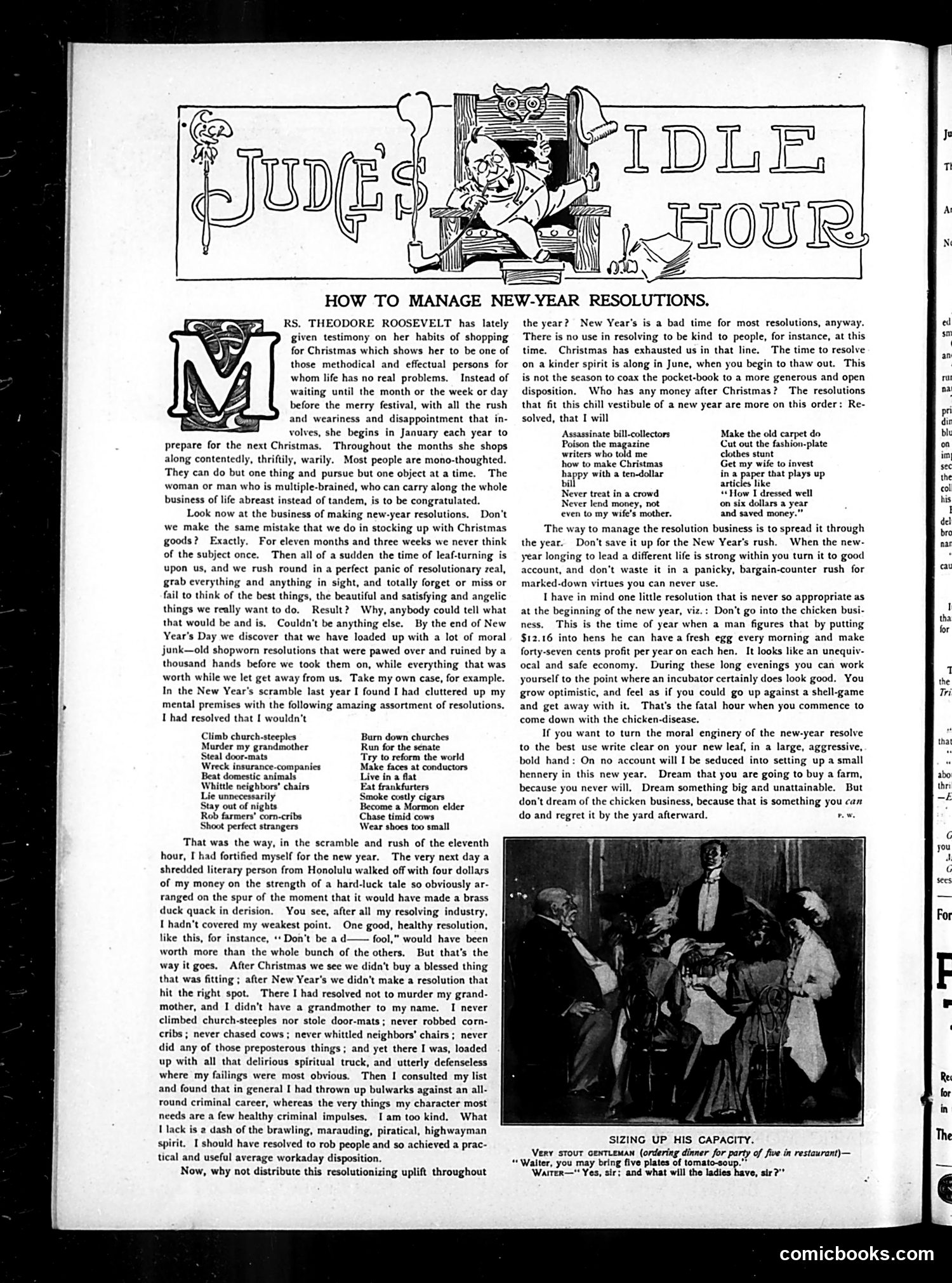
This satirical piece critiques the American habit of making hasty, ill-considered New Year's resolutions. The author uses Mrs. Theodore Roosevelt as a counterexample—she shops for Christmas methodically throughout the year rather than in a last-minute panic. The satire argues that people make the same mistake with resolutions: cramming them all in at year's end without thought. The author's own resolution list exemplifies this absurdity—he resolved not to commit crimes he'd never commit (murder his grandmother, steal doormats, chase cows) while ignoring his actual weakness: gullibility that led him to be swindled by a con artist from Honolulu. The joke is that elaborate moral resolutions prove worthless when they don't address real character flaws. The piece advocates distributing resolutions throughout the year and focusing on practical self-improvement rather than grand but meaningless pledges.
📄 Transcribed text from this page (OCR, searchable)
Machine-transcribed from the original scan — historical spelling and the odd misread are preserved.
HOW TO MANAGE NEW-YEAR RESOLUTIONS. RS. THEODORE ROOSEVELT has lately given testimony on her habits of shopping for Christmas which shows her to be one of those methodical and effectual persons for whom life has no real problems. Instead of waiting until the month or the week or day before the merry festival, with all the rush and weariness and disappointment that in- volves, she begins in January each year to prepare for the next Christmas. Throughout the months she shops along contentedly, thriftily, warily. Most people are mono-thoughted. They can do but one thing and pursue but one object at atime. The woman or man who is multiple-brained, who can carry along the whole business of life abreast instead of tandem, is to be congratulated. Look now at the business of making new-year resolutions. Don't we make the same mistake that we do in stocking up with Christmas goods? Exactly. For eleven months and three weeks we never think of the subject once. Then all of a sudden the time of leaf-turning is upon us, and we rush round in a perfect panic of resolutionary zeal, grab everything and anything in sight, and totally forget or miss or fail to think of the best things, the beautiful and satisfying and angelic things we really want todo. Result? Why, anybody could tell what that would be and is, Couldn't be anything else. By the end of New Year's Day we discover that we have loaded up with a lot of moral junk—old shopworn resolutions that were pawed over and ruined by a thousand hands before we took them on, while everything that was worth while we let get away from us. Take my own case, for example. In the New Year's scramble last year I found I had cluttered up my mental premises with the following amazing assortment of resolutions. Thad resolved that I wouldn't Burn down churches Run for the senate ‘Try to reform the world Make faces at conductors Live in a flat Eat frankfurters Smoke costly cigars Become a Mormon elder Chase timid cows Wear shoes too small Climb church-steeples Murder my grandmother Steal door-mats Wreck insurance-companies Beat domestic animals Whittle neighbors’ chairs Lie unnecessarily Stay out of nights Rob farmers’ corn-cribs Shoot perfect strangers That was the way, in the scramble and rush of the eleventh hour, I had fortified myself for the new year. The very next day a shredded literary person from Honolulu walked off with four dollars of my money on the strength of a hard-luck tale so obviously ar- ranged on the spur of the moment that it would have made a brass duck quack in derision. You see, after all my resolving industry, I hadn't covered my weakest point. One good, healthy resolution, like this, for instance, +* Don’t be a d—— fool,” would have been worth more than the whole bunch of the others. But that’s the way it goes. After Christmas we see we didn’t buy a blessed thing that was fitting ; after New Year's we didn’t make a resolution that hit the right spot. There I had resolved not to murder my grand- mother, and I didn’t have a grandmother to my name. I never climbed church-steeples nor stole door-mats; never robbed corn- cribs ; never chased cows ; never whittled neighbors’ chairs ; never did any of those preposterous things ; and yet there I was, loaded up with all that delirious spiritual truck, and utterly defenseless where my failings were most obvious. Then I consulted my list and found that in general I had thrown up bulwarks against an all- round criminal career, whereas the very things my character most needs are a few healthy criminal impulses. Iam too kind. What I lack is @ dash of the brawling, marauding, piratical, highwayman spirit. I should have resolved to rob people and so achieved a prac- tical and useful average workaday disposition Now, why not distribute this resolutionizing uplift throughout the year? New Year's is a bad time for most resolutions, anyway. There is no use in resolving to be kind to people, for instance, at this time. Christmas has exhausted us in that line. The time to resolve on a kinder spirit is along in June, when you begin to thaw out. This is not the season to coax the pocket-book to a more generous and open disposition. Who has any money after Christmas? The resolutions that fit this chill vestibule of a new year are more on this order: Re- solved, that I will Assassinate bill-collectors Poison the magazine writers who told me how to make Christmas Get my wife to invest happy with a ten-dollar ina paper that plays up bill articles like Never treat in a crowd “How I dressed well Never lend money, not on six dollars a year even to my wife's mother. and saved money.” The way to manage the resolution business is to spread it through the year. Don't save it up for the New Year's rush. When the new- year longing to lead a different life is strong within you turn it to good account, and don't waste it in a panicky, bargain-counter rush for marked-down virtues you can never use. T have in mind one little resolution that is never so appropriate as at the beginning of the new year, viz.: Don't go into the chicken busi- ness. This is the time of year when a man figures that by putting $12.16 into hens he can have a fresh egg every morning and make forty-seven cents profit per year on each hen, It looks like an unequiv- ocal and safe economy. During these long evenings you can work yourself to the point where an incubator certainly does look good. You grow optimistic, and feel as if you could go up against a shell-game and get away with it. That's the fatal hour when you commence to come down with the chicken-disease. If you want to turn the moral enginery of the new-year resolve to the best use write clear on your new leaf, in a large, aggressive, bold hand: On no account will I be seduced into setting up a small hennery in this new year. Dream that you are going to buy a farm, because you never will. Dream something big and unattainable. But don't dream of the chicken business, because that is something you can do and regret it by the yard afterward. Make the old carpet do Cut out the fashion-plate clothes stunt SIZING UP HIS CAPACITY. Very stout centueman (ordering dinner for party of five in restaurant) — “Walter, you may bring five plates of tomato-soup.”” ‘Warren —"Yes, siet and what will the ladies have, sir?” comicbooks.com