
A complete issue · 16 pages · 1906
Judge — November 24, 1906
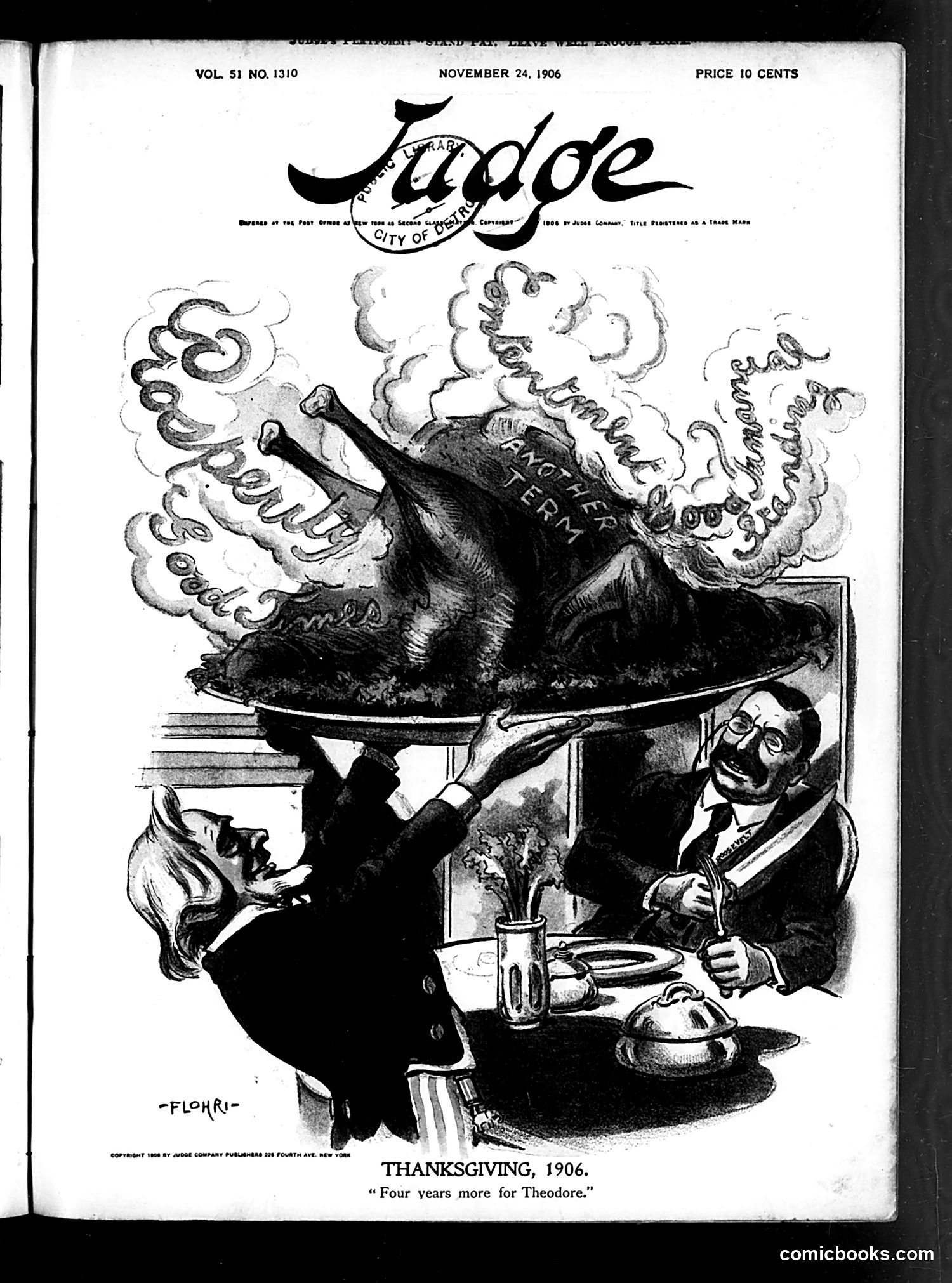
This is a political cartoon from *Judge* magazine dated November 24, 1906, satirizing President Theodore Roosevelt's recent election victory. The main image shows a large turkey being served at a dining table, labeled "KITCHEN FERRY" (likely referring to kitchen duties or service). Two well-dressed men sit at the table—one appears to be a political figure carving the bird while another watches approvingly. The caption "Four years more for Theodore" references Roosevelt's recent reelection, suggesting the cartoon celebrates or comments on his continued presidency. The turkey, a traditional Thanksgiving symbol, likely represents either the spoils of political victory or the American public being "served" another four years of Roosevelt's administration. The satirical tone typical of *Judge* suggests commentary on Roosevelt's political dominance.
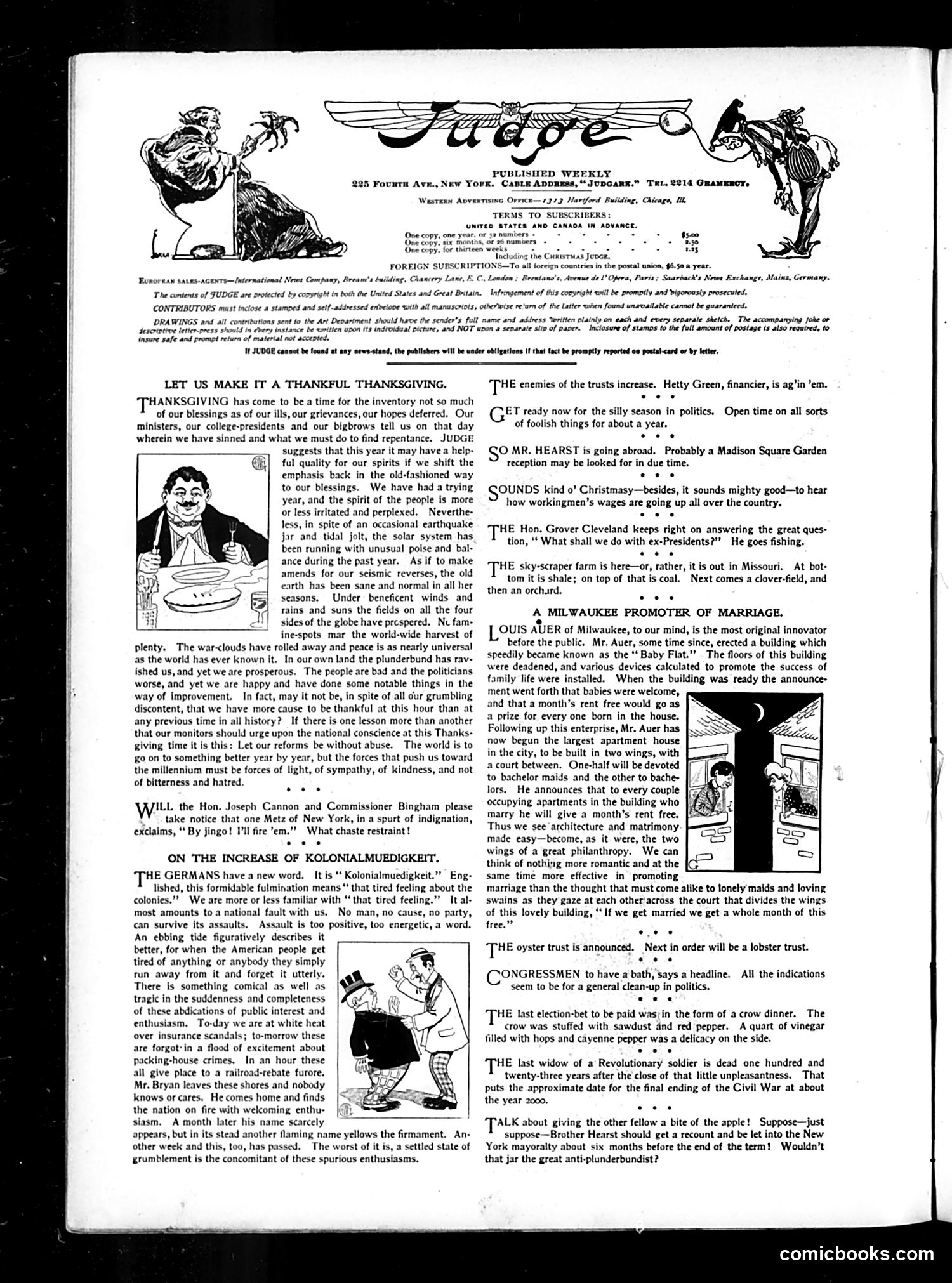
This page contains satirical commentary on contemporary political and social issues, though the specific date isn't clearly visible. **Left cartoon**: Depicts a portly, satisfied-looking man (labeled "Mr. Hearst") at a dining table, likely satirizing William Randolph Hearst, the newspaper magnate, possibly regarding his wealth or influence. **Main editorial content**: Articles reference: - Trust monopolies and financial manipulation ("Hetty Green, financier") - A Milwaukee apartment building innovation offering rent-free months to newlyweds—mocking commercialized marriage promotion - "Colonial smugness" (appears to reference American attitudes) - Politics and election scandals **Right illustration**: Shows figures in what appears to be a architectural or housing-related scene, accompanying the Milwaukee apartment building story. The overall tone satirizes wealthy industrialists, corporate exploitation, and American consumerism through humor and caricature typical of Judge's format.
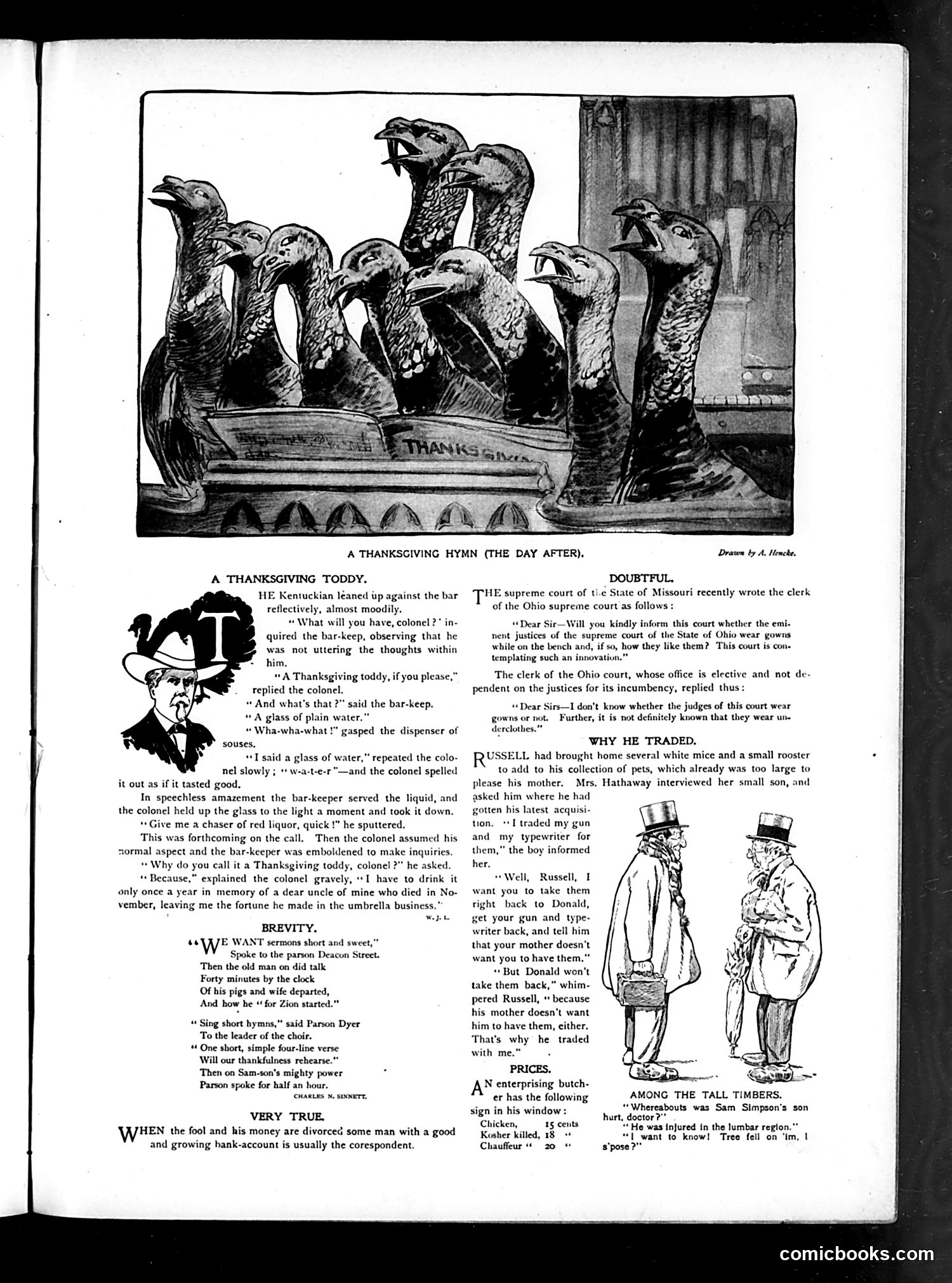
**Top Cartoon ("A Thanksgiving Hymn"):** Shows turkeys in a boat labeled "Thanks" - a dark visual pun where the intended Thanksgiving dinner celebrates its own fate. The satire mocks the irony of gratitude amid slaughter. **Text Sections:** The page contains several short satirical pieces: - "A Thanksgiving Toddy" jokes about a colonel's drinking preferences - "Doubtful" satirizes a Missouri court's formal inquiry about whether judges wear underclothes - mocking bureaucratic absurdity - "Why He Traded" presents a humorous domestic dispute over pet mice - "Brevity" and other brief quips offer social commentary **Overall Tone:** This appears to be a miscellaneous humor page mixing visual and written satire, typical of Judge's format. The cartoons target everyday American social situations—drinking, legal pomposity, domestic life—rather than specific political figures or events.
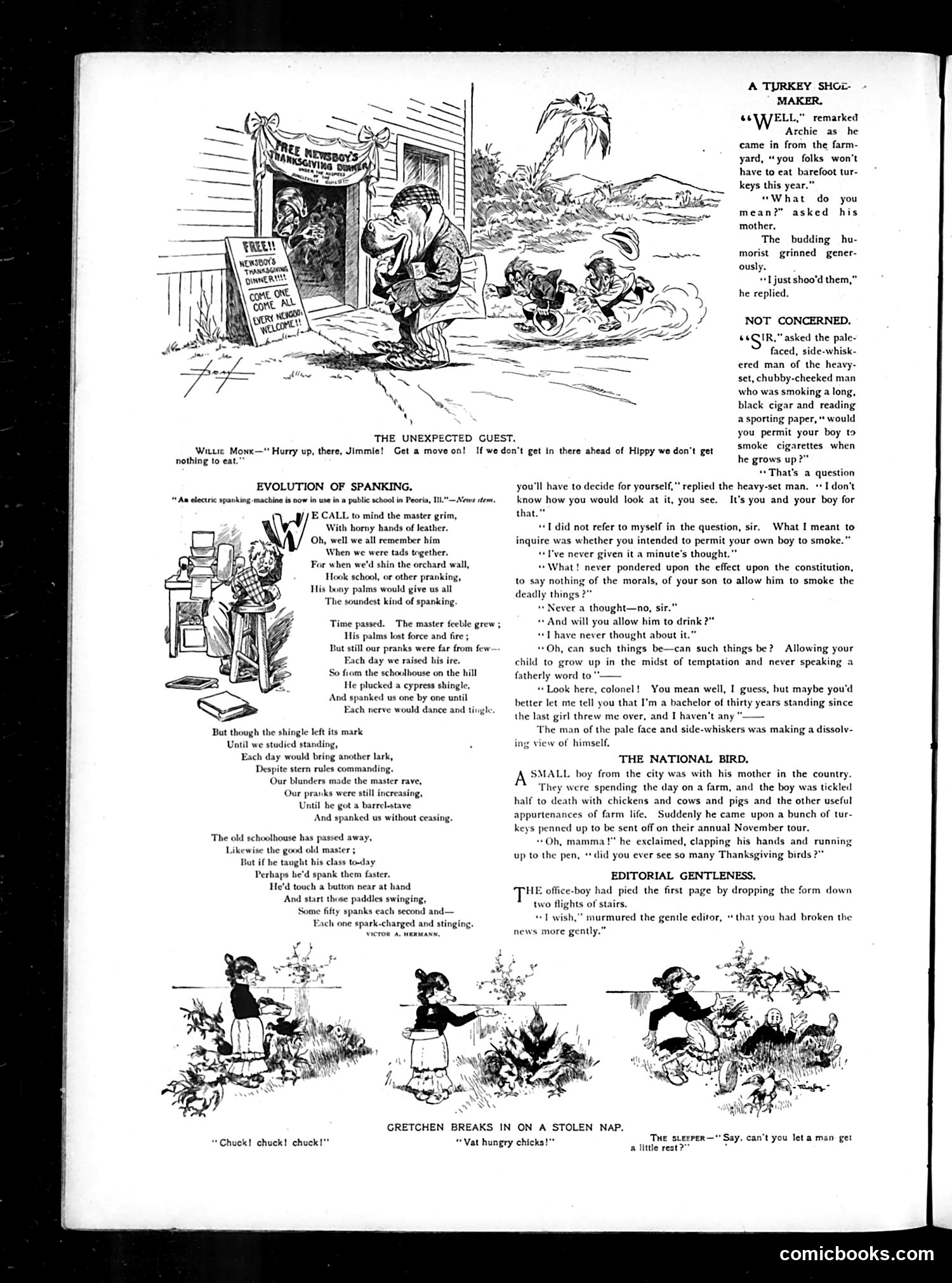
This page contains three separate pieces satirizing American social customs: 1. **"A Turkey Shoemaker"** (top): A rural scene mocking backwoods life, where a farmer boasts he'll make "barefoot turkeys" rather than address poverty directly—satirizing rural ignorance and evasion of real problems. 2. **"Evolution of Spanking"** (center): A poem tracing changing attitudes toward corporal punishment, suggesting spanking has become less common over time. The accompanying illustration shows a master considering whether to strike his child, reflecting contemporary debates about parenting methods and discipline. 3. **"The National Bird"** and **"Editorial Gentleness"** (bottom): Brief humorous vignettes about farm life and an office boy's clumsiness, mocking urban/rural cultural differences and workplace propriety. The page reflects late 19th/early 20th-century American anxieties about changing social norms, parenting, and rural versus urban values.
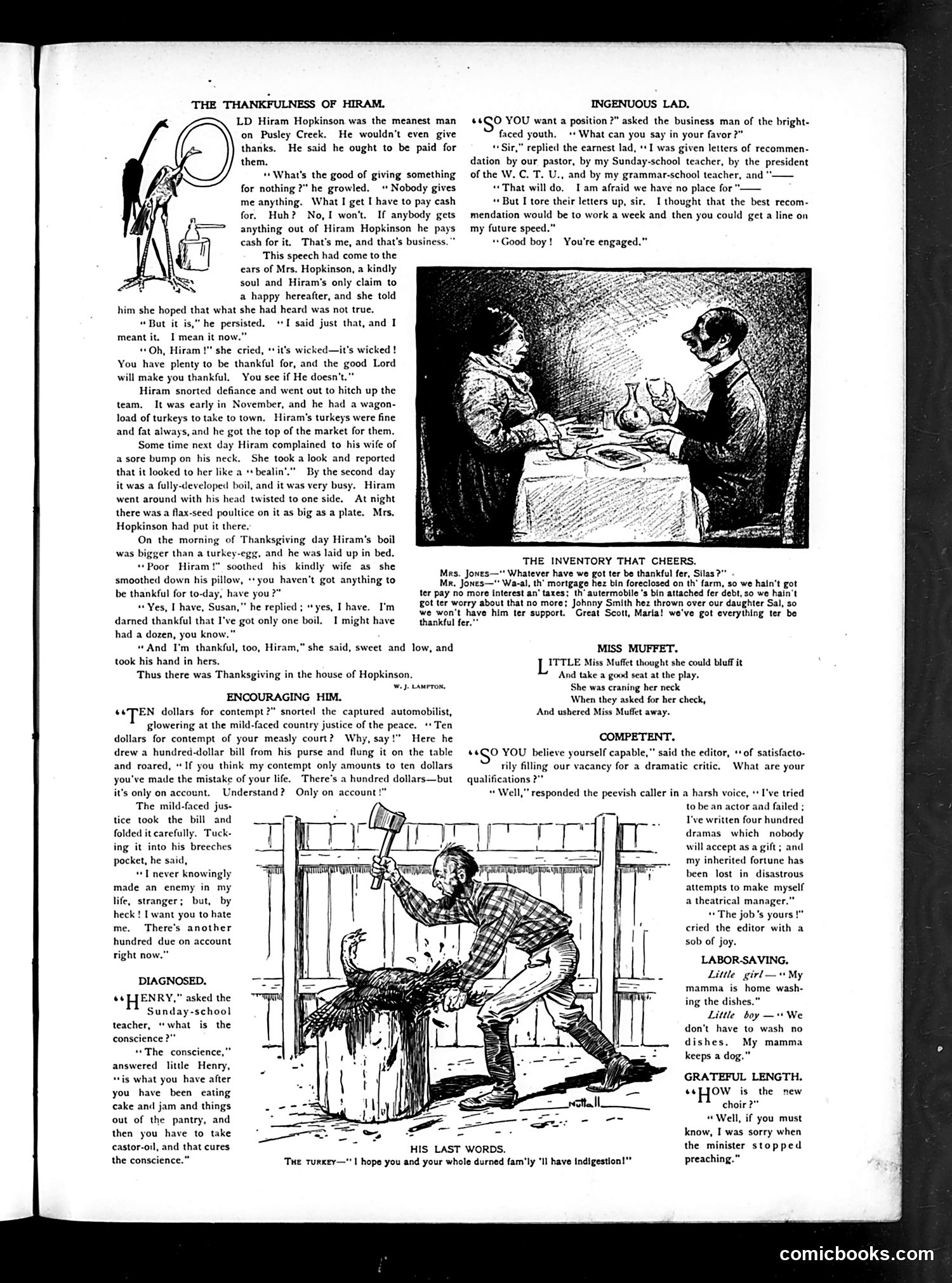
This page contains several short humorous pieces rather than political cartoons. The main content includes: **"The Thankfulness of Hiram"** - A story mocking a stingy farmer named Hiram Hopkinson who resents paying hired help and giving thanks, eventually boiling a turkey to hide it from his wife on Thanksgiving. **"Diagnosed"** - A joke about a Sunday-school teacher asking a boy about his conscience after he's been stealing from the pantry. **Additional short humor pieces** with titles like "Competent," "Miss Muffet," and "Labor-Saving" - brief comic quips about everyday situations. The illustrations support these domestic humor stories rather than serving as political satire. This appears to be general entertainment content typical of Judge magazine's lighter fare, focusing on character comedy and social observation rather than contemporary political commentary.
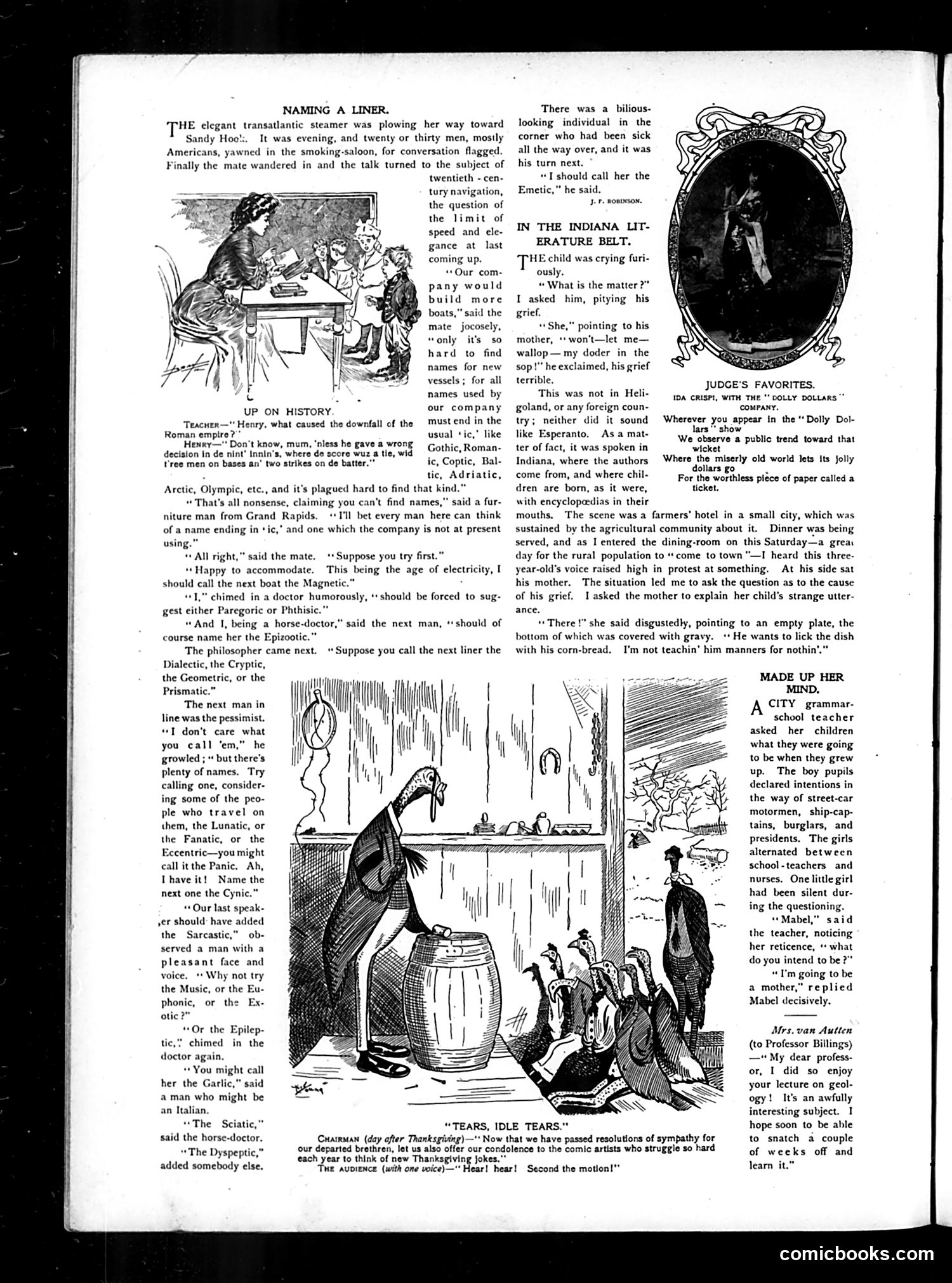
This page contains multiple satirical pieces typical of early 20th-century humor journalism: **"Naming a Liner"** mocks the shipping industry's naming conventions (ships ending in "-ic": Gothic, Romantic, Arctic, Olympic). Men aboard a transatlantic steamer suggest increasingly ridiculous names—Magnetic, Paregoric, Epizootic—reflecting their professions and personalities. A sick passenger suggests "Emetic," the joke being that his seasickness makes the name apt. The satire targets both maritime tradition and the creative bankruptcy of corporate naming. **"Up on History"** is a brief classroom joke where a boy confuses Roman history with baseball terminology—typical "foolish student" humor. **"Made Up Her Mind"** humorously reports schoolchildren's career ambitions, with girls choosing conventional roles (nurses, teachers) versus boys' adventurous choices. **"Tears, Idle Tears"** (bottom cartoon) satirizes cartoonists' annual struggle to produce Thanksgiving jokes—meta-commentary on the magazine's own creative demands. The overall tone reflects Judge's upper-middle-class readership's amusement at linguistic quirks, professional pretension, and American cultural contradictions.
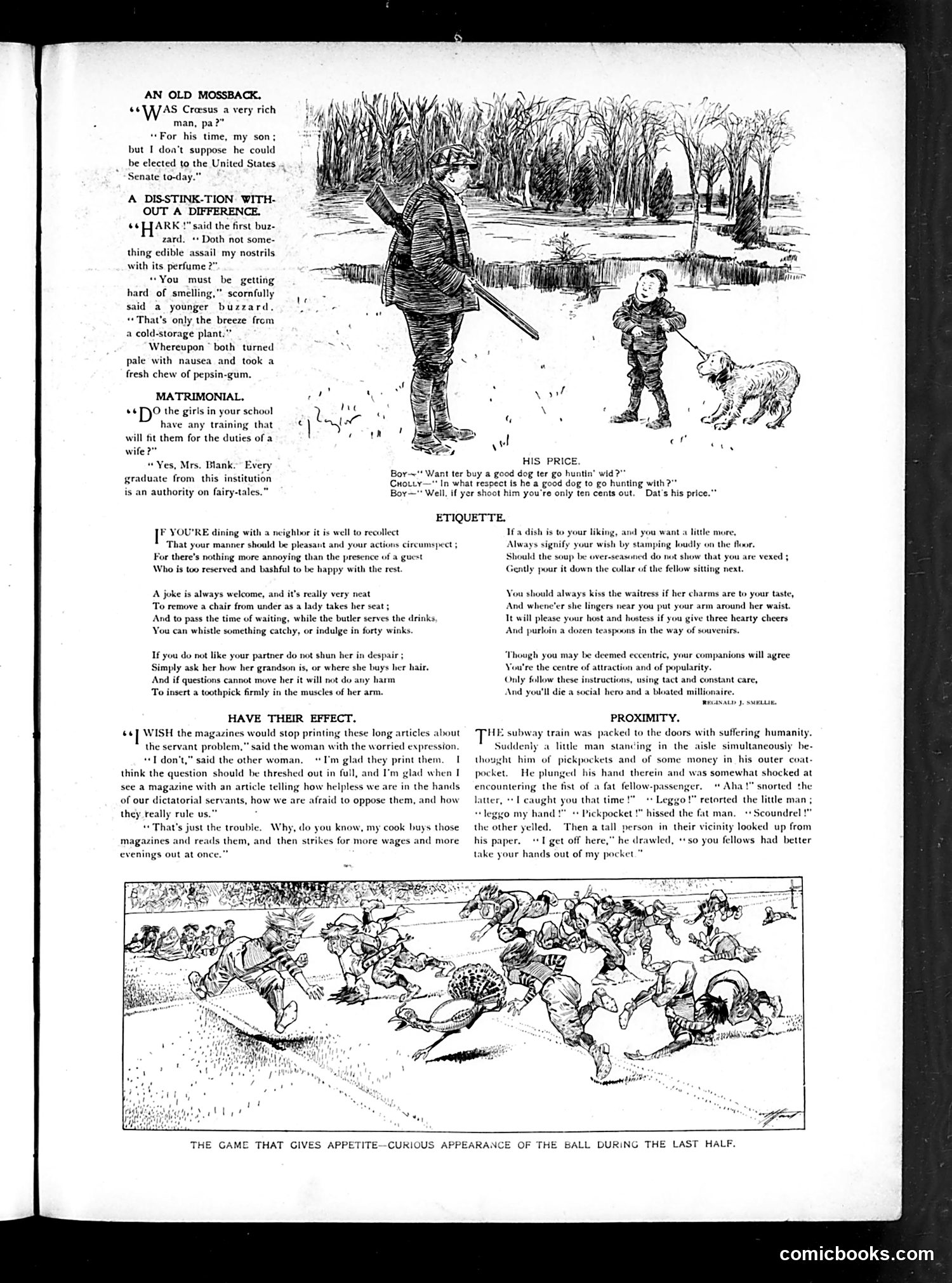
This page from *Judge* contains several satirical pieces mocking American social conventions and contemporary issues: **"An Old Mossback"** jokes that even Croesus couldn't be elected to the Senate today—suggesting Senate candidates must meet standards beyond mere wealth, likely critiquing either corrupt senators or unrealistic electoral expectations. **"A Distinction Without a Difference"** uses buzzards discussing foul odors from a "cold-storage plant" to satirize inability to distinguish between trivial differences—possibly mocking political or social debates over minor distinctions. **"Matrimonial"** suggests girls' education focused on "fairy-tales" rather than practical wife-training, mocking both women's limited educational opportunities and romantic idealization. **"Etiquette"** sections provide deliberately absurd "advice" (inserting toothpicks in companions' arms, stamping on floors, stealing spoons) to ridicule overly complicated social rules and pretentious dining customs. **"Proximity"** depicts subway pickpocketing chaos, satirizing crowded urban transit conditions. The bottom illustration shows a chaotic rugby or football scene, though its specific reference is unclear without additional context.
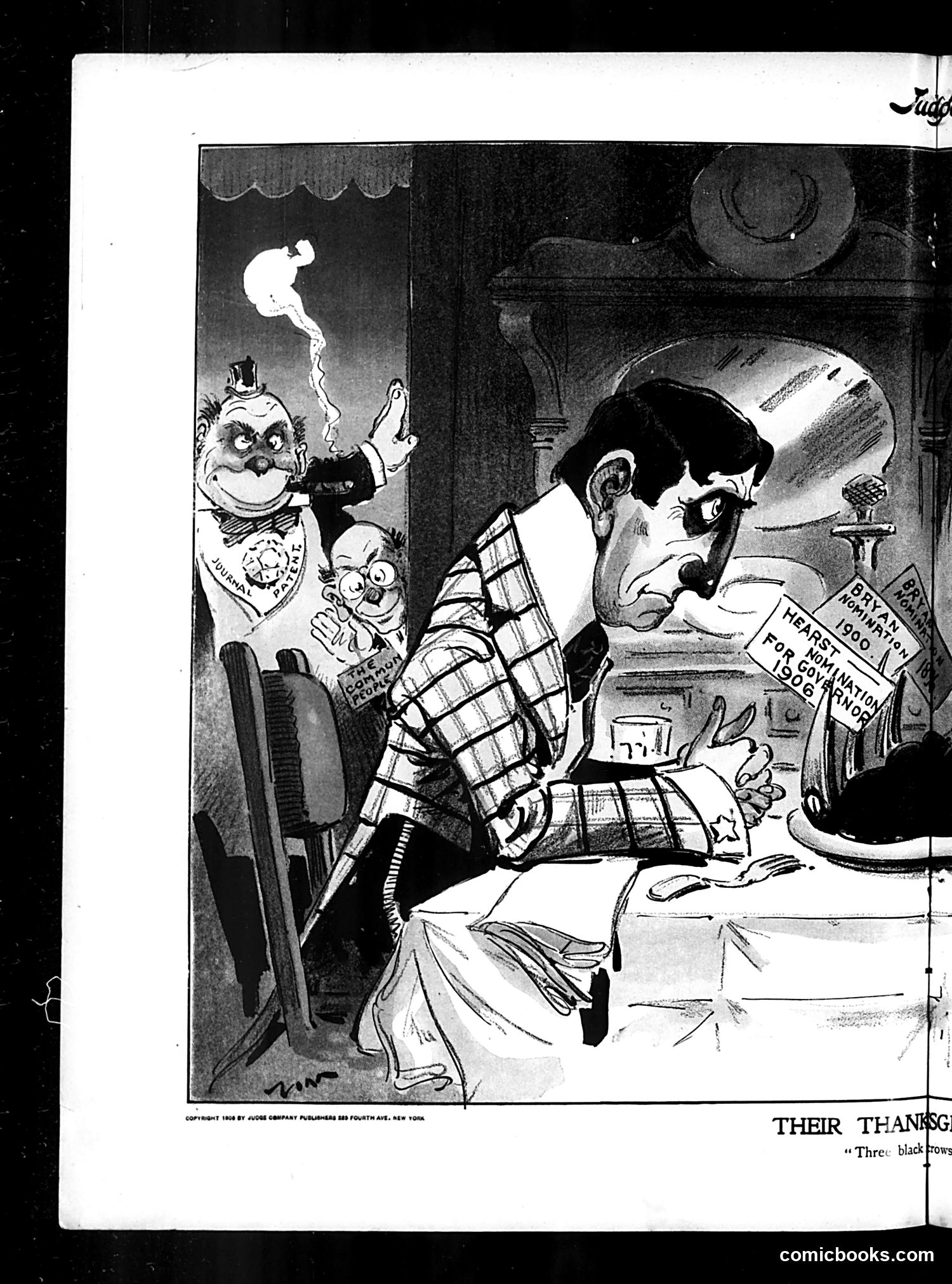
This appears to be a satirical cartoon from *Judge* magazine depicting a man at a desk receiving what looks like a genie or magical apparition emerging from a lamp. The figure on the right holds papers labeled "BRYAN HEARST FOR GOVERNOR 1906" (partially visible text). The cartoon likely satirizes the political aspirations or unexpected political developments of 1906, possibly mocking either William Jennings Bryan or William Randolph Hearst's gubernatorial ambitions. The magical lamp genie suggests surprise or absurdity—perhaps commenting that such a political outcome would be as unlikely or fantastical as a genie appearing. The caption beginning "Three black Frows..." is partially cut off, making the complete meaning unclear. The exaggerated facial features are typical of early 20th-century political cartooning.
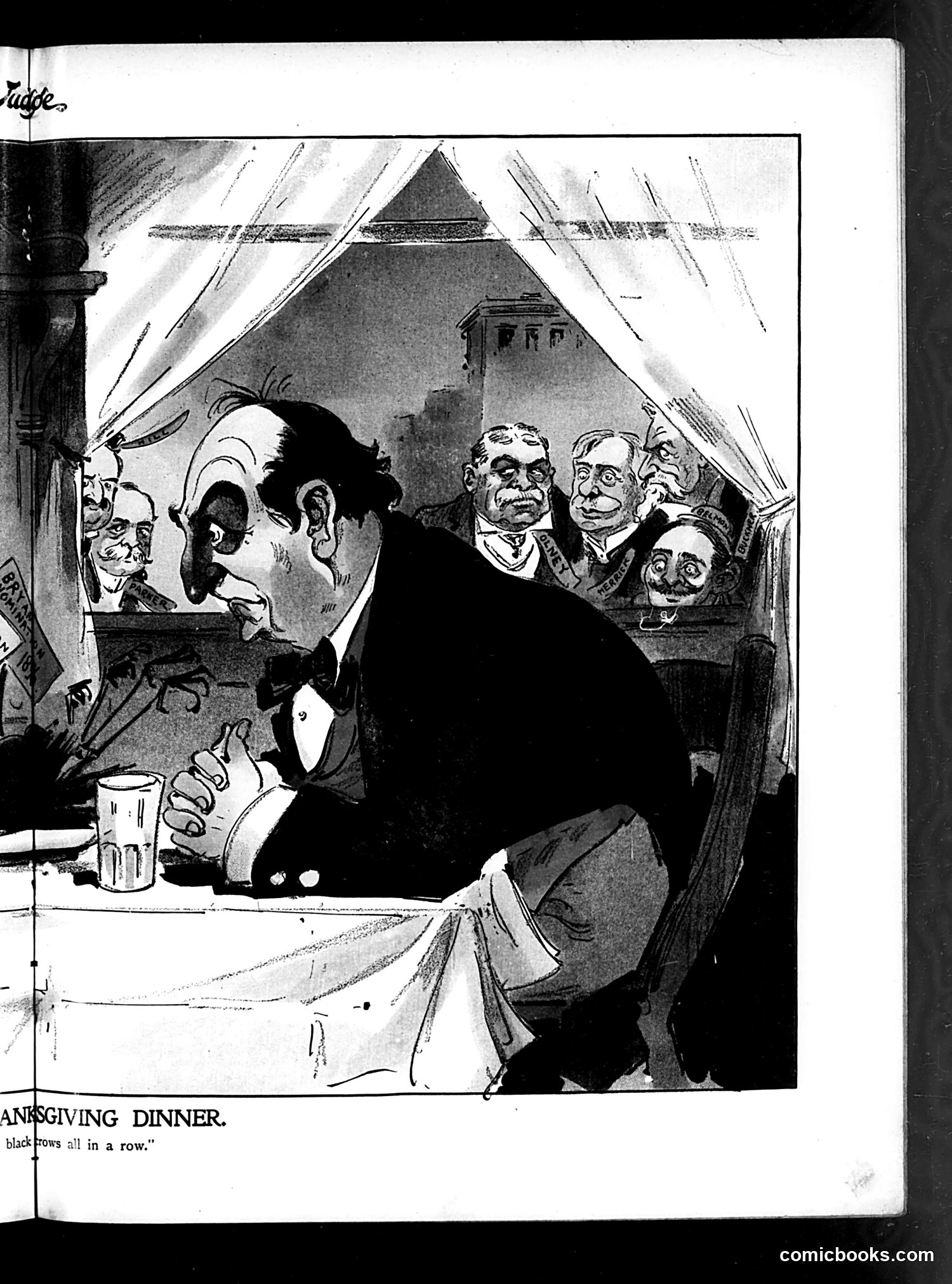
This political cartoon depicts a formal dinner scene with a central figure in formal attire (tuxedo and bow tie) seated at a table. He's surrounded by exaggerated caricatures of other men with pronounced facial features displayed on what appear to be decorative plates or busts behind him. The caption "black Fows all in a row" suggests this is a satirical commentary, likely playing on the nursery rhyme "Blackbirds baked in a pie." The cartoon appears to mock political or social figures of the era, presenting them as decorative objects or specimens rather than peers—a form of dehumanizing satire typical of *Judge* magazine's political commentary. Without clearer identification of the specific figures, the precise political targets remain unclear, though the imagery suggests commentary on power dynamics or social hierarchy.
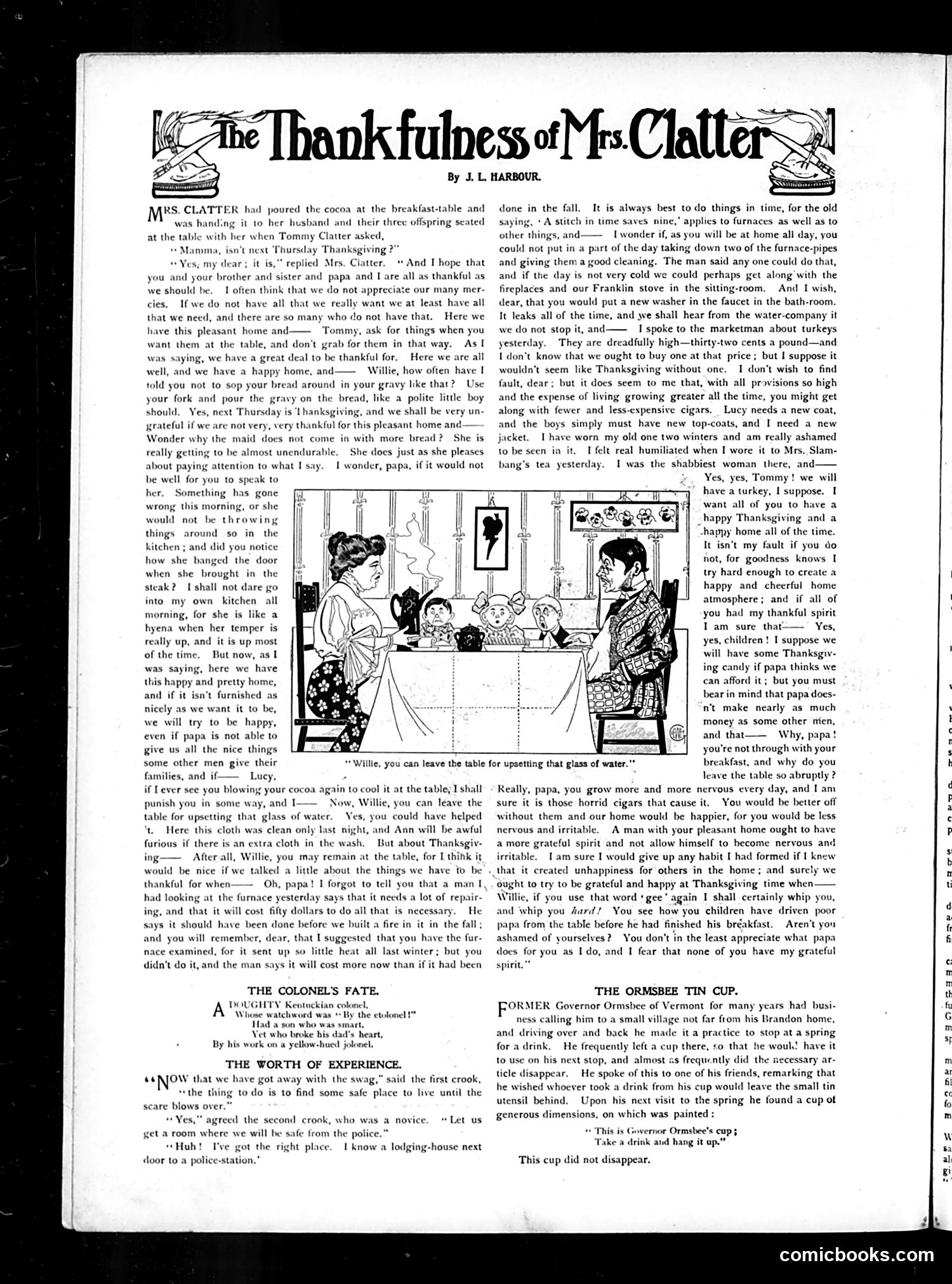
This story-cartoon satirizes the hypocrisy of middle-class domestic life during Thanksgiving preparation. Mrs. Clatter delivers a lengthy sermon to her family about gratitude and appreciating their blessings—while simultaneously complaining about nearly everything: the maid's laziness, the expense of living, needed home repairs, expensive turkeys, and her shabby coat worn to a neighbor's tea. The joke is the stark contradiction between her preached thankfulness and her constant, anxious complaints. She demands her husband fix furnaces, install washers, and replace worn items, while reproaching him for smoking expensive cigars—all while lecturing her children about counting their blessings. The illustration shows the family at breakfast as she delivers this contradictory message, capturing the obliviousness and self-deception of someone convinced of their own virtue while revealing deep materialism and discontent.
This page from *Judge* magazine consists primarily of **humorous anecdotes and jokes** rather than political cartoons. The content reflects early 20th-century American humor styles: **Main pieces:** - "Another Unlucky Brother": A tall tale about a chronically unfortunate rural man whose bad luck causes a train wreck - "Influence of Environment": A pun-based joke about a man's pets becoming intellectually affected by his home - "Kippered": A mild cultural humor piece about a French pastor misunderstanding Scottish breakfast terminology - "A Doctor's Trials": An advertisement disguised as testimonial, promoting Grape-Nuts cereal to exhausted physicians **The satire:** These aren't political—they mock human folly, linguistic confusion, and play on words. The doctor's piece is essentially an early **advertorial**, presenting product benefits through a supposed real account. The page is primarily **advertising-heavy**, with promotions for pianos, cigars, and the *Christmas Judge* publication dominating the layout. The humor is gentle, domestic, and focused on wordplay rather than social commentary.
This page is primarily **advertisements and short jokes** rather than political cartoons. The only illustrated item is a small horse-and-rider logo for "Hunter Baltimore Rye" whiskey. The text content consists of: 1. **"Winter Miseries"** — a humorous poem about a furnace operator unable to satisfy quarreling household members' temperature preferences 2. **"Coals to Newcastle"** — a joke about a condescending gentleman trying to educate a rural man about telegraph wires, only to learn the man is actually a telegraph lineman (ironic reversal of assumed ignorance) 3. **Various brief jokes** on topics like champagne snobbery, gratitude, bank robbery, and memory The advertisements promote patent medicines (blood poison cure, stomach capsules), whiskey, shaving soap, and railroad service. The humor is gentle and domestic rather than political—typical light entertainment for Judge magazine's general readership.
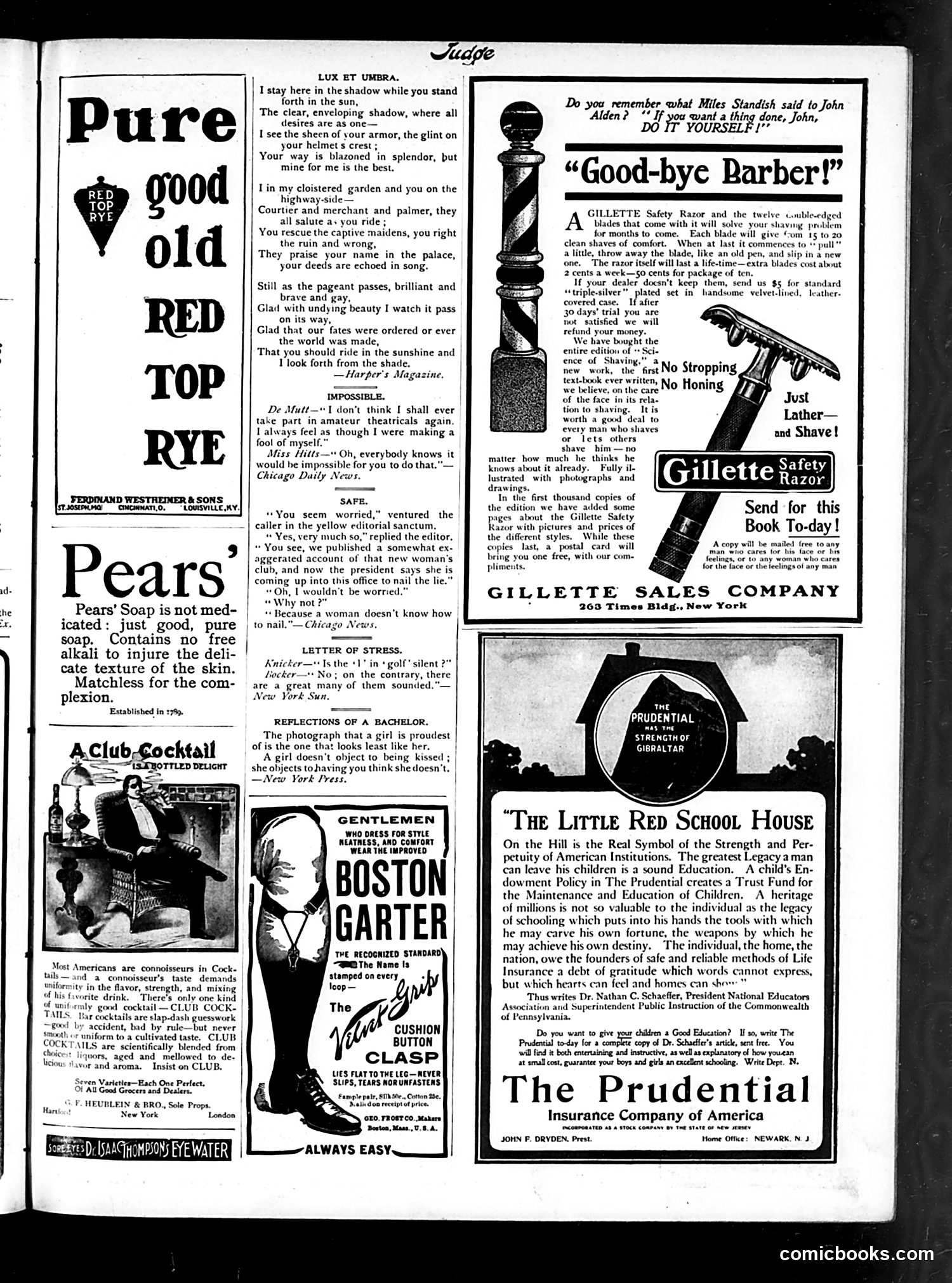
This is primarily an **advertising page** from Judge magazine, not a political cartoon page. The page contains multiple product advertisements (Pears' Soap, Club Cocktails, Gillette Safety Razors, Boston Garter, Prudential Insurance) interspersed with brief humorous items and poetry. The notable content includes: **"Good-bye Barber!"** – A Gillette ad referencing Miles Standish and John Alden (historical/literary figures) to pitch safety razors as making barbers obsolete. The advertisement emphasizes the razor's reusability and economy. **Brief jokes** about gender ("a woman doesn't know how to nail"), amateur theater, and golf, typical of early-20th-century magazine humor. **"Lux et Umbra"** – A romantic poem contrasting public achievement with private devotion, appearing between advertisements. The page reflects **early 1900s consumer culture** and advertising strategies targeting middle-class men concerned with grooming, fashion, and leisure pursuits (cocktails, insurance).
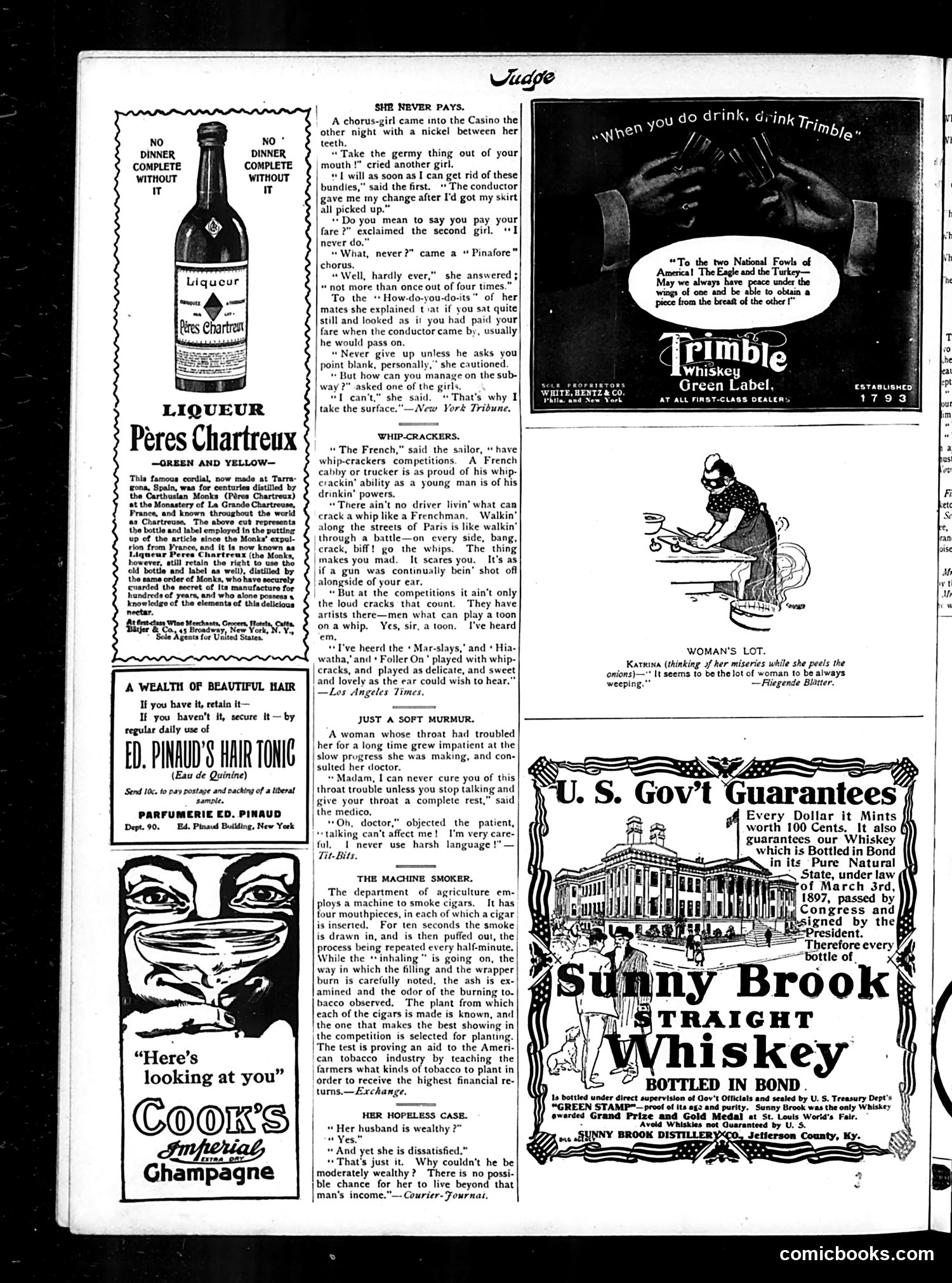
This page is primarily **advertising**, with brief satirical text pieces interspersed. **Main satirical content:** - **"She Never Pays"**: A chorus girl boasts about evading streetcar fares by sitting quietly so conductors overlook her, though she admits this doesn't work on subways. Social satire about working-class women's petty dishonesty. - **"Whip-Crackers"**: A sailor describes French whip-cracking competitions as a competitive art form, even claiming whips can play melodies. Light humor about French cultural pride. - **"Just a Soft Murmur"**: A woman with throat trouble refuses to stop talking despite doctor's orders for complete rest. Brief joke about female chattiness. - **"The Machine Smoker"**: Agriculture department uses mechanical smoking devices to test cigars. Humorous commentary on industrial automation. **Advertisements** dominate: Péres Chartreux liqueur, Ed. Pinaud's hair tonic, Cook's champagne, Trimble whiskey, and Sunny Brook whiskey—typical period products marketed with gendered appeals.
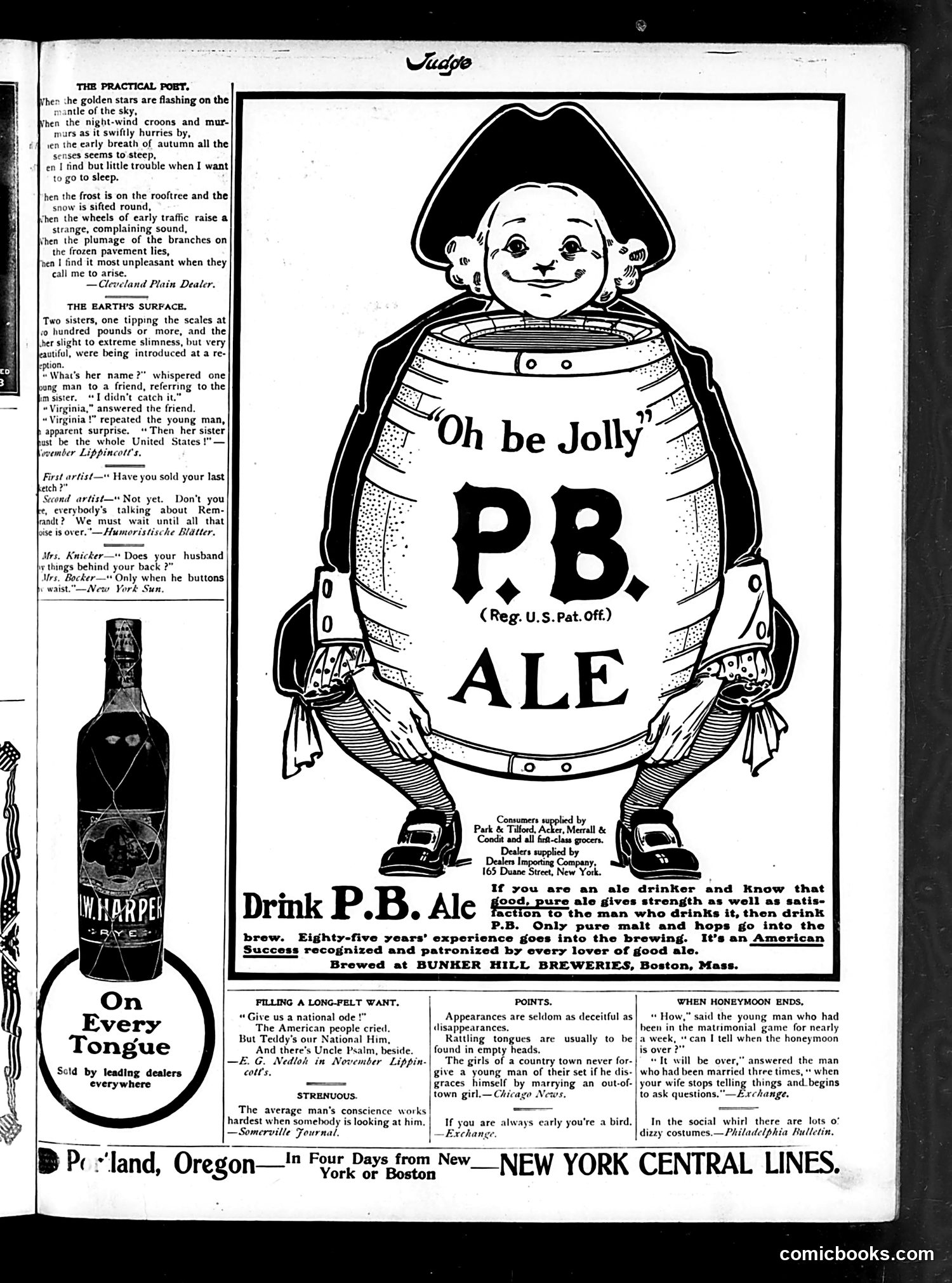
This page combines humor columns with period advertising. The main content includes: **Humorous Columns:** - "The Practical Poet" jokes about sleeping during pleasant weather but struggling to wake in winter - "The Earth's Surface" contains a size-based joke: two sisters are introduced—one weighs 200+ pounds, the other is extremely thin. When told one sister is "Virginia," a man quips the other must be "the whole United States"—a geographic/body-size pun - Various one-liners about artists, marriage, and social behavior **Major Advertisement:** The page prominently features **P.B. Ale** with an illustration of a jolly, rotund figure (appearing as a personified beer barrel or tavern character) labeled "Oh be Jolly." The ad emphasizes "pure malt and hops" and 85 years of brewing experience at Bunker Hill Breweries in Boston. **Context for Modern Readers:** This reflects pre-Prohibition America (advertisement of alcohol was still legal). The rotund character embodies the stereotypical association between ale consumption and jovial corpulence—a marketing strategy linking the product to good cheer and robust health.
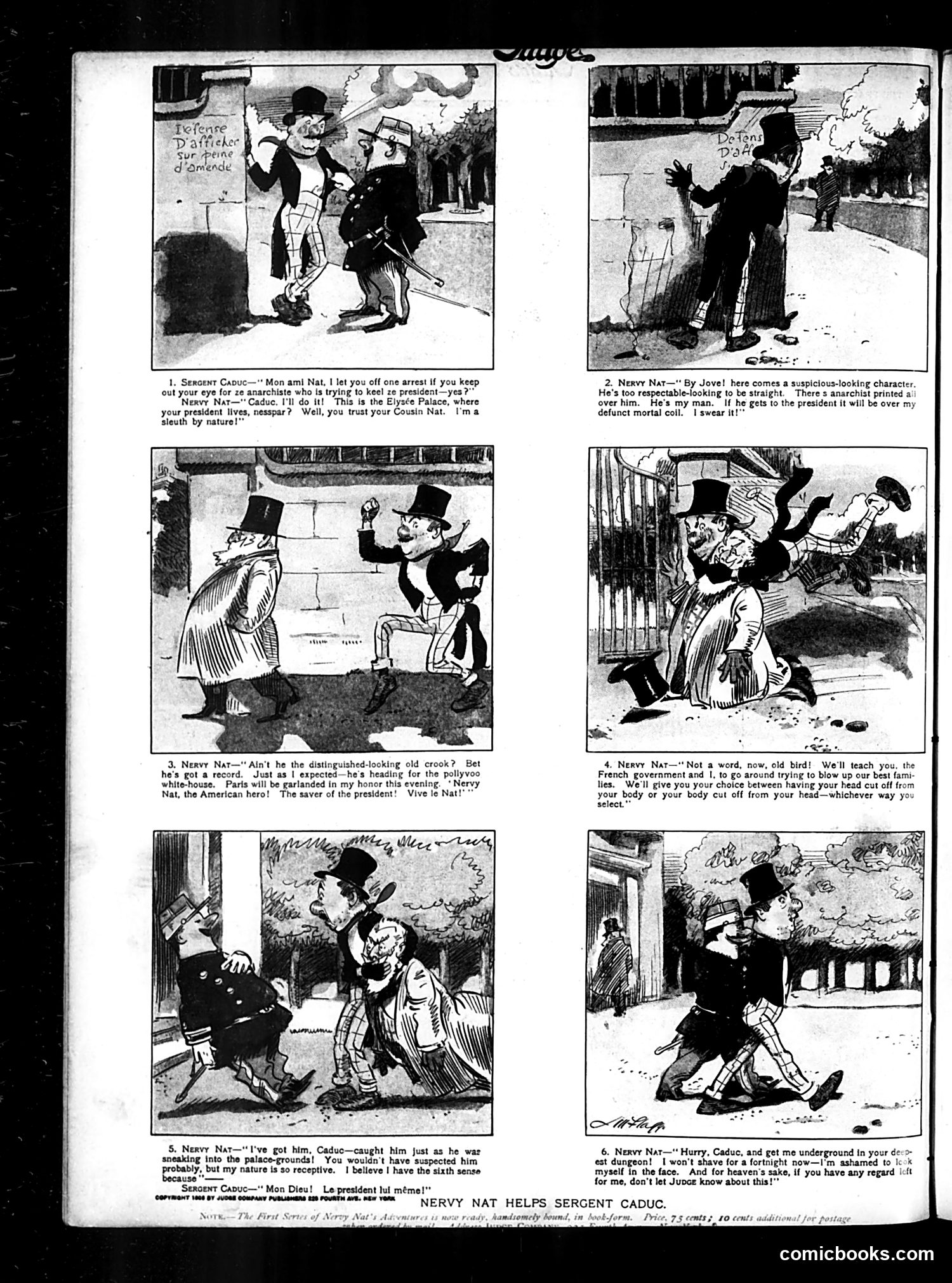
This comic strip satirizes American overconfidence and incompetence abroad. "Nervy Nat," an American character, volunteers to protect the French president at the Élysée Palace from anarchists. He immediately misidentifies an innocent man as a dangerous anarchist—revealing his inability to discern actual threats. When the real threat (the actual anarchist) turns out to be the president himself, Nat's bumbling becomes farcical. The satire targets both American naïveté about European politics and the anarchist threat that genuinely worried European governments in the late 19th/early 20th century. Nat's boastful patriotism ("The American hero!") contrasts sharply with his utter failure, suggesting Americans were overestimating their competence in international affairs. His final humiliation—wanting to hide underground—mocks American pride deflated by reality.