
A complete issue · 16 pages · 1906
Judge — November 17, 1906
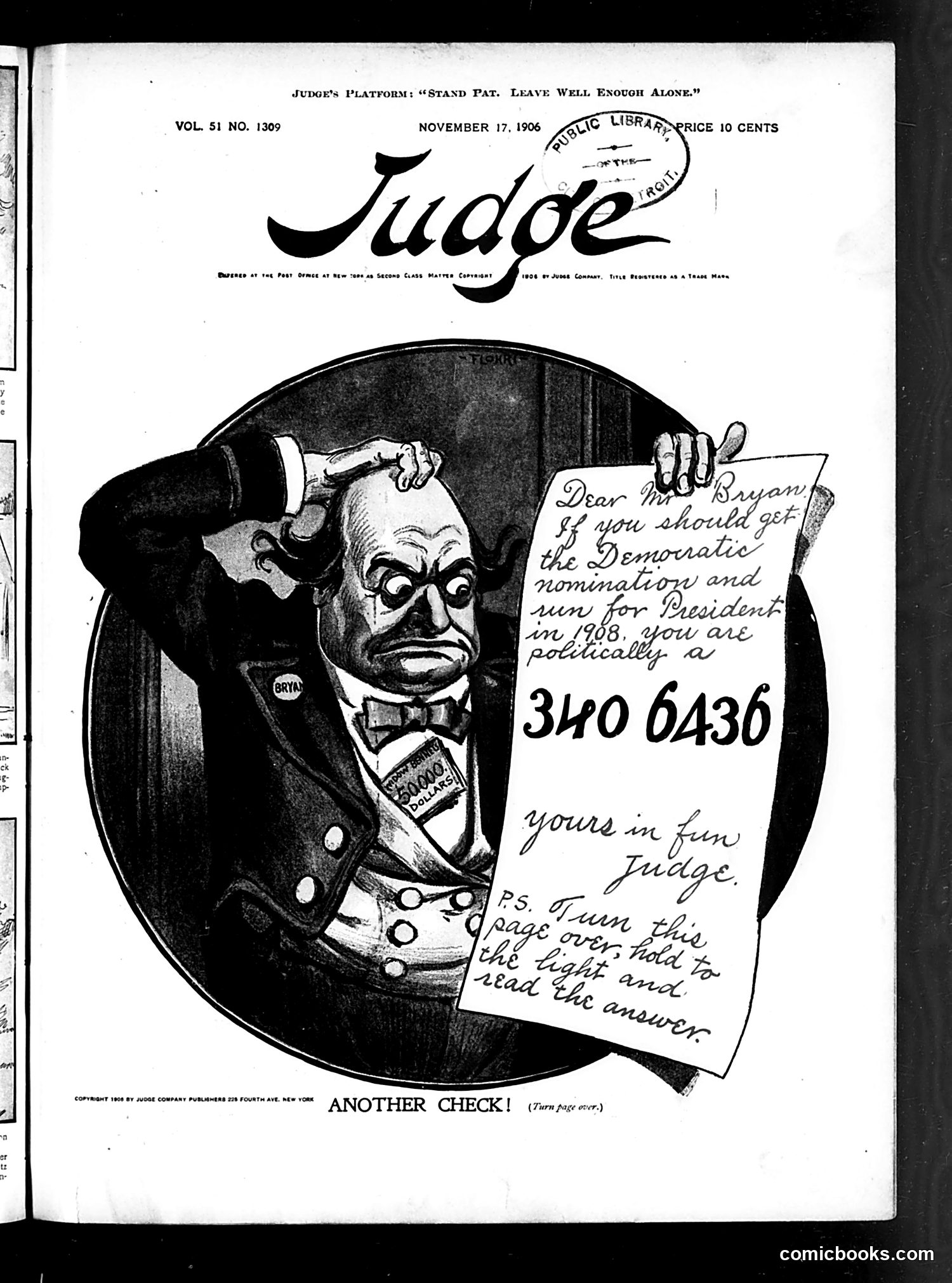
This cartoon satirizes William Jennings Bryan, the three-time Democratic presidential candidate. The caricatured figure holds a check for $340,643.6—likely representing campaign funds or speaking fees Bryan received. The joke's premise: Judge suggests Bryan is being paid to abandon his Democratic nomination aspirations and avoid running for president in 1908. The accompanying letter sarcastically claims if Bryan "should get the Democratic nomination and run for president in 1908, you are politically a 340 6436"—implying the number represents his political value or worth. The satire mocks Bryan as mercenary, suggesting his political principles were negotiable for the right price. The "check" serves as visual evidence of this satirical corruption claim.
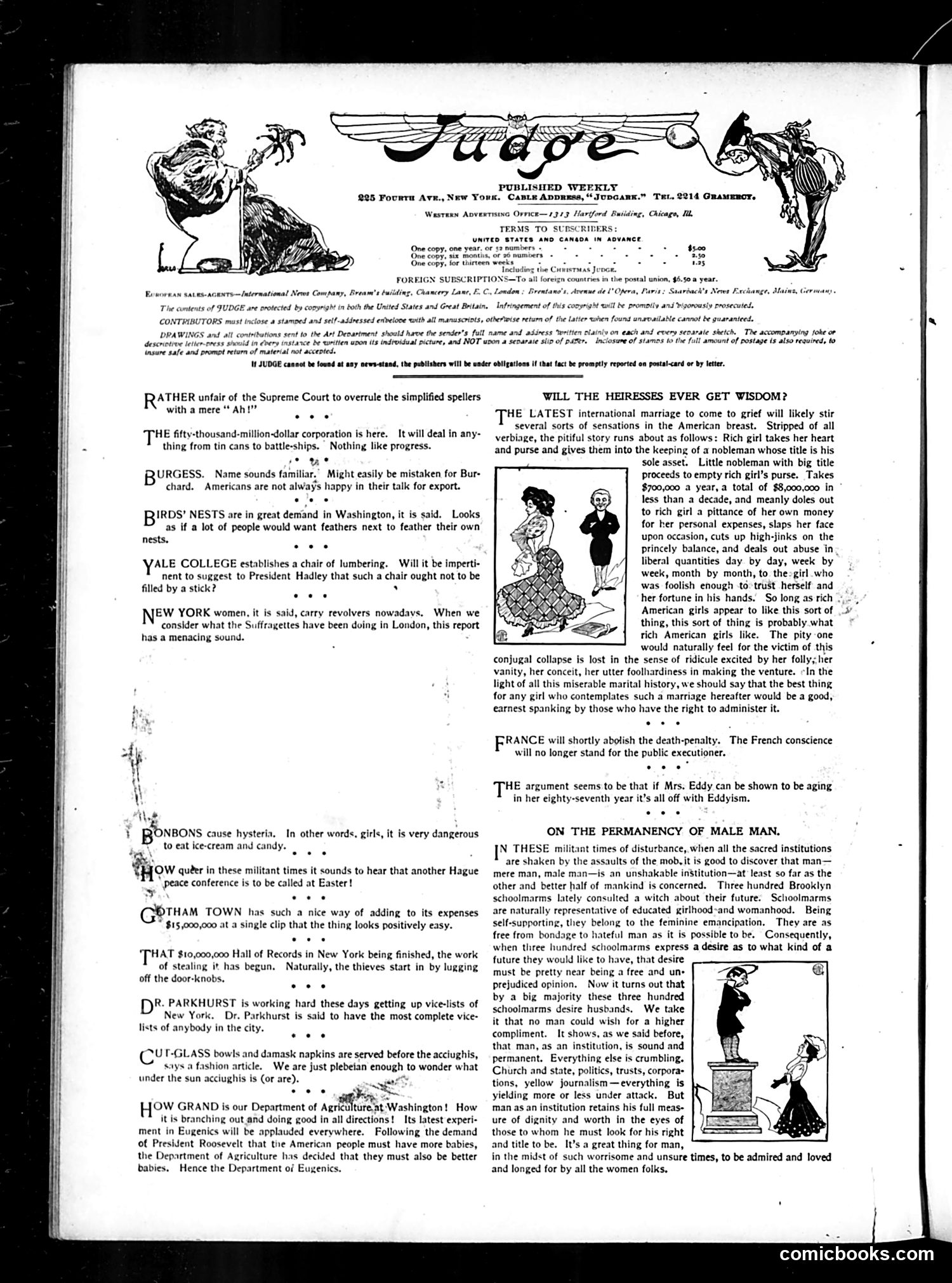
This page features satirical commentary typical of early 20th-century Judge magazine. The left column contains brief humorous observations on current events ("Rather unfair of the Supreme Court to overrule the simplified spellers," "Burgess. Name sounds familiar"). The main article, "Will the Heiresses Ever Get Wisdom?" criticizes wealthy American heiresses who marry foreign noblemen, viewing them as frivolous and easily manipulated. The accompanying illustration shows a young woman and an aristocratic male figure—likely satirizing the practice of American heiresses seeking titles through international marriages. The text argues such women lack judgment and are exploited by fortune-seeking Europeans. The other brief items mock contemporary trends: women's suffrage, food safety concerns, and agricultural policy debates.
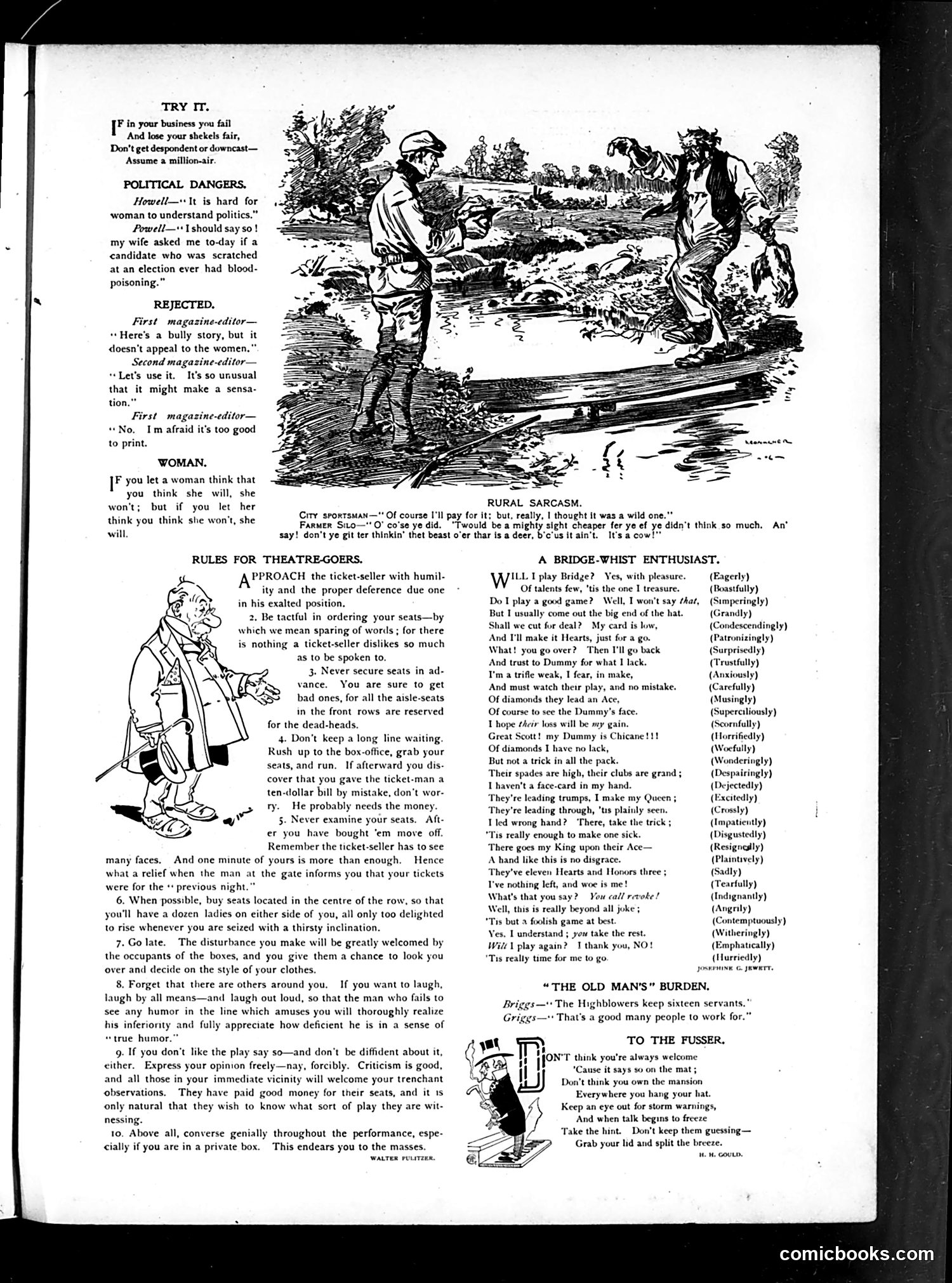
The main illustration depicts a **fishing scene with rural/working-class figures**, likely satirizing American attitudes toward politics and social class. The "Political Dangers" section mocks how women approach politics—a husband notes his wife asked if a candidate experienced "blood-poisoning" at an election, suggesting women voters lack serious political understanding. This reflects early 20th-century skepticism about female suffrage and women's political competence. The page also includes "Rules for Theatre-Goers," humorous etiquette advice for patrons, and various comic verses about Bridge, "The Old Man's Burden," and "To the Puss[er]"—light entertainment content typical of Judge's satirical format. The overall tone reflects period assumptions about gender, class, and proper social behavior.
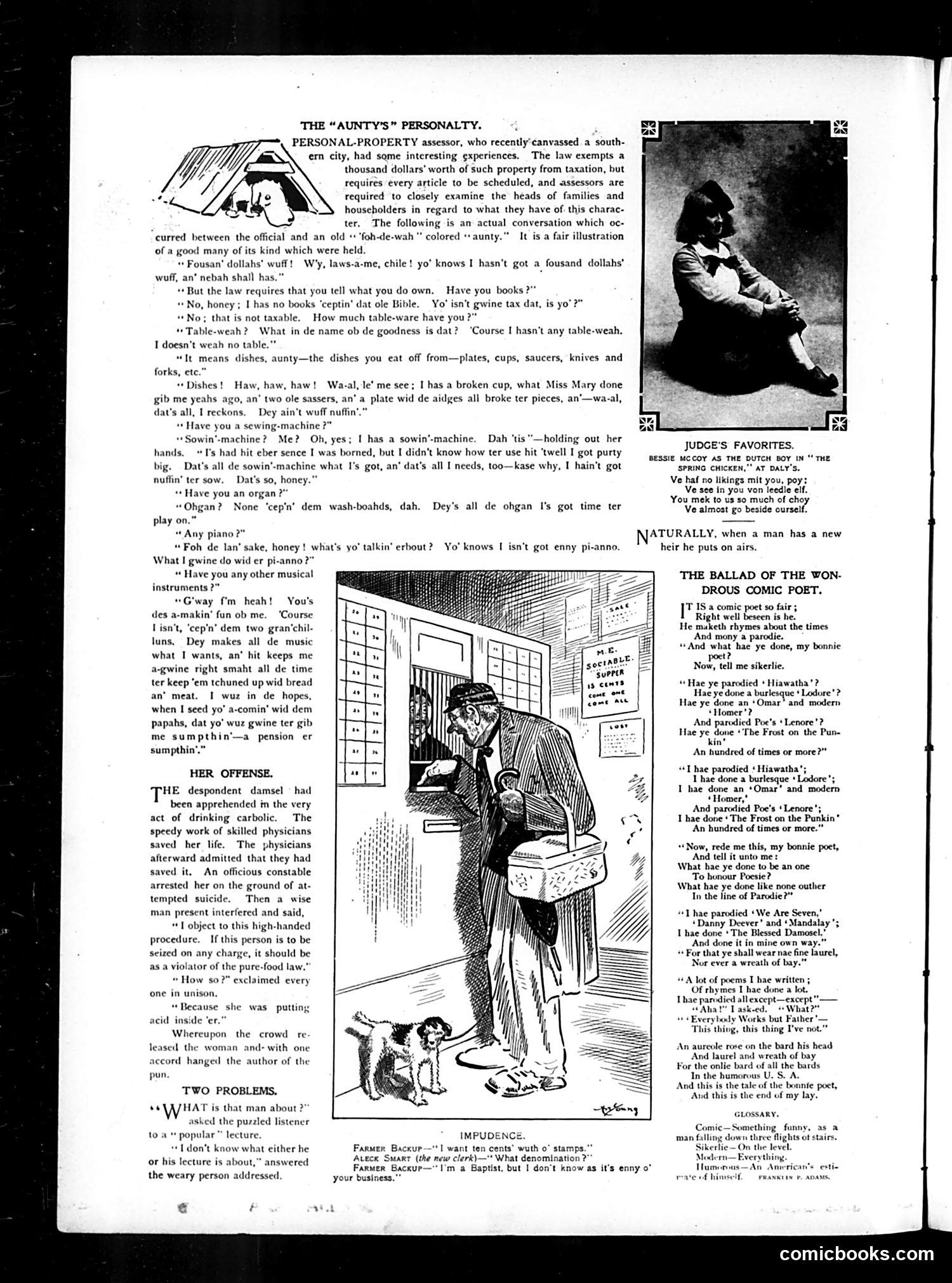
This page contains several distinct satirical pieces rather than a single cartoon. **"The Auntys' Personality"** features a dialogue between a property assessor and an elderly woman ("Aunty"), mocking her reluctance to declare taxable possessions. The humor relies on her evasive responses about owning books, dishes, and a sewing machine—common household items that represent hidden wealth. **"Her Offense"** describes a woman who attempted suicide after her husband's infidelity was exposed in court proceedings. The satire criticizes the legal system for public humiliation. **"The Ballad of the Wondrous Comic Poet"** parodies contemporary poetry by listing absurdly exaggerated poem titles about common subjects. The illustrations are period sketches typical of early 20th-century satirical magazines, targeting everyday social hypocrisy and legal absurdities rather than specific political figures.
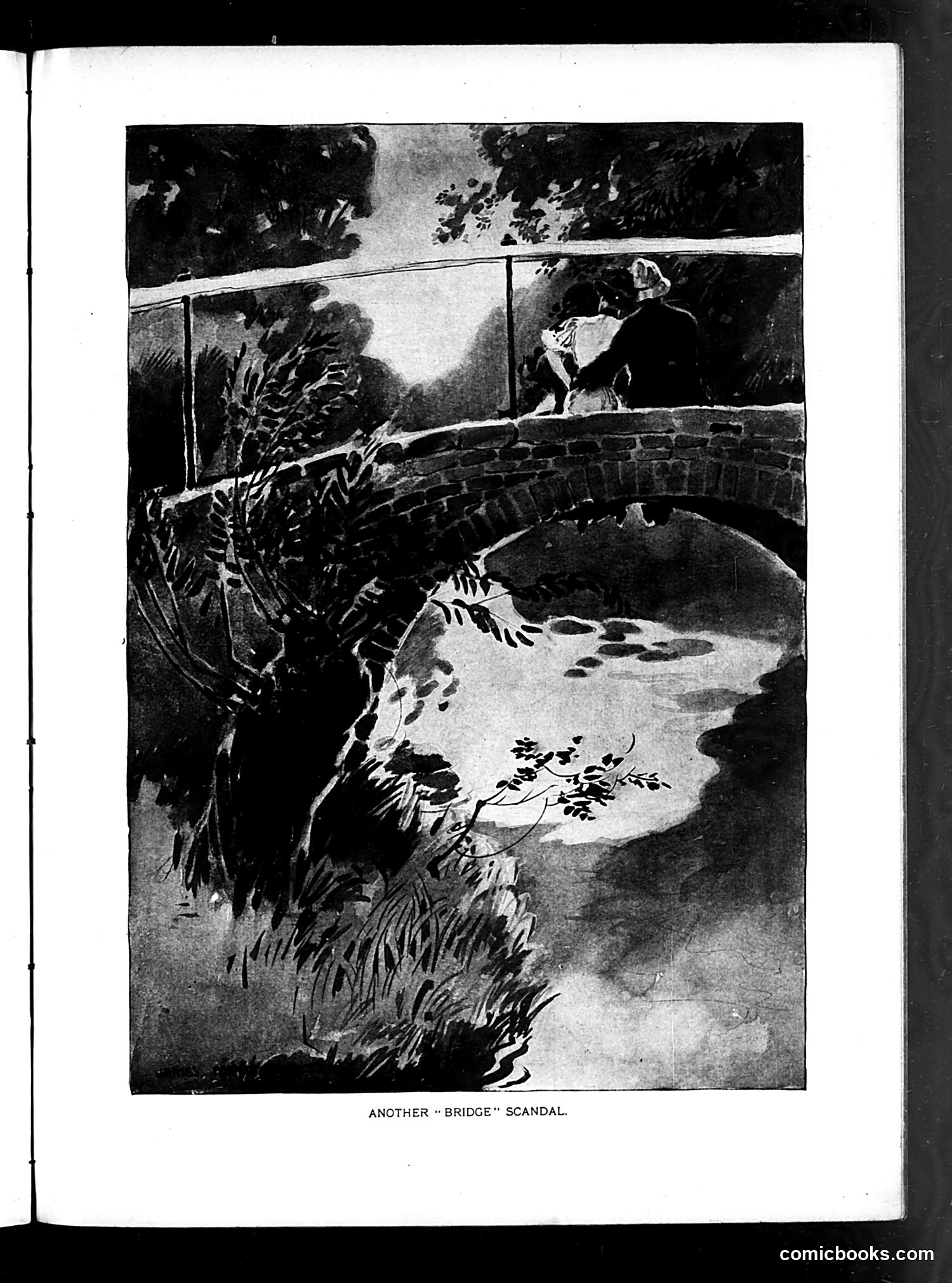
This satirical cartoon from *Judge* magazine depicts a romantic scandal involving a bridge—likely referencing a real contemporary incident where a couple was caught in a compromising position on or near a bridge. The illustration shows two figures on an arched stone bridge over water, with vegetation framing the scene. The caption's quotation marks around "Bridge" suggest the word carries double meaning or is euphemistic. The satire appears to mock either the couple's indiscretion, the scandal's public exposure, or society's obsession with such incidents. Without additional context about the specific historical event referenced, the exact identities of the figures remain unclear, though the cartoon clearly intends ridicule of contemporary moral lapses or journalistic sensationalism.
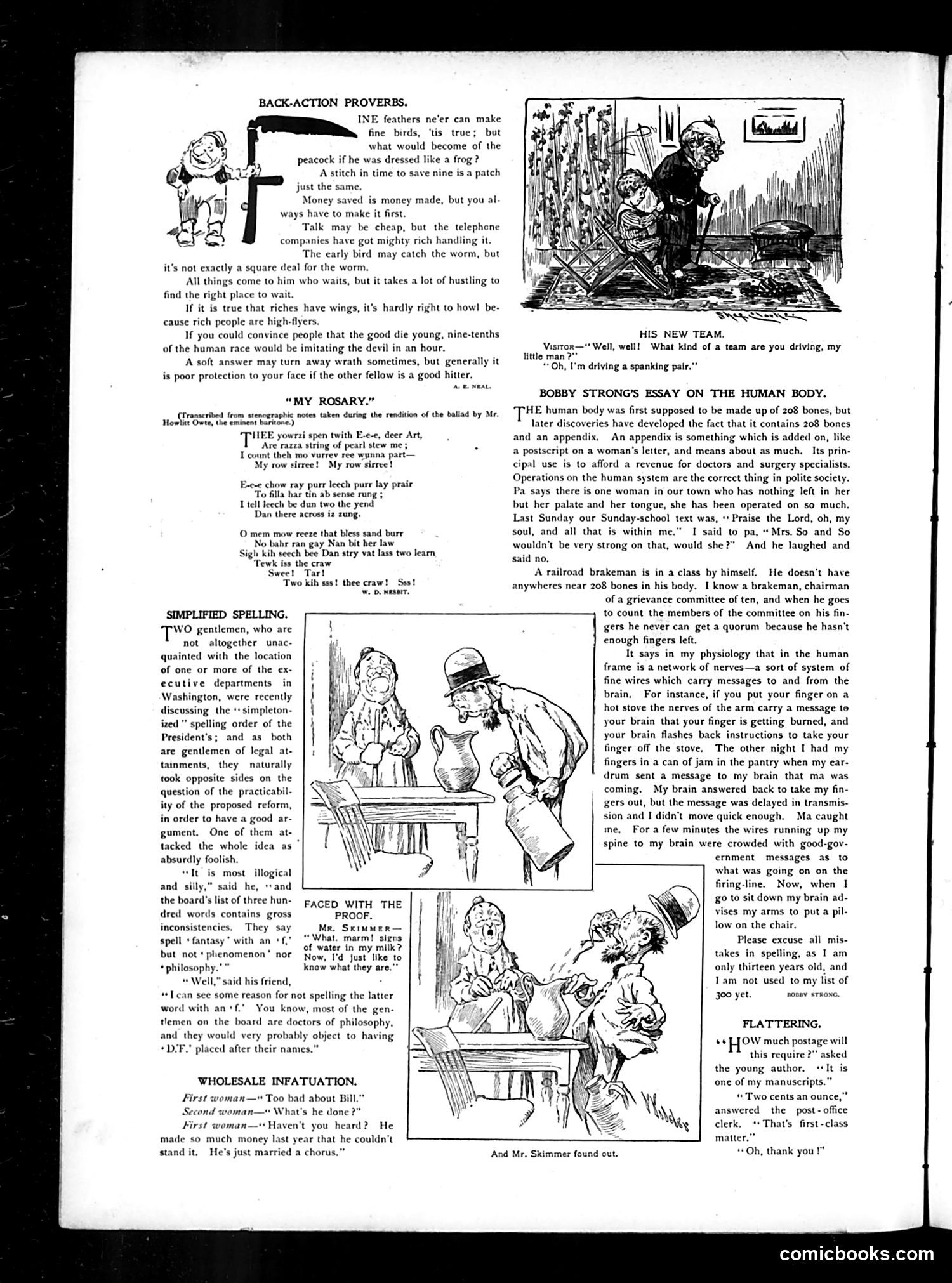
This page from *Judge* contains several satirical pieces mocking conventional wisdom and contemporary American life: **"Back-Action Proverbs"** offers cynical reversals of traditional sayings—for instance, that telephone companies grew rich from "cheap talk," or that the early bird's gain is the worm's loss. The satire targets both empty platitudes and economic inequalities of the era. **"My Rosary"** mockingly transcribes a baritone's mangled operatic performance, poking fun at pretentious vocal affectation and bad singing. **"Bobby Strong's Essay on the Human Body"** is a child's naive but sharp-edged commentary on medicine and surgery, suggesting doctors profit from unnecessary operations. It likely reflects early 20th-century skepticism about medical overtreatment. **"Simplified Spelling"** satirizes President Theodore Roosevelt's push for spelling reform, showing two lawyers debating its practicality—reflecting genuine contemporary controversy over the initiative. The cartoons and text together critique American social pretension, medical profiteering, and government overreach, using humor to expose perceived absurdities.
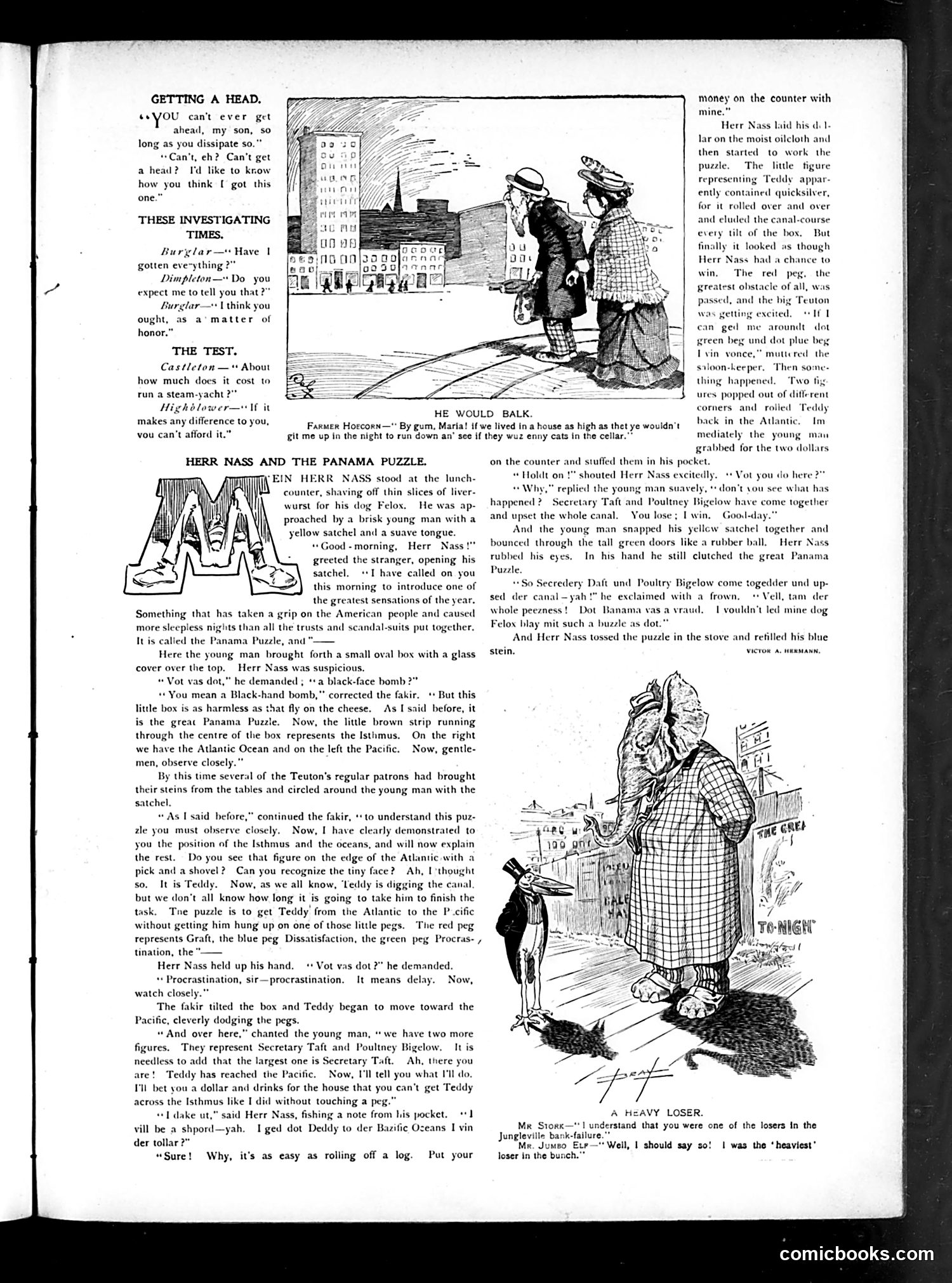
This page from *Judge* satirizes Theodore Roosevelt's Panama Canal project through a clever puzzle-game conceit. A traveling salesman tries to sell "Herr Nass" (a German immigrant character) the "Panama Puzzle"—a tilting box game where a tiny figure representing "Teddy" (Roosevelt) must navigate from the Atlantic to the Pacific Ocean while avoiding pegs labeled "Graft," "Dissatisfaction," and "Procrastination." The satire mocks the canal's delays and obstacles, suggesting Roosevelt's ambitious project faced real difficulties despite his determination. Secretary of War William Howard Taft and politician Poultney Bigelow are also represented as figures in the puzzle. The humor targets both the canal's troubled progress and American fascination with the "sensation" of the project—which genuinely captivated the public during this era of American imperial expansion.
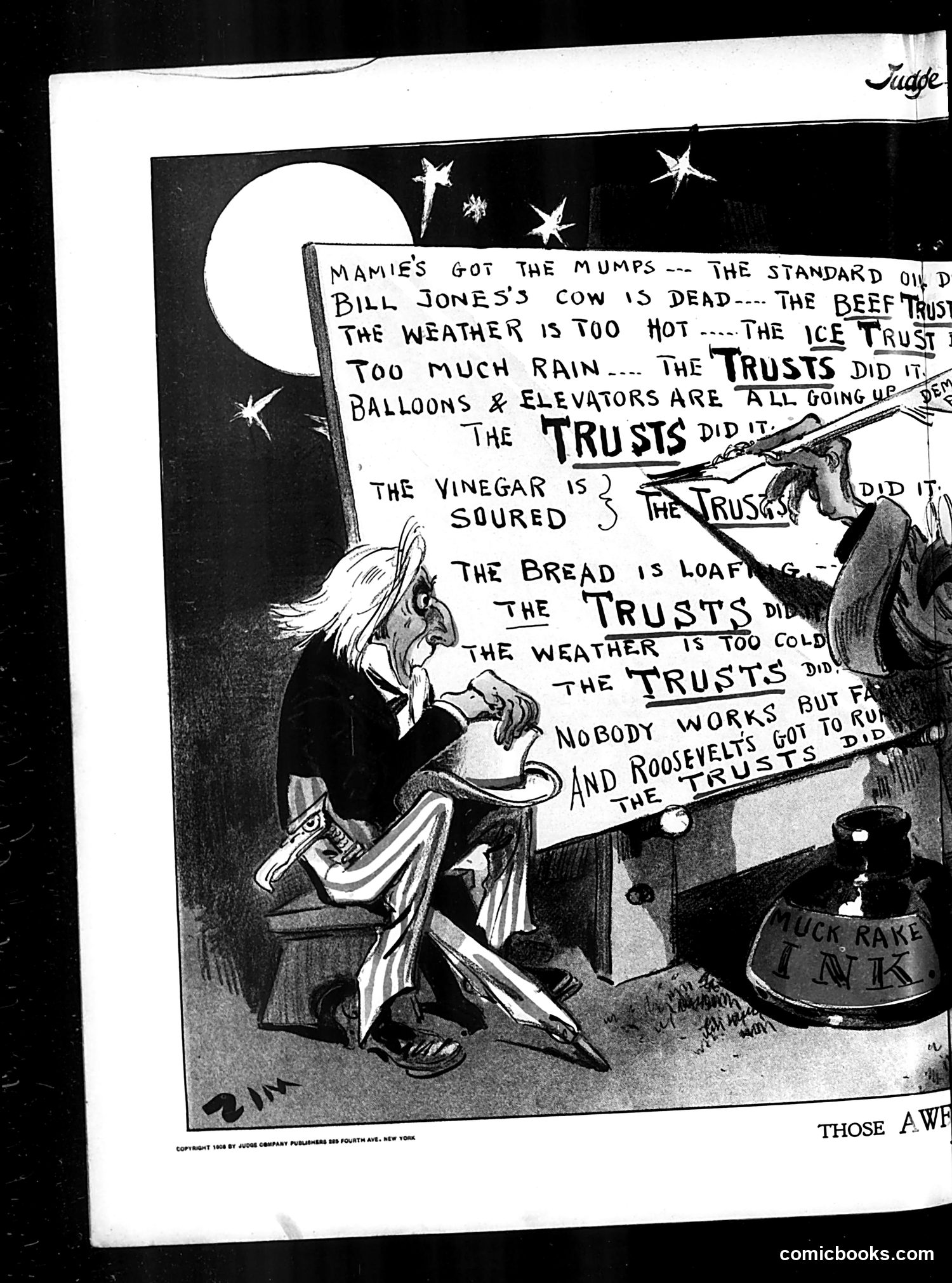
This cartoon satirizes how Americans blamed monopolistic business trusts for nearly every contemporary problem. An elderly figure (likely representing an everyman or common citizen) reads a long list of grievances—from personal misfortunes (Mamie's mumps, a dead cow) to economic issues (the beef trust, ice trust, bread loafing) to weather complaints—with nearly every problem attributed to "the Trusts." The satire's point: Americans had become so fixated on blaming monopolies for their troubles that they blamed trusts for things entirely beyond corporate control (weather, disease, personal bad luck). The cartoon mocks this knee-jerk scapegoating during the Progressive Era's anti-trust fervor, suggesting public discourse had become absurdly one-note. The reference to Roosevelt likely ties this to Theodore Roosevelt's trust-busting campaign, which dominated political conversation of that period.
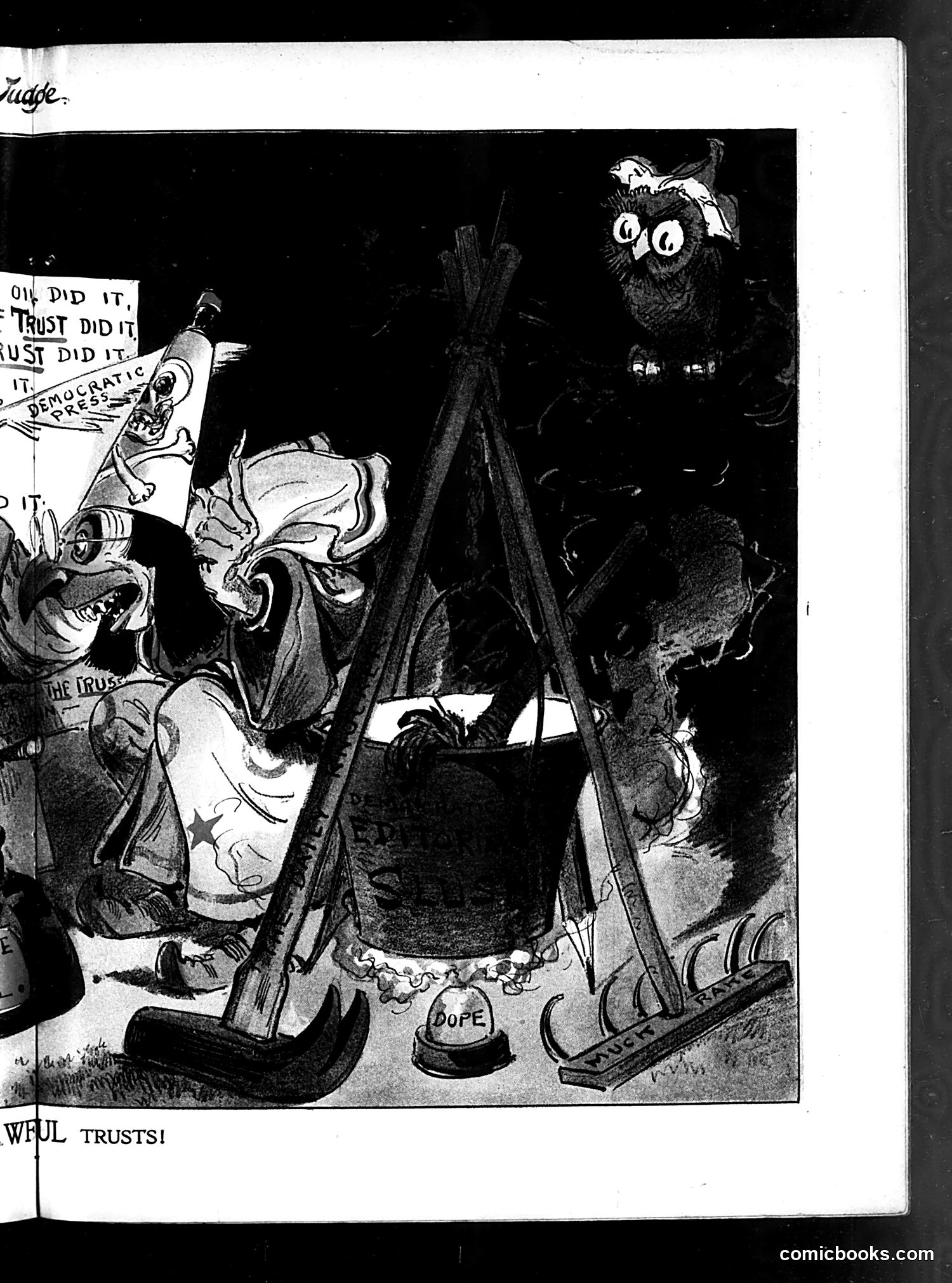
This Judge magazine cartoon satirizes the trust monopolies and corporate corruption of the Gilded Age. The central cauldron labeled "DOPE" bubbles ominously, watched over by a sinister owl perched above—likely representing political corruption or greed overseeing the operation. On the left, figures labeled "TRUST" wield weapons (axes/hammers) while holding documents reading "DEMOCRATIC PRESS" and repeating "TRUST DID IT." This suggests the cartoon accuses corporate trusts of controlling the press and blaming themselves cynically for wrongdoing while evading accountability. The "AWFUL TRUSTS!" caption condemns these monopolistic corporations as dangerous social evils. The imagery conveys how trusts wielded power over democratic institutions and public discourse during this period of rapid industrialization and unregulated capitalism.
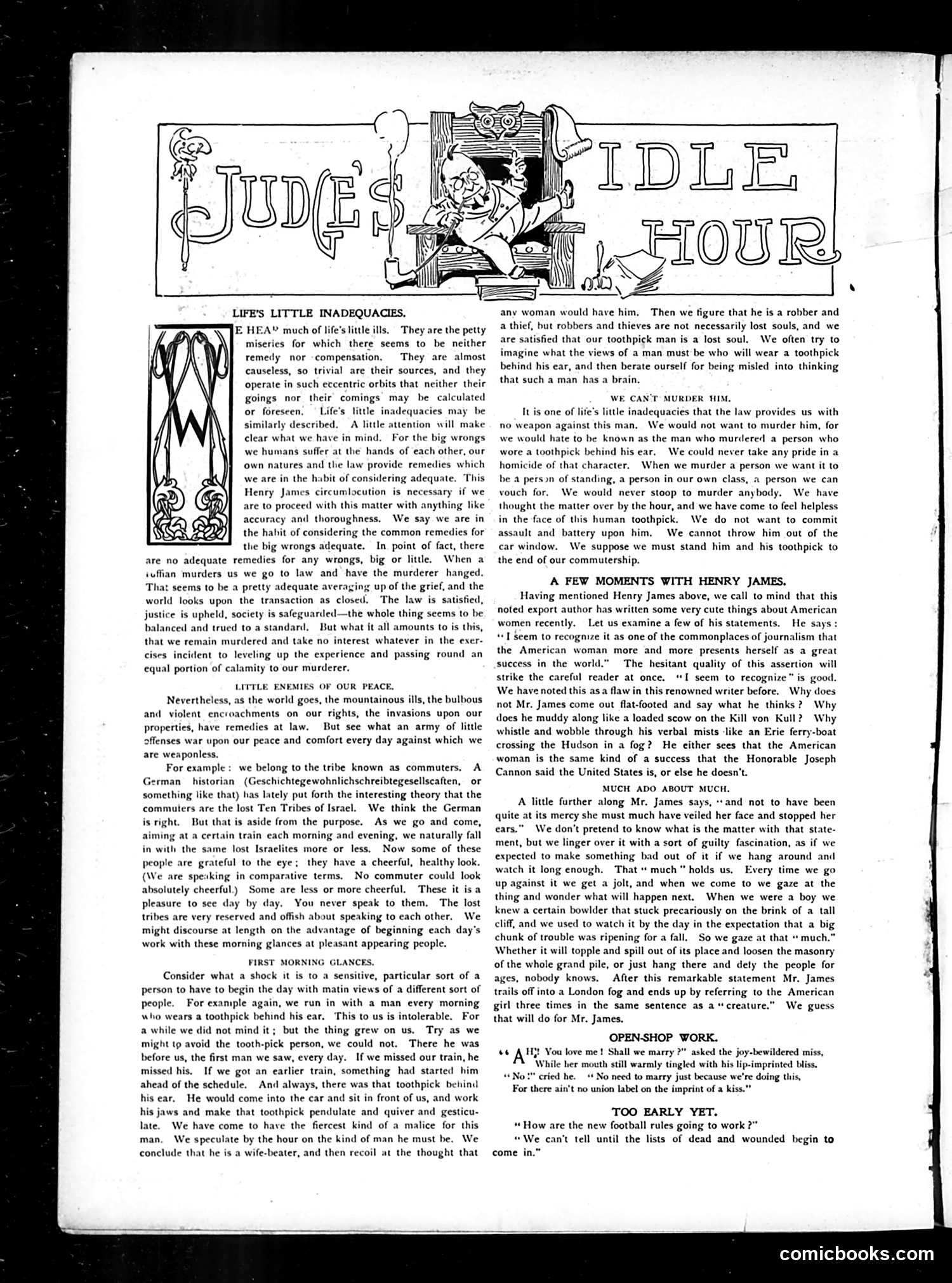
This page from *Judge* magazine satirizes society's obsession with major crimes and injustices while ignoring the daily irritations that truly poison life. The essay argues that while murder has legal remedies (execution), there are "no adequate remedies" for the petty miseries we endure constantly. The specific example targets commuters—humorously called "the lost Ten Tribes of Israel." The author describes harboring intense hatred for a fellow commuter who wears a toothpick behind his ear. This absurdly trivial detail grows so unbearable through daily exposure that it generates genuine malice, yet society provides no legal recourse. The satire's point: we've perfected justice for serious wrongs but remain "weaponless" against the small annoyances—unpleasant strangers, irritating habits—that genuinely damage our peace of mind. The humor derives from treating this commuter's toothpick with the gravity usually reserved for actual crimes.
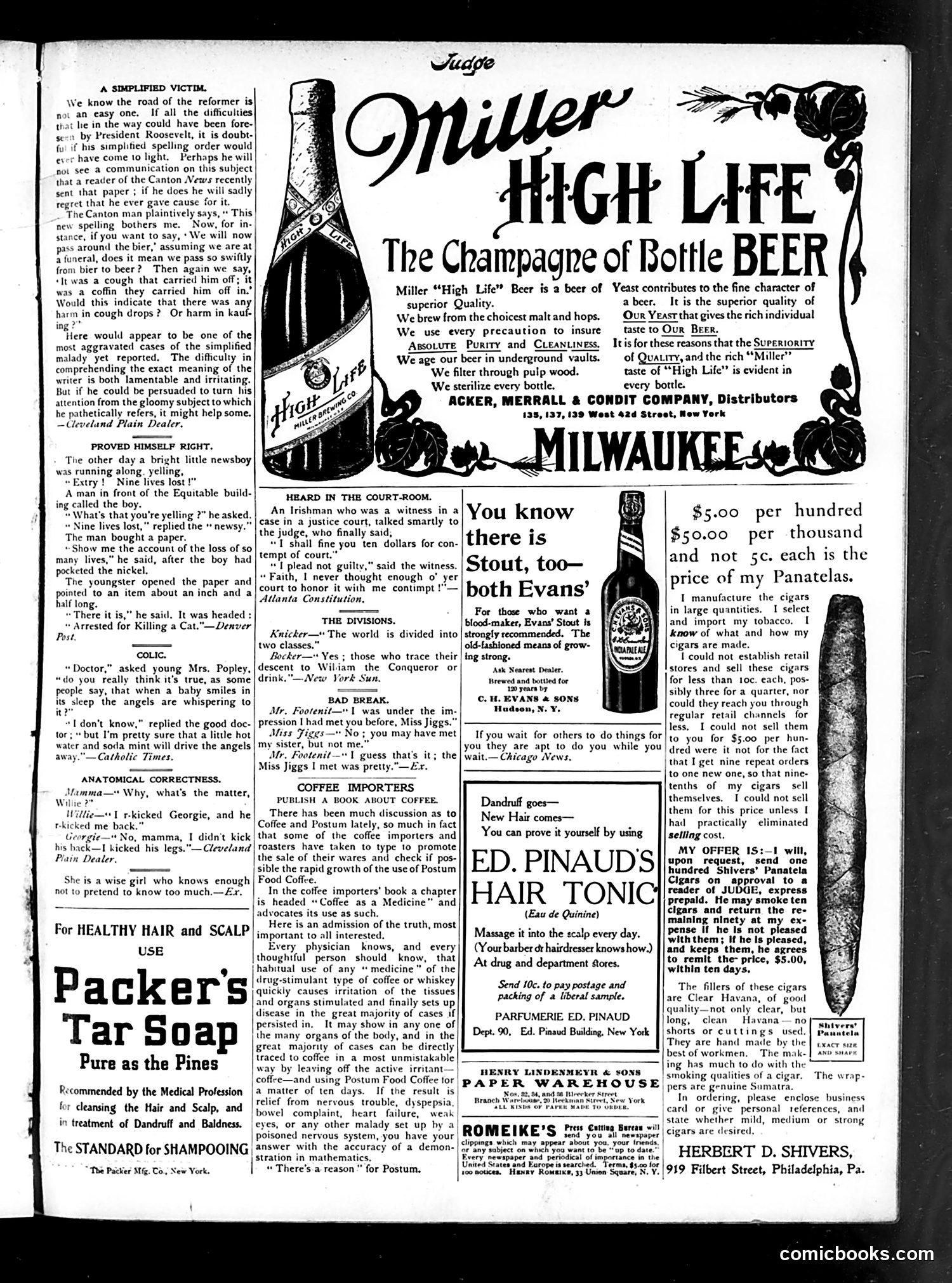
This page is primarily **advertising**, featuring prominent ads for Miller High Life beer and Packer's Tar Soap, alongside several short humorous anecdotes typical of Judge magazine's satirical content. The cartoons/jokes mock: 1. **President Roosevelt's simplified spelling reform** — A Canton, Ohio reader complains the new spelling rules create confusing homophones (bier/beer, cough/kauff), illustrating the reform's impracticality through absurdist examples. 2. **A newsboy's misleading headline** — He shouts "Nine lives lost!" referring only to a cat being killed, demonstrating how sensationalist newspaper language dupes readers. 3. **Irish-American court defiance** — An Irish witness insults a judge, then claims he wasn't showing "contempt of court" because he didn't respect the court enough to honor it with contempt—a play on logical technicality that satirizes both Irish stubbornness and courtroom pomposity. These represent typical Judge humor: political jabs at Roosevelt, satire of American institutions, and ethnic stereotyping common to the era.
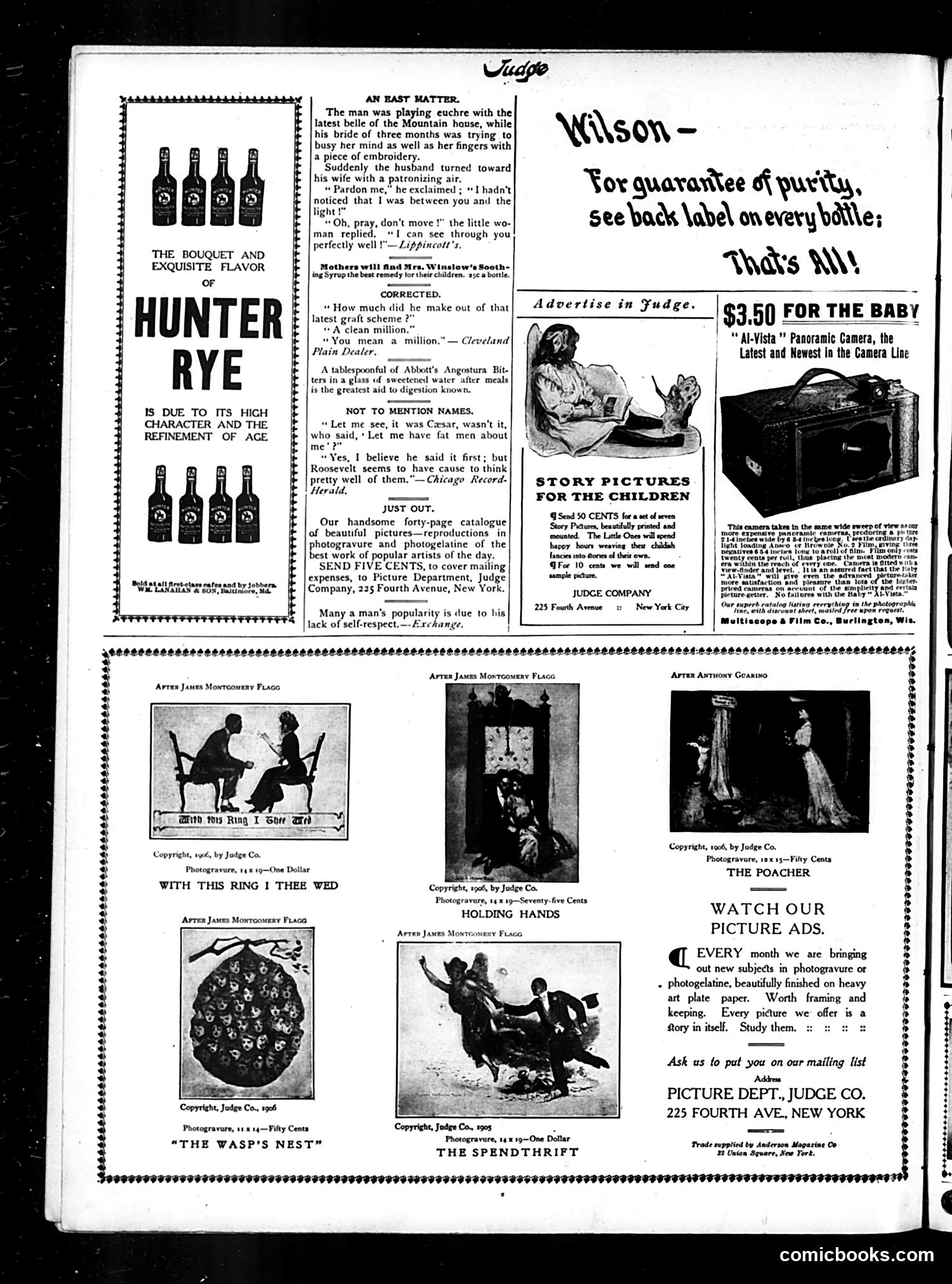
This page is primarily **advertisements and filler content** rather than political satire. The main elements include: **Advertisements:** - Hunter Rye whiskey (left side) - Wilson whiskey (center, emphasizing purity) - Al-Vista panoramic cameras ($3.50) - Story Pictures for Children (Judge Company) - Picture Department promotional ads featuring framed art reproductions **Humor Fillers:** Brief jokes appear throughout, including "An East Matter" (a marital joke about a woman seeing through her husband) and "Not to Mention Names" (a Roosevelt joke about preferring "fat men," likely referring to TR's trust-busting reputation or political associates). **Educational Content:** The page advertises Judge's catalog of photogravure reproductions and story pictures for children—reflecting the magazine's role as family entertainment. The Roosevelt reference suggests this is **early 1900s** (his presidency or post-presidency era), but otherwise the page reflects Judge's typical mix of advertising, light domestic humor, and product promotion rather than substantive political commentary.
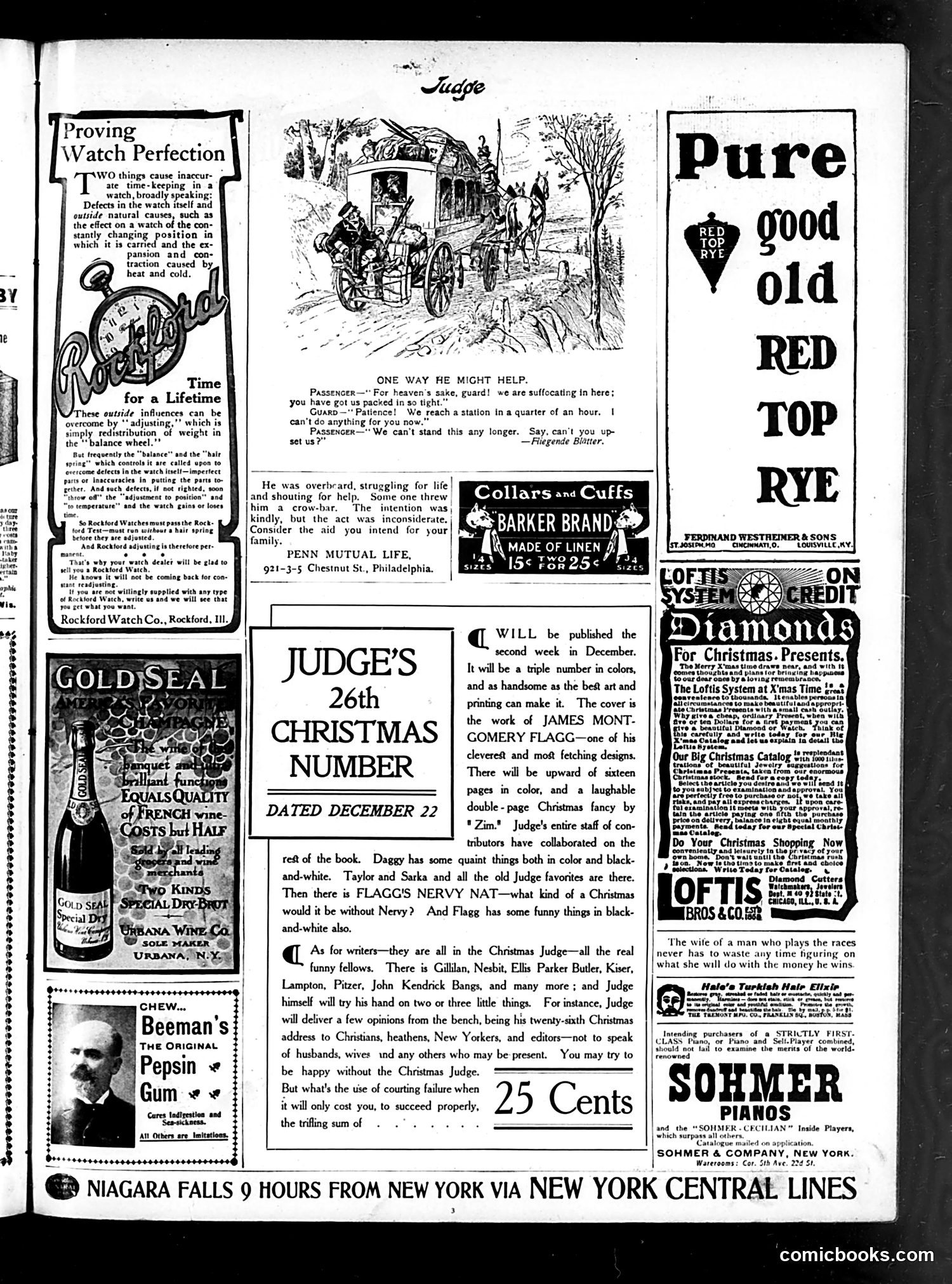
This is primarily an **advertising and announcement page** from Judge magazine's Christmas issue (dated December 22). ## Main Content: The central feature announces Judge's **26th Christmas Number**, promoting its December 2nd publication at 25 cents. The text highlights contributions from humorists (Gillilan, Ellis Parker Butler, John Kendrick Bangs) and artist James Montgomery Flagg's cover design. It mentions "Nervy Nat," apparently a recurring Judge character. ## Cartoons: A small cartoon titled "ONE WAY HE MIGHT HELP" depicts a railway guard dismissing passengers' complaints about overcrowding—satirizing unhelpful official responses to legitimate grievances. Another cartoon shows someone throwing a crow-bar to a drowning man—a darkly humorous commentary on well-intentioned but thoughtless assistance. ## Advertisements: The page is dominated by period ads for watches (Rockford), wine (Gold Seal), collars (Barker Brand), pianos (Sohmer), and other goods—typical of Judge's commercial model.
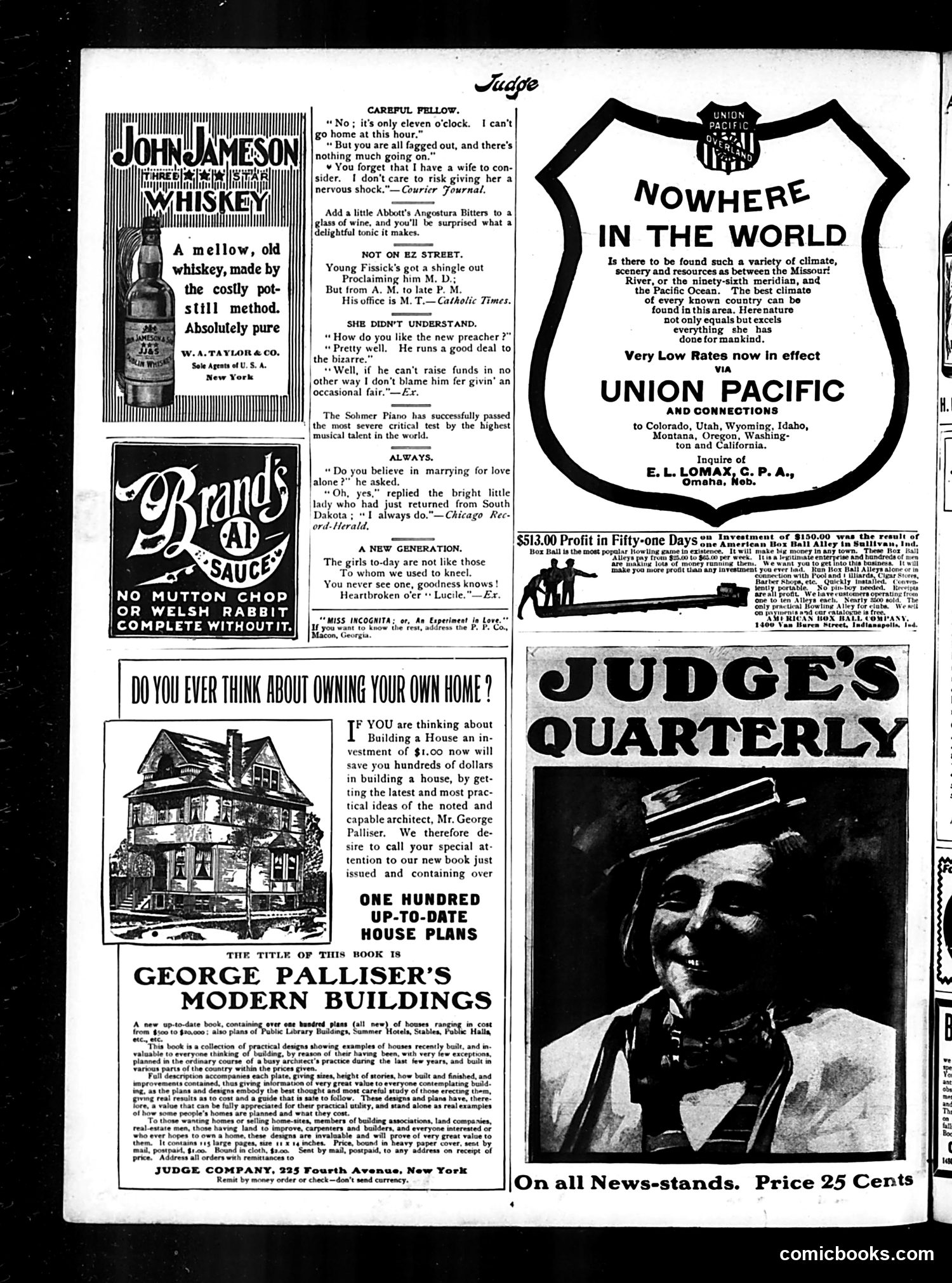
This is primarily an **advertising and humor miscellany page**, not a cohesive political cartoon. The content includes: **Advertisements** dominate: whiskey, sauce, house-building plans, Union Pacific railway, a "Box Ball" bowling game investment scheme, and Judge's Quarterly magazine. **Humor snippets** scattered throughout are mild, domestic jokes—a husband afraid to come home late lest he upset his wife; a young doctor with no patients; confusion over a preacher's "bizarre" style. These reflect early-20th-century domestic anxieties and small-town life but lack sharp political satire. **One notable element**: the "Nowhere in the World" Union Pacific ad uses hyperbolic language promoting American Western expansion and development, reflecting era-typical boosterism. The page reveals Judge's business model: **satirical magazine subsidized by advertisements** rather than driven by specific political commentary. The humor is generic, genteel, and inoffensive—aimed at middle-class readers.
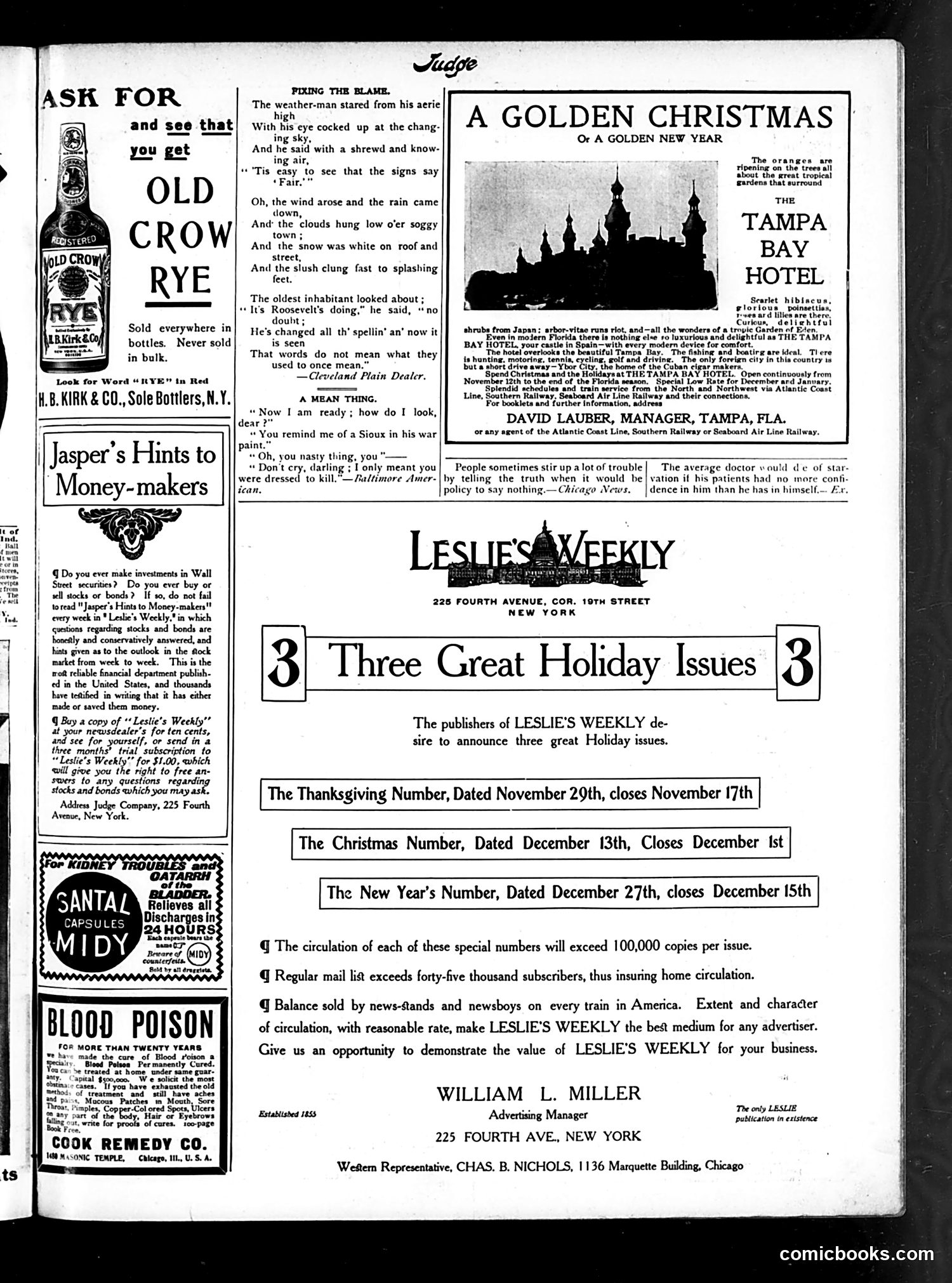
This is primarily an **advertising and announcements page** from Judge magazine, with minimal political cartoon content. The main satirical piece is a brief poem titled "A Mean Thing," where a woman insults a man's appearance by saying he looks like "a Sioux in his war paint" when he's dressed up. The joke relies on period stereotypes about Native American appearance—playing on the idea that colorful or distinctive dress is ridiculous or primitive. The page's other notable item is a short verse called "Fixing the Blame," where an old man attributes weather changes and spelling reforms to President Roosevelt, sarcastically suggesting Roosevelt controls nature and has "changed all th' spellin'." This reflects early 1900s criticism of Roosevelt's Progressive-era reforms, including simplified spelling initiatives. The bulk of the page comprises advertisements for whiskey, financial advice columns, and a Tampa Bay hotel—typical magazine filler from this era. The political/social satire is minimal and relies on now-outdated stereotypes and period-specific references to Roosevelt's policies.
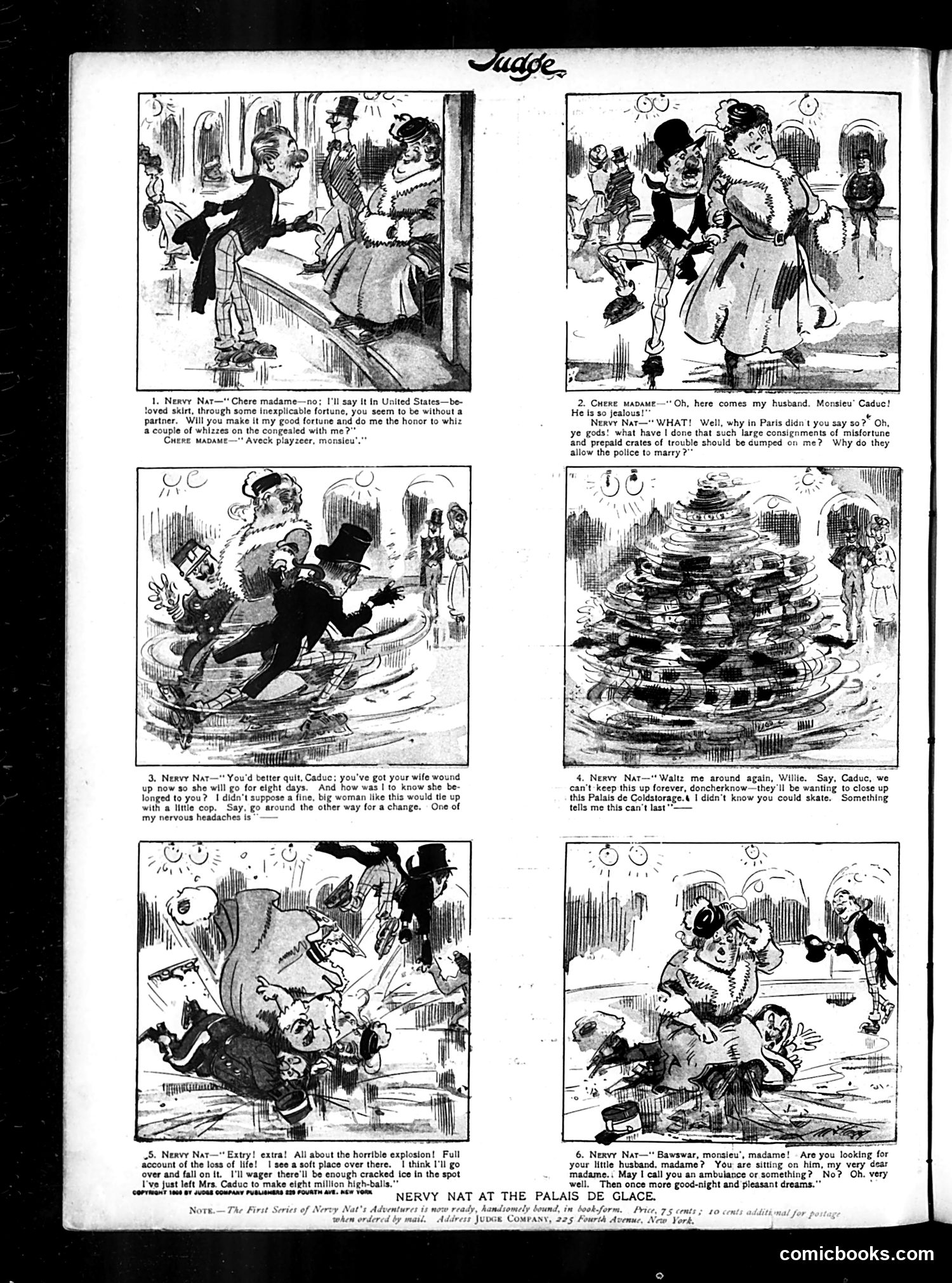
This six-panel comic strip follows "Nervy Nat," a hapless American character, through an ice-skating mishap in Paris. The humor relies on physical comedy and cultural collision: Nat encounters a French woman at an ice rink ("Palais de Glace"), doesn't realize she's married to a jealous French policeman (Monsieur Caduc), and inadvertently causes chaos—spinning her repeatedly until she's literally wound up like a top, then accidentally sitting on her during skating. The satire targets American naïveté abroad: Nat speaks broken French, misunderstands social conventions, and treats the situation with oblivious cheerfulness despite escalating disaster. The comic plays on stereotypes of Americans as bumbling foreigners and French husbands as absurdly jealous. The title character's "nerve" (audacity) is both his defining trait and the source of his downfall—typical of early Judge magazine's gentle mockery of American types.