
Judge, 1906-11-17 · page 4 of 16
Judge — November 17, 1906 — page 4: what you’re looking at
What you’re looking at
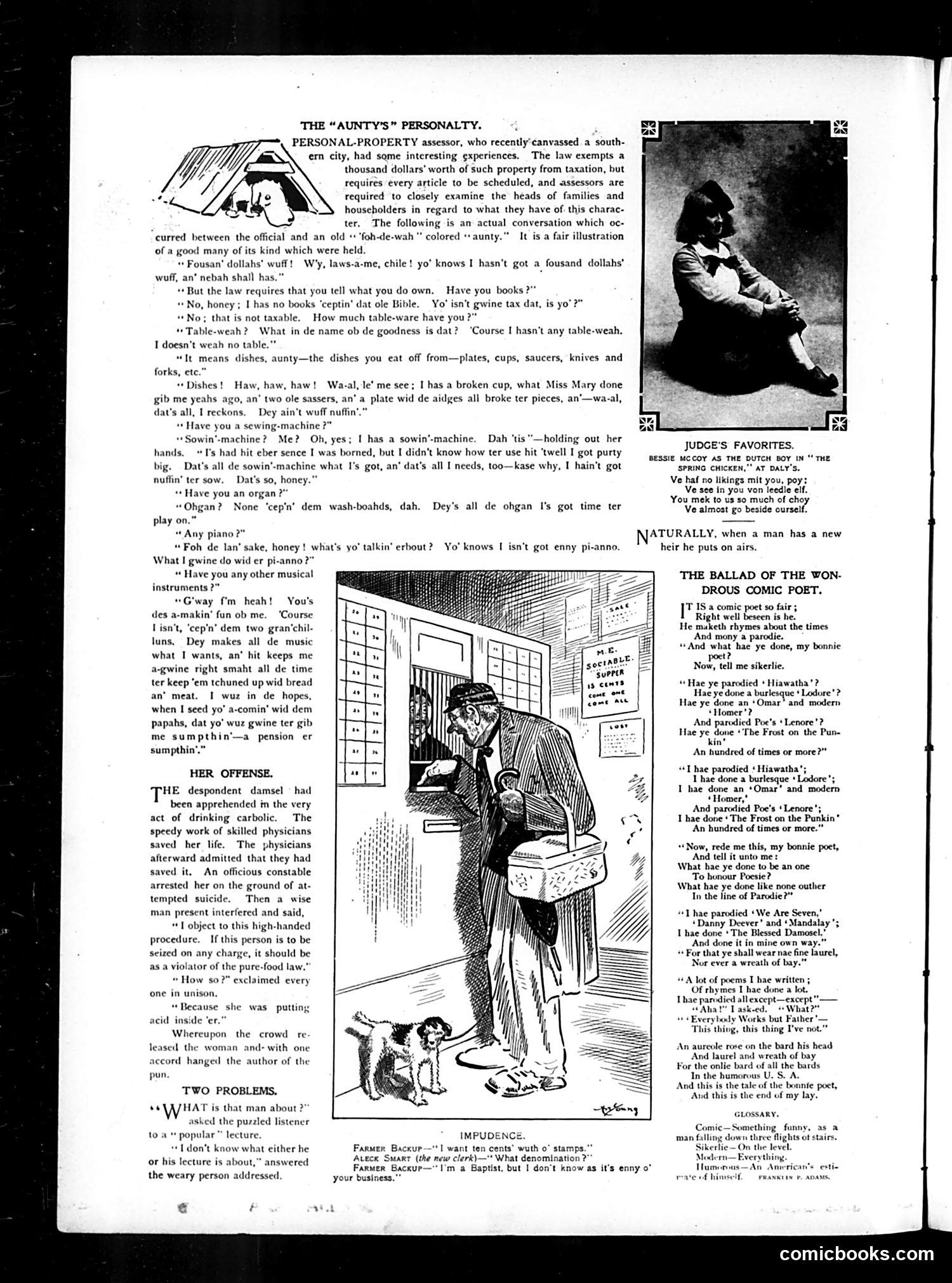
This page contains several distinct satirical pieces rather than a single cartoon. **"The Auntys' Personality"** features a dialogue between a property assessor and an elderly woman ("Aunty"), mocking her reluctance to declare taxable possessions. The humor relies on her evasive responses about owning books, dishes, and a sewing machine—common household items that represent hidden wealth. **"Her Offense"** describes a woman who attempted suicide after her husband's infidelity was exposed in court proceedings. The satire criticizes the legal system for public humiliation. **"The Ballad of the Wondrous Comic Poet"** parodies contemporary poetry by listing absurdly exaggerated poem titles about common subjects. The illustrations are period sketches typical of early 20th-century satirical magazines, targeting everyday social hypocrisy and legal absurdities rather than specific political figures.
📄 Transcribed text from this page (OCR, searchable)
Machine-transcribed from the original scan — historical spelling and the odd misread are preserved.
‘THE “AUNTY’S” PERSONALTY. i PERSONAL-PROPERTY assessor, who recently’canvassed a south- ern city, had some interesting gxperiences. The law exempts a thousand dollars’ worth of such property from taxation, but requires every article to be scheduled, and assessors are required to closely examine the heads of families and householders in regard to what they have of. this charac- ter. The following is an actual conversation which oc- “curred between the official and an old ++ ‘foh-de-wah” colored “+ aunty.” It is a fair illustration of a good many of its kind which were held. “+ Fousan’ dollahs’ wuff! Wy, laws-a-me, chile! yo” knows I hasn't got a fousand dollahs’ wuff, an’ nebah shall has. . But the law requires that you tell what you do own, Have you books ?"” +No, honey ; I has no books ‘ceptin’ dat ole Bible. Yo isn’t gwine tax dat, is yo?" No; that is not taxable. How much table-ware have you?” Table-weah ? What in de name ob de goodness is dat? ‘Course I hasn't any table-weah. I doesn’t weah no table. “It means dishes, aunty—the dishes you eat off from—plates, cups, saucers, knives and forks, ete.” “Dishes! Haw, haw, haw! Wa-al,le’ me see; I has a broken cup, what Miss Mary done gib me yeahs ago, an’ two ole sassers, an’ a plate wid de aidges all broke ter pieces, an'—wa-al, dat’s all, I reckons. Dey ain’t wuff nuffin’, + Have you a sewing-machine ?” “«Sowin'-machine? Me? Oh, yes; I has a sowin’-machine. Dah ‘tis""—holding out her hands. “I's had hit eber sence I was borned, but I didn’t know how ter use hit ‘twell I got purty big. Dat's all de sowin'-machine what I's got, an’ dat’s all I needs, too—kase why, I hain’t got nuffin’ ter sow. Dat's so, honey.” + Have you an organ?” “Ohgan? None ‘cep'n’ dem wash-boahds, dah. Dey’s all de ohgan I's got time ter play on.” “Any piano?" “ Foh de lan’ sake, honey! what's yo" talkin’ erbout?- Yo" knows I isn’t got enny pi-anno. What I gwine do wid er pi-anno?” “ Have you any other musical instruments ?” “Giway f'm heah! You's des a-makin’ fun ob me. ‘Course I isn’t, ‘cep'n’ dem two gran’chil- luns, Dey makes all de music what T wants, an’ hit keeps me agwine right smaht all de time ter keep ‘em tchuned up wid bread an’ meat. I wuz in de hopes, when I seed yo’ a-comin’ wid dem papahs, dat yo’ wuz gwine ter gib me sumpthin'—a pension er sumpthin’.” HER OFFENSE. THE despondent damsel had been apprehended in the very act of drinking carbolic. The speedy work of skilled physicians saved her life. The physicians afterward admitted that they had saved it. An officious constable arrested her on the ground of at- tempted suicide. Then a wise man present interfered and said, *L object to this high-handed procedure. If this person is to be seized on any charge, it should be as a violator of the pure-food law.” * How so?" exclaimed every one in unison, “Because she was putting acid inside ‘er.” Whereupon the crowd re leased the woman and with one accord hanged the author of the pun. TWO PROBLEMS. SOYVHAT is that man about? asked the puzzled listener to a“ popular” lecture, + Ldon’t know what either he Faruer Backur—"'| want ten cents’ wuth o° stamps.” or his lecture is about,” answered Aveck Smart (the new clerk)—"* What denomination ? the weary person addressed your business.” os: q JUDGE'S FAVORITES. BESSIE MCCOY AS THE DUTCH BOY IN" THE SPRING CHICKEN," AT DALY'S. Ve haf no likings mit you, poy; Ve see in you von leedie elf. You mek to us so much of choy Ve almost go beside ourself. ATURALLY, when a man has a new heir he puts on airs, THE BALLAD OF THE WON- DROUS COMIC POET. [7 1S. comic poet so fairs Right well beseen is he. He maketh rhymes about the times And mony a parodie. “And what hae ye done, my bonnie poet? Now, tell me sikerlie. ea “Hae ye parodied * Hiawatha’? Hae ye done a burlesque + Lodore'? Hae ye done an ‘Omar’ and modern * Homer’? And parodied Poe's Lenore’? Hae ye done “The Frost on the Pun- kin® An hundred of times or more?” “hae parodied ‘ Hiawatha’; Thae done a burlesque * Lodore"; I hae done an ‘Omar’ and modern ‘ Homer," And parodied Poe's ‘Lenore’; T hae done * The Frost on the Punkin* ‘An hundred of times or more. “Now, rede me this, my bonnie poet, And tell it unto me: What hae ye done to be an one To honour Poesie? What hae ye done like none outher In the line of Parodie?” “1 hae parodied ‘We Are Seven,’ “Danny Deever’ and ‘Mandalay *; Thae done ‘The Blessed Damose! And done it in mine own way. «For that ye shall wear nae fine laurel, Nor ever a wreath of bay.” <A lot of poems T hae written ; Of rhymes I hae done a lot. Thae pared An aureole rose on the bard his head And laurel and wreath of bay For the onlie bard of all the bards In the humorous U. And this is the tale of t And this is the end GLOSSARY. Comic—Something funny, as man falling down three flights of stairs. Sikerlie~On the le' Mod Farmer Backur—"'I'm a Baptist, but | don't know as it's enny o° Hun rate of hime comicbooks.com