
Judge, 1906-11-17 · page 10 of 16
Judge — November 17, 1906 — page 10: what you’re looking at
What you’re looking at
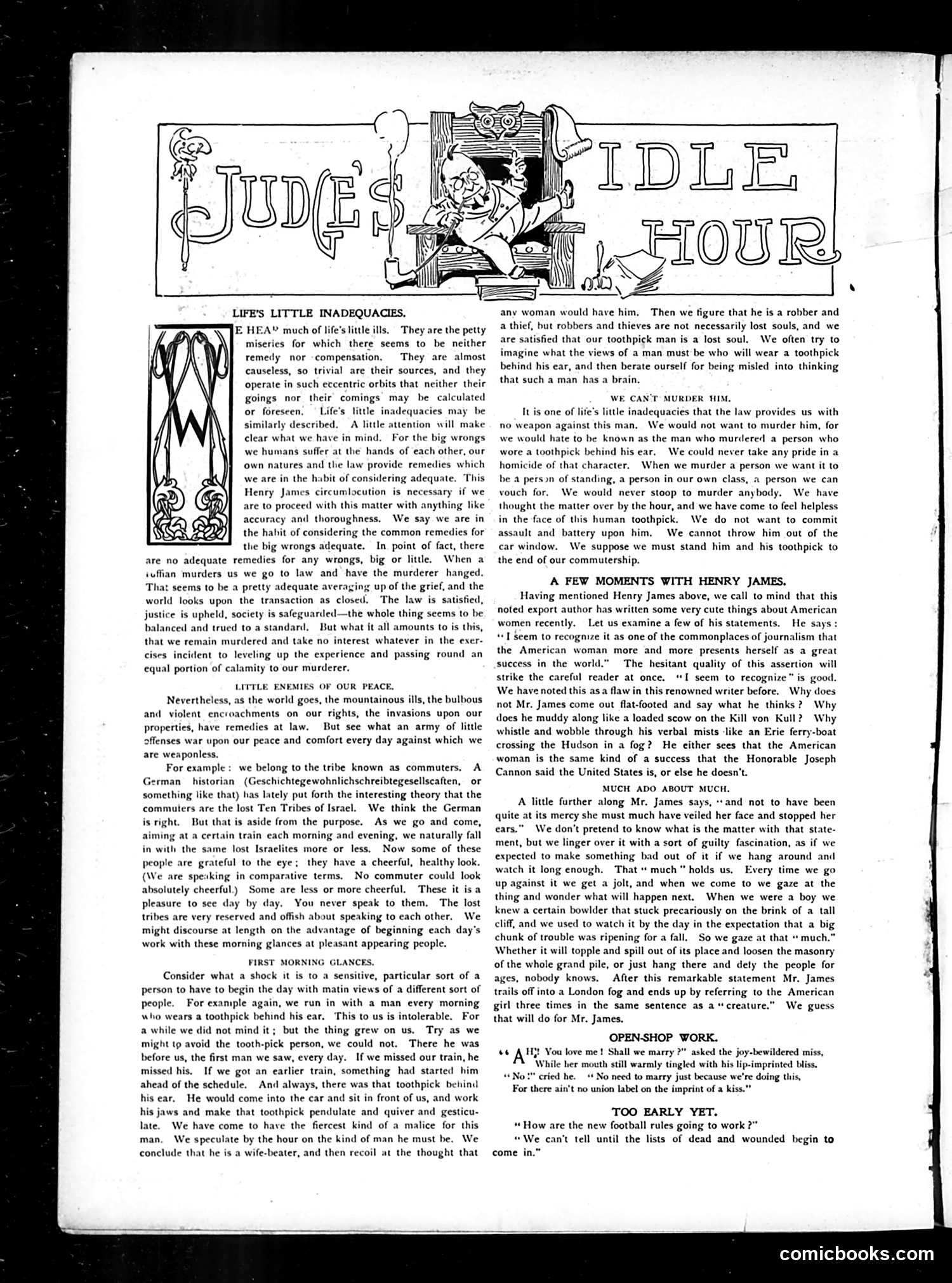
This page from *Judge* magazine satirizes society's obsession with major crimes and injustices while ignoring the daily irritations that truly poison life. The essay argues that while murder has legal remedies (execution), there are "no adequate remedies" for the petty miseries we endure constantly. The specific example targets commuters—humorously called "the lost Ten Tribes of Israel." The author describes harboring intense hatred for a fellow commuter who wears a toothpick behind his ear. This absurdly trivial detail grows so unbearable through daily exposure that it generates genuine malice, yet society provides no legal recourse. The satire's point: we've perfected justice for serious wrongs but remain "weaponless" against the small annoyances—unpleasant strangers, irritating habits—that genuinely damage our peace of mind. The humor derives from treating this commuter's toothpick with the gravity usually reserved for actual crimes.
📄 Transcribed text from this page (OCR, searchable)
Machine-transcribed from the original scan — historical spelling and the odd misread are preserved.
LIFE'S LITTLE INADEQUACIES. E HEA® much of life’slittle ills. They are the petty miseries for which there seems to be neither remedy nor -compensation, They are almost causeless, so trivial are their sources, and they operate in such eccentric orbits that neither their goings nor their comings may be calculated or foreseen, — Life’s little inadequacies may be similarly described. A little attention will make clear what we have in mind, For the big wrongs we humans suffer at the hands of each other, our own natures and the law provide remedies which we are in the habit of considering adequate. Henry James circumlocution is necessary if we are to proceed with this matter with anything like accuracy and thoroughness. We say we are in the habit of considering the common remedies for In point of fact, there When a the big wrongs adequate. are no adequate remedies for any wrongs, big or little. ‘uffian murders us we go to law and have the murderer hanged. That seems to be a pretty adequate averaging up of the grief, and the world looks upon the transaction as closed. The law is satisfied, justice is upheld, society is safeguarded—the whole thing seems to be balanced and trued to a standard, But what it all amounts to is this, that we remain murdered and take no interest whatever in the exer- cises incident to leveling up the experience and passing round an equal portion of calamity to our murderer. LITTLE ENEMIES OF OUR PEACE, Nevertheless, as the world goes, the mountainous ills, the bulbous and violent encroachments on our rights, the invasions upon our properties, have remedies at law. But see what an army of little offenses war upon our peace and comfort every day against which we are weaponless. For example : we belong to the tribe known as commuters. A German historian (Geschichtegewohnlichschreibtegesellscaften, or something like that) has lately put forth the interesting theory that the commuters are the lost Ten Tribes of Israel. We think the German is right. But that is aside from the purpose. As we go and come, aiming at a certain train each morning and evening, we naturally fall in with the same lost Israelites more or less. Now some of these people are grateful to the eye; they have a cheerful, healthy look. (We are spesking in comparative terms, No commuter could look absolutely cheerful.) Some are less or more cheerful. These it is a pleasure to see day by day, You never speak to them. The lost tribes are very reserved and offish about speaking to each other. We might discourse at length on the advantage of beginning each day's work with these morning glances at pleasant appearing people. FIRST MORNING GLANCES. Consider what a shock it is to a sensitive, particular sort of a person to have to begin the day with matin views of a different sort of people. For example again, we run in with a man every morning who wears a toothpick behind his ear, This to us is intolerable. For a while we did not mind it; but the thing grew on us. Try as we might tp avoid the tooth-pick person, we could not. There he was before us, the first man we saw, every day. If we missed our train, he missed his. If we got an earlier train, something had started him ahead of the schedule, And always, there was that toothpick behind his ear. He would come into the car and sit in front of us, and work his jaws and make that toothpick pendulate and quiver and gesticu- late. We have come to have the fiercest kind of a malice for this man. We speculate by the hour on the kind of man he must be. We conclude that he is a wife-beater, and then recoil at the thought that any woman would have him, Then we tigure that he is a robber and a thief, but robbers and thieves are not necessarily lost souls, and we are satisfied that our toothpick man is a lost soul. We often try to imagine what the views of a man must be who will wear a toothpick behind his ear, and then berate ourself for being misled into thinking that such a man has a brain. WE CAN'T MURDER HIM, It is one of life’s little inadequacies that the law provides us with no weapon against this man. We would not want to murder him, for we would hate to be known as the man who murdered a person who wore a toothpick behind his ear. We could never take any pride in a When we murder a person we want it to be a person of standing, a person in our own class, a person we can vouch for, We would never stoop to murder anybody. We have thought the matter over by the hour, and we have come to feel helpless in the face of this human toothpick. We do not want to commit assault and battery upon him, We cannot throw him out of the car window. We suppose we must stand him and his toothpick to the end of our commutership. A FEW MOMENTS WITH HENRY JAMES, Having mentioned Henry James above, we call to mind that this noted export author has written some very cute things about American women recently, Let us examine a few of his statements. He says: + 5eem to recognize it as one of the commonplaces of journalism that the American woman more and more presents herself as a great The hesitant quality of this assertion will “1 seem to recognize” is good. Why does homicide of that character, success in the world.” strike the careful reader at once. We have noted this as a flaw in this renowned writer before. not Mr. James come out flat-footed and say what he thinks? Why does he muddy along like a loaded scow on the Kill von Kull? Why whistle and wobble through his verbal mists -like an Erie ferry-boat crossing the Hudson in a fog? He either sees that the American woman is the same kind of a success that the Honorable Joseph Cannon said the United States is, or else he doesn't. MUCH ADO ABOUT MUCH. A little further along Mr. James says, and not to have been quite at its mercy she must much have veiled her face and stopped her ears.” We don’t pretend to know what is the matter with that state- ment, but we linger over it with a sort of guilty fascination, as if we expected to make something bad out of it if we hang around and watch it long enough. That“ much” holds us. Every time we go up against it we get a jolt, and when we come to we gaze at the thing and wonder what will happen next, When we were a boy we knew a certain bowlder that stuck precariously on the brink of a tall cliff, and we used to watch it by the day in the expectation that a big chunk of trouble was ripening for a fall. So we gaze at that “ much.” Whether it will topple and spill out of its place and loosen the masonry of the whole grand pile, or just hang there and dety the people for ages, nobody knows. After this remarkable statement Mr. James trails off into a London fog and ends up by referring to the American girl three times in the same sentence as a‘ creature.” We guess that will do for Mr. James. OPEN-SHOP WORK. +4 AH You love met Shall we marry" asked the joy-bewildered miss, While her mouth still warmly tingled with his lip-imprinted bliss. “Not” cried he. ‘No need to marry just because we're doing this, For there ain't no union label on the imprint of a kiss. TOO EARLY YET. “ How are the new football rules going to work ?" “We can’t tell until the lists of dead and wounded begin to come in.” comicbooks.com