
Judge, 1906-11-17 · page 3 of 16
Judge — November 17, 1906 — page 3: what you’re looking at
What you’re looking at
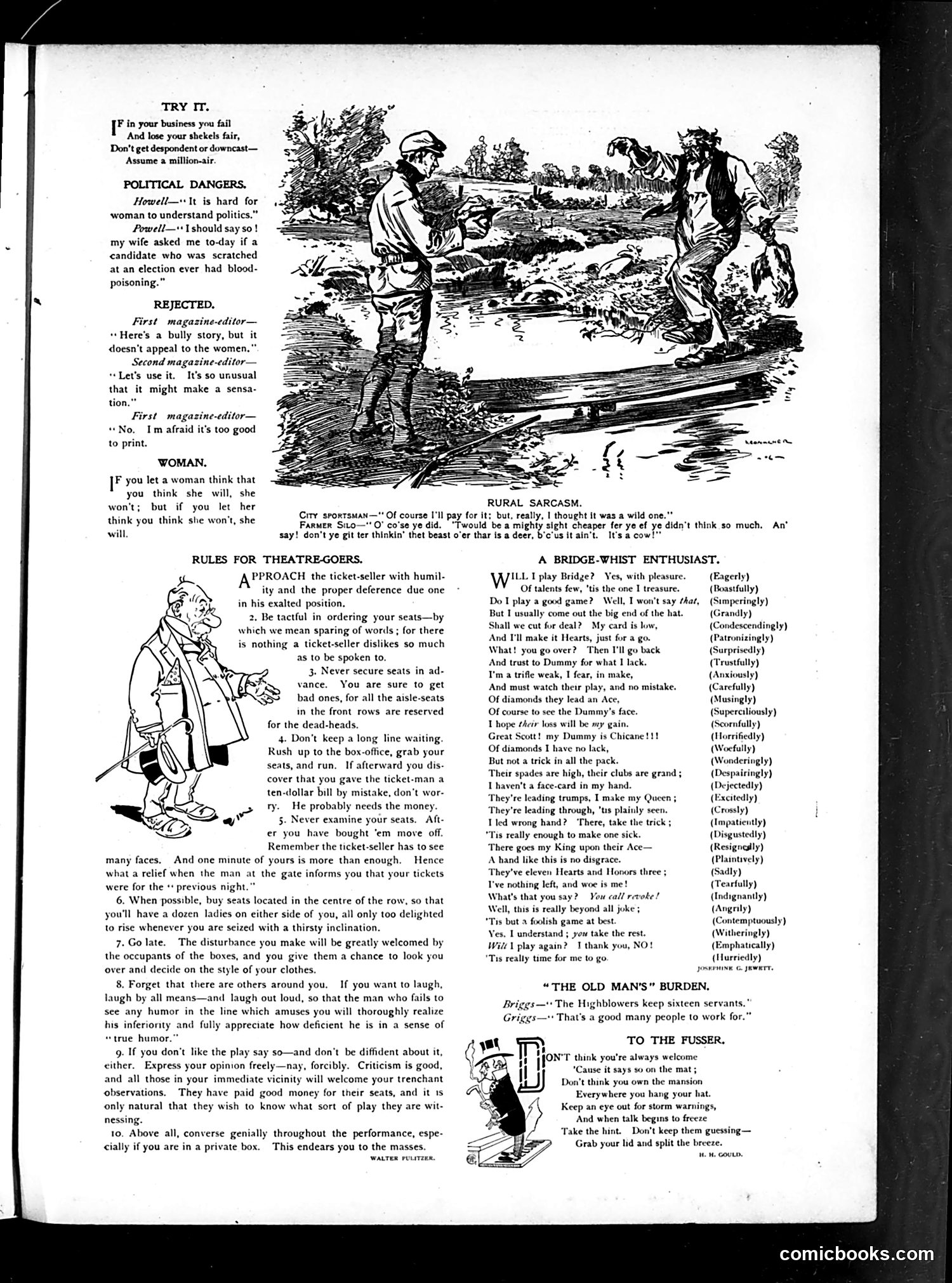
The main illustration depicts a **fishing scene with rural/working-class figures**, likely satirizing American attitudes toward politics and social class. The "Political Dangers" section mocks how women approach politics—a husband notes his wife asked if a candidate experienced "blood-poisoning" at an election, suggesting women voters lack serious political understanding. This reflects early 20th-century skepticism about female suffrage and women's political competence. The page also includes "Rules for Theatre-Goers," humorous etiquette advice for patrons, and various comic verses about Bridge, "The Old Man's Burden," and "To the Puss[er]"—light entertainment content typical of Judge's satirical format. The overall tone reflects period assumptions about gender, class, and proper social behavior.
📄 Transcribed text from this page (OCR, searchable)
Machine-transcribed from the original scan — historical spelling and the odd misread are preserved.
TRY IT. [F in roar business you fail ‘And lose your shekels fair, Don't get despondent or downcast— Assume a million-air. POLITICAL DANGERS. Howell—1t is hard for woman to understand politics.” Powell—"" should say so! my wife asked me to-day if a candidate who was scratched at an election ever had blood- poisoning.” REJECTED. First magazine-editor— “Here's a bully story, but it doesn’t appeal to the women.” Second magazine-editor— ++ Let's use it. It's so unusual that it might make a sensa- tion.” First magazine-editor— +No. Im afraid it’s too good to print. WOMAN. ]F you let a woman think that you think she will, she won't; but if you let her think you think she won't, she Faruer Sito—" 0° co'se ye did. RURAL SARCASM. Crrv srorrsuan—"' Of course I'll pay for it; but, really, | thought it was a wild one."* “Twould ‘be a mighty sight cheaper fer ye ef ye didn't think so much. An‘ will. say! don't ye git ter thinkin’ thet beast o'er thar is a deer, b’c’us it ain't. It's a cow!" RULES FOR THEATREGOERS. PPROACH the ticket-seller with humil- ity and the proper deference due one in his exalted position. 2. Be tactful in ordering your seats—by which we mean sparing of words ; for there is nothing a ticket-seller dislikes so much as to be spoken to. 3. Never secure seats in ad- You are sure to get bad ones, for all the aisle-seats in the front rows are reserved for the dead-heads. 4. Don’t keep a long line waiting Rush up to the box-office, grab your seats, and run. If afterward you dis- cover that you gave the ticket-man a ten-dollar bill by mistake, don't wor- ty. He probably needs the money. 5. Never examine your seats. Aft- er you have bought ‘em move of. Remember the ticket-seller has to see many faces. And one minute of yours is more than enough. Hence what a relief when the man at the gate informs you that your tickets were for the previous night.” 6. When possible, buy seats located in the centre of the row, so that you'll have a dozen ladies on either side of you, all only too delighted to rise whenever you are seized with a thirsty inclination. 7.Go late. The disturbance you make will be greatly welcomed by the occupants of the boxes, and you give them a chance to look you over and decide on the style of your clothes. vance. 8. Forget that there are others around you, If you want to laugh, laugh by all means—and laugh out loud, so that the man who fails to see any humor in the line which amuses you will thoroughly realize his inferionty and fully appreciate how deficient he is in a sense of “true humor. 9. If you don’t like the play say so—and don’t be diffident about it, either. Express your opinion freely—nay, forcibly. Criticism is good, and all those in your immediate vicinity will welcome your trenchant observations. They have paid good money for their seats, and it 1s only natural that they wish to know what sort of play they are wit nessing. to. Above all, converse genially throughout the performance, espe- cially if you are in a private box. This endears you to the masses. wauren rourrzex A BRIDGE-WHIST ENTHUSIAST. Witt Lplay Bridge? Ves, with pleasure. Of talents few, 'tis the one I treasure. Do I play a good game? Well, I won't say that, But I usually come out the big end of the hat. Shall we cut for deal? My card is low, And T'll make it Hearts, just for a go. What! you go over? Then I'll go back And trust to Dummy for what I lack. I'ma trifle weak, I fear, in make, And must watch their play, and no mistake. Of diamonds they lead an Ace, Of course to see the Dummy’s face. T hope ¢heir loss will be my gain. Great Scott! my Dummy is Chicane!!! Of diamonds I have no lack, But not a trick in all the pack. Their spades are high, their clubs are grand ; Thaven’t a face-card in my hand. They're leading trumps, I make my Queer They're leading through, ‘tis plainly see Ted wrong hand? ‘There, take the trick “Tis really enough to make one sick. There goes my King upon their Ace— A hand like this is no disgrace. They've eleven Hearts and Honors three ; T've nothing left, and woe is met What's that you say? You call revoke! Well, this is really beyond all joke; ‘Tis but a foolish game at best. Yes, L understand ; you take the rest. Witt play again? I thank you, NOt "Tis really time for me to go. (Eagerly) (Boastfully) (Simperingly) (Grandly) (Condescendingly) (Patronizingly) (Surprisedly) (Trustfully) (Anxiously) (Carefully) (Musingly) (Superciliously) (Scornfully) (lorrifiedly) (Woefully) (Wonderingly) (Despairingly) (Dejectedly) itedly) (Crossly) (Impatiently) (Disgustedly) (Resigneslly) (Pluntively) (Sadly) (Tearfully) (Indignantly) (Angnily) (Contemptuously) (Witheringly) (Emphatically) (Hurriedly) JOSIAUNE G JRWIEFT “THE OLD MAN'S” BURDEN. Briggs —“ The Highblowers keep sixteen servants.” Griggs— That's a good many people to work for.” TO THE FUSSER. H VION'T think you're always welcome "Cause it says so on the mat; Don’t think you own the mansi Everywhere you hang your hat. Keep an eye out for storm warnings, And when talk begins to freeze ‘Take the hint. Don't keep them guessing — Grab your lid and split the breeze. MM. CouLD, comicbooks.com