
A complete issue · 16 pages · 1906
Judge — October 20, 1906
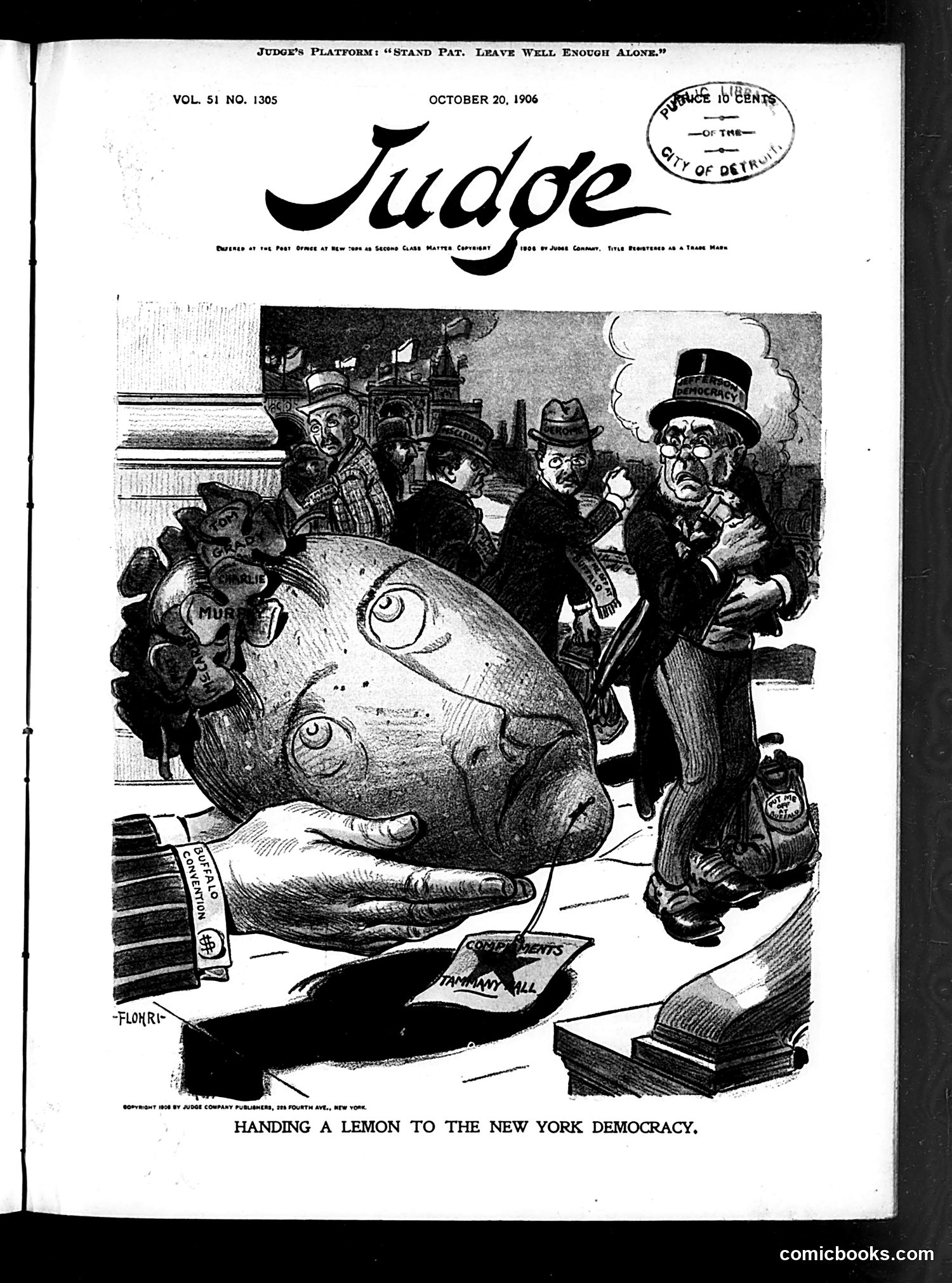
This Judge magazine cartoon from October 20, 1906 uses the metaphor of a "lemon" (something defective or worthless) to satirize New York's Democratic Party. A large hand labeled "FLOYD" (likely referring to a political figure of that era) presents a grotesque, bulbous head—caricatured with exaggerated features suggesting incompetence or poor leadership—to a group of well-dressed politicians and party members gathered below. The "lemon" represents what the cartoonist views as a flawed Democratic candidate or platform being forced upon the party. The satirical point: New York Democrats are being handed damaged goods they must accept, criticizing either party leadership decisions or an unfavorable nomination choice during this election cycle.
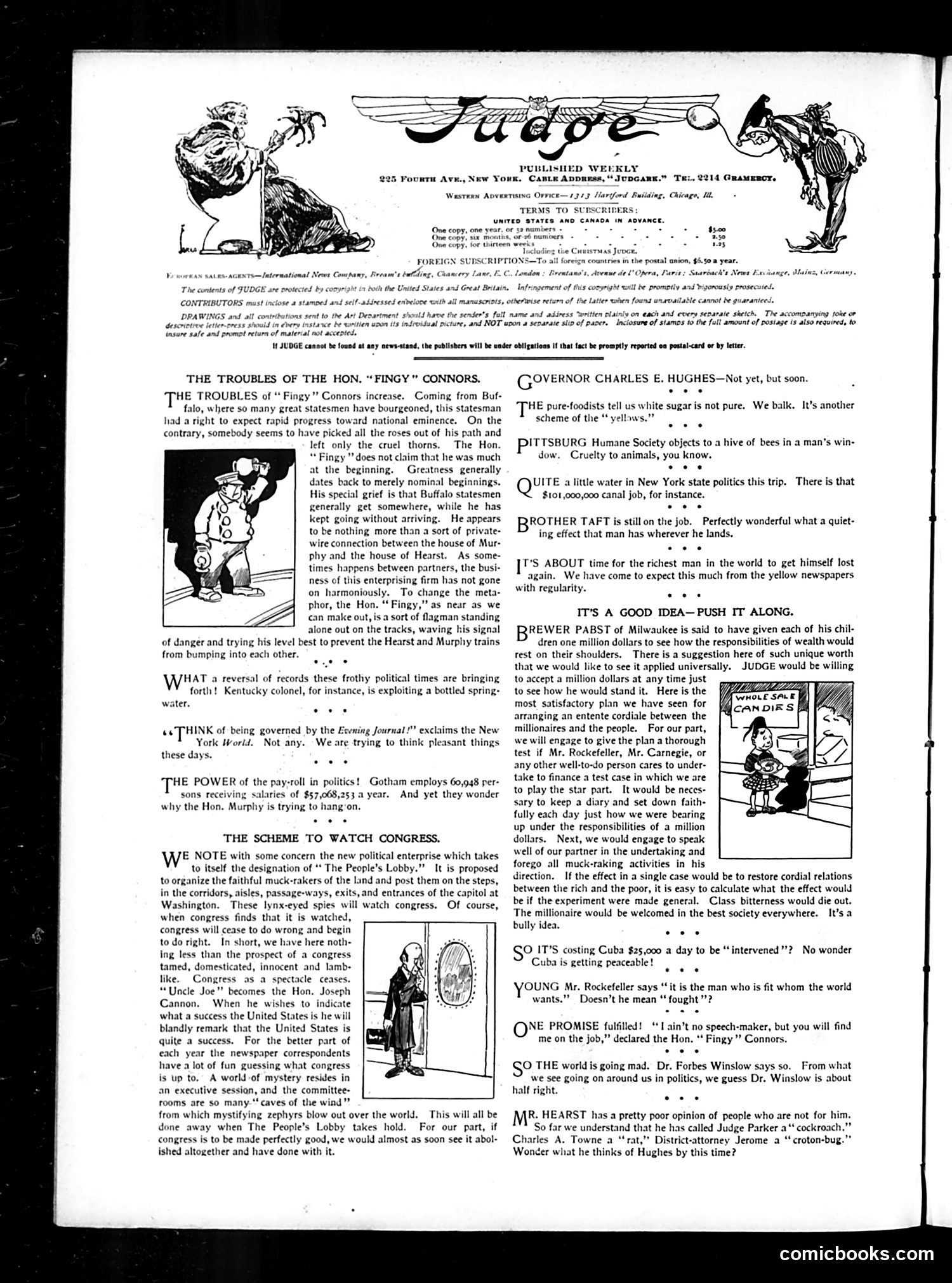
This page satirizes political figures and events from the early 1900s. The main article, "The Troubles of the Hon. 'Fingy' Connors," mocks a Buffalo politician experiencing difficulties. The cartoon shows a rotund figure struggling with his vest, illustrating the text's complaint that Connors "does not claim that he was much at the beginning." The right column contains brief political commentary items mocking various figures: Governor Charles E. Hughes, Brother Taft, Brewer Pabst, and others. These short quips ridicule their public statements or actions through wordplay. The cartoons employ caricature and exaggeration typical of Judge's satirical style—visual humor paired with sharp political commentary. Without knowing specific incidents referenced, the general targets appear to be political hypocrisy, wealth disparities, and public figures' contradictions between stated positions and actual behavior.
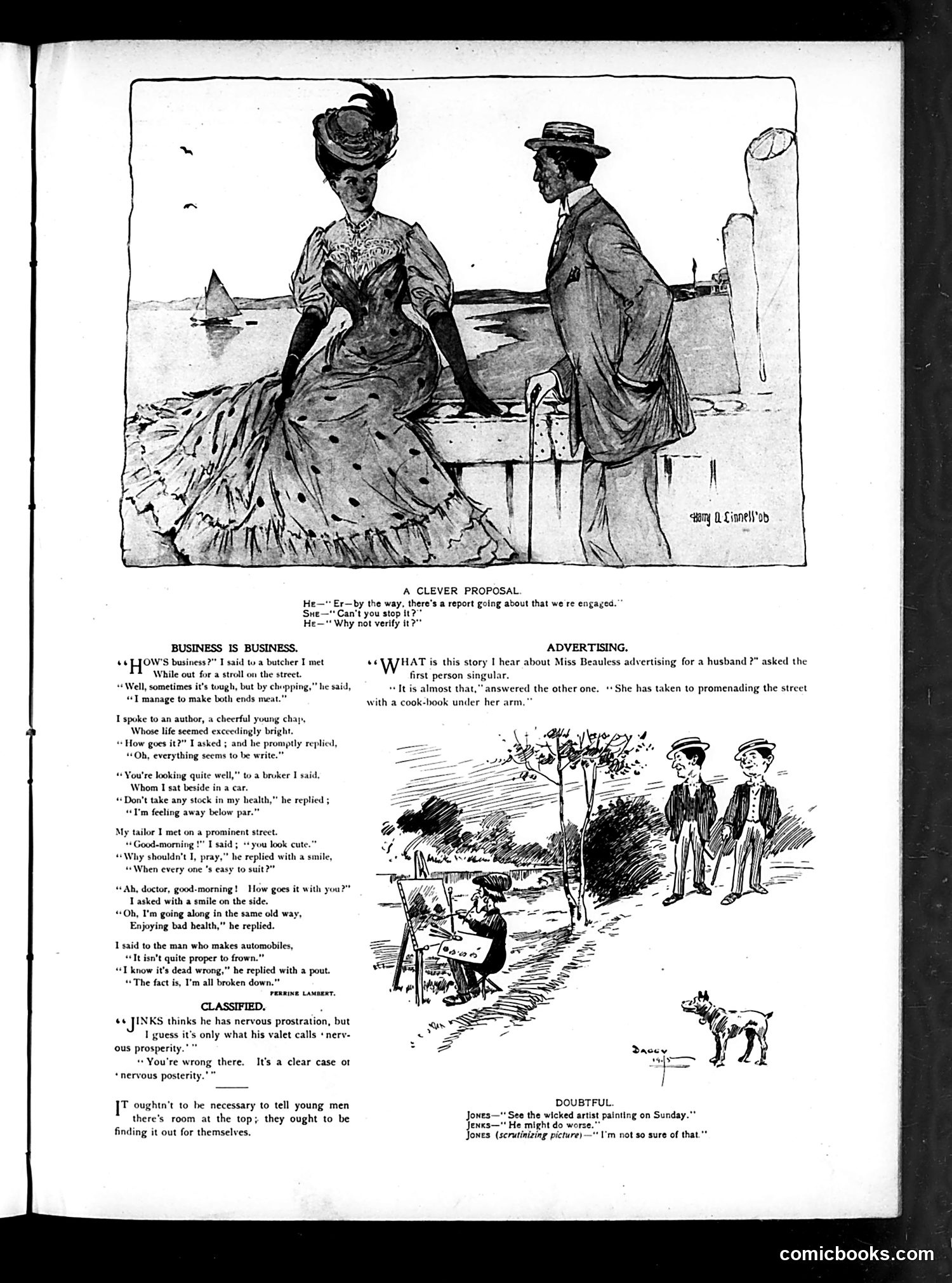
**Top Cartoon ("A Clever Proposal"):** A woman in elaborate Edwardian dress sits on a beach bench while a man in a straw hat stands nearby. The dialogue suggests she's heard rumors about his engagement and tests whether he'll deny them—he asks why she won't verify the rumor herself. The satire mocks courtship conventions: rather than directly confirming or denying his romantic status, he deflects by questioning her skepticism. This plays on early 1900s social awkwardness around marriage proposals and gossip. **Lower Content:** The page contains several humorous short pieces ("Business is Business," "Advertising," "Classified," "Doubtful") depicting everyday social situations—interactions with tradespeople, artists, and ordinary encounters. These satirize contemporary manners, pretension, and the gap between appearances and reality in Edwardian society.
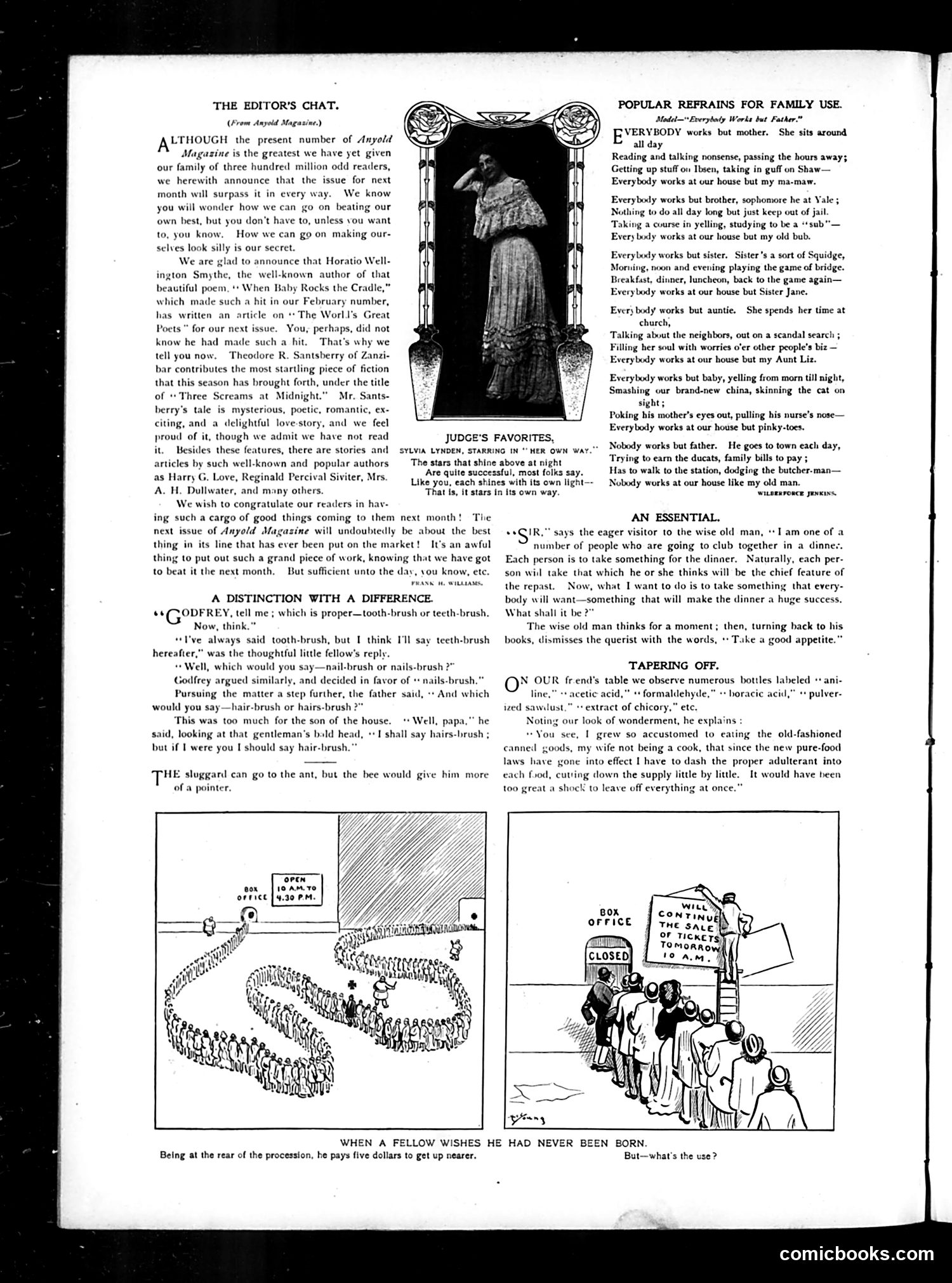
This page contains several distinct features: **"The Editor's Chat"** announces Judge Magazine's circulation growth and upcoming content, including articles by established authors like Hjalmar Hjorth Boyesen and Theodore Roosevelt's sister. **"Judge's Favorites"** features Sylvia Lynden in what appears to be a theatrical production titled "Her Own Way." **Two political cartoons** appear at the bottom. The left cartoon shows a massive queue of people at a box office, satirizing either ticket demand or public interest in some event. The right cartoon depicts a closed box office with crowds waiting, captioned "When a Fellow Wishes He Had Never Been Born"—suggesting frustration with poor service or access issues. The humor relies on depicting bureaucratic inefficiency and public inconvenience, though the specific event referenced is unclear from the image alone.
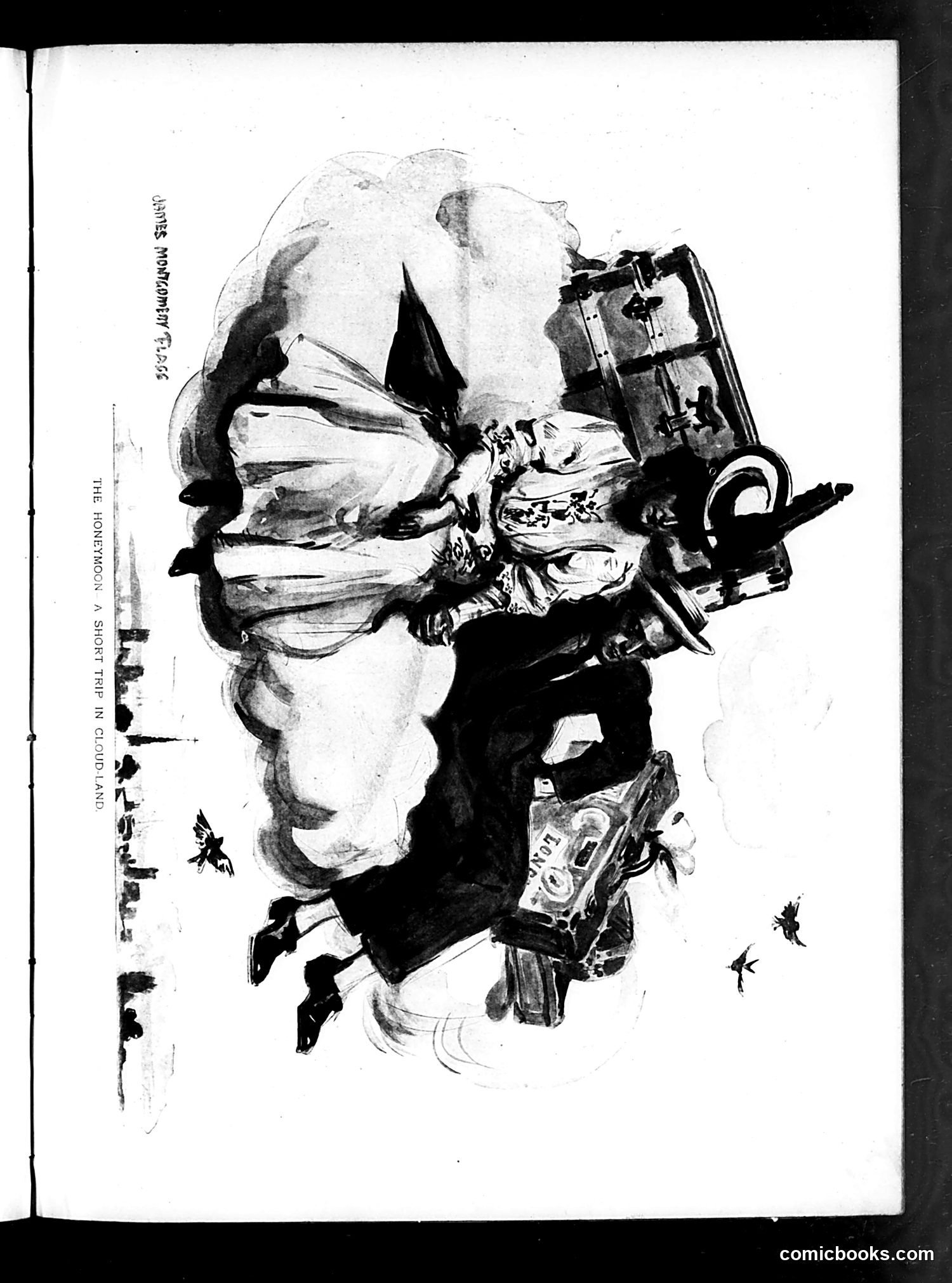
This appears to be a Judge magazine cartoon page, though the OCR text is too degraded to read clearly. The image itself shows a caricatured figure with exaggerated facial features holding what appears to be early film or photography equipment. The style and subject matter suggest this is satirizing someone involved in the emerging motion picture industry, likely from the early 20th century. The caricature emphasizes distinctive facial characteristics in typical Judge magazine fashion. The equipment and theatrical pose suggest commentary on the film industry or a specific filmmaker's pretensions or methods. However, without legible text identifying the subject and without clear historical context visible in the image alone, I cannot definitively state who is being caricatured or what specific event or controversy is being satirized. More context would be needed for accurate interpretation.
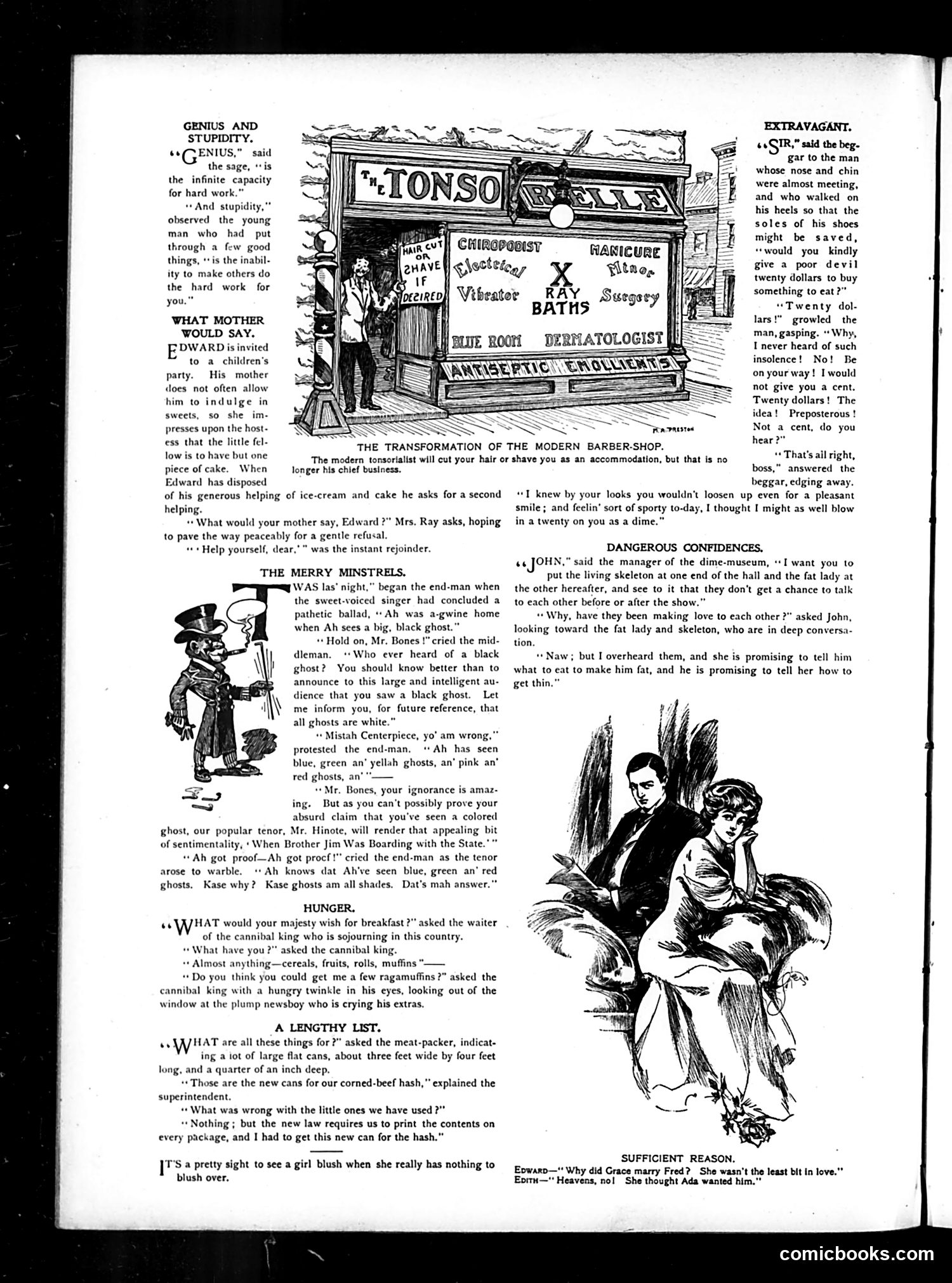
This page contains several short humorous pieces typical of Judge's satirical style: **"Genius and Stupidity"** contrasts a sage's definition of genius (capacity for hard work) with a young man's cynical view: genius is making *others* do the hard work—mocking both naïve idealism and shrewd self-interest. **"The Merry Minstrels"** depicts a minstrel show debate where performers argue about ghost colors. The middleman insists "all ghosts are white," while the end-man claims seeing colored ghosts. This reflects period racial attitudes embedded even in absurdist humor—the "joke" involves stereotyped dialect and casual racial assumptions. **"Hunger"** features a cannibal king in America asking for "ragamuffins" for breakfast, punning on the food term while eyeing a newsboy—combining exotic stereotype humor with commentary on poverty. **"The Transformation of the Modern Barber-Shop"** shows a barber-shop now offering chiropody, electrical treatments, and surgery—satirizing commercialization and over-expansion of services. Minor pieces mock stinginess, children's manners, and meat-packing regulations. The page emphasizes period-typical humor: class mockery, ethnic caricature, and social observation.
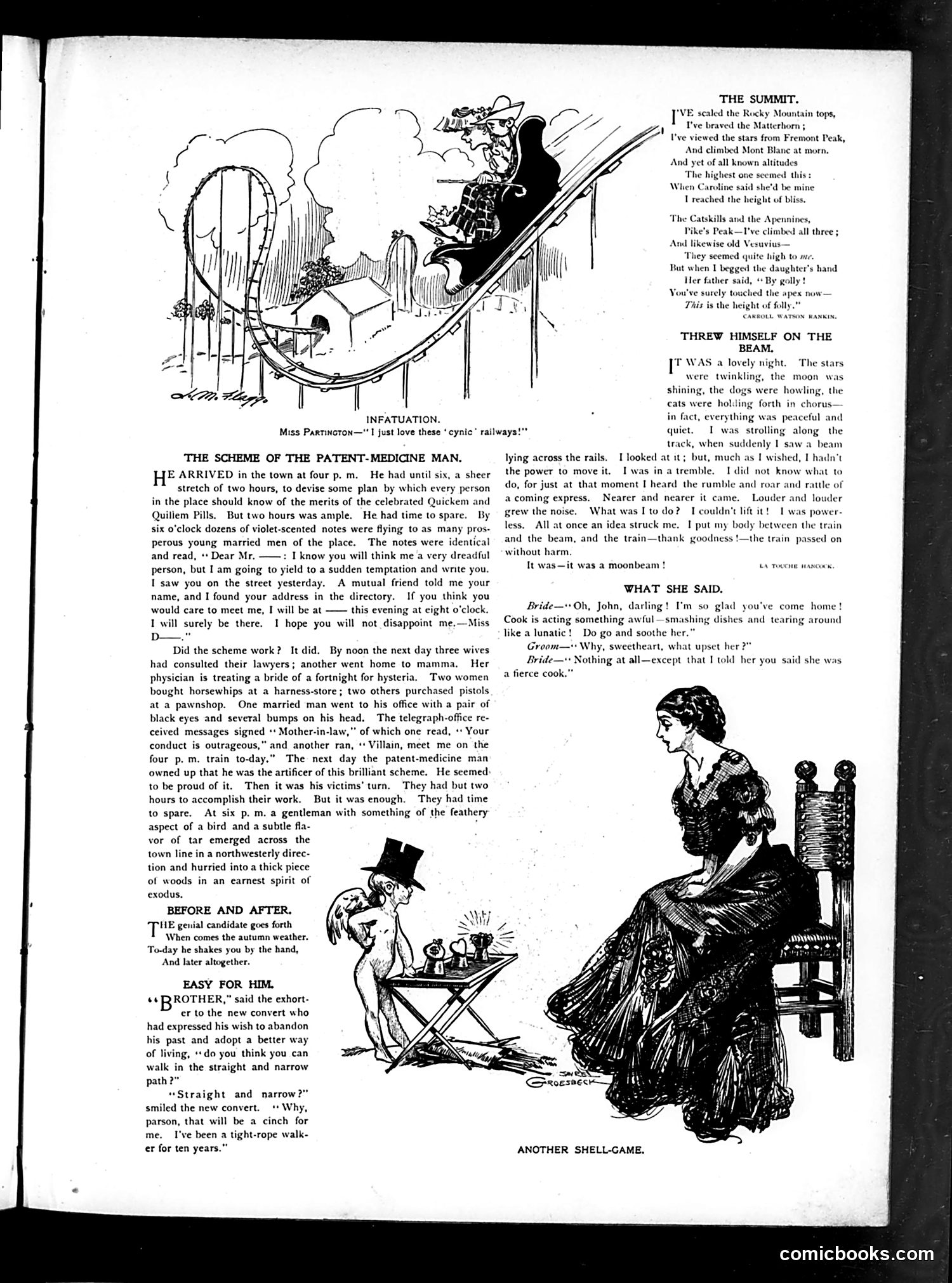
This page contains multiple satirical pieces mocking various social behaviors and types: **"The Scheme of the Patent-Medicine Man"** satirizes unscrupulous advertisers who use deceptive tactics. A medicine salesman sends fake love notes to married men to cause domestic chaos, apparently to generate publicity. The joke's dark humor lies in showing how his scheme backfires spectacularly—the victims unite against him, forcing him to flee town tarred and feathered. **"Before and After"** mocks politicians who court voters before elections then ignore them afterward. **"Easy for Him"** plays on a convert's misunderstanding—a reformed tightrope walker thinks the "straight and narrow path" of morality will be easy because he's skilled at literal tightropes. **"The Summit"** and **"Threw Himself on the Beam"** appear to be romantic/comedic verse pieces, typical of Judge's lighter content. The overall page reflects turn-of-century American anxieties about patent medicine fraud, political hypocrisy, and social pretension.
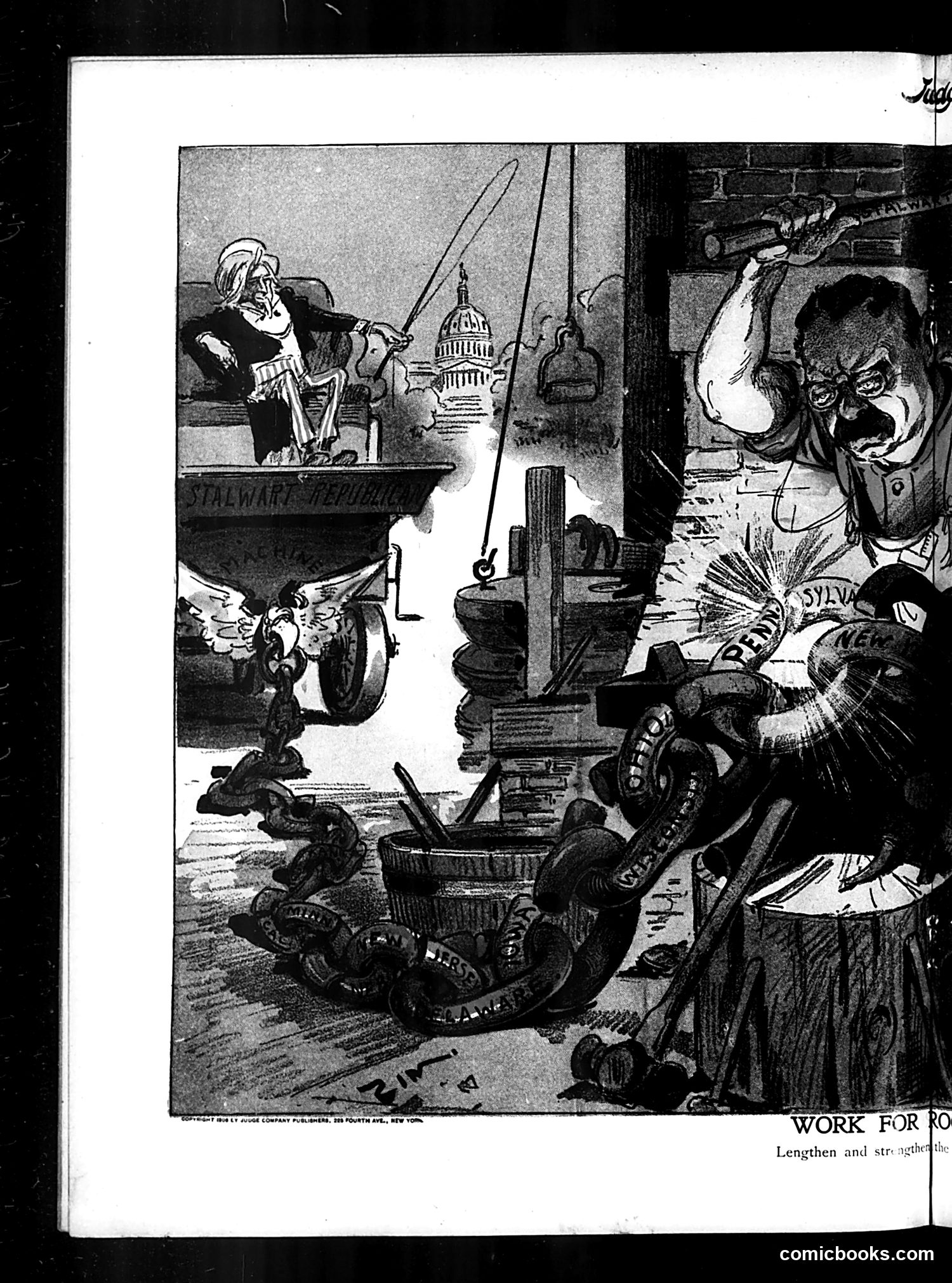
This political cartoon appears to satirize military-industrial corruption or defense spending. The left panel shows a figure (likely a politician or military official) at what appears to be a podium or government building with the Capitol visible behind him. The right panel depicts grotesque caricatured figures (possibly representing munitions manufacturers or defense contractors) emerging from or surrounded by weapons, ammunition, and industrial equipment. The satire suggests these figures are profiting from or manipulating government military decisions. The contrasting composition—dignified government on one side versus greedy industrialists on the other—critiques the relationship between political leadership and weapons manufacturers. The title fragment "WORK FOR..." suggests commentary on labor or economic aspects of military production.
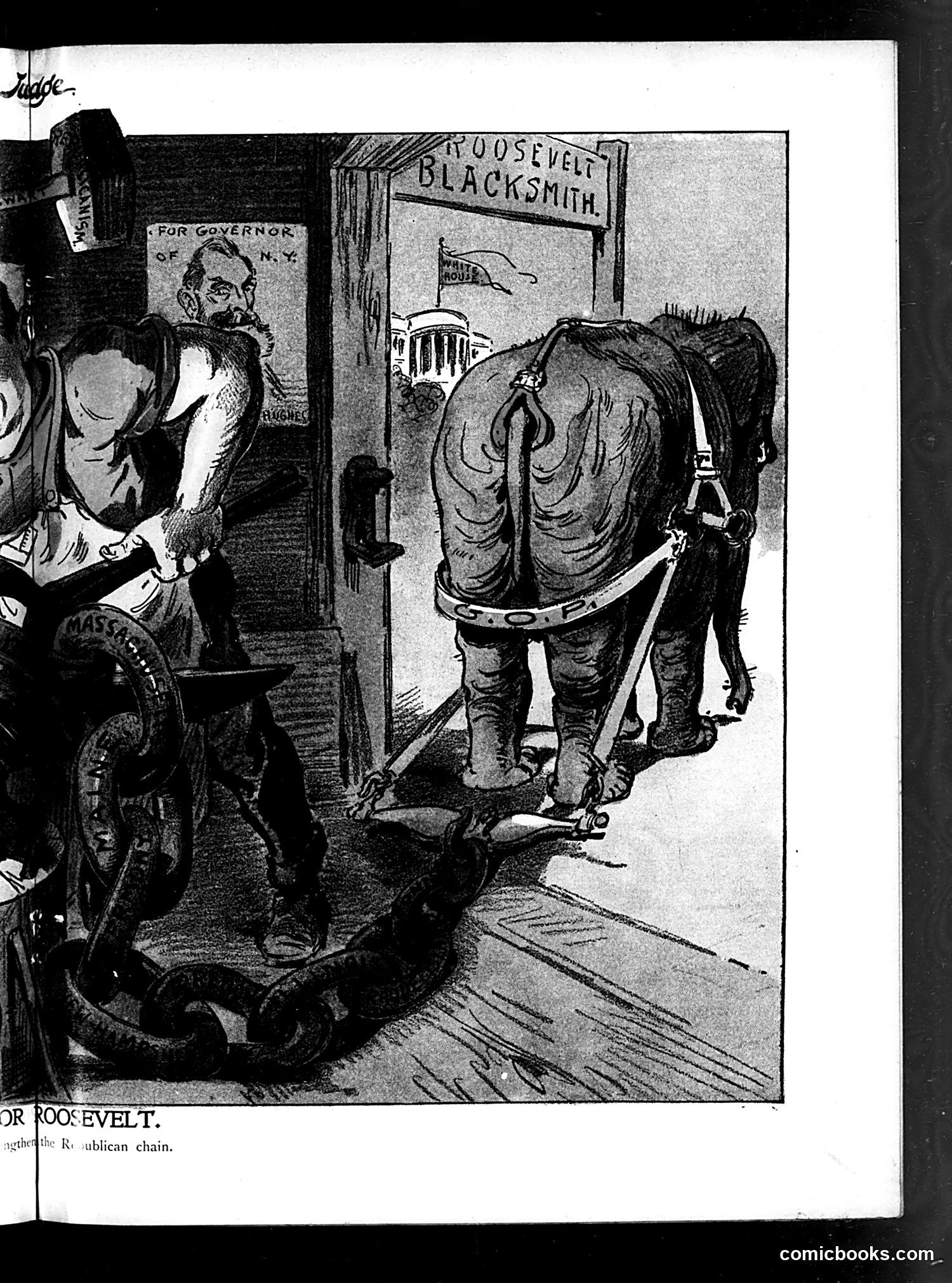
This Judge magazine cartoon satirizes Theodore Roosevelt's political positioning. On the left, a poster advertises a candidate "For Governor of N.Y." (likely a Roosevelt opponent). The main image shows a horse being led into a blacksmith shop labeled "Roosevelt Blacksmith," with the Capitol building visible in the background. The satire likely comments on Roosevelt "reshaping" or "forging" political alliances—treating politicians or the Republican Party like raw material to be worked in a forge. The horse, a traditional symbol of political machinery, suggests the cartoon critiques how Roosevelt manipulates or reforms the political establishment for his purposes. The text fragment mentioning "Republican chain" reinforces this metalworking metaphor applied to party politics.
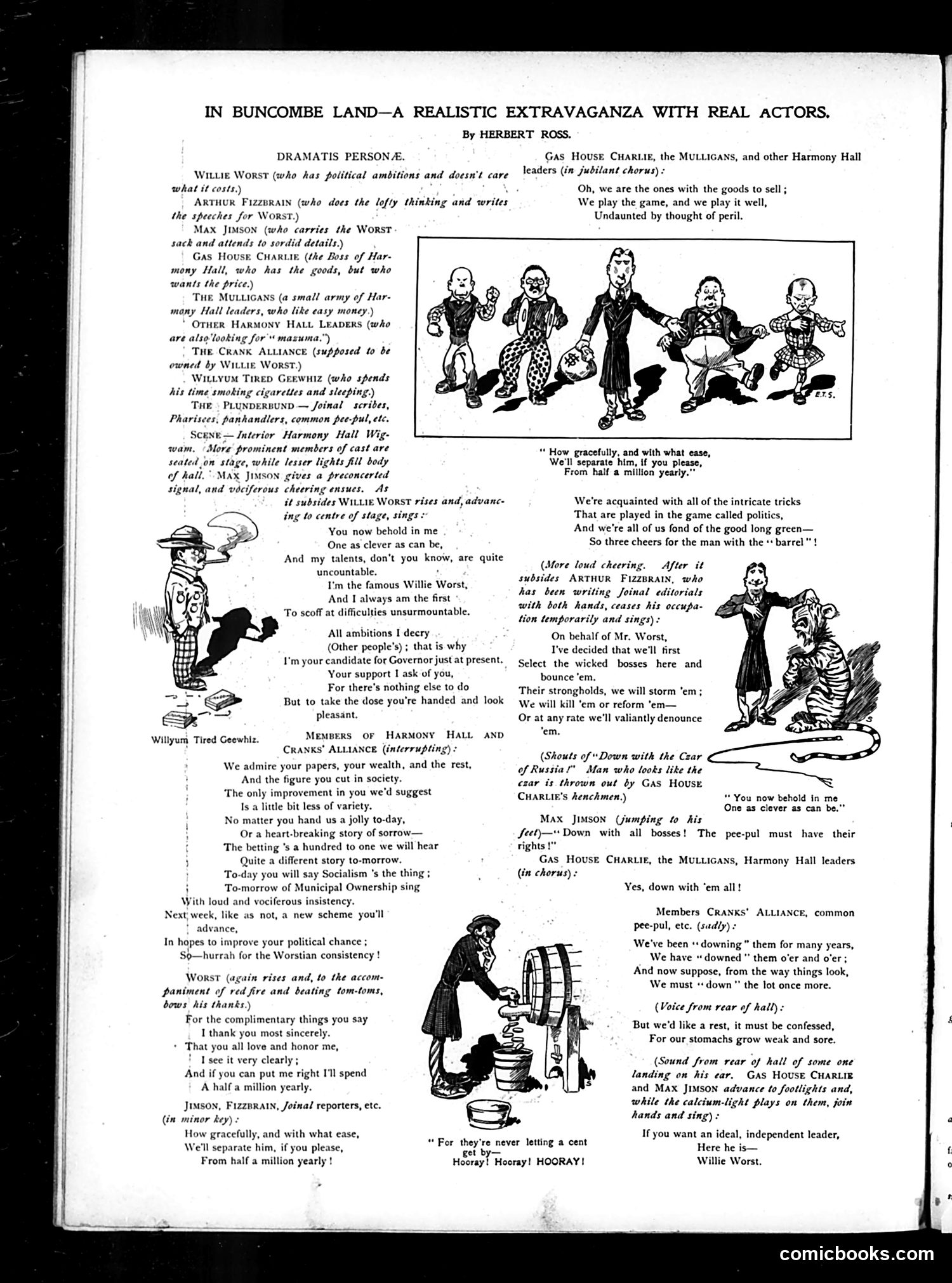
This satirical piece by Herbert Ross mocks a corrupt political campaign. **Willie Worst**, a cynical politician with unlimited money, represents a venal candidate. **Arthur Fizzbrain** (the speechwriter) crafts eloquent rhetoric masking dishonest intent. The **"Harmony Hall" bosses and Crank Alliance** are political machines and interest groups—depicted as self-serving operatives who will gladly accept bribes. The satire's core joke: Worst sings he's "uncountable" in talents while simultaneously promising voters a half-million annually—which his own cronies immediately plan to steal via political manipulation. The chorus mocks his flip-flopping positions (Socialism today, Municipal Ownership tomorrow), exposing his complete lack of principle. "Buncombe" (nonsense/empty political talk) perfectly captures the target: **wealthy, unprincipled candidates buying elections through promises they have no intention of keeping, while political machines and newspapers profit from the corruption.** It's a direct attack on Gilded Age machine politics and bought politicians.
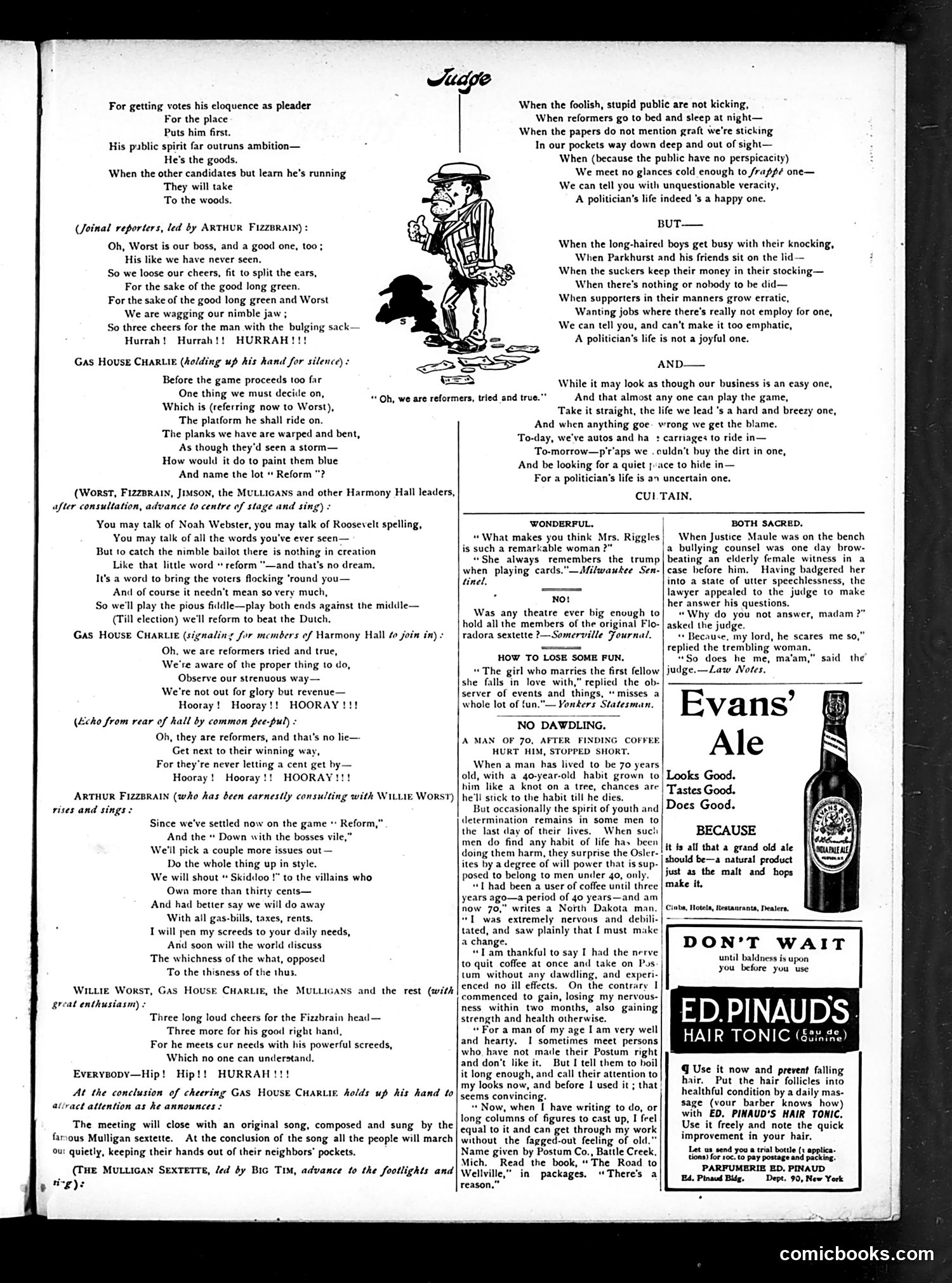
This page satirizes corrupt political machines, particularly Tammany Hall-style organizations that cynically exploit reform rhetoric. The central figure appears to be "Willie Worst," a corrupt political boss surrounded by sycophants (Fizzbrain, Gas House Charlie, the Mulligans) who cheerfully admit their hypocrisy. The satire's point: these "reformers" use the word "reform" as empty marketing—a word that "needn't mean so very much"—while actually enriching themselves through graft ("sticking in our pockets"). They'll adopt any popular issue (anti-boss sentiment, fighting monopolies) purely for votes, play "both ends against the middle," and maintain their schemes by keeping the public foolish and inattentive. The repeated "Hurrahs!" and enthusiastic songs underscore the brazen shamelessness: these politicians openly mock the public's gullibility while admitting they're "never letting a cent get by" for themselves. It's a biting critique of machine politics dressed in reformist clothing.
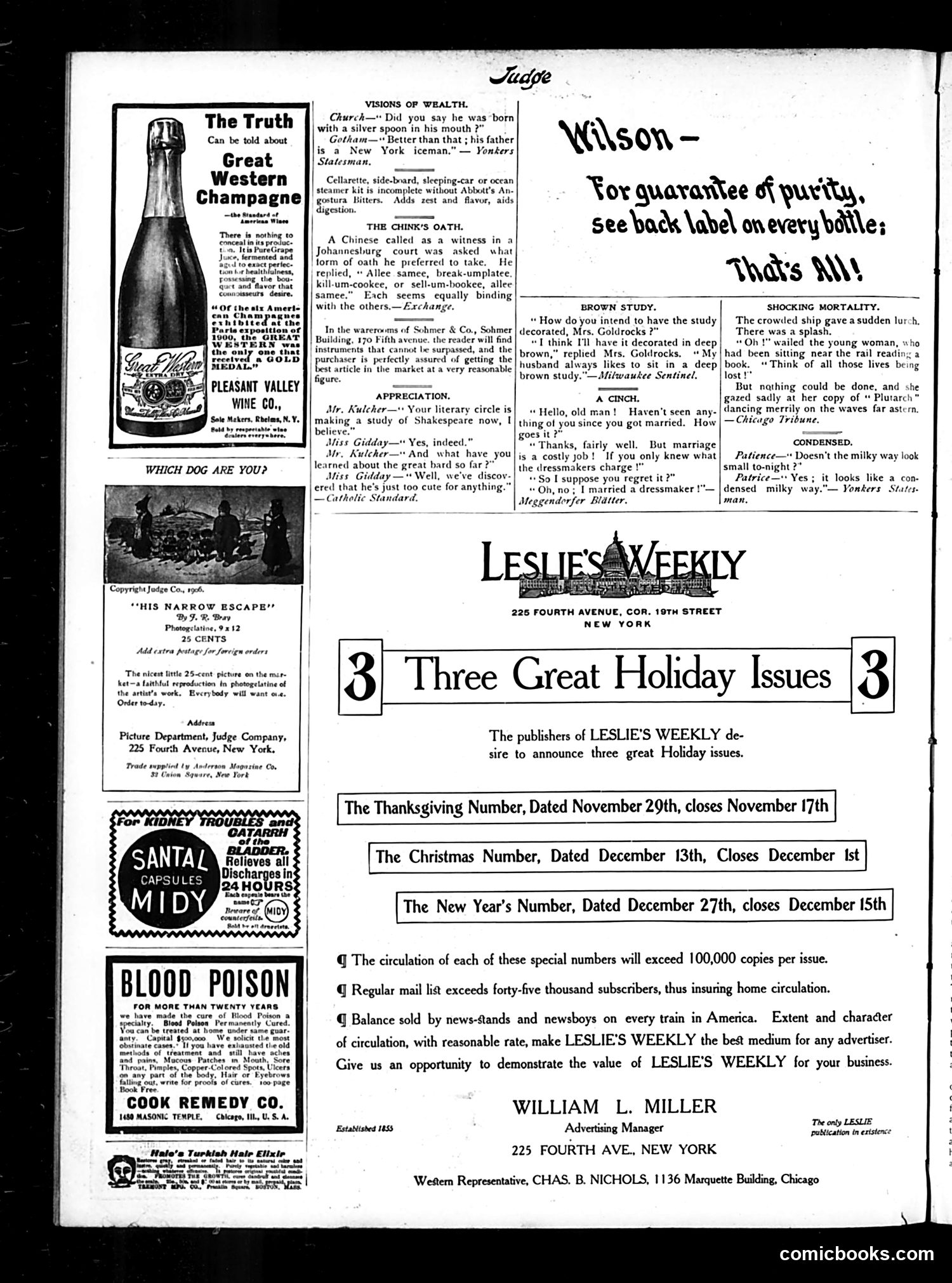
This page is primarily **advertising and announcements**, not political satire. The content consists of: **Main Advertisement**: Leslie's Weekly announces three special holiday issues (Thanksgiving, Christmas, New Year's), promoting circulation exceeding 100,000 copies per issue and 45,000 regular mail subscribers. **Other Advertisements**: Champagne, a photogelatine print ("His Narrow Escape"), blood poison cure, and other commercial products typical of early 1900s magazines. **Humor Section**: Several brief jokes, including: - A man born to wealth because his father is a New York ice dealer (satirizing how wealth derives from unexpected sources) - A play on "brown study" (melancholy mood) involving a woman's home decoration - Wordplay about condensed milk The page contains **no identifiable political cartoons or caricatures**. The humor is gentle, domestic, and commercial rather than satirical. The overall purpose is generating advertising revenue and promoting Leslie's Weekly's holiday publications.
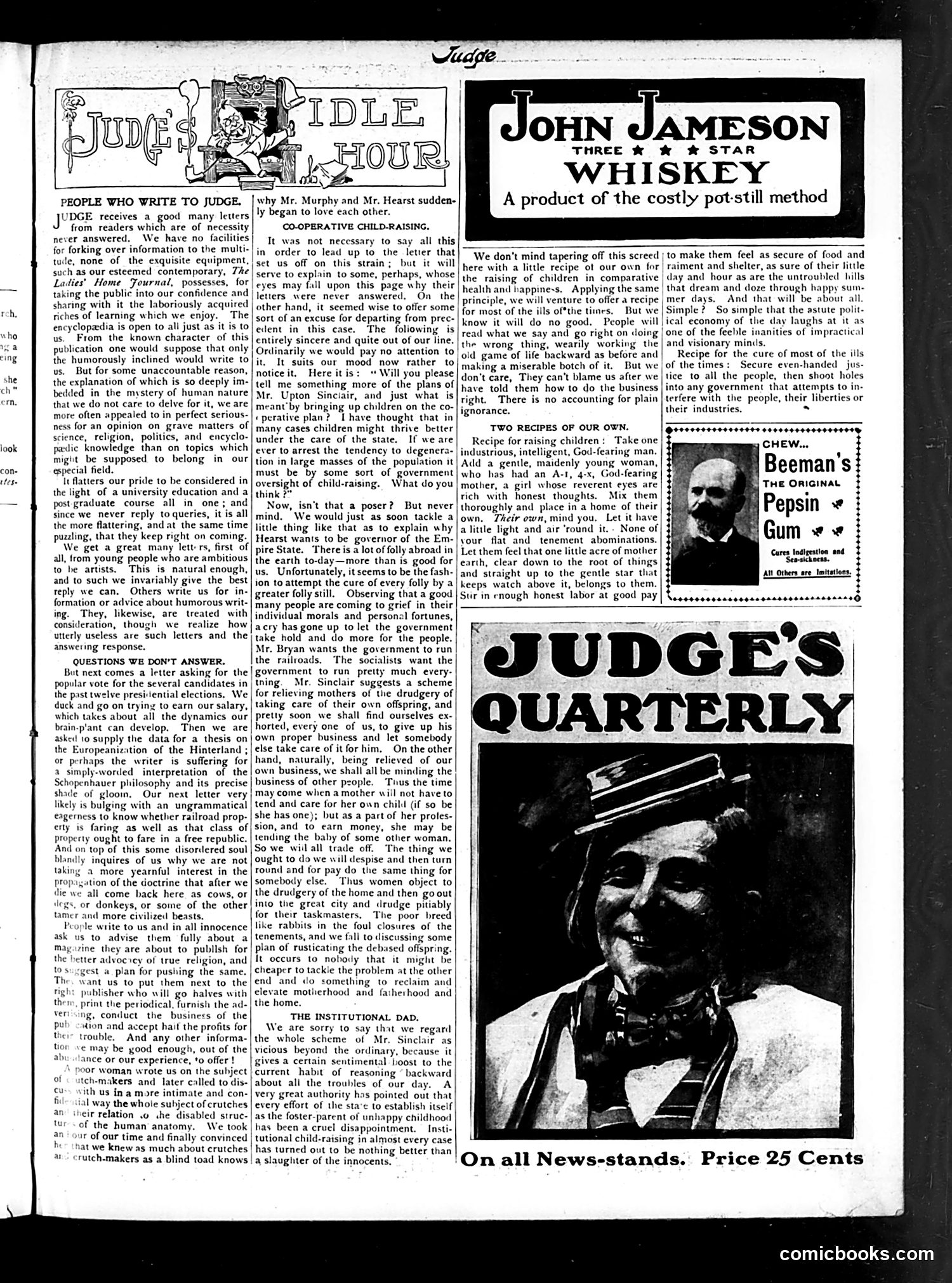
This page is primarily **advertising and editorial content** rather than political cartoons. The main elements are: **Left side:** "Judge's Idle Hour" - an editorial column addressing reader mail. Judge complains it receives serious inquiries on topics like railroad policy, philosophy, and religion, rather than humorous submissions. The editors mock their readers' expectations that Judge functions as an encyclopedia or advice column. **Right side:** Advertisement for John Jameson whiskey and Beeman's Pepsin Gum, plus the cover of "Judge's Quarterly" magazine (price 25 cents). **The satire:** Judge pokes fun at Americans who write to a humor magazine seeking earnest intellectual guidance—treating satirists as serious authorities. References to "Mr. Murphy and Mr. Hearst" (likely political/media figures of the era) suggest contemporary political content, though context is unclear here. The page is **primarily commercial** rather than offering substantive political commentary visible in this excerpt.
This page is primarily **advertising and promotional content** for various 1910s-era products and services—railroads, pianos, house plans, building materials—rather than political satire or editorial cartooning. The minor humorous content consists of brief **joke vignettes** (short dialogues like "Brave" and "She Didn't Tell Him") typical of Judge magazine's lighter filler. These are domestic/social humor rather than political satire: a man sarcastically responds to a woman's dare to "say boo to a goose" by questioning why he'd do it, and another anecdote mocks a man ("Riggles") for rudely talking back to a hotel waiter. The page reflects Judge's business model: a satirical magazine sustained largely through advertising revenue. The few cartoon/joke references present target **everyday middle-class anxieties**—romance, courage, propriety—not political figures or current events. Without clearer editorial content, this page demonstrates how such magazines balanced humor and commerce.
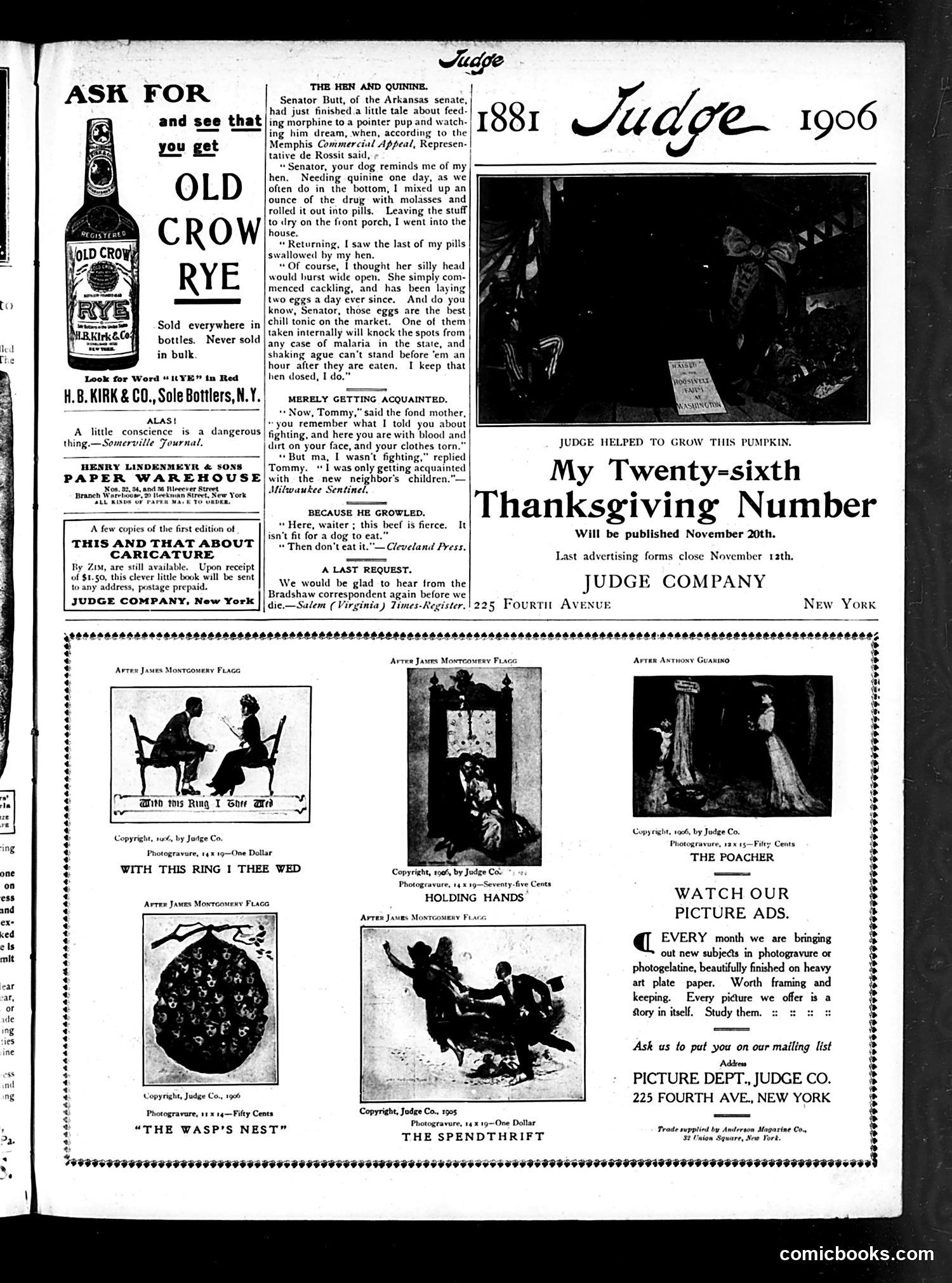
This page is primarily **advertising and promotional content** for Judge Company's photogravure prints, with several humorous anecdotes scattered throughout. The main comic stories are brief sketches: 1. **"The Hen's Quinine"** — A senator hears a tall tale about a hen that ate quinine pills, then supposedly laid exceptional eggs that cure malaria and chills. It's folksy rural humor mocking exaggerated patent-medicine claims. 2. **"Merely Getting Acquainted"** — A mother scolds her son for fighting; he protests he was "only getting acquainted with the new neighbor's children." Light domestic comedy about childhood mischief. 3. Brief one-liners about tough beef and a final request from a dying correspondent. The page advertises Judge's picture department, showcasing photogravure prints available for purchase (titles like "With This Ring I Thee Wed," "The Wasp's Nest," "The Spendthrift"). There's also an ad for **Old Crow Rye whiskey** and other vintage products. The centerpiece is announcement of Judge's "Twenty-sixth Thanksgiving Number" coming November 20th.
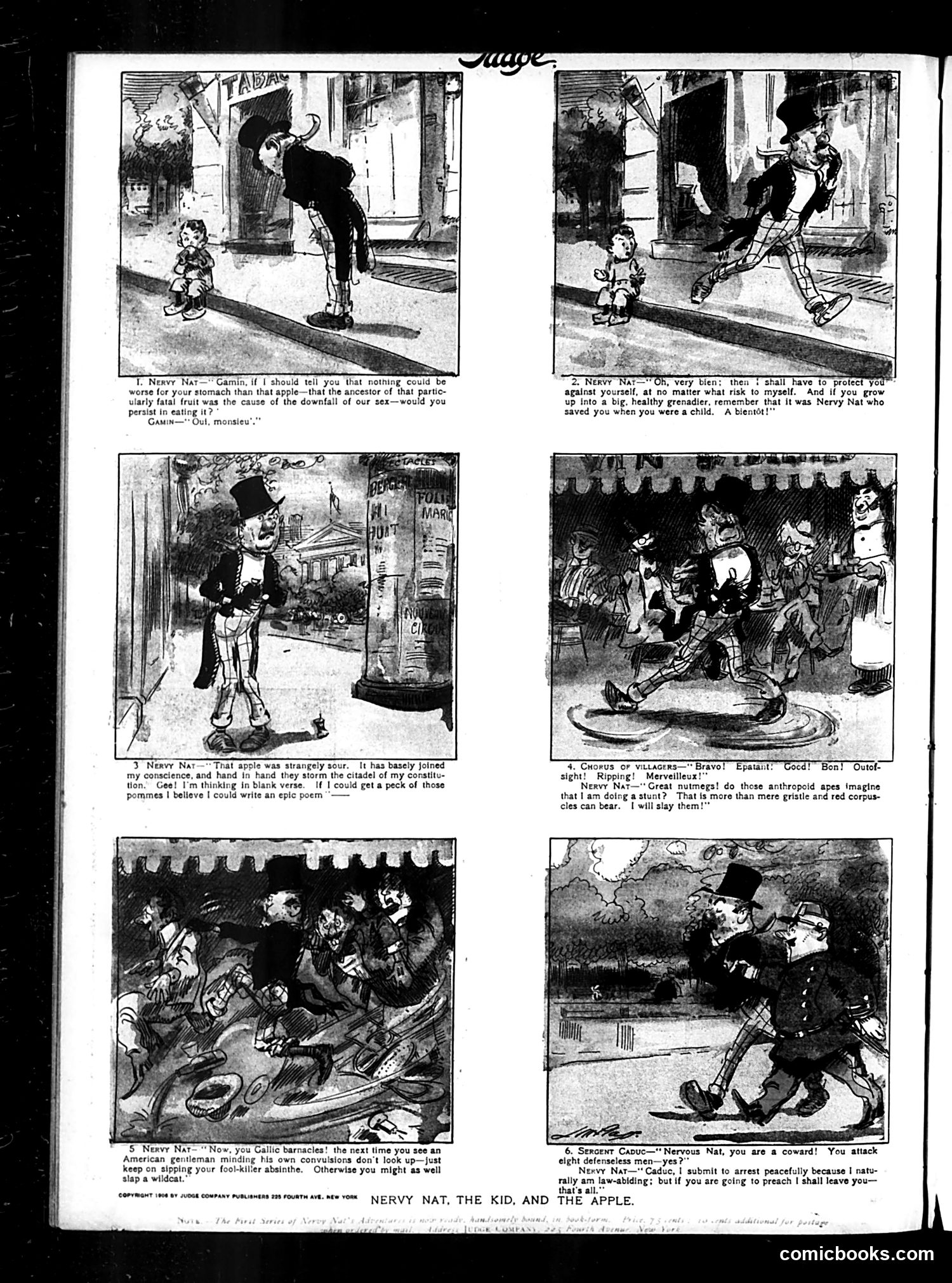
This is a satirical comic strip featuring "Nervy Nat," a combative character who intervenes in a street scene involving a poor child (a "gamin") eating an apple. Nat attempts to warn the boy about the apple's historical significance (the Fall of Man), but the child ignores him. The satire escalates absurdly: Nat becomes philosophically disturbed by the sour apple, speaks in blank verse, then encounters French villagers whom he attacks, claiming to "protect" the boy. A sergeant arrests him for assaulting eight defenseless men. The joke appears to target do-gooder busybodies and their self-righteous interventions—Nat's pretense of protection masks violent arrogance and inappropriate behavior. His grandiose language and dramatic overreaction to minor situations mock the type of person who meddles in others' affairs while convincing themselves of noble motives. The French characters' mockery reinforces this critique of sanctimonious meddling.