
A complete issue · 16 pages · 1906
Judge — August 11, 1906
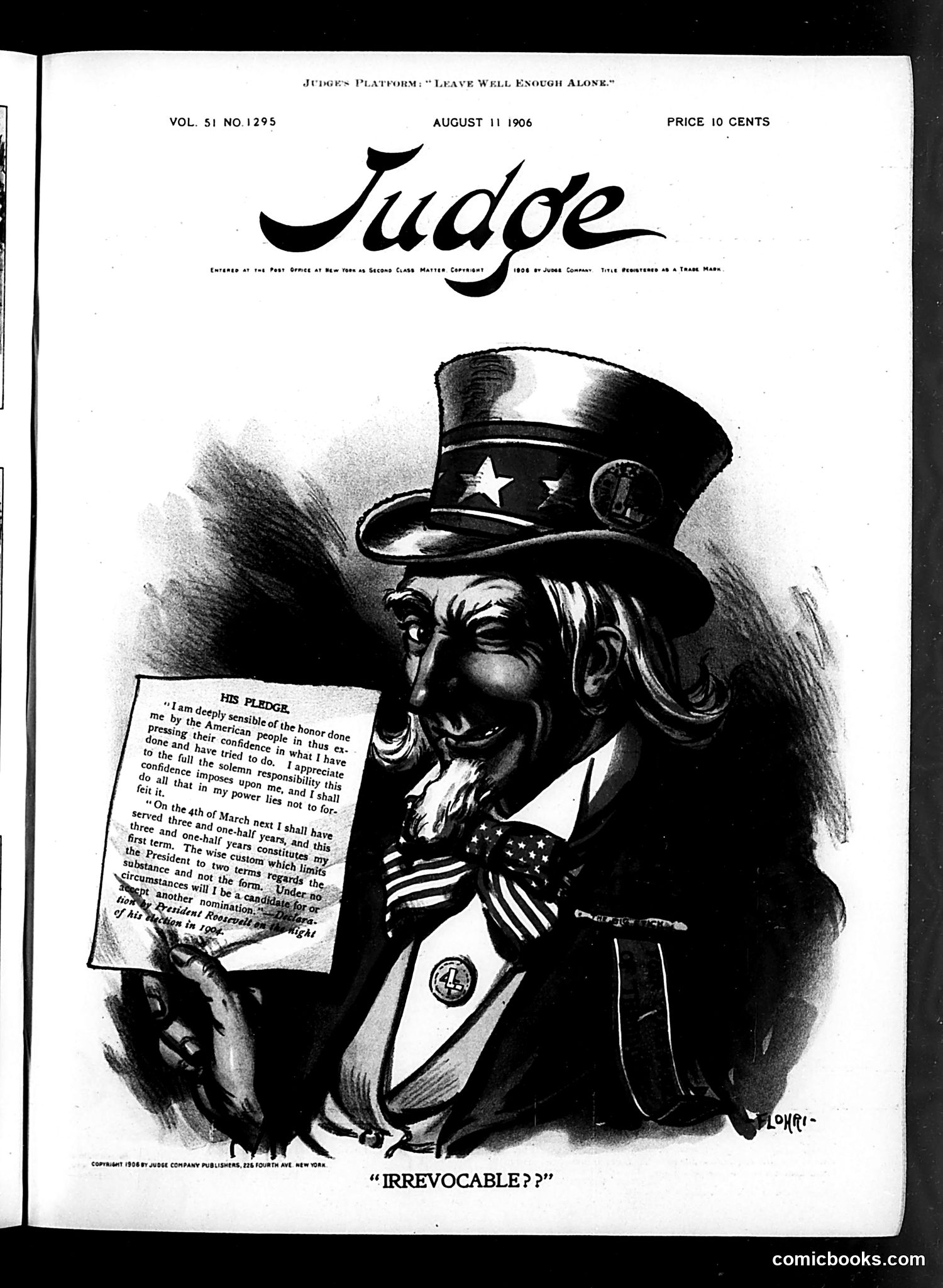
This August 1906 *Judge* cartoon depicts Uncle Sam holding a document labeled "His Pledge," which appears to reference a presidential commitment or policy statement. The caption "Irrevocable??" suggests skepticism about whether this pledge will be honored. The cartoon likely comments on President Theodore Roosevelt's public statements regarding his political future or policy positions. The questioning tone implies contemporary doubt about the permanence or reliability of Roosevelt's declarations—a common satirical theme in this era. The Uncle Sam figure, dressed in patriotic regalia, represents American authority and credibility. The artist (signed "Lohr") uses the figure's somewhat bemused expression to convey public uncertainty about whether commitments made by leaders will actually be kept. Without the specific pledge text fully legible, the exact policy reference remains unclear, though it likely concerns Roosevelt's well-publicized political positions of that period.
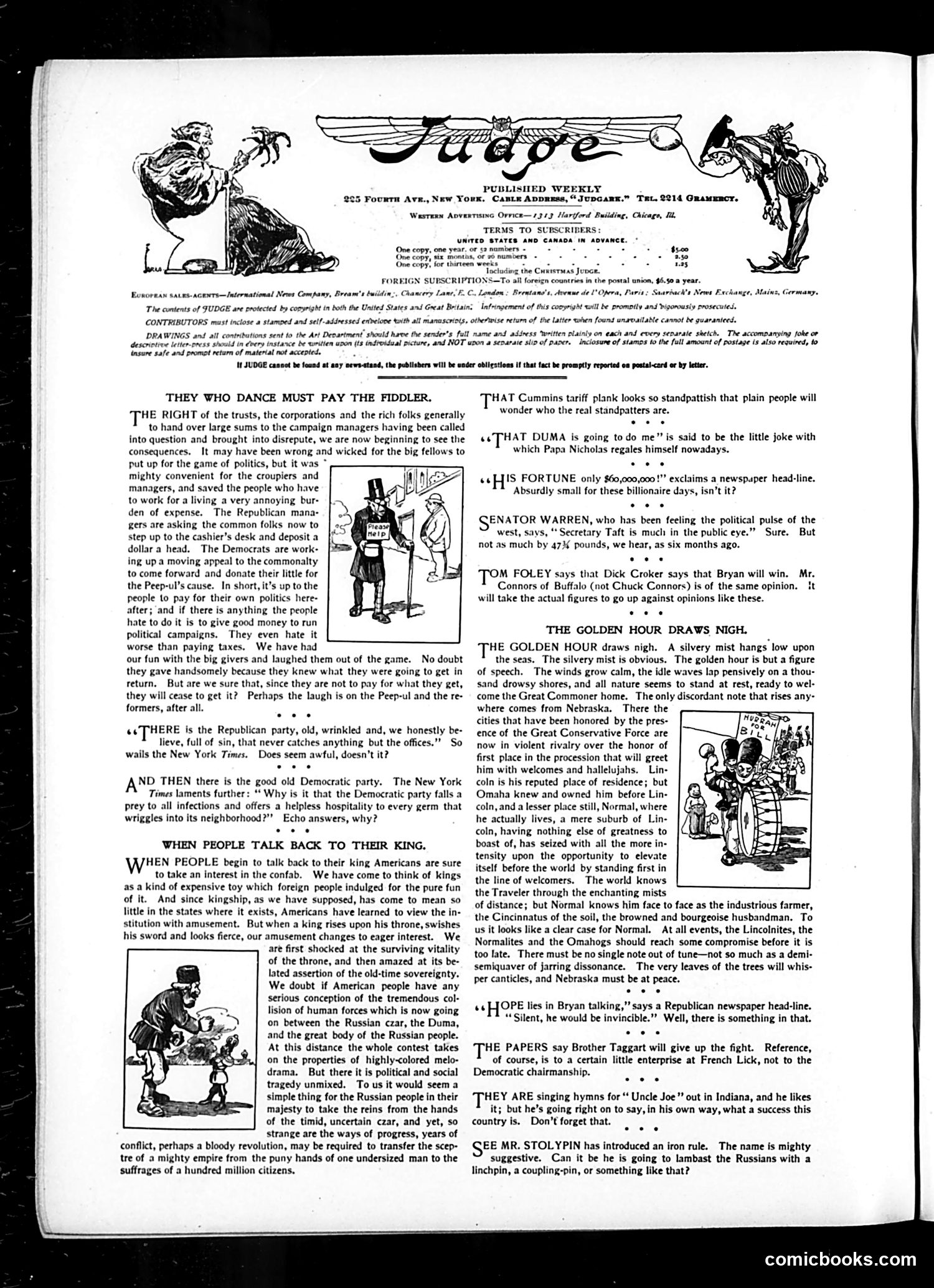
This page contains political commentary from the early 1900s. The main article "They Who Dance Must Pay the Fiddler" criticizes wealthy Republicans and Democratic campaign managers for funding expensive political campaigns while ordinary citizens bear the tax burden. It argues that both parties wastefully spend money on elections rather than governing effectively. The accompanying cartoon depicts a well-dressed figure (likely representing a political boss or wealthy donor) handing money to a fiddle player, visualizing how campaign finances flow from the wealthy to political operatives. The right column contains brief satirical items mocking various political figures including Senator Warren, Tom Foley, and references to Bryan's political prospects—typical Judge fare mixing partisan jabs with commentary on wealth, corruption, and electoral politics.
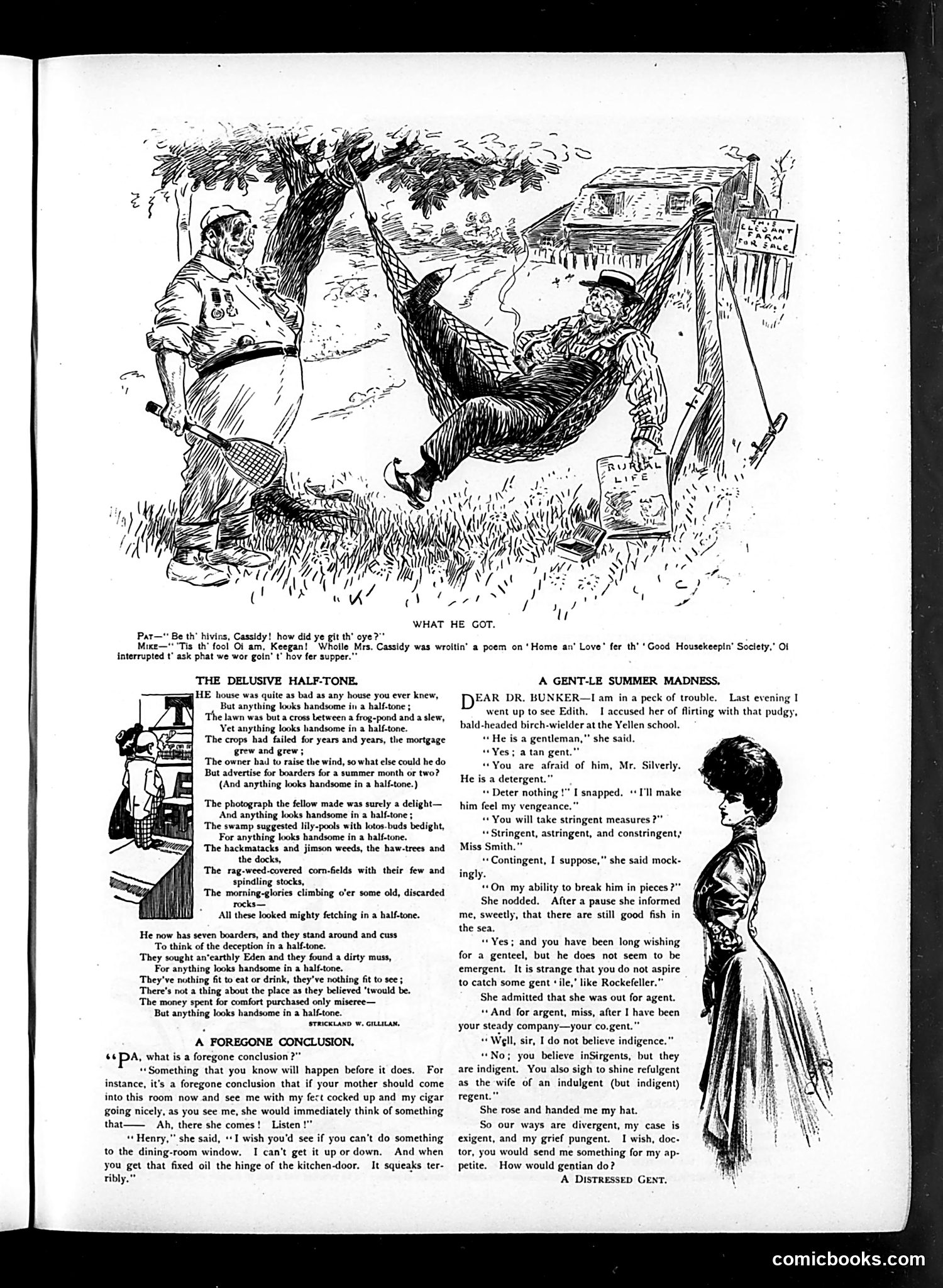
**Top Cartoon ("What He Got"):** A man in military uniform stands while another reclines in a hammock labeled "Rural Life." The caption jokes about a woman named Cassidy writing poetry for a "Good Housekeeping Society" competition. The satire appears to mock rural domesticity and the contrast between military duty and leisurely country living. **Lower Stories:** "The Delusive Half-Stone" is a poem criticizing rural life's hardships despite its romanticized image—mortgages, labor, and poverty persist despite the aesthetic appeal. "A Genteel Summer Madness" depicts a conversation between a woman (Miss Smith) and a gentleman caller (Mr. Silverly), satirizing courtship conventions and the pretenses of "genteel" society. She questions his sincerity and independence, mocking affected social rituals of the era.
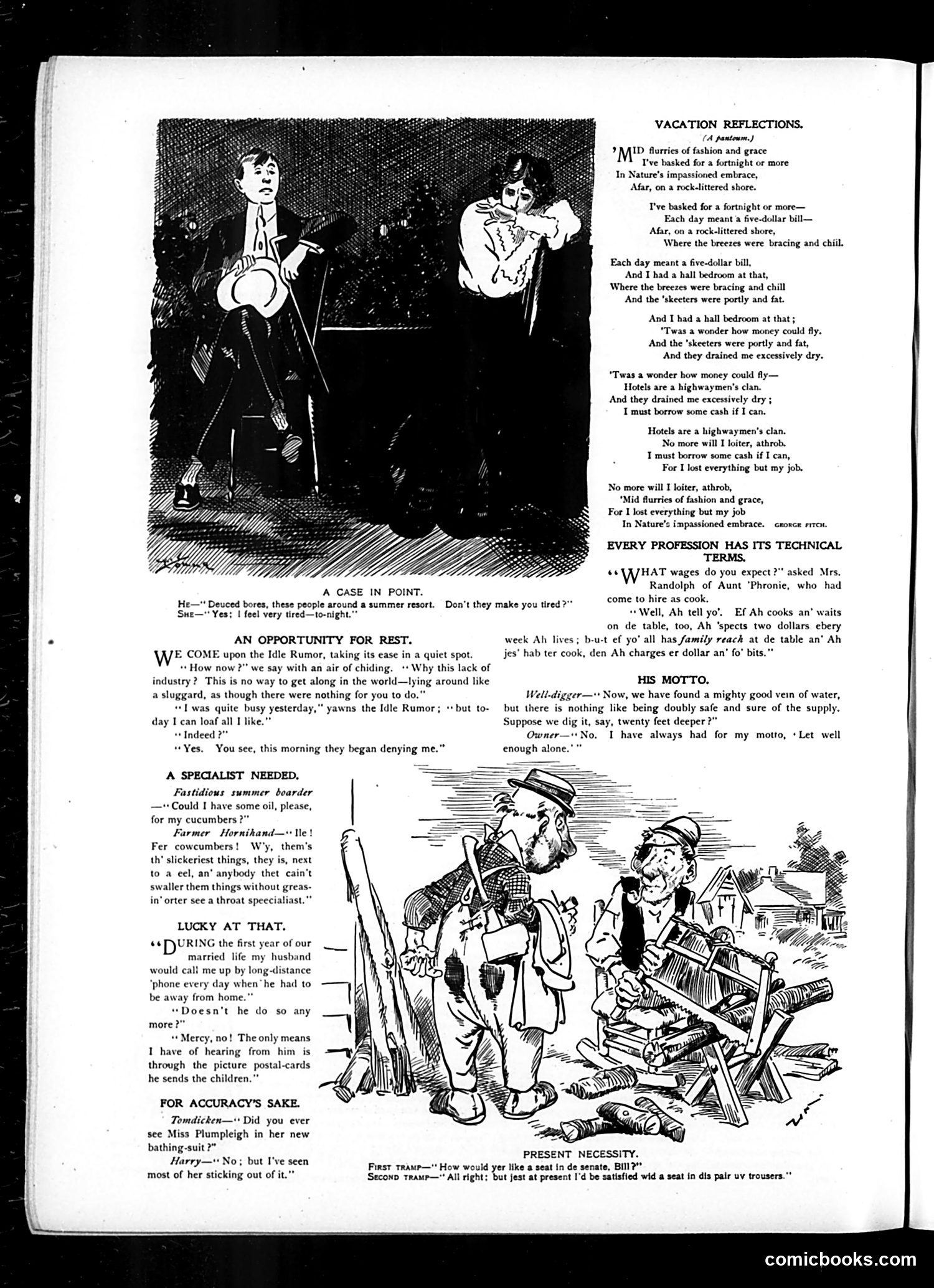
This page contains humor sketches and humorous dialogues typical of early 20th-century satirical magazines. The content includes: **"Vacation Reflections"** - A poem about the financial strain of vacationing, complaining about high hotel costs ("five-dollar bill") and excessive charges. The satire targets the hospitality industry's perceived greed. **"A Case in Point"** and other brief dialogues mock various social situations: idle people loitering, summer boarders making special requests, and long-distance telephone charges. **The cartoon** (lower portion) depicts two tramps discussing present necessities, likely satirizing poverty or vagrancy during an economic period. The overall theme critiques middle-class vacation expenses and working-class hardships. Without knowing the specific publication date, the general era appears to be early-to-mid 20th century based on the illustration style and social references.
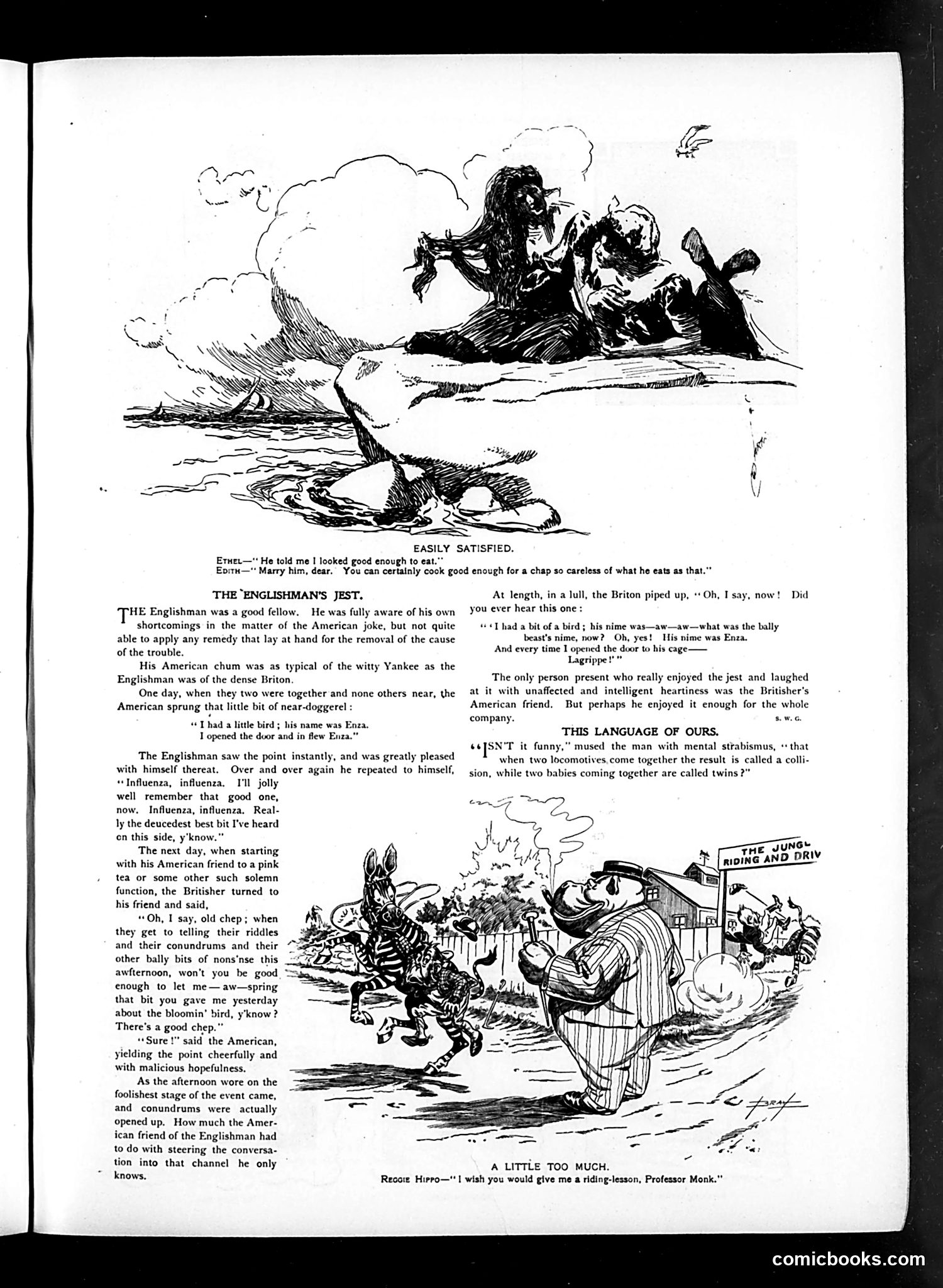
This page contains three separate humorous pieces mocking Anglo-American cultural differences: **"Easily Satisfied"** (top): A joke about an Englishman's low culinary standards—he claims food "good enough to eat" suffices, prompting an American to suggest cooking whatever he eats as cheaply as possible. **"The Englishman's Jest"** (left): The main piece satirizes English humor as dense and unfunny compared to American wit. An Englishman's labored joke about "influenza" fails to amuse, while only his American friend appreciates the attempt. **"This Language of Ours"** (right): A brief joke about railroad terminology—comparing "collision" (two locomotives together) to "twins" (two babies together). **"A Little Too Much"** (bottom): A cartoon showing a hippo requesting riding lessons from "Professor Monk," suggesting the animal is overly ambitious. These pieces reflect early 20th-century American attitudes of cultural superiority toward the British.
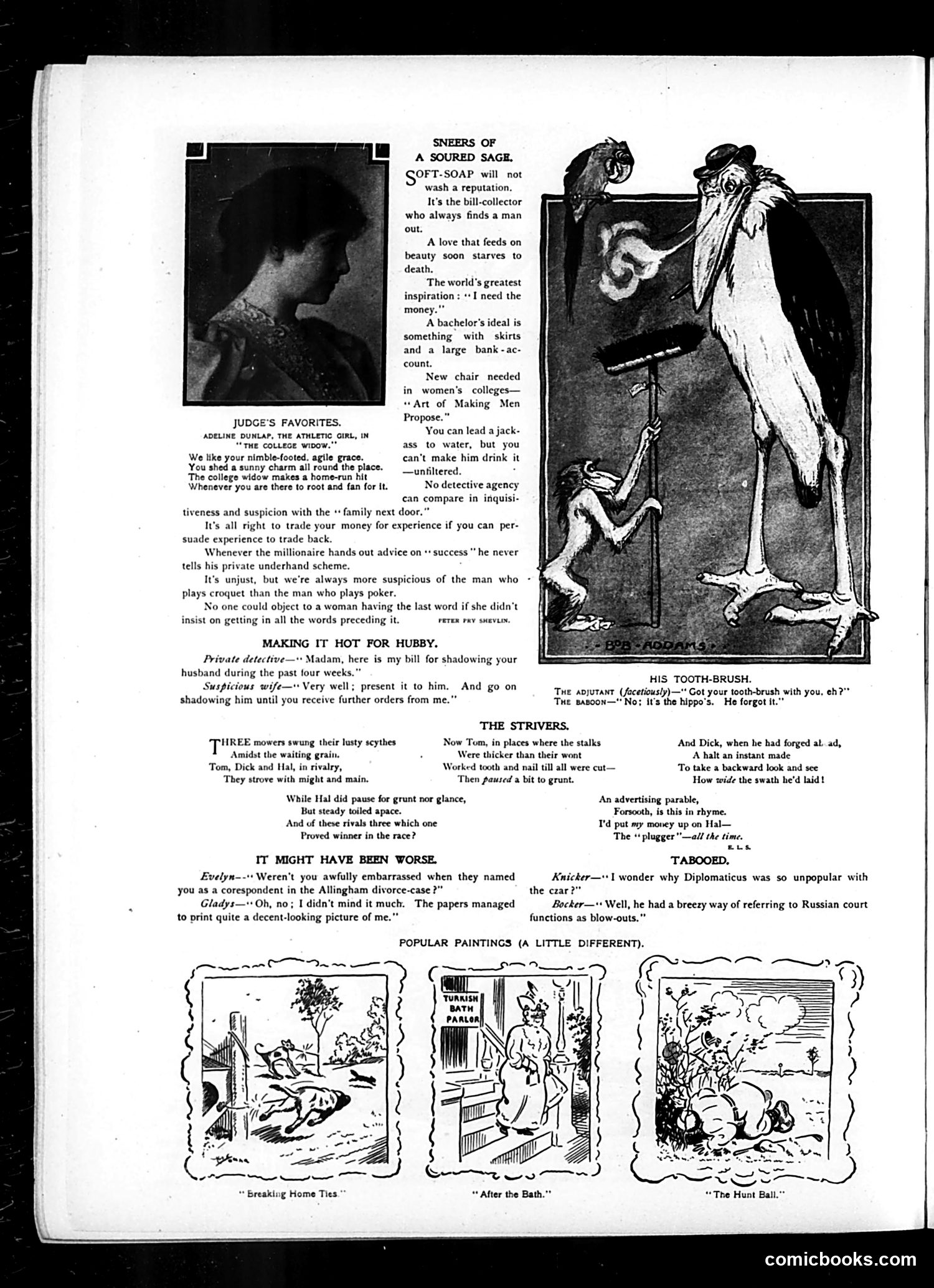
This page from Judge magazine contains early 20th-century satirical commentary on marriage, gender relations, and social behavior. **"Sneers of a Soured Sage"** presents cynical aphorisms mocking romance, materialism, and social pretense—bachelor ideals of women with money, bill-collectors exposing reputations, love based on beauty starving quickly. **"Making It Hot for Hubby"** jokes about marital suspicion: a wife hires a private detective to shadow her husband, then orders continued surveillance indefinitely—satirizing paranoid spousal relationships. **"The Strivers"** is a moral parable: three workers mow hay competitively, but only "Hal the plugger" works steadily without pausing, winning the race—celebrating honest labor over showiness. **"Popular Paintings"** presents three domestic scenes ("Breaking Home Ties," "After the Bath," "The Hunt Ball") as conventional sentimental art subjects, implying Judge views such imagery as clichéd. The overall tone mocks Victorian sentimentality about marriage and domesticity while celebrating industriousness.
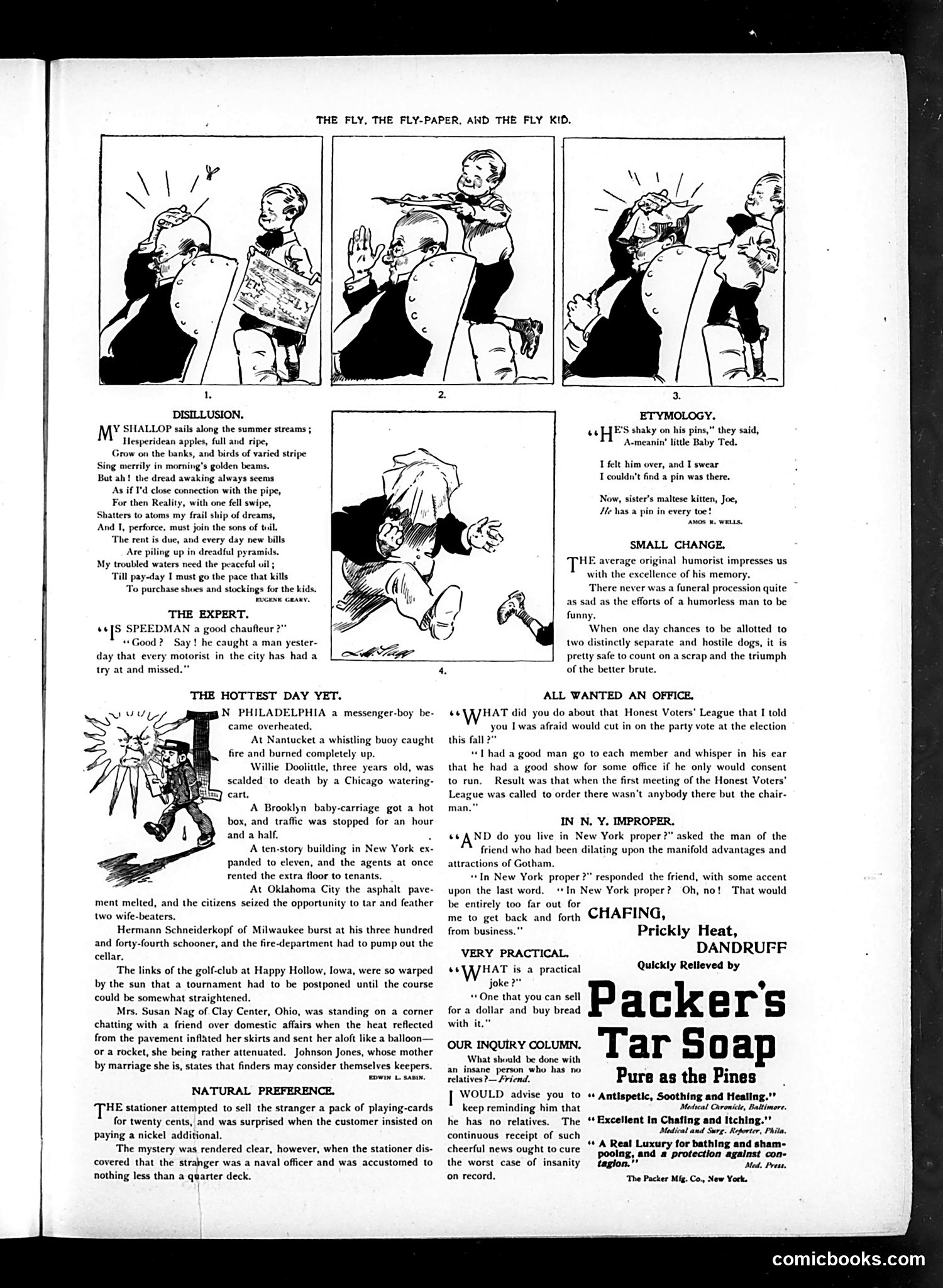
This page contains several unrelated humor pieces typical of Judge magazine's satirical approach to American life in the early 20th century. The top cartoon "The Fly, The Fly-Paper, and The Fly Kid" uses the extended metaphor of a fly caught in fly-paper to comment on working-class struggle—a man dreams of leisure but reality forces him back to labor to support his family ("shoes and stockings for the kids"). "The Hottest Day Yet" is absurdist humor cataloging exaggerated effects of extreme heat across America, including satirical commentary on social issues (citizens using the melted pavement opportunity "to tar and feather two wife-beaters"). Other pieces mock contemporary social types: the incompetent chauffeur, a political scam where an "Honest Voters' League" dissolves when members are offered fake office positions, and ethnic humor targeting German and Irish immigrants ("quarter deck" naval terminology pun). The page reflects Judge's focus on ridiculing ordinary American life, political corruption, and immigrant stereotypes typical of early 1900s American satire.
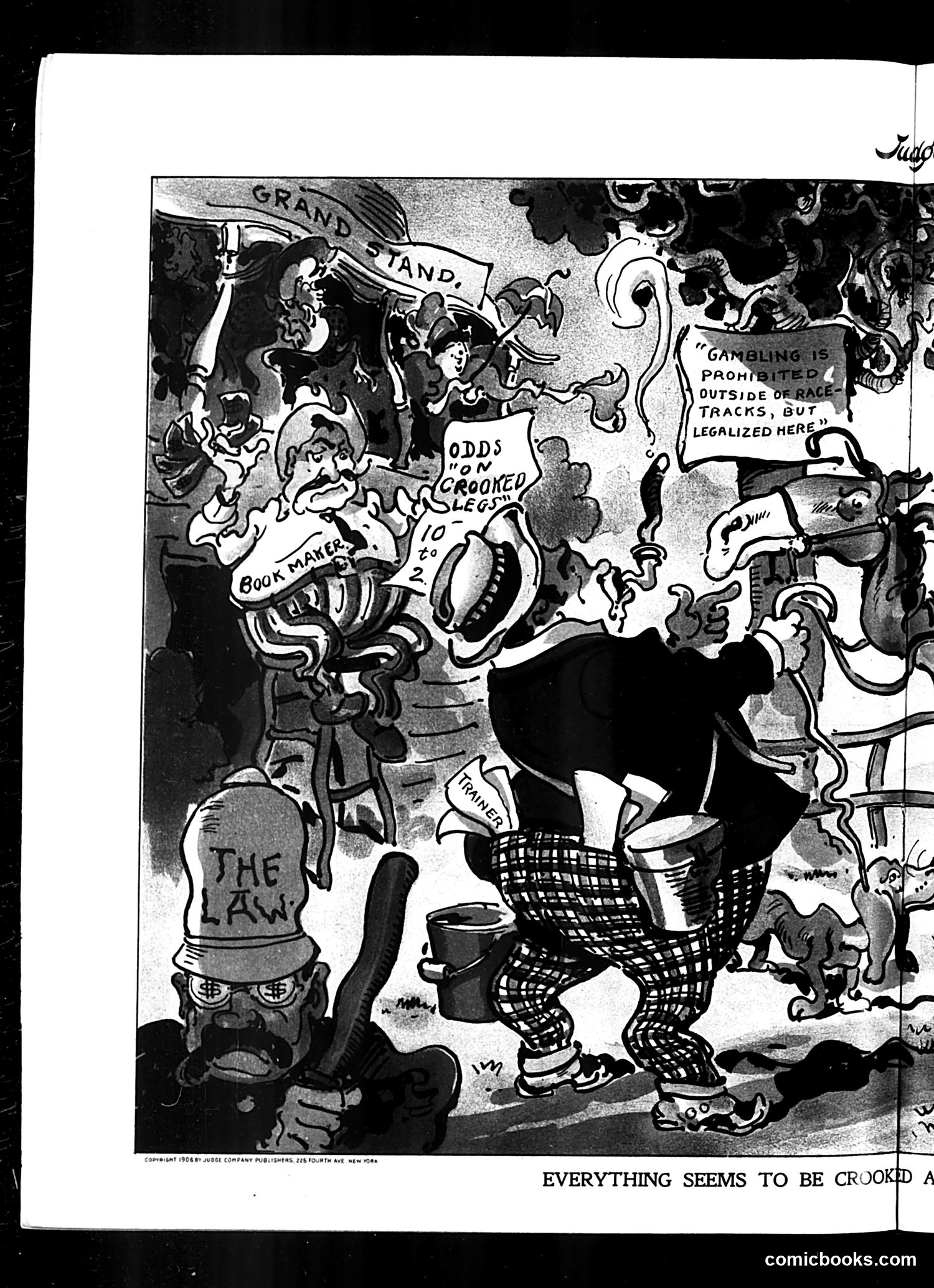
This Judge magazine cartoon satirizes corruption during Prohibition era America. A large figure labeled "THE LAW" stands amid various vice operators—a "BOOK MAKER" (illegal gambling), "ODDS ON CROOKED LEGS," and a "GAMBLER"—all depicted as grotesque demons or criminals. The caption notes that gambling is "prohibited outside of race tracks, but legalized here," highlighting the hypocrisy and selective enforcement of laws. The speech bubble "Everything seems to be crooked" emphasizes widespread corruption. The satire targets how Prohibition-era authorities selectively enforced laws, allowing certain vices (like track gambling) while purporting to eliminate others. The chaotic, demon-filled scene suggests that organized crime and corruption flourished despite—or because of—these contradictory legal frameworks. The cartoon critiques the era's moral inconsistency and institutional corruption.
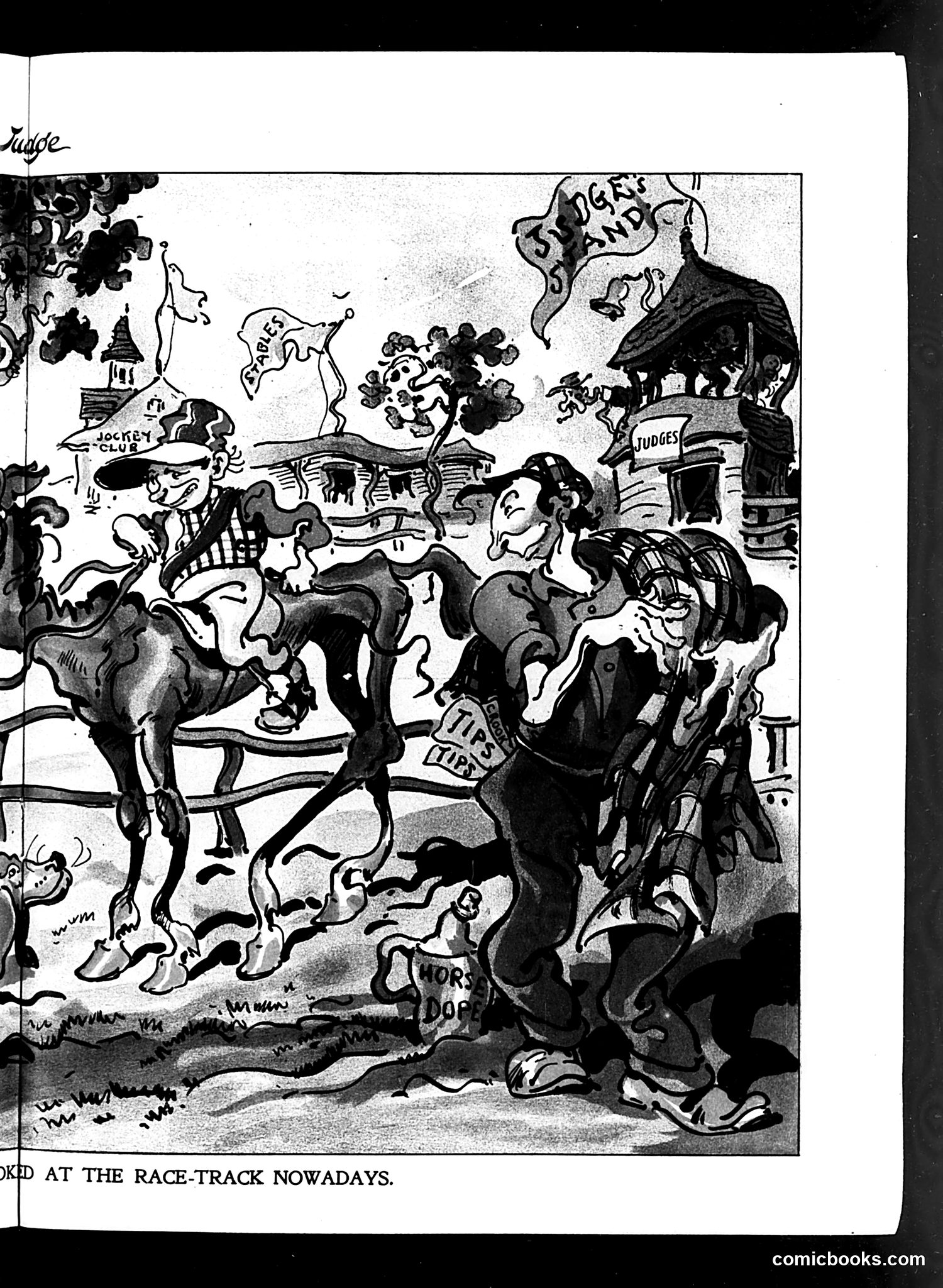
This Judge cartoon satirizes corruption and impropriety at racetracks. The visible text references a "Jockey Club" and "Judges," suggesting commentary on racing governance. The scene depicts various caricatured figures in what appears to be chaotic or unseemly activity at the track—possibly representing bribery, fixed races, or other scandals. The style and composition suggest early 20th-century concerns about organized racing being compromised by gambling interests and criminal elements. The exaggerated, grotesque character designs are typical of Judge's satirical approach to expose perceived moral failings and institutional corruption. Without clearer identification of specific figures or dated context, the precise incident being referenced remains unclear, though the general message criticizes the integrity of American horse racing during this era.
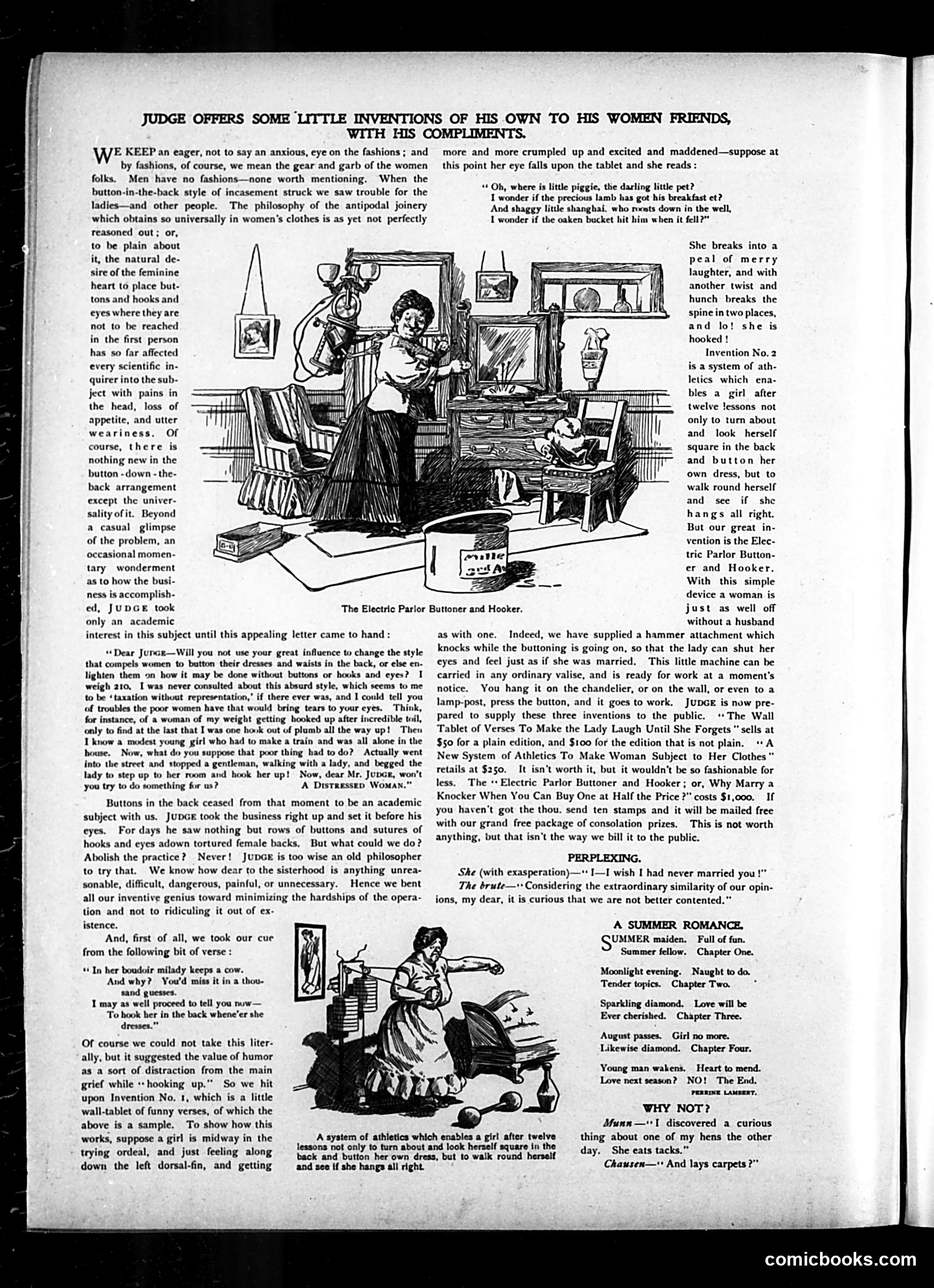
This page satirizes the impracticality of late Victorian women's fashion, specifically the back-buttoned dress. The magazine received a complaint letter from a heavy woman (210 lbs) describing the genuine difficulty women faced dressing themselves—buttons placed where they couldn't reach, requiring outside help or awkward contortions. Judge responds with mock-serious "inventions" to solve this problem: 1. **A wall-mounted tablet of funny verses** to distract women during the ordeal of hooking up 2. **The "Electric Parlor Buttoner and Hooker"** (illustrated) — an absurd mechanical device 3. **An athletics system** allowing girls to twist and contort themselves to self-button after twelve lessons The satire's point: Rather than admit the obvious solution (moving buttons to the front), Judge proposes increasingly ridiculous workarounds. It mocks both the fashion industry's stubbornness and women's resigned acceptance of impractical design—treating a genuine complaint with humorous exaggeration to highlight its absurdity.
This is a **Schlitz beer advertisement**, not a political cartoon. The page features ornamental hop-vine decorative borders framing the ad copy. The advertisement's message is straightforward: Schlitz beer has maintained quality for fifty years through commitment to purity, spending over half its brewing costs on purity assurance. The ad emphasizes that requesting Schlitz by name guarantees you receive the premium product rather than "a common beer." The tagline "The Beer That Made Milwaukee Famous" associates the brand with Milwaukee's brewing reputation. This appears to be early-to-mid 20th-century advertising, when brand differentiation through purity claims was a common marketing strategy. There is no satire, political commentary, or caricature present—just straightforward commercial promotion dressed in period typography and decorative design.
This is primarily an **advertising and humor page** from Judge magazine, not a political cartoon page. The content consists mainly of: **Advertisements** for products like Hunter Rye whiskey, Mennen's talcum powder, Wilson whiskey, and the magazine's own publications. **Short humorous anecdotes** about everyday situations—a farmer-turned-brakeman signaling mules with railroad hand signals, a country store clerk who doesn't know birds grow from eggs, observations about can-openers revealing more "deadly stuff" than corkscrews. **Social commentary** in brief quips, such as the joke about wealthy men being able to be "disagreeable" because of their riches, or a girl regretting rejecting a suitor after he finds someone else. These are lightweight, gentle jokes about rural life, courtship, and human nature—typical of early-1900s American humor magazines. There's **no identifiable political satire or caricature** on this page; it's representative of Judge's mix of advertising and accessible domestic humor for middle-class readers.
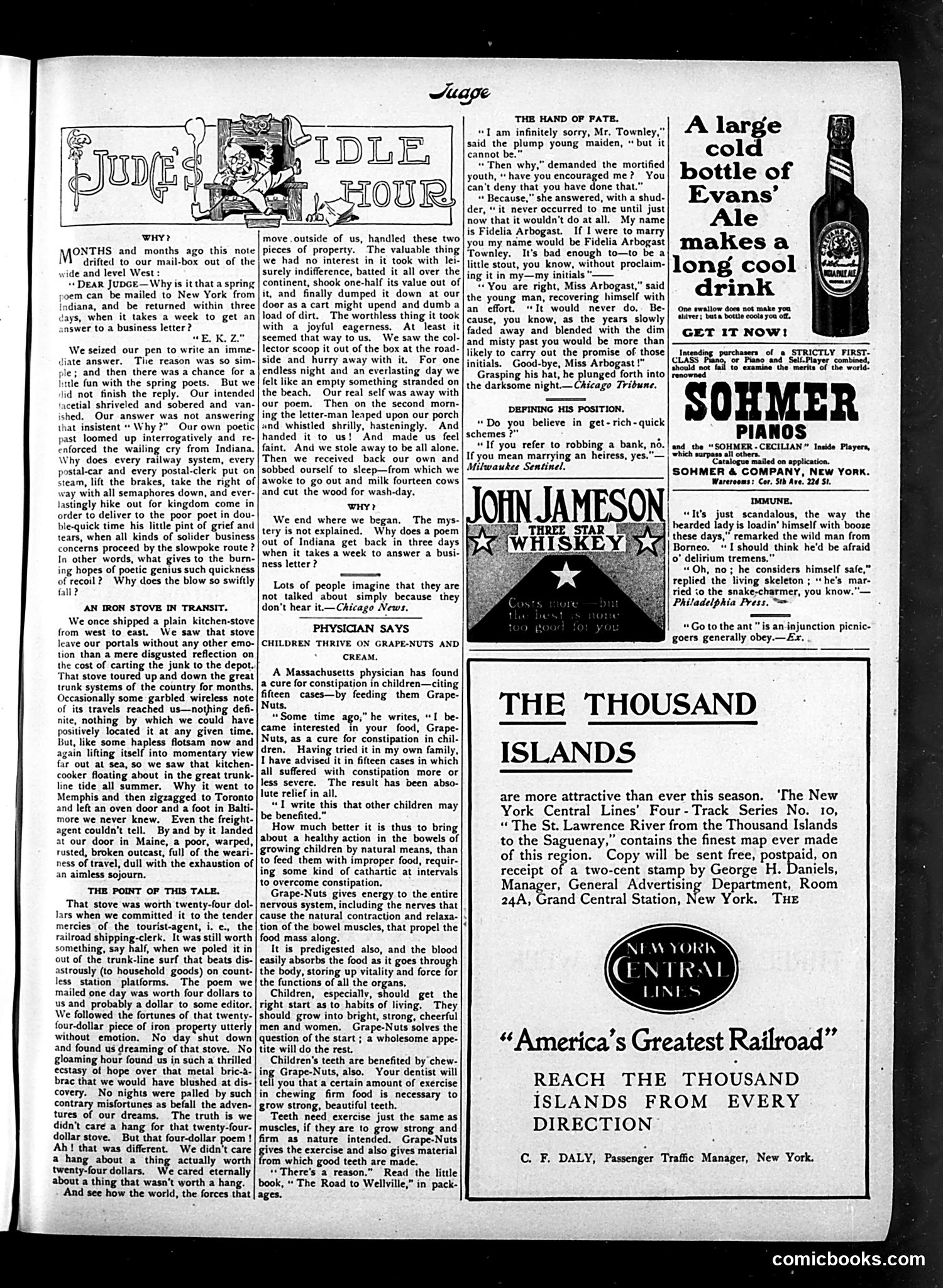
This page contains a humorous essay titled "Judge's Idle Hour" that satirizes the postal and railroad systems' treatment of mail versus freight. **The Central Joke:** The author contrasts two shipping experiences: a valuable kitchen stove that traveled slowly and circuitously across America, arriving damaged; versus a worthless four-dollar poem that was delivered quickly back to Indiana. **The Satire's Point:** The piece mocks the irony that transportation systems handle valueless poetry with urgent efficiency while treating genuinely valuable goods with careless negligence. The author suggests this reflects human nature—we obsess over our creative dreams (the poem) while remaining emotionally indifferent to practical, tangible property (the stove). **Social Context:** This satirizes both 1) the inefficiency and unreliability of early 20th-century American rail and postal infrastructure, and 2) the romantic idealization of poets and poetry that society supposedly promotes while actual commerce moves sluggishly. The humor derives from the absurd reversal of what *should* matter economically versus what actually captures human attention and emotional investment.
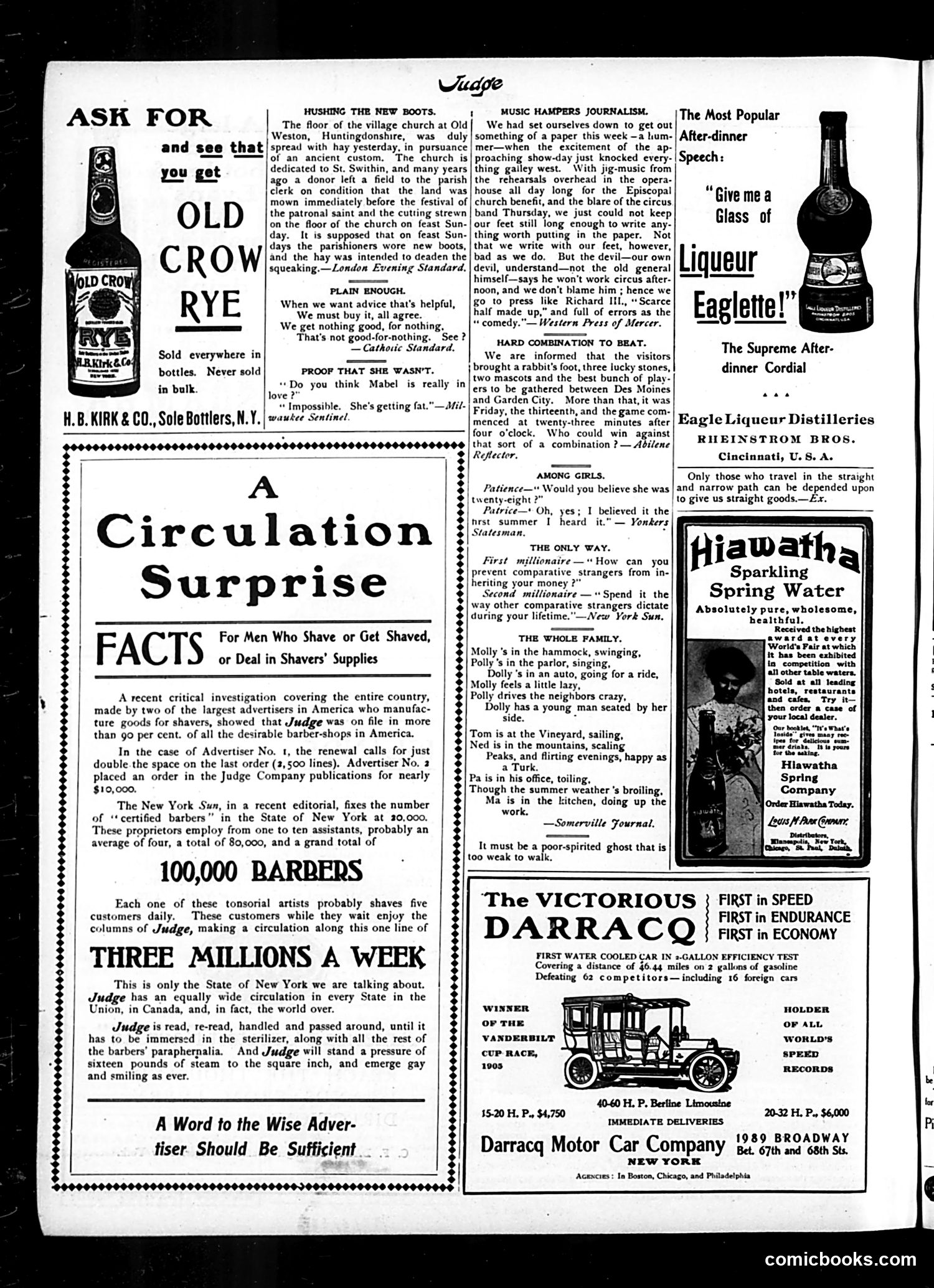
This page is primarily advertising for Judge magazine and various products (Old Crow Rye whiskey, Darraq automobiles, etc.), with a "Circulation Surprise" section aimed at barber-shop advertisers. The main editorial content includes brief humorous pieces and short jokes typical of Judge's satirical style. Notable among these: a joke where a man claims his girlfriend "Mabel" cannot be "good-for-nothing" because "She's getting fat"—turning the insult into unintended praise. Another piece notes how local newspaper production was disrupted by competing entertainment (opera rehearsals and circus band noise), using the chaos as comedic excuse for editorial quality. Short jokes touch on luck/superstition and inheritance. The overall page reflects early-20th-century middle-class humor: light domestic satire, wordplay, and gentle jabs at contemporary social situations. Without identifying specific political figures or events, this is essentially lifestyle and consumer-oriented satirical content rather than political commentary.
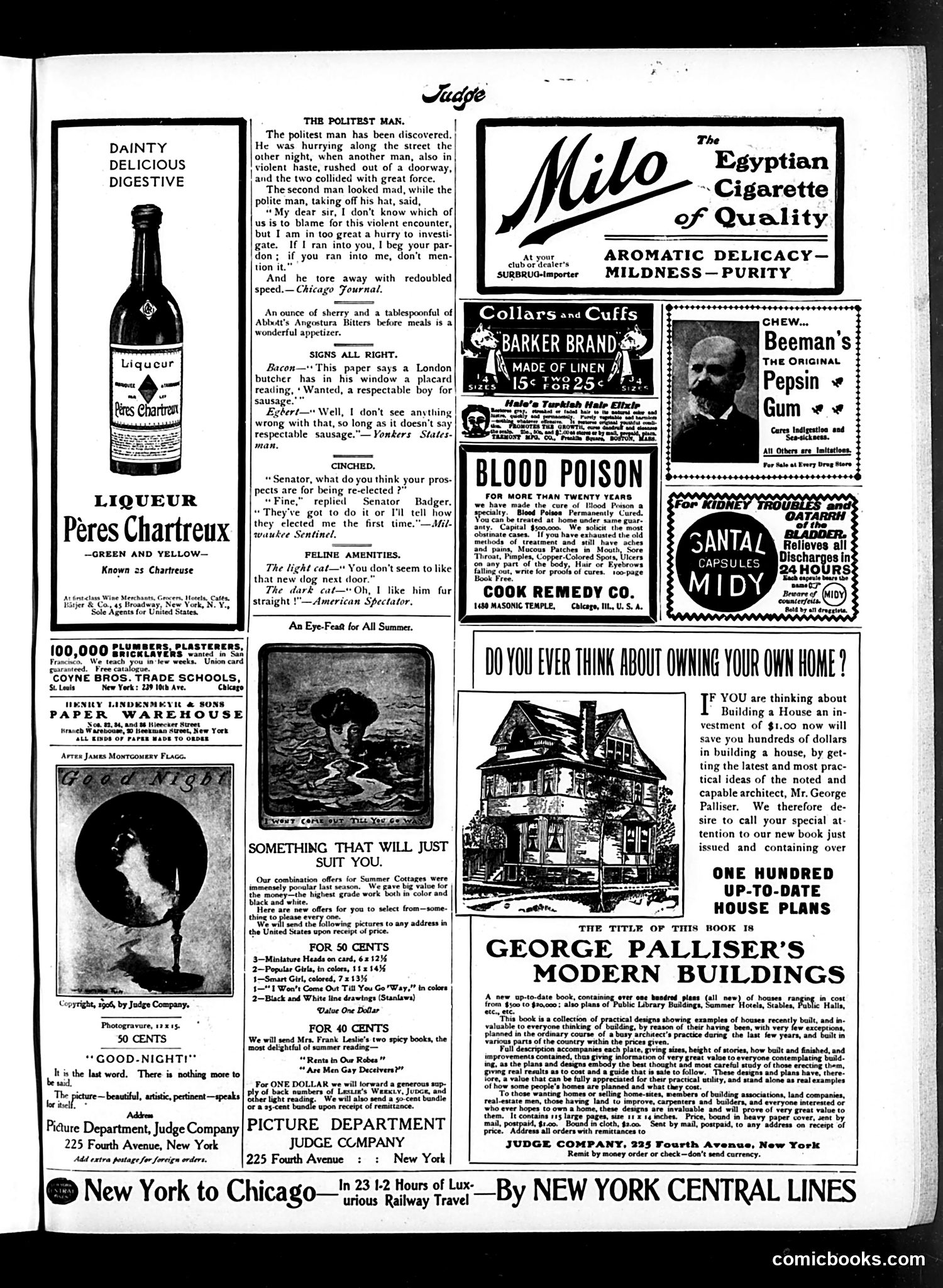
This brief comic anecdote satirizes extreme politeness taken to absurd extremes. Two men collide violently on the street, but rather than determine fault, the "polite man" apologizes preemptively for either possibility—then immediately flees without resolution. The joke mocks people who prioritize superficial politeness over genuine interaction or accountability. The punchline is that his hasty departure undercuts his elaborate courtesy, suggesting such politeness is performative rather than sincere. The page is primarily **advertisements** for period products (liqueurs, trade schools, cigarettes, remedies for venereal disease, building plans), with several brief humor pieces scattered between them. "Cinched" jokes about political corruption; "Feline Amenities" presents mild cat humor. No major political figures are identified or caricatured on this page.
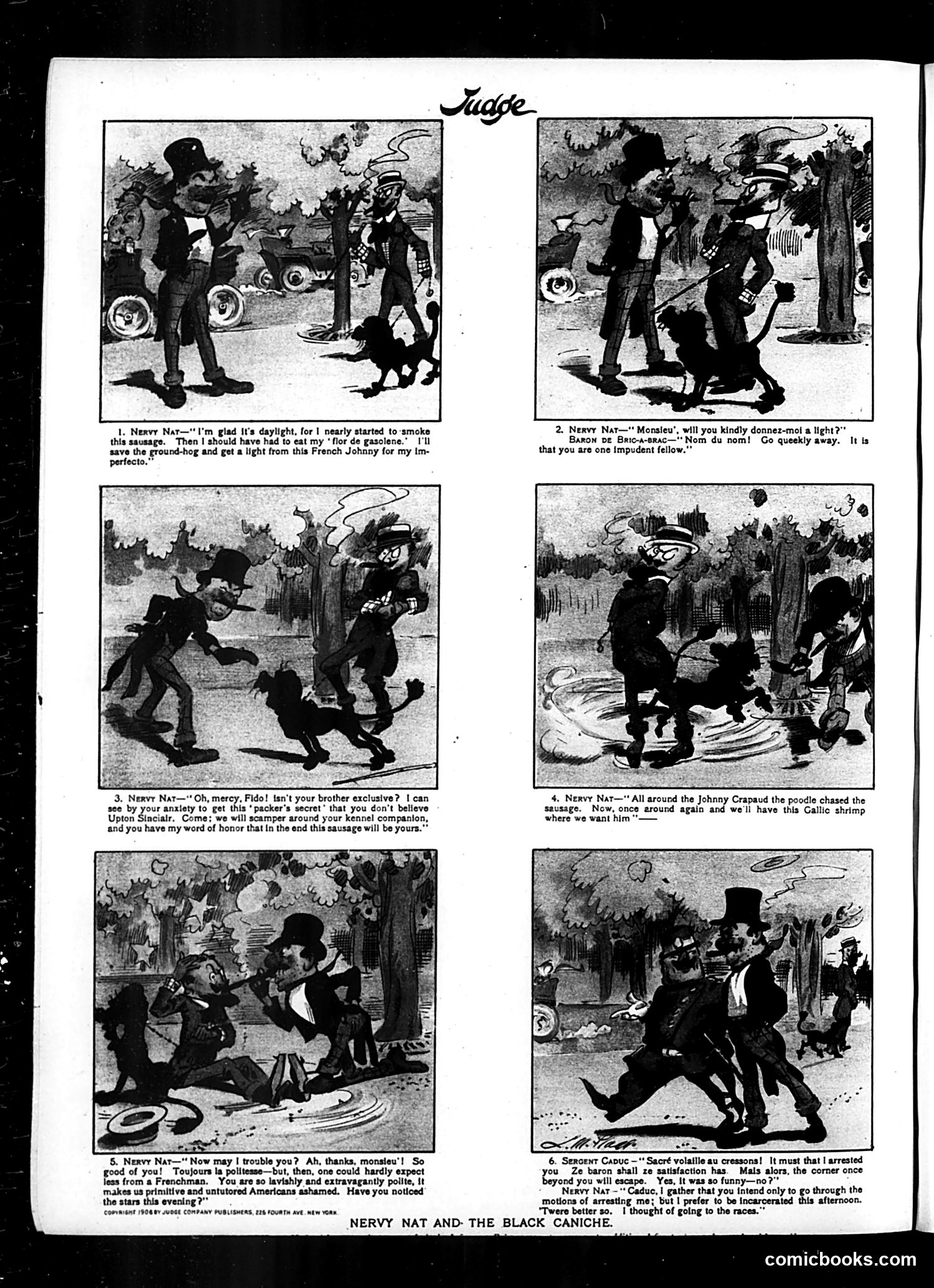
This six-panel comic strip satirizes American rudeness toward French people and French culture. "Nervy Nat," an irreverent American character, repeatedly bothers a dignified French baron and his poodle ("caniche") by mooching cigarettes, discussing a suspicious sausage (likely referencing Upton Sinclair's *The Jungle*, a 1906 exposé of meat-packing practices), and generally pestering French citizens with his brash behavior. The humor relies on contrasting American informality and crudeness with exaggerated French politeness and formality. The baron responds with increasingly strained courtesy despite obvious annoyance. The final panel shows a French sergeant arresting Nat, who accepts incarceration with the same casual American impertinence. The satire mocks both American boorishness abroad and, implicitly, French pretentiousness—each culture finds the other absurd.