
Judge, 1906-08-11 · page 13 of 16
Judge — August 11, 1906 — page 13: what you’re looking at
What you’re looking at
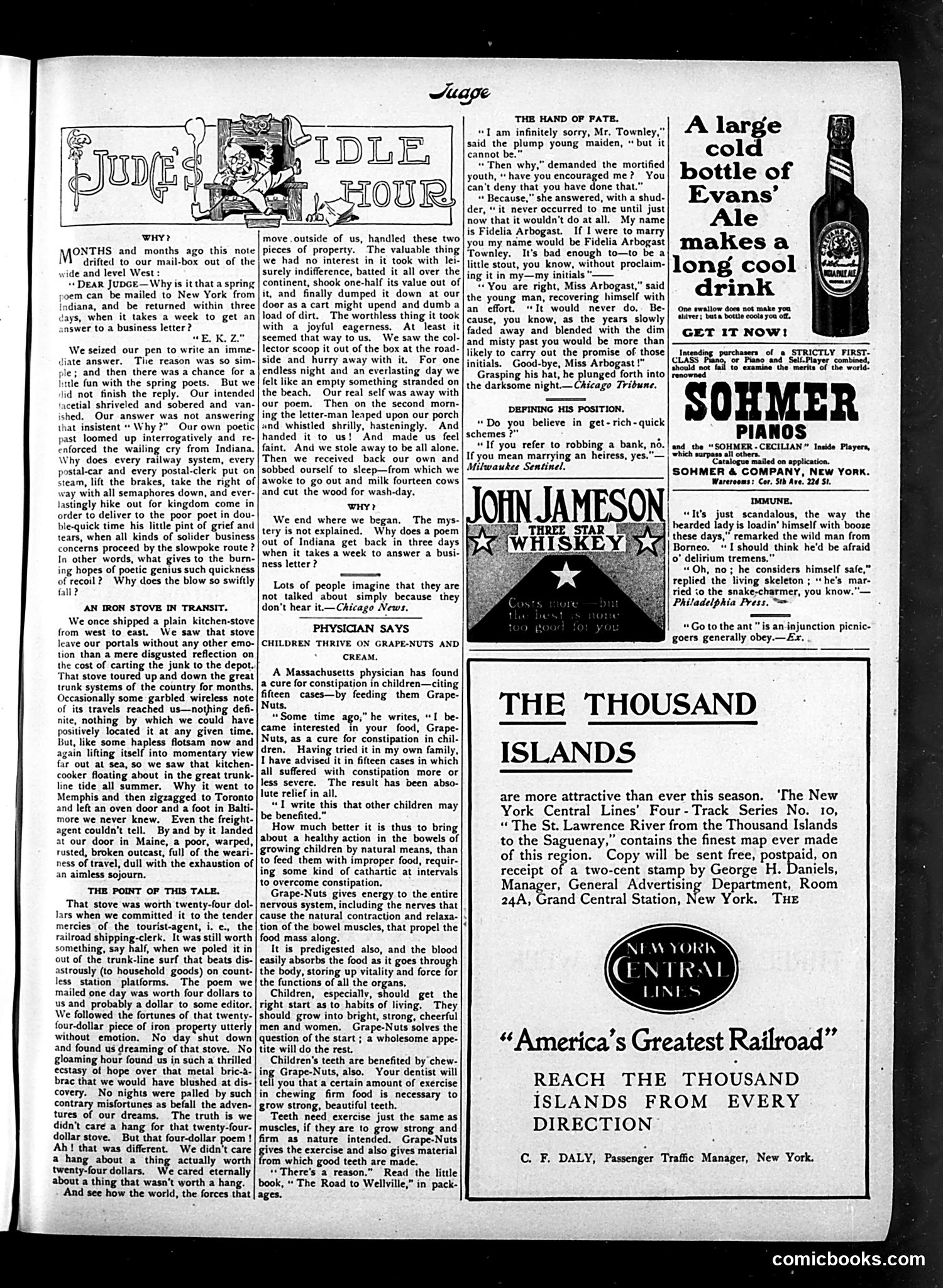
This page contains a humorous essay titled "Judge's Idle Hour" that satirizes the postal and railroad systems' treatment of mail versus freight. **The Central Joke:** The author contrasts two shipping experiences: a valuable kitchen stove that traveled slowly and circuitously across America, arriving damaged; versus a worthless four-dollar poem that was delivered quickly back to Indiana. **The Satire's Point:** The piece mocks the irony that transportation systems handle valueless poetry with urgent efficiency while treating genuinely valuable goods with careless negligence. The author suggests this reflects human nature—we obsess over our creative dreams (the poem) while remaining emotionally indifferent to practical, tangible property (the stove). **Social Context:** This satirizes both 1) the inefficiency and unreliability of early 20th-century American rail and postal infrastructure, and 2) the romantic idealization of poets and poetry that society supposedly promotes while actual commerce moves sluggishly. The humor derives from the absurd reversal of what *should* matter economically versus what actually captures human attention and emotional investment.
📄 Transcribed text from this page (OCR, searchable)
Machine-transcribed from the original scan — historical spelling and the odd misread are preserved.
MONTHS and months ago this note ! drifted to our mail-box out of the wide and level West: + DEAR JUDGE—Why is it that a spring poem can be mailed to New York from indiana, and be returned within three days, when it takes a week to get an naswer to a business letter? We seized our pen to write an imme- diate answer, Tie reason was so sim- le; and then there was a chance for a lutle fun with the spring poets. But we lid not finish the reply. Our intended tacetial shriveled and sobered and van- shed. Our answer was not answering that insistent “ Why?” Our own poetic past loomed up interrogatively and re- enforced the wailing cry from Indiana. Why does every railway system, every postal-car and every postal-clerk put on steam, lift the brakes, take the right of way with all semaphores down, and ever- lastingly hike out for kingdom come in order to deliver to the poor poet in dou- ble-quick time his little pint of grief and tears, when all kinds of solider business concerns proceed by the slowpoke route ? In other words, what gives to the burn- ing hopes of poetic genius such quickness of recoil? Why does the blow so swiftly fall? AN IRON STOVE IN TRANSIT. We once shipped a plain kitchen-stove from west to east. We saw that stove leave our portals without any other emo- tion than a mere disgusted reflection on the cost of carting the junk to the depot. That stove toured up and down the great trunk systems of the country for months. Occasionally some garbled wireless note of its travels reached us—nothing defi- nite, nothing by which we could have positively located it at any given time. But, like some hapless flotsam now and again lifting itself into momentary view far out at sea, so we saw that kitchen- cooker floating about in the great trunk- line tide all summer. Why it went to Memphis and then zigzagged to Toronto and left an oven door and a foot in Balti- more we never knew. Even the freight- agent couldn't tell. By and by it landed at our door in Maine, a poor, warped, rusted, broken outcast, full of the weari- ness of travel, dull with the exhaustion of| an aimless sojourn. THE POINT OF THIS TALE. That stove was worth twenty-four dol- lars when we committed it to the tender mercies of the tourist-agent, i. e., the railroad shipping-clerk. It was still worth something, say half, when we poled it i out of the trunk-line surf that beats dis- astrously (to household goods) on count- less station platforms. The poem we mailed one day was worth four dollars to us and probably a dollar to some editor. We followed the fortunes of that twenty- four-dollar piece of iron property utterly without emotion. No day shut down and found us dreaming of that stove. No gloaming hour found us in such a thrilled ecstasy of hope over that metal bric-a- brac that we would have blushed at dis- covery. No nights were palled by such contrary misfortunes as befall the adven- tures of our dreams. The truth is we didn’t care a hang for that twenty-four- dollar stove. But that four-dollar poem ! Ah! that was different. We didn’t care a hang about a thing actually worth twenty-four dollars, We cared eternally about a thing that wasn’t worth a hang. And see how the world, the forces that move outside of us, handled these two pieces of property. The valuable thing we had no interest in it took with lei- surely indifference, batted it all over the continent, shook one-half its value out of it, and finally dumped it down at our door as a cart might upend and dumb a load of dirt. The worthless thing it took with a joyful eagerness. At least it seemed that way to us. We saw the col- lector scoop it out of the box at the road- side and hurry away with it, For one endless night and an everlasting day we felt like an empty something stranded on the beach. Our real self was away with our poem. Then on the second morn- ing the letter-man leaped upon our porch id whistled shrilly, hasteningly. And handed it to us! And made us feel faint. And we stole away to be all alone. Then we received back our own and sobbed ourself to sleep—from which we awoke to go out and milk fourteen cows and cut the wood for wash-day. WHY? We end where we began. The mys- tery is not explained. Why does a poem out of Indiana get back in three days when it takes a week to answer a busi- ness letter? Lots of people imagine that they are not talked about simply because they don't hear it—Chicago News. PHYSICIAN SAYS CHILDREN THRIVE ON GRAPE-NUTS AND CREAM. A Massachusetts physician has found a cure for constipation in children—citing fifteen cases—by feeding them Grape- Nuts, “Some time ago,” he writes, “I be- came interested in your food, Grape- Nuts, as a cure for constipation in chil- dren. Having tried it in my own family, I have advised it in fifteen cases in which all suffered with constipation more or Jess severe. The result has been abso- lute relief in all. “TI write this that other children may be benefited.” How much better it is thus to bring about a healthy action in the bowels of| growing children by natural means, than to feed them with improper food, requir- ing some kind of cathartic at intervals to overcome constipation. Grape-Nuts gives energy to the entire nervous system, including the nerves that cause the natural contraction and relaxa- |, tion of the bowel muscles, that propel the |‘ food mass along. It is predigested also, and the blood easily absorbs the food as it goes through the body, storing up vitality and force for the functions of all the organs, Children, especially, should get the right start as to habits of living. They should grow into bright, strong, cheerful men and women. Grape-Nuts solves the question of the start ; a wholesome appe- tite will do the rest. Children’s teeth are benefited by chew- ing Grape-Nuts, also. Your dentist will tell you that a certain amount of exercise in chewing firm food is necessary to grow strong, beautiful teeth. Teeth need exercise just the same as muscles, if they are to grow strong and firm as nature intended. Grape-Nuts gives the exercise and also gives material from which good teeth are made. «There's a reason.” Read the little THE HAND OF FATE. “Tam infinitely sorry, Mr. Townley,” said the plump young maiden, “but it cannot be.” « Then why,” demanded the mortified youth, “have you encouraged me? You can't deny that you have done that.” “ Because,” she answered, with a shud- der, “it never occurred to me until just now that it wouldn't do at all. My name is Fidelia Arbogast. If I were to marry you my name would be Fidelia Arbogast Townley. It’s bad enough to—to be a little stout, you know, without proclaim- ing it in my—my initials "— ‘You are right, Miss Arbogast,” said the young man, recovering himself with an effort. ‘It would never do, Be- cause, you know, as the years slowly faded away and blended with the dim and misty past you would be more than likely to carry out the promise of those initials. Good-bye, Miss Arbogast !” Grasping his hat, he plunged forth into the darksome night.— Chicago Tribune. DEFINING HIS POSITION. “Do you believe in get-rich-quick schemes 2” ? “If you refer to robbing a bank, nd. Ifyou mean marrying an heiress, ye: Milwaukee Sentinel, A large cold bottle of Evans’ Ale makes a long cool . drink One swallow does not make you ‘liver; bata bottle cools you off, GET IT NOW! Intending purchasers of a STRICTLY FIRST- GLASS Plano, or Piano and Sel-Player com should to examine the merits Of the world: Fenowned PIANOS and the “SOHMER-CECILIAN” Inside Players, which surpass all others. ‘Catalogue mailed on application. SOHMER 4& COMPANY, New York. Warerooms: Cor. Sth Ave, 224 St. IMMUNE. “It’s just. scandalous, the way the bearded iady is loadin’ himself with booze these days," remarked the wild man from Borneo. ‘I should think he'd be afraid o’ delirium tremens.” “Oh, no; he considers himself safe,” replied the living skeleton ; “he’s mar- ried io the snake-charmer, you know." — Philadelphia Press, = : «Go to the ant "is an injunction picnic- goers generally obey.—Ex. THOUSAND THE ISLANDS are more attractive than ever this season. ‘The New York Central Lines’ Four-Track Series No. 10, “The St. Lawrence River from the Thousand Islands to the Saguenay,” contains the finest map ever made of this region. Copy will be sent free, postpaid, on receipt of a two-cent stamp by George H. Daniels, Manager, General Advertising Department, Room 24A, Grand Central Station, New York. THE “America’s Greatest Railroad” REACH THE THOUSAND ISLANDS FROM EVERY DIRECTION C. F. DALY, Passenger Traffic Manager, New York. book, “ The Road to Wellville,” in pack- ages. comicbooks.com