
Judge, 1906-08-11 · page 5 of 16
Judge — August 11, 1906 — page 5: what you’re looking at
What you’re looking at
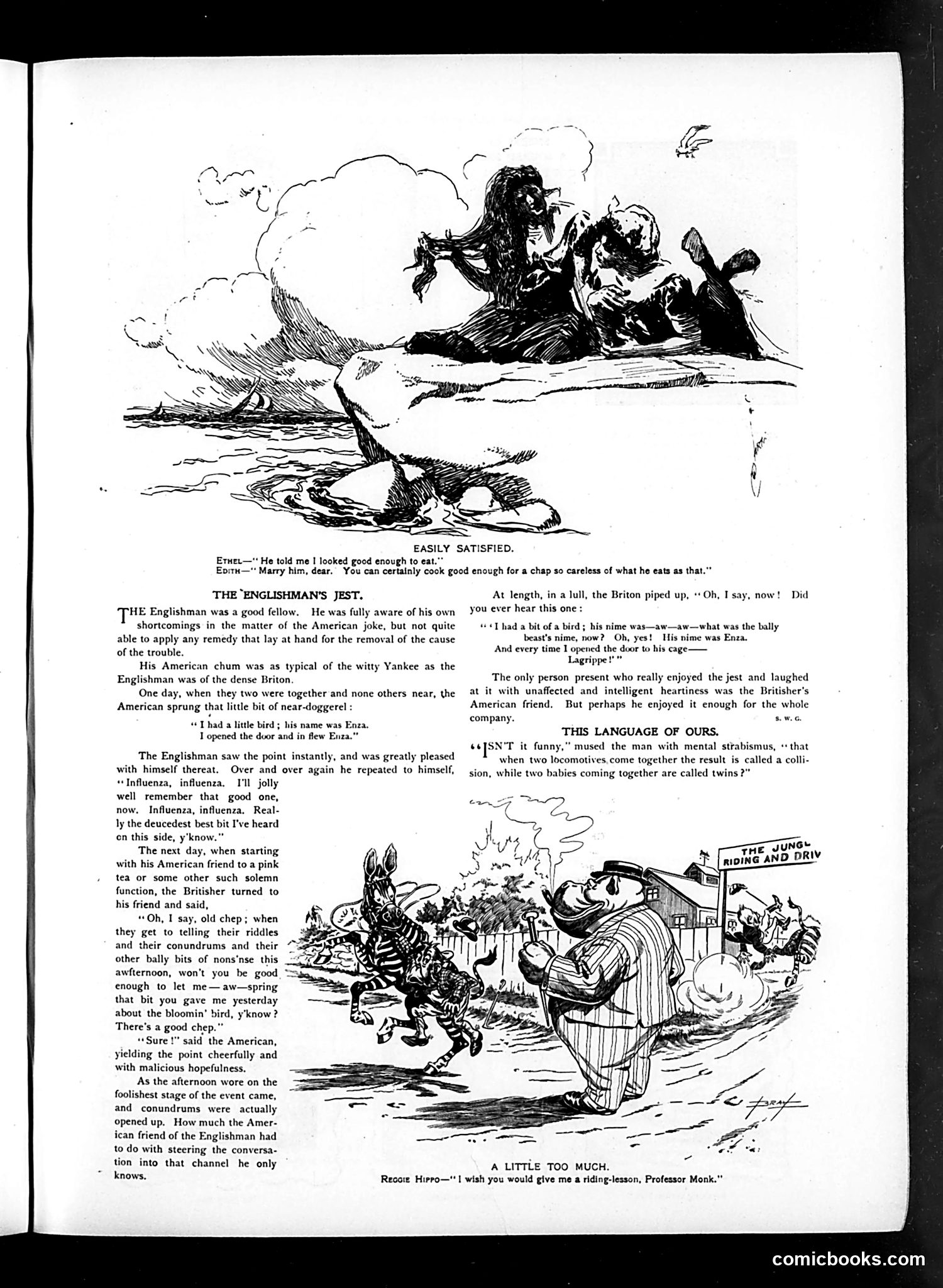
This page contains three separate humorous pieces mocking Anglo-American cultural differences: **"Easily Satisfied"** (top): A joke about an Englishman's low culinary standards—he claims food "good enough to eat" suffices, prompting an American to suggest cooking whatever he eats as cheaply as possible. **"The Englishman's Jest"** (left): The main piece satirizes English humor as dense and unfunny compared to American wit. An Englishman's labored joke about "influenza" fails to amuse, while only his American friend appreciates the attempt. **"This Language of Ours"** (right): A brief joke about railroad terminology—comparing "collision" (two locomotives together) to "twins" (two babies together). **"A Little Too Much"** (bottom): A cartoon showing a hippo requesting riding lessons from "Professor Monk," suggesting the animal is overly ambitious. These pieces reflect early 20th-century American attitudes of cultural superiority toward the British.
📄 Transcribed text from this page (OCR, searchable)
Machine-transcribed from the original scan — historical spelling and the odd misread are preserved.
EASILY SATISFIED. He told me | looked good enough to eat.”” "Marry him, dear. You can certainly cook good enough for a chap so careless of what he eats as that.” ‘THE “ENGLISHMAN'S JEST. THE Englishman was a good fellow. He was fully aware of his own shortcomings in the matter of the American joke, but not quite able to apply any remedy that lay at hand for the removal of the cause of the trouble. His American chum was as typical of the witty Yankee as the Englishman was of the dense Briton. One day, when they two were together and none others near, the American sprung that little bit of near-doggerel : “Thad a little bird ; his name was Enza. I opened the door and in flew Enza.” The Englishman saw the point instantly, and was greatly pleased with himself thereat. Over and over again he repeated to himself, “Influenza, influenza, I'll jolly well remember that good one, now, Influenza, influenza. Real- ly the deucedest best bit I've heard cn this side, y'know.” The next day, when starting with his American friend to a pink tea or some other such solemn function, the Britisher turned to his friend and said, “Oh, I say, old chep; when they get to telling their riddles and their conundrums and their other bally bits of nons‘nse this awfternoon, won't you be good enough to let_me—aw—spring that bit you gave me yesterday about the bloomin’ bird, y'know ? There's a good chep.” **Sure !" said the American, yielding the point cheerfully and with malicious hopefulness. As the afternoon wore on the foolishest stage of the event came, and conundrums were actually opened up. How much the Amer- ican friend of the Englishman had to do with steering the conversa- tion into that channel he only At length, in a lull, the Briton piped up, “Oh, Tsay, now! Did you ever hear this one: “ «Thad a bit of a bird; his nime was—aw—aw—what was the bally beast’s nime, now? Oh, yes! His nime was Enza. And every time I opened the door to his cage— Lagrippe!” The only person present who really enjoyed the jest and laughed at it with unaffected and intelligent heartiness was the Britisher's American friend. But perhaps he enjoyed it enough for the whole company. swe. THIS LANGUAGE OF OURS. S4]SN'T it funny,” mused the man with mental strabismus, «that when two locomotives, come together the result is called a colli- sion, while two babies coming together are called twins?” He JUNGH RioING AND _DRIV A LITTLE TOO MUCH. knows. Recote Hirro—''| wish you would give me a riding-lesson, Professor Monk." comicbooks.com