
A complete issue · 16 pages · 1906
Judge — June 9, 1906
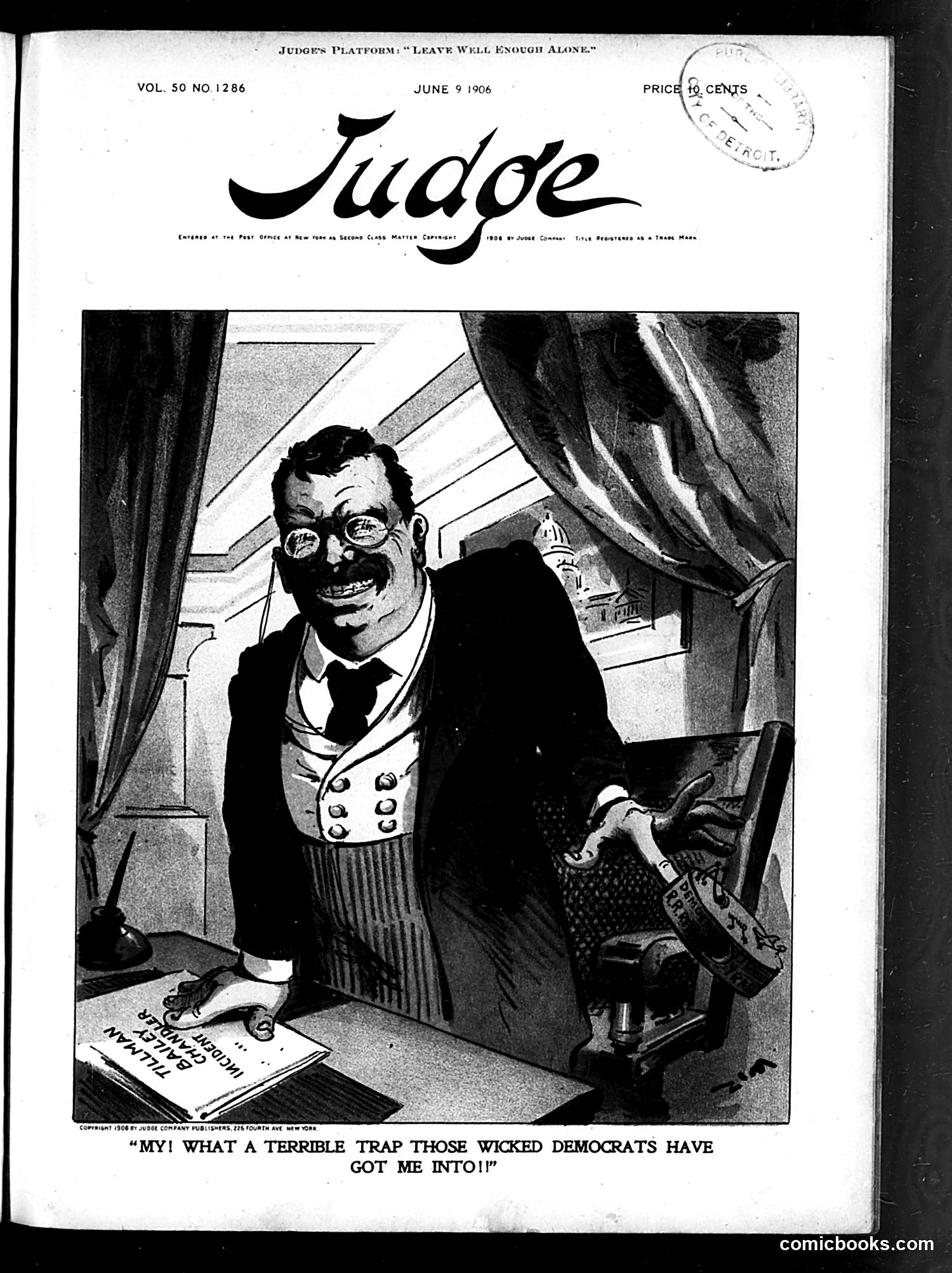
This Republican-leaning satirical cartoon depicts a portly Republican politician trapped in mechanical restraints labeled "DEMOCRATIC SNARE" and "TRAP." The figure's exaggerated facial features—prominent nose, thick mustache, and gleeful expression—and formal attire suggest a caricatured political figure of the era, though the specific identity remains unclear from the image alone. The caption reads: "MY! WHAT A TERRIBLE TRAP THOSE WICKED DEMOCRATS HAVE GOT ME INTO!!" The satire mocks Republican complaints about Democratic legislative or procedural obstacles during the 1906 congressional period. The cartoon suggests Republicans are caught in their own political machinations while blaming Democrats, using the literal trap imagery to ridicule what Judge's editors viewed as hypocritical victimhood claims.
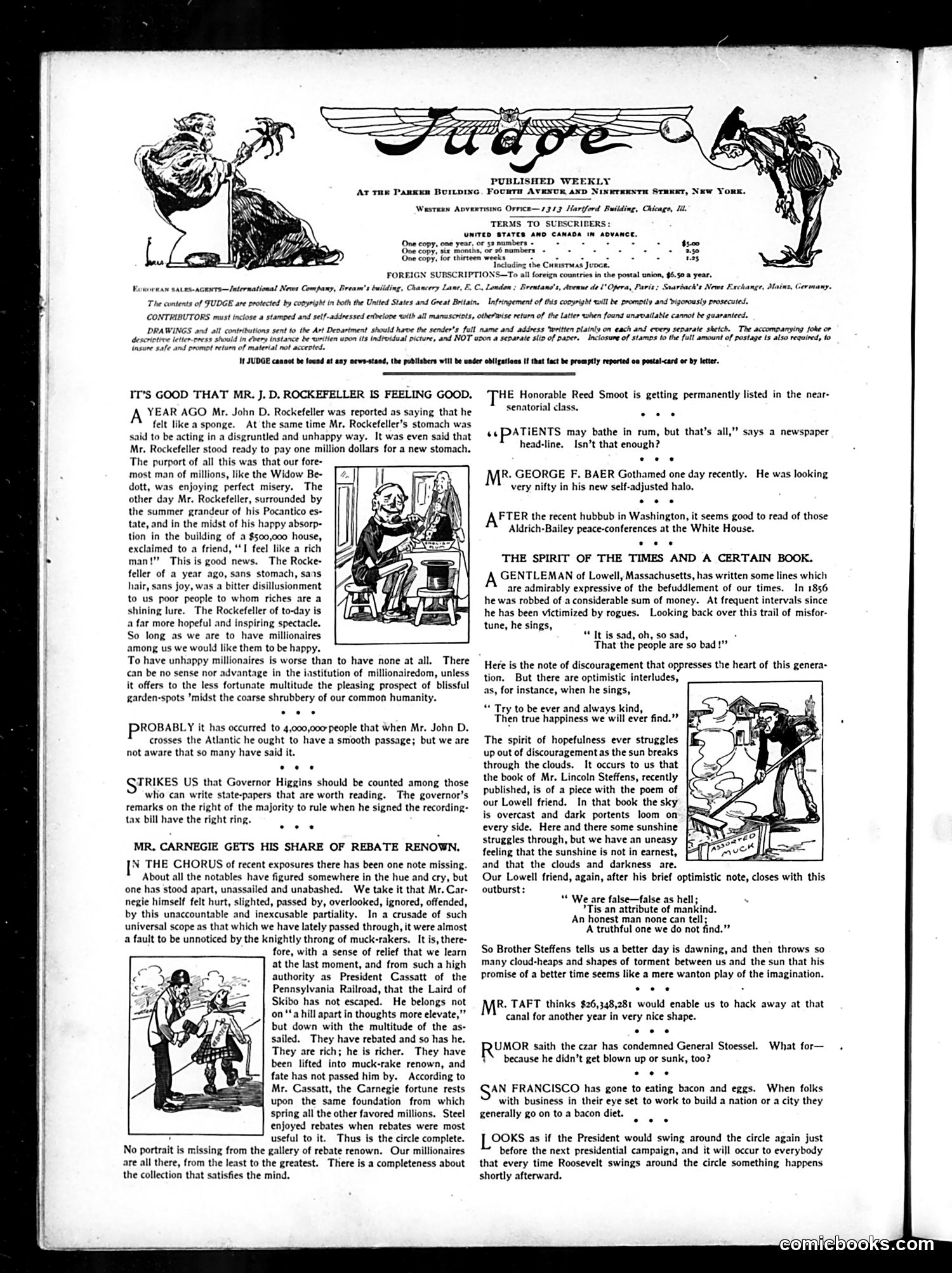
This page contains satirical commentary on contemporary political and social figures, circa early 1900s. The visible text references: **John D. Rockefeller** - mocked for his wealth and charitable giving, with satire suggesting his generosity stems from guilt over his fortune rather than genuine benevolence. **Reed Smoot** - apparently facing senatorial confirmation issues. **George F. Baer** - noted for his bald appearance in a new self-adopted style. **Andrew Carnegie** - satirized regarding railroad rebates and tax policy, with commentary on his philanthropic activities versus his business practices. The cartoons appear to criticize wealthy industrialists of the Gilded Age, their tax avoidance, labor practices, and the gap between their public philanthropy and private business ethics. The tone suggests populist skepticism toward the justifications offered by America's richest men for their fortunes and charitable work.
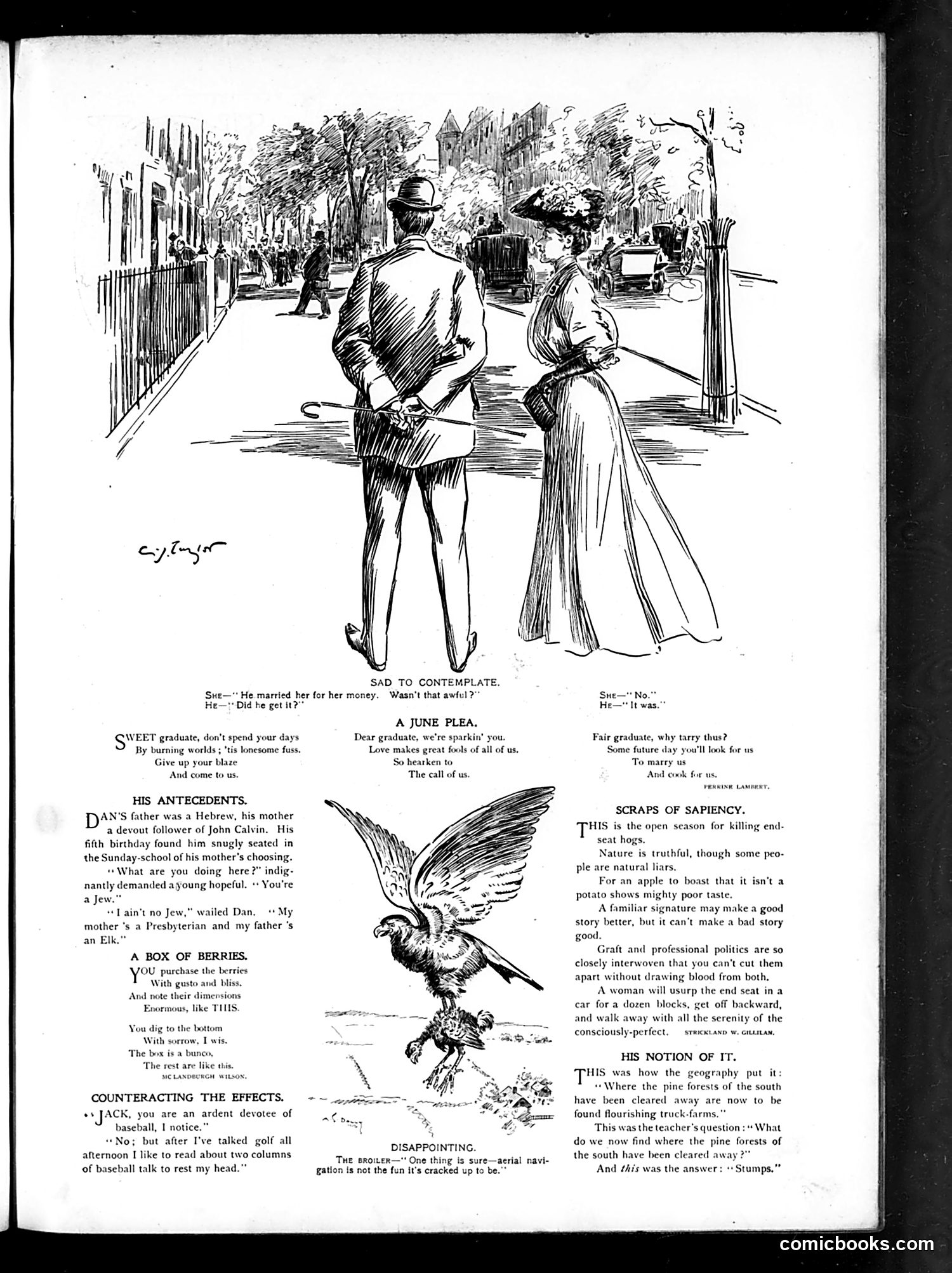
The top cartoon illustrates a domestic comedy about marriage and money. A well-dressed couple contemplates marriage; she married him for his wealth, but he didn't actually have it—a reversal of typical gold-digger expectations. The joke plays on Edwardian-era anxieties about mercenary marriages and financial deception. Below are several short satirical pieces and humorous poems targeting contemporary social types: clergy, Jewish immigrants (Dan's mixed-faith family), and educational pretense ("His Antecedents"). The central illustration of a bird with a mouse appears unrelated to surrounding text. The remaining sections include light social satire about berry-picking etiquette, baseball talk, and geography education—typical Judge fare lampooning middle-class manners and institutional follies rather than specific political figures or events.
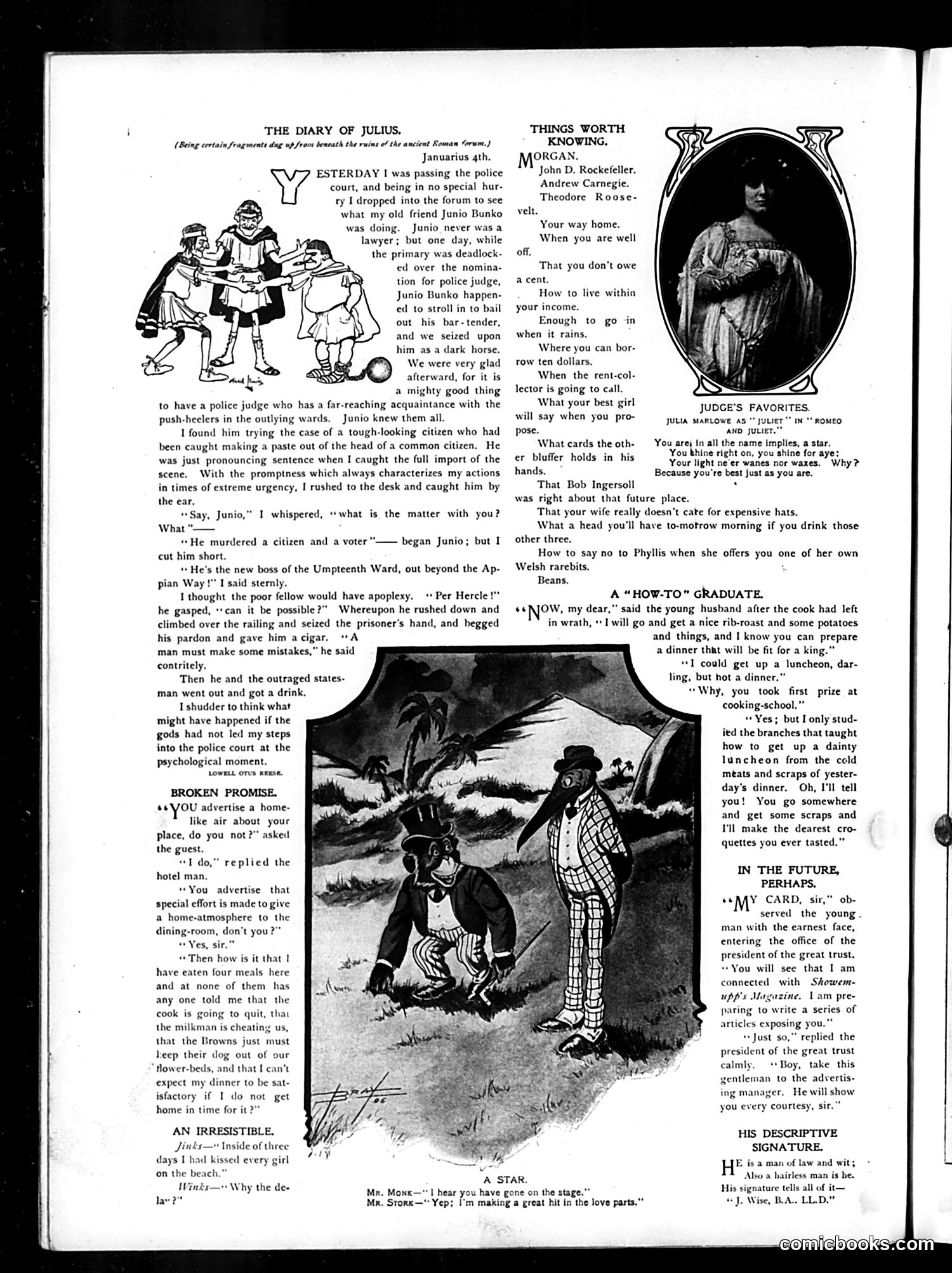
This page combines fiction ("The Diary of Julius") with advice columns and illustrations. The main cartoon depicts two men on a rural road—one labeled "Mr. Moke" says "I hear you have gone on the stage," while "Mr. Stoke" replies "Yes; I'm making a great hit in the love parts." The joke appears to be a pun: "on the stage" likely refers to stagecoach travel (visible in the background), not theatrical performance. Mr. Stoke's earnest response about "love parts" creates absurdist humor by treating the misunderstanding literally. The surrounding content includes practical advice columns ("A 'How-to' Graduate," "In the Future, Perhaps") and a portrait labeled "Judge's Favorites," presenting this as a typical Judge issue mixing satire, humor, and lifestyle advice for educated readers.
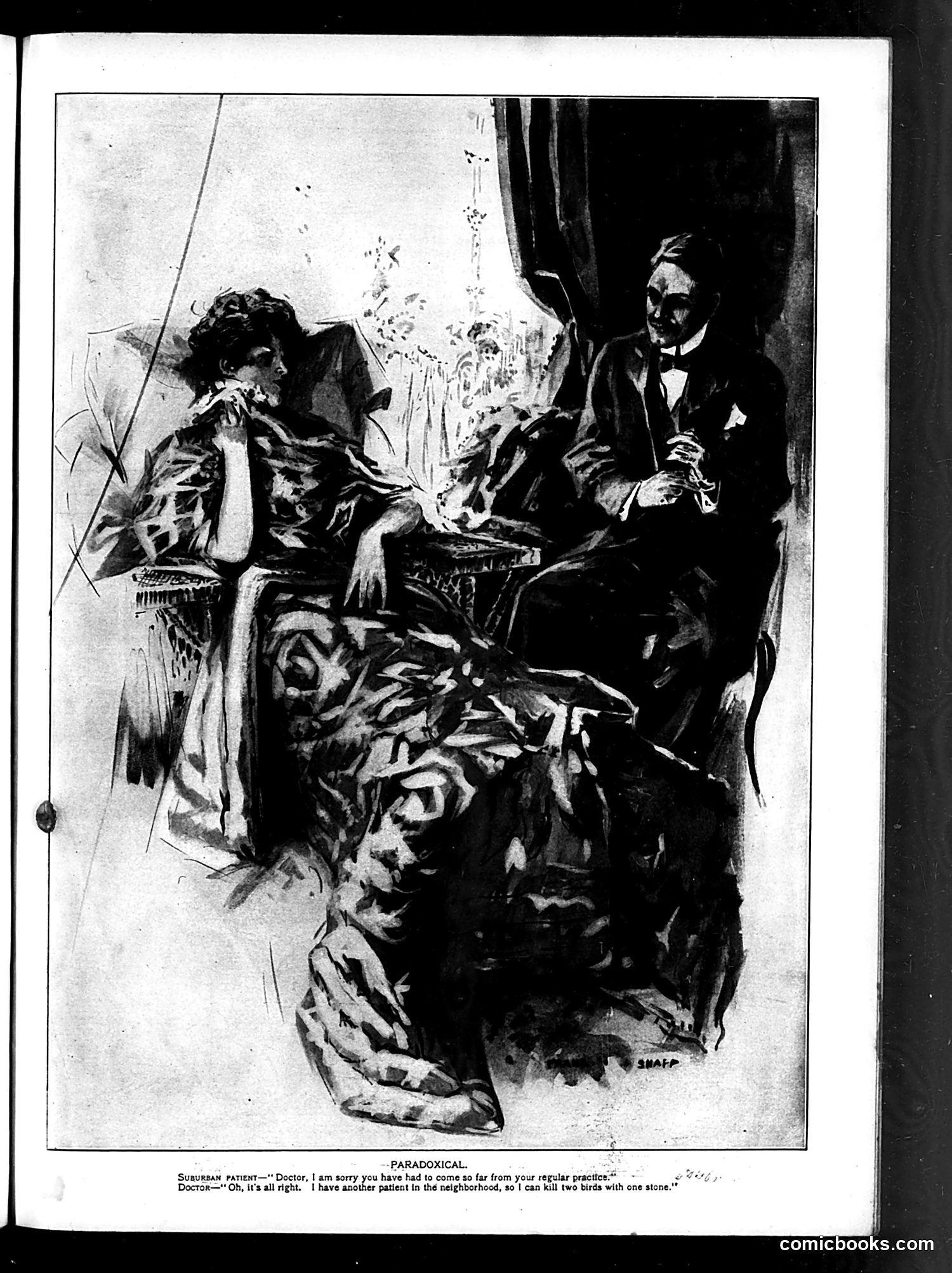
This cartoon satirizes a doctor's contradictory excuse-making. A well-dressed physician tells a suburban patient he's sorry for missing regular appointments because he's been attending to another patient in the neighborhood—so he can "kill two birds with one stone." The joke hinges on the phrase "kill two birds with one stone" (accomplish two things efficiently), which the doctor unwittingly applies to his medical practice in darkly ironic fashion. The implication is that by having patients geographically close together, he can treat them simultaneously—an absurdly efficient but medically questionable approach that reduces patients to mere logistical problems. The satire mocks both medical professionalism and the era's emerging suburban expansion, suggesting doctors prioritized convenience over care.
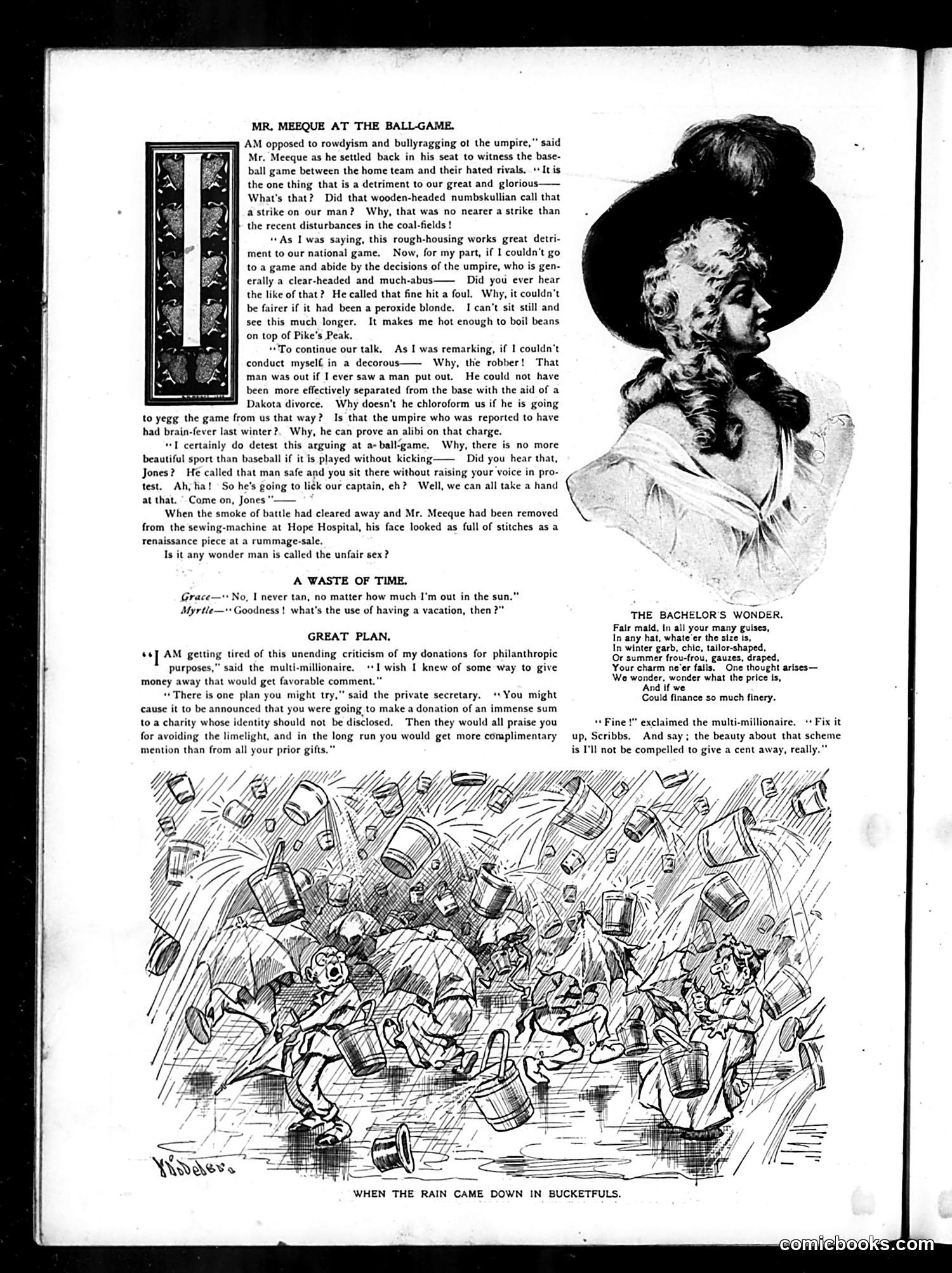
This page contains three satirical pieces from *Judge* magazine: **"Mr. Meeque at the Ball-Game"**: A hypocritical businessman loudly declares his opposition to rowdy umpire-baiting before a baseball game, then immediately violates his own principle by loudly complaining about every call. The satire targets self-righteous hypocrisy—he preaches civility while behaving outrageously, eventually getting into a fight and hospitalized. The references to "coal-fields disturbances" and "Dakota divorce" suggest early 20th-century labor unrest and divorce scandal. **"A Waste of Time"**: Brief joke about vacation futility for pale people. **"Great Plan"**: Mocks wealthy philanthropists' desire for praise without sacrifice. A millionaire's secretary suggests announcing huge donations to unnamed charities—generating praise for "humility" while actually giving nothing. This satirizes performative charity and wealthy donors' ego-driven generosity. The bottom cartoon ("When Rain Came Down in Bucketfuls") appears to show people scrambling during heavy rainfall—likely depicting comedic chaos.
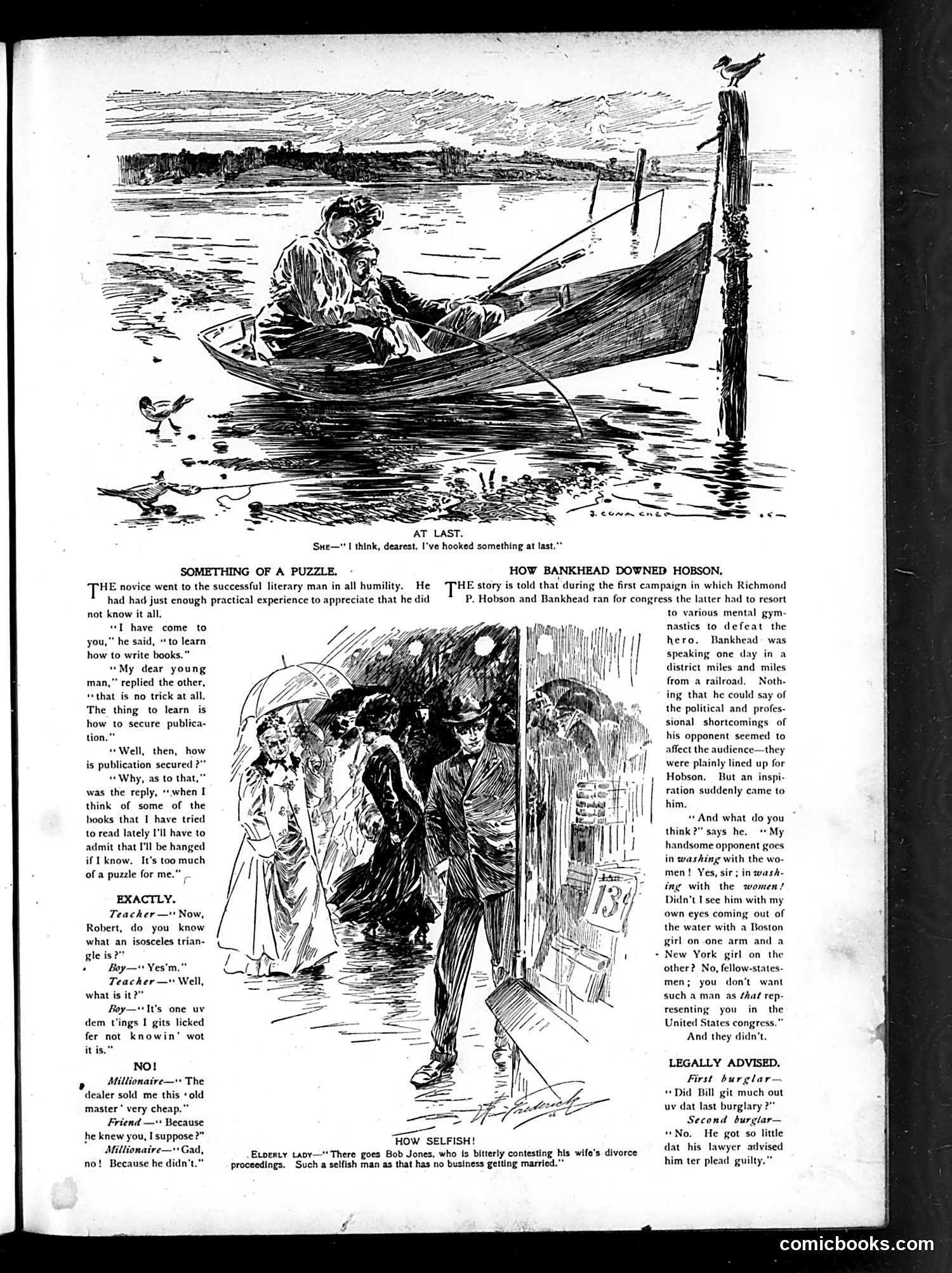
This page contains multiple unrelated satirical items typical of Judge magazine's format: **"At Last"** (top): A couple in a rowboat; the woman announces she's "hooked something at last"—a double entendre joke about fishing and marriage. **"Something of a Puzzle"** and **"Exactly"**: Two separate teacher-student dialogues mocking ignorance and pretension in education. **"How Bankhead Downed Hobson"**: References a real congressional race between Richmond P. Hobson and John Hollis Bankhead (likely early 1900s, unclear which election). The story illustrates Bankhead's campaign tactic: he claimed Hobson was seen "washing with the women," implying impropriety or unmanly behavior. This succeeded in turning rural voters against Hobson—satirizing how voters could be swayed by character attacks rather than policy. **"How Selfish"** and **"Legally Advised"**: Brief joke items about divorce and burglary, typical filler humor. The page exemplifies Judge's mix of political commentary, social satire, and light humor aimed at educated readers.
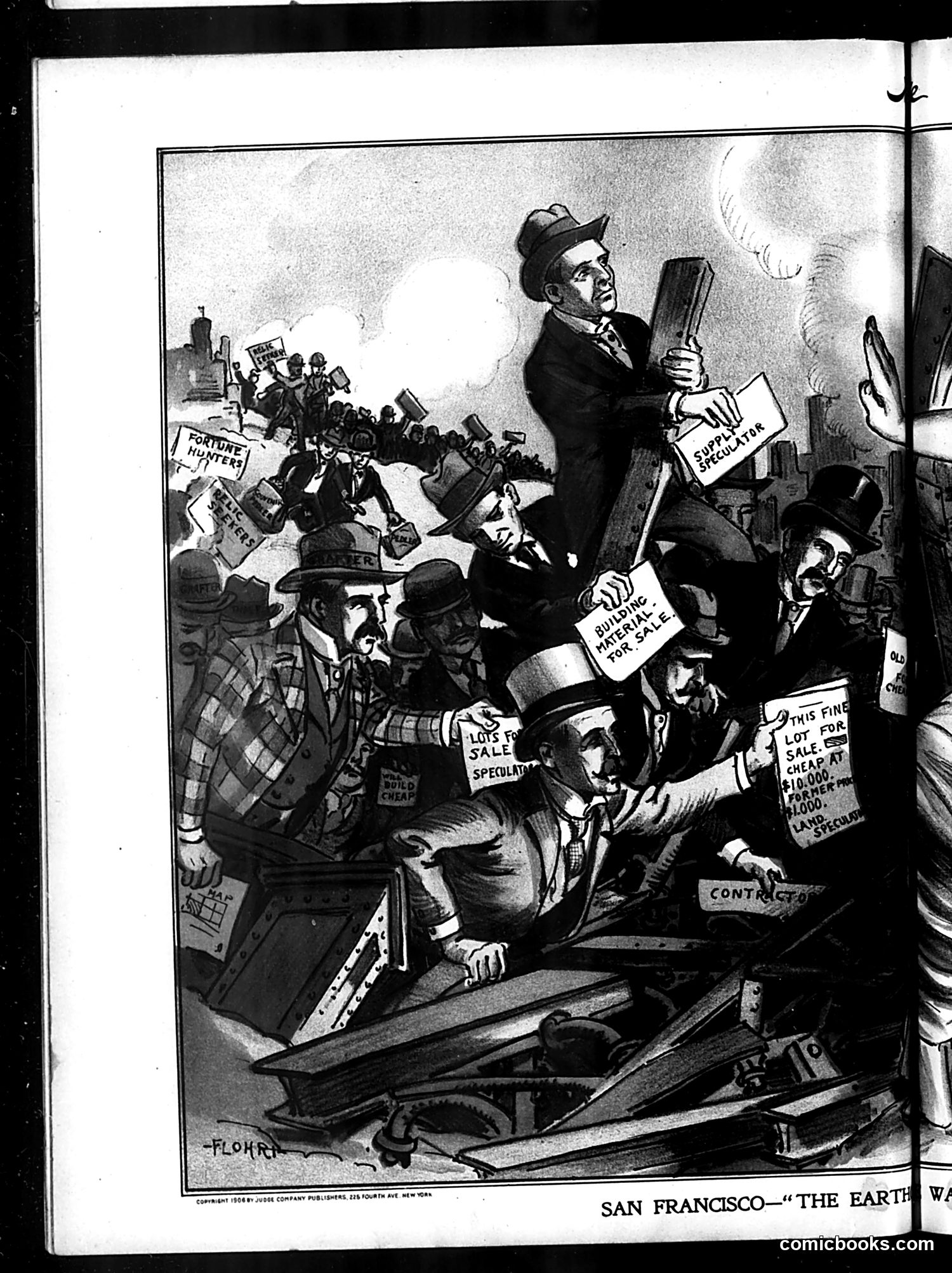
This political cartoon by Florine (signed "FLORI") depicts the 1906 San Francisco earthquake's aftermath through satire. Well-dressed speculators and businessmen hold signs advertising land sales—"LOTS FOR SALE," "CHEAP AT $10,000," "BUILDINGS FOR SALE"—treating the disaster as a profit opportunity. An auctioneer figure stands elevated, orchestrating sales. The cartoon criticizes how wealthy investors exploited the catastrophe, buying up devastated property at low prices to resell for profit. The chaotic composition and the businessmen's eager expressions emphasize their callous opportunism amid others' suffering. This reflects Progressive Era criticism of capitalism's exploitation during human tragedy—a common Judge magazine theme attacking corruption and greed.
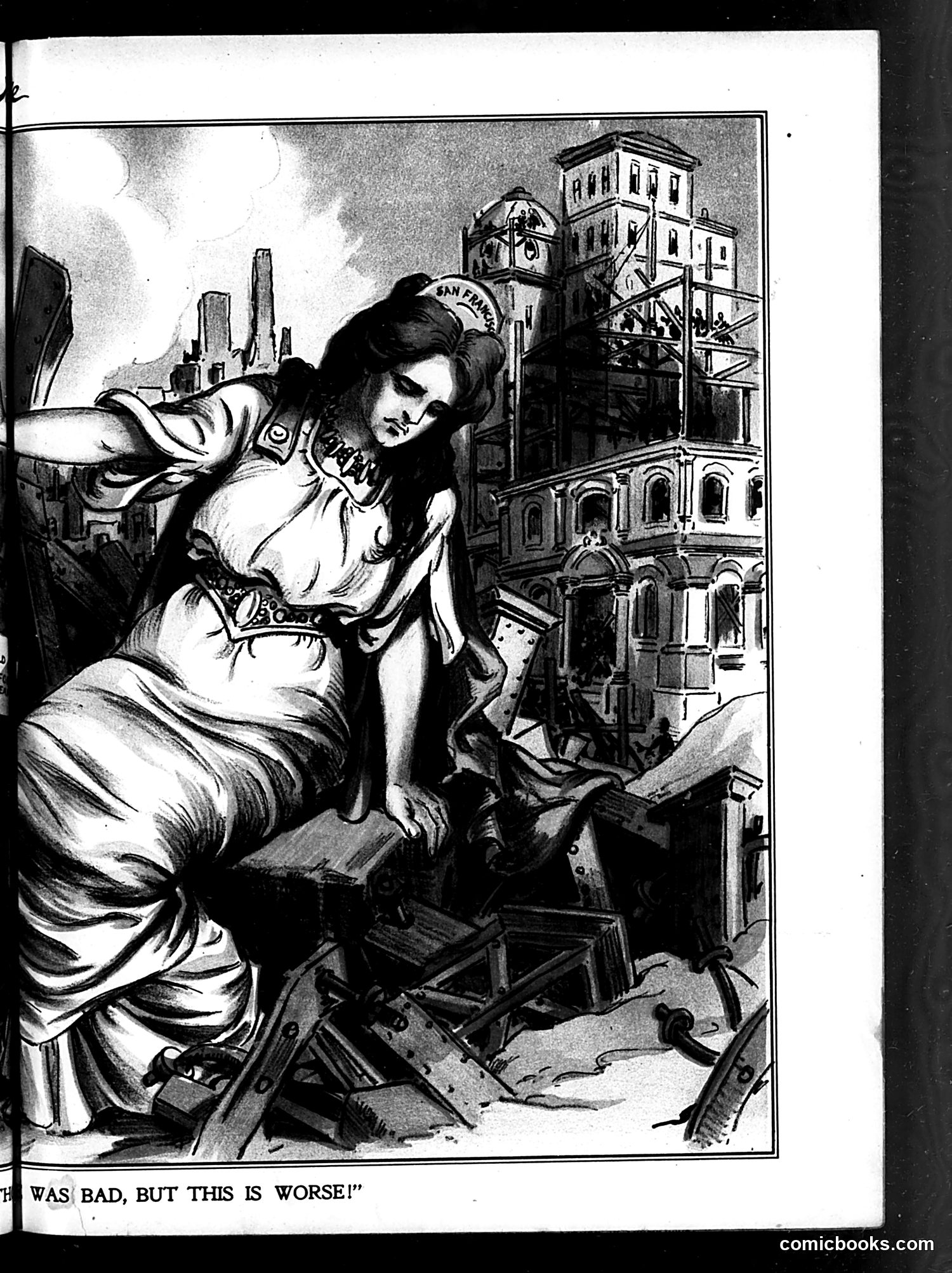
This appears to be an early 20th-century political or social satire cartoon. The image shows a female allegorical figure (possibly representing San Francisco, given the visible text on a building) surveying urban destruction—collapsed structures and debris below her. The caption reads: "WAS BAD, BUT THIS IS WORSE!" This likely references the 1906 San Francisco earthquake and its aftermath. The cartoon suggests that while the earthquake itself caused tremendous damage, whatever follows (possibly the fire, or perhaps social/political consequences) is being portrayed as even more catastrophic. The allegorical female figure and dramatic composition are typical of Judge magazine's satirical style, using personification to comment on contemporary disasters and their implications.
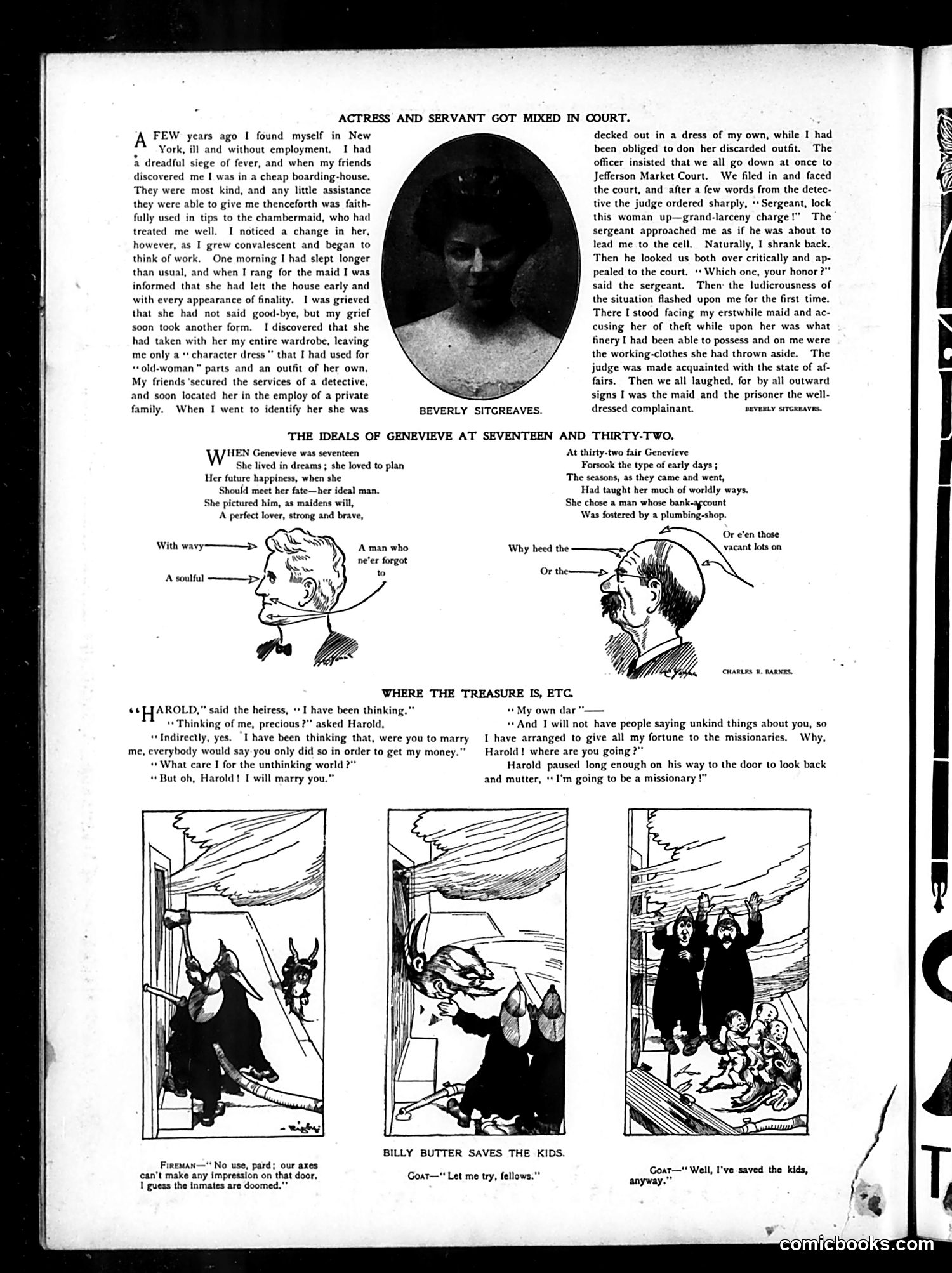
This page contains three distinct satirical pieces from *Judge* magazine: **"Actress and Servant Got Mixed in Court"** mocks the absurdity of courtroom justice. An actress sues her maid for stealing her clothes, but because the maid is wearing the actress's fine dress while the actress wears the maid's work clothes, the sergeant cannot identify which woman is the accused. The satire highlights how appearance and class markers can confuse justice itself. **"The Ideals of Genevieve"** compares a woman's romantic dreams at seventeen (wanting a "perfect lover, strong and brave") versus her practical choice at thirty-two (marrying for money). The jokes mock women's supposed materialism and changing values with age. **"Billy Butter Saves the Kids"** appears to be a sequential comic strip showing someone (Billy Butter, likely a recurring character) rescuing children, though the full narrative isn't visible on this page. The overall tone reflects *Judge's* satirical commentary on class, gender, and social hypocrisy common to early 20th-century American humor.
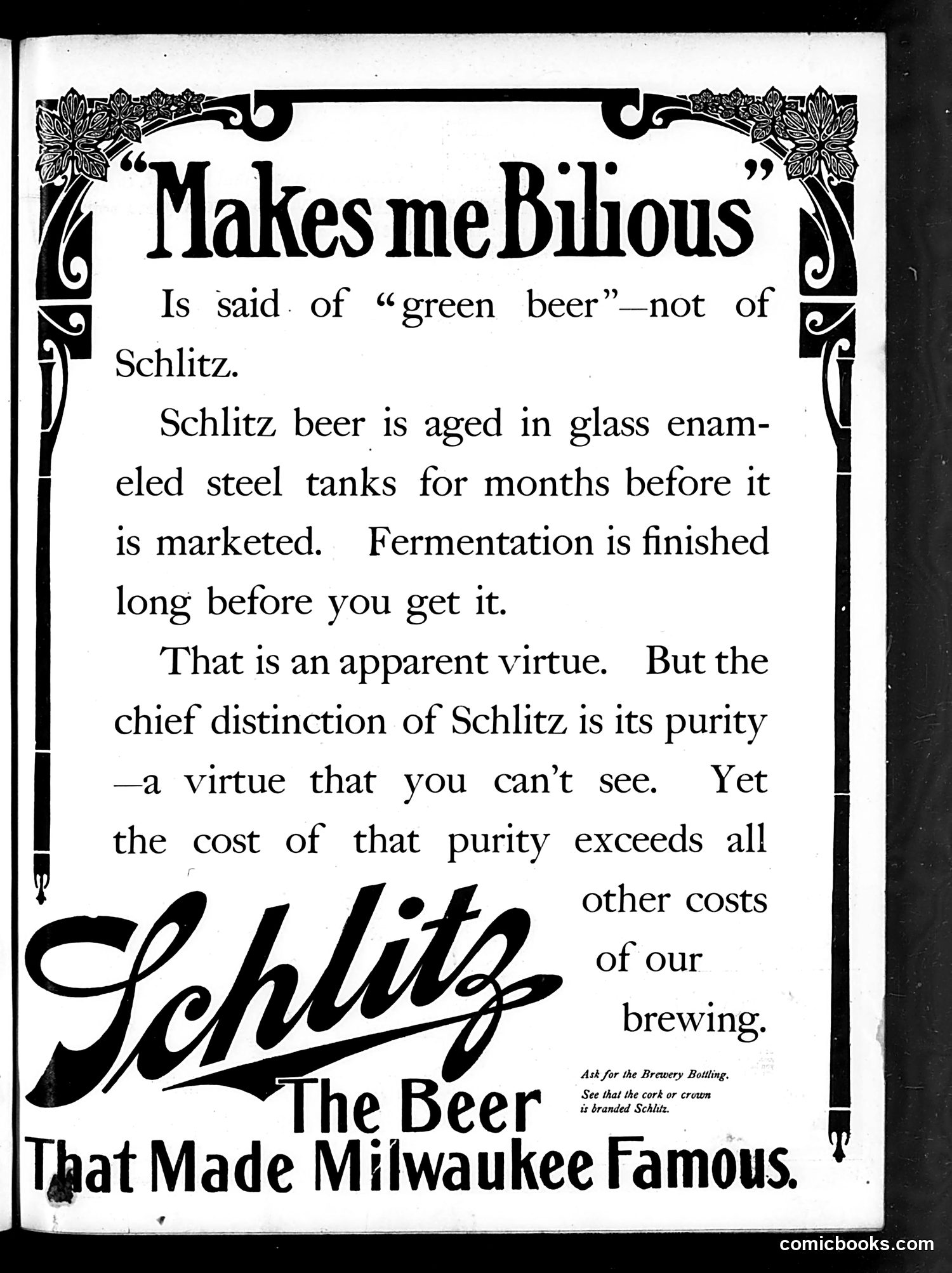
This is a **Schlitz beer advertisement**, not satire or political commentary. The page uses the phrase "Makes me Bilious" as a hook—likely referencing stomach upset from inferior beers—to then argue that Schlitz beer *doesn't* cause this problem. The ad emphasizes Schlitz's **purity** as its key selling point, claiming the beer undergoes months of aging in glass-enameled steel tanks with fermentation completed before sale. It asserts that while purity is invisible to consumers, Schlitz bears exceptional costs to maintain it—positioning the brewery as premium and quality-focused. The tagline "The Beer That Made Milwaukee Famous" establishes Schlitz as the city's signature product. This appears to be a straightforward corporate advertisement rather than political satire or humor content typical of *Judge* magazine.
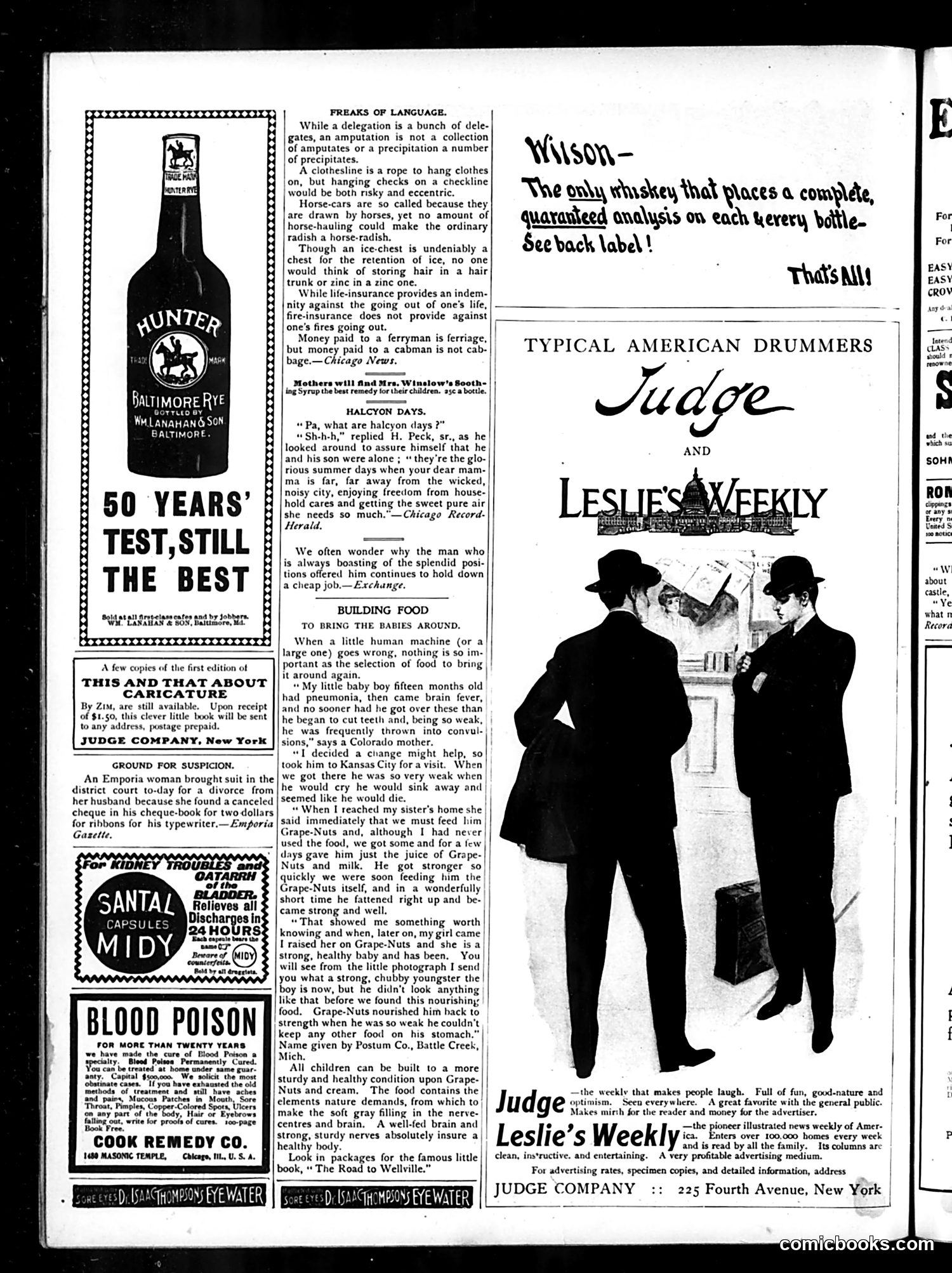
This page from Judge magazine is primarily **advertising and advice columns**, not satirical cartoons. The main content includes: **Advertisements**: Hunter Baltimore Rye whiskey (claiming 50 years of quality), patent medicines (Santal capsules for kidney trouble, blood poison treatments), and notably **Grape-Nuts cereal**, featured in a testimonial about feeding a sickly infant who recovers through proper nutrition. **Humor sections**: "Freaks of Language" plays on English linguistic absurdities (why "horse-radish" isn't actually radish drawn by horses). "Halcyon Days" jokes that a father means the summer months when his wife is away from home—mild domestic humor about marital relief. **The Wilson's whiskey ad** (top right) emphasizes complete analysis on each bottle as a selling point. The page reflects early 20th-century attitudes: patent medicines with dubious claims, infant feeding advice (Grape-Nuts as baby food), and lighthearted misogyny in the "halcyon days" joke. There's no identifiable political satire here—it's largely commercial content typical of the era's magazines.
This page is primarily **advertising and filler content**, not political satire. It contains: **Advertisements:** Evans' Ale, Sohmer pianos, The Prudential Insurance Company (featuring "The Wedding Ring"), and the Adirondack Mountains/New York Central Lines. **Humor Sections:** Three brief, lighthearted jokes: - "Prophets vs. Patriarchs": A minister's anecdote about a woman calling old chickens "patriarchs" instead of poultry - "Salutatory": A new newspaper editor's modest introduction, contrasting himself with sensationalist competitors - "Couldn't Be in Two Places": A child's innocent logical confusion between his father's and Sunday school teacher's promises of rewards (heaven vs. circus) **Notable Content:** An announcement for Judge's Fourth-of-July double issue, promoting patriotic content including fireworks coverage. The page reflects early 20th-century advertising practices and gentle, family-friendly humor rather than sharp political commentary. No specific political figures or events are referenced.
This is primarily an **advertising page** with scattered short humorous anecdotes rather than political cartoons. The content reflects early 20th-century American consumer culture and social humor. **Key advertisements include:** - Brand's A.1. Sauce (positioned as royalty-approved) - Gillette Safety Razors (emphasizing no stropping/honing needed) - Mennen's Toilet Powder - Triscott whiskey - Atlantic City resort promotion **The humor pieces** are light social commentary: a choir soprano troubled by jealous congregants; a senator's best speech being one that earned him a railroad pass; wordplay about debt and composers "stealing marches"; a Boston woman called "Little Foureyes" by a New York man (mocking spectacles); and a child's observation that heaven-thunder means angels "cleaning house." **The overall tone** is genteel, commercial, and apolitical—reflecting Judge's appeal to middle-class consumers rather than satirizing political figures or movements. The page documents early advertising strategies and period social attitudes rather than significant satire.
This page is primarily **advertisements and light humor pieces** rather than political satire. The **"Personal" and "Bubbles" sections** are genteel jokes typical of the era: a cook baking biscuits so light they weigh less than a pound (ironic praise), commentary on relationships and gender dynamics, and observations about women keeping secrets. These reflect early 20th-century attitudes about gender roles without targeting specific political figures. The **advertisements dominate**: Cook's Champagne, Pears' Soap, Allen's Foot-Ease powder, and prominently, Sunny Brook Whiskey (marketed as "Bottled in Bond" under U.S. government guarantee) and George Palliser's house-plan books. The whiskey ad notably emphasizes government oversight and a St. Louis World's Fair prize, suggesting consumer trust in official endorsements. There are **no identifiable political cartoons or caricatures**—this appears to be an advertising-heavy issue rather than satirical commentary. The humor is domestic and gender-focused rather than political.
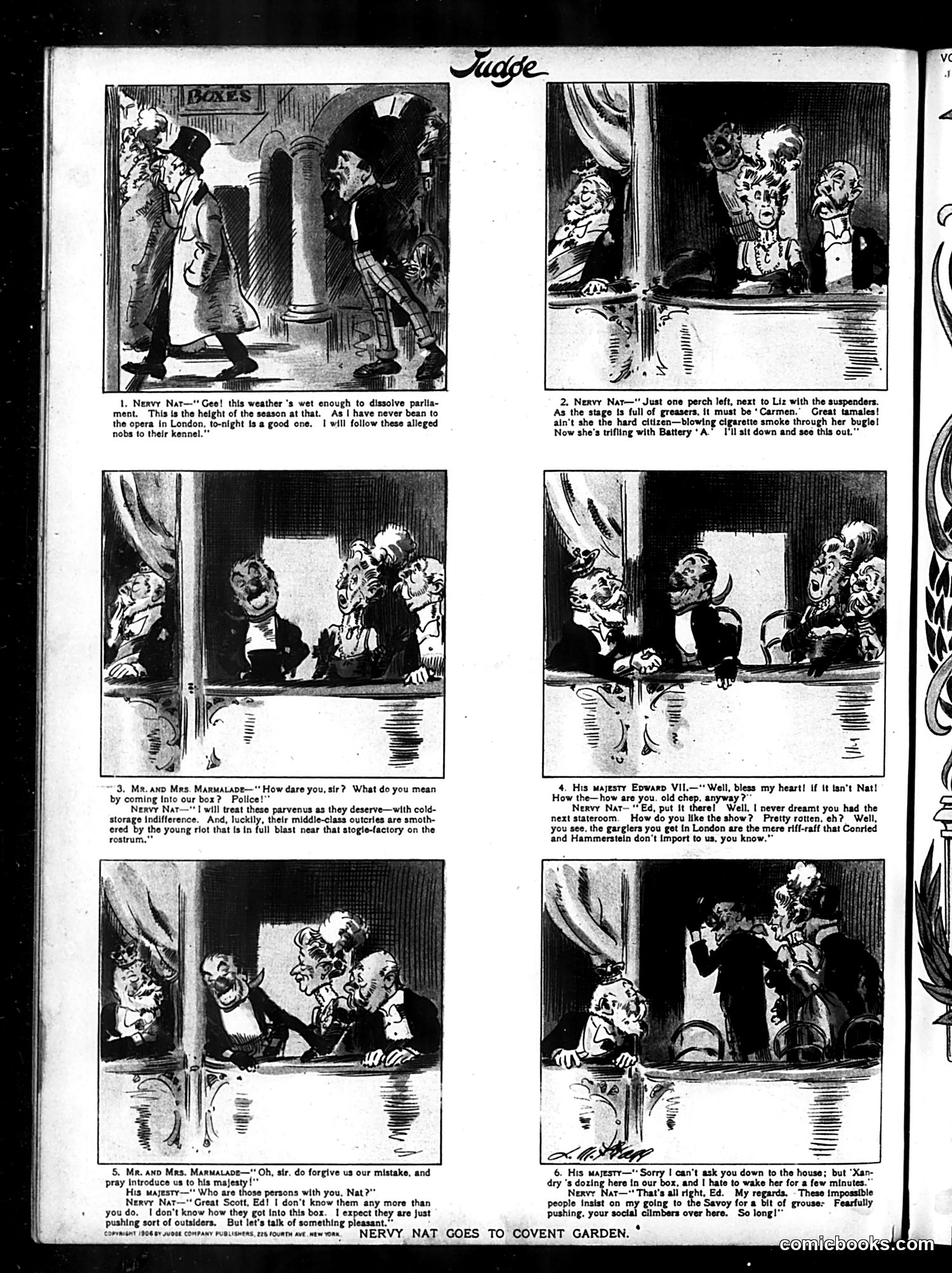
This comic strip satirizes a brash American character, "Nervy Nat," who crashes London's high society at the opera (Covent Garden). The humor hinges on his complete lack of social awareness and pretension. Nat brazenly enters aristocratic boxes uninvited, speaks familiarly to King Edward VII as "Ed," insults the opera performance and other attendees with crude comments, and pretends to know people he's just met. He calls opera singers "greasers" and dismisses the audience as "riff-raff." The satire targets American wealth and vulgarity encountering British class hierarchies. Nat represents the stereotype of the unsophisticated American tourist who, armed with money and confidence, assumes he belongs anywhere and shows contempt for European refinement. His repeated phrase "I'll sit down and see this out" reflects oblivious determination to stay where he's unwelcome—the entire joke being his social blindness.