
Judge, 1906-06-09 · page 2 of 16
Judge — June 9, 1906 — page 2: what you’re looking at
What you’re looking at
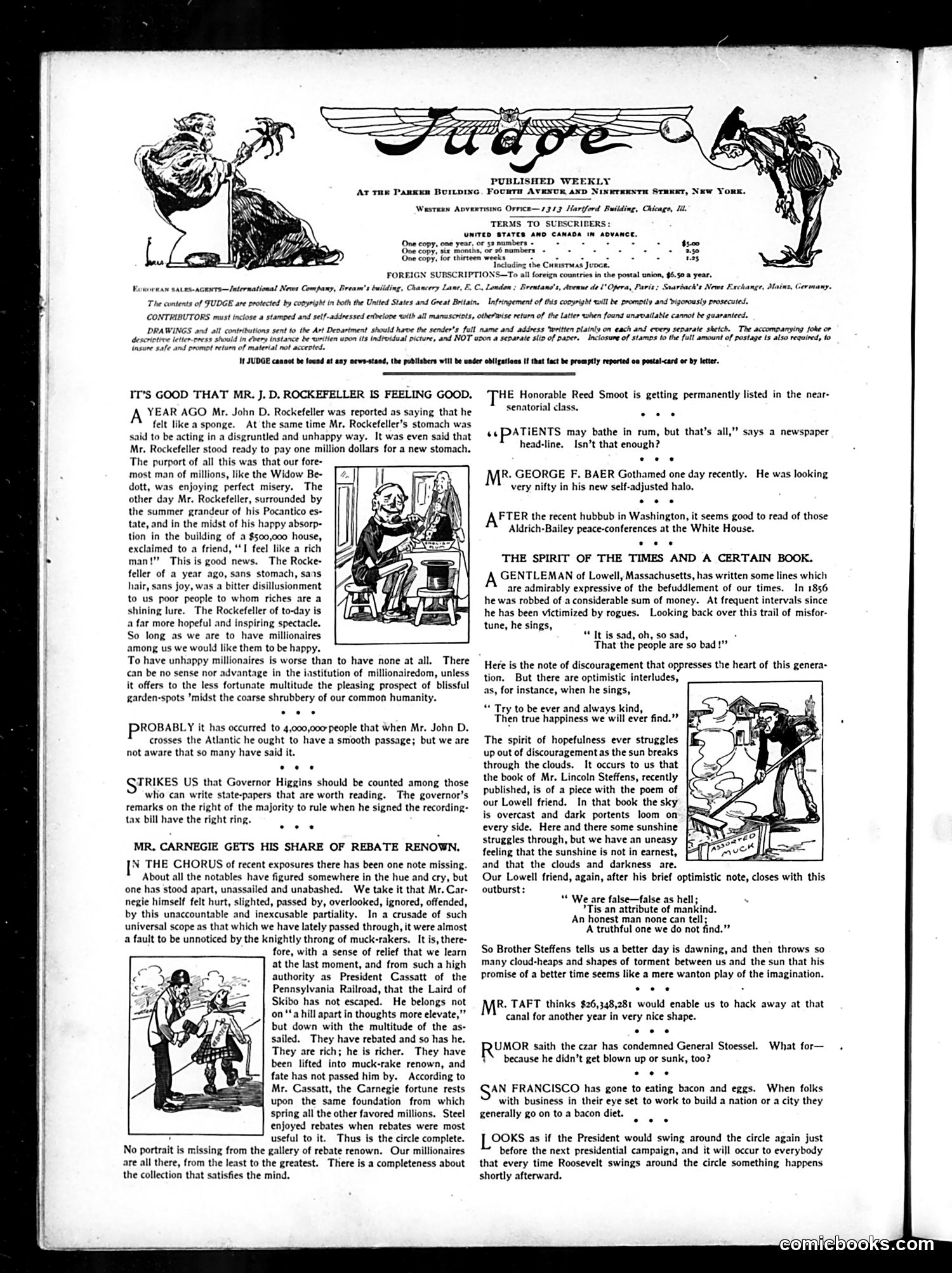
This page contains satirical commentary on contemporary political and social figures, circa early 1900s. The visible text references: **John D. Rockefeller** - mocked for his wealth and charitable giving, with satire suggesting his generosity stems from guilt over his fortune rather than genuine benevolence. **Reed Smoot** - apparently facing senatorial confirmation issues. **George F. Baer** - noted for his bald appearance in a new self-adopted style. **Andrew Carnegie** - satirized regarding railroad rebates and tax policy, with commentary on his philanthropic activities versus his business practices. The cartoons appear to criticize wealthy industrialists of the Gilded Age, their tax avoidance, labor practices, and the gap between their public philanthropy and private business ethics. The tone suggests populist skepticism toward the justifications offered by America's richest men for their fortunes and charitable work.
📄 Transcribed text from this page (OCR, searchable)
Machine-transcribed from the original scan — historical spelling and the odd misread are preserved.
PUBLISHED WEEKLY Ar rue Parken Buripixc. FounTa AVeNcx axp Nixereextm Sraxet, New Youx. Wastaxx Apvexnisine Ornic unrreo 1313 Hartford Building, Chicage, Iit TERMS TO S ano One copy, one year. or 52 numbers ‘One copy, six months, or 26 numbers = ‘One copy, for thirteen weeks FOREIG: Teclading the Cuiisraeas Juoce SUDSCRIPTIONS—To all foreign countries in the postal union, $6.50. year, Po nornan Sates-acRnrs—Jnternational News Company, Bream's building, Chancery Lane, E.C, London: Brentane's, Avenue de i" Opera, Paris : Saarbach's News Exchange, Mains, G The contents of FUDGE are protected by copyright in both the United States and Great Britain, Infringement of this conyright will be promptly and digorously prosecuted. CONTRIBUTORS must inctose a stamped and self-addressed erfoeione with all manascricts, otherwise return of the Latter when found unavailable cannot be guarantecd. DRAWINGS and alt contributions sent to the Art Deoartment should harve the sender's fall name and address Yeritten plainly on each and every separate sketch. The accompanying joke or descriptive letler-press should in ébery instance be wrilien upon its indtoideal picture, and NOT upon a separate slip of paper. insure safe and promot return of material not accected. Inciosure of stamps to the fall amount of postage ts also reauired, 10 Mf JUDGE cansot be found at any wews-stand, the publishers will be uader obligations If that fact be promptly reported ow postal-card or by letter. IT’S GOOD THAT MR. J. D, ROCKEFELLER IS FEELING GOOD. YEAR AGO Mr. John D, Rockefeller was reported as saying that he felt like a sponge. At the same time Mr. Rockefeller’s stomach was said to be acting in a disgruntled and unhappy way. It was even said that Mr. Rockefeller stood ready to pay one million dollars for a new stomach. The purport of all this was that our fore- most man of millions, like the Widow Be- dott, was enjoying perfect misery. The other day Mr. Rockefeller, surrounded by the summer grandeur of his Pocantico es- tate, and in the midst of his happy absorp- tion in the building of a $500,000 house, exclaimed to a friend, “I feel like a rich man!’’ This is good news. The Rocke- feller of a year ago, sans stomach, sars hair, sans joy, was a bitter disillusionment to us poor people to whom riches are a shining lure. The Rockefeller of to-day is a far more hopeful and inspiring spectacle. So long as we are to have millionaires among us we would like them to be happy. To have unhappy millionaires is worse than to have none at all. There can be no sense nor advantage in the institution of millionairedom, unless it offers to the less fortunate multitude the pleasing prospect of blissful garden-spots ’midst the coarse shrubbery of our common humanity. ROBABLY it has occurred to 4,000,000 people that when Mr. John D. crosses the Atlantic he ought to have a smooth passage; but we are not aware that so many have said it. eee GTRIKES US that Governor Higgins should be counted among those whio can write state-papers that are worth reading. The governor's remarks on the right of the majority to rule when he signed the recording- tax bill have the right ring. MR. CARNEGIE GETS HIS SHARE OF REBATE RENOWN. IN THE CHORUS of recent exposures there has been one note missing. About all the notables have figured somewhere in the hue and cry, but one has stood apart, unassailed and unabashed. We take it that Mr. Car- negie himself felt hurt, slighted, passed by, overlooked, ignored, offended, by this unaccountable and inexcusable partiality. In a crusade of such universal scope as that which we have lately passed through, it were almost a fault to be unnoticed by the knightly throng of muck-rakers. It is, there- fore, with a sense of relief that we learn at the last moment, and from such a high authority as President Cassatt of the Pennsylvania Railroad, that the Laird of Skibo has not escaped. He belongs not on ‘a hill apart in thoughts more elevate,” but down with the multitude of the as- sailed. They have rebated and so has he. They are rich; he is richer. They have been lifted into muck-rake renown, and fate has not passed him by. According to Mr. Cassatt, the Carnegie fortune rests upon the same foundation from which spring all the other favored millions. Steel enjoyed rebates when rebates were most useful to it. Thus is the circle complete. No portrait is missing from the gallery of rebate renown. Our millionaires are all there, from the least to the greatest. There is a completeness about the collection that satisfies the mind. THE Honorable Reed Smoot is getting permanently listed in the near- senatorial class. s4PATIENTS may bathe in rum, but that’s all,” says a newspaper head-line. Isn't that enough? eee R. GEORGE F. BAER Gothamed one day recently. He was looking very nifty in his new self-adjusted halo. AFTER the recent hubbub in Washington, it seems good to read of those Aldrich-Bailey peace-conferences at the White House. THE SPIRIT OF THE TIMES AND A CERTAIN BOOK. GENTLEMAN of Lowell, Massachusetts, has written some lines which are admirably expressive of the befuddlement of our times. In 1856 he was robbed of a considerable sum of money. At frequent intervals since he has been victimized by rogues. Looking back over this trail of misfor- tune, he sings, “* It is sad, oh, so sad, . That the people are so bad !’” Here is the note of discouragement that oppresses the heart of this genera- tion. But there are optimistic interludes, as, for instance, when he sings, “ Try to be ever and always kind, Then true happiness we will ever find.” The spirit of hopefulness ever struggles up out of discouragement as the sun breaks through the clouds. It occurs to us that the book of Mr. Lincoln Steffens, recently published, is of a piece with the poem of our Lowell friend. In that book the sky is overcast and dark portents loom on every side. Here and there some sunshine struggles through, but we have an uneasy feeling that the sunshine is not in earnest, and that the clouds and darkness are. Our Lowell friend, again, after his brief optimistic note, closes with this outburst : “* We are false—false as hell; . 'Tis an attribute of mankind. An honest man none can tell; A truthful one we do not find.”” So Brother Steffens tells us a better day is dawning, and then throws so many cloud-heaps and shapes of torment between us and the sun that his promise of a better time seems like a mere wanton play of the imagination. R. TAFT thinks $26,348,281 would enable us to hack away at that canal for another year in very nice shape. UMOR saith the czar has condemned General Stoessel. because he didn’t get blown up or sunk, too? eee SAN FRANCISCO has gone to eating bacon and eggs. When folks with business in their eye set to work to build a nation or a city they generally go on to a bacon diet. What for— LOOKS as if the President would swing around the circle again just before the next presidential campaign, and it will occur to everybody that every time Roosevelt swings around the circle something happens shortly afterward.