
A complete issue · 16 pages · 1906
Judge — February 10, 1906
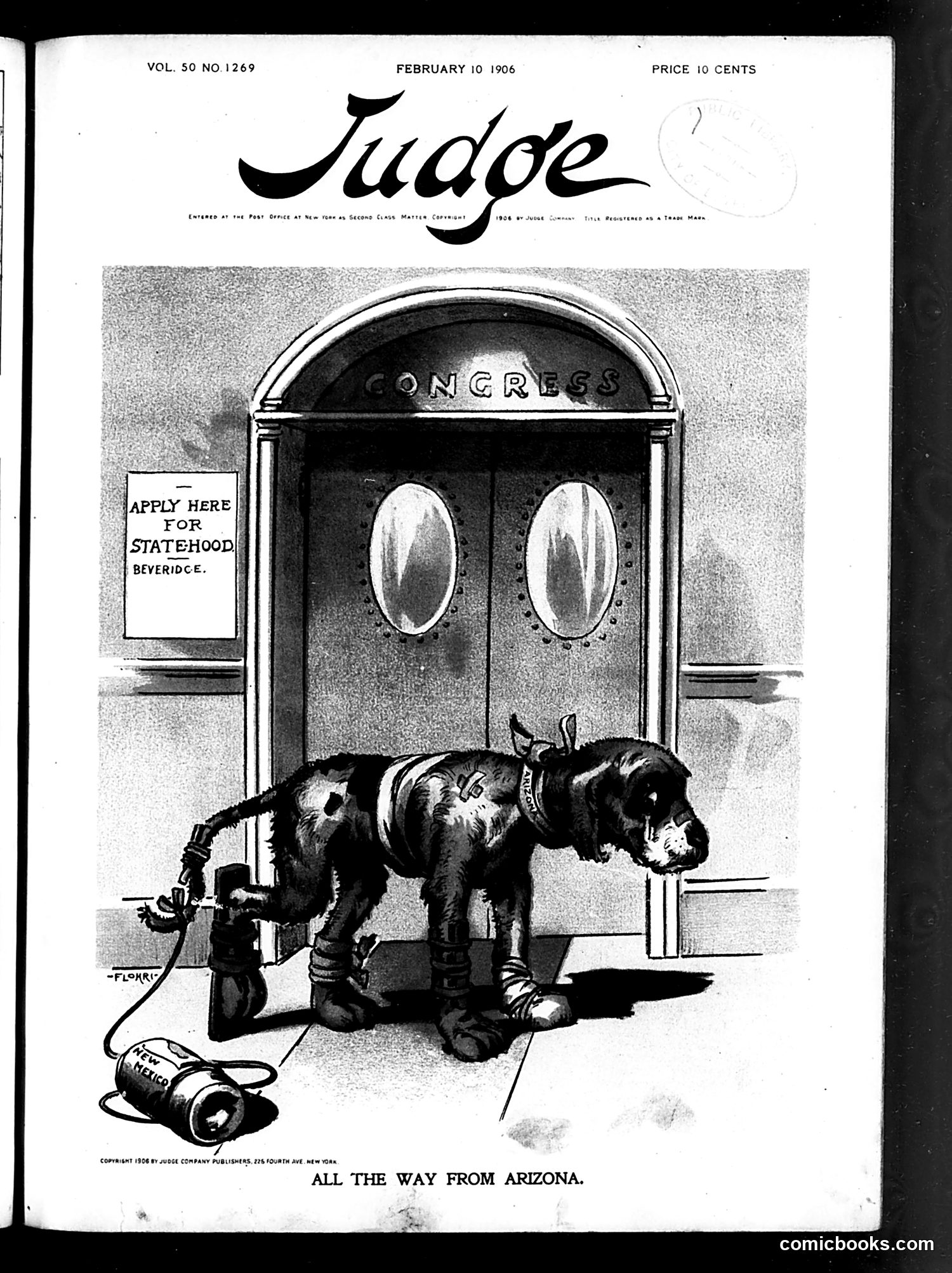
This cartoon satirizes the statehood application process for Arizona Territory. The donkey—a traditional symbol of the Democratic Party—stands before a Congressional door marked "CONGRESS," wearing packs and appearing exhausted. A sign reading "APPLY HERE FOR STATEHOOD, BEVERDIGE C." references Senator Albert J. Beveridge, who chaired the Senate Committee on Territories and controlled statehood decisions. The joke: Arizona's statehood petition has traveled the long, difficult journey from Arizona to Congress, only to encounter bureaucratic obstacles. The empty chamber suggests Congress ignores the request, while the worn donkey symbolizes the tiresome, endless process. Arizona would not achieve statehood until 1912—six years after this publication.
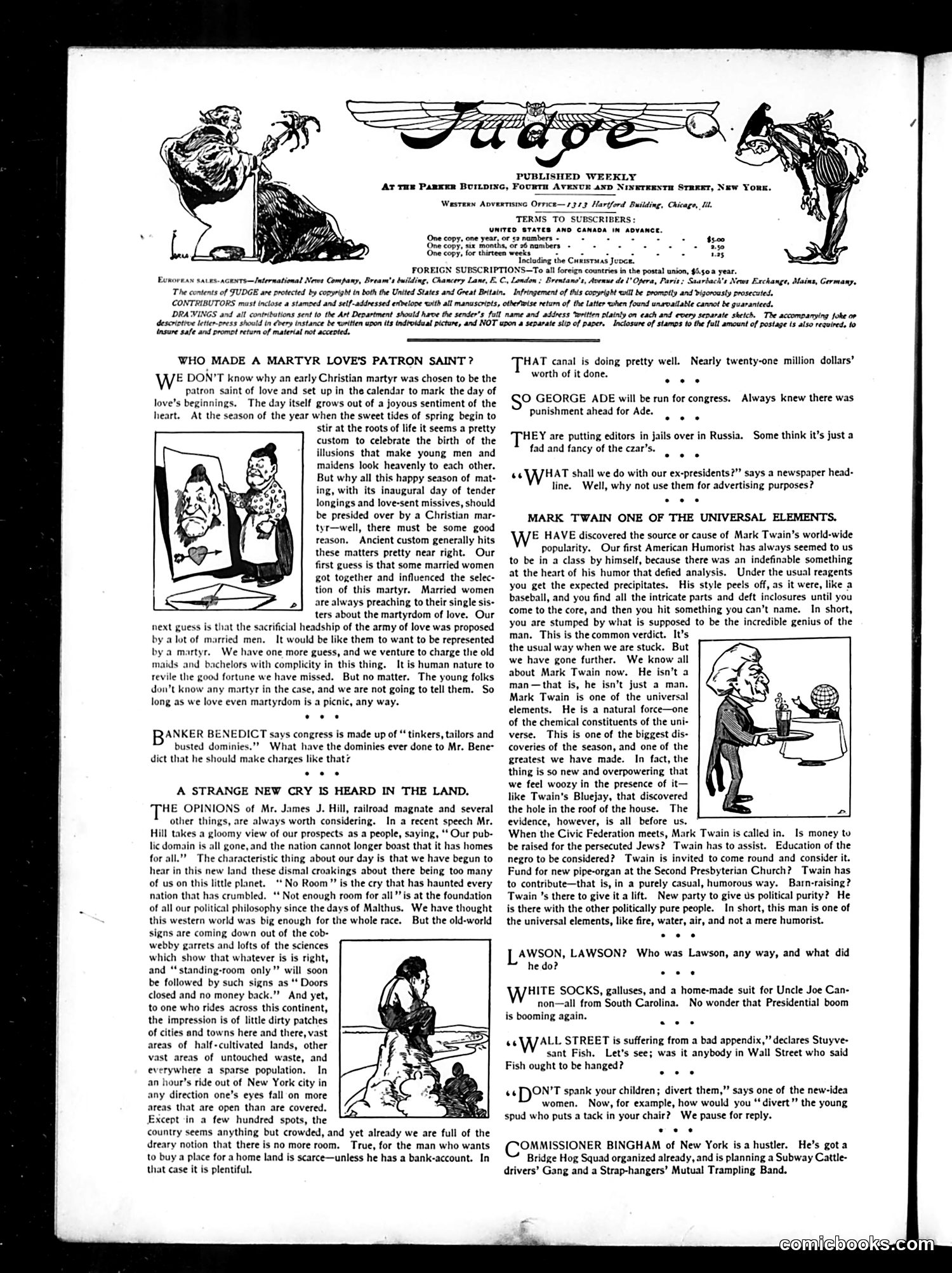
This page contains satirical commentary on contemporary issues. "Who Made a Martyr Love's Patron Saint?" discusses Christian martyrdom traditions humorously. The section "Mark Twain One of the Universal Elements" praises author Mark Twain's broad appeal and humor, suggesting his work contains something for everyone—comparing his ability to break down complex subjects like a chemist analyzes materials. "A Strange New Cry Is Heard in the Land" critiques American expansionism and railroad development, mocking the jingoistic rhetoric about "civilization" and "progress" while noting the negative effects on Native American populations and natural lands. Other brief items satirize contemporary politics and social issues, including references to Congress and Jewish persecution, though details require historical context to fully parse. The cartoons use caricature and exaggeration typical of period satire.
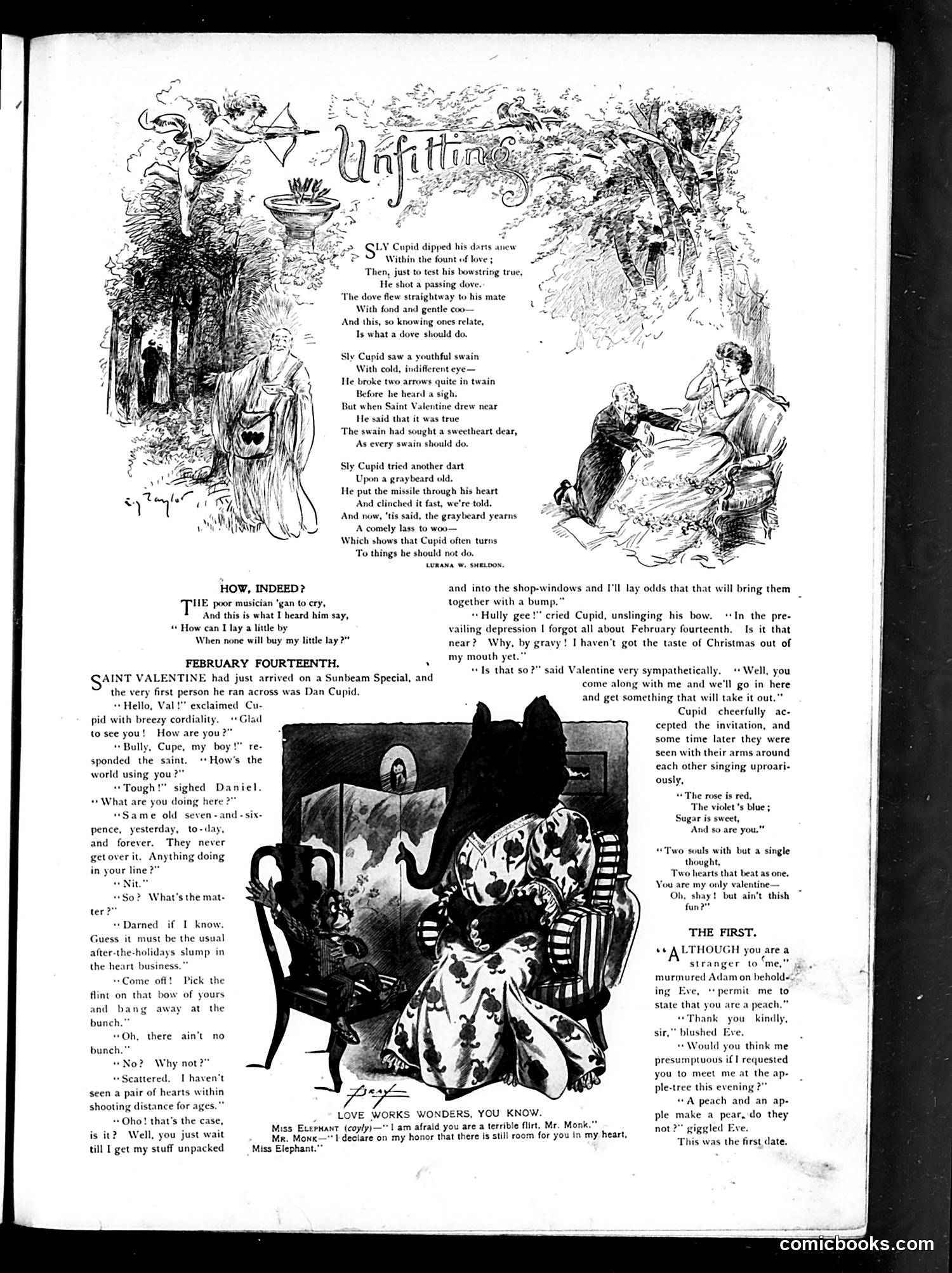
This page contains a Valentine's Day-themed romantic story with illustrations rather than political satire. The narrative follows "Sly Cupid" attempting matchmaking through various romantic mishaps—shooting arrows at a dove, a swan, and attempting to hit targets with a graveyard old woman. The central illustrated scene shows a couple (labeled with character names like "Miss Elephant" and "Mr. Monk") in a domestic setting, with dialogue about declaring love and arranging a meeting at an apple-tree. The content is lighthearted romantic comedy, not political commentary. The "satire" here is gentle social humor about courtship and Valentine's Day customs—poking fun at love's complications—rather than commentary on political figures or events. The page represents Judge's broader editorial mix beyond its better-known political cartoons.
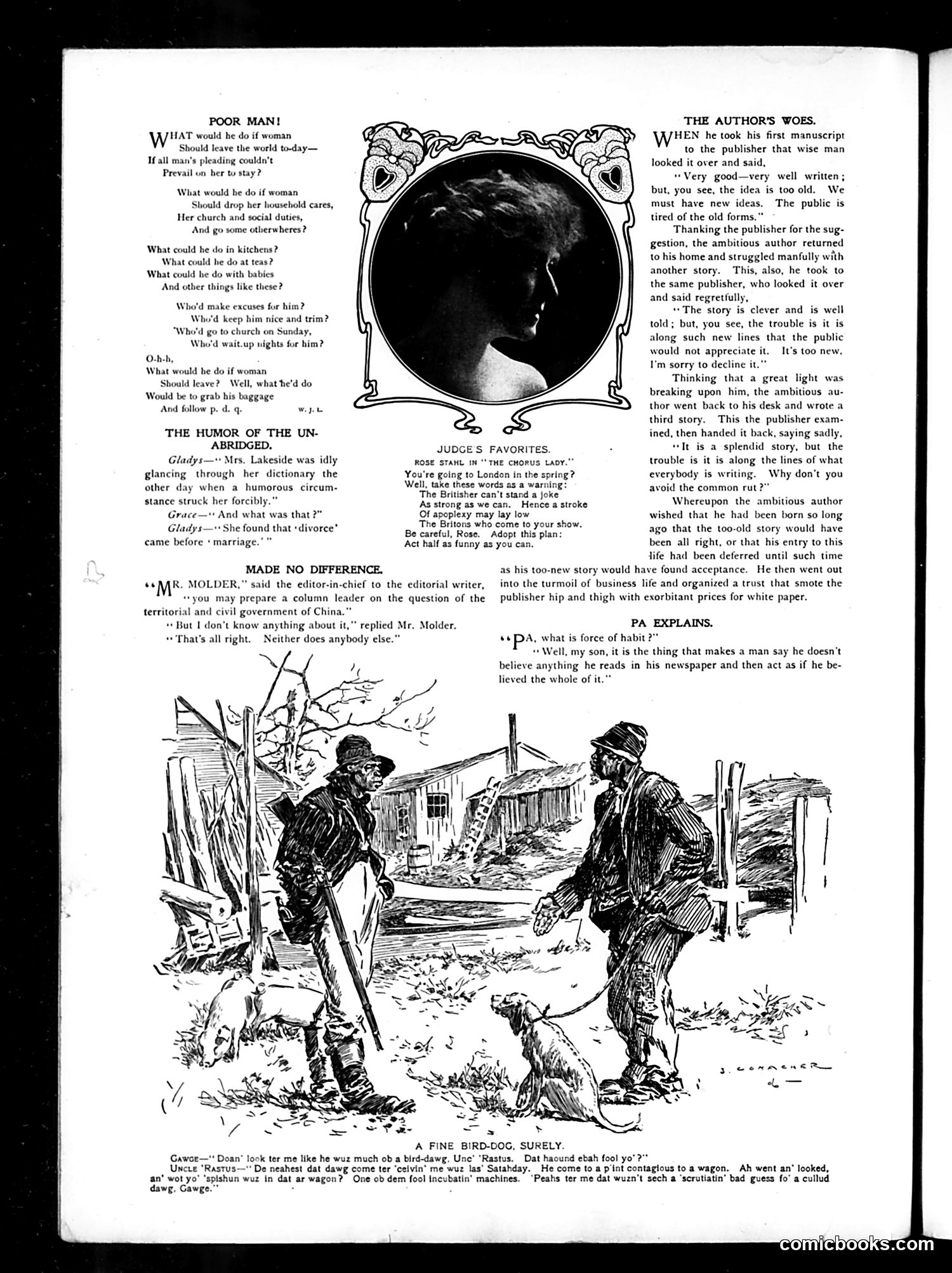
This page contains several satirical pieces typical of Judge magazine's humor: **"Poor Man"** (upper left): A poem questioning what a poor man should do with his life—work, manage household cares, or attend church. It satirizes the impossible expectations placed on working-class men. **"The Author's Woes"** (upper right): A prose piece mocking publishers' rejection of new literary ideas, preferring established forms. It reflects early-20th-century publishing conservatism. **"Made No Difference"** and **"Pa Explains"**: Brief comic dialogues about ignorance and habit—everyday humor about how people believe newspaper claims uncritically. **"A Fine Bird-Dog, Surely"** (bottom): An illustration depicting two rural figures discussing a dog, with dialectal speech representing working-class or rural characters. The humor derives from class-based caricature and vernacular language comedy typical of the era.
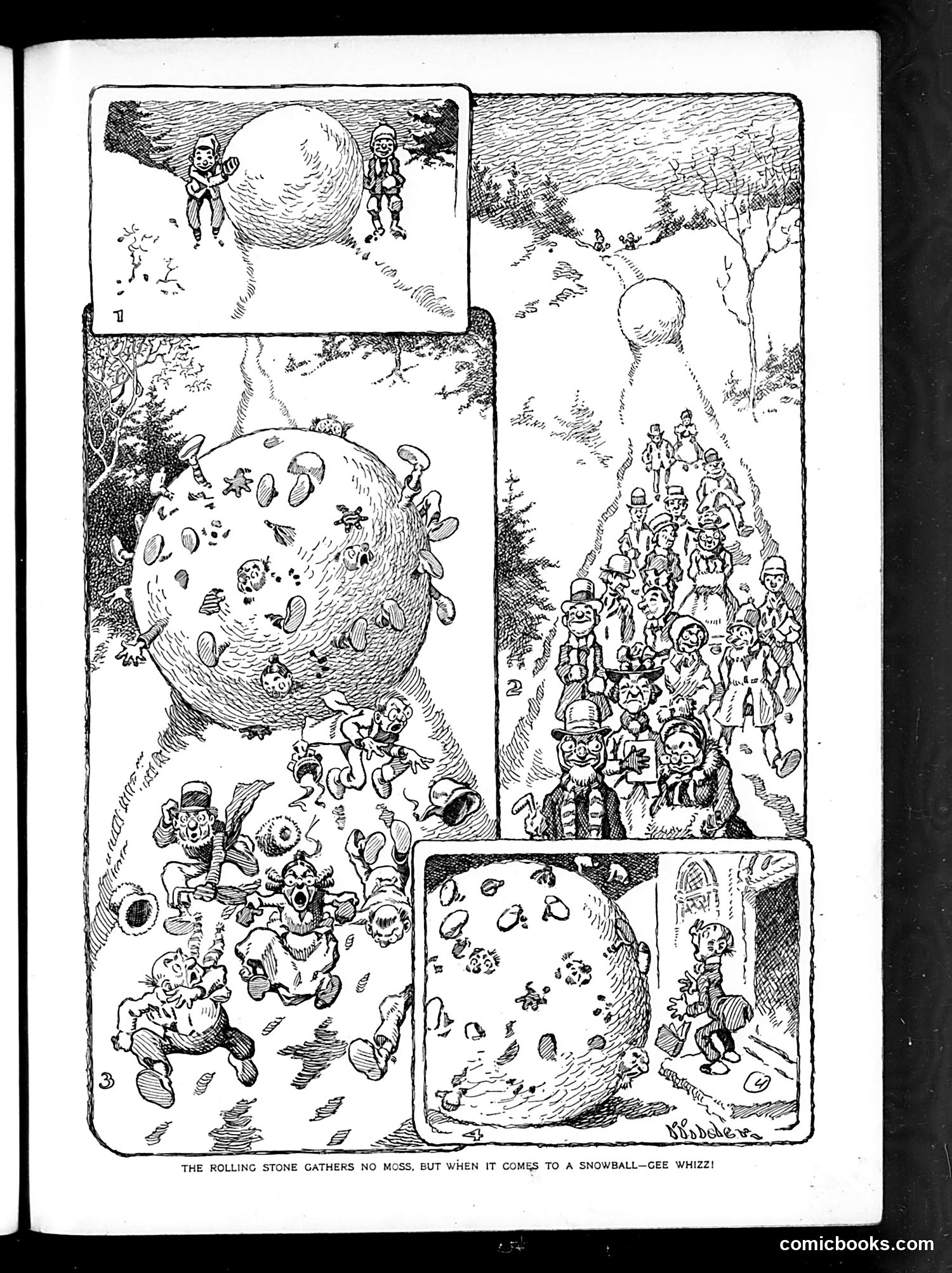
This comic illustrates the saying "The rolling stone gathers no moss, but when it comes to a snowball—gee whizz!" The four-panel sequence shows a snowball growing larger as it rolls downhill, gathering more snow and accumulating a crowd of people riding on it. The joke presents a visual paradox: while a rolling stone traditionally remains clean (gathers no moss), a rolling snowball becomes increasingly heavy and crowded—the opposite problem. The cartoon appears to be a humorous visual pun rather than political satire, playing on the familiar proverb. The escalating size and chaos of the rolling snowball, with its growing entourage of riders, emphasizes the absurdity of the contrast between the adage and the snowball's actual behavior.
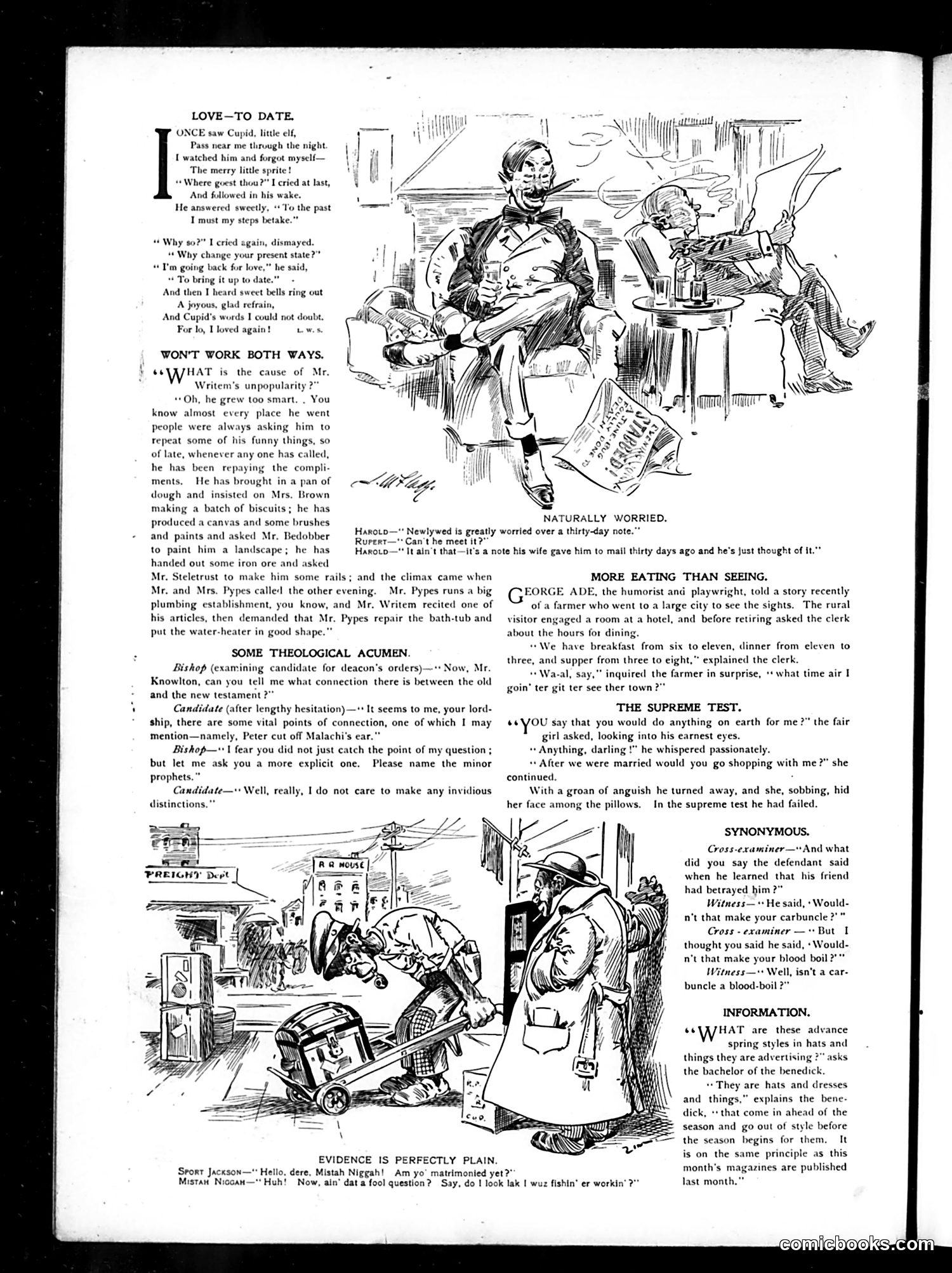
This page contains several short humor pieces typical of early 20th-century American satire: **"Love—To Date"**: A sentimental poem about Cupid returning to rekindle lost love, playing on the phrase "bring it up to date" (modernize it). **"Won't Work Both Ways"**: Satirizes a social climber who becomes obnoxious by constantly demanding others repeat their clever remarks or perform tasks for him—suggesting reciprocal cleverness fails when one-directional. **"Some Theological Acumen"**: Mocks an incompetent deacon candidate who confuses biblical figures (Peter/Malachi) and dodges naming minor prophets with evasive language. **"Evidence is Perfectly Plain"**: A crude racial caricature using dialect humor about marriage, reflecting the period's deeply offensive stereotyping. **"More Eating Than Seeing"**: George Ade anecdote about a farmer prioritizing mealtimes over sightseeing, playing on rural simplicity. **"The Supreme Test"**: Gender humor—a woman tests her suitor's devotion by asking him to go shopping; he fails, suggesting men find shopping intolerable. The page reflects early 1900s magazine humor: sentimental verse, social observation, ethnic caricature, and gendered jokes now considered offensive.
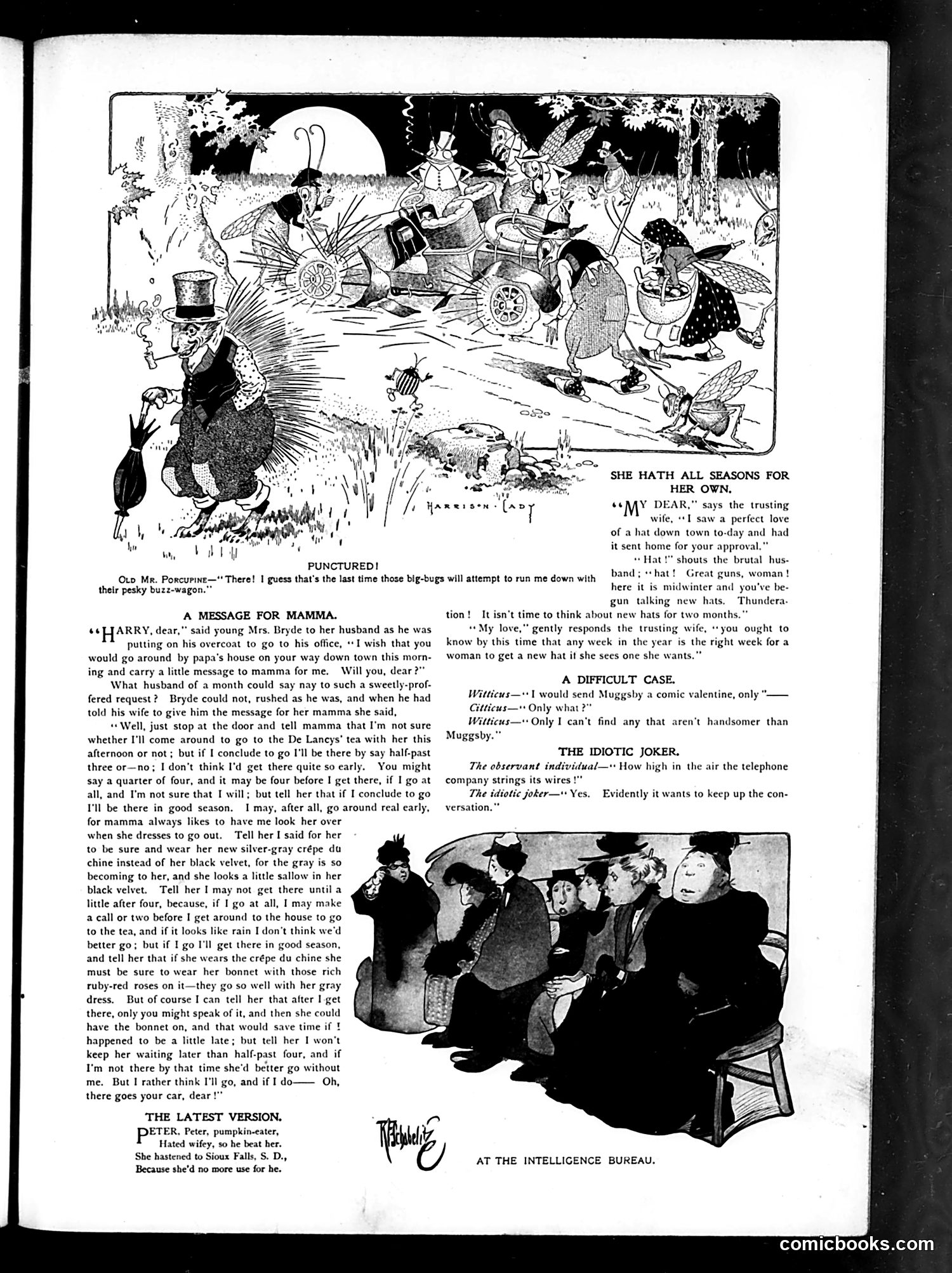
This page contains multiple satirical pieces mocking domestic life and gender relations circa early 1900s: **"Punctured!"** depicts anthropomorphic insects, with Old Mr. Porcupine complaining about "big-bugs" in a "buzz-wagon"—likely satirizing wealthy automobile owners and their reckless driving. **"A Message for Mamma"** ridicules the stereotypical indecisive wife, endlessly qualifying a simple message with contradictory instructions about arrival time, clothing choices, and bonnet selection. The satire targets women's perceived flightiness and the husband's hapless compliance. **"She Hath All Seasons"** mocks women's perpetual desire for new hats regardless of season—a common era joke about female fashion obsession and impracticality. **"The Latest Version"** updates "Peter Pumpkin-Eater" nursery rhyme to reference Sioux Falls, South Dakota (then the divorce capital), implying marital discord. Minor pieces like "A Difficult Case" and "The Idiotic Joker" are brief humor snippets. The overall tone reflects Judge's satirical take on marriage dynamics, female consumerism, and automotive culture.
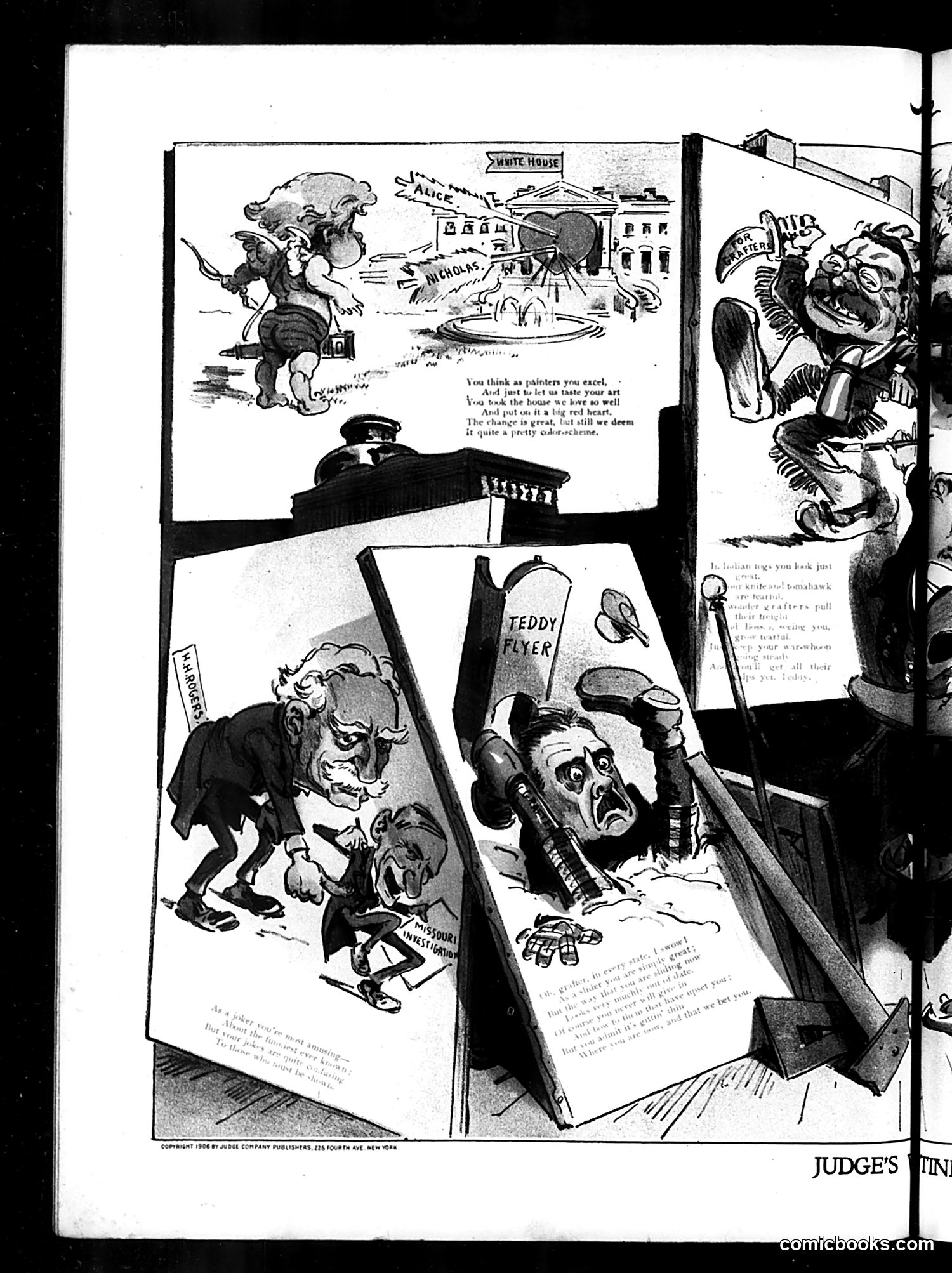
This page from *Judge* magazine contains multiple satirical cartoons appearing to reference early 20th-century American politics and culture. The top panel shows caricatured figures near the White House, with text mentioning "Alice" (likely Alice Roosevelt, Theodore Roosevelt's daughter, who was a public figure of interest). The lower panels depict exaggerated characters in confrontational poses, with references to "Teddy Flyer" visible on one figure. The grotesque caricatures and distorted features are typical of period political satire targeting specific individuals or policies. Without clearer OCR text and specific date information, the exact political references remain unclear, though the content appears to mock prominent political figures through crude caricature and satirical commentary typical of *Judge* magazine's style.
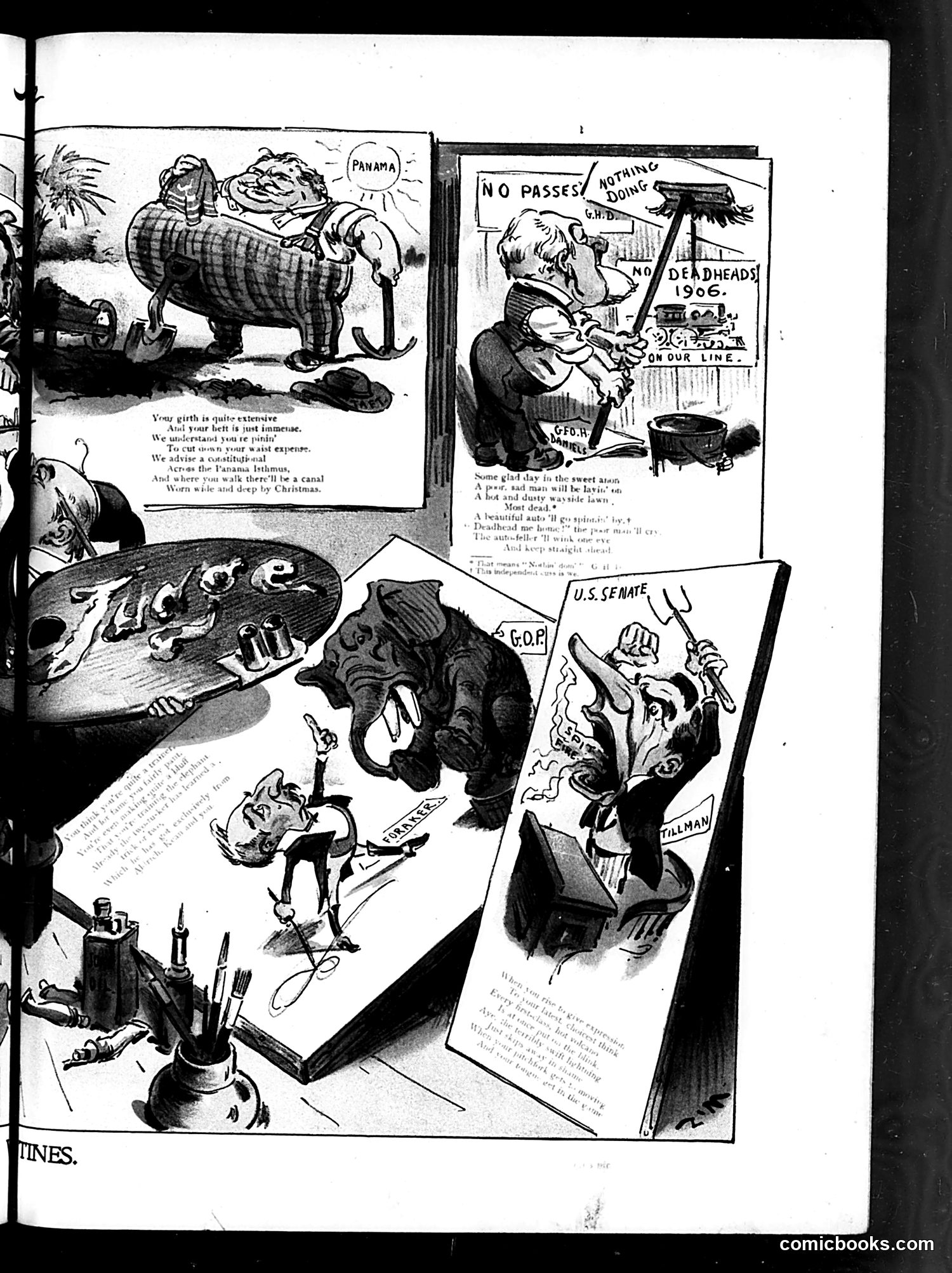
This page from *Judge* magazine contains several satirical cartoons addressing early 1900s American politics and imperialism. The **top left** depicts Panama labeled on a laden donkey—likely satirizing America's intervention in Panama, possibly referencing the 1906 Roosevelt administration's involvement. The **top right** shows a figure at a "No Pass" gate marked "1906," with text about "deadheads"—apparently mocking political patronage and free passes to favored individuals. The **bottom cartoon** references the U.S. Senate and shows what appears to be political conflict, with "Tillman" visible. This likely addresses Senate debates, possibly related to tariffs or foreign policy during the Roosevelt era. The overall page satirizes American imperial ambitions abroad and political corruption at home—themes central to early 20th-century progressive-era satire.
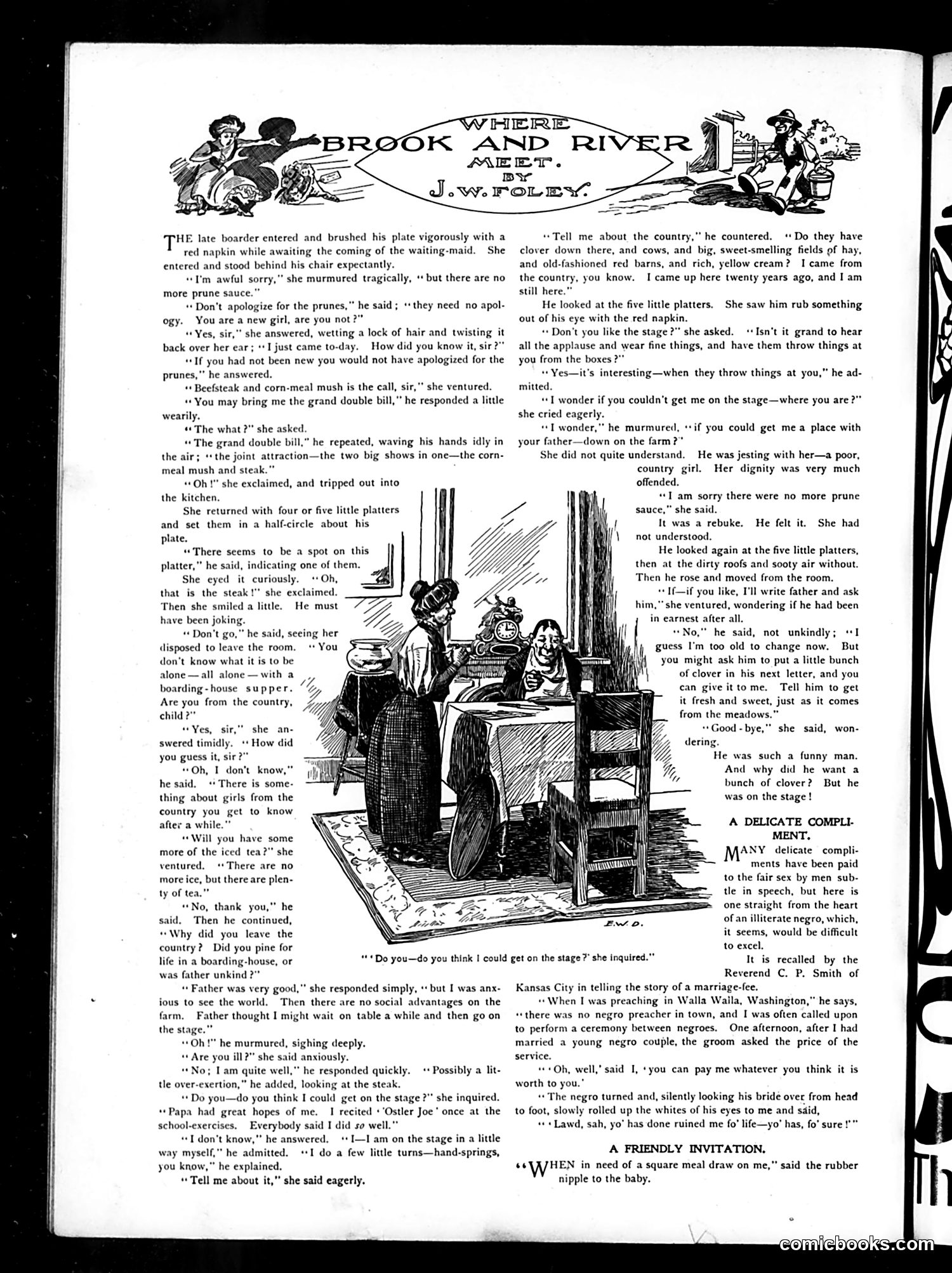
This is a humorous short story (not a political cartoon) about a jaded boarder and a naive country girl working as a maid. The joke centers on their clash of values: she's ambitious to become a stage performer, having recited a dramatic poem once at school. He's a weary vaudeville performer ("I do a few little turns—hand-springs") who's disillusioned with stage life. The satire mocks both characters: her naive belief that one recitation qualifies her for stardom, and his world-weary cynicism. When she asks if he can get her on stage, he counters by suggesting she return to her father's farm—implying rural simplicity is preferable to the hardscrabble theater life. The boarding-house setting (cheap food, sparse service) emphasizes their shared humble circumstances, making their respective dreams of escape seem both touching and foolish.
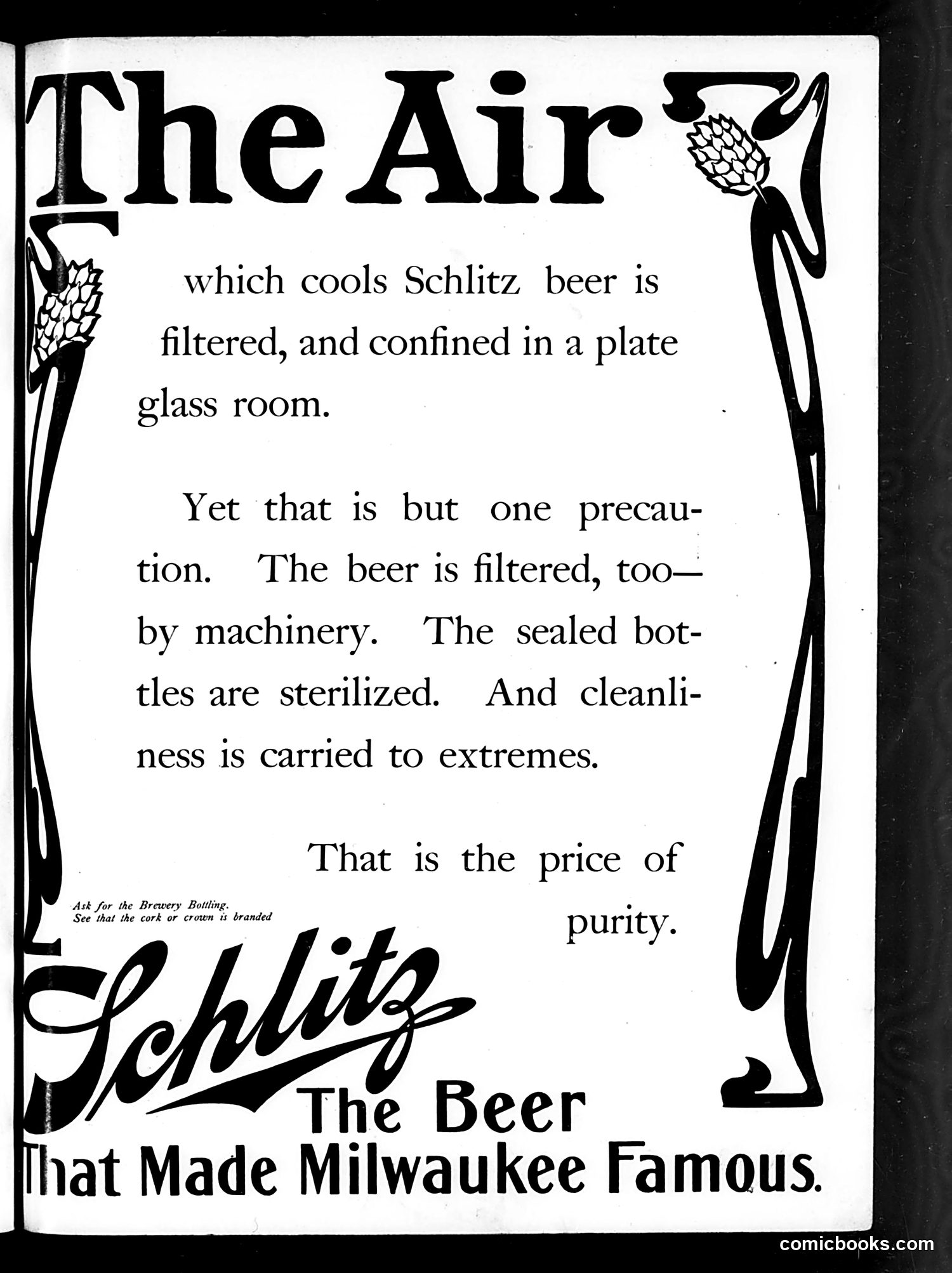
This is a **Schlitz beer advertisement**, not a cartoon or satire. The page promotes Schlitz's manufacturing process to a modern audience by emphasizing hygiene and purity—key selling points for early 20th-century beverages when contamination and spoilage were genuine public concerns. The text describes multiple filtration and sterilization steps: cooled air in a glass room, machinery filtering, sealed bottles, and sterilization. The phrase "That is the price of purity" suggests Schlitz justifies its product quality through rigorous sanitation. The decorative hop illustrations (left and right margins) reinforce the beer theme. "The Beer That Made Milwaukee Famous" references Milwaukee's historical dominance in American beer production, positioning Schlitz as the city's defining export.
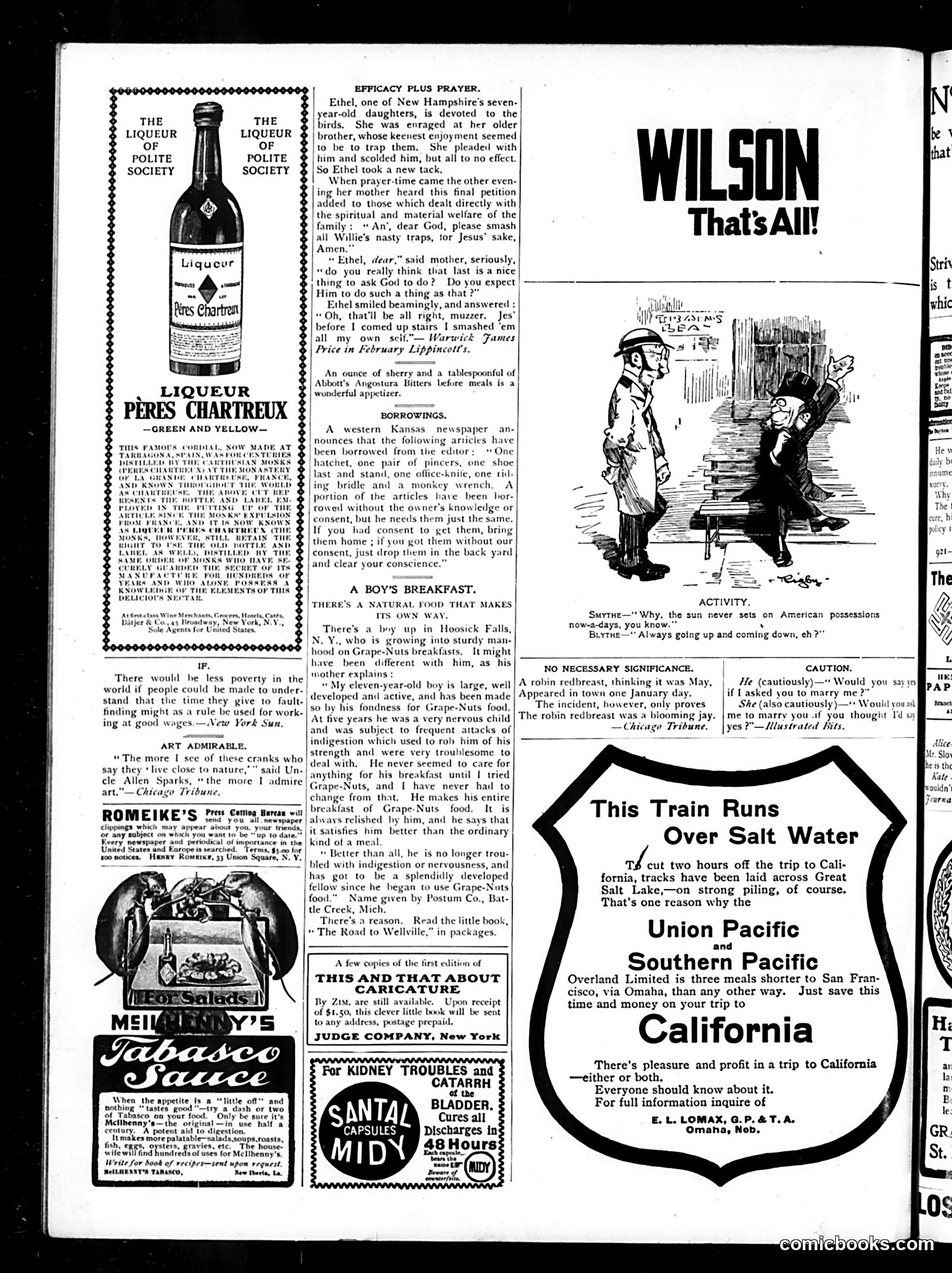
This page mixes advertisements and brief humorous anecdotes. The main cartoon/story is "EFFICACY PLUS PRAYER," which presents a moral lesson: young Ethel prays to God to destroy her brother's bird traps, but then admits she already smashed them herself. The joke satirizes childhood logic—the girl uses prayer as cover for her own direct action, revealing both innocent cunning and the gap between pious words and actual deeds. The "BORROWINGS" anecdote mocks a newspaper editor's complaints about stolen tools, sarcastically suggesting borrowed items be returned "without our consent" to the back yard. "ACTIVITY" is a brief visual gag about American imperial possessions—one character notes the sun never sets on U.S. territories; the other quips they're always rising and setting anyway, deflating imperial boasting. The remaining content is advertising (Peres Chartreux liqueur, Grape-Nuts cereal, McIlhenny's sauce, etc.), typical of Judge's revenue model.
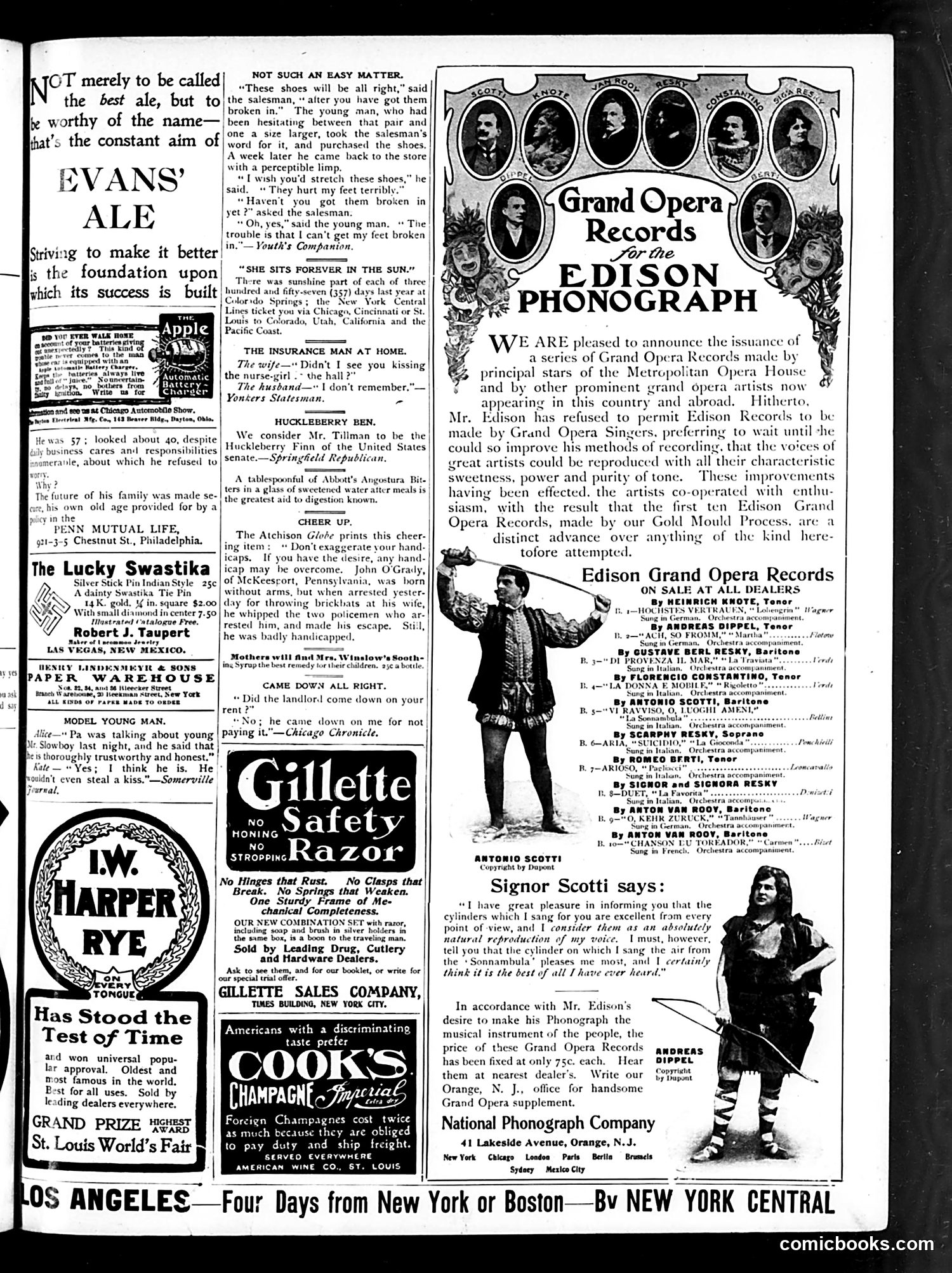
This page is primarily **advertisements and satirical humor columns**, not political cartoons. The visible content includes: **Advertisements**: Evans' Ale, insurance, jewelry, paper supplies, razors, and champagne—typical early 1900s commercial pitches. **Satirical Shorts**: Brief humorous items typical of *Judge* magazine, including: - A joke about uncomfortable new shoes requiring "breaking in" - A quip comparing Senator Tillman to Huckleberry Finn (unclear why, without more context) - Anecdotes about bureaucrats and everyday life **Notable Feature**: A large advertisement for **Edison Grand Opera Records** featuring opera singers like Antonio Scotti, positioned as a prestige product. This reflects Edison's cylinder phonograph era (early 1900s), promoting recorded classical music as aspirational entertainment. The page lacks cohesive political satire or caricature. It's a typical magazine spread mixing commerce with light humor—the satire is gentle and domestic rather than pointed social commentary.
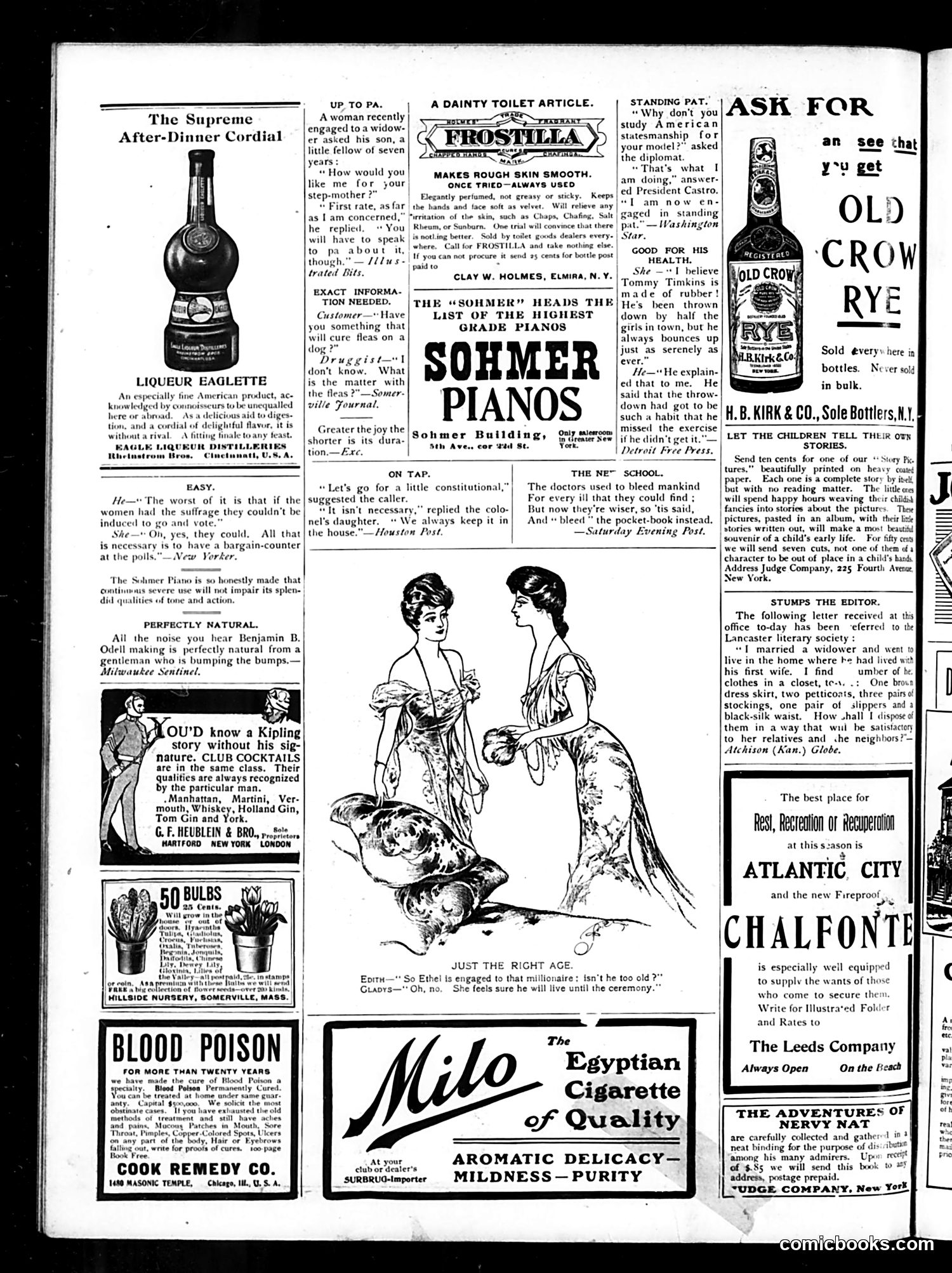
This page is primarily **advertising** interspersed with brief satirical snippets rather than a coherent political cartoon. The main visual cartoon shows two fashionable women with dogs, captioned "JUST THE RIGHT AGE," depicting social commentary on marriage and age compatibility—typical society-page humor of the era. The text snippets are brief jokes on standard themes: - A boy asking his future stepmother about being a suitable replacement - A colonel's daughter on constitutional walks and house remedies - A reference to President Castro (unclear context without date) - Commentary on women's suffrage (women couldn't be induced to vote) The dominant content is **product advertisements**: Frostilla cream, Sohmer pianos, Old Crow whiskey, Cook Remedy for blood poison, Milo cigarettes, and Atlantic City tourism. The "STUMPS THE EDITOR" column at bottom suggests reader submissions to the magazine. Without visible publication date or clearer Castro reference, specific historical context remains uncertain, but the page reflects early 20th-century American leisure-class concerns and consumer culture.
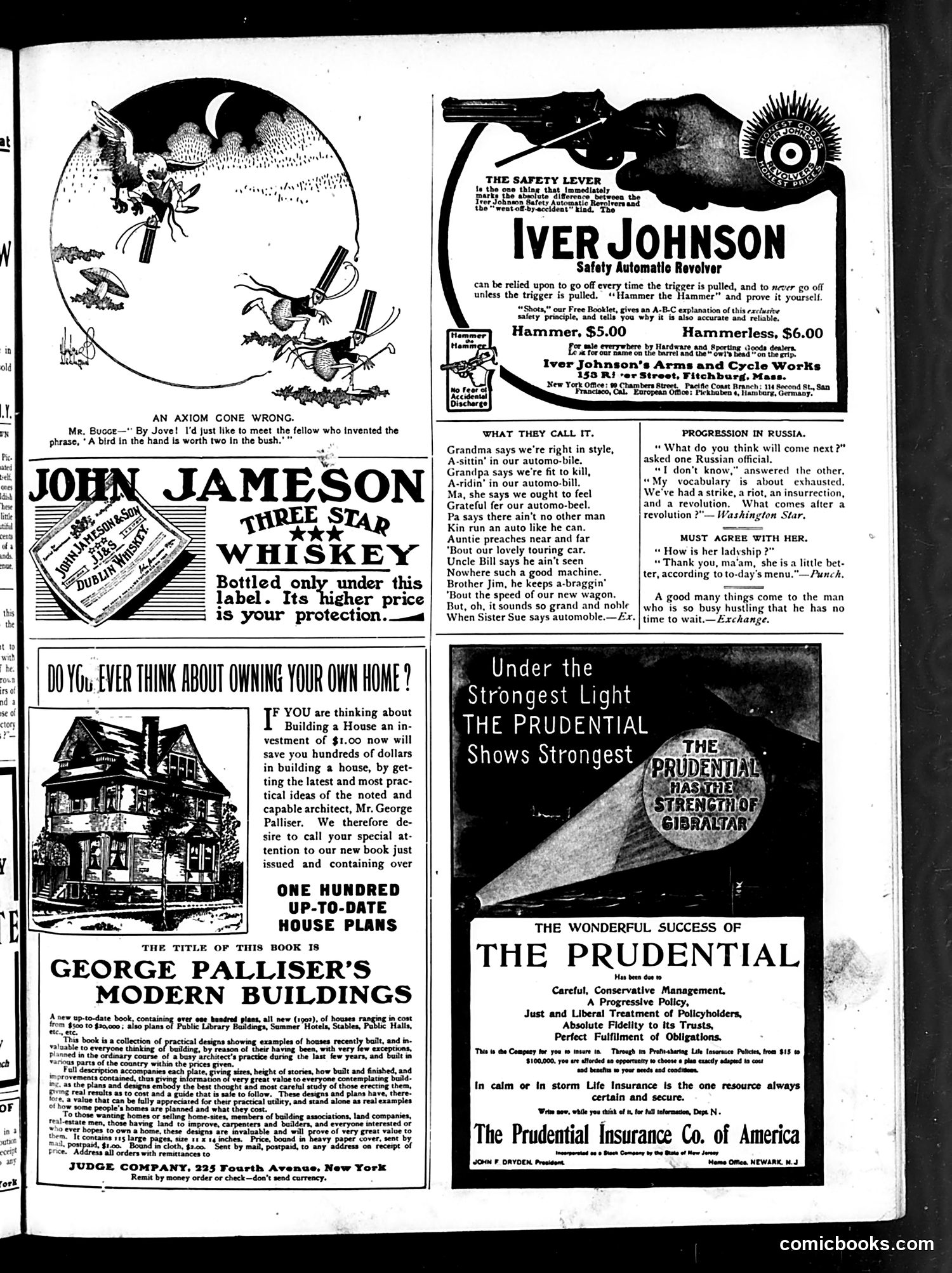
This page is primarily **advertising** with brief comic content interspersed. The main cartoon (top left) shows a man complaining about the proverb "a bird in the hand is worth two in the bush"—likely satirizing automobile ownership: he'd prefer owning an automobile (the "bird") to traditional investments. The page features period advertisements for **John Jameson Whiskey**, **Iver Johnson Safety Revolvers** (emphasizing their reliable trigger mechanism), **George Palliser's architecture book** for home builders, and **Prudential Insurance**. Small humor items mock contemporary trends: one jokes about families using "automo-bile" terminology obsessively; another satirizes Russian political instability, referencing strikes, riots, and revolutions in rapid succession—suggesting chaos and unpredictability in Russian governance (likely post-1905 Revolution context). The satirical targets are primarily **consumerism** and **technological enthusiasm** rather than political figures.
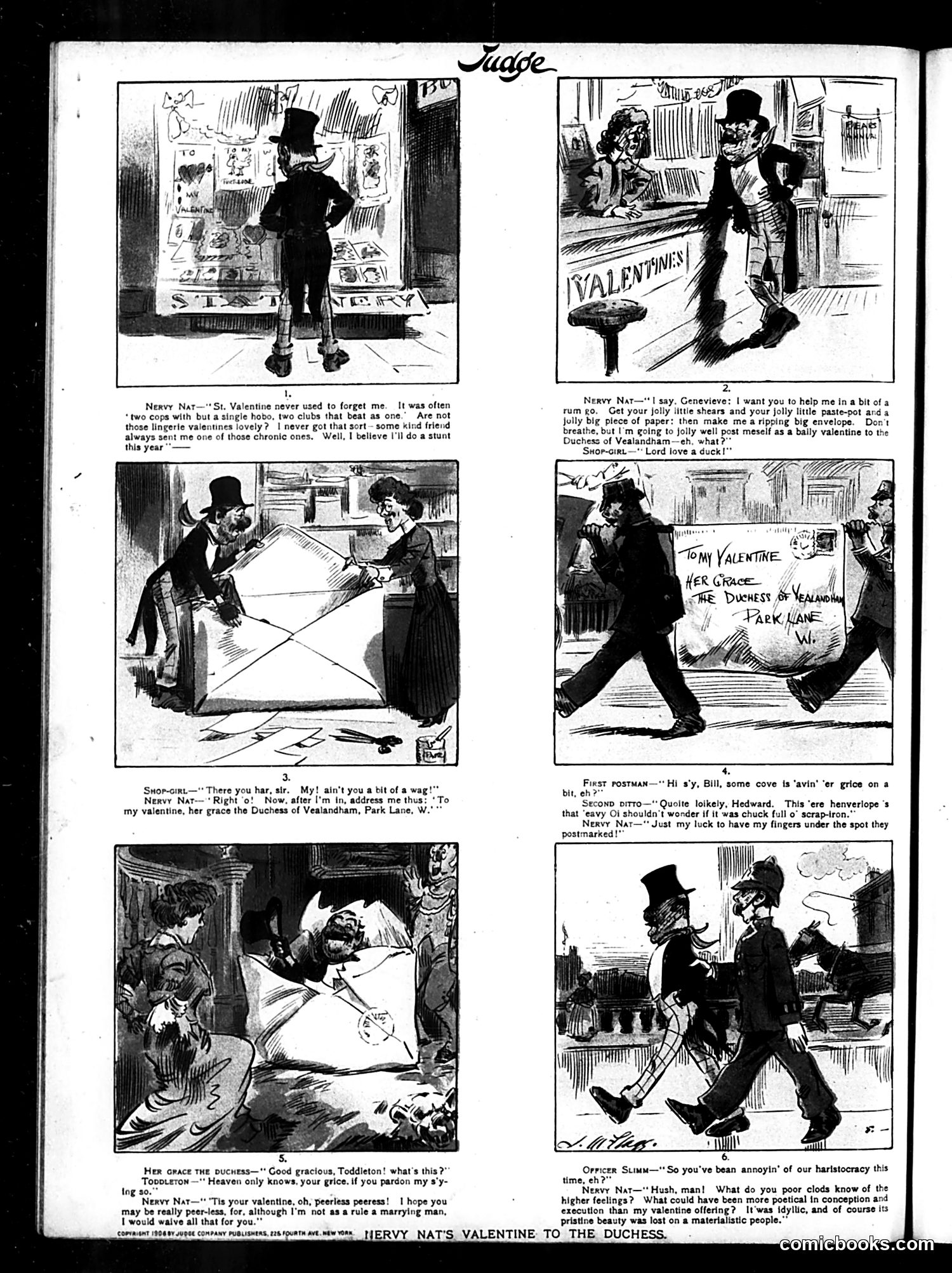
This six-panel comic strip follows "Nervy Nat," a working-class character attempting an elaborate prank on "the Duchess of Vealandham," apparently a titled noblewoman. Nat plans to mail himself to her in a giant Valentine's Day envelope, viewing this as romantic and poetic. The satire targets class pretension: Nat romanticizes his scheme as "idyllic," while practical working people (a shop-girl, postmen, a police officer) view it as absurd or troublesome. The joke hinges on the gap between Nat's delusional aspirations toward upper-class courtship and the crude reality of his stunt—essentially posting himself as an oversized, heavy package. The humor reflects Edwardian attitudes about class crossing: his presumption to court a duchess through such an undignified method is inherently ridiculous to both the nobility and the working class. The exaggerated dialect reinforces stereotypes about each class.