
Judge, 1906-02-10 · page 10 of 16
Judge — February 10, 1906 — page 10: what you’re looking at
What you’re looking at
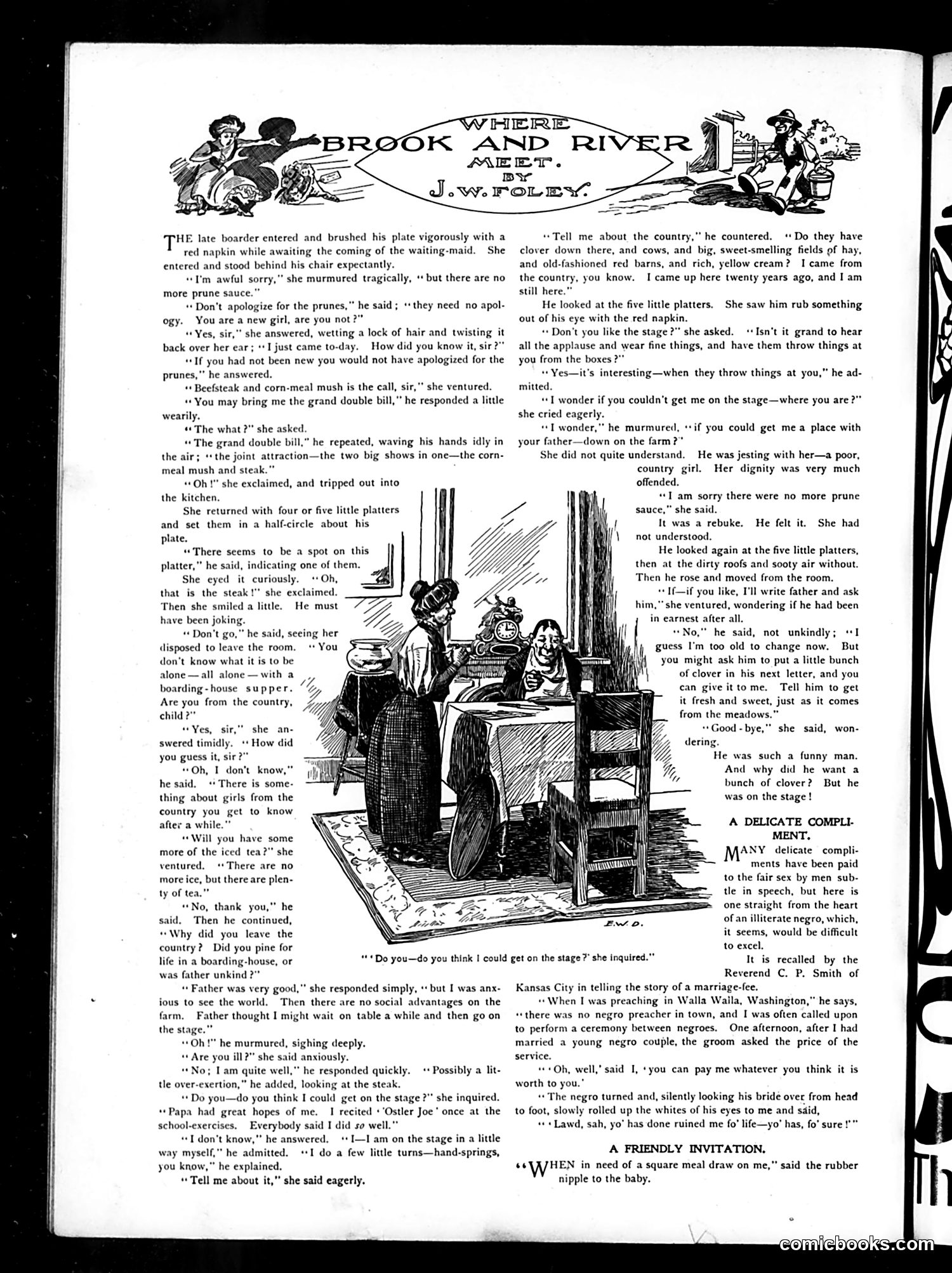
This is a humorous short story (not a political cartoon) about a jaded boarder and a naive country girl working as a maid. The joke centers on their clash of values: she's ambitious to become a stage performer, having recited a dramatic poem once at school. He's a weary vaudeville performer ("I do a few little turns—hand-springs") who's disillusioned with stage life. The satire mocks both characters: her naive belief that one recitation qualifies her for stardom, and his world-weary cynicism. When she asks if he can get her on stage, he counters by suggesting she return to her father's farm—implying rural simplicity is preferable to the hardscrabble theater life. The boarding-house setting (cheap food, sparse service) emphasizes their shared humble circumstances, making their respective dreams of escape seem both touching and foolish.
📄 Transcribed text from this page (OCR, searchable)
Machine-transcribed from the original scan — historical spelling and the odd misread are preserved.
HE late boarder entered and brushed his plate vigorously with a red napkin while awaiting the coming of the waiting-maid. She entered and stood behind his chair expectantly. «I'm awful sorry,” she murmured tragically, * but there are no more prune sauce.” + Don't apologize for the prunes,” he said; ‘they need no apol- You are a new girl, are you not?” “Yes, sir,"" she answered, wetting a lock of hair and twisting it back over her ear; ++I just came to-day. How did you know it, sir?” “If you had not been new you would not have apologized for the prunes,” he answered. + Beefsteak and corn-meal mush is the call, sir," she ventured. «You may bring me the grand double bill," he responded a little wearily. «The what?" she asked “The grand double bill,” he repeated, waving his hands idly in the air; the joint attraction—the two big shows in one—the corn- ogy: meal mush and steak.” Oh!" she exclaimed, and tripped out into the kitchen, She returned with four or five little platters and set them in a half-circle about his plate. “There seems to be a spot on this platter,” he said, indicating one of them. She eyed it curiously. Oh, that is the steak!" she exclaimed. Then she smiled a little. He must have been joking. “Don't go,” he said, seeing her disposed to leave the room. ++ You don't know what it is to be alone —all alone — with a boarding-house supper. Are you from the country, child?” “Yes, sir," she an- swered timidly. +* How did you guess it, sir? «Oh, I don’t know,” he said. «There is some- thing about girls from the country you get to know after a while.” “Will you have some more of the iced tea?" she ventured, «There are no more ice, but there are plen- ty of tea.” “No, thank you,” he said. Then he continued, “Why did you leave the country? Did you pine for life in a boarding-house, or was father unkind 2?” “ Father was very good,” she responded simply, + but I was anx- ious to see the world. Then there are no social advantages on the !" he murmured, sighing deeply. “Are you ill?” she said anxiously. “No; Lam quite well,” he responded quickly. tle over-exertion,” he added, looking at the st “Do you—do you think I could get on the stage ?" she inquired. ‘Papa had great hopes of me. I recited + ‘Ostler Joe’ once at the school-exercises. Everybody said I did so well." “I don’t know,” he answered. I—I am on the stage in a little way myself,” he admitted. 1 do a few little turns—hand-springs, you know,” he explained. “Tell me about i «Possibly a lit- she said eagerly. "Do you—do you think I could get on the stage?" she inquired." “Tell me about the country," he countered. ‘Do they have clover down there, and cows, and big, sweet-smelling fields pf hay, and old-fashioned red barns, and rich, yellow cream? I came from the country, you know. I came up here twenty years ago, and I am still here.” He looked at the five little platters. out of his eye with the red napkin. + Don't you like the stage ?” she asked. «Isn't it grand to hear all the applause and wear fine things, and have them throw things at you from the boxes ?"" + Yes—it's interesting—when they throw things at you," he ad- mitted. +L wonder if you couldn't get me on the stage—where you are?” she cried eagerly. “LT wonder,” he murmured, “if you could get mea place with your father—down on the farm ?* She did not quite understand. country girl. offended. “Iam sorry there were no more prune sauce,” she said. It was a rebuke. not understood. He looked again at the five little platters, then at the dirty roofs and sooty air without. Then he rose and moved from the room. + Ifif you like, I'll write father and ask him," she ventured, wondering if he had been in earnest after all, No," he said, not unkindly; «1 , Suess Tm too old to change now. But 4 i you might ask him to put a little bunch \ of clover in his next letter, and you can give itto me, Tell him to get it fresh and sweet, just as it comes from the meadows. ** Good - bye, dering. He was such a funny man, And why did he want a bunch of clover? But he was on the stage! She saw him rub something He was jesting with her—a poor, Her dignity was very much He felt it. She had she said, won- A DELICATE COMPLI- MENT. MANY delicate compli- ments have been paid to the fair sex by men sub- tle in speech, but here is one straight from the heart of an illiterate negro, which, it seems, would be difficult to excel. It is recalled by the Reverend C. P. Smith of Kansas City in telling the story of a marriage-fee. + When I was preaching in Walla Walla, Washington,” he says, ‘there was no negro preacher in town, and I was often called upon to perform a ceremony between negroes. One afternoon, after I had married a young negro couple, the groom asked the price of the service. + +Oh, well," said I, +you can pay me whatever you think it is worth to you.” «The negro turned and, silently looking his bridé over from head to foot, slowly rolled up the whites of his eyes to me and said, ++ «Lawd, sah, yo" has done ruined me fo" life—yo’ has, fo’ sure ! Hy |. A FRIENDLY INVITATION. eYVHEN in need of a square meal draw on me,” said the rubber nipple to the baby.