
Judge, 1906-02-10 · page 6 of 16
Judge — February 10, 1906 — page 6: what you’re looking at
What you’re looking at
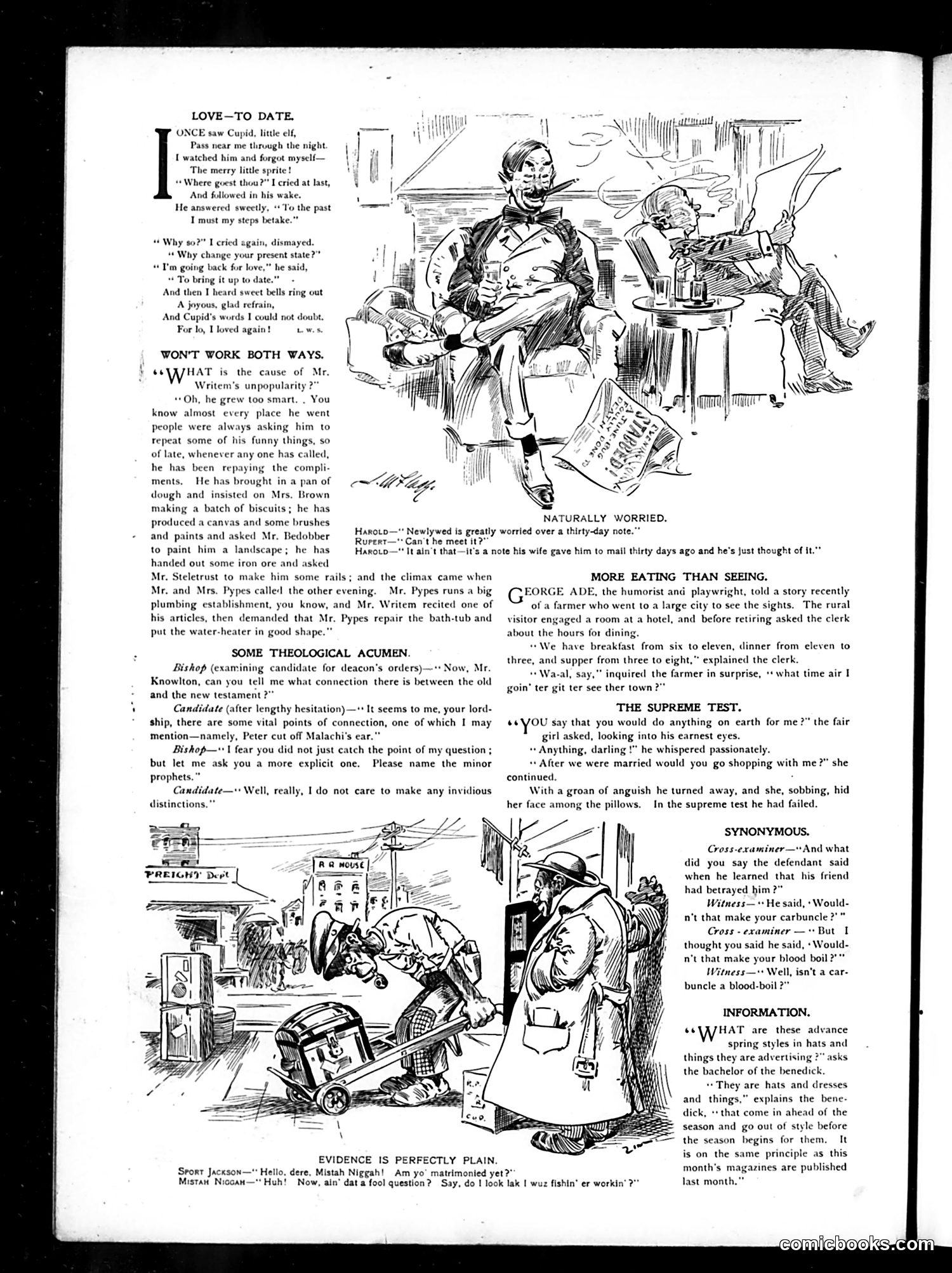
This page contains several short humor pieces typical of early 20th-century American satire: **"Love—To Date"**: A sentimental poem about Cupid returning to rekindle lost love, playing on the phrase "bring it up to date" (modernize it). **"Won't Work Both Ways"**: Satirizes a social climber who becomes obnoxious by constantly demanding others repeat their clever remarks or perform tasks for him—suggesting reciprocal cleverness fails when one-directional. **"Some Theological Acumen"**: Mocks an incompetent deacon candidate who confuses biblical figures (Peter/Malachi) and dodges naming minor prophets with evasive language. **"Evidence is Perfectly Plain"**: A crude racial caricature using dialect humor about marriage, reflecting the period's deeply offensive stereotyping. **"More Eating Than Seeing"**: George Ade anecdote about a farmer prioritizing mealtimes over sightseeing, playing on rural simplicity. **"The Supreme Test"**: Gender humor—a woman tests her suitor's devotion by asking him to go shopping; he fails, suggesting men find shopping intolerable. The page reflects early 1900s magazine humor: sentimental verse, social observation, ethnic caricature, and gendered jokes now considered offensive.
📄 Transcribed text from this page (OCR, searchable)
Machine-transcribed from the original scan — historical spelling and the odd misread are preserved.
LOVE—TO DATE. ONCE saw Cupid, little elf, Pass near me through the night I watched him and forgot myself— The merry little sprite! “+ Where goest thou?" I cried at last, And followed He answered sweetly, I must my steps betake.” his wake. he past “| Why 0?" I cried again, dismayed. “Why change your present state?” + T'm going back for love,” he said, “+ To bring it up to dat . And then T heard sweet bells ring out A joyous, glad refrain, And Cupid's words I could not doubt. For lo, I loved agai Lwes. WON'T WORK BOTH WAYS. seat is the cause of Mr. Writem’s unpopularity ? Oh, he grew too smart. . You know almost every place he went people were always asking him to repeat some of his funny things, so of late, whenever any one has called, he has been repaying the compli- ments. He has brought in a pan of dough and insisted on Mrs. Brown making a batch of biscuits; he has produced a canvas and some brushes and paints and asked Mr. Bedobber to paint him a landscape; he has handed out some iron ore and asked Mr. Steletrust to make him some rails; and the climax came when Mr. and Mrs. Pypes called the other evening. Mr. Pypes runs a big plumbing establishment, you know, and Mr. Writem recited one of his articles, then demanded that Mr. Pypes repair the bath-tub and put the water-heater in good shape." SOME THEOLOGICAL ACUMEN. Bishop (examining candidate for deacon’s orders)—* Now, Mr. Knowlton, can you tell me what connection there is between the old and the new testament ?” Candidate (alter lengthy hesitation) —** It seems to me, your lord- ship, there are some vital points of connection, one of which I may mention—namely, Peter cut off Malachi’s ear.” Bishop—* | fear you did not just catch the point of my question ; but let me ask you a more explicit one. Please name the minor prophets.” Candidate— Well, really, Ido not care to make any invidious distinctions.”* "Can't he meet it? Harovo—"' It ain't that EVIDENCE IS PERFECTLY PLAIN. Hello, dere, Mistah Niggah! Huh! Sport Jackson— Mistan Niccan. Am yo" matrimonied yet?" Now, ain’ data fool question? Say, do I look lak | wuz fishin’ er workin’ ?” vi ene NATURALLY WORRIED. ““ Newlywed is greatly worried over a thirty-day note.” it’s a note his wife gave him to mail thirty days ago and he’s just thought of it.”” MORE EATING THAN SEEING. EORGE ADE, the humorist and playwright, told a story recently of a farmer who went to a large city to see the sights. The rural visitor engaged a room at a hotel, and before retiring asked the clerk about the hours for dining. “We have breakfast from six to eleven, dinner from eleven to three, and supper from three to eight,” explained the clerk. + Wa-al, say,” inquired the farmer in surprise, ** what time air I goin’ ter git ter see ther town?” THE SUPREME TEST. +4 YOU say that you would do anything on earth for me?” the fair girl asked, looking into his earnest eyes. “+ Anything, darling !" he whispered passionately. “+ After we were married would you go shopping with me continued. With a groan of anguish he turned away, and she, sobbing, hid In the supreme test he had failed. he her face among the pillows. SYNONYMOUS. Cross-examiner—“ And what did you say the defendant said when he learned that his friend had betrayed him?” Witness— «He said, *Would- n’t that make your carbuncle ?"" Cross - examiner —“ But 1 thought you said he said, Would- n't that make your blood boil 2" Witness —« Well, isn't a car buncle a blood-boil ? INFORMATION. S6\JHAT are these advance spring styles in hats and things they are advertising 2" asks the bachelor of the benedick. «They are hats and dresses and things,” explains the bene- dick, ++that come in ahead of the season and go out of style before the season begins for them, It is on the same principle as this month’s magazines are published last month,