
A complete issue · 16 pages · 1906
Judge — January 13, 1906
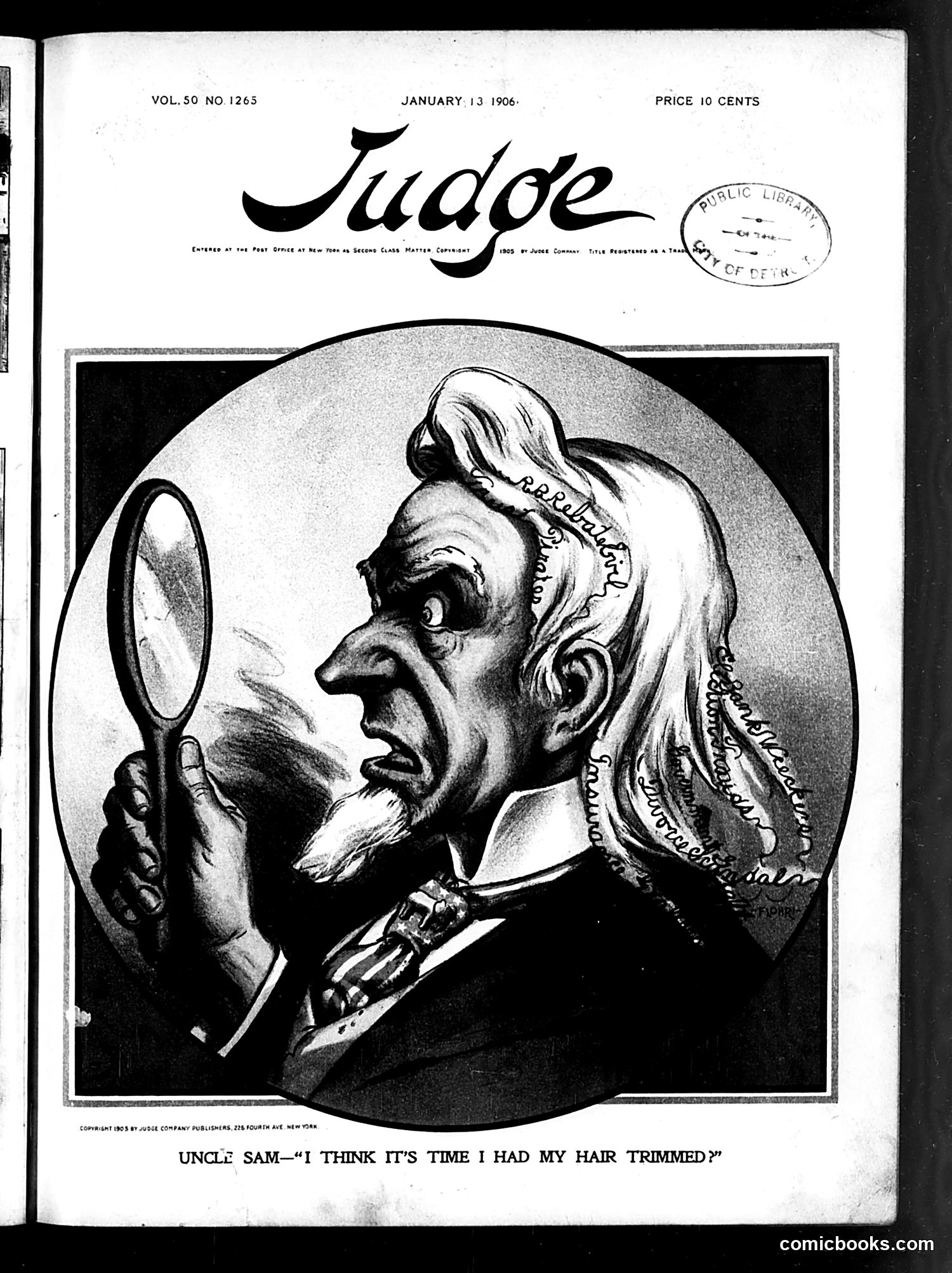
The cartoon depicts Uncle Sam—the personification of the United States—examining his reflection in a mirror and commenting, "I think it's time I had my hair trimmed." This is political satire about American foreign policy and imperial overreach. Uncle Sam's long, elaborate hair likely represents excessive American territorial acquisitions and military interventions abroad. The suggestion that his "hair needs trimming" is a metaphorical call for the U.S. to reduce its international commitments and colonial possessions. In 1906, the U.S. was actively engaged in the Philippines (post-Spanish-American War), maintained Caribbean interests, and was expanding its global influence under Theodore Roosevelt's presidency. The cartoon critiques this expansionist agenda as bloated and excessive, humorously suggesting restraint was overdue.
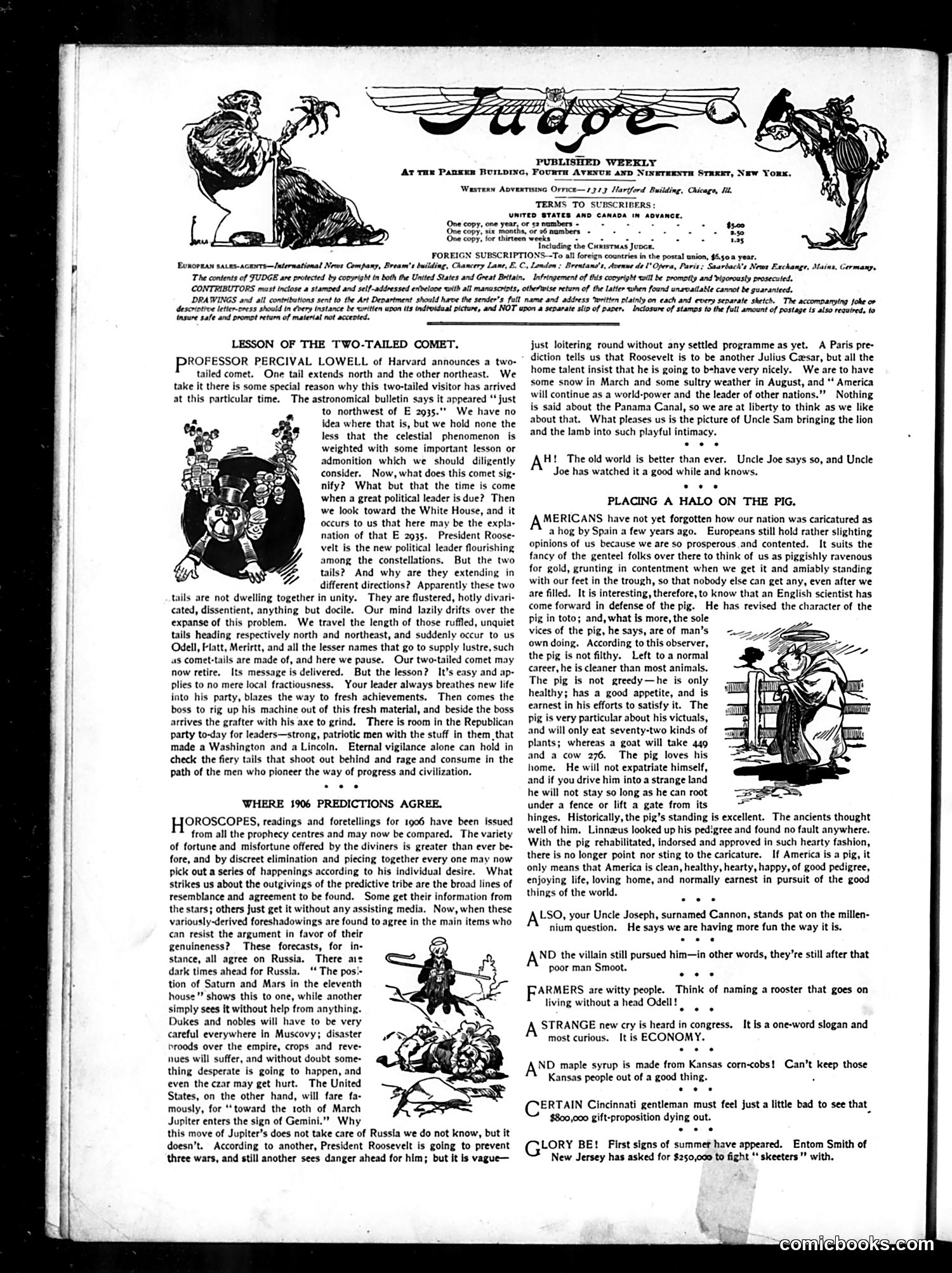
This page contains multiple brief satirical items rather than a single cartoon. Key elements include: **"Lesson of the Two-Tailed Comet"**: A political allegory using a comet as metaphor for examining leadership during crises. The text references President Roosevelt and suggests that while political leaders matter, eternal principles (represented by Lincoln) ultimately guide the nation through turbulent times. **"Placing a Halo on the Pig"**: This piece defends American character against European criticism, asserting that Americans' practicality and straightforwardness (symbolized by the pig) represent healthy national values rather than vulgarity. It's a nationalistic rebuttal to Old World snobbery. The remaining items are brief satirical quips on contemporary political and social topics, characteristic of Judge's format as a weekly satirical publication.
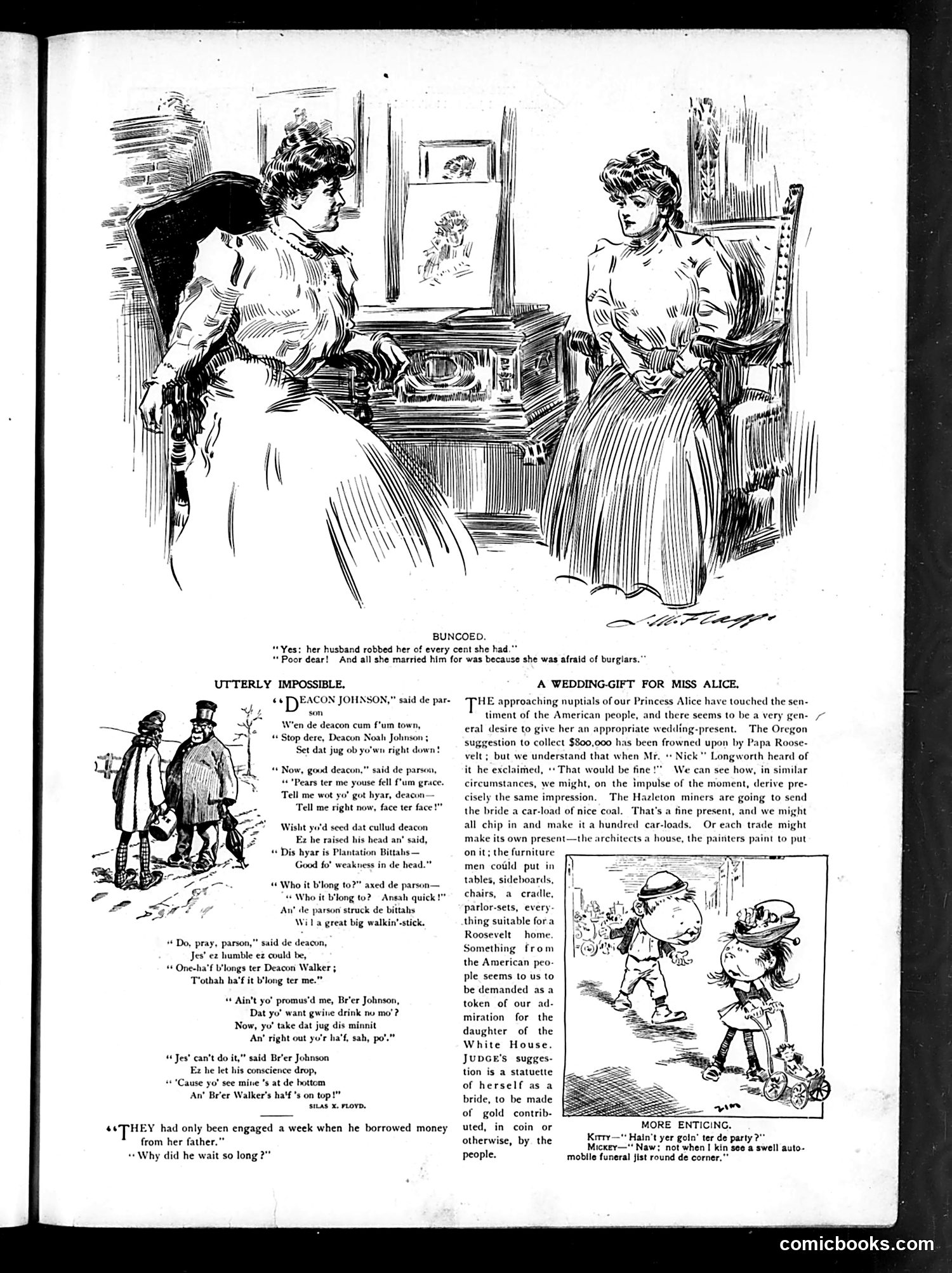
**Top illustration ("Buncoed"):** Shows two women in an office setting. The dialogue reveals a domestic financial dispute: a husband emptied their account out of fear his wife would be robbed by burglars. The satire mocks both marital distrust and the era's anxieties about crime and wealth security. **Left cartoon ("Utterly Impossible"):** Depicts a parson refusing alcohol from "Deacon Johnson," with dialect-heavy dialogue. This likely satirizes temperance debates or religious hypocrisy regarding alcohol consumption—common Judge targets in the early 20th century. **Right section ("A Wedding-Gift for Miss Alice"):** Discusses gift ideas for Princess Alice's upcoming nuptials, suggesting coal as an alternative to expensive presents. This appears to mock either the impracticality of gift-giving for royalty or American attitudes toward British nobility.
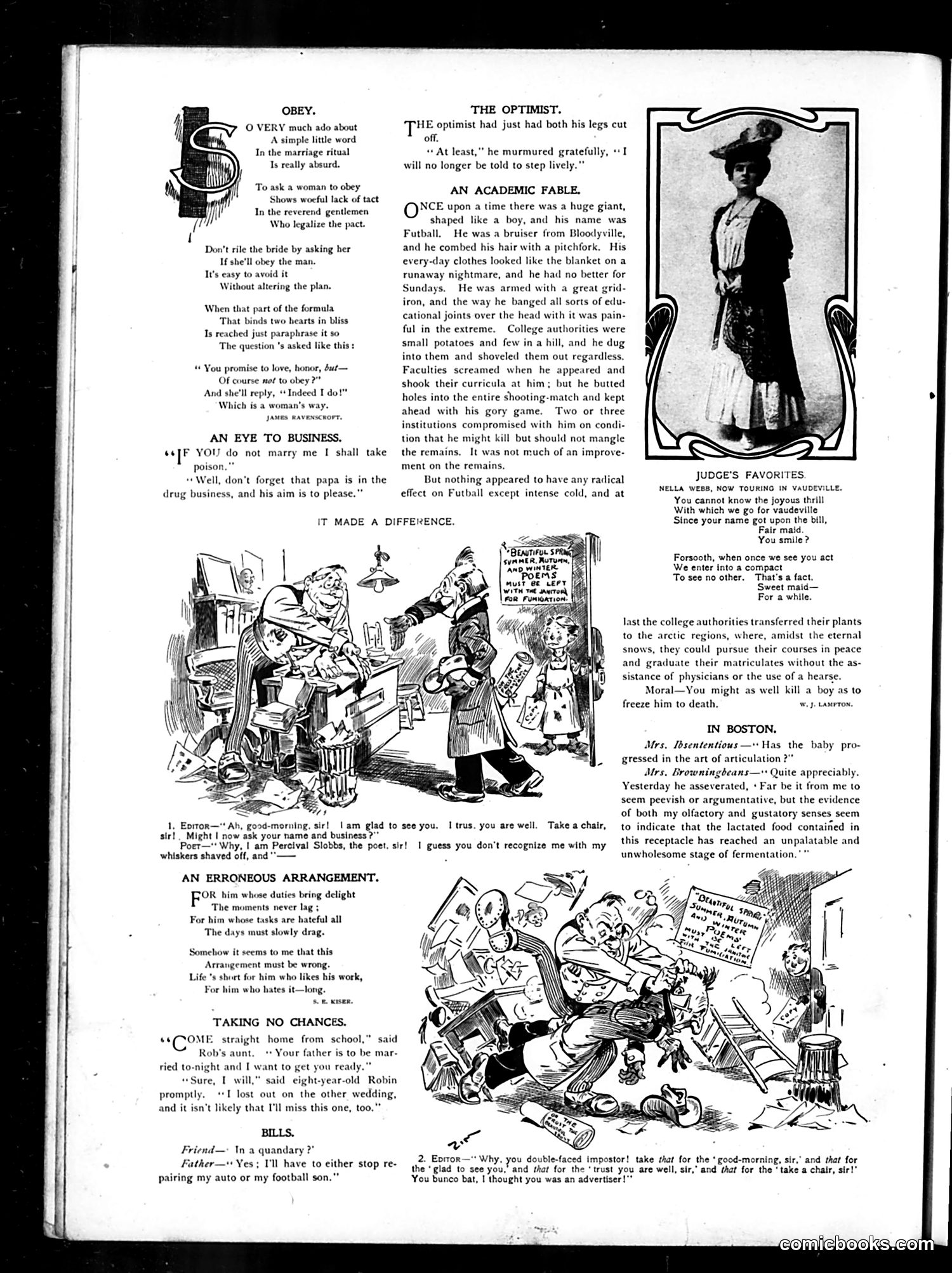
This page contains several short satirical pieces and cartoons typical of early 20th-century humor magazines: **"Obey"** and **"The Optimist"** are brief verse jokes about social conformity and attitude. **"An Academic Fable"** mocks college administrators through an absurdist story about a giant student named Futball who disrupts campus life. The satire targets how institutions compromise their standards rather than enforce discipline—a commentary on weakening academic authority. **"It Made a Difference"** and **"An Erroneous Arrangement"** are illustrated comic scenes with unclear specific references but typical domestic humor. **"Taking No Chances"** jokes about a child's negotiation between parents. **"Bills"** is a brief exchange about auto and football expenses. The **portrait on the right** labeled "Judge's Favorite" appears to be a contemporary public figure, though the name isn't clearly legible in this reproduction.
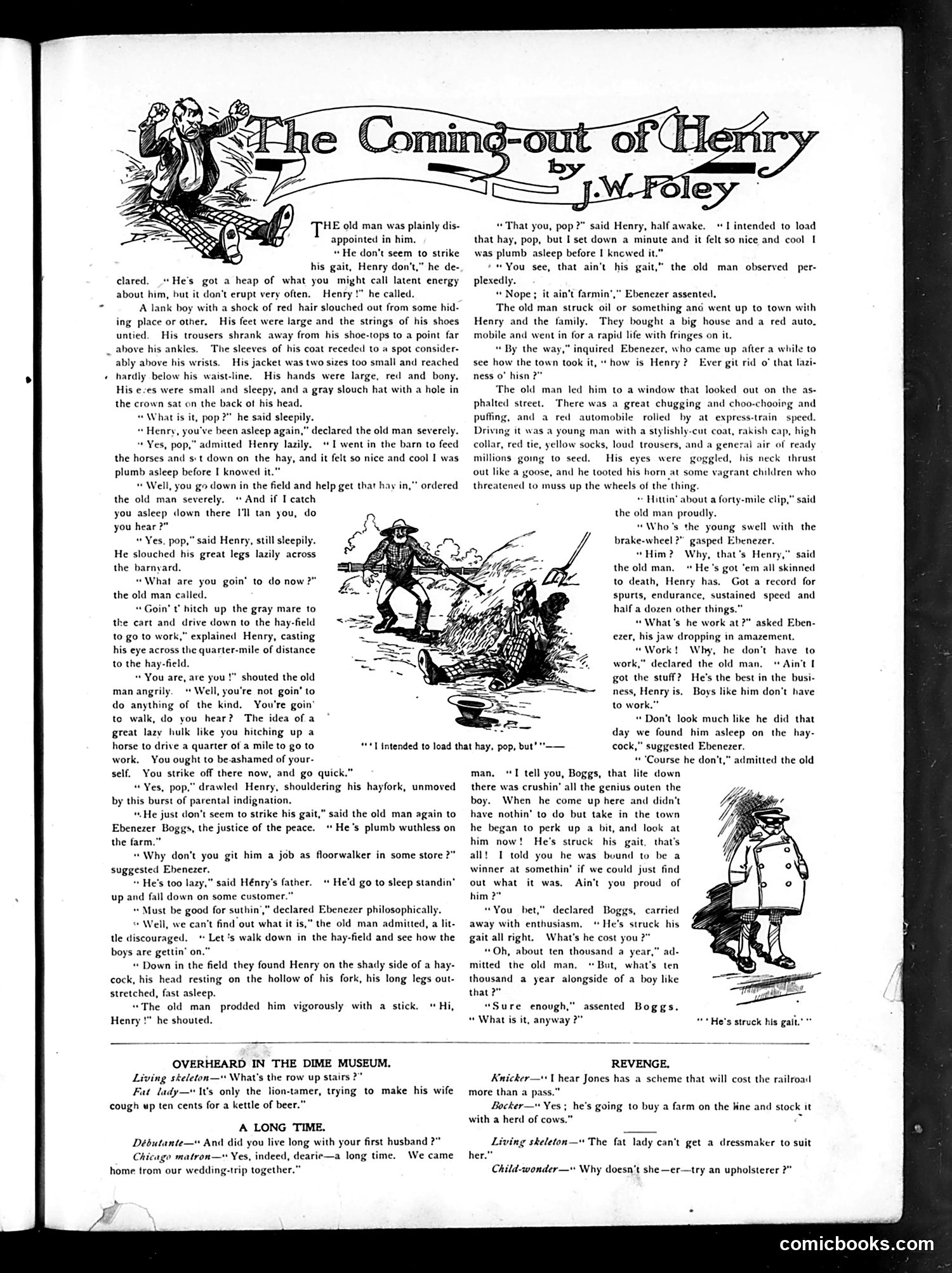
This page contains a short story rather than political satire. The narrative follows an elderly man named Henry who has been sleeping in a haycock and is discovered by neighbors. The story satirizes Henry's laziness and lack of ambition through dialogue where an older farmer criticizes Henry for idleness, declaring he should work rather than sleep. The accompanying illustrations show Henry being roused from the hay and later riding in a stylish automobile, which contrasts with his vagrant status. The humor derives from Henry's shameless indolence and the frustrated reactions of hardworking townspeople to his idleness. This appears to be general social satire about work ethic rather than commentary on specific political figures or events.
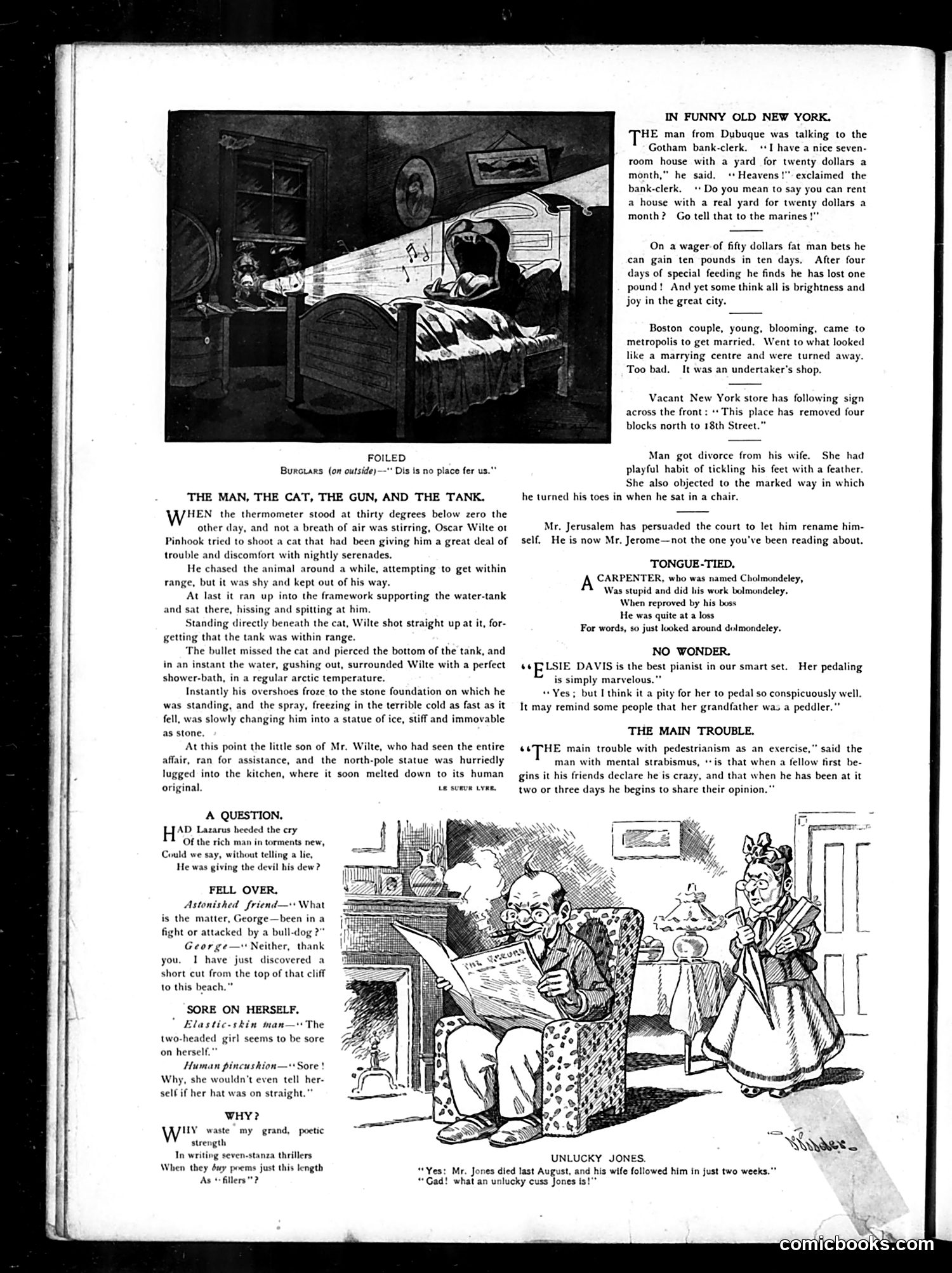
This is a humorous miscellany page from Judge, an American satirical weekly. The main content includes: **"The Man, the Cat, the Gun, and the Tank"** — A slapstick story about Oscar Wilte of Pinhook who attempts to shoot a cat perched on a water tank during freezing weather. His upward shot punctures the tank; water sprays down, freezes instantly in the arctic cold, and encases him in ice until rescued. The joke is physical comedy—the would-be hunter becomes the victim of his own miscalculation. **Miscellaneous jokes** include absurdist humor ("Fell Over"), puns ("Sore on Herself"), and social commentary on New York City life—highlighting contrasts between a naive Midwesterner and urban realities (cheap rent doesn't exist; undertakers mistaken for marriage bureaus). The cartoons use exaggeration and irony typical of Edwardian-era humor. The overall tone suggests urban sophistication mocking both rural simplicity and modern city absurdities.
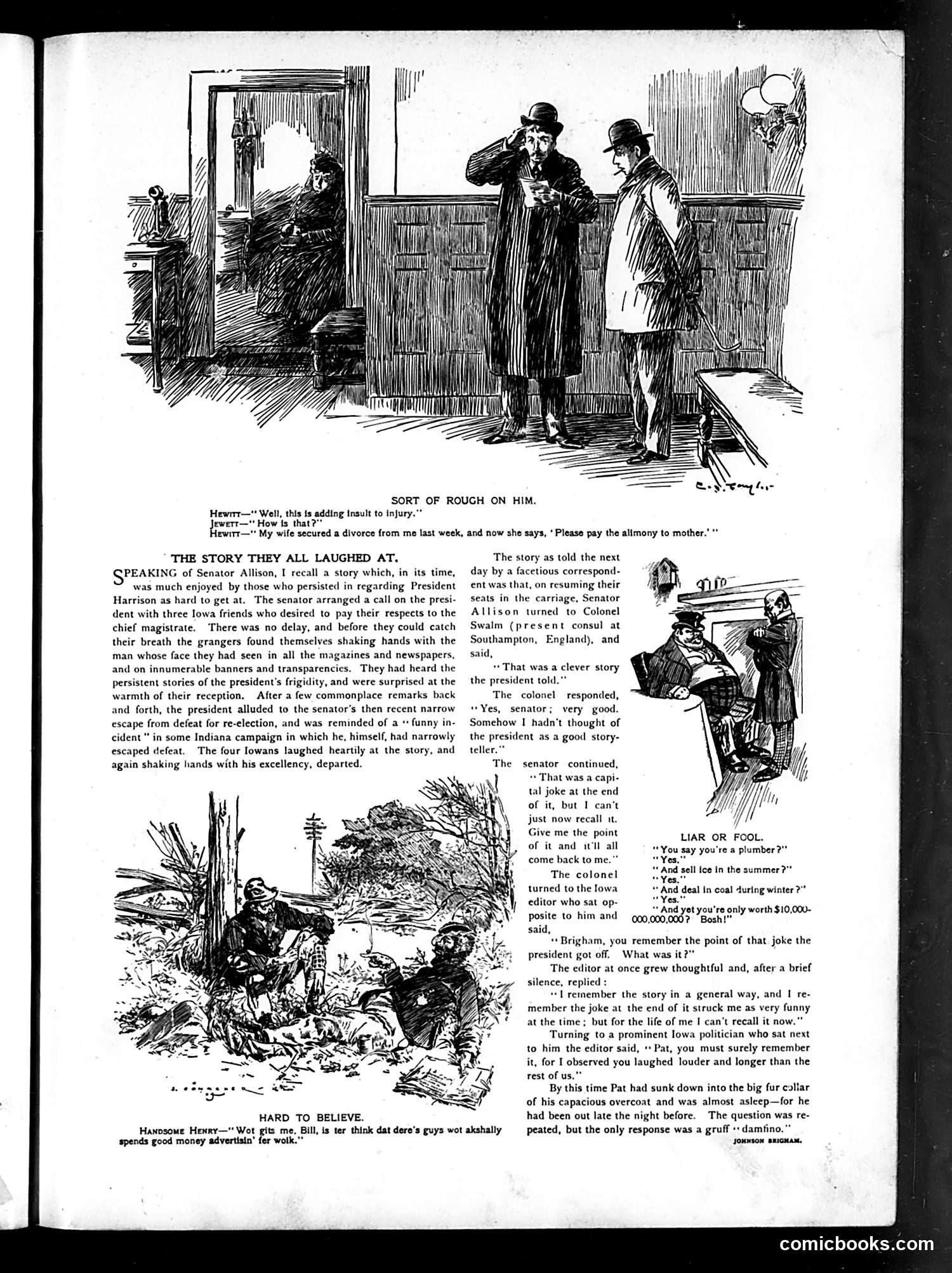
This page contains two separate satirical pieces: **"Sort of Rough on Him"** (top cartoon): A joke about divorce and alimony. A man complains that after his wife divorced him, she now demands he pay alimony to *her mother*—adding insult to injury by enriching the wrong person. **"The Story They All Laughed At"** (main article): Satirizes President Harrison's reputation for coldness. Senator Allison brings Iowa constituents to meet Harrison, who tells a funny story. However, when the group later tries to recount the joke, none of them can remember the actual point—the editor, politician, and even the senator himself have forgotten it. The satire mocks both the president's storytelling ability and the visitors' shallow engagement, suggesting Harrison's warmth was merely performative. **"Liar or Fool"** (bottom right): A brief joke about a man claiming multiple professions while supposedly worth $10 quintillion dollars—absurd wealth claims undermine credibility. These pieces satirize politicians, social pretense, and contemporary concerns about divorce law.
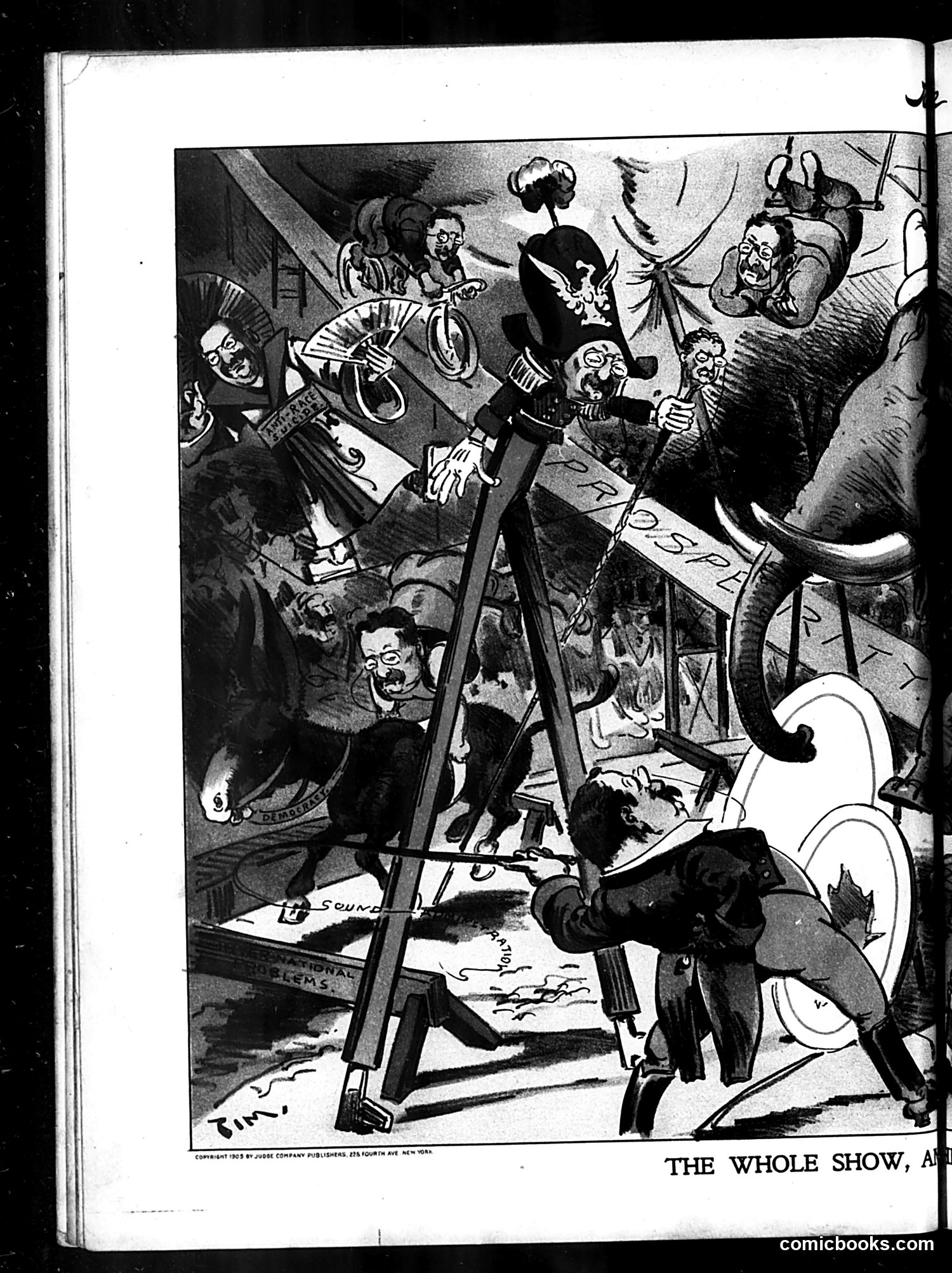
This appears to be a satirical cartoon titled "THE WHOLE SHOW" from *Judge* magazine. The image depicts a film or theater production scene with multiple caricatured figures arranged around a movie camera on a tripod. The exaggerated facial features and theatrical poses suggest these are political or public figures being mocked. However, without clear identifying labels visible in the image and given the OCR text provides only a website source, I cannot confidently identify specific individuals being satirized or the particular political event being referenced. The cartoon likely comments on Hollywood's relationship with politics or contemporary political figures being "performed for" the camera, but determining the precise targets and date would require additional context beyond what's clearly legible here.
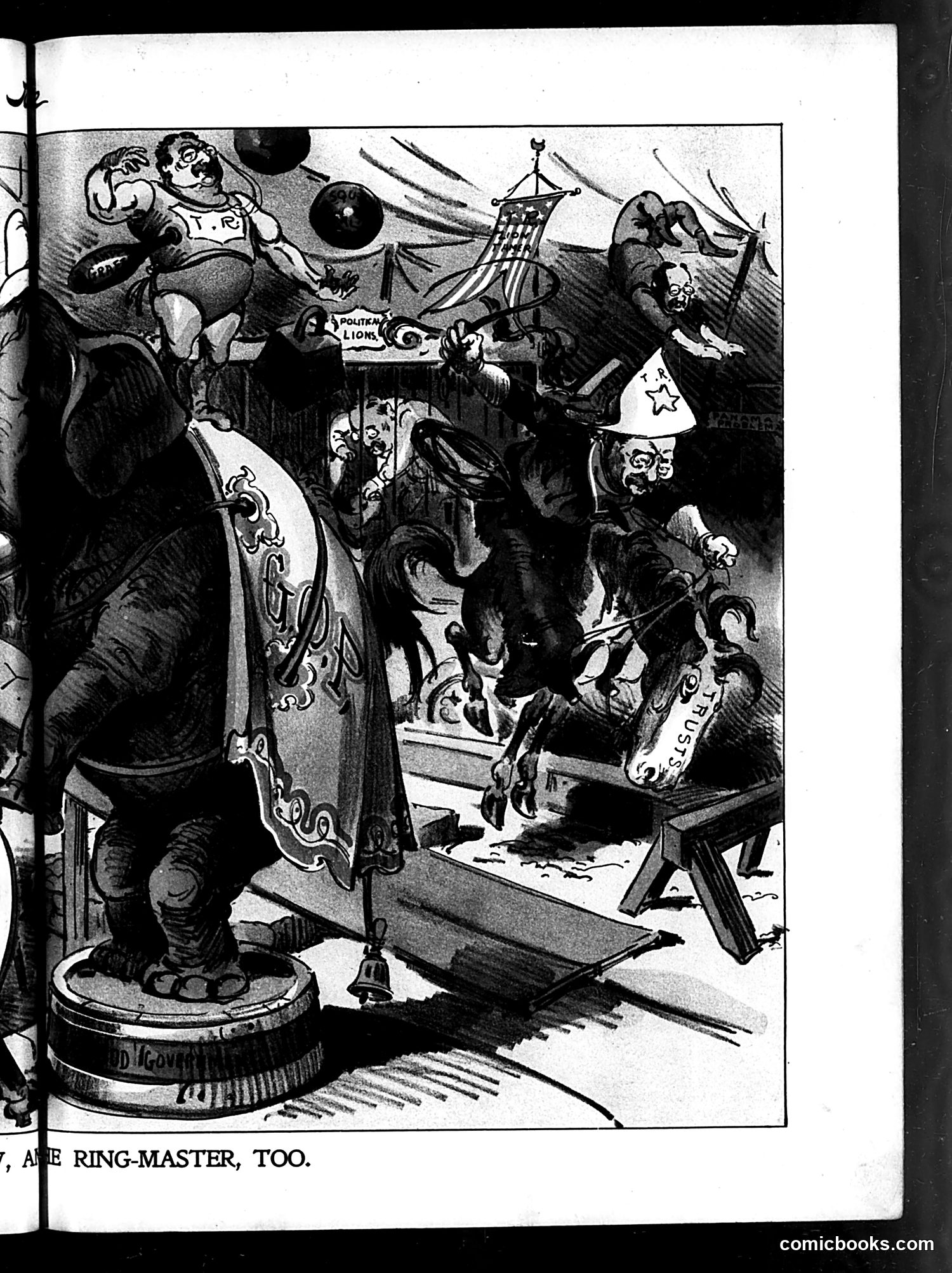
This appears to be a circus or carnival scene satirizing political leadership. The caption reads "...ARE RING-MASTER, TOO," suggesting commentary on someone's multiple roles or overreach of power. The image shows anthropomorphic animals (elephants, lions, and other creatures) in a circus setting with a ringmaster figure. The "Politica Lions" label is visible, indicating the lions represent political entities or parties. The circus metaphor—with its chaos, performance, and control dynamics—suggests the cartoonist is critiquing political management or governance as mere spectacle or circus-like disorder. Without the full page context or date, I cannot definitively identify which specific political figure or event this targets, though the ringmaster imagery suggests criticism of centralized control or showmanship in politics.
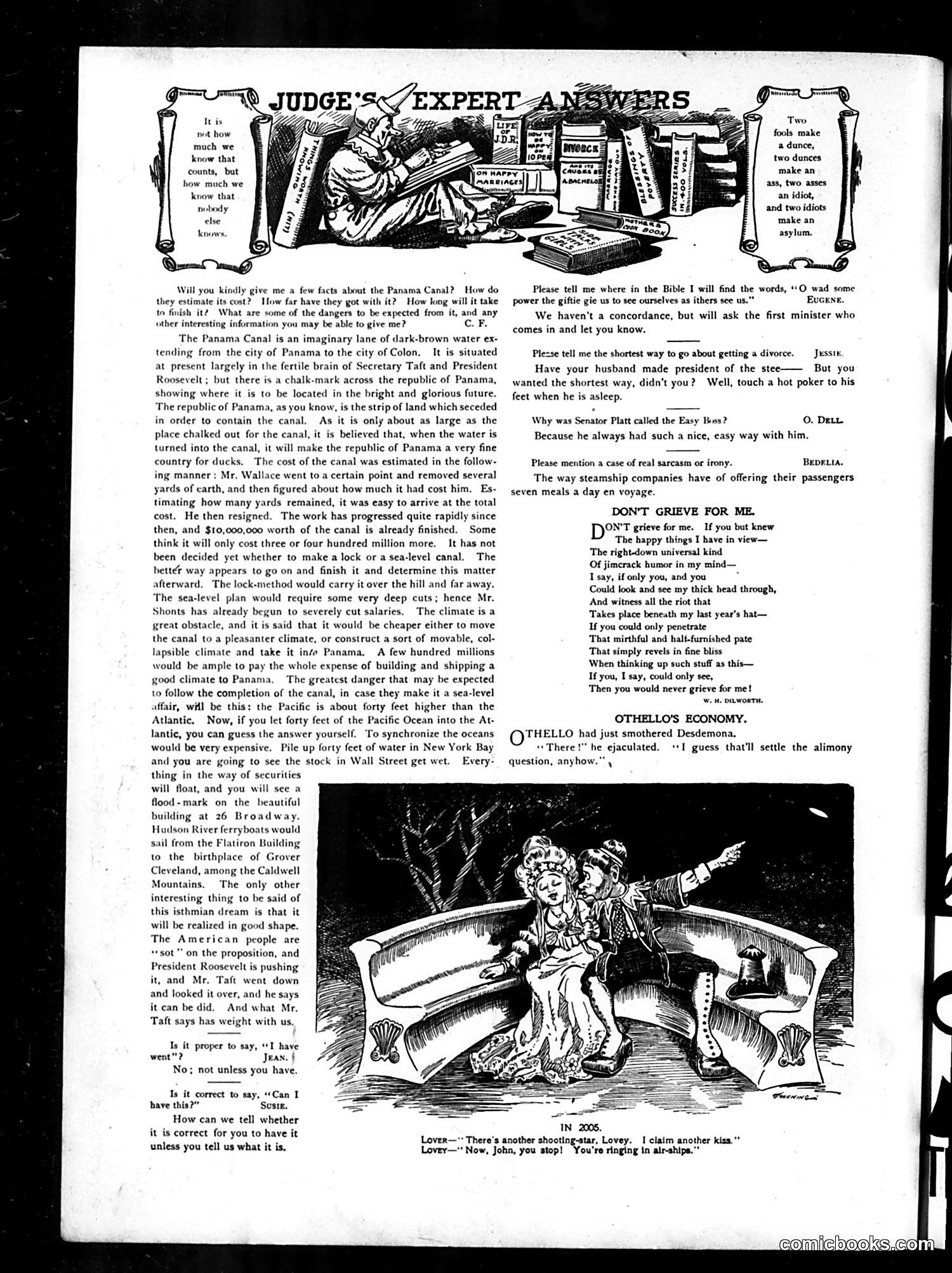
This page satirizes the Panama Canal project under President Theodore Roosevelt and Secretary of War William Howard Taft (early 1900s). The lengthy text mock-explains the canal's imaginary status, noting it exists mainly "in the fertile brain of Secretary Taft and President Roosevelt." The satire ridicules the project's vague planning: cost estimates derived from extrapolating a small soil sample, frequent leadership changes (Wallace's resignation), and the absurd proposal that moving the canal to a "pleasanter climate" might be cheaper. Judge particularly mocks the engineering problem—the Pacific allegedly being 40 feet higher than the Atlantic—claiming synchronizing the oceans would flood Wall Street. The humor targets Roosevelt's enthusiasm for the project despite its speculative nature and design uncertainties (lock vs. sea-level). The "Judge's Expert Answers" column uses faux-earnest advice to reinforce the mockery.
This is primarily a **full-page advertisement** for Schlitz beer, not satirical content. There are no political cartoons or caricatures present. The ad emphasizes Schlitz's manufacturing superiority through its proprietary yeast strain and rigorous quality-control processes (cleanliness, filtering, aging, sterilizing). The tagline "The Beer That Made Milwaukee Famous" references Milwaukee's historical dominance in American beer production. The decorative hop vine borders are typical of early 20th-century beer advertising design. The note about "Ask for the Brewery Bottling" suggests concerns about counterfeit or inferior products—a common issue when distribution networks were less regulated. This appears to be a standard commercial advertisement placed in *Judge* magazine, not editorial or satirical content.
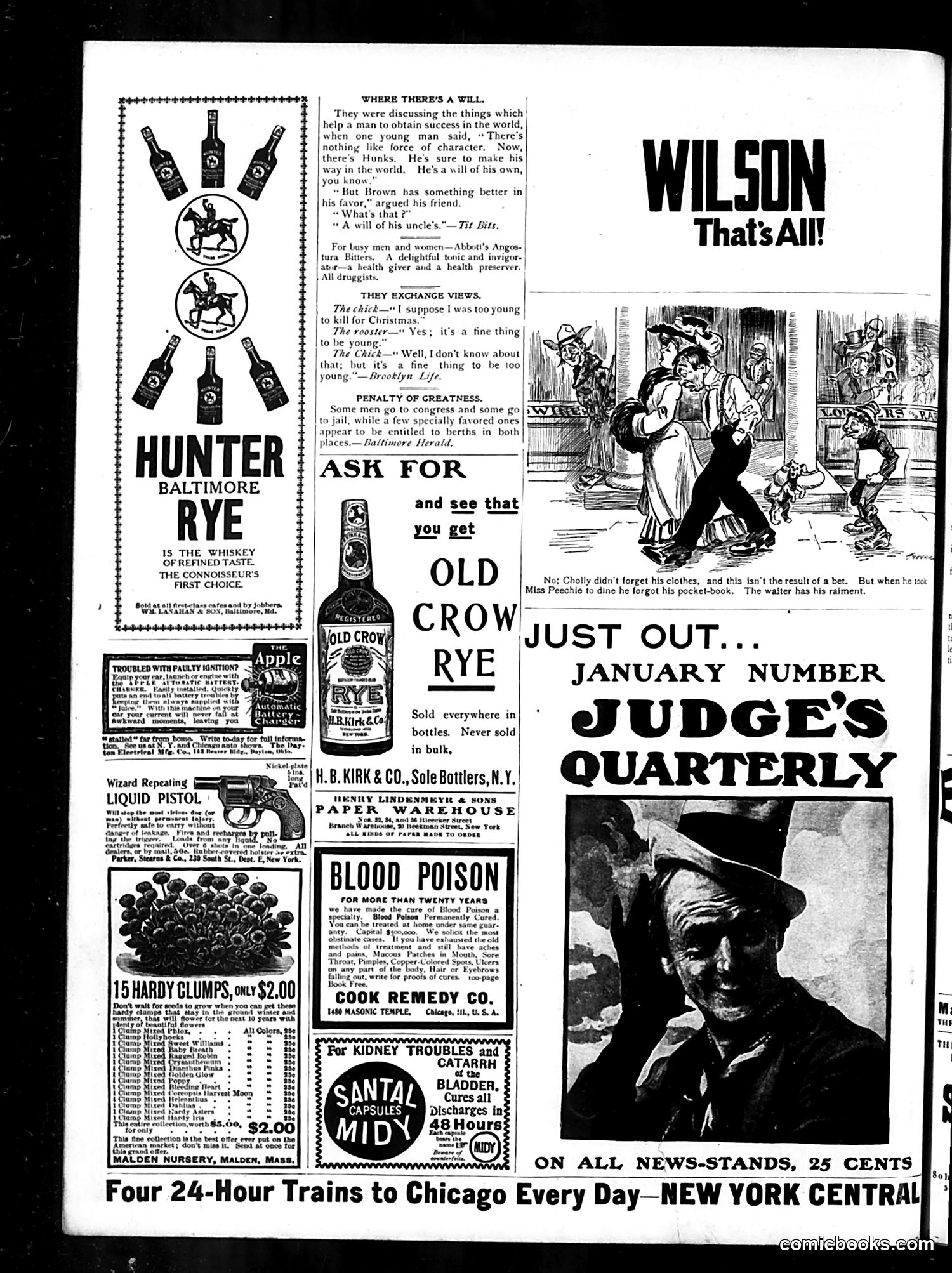
This page is primarily **advertisements and filler content** rather than political satire. The main elements include: **Advertisements:** The page features numerous patent medicine and product ads typical of early 20th-century publications—whiskey (Hunter Baltimore Rye, Old Crow Rye), dubious medical treatments (blood poison cure, kidney/bladder remedies), and nursery plants. **Humor Sections:** Brief, mild jokes appear under headings like "Where There's a Will" and "They Exchange Views"—simple puns about inheritance and youth rather than political commentary. **Main Feature:** "Wilson—That's All!" shows a cartoon illustration with accompanying text about someone named Cholly at a restaurant, apparently having dining troubles (the waiter holds his clothing as collateral). This appears to be light social humor rather than political satire. **Context:** Without a visible date, the "Wilson" reference is unclear—it could reference President Woodrow Wilson or simply be a character name. The page reflects Judge's role as a general-interest humor and advertisement vehicle rather than focused political commentary.
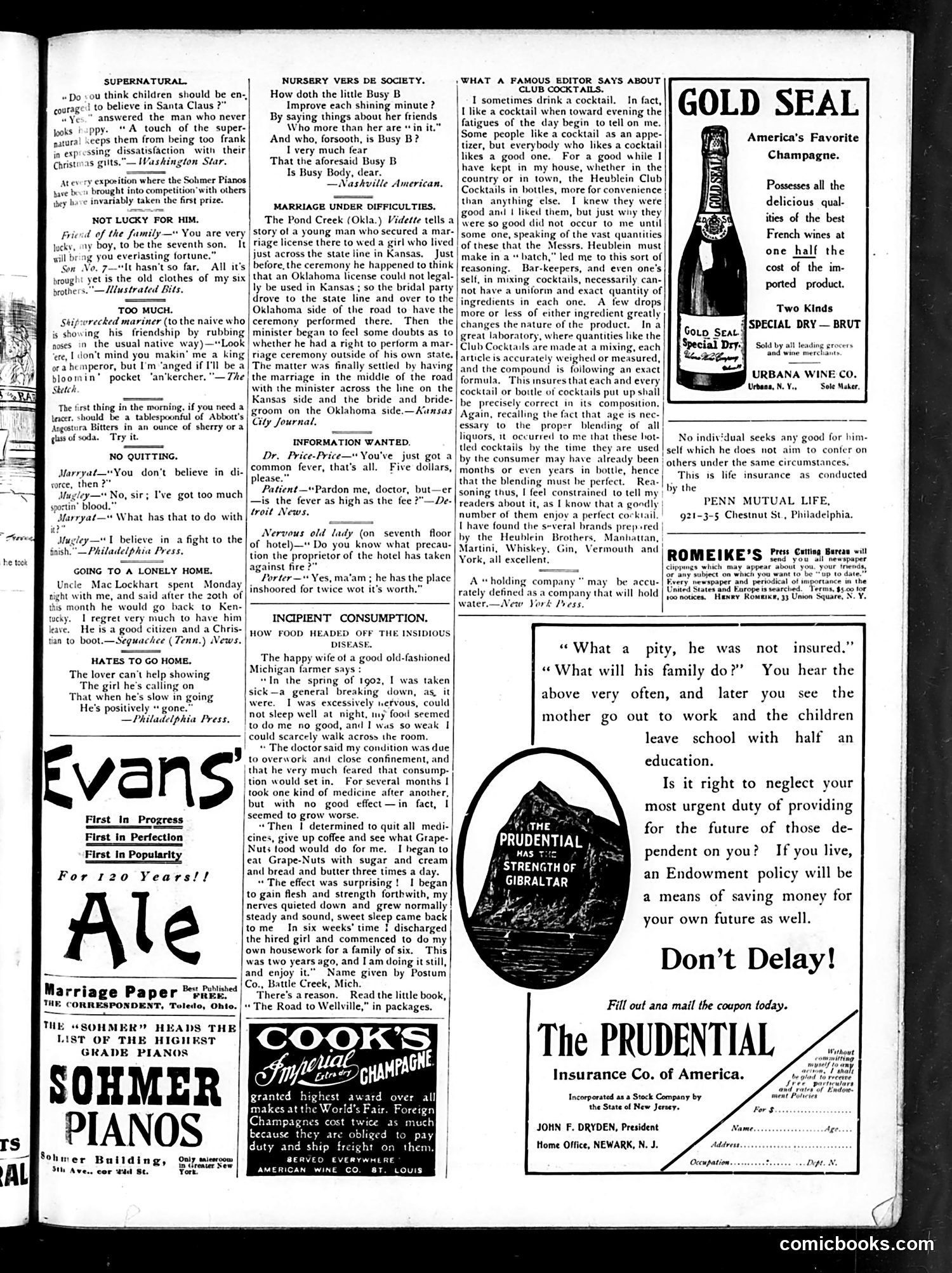
This page from *Judge* magazine contains primarily **humorous anecdotes and short jokes** rather than political cartoons. The content reflects early 1900s American social satire: **Key humor themes:** - **"Supernatural"**: A debate about whether children should believe in Santa Claus—suggesting belief in fantasy prevents dissatisfaction with reality - **"Marriage Under Difficulties"**: A satirical account of a couple forced to marry straddling the Oklahoma-Kansas state line because their license wasn't valid across state borders—mocking jurisdictional absurdities - **"Information Wanted"**: A patient questions a doctor's five-dollar fee being as high as his fever—class commentary on medical costs - **"Incipient Consumption"**: A woman recovers from illness through proper diet—promoting food's medicinal value The jokes target **bureaucratic inefficiency, medical profiteering, social pretension, and marital difficulties**. The page also includes advertisements (Gold Seal Champagne, Sohmer Pianos, insurance) typical of period magazines. No specific political figures or events are caricatured on this particular page.
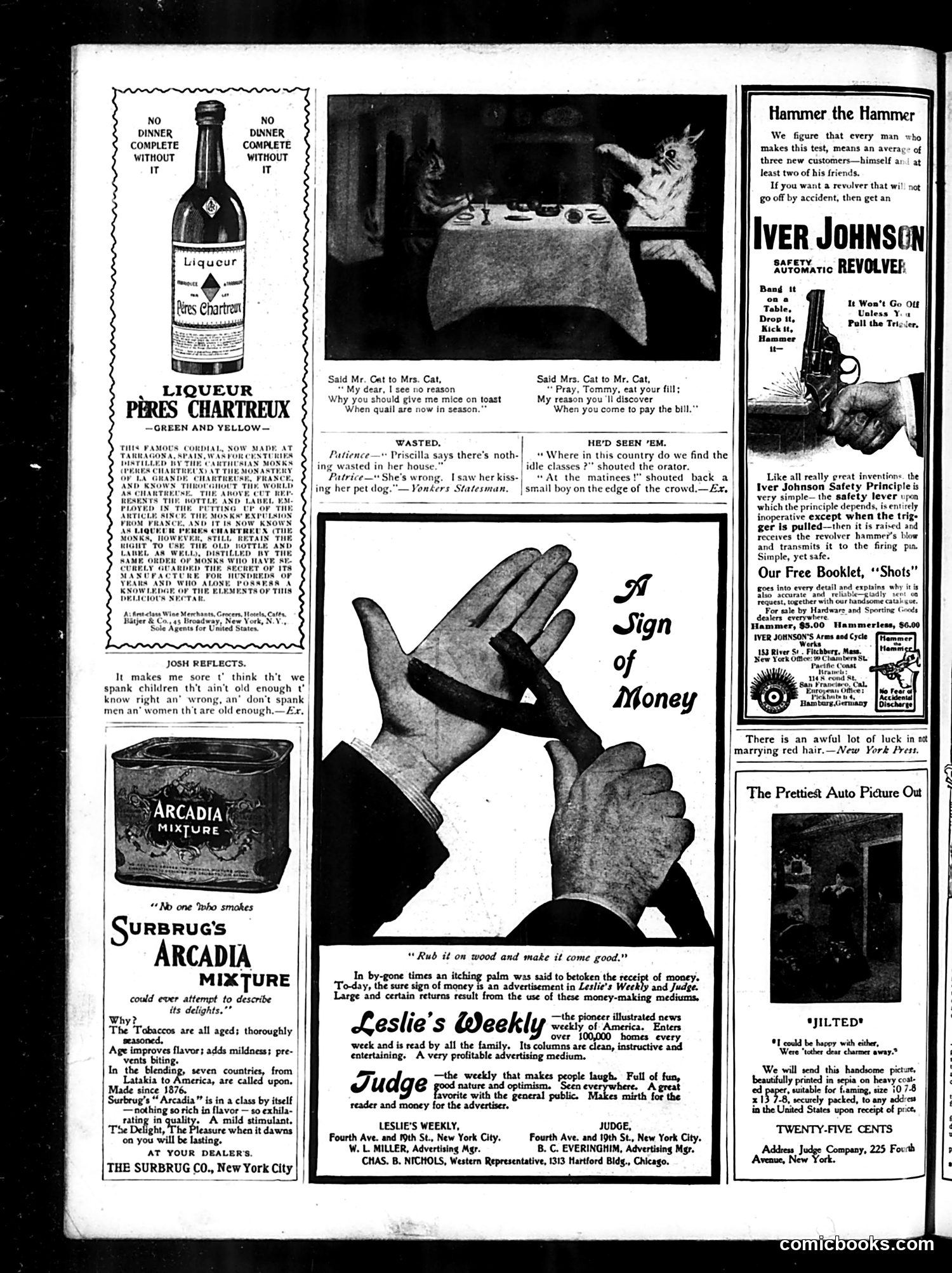
This page is primarily **advertisements and filler content** rather than political satire. The main elements include: **Advertisements:** - Liqueur Chartreuse (wine merchant ad) - Surbrug's Arcadia Mixture (tobacco) - Iver Johnson Safety Revolver (emphasizing accident-prevention) - Leslie's Weekly and Judge magazines (self-promotion) **Humorous Filler:** - "Josh Reflects" — a mild observation about inconsistent child discipline - Cat dialogues about food preferences and bills - A joke about "idle classes" attending matinees - A commentary on money as advertisement **Central Image:** "A Sign of Money" shows a hand holding currency, accompanying text about how advertising in publications like Leslie's and Judge is now "the sure sign of money." The page reflects early 20th-century consumer culture and magazine advertising practices. There's no significant political satire—it's typical magazine filler mixing light humor with revenue-generating advertisements for liquor, tobacco, firearms, and competing publications.
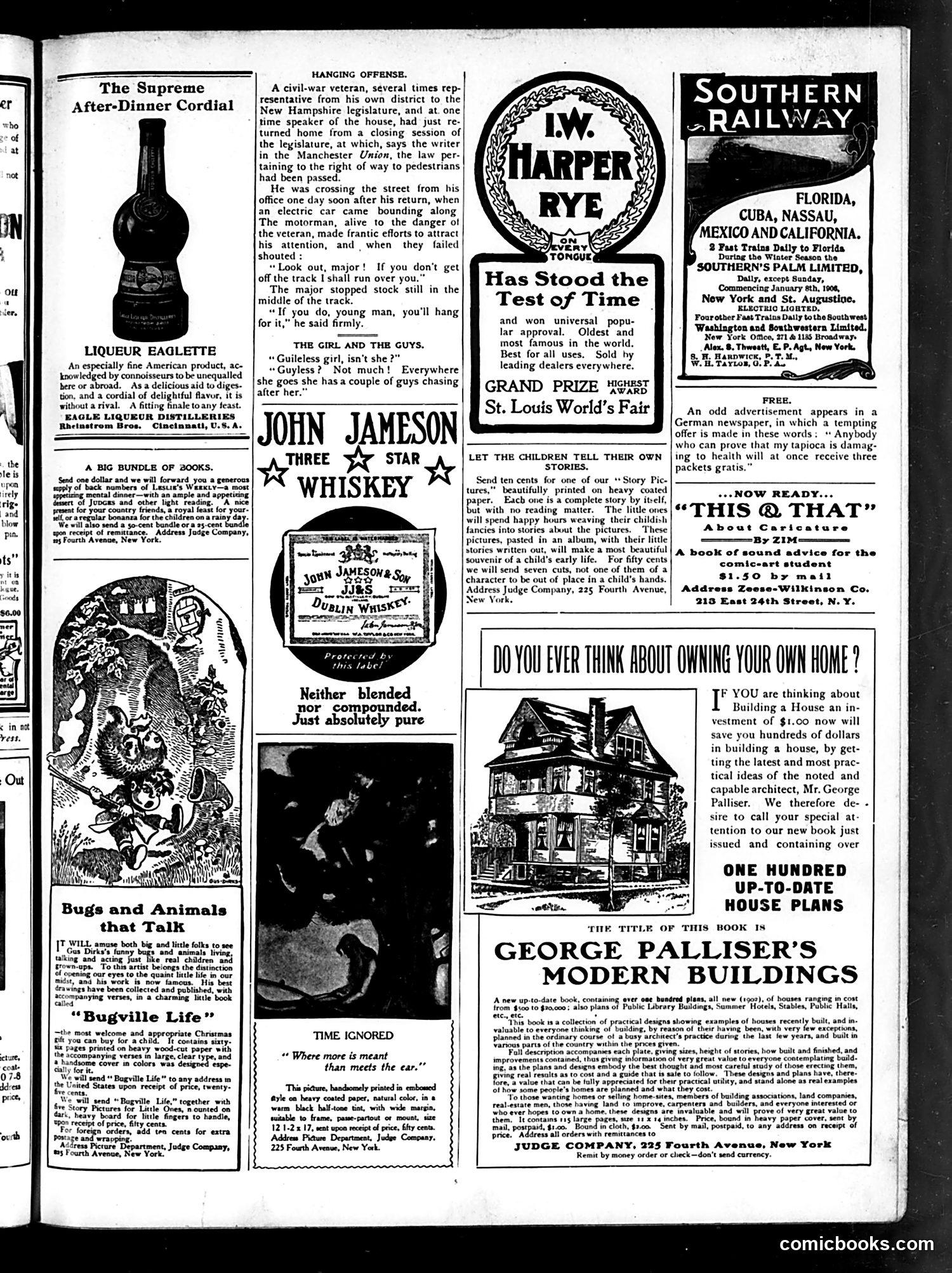
This page is primarily **advertising**, with minimal political content. The main items are: **"Hanging Offense" joke**: A New Hampshire legislator and former civil-war veteran, freshly returned from passing pedestrian right-of-way laws, is nearly hit by an electric streetcar. When the motorman warns him, the major threatens to have him hanged—apparently considering the irony that he just passed laws protecting pedestrians, so hitting one would now be a capital offense. It's satire on legislative inconsistency and the veteran's pompousness. **Other content**: The page features advertisements for liqueurs (Liqueur Eaglette, John Jameson whiskey), books (children's "Bugville Life" stories, house-building plans), and the St. Louis World's Fair. A brief joke about a "guileless girl" surrounded by pursuing men appears mid-page. The material reflects early 1900s concerns: alcohol advertising, home ownership aspirations, and children's literature marketing.
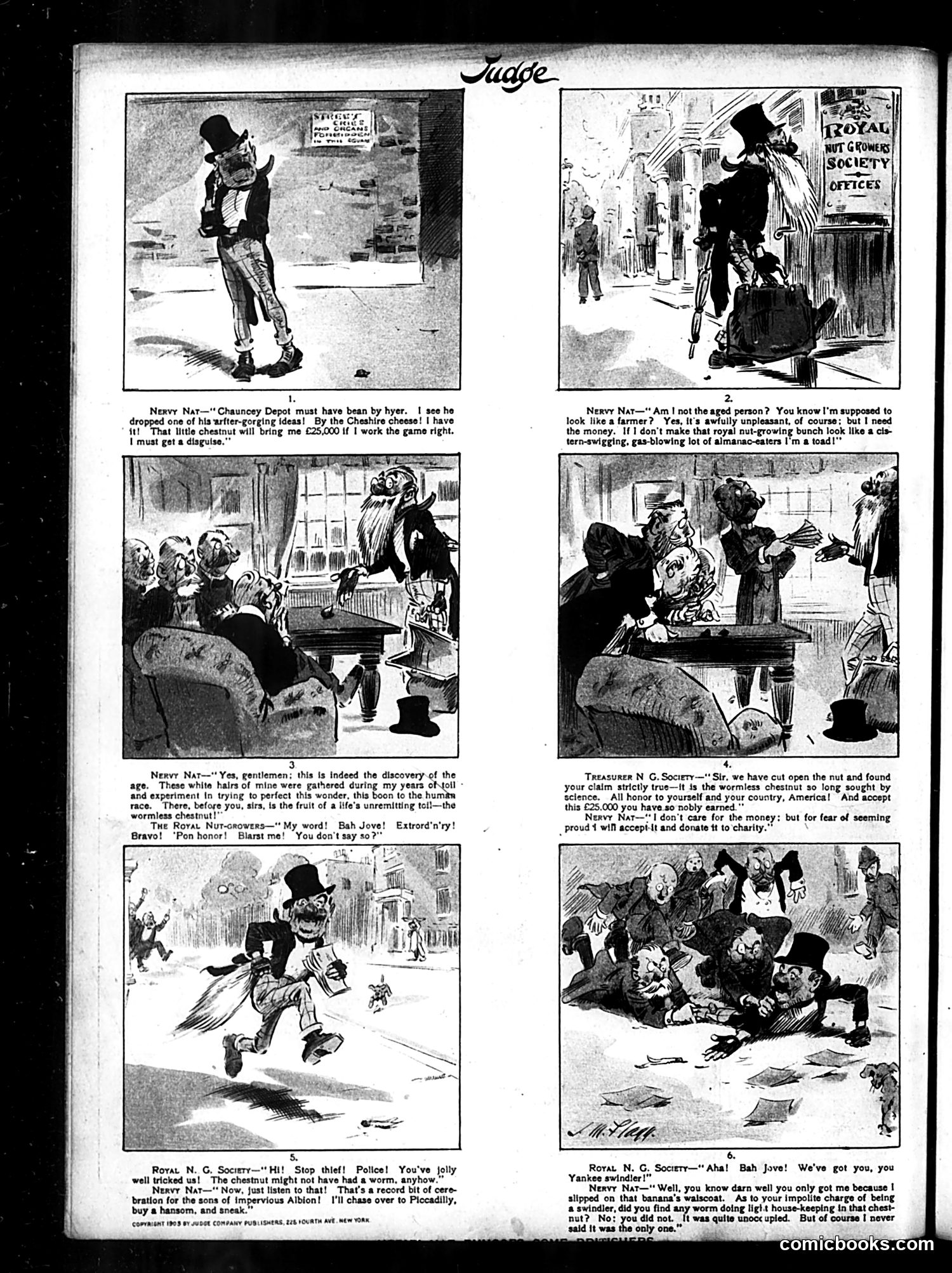
This six-panel comic strip satirizes both American con artists and British gullibility. "Nervy Nat," an American swindler, steals an idea about a wormless chestnut from someone named Chauncey Depot. He disguises himself as an elderly farmer-scientist and tricks the Royal Nut-Growers Society—portrayed as pompous, easily-impressed British gentlemen—into believing he's discovered a revolutionary scientific breakthrough. The punchline exposes the scam: when caught, Nervy Nat admits he merely planted a genuinely wormless nut (by chance) but claims he never promised there *weren't other wormless ones*. The satire mocks both the shallow vanity of British "society" and American entrepreneurial dishonesty. The cartoon also reflects period stereotypes of British formality ("'Pon honor!") versus American cunning.