
Judge, 1906-01-13 · page 5 of 16
Judge — January 13, 1906 — page 5: what you’re looking at
What you’re looking at
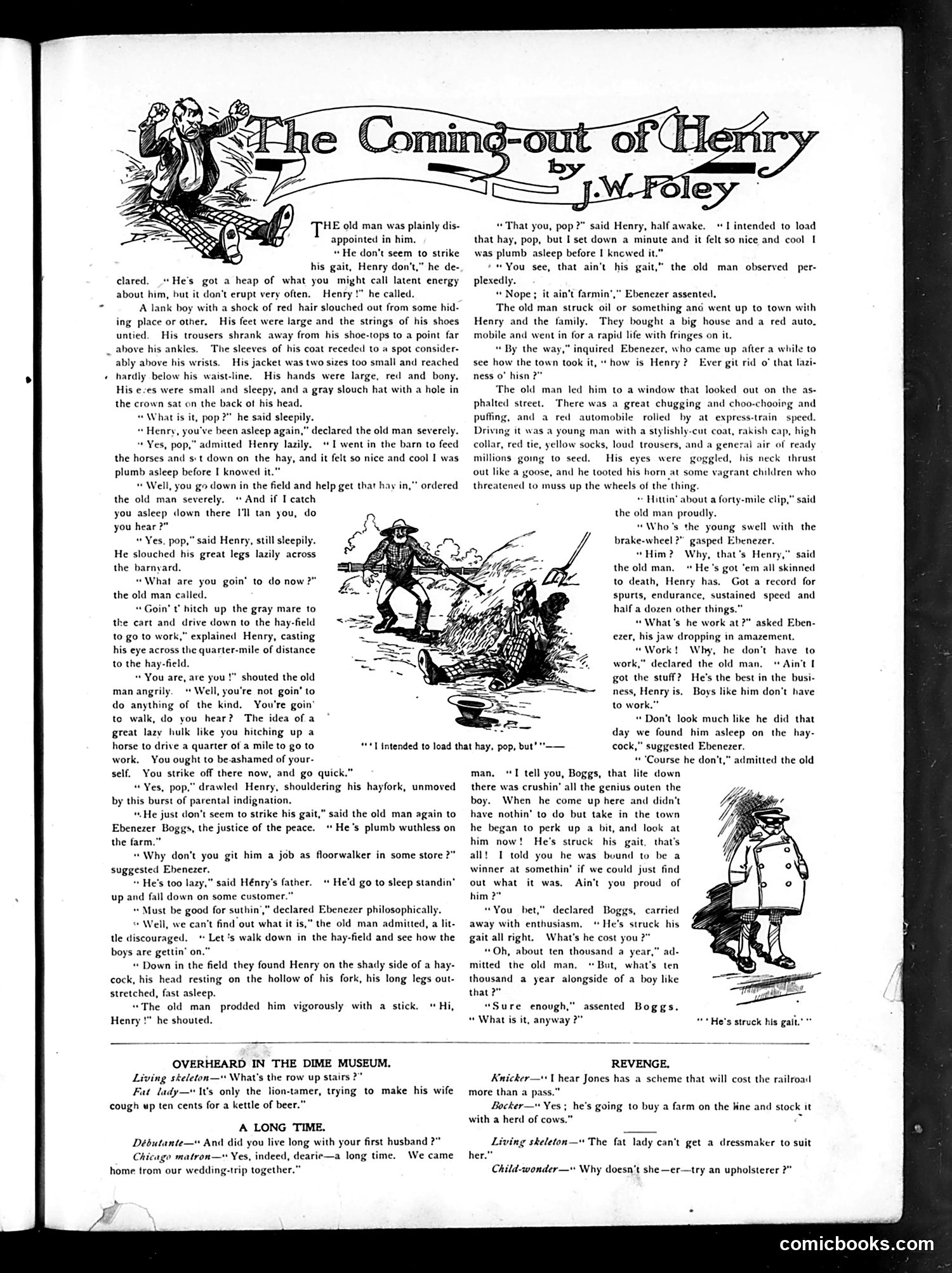
This page contains a short story rather than political satire. The narrative follows an elderly man named Henry who has been sleeping in a haycock and is discovered by neighbors. The story satirizes Henry's laziness and lack of ambition through dialogue where an older farmer criticizes Henry for idleness, declaring he should work rather than sleep. The accompanying illustrations show Henry being roused from the hay and later riding in a stylish automobile, which contrasts with his vagrant status. The humor derives from Henry's shameless indolence and the frustrated reactions of hardworking townspeople to his idleness. This appears to be general social satire about work ethic rather than commentary on specific political figures or events.
📄 Transcribed text from this page (OCR, searchable)
Machine-transcribed from the original scan — historical spelling and the odd misread are preserved.
HE old man was plainly dis- appointed in him, “He don’t seem to strike his gait, Henry don't,” he de- clared. He's got a heap of what you might call latent energy about him, but it don’t erupt very often. Henry !" he called, A lank boy with a shock of red hair slouched out from some hid- ing place or other. His feet were large and the strings of his shoes untied. His trousers shrank away from his shoe-tops to a point far above his ankles. The sleeves of his coat receded to # spot consider- ably above his wrists. His jacket was two sizes too small and reached hardly below his waist-line. His hands were large, red and bony. His ees were small and sleepy, and a gray slouch hat with a hole in the crown sat on the back of his head. “ What is it, pop 2” he said sleepily. “ Henry, you've been asleep again,” declared the old man severely. “Yes, pop,” admitted Henry lazily, “I went in the barn to feed the horses and s:t down on the hay, and it felt so nice and cool 1 was plumb asleep before I knowed it.” * Well, you go down in the field and help get that hay in,” ordered the old man severely, © And if I catch you asleep down there I'll tan you, do you hear 2” “ Yes, pop,” said Henry, still sleepily. He slouched his great legs lazily across the barnyard. “What are you goin’ to do now?” the old man called. “ Goin’ t hitch up the gray mare to the cart and drive down to the hay-field to go to work,” explained Henry, casting his eye across the quarter-mile of distance to the hay-field. “ You are, are you !” shouted the old man angrily. “Well, you're not goin’ to do anything of the kind. You're goin’ to walk, do you hear? The idea of a great lazy hulk like you hitching up a “That you, pop ?” said Henry, half awake. “I intended to load that hay, pop, but I set down a minute and it felt so nice and cool [ was plumb asleep before | knewed it.” “You see, that ain't his gait,” the old man observed per- plexedly. “ Nope ; it ain't farmin’," Ebenezer assented, The old man struck oil or something and went up to town with Henry and the family. They bought a big house and a red auto. mobile and went in for a rapid life with fringes on it. “ By the way,” inquired Ebenezer, who came up after a while to see how the town took it, how is Henry? Ever git rid o” that lazi- ness 0° hisn ?” The old man led him to a window that looked out on the as- phalted street. There was a great chugging and choo-chooing 3 puffing, and a red automobile rolled hy at express-train speed. Driving it was a young man with a stylishly-cut coat, rakish cap, high collar, red tie, yellow socks, loud trousers, and a general air of ready millions going to seed. His eyes were goggled, his neck thrust out like a goose, and he tooted his horn at some vagrant children who threatened to muss up the wheels of the thing + Hittin’ about a forty-mile clip,” said the old man proudly. “Who's the young swell with the brake-wheel ?” gasped Ebenezer. “Him? Why, that's Henry,” said the old man,“ He's got ‘em all skinned to death, Henry has. Got a record for spurts, endurance, sustained speed and half a dozen other things. “What's he work at?" asked Eben- ezer, his jaw dropping in amazement. “Work! Why, he don’t have to work,” declared the old man, “Ain't [ got the stuff? He's the best in the busi- ness, Henry is. Boys like him don’t have to work.” “Don't look much like he did that day we found him asleep on the hay- horse to drive a quarter of a mile to go to “ "1 intended to load that hay, pop, but’ "—— suggested Ebenezer. work. You ought to be-ashamed of your- self. You strike off there now, and go quic “Yes, pop,” drawled Henry, shouldering his hayfork, unmoved by this burst of parental indignation. “He just don't seem to strike his gait,” said the old man again to Ebenezer Boggs, the justice of the peace. “He's plumb wuthless on the farm “Why don't you git him a job as floorwalker in some store 2” suggested Ebenezer. He's too lazy,” said Hénry’s father.“ He'd go to sleep standin’ up and fall down on some customer.” * Must be good for suthin’,” declared Ebenezer philosophically. + Well, we can’t find out what it is,” the old man admitted, a lit- tle discouraged. * Let's walk down in the hay-field and see how the boys are gettin’ on. “ Down in the field they found Henry on the shady side of a hay- cock, his head resting on the hollow of his fork, his long legs out- stretched, fast asleep. “The old man prodded him vigorously with a stick. “Hi, Henry !" he shouted. * ‘Course he don't,” admitted the old man, “I tell you, Boggs, that lite down there was crushin’ all the genius outen the boy. When he come up here and didn’t have nothin’ to do but take in the town he began to perk up a bit, and look at him now! He's struck his gait, that's all! I told you he was bound to be a winner at somethin’ if we could just find out what it was. Ain't you proud of ‘ou bet,” declared Boggs, carried away with enthusiasm, “He's struck his gait all right. What's he cost you ?” “Ob, about ten thousand a yea mitted the old man, «But, what's ten thousand a year alongside of a boy like that ?" “Sure enough,” assented Boggs. “ What is it, anyway ?” “* He's struck his gait. OVERHEARD IN THE DIME MUSEUM. Living skeleton—« What's the row up stairs 2” Fat lady— It's only the lion-tamer, trying to make his wife cough up ten cents for a kettle of beer.” A LONG TIME. Débutante—* And did you live long with your first husband 2” Chicago matron— Yes, indeed, dearie—a long time. We came home trom our wedding-trip together. REVENGE. Knicker— 1 hear Jones has a scheme that will cost the railroad more than a pass. Bocker— Yes ; he’s going to buy a farm on the kine and stock it with a herd of cows. 2 Living skeleton—“ The fat lady can't get a dressmaker to suit her.’ Child-wonder—" Why doesn’t she—er—try an upholsterer 2" comicbooks.com