
A complete issue · 14 pages · 1906
Judge — January 6, 1906
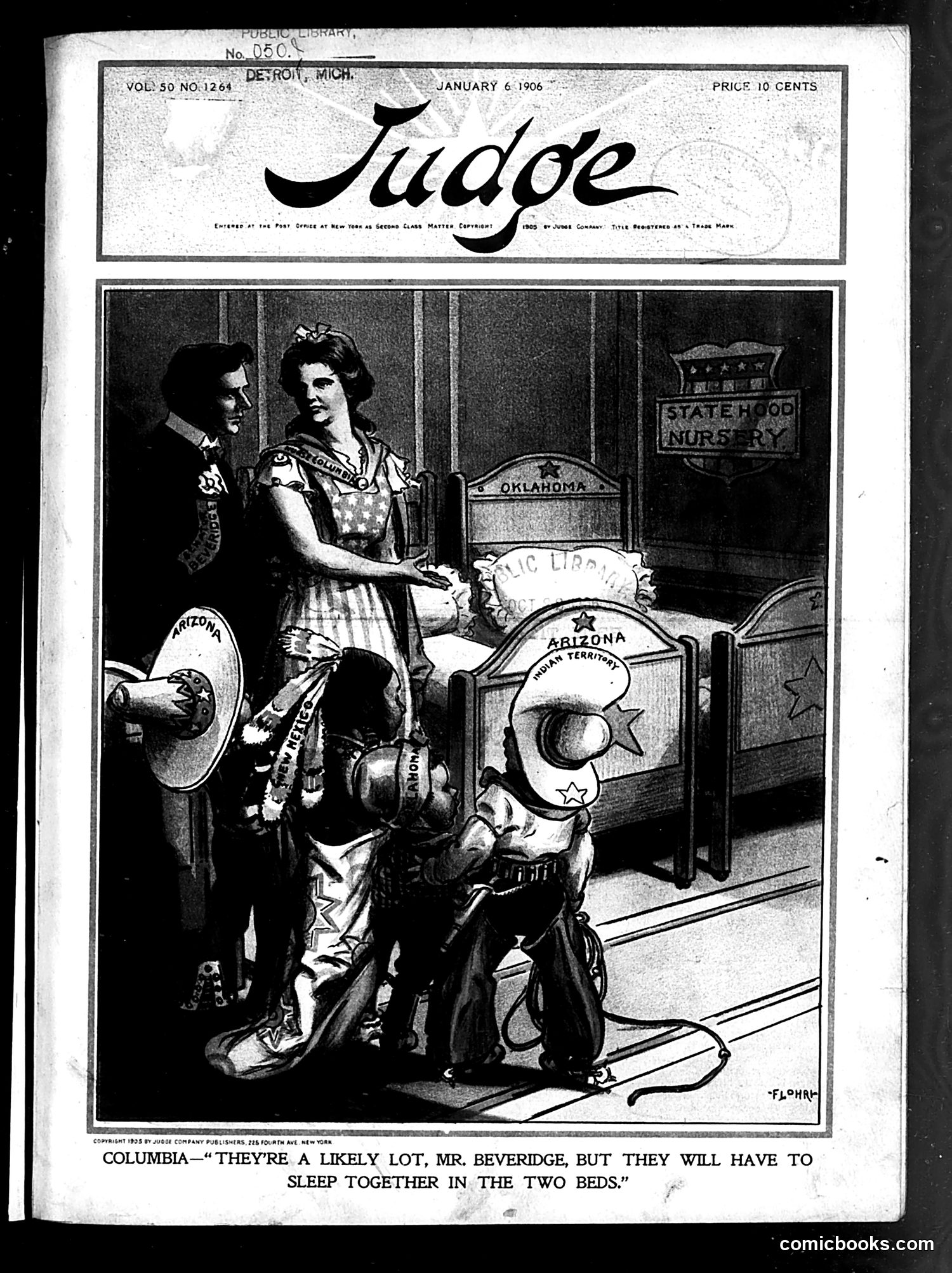
This satirical cartoon depicts the admission of new U.S. territories as states. The figure labeled "Columbia" (America personified) shows two men beds labeled for Arizona and Oklahoma territories, with other beds visible for territories like Oklahoma and what appears to be other western regions in the background. The caption reads: "They're a likely lot, Mr. Beveridge, but they will have to sleep together in the two beds." This references Senator Albert Beveridge, a prominent expansionist advocate. The joke satirizes the challenge of admitting multiple western territories to statehood—they must share limited federal "beds" (resources/representation). The cartoon mocks both the territorial ambitions and the practical crowding problem of accommodating many new states simultaneously, expressing skepticism about whether these territories are ready for full statehood.
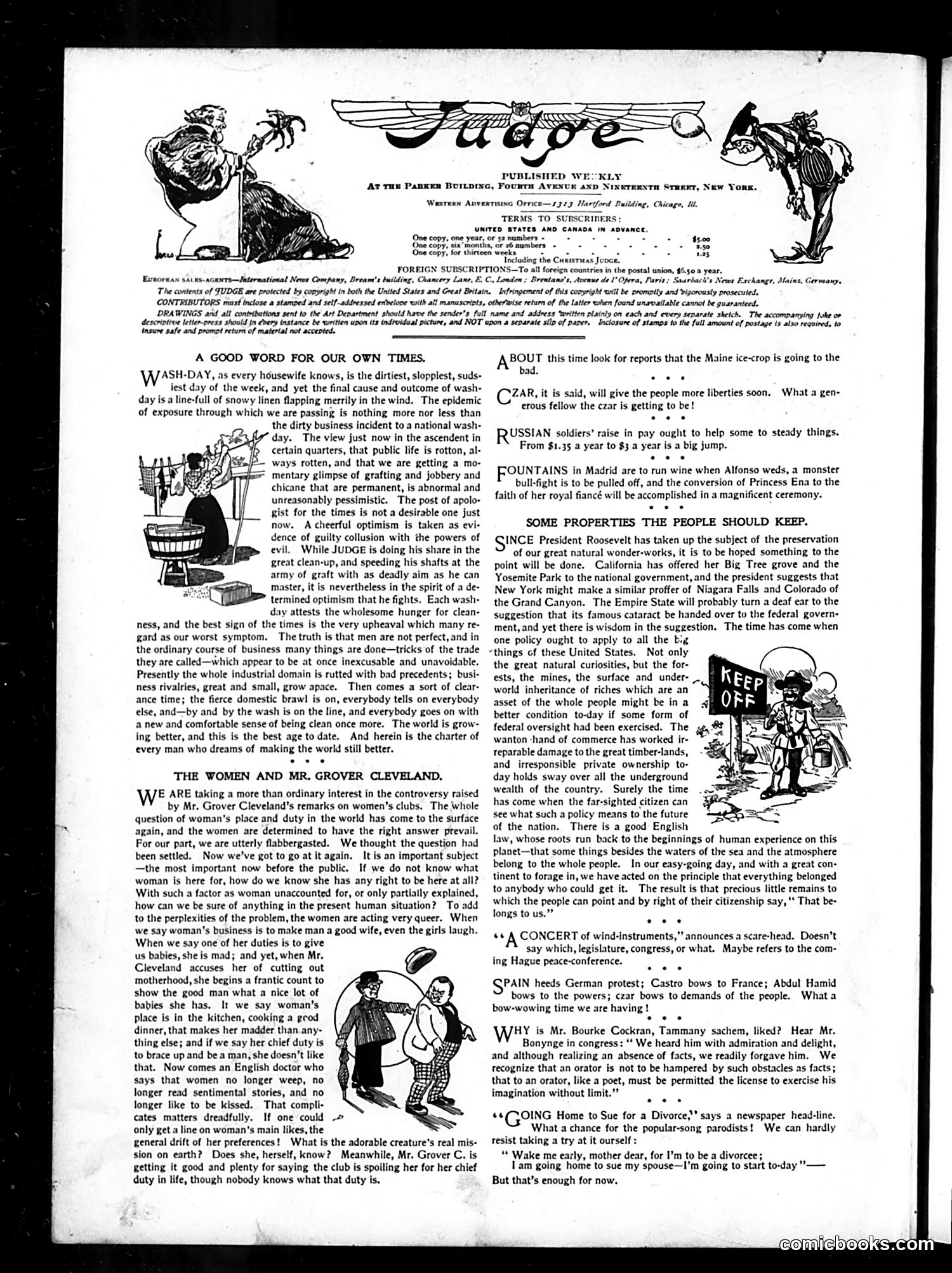
This page contains several political and social commentaries typical of Judge's satirical format: **"A Good Word for Our Own Times"** (left column): Defends wash day as essential labor, arguing that cleanliness serves public health and national vigor. The accompanying illustration shows a woman doing laundry—seemingly praising domestic work against those who might view it as drudgery. **"The Women and Mr. Grover Cleveland"** (center): Discusses Cleveland's relationship with women's groups, questioning women's proper role and duties. The text debates whether women should focus on domestic life versus public engagement—a contentious Progressive Era issue. The remaining brief items reference contemporary political figures (Czar, Roosevelt, Madrid fountains) and social gossip, typical of Judge's miscellaneous commentary format. The cartoons use caricature and humor to critique social positions and political figures.
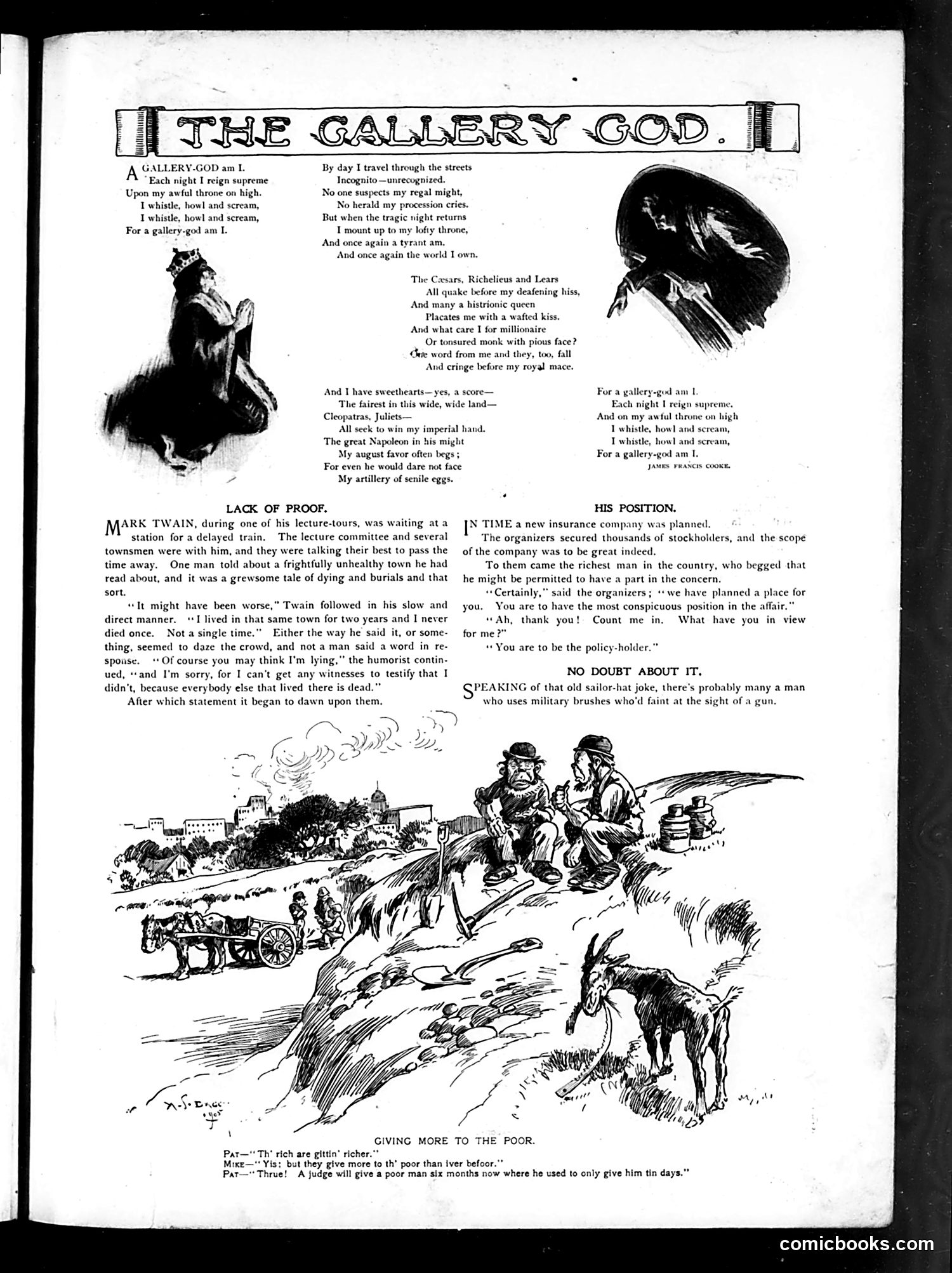
The poem satirizes an obsessive theater-goer ("gallery-god") who frequents the cheapest seats nightly, living vicariously through dramatic performances. The figure whimpers and screams along with stage action, experiencing life only through theatrical spectacle rather than genuine experience. The lower cartoons address separate topics: "Lack of Proof" features Mark Twain discussing an unhealthy town where nobody dies—a logical paradox used to mock unreliable witnesses. "His Position" and "No Doubt About It" appear to reference insurance schemes and military matters, though specific context is unclear without publication date. The bottom cartoon "Giving More to the Poor" depicts a beggar receiving judicial sentencing rather than charity—satirizing harsh treatment of the destitute.
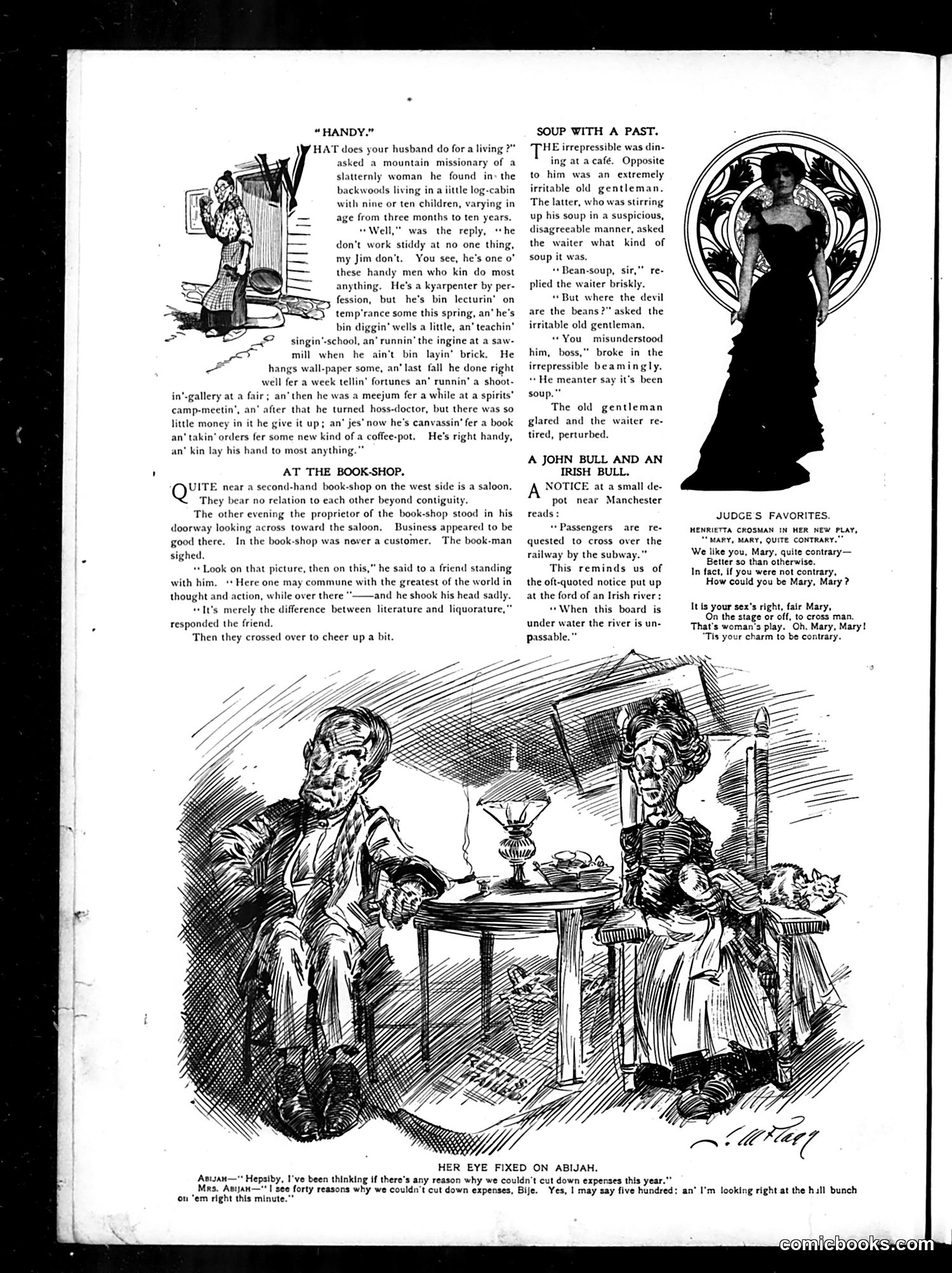
This page contains three separate humorous pieces: 1. **"Handy"**: A joke about a mountain missionary's wife with many children whose husband is a jack-of-all-trades—a carpenter, lecturer, fortune teller, and book salesman. The humor relies on listing his various odd jobs. 2. **"At the Bookshop"**: Two men discuss a painting in a second-hand bookshop, debating whether it depicts "the greatest of the world in thought and action" or "the old school has lied sadly." The joke appears to involve disagreement about what a painting represents. 3. **"A John Bull and an Irish Bull"** with **"Judge's Favorites"**: A Irish railway notice joke about crossing when "under water the river is unpassable," followed by verses about "Mary" playing with contraries—typical Victorian wordplay humor. The satire is genteel and domestic rather than political.
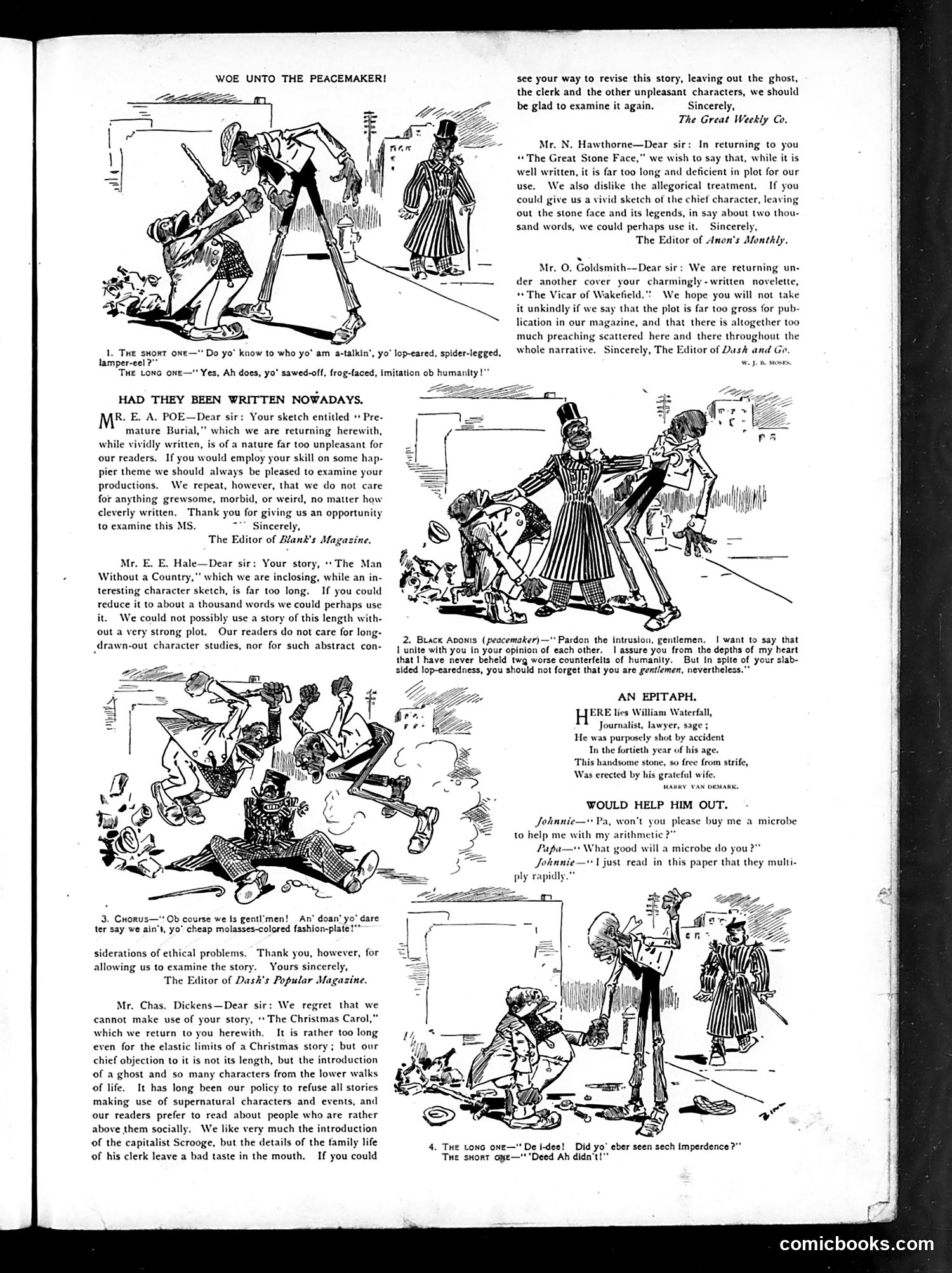
This page consists primarily of **editorial correspondence** rather than political cartoons. Editors from various magazines (The Great Weekly Co., Amen's Monthly, Blank's Magazine, Dash's Popular Magazine) reject submitted stories as too long or poorly suited for their publications. The accompanying **small comic illustrations** show characters in Victorian dress experiencing everyday situations—a couple arguing, people in social settings—but these appear to be generic humorous vignettes rather than political satire. The page's satire targets **magazine editors and the submission process itself**: depicting the frustration writers faced with rejection letters citing length, plot issues, or inappropriate content. This represents internal publishing-industry humor for Judge's readers, many of whom were likely writers or publishing professionals.
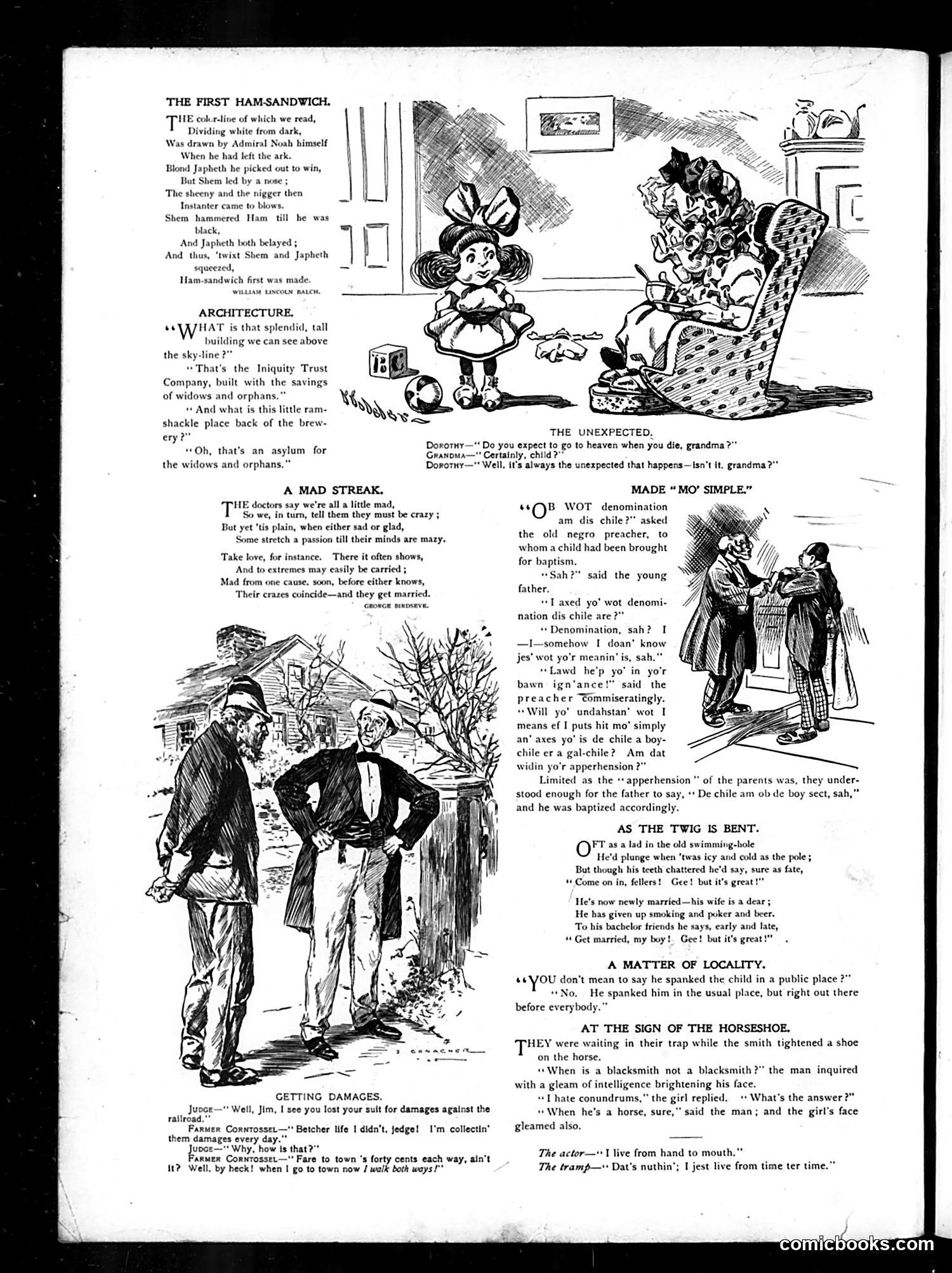
This satirical page from *Judge* magazine (date unclear from image) contains multiple pieces mocking contemporary social issues and human folly: **"The First Ham-Sandwich"** uses crude racial stereotyping to joke about segregation—depicting biblical figures Shem, Japheth, and Ham fighting, with Ham "squeezed" between them. The humor relies on offensive racial language now entirely unacceptable. **"Architecture"** satirizes wealthy trusts built on exploiting vulnerable people (widows, orphans), then offering them a shabby "asylum"—critiquing robber-baron hypocrisy. **Other sketches** mock human irrationality: lovers' madness leading to marriage, a farmer's logic about lawsuit damages, a child's unexpected theological skepticism, and simplified speech when addressing Black Americans (reflecting period racism). The page reflects *Judge*'s typical late-19th/early-20th century satirical approach: punching at institutional greed, marital absurdity, and rural simplicity, while casually embedding racist tropes that were then considered acceptable humor.
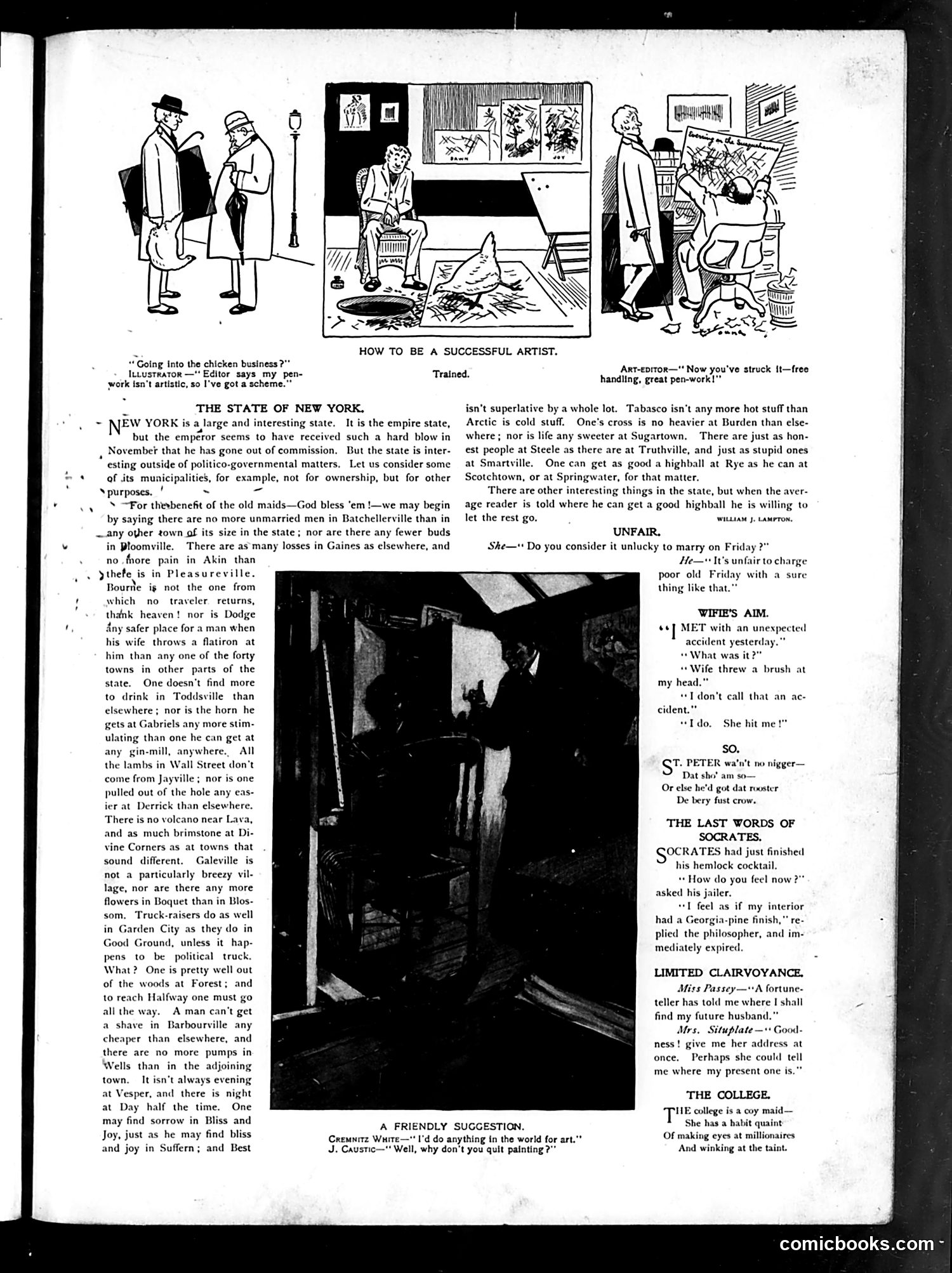
This *Judge* magazine page contains three separate satirical pieces: **"How to Be a Successful Artist"** (top cartoons): An illustrator tells an editor his pen-work isn't "artistic," so he's switching to raising chickens. The joke: if editors reject your art, abandon it entirely for manual labor—dark satire on the struggling artist's plight. **"The State of New York"** (main article): A lengthy humor piece mocking place names by creating puns. Towns like "Pleasureville," "Gaines," "Burden," and "Rye" are treated literally—suggesting that living in "Pleasureville" offers no more pleasure than elsewhere. The final punchline: once someone learns where to get a good highball (whiskey) in New York, they stop caring about the state's other features. This reflects Prohibition-era drinking culture and mocks both tourist guides and drinkers' priorities. **Smaller jokes below**: Various brief satirical quips about marriage, accidents, and classical philosophy, typical of *Judge*'s miscellaneous humor format. The page targets early-20th-century American sensibilities: struggling artists, geographic pretension, and alcohol consumption.
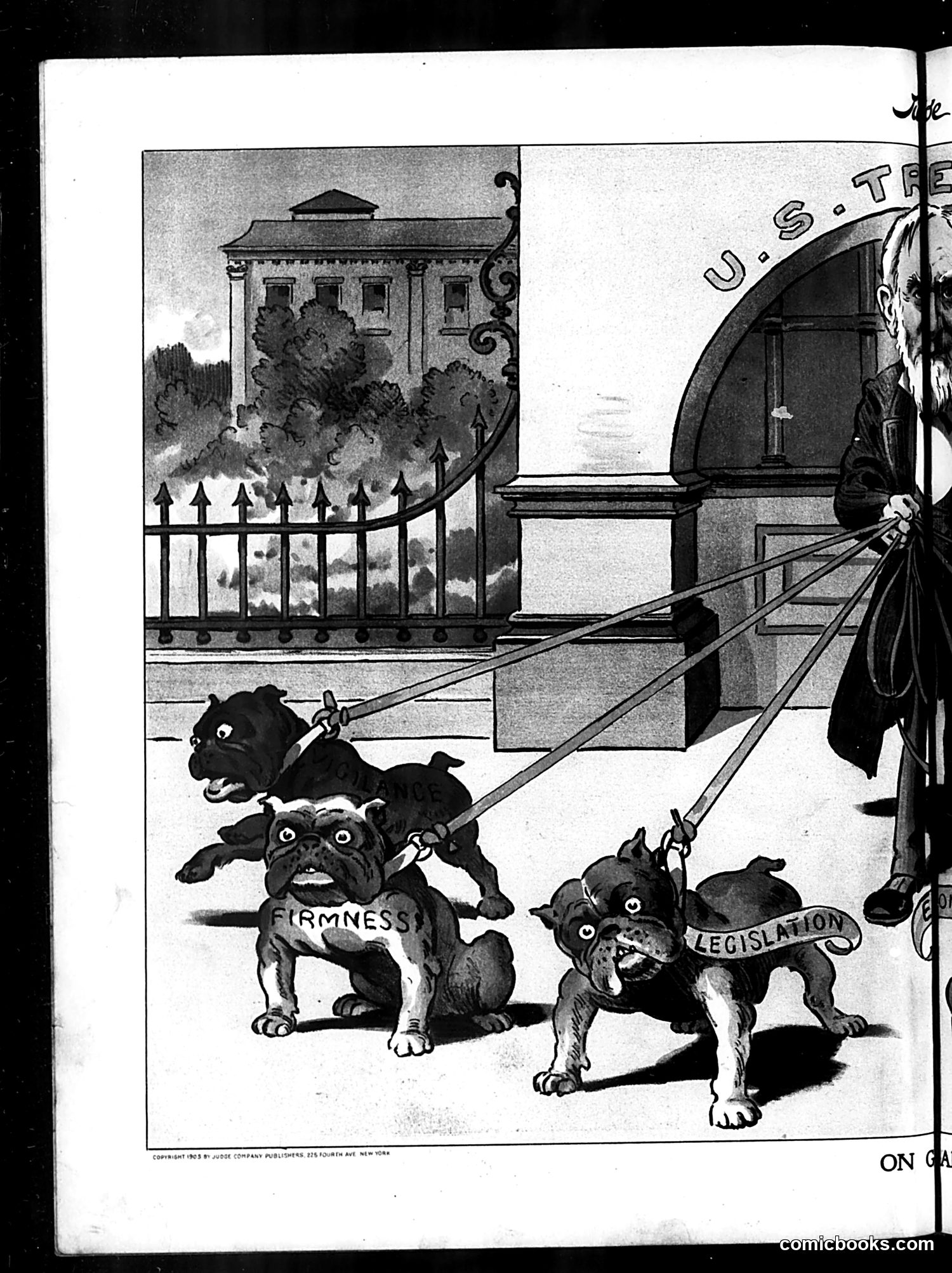
This Judge magazine cartoon depicts a figure (appearing to be a U.S. government official, given the "U.S. Treasury" text visible) struggling to control three aggressive dogs labeled "Firmness" and "Legislation." The dogs are straining at their leashes in different directions, suggesting conflicting policy demands. The cartoon satirizes the difficulty of managing competing political pressures—firmness in policy versus legislative action. The architectural backdrop (appearing to be a government building) reinforces the political setting. The cartoonist suggests that executive leadership is being "pulled apart" by contradictory forces demanding simultaneous strength and legislative compromise. Without the publication date visible, the specific historical context remains unclear, though the satire targets executive branch challenges in balancing different governmental approaches.
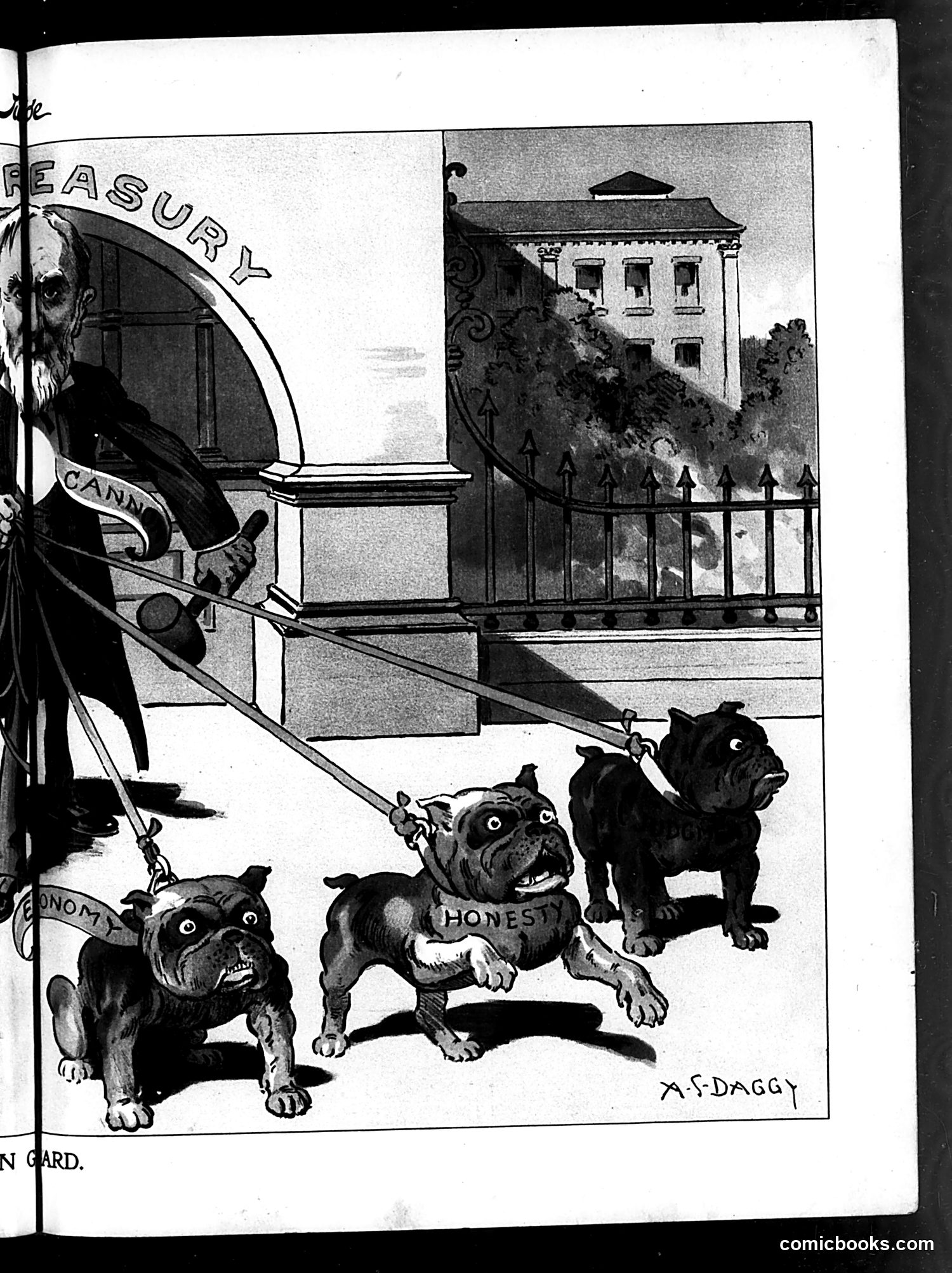
This cartoon by A.F. Daggy depicts three bulldogs on leashes held by a bearded figure labeled "TREASURY" near a classical government building (likely the Capitol or Treasury Building). The dogs are labeled with virtues: "HONESTY" is clearly visible on the center dog, while the others appear labeled with similar civic values (text partially obscured). The satire suggests the Treasury Department is controlling or restraining these abstract principles—possibly critiquing government mismanagement of public virtue or fiscal ethics. The bulldog imagery (traditionally representing strength and stubbornness) combined with the leashes implies these ideals are being constrained or manipulated by Treasury policy. Without a specific date visible, the exact historical context remains unclear, though this reflects broader Progressive-era concerns about government corruption and financial accountability.
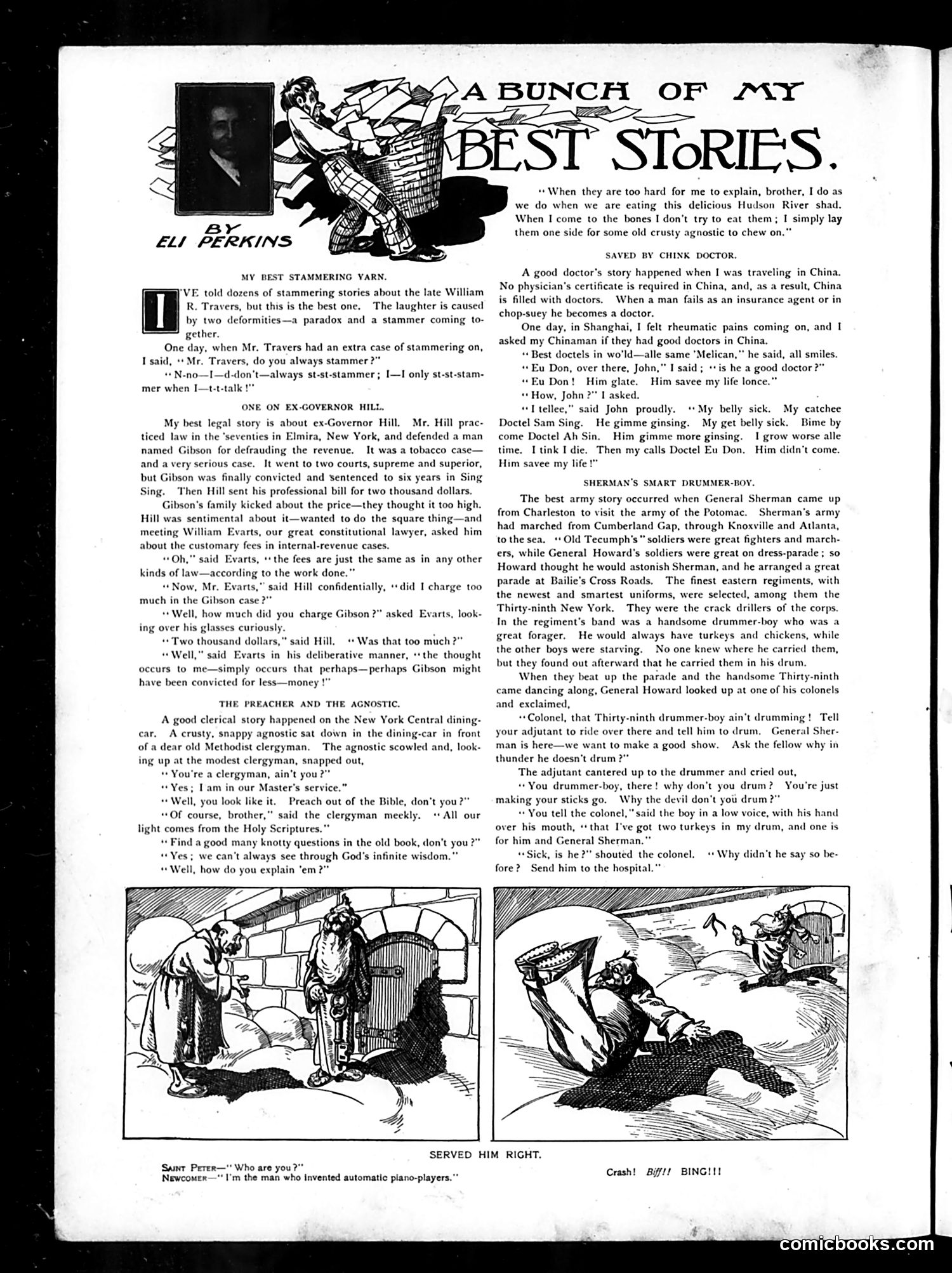
This page features **Eli Perkins**, a prominent 19th-century American humorist and lecturer, sharing four anecdotal stories in his characteristic style. The jokes rely on wordplay and social commentary: 1. **William R. Travers** anecdote: A stammerer's paradoxical statement that he only stammers "when I talk" — humor from self-contradiction. 2. **Ex-Governor Hill story**: Legal satire suggesting a tobacco fraud defendant might have been convicted for "less money" — mocking inflated lawyer fees and judicial corruption. 3. **Preacher vs. Agnostic**: Religious humor where the clergyman deflects difficult theological questions by comparing them to fish bones—implying skeptics can handle what believers cannot. This reflects 19th-century tensions between religious orthodoxy and agnosticism. 4. **China doctor anecdote**: Ethnic stereotype humor about Chinese medical practices and pidgin English, typical of period American attitudes toward Asian immigrants. The illustrations support two stories visually. These represent genteel American humor circa 1880s-1890s, mixing clever wordplay with class commentary and casual ethnic mockery now considered offensive.
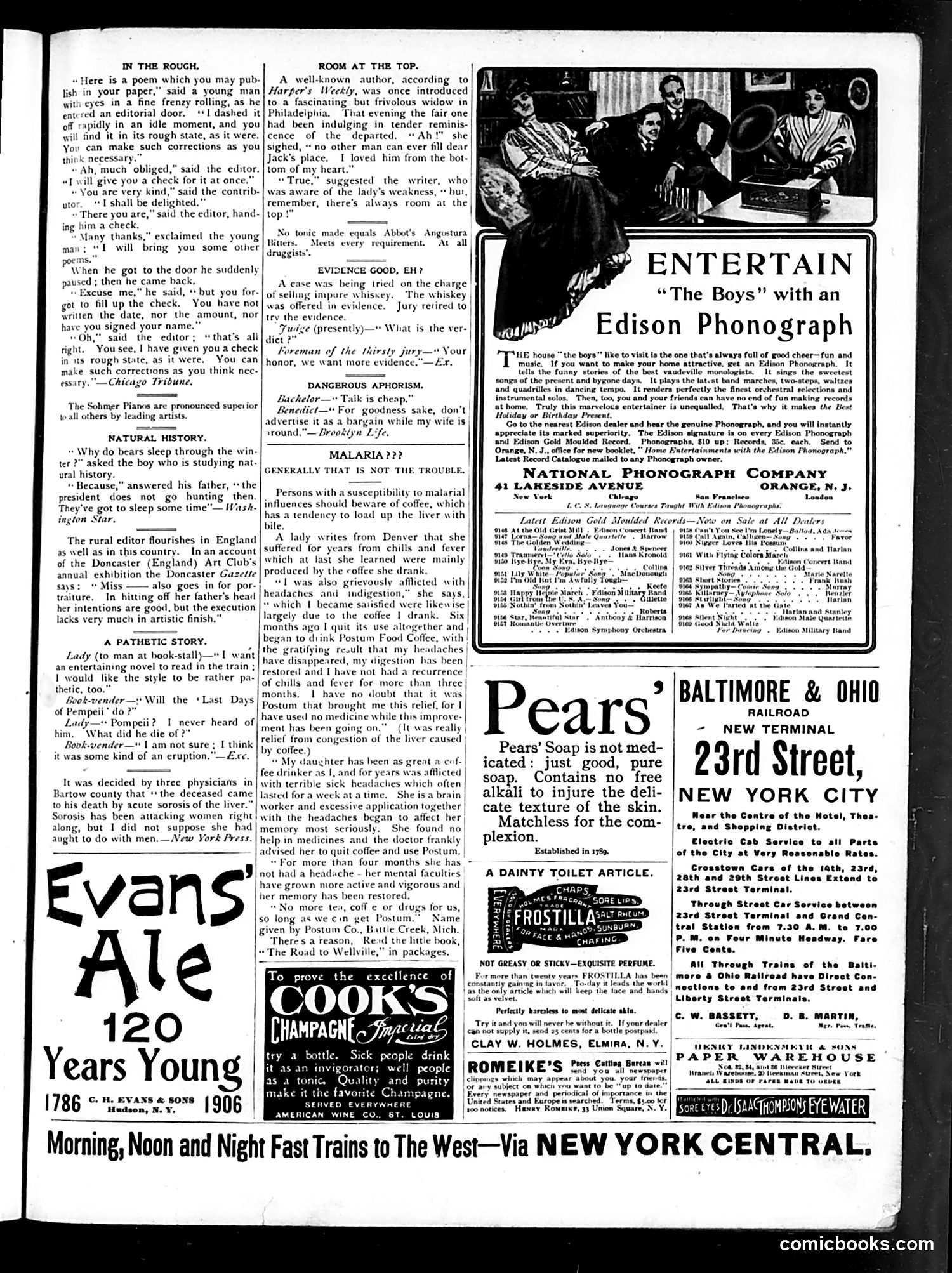
This is primarily an **advertising and humor page** from Judge magazine (circa 1906). The main content consists of brief satirical jokes and advertisements rather than political cartoons. The humor pieces include: - **"In the Rough"**: An editor tricks a naive poet by giving him a blank check, then uses the poet's own logic against him—claiming the check is "in rough state" needing corrections, mirroring the poet's earlier phrase about his unpolished poem. - **"Room at the Top"**: A widow mourning her dead husband is subtly propositioned by a writer who suggests there's always "room at the top"—a mildly risqué double entendre. - **"Evidence Good, Eh?"**: A jury trying a whiskey case requests "more evidence"—implying they want to taste-test the allegedly impure whiskey themselves. The page relies on wordplay and gentle social satire about human nature (greed, flirtation, deception) rather than political commentary. The heavy advertising (Evans Ale, Edison Phonographs, Pears' Soap, railroad services) indicates this was revenue-dependent content.
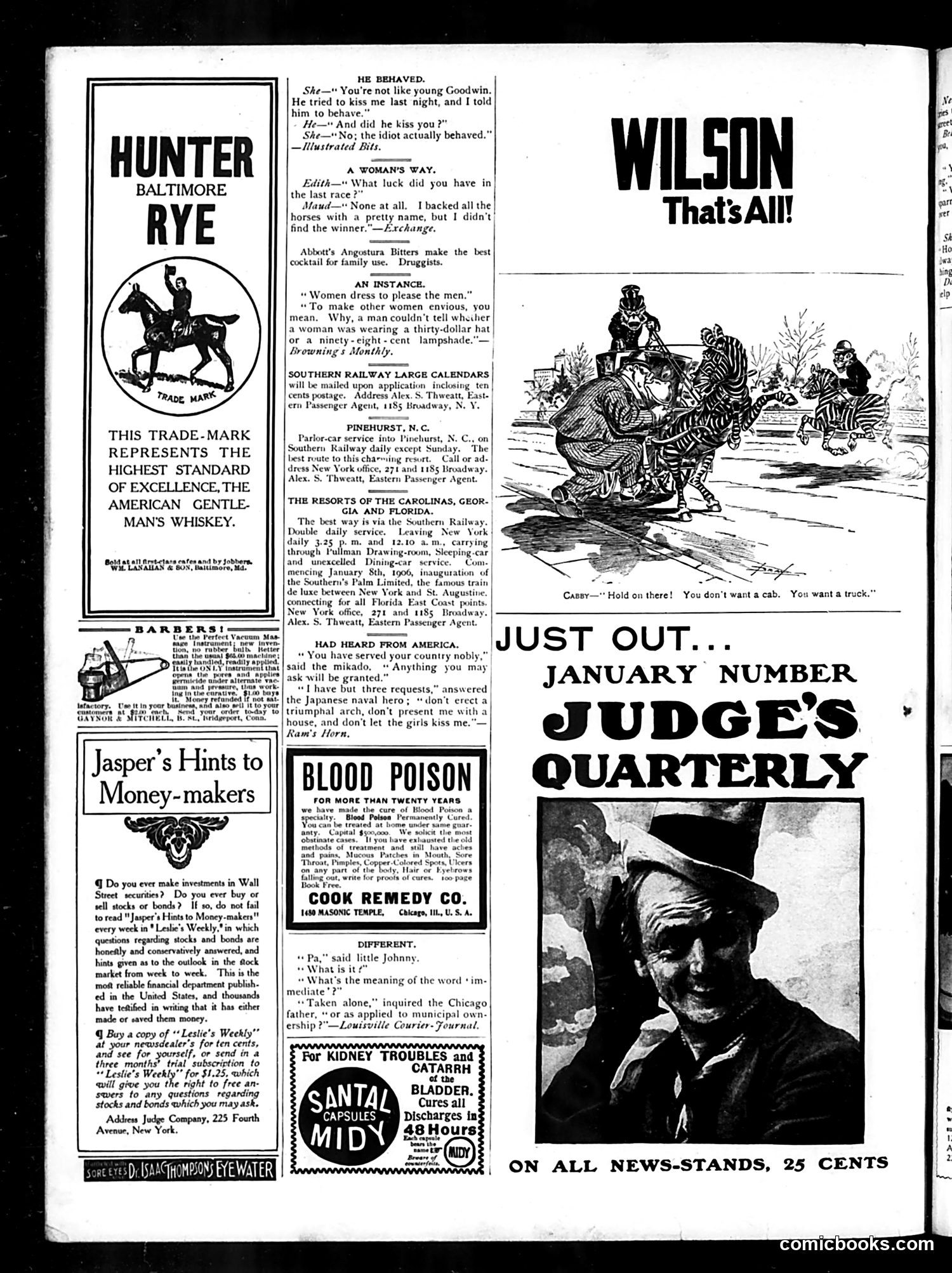
This is primarily an **advertising page** from Judge magazine's January issue, with minimal editorial content. The notable cartoon appears upper right: "Wilson—That's All!" depicts a figure (likely President Wilson, based on the caption) in a car with a woman, with the caption "Hold on there! You don't want a cab. You want a truck." The joke appears to be a sexual innuendo about the woman's weight or size—she needs a "truck" rather than a cab to transport her. The page consists mostly of **advertisements** for whiskey (Hunter Baltimore Rye), patent medicines (blood poison cure, kidney remedies), railroad travel packages, and financial advice columns. Several brief **joke items** appear in text, including tired vaudeville-style humor about courtship and gender relations typical of early-1900s publications. The content reflects Judge's role as a satirical magazine mixing light social commentary with commercial advertising, aimed at affluent male readers interested in stocks, travel, and consumer goods.
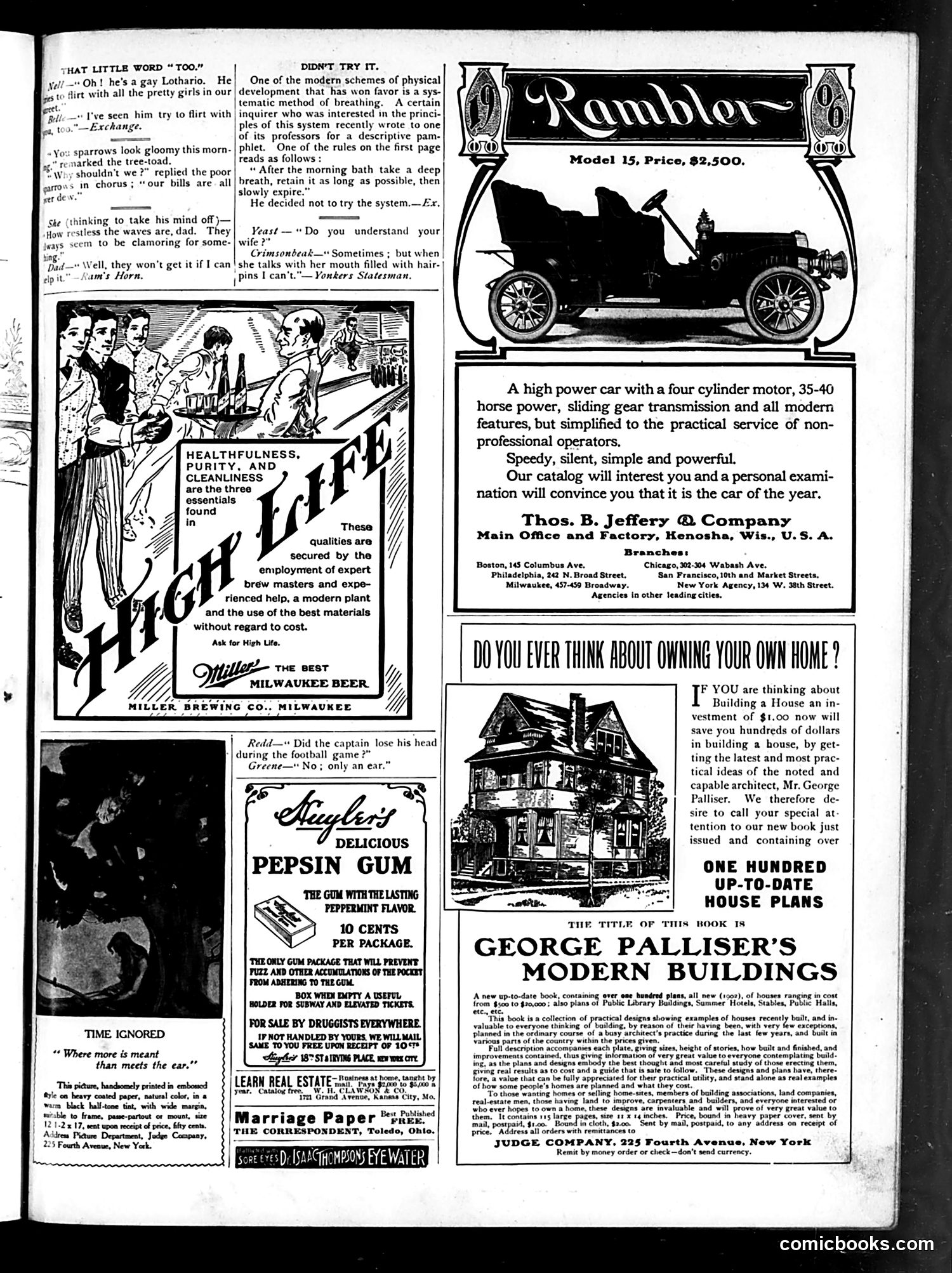
This page from *Judge* magazine (date unclear from image) contains several brief comedic vignettes rather than a single political cartoon. **The jokes satirize:** 1. **"That Little Word 'Too'"** – A series of quips poking fun at flirtation, melancholy birds, and restless waves—light domestic humor with no clear political target. 2. **"Didn't Try It"** – Mocks the early-1900s fad of "scientific" breathing exercises for physical development, suggesting the prescribed method was impractical or absurd enough to discourage actual trial. 3. **"Time Ignored"** – A wordplay joke referencing classical dramatic convention ("where more is meant than meets the ear"). 4. **The Crimsonbeak/Yeast exchange** – Domestic humor about marital incomprehension, specifically wives with hairpins in their mouths. The page is primarily **advertising**: Rambler automobiles, Miller beer, Pepsin gum, real estate instruction, and architect George Palliser's house-plan book dominate the layout. These ads reflect early-1900s consumer culture targeting middle-class homeowners and car buyers.
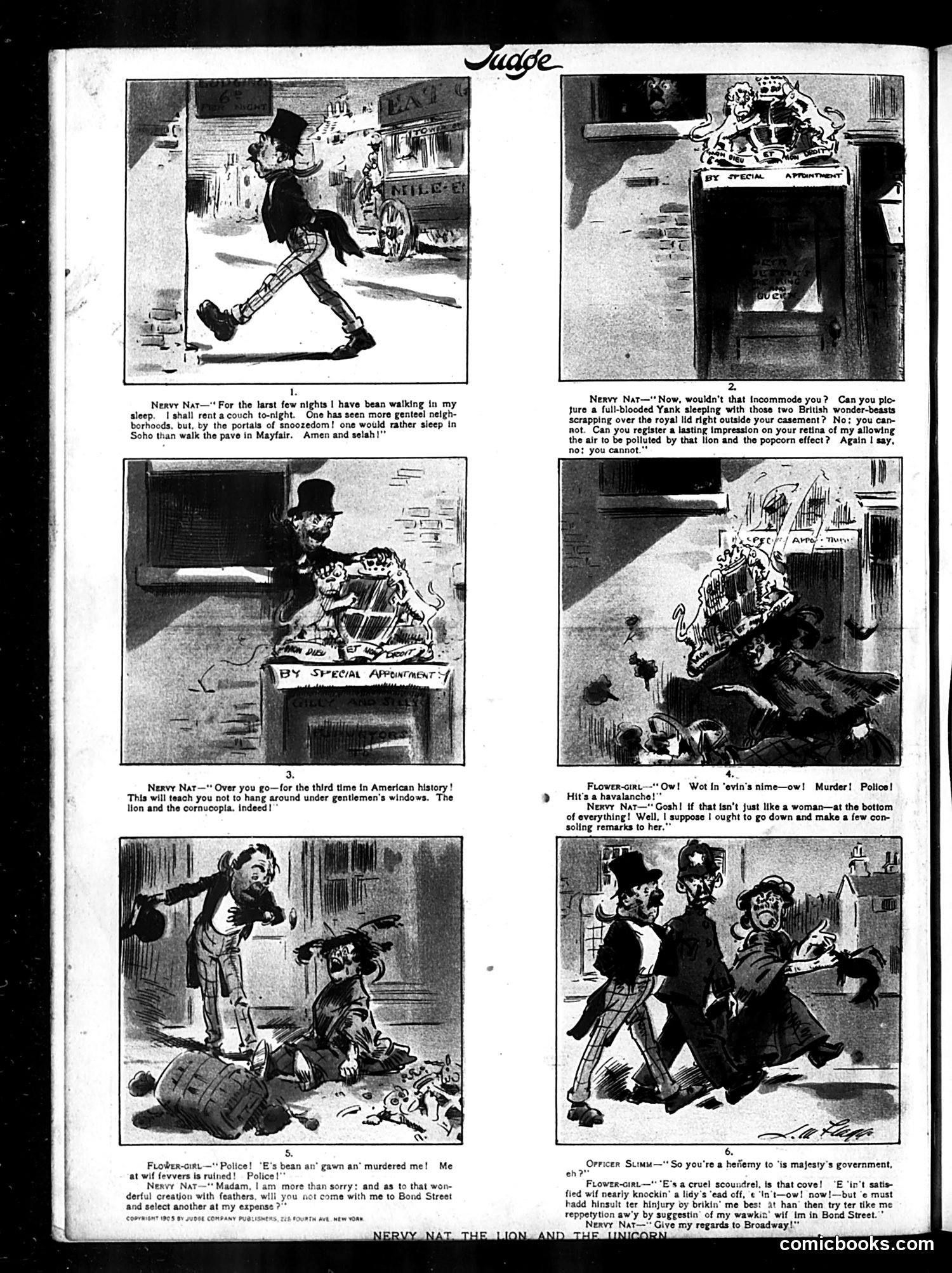
This six-panel satirical comic strip features "Nervy Nat," a character (likely British, given the accent and references) who encounters a lion and unicorn—symbols of the British Royal Coat of Arms. The humor derives from treating these heraldic symbols as literal animals causing chaos in London streets. The satire mocks both pompous British manners and the destruction these "royal" creatures cause. Nat sleepwalks through Mayfair, the lion attacks a flower seller's prized hat, and officers respond with absurd formality. The recurring joke: Nat apologizes graciously for the lion's mayhem while simultaneously dismissing the damage as merely annoying. The reference to "Broadway" in the final panel suggests either American tourism or mockery of American cultural attitudes. The working-class flower seller's dialect contrasts with Nat's refined speech, adding class commentary typical of Judge's satirical approach.