
Judge, 1906-01-06 · page 4 of 14
Judge — January 6, 1906 — page 4: what you’re looking at
What you’re looking at
This page contains three separate humorous pieces: 1. **"Handy"**: A joke about a mountain missionary's wife with many children whose husband is a jack-of-all-trades—a carpenter, lecturer, fortune teller, and book salesman. The humor relies on listing his various odd jobs. 2. **"At the Bookshop"**: Two men discuss a painting in a second-hand bookshop, debating whether it depicts "the greatest of the world in thought and action" or "the old school has lied sadly." The joke appears to involve disagreement about what a painting represents. 3. **"A John Bull and an Irish Bull"** with **"Judge's Favorites"**: A Irish railway notice joke about crossing when "under water the river is unpassable," followed by verses about "Mary" playing with contraries—typical Victorian wordplay humor. The satire is genteel and domestic rather than political.
📄 Transcribed text from this page (OCR, searchable)
Machine-transcribed from the original scan — historical spelling and the odd misread are preserved.
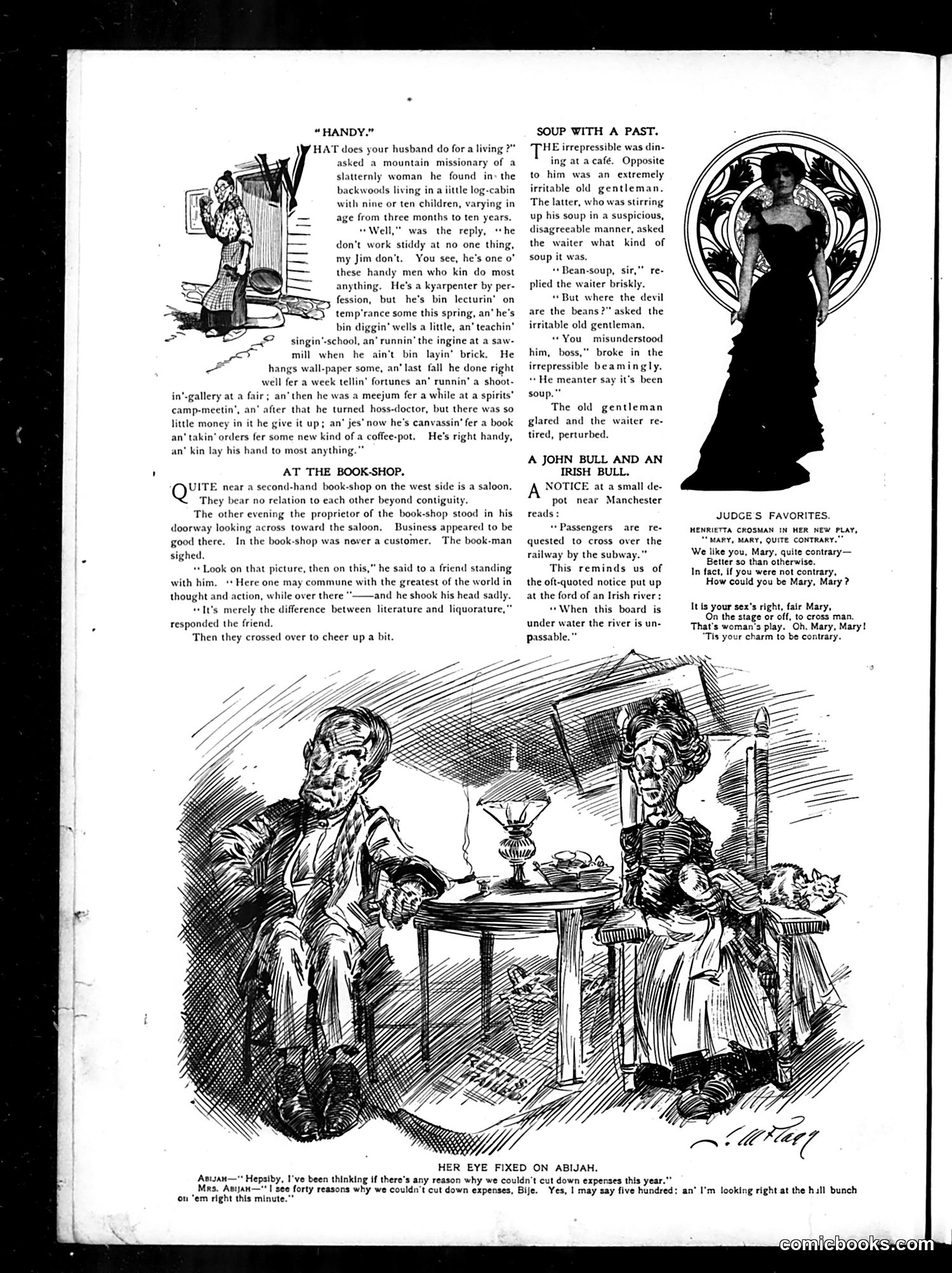
“HANDY.” HAT does your husband do fora living ?” asked a mountain missionary of a slatternly woman he found ins the backwoods living in a iittle log-cabin with nine or ten children, varying in age from three months to ten years. “Well,” was the reply, “he don't work stiddy at no one thing, my Jim don’t. You see, he’s one o° these handy men who kin do most anything. He's a kyarpenter by per- fession, but he's bin lecturin’ on temp'rance some this spring, an’ he’s bin diggin’ wells a little, an’ teachin’ singin‘-school, an’ runnin’ the ingine at a saw- mill when he ain't bin layin’ brick. He hangs wall-paper some, an’ last fall he done right well fer a week tellin’ fortunes an’ runnin’ a shoot- in'-gallery at a fair; an’ then he was a meejum fer awhile at a spirits’ camp-meetin’, an’ after that he turned hoss-loctor, but there was so little money in it he give it up; an’ jes’ now he’s canvassin’ fer a book an‘ takin’ orders fer some new kind of a coffee-pot. He's right handy, an’ kin lay his hand to most anything.” AT THE BOOK-SHOP. UITE near a second-hand book-shop on the west side is a saloon, They bear no relation to each other beyond contiguity. The other evening the proprietor of the book-shop stood in his doorway looking across toward the saloon, Business appeared to be good there. In the book-shop was never a customer. The book-man sighed. ++ Look on that picture, then on this," he said to a friend standing with him. ‘+ Here one may commune with the greatest of the world in thought and action, while over there "——and he shook his head sadly. ‘It's merely the difference between literature and liquorature,” responded the friend. ‘Then they crossed over to cheer up a bit. SS) SOUP WITH A PAST. THE irrepressible was din- ing at acafé. Opposite to him was an extremely irritable old gentleman. The latter, who was stirring up his soup in a suspicious, disagreeable manner, asked the waiter what kind of soup it was. “Bean-soup, si plied the waiter briskly. “But where the devil are the beans?” asked the irritable old gentleman. “You misunderstood him, boss,” broke in. the irrepressible beamingly. + He meanter say it’s been soup." The old gentleman glared and the waiter re- tired, perturbed. A JOHN BULL AND AN IRISH BULL. A NOTICE at a small de- pot near Manchester reads: “Passengers are re- quested to cross over the railway by the subway.” This reminds us of the oft-quoted notice put up at the ford of an Irish river: “When this board is under water the river is un- passable.” SESS SSS HER EYE FIXED ON ABIJAH. Anisan—" Hepsiby, I've been thinking if there's any reason why we couldn't cut down expenses this year." Mrs. Anijan—"'I see forty reasons why we couldn't cut down expenses, Bije. Yes, 1 may say five hundred: on ‘em right this minute.”” JUDGE'S FAVORITES. MENRIETTA CROSMAN IN HER NEW PLAY, “MARY, MARY, QUITE CONTRARY.” We like you, Mary, quite contrary— Better so than otherwise. In fact, if you were not contrary, How could you be Mary, Mary ? It is your sex’s right, fair Mary, On the stage or off, to cross man. That's woman's play. ‘Oh. Mary, Mary! “Tis your charm to be contrary. pe arly I'm looking right at the hull bunch