
A complete issue · 17 pages · 1905
Judge — December 30, 1905
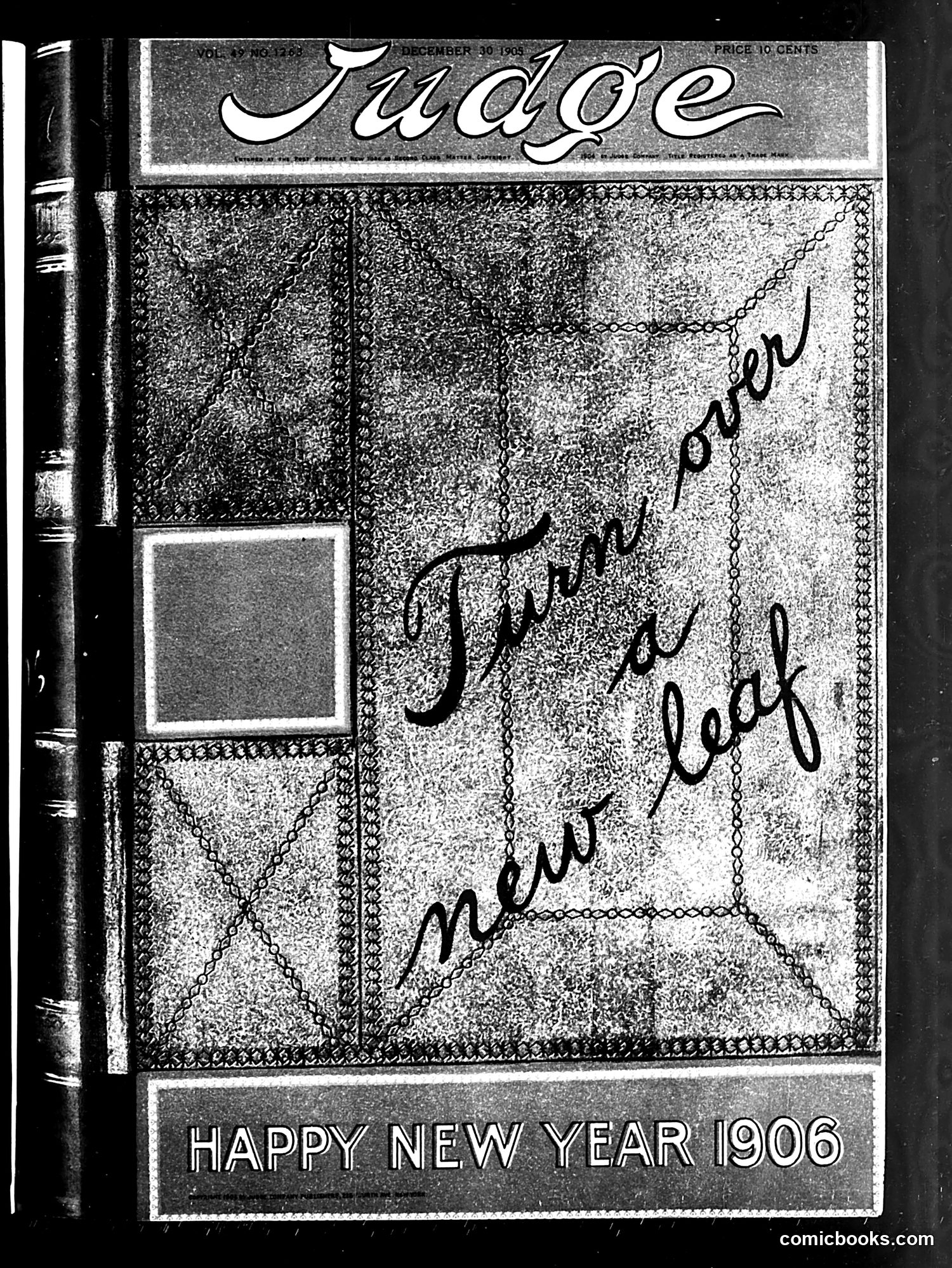
This is a *Judge* magazine cover from December 30, 1905 (priced at 10 cents). The cover is primarily a **New Year's greeting card** rather than political satire. The image shows an open door or window with decorative lattice work and what appears to be a blank space (likely for an illustration or photograph that didn't reproduce clearly in this scan). The handwritten text reads "Turn over a new leaf!" — a common New Year's expression meaning to start fresh or reform one's behavior. The bottom text reads "HAPPY NEW YEAR 1906," confirming this is celebratory holiday content rather than commentary on specific political figures or events. This appears to be a decorative cover design suited for the magazine's year-end issue.
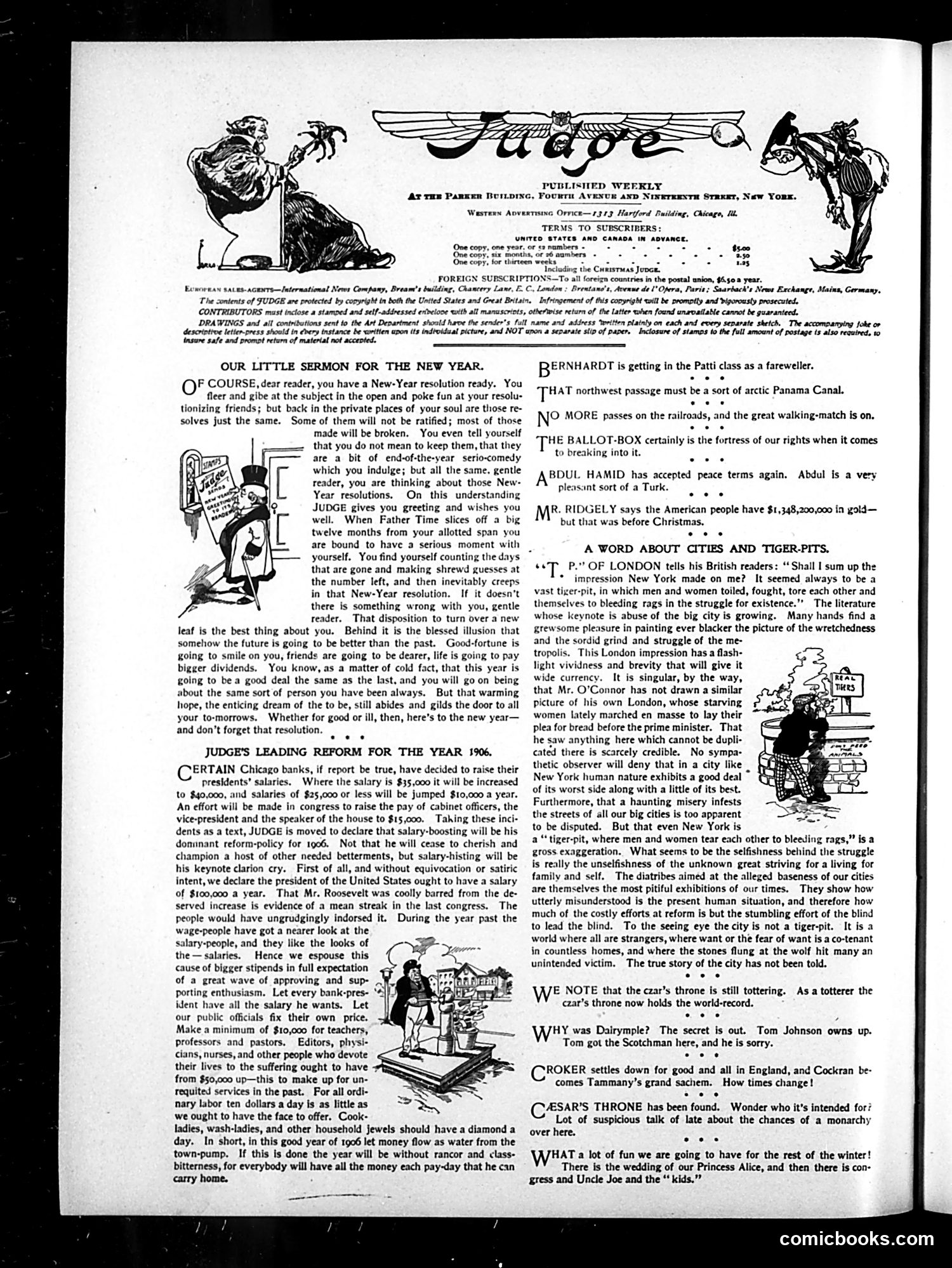
This is primarily a **satirical commentary page** rather than political cartoons. The main content includes: 1. **"Our Little Sermon for the New Year"** - A moralistic essay mocking New Year's resolutions, suggesting people make and break them annually with no real change. 2. **"Hinges Leading Reform for the Year 1906"** - Satirizes Chicago politicians and labor reforms, critiquing wage increases and workplace improvements as insufficient and performative. 3. **"A Word About Cities and Tiger-Pits"** - Compares New York to a dangerous "tiger-pit," criticizing urban poverty and vice while defending the city's complexity against simplistic moral judgments. The decorative illustrations show generic figures engaged in everyday activities rather than specific political caricatures. The overall tone is cynical about reform efforts and human nature.
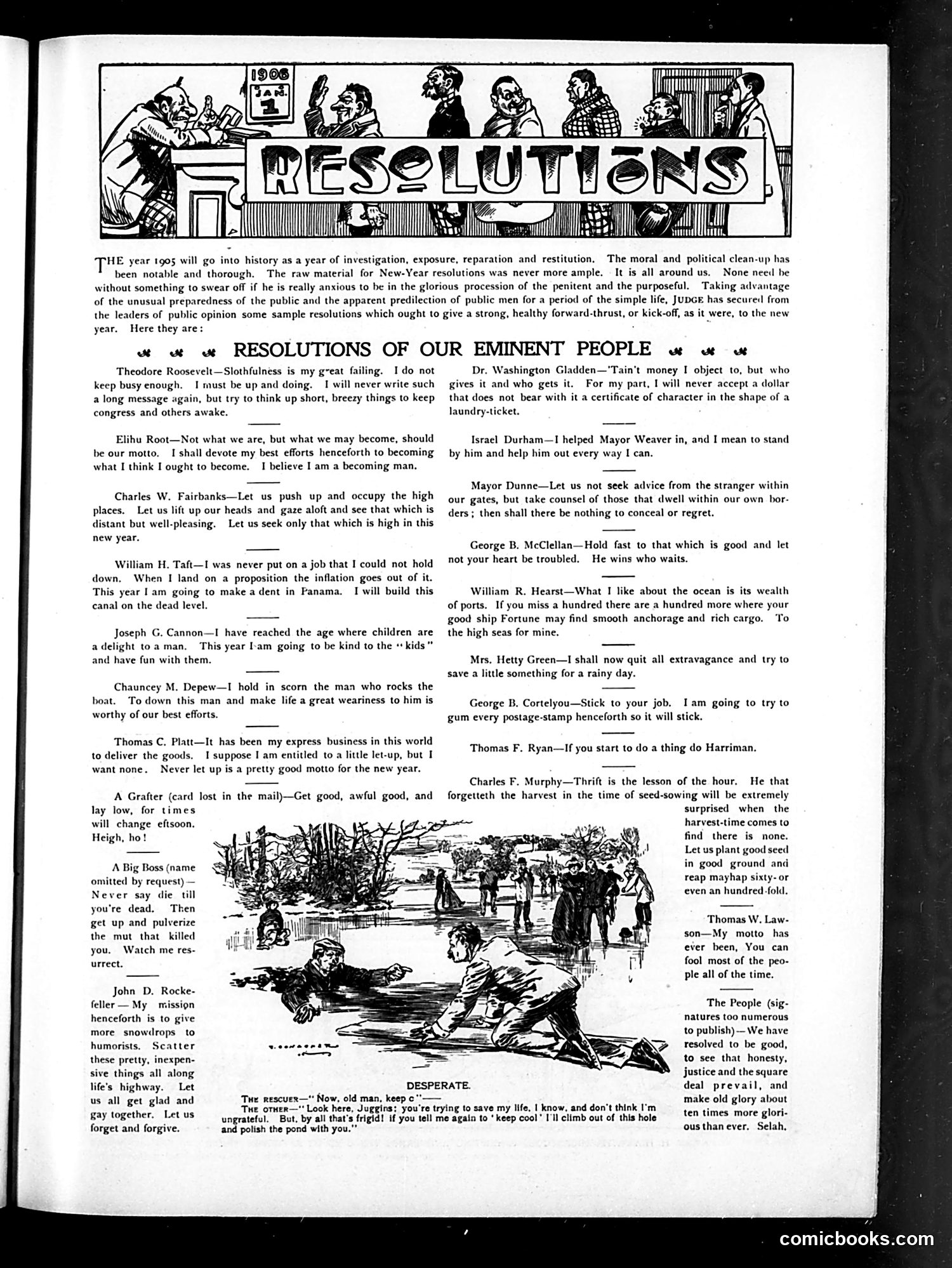
This page presents satirical "New Year's Resolutions" from prominent public figures of 1905. The format mocks the practice of New Year's pledges by having famous politicians and businessmen make self-aware, often contradictory commitments. Notable figures include Theodore Roosevelt (admitting "slothfulness"), William H. Taft (promising to make a canal in Panama), and Charles W. Fairbanks. The humor lies in each resolution revealing the figure's known flaws, ambitions, or controversies—presented as if they're reforming themselves, which readers would recognize as unlikely. The central illustration shows a "Desperate" rescue scene, likely a separate editorial cartoon commenting on contemporary crisis or crisis-response. Overall, the page uses irony to satirize the hypocrisy of public figures' stated intentions versus their actual behavior.
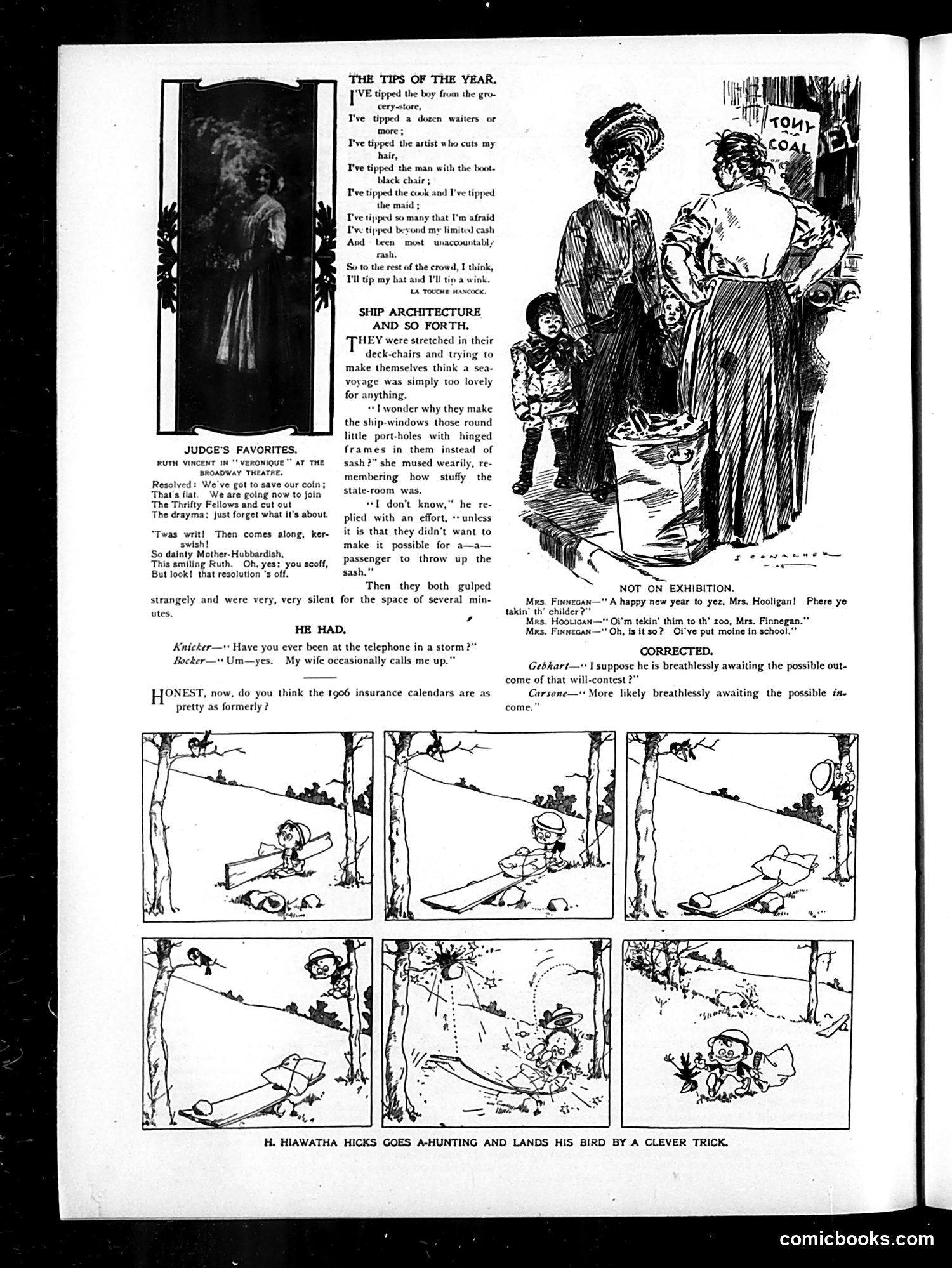
This page contains several unrelated sections typical of Judge's format: **"The Tips of the Year"** and **"Ship Architecture and So Forth"** are humorous prose pieces with no clear political content—they appear to be general comedy bits about social mishaps and naval design. **"Judge's Favorites"** shows a portrait illustration, likely of a notable public figure, though the caption is unclear in the OCR. **"Not on Exhibition"** depicts a domestic scene with women and children, apparently satirizing class pretensions or social climbing through references to "holigans" and school attendance. The bottom section, **"H. Hiawatha Hicks Goes A-Hunting and Lands His Bird by a Clever Trick,"** is a six-panel comic strip showing slapstick hunting humor with no apparent political message. Without clearer captions or context, most political references remain obscure to modern readers.
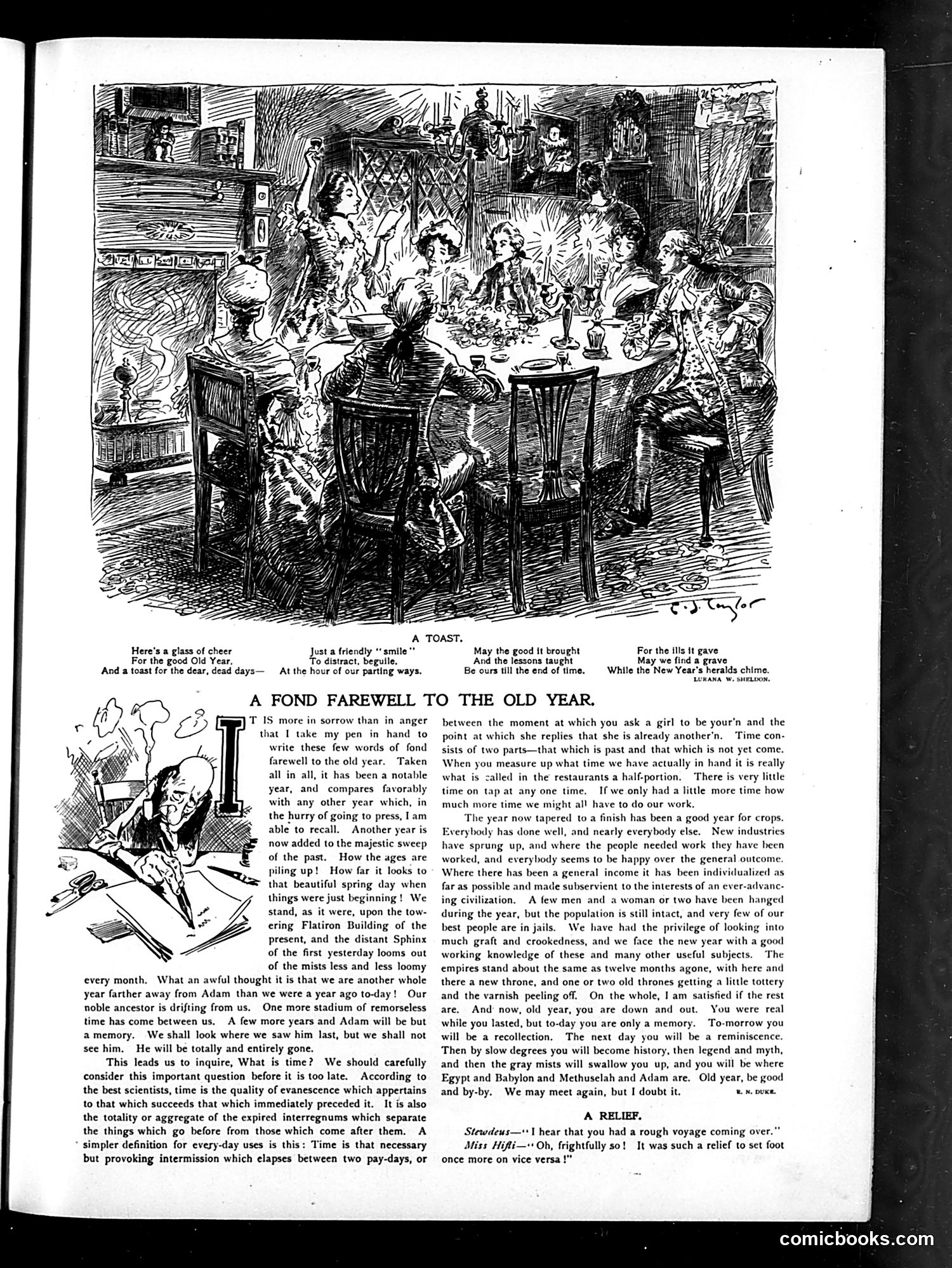
**"A Toast"** (top illustration): Shows a New Year's Eve celebration with well-dressed figures gathered around a table, raising glasses. The poem beneath celebrates the passing year and toasts to new beginnings—a typical seasonal sentiment. **"A Fond Farewell to the Old Year"** (main article): The text reflects on the departing year, noting it brought both good crops and social problems (crime, corruption, executions). The author philosophically considers the nature of time itself, questioning whether we truly progress year to year or merely repeat cycles. **"A Relief"** (bottom joke): A brief exchange where someone describes a rough voyage ending, providing comic relief after the heavier philosophical meditation above. The overall page is New Year's themed commentary—typical Judge fare mixing sentiment with social observation.
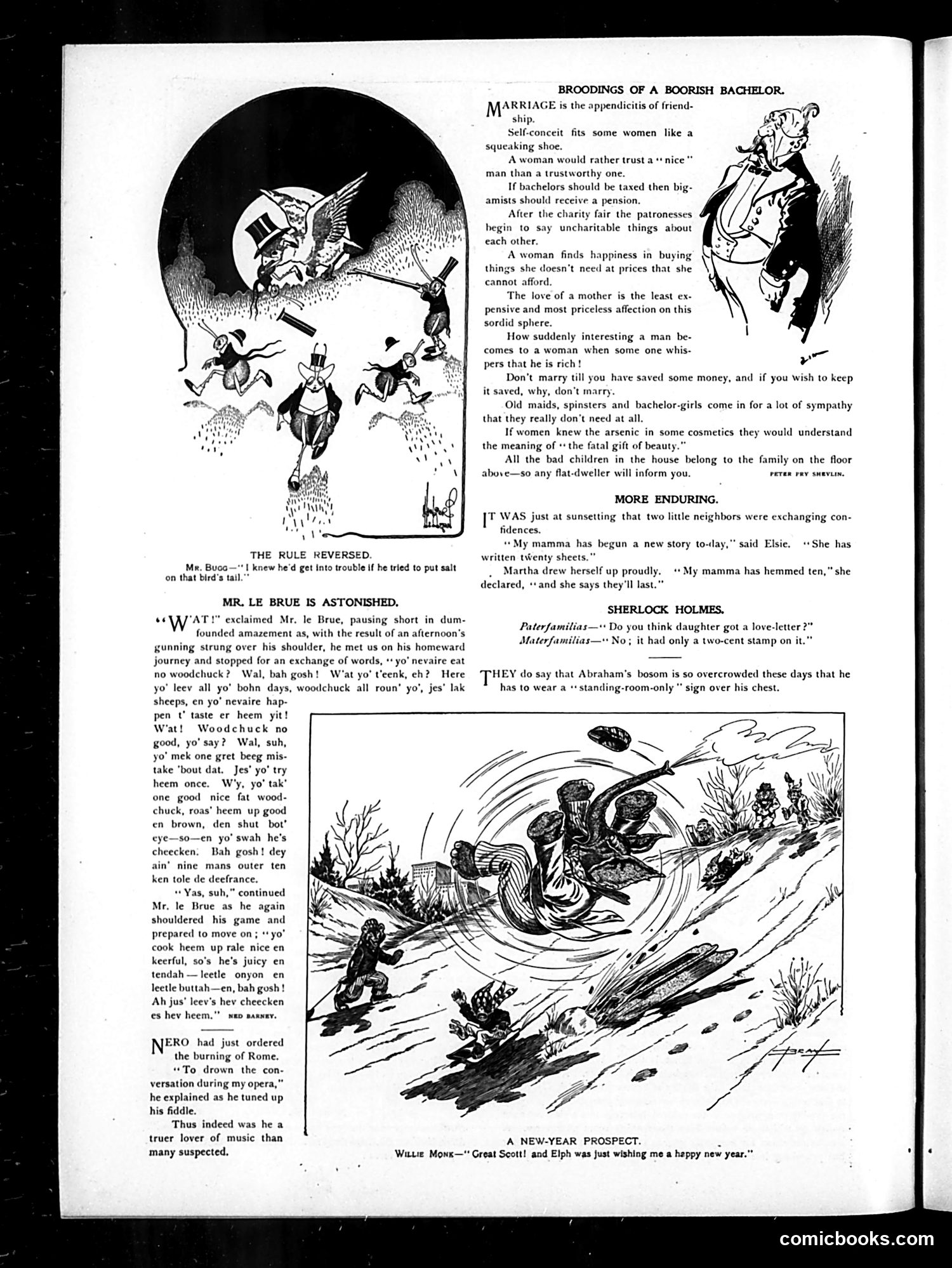
This page contains several satirical pieces from *Judge* magazine: **"The Rule Reversed"** and **"Mr. Le Brue is Astonished"** feature a French-accented character (stereotypical dialect humor common to the era) discussing hunting and cooking woodchuck, which he humorously claims tastes like chicken—a joke about culinary deception. **"Broodings of a Boorish Bachelor"** is a series of misogynistic aphorisms mocking women, marriage, and single women—typical of early 20th-century men's magazine humor that portrayed women as vain, materialistic, or pitiable. **"More Enduring"** jokes about mothers' productivity: one child's mother wrote twenty pages; another's completed ten pieces of hemming—implying domestic work is "enduring." **"Sherlock Holmes"** quips that a man's bosom is "overcrowded" with children and needs standing-room signage—joking about large families. **"A New-Year Prospect"** shows a humorous misunderstanding about a letter's cost. The page reflects era-typical attitudes: ethnic caricature, domestic satire, and anti-feminist humor.
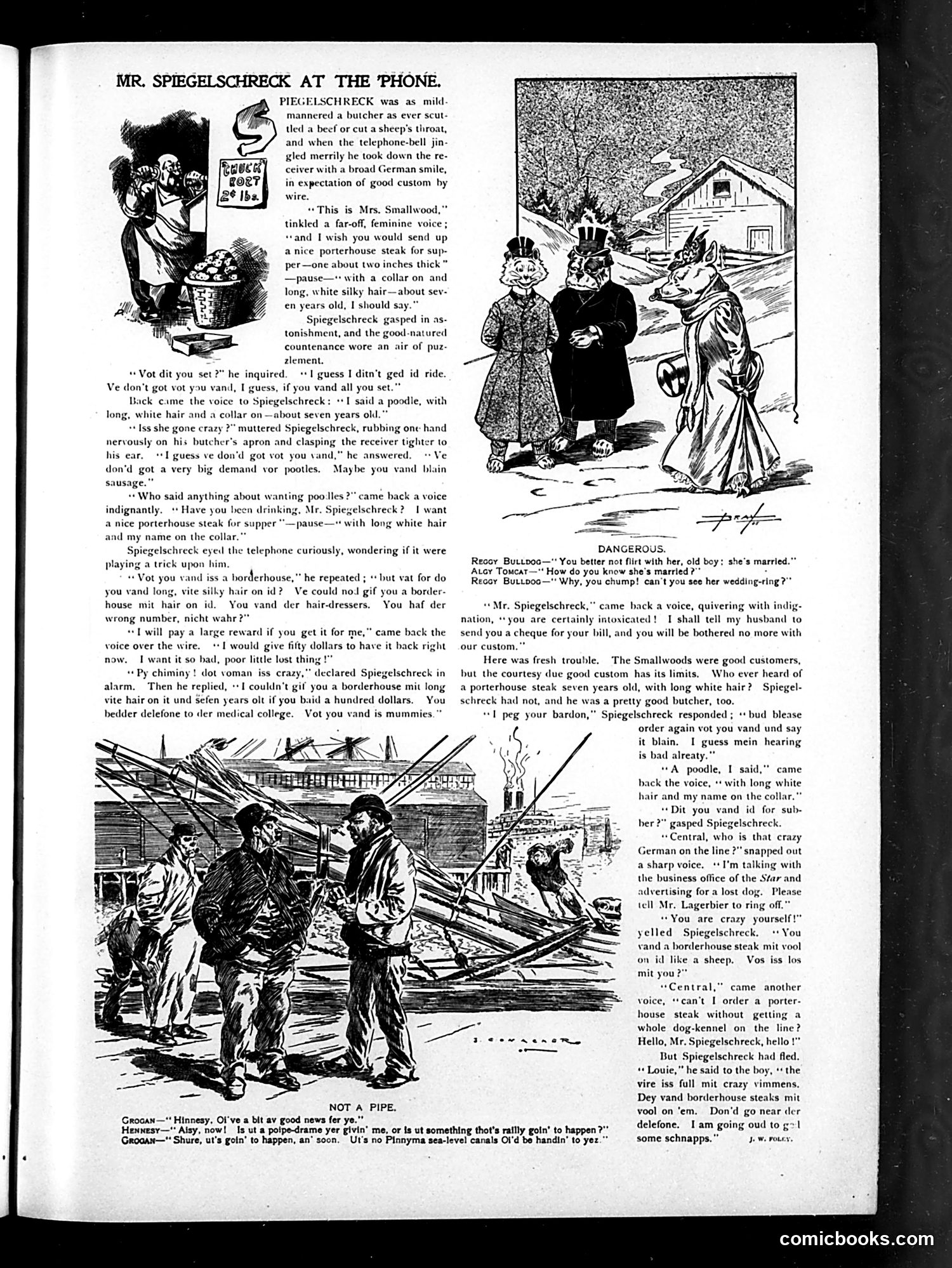
This satirical story mocks German immigrants through an ethnic stereotype character. Spiegelschreck, a butcher with heavy German dialect, receives a phone call from Mrs. Smallwood requesting a "porterhouse steak" with "long, white silky hair—about seven years old." She's actually describing her lost poodle dog, but Spiegelschreck—speaking in exaggerated German-accented English ("Vot dit you set?")—cannot understand, repeatedly insisting he doesn't sell such items and suggesting she contact a medical college instead. The humor targets both the immigrant's linguistic confusion and the absurdity of Mrs. Smallwood's misdirected call. The satire also gently mocks upper-class American customers for their disconnection from reality. When Smallwood angrily accuses Spiegelschreck of drunkenness and threatens to withdraw her business, he remains bewildered, reinforcing the stereotype of the confused immigrant businessman.
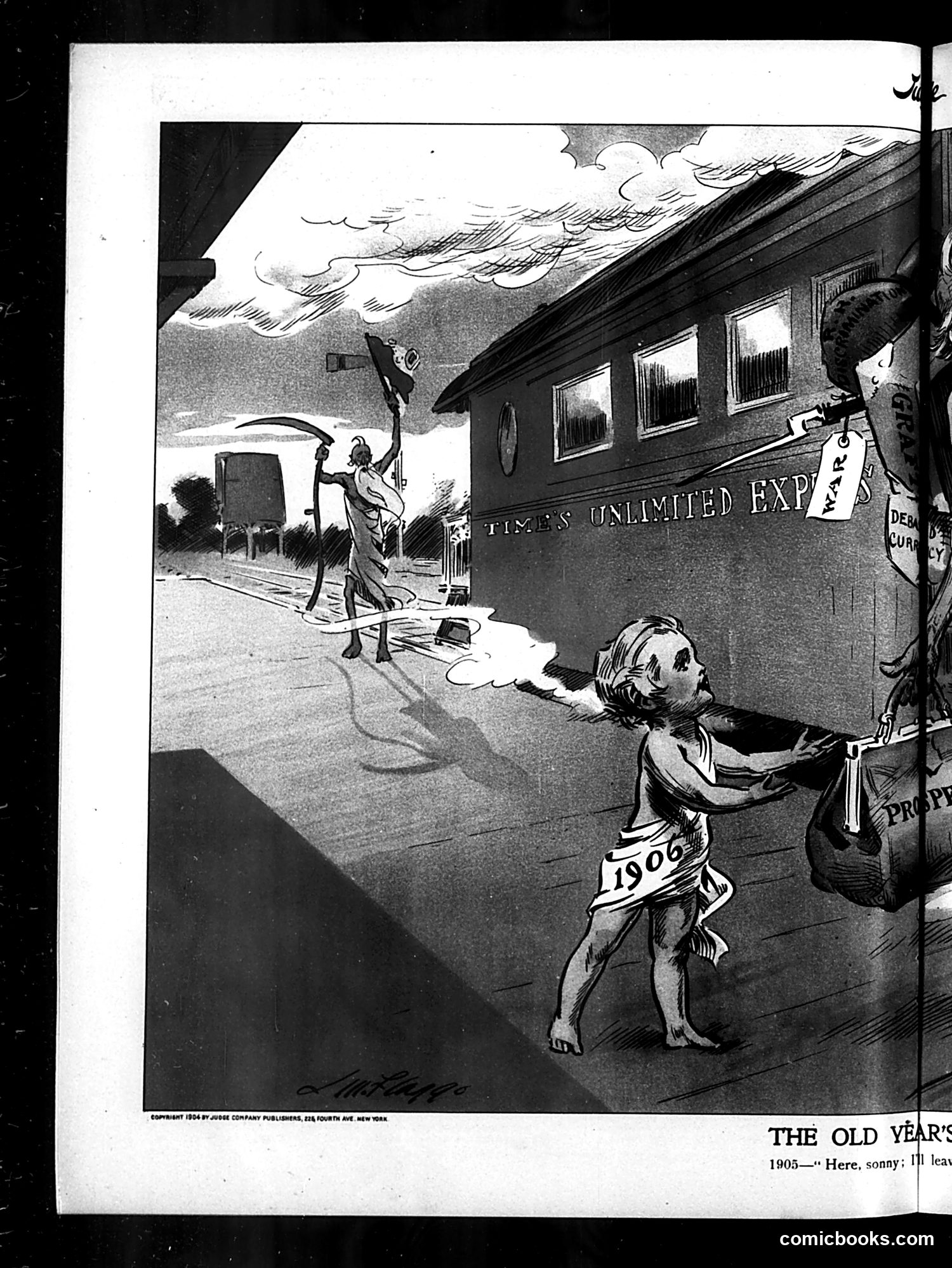
This is a New Year's themed satirical cartoon from *Judge* magazine, copyright 1904. It depicts the symbolic transition between years: a cherub or putto labeled "1906" (visible on its body) stands outside a building marked "Times Unlimited Exp[ress]," watching as the old year (1905) departs. A figure in classical dress appears to be leaving or being ejected from the structure, while others gesture from within. The cartoon plays on the common Victorian tradition of personifying years as characters—the outgoing year as an aging figure and the incoming year as an infant or child. The "Times Unlimited Express" building suggests time's unstoppable forward motion. The exact satirical point regarding specific 1905 events remains unclear without fuller context, but the overall message celebrates the passage from one year to the next.
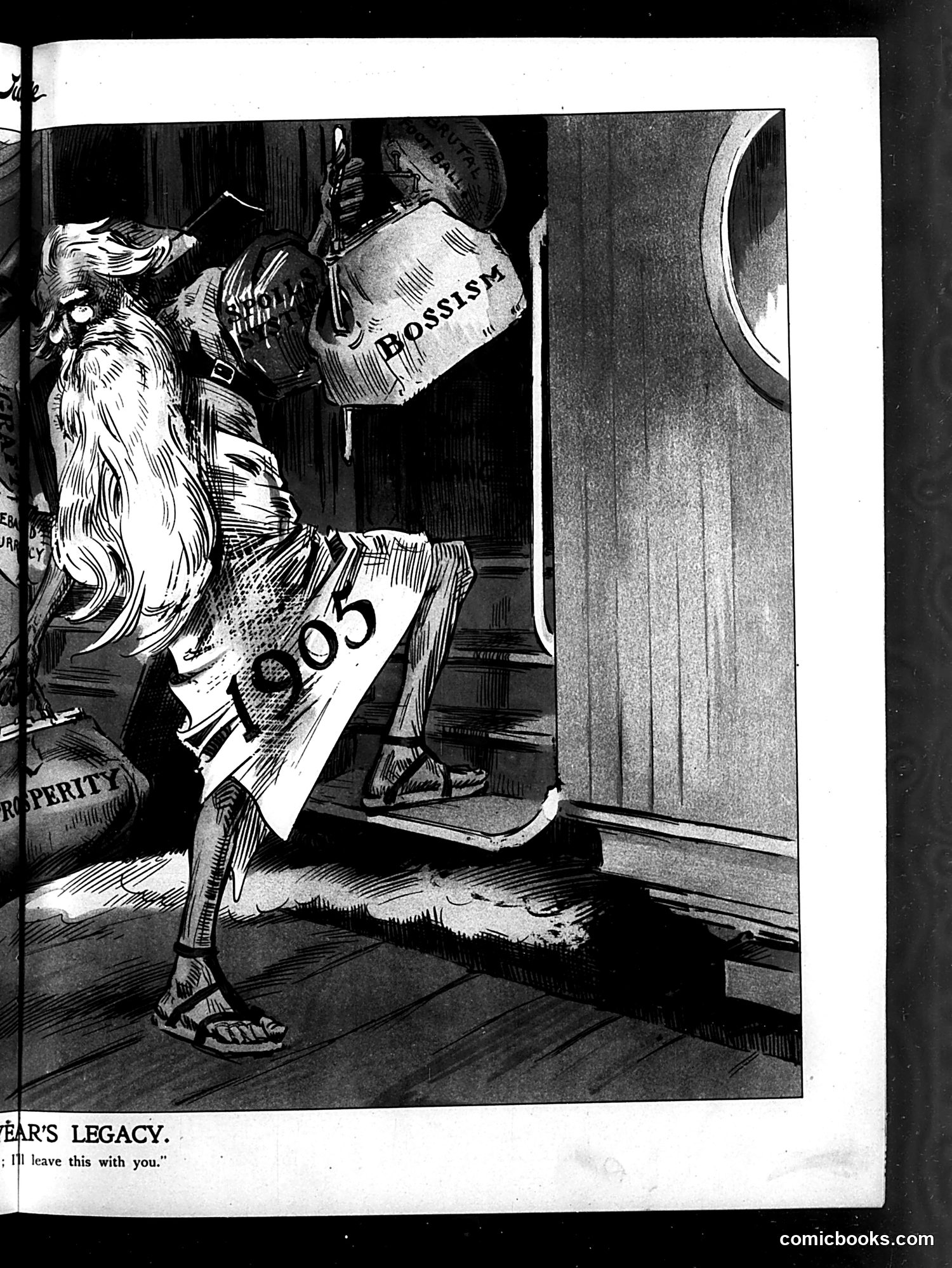
This political cartoon depicts a menacing, armored militaristic figure (labeled "Bossism") attempting to enter through a doorway, while a bearded man in civilian clothes blocks the entrance. The figure carries a large sack marked "1905" and holds what appears to be propaganda material labeled "Bossism." The cartoon satirizes political corruption and "bossism"—the control of politics by powerful party bosses—as a dangerous legacy being passed into the new year. The civilian defender represents honest government or democratic resistance. The 1905 date suggests this cartoon comments on corrupt political machines continuing their influence into a new calendar year. The satire warns against allowing such corrupting forces to establish themselves, framing bossism as an unwanted intruder rather than legitimate governance.
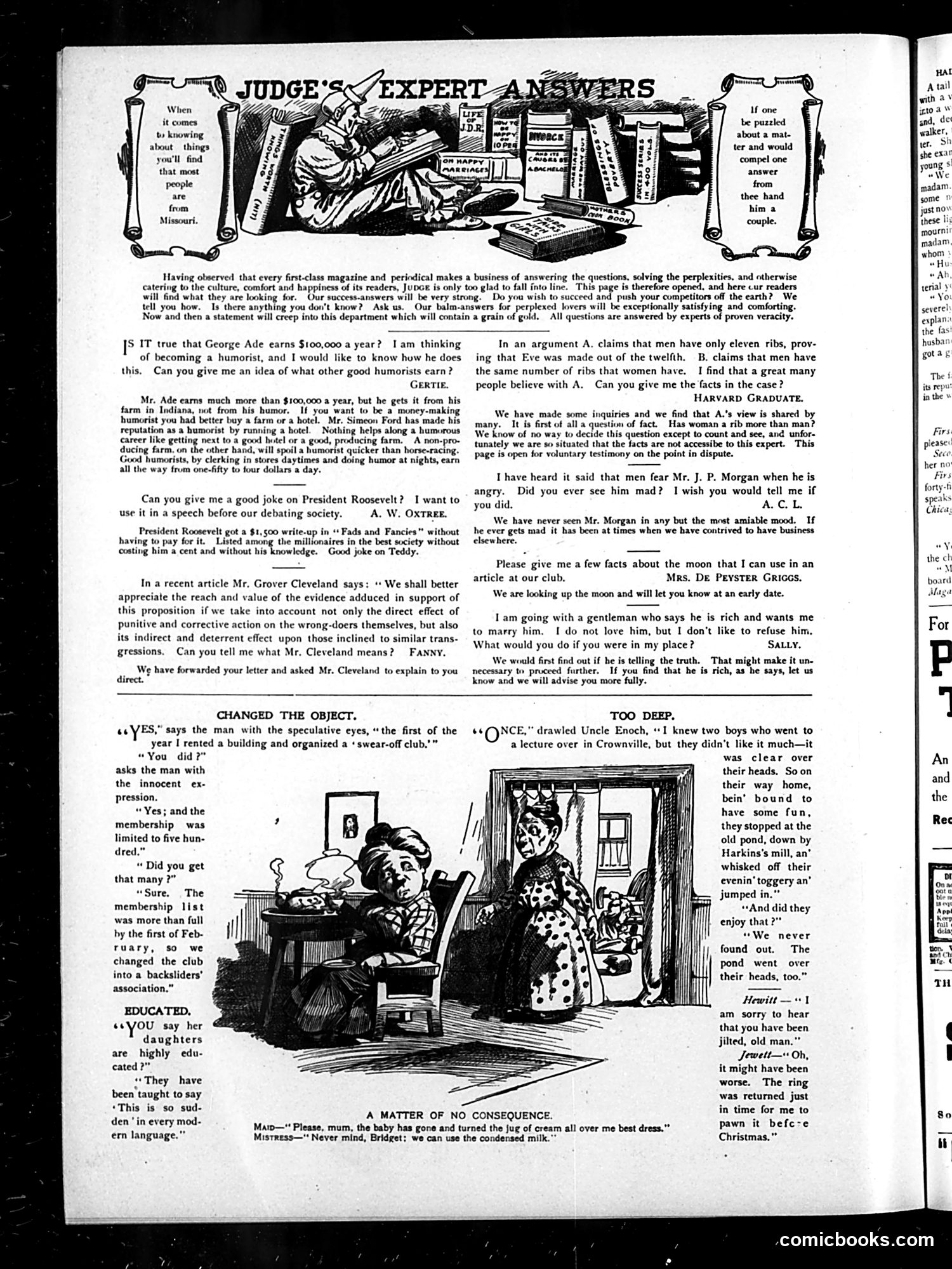
This page parodies the era's popular advice columns, presenting humorous "expert" answers to reader questions. The satire mocks both the questions and Judge's fake expertise. **Key references:** - **George Ade**: A real humorist/writer of the period; the joke is that his wealth comes from farm ownership, not humor writing - **President Roosevelt**: Readers asking for jokes about the current president (likely Theodore Roosevelt) - **J.P. Morgan**: The famous banker/industrialist, humorously portrayed as so intimidating that the magazine claims avoiding him when he's angry - **Grover Cleveland**: A former president whose recent article is quoted; they jokingly defer explanation to Cleveland himself **The satire:** Judge ridicules the earnest self-help culture by offering deliberately unhelpful, circular, or evasive answers—admitting ignorance about the moon, refusing to count ribs, and claiming inability to explain Cleveland's own writing. The cartoon illustrations show the absurdity of seeking worldly advice from "experts."
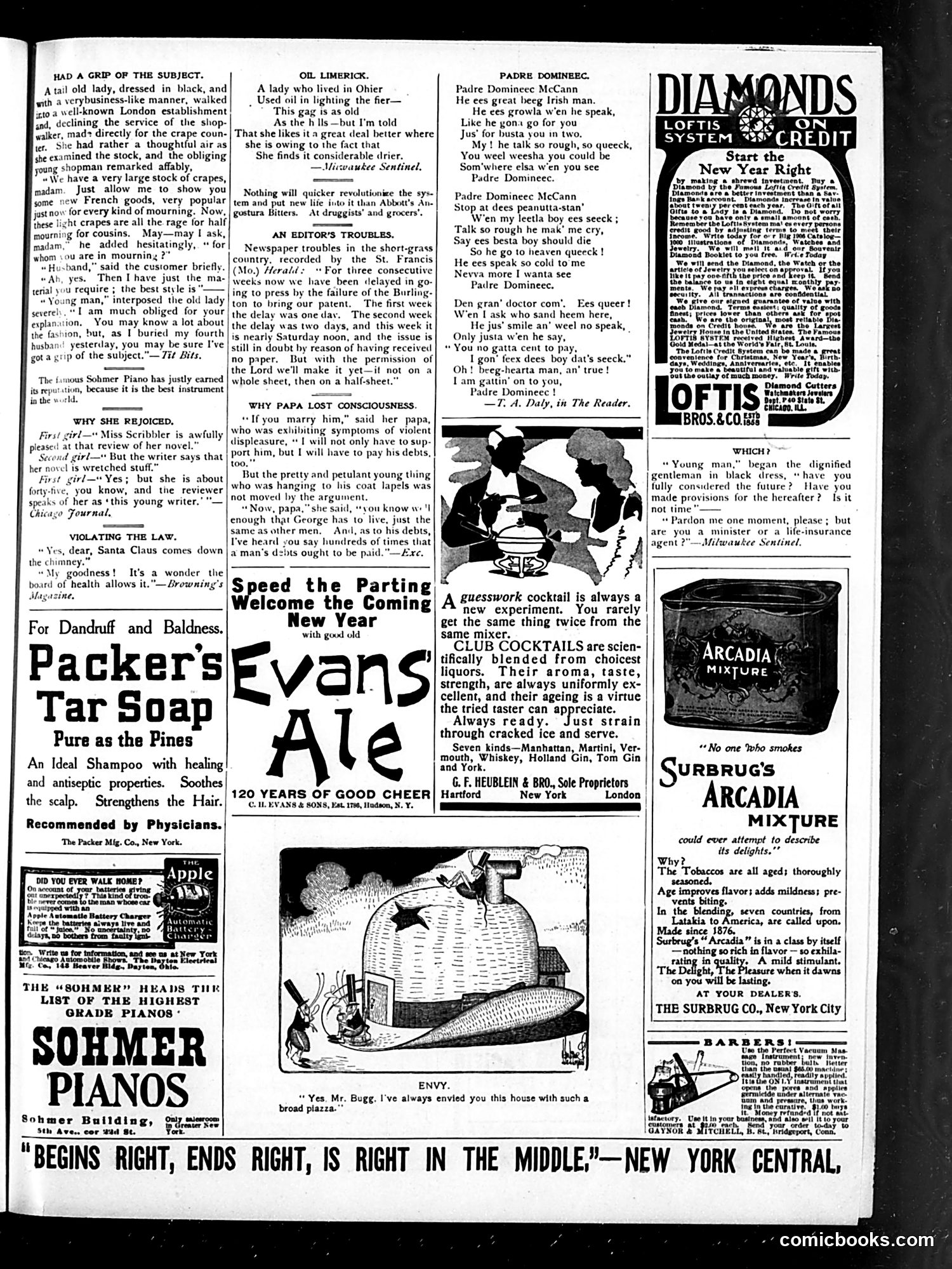
This page from *Judge* magazine contains several short humorous pieces typical of early 20th-century American satirical publications: **The cartoons/jokes** include: - "Had a Grip of the Subject": A widow buying excessive mourning crape, revealing she's buried four husbands—social commentary on serial marriage or widowhood - "Why Papa Lost Consciousness": A father fainting when his daughter announces marriage to a poor man with debts, satirizing class anxiety and paternal authority - "Why Papa Lost Consciousness" (second piece): A daughter manipulating her father by quoting his own words about paying debts back to him **The satirical targets** are middle-class domestic anxieties: marriage prospects, financial responsibility, and generational conflict. **The remaining content** is primarily **advertisements** for products like Parker's Tar Soap, Sohmer Pianos, Evans Ale, and Surbrugís Arcadia tobacco mixture—typical commercial filler for magazines of this era. The page reflects *Judge*'s focus on quick, domestic humor rather than political satire.
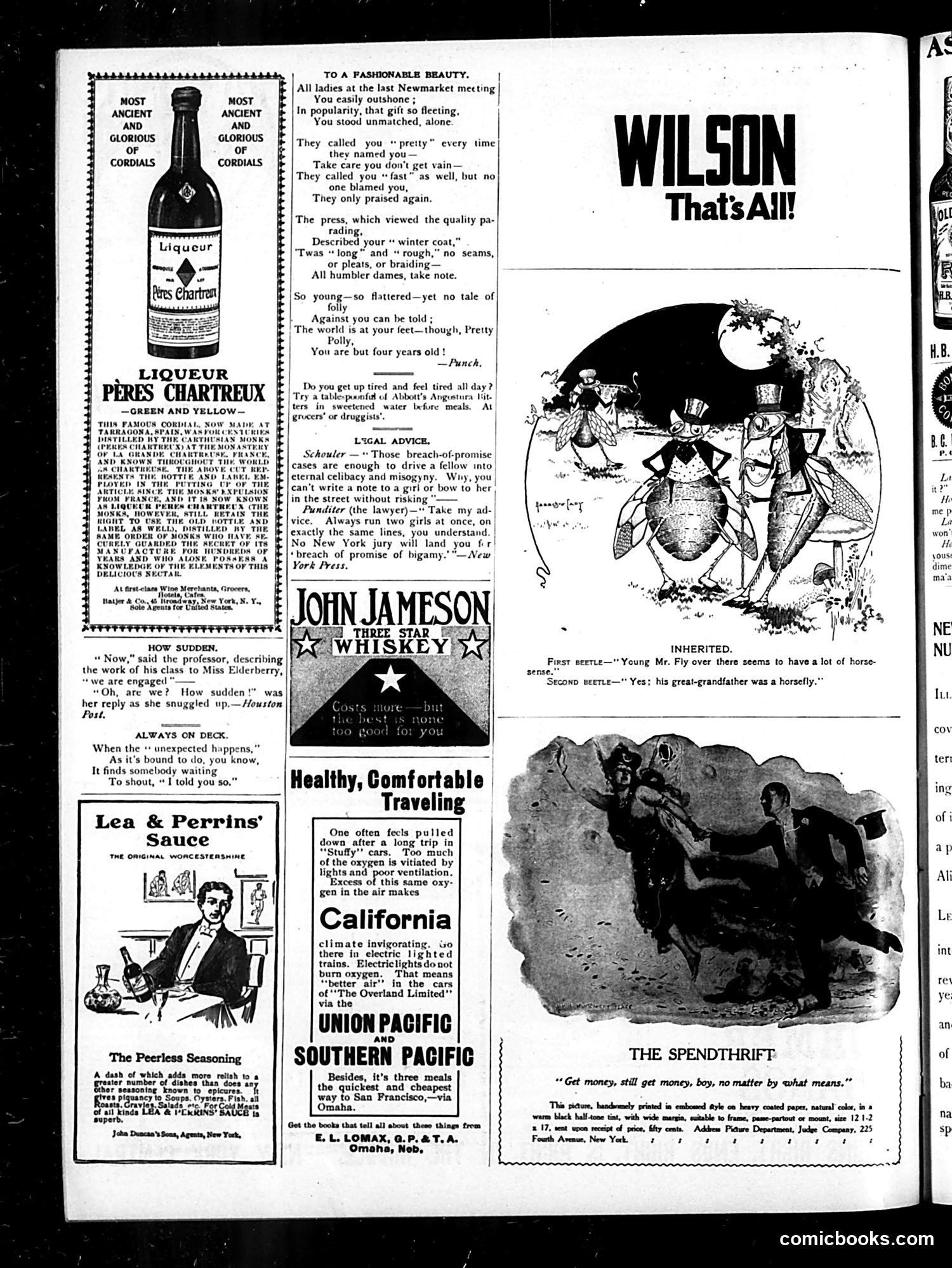
This page contains primarily **advertisements and light humor pieces** rather than political satire. The main content includes: **"To a Fashionable Beauty"** — A satirical poem mocking a young society woman ("Pretty Polly") who has achieved fame and admiration at just four years old. The joke targets the shallow vanity of upper-class social circles, where even children are celebrated for appearance and fashion rather than substance. **Legal humor** — A brief joke about breach-of-promise lawsuits, where a lawyer cynically advises running "two girls at once" on identical terms to avoid prosecution—satirizing both the prevalence of such suits and legal duplicity. **"Inherited"** — A caption joke about a young fly inheriting his great-grandfather's horseplay/foolishness, playing on the word "horse-sense." **The Spendthrift** — An illustration (caption visible) critiquing reckless spending habits. The page is primarily filled with **period advertisements** for liqueurs, sauces, whiskey, and railroad travel—typical Judge magazine content mixing commerce with light social commentary.
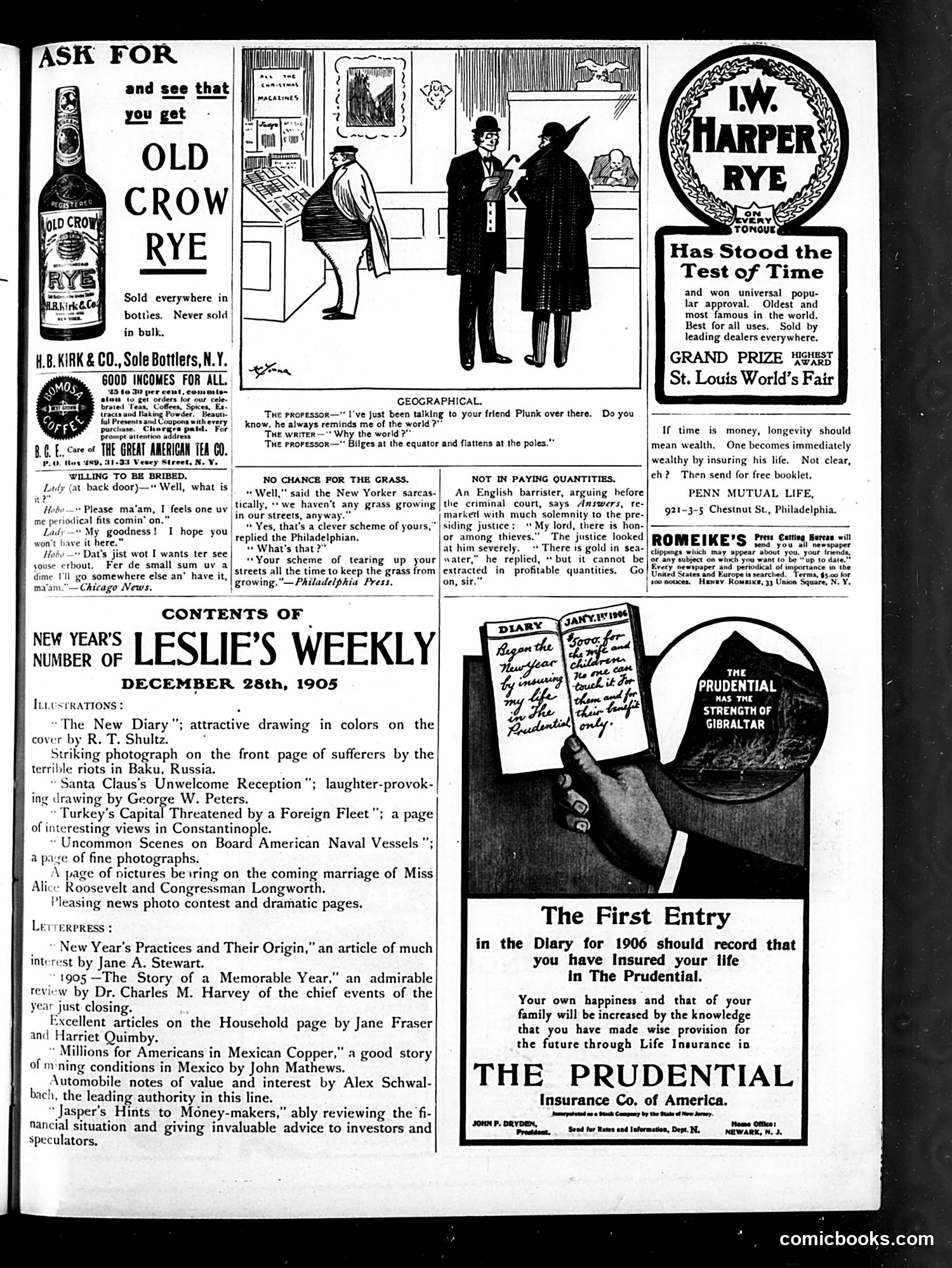
This is primarily a **title/contents page** from Judge's December 28, 1905 New Year's issue, dominated by advertisements rather than editorial cartoons. The **one cartoon visible** ("Geographical") depicts two gentlemen in conversation. One remarks that his acquaintance "Plunk" reminds him of the world itself. When asked why, he explains that like Earth, Plunk "bulges at the equator and flattens at the poles"—a joke about the man's round middle and thin limbs, comparing his body shape to planetary geography. This is straightforward physical humor rather than political satire. The page also includes several brief humorous anecdotes (labeled "Short Sayings") about unrelated topics: Philadelphia street maintenance, a hobo seeking money, and a barrister's courtroom quip about honor among thieves. The bulk of the page advertises liquor brands (Old Crow Rye, I.W. Harper Rye) and insurance companies (Prudential, Penn Mutual Life), typical of Judge's commercial content. The issue contents promise photographs of the 1905 Baku riots and the coming Roosevelt-Longworth wedding.
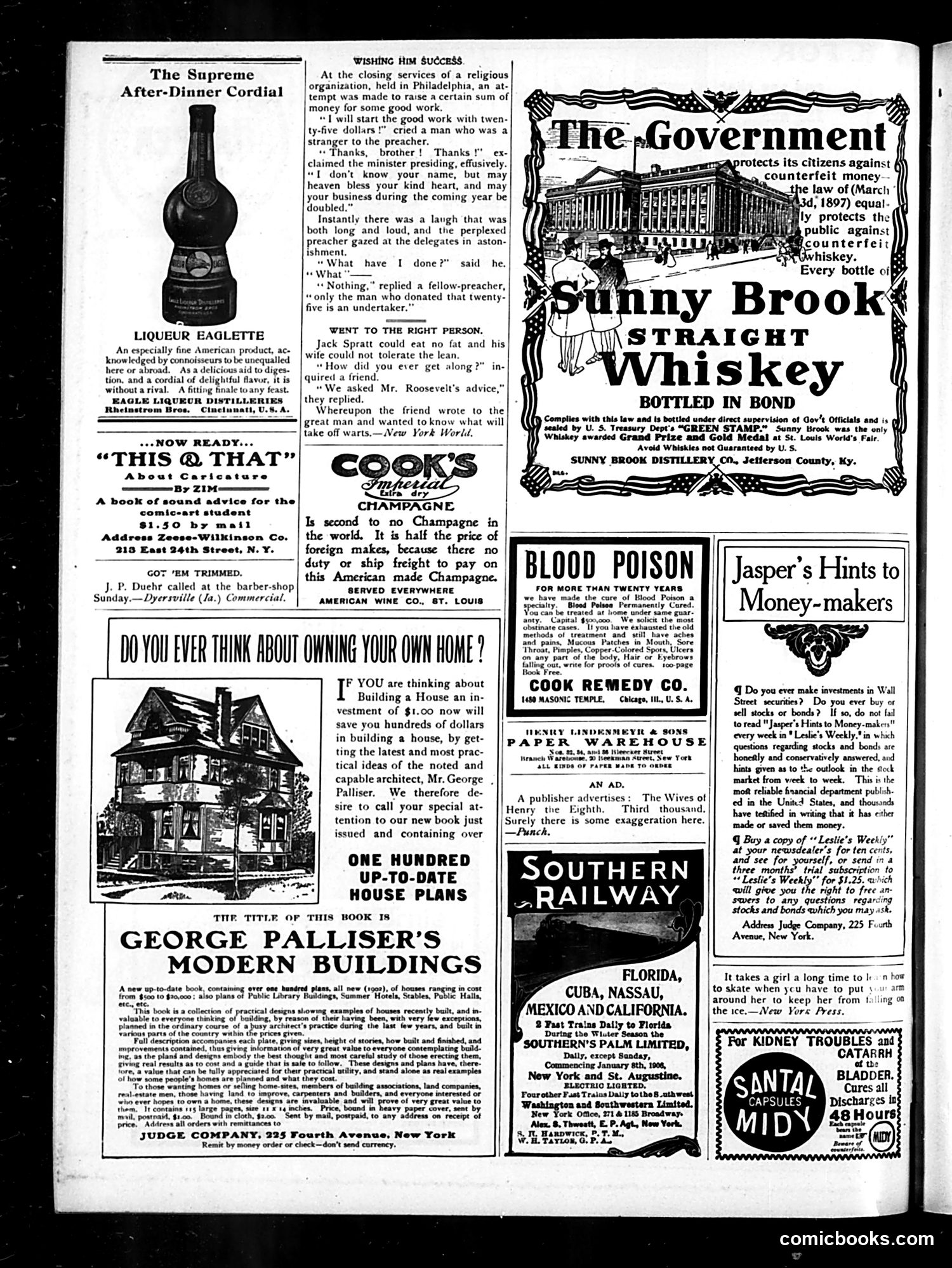
This page contains primarily **advertisements and filler content** rather than political cartoons, though a few brief satirical jokes appear. The main joke—"Wishing Him Success"—satirizes religious hypocrisy. A stranger donates $25 to a church fundraiser, and the minister effusively blesses his business, hoping it doubles. The punchline: the donor is an **undertaker**, making the "blessing" darkly comedic since his profit depends on death. The satire mocks both naive clergy and mercenary motivations disguised as charity. A second joke references **Theodore Roosevelt**, implying he was consulted on domestic matters by the public (via the Jack Spratt rhyme). This reflects Roosevelt's popular image as an all-purpose advice-giver. The page is dominated by period product advertisements (whiskey, champagne, real estate guides, railway services, patent medicines for "blood poison") typical of Judge's commercial content. These ads, particularly the dubious medical remedies, are themselves subjects of period satire.
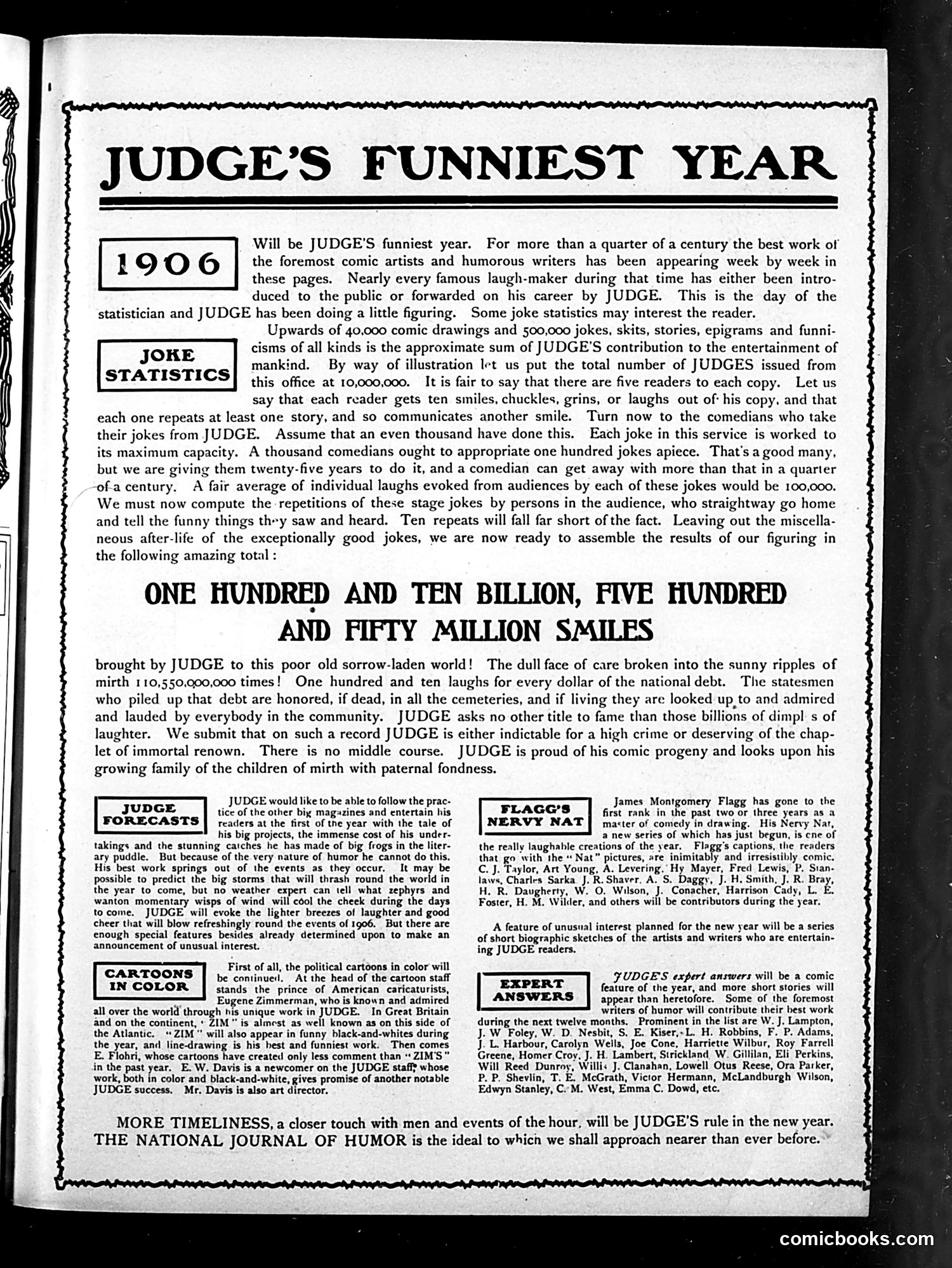
This is primarily a **promotional/editorial page**, not a cartoon page. It celebrates Judge magazine's 25-year track record as America's leading humor publication. The text boasts that Judge has published 40,000 comic drawings and 500,000 jokes. It then performs absurdist mathematics to calculate the magazine's impact: claiming 10 million copies × 5 readers each × 10 laughs per reader, plus secondary sharing, equals **110 billion smiles** brought to the world—"one hundred and ten laughs for every dollar of the national debt." The page humorously compares Judge's cultural contribution favorably to the politicians who created the national debt, suggesting the magazine deserves either criminal indictment or immortal honor for its comic achievements. The page also **advertises upcoming content**: James Montgomery Flagg's popular "Nervy Nat" comic series, political cartoons in color, and predictions about the year ahead. This is essentially Judge's self-promotional celebration of its own influence and reach.
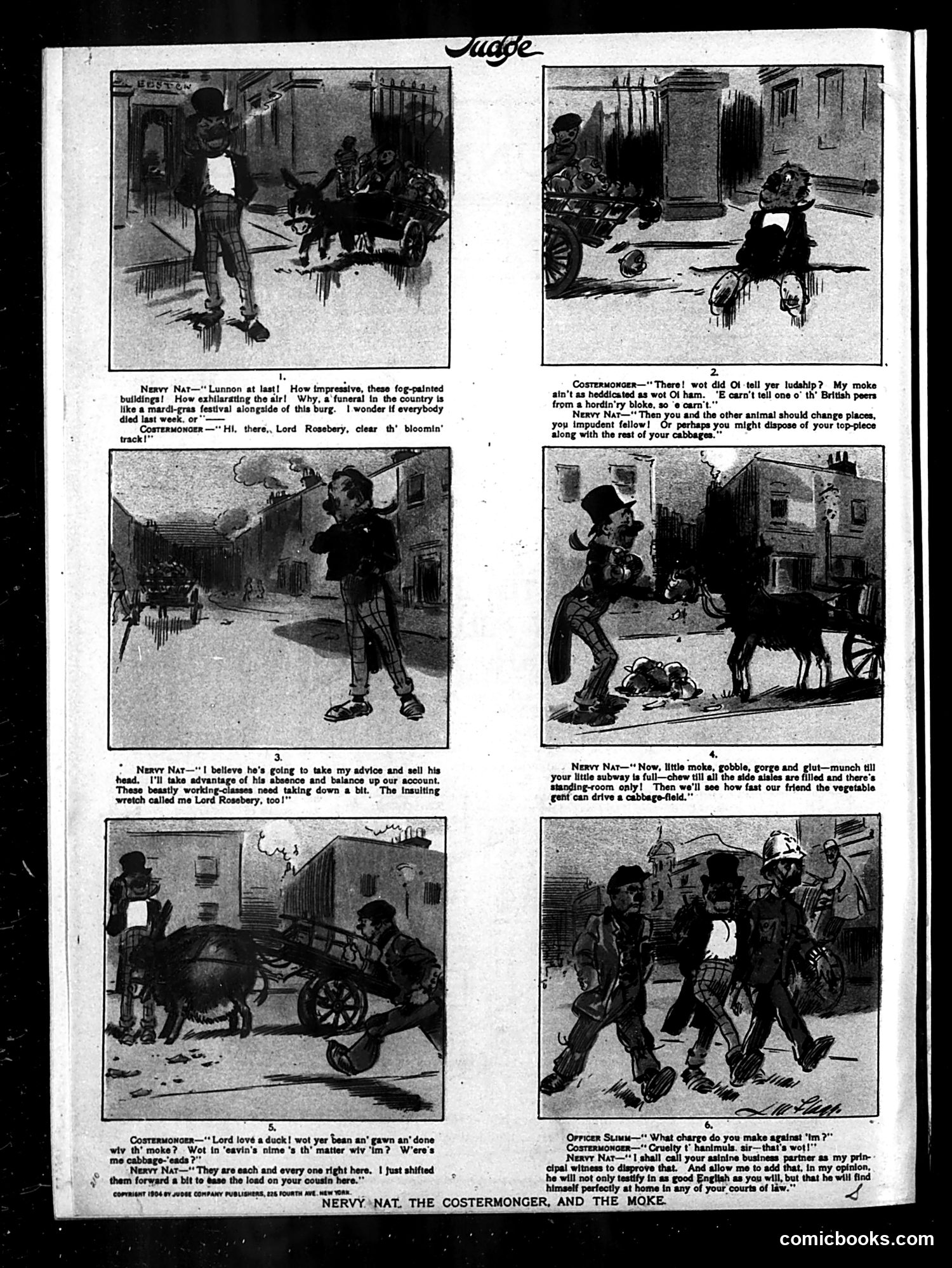
This is a multi-panel satirical comic strip featuring three recurring characters: **Nervy Nat** (an arrogant American tourist/businessman), a **Costermonger** (a British street vendor/working-class Londoner), and a **moke** (donkey/cart horse). The satire mocks class conflict and cultural misunderstanding. Nervy Nat insults London's fog and the costermonger's intelligence, dismisses working-class British people as needing "taking down," and later sabotages the vendor's vegetable cart by shifting cabbages to overload the animal. The costermonger's exaggerated Cockney dialect ("'eavin's nime") underscores the class divide. The final panels show consequences: the animal collapses, leading to arrest. Nervy Nat's threat to call the costermonger as a "principal witness"—implying he'll testify against him in court—reveals the cartoon's critique of American arrogance and contempt for working-class British culture, while depicting the class-based legal system's favoritism toward wealthy foreigners.

I can see this is a page from *Judge* magazine (confirmed by the "comicbooks.com" watermark), but the image itself is almost entirely black or severely underexposed, making it impossible to discern any cartoon illustrations, caricatures, text, or satirical content. The page appears to be either: - A blank or advertising page - Severely damaged or poorly scanned - The back of a page with minimal content Without visible imagery or readable text beyond the OCR header, I cannot identify figures, political references, or explain any satirical points. A clearer scan would be needed to provide historical analysis.