
A complete issue · 17 pages · 1905
Judge — December 9, 1905
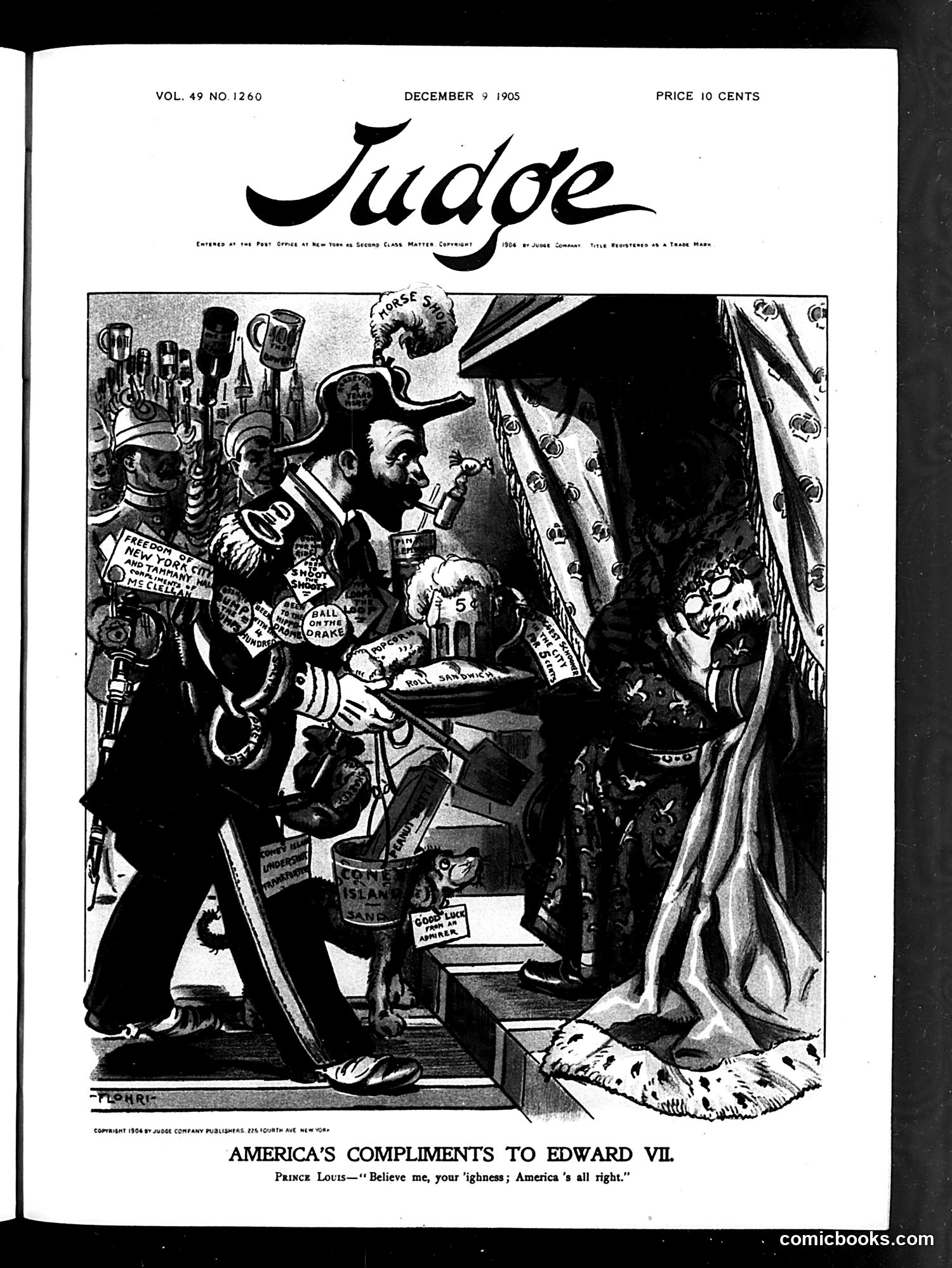
This December 9, 1905 *Judge* cartoon satirizes American deference to British royalty. The central figure appears to be Prince Louis (identified in the caption), addressing Edward VII with the reassuring words "Believe me, your 'ighness; America's all right." The cartoon depicts various American figures—military officers, businessmen, and politicians—presenting gifts and tokens of respect to the British monarch, depicted on the right. The satire mocks America's eagerness to curry favor with British royalty despite the nation's founding as a republic explicitly rejecting such hierarchies. The cartoon criticizes what the artist views as American hypocrisy: publicly valuing democratic independence while privately fawning over foreign nobility and their representatives.
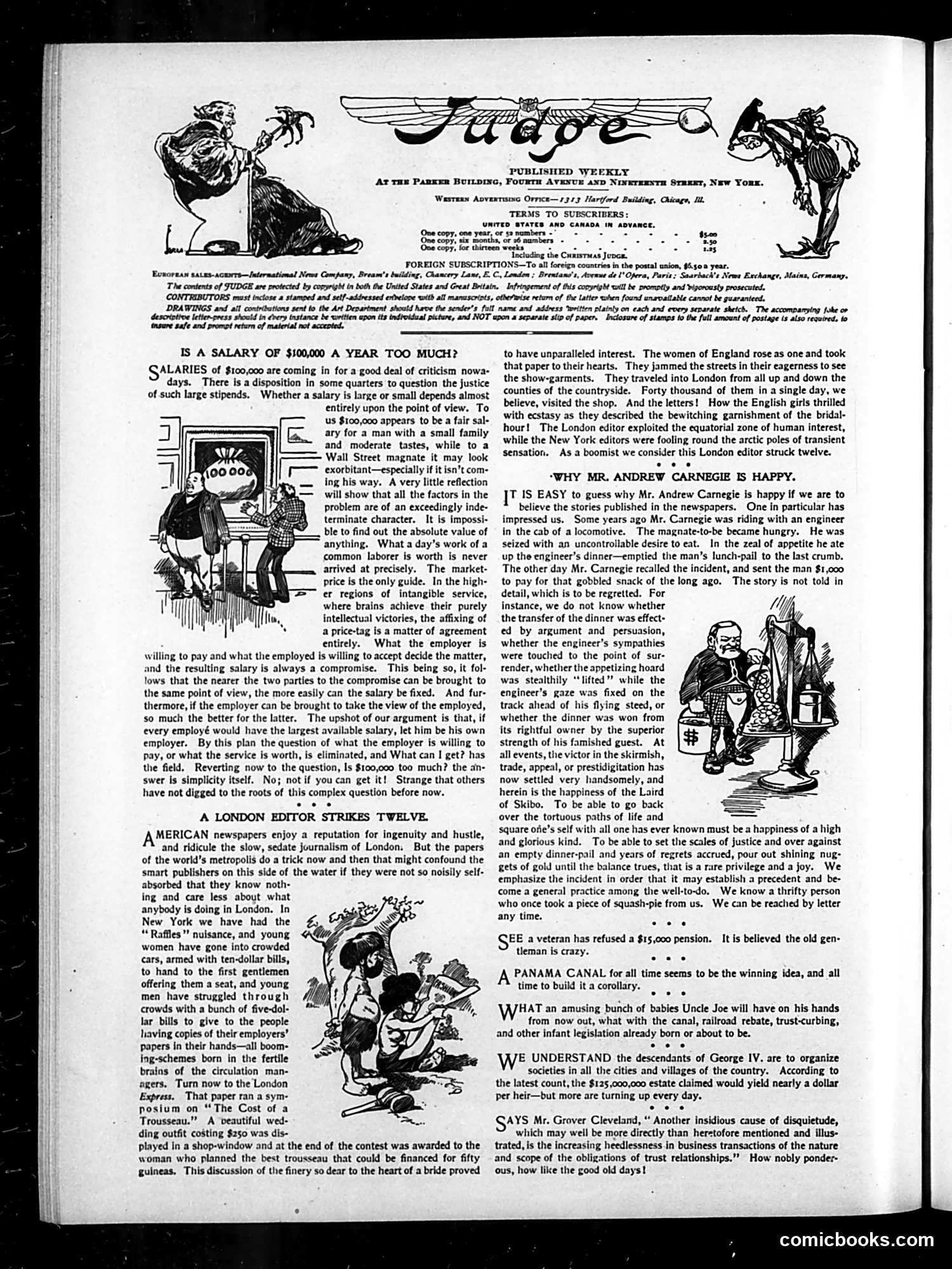
This page from Judge magazine contains several opinion pieces and editorial cartoons critiquing contemporary issues. The left cartoon illustrates "Is a Salary of $100,000 a Year Too Much?" — debating whether such wages are fair. The accompanying text discusses the tension between employers' desires to minimize labor costs and workers' needs, touching on broader class anxieties of the era. The right section, "Why Mr. Andrew Carnegie Is Happy," appears to reference Carnegie's philanthropic activities and contentment, likely with satirical undertones about wealth and social obligation. "A London Editor Strikes Twelve" criticizes London newspapers' sensationalism and lurid content, contrasting it with American journalism standards. The cartoons use exaggerated figures and satirical humor typical of Judge's social commentary approach, addressing labor economics, wealth, and media ethics—recurring themes in early 20th-century American satire.
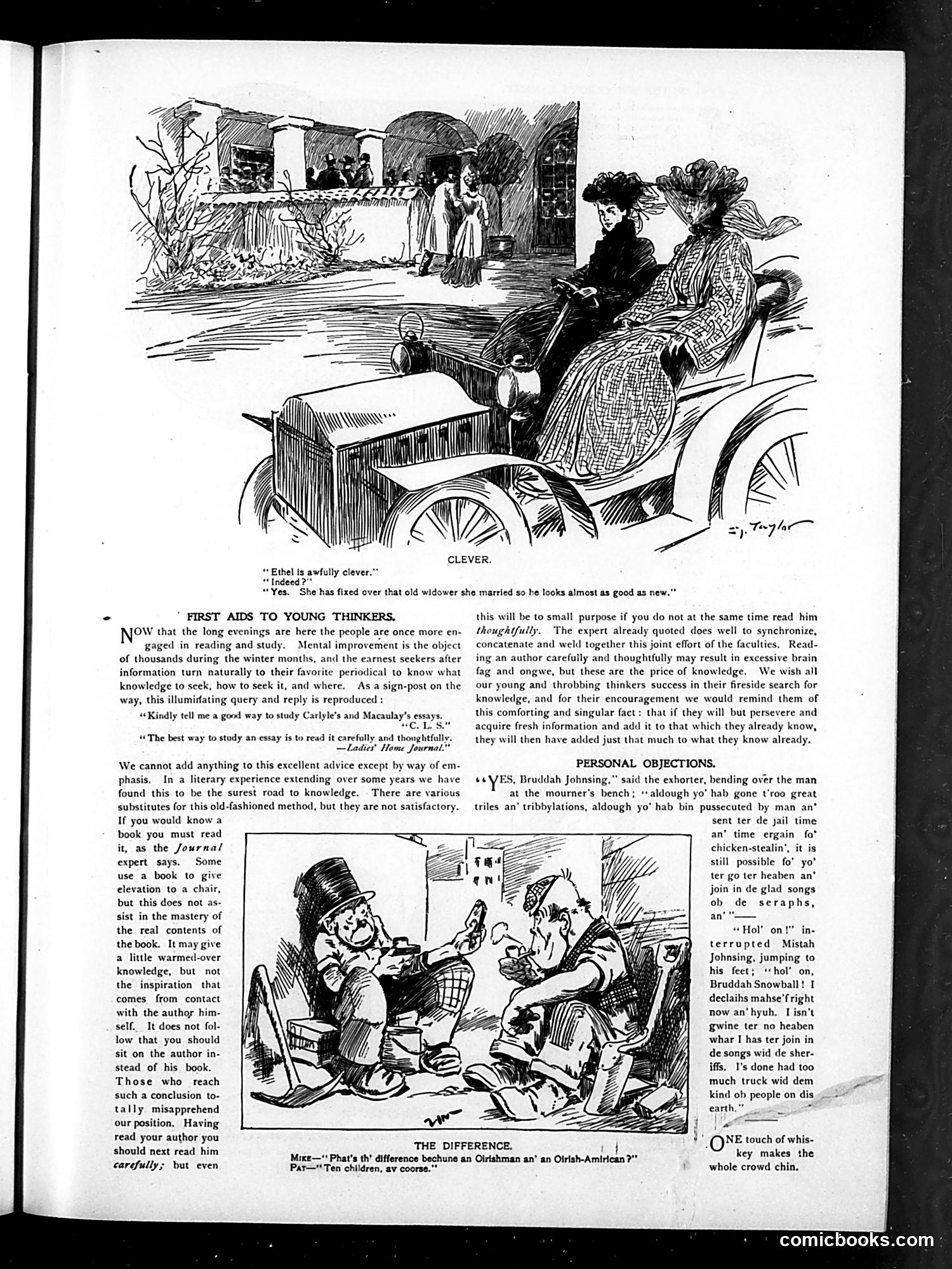
**Top Cartoon ("Clever"):** A woman in a carriage passes a house party. The joke's caption reveals she's a widow who "fixed over" her appearance so successfully after remarriage that "she looks almost as good as new"—a dig at cosmetics and remarriage practices among wealthy women. **Lower Cartoon ("The Difference"):** Two figures (appears to be an Irish immigrant and an Oirish-American) debate religious differences. The humor relies on ethnic stereotyping and dialect humor common to the era, mocking both Irish immigrants and assimilated Irish-Americans through exaggerated speech patterns. Both cartoons reflect Judge's satirical approach to contemporary social anxieties about class mobility, cosmetic enhancement, immigration, and assimilation in turn-of-the-century America.
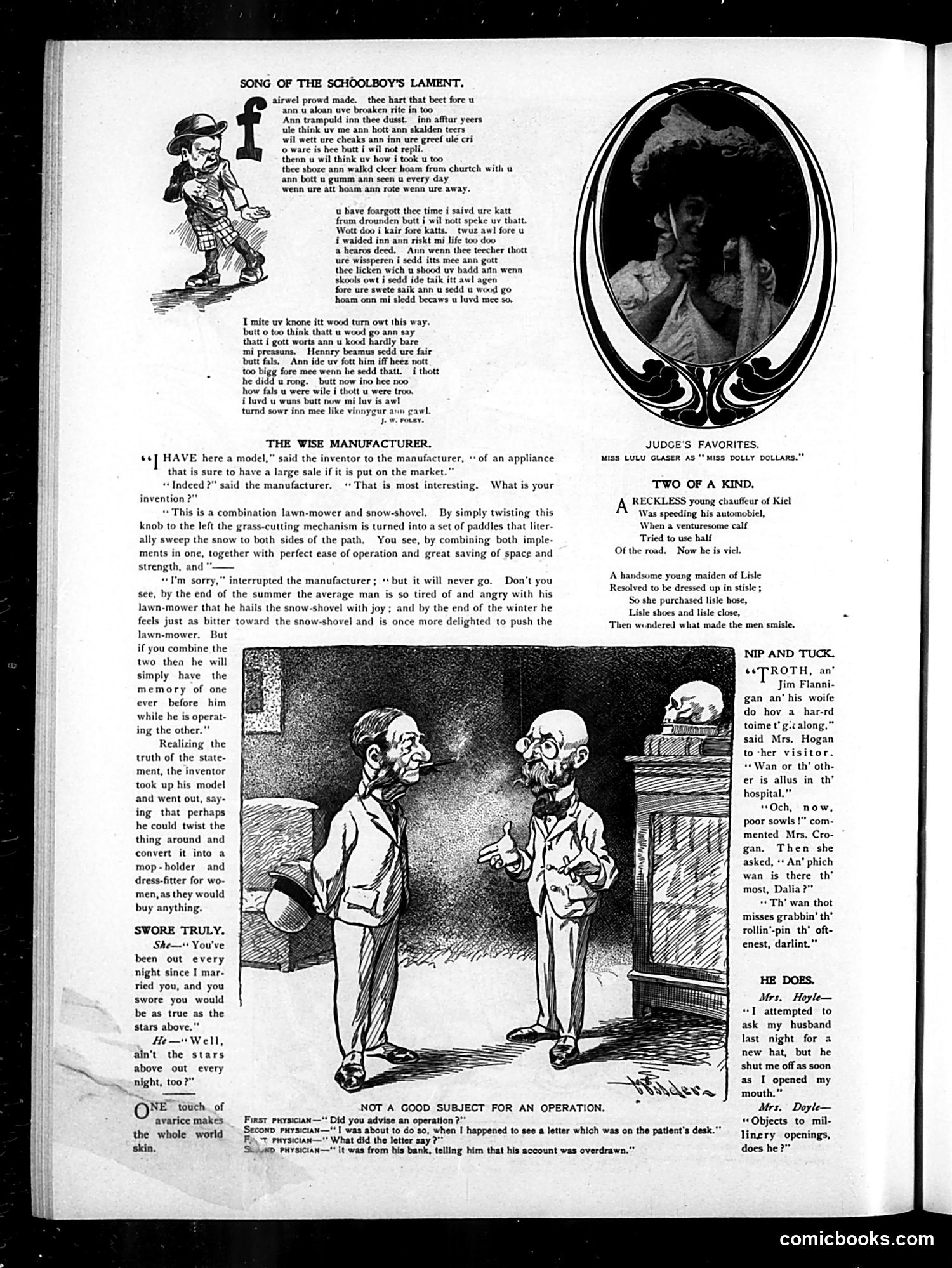
This page contains several distinct pieces of humor typical of Judge magazine's satirical approach: **"The Wise Manufacturer"** presents a dialogue where an inventor pitches a combination lawn-mower/snow-shovel to a manufacturer. The satire mocks both impractical inventions and sales pitches—the manufacturer correctly notes that combining two seasonal tools means users will only remember frustration with whichever tool they're not currently needing. **"Not a Good Subject for an Operation"** shows two physicians discussing a patient's letter revealing financial troubles (overdrawn bank account). The joke satirizes doctors' tendency to avoid operating on poor patients who cannot pay. The remaining items are short humorous verses and anecdotes typical of Judge's miscellaneous humor columns, requiring no specific historical context beyond general turn-of-the-century American sensibilities.
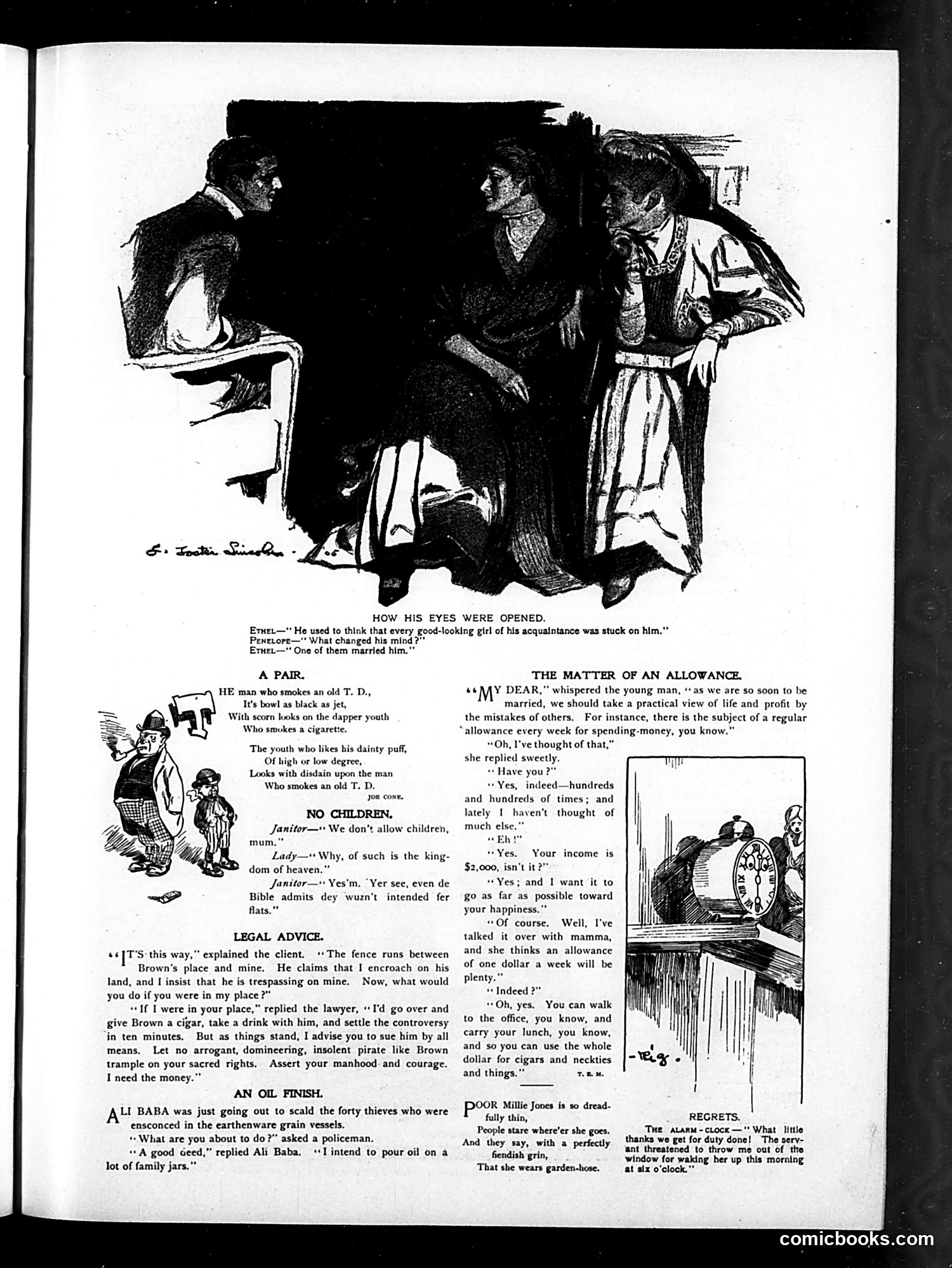
The top illustration titled "How His Eyes Were Opened" depicts a social commentary on marriage and infidelity. The caption dialogue suggests a man discovered that his seemingly virtuous acquaintances were unfaithful—a common theme in early 20th-century humor. The page contains several short satirical pieces: - **"A Pair"** mocks smokers, particularly those who smoke cheap cigarettes ("T.D.s") - **"No Children"** jokes about working-class attitudes toward large families - **"Legal Advice"** satirizes property disputes and overly litigious neighbors - **"An Oil Finish"** appears to reference questionable business practices **"The Matter of an Allowance"** discusses marital finances—a wife asking her husband for weekly spending money, reflecting early 20th-century gender dynamics regarding women's financial independence. The humor targets class pretensions, consumer behavior, and marital relations typical of Judge's satirical approach.
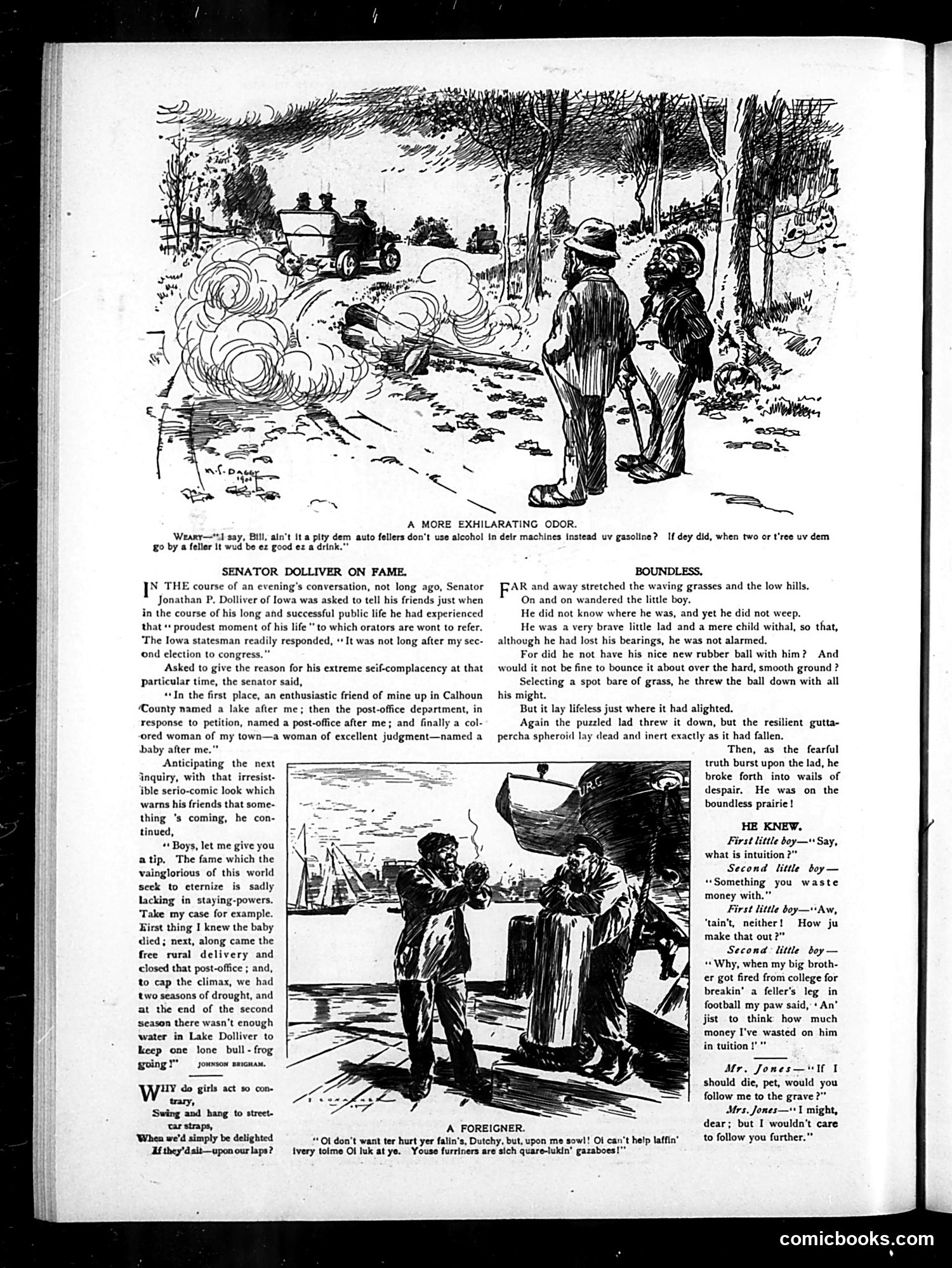
This page contains several satirical pieces typical of early 20th-century American humor: **"A More Exhilarating Odor"**: Working-class men joke about using alcohol instead of gasoline in automobiles—commentary on both early car culture and drinking habits. **"Senator Dolliver on Fame"**: Senator Jonathan P. Dolliver of Iowa recounts his "proudest moments"—a lake, post office, and a baby named after him—only to reveal they've all disappeared (the lake dried up, the post office closed, the baby died). The satire mocks political vanity and the ephemerality of local fame and honor. **"Boundless"**: A child loses his rubber ball on the prairie and panics, realizing he's truly isolated—a sentimental story playing on childhood fears. **"He Knew"**: Two boys discuss intuition; the second defines it cynically as "something you waste money with," referencing his brother's college tuition after expulsion. **"A Foreigner"**: An Irish-American mocks a German immigrant's appearance—period ethnic humor reflecting contemporary immigration tensions.
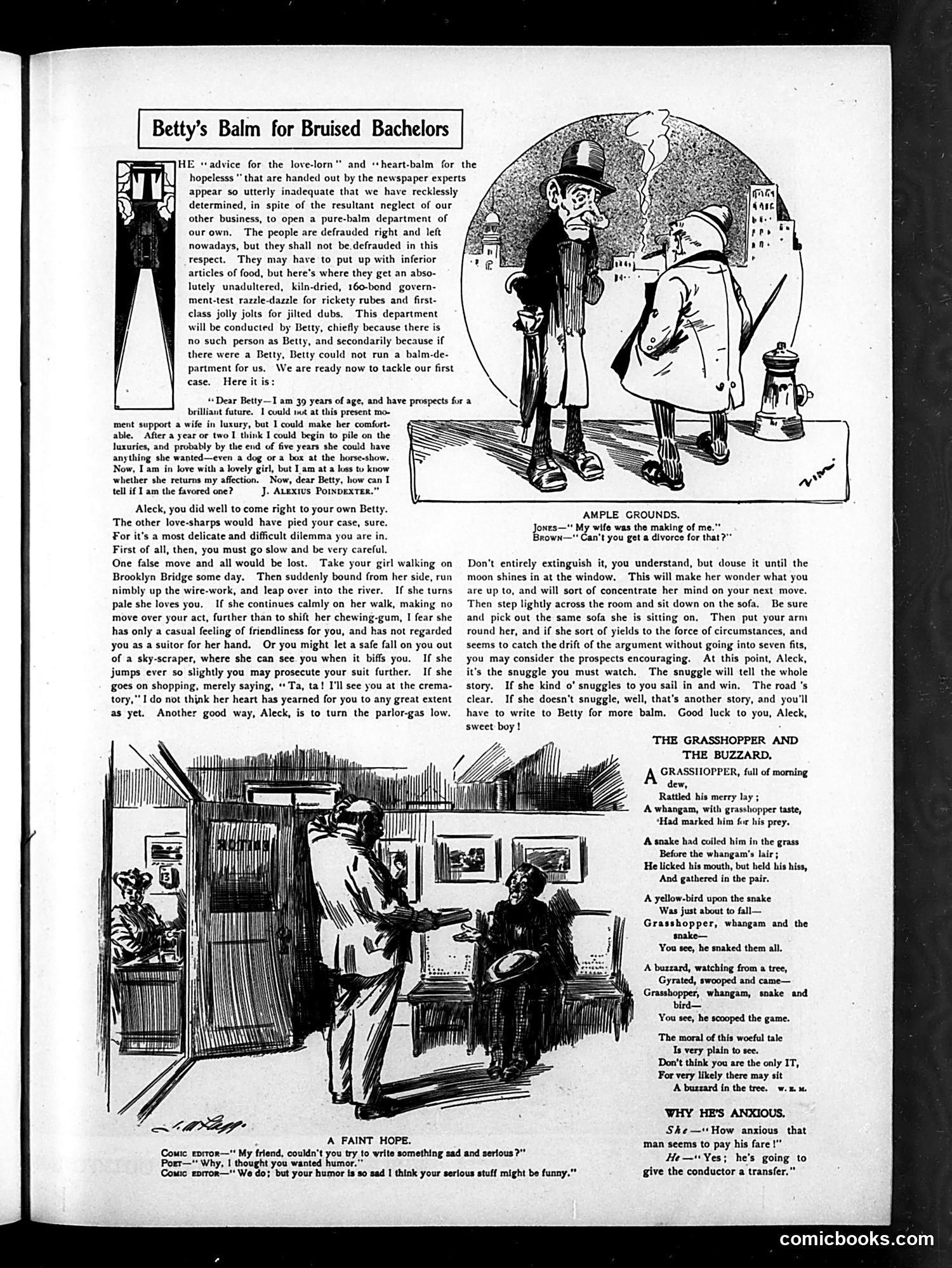
This page satirizes the era's popular "advice columnist" phenomenon. Judge mocks the absurd relationship guidance offered by newspaper experts by creating a fictional "Betty" advice column. The main humor targets a lovelorn bachelor (J. Alexius Poindexter) seeking romantic certainty. Betty's deliberately ridiculous "tests"—jumping off Brooklyn Bridge, dropping safes on himself, turning down parlor gas—parody the overwrought melodrama of contemporary advice literature. Each extreme scenario supposedly reveals his girlfriend's true feelings through her reaction. The satire works on two levels: mocking both the impractical advice columnists and the desperate men who sought their guidance. The exaggerated masculinity and financial anxiety ("prospects for a brilliant future" but cannot yet afford luxuries) reflect bachelor anxieties of the period. The other comic elements ("Ample Grounds," "A Faint Hope") are separate features typical of Judge's mixed-content format.
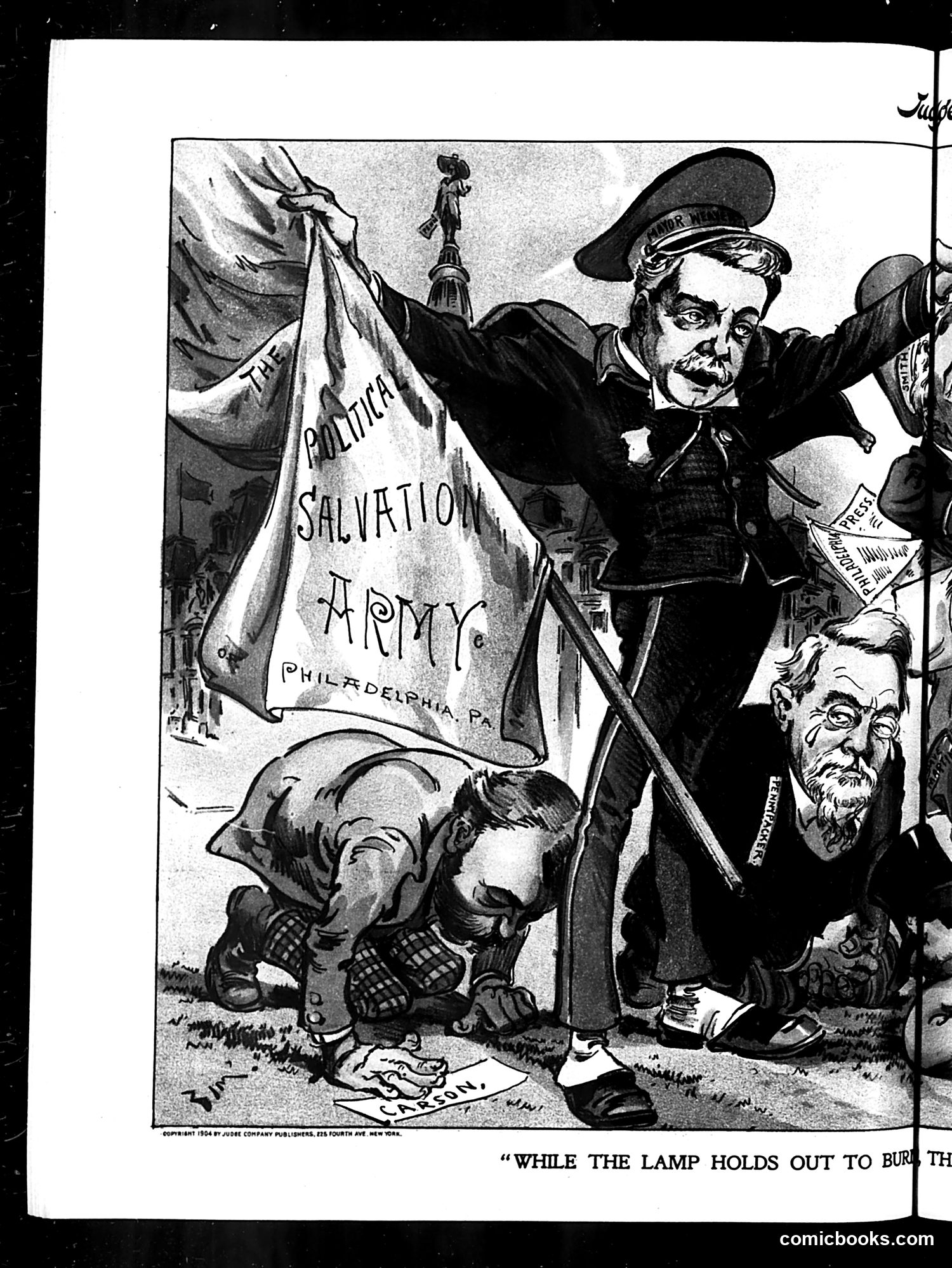
This Judge magazine cartoon satirizes the Salvation Army's charitable work in Philadelphia. The central figure, a uniformed Salvation Army officer, holds aloft a banner reading "Political Salvation Army" with "Philadelphia, PA" below it. The cartoon criticizes what appears to be the politicization of charitable work—the officer presents "salvation" as a political instrument rather than genuine charity. The ragged, impoverished figures gathered below (appearing to represent the poor or working class) are depicted as the targets or beneficiaries of this "political" rather than authentic charitable mission. The satire suggests the Salvation Army, or similar organizations, were being used for partisan political gain rather than serving humanitarian purposes. The caption fragment visible at bottom ("While the lamp holds out to burn...") remains incomplete.
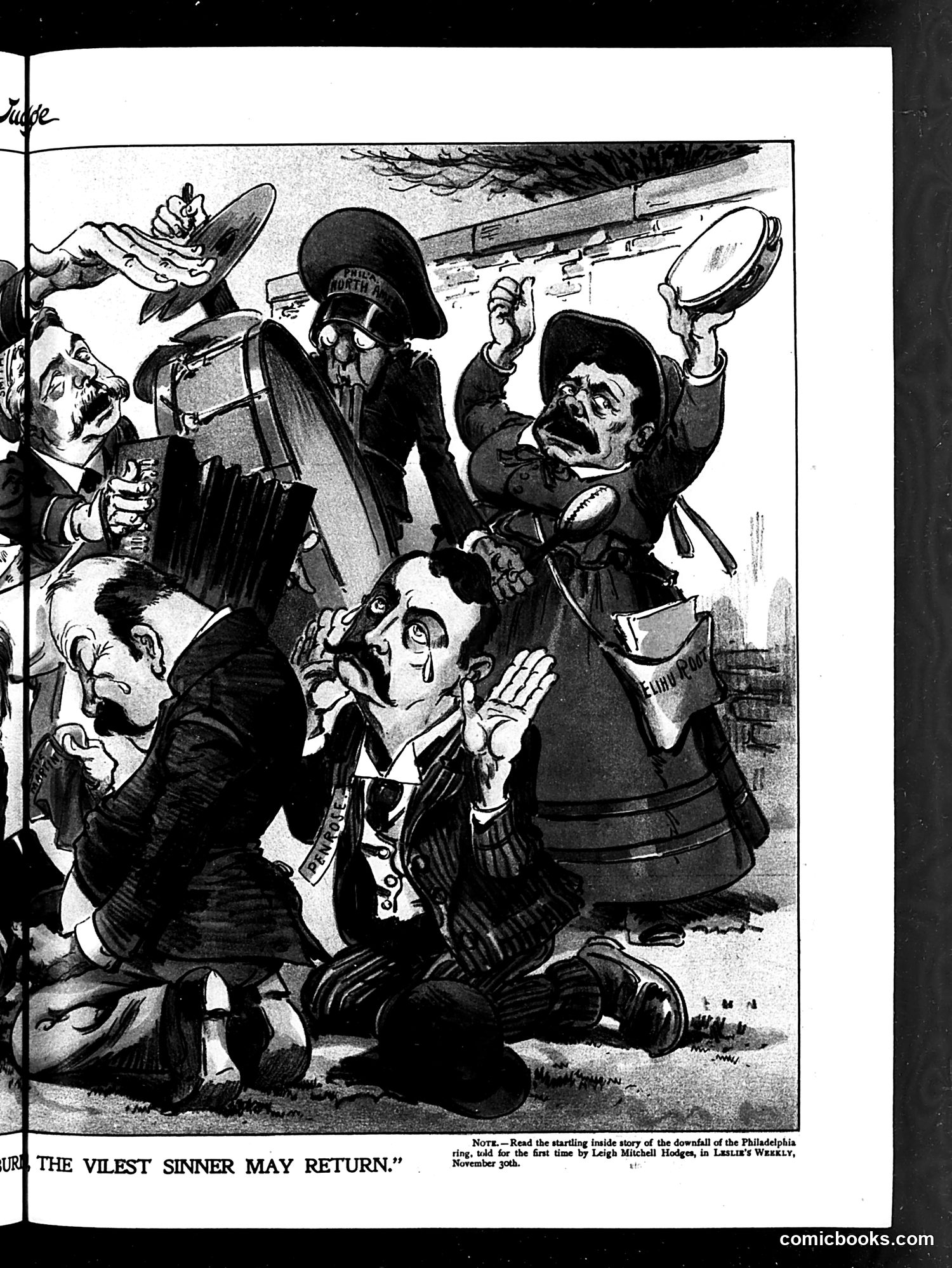
This political cartoon from Judge magazine satirizes the Philadelphia political machine's collapse. The caricatured figures appear to be corrupt Philadelphia politicians or "ring" members—depicted as disheveled, scheming men in formal dress caught in apparent distress or panic. The title suggests ironic commentary on redemption or restoration, likely mocking claims that disgraced political figures might rehabilitate their reputations. The note references an exposé by Leigh Mitchell Hodges in Laskin's Weekly (November 30th) detailing the "downfall of the Philadelphia ring"—referring to the notorious political corruption network that dominated Philadelphia politics in the late 19th/early 20th century. The cartoon ridicules these corrupt officials through exaggerated caricature, a standard Judge technique for political commentary.
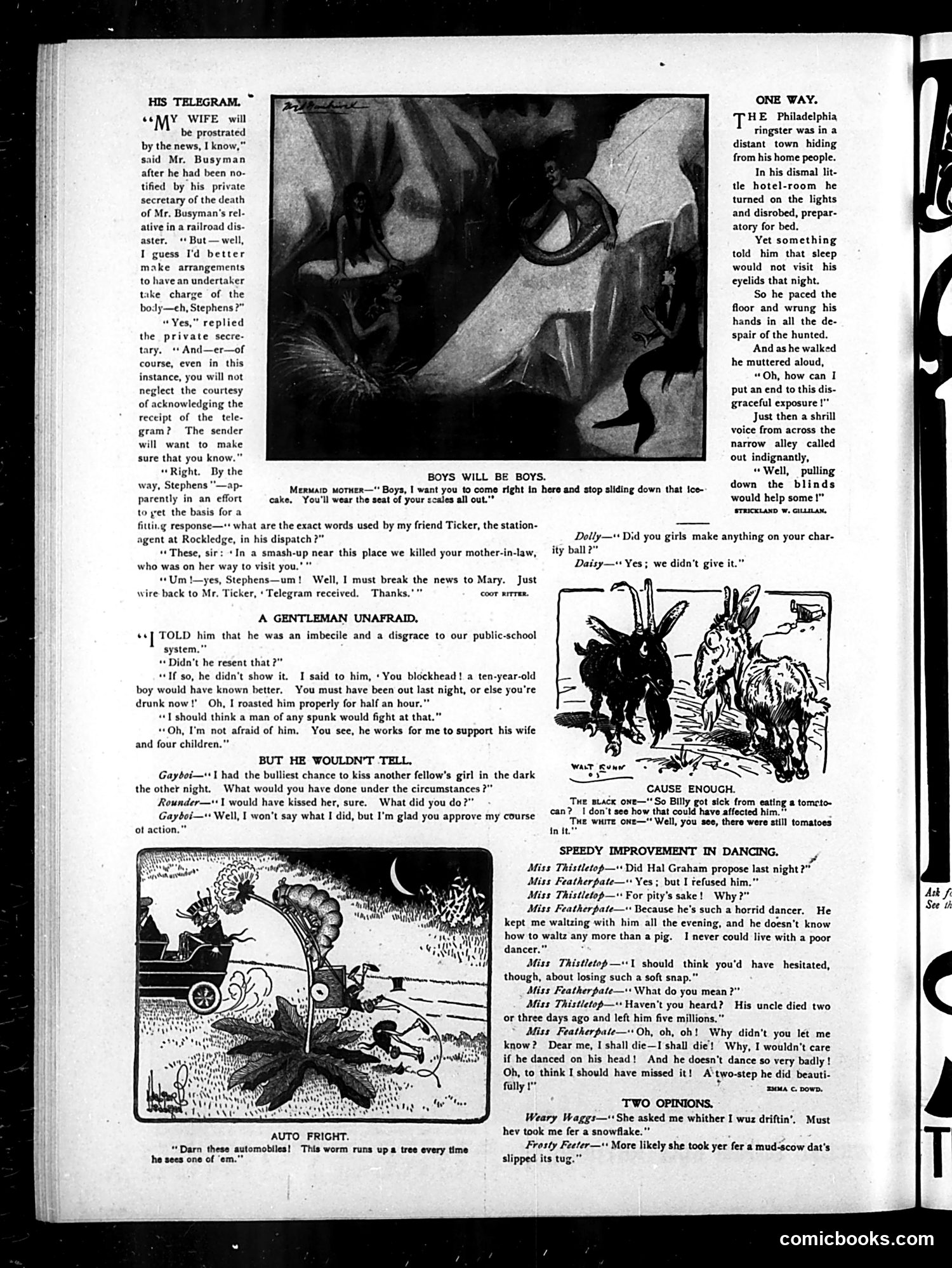
This page contains several short satirical pieces typical of early 20th-century American humor magazines: **"One Way"** depicts a Philadelphia boxer/criminal hiding from exposure, agonizing over scandal while neighbors complain about his noise—satirizing moral hypocrisy among public figures. **"His Telegram"** mocks a wealthy businessman's callous response to a relative's death in a railroad accident, prioritizing formal etiquette (acknowledging receipt of the telegram) over genuine grief—critiquing upper-class superficiality. **"A Gentleman Unafraid"** satirizes a boss who verbally abuses his working-class employee without consequence because the man depends on him financially—exposing power imbalances and workplace exploitation. **"But He Wouldn't Tell"** jokes about sexual temptation and discretion between young men. The remaining pieces use humor about dancing, illness, and romantic proposals. Overall, the page critiques hypocrisy, class privilege, and social pretense through brief comedic scenarios—the magazine's standard approach to contemporary American manners and morality.
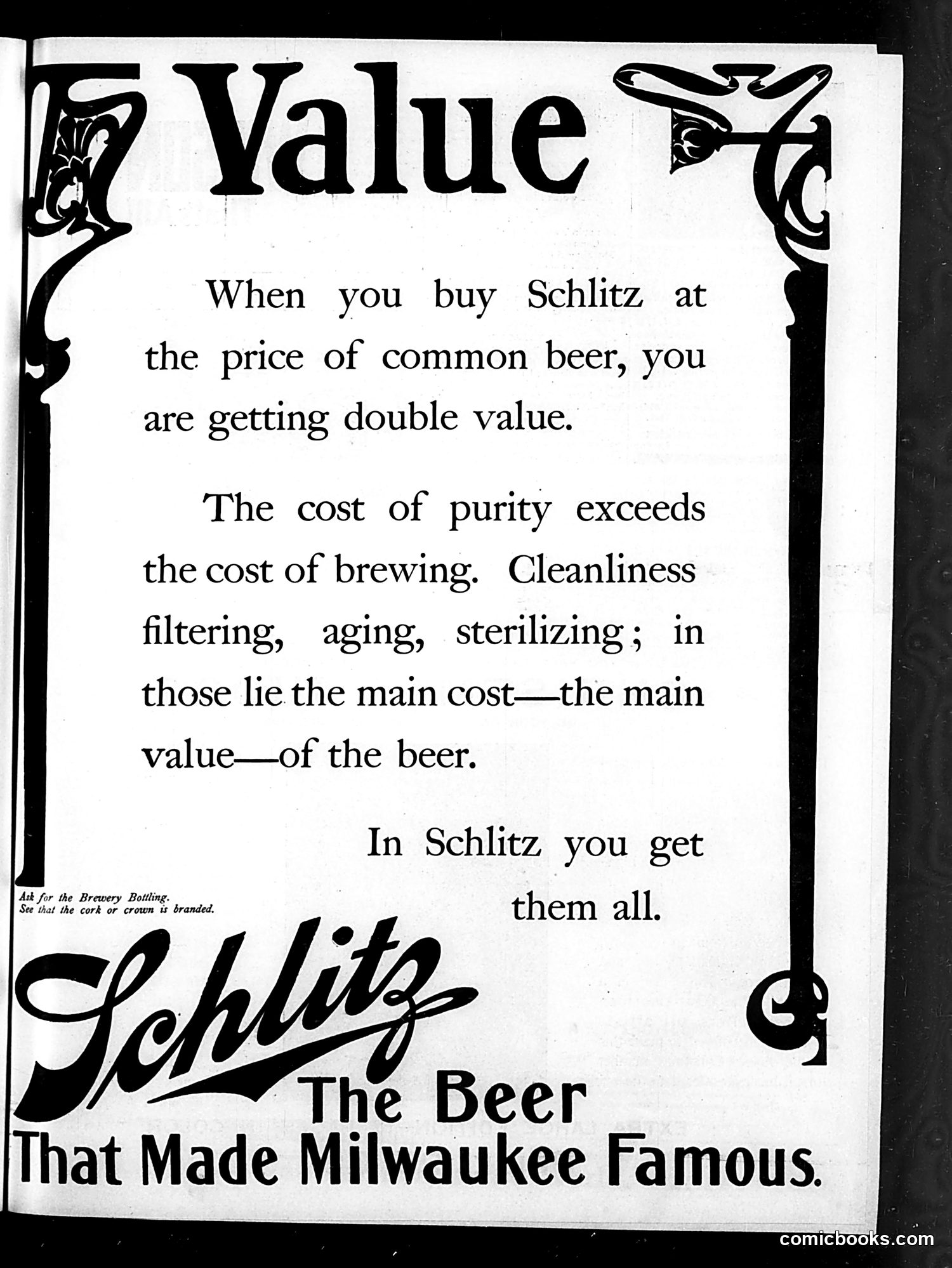
This is a **Schlitz beer advertisement**, not a political cartoon. The page promotes Schlitz as premium beer sold at common beer prices, arguing consumers get "double value." The ad's strategy appeals to early 20th-century consumer concerns about **food safety and purity**—likely referencing widespread anxiety about contaminated products. It emphasizes Schlitz's expensive purification processes (filtering, aging, sterilizing, cleanliness) as justification for quality, positioning these manufacturing costs as the product's true value. The tagline "The Beer That Made Milwaukee Famous" references Milwaukee's reputation as a major brewing center, particularly among German-American communities. For modern readers, this reflects how breweries marketed scientific manufacturing as a competitive advantage when food safety was a genuine public concern.
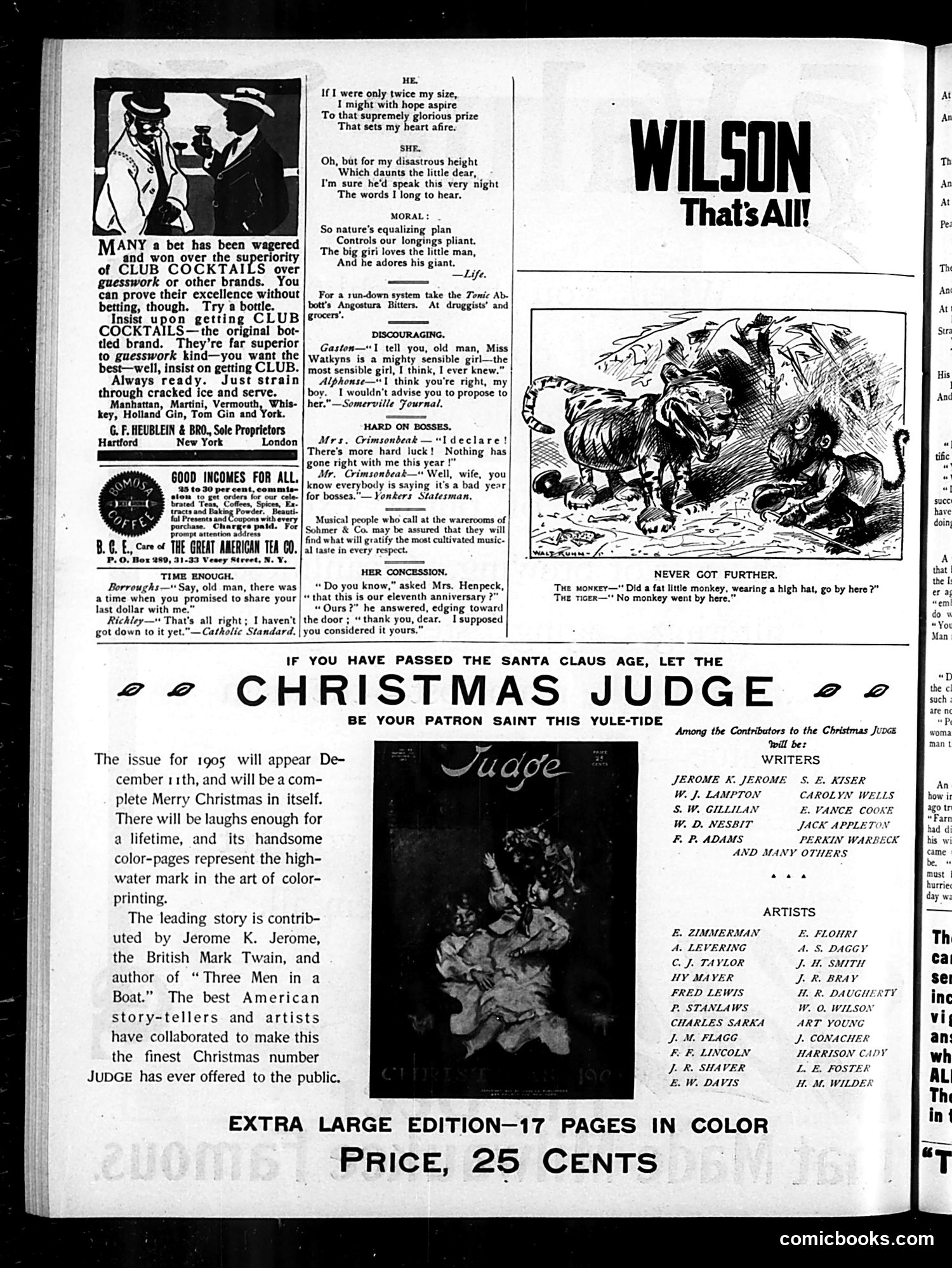
This page is primarily **advertising and promotional content** for Judge's 1905 Christmas issue, with several small humorous filler items. The main advertisement promotes Judge's upcoming Christmas edition, featuring contributions from notable writers including Jerome K. Jerome (the "British Mark Twain") and various artists. The issue promised 17 color pages—a significant technological achievement for 1904 printing. The scattered jokes are typical period humor: a couple's height mismatch preventing romance ("She loves the little man, / And he adores his giant"); a hen-pecking wife's slip calling their anniversary "hers" not "theirs"; and employer mockery ("a bad year for bosses"). The top-left section advertises Club Cocktails as superior to homemade "guesswork" drinks—a selling point for early commercial bottled cocktails. Other ads promote patent medicines, tea, and bitters as tonics. The cartoon labeled "Never Got Further" appears to be a simple animal joke involving a monkey and tiger, though the exact reference is unclear.
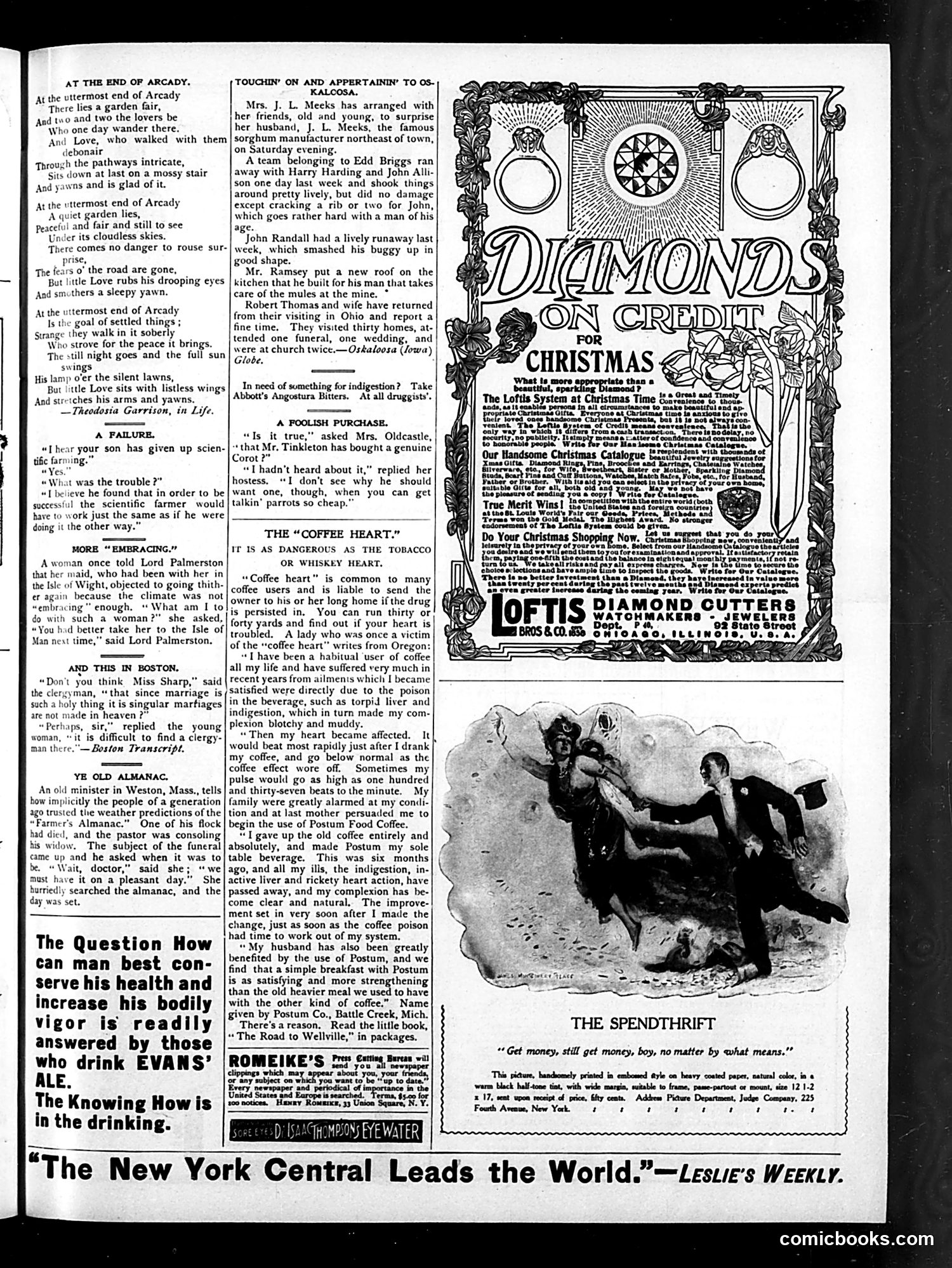
This page contains **light satirical humor and advertisements** rather than political cartoons. The left column features genteel poetry and anecdotes mocking romantic idealization and human folly. "At the End of Arcady" satirizes the anticlimactic reality of romantic love—even Cupid yawns once the journey ends. Other brief jokes target scientific farming's impracticality, misheard words ("embracing" climate), and religious hypocrisy (difficulty finding clergy to marry people). The right side is dominated by a large **Christmas diamond advertisement** for Loftis & Company jewelers, promoting diamonds as holiday gifts with elaborate marketing copy about gift-giving traditions. Below is a Postum coffee substitute advertisement featuring testimonials claiming coffee causes heart problems, while Postum provides safe nutrition—typical early-20th-century health-claim advertising. The "Spendthrift" illustration at bottom depicts someone squandering money. Overall, this reflects **Judge's satirical commentary on middle-class American life**—romance, farming, marriage, and conspicuous consumption—alongside period advertising making dubious health claims.
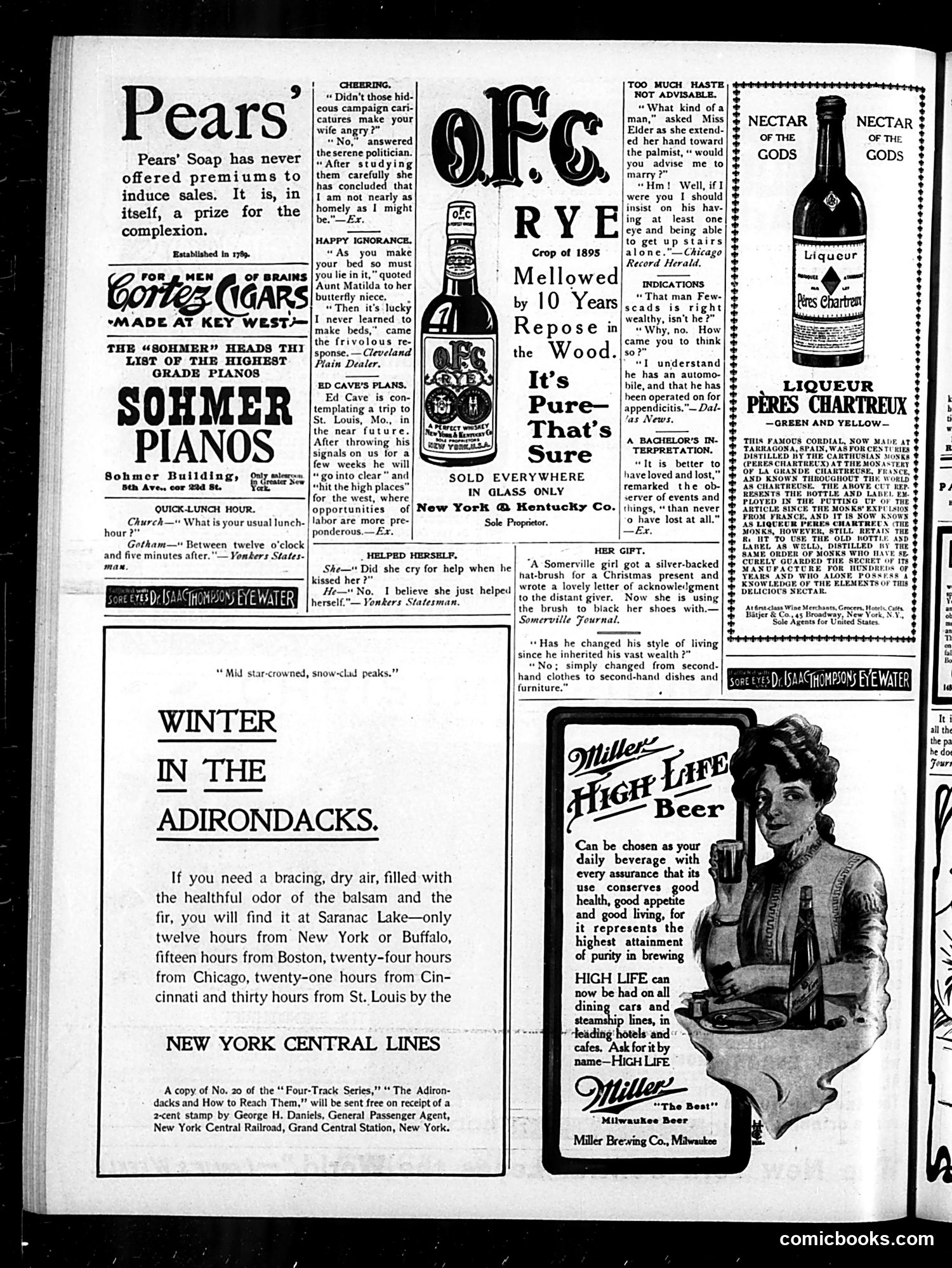
This page is **primarily advertising**, with small satirical jokes interspersed—typical of Judge magazine's format. The cartoons present light domestic and social humor: - **"Cheering"**: A politician's wife wasn't angered by campaign caricatures because he's already homely—humor based on self-deprecating acceptance. - **"Happy Ignorance"**: A young woman didn't learn household lessons, so she's "lucky" not to know she should suffer for her mistakes—gentle satire of female education gaps. - **"Too Much Haste"**: A woman asks a palmist about marriage; he advises she ensure her suitor can climb stairs—jokes about hasty romantic decisions and practical concerns. The remaining jokes mock social pretense: someone inheriting wealth doesn't change lifestyle but replaces quality items with secondhand versions; a woman uses an expensive hairbrush to polish shoes. **Advertisements dominate**: Pears' Soap, Sohmer Pianos, Cortés Cigars, OFG Rye whiskey, Pères Chartreaux liqueur, Miller High Life beer, and New York Central Lines' Adirondack tourism promotion. The content reflects turn-of-century American middle-class anxieties about wealth, appearance, and social propriety.
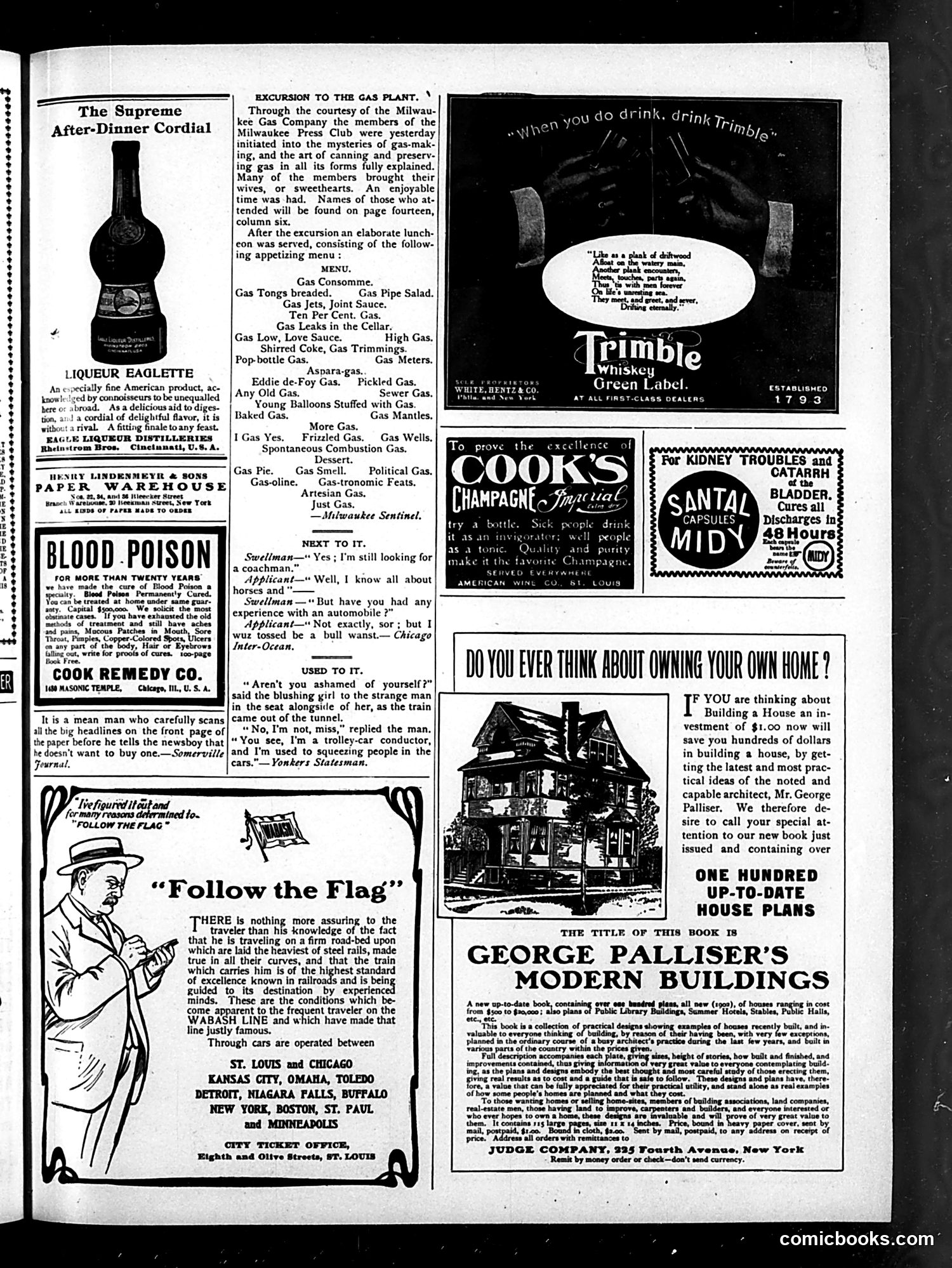
This page is primarily **advertising**, interspersed with brief humorous snippets typical of Judge magazine's satirical approach. The main notable content is a pseudo-menu from a Milwaukee Press Club excursion to a gas plant—satire playing on the word "gas" by listing dishes with gas-related puns ("Gas Consomme," "Gas-oline," "Aspara-gas"). This is straightforward wordplay humor rather than political satire. The small dialogue jokes use common early-1900s stereotypes: an Irish immigrant coachman unfamiliar with automobiles, and a trolley conductor's unwanted advance in a tunnel—mild social humor targeting working-class characters and modern technology anxieties. The "Follow the Flag" Wabash railroad advertisement emphasizes American infrastructure superiority, likely reflecting early-20th-century nationalism and railroad industry pride. The remainder consists of patent medicine ads (blood poison cures, kidney remedies) and liqueur advertisements—typical of the era's magazine advertising before FDA regulation.
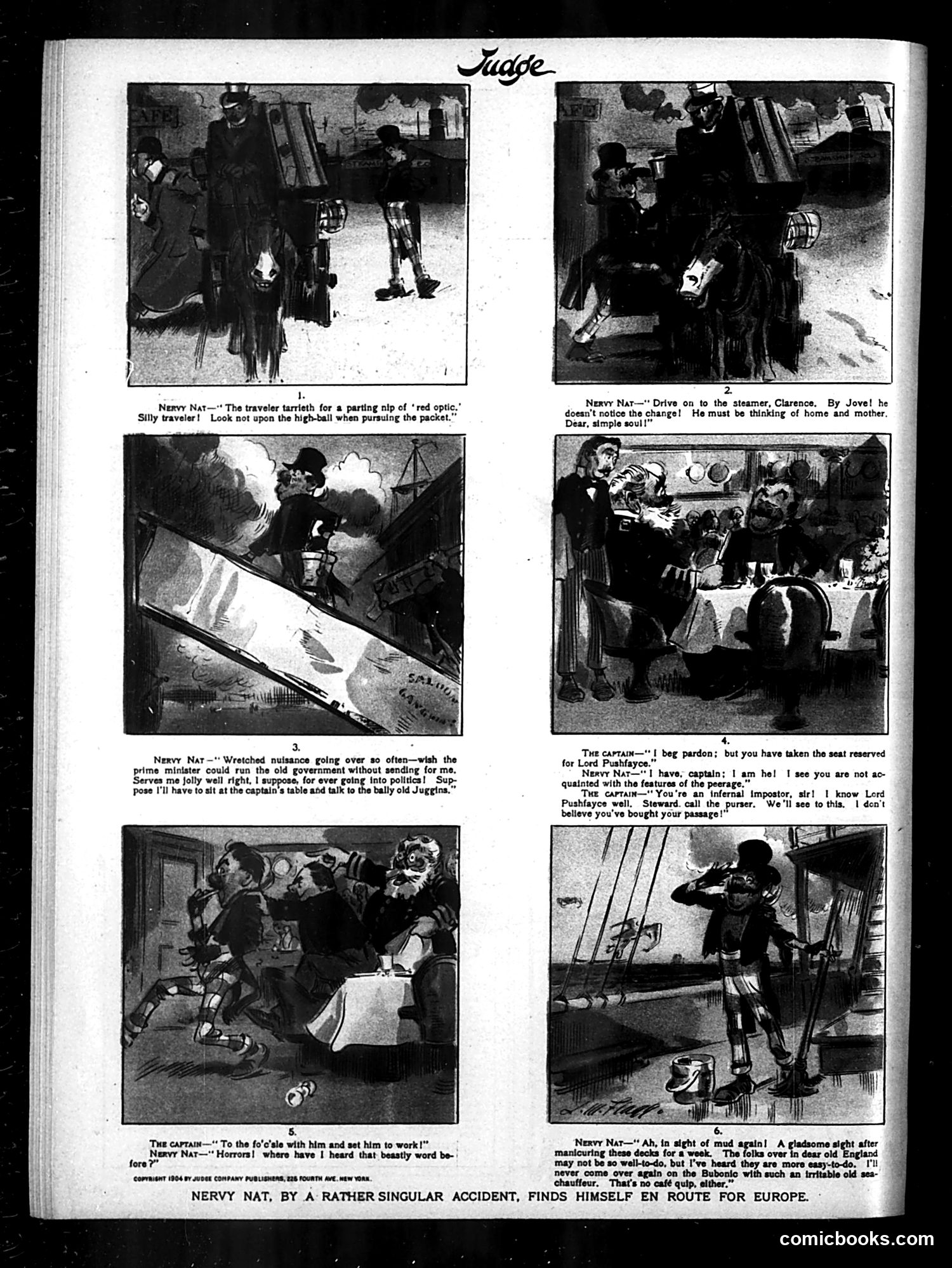
This is a sequential comic strip following "Nervy Nat," an apparently well-connected British social climber who impersonates a peer (Lord Pushfayce) to secure passage on a steamship to Europe. The humor relies on class satire: Nat repeatedly attempts to exploit his connections and social status, but his deceptions unravel. When confronted by the captain, Nat's false identity is exposed. He's exposed as an "infernal impostor" and forced to work below decks—the ultimate humiliation for someone pretending to aristocratic standing. The final panel suggests ironic redemption: despite his comeuppance, Nat finds satisfaction in honest labor ("a gladsome sight"), contrasting his earlier social pretension with working-class authenticity. The strip mocks both social climbers and the rigid class hierarchies that make such imposture possible, a common Judge magazine theme.

I can see this is a page from *Judge* magazine (as indicated by the watermark), but the image is almost entirely black or heavily degraded, making it impossible to discern any cartoon illustrations, text content, or satirical details beyond the "comicbooks.com" credit line at the bottom. To accurately explain the political and social context of any cartoons or content on this page—identifying specific figures, references, and the satirical points—I would need a clearer, more legible image where the actual artwork and text are visible. If you have a higher-quality scan or image of this page, I'd be happy to analyze it properly.