
Judge, 1905-12-09 · page 2 of 17
Judge — December 9, 1905 — page 2: what you’re looking at
What you’re looking at
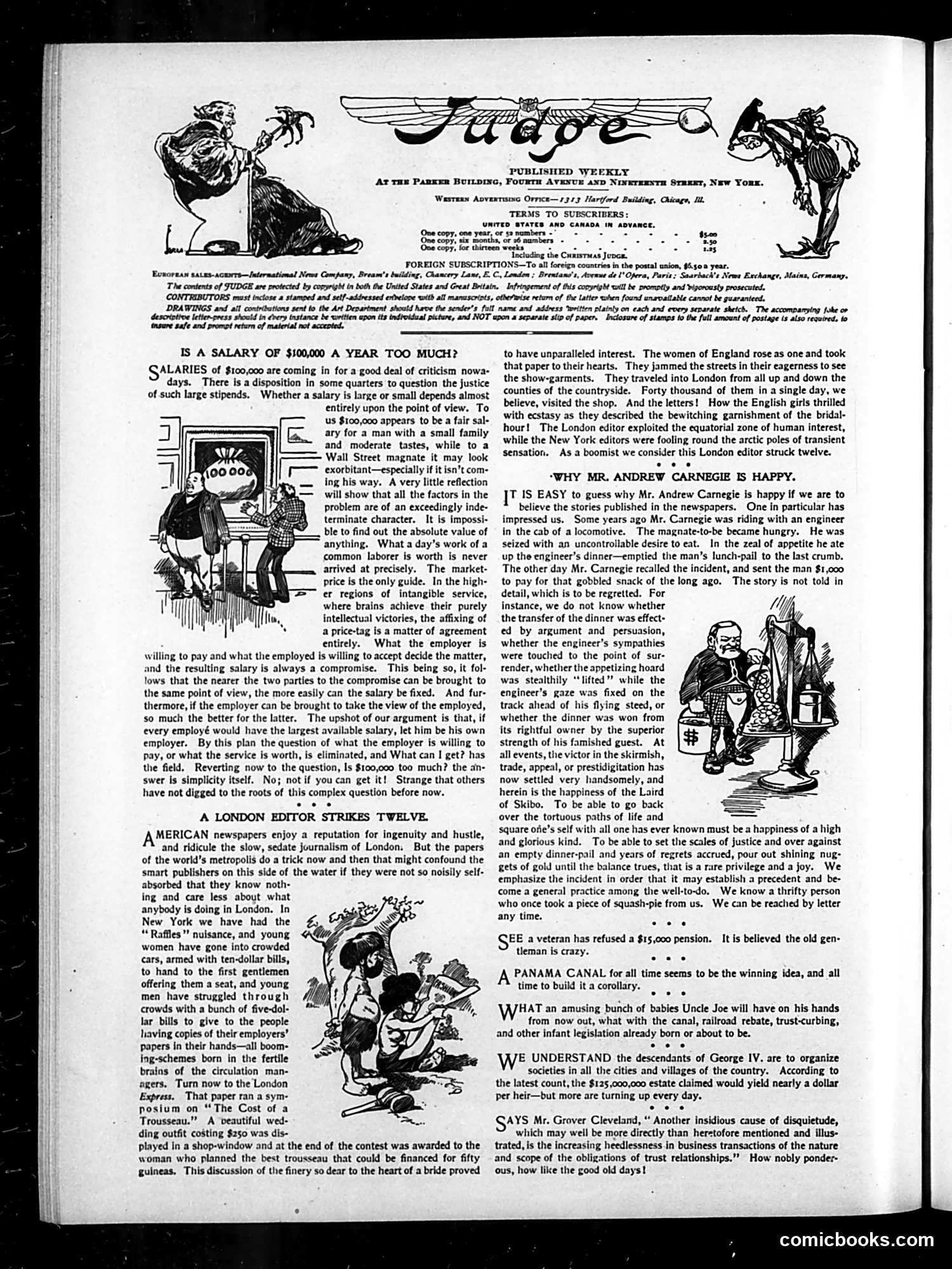
This page from Judge magazine contains several opinion pieces and editorial cartoons critiquing contemporary issues. The left cartoon illustrates "Is a Salary of $100,000 a Year Too Much?" — debating whether such wages are fair. The accompanying text discusses the tension between employers' desires to minimize labor costs and workers' needs, touching on broader class anxieties of the era. The right section, "Why Mr. Andrew Carnegie Is Happy," appears to reference Carnegie's philanthropic activities and contentment, likely with satirical undertones about wealth and social obligation. "A London Editor Strikes Twelve" criticizes London newspapers' sensationalism and lurid content, contrasting it with American journalism standards. The cartoons use exaggerated figures and satirical humor typical of Judge's social commentary approach, addressing labor economics, wealth, and media ethics—recurring themes in early 20th-century American satire.
📄 Transcribed text from this page (OCR, searchable)
Machine-transcribed from the original scan — historical spelling and the odd misread are preserved.
CsSS ISS SS PUBLISHED WEEKLY Az rae Panxer Bortpinc, Fourtm AVENUn axp NixerExxTm SteEer, New Yorx. Wasterx Apvextisinc Orrice—1313 Hartford Building, Chicage, Mit UNITED STATES Ove copy, one year, or 52 numbers = Se ee One copy, six months, or s6numbers- = = ee Dirteen weeks One copy, for TERMS TO SUBSCRIBERS: 1D CANADA IN ADVANCE. = ts00 30 Tncloding the Cwnistsas Juocs. FOREIGN SUBSCRIPTIONS—To all foreign countries in the postal union, $4.50. year. Eonorean sates-acewre—lntermational News Company, Bream’s building, Chancery Lane, E. C, London : Brentans's, Avenue de U' Opera, Parit; Saarback's News Exchange, Mains, Germany, The contents of FUDGE are protected by copyright in both the United States and Great Britain. Infringement of this copyright will be promptly and digorously prosecuted. CONTRIBUTORS mast inctose a stamped and self-addressed erelove with all manuscripts, othefiise retarn of the latter when found unavailae cannot be guaranteed. DRAWINGS and ait contribations sent to the Art Department should have the sender's fall name and address ‘written plainly on each and every letterpress should tn every instance be written upon its indtotdual picture, and NOT upon a separate slip of paper. Inclosure descriptive tnsare safe and prompt retarn of material not IS A SALARY OF $500,000 A YEAR TOO MUCH? SALARIES of $100,000 are coming in for a good deal of criticism nowa- days. There is a disposition in some quarters to question the justice of such large stipends. Whether a salary is large or small depends almost entirely upon the point of view. To us $100,000 appears to be a fair sal- [Bary for a man with a small family and moderate tastes, while to a Wall Street magnate it may look [7 exorbitant—especially if it isn’t com- — ing his way. A very little reflection — will show that all the factors in the problem are of an exceedingly inde- terminate character. It is impossi- ble to find out the absolute value of anything. What a day’s work of a common laborer is worth is never arrived at precisely. The market- price is the only guide. In the high- er regions of intangible service, where brains achieve their purely intellectual victories, the affixing of a price-tag is a matter of agreement entirely. What the employer is willing to pay and what the employed is willing to accept decide the matter, and the resulting salary is always a compromise. This being so, it fol lows that the nearer the two parties to the compromise can be brought to the same point of view, the more easily can the salary be fixed. And fur- thermore, if the employer can be brought to take the view of the employed, so much the better for the latter. The upshot of our argument is that, if every employé would have the largest available salary, let him be his own employer. By this plan the question of what the employer is willing to pay, or what the service is worth, is eliminated, and What can I get? has the field, Reverting now to the question, Is $100,000 too much? the an- swer Is simplicity itself. No; not if you can get it! Strange that others have not digged to the roots of this complex question before now. A LONDON EDITOR STRIKES TWELVE. AMERICAN newspapers enjoy a reputation for ingenuity and hustle, and ridicule the slow, sedate journalism of London, But the papers of the world’s metropolis do a trick now and then that might confound the ‘smart publishers on this side of the water if they were not so noisily self- absorbed that they know noth- ing and care less aboyt what anybody is doing in London. In New York we have had the “Raffles” nuisance, and young women have gone into crowded cars, armed with ten-dollar bills, to hand to the first gentlemen offering them a seat, and young men have struggled through crowds with a bunch of five-dol- lar bills to give to the people having copies of their employers’ papers in their hands—all boom- ing-schemes born in the fertile brains of the circulation man- agers. Turn now to the London Express, That paper ran a sym- posium on “The Cost of a Trousseau.” A veautiful wed- ding outfit costing $250 was dis- played in a shop-window and at the end of the contest was awarded to the woman who planned the best trousseau that could be financed for fifty guineas. This discussion of the finery so dear to the heart of a bride proved separate shetch. The accompanying joke or of stamps to the full amount of postage (3 also required, 10 to have unparalleled interest. The women of England rose as one and took that paper to their hearts. They jammed the streets in their eagerness to see the show-garments. They traveled into London from all up and down the counties of the countryside. Forty thousand of them ina single day, we believe, visited the shop. And the letters! How the English girls thrilled with ecstasy as they described the bewitching garnishment of the bridal- hour! The London editor exploited the equatorial zone of human interest, while the New York editors were fooling round the arctic poles of transient sensation. As a boomist we consider this London editor struck twelve. ‘WHY MR. ANDREW CARNEGIE IS HAPPY. JT JS EASY to guess why Mr. Andrew Carnegie is happy if we are to believe the stories published in the newspapers. One in particular has ‘Some years ago Mr. Carnegie was riding with an engineer in the cab of a locomotive. The magnate-to-be became hungry. He was seized with an uncontrollable desire to eat. In the zeal of appetite he ate up the engineer’s dinner—emptied the man’s lunch-pail to the last crumb. The other day Mr. Carnegie recalled the incident, and sent the man $1,000 to pay for that gobbled snack of the long ago. The story is not told in detail, which is to be regretted. For instance, we do not know whether the transfer of the dinner was effect- ed by argument and persuasion, whether the engineer’s sympathies were touched to the point of sur- render, whether the appetizing hoard was stealthily “lifted” while the engineer’s gaze was fixed on the track ahead of his flying steed, or whether the dinner was won from its rightful owner by the superior strength of his famished guest. At all events, the victor in the skirmish, trade, appeal, or prestidigitation has now settled very handsomely, and herein is the happiness of the Laird of Skibo, To be able to go back over the tortuous paths of life and square orie’s self with all one has ever known must be a happiness of a high and glorious kind. To be able to set the scales of justice and over against an empty dinner-pail and years of regrets accrued, pour out shining nug- gets of gold until the balance trues, that is a rare privilege and a joy. We emphasize the incident in order that it may establish a precedent and be- come a general practice among the well-to-do. We know a thrifty person who once took a piece of squash-pie from us. We can be reached by letter any time. impressed us. SFE a veteran has refused a $15,000 pension. tleman is crazy. It is believed the old gen- A PANAMA CANAL for all time seems to be the winning idea, and all time to build it a corollary. HAT an amusing bunch of babies Uncle Joe will have on his hands from now out, what with the canal, railroad rebate, trust-curbing, and other infant legislation already born or about to be. WE UNDERSTAND the descendants of George IV. are to organize societies in all the cities and villages of the country. According to the latest count, the $125,000,000 estate claimed would yield nearly a dollar per heir—but more are turning up every day. AYS Mr. Grover Cleveland, “* Another insidious cause of disquietude, which may well be more directly than heretofore mentioned and illus trated, is the increasing heedlessness in business transactions of the nature and scope of the obligations of trust relationships.” How nobly ponder- ous, how like the good old days! comicbooks.com