
A complete issue · 16 pages · 1905
Judge — November 18, 1905
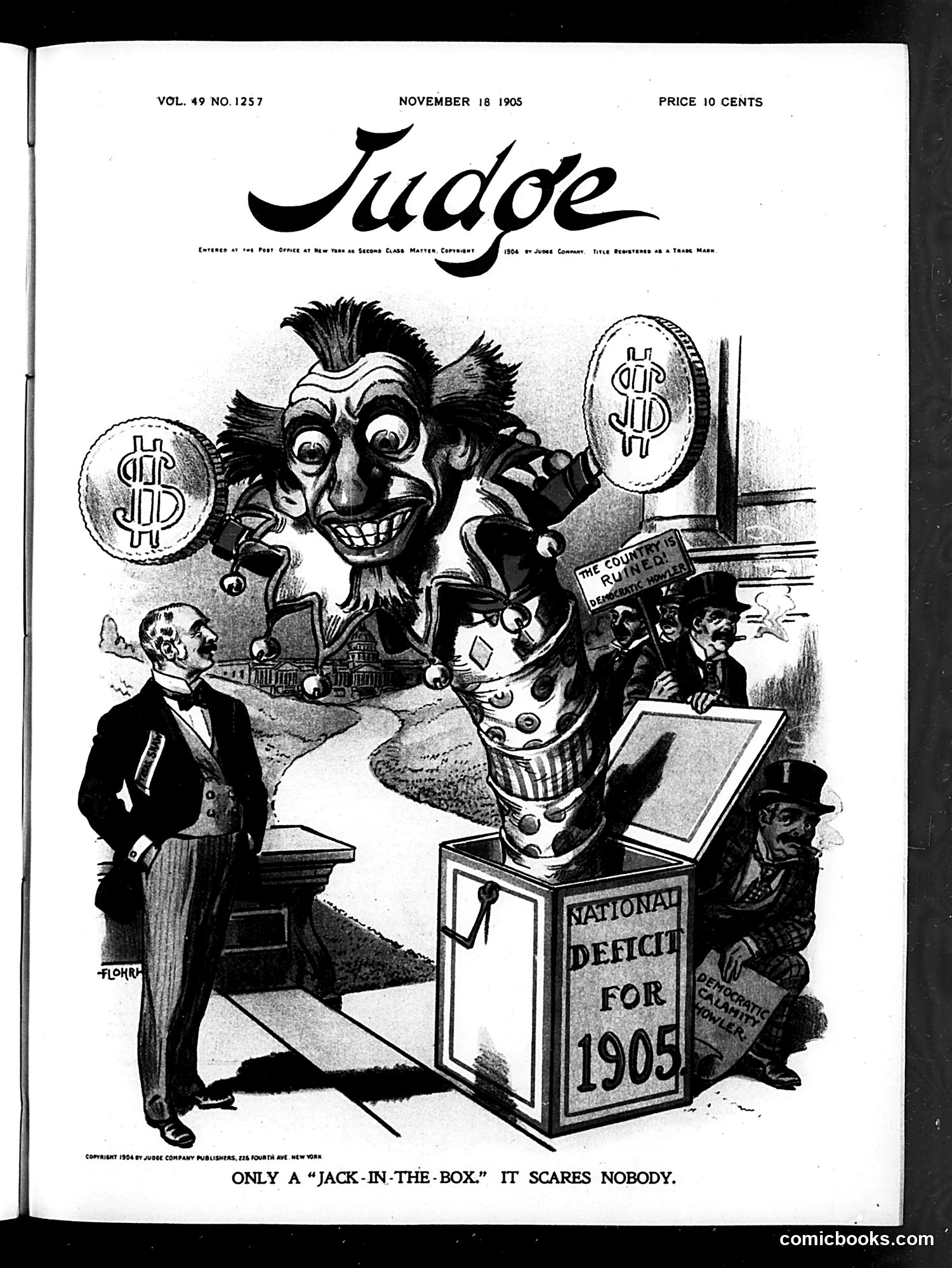
This political cartoon satirizes the 1905 U.S. national budget deficit. A grotesque "jack-in-the-box" figure—representing runaway government spending—springs from a box labeled "National Deficit for 1905," alarming onlookers. The figure juggles dollar signs, symbolizing wasteful spending or financial mismanagement. The well-dressed gentleman observing on the left appears to represent responsible fiscal authority, while the distressed figures on the right (including what seems to be a political or economic figure labeled with text about the deficit) react with concern. The caption—"Only a 'Jack-in-the-Box.' It Scares Nobody"—suggests ironic commentary: the deficit should frighten people more than it apparently does, or that public complacency toward fiscal problems is itself the real joke.
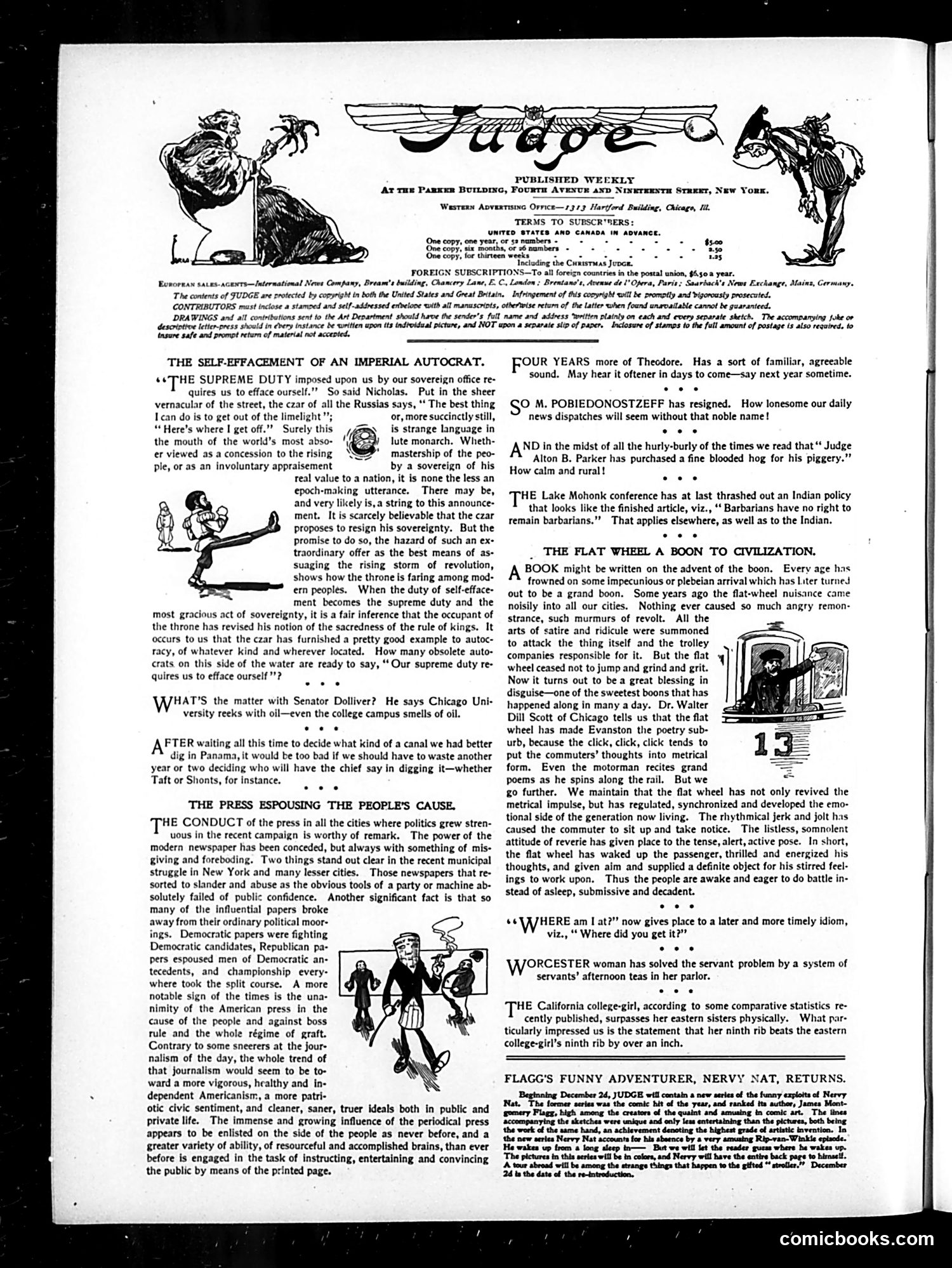
This editorial cartoon critiques Tsar Nicholas II of Russia, mocking his claim to limit his own power through constitutional reform. The illustration shows a figure (the Tsar) appearing diminished or constrained—depicted as absurdly small—suggesting the satirist's view that his promised self-restraint is hollow theater. The accompanying article argues that Nicholas's concessions to parliamentarism represent false modesty masking continued autocratic control. The joke targets the contradiction between his rhetoric of voluntarily reducing imperial authority and the reality that he retains supreme power. The cartoon ridicules what Judge views as the Tsar's transparent pretense of constitutional limitation while maintaining actual despotic rule.
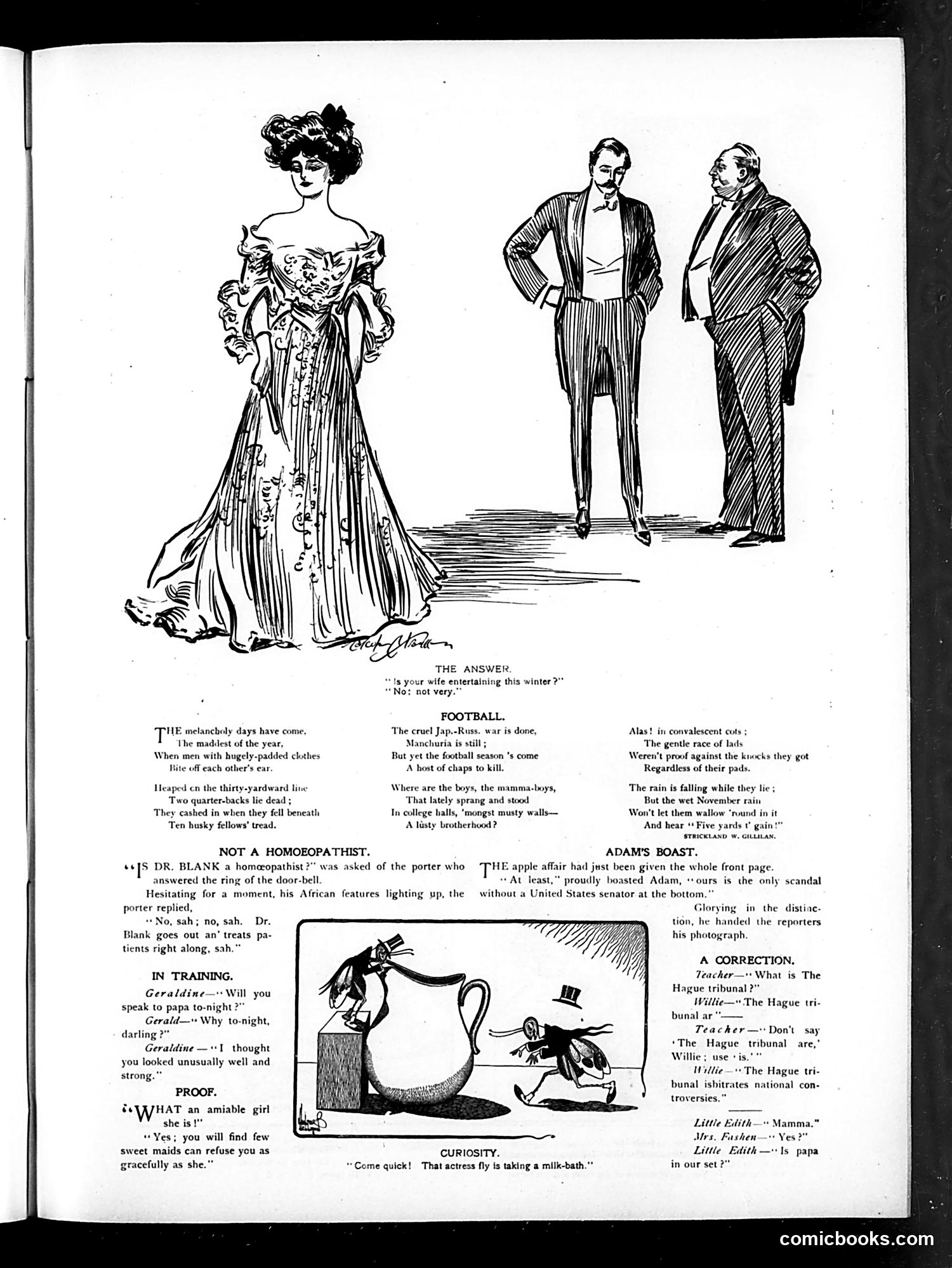
This Judge magazine page contains several humor sections typical of early 20th-century satirical magazines: **Top illustration**: A woman in elaborate evening dress encounters two men, with the caption "THE ANSWER" to the question "Is your wife entertaining this winter?" / "Not very."—a joke about the woman's social status or entertaining abilities. **"FOOTBALL"** and **"NOT A HOMOEOPATHIST"**: Standalone humorous anecdotes without political content. **Bottom cartoons**: Include domestic humor sketches ("IN TRAINING," "PROOF," "CURIOSITY") depicting exaggerated gender relations and family scenarios common to Judge's comedic formula. The page lacks clear political satire or identifiable public figures. Instead, it represents typical early 1900s humor: upper-class social commentary, marital jokes, and sentimental domestic scenarios that modern readers would find conventional rather than sharp satire.
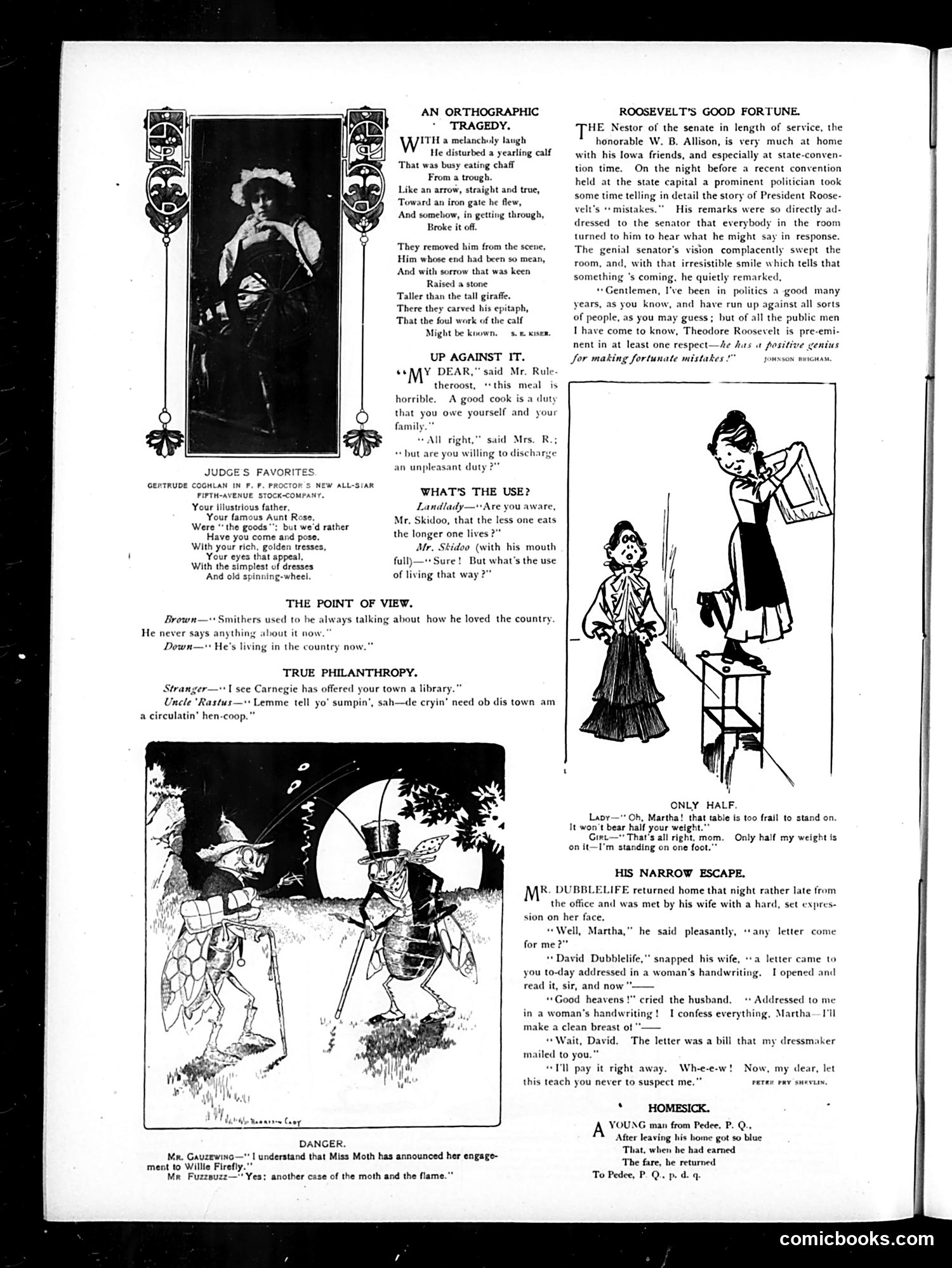
This page contains several satirical pieces: **"Roosevelt's Good Fortune"**: A humorous anecdote where W.B. Allison recounts Roosevelt's positive quality—his "positive genius for making fortunate mistakes." The joke appears to mock Roosevelt's reputation for achieving favorable outcomes despite questionable decisions. **"Judge's Favorites"**: A poem about Gertrude Cochran in Proctor's theatrical production, celebrating her as the "famous Aunt R——" with flattering verse. **Multiple Short Jokes**: Including "The Point of View" (contrasting rural and urban perspectives), "True Philanthropy" (mocking false charity), and "Only Half" (a domestic humor bit). **"His Narrow Escape"**: A domestic comedy where Mr. Dubblelife opens a letter addressed to his wife in another woman's handwriting, creating marital misunderstanding. The overall tone reflects typical early-1900s Judge magazine humor—political mockery, theatrical gossip, and domestic comedy.
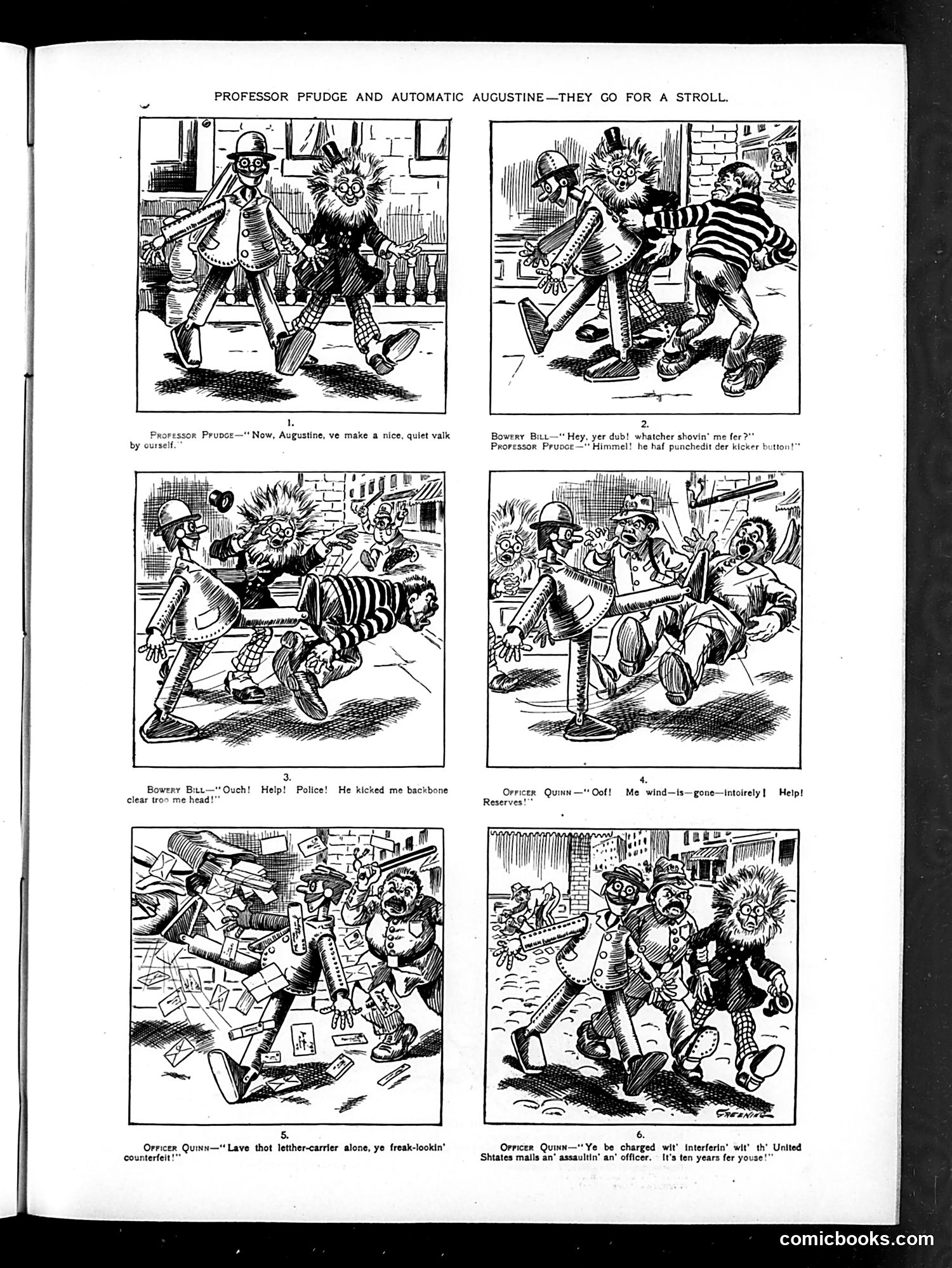
This comic strip satirizes two characters—Professor Pfudge and "Automatic Augustine"—on a chaotic city stroll. The humor derives from physical comedy: Augustine is a mechanical or robot-like figure (suggested by "Automatic") whose uncontrolled movements create mayhem. In successive panels, Augustine kicks Bowery Bill, collides with Officer Quinn, scatters papers everywhere, and causes general urban pandemonium. The satire likely mocks early 20th-century automatons/mechanical inventions and their unpredictable dangers. The "Bowery" reference (NYC's notorious slum district) and the interaction with police suggest social commentary on lower-class city life. The absurdist humor relies on slapstick and the premise that introducing mechanical chaos into everyday urban society produces inevitable disorder.
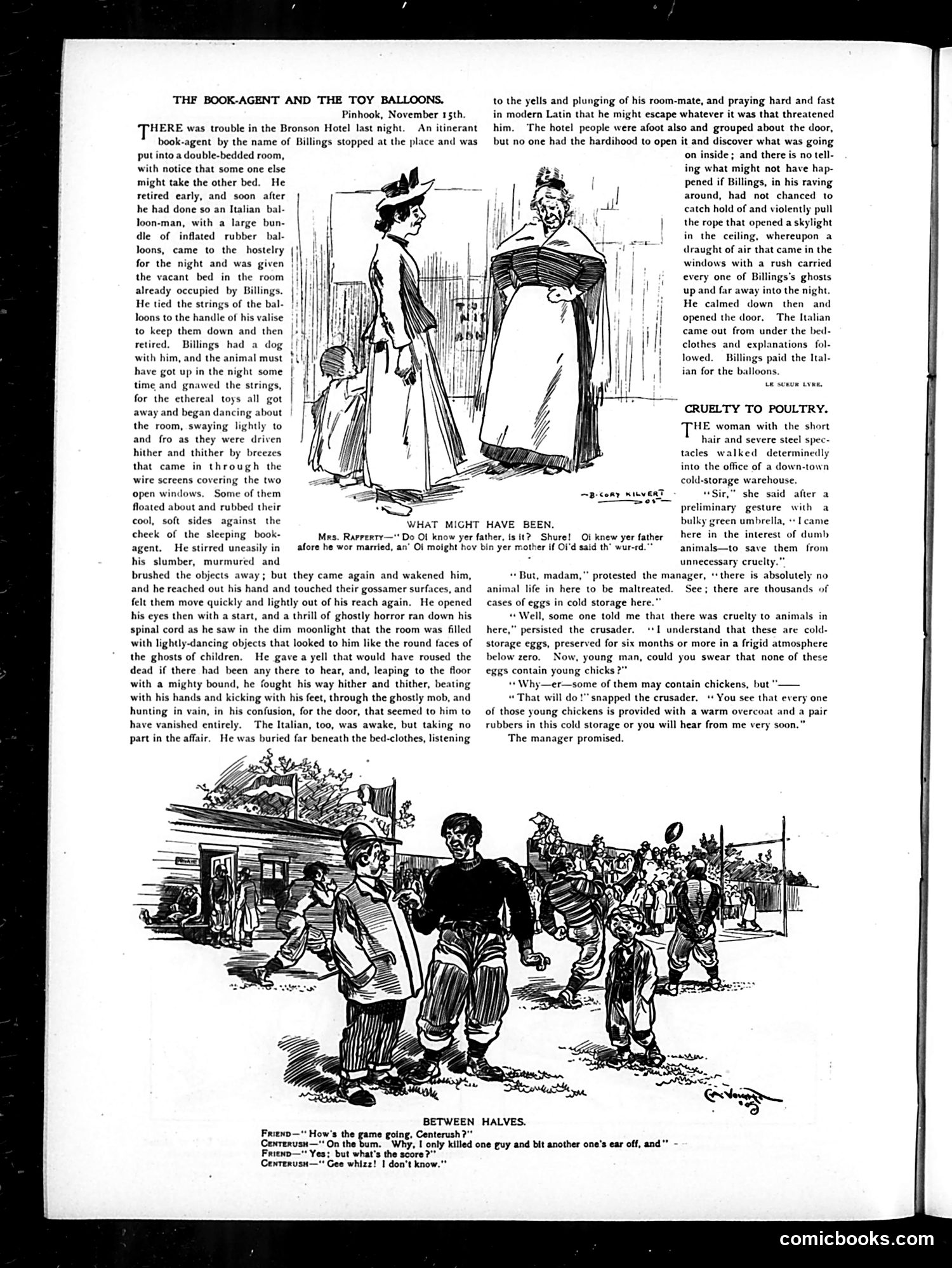
This page contains two separate humorous stories satirizing late-19th/early-20th-century American types: **"The Book-Agent and the Toy Balloons":** A traveling book salesman shares a hotel room with an Italian balloon vendor. The salesman's dog gnaws through the balloon strings, and they float about in the darkness. The panicked salesman mistakes the ghostly, glowing balloons for spectral children's faces and creates chaos. The satire targets itinerant salesmen (then considered annoying and suspicious) and the superstitious terror they could experience. **"Cruelty to Poultry":** A short-haired woman with steel spectacles—visual markers identifying her as a humorless "animal rights crusader"—invades a cold-storage warehouse. She accuses them of cruelty, apparently believing that eggs contain young chickens requiring warmth and care. The joke ridicules do-gooding reformers and animal welfare activists as well-meaning but absurdly ignorant. Both stories mock contemporary social types through exaggerated situations.
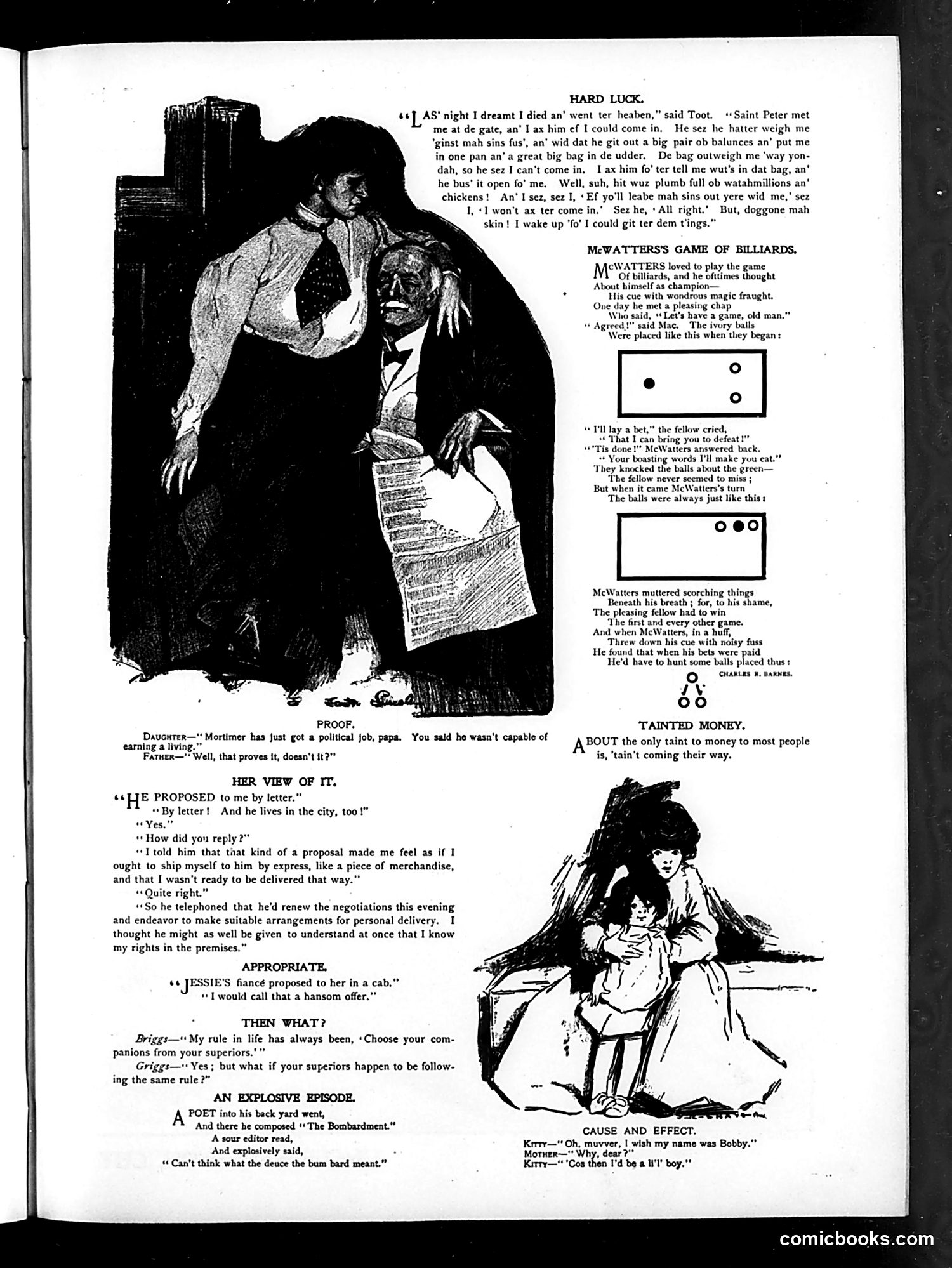
This page collects humorous short pieces typical of early 20th-century American humor magazines. The main content includes: **"Hard Luck"**: A dialect joke where a Black character (Toot) recounts a dream about St. Peter weighing his sins; the punchline relies on racist stereotypes about watermelons and chickens. **"McWatters's Game of Billiards"**: A straightforward joke about a confident billiards player who loses repeatedly, illustrated with diagrams showing ball positions. **"Tainted Money"**: A political jab at a man appointed to a government job despite incompetence—satire of political patronage and nepotism. **Other short jokes** about marriage proposals, class pretension, and a poet whose inflammatory poem angers an editor. The page demonstrates Judge's formula: mixing social satire (political appointments, class anxiety) with domestic humor and period-specific dialect comedy. The racial caricature reflects the magazine's casual bigotry typical of its era.
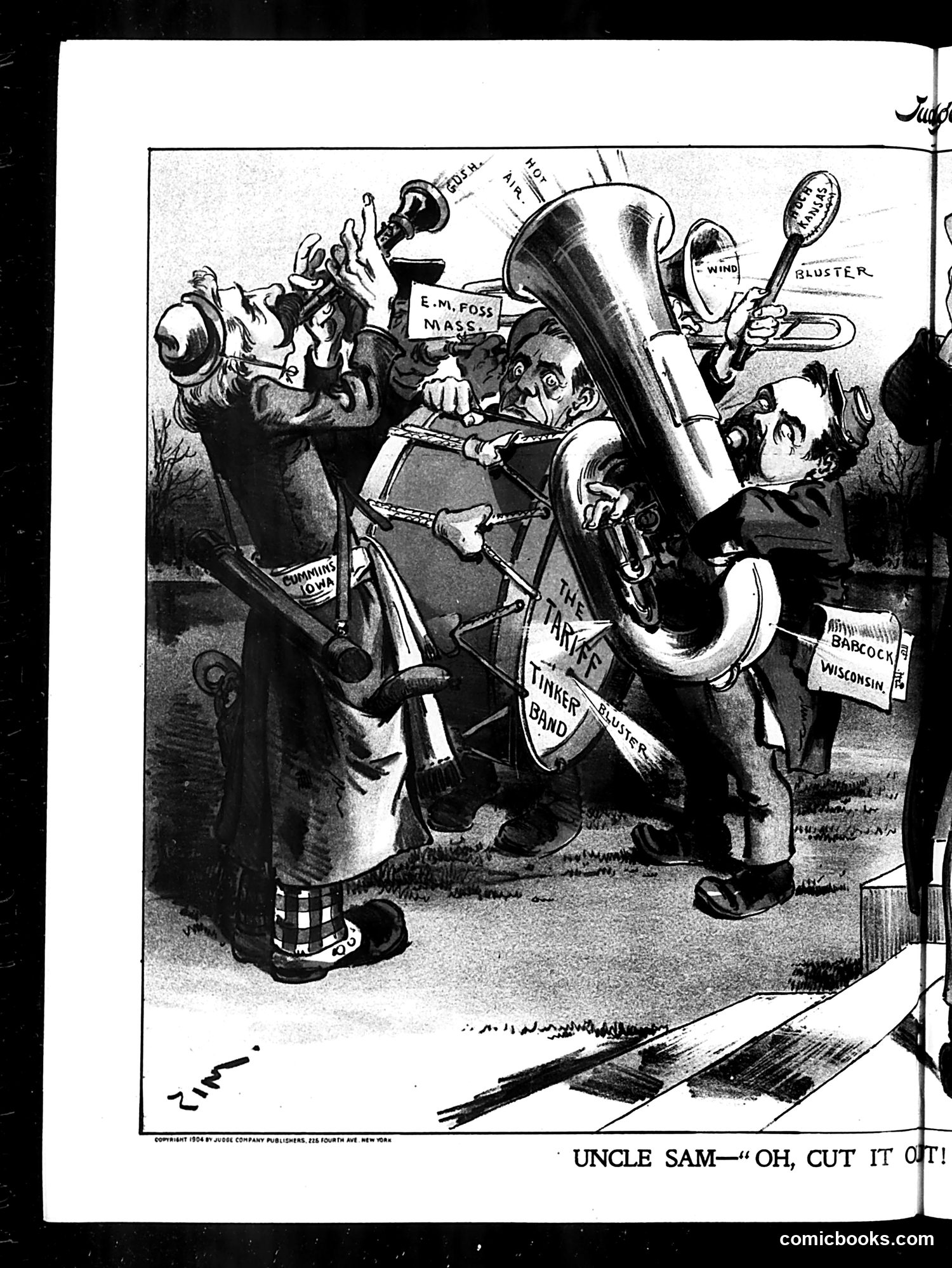
This 1904 political cartoon depicts Uncle Sam (representing the United States) exasperatedly telling someone to "cut it out." He's surrounded by what appears to be a brass band or musical group creating chaos—visible labels include "E.M. Foss Mass," "Cummings Iowa," "Babcock Wisconsin," and references to a "Tin-type Band" and "Bluster." The satire likely critiques noisy, disruptive political figures or campaigning during this era. The "band" metaphor suggests politicians making excessive noise or commotion. Without clearer identification of all figures, the precise political targets remain uncertain, but the cartoon expresses frustration with loud, attention-seeking political behavior disrupting the nation's governance. The composition emphasizes cacophony and disorder surrounding Uncle Sam's weary authority.
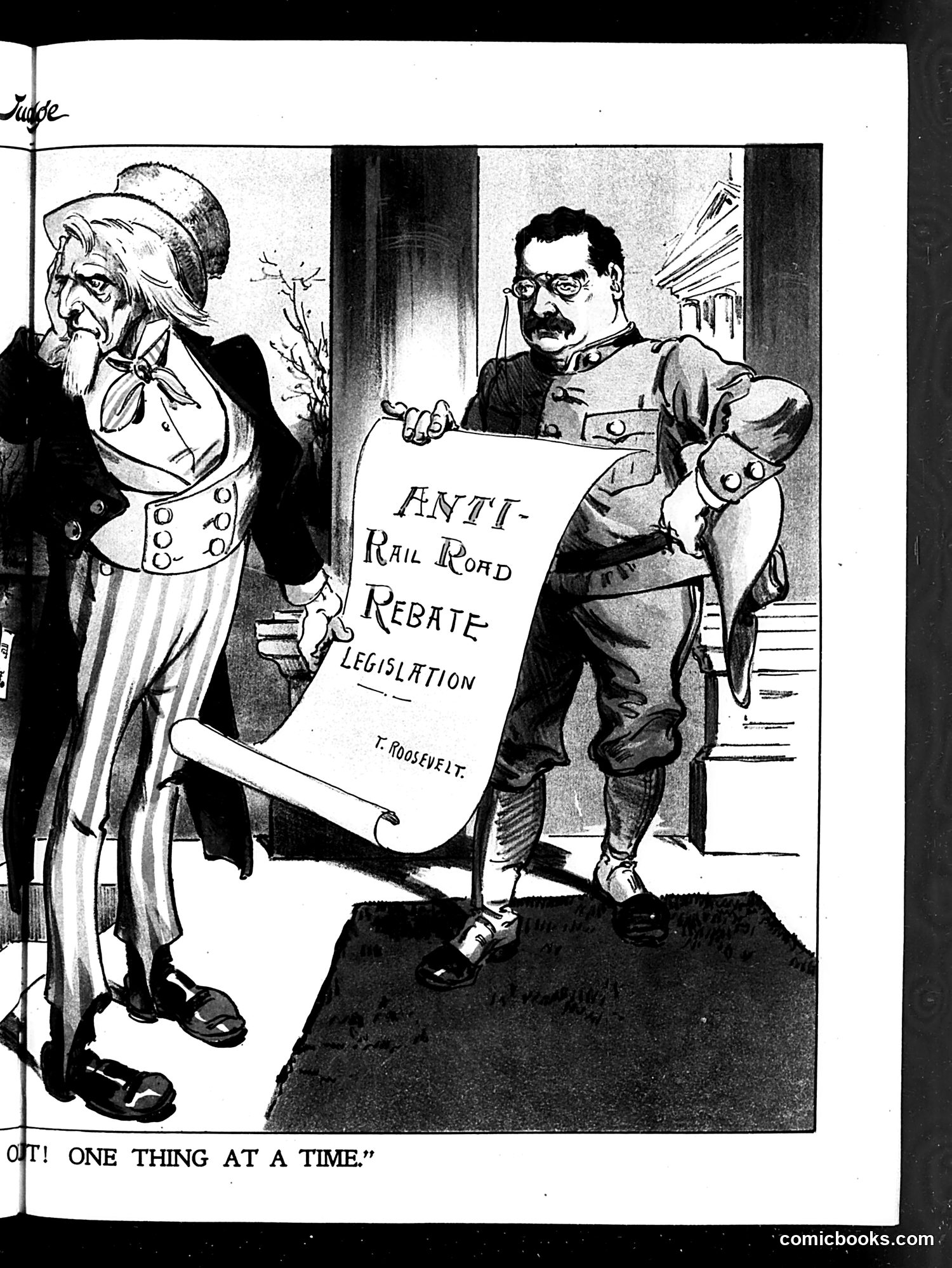
This **Judge** magazine cartoon satirizes Theodore Roosevelt's "Anti-Rail Road Rebate Legislation." The figure on the left (an elderly man with a long beard, likely representing an established political or business interest) appears dismayed as Roosevelt (identifiable by his distinctive glasses and mustache, wearing a military-style uniform) holds up legislation addressing railroad rebates—illegal practices where railroads secretly reduced shipping rates for favored customers. The caption "Out! One thing at a time" suggests the satire: Roosevelt is pursuing multiple reform initiatives simultaneously, and the cartoon implies this aggressive reform agenda frustrates traditional power brokers. The image criticizes or mocks Roosevelt's progressive regulatory approach to corporate practices during the trust-busting era of early 1900s American politics.
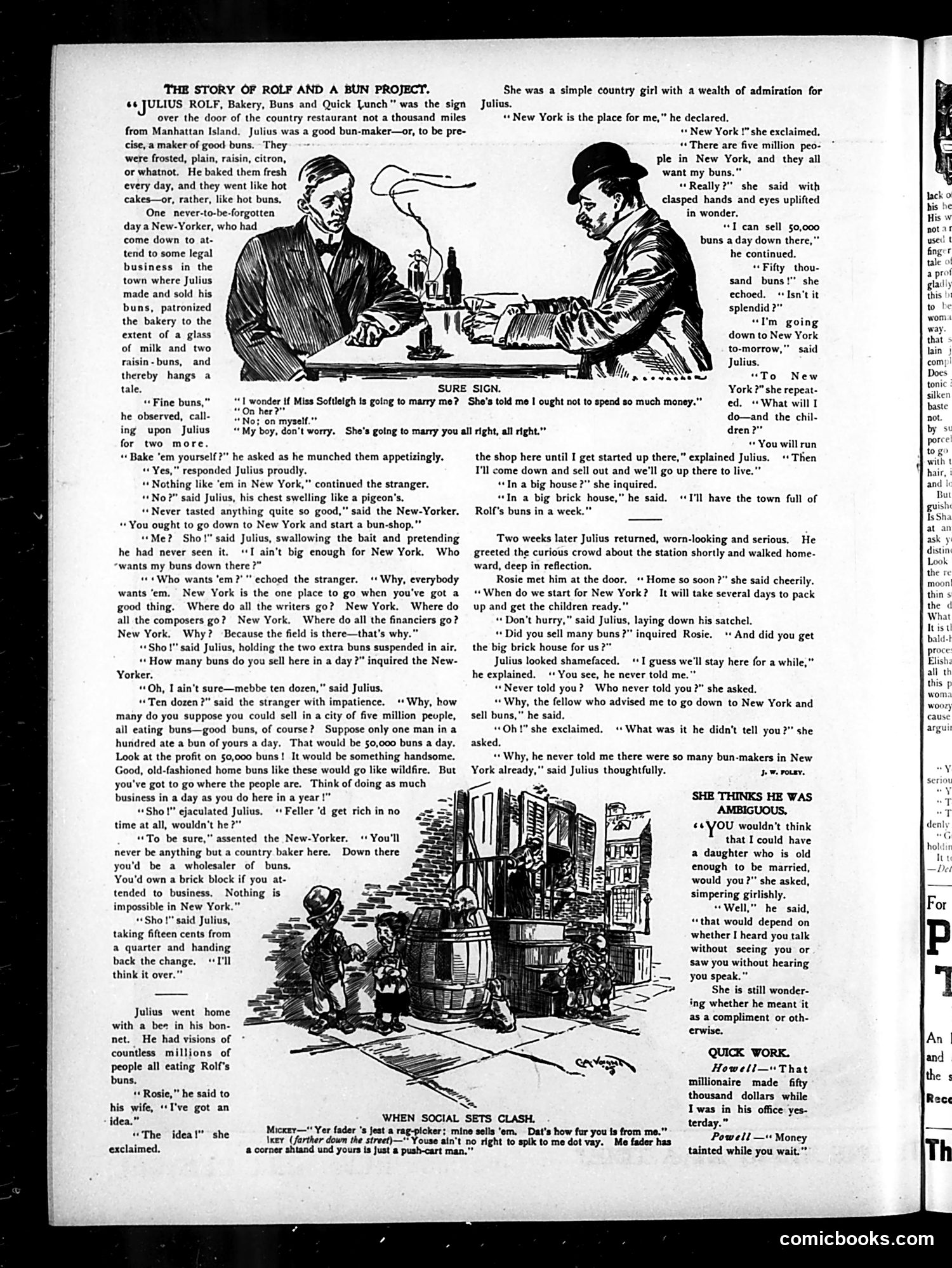
This is a satirical story mocking get-rich-quick schemes and the seductive promises of New York entrepreneurship. Julius, a successful country baker, is persuaded by a smooth-talking stranger that he could become wealthy selling buns in New York City. The stranger uses classic sales tactics: flattery ("finest buns"), appeals to ambition ("you'd own a brick block"), and inflated projections (50,000 buns daily vs. his current ten dozen). The satire targets gullible small-town businessmen lured by visions of urban fortune, and the con-artist rhetoric that promises wealth through relocation and scale. Julius's naive faith in the stranger's math and his wife's starry-eyed responses exemplify the period's fascination with—and skepticism toward—American capitalist mobility and big-city dreams. The tone suggests Julius will likely fail in New York, having abandoned proven success for unrealistic fantasy.
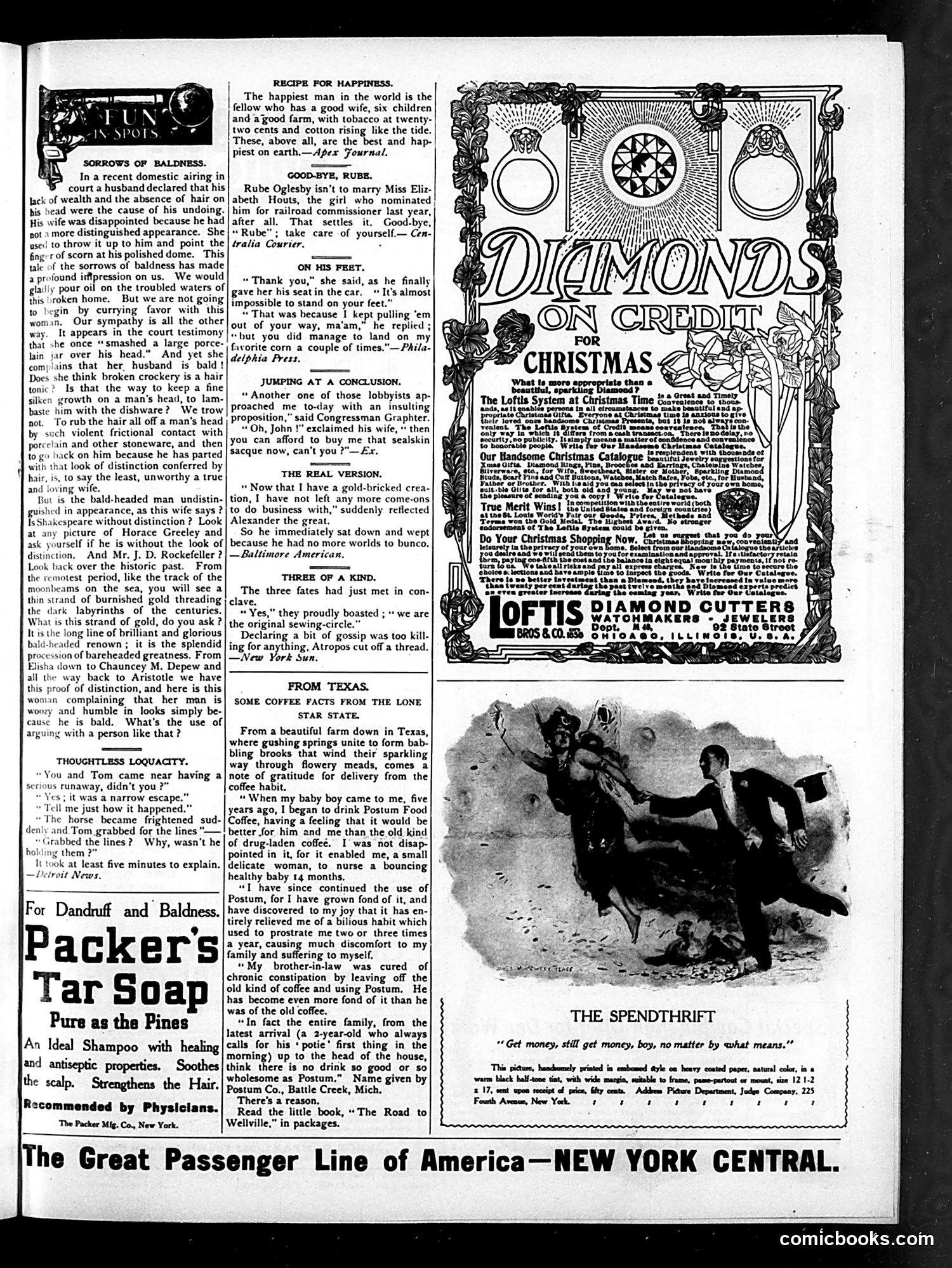
This page is primarily **advertising and short humor pieces**, not political cartoons. The content includes: **Main Advertisement**: "Diamonds on Credit for Christmas" dominates the right side—a jewelry store promotion offering installment purchasing, reflecting early 20th-century consumer credit expansion. **Humor Sections**: Several brief anecdotes satirize domestic life and social pretension: - "Sorrows of Baldness" mocks a wife who physically abused her husband then complained he was bald, while ironically defending baldness as a sign of distinction (citing Shakespeare, Rockefeller, and historical figures). - "Thoughtless Loquacity" jokes about a woman misunderstanding whether her companion was "holding the lines" (reins) during a runaway horse incident. - "From Texas" describes a mother praising Postum (a coffee substitute) for curing family ailments—clearly promotional content disguised as anecdote. **The Spendthrift**: A photograph with caption "Get money, still get money, boy, no matter by what means" depicts apparent poverty. The page reflects **consumer culture themes** and gentle domestic satire typical of Judge magazine's era, with heavy advertising integration.
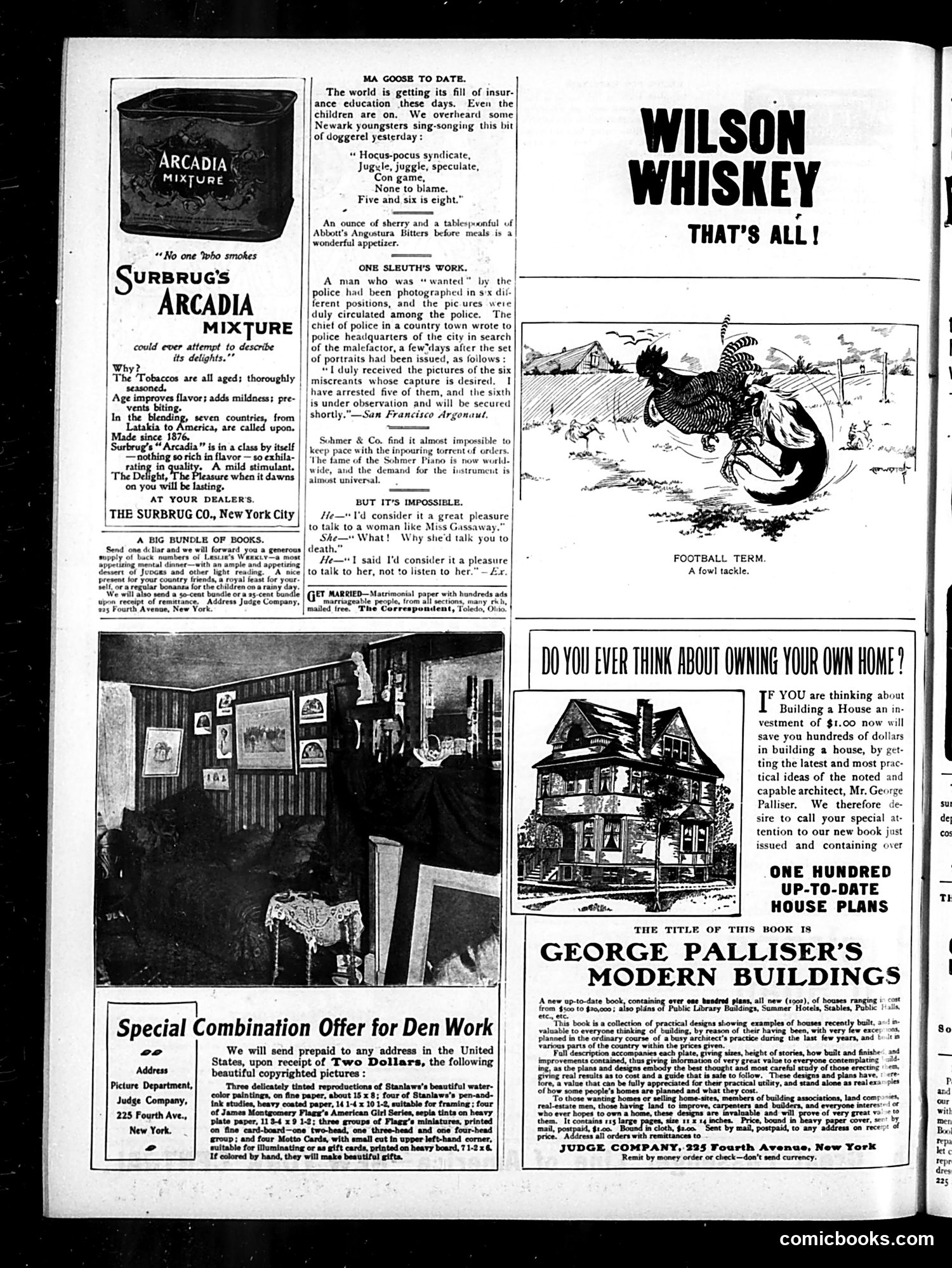
This page is primarily **advertising and miscellaneous content** rather than political satire. The main cartoon—titled "FOOTBALL TERM"—shows a rooster attacking what appears to be a person, with the caption "A fowl tackle," a simple pun on the sports term. The page contains multiple advertisements for consumer products (Surbrug's Arcadia tobacco mixture, Wilson Whiskey, Sohmer pianos) and services (house plans by architect George Palliser, Judge Company's picture reproductions). The text includes light humor pieces: a parody of "Mother Goose" mocking insurance industry jargon (the verse "Five and six is eight" satirizes financial manipulation), an anecdote about a police chief arresting five of six wanted criminals, and a brief dialogue joke about a talkative woman. The overall tone is genteel, commercial humor typical of early 1900s American magazines—lacking sharp political critique or caricature of identifiable public figures.
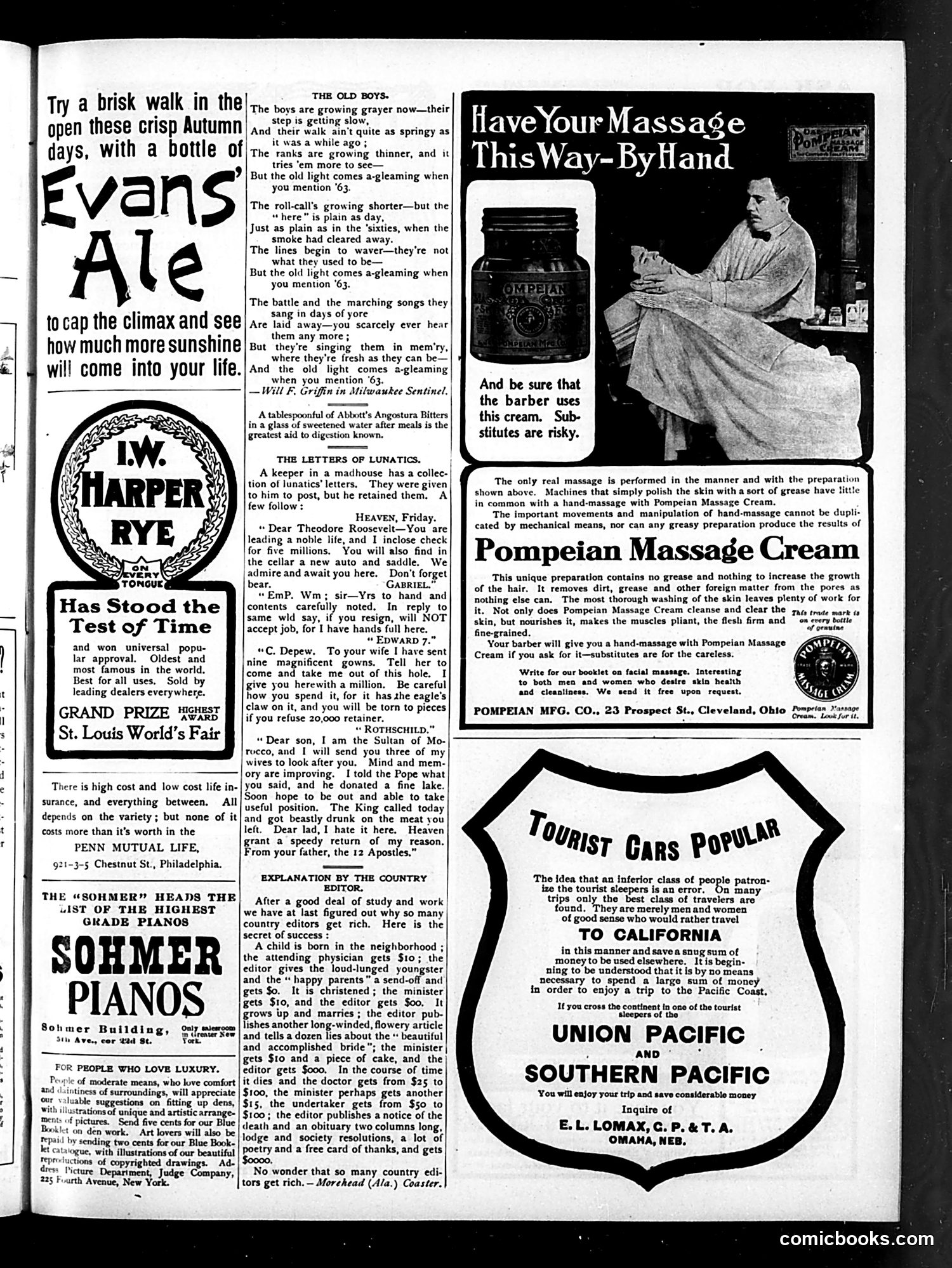
This page features a humorous satirical column presenting fictional letters supposedly written by mentally ill asylum patients. The joke relies on the conceit that lunatics write absurdly flattering, delusional letters to famous figures of the era. The targets include **Theodore Roosevelt** (receiving offers of millions and a car), **Emperor William II** of Germany, **Chauncey Depew** (a prominent businessman), **the Rothschild banking family**, and the **Sultan of Morocco**. Each letter contains obvious delusions—offers of impossible wealth, celestial settings ("Heaven, Friday"), or ridiculous promises. The satire works on multiple levels: mocking both the recipients' egos (suggesting they'd enjoy such excessive praise) and contemporary attitudes toward mental illness, treating lunatics as amusing curiosities. The tone is light and dismissive rather than sympathetic. The page is otherwise filled with period advertisements for ales, pianos, massage devices, and life insurance—typical Judge magazine content from this early 20th-century era.
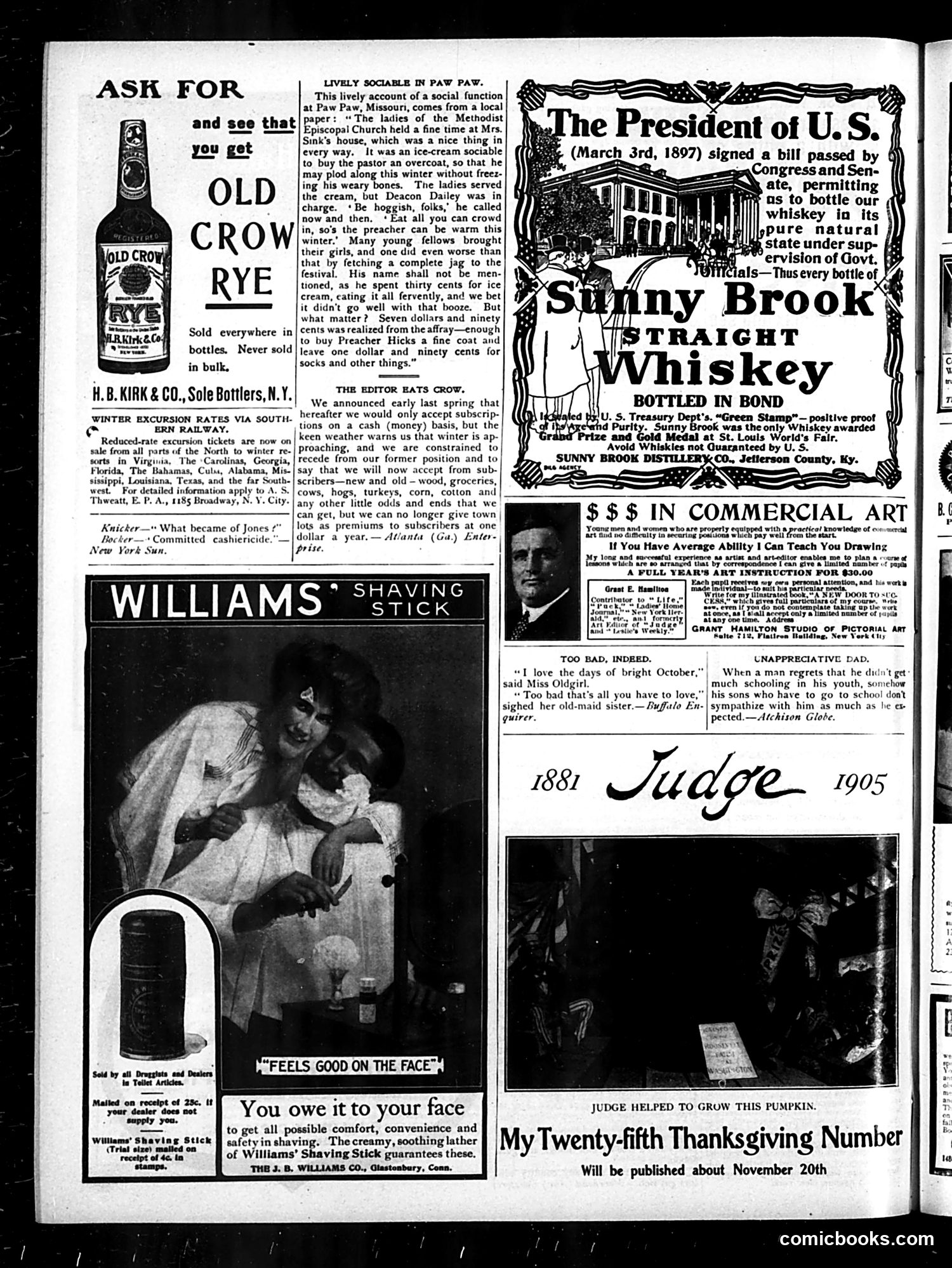
This page is primarily **advertising and light humor** rather than political satire. Key content: **Advertisements:** Old Crow Rye whiskey, Williams' Shaving Stick, art instruction courses, and railroad excursion rates dominate the page. **Humorous Items:** Brief jokes include an editor admitting he must accept non-cash subscriptions (reversing his spring policy due to approaching winter), and quips about a Methodist church ice-cream social where a drunk man spent thirty cents on dessert. **The Sunny Brook Whiskey Advertisement** celebrates that President McKinley (March 3, 1897) signed legislation allowing whiskey bottling under government supervision—presented as proof of purity. The ad notes this whiskey won awards at the St. Louis World's Fair. **Judge Magazine Context:** This appears to be a standard issue mixing advertising revenue with gentle social humor and promotional content—typical of early 1900s publications. The satire is mild; no sharp political commentary is evident on this particular page.
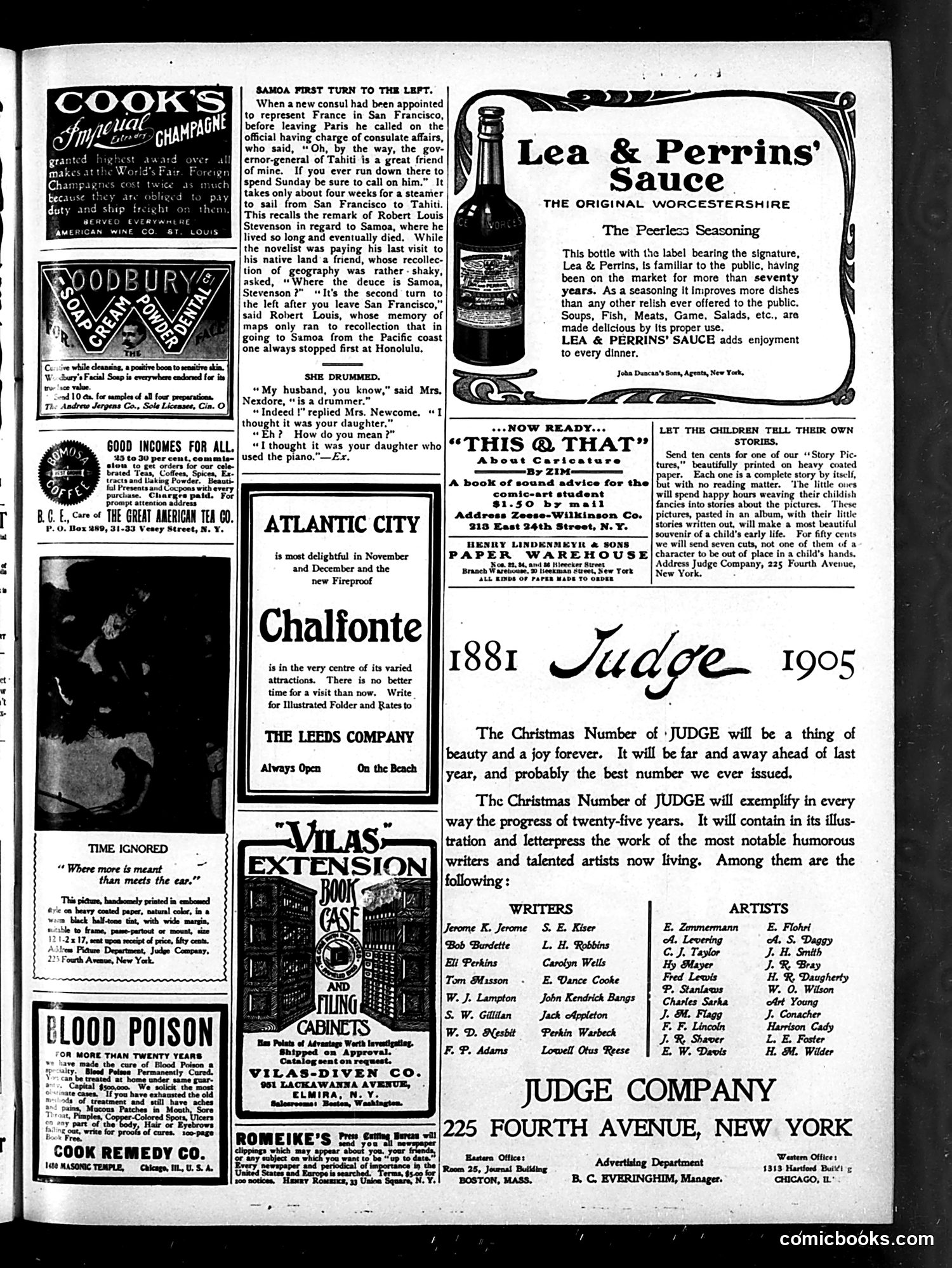
This page is primarily advertisements and promotional material for *Judge* magazine's upcoming Christmas issue. However, the featured content is a humorous anecdote about imprecise geography. The story mocks vague directional knowledge: a French official tells a consul visiting Tahiti to simply "call on" the governor-general there, as if it's a casual Sunday visit, when it actually requires four weeks by steamer from San Francisco. The joke is extended through Robert Louis Stevenson's similarly flippant response about Samoa's location: "the second turn to the left after you leave San Francisco"—treating a distant Pacific island nation as though it were a local street corner. The satire targets how geography seems irrelevant to people discussing faraway colonial territories, suggesting either ignorance or indifference about actual distances and travel involved in colonial administration. The page also includes a brief "She Drummed" joke playing on the double meaning of "drummer" (traveling salesman vs. percussionist).
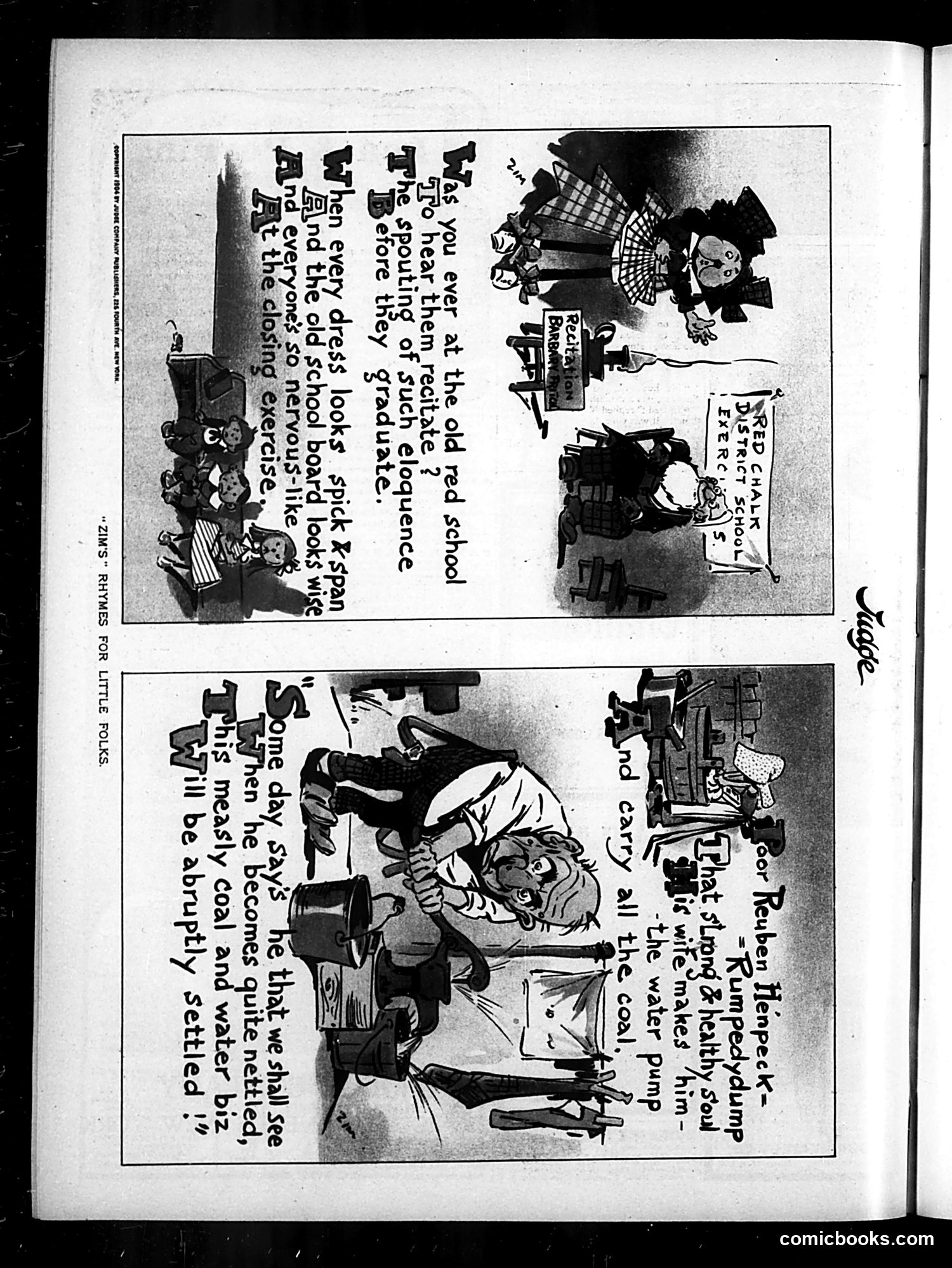
This page contains nostalgic and humorous content about schoolchildren rather than political satire. The top section features verse about "the old red school," romanticizing a one-room schoolhouse where children recited lessons and wore neat clothing before graduation—evoking rural American educational tradition. The lower section presents "Zim's Rhymes for Little Folks," appearing to be children's verse. One illustrated rhyme depicts a character named Rumpledydump at a water pump, with accompanying text suggesting he'll eventually leave his "measly coal and water biz" when he "becomes quite nettled" (annoyed). The humor appears gentle and domestic rather than satirical—poking mild fun at childhood and rural American life. There's nostalgia for simpler schooling and anticipation of social advancement, reflecting early 1900s American values around education and upward mobility, but no apparent sharp political critique or contemporary reference.