
Judge, 1905-11-18 · page 10 of 16
Judge — November 18, 1905 — page 10: what you’re looking at
What you’re looking at
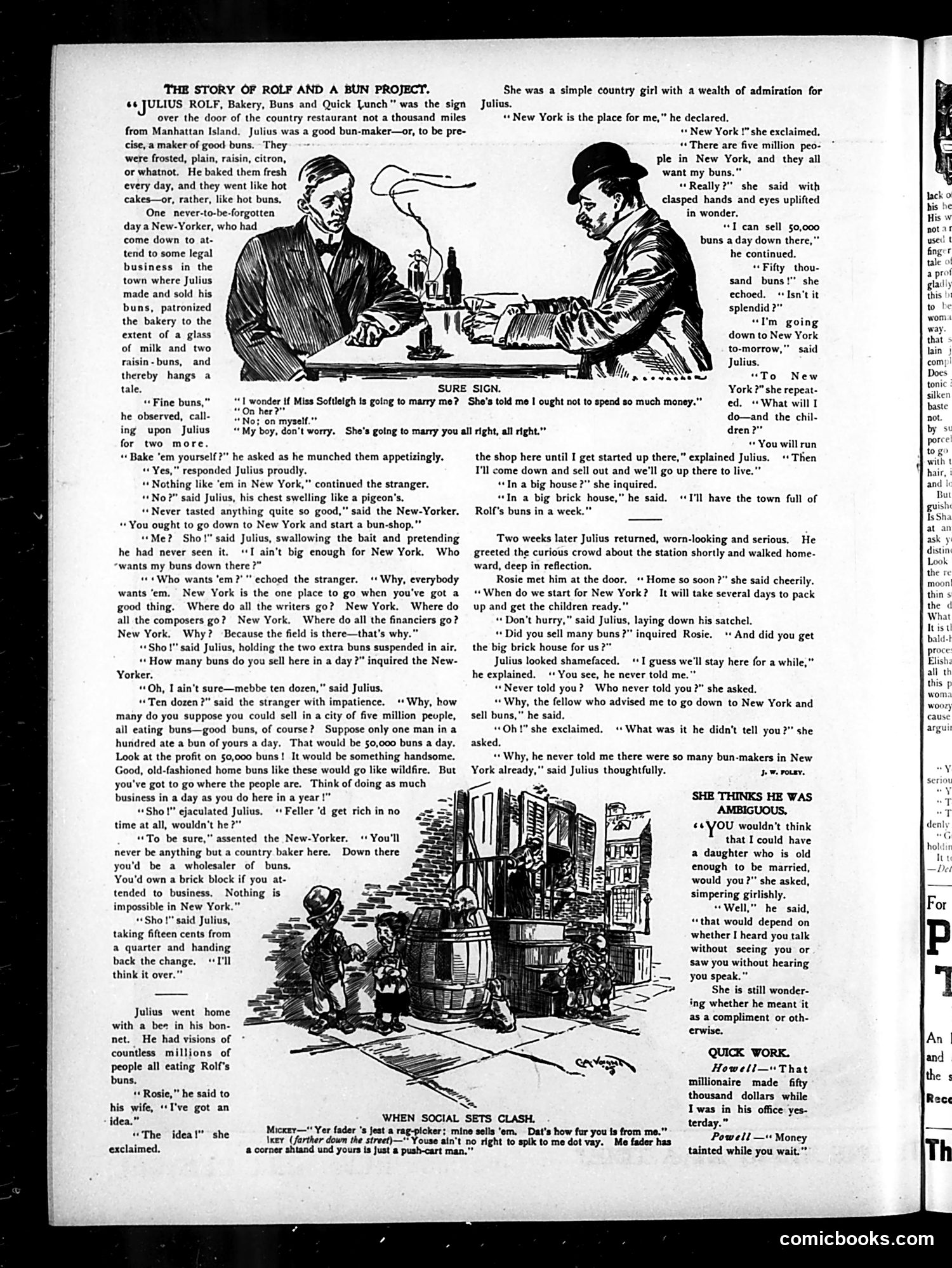
This is a satirical story mocking get-rich-quick schemes and the seductive promises of New York entrepreneurship. Julius, a successful country baker, is persuaded by a smooth-talking stranger that he could become wealthy selling buns in New York City. The stranger uses classic sales tactics: flattery ("finest buns"), appeals to ambition ("you'd own a brick block"), and inflated projections (50,000 buns daily vs. his current ten dozen). The satire targets gullible small-town businessmen lured by visions of urban fortune, and the con-artist rhetoric that promises wealth through relocation and scale. Julius's naive faith in the stranger's math and his wife's starry-eyed responses exemplify the period's fascination with—and skepticism toward—American capitalist mobility and big-city dreams. The tone suggests Julius will likely fail in New York, having abandoned proven success for unrealistic fantasy.
📄 Transcribed text from this page (OCR, searchable)
Machine-transcribed from the original scan — historical spelling and the odd misread are preserved.
THE STORY OF ROLF AND A BUN PROJECT. ss JULIUS ROLF, Bakery, Buns and Quick Lunch” was the sign over the door of the country restaurant not a thousand miles from Manhattan Island. Julius was a good bun-maker—or, to be pre- cise, a maker of good buns. They were frosted, plain, raisin, citron, or whatnot. He baked them fresh every day, and they went like hot cakes—or, rather, like hot buns. One never-to-be-forgotten day a New-Yorker, who had come down to at- tend to some legal business in the town where Julius made and sold his buns, patronized the bakery to the extent of a glass of milk and two raisin-buns, and thereby hangs a tale. SURE «Fine buns,” wonder if Miss Sofleigh is golng to marry me? “On her?" he observed, calle ogo er ett ing upon Julius “My boy, don't worry. She's going to marry you all right, all right.”” for two more. «Bake ‘em yourself?" he asked as he munched them appetizingly. «Yes," responded Julius proudly. «Nothing like ‘em in New York,” continued the stranger. ++No?" said Julius, his chest swelling like a pigeon's. «Never tasted anything quite so good," said the New-Yorker. ** You ought to go down to New York and start a bun-shop.”” ‘*Me? Sho!" said Julius, swallowing the bait and pretending he had never seen it. «I ain't big enough for New York. Who “wants my buns down there ?” «Who wants ‘em ?'" echoed the stranger.‘ Why, everybody wants ‘em. New York is the one place to go when you've got a good thing. Where do all the writers go? New York. Where do all the composers go? New York. Where do all the financiers go? New York. Why? Because the field is there—that's why.” «Sho !" said Julius, holding the two extra buns suspended in air, + How many buns do you sell here in a day?” inquired the New- Yorker. “Oh, I ain't sure—mebbe ten dozen,” said Julius. «Ten dozen ?" said the stranger with impatience. ‘Why, how many do you suppose you could sell in a city of five million peuple, all eating buns—good buns, of course? Suppose only one man in a hundred ate a bun of yours a day. That would be 50,000 buns a day. Look at the profit on 50,000 buns! It would be something handsome. Good, old-fashioned home buns like these would go like wildfire. But you've got to go where the people are. Think of doing as much business in a day as you do here in a year!” Sho!" ejaculated Julius. «Feller ‘d get rich in no time at all, wouldn't he?” «To be sure,” assented the New-Yorker. ‘You'll never be anything but a country baker here. Down there you'd be a wholesaler of buns. You'd own a brick block if you at- tended to business, Nothing is impossible in New York.” “Sho !" said Julius, taking fifteen cents from a quarter and handing back the change. “I'll think it over.” Julius went home with a ber in his bon- net. He had visions of countless millions of people all eating Rolf’s buns. «+ Rosie,” he said to his wife, “I've got an idea.” Micxey—"' Yer fader 's jest a einner iden |= she ner (farther dowm the street)—" Youse ain exclaimed. a corner shtand und yours is just a push-cart She was a simple country girl with a wealth of admiration for Julius. «« New York is the place for me,” he declared. « New York !" she exclaimed. “There are five million peo- ple in New York, and they all want my buns.” “Really?” she said with clasped hands and eyes uplifted in wonder. “I can sell 50,000 buns a day down there,” he continued. “Fifty thou- sand buns!" she echoed. «Isn't it splendid 2” “I'm going down to New York to-morrow,” said Julius. “To New SIGN. York 2” she repeat- ‘She's told me | ought not to spend so much money." ed. «What will I do—and the chil- dren?” «You will run the shop here until I get started up there,” explained Julius. «Then T'll come down and sell out and we'll go up there to live.” «In a big house 2” she inquired. “In a big brick house,” he said. «I'll have the town full of Rolf’s buns in a week.” Two weeks later Julius returned, worn-looking and serious, He greeted the curious crowd about the station shortly and walked home- ward, deep in reflection. Rosie met him at the door. «+ Home so soon ?” she said cheerily. «When do we start for New York? It will take several days to pack up and get the children ready.” “Don't hurry,” said Julius, laying down his satchel. “Did you sell many buns?" inquired Rosie. + And did you get the big brick house for us?” Julius looked shamefaced. «+I guess we'll stay here for a while, he explained. ‘+ You see, he never told me." «* Never told you? Who never told you?” she asked. “Why, the fellow who advised me to go down to New York and sell buns,” he said. “Oh!” she exclaimed. ++ What was it he didn’t tell you?” she asked. «Why, he never told me there were so many bun-makers in New York already,” said Julius thoughtfully. ew. rou. SHE THINKS HE WAS AMBIGUOUS, «6 YOU wouldn't think that I could have a daughter who is old enough to be married, would you?” she asked, simpering girlishly. “Well,” he said, “that would depend on whether I heard you talk without seeing you or saw you without hearing you speak.” She is still wonder- ing whether he meant it as a compliment or oth- erwise. QUICK WORK. Howell—«That millionaire made fifty thousand dollars while Iwas in his office yes- WHEN SOCIAL SETS CLASH. terday.” rag-picker; mine sells ‘em. Dat's how fur you is from me." Powell —« Money t no right t te dot vay. Me fader has my 0k bo me dot oe tainted while you wait.” IsSha at an ask the 5 moo thin s the What Ttis ul bald-t proce Elish all th this comicbooks.com