
Judge, 1905-11-18 · page 2 of 16
Judge — November 18, 1905 — page 2: what you’re looking at
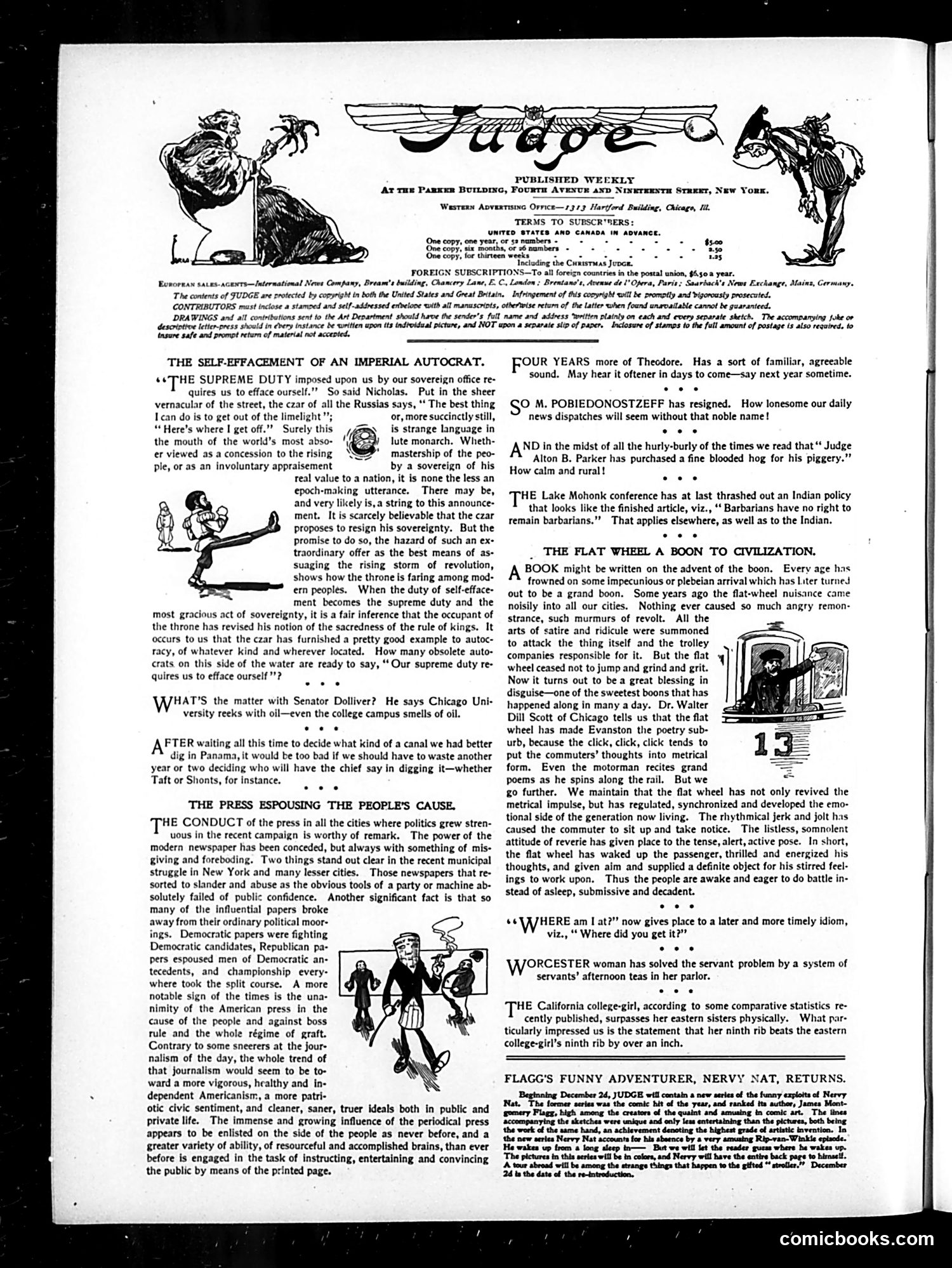
What you’re looking at
This editorial cartoon critiques Tsar Nicholas II of Russia, mocking his claim to limit his own power through constitutional reform. The illustration shows a figure (the Tsar) appearing diminished or constrained—depicted as absurdly small—suggesting the satirist's view that his promised self-restraint is hollow theater. The accompanying article argues that Nicholas's concessions to parliamentarism represent false modesty masking continued autocratic control. The joke targets the contradiction between his rhetoric of voluntarily reducing imperial authority and the reality that he retains supreme power. The cartoon ridicules what Judge views as the Tsar's transparent pretense of constitutional limitation while maintaining actual despotic rule.
📄 Transcribed text from this page (OCR, searchable)
Machine-transcribed from the original scan — historical spelling and the odd misread are preserved.
= Bee Sw LF 71 It), oY One copy, one year, or senumbers- = +e a One copy, six months, or s6numbers = = eee One copy, for thirteen weeks fy20 3 inclading the Cuntsrias Juoce a FOREIGN SUBSCRIPTIONS—To all foreign countries in the postal union, $30. year. Evrornan sates-acents—International News Company, Bream's building, Chancery Lane, EC, London: Brentano's, Avenue de !" Opera, Paris; Saarsach's News Exchange, Mains, Germany. The contents of FUDGE are rrotected by copyright in both the United States and Great Britain. Infringement of this conyright wxil be prompily and bigorously prosecuted. CONTRIBUTORS mast inciose a stamped and self-addressed extvelove with all manascrtots, otherivise retum of the Latter when foand unavallale cannot be guaranteed. DRAWINGS and ait contributions sent to the Art Department should have the sender's full name and address ‘written plainty on each and every separate sketch. The accompanying Jobe or descriptive letter-press should in ébery instance be written upon tts indtoidaal pictare, and NOT upon a separate slip of paper. accented. tnsure safe and prompt return of material not ‘THE SELF-EFFACEMENT OF AN IMPERIAL AUTOCRAT. 4*THE SUPREME DUTY imposed upon us by our sovereign office re- quires us to efface ourself." So said Nicholas. Put in the sheer vernacular of the street, the czar of all the Russias says, ** The best thing Ican do is to get out of the limelight"; or, more succinctly still, “*Here’s where I get off.” Surely this » is strange language in the mouth of the world’s most abso- G. lute monarch. Wheth- er viewed as a concession to the rising \S&" mastership of the peo- ple, or as an involuntary appraisement by a sovereign of his real value to a nation, it is none the less an epoch-making utterance. There may be, and very likely is,a string to this announce- ment. It is scarcely believable that the czar proposes to resign his sovereignty. But the promise to do so, the hazard of such an ex- traordinary offer as the best means of as- suaging the rising storm of revolution, shows how the throne is faring among mod- . ern peoples. When the duty of self-efface- BS ment becomes the supreme duty and the most gracious act of sovereignty, it is a fair inference that the occupant of the throne has revised his notion of the sacredness of the rule of kings. It occurs to us that the czar has furnished a pretty good example to autoc- racy, of whatever kind and wherever located. How many obsolete auto- crats on this side of the water are ready to say, Our supreme duty re- quires us to efface ourself"? aes) war's the matter with Senator Dolliver? He says Chicago Uni- versity reeks with oil—even the college campus smells of oil. AFTER waiting all this time to decide what kind of a canal we had better dig in Panama, it would be too bad if we should have to waste another year or two deciding who will have the chief say in digging it—whether Taft or Shonts, for instance. aes THE PRESS ESPOUSING THE PEOPLE'S CAUSE. THE CONDUCT of the press in all the cities where politics grew stren- uous in the recent campaign is worthy of remark. The power of the modern newspaper has been conceded, but always with something of mis- giving and foreboding. Two things stand out clear in the recent municipal struggle in New York and many lesser cities. Those newspapers that re- sorted to slander and abuse as the obvious tools of a party or machine ab- solutely failed of public confidence. Another significant fact is that so many of the influential papers broke away from their ordinary political moor- ings. Democratic papers were fighting Democratic candidates, Republican pa- pers espoused men of Democratic an- tecedents, and championship every- where took the split course. A more notable sign of the times is the una- nimity of the American press in the cause of the people and against boss tule and the whole régime of graft. Contrary to some sneerers at the jour- nalism of the day, the whole trend of that journalism would seem to be to- ward a more vigorous, healthy and in- dependent Americanism, a more patri- otic civic sentiment, and cleaner, saner, truer ideals both in public and private life. The immense and growing influence of the periodical press appears to be enlisted on the side of the people as never before, and a greater variety of ability, of resourceful and accomplished brains, than ever before is engaged in the task of instructing, entertaining and convincing the public by means of the printed page. of stamps to the full amount of postage (3 also required. to ‘OUR YEARS more of Theodore. Has a sort of familiar, agreeable sound. May hear it oftener in days to come—say next year sometime. SO M. POBIEDONOSTZEFF has resigned. How lonesome our daily news dispatches will seem without that noble name! eee AND in the midst of all the hurly-burly of the times we read that Judge Alton B. Parker has purchased a fine blooded hog for his piggery.” How calm and rural! Sa % THE Lake Mohonk conference has at last thrashed out an Indian policy that looks like the finished article, viz., ‘‘ Barbarians have no right to remain barbarians.” That applies elsewhere, as well as to the Indian. ‘THE FLAT WHEEL A BOON TO CIVILIZATION. BOOK might be written on the advent of the boon. Every age has frowned on some impecunious or plebeian arrival which has Liter turned Some years ago the flat-wheel nuisance came noisily into all our cities. Nothing ever caused so much angry remon- strance, such murmurs of revolt. All the arts of satire and ridicule were summoned to attack the thing itself and the trolley companies responsible for it. But the flat wheel ceased not to jump and grind and grit. Now it turns out to bea great blessing in disguise—one of the sweetest boons that has happened along in many a day. Dr. Walter Dill Scott of Chicago tells us that the flat wheel has made Evanston the poetry sub- urb, because the click, click, click tends to put the commuters’ thoughts into metrical form. Even the motorman recites grand poems as he spins along the rail. But we go further. We maintain that the flat wheel has not only revived the metrical impulse, but has regulated, synchronized and developed the emo- tional side of the generation now living. The rhythmical jerk and jolt has caused the commuter to sit up and take notice. The listless, somnolent attitude of reverie has given place to the tense, alert, active pose. In short, the flat wheel has waked up the passenger, thrilled and energized his thoughts, and given aim and supplied a definite object for his stirred feel- ings to work upon. Thus the people are awake and eager to do battle in- stead of asleep, submissive and decadent. eee 66) HERE am I at?” now gives place to a later and more timely idiom, viz., “* Where did you get it?” WORCESTER woman has solved the servant problem by a system of servants’ afternoon teas in her parlor. THE California college-girl, according to some comparative statistics re- cently published, surpasses her eastern sisters physically. What par- ticularly impressed us is the statement that her ninth rib beats the eastern college-girl’s ninth rib by over an inch. A out to be a grand boon. FLAGG'S FUNNY ADVENTURER, NERVY NAT, RETURNS. "Tha pchares tthe sekos vl eta cars tad erry A tour abroad will be among the strange things that happen to the gifted “stroller.” 2d ta the date of the re-intreduction, comicbooks.com