
A complete issue · 16 pages · 1905
Judge — September 16, 1905
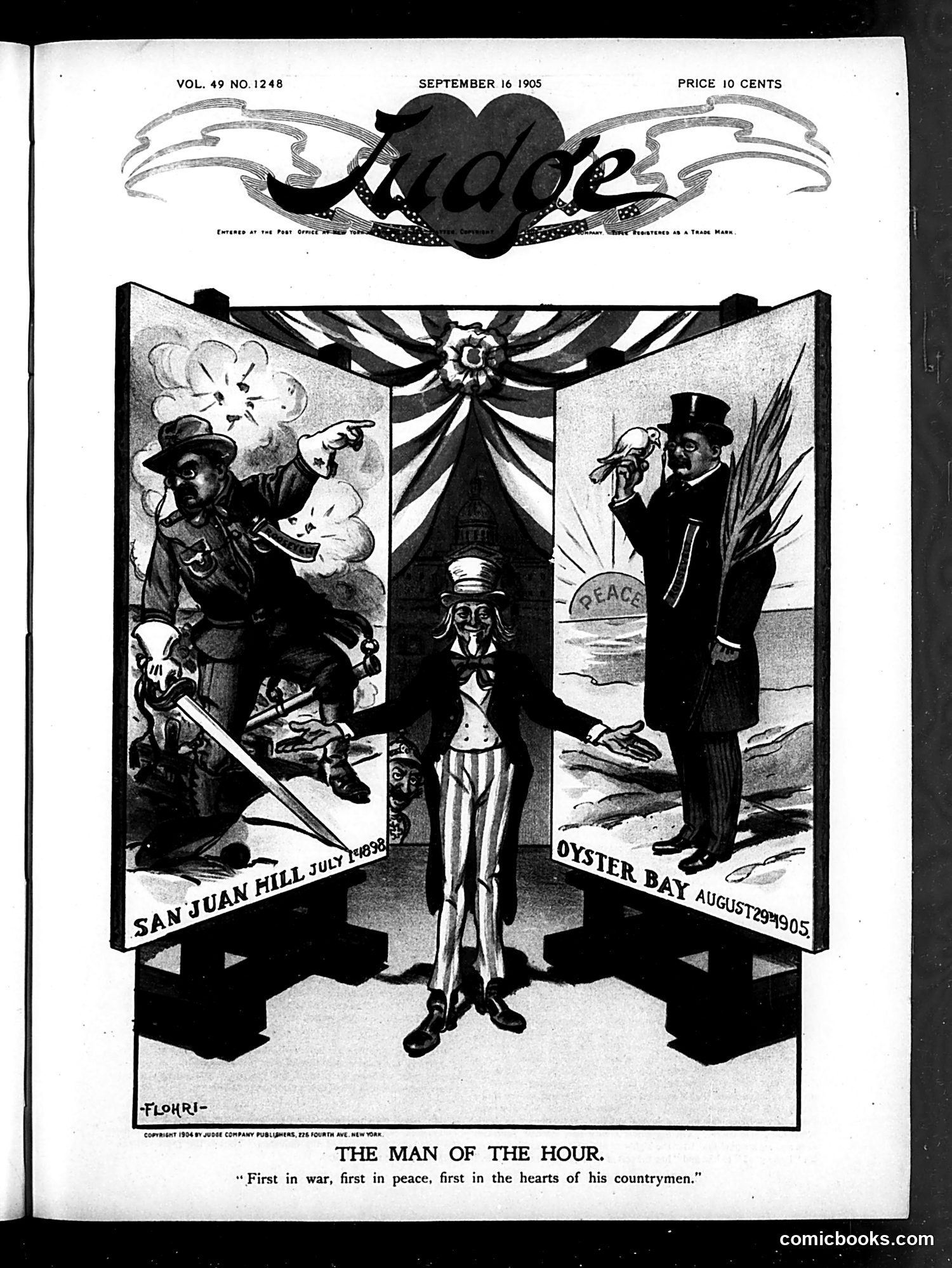
This political cartoon depicts "The Man of the Hour"—President Theodore Roosevelt—standing centrally in formal dress, holding a peace dove. He's flanked by two panels showing recent military events: "San Juan Hill" (July 1898, where Roosevelt gained fame as a Rough Rider) on the left, and "Oyster Bay" (August 29, 1905, his home) on the right. The cartoon celebrates Roosevelt's role in negotiating peace between Russia and Japan, ending their war. The subtitle quotes him: "First in war, first in peace, first in the hearts of his countrymen." This references both his military reputation and his contemporary diplomatic achievement, presenting him as a statesman balancing warrior and peacemaker roles.
This page contains satirical commentary pieces rather than political cartoons. The main articles critique post-WWI social conditions and foreign affairs: "Summer Amusements of Sovereigns" mocks European royalty for their frivolous pursuits while nations suffer post-war hardship. King Edward appears caricatured enjoying leisure while his subjects struggle. "Hinky Dink's Sturdy Americanism" satirizes American attitudes toward Europe, portraying Americans as boastful yet ignorant—viewing Europeans as backward while American inventions supposedly outpace European progress. The satire suggests American superiority complex is unfounded. Additional brief items mock various contemporary issues: a pie explosion incident, Australian Baron Andreas's wife-hunting, and debates about women's suffrage. The overall tone critiques post-war complacency and American pretension.
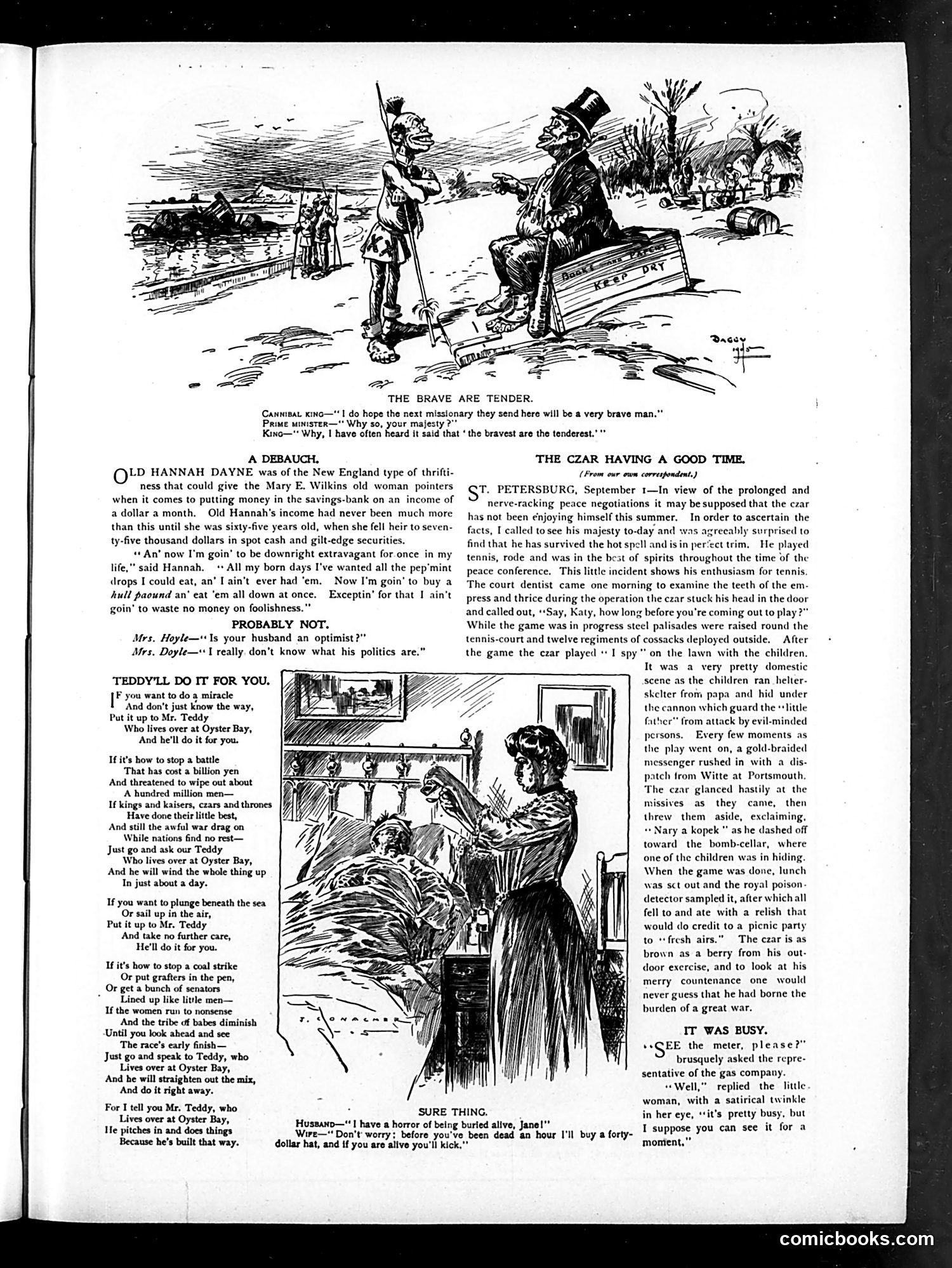
**Top Cartoon: "The Brave Are Tender"** A colonial-era figure (likely representing an American missionary or diplomat) encounters a man in top hat labeled "KEEP OUT DRY" (possibly representing commercial interests or a colonial power). The dialogue references sending a "brave" missionary and questions about bravery. This satirizes the contradiction between missionary work's noble rhetoric and practical self-interest in colonial expansion. **Middle Section: "Teddy'll Do It for You"** A poem praising Theodore Roosevelt's capability to solve various national problems (wars, strikes, economic issues). This reflects Roosevelt's contemporary reputation for aggressive intervention and expansive executive power during his presidency. **Right Section: "The Czar Having a Good Time"** Describes Tsar Nicholas II's leisure activities during WWI peace negotiations, mocking his apparent indifference to serious diplomatic matters during wartime.
This page contains several satirical pieces typical of Judge magazine's style. "The Way to Win" offers cynical advice about success through small moral compromises rather than honest work. "Value of a Reputation" satirizes how society doubts reformed criminals, even after confession. The large illustration "In the Country" depicts a rural scene with a woman asking "Little Freddie" about the green grass, to which he responds it's "blue"—a simple joke about childhood perception or stubbornness. "A Joke," "Far-Sighted," "Too Cheap," and other brief pieces are typical Judge humor: pun-based exchanges between named characters exploring human foibles like vanity, cheapness, and social pretension. The "Judge's Favorites" section appears to be reader submissions. Overall, this reflects early 20th-century American humor emphasizing wit, wordplay, and social observation.
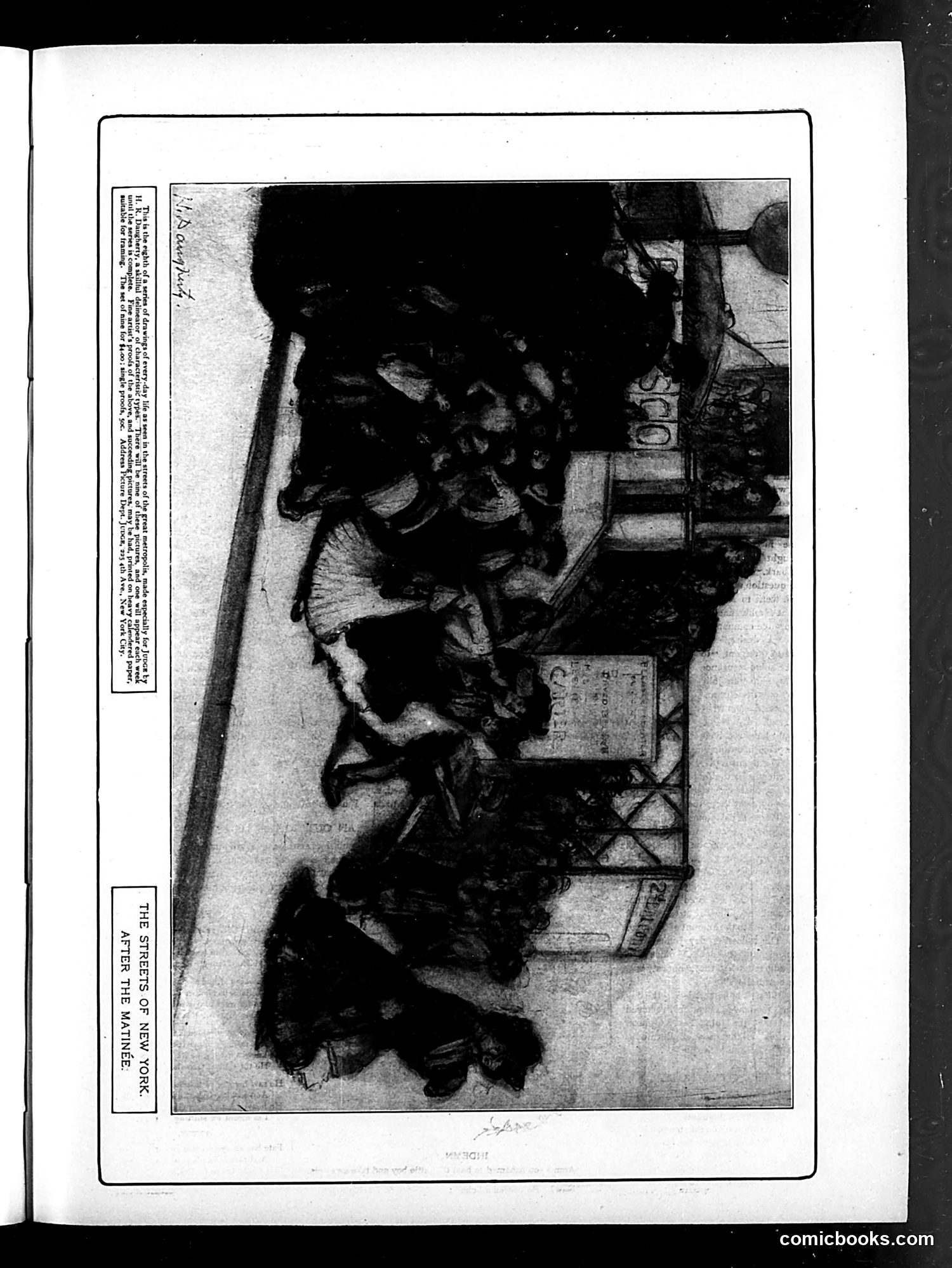
This Judge magazine page shows a satirical cartoon titled "After the Matinee: The Streets of New York." The image appears rotated, depicting street scenes with multiple figures in what seems to be early 20th-century dress. The satire likely mocks the contrast between theatrical entertainment and urban reality—how audiences emerging from matinee performances encounter the actual conditions of New York streets. The caption references sending pictures to Judge's Picture Department, suggesting this was part of the magazine's satirical commentary on contemporary city life. Without clearer visibility of specific caricatured figures or identifying details, I cannot specify which public figures or events are referenced. The general thrust critiques the disconnect between refined theatrical culture and gritty street-level existence in New York.
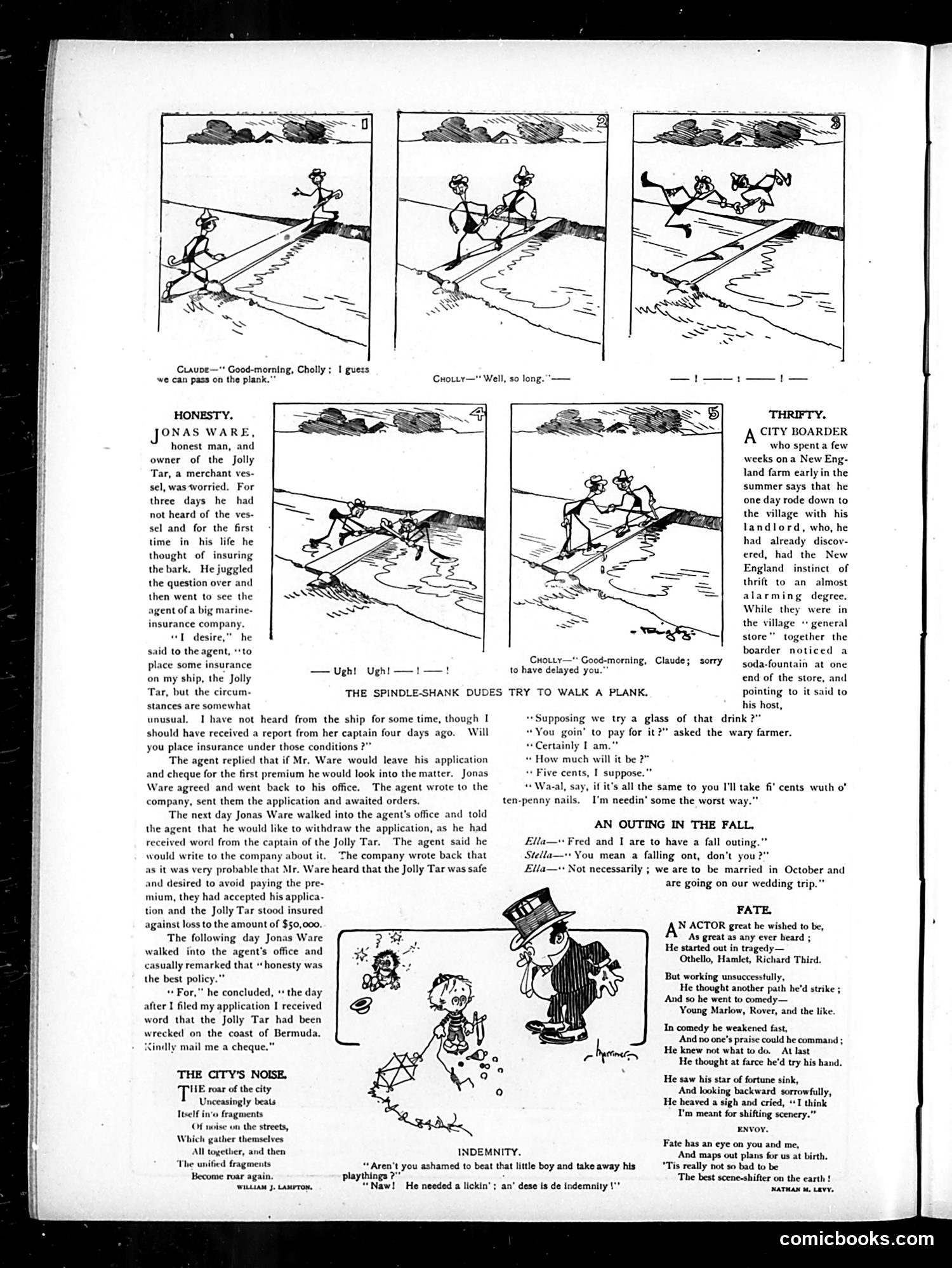
This page contains three main humorous sections: **"The Spindle-Shank Dudes Try to Walk a Plank"** (top): A visual gag showing thin, awkward men attempting to cross a wooden plank over water, repeatedly failing with exaggerated poses. "Spindle-shank" refers to their spindly legs—satirizing fashionably thin young men of the era. **"Honesty" (center story)**: A tale mocking marine insurance fraud. Jonas Ware, a ship owner, deliberately times his insurance application to coincide with his vessel's wreck, then cynically claims he's practicing "honesty" by collecting the $50,000 payout. The irony—that honest men can exploit systems—critiques both insurance companies' gullibility and moral hypocrisy among businessmen. **Bottom sections**: Include light satirical pieces on a New England farmer's extreme frugality (refusing a soda for ten-penny nails instead) and various humorous observations about urban noise and theatrical ambitions. The overall tone reflects Judge's typical satirical approach to American social pretension and business ethics.
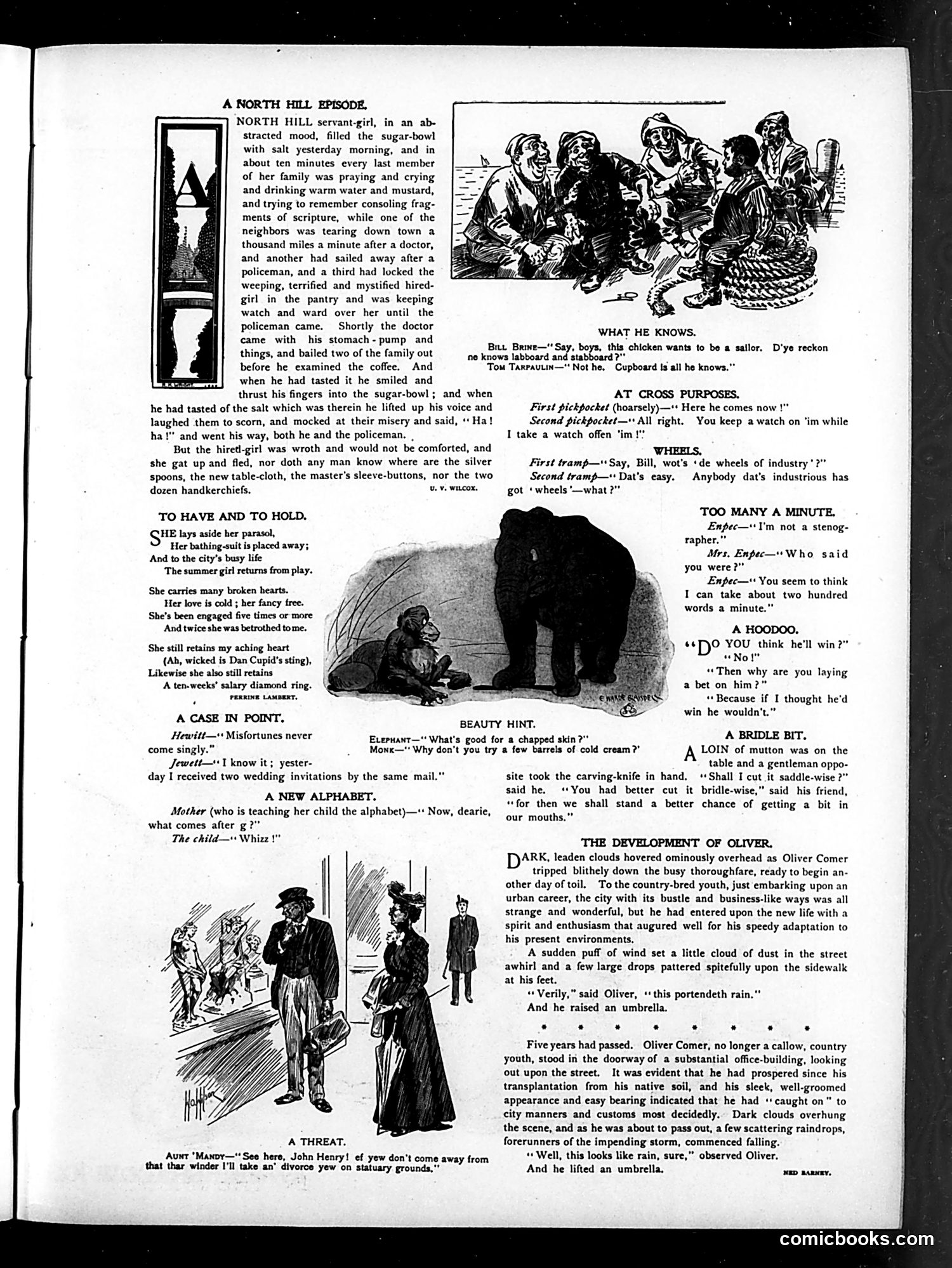
This page consists of multiple brief humorous pieces typical of Judge magazine's satirical format: **"A North Hill Episode"** satirizes servant incompetence through slapstick: a distracted maid fills the sugar bowl with salt, causing family panic—doctors, police summoned—only for the doctor to laugh at their hysteria. The hired girl then flees, stealing silver and valuables, punishing the family's class assumption that she'd meekly accept blame. **Other pieces** include:** "To Have and to Hold"—mocking fickle young women who accept engagements casually; "A Case in Point"—a pun on wedding invitations as misfortunes; and working-class dialogue jokes ("Wheels," "At Cross Purposes") featuring malapropisms and wordplay. **"The Development of Oliver"** (serialized) follows a country youth's urban transition—romanticizing naive optimism meeting city harshness. The satire targets **class friction, servant unreliability, romantic superficiality, and rural-urban culture clash**—all recurring Judge themes. The tone is broadly comedic rather than deeply political.
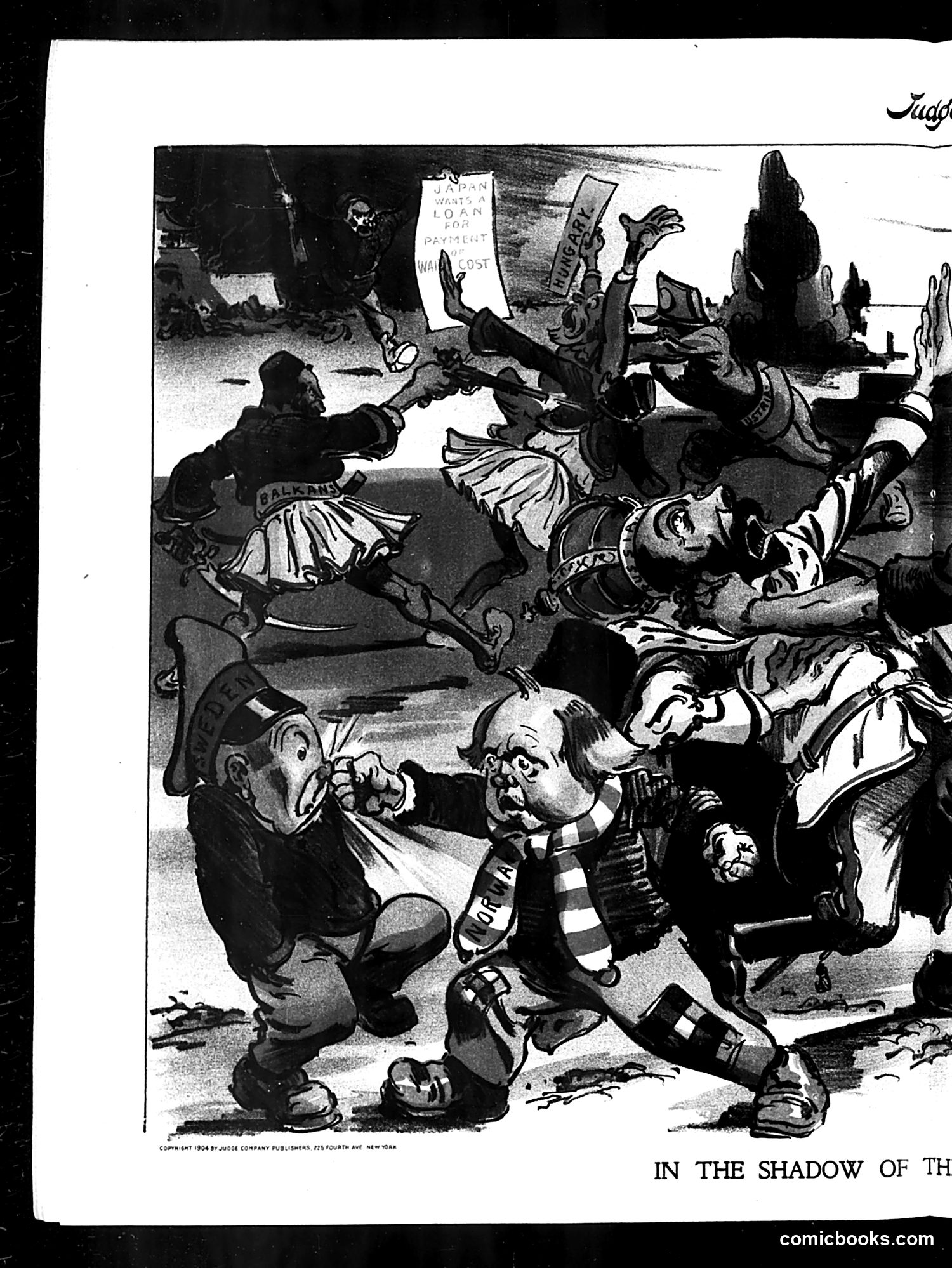
This appears to be a satirical cartoon from *Judge* magazine titled "In the Shadow of th[e]..." (title cut off). The image depicts caricatured figures in what seems to be a chaotic scene with exaggerated physical features typical of early-20th-century political cartooning. The figures appear to be engaged in some kind of conflict or turmoil. Without the complete title or visible date, I cannot definitively identify the specific political figures or event being satirized. The cartoon's style and composition suggest commentary on political corruption, conflict, or social disorder, but the exact historical context remains unclear from the visible elements alone. The full title and publication date would be necessary for precise interpretation.
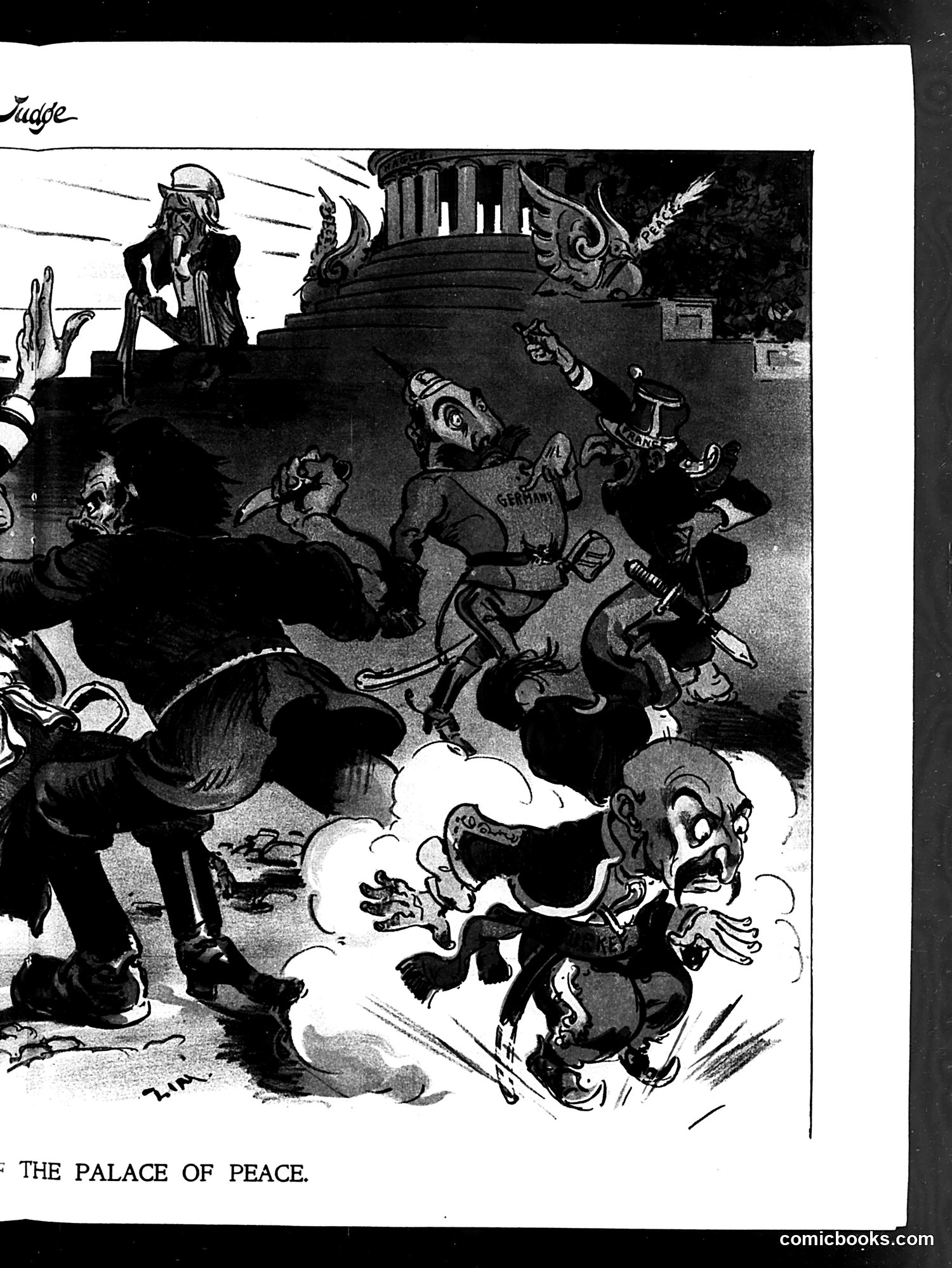
This political cartoon satirizes peace negotiations, likely from the early 20th century. A dignified figure (possibly representing a statesman or peacemaker) stands elevated at a classical "Palace of Peace" building, while below, demonic or grotesque caricatures—representing various nations or political factions—engage in chaotic violence and conflict. The contrasting imagery is ironic: the grand architecture symbolizes lofty peace ideals, while the violent pandemonium beneath reveals the actual breakdown of diplomatic efforts. The cartoon suggests that despite grand proclamations and formal institutions dedicated to peace, underlying national tensions and hostilities persist. The exaggerated, monstrous caricatures emphasize how irrational and bestial international conflicts appear, undercutting any pretense of civilized negotiation happening above.
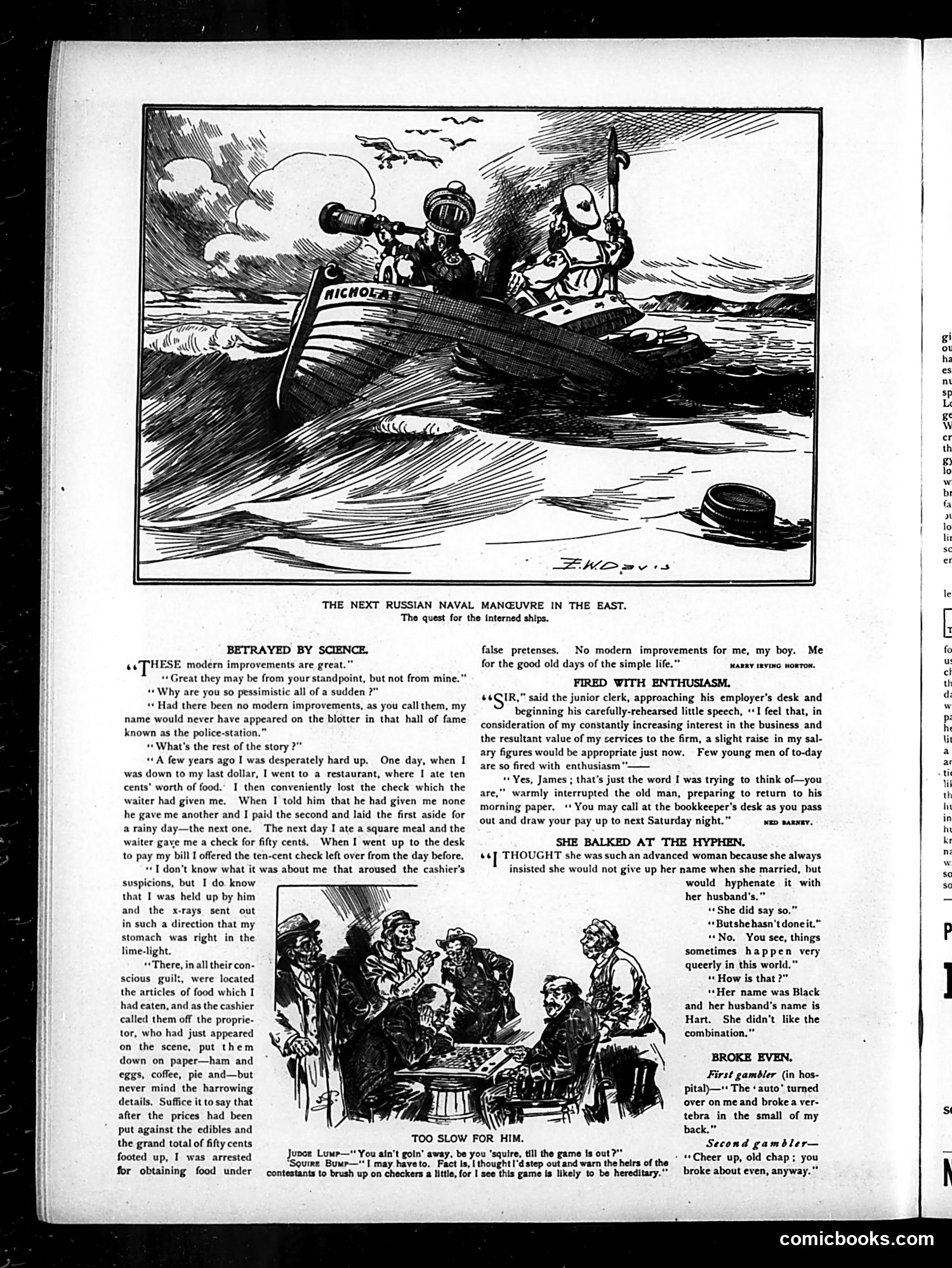
This page from *Judge* contains three separate satirical pieces mocking modern life: **"Betrayed by Science"** ridicules X-ray technology. A man describes committing petty food-theft fraud at a restaurant, evading detection for years through simple deception. Modern X-rays expose his stomach's contents to the cashier, proving his crime—technology defeats his old-fashioned dishonesty. **"Fired with Enthusiasm"** satirizes workplace dynamics. An ambitious young clerk (James) rehearses a salary request, emphasizing his "enthusiasm." His boss cynically uses the word back at him while promptly dismissing him to collect his pay from accounting—enthusiasm earns nothing. **"She Balked at the Hyphen"** jokes about feminism and marriage. A woman publicly refuses to surrender her maiden name upon marriage (a progressive stance), but hyphenating "Black" with her husband's surname "Hart" creates an awkward combination, so she abandons principle for aesthetics. The top cartoon references Russian naval affairs, likely concerning interned ships during early 20th-century conflicts.
This page presents **early-20th-century advice literature** disguised as satire. The main editorial essay argues that women's domestic cooking skills—not feminism or independence—determine romantic success and male happiness. The satirical "hook" is absurdly exaggerated: a woman who cooks poorly is compared to one who "killed her husband" by feeding him "sawdust and nails," suggesting her bad cooking literally murdered him. The Connecticut girl story presents cooking mastery as a path to marriage ("rarebit gone wrong for aye" = lost love). The subheader "What He'd Do" presents a class commentary: a poor man would ask a millionaire if his wealth was honestly earned, implying moral scrutiny of the rich—a mild jab at Gilded Age capitalism. The "Honest Physician" section advocates natural remedies over drugs, reflecting Progressive Era skepticism toward pharmaceutical companies. **Context modern readers miss:** This reflects pre-WWI attitudes where women's value centered on domestic labor, and cooking ability was considered legitimate grounds for romantic judgment. The "feminism vs. homemaking" tension underlying the piece would have resonated with contemporary debates.
This page is primarily **advertising and humor snippets** rather than political cartoons. The content consists of: **Major Advertisements:** - Hunter Whiskey, Glenn's Sulphur Soap, Club Cocktails, and various other products typical of early 20th-century magazines **Humor Section ("POINTS"):** A collection of brief satirical observations about human nature—cynical observations on virtue, fortune, creditors, and relationships. These are generic social commentary without specific political targets. **Short Anecdotes:** - A Boston boy preferring to build "Browning clubs" libraries over becoming president (light mockery of intellectual pretension) - A woman with a "fine vocabulary" who has never read books (satirizing superficial culture) - A writer who wrote his own press notices (mocking self-promotion) **"Rusty But Still in the Game":** A dialect cartoon about a baseball player refusing to be marked out after dying at first base—appears to be simple sports humor. The page lacks coherent political satire or identifiable caricatures of specific public figures. It reflects the magazine's mixed format of advertisements, genteel humor, and consumer products.
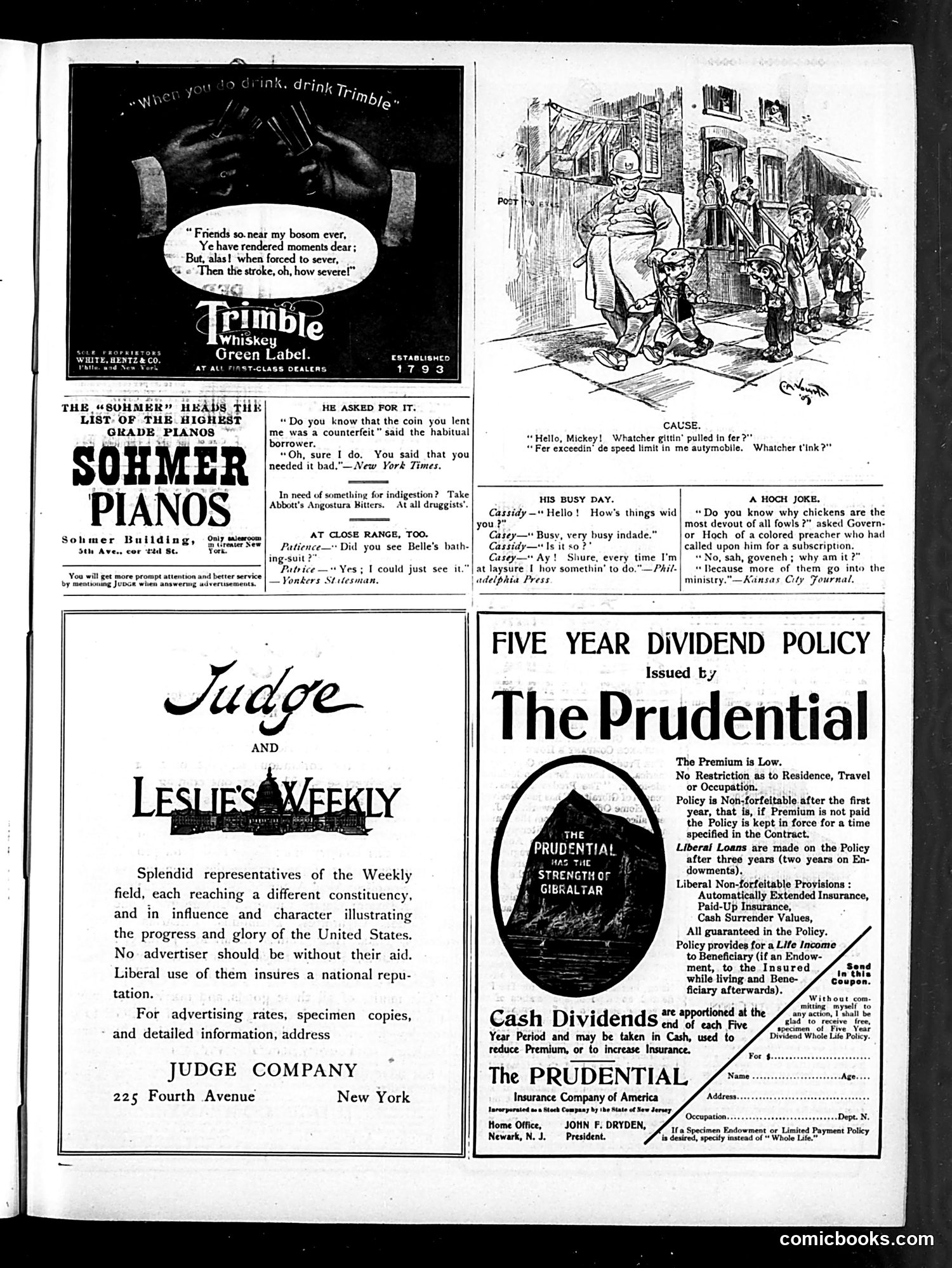
This is primarily an **advertising page** with several small humorous items scattered among commercial notices. ## Main Content: **The cartoons** are brief joke items with ethnic/dialect humor typical of early 1900s American comedy: - "He Asked for It" concerns a counterfeit coin (common scam scenario) - "His Busy Day" features Irish-accented characters (Casey, Cassidy) - "A Hoch Joke" references Governor Hoch and uses racial stereotypes in a minister joke These reflect the period's casual use of caricatured speech patterns as humor. ## Advertisements: The page features full-page ads for **Sohmer Pianos**, **Judge and Leslie's Weekly** (the publisher promoting its own magazine), and notably **The Prudential Insurance Company**—emphasizing dividend policies, non-forfeiture provisions, and cash benefits. The Trimble Whiskey ad at top uses sentimental verse to sell alcohol. **Context**: This represents early 20th-century American magazine advertising and entertainment—mixing light humor with financial services marketing, before modern sensibilities regarding ethnic comedy.
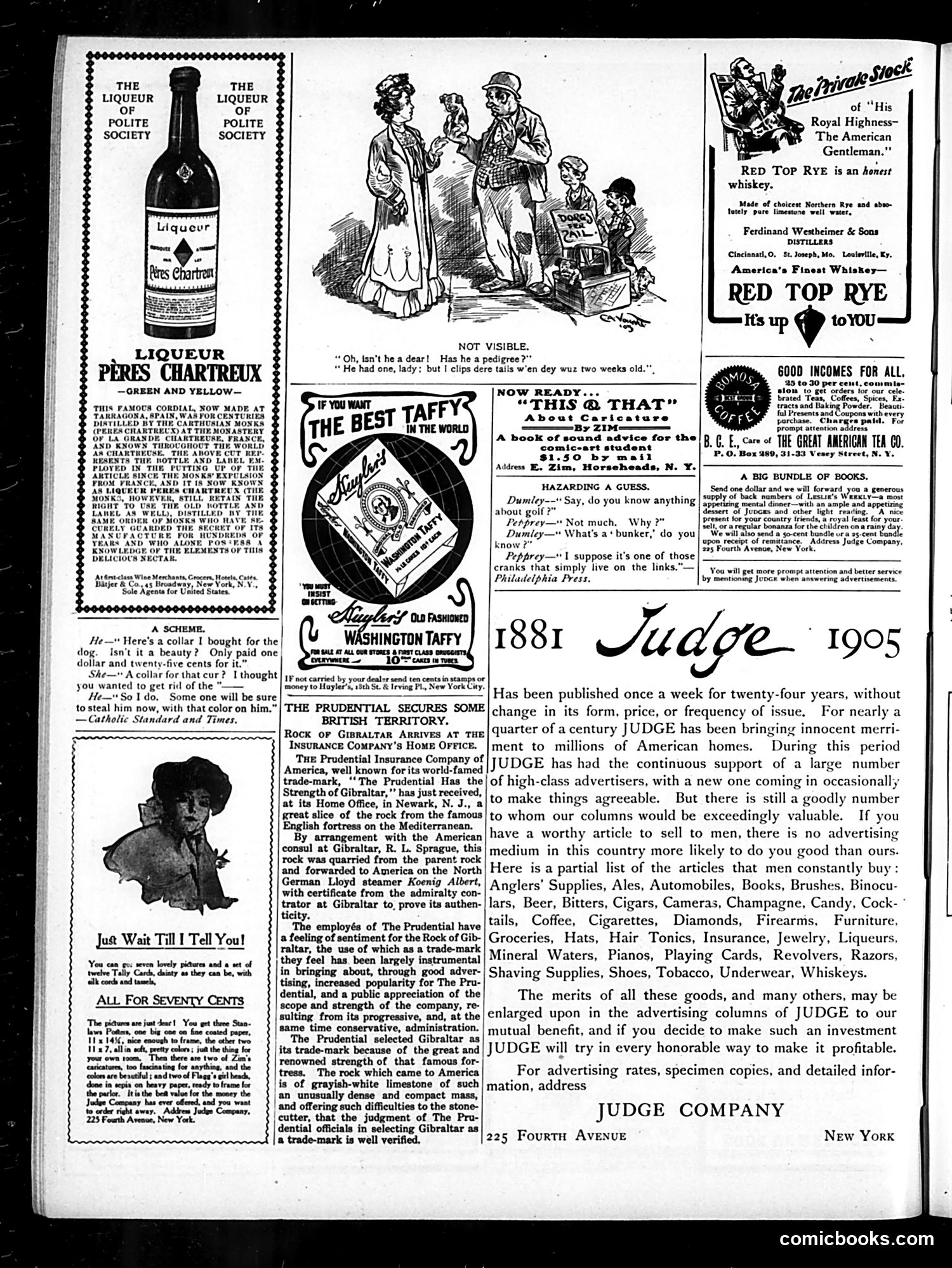
This page is primarily **advertising**, with one small joke cartoon visible. The main cartoon titled "NOT VISIBLE" depicts a woman admiring a man's appearance, asking if he has a pedigree. His response—that he *had* one but had his tail docked as a puppy—is the joke's punchline, implying the man is being treated or compared to a dog. This is a class-based insult common to the era. The page otherwise features advertisements for liqueurs (Pères Chartreux), whiskey (Red Top Rye), and taffy candy. There's also a humorous domestic exchange where a man buys a fancy collar for his dog intending to lose the animal, planning theft rather than abandonment. A substantial article celebrates The Prudential Insurance Company's receipt of an actual rock sample from the Rock of Gibraltar—the company's trademark symbol—shipped from the Mediterranean fortress, emphasizing the company's strength and stability. The remaining content advertises Judge's back issues and related publications.
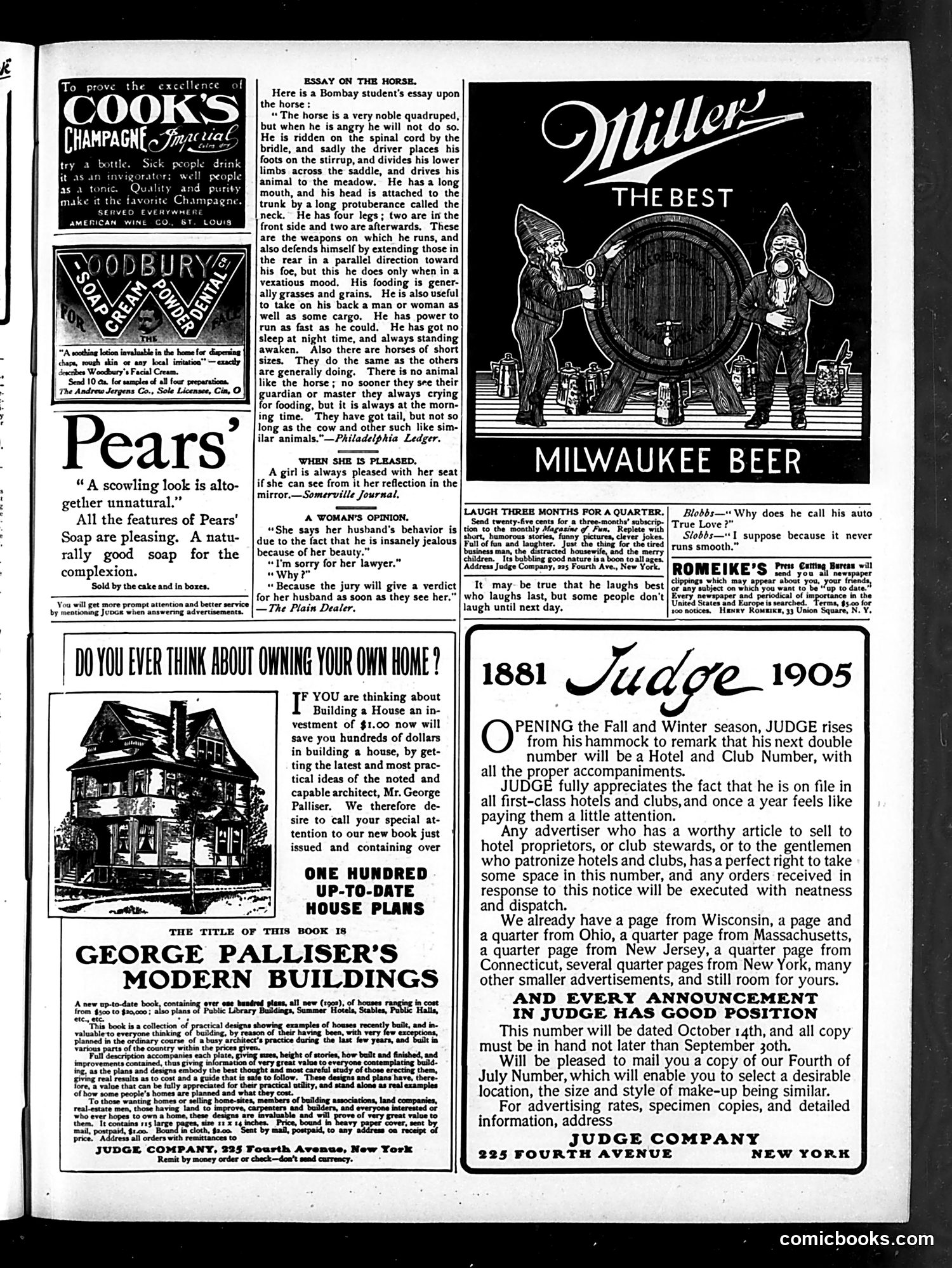
This page is primarily **advertising and miscellaneous content** rather than political satire. The main items include: **"Essay on the Horse"**: A humorous piece presenting a Bombay student's comically awkward English description of horses. The satire lies in the broken grammar and absurd observations ("He has got no sleep at night time, and always standing awaken"), mocking non-native English speakers—a casual form of ethnic humor common in early 1900s publications. **Other humor sections**: Brief jokes about women's vanity, marital jealousy, and laughter—typical genteel magazine humor of the era, relying on gender stereotypes. **Advertisements**: Cook's Champagne, Pears' Soap, Miller's Milwaukee Beer, and George Palliser's house-building plans dominate the page. The page contains **no recognizable political cartoons or caricatures** of public figures. It reflects the magazine's mix of light satire, advertising, and domestic humor typical of Judge magazine's content.
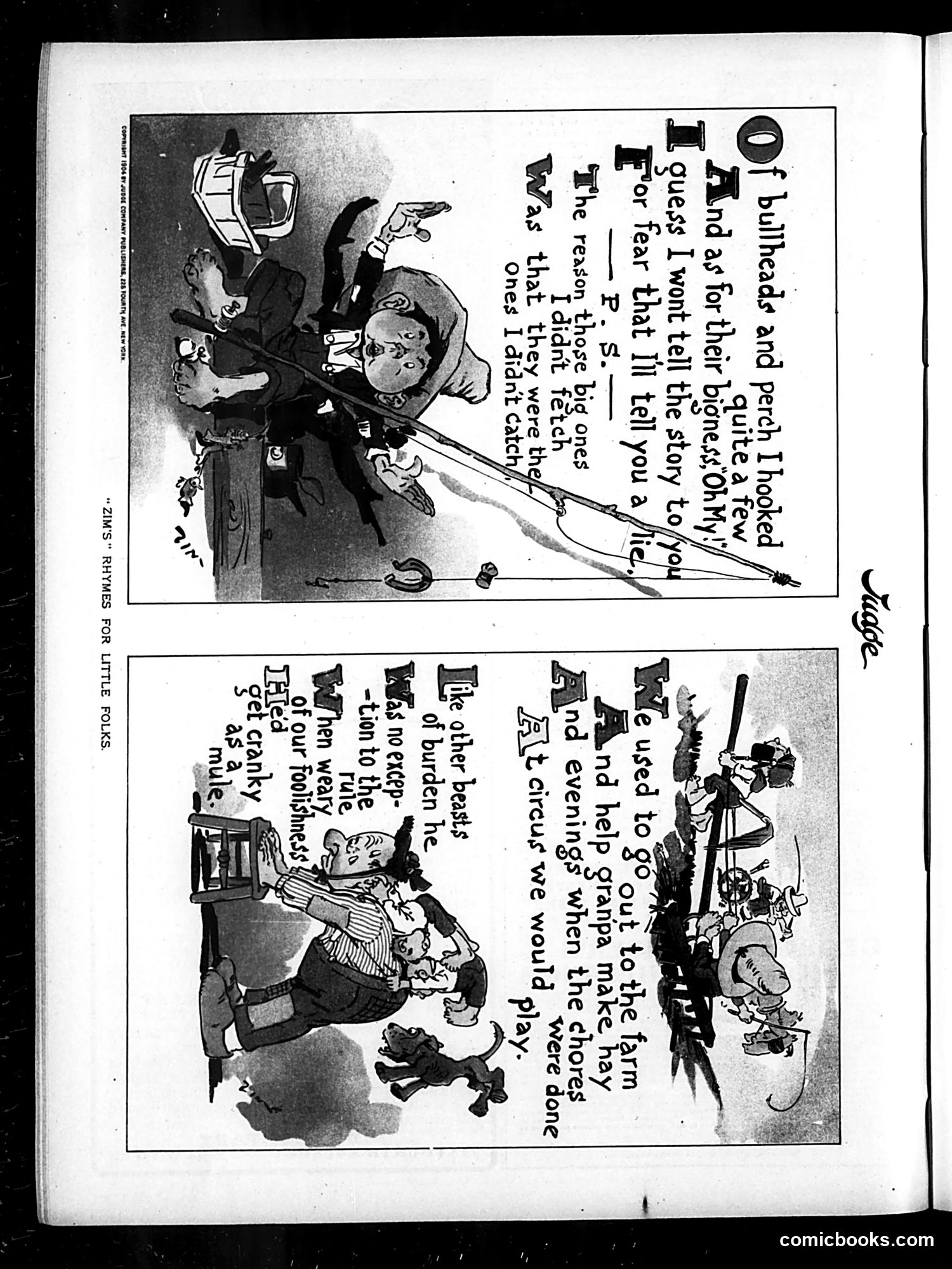
This page from *Judge* magazine contains "Zim's Rhymes for Little Folks"—children's poetry with accompanying illustrations rather than political satire. The OCR text is heavily corrupted, but the visible content shows two illustrated verses about childhood experiences: one about fishing (mentioning "bullheads and perch" caught, with exaggeration about their size), and another about helping grandpa make hay at the farm and visiting a circus with animals. These are nostalgic, lighthearted reminiscences of rural/agricultural American childhood—the kind of sentimental content that would appeal to early-20th-century magazine readers. The humor is gentle and wholesome rather than satirical or political. This appears to be a regular children's feature rather than the magazine's signature satirical commentary.