
A complete issue · 16 pages · 1905
Judge — September 2, 1905
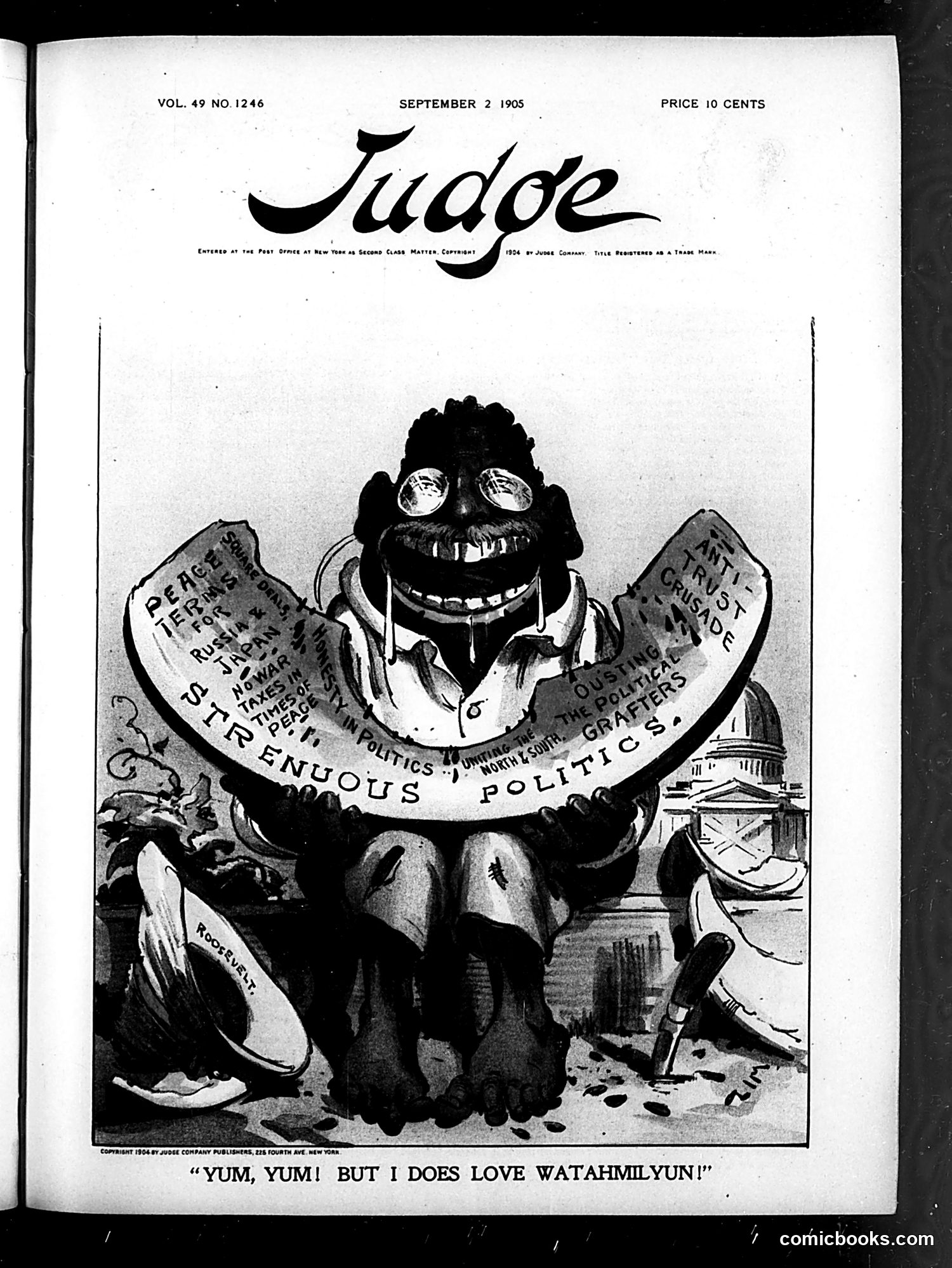
This is a racist caricature satirizing President Theodore Roosevelt's diplomatic efforts. The grotesque figure represents Roosevelt himself, depicted with exaggerated simian features—a common racist trope of the era used to mock politicians. The banners reference Roosevelt's mediation of the Russo-Japanese War (for which he won the 1906 Nobel Peace Prize). Labels mention "strenuous politics" (Roosevelt's famous phrase) and what appears to be criticism of his foreign policy approach. The caption "Yum, yum! But I does love Watahmilyu'n!" appears to mock Roosevelt's accent or speaking style while commenting on his appetite for political involvement in international affairs. The surrounding imagery—including what appears to be a capitol building—emphasizes the political nature of the satire.
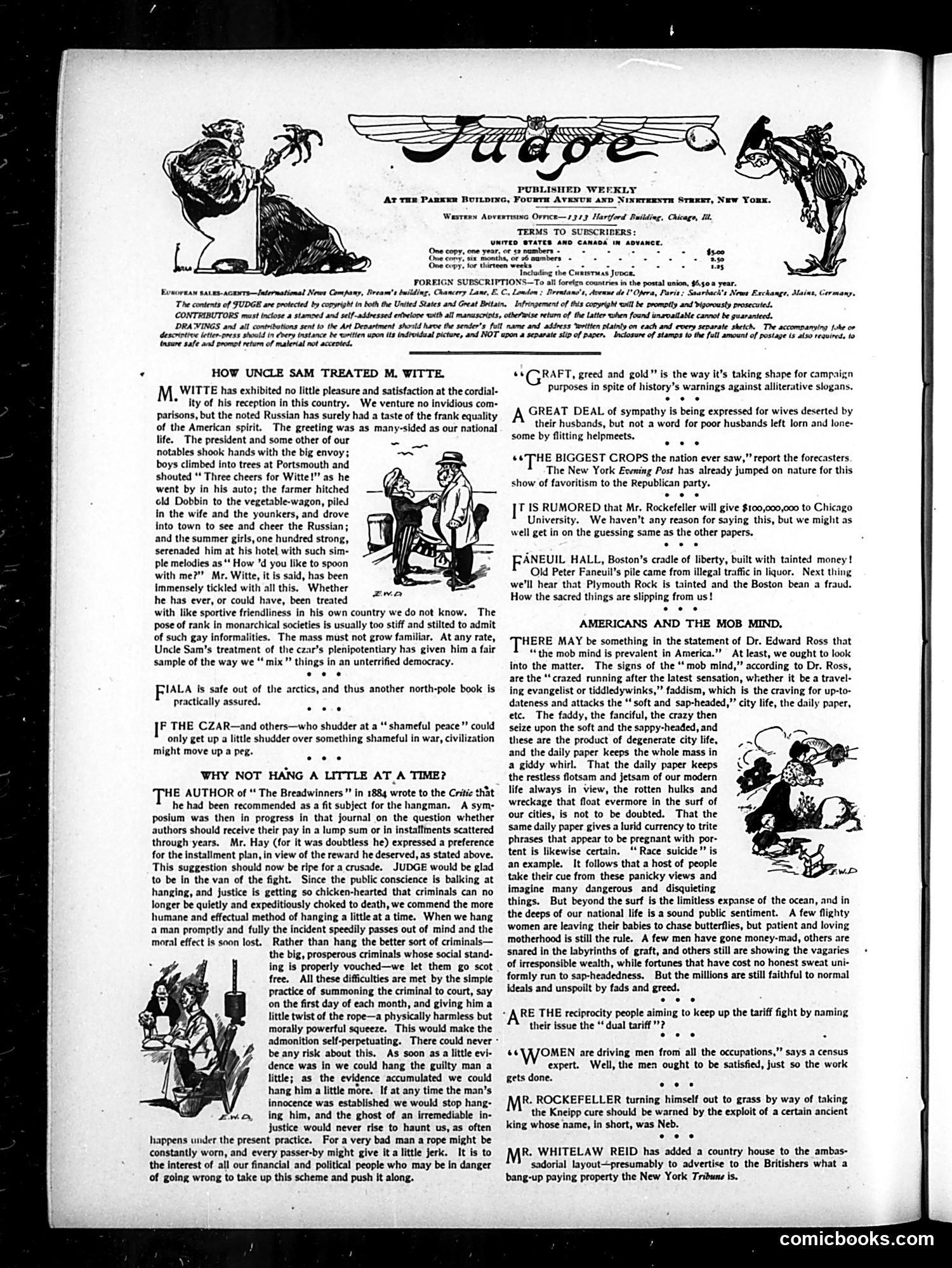
This page from *Judge* contains several satirical commentary pieces rather than a single cartoon. The main article, "How Uncle Sam Treated M. Wittle," uses an illustration showing a man in formal dress being confronted by Uncle Sam (the bearded American symbol). The satire appears to criticize an individual's reception in America, possibly mocking pretentious European attitudes or failed expectations upon arrival. Other brief items mock political figures and events: Republican favoritism, Rockefeller's wealth, and Faneuil Hall. A substantial piece titled "Americans and the Mob Mind" critiques sensationalist journalism and public hysteria over crime. The magazine demonstrates *Judge's* typical approach: mixing satirical commentary on politics, society, and press behavior with biting social criticism of its era.
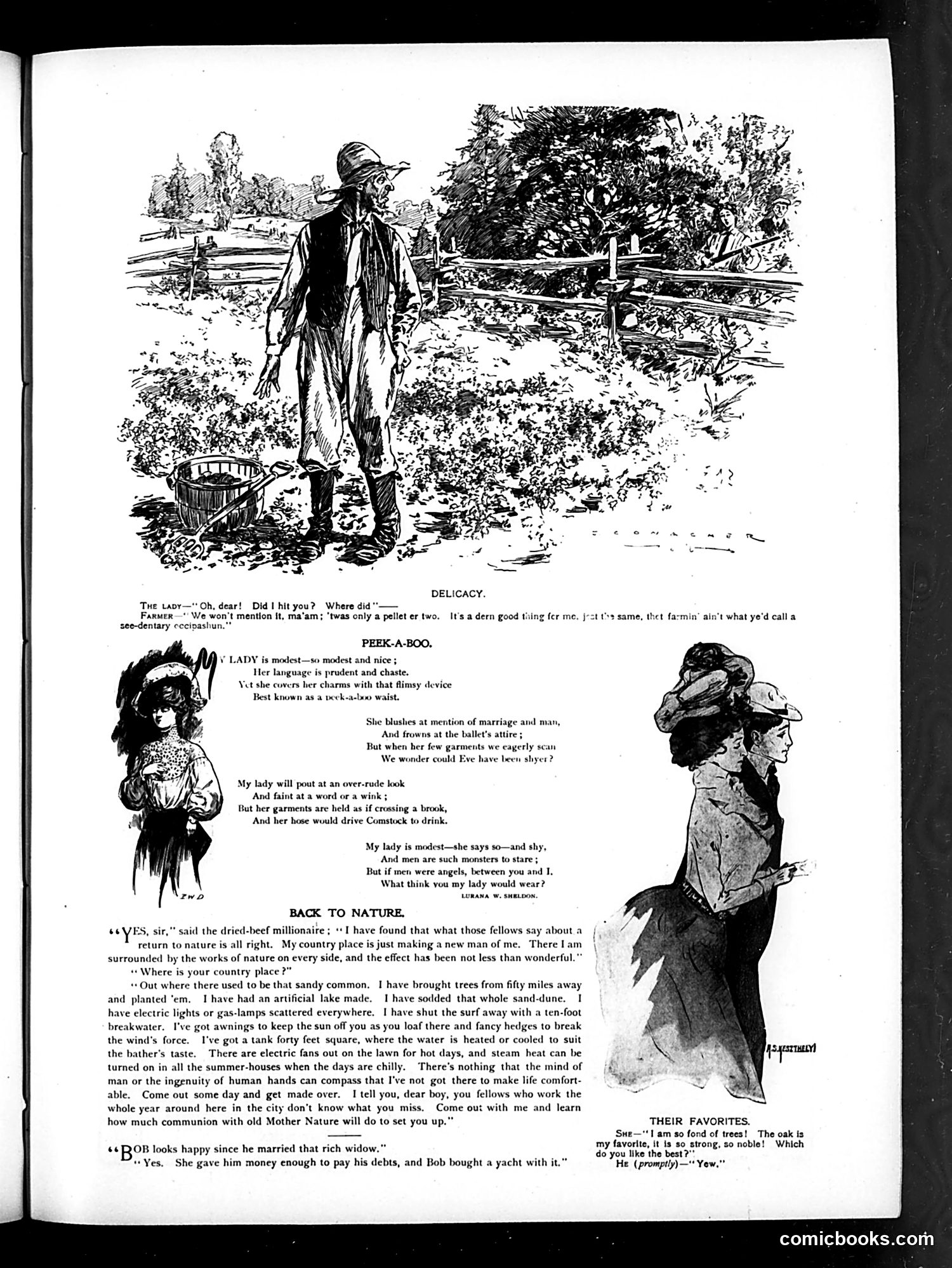
This page contains three distinct pieces of satirical content: **"Delicacy"** - A farmer-gentleman dialogue mocking class pretension. The farmer dismisses refined sensibilities as impractical, suggesting "that farmin' ain't what ye'd call a delicate recoupation." **"Peek-a-Boo"** - Verse satirizing women's fashion and modesty. It criticizes ladies for covering themselves modestly while wearing increasingly revealing garments, questioning the contradiction between claimed propriety and actual dress. **"Back to Nature"** - A monologue from a wealthy industrialist describing his country estate with artificial amenities (electric lights, heated pools, yachts). The satire mocks the absurdity of recreating urban comforts under the guise of "returning to nature." **"Their Favorites"** - A brief joke about spousal preferences. The overall theme critiques class affectation, fashion hypocrisy, and the wealthy's contradictory relationship with "authenticity."
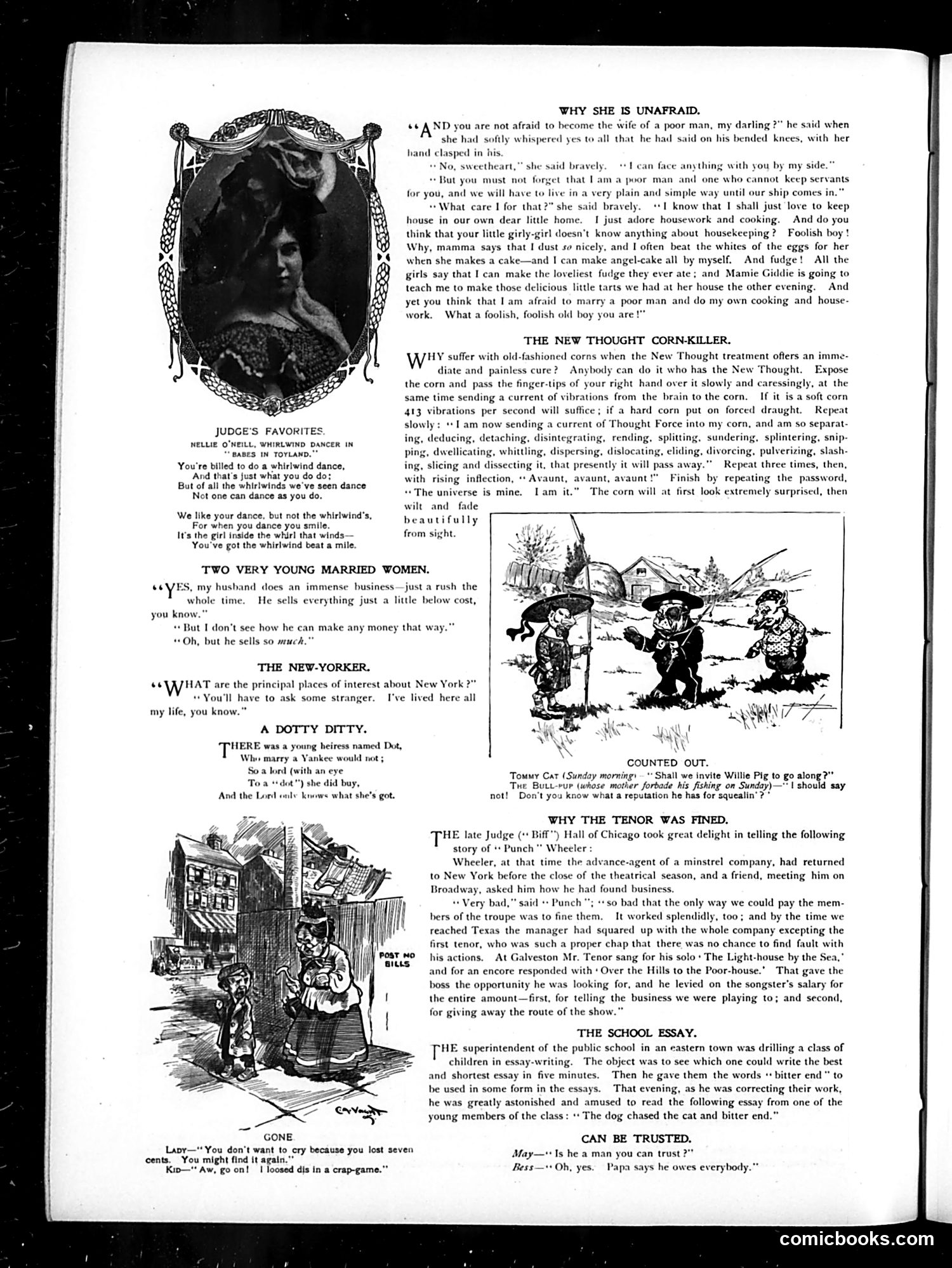
This page contains several disconnected humorous anecdotes and illustrations rather than political cartoons. The content includes: **"Why She Is Unafraid"** — A dialogue satirizing a woman's confidence in her domestic skills despite marrying a poor man, mocking both gender assumptions about housekeeping and class pretensions. **"The New Thought Corn-Killer"** — Absurdist humor about treating corns through "thought force," likely satirizing the period's "New Thought" movement (early positive-thinking philosophy). **Additional sketches** labeled "Judge's Favorites," "Two Very Young Married Women," "The New-Yorker," and others present brief comedic dialogues on marriage, business, and urban life. The illustrations depict everyday domestic and social situations. Overall, this appears to be a miscellaneous humor page typical of Judge magazine's format—light social satire without specific political targets.
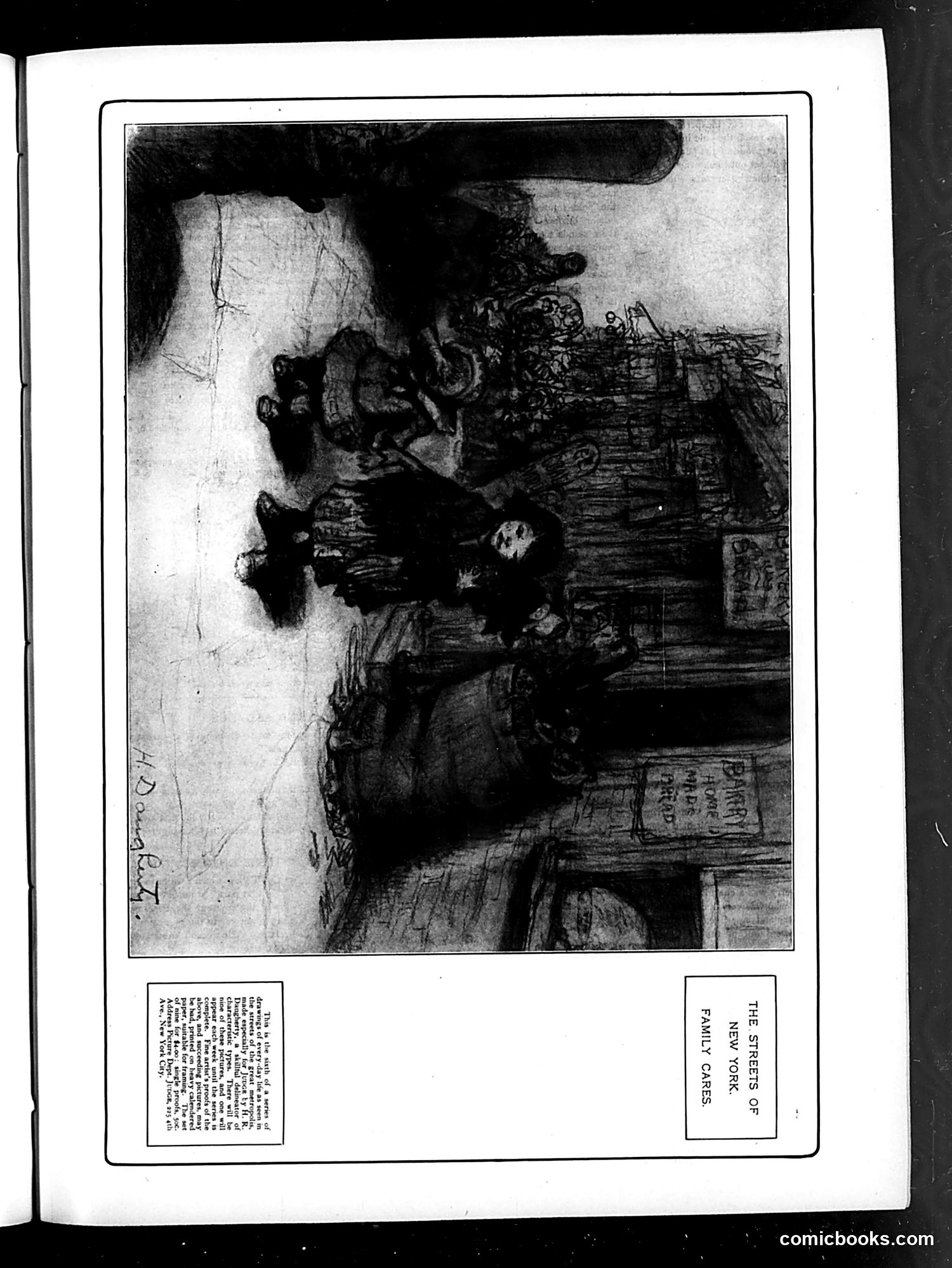
This appears to be a *Judge* magazine illustration depicting a domestic scene set against an urban New York backdrop. The image shows what seems to be a family group, though the reproduction quality makes specific details difficult to discern. The caption "Family Cares" suggests the cartoon satirizes domestic life or family responsibilities, likely contrasting private family concerns with the chaos of city streets visible in the background. Without clearer visibility of the figures or accompanying article text, the specific social critique remains unclear—it could address working-class struggles, immigration experiences, or urban domestic hardship common in *Judge's* satirical coverage of turn-of-the-century American life. The page layout suggests this may be accompanied by additional text or advertising material below the main illustration.
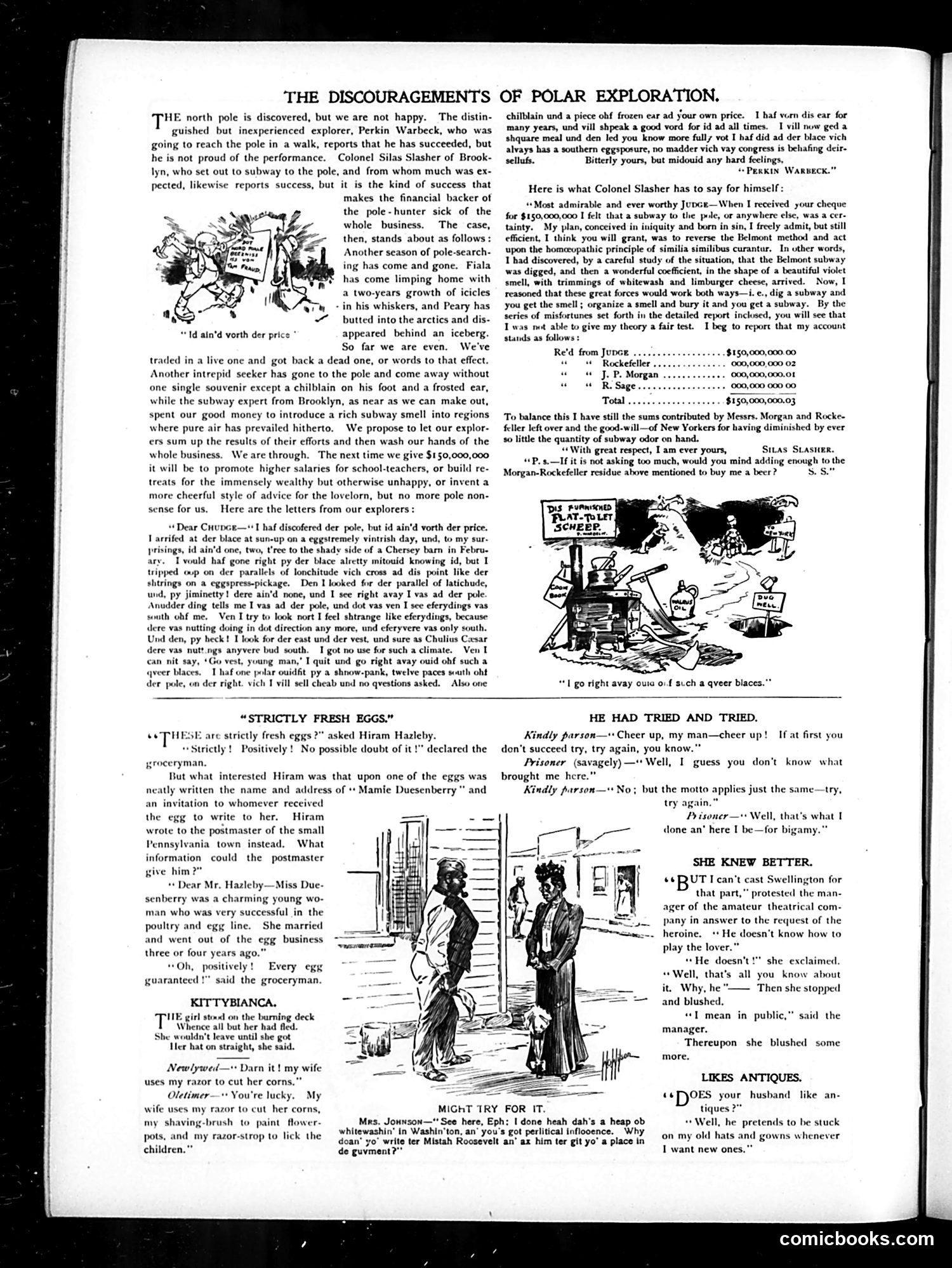
This satirical piece mocks the era's obsession with North Pole expeditions and their disappointing results. Judge ridicules explorers—particularly "Perkin Warbeck" (a fictional stand-in for real Arctic explorers like Peary and Fiala) and "Colonel Silas Slasher" from Brooklyn—who squandered massive public funding ($150 million mentioned) yet returned with trivial or embarrassing results: frostbite, chilblains, and no meaningful achievement. The humor targets wasteful spending on exploration when that money could fund teachers or social services. The exaggerated German-accented letters from explorers parody immigrant speech while highlighting the absurdity of their expeditions—one explorer discovering the pole is worthless, another finding only a "subway smell." The satire reflects early 20th-century American skepticism about polar exploration's value and expense, particularly after several high-profile expeditions yielded questionable results.
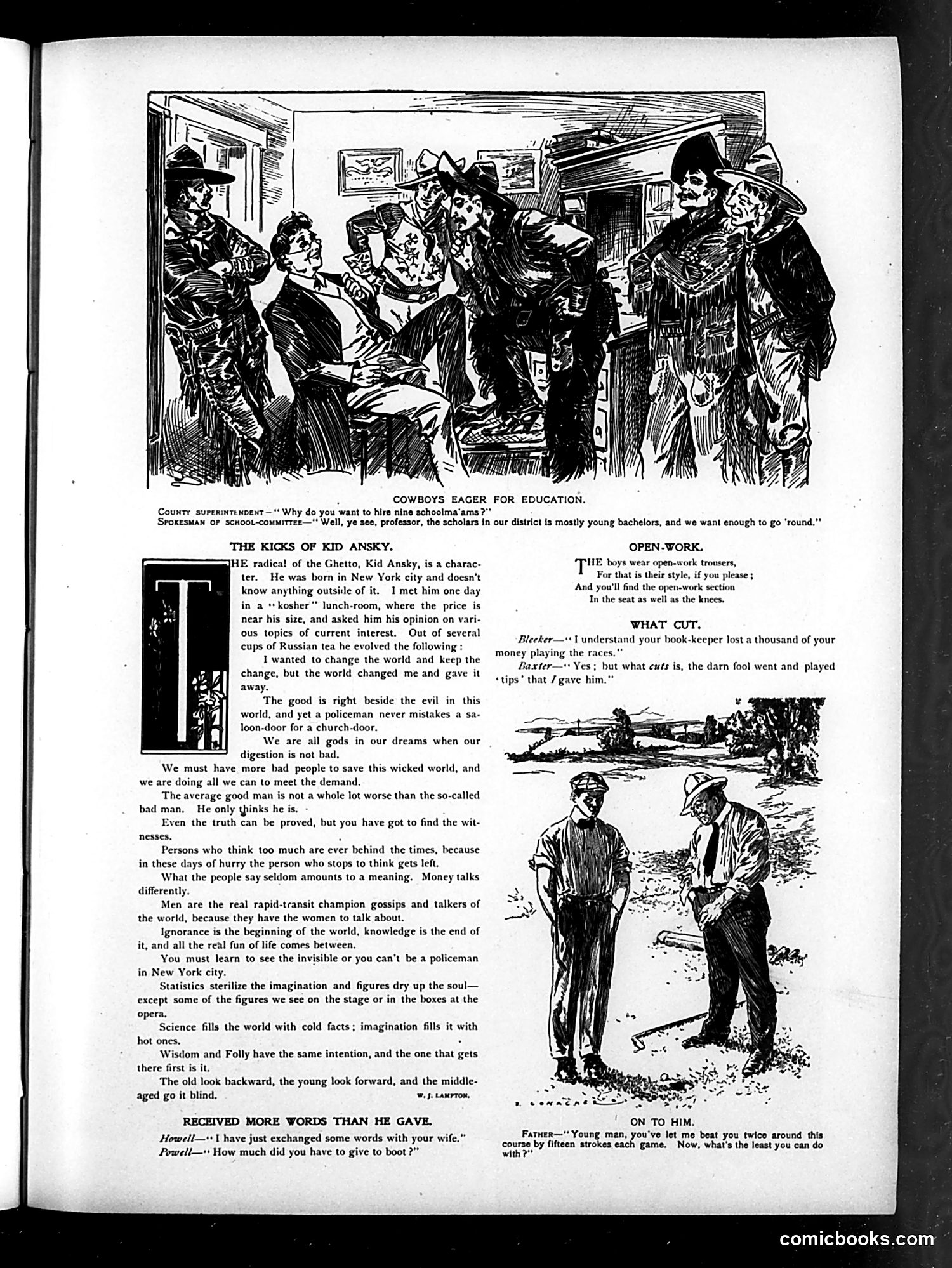
This Judge magazine page contains three satirical pieces: **"Cowboys Eager for Education"** mocks rural attitudes by depicting a school committee wanting to hire nine teachers for young bachelor students—the joke being they're motivated by romance rather than education. **"The Kicks of Kid Ansky"** presents philosophical musings from a character described as a Ghetto radical and New York native. These are cynical observations about human nature, morality, and city life—typical turn-of-century urban immigrant satire, poking fun at both idealistic reformers and working-class pragmatism. **"Open-Work" and smaller jokes** use wordplay and double meanings common to the era's humor style. The overall tone reflects Judge's satirical approach: mocking rural simplicity, immigrant characters and their accented English, and contemporary social anxieties. The "Kid Ansky" section particularly exemplifies how early 20th-century American publications caricatured immigrant intellectuals and their perspectives, combining condescension with occasionally sharp social criticism.
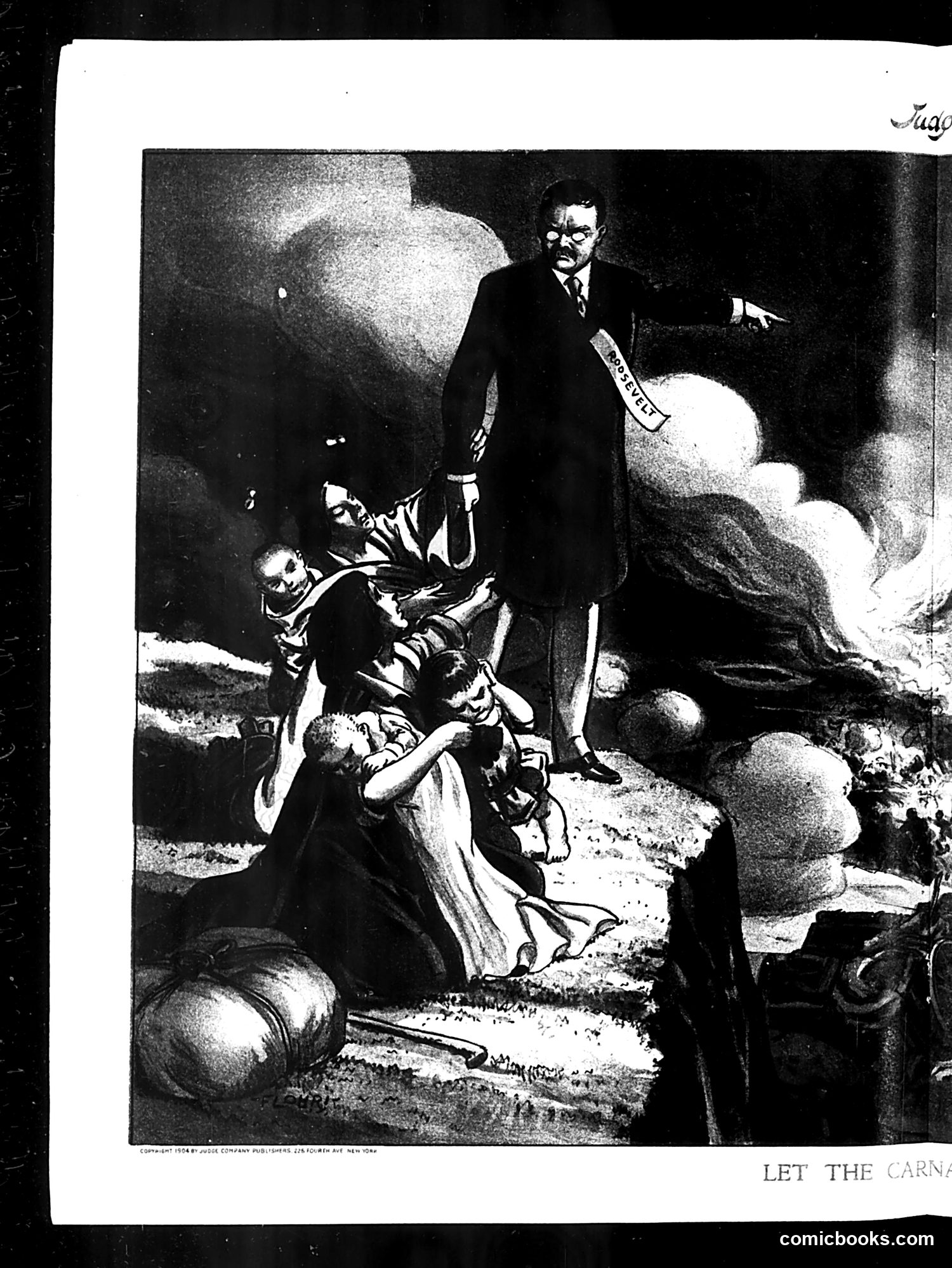
This appears to be a satirical political cartoon from *Judge* magazine, though the image quality and partial text ("LET THE CARNA[L]...") make complete interpretation difficult. The scene depicts a well-dressed man in formal attire (wearing what appears to be an official sash or ribbon) standing over figures on the ground surrounded by large spherical objects—possibly representing bombs or cannonballs. The kneeling/prostrate figures and the authoritative stance suggest a commentary on power dynamics, possibly depicting a political or military figure exercising dominance. Without clearer text or date information, the exact political reference remains unclear. The cartoon likely satirized a contemporary political figure or policy involving conflict, authority, or national security. More context would be needed to identify the specific reference.
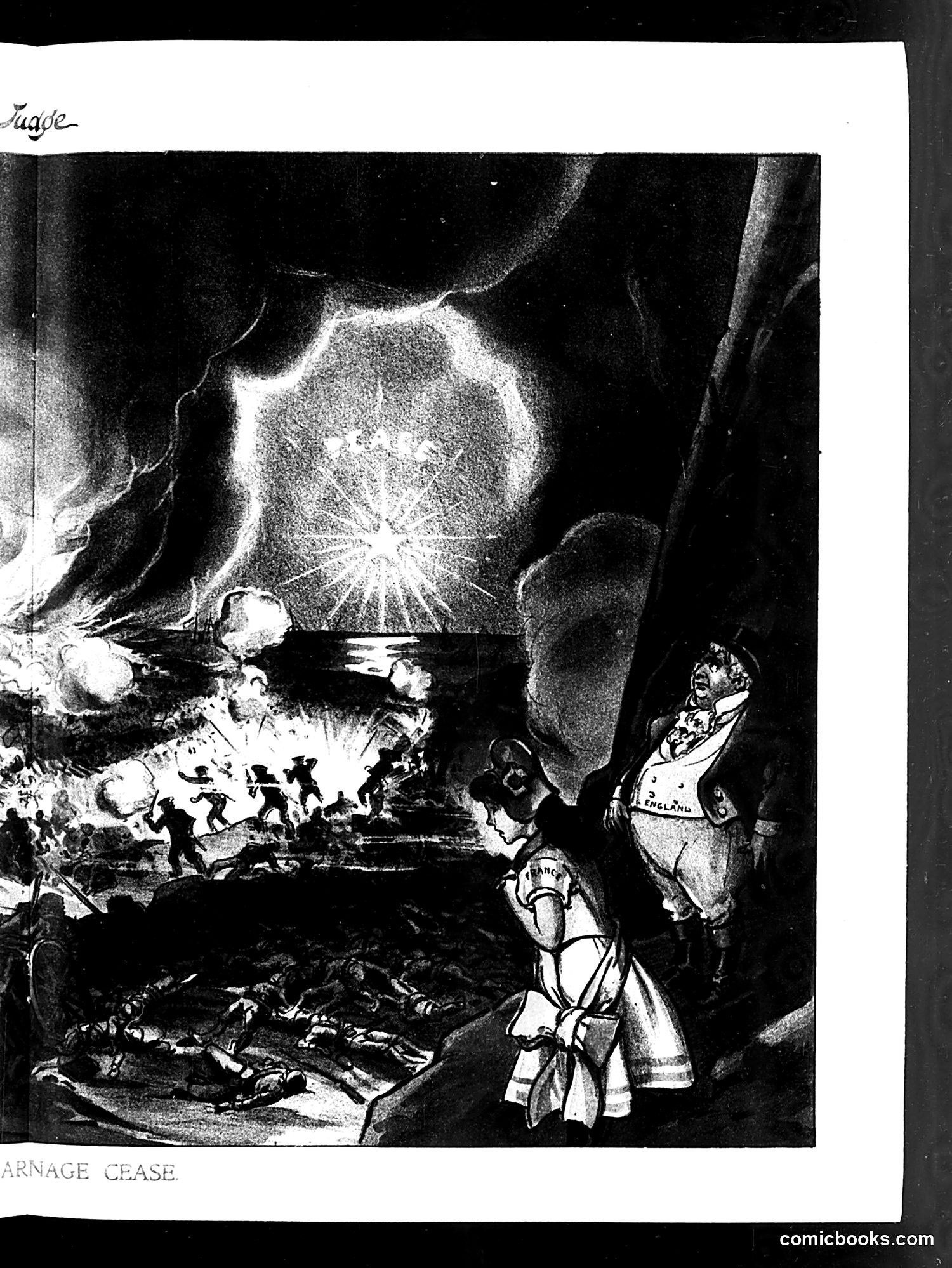
This political cartoon depicts a dramatic nighttime scene titled "Armage Cease" (likely "Armistice Cease"). The image shows military figures in uniform observing what appears to be a massive celestial light or divine intervention breaking through dark clouds above a battlefield. Below, soldiers are shown amid destruction and chaos. The cartoon likely satirizes World War I's end through religious imagery—the bright light suggests divine blessing or judgment on the armistice. The uniformed officers witnessing this moment may represent political or military leadership. The contrast between the heavenly light and earthly carnage below critiques the human cost of war, questioning whether any armistice truly resolves such devastation. The religious symbolism suggests contemporary debate about war's moral implications.
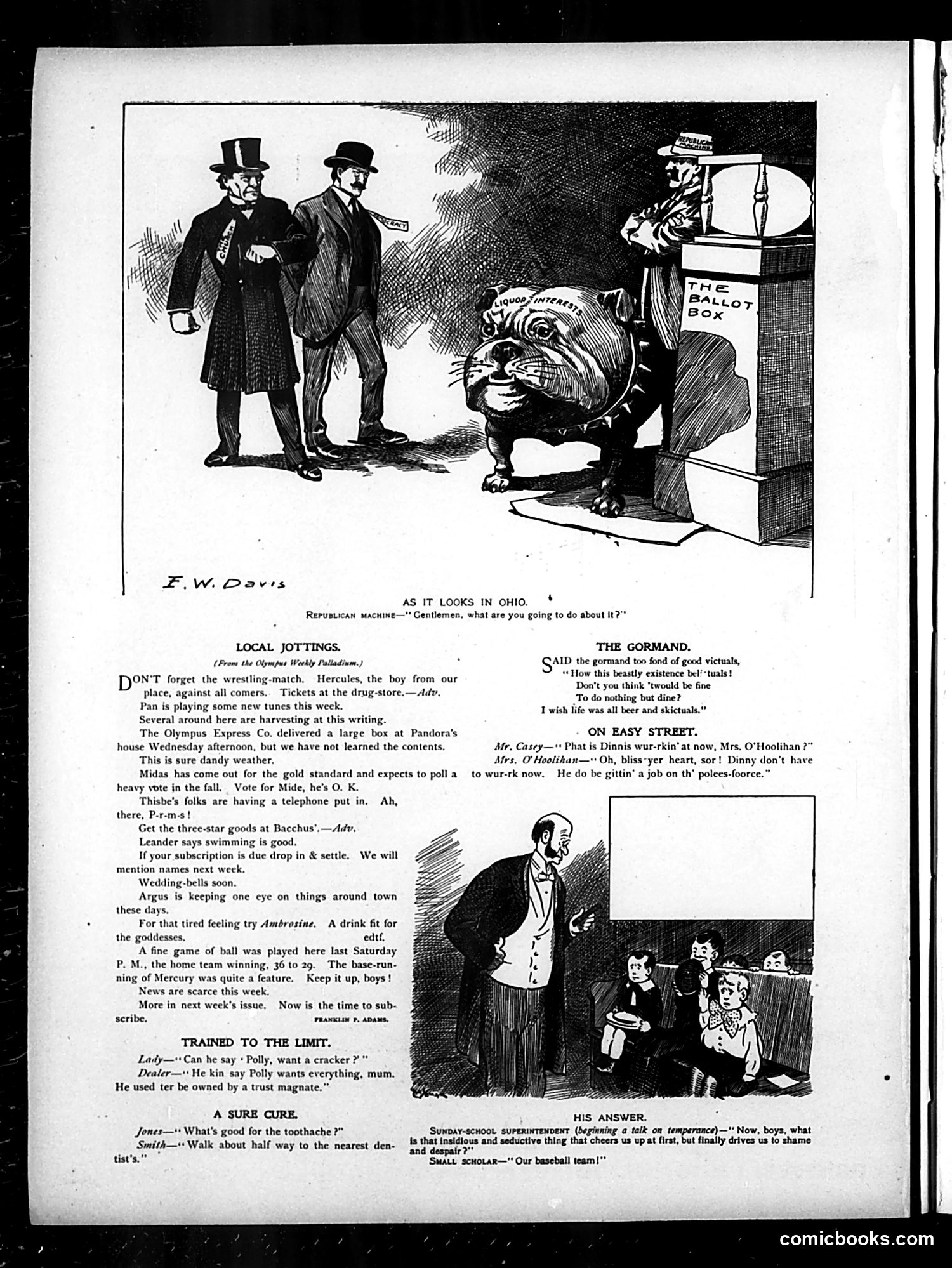
**Main Cartoon ("As It Looks in Ohio"):** The top illustration shows a bulldog labeled "Republican Machine" confronting two well-dressed gentlemen. The dog wears a spiked collar and guards "The Ballot Box." The caption asks what they'll do about it—satirizing Republican political control in Ohio, likely during the Gilded Age when machine politics dominated. The aggressive bulldog represents the party's stranglehold on voting. **Supporting Content:** The page mixes local satirical news items with brief humorous dialogues. Notable references include: - "Midas" supporting the gold standard (likely President McKinley or another Republican) - Irish immigrant characters ("O'Hoolihan") - References to mythological figures (Mercury, Bacchus, Leander) used as local placeholders **Overall Purpose:** This is a satirical political/social commentary page typical of *Judge*—mocking Republican political machinery, economic policies (gold standard), and poking fun at urban immigrant populations and everyday life in Gilded Age America.
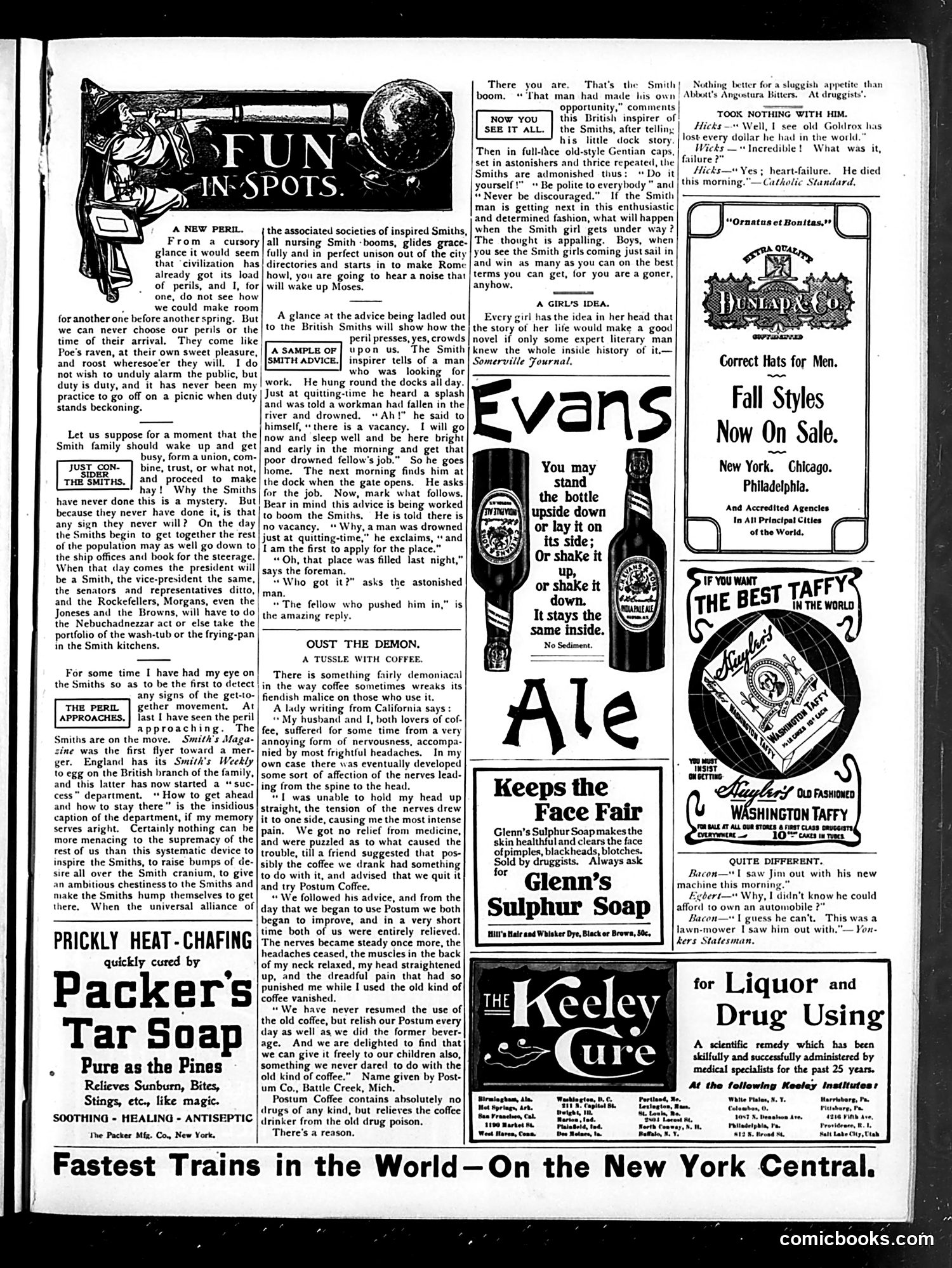
This page contains satirical commentary on the "Smith" family threat—a humorous exaggeration of middle-class social mobility. The main article warns that if the Smith family (representing ordinary, common people) ever organize collectively through unions or business combinations, they'll dominate society, displacing the wealthy elite (Rockefellers, Morgans, Joneses, Browns). The satire references *Smith's Magazine* and *Smith's Weekly* (real publications) as evidence that Smiths are being systematically encouraged toward ambition and success. The cruel anecdote about a dock worker—where the man who pushed a coworker into the river gets the job—illustrates the article's darkly cynical view of competitive advantage and social climbing. The remainder of the page consists primarily of period advertisements (Evans ale, Glenn's Sulphur Soap, Packer's Tar Soap, etc.), typical of Judge's revenue model. The satire represents anxiety about upward mobility and working-class organization in the early 20th century.
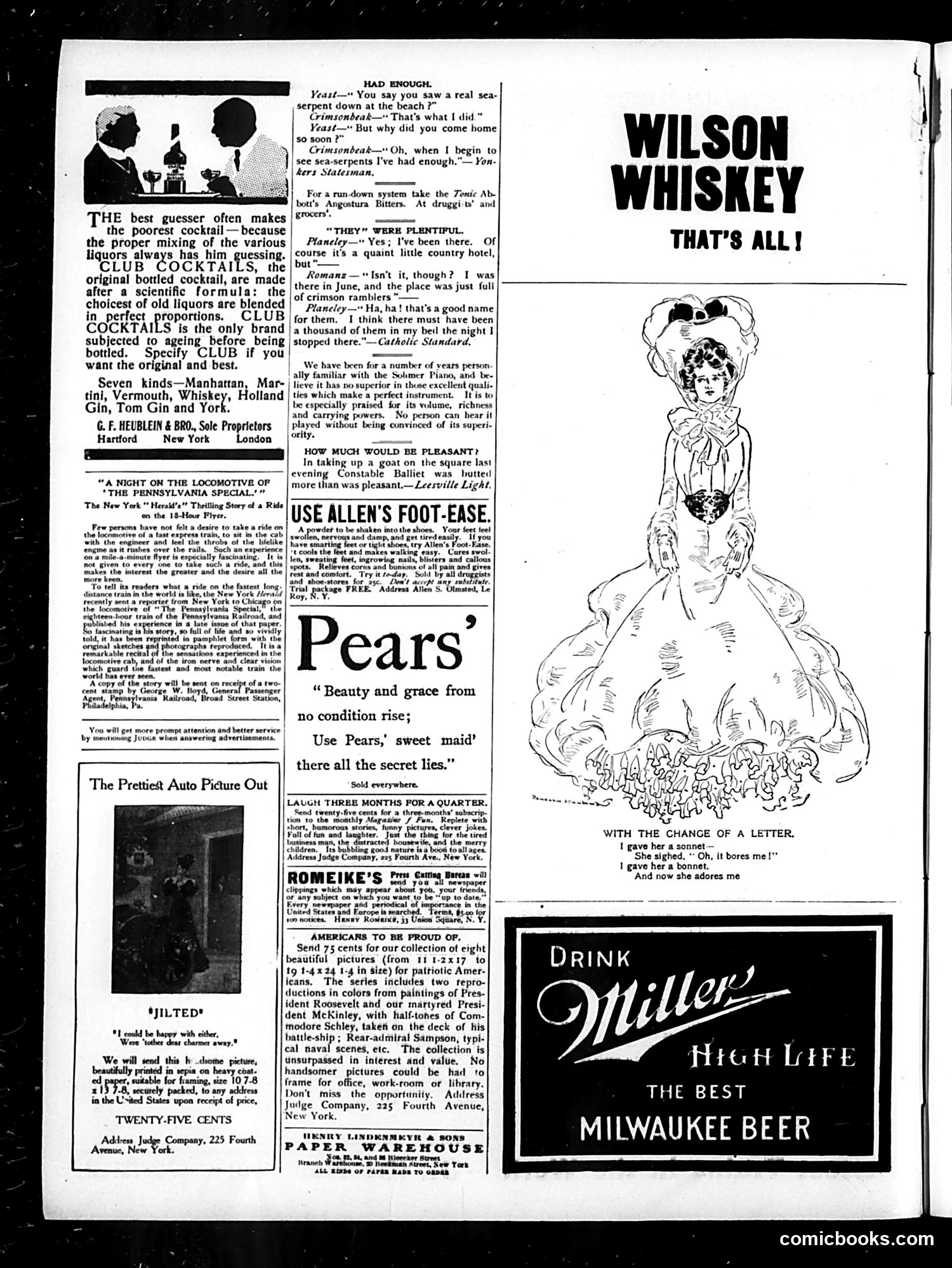
This page is primarily **advertisements and brief humor pieces** rather than political cartoons. The main content includes: **Advertisements:** - Club Cocktails (bottled cocktail brand) - Wilson Whiskey - Miller High Life Beer - Pears' soap (with poetic tagline) - Allen's Foot-Ease (foot powder) - Various other products **Humor Pieces:** Small comic anecdotes appear throughout, including: - "Had Enough": A joke about someone claiming to see a sea-serpent, then leaving abruptly - "They Were Plentiful": A hotel guest mistaking bedbugs ("crimson ramblers") for the flower of that name **Other Content:** - A story promotion about riding the Pennsylvania Special locomotive - "The Prettiest Auto Picture Out" (an illustrated auto picture for sale) The page reflects early 20th-century advertising culture and light domestic humor typical of Judge magazine. There is no significant political satire or caricature present on this particular page.
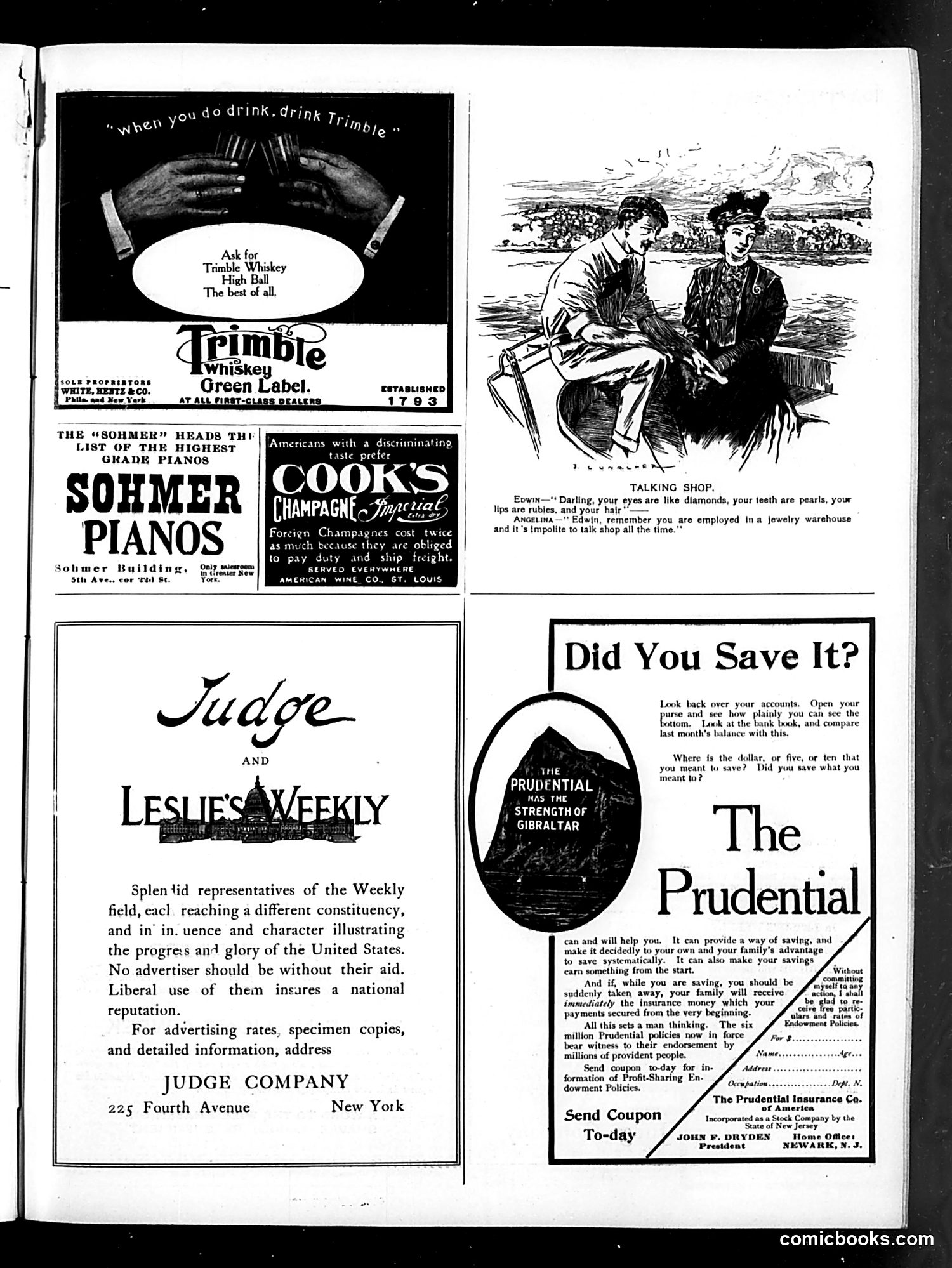
This page is primarily **advertising**, not editorial satire. It contains four distinct advertisements: 1. **Trimble Whiskey** - promoting their product with the slogan "When you do drink, drink Trimble" 2. **Sohmer Pianos** and **Cook's Champagne** - positioned as quality American alternatives to expensive imports 3. **"Talking Shop"** - a brief comic sketch showing a man employed at a jewelry warehouse who can't stop using jewelry metaphors when complimenting his girlfriend ("your eyes are like diamonds"), with the joke being he's inappropriately mixing work jargon into romance 4. **The Prudential Insurance Company** - a full advertisement encouraging readers to save money and consider life insurance, with the tagline "Did You Save It?" prompting financial self-reflection The page reflects early 20th-century consumer culture, positioning American products as quality equals to imported goods, while promoting personal thrift and financial planning through insurance.
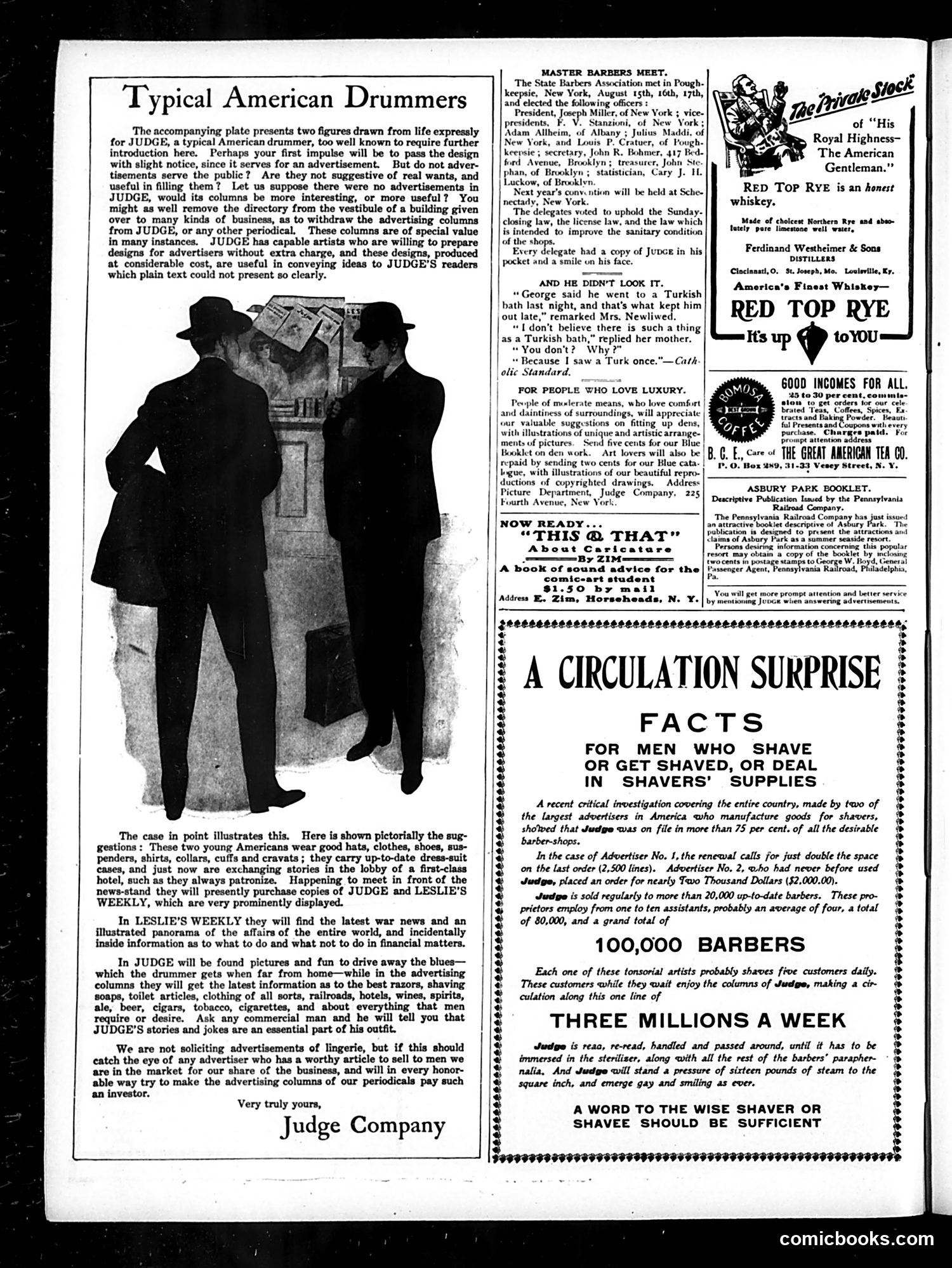
This page's main content is promotional writing disguised as editorial. "Drummers" refers to traveling salesmen—a common fixture in American commerce. The accompanying illustration shows two well-dressed businessmen exchanging stories in a hotel lobby, establishing the "typical" drummer's identity and lifestyle. The text employs a satirical meta-commentary: it argues that Judge's advertising columns serve the public as useful guides to consumer goods—razors, spirits, cigars, hotels—much like a directory. The implicit joke is that Judge is defending advertising's prominence by reframing consumption as practical necessity. The repeated plugs for Judge and Leslie's Weekly within the narrative are themselves advertisements disguised as editorial content, exemplifying exactly what the piece describes: useful information clothed in entertainment. The page represents turn-of-century advertising strategy: making sales pitches entertaining and normalizing commercial messaging as legitimate editorial content.
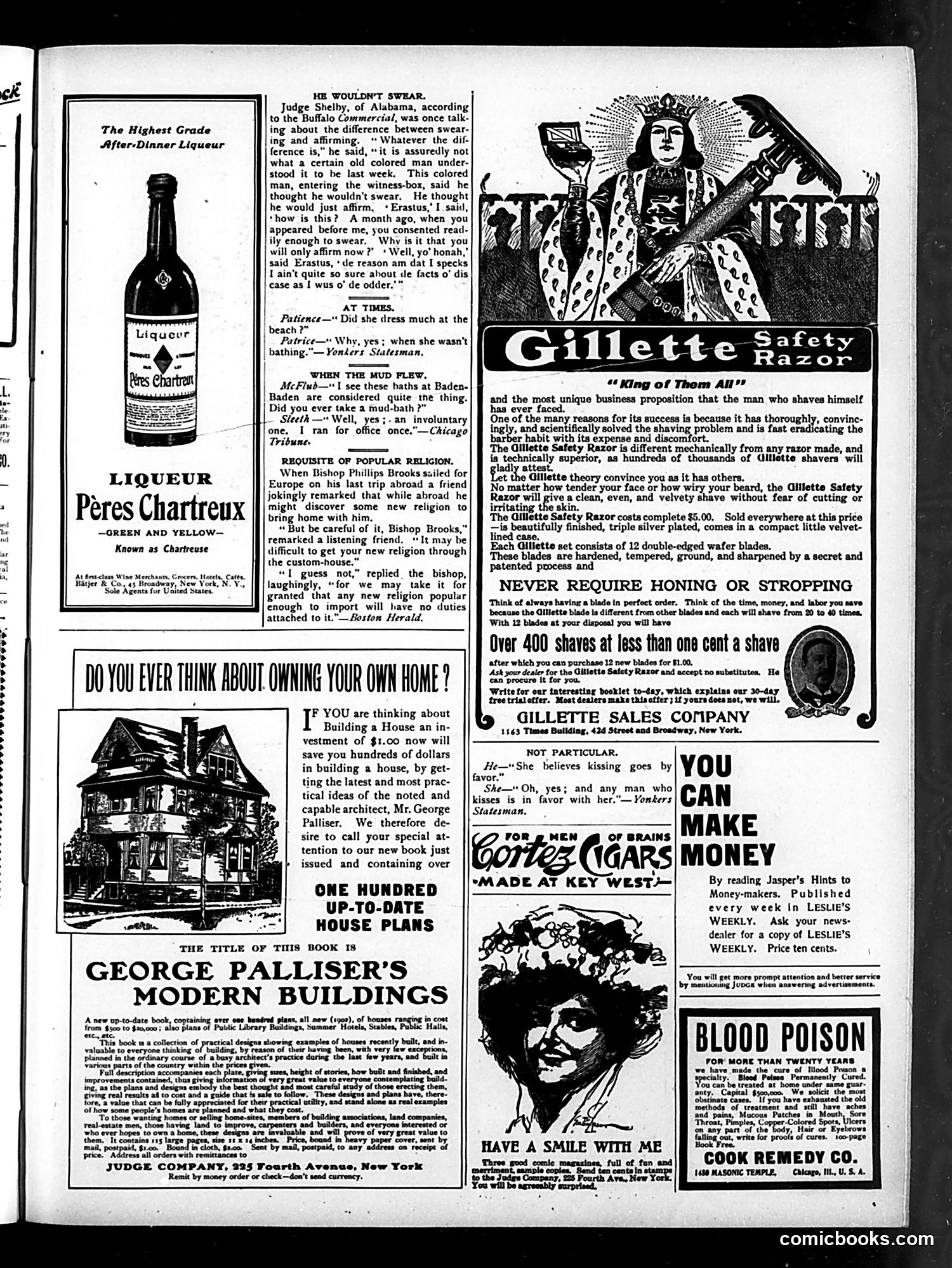
This page from *Judge* magazine contains several satirical pieces reflecting turn-of-the-century American attitudes: **"He Wouldn't Swear"**: A joke mocking an African American witness who refuses to swear an oath, claiming uncertainty about facts. The humor relies on a racist stereotype of Black dialect and alleged unreliability—typical of period satire that treated Black Americans as objects of ridicule. **"When the Mud Flew"**: A political joke where a candidate's experience with mud baths is compared to the messy aftermath of running for office—commentary on campaign corruption. **"Requisite of Popular Religion"**: Bishop Phillips Brooks is humorously told his new religion won't face customs duties because popular religions don't carry obligations—satire on religion's commercialization and lack of moral substance. The page is primarily **advertising** for liqueur, house-building plans, cigars, and patent medicines, with scattered jokes typical of *Judge*'s satirical humor targeting contemporary social figures and practices.
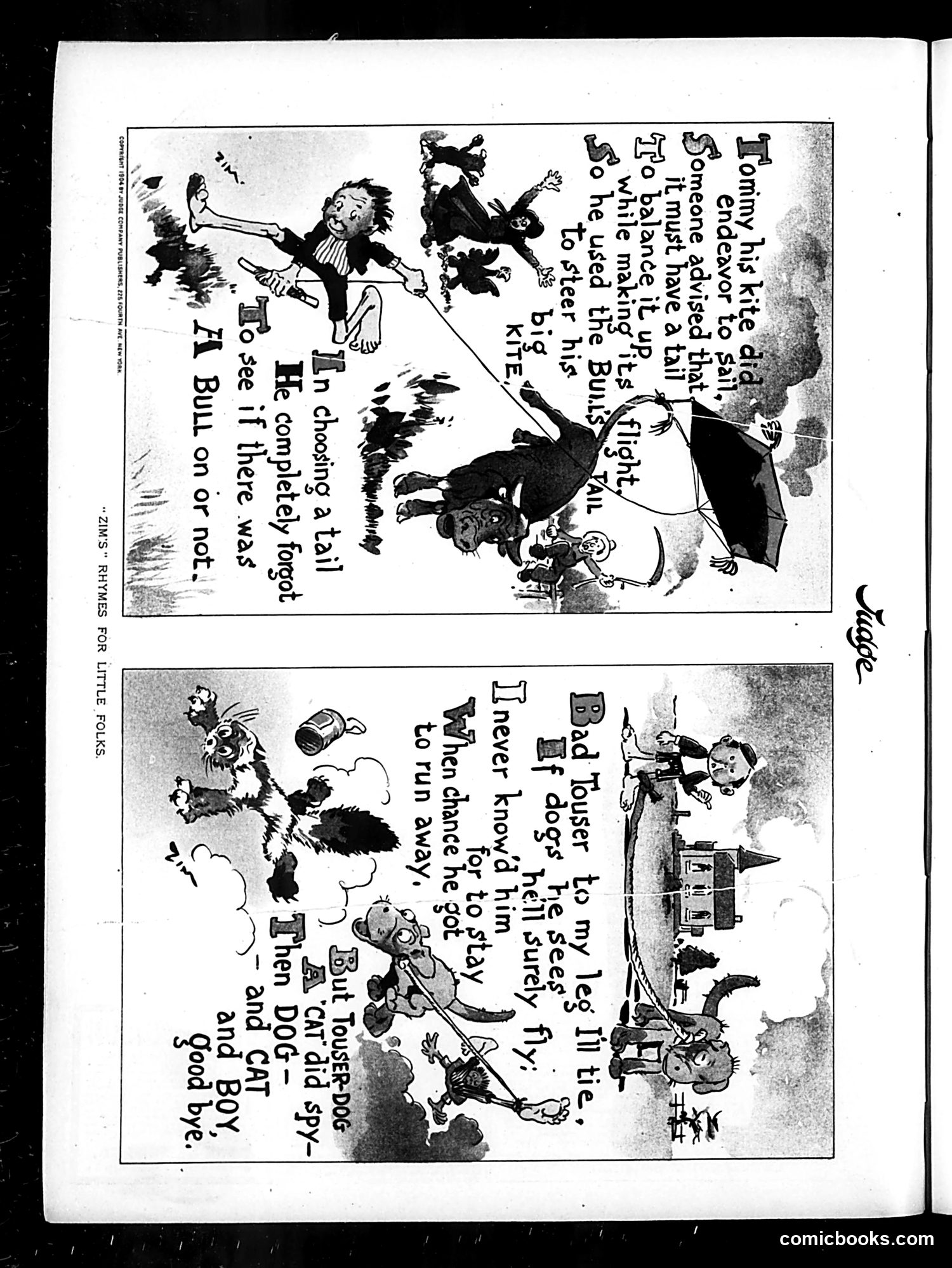
This page from *Judge* contains children's verse and illustrations rather than political satire. "Zim's Rhymes for Little Folks" appears to be humorous poetry about a boy named Tommy attempting to fly a kite. The narrative follows Tommy's mishap: he forgets to attach a tail to his kite, causing it to fail. The story escalates into comic chaos involving a dog chasing the boy, with a cat apparently involved in the mayhem as well. This is lighthearted, domestic humor aimed at children—not political commentary. The satire here is gentle slapstick about childhood mistakes and animal antics, typical of *Judge* magazine's family-oriented content alongside its more pointed political cartoons. No specific historical figures or political references are evident.