
Judge, 1905-09-02 · page 7 of 16
Judge — September 2, 1905 — page 7: what you’re looking at
What you’re looking at
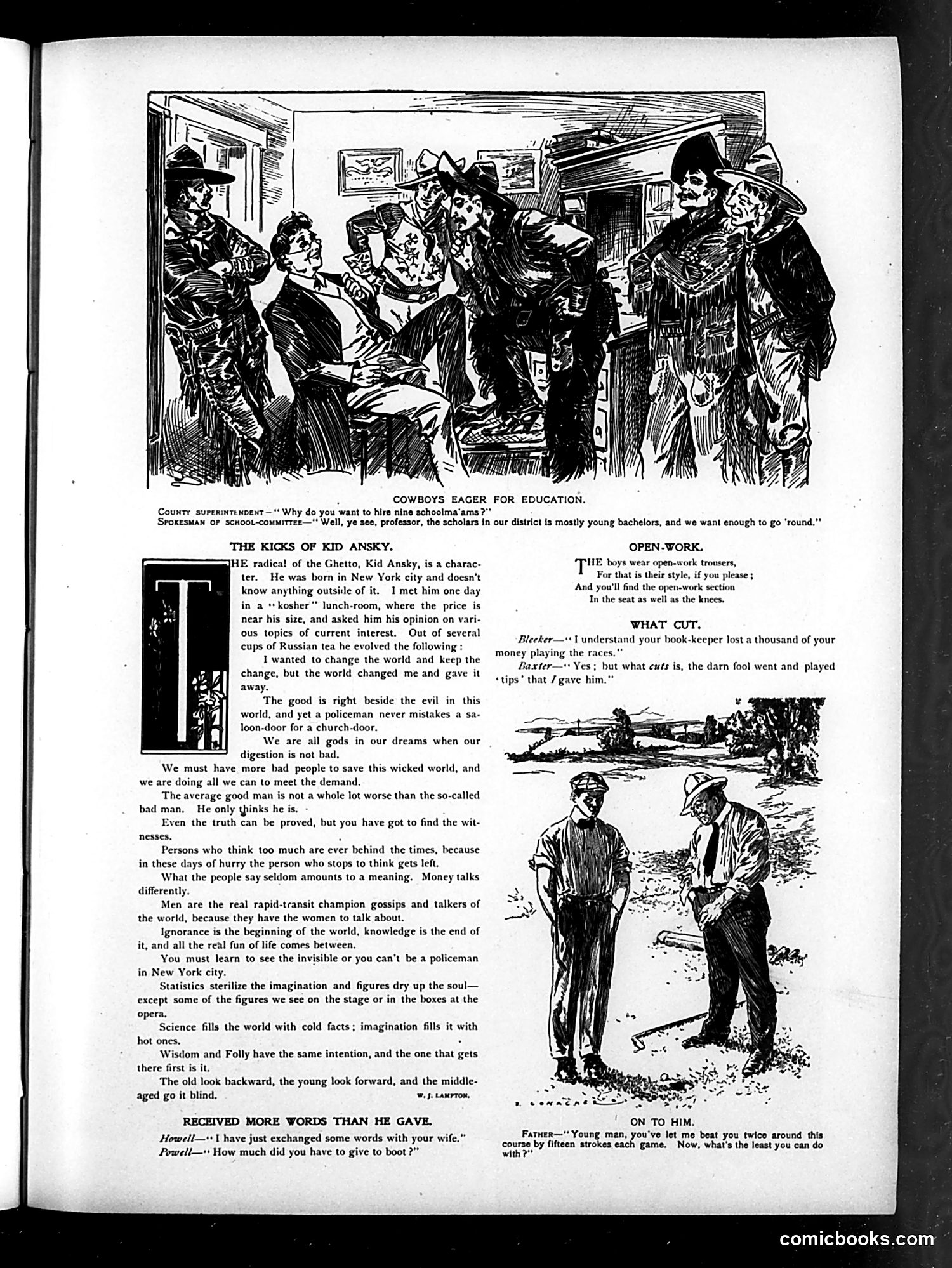
This Judge magazine page contains three satirical pieces: **"Cowboys Eager for Education"** mocks rural attitudes by depicting a school committee wanting to hire nine teachers for young bachelor students—the joke being they're motivated by romance rather than education. **"The Kicks of Kid Ansky"** presents philosophical musings from a character described as a Ghetto radical and New York native. These are cynical observations about human nature, morality, and city life—typical turn-of-century urban immigrant satire, poking fun at both idealistic reformers and working-class pragmatism. **"Open-Work" and smaller jokes** use wordplay and double meanings common to the era's humor style. The overall tone reflects Judge's satirical approach: mocking rural simplicity, immigrant characters and their accented English, and contemporary social anxieties. The "Kid Ansky" section particularly exemplifies how early 20th-century American publications caricatured immigrant intellectuals and their perspectives, combining condescension with occasionally sharp social criticism.
📄 Transcribed text from this page (OCR, searchable)
Machine-transcribed from the original scan — historical spelling and the odd misread are preserved.
COWBOYS EAGER FOR EDUCATION. County surerinrenvent—"* Why do you want to hire nine schoolma‘ams ?” SPOKESMAN OF scHooL-commiTree—“* Well, ye see, professor, the scholars in our district is mostly young bachelors, and we want enough to go ‘round."* ‘THE KICKS OF KID ANSKY. (emt radical of the Ghetto, Kid Ansky, is a charac- ter. He was born in New York city and doesn’t know anything outside of it. I met him one day in a kosher” lunch-room, where the price is near his size, and asked him his opinion on vari- ous topics of current interest. Out of several cups of Russian tea he evolved the following : I wanted to change the world and keep the change, but the world changed me and gave it away. The good is right beside the evil in this world, and yet a policeman never mistakes a sa- loon-door for a church-door. We are all gods in our dreams when our digestion is not bad. We must have more bad people to save this wicked world, and we are doing all we can to meet the demand. The average good man is not a whole lot worse than the so-called bad man. He only thinks he is. - Even the truth can be proved, but you have got to find the wit- nesses. 6 Persons who think too much are ever behind the times, because in these days of hurry the person who stops to think gets left. What the people say seldom amounts to a meaning. Money talks differently. Men are the real rapid-transit champion gossips and talkers of the world, because they have the women to talk about. Ignorance is the beginning of the world, knowledge is the end of it, and all the real fun of life comes between. You must learn to see the invisible or you can’t be a policeman in New York city. Statistics sterilize the imagination and figures dry up the soul— except some of the figures we see on the stage or in the boxes at the opera. Science fills the world with cold facts; imagination fills it with hot ones. . Wisdom and Folly have the same intention, and the one that gets there first is it. The old look backward, the young look forward, and the middle- aged go it blind. w. J. tasrron, RECEIVED MORE WORDS THAN HE GAVE. Howell—1 have just exchanged some words with your wife.” Powell—« How much did you have to give to boot ?” OPEN-WORK. HE. boys wear open-work trousers, For that is their style, if you please ; And you'll find the open-work section In the seat as well as the knees. WHAT CUT. and your book-keeper lost a thousand of your eae ON TO HIM. Farner—" Young man, you've let me beat you twice around this courte by fifteen strokes each game. Now, what's the least you can do with?” comicbooks.com