
A complete issue · 16 pages · 1905
Judge — August 26, 1905
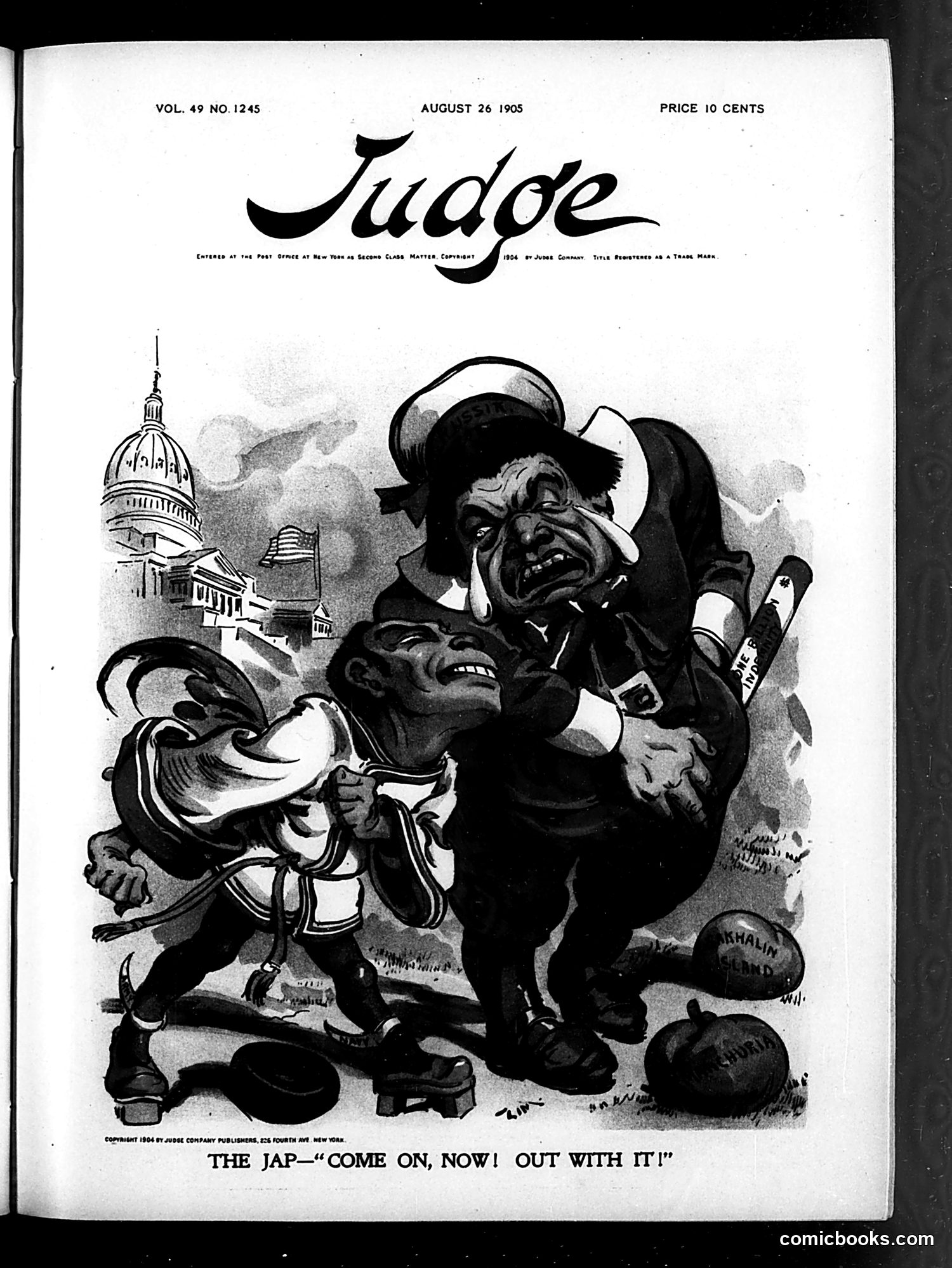
This Judge magazine cover from August 26, 1905 uses caricature to comment on the Russo-Japanese War. The cartoon depicts a caricatured Japanese figure (labeled "The Jap") being pressured by another figure to reveal or surrender something, likely representing Japan's demands during peace negotiations following their military victories. The Capitol building in the background suggests American involvement or mediation in the conflict. The "come on, now! out with it!" caption implies the cartoon satirizes Japan's reluctance to concede territorial or financial demands during negotiations (President Theodore Roosevelt later mediated the Portsmouth Treaty ending this war). The exaggerated facial features reflect the deeply racist visual conventions of the era's American political cartooning.
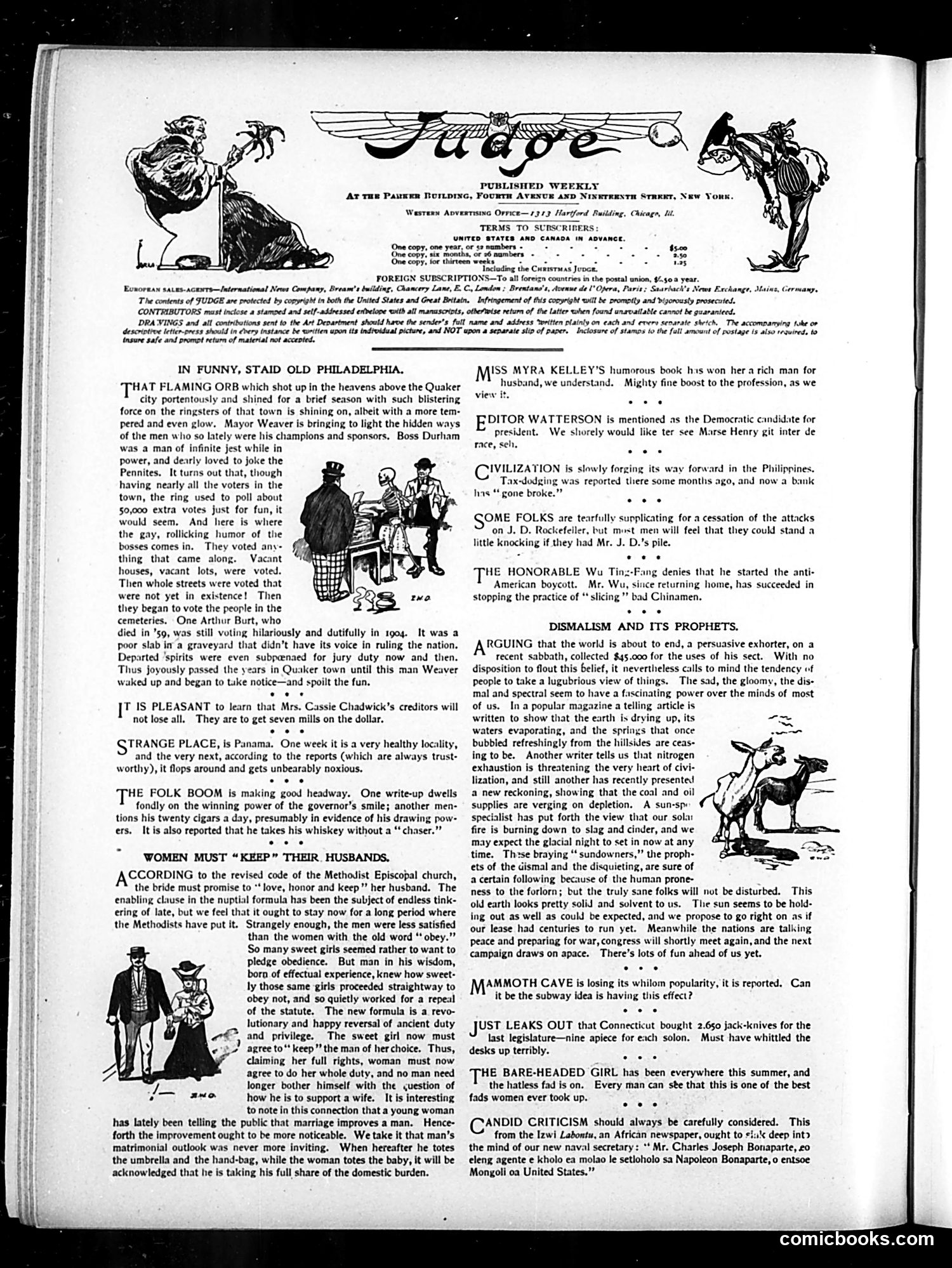
This appears to be a humor/news commentary page from Judge magazine featuring several brief satirical items and accompanying illustrations. The visible cartoons include figures in period dress (appearing early 20th century), though specific identities are unclear from the image alone. One illustration shows what appears to be a well-dressed couple, another depicts a man in formal attire. The text items mock various topics: Philadelphia politics and voting irregularities; Methodist church marriage doctrine; and international affairs (Wu Ting-Fang's anti-American boycott efforts in China). There's commentary on doomsday prophecies about earth's depletion and the Mammoth Cave tourist attraction. The satire targets contemporary social concerns—electoral corruption, religious hypocrisy, international relations, and pseudo-scientific catastrophism—through brief, witty observations typical of Judge's editorial style.
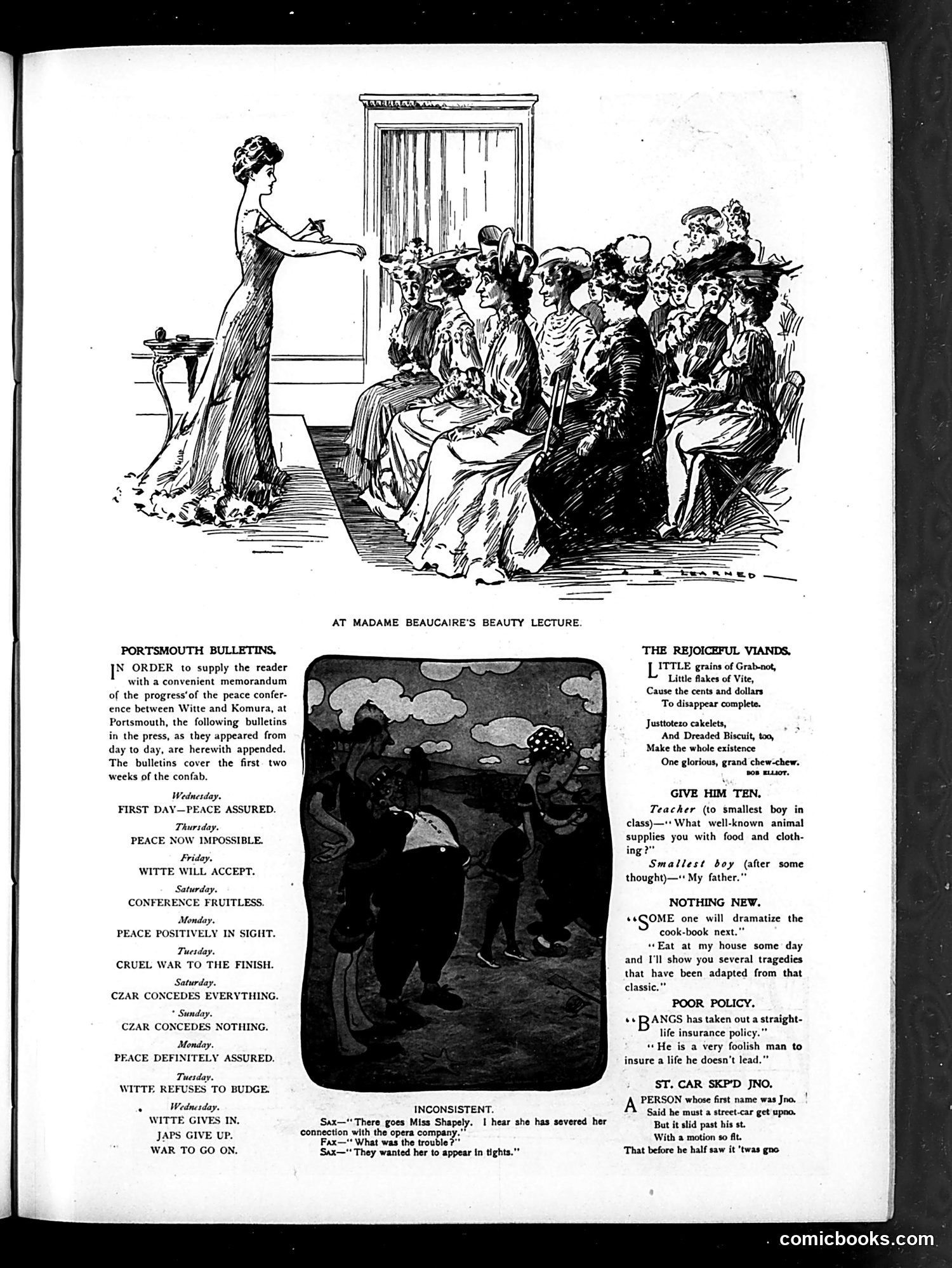
**Top Illustration:** "At Madame Beaucaire's Beauty Lecture" depicts an elegantly dressed woman lecturing to an attentive audience of fashionable ladies about beauty and appearance—a satirical commentary on the commercialization of women's beauty standards and the lecture-circuit culture of the era. **Left Column:** "Portsmouth Bulletins" mockingly tracks peace negotiations between Witte and Komura (Russian and Japanese diplomats ending the Russo-Japanese War, 1904-1905). Each day's "prediction" contradicts the previous, satirizing the endless, futile back-and-forth of peace talks and the unreliability of diplomatic pronouncements. **Right Column:** Humorous short items about contemporary social absurdities, typical of Judge's satirical content. **Center Image:** An unclear nighttime scene; context insufficient for confident interpretation.
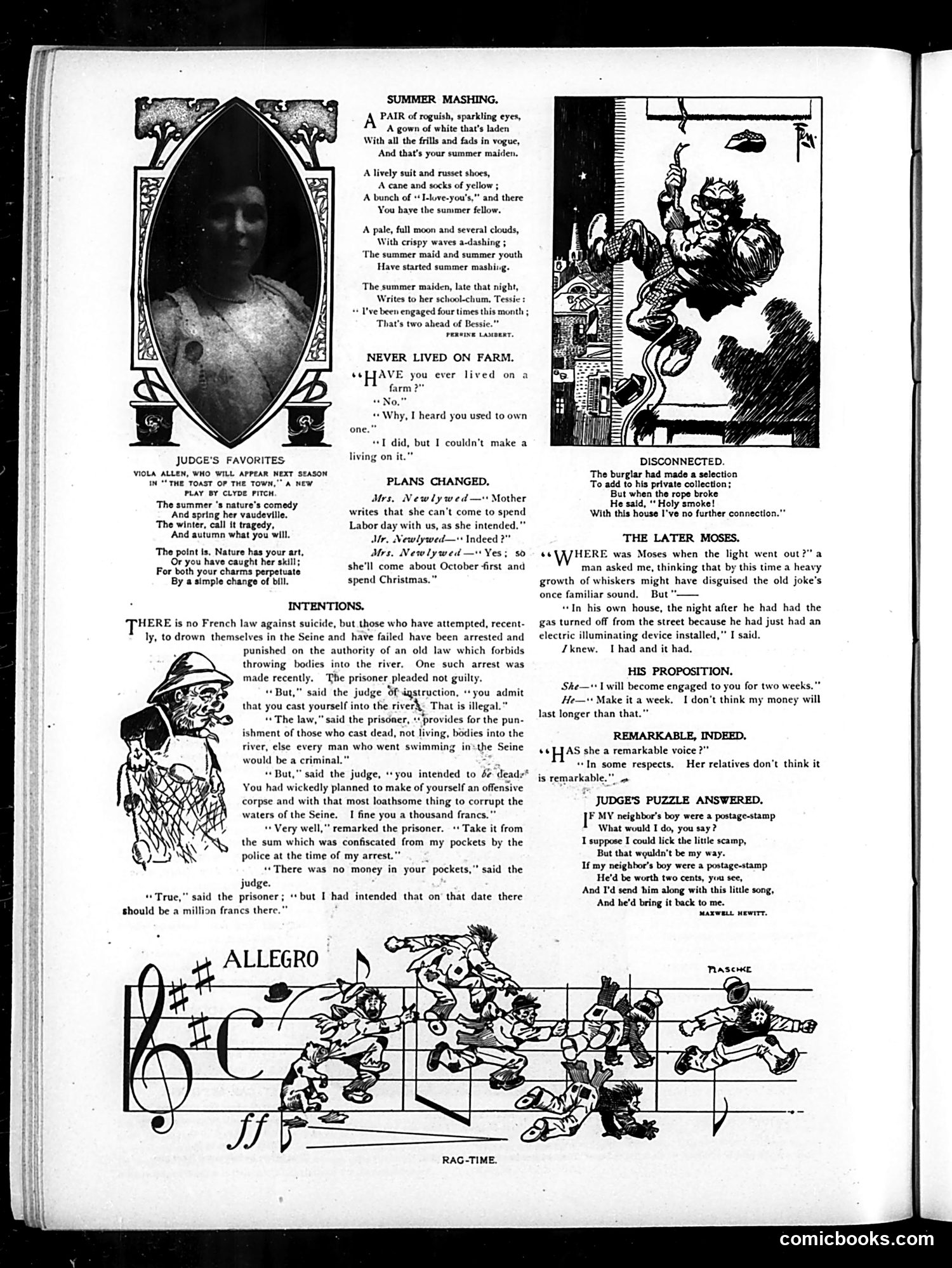
This page contains several unrelated humor pieces typical of Judge's satirical format: **"Summer Mashing"** features a poem about courtship rituals, paired with a portrait photograph—likely advertising romantic/social content. **"Never Lived on Farm"** and other brief comedic dialogues appear to be general-interest humor pieces with no specific political targets. **"Intentions"** presents a dialogue about French suicide law and river disposal, appearing to mock legal proceedings rather than target specific figures or events. **Visual elements** include a caricatured face (possibly a character type rather than specific person), and sheet music labeled "Rag-Time"—reflecting Judge's mix of humor, social commentary, and entertainment content. Without clearer identifying details or dated references in the text, most pieces appear to be timeless humor rather than commentary on specific contemporary events.
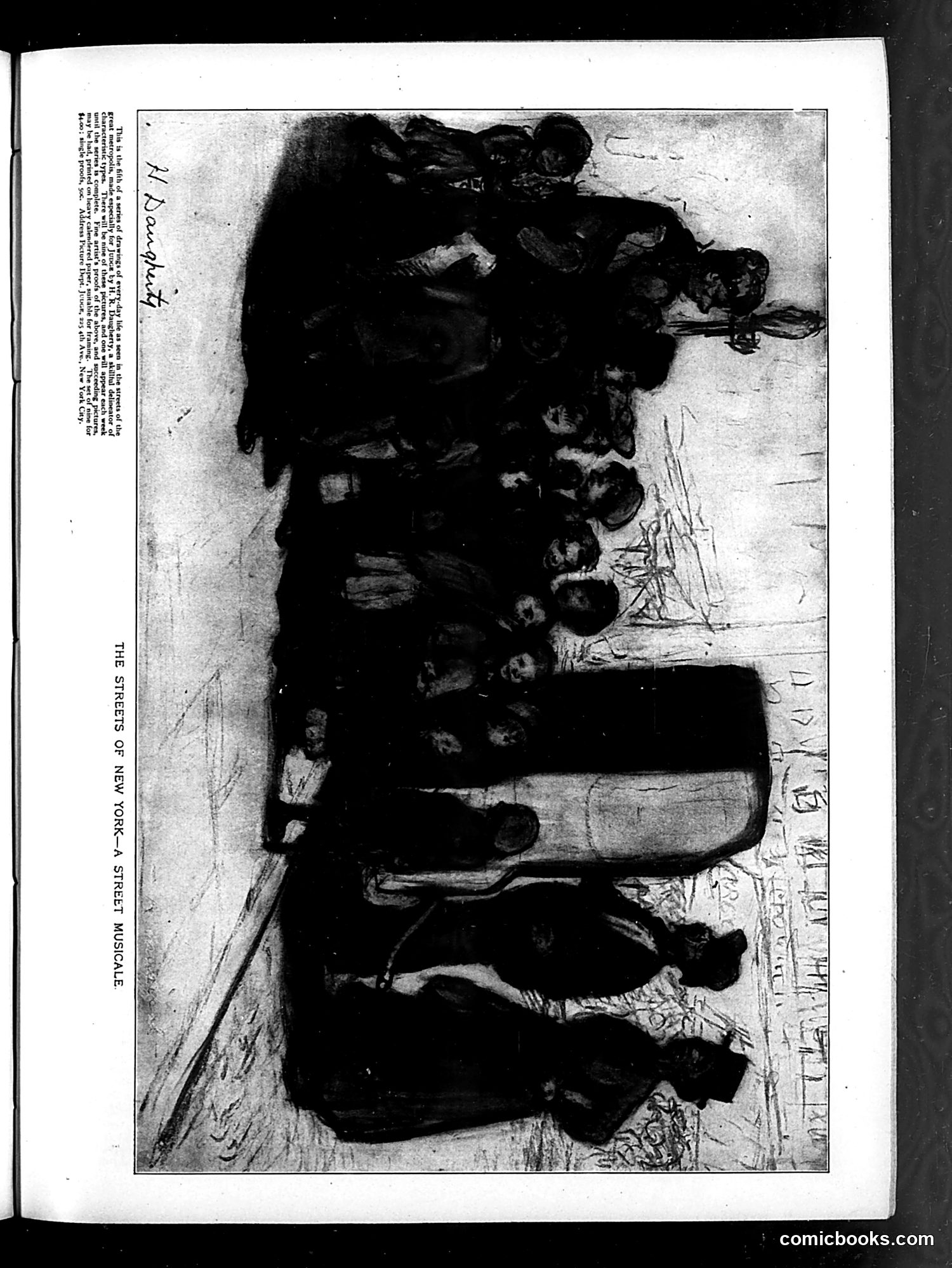
This Judge cartoon satirizes street musicians performing in New York City. The image, rotated 90 degrees, depicts multiple figures with musical instruments crowded together on a street, likely representing the common nuisance of street performers during this era. The satire targets the chaos and cacophony of urban street life—multiple musicians playing simultaneously without coordination, creating discord rather than harmony. This reflects contemporary complaints about noise pollution and unregulated street performance in densely populated cities. The title's term "musicale" (a formal musical gathering) is ironic: instead of refined entertainment, readers see a jumbled street scene. Judge magazine frequently mocked urban inconveniences and working-class street culture, making this a typical commentary on the disorder of city living for middle-class readers.
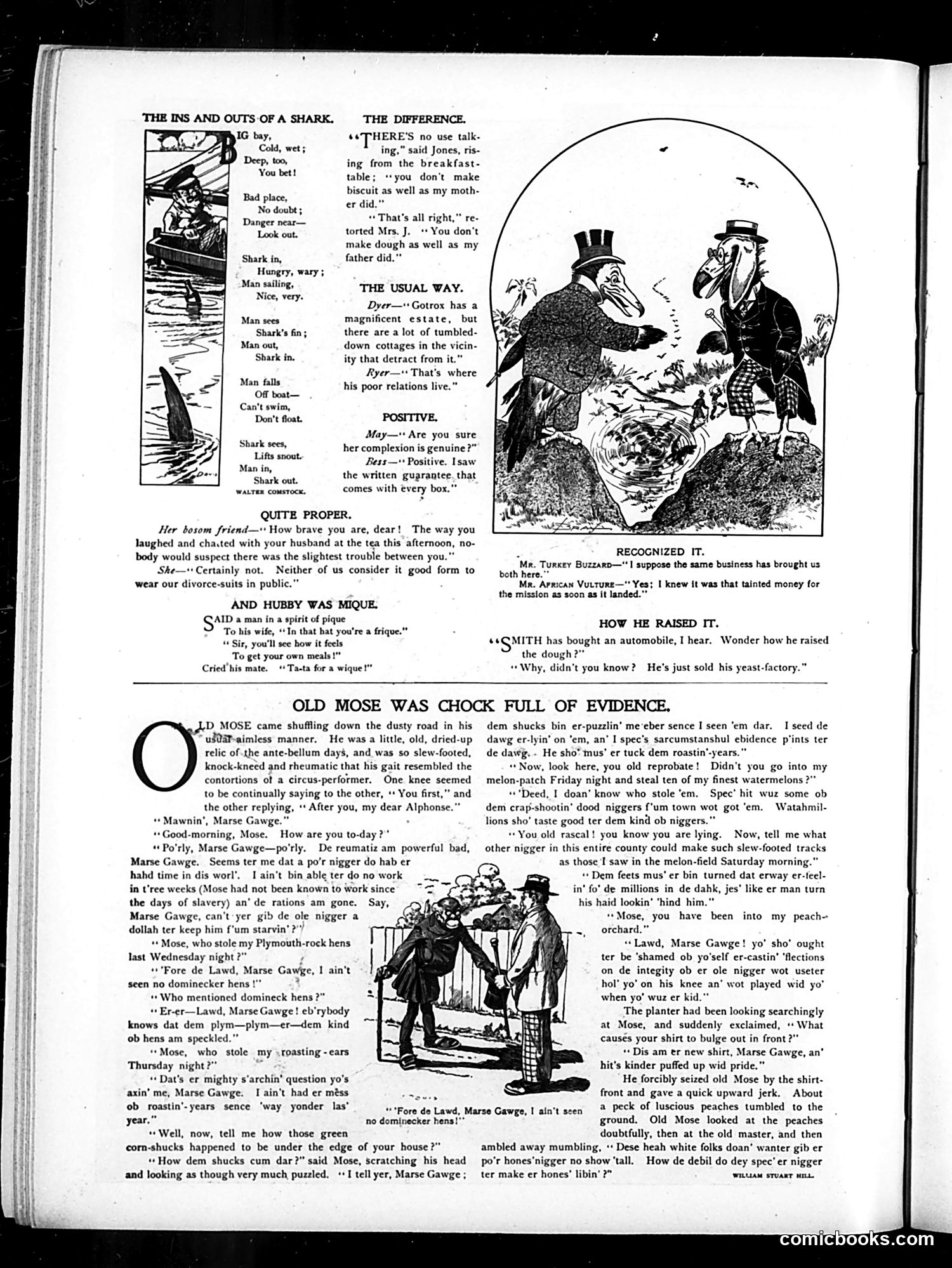
This page contains multiple short humor pieces typical of Judge magazine's satirical style. The dominant feature is a lengthy dialect story about "Old Mose," a formerly enslaved Black man, confronted by "Marse Gawge" (his former master or local landowner) about stolen chickens and corn. The piece uses exaggerated racial stereotypes and dialect to portray Mose as evasive and dishonest. When confronted with evidence of theft, Mose deflects by blaming his dog—a comedic reversal where he ironically claims to have "circumstantial evidence" pointing to the animal. The humor derives from Mose's supposed cunning in evading responsibility through technically accurate (but misleading) statements. This reflects early 1900s white attitudes: depicting Black characters as inherently untrustworthy, linguistically deficient, and clever only in deception. The surrounding shorter pieces use similar comedic patterns involving class differences, marital discord, and consumer culture—standard Judge fare of the era.
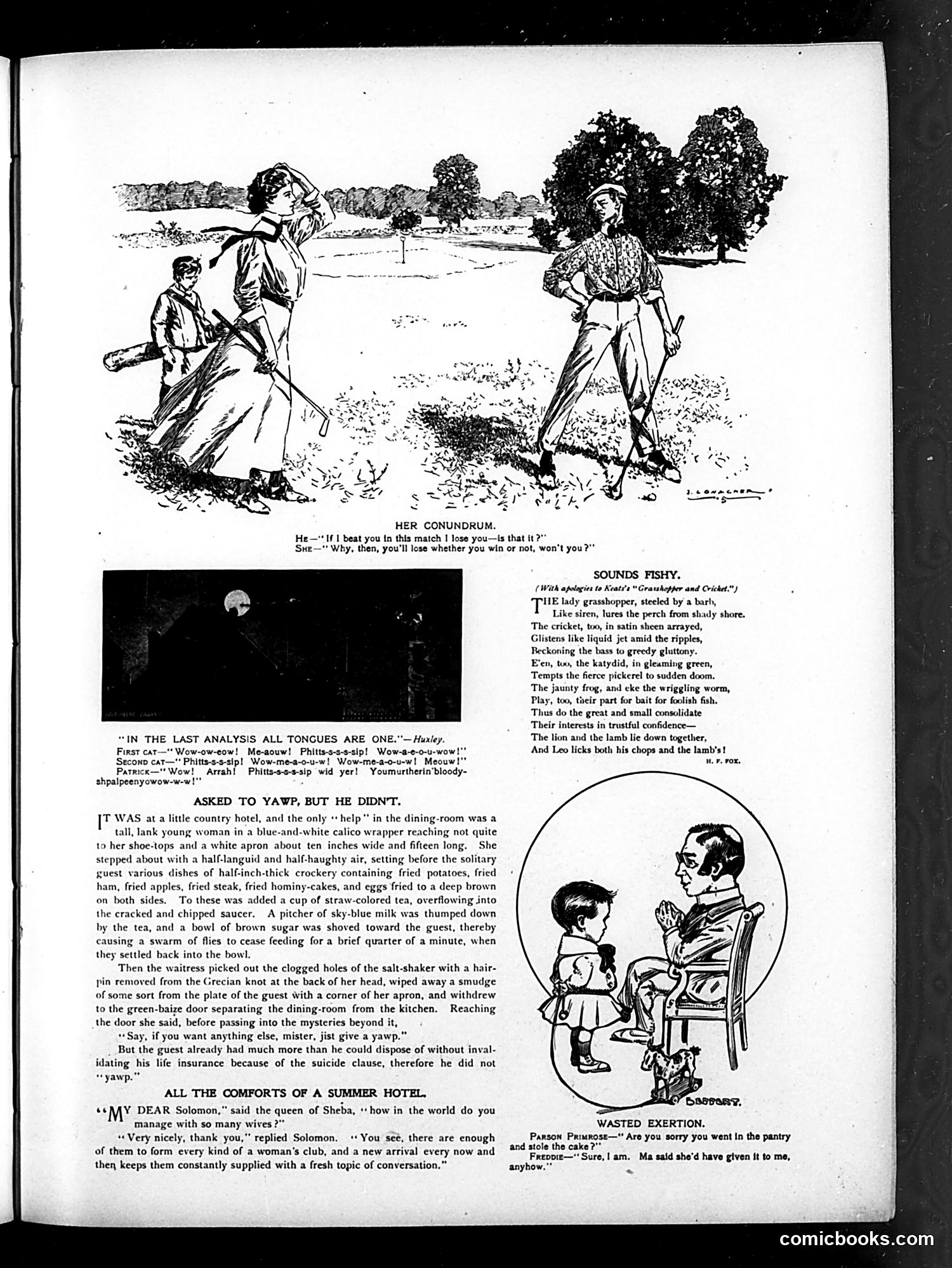
This page contains several satirical pieces targeting early-20th-century American social conventions: **"Her Conundrum"** depicts a woman playing sports with a man, presenting a logical paradox about losing a romantic relationship—satire on anxieties about women's independence and athletic participation. **"Sounds Fishy"** parodies Keats's poetry, sarcastically comparing predator-prey relationships to social "consolidation" and harmony. The final section mocks Emerson's famous quote "In the Last Analysis All Tongues Are One" by showing cats and an Irishman fighting violently while claiming unity—obvious satire on false idealism and class/ethnic tensions. **"Asked to Yawp"** ridicules rural American hospitality and service, depicting a slovenly waitress at a country hotel serving terrible food with casual indifference—social commentary on rural backwardness versus urban standards. **"All the Comforts of a Summer Hotel"** jokes about Solomon managing multiple wives by organizing them into women's clubs—satirizing both polygamy and the contemporary women's club movement. The humor targets rural life, false philosophy, women's changing roles, and ethnic stereotypes typical of *Judge*'s urban, educated audience.
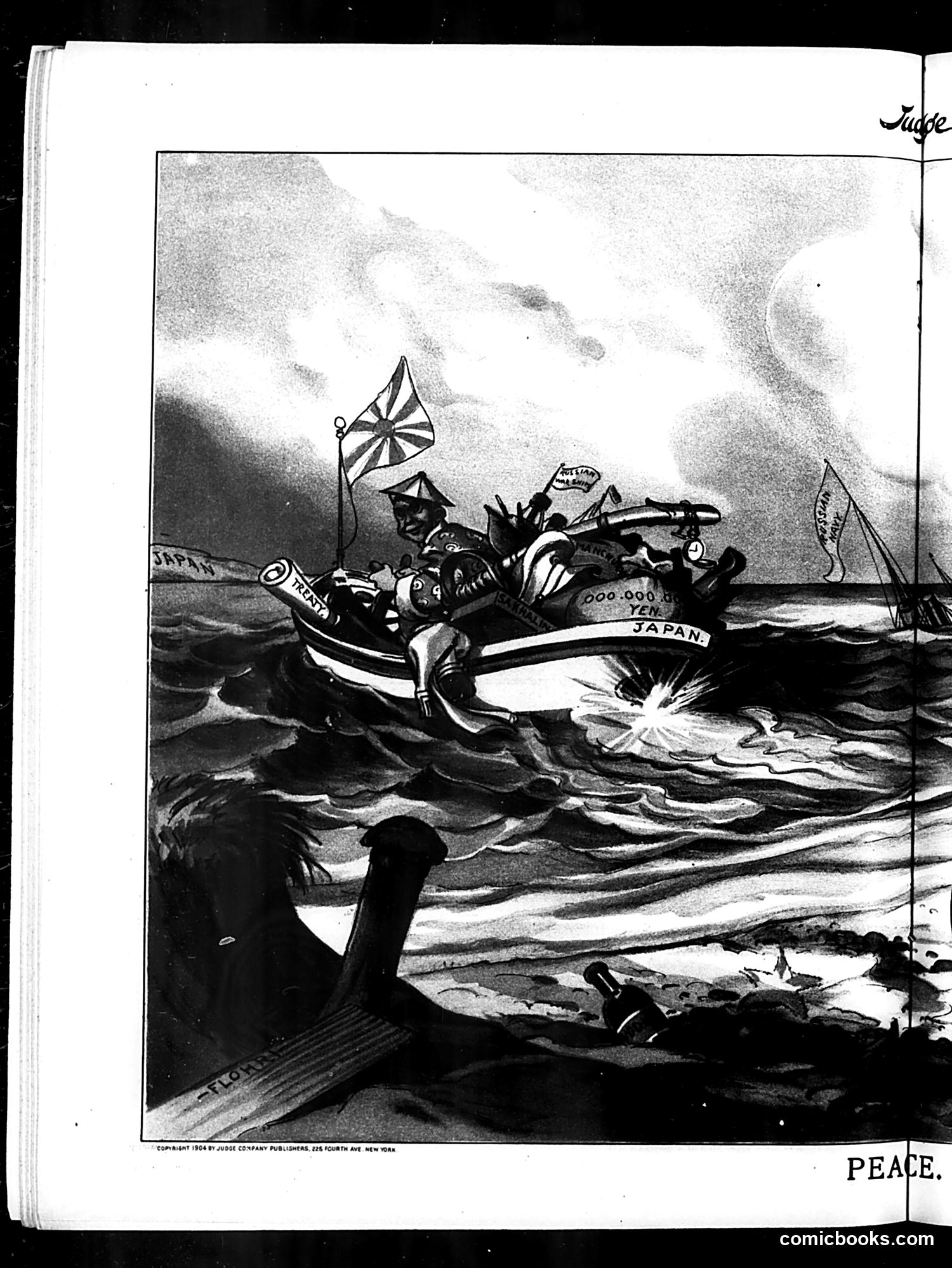
This cartoon depicts a heavily laden Japanese vessel labeled "JAPAN" capsizing or struggling in rough seas, weighed down by numerous military figures and armaments. Japanese flags flutter from the boat. The caption simply reads "PEACE." The satire critiques Japan's militarism and imperial ambitions—suggesting that Japan's military buildup and aggressive policies are unsustainable, like an overloaded ship doomed to sink. The irony of titling this "PEACE" suggests that true peace requires Japan to abandon its militaristic course. Based on the style and "Judge" publication, this appears to be early-to-mid 20th century commentary, likely relating to Japanese imperial expansion in Asia. The cartoon uses visual metaphor to argue that military overextension inevitably leads to disaster.
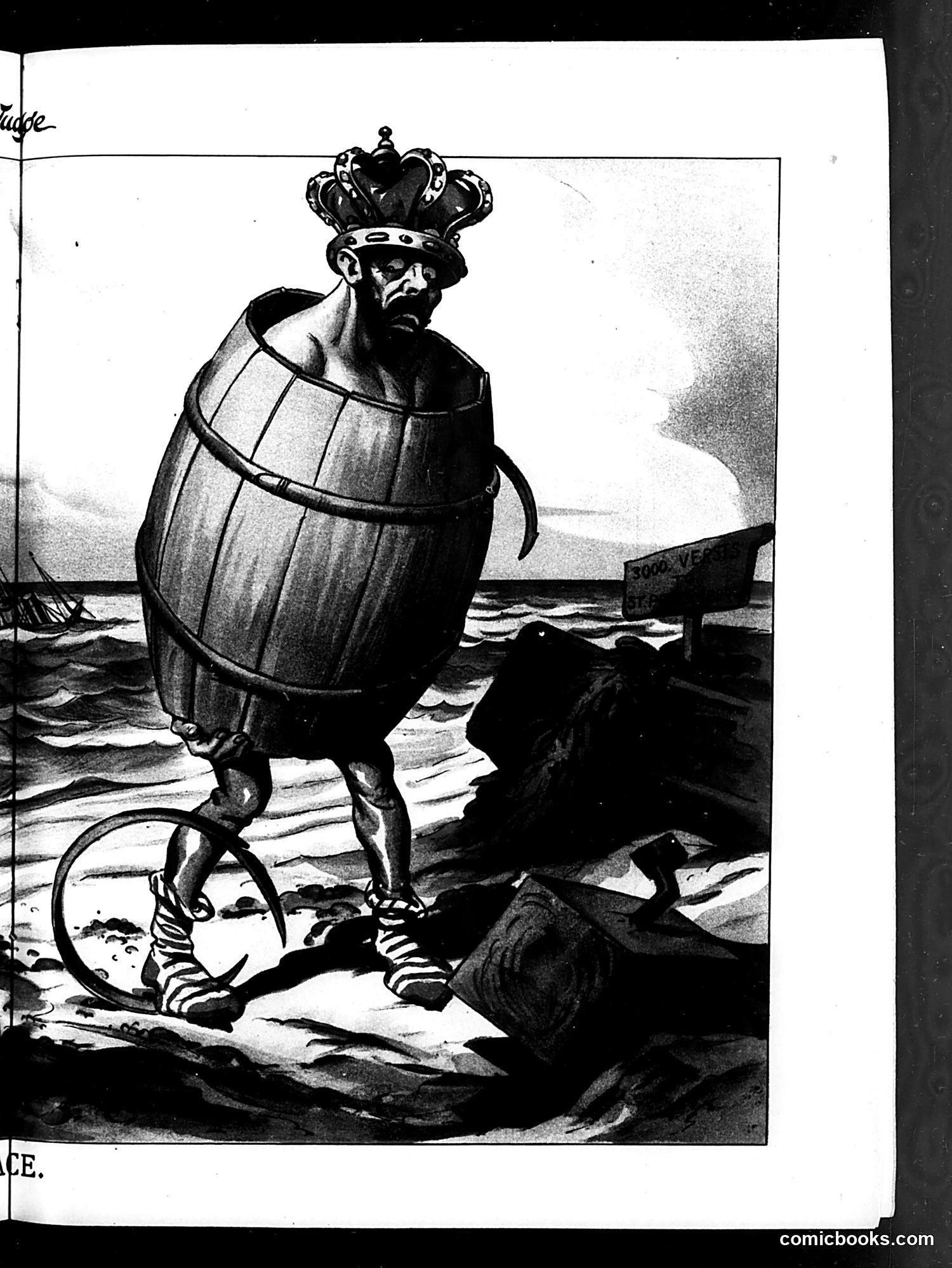
This political cartoon depicts a crowned figure emerging from a large barrel, standing on a beach with shipwreck debris. The figure wears royal regalia (ornate crown) but is humorously confined within a wooden barrel, suggesting constraint or limitation of power. The imagery appears to satirize a political or royal figure whose authority has been compromised or reduced—literally "barreled up." The seaside wreckage setting implies disaster or downfall. Without clearer OCR text or visible publication date, I cannot identify the specific figure or historical event referenced. The cartoon likely comments on a contemporary political scandal, failed leadership, or loss of power during Judge magazine's publication period. The barrel itself may carry additional symbolic meaning specific to that era's political discourse.
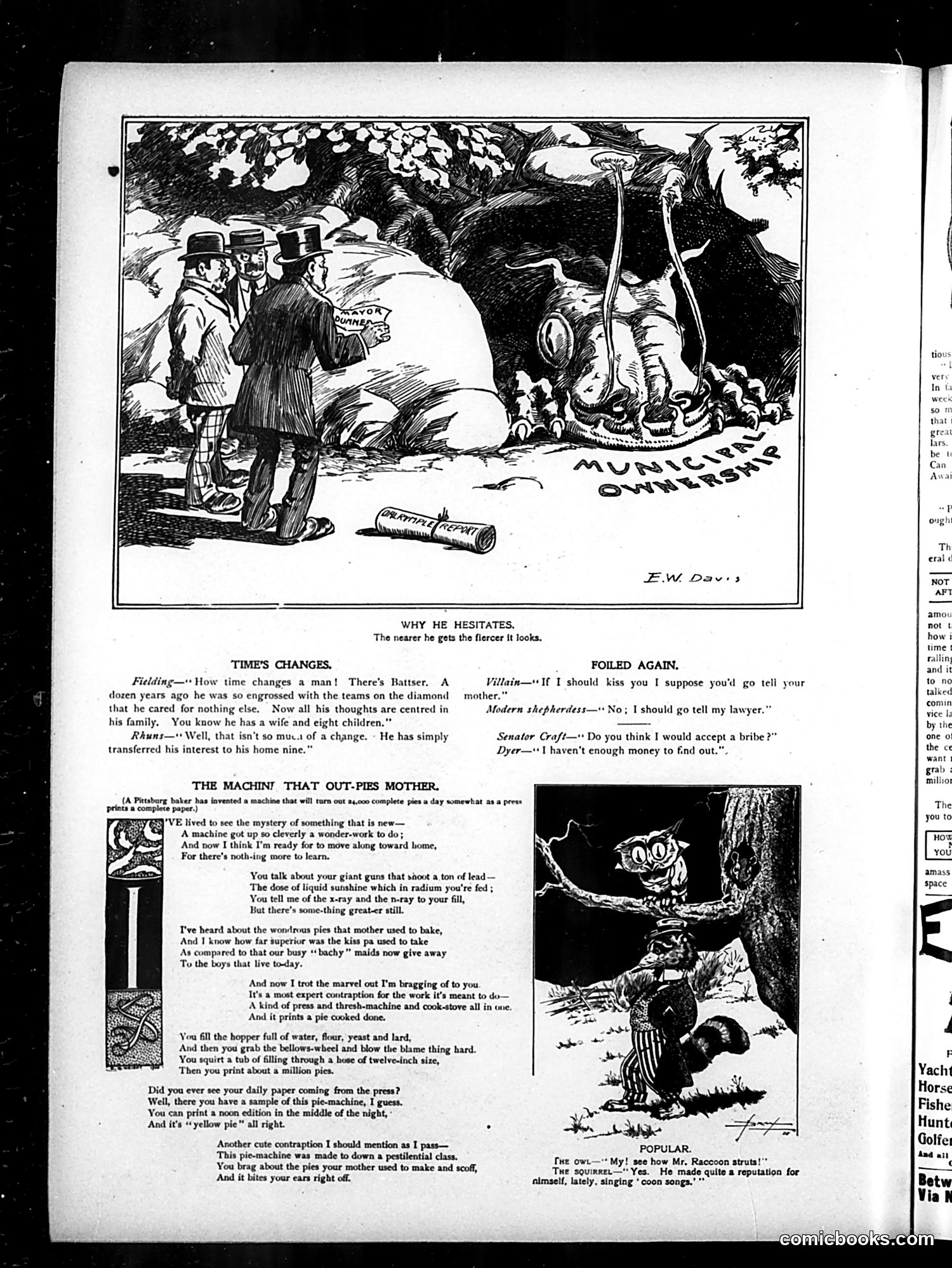
This page contains several unrelated satirical pieces: **Top cartoon ("Why He Hesitates"):** Shows three well-dressed men examining what appears to be a large bomb or explosive device labeled "Municipal Ownership." The satire critiques hesitation about municipal ownership—likely of utilities or services—suggesting politicians fear its consequences despite public interest. **"Time's Changes":** A brief joke about a baseball fan (Battser) who now focuses on his "home nine" (his eight children plus wife), punning on baseball terminology. **"The Machine That Out-Pies Mother":** A satirical poem mocking industrial progress and mass-production machinery. It celebrates a fictional automated pie-making machine while nostalgically lamenting lost domestic values—mother's homemade pies and genuine affection replaced by industrial efficiency and fake sentiment from modern women. **"Foiled Again":** Three brief jokes about modern gender relations and political corruption, suggesting cynicism about both romance and ethics. The page reflects Progressive Era anxieties about industrialization, changing gender roles, and municipal politics.
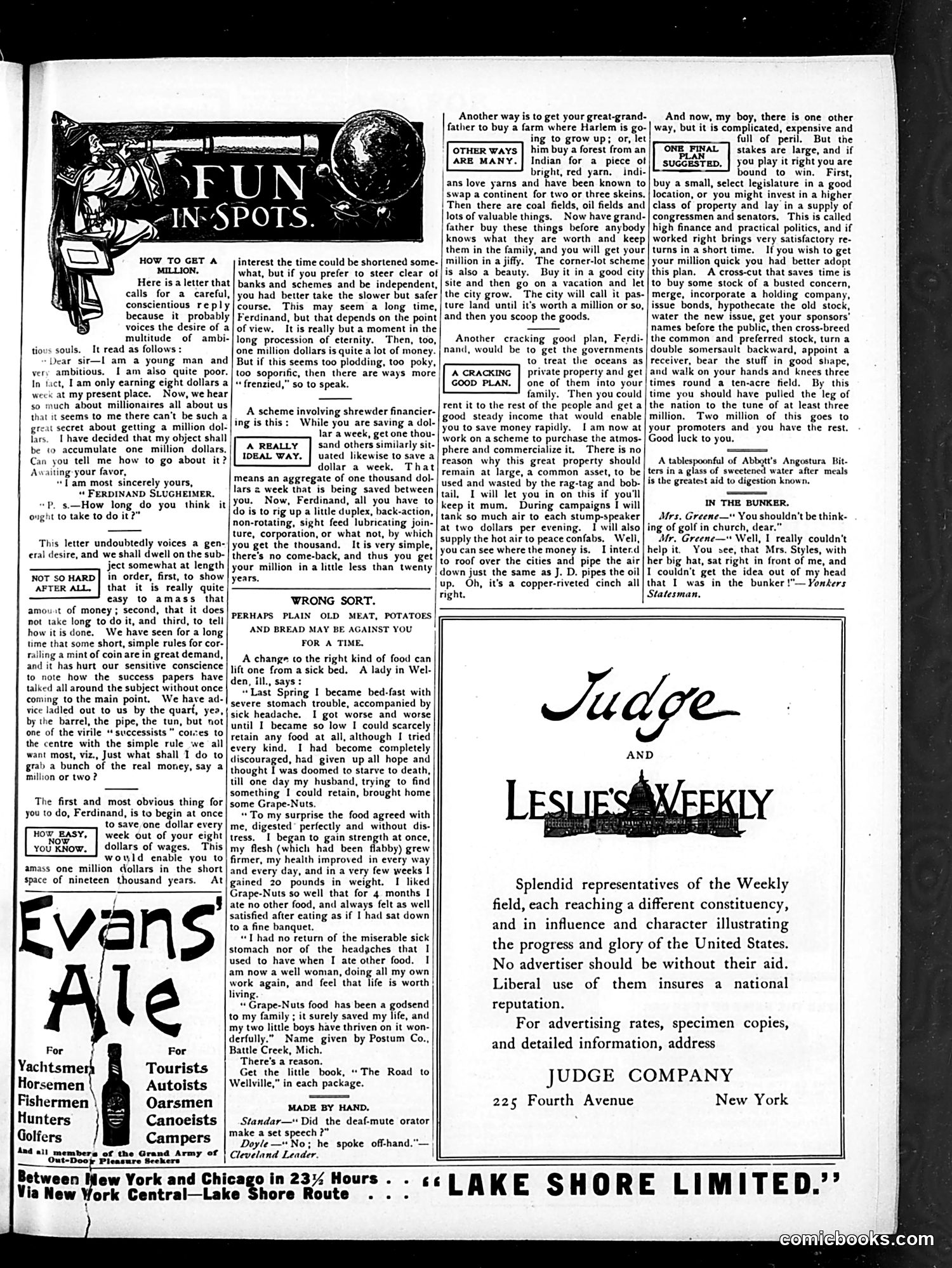
This is satirical advice to an ambitious but poor young man (Ferdinand Slugheimer) seeking wealth. The satire operates on multiple levels: **The main joke:** The magazine offers two schemes, both absurd. First: save $1 weekly for 19,000 years. Second: organize 1,000 others to each save $1 weekly, then use a fabricated corporate scheme ("duplex, back-action" device) to pocket their collective savings—essentially describing embezzlement or fraud wrapped in corporate jargon. **The satire's target:** Early-20th-century "get rich quick" schemes and business manipulation. By making the timescale comically long in scheme one, and the fraud transparently obvious in scheme two, Judge ridicules both the naïveté of ambitious poor workers and the ruthless financiers who exploit them through corporate structures. **Context:** This reflects Progressive Era anxieties about wealth inequality, corporate corruption, and the impossibility of legitimate advancement for working-class Americans earning eight dollars weekly.
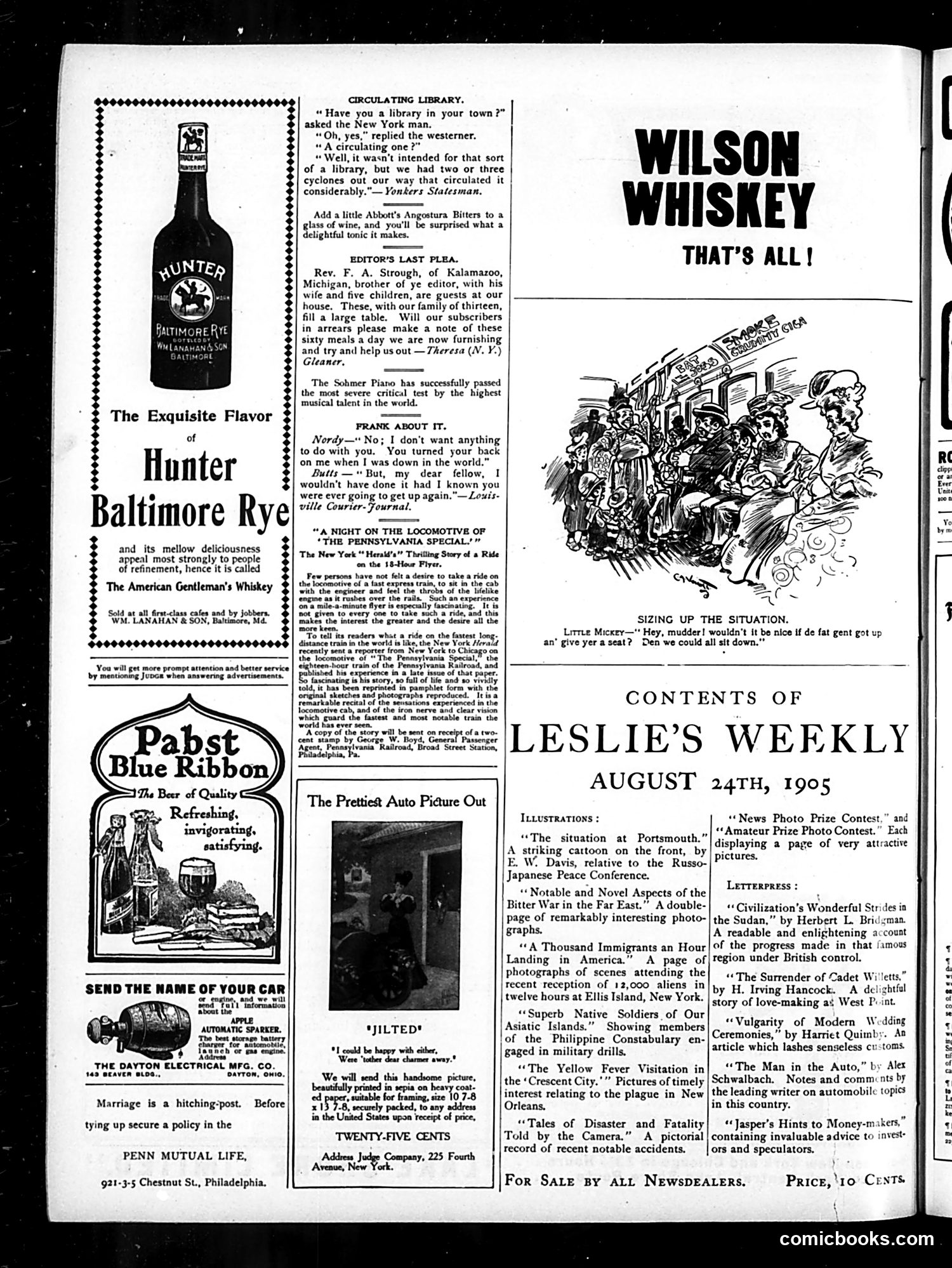
This page is primarily **advertisements and editorial notes**, with one notable cartoon titled **"Sizing Up the Situation."** The cartoon depicts a crowded streetcar or train where a small boy ("Little Mickey") suggests to his mother that if the "fat gent" would stand up, everyone could sit down. The humor is straightforward sarcasm: the boy's "solution" would actually make the crowding worse, not better—it's absurd logic played for laughs. The cartoon likely reflects **turn-of-the-century urban life** and the everyday frustrations of public transportation in crowded cities, poking fun at both the boy's innocent illogic and the general discomfort of shared public spaces. The rest of the page consists of whiskey and auto advertisements, editorial snippets (including one humorous piece about a "circulating library" destroyed by cyclones), and notices about Leslie's Weekly's upcoming content on the **Russo-Japanese Peace Conference at Portsmouth**—a major 1905 news event.
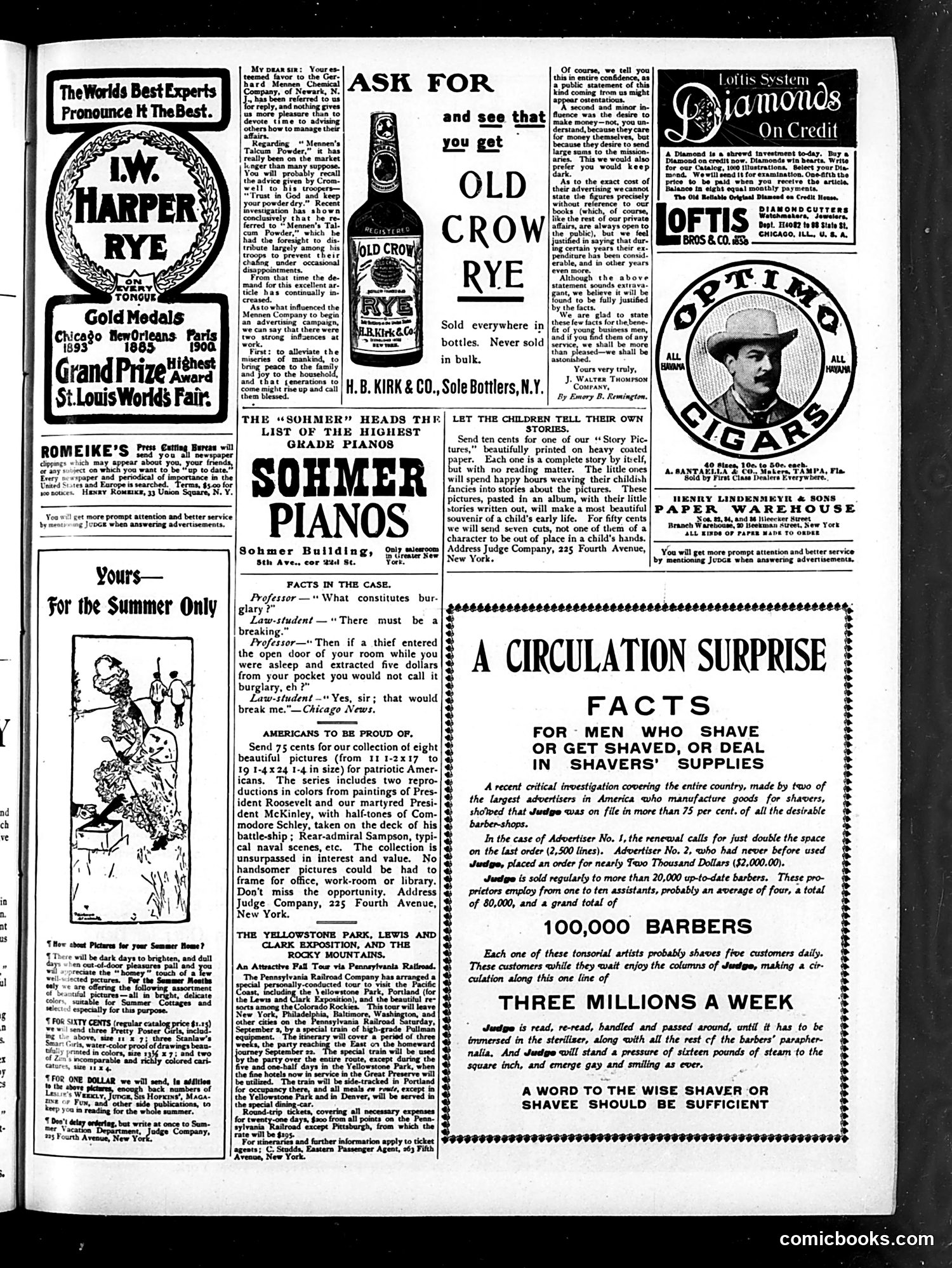
This page is primarily **advertisements and filler content** rather than political satire. The main visual element is a **cartoon joke** (lower left): A law professor questions a student about burglary. When asked if stealing from an open door while someone sleeps counts as burglary, the student replies "Yes, sir; that would break me"—a pun on "break" (entering) and being financially ruined. The page contains ads for **I.W. Harper Rye whiskey**, **Sohmer Pianos**, **Loftis System Diamonds on Credit**, and **Optis Cigars**. A significant section discusses **shaving products and barber shops**, revealing that "Judge was on file in more than 75 per cent. of all the desirable barber-shops"—essentially advertising the magazine's circulation reach to potential advertisers. The "Circulation Surprise Facts" section boasts Judge reaches approximately **100,000 barbers** weekly, framing this as proof of the magazine's valuable audience for product advertising. This appears to be a **house advertisement page** promoting Judge's own value to advertisers rather than satirical content.
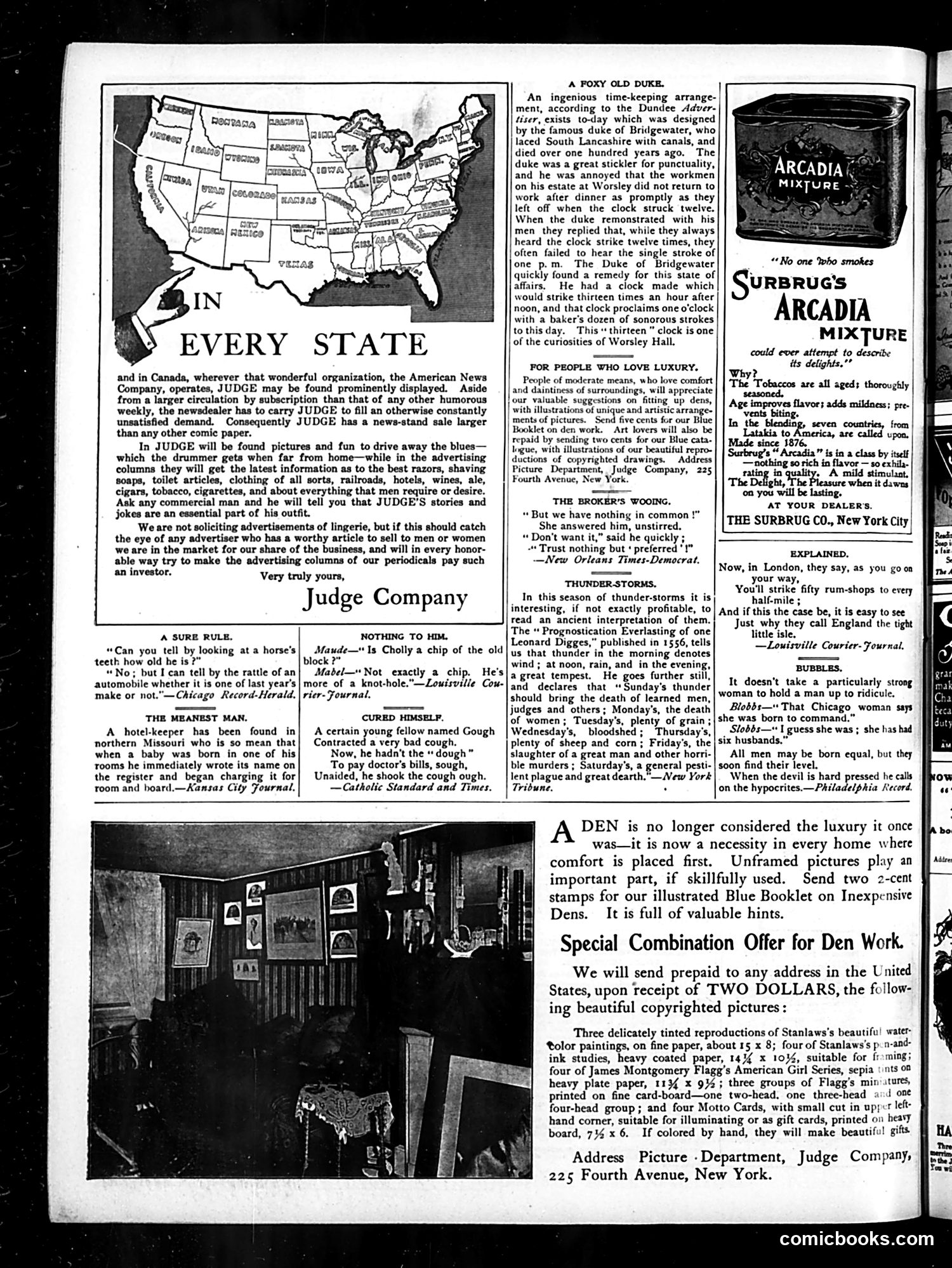
This page is primarily **advertising and promotional content** for Judge Company, interspersed with brief humorous anecdotes typical of the era. The main content includes: **Humorous shorts** (common Judge fare): - A joke about judging horses' ages by automobile rattle instead of teeth - A mean hotel-keeper charging a newborn rent - Wordplay about "Cholly" being a "knot-hole" rather than a "chip off the old block" - A pun-heavy poem about a man named Gough curing his cough **Historical anecdote**: A story about the Duke of Bridgewater's 13-strike clock at Worsley Hall, designed to ensure workers returned promptly after lunch—presented as curious trivia rather than satire. **Advertisements**: Surburg's Arcadia Mixture tobacco and den-decorating services dominate the right side. The **map** shows Judge's nationwide distribution through the American News Company—essentially a self-promotional boast about the magazine's reach and market dominance among newsstand sales. No political cartoons or caricatures appear on this page; it's primarily a sales/promotional issue.
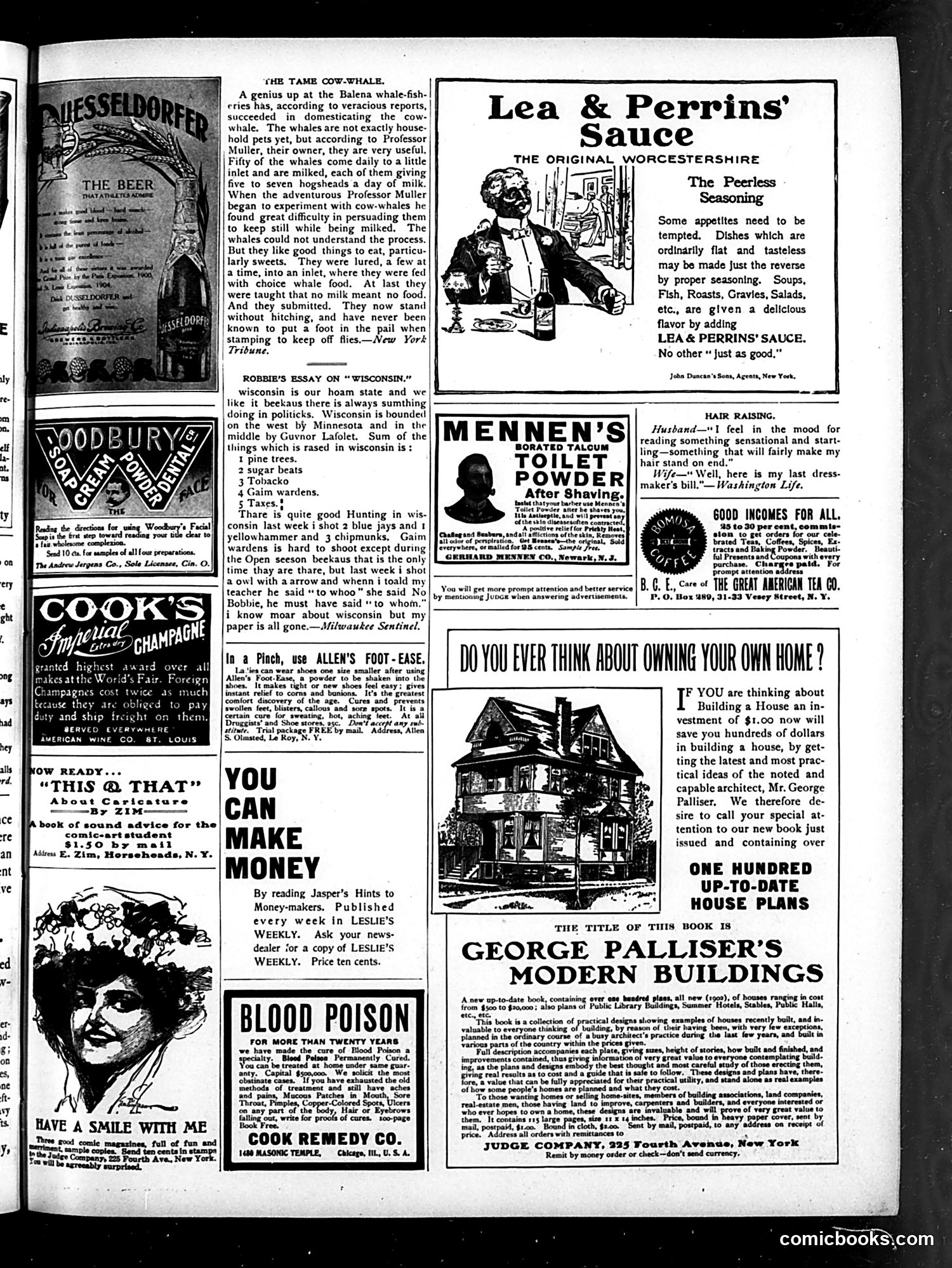
This is primarily an **advertising page** from Judge magazine, with one notable satirical piece. **Main Content:** The "Tame Cow-Whale" article is a humorous tall tale about a professor allegedly domesticating whales for milking—a pure fantasy meant to amuse readers with its absurdity. It's genteel nonsense rather than social commentary. **"Robbie's Essay on Wisconsin"** is a light satire on schoolboy writing, featuring intentional misspellings and rambling observations (pine trees, sugar beets, tobacco, game wardens, taxes) that gently mock both childish composition and Wisconsin politics. The teacher's grammar correction ("to whom") provides the punchline. **The "Hair Raising" joke** is domestic humor: a husband wants thrilling reading; his wife offers her dressmaker's bill—implying its cost is genuinely shocking. The page is otherwise filled with period product advertisements (Lea & Perrins sauce, Cook's Champagne, Mennen's powder, home-building guides) typical of early 20th-century magazines. No significant political figures or events are caricatured here.
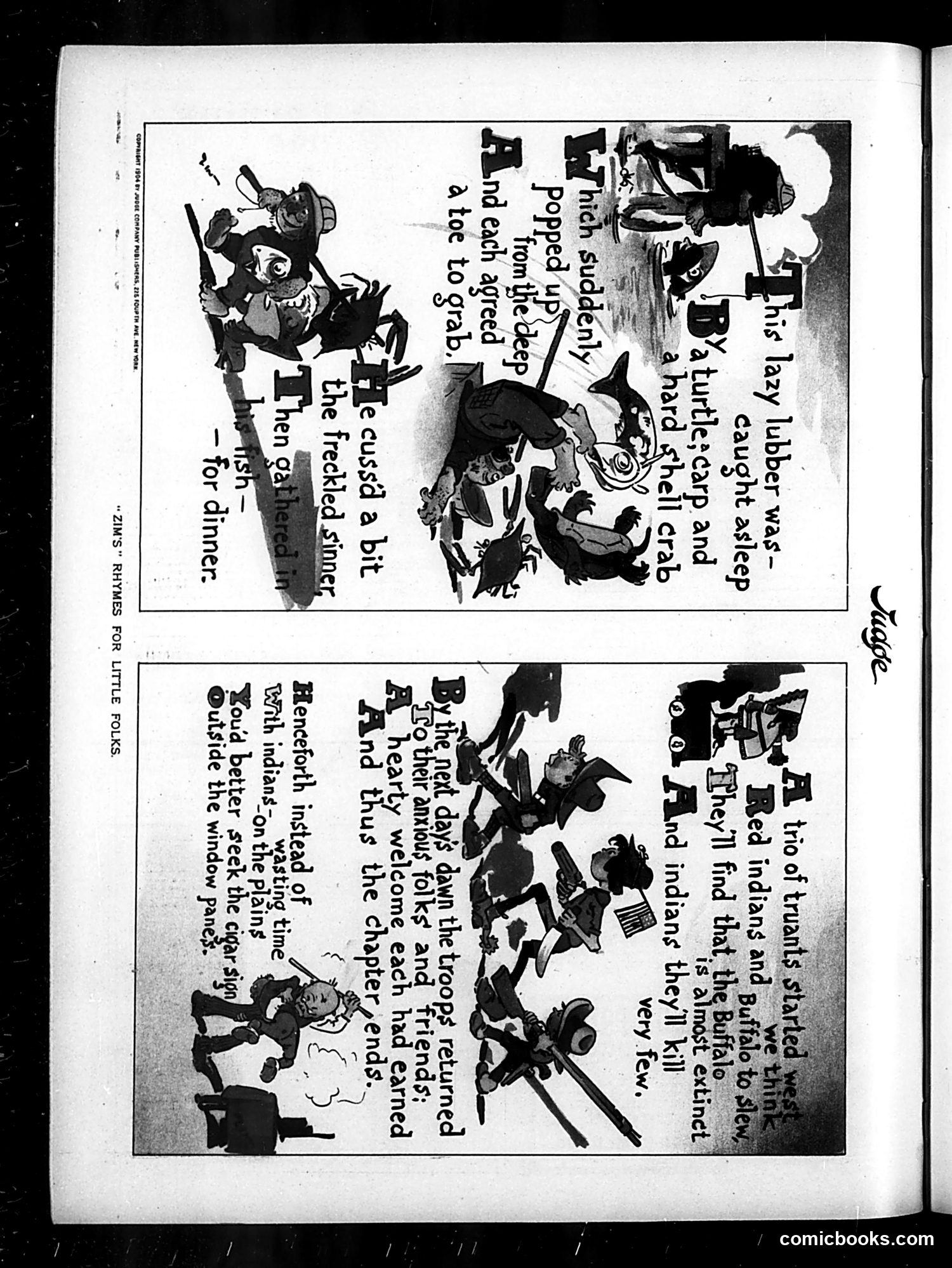
This page contains two illustrated humorous verses titled "Zim's Rhymes for Little Folks" — children's comedy poetry rather than political satire. The top panel depicts a lazy sailor ("lubber") caught sleeping by turtle, carp, and crab sea creatures who assault him as punishment. The narrative suggests truant children who've run off to play "Red Indians and Buffalo" will similarly face consequences upon returning home. The bottom panel continues this moral lesson: after the "trio of truants" returns, their adventure ends and they're advised to abandon such wild play. Instead of wasting time with "Indians," they should focus on legitimate pursuits — humorously suggesting they seek "the cigar sign outside the window pane." The satire appears directed at children's misbehavior and romanticization of frontier adventure rather than at political figures. The work reflects early 1900s attitudes toward indigenous peoples and uses them as generic tropes for "wild" or "uncivilized" play. This is children's light verse, not editorial commentary.