
A complete issue · 16 pages · 1905
Judge — August 19, 1905
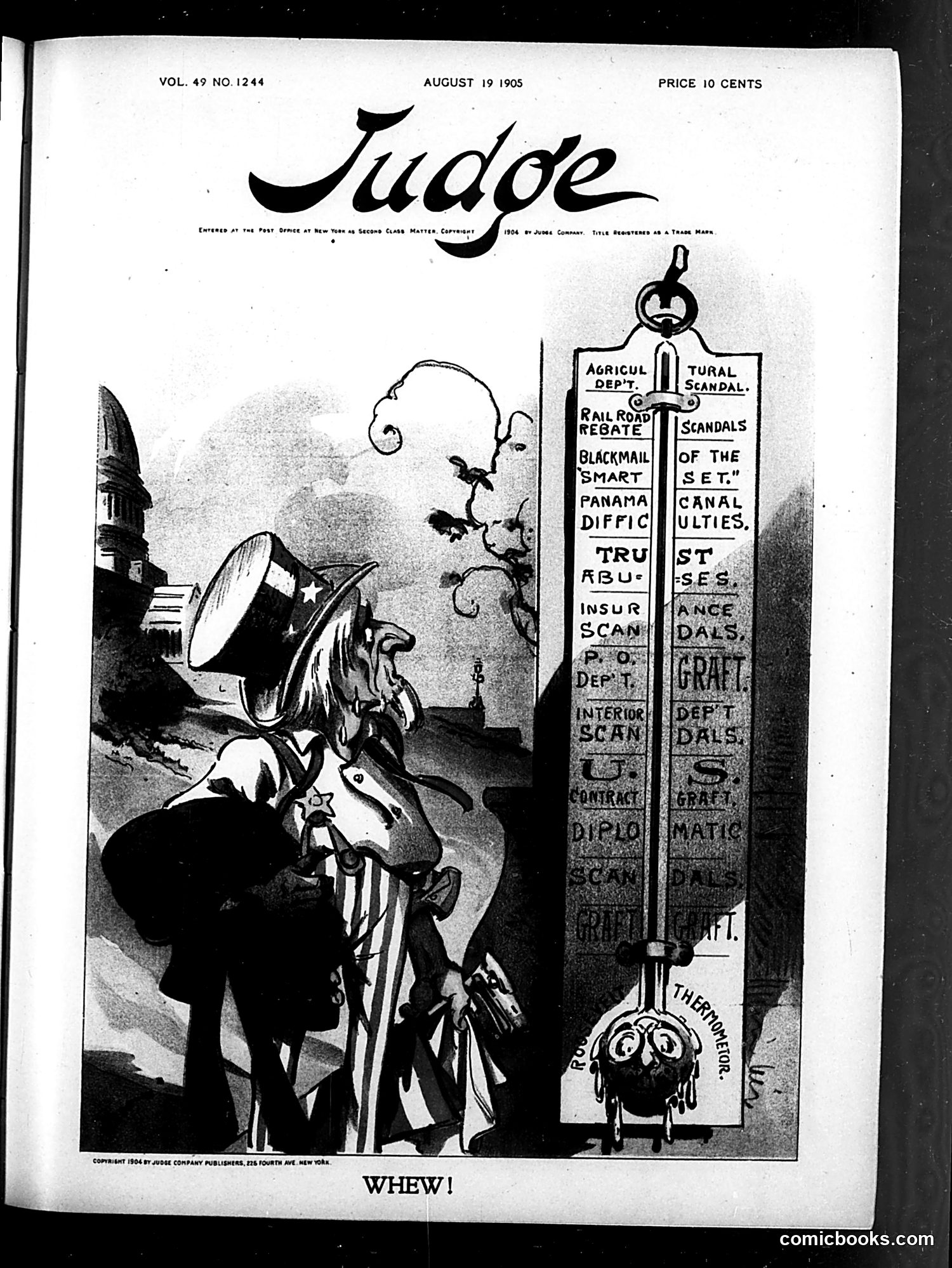
This cartoon satirizes scandals within President Theodore Roosevelt's administration. The central figure (likely Uncle Sam or a political authority) holds an enormous key labeled with various departmental scandals: "Agricultural Department Scandal," "Railroad Rebate Scandals," "Blackmail Smart," "Panama Difficulty," "Trust Abuses," "Insurance Scandals," "Canal Duties," "Post Office Scandal," "Interior Scandal," "Diplomatic Scandal," and "Contract Scandal." The figure expresses exasperation ("WHEW!") as if overwhelmed by the sheer weight of governmental mismanagement. This reflects genuine 1905 controversies plaguing Roosevelt's supposedly reform-minded administration. The cartoon critiques the gap between Roosevelt's progressive reputation and actual administrative corruption, suggesting his presidency carried numerous unresolved scandals despite reformist promises.
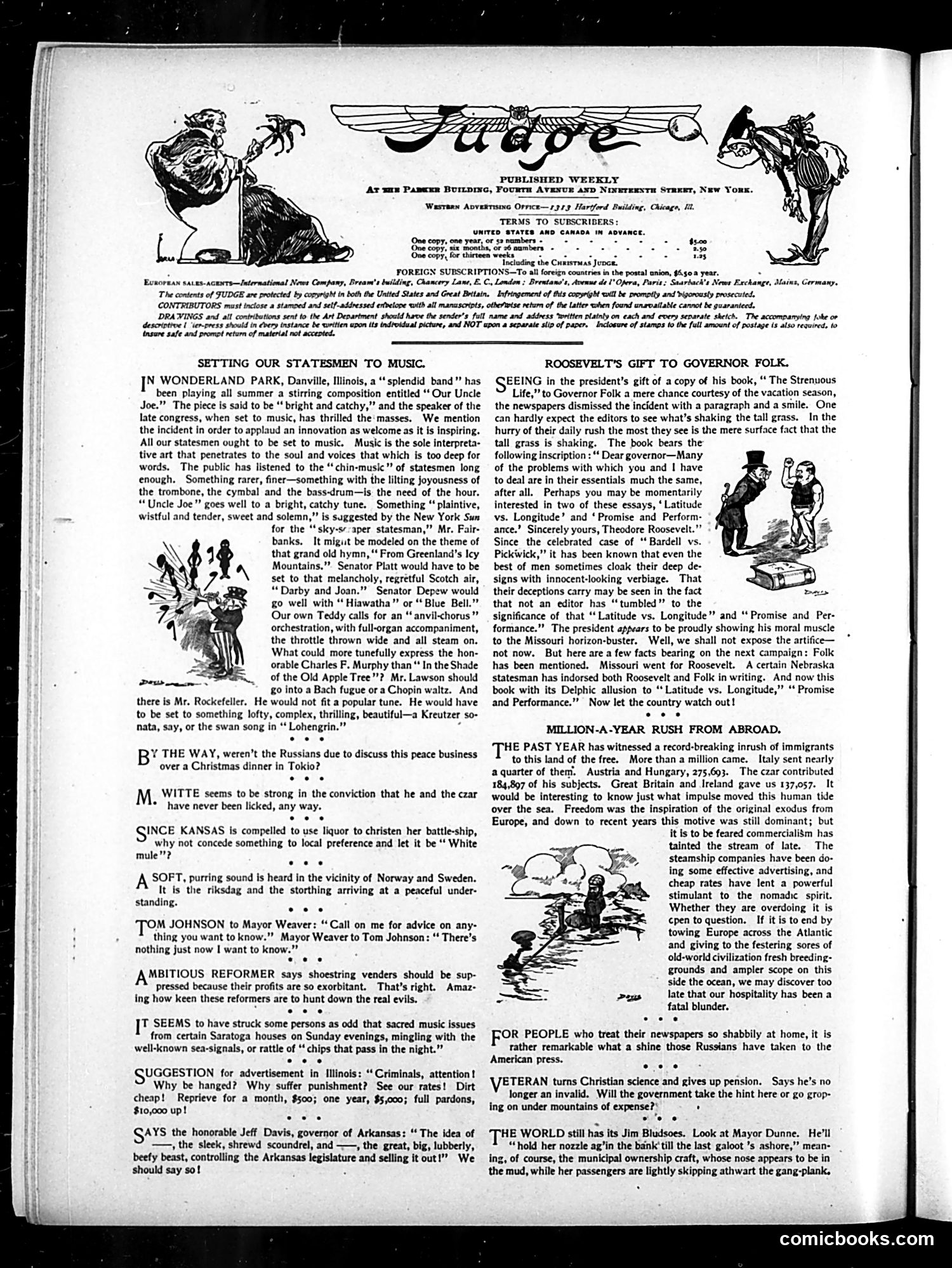
This page contains multiple brief satirical commentaries rather than a single cartoon. The pieces mock contemporary political figures and issues: **"Setting Our Statesmen to Music"** ridicules politicians' tendency toward grandiose self-importance, suggesting their speeches should be set to popular songs—implying their rhetoric is hollow bombast. **"Roosevelt's Gift to Governor Folk"** appears to reference President Roosevelt gifting books to a governor, satirizing the president's intellectual posturing or gift-giving as transparent political maneuvering. Other brief items mock Kansas's liquor laws, Norwegian-Swedish peace negotiations, and various political figures' questionable statements or policies. The cartoons accompanying these pieces use exaggerated caricature to emphasize absurdity. Without clearer image details, specific figure identifications remain uncertain, but the overall tone is cynical commentary on early 20th-century American political pretension and hypocrisy.
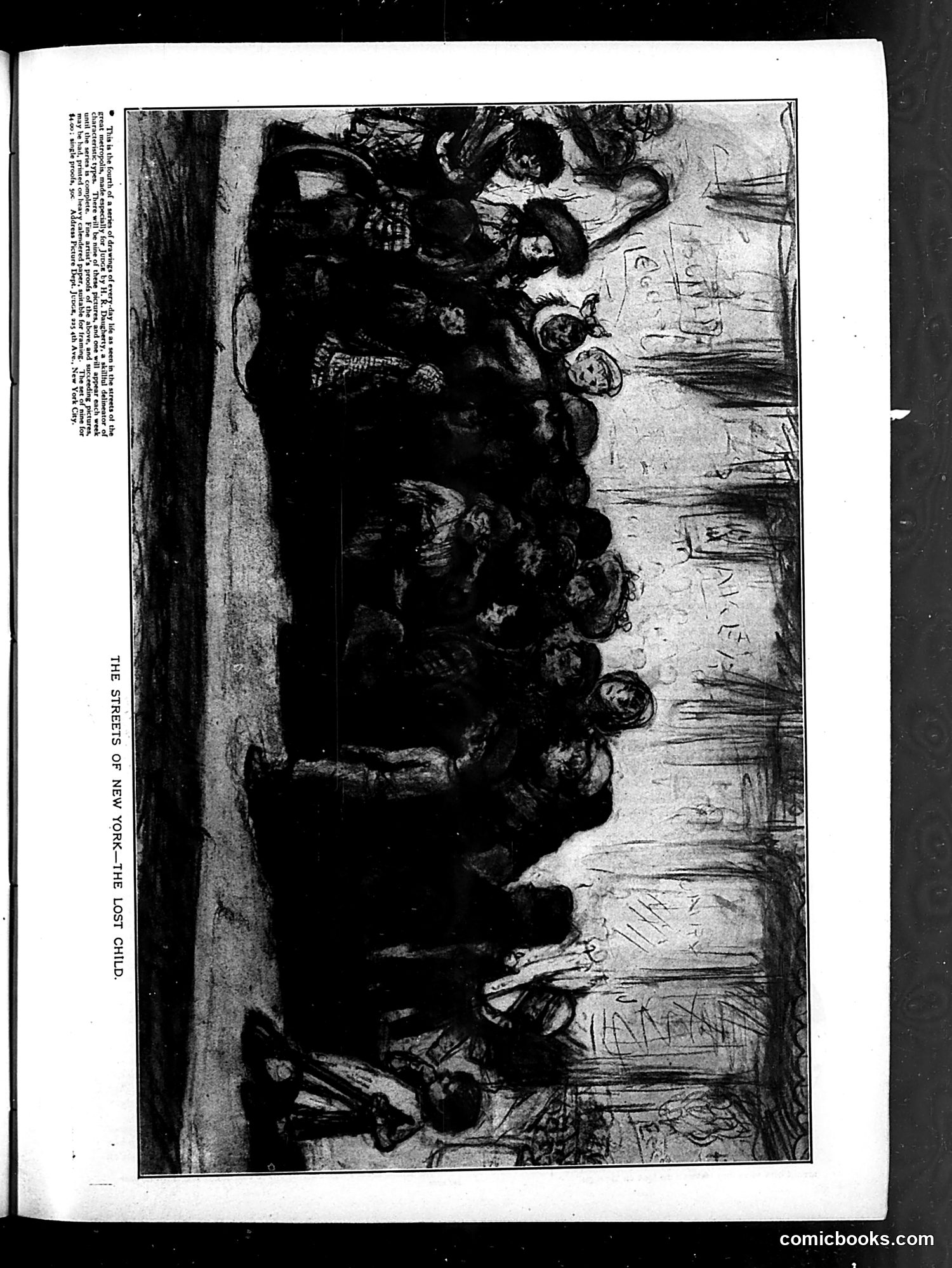
I can see this is a page from *Judge* magazine with the caption "THE STREETS OF NEW YORK—THE LOST CHILD" printed vertically on the left side. The image appears to be a dark, detailed etching or engraving depicting a crowded street scene. However, the image quality and orientation make it difficult for me to identify specific figures or caricatures with confidence. The OCR text provided doesn't include the actual article or explanation that would clarify the satire's target. Without being able to read accompanying text or clearly distinguish individual subjects in this dark illustration, I cannot reliably explain what political or social commentary this cartoon makes or identify the specific figures being satirized. To accurately explain this cartoon's meaning to a modern reader, I would need clearer source material or additional context from the magazine page.
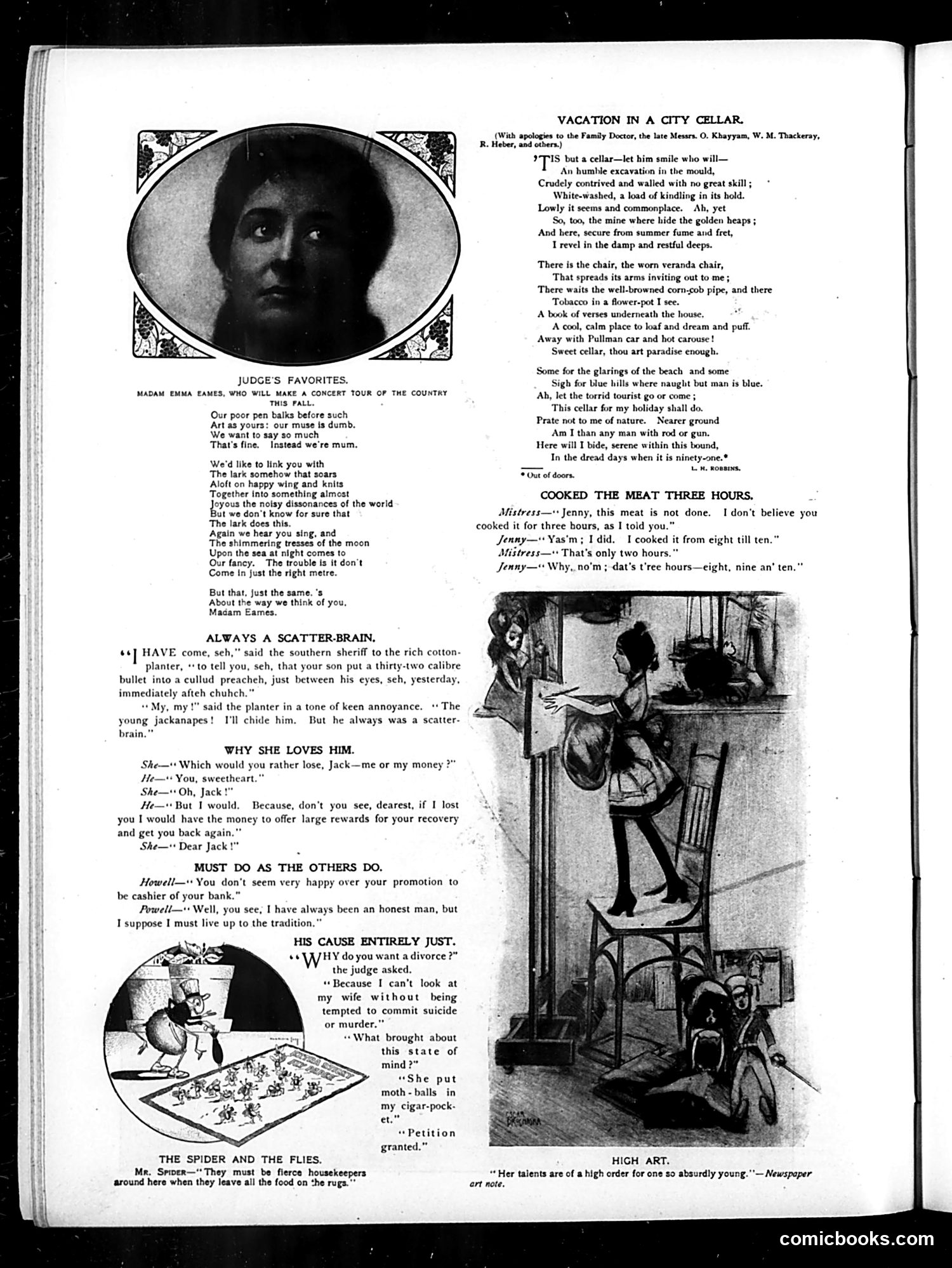
This page contains several unrelated humor pieces typical of Judge magazine's format: **"Vacation in a City Cellar"** is a poem celebrating the modest pleasures of a cool basement hideaway—a relatable escape from summer heat. **"Judge's Favorites"** advertises Madame Emma Eames, a concert performer, in verse promoting her tour. The remaining items are brief comedic dialogues: "Cooked the Meat Three Hours" (a domestic dispute about cooking times), "Always a Scatter-Brain" (a southern sheriff anecdote about a wealthy planter's son), "Why She Loves Him" (a couple's exchange about money and devotion), "Must Do as the Others Do" (a bank promotion complaint), and "His Cause Entirely Just" (a divorce petition involving moth-balls in a cigar pocket). These represent typical Judge humor—domestic situations, regional stereotypes, and wordplay aimed at general audiences.
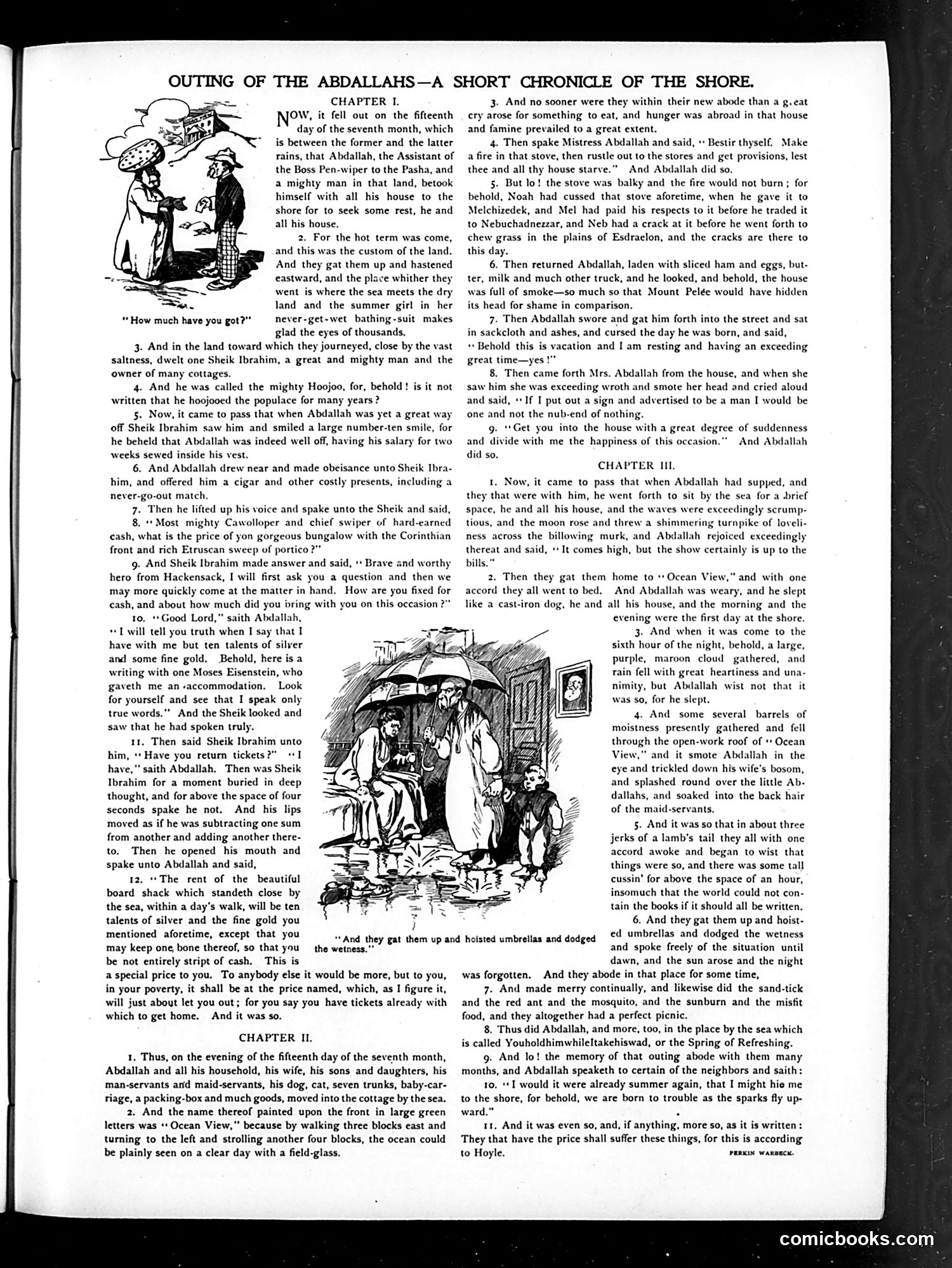
This appears to be a satirical narrative (not a political cartoon) mocking middle-class vacation culture and rental exploitation, likely from the early 1900s. The story uses biblical/mock-heroic language to describe "Abdallah," a minor bureaucrat ("Assistant of the Boss Pen-wiper to the Pasha") seeking seaside rest. The satire targets: 1. **Landlord gouging**: "Sheik Ibrahim" (the cottage owner) extracts the tenant's entire two weeks' salary plus savings—exploiting Abdallah's eagerness and financial vulnerability. 2. **Deceptive marketing**: The cottage advertised as "Ocean View" requires walking "three blocks east and turning to the left and strolling another four blocks" to see the ocean—a joke about false advertising. 3. **Working-class aspirations**: Abdallah's modest savings and return tickets illustrate the limited leisure available to ordinary workers. The elaborate biblical parody style amplifies the ridiculousness of both the landlord's greed and the tenant's willingness to surrender financial security for a brief vacation.
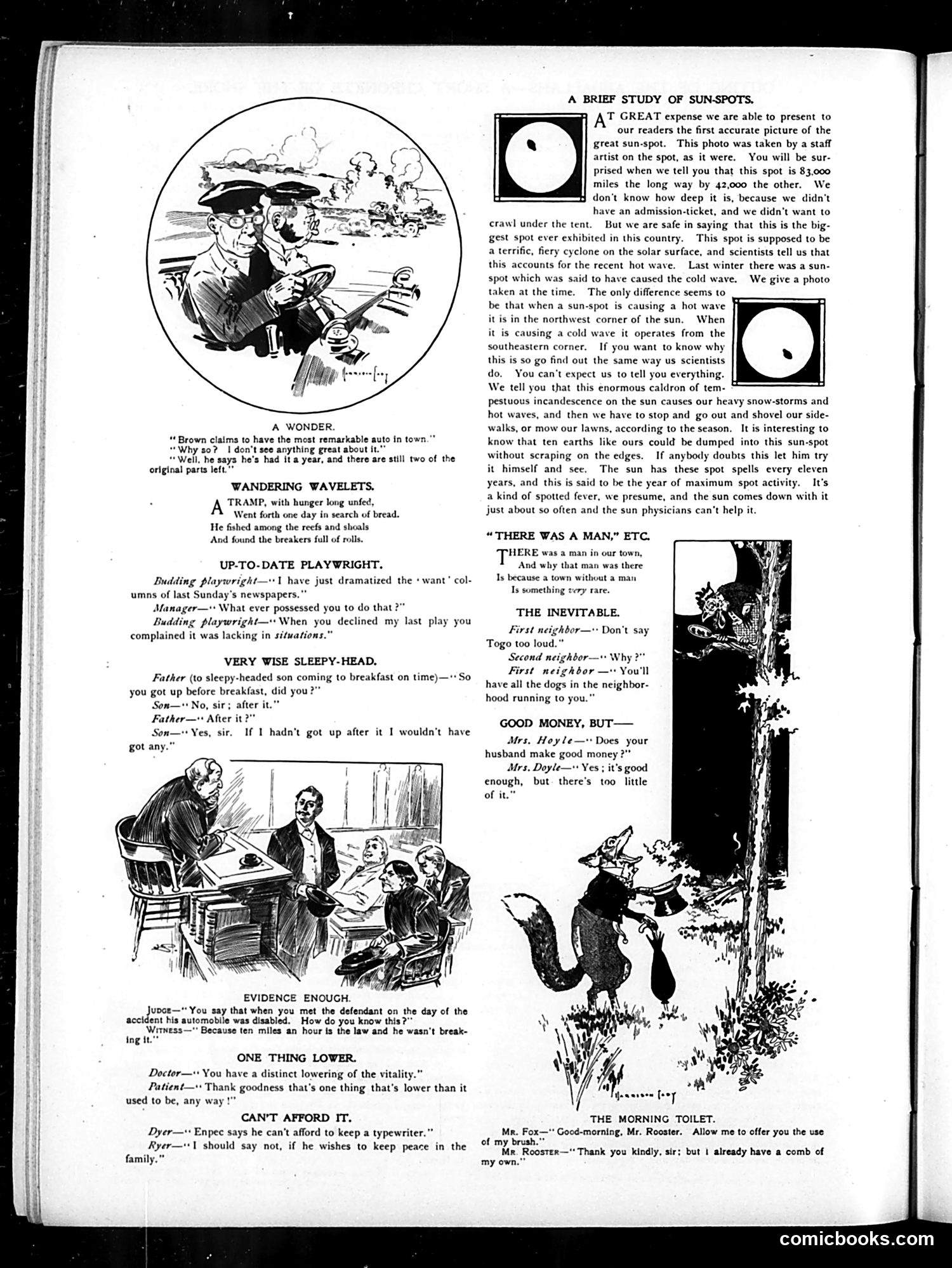
This is a humor page from *Judge* magazine featuring short jokes and comic sketches typical of early 20th-century American satire. **Key items:** - **"A Wonder"**: Mocks unreliable automobiles—the joke being a car is so poorly made that after a year, only two original parts remain. - **"Up-to-Date Playwright"**: Satirizes theatrical writers adapting newspaper "want ads" (classified advertisements) into plays, mocking both playwrights and the demand for sensational content. - **"Very Wise Sleepy-Head"**: A child jokes that he got up *after* breakfast to avoid missing it. - **"Sun-Spots" article**: Parodies pseudo-scientific explanations popular at the time, humorously claiming sun-spots cause both hot waves and cold waves depending on their location, while admitting the author doesn't actually understand the phenomenon. - **Other brief jokes**: Wordplay about lowered vitality, typewriters causing marital discord, and neighborhood gossip. The humor relies on observational comedy about technology, daily life, and contemporary pseudoscience rather than political content.
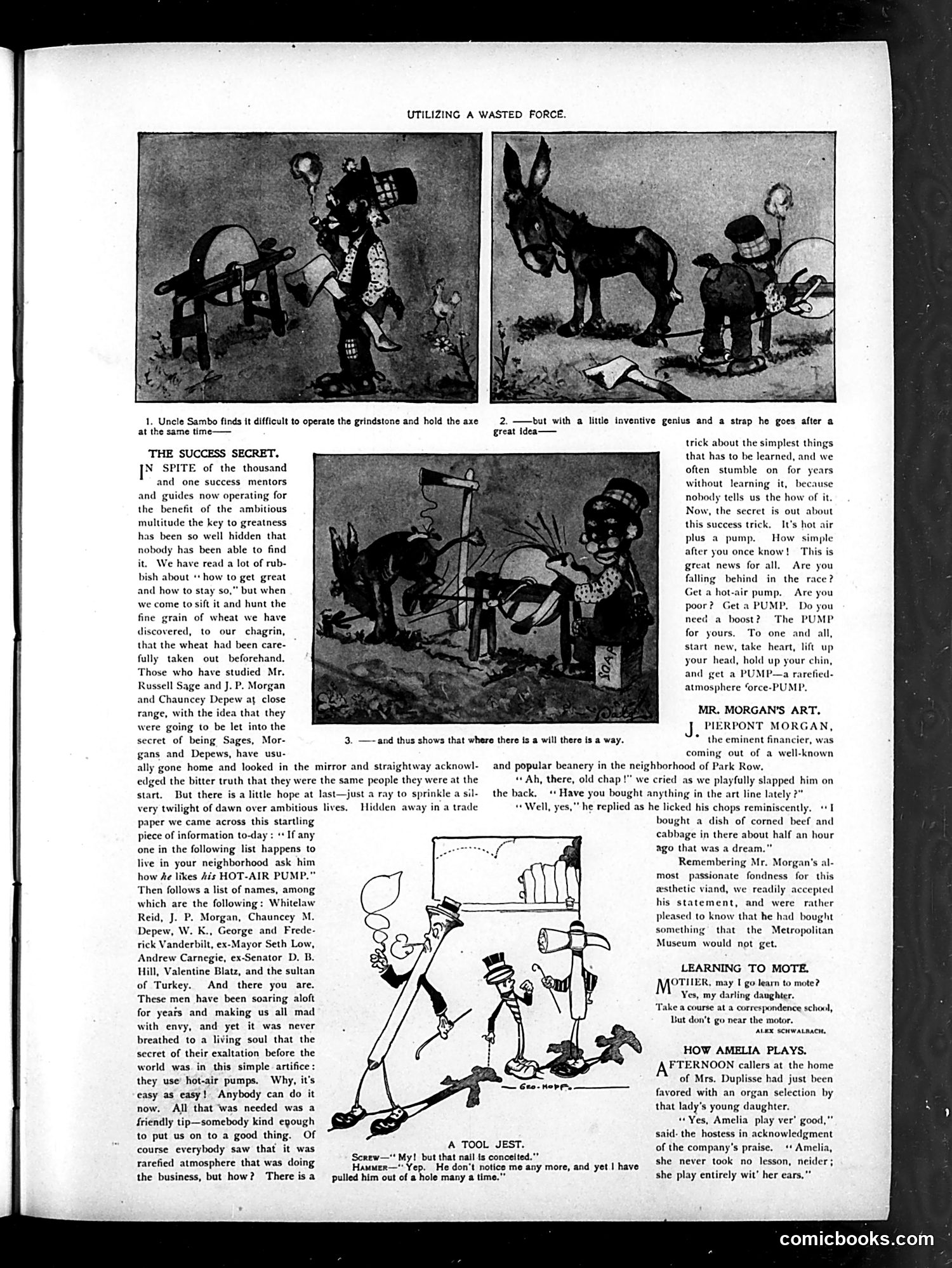
This page satirizes wealthy American industrialists' supposed "success secrets" through three jokes: **Main cartoon**: Uncle Sam (depicted as "Uncle Sambo," using period racist terminology) struggles operating a grindstone alone. A donkey with "inventive genius and a strap" solves the problem—the joke being that the wealthy succeed through simple tricks, not brilliance. **"The Success Secret"**: The article mocks the era's self-help industry and wealthy mentors (J.P. Morgan, Russell Sage, Chauncey Depew, Carnegie, Vanderbilts). It claims their secret is literally a "hot-air pump"—satirizing that their success relies on hot air (bluster/fraud) rather than genuine merit. The sarcastic list suggests anyone can replicate their success if they just know the "trick." **"Mr. Morgan's Art"**: A brief joke where J.P. Morgan credits corned beef and cabbage as his art acquisition—mocking his reputation as a major art collector while suggesting his tastes are actually crude and common. The page ridicules Gilded Age wealth inequality and the mythology surrounding self-made men.
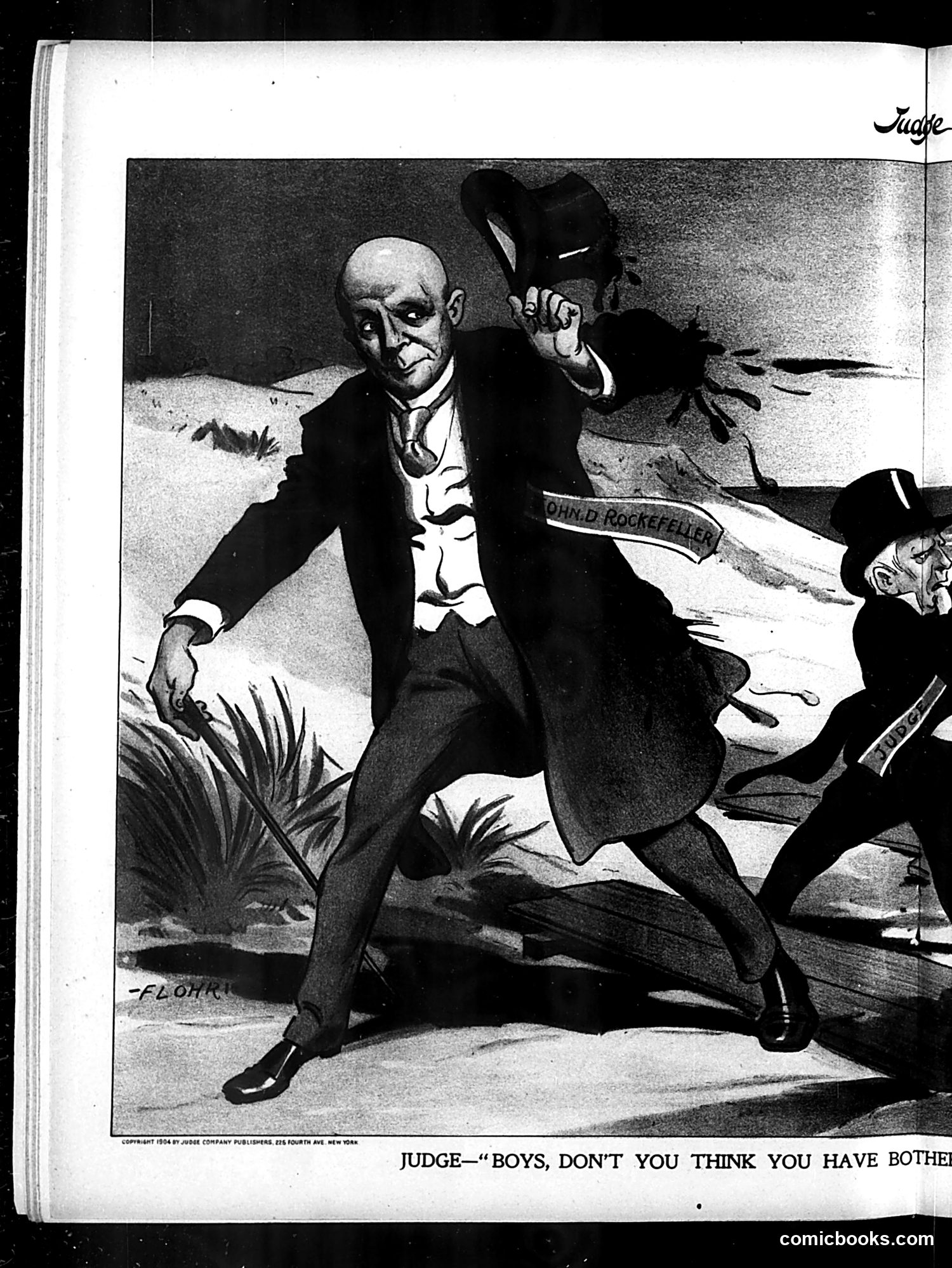
This Judge magazine cartoon depicts a bald, stern-faced judge character confronting two younger figures labeled with "John D. Rockefeller" visible on one figure's clothing. The judge appears to be in a desert or desolate landscape, holding his hat aloft in an animated gesture. The incomplete caption reads: "JUDGE—'BOYS, DON'T YOU THINK YOU HAVE BOTHE[R]..." This appears to be satire about Rockefeller and associates, likely critiquing wealthy industrialists or their business practices. The desert setting may symbolize moral or ethical wasteland. Without the complete caption, the specific complaint remains unclear, but Judge magazine regularly attacked wealthy magnates and monopolistic business practices during the Progressive Era. The confrontational tone suggests the judge (representing law or morality) is reproaching the figures.
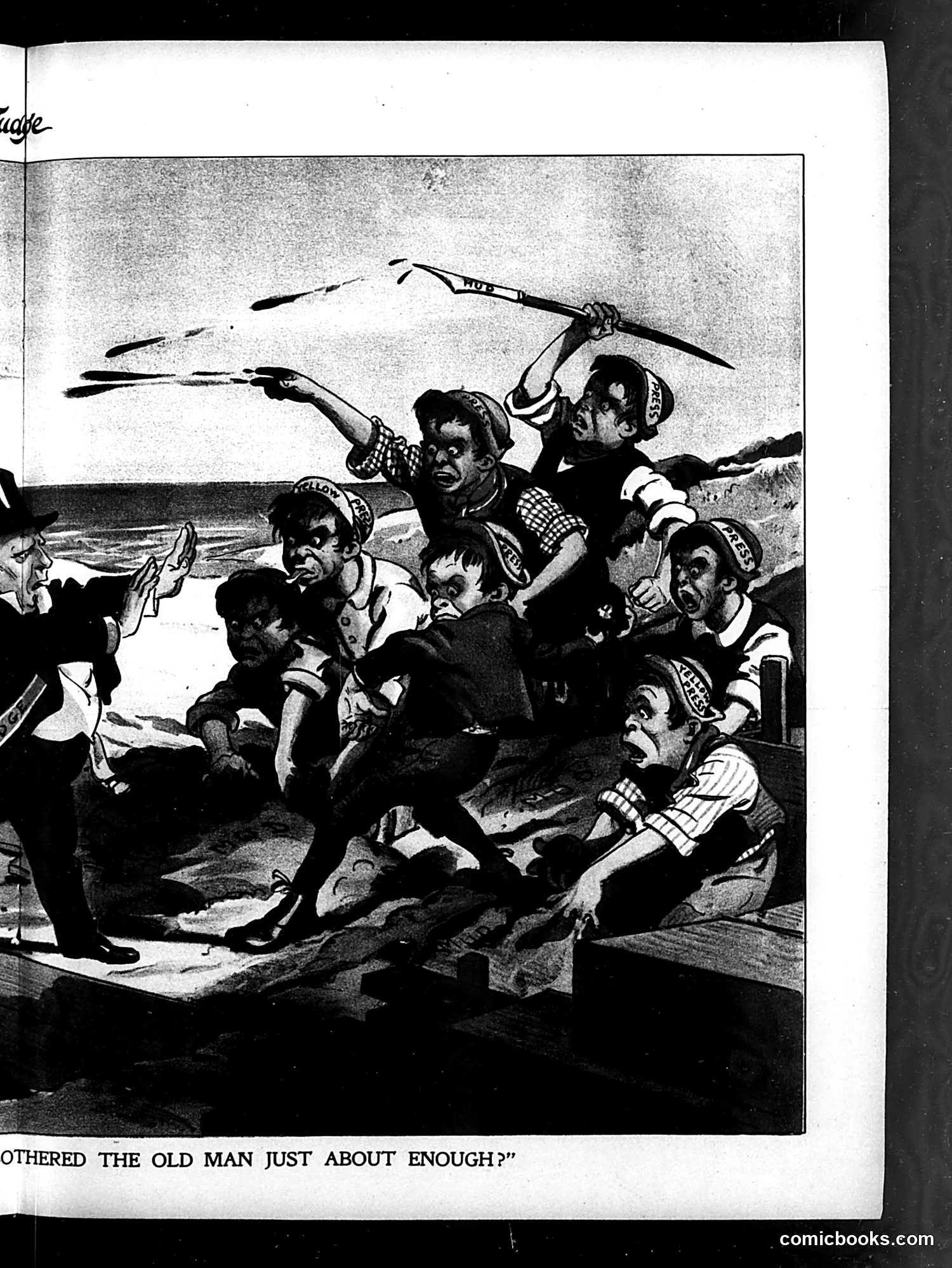
This appears to be a political cartoon depicting violence or conflict. Multiple figures wielding what look like pickaxes or similar tools surround a central elderly man who appears to be in distress or under attack. The figures wear period clothing with distinctive hats and checkered patterns, suggesting a specific historical or ethnic group. The caption—"OTHERED THE OLD MAN JUST ABOUT ENOUGH?"—suggests satire about mistreatment or persecution of an older authority figure, though the specific historical context is unclear from the image alone. Without knowing Judge magazine's publication date or the surrounding articles, I cannot identify which historical figure or political situation this references. It appears critical of mob violence or persecution, but the exact target remains uncertain.
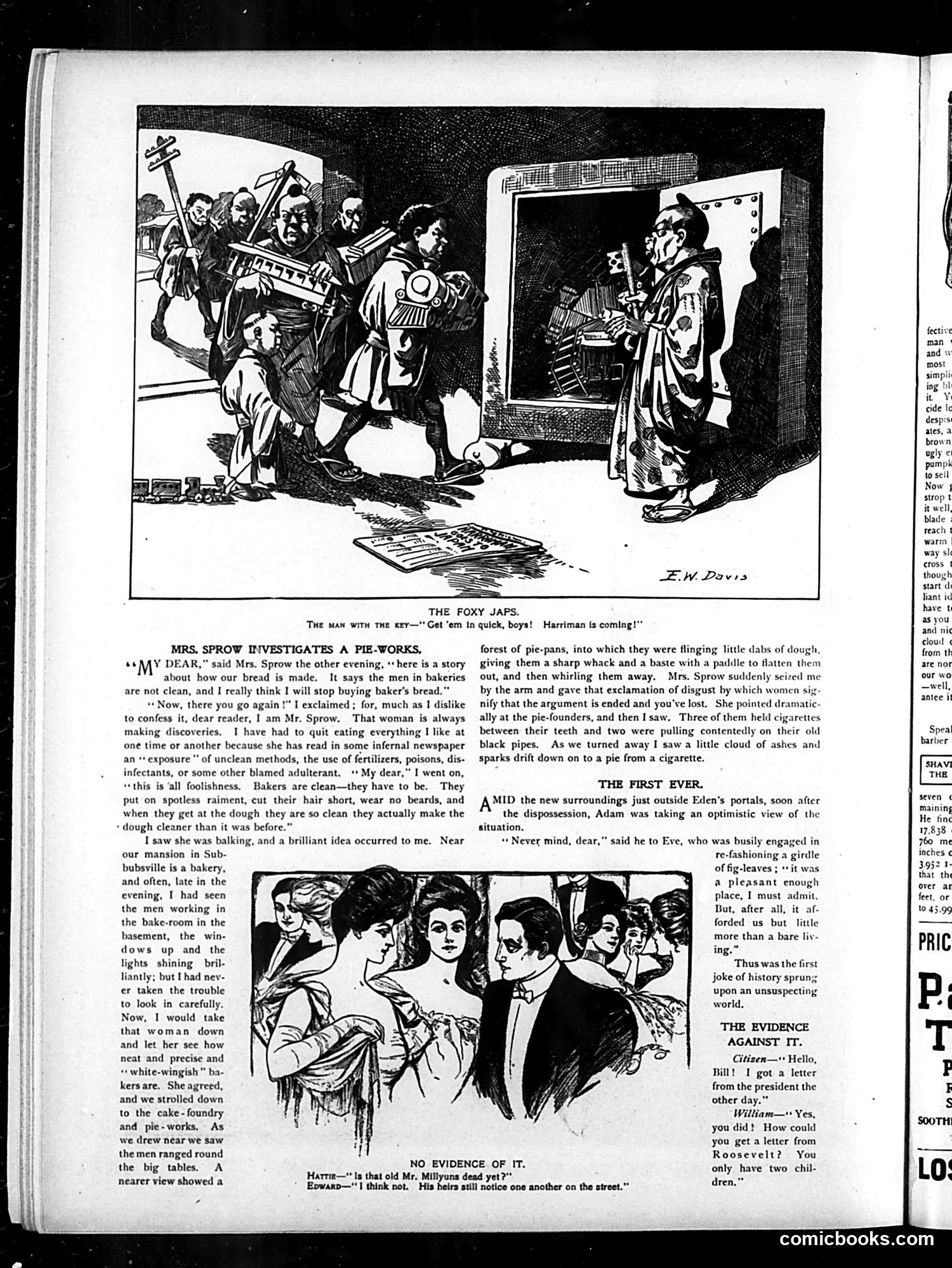
This page contains three distinct satirical pieces: **"The Foxy Japs"** (top cartoon): References a scandal involving E.H. Harriman, a railroad magnate. The "man with the key" appears to represent someone smuggling or hiding something (likely related to corruption or improper dealings) before Harriman's arrival—satirizing business malfeasance and the need to conceal wrongdoing from powerful figures. **"Mrs. Sprow Investigates a Pie-Works"**: A humorous domestic narrative mocking anxious wives who read newspaper exposés about food safety. Mr. Sprow takes his skeptical wife to a bakery to prove bakers are clean, but they discover workers smoking over pies—vindicating her concerns and making him the fool. It satirizes both consumer anxiety about industrial food production and husbands dismissing their wives' legitimate worries. **"The First Ever" and "The Evidence Against It"**: Brief joke items. The first is a pun about Adam and Eve; the second mocks someone claiming to have received a letter from President Roosevelt, implying only the president's children would receive such mail. The page represents typical early-20th-century American satirical humor: mocking business corruption, food safety fears, marital dynamics, and political figures.
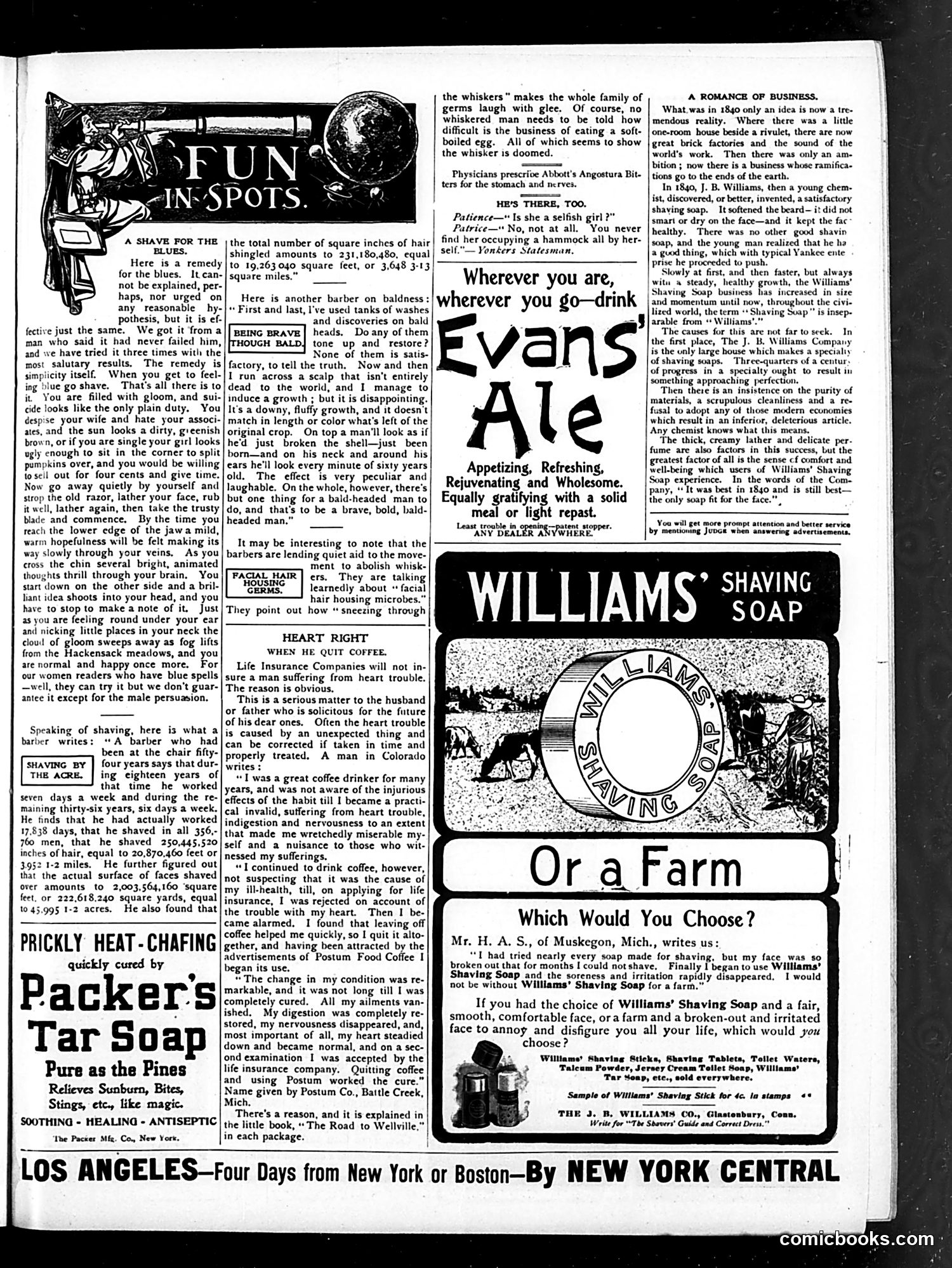
This page is primarily **advertising and humor columns**, not political satire. The main content is a tongue-in-cheek piece claiming that shaving cures depression—a remedy the author admits is inexplicable but claims works. The humor lies in the absurdist premise and the detailed description of the transformative mental experience of shaving. The page includes a lengthy anecdote from a 54-year barber tallying his career statistics (356,760 men shaved, 3.952 miles of hair cut), which combines humor with the era's fascination with quantifying labor. There's also contemporary skepticism about baldness "cures" and a barber's dismissive claim that whiskers harbor microbes—reflecting early 20th-century germ theory anxieties. The page is dominated by advertisements for **Packer's Tar Soap** and **Williams' Shaving Soap**, suggesting the humor serves primarily to promote grooming products.
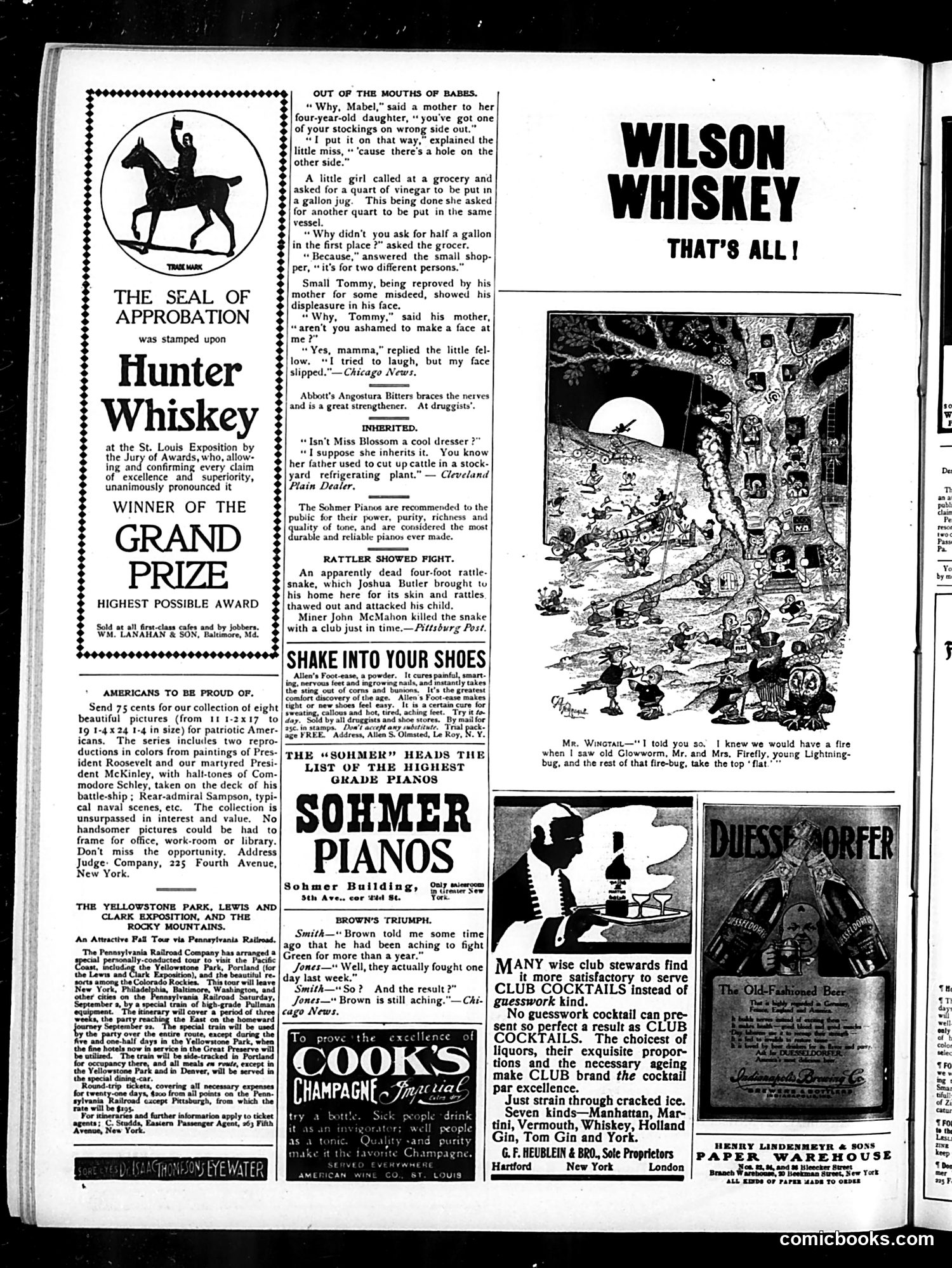
This page is primarily **advertising and filler content** rather than political satire or comics. The layout consists mostly of commercial advertisements (Hunter Whiskey, Sohmer Pianos, Allen's Foot-ease powder) interspersed with brief humorous anecdotes. The main content labeled "OUT OF THE MOUTHS OF BABES" comprises short, wholesome children's jokes—a common magazine feature of the era. These include a child's innocent logic about a hole in a stocking and children's misunderstandings of adult situations. The illustrated cartoon near the center appears to show a rural or frontier scene but lacks clear satirical intent visible in the image. The editorial content includes patriotic picture offerings featuring Presidents Roosevelt and McKinley, reflecting early 1900s American nationalism. Overall, this appears to be a standard turn-of-the-century magazine page blending advertising revenue with light entertainment and patriotic content, rather than containing pointed political commentary.
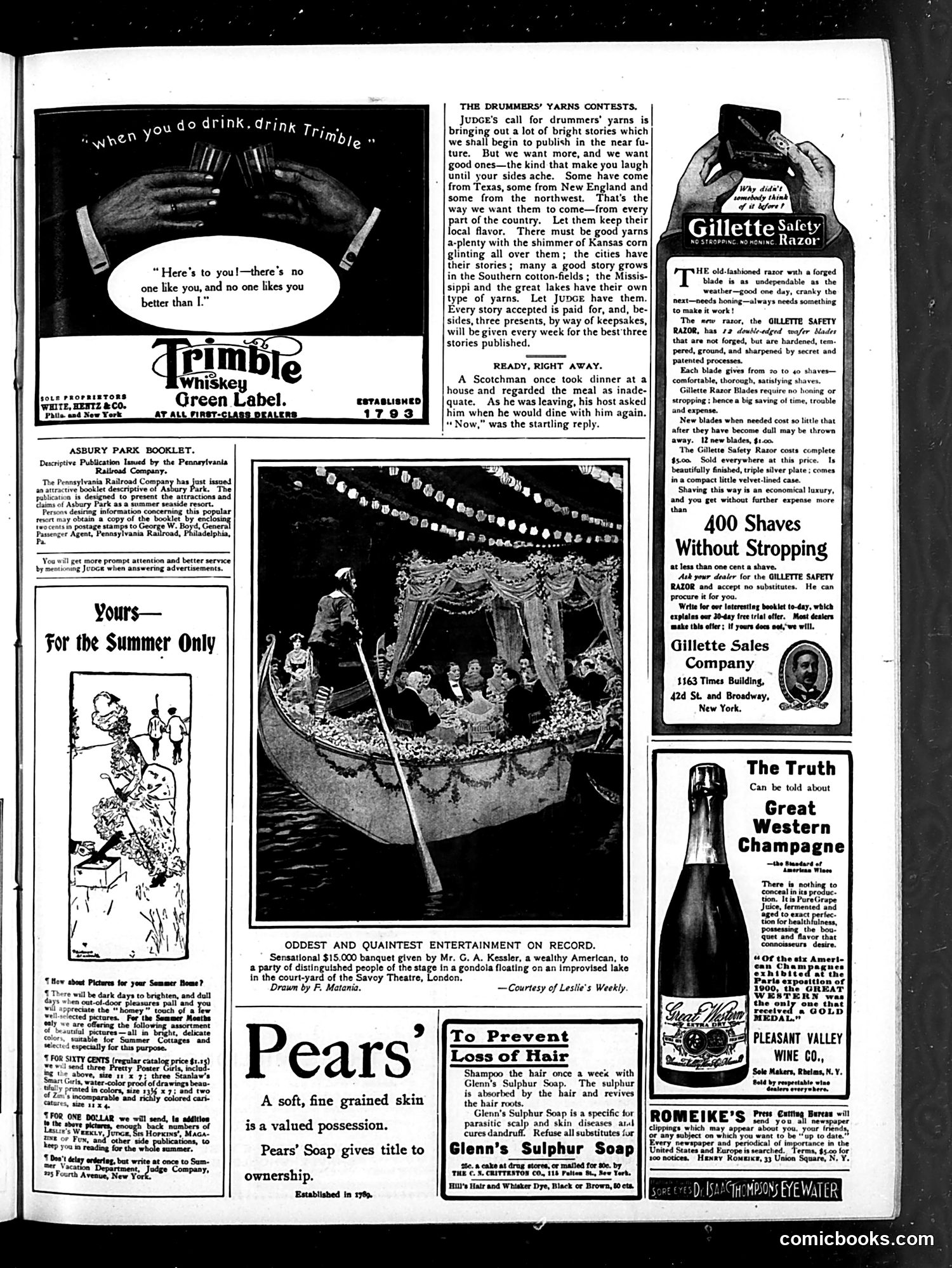
This page is primarily **advertisements and filler content** rather than satirical editorial material. The main cartoon is a **Trimble Whiskey ad** featuring two hands toasting, with text promoting the brand's quality—typical advertising humor of the era, not political satire. The page includes: - A **Scottish stereotype joke** about a stingy Scot wanting to dine immediately (rather than accept the host's invitation for another time) - A call for **"drummers' yarns"** (sales representatives' humorous stories from across America) - A notice about an **Asbury Park travel booklet** from the Pennsylvania Railroad - Multiple product advertisements: **Pears' Soap**, **Glenn's Sulphur Soap**, **Gillette Safety Razors**, and **Great Western Champagne** A large central photograph shows an **elaborate 1913 banquet staged in a gondola at London's Savoy Theatre**—presented as curiosity/entertainment reporting rather than satire. **This is primarily a commercial page**, not editorial content with political meaning for modern readers.
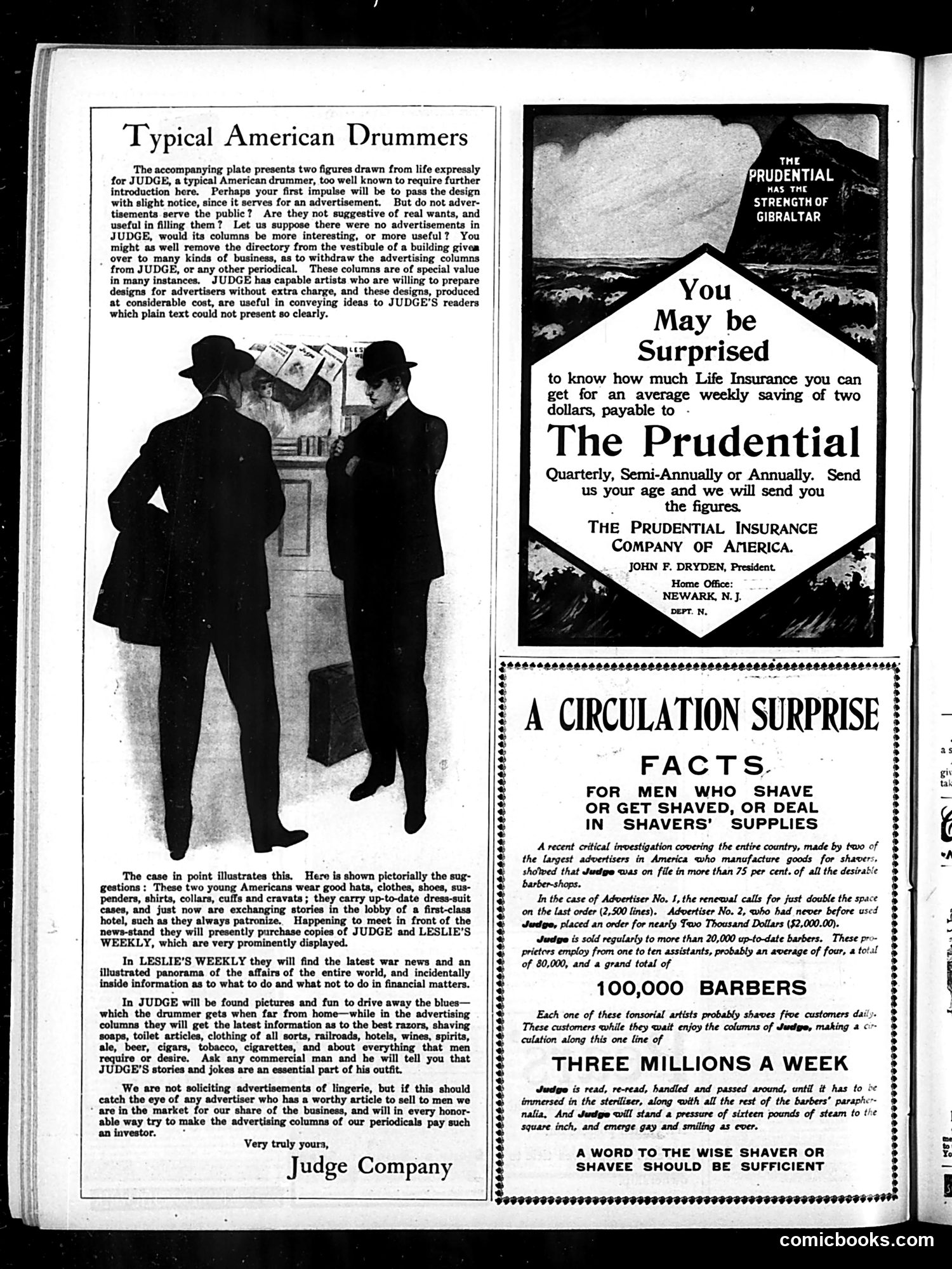
This page is primarily **advertising content** disguised as editorial material. The left side features a letter from Judge Company promoting their magazine to potential advertisers, using an illustration of two well-dressed traveling salesmen ("drummers"—a period term for traveling businessmen) as an example. The satire is subtle: Judge argues that advertisements are valuable editorial content, not mere filler. They claim their ads reach desirable audiences—in this case, 100,000 barbers reading about shaving supplies weekly. The accompanying advertisements (Prudential Insurance, and a barber-shop circulation study) demonstrate Judge's pitch: the magazine reaches profitable, respectable audiences in hotels and barbershops. **The point:** Judge was selling advertising space by convincing companies their products would reach ideal customers. There's gentle irony in treating advertisements as public service while simultaneously proving their commercial effectiveness to potential clients.
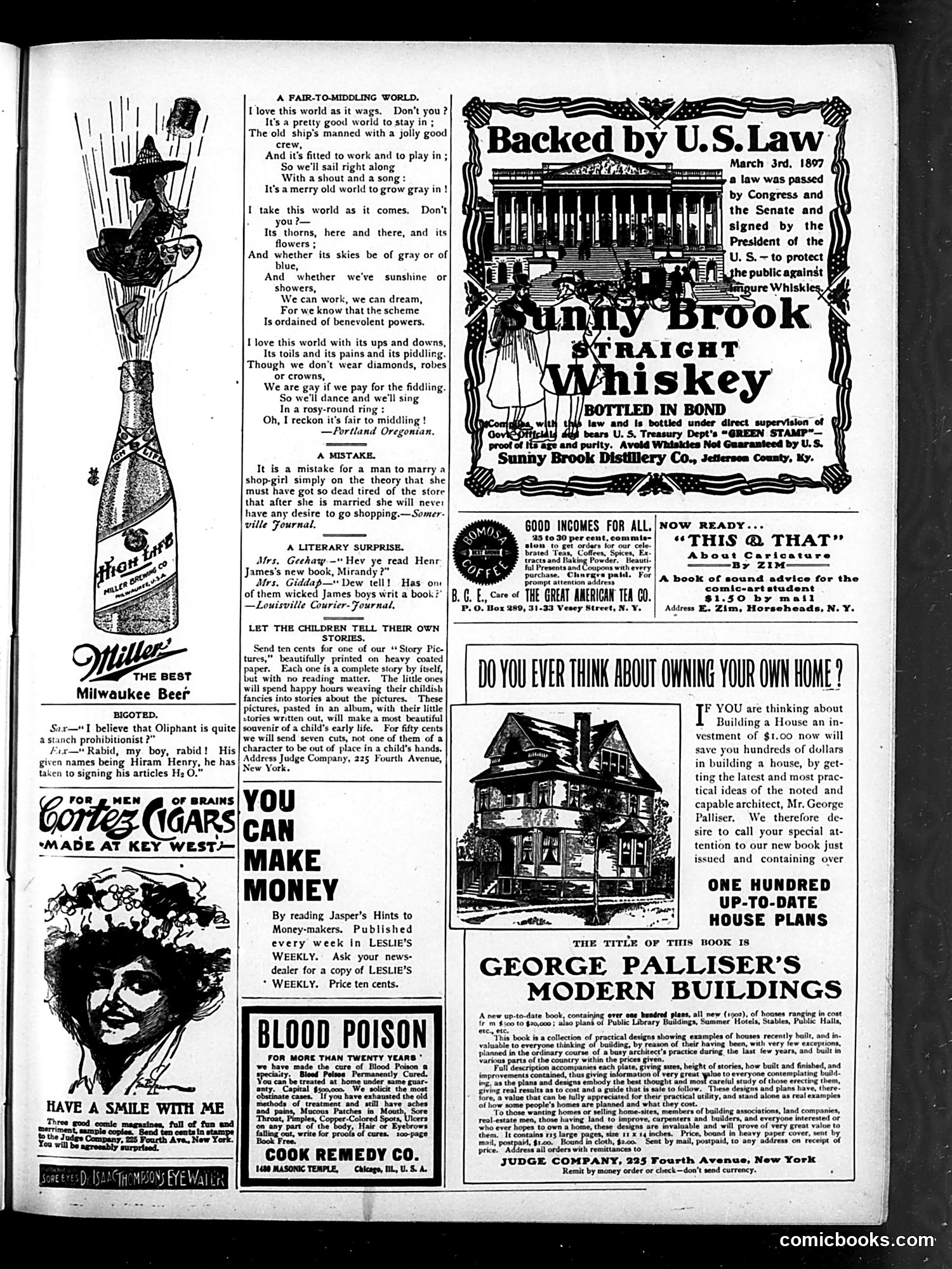
This page is primarily **advertising mixed with light humor pieces**, rather than political satire. The main content includes: **"A Fair-to-Middling World"** — a sentimental poem celebrating contentment with ordinary life, appearing before prohibition-era whiskey ads (ironic timing). **Small jokes** mocking common foibles: a "bigoted" prohibitionist named Hiram Henry ironically signing articles "H.O."; the mistaken belief that shop-girls stop shopping after marriage; confusion of Henry James with the outlaw James brothers. **Prominent advertising** for Miller Beer, Sunny Brook Whiskey (explicitly "backed by U.S. law" for protection), cigars, and patent medicines (including "Blood Poison" cure — likely for syphilis, a common euphemism). **Practical consumer ads** for house plans by architect George Palliser and children's educational picture books. The page reflects 1907 consumer culture: booze and patent medicines were heavily advertised to mainstream publications, and the "prohibition debate" was already contentious enough to warrant gentle mockery. The overall tone is commercial rather than satirically sharp.
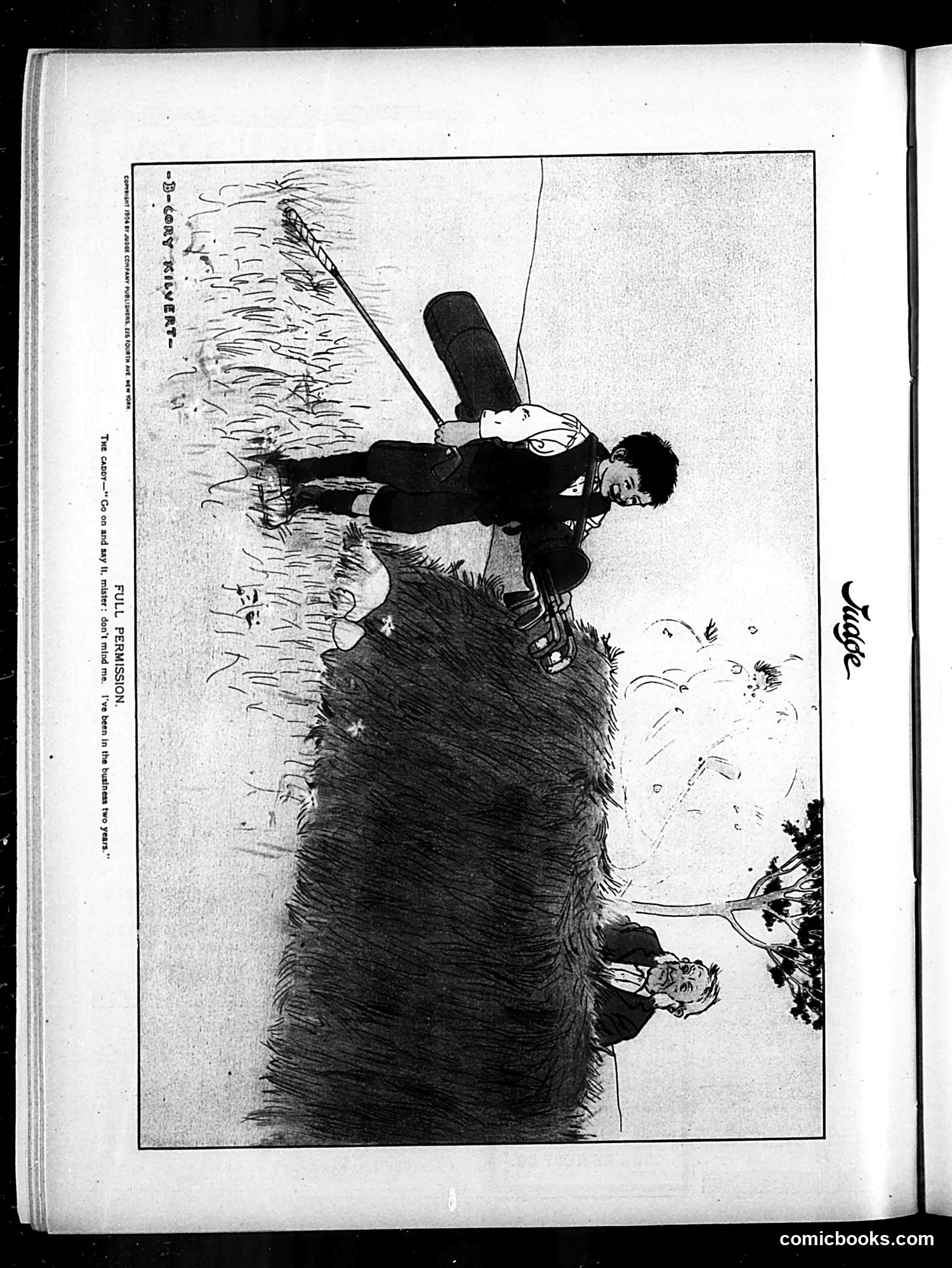
This Judge magazine cartoon from 1904 depicts a cab driver (labeled "The Cabby") speaking to a well-dressed passenger. The cabby's comment—"Go on and say it, mister; don't mind me. I've been in the business two years"—suggests the passenger is hesitating to complain or criticize something, likely the cab service itself. The satire appears to target the cab driver's cynical acceptance of criticism after only two years in the profession. The joke implies that cab drivers routinely received complaints about their service (poor driving, high fares, rudeness), and this driver has become so accustomed to it that he's resigned to hearing insults. It's social commentary on working-class service industries and the contentious relationship between drivers and passengers in early 1900s urban America.