
A complete issue · 20 pages · 1904
Judge — October 29, 1904
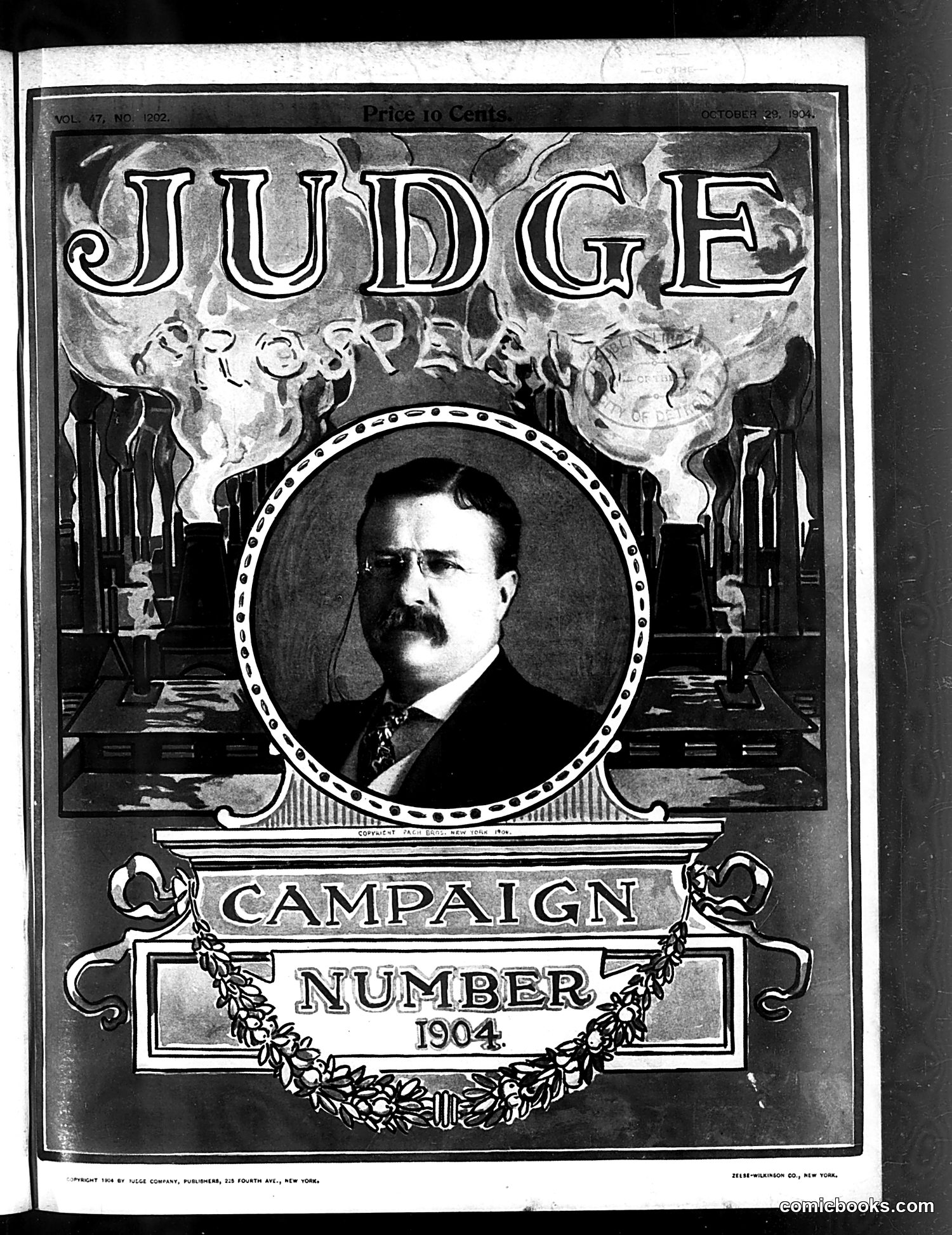
This is a **Campaign Number** special issue featuring a portrait of a man with a distinctive mustache in formal attire. Based on the 1904 date and "Campaign" designation, this likely relates to the 1904 U.S. presidential election. The ornate framing with classical architectural elements and laurel wreaths suggests this is honoring a political figure. The demonic or grotesque faces depicted above the portrait appear to represent opposing forces or critics—a common satirical device in Judge magazine's political commentary. Without clear identifying text visible in the image itself, I cannot definitively name the figure portrayed. However, the prominent placement and ceremonial presentation indicate this was a significant political endorsement or commentary from the magazine's editors during that election year.
This page is primarily **advertising**, with minimal editorial content. The dominant image is a Prudential Insurance advertisement featuring the Rock of Gibraltar—the company's famous corporate symbol—with the tagline "The Prudential has the strength of Gibraltar." The ad promotes life insurance for "Family Protection" to a middle-class audience. The surrounding advertisements are for consumer products: Miller Beer, a Radiumite razor strop, Cook's champagne, and Ducker portable houses. There is a brief text snippet about a congressman's ambitions, but **no clear political cartoon** is visible. The page represents turn-of-the-century commercial magazine content targeting prosperous readers through familiar brand imagery and lifestyle products.
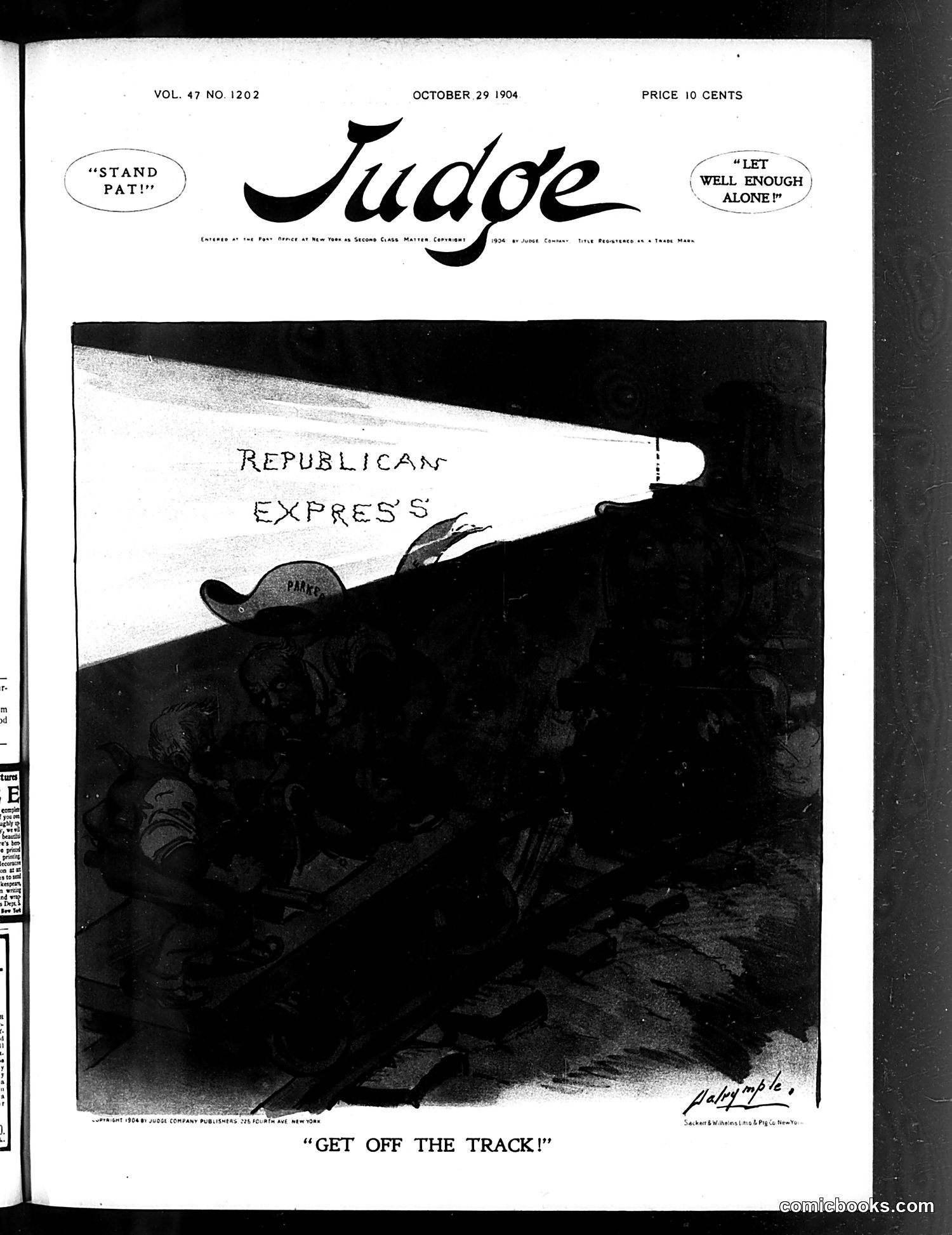
This political cartoon depicts the "Republican Express" train bearing down on figures on the tracks, with the caption "GET OFF THE TRACK!" The satire criticizes the Republican Party's momentum during the 1904 election cycle. The darkened figures appear to represent Democratic opposition or obstacles being steamrolled by Republican political power. The train imagery is a common metaphor for unstoppable political forces. The page headers—"STAND PAT!" and "LET WELL ENOUGH ALONE!"—suggest conservative Republican messaging, likely referencing President Theodore Roosevelt's re-election campaign. The cartoon mocks Democratic futility against Republican dominance, portraying them as helplessly in the path of an overwhelming political machine they cannot stop.
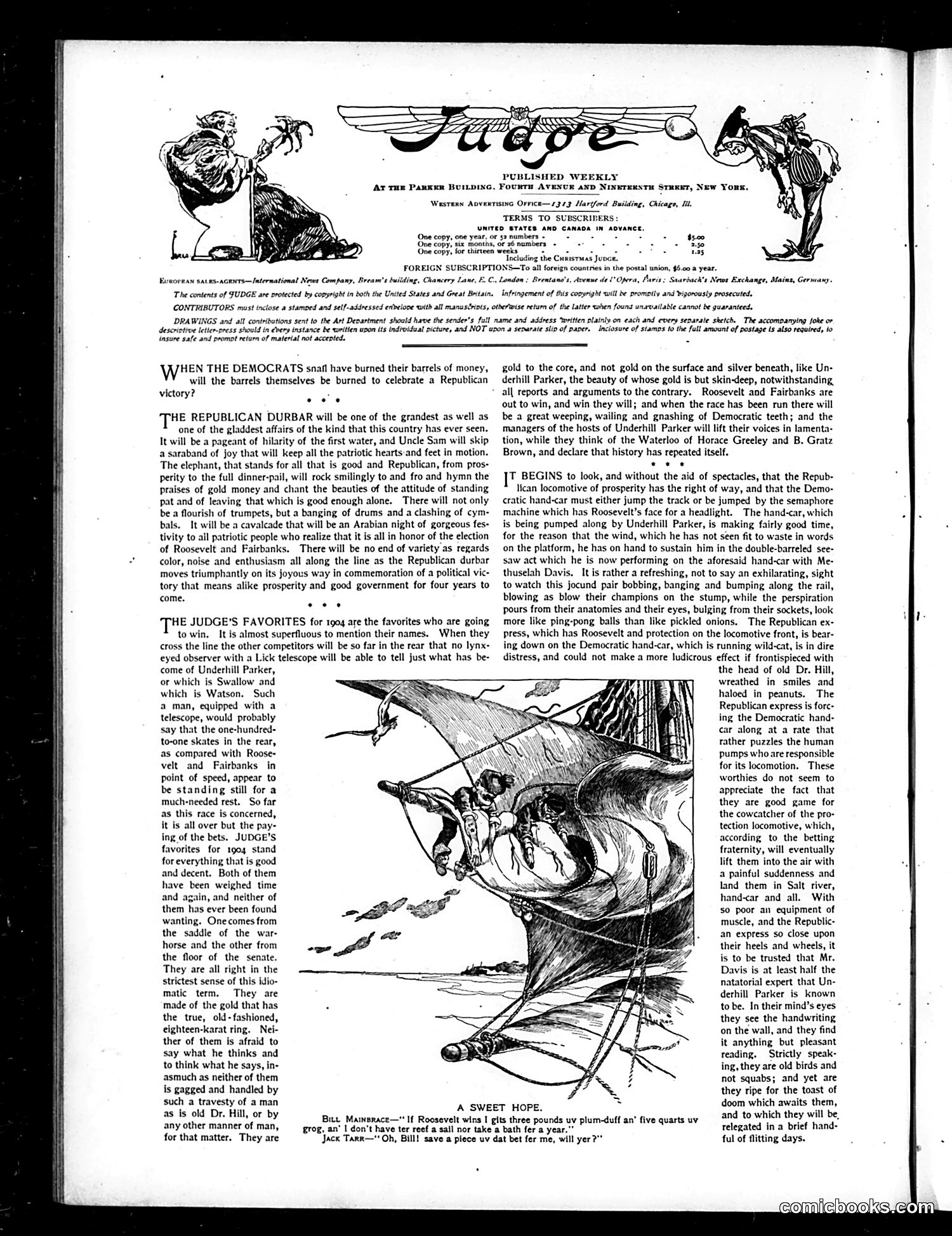
This page contains political commentary on the 1904 U.S. presidential election. The main text attacks Democrats, celebrating Republican prospects and mocking Democratic leadership. References to "Roosevelt and Fairbanks" indicate this supports the Republican ticket. The central cartoon depicts a figure (likely representing the Democratic Party or candidate) being thrown from a mechanical device labeled with Democratic symbolism—a common metaphor for electoral defeat. The "Sweet Hope" caption at bottom features dialogue between two men discussing a wager, using horse-racing imagery as metaphor for the campaign. The satire assumes Republican victory is inevitable, ridiculing Democratic efforts as futile. The cartoons employ period-typical exaggeration and anthropomorphic machinery to convey political positions. Without clearer labels on figures, specific identifications beyond Roosevelt/Fairbanks remain uncertain.
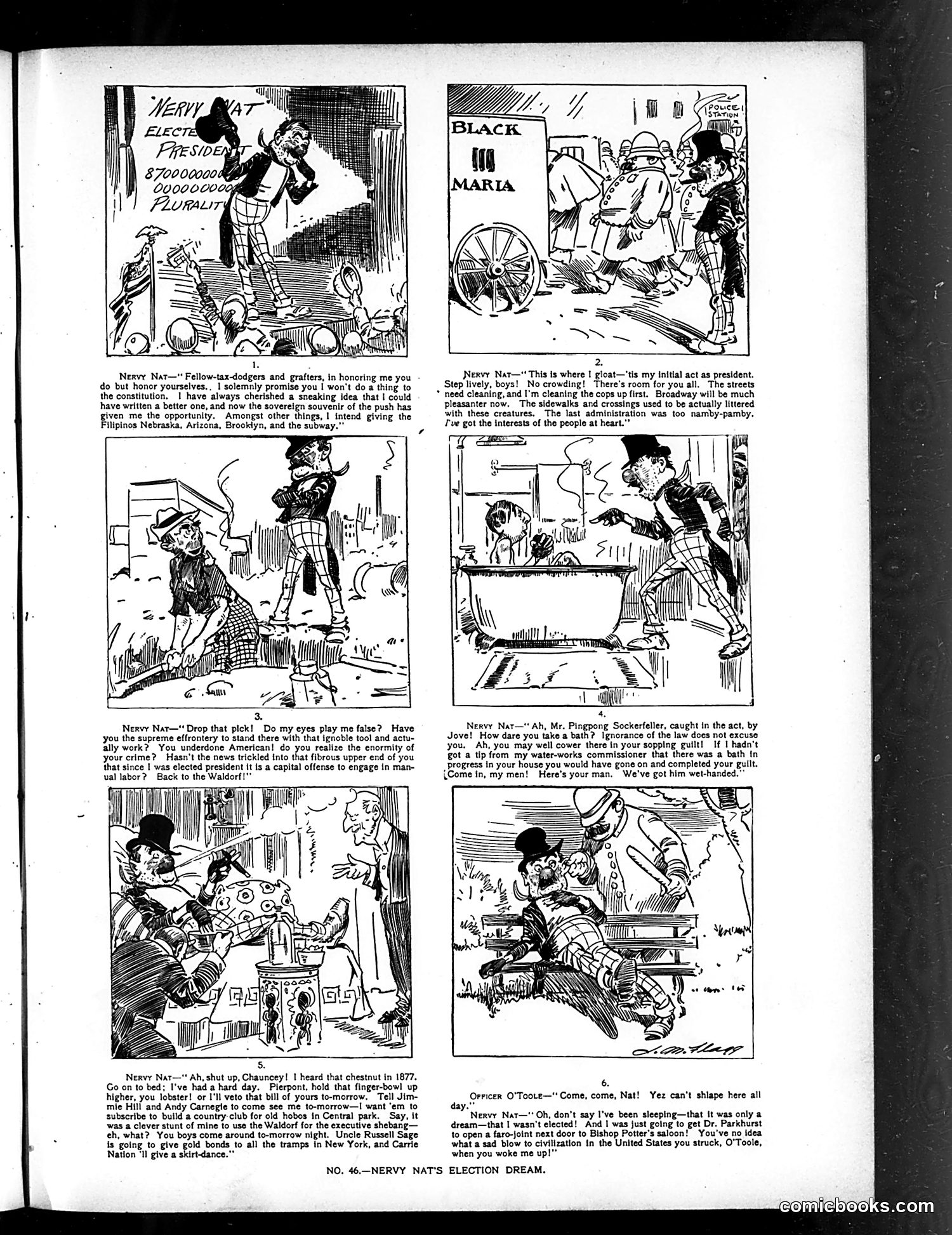
This comic strip satirizes Theodore Roosevelt's presidency through a dream sequence mocking his perceived arrogance and radical policies. "Nervy Nat" is a caricature of Roosevelt, depicted as a pompous, power-drunk leader who boasts of rewriting the Constitution and dismisses democratic norms ("capital offense to engage in manual labor"). The satire targets: - **Corruption**: Nat celebrates tax-dodgers and grafters in his opening address - **Police reform**: His dismissal of police as vermin requiring elimination - **Class warfare**: Mocking wealthy industrialists (Pierpont Morgan, Rockefeller, Carnegie, Russell Sage) whom he simultaneously courts - **Absurd policies**: Giving Filipinos American states, eliminating manual labor - **Hypocrisy**: His claimed concern for "the people" while socializing exclusively with the wealthy The final panel reveals it's a dream—a common satirical device suggesting these fears are exaggerated but reflect genuine anxieties about Roosevelt's executive power and progressive policies. The humor depends on understanding Roosevelt's actual presidency (1901-1909) and contemporary political debates.
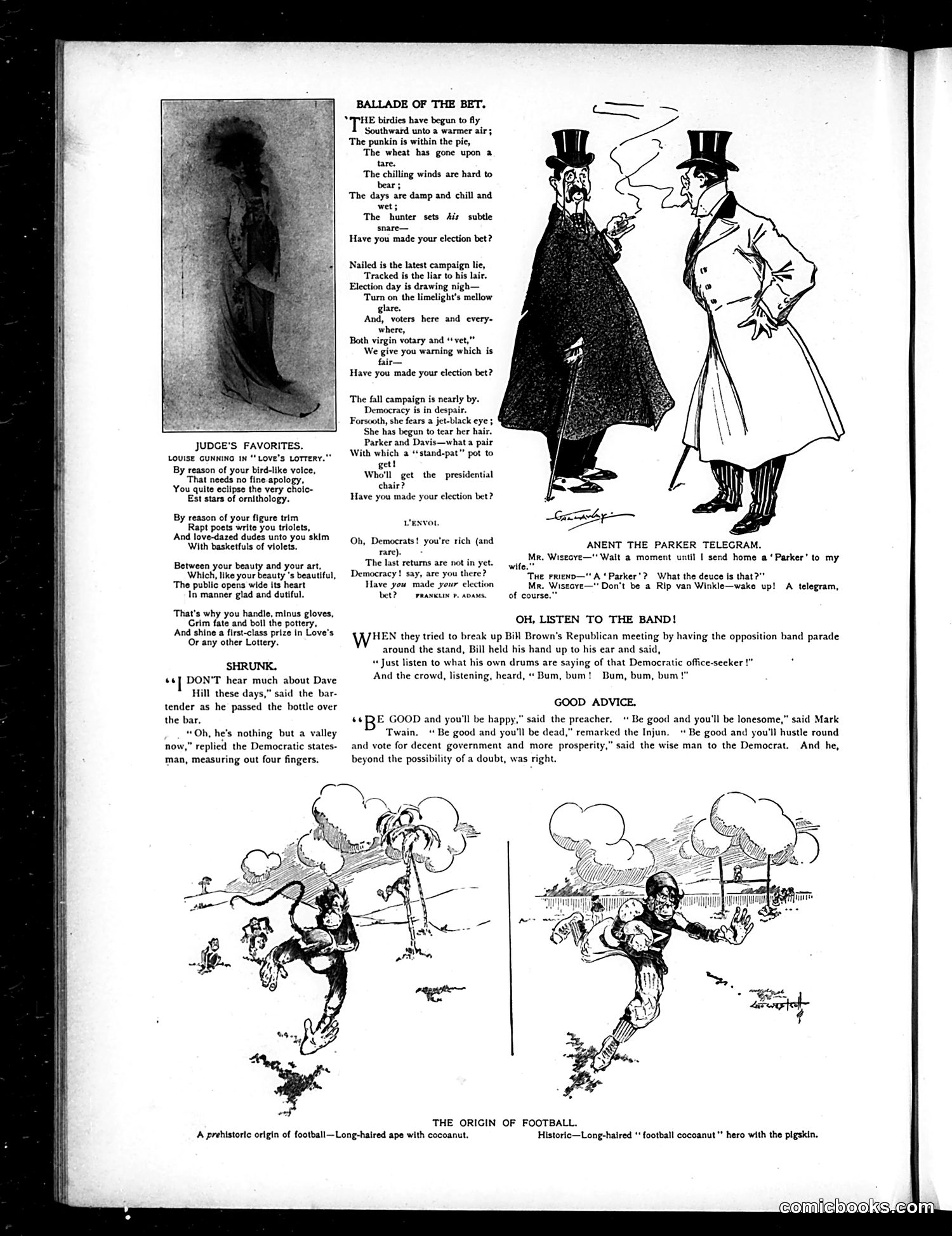
This page contains election-year political satire, likely from 1904. The central content mocks the Democratic Party's presidential campaign. **Key pieces:** The "Ballade of the Bet" repeatedly asks "Have you made your election bet?"—suggesting Democrats are so desperate they're gambling on the outcome. It references Parker and Davis (Alton B. Parker and Henry G. Davis, the Democratic nominees) as a weak "pair" to run against Republican "stand-pat" incumbents. "Oh, Listen to the Band!" depicts Republicans disrupting a Democratic meeting; when they hear opposition drums, they mock the sound as "Bum, bum!"—implying Democratic campaign rhetoric is empty noise. "Good Advice" sarcastically suggests voting Democratic leads to prosperity, while implying Democrats won't actually achieve it. The "Parker Telegram" joke plays on a recent scandal involving Parker's communications. Throughout, the satire portrays Democrats as hapless, desperate, and ineffective—a typical Judge magazine stance favoring Republicans during this era.
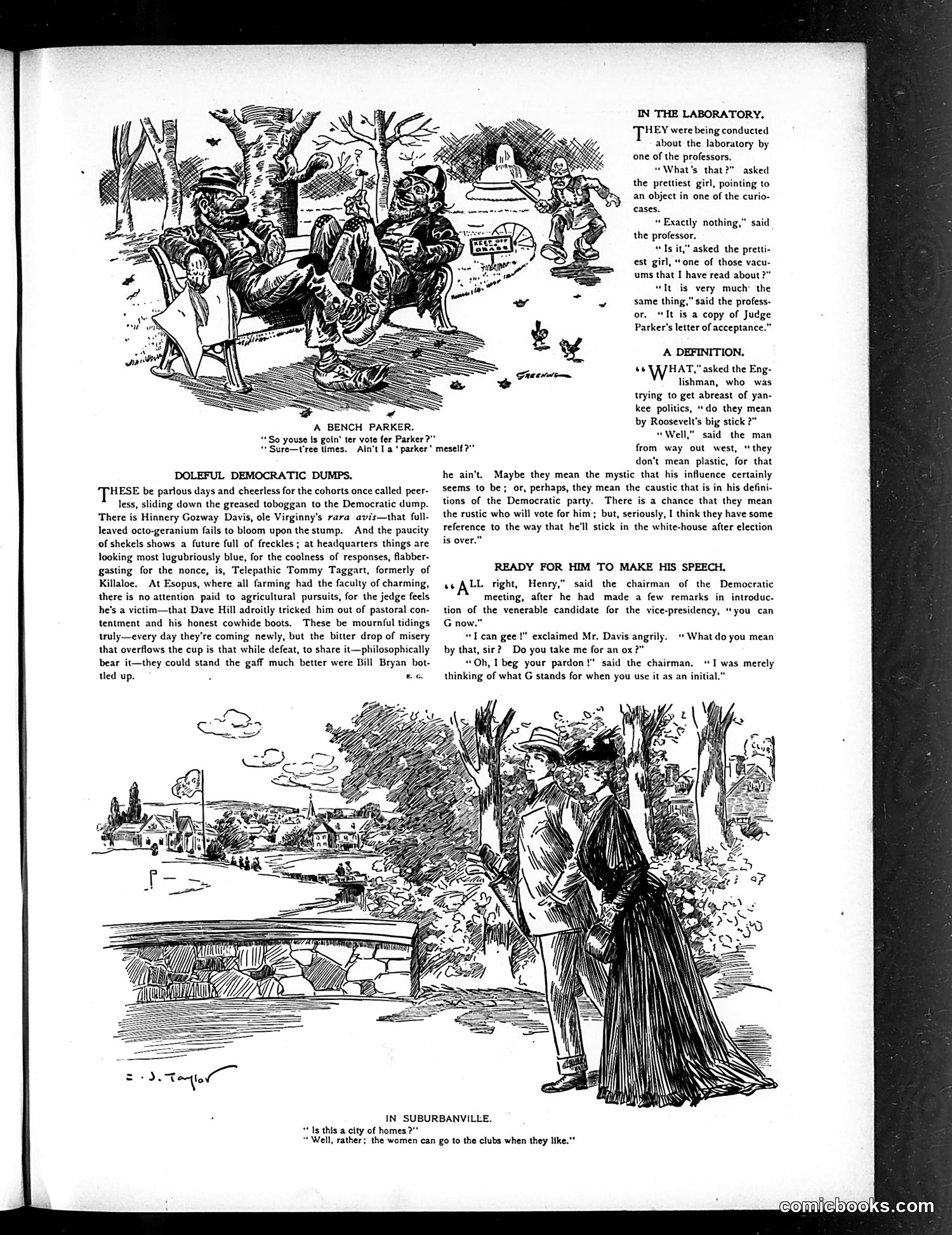
This page mocks the 1904 Democratic presidential campaign and candidate Alton Parker. **"A Bench Parker"** jokes that working-class voters plan to vote for Parker three times—a dig at both electoral fraud concerns and the notion that Parker lacks appeal even to his own party. **"Doleful Democratic Dumps"** satirizes Democratic demoralization. It references specific figures: Henry Gassaway Davis (the vice-presidential nominee, dismissed as ineffective), "Tommy Taggart" (party operative), and Judge Parker himself at Esopus. The piece laments that William Jennings Bryan isn't leading the ticket instead, suggesting Parker as nominee was a dispiriting compromise. **"Judge Parker's Letter of Acceptance"** compares his campaign statement to a vacuum—suggesting it was contentless or forgettable. **"Roosevelt's Big Stick"** explains Theodore Roosevelt's famous political philosophy through American vernacular, suggesting it means his ability to remain in power after election. **The Davis speech joke** puns on "G" (his initial, Henry Gassaway) as something you'd say to oxen, implying he's dull or bovine.
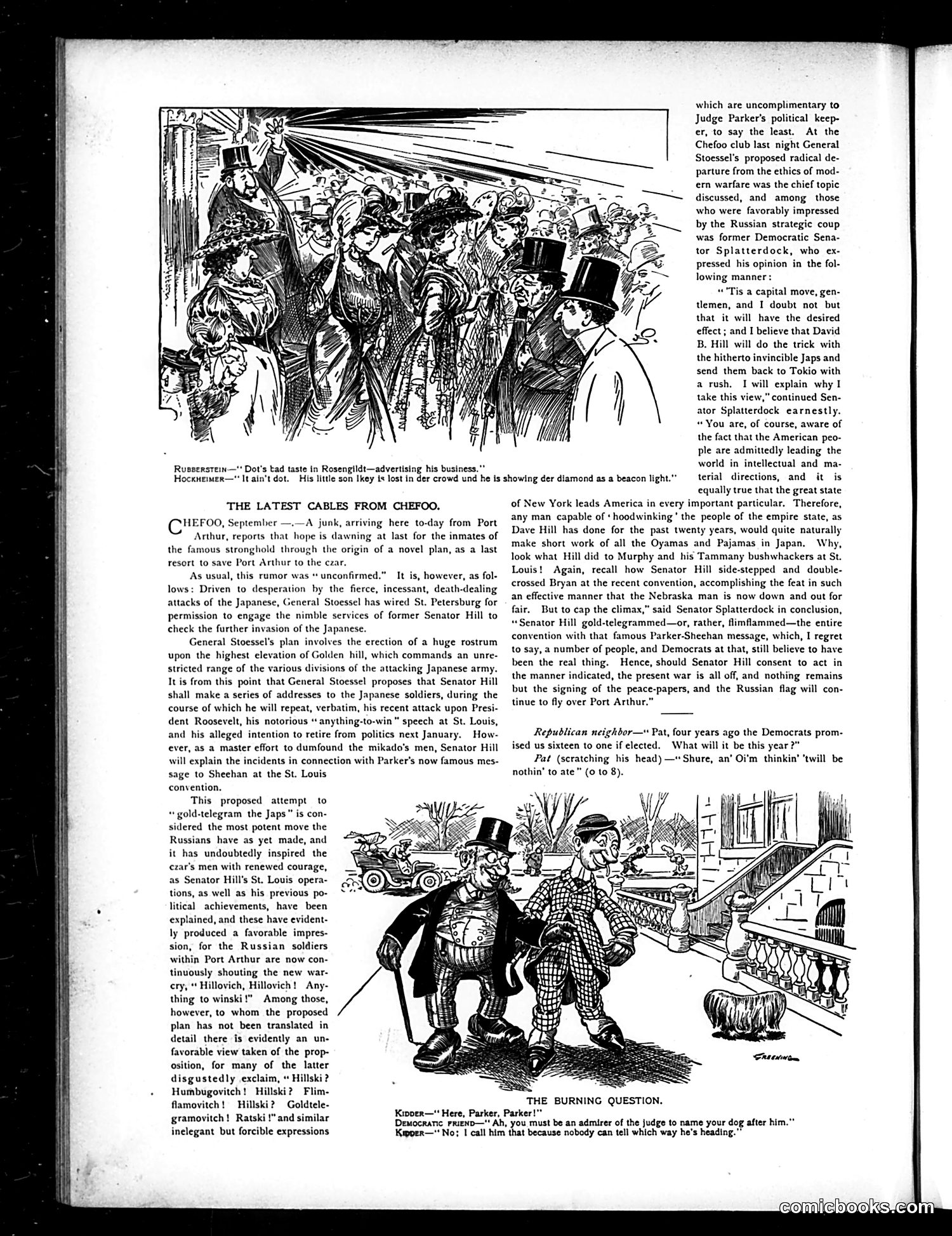
This page satirizes Senator **David B. Hill**, a prominent New York Democrat known for political maneuvering. The main cartoon mocks the Russo-Japanese War (1904-1905) by imagining Russia's desperate plan to send Hill to Port Arthur to demoralize Japanese soldiers with his speeches—a ridiculous proposal suggesting Hill is so tediously manipulative that even enemy troops would surrender to escape him. The satire references Hill's notorious "anything to win" approach to politics, his controversial "gold telegram" incident at the Democratic convention (attempting to influence Judge Parker), and his manipulation of New York politics. The cartoonists' joke: Hill's talent for bamboozling American voters would surely work against the Japanese. The lower cartoon appears to mock Yiddish-speaking immigrants, using stereotypical dialect humor common to the era, contrasting with the political content above.
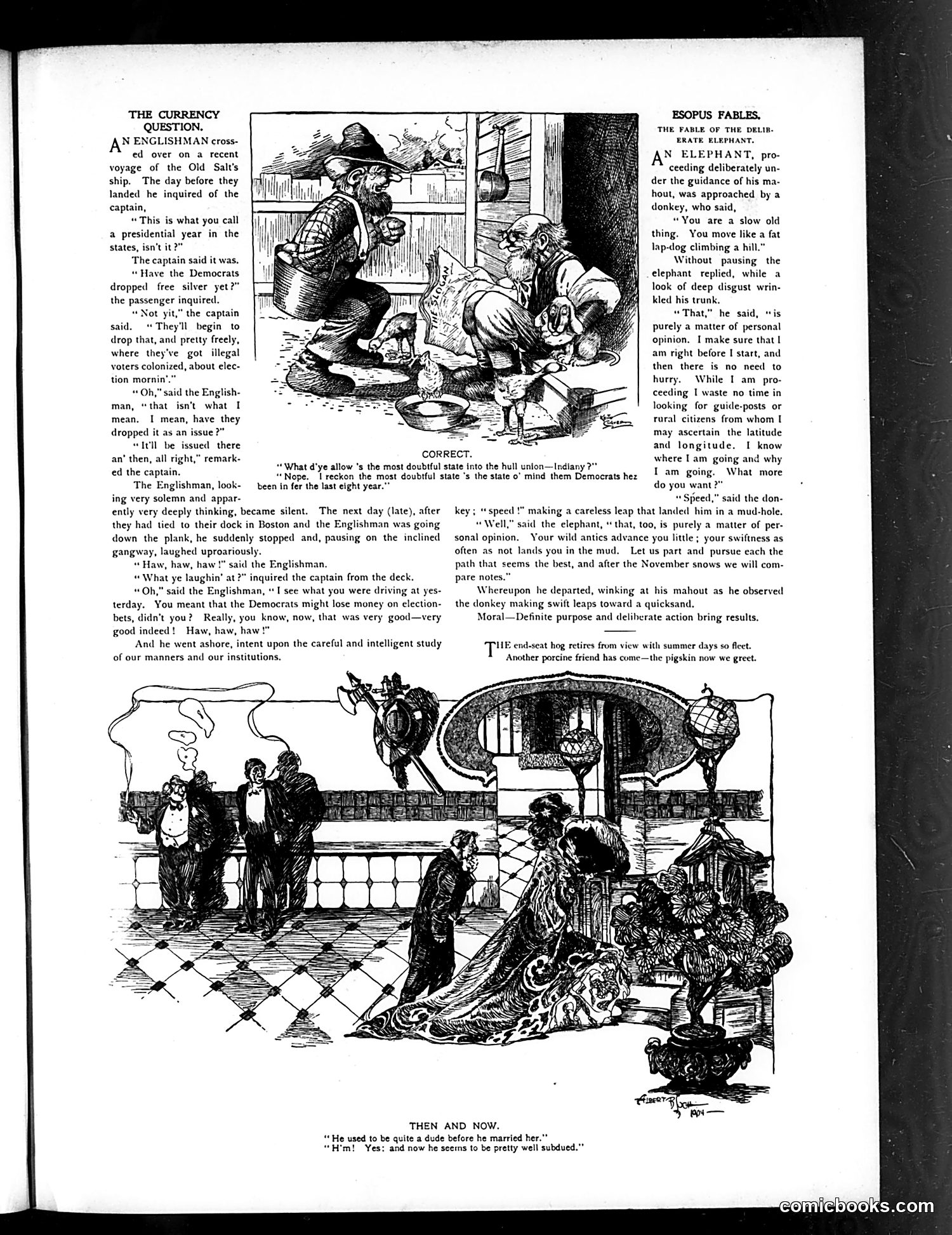
**"The Currency Question"** mocks Democratic indecision on the "free silver" issue—a major 1890s political debate. An English visitor asks a ship captain whether Democrats have abandoned their support for unlimited silver coinage. The captain's witty response suggests Democrats will drop the issue only where they need to prevent losses on election betting among illegal voters they've "colonized." The joke is that Democrats are so unprincipled they'll shift positions based on electoral advantage, treating policy like a gambling proposition rather than conviction. **"The Fable of the Deliberate Elephant"** contrasts the elephant's measured, purposeful approach with the donkey's reckless speed—clearly allegory for political temperament. The elephant's superior wisdom appears to critique hasty action, likely referencing contemporary debates about deliberative governance versus populist impulses. The cartoons collectively satirize Democratic Party inconsistency and poor judgment during the contentious Currency/Free Silver debates of the 1890s.
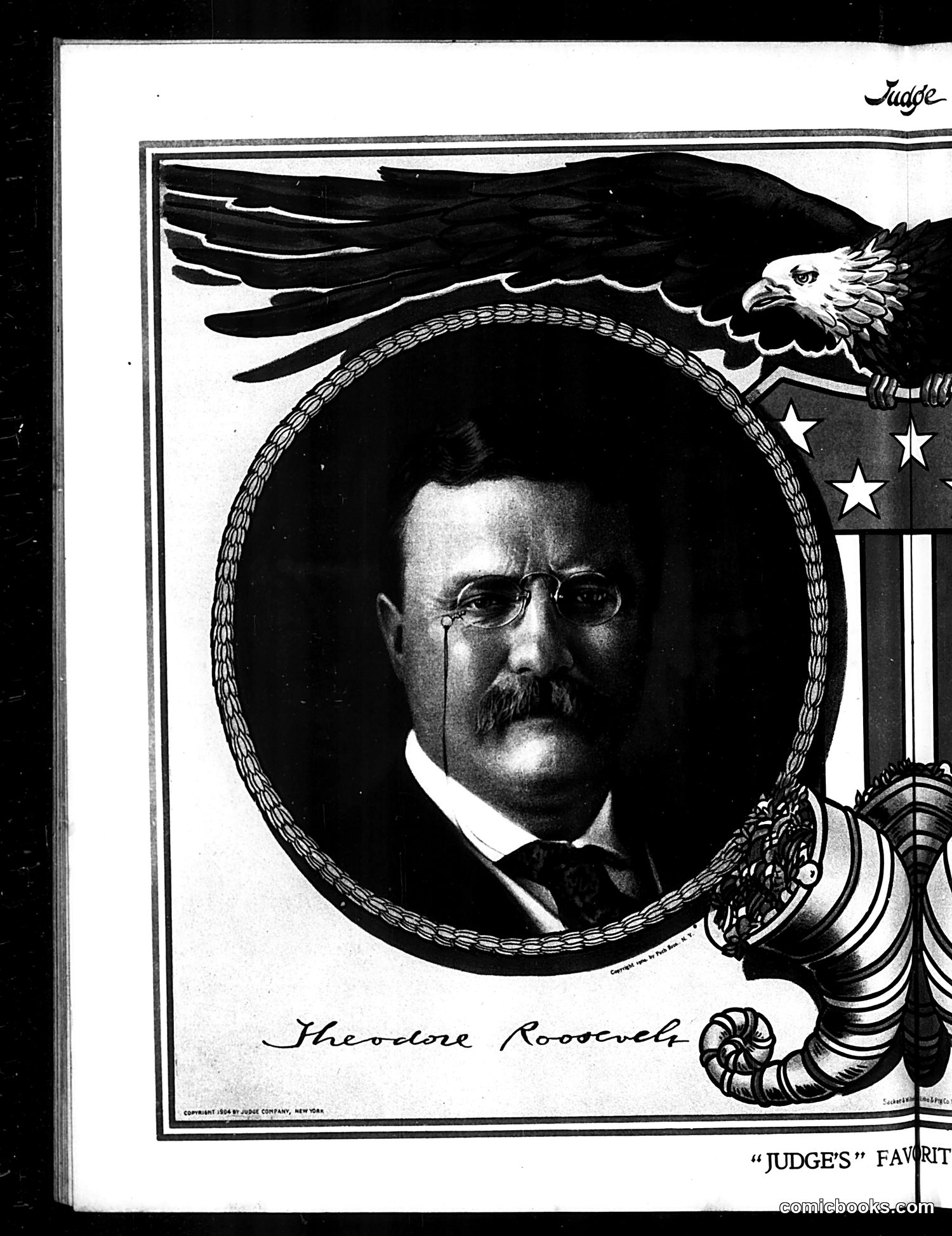
This page features a portrait of **Theodore Roosevelt**, identified by the handwritten signature beneath the circular frame. The image is labeled **"'JUDGE'S' FAVORITE"** at the bottom, indicating Roosevelt was a favored subject of Judge magazine's satire. The surrounding decorative elements—an eagle holding an American shield with stars and stripes—present Roosevelt in a patriotic, heroic context. This suggests the cartoon celebrates Roosevelt as an American icon, likely referencing his popularity during his presidency or public life. The formal portrait style combined with the patriotic framing indicates this is complimentary rather than mocking satire—Judge's editors viewed Roosevelt as embodying American ideals and leadership worthy of celebration.
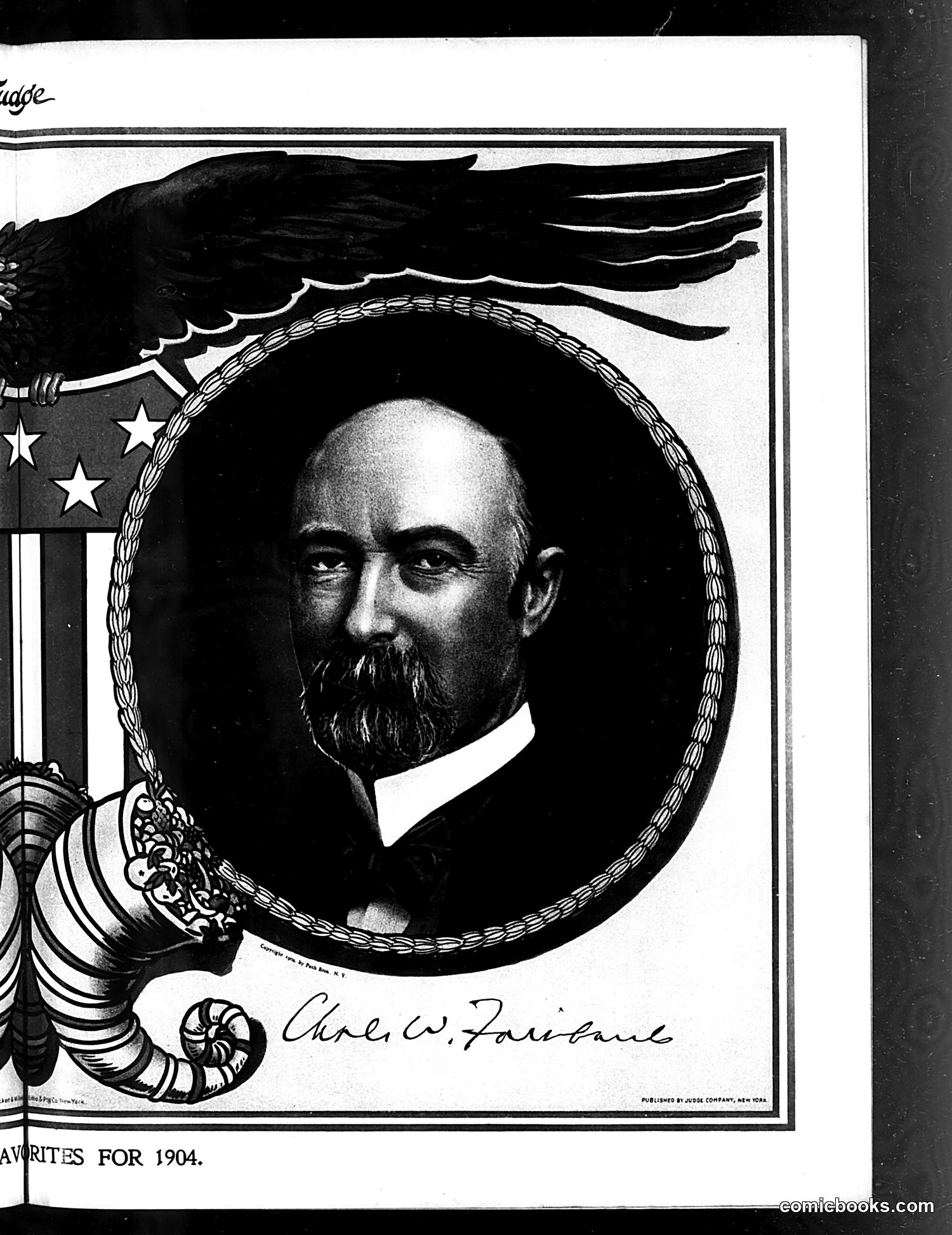
This appears to be a title page or section header from Judge magazine featuring a portrait labeled "Chas. W. Fairbanks" in what looks like an official or commemorative style. The decorative elements—an eagle at top, American flag on the left, and classical cornucopia (horn of plenty) at bottom—suggest this is presenting a figure of national importance for 1904. The text "FAVORITES FOR 1904" indicates this is likely part of a series featuring prominent American political figures that year. Charles W. Fairbanks was Theodore Roosevelt's Vice President (1905-1909), so this may be previewing or promoting him as a notable figure for that election year, though the exact satirical intent isn't entirely clear from this page alone.
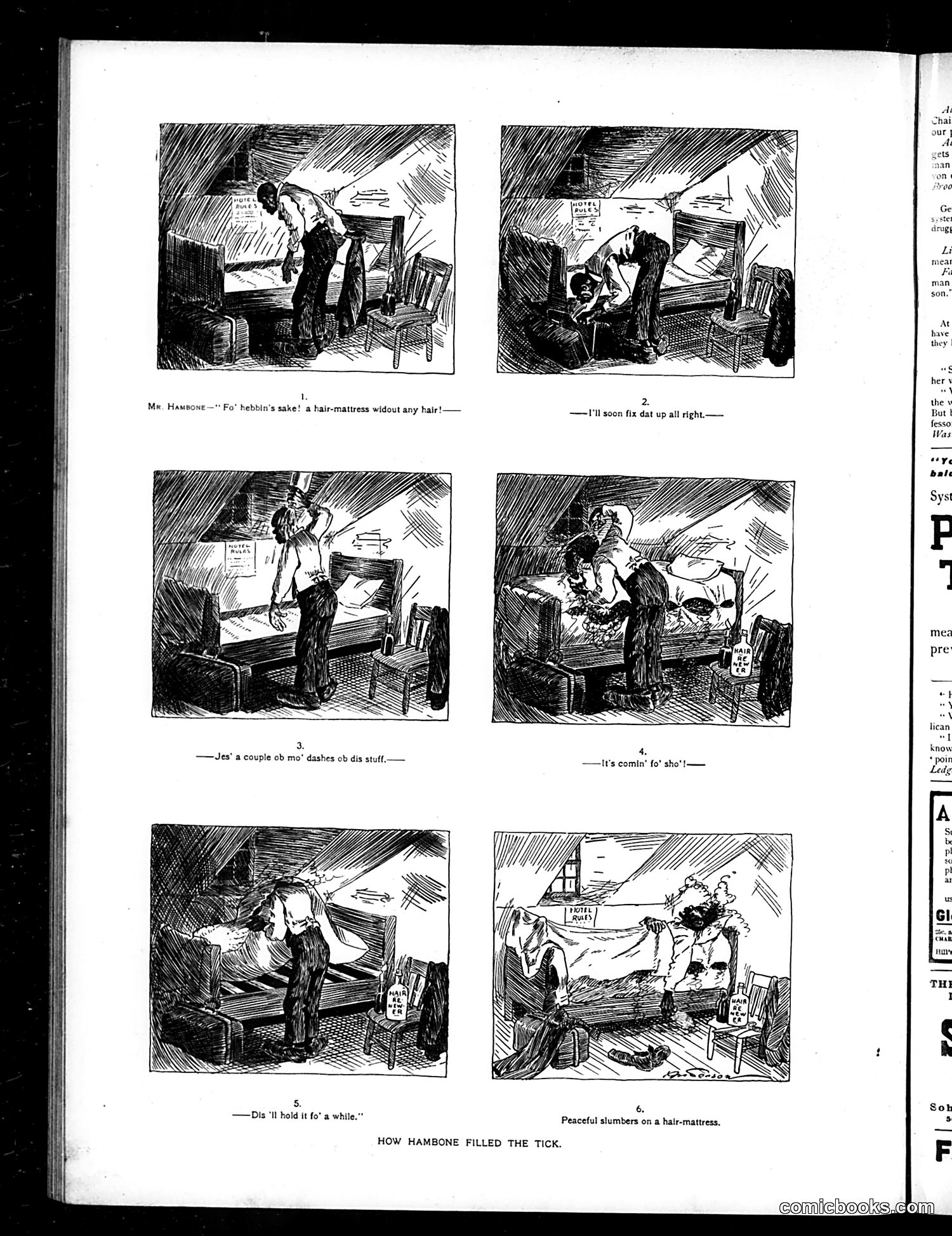
This is a six-panel comic strip titled "How Hambone Filled the Tick," depicting a character named Hambone dealing with a mattress ("tick" being period slang for mattress ticking/cover). The sequence shows Hambone attempting to stuff a hair-mattress, with captions using heavy dialect ("Fo'" for "for," "dis" for "this"). Panel 1 references "hair-mattress widout any hair," suggesting the mattress is empty. The subsequent panels show Hambone's humorous attempts to fill it, with the final panel showing him peacefully sleeping on the completed mattress. The strip employs racial caricature stereotyping common to early 20th-century American humor magazines. The dialect and character name reflect the period's offensive depictions. The humor derives from slapstick physical comedy and working-class domestic struggles with household goods.
This page is primarily **advertising**, with minimal cartoon content. The most substantial text pieces are humorous anecdotes rather than political satire. The few jokes present mock **ethnic stereotypes** and social pretension typical of early 20th-century humor. An opening anecdote features "Alderman Duffy" and "Alderman Limburger"—names suggesting Irish and German immigrants—portrayed as dialect-speaking buffoons unable to pronounce "transparency" correctly. Other brief jokes target **bourgeois affectation**: a father hiring a voice professor hoping to cure (not cultivate) his daughter's singing; a hostess's disappointment that a visiting violinist didn't bring his instrument. The bulk of the page consists of **product advertisements** for soaps, pianos, shoes, and investment services—typical Judge magazine content from this era. A large W.L. Douglas shoe ad features illustrated figures. **Context for modern readers**: This reflects early-1900s American attitudes mixing crude ethnic humor with consumer culture, before such stereotyping became socially unacceptable.
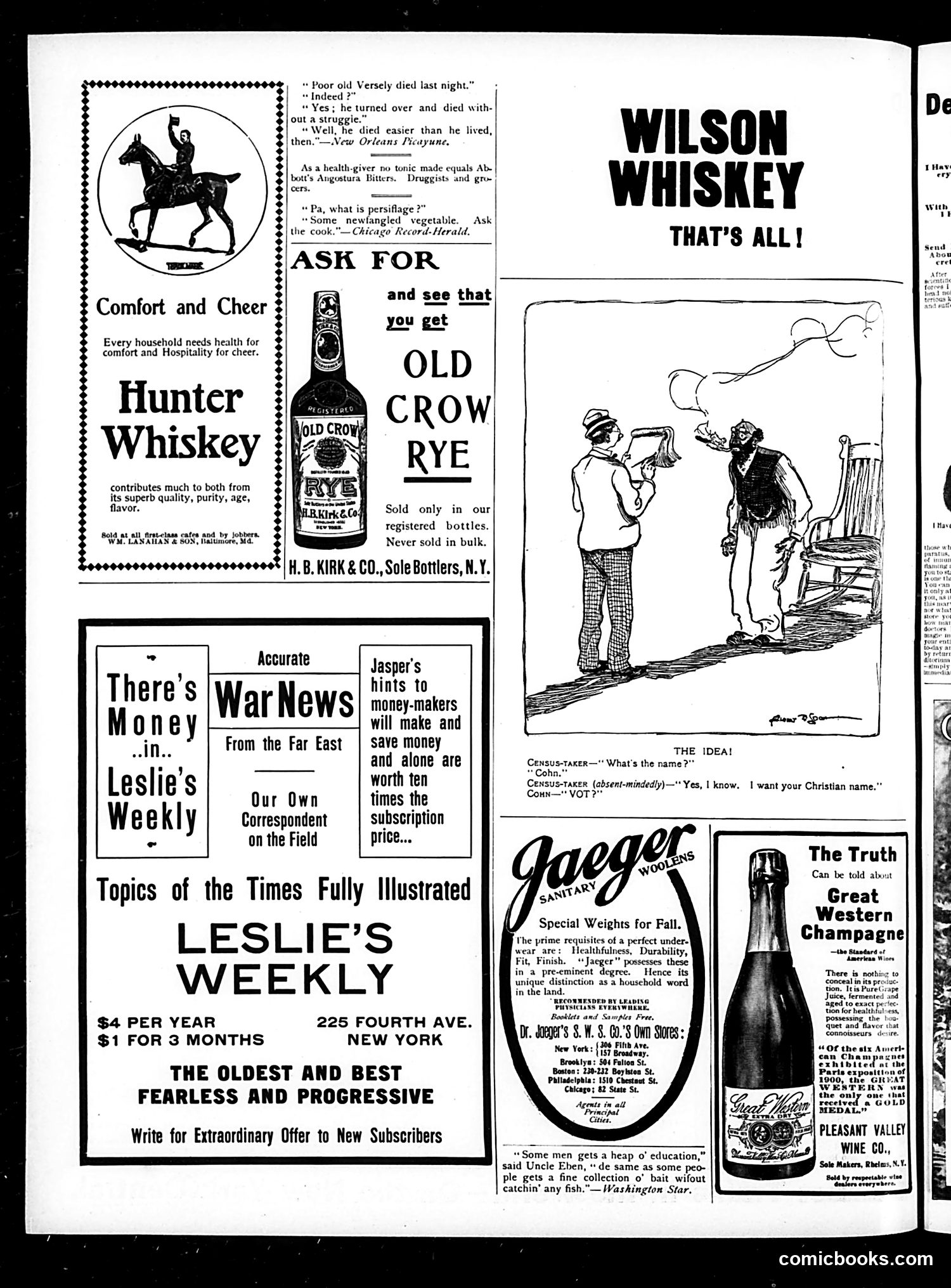
This page is primarily **advertising**, not editorial content. It features liquor and consumer product advertisements from the early 20th century, interspersed with brief jokes and comic captions. The main cartoons are: 1. **"The Idea!"** — A census-taker asks a man for his "Christian name," misunderstanding the request as religious rather than personal identification. The humor plays on the term's ambiguity. 2. **Small quoted jokes** at top discuss death, health tonics, and "persiflage" (a vegetable misidentification), typical of Judge's brief, punchy humor style. The advertisements emphasize **alcohol products** (Hunter Whiskey, Old Crow Rye, champagne) and consumer goods (Jaeger woolens, Leslie's Weekly magazine). These reflect pre-Prohibition advertising norms and the magazine's commercial focus. The page reveals early 1900s consumer culture and casual attitudes toward alcohol marketing that would later change dramatically with Prohibition.
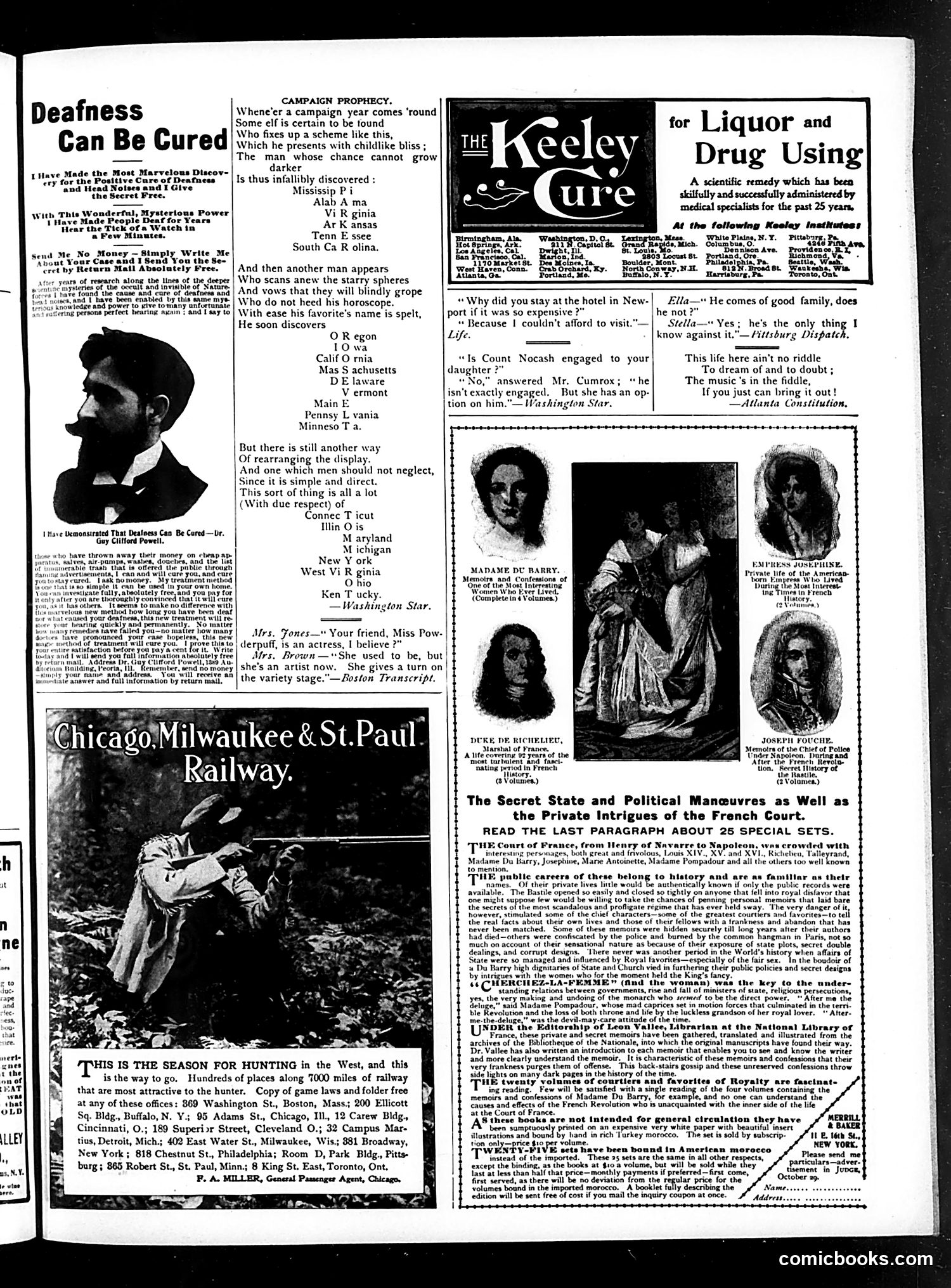
This page mixes political satire with period advertisements. The main cartoon titled "Campaign Prophecy" satirizes electoral prediction schemes. It shows how various people claim to have discovered which states will vote for a particular candidate by hidden letter patterns—spelling out state names using emphasized letters in lists like "Mississip**P**i," "Alab**A**ma," etc. The joke: these "prophetic" methods are all arbitrary nonsense dressed up as mystical insight, mocking both superstitious thinking and dubious campaign prognostication. The page also advertises dubious medical remedies (deafness cure, drug treatment) typical of early 1900s magazine advertising—unverified claims presented as scientific breakthroughs. The scattered jokes at bottom mock social pretense: actresses reinventing themselves, gold-diggers pursuing broke nobility.
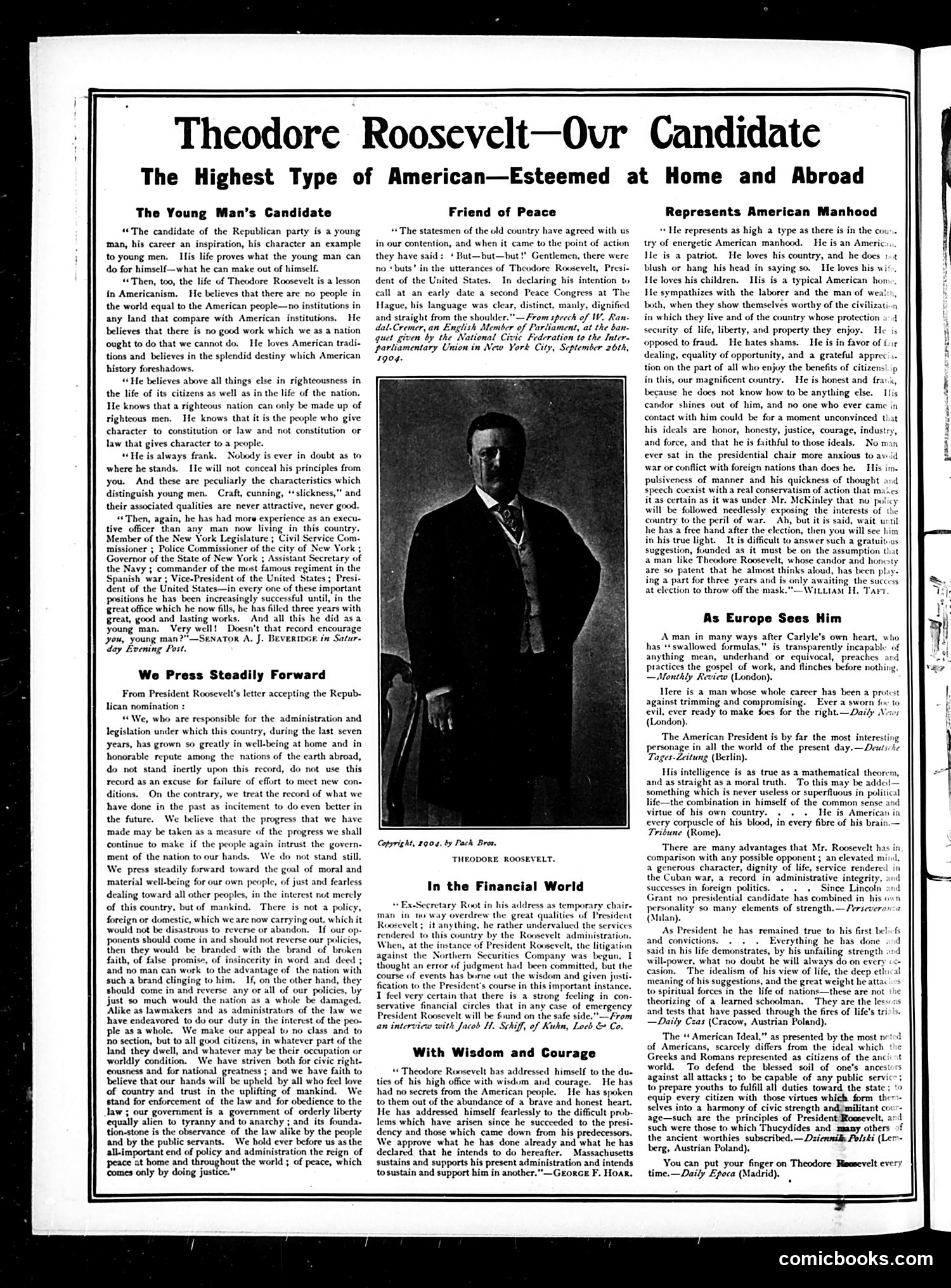
This is a **1904 Republican campaign advertisement** for Theodore Roosevelt's presidential reelection, not a satirical cartoon. The page presents straightforward political promotion rather than satire. The central photograph shows Roosevelt in formal attire. The text consists of laudatory quotes from Senator Albert J. Beveridge and President Roosevelt himself, emphasizing: - Roosevelt's youth and exemplary character for young men - His extensive executive experience (New York offices, Navy Assistant Secretary, Spanish-American War commander, Vice President, President) - His belief in American superiority and righteousness - His record of accomplishment and progressive policies Sidebar sections titled "Friend of Peace," "Represents American Manhood," "As Europe Sees Him," "In the Financial World," and "With Wisdom and Courage" contain glowing testimonials from international and domestic sources praising Roosevelt's leadership. This appears to be **straightforward political propaganda** rather than satirical commentary—Judge magazine here functions as a campaign publication promoting Roosevelt's 1904 candidacy.
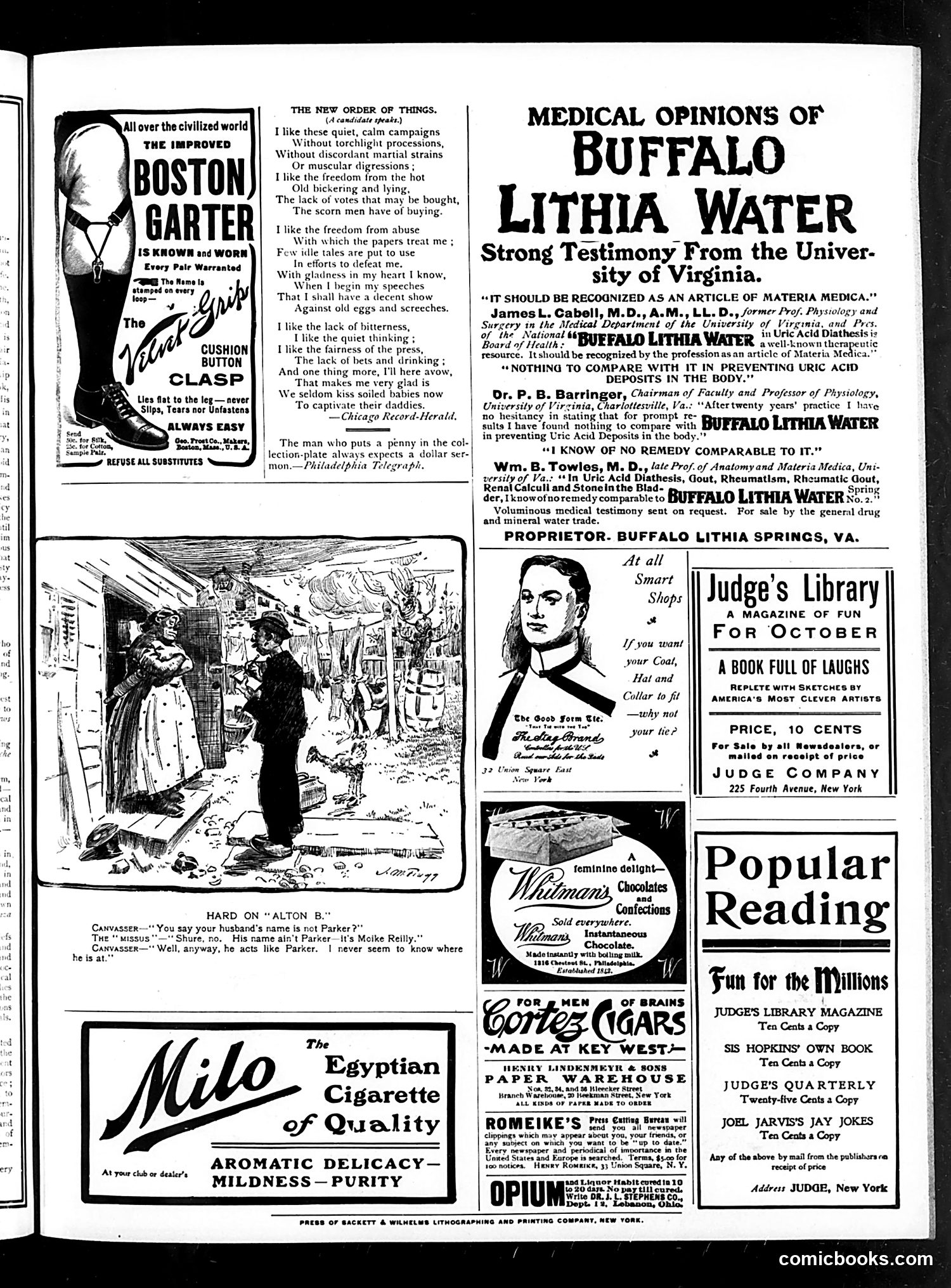
This page contains satirical content about early 20th-century American politics and social customs, alongside period advertisements. **The main cartoon "The New Order of Things"** depicts a political candidate praising a supposedly genteel campaign—no torchlight parades, no vote-buying, no press attacks, no kissing babies for votes. The satire is clear: the candidate is *lying*. He's praising the absence of exactly those corrupt, vulgar practices that actually dominated American campaigns of this era. The joke mocks candidates who claimed to run "clean" campaigns while engaging in the very abuses they denounced. **"Hard on 'Alton B.'"** references Alton B. Parker, the 1904 Democratic presidential nominee. The cartoon mocks him by showing a woman confusing her husband "Moike Reilly" with Parker, suggesting Parker was forgettable or indistinct—a jab at his candidacy. The remaining content is primarily **period advertising** for products (garters, water, cigars, magazines) typical of the era, including dubious medical claims for "Buffalo Lithia Water" endorsed by university physicians.
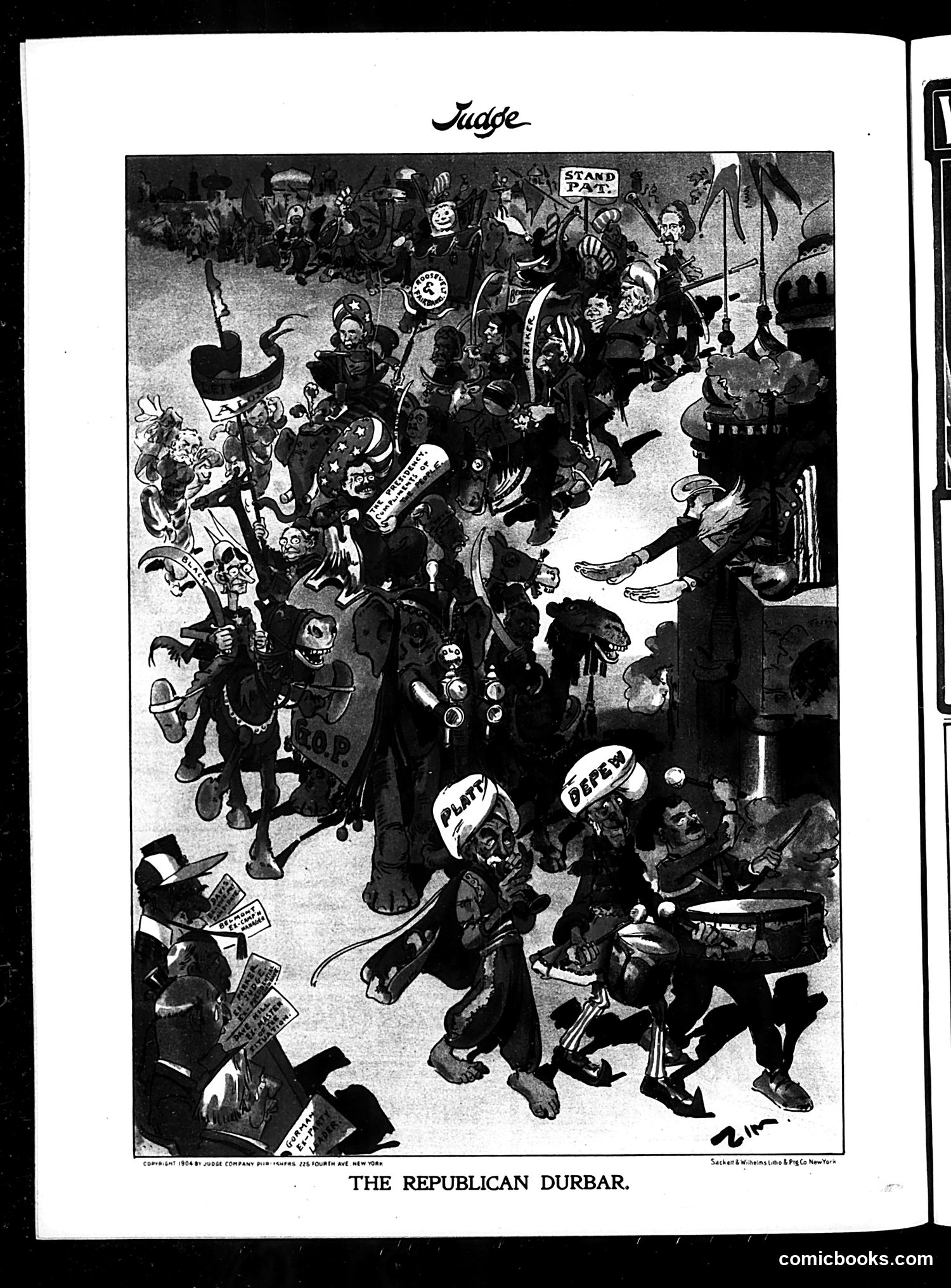
This political cartoon satirizes Republican Party leadership as an chaotic, exotic "durbar" (an Indian court or gathering). The image depicts Republican figures as grotesque, costumed characters in a wild carnival scene, complete with various symbols and props suggesting disorder and spectacle rather than serious governance. The title suggests Republicans are conducting themselves like an Oriental court—ornate, performative, and disconnected from American democratic values. The caricatures and exaggerated costumes mock what the cartoonist views as Republican pretension or theatrical posturing during what appears to be an election period. The "Stand Pat" sign visible in the image likely references the "stand pat" Republican faction of the era, supporting the status quo against progressive reform. Overall, the cartoon presents Republican leadership as absurd and unserious.
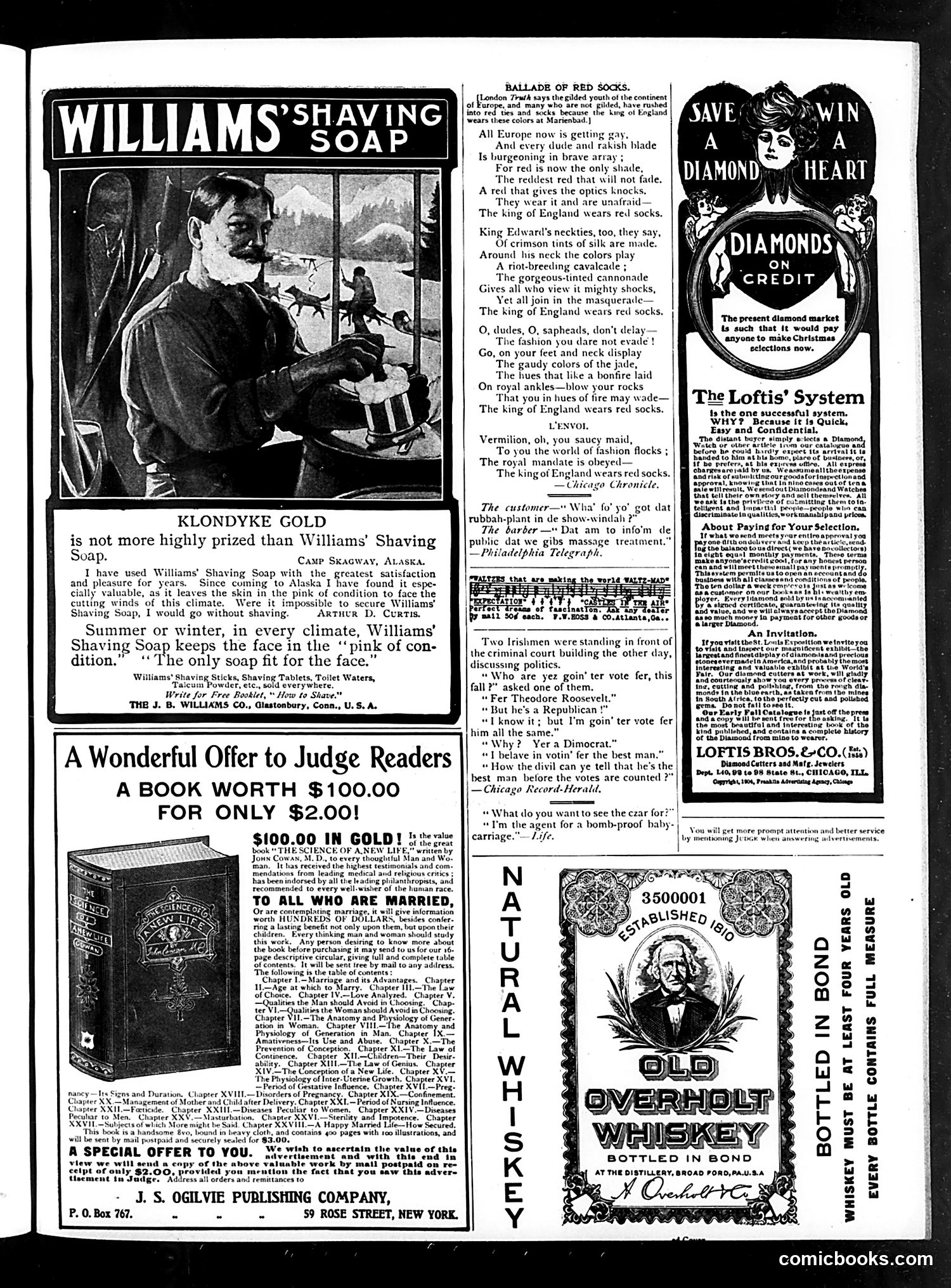
This page from *Judge* magazine contains primarily **advertisements and humorous verses**, not political cartoons. The main content is a satirical poem ("Ballad of Red Socks") mocking the fashion trend of King Edward VII wearing red socks—depicted as an absurd fad sweeping Europe. The joke relies on treating trivial royal fashion choices as momentous cultural events worthy of serious poetic treatment. The page includes several period advertisements (Williams' Shaving Soap, a marriage advice book, diamond credit, whiskey) and two brief ethnic humor pieces: one featuring a Black barber's malapropism, another depicting Irish-American political naiveté. These reflect early 1900s *Judge* magazine conventions, not serious satire. The Edward VII reference dates this to his reign (1901-1910). The humor is lightweight society gossip elevated through mock-heroic verse—characteristic of *Judge*'s approach to fashionable absurdities.
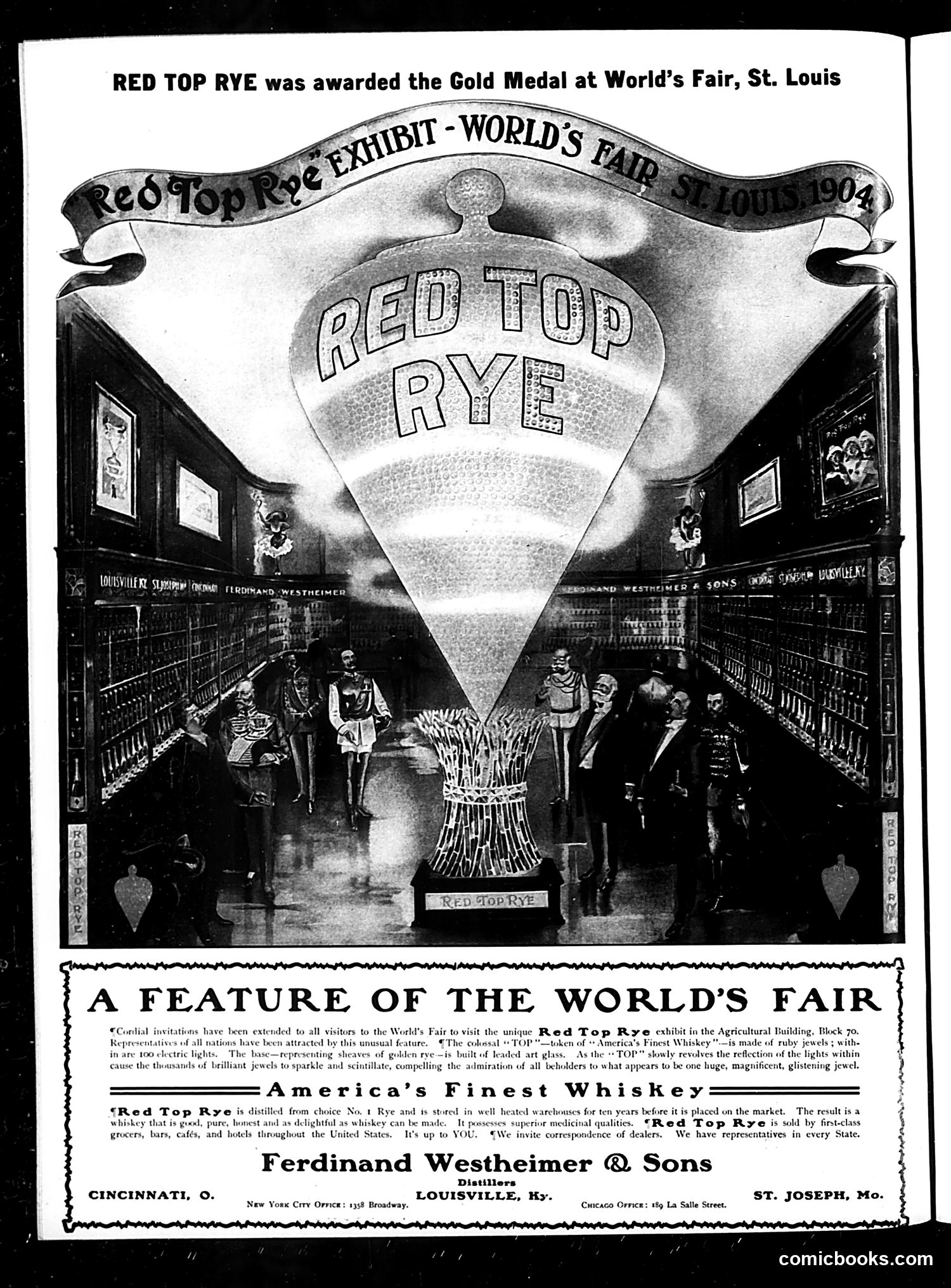
This is primarily an **advertisement**, not political satire. It promotes Red Top Rye whiskey by Ferdinand Westheimer & Sons, capitalizing on the 1904 World's Fair in St. Louis. The centerpiece depicts Red Top Rye's elaborate exhibition booth—a giant jewel-shaped structure containing electric lights, leaded glass, and ruby gems, designed to dazzle fairgoers. The image shows formally dressed visitors (appearing to represent international delegates) admiring this spectacular display. The copy emphasizes the whiskey's quality: distilled from choice rye, aged ten years in heated warehouses, and possessing "superior medicinal qualities"—a common claim for spirits in that era. The advertisement distributed to "every State" targets retailers and consumers through national magazine placement. This reflects early-1900s advertising strategies: using World's Fair prestige, technological spectacle (electric lights were still novel), and claims of medicinal value to market luxury goods.