
Judge, 1904-10-29 · page 16 of 20
Judge — October 29, 1904 — page 16: what you’re looking at
What you’re looking at
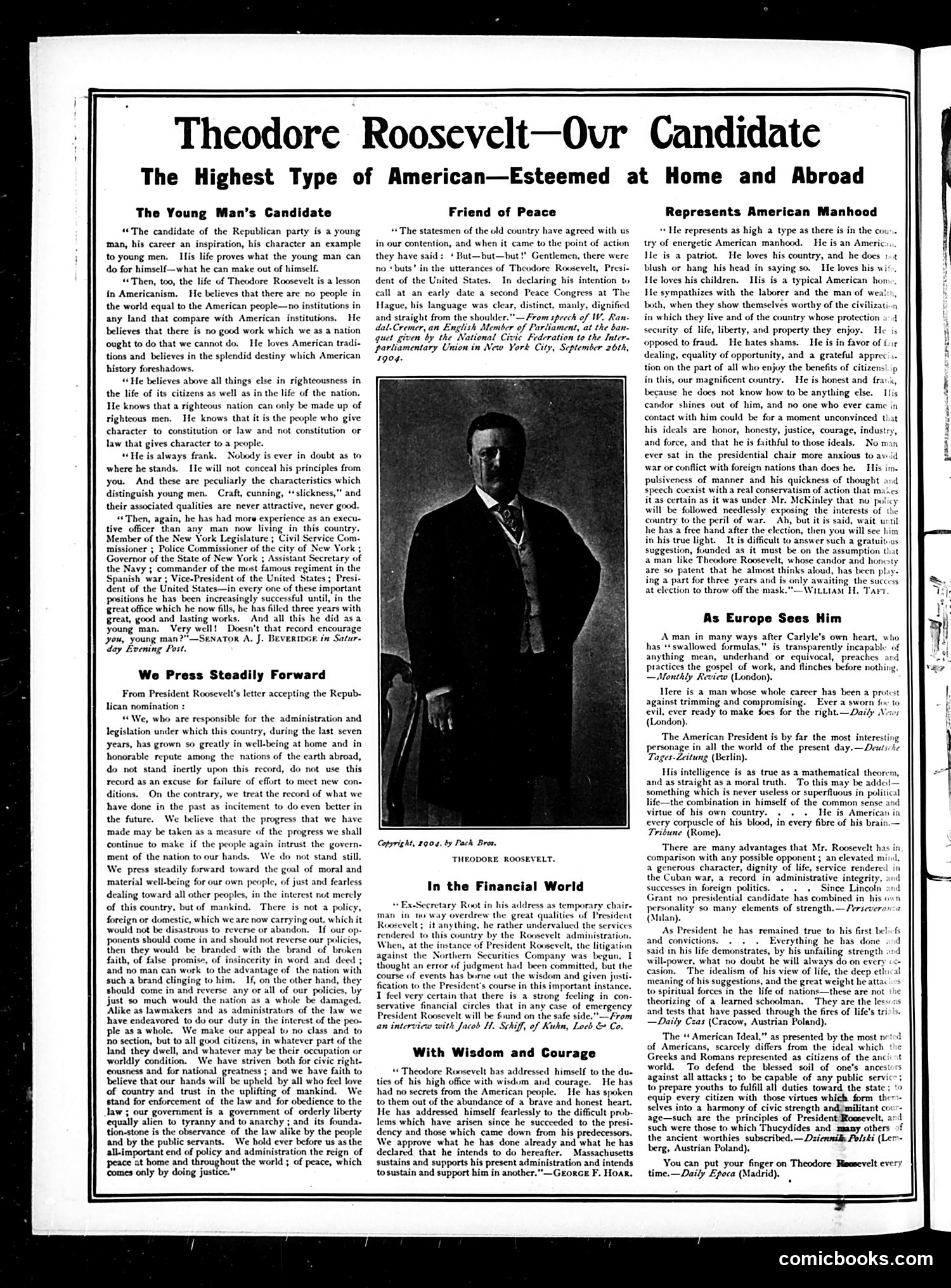
This is a **1904 Republican campaign advertisement** for Theodore Roosevelt's presidential reelection, not a satirical cartoon. The page presents straightforward political promotion rather than satire. The central photograph shows Roosevelt in formal attire. The text consists of laudatory quotes from Senator Albert J. Beveridge and President Roosevelt himself, emphasizing: - Roosevelt's youth and exemplary character for young men - His extensive executive experience (New York offices, Navy Assistant Secretary, Spanish-American War commander, Vice President, President) - His belief in American superiority and righteousness - His record of accomplishment and progressive policies Sidebar sections titled "Friend of Peace," "Represents American Manhood," "As Europe Sees Him," "In the Financial World," and "With Wisdom and Courage" contain glowing testimonials from international and domestic sources praising Roosevelt's leadership. This appears to be **straightforward political propaganda** rather than satirical commentary—Judge magazine here functions as a campaign publication promoting Roosevelt's 1904 candidacy.
📄 Transcribed text from this page (OCR, searchable)
Machine-transcribed from the original scan — historical spelling and the odd misread are preserved.
Theodore Roosevelt—Our Candidate The Highest Type of American—Esteemed at Home and Abroad The Young Man’s Candidate “The candidate of the Republican party is a young man, his career an inspiration, his character an example to young men. Ilis life proves what the young man can do for himself—what he can make out of himself. “Then, too, the life of Theodore Roosevelt is a lesson in Americanism. He believes that there are no people in the world equal to the American people—no institutions in any land that compare with American institutions, He believes that there is no good work which we as a nation ought to do that we cannot do. He loves American tradi- tions and believes in the splendid destiny which American history foreshadows. «He believes above all things else in righteousness in the life of its citizens as well as in the life of the nation. He knows that a righteous nation can only be made up of righteous men. He knows that it is the people who give character to constitution or law and not constitution or law that gives character to a people. “He is always frank. Nobody is ever in doubt as to where he stands. He will not conceal his principles from you. And these are peculiarly the characteristics which distinguish young men. Craft, cunning, ‘slickness,"" and their associated qualities are never attractive, never good. “Then, again, he has had more experience as an execu- tive officer than any man now living in this country. Member of the New York Legislature ; Civil Service Com- missioner ; Police Commissioner of the city of New York ; Governor of the State of New York ; Assistant Secretary of the Navy ; commander of the most famous regiment in the Spanish war ; Vice-President of the United States ; Presi dent of the United States—in every one of these importan positions he has been increasingly successful until, in the great office which he now fills, he has filled three years with Breat, good and lasting works. And all this he did asa young man. Very well! Doesn't that record encourage ‘you, young man?”—SeNATOR A. J. BEVERIDGR. in Satur day Evening Post. We Press Steadily Forward From President Roosevelt's letter accepting the Repub- lican nomination : We, who are responsible for the administration and legislation under which this country, during the last seven years, has grown so greatly in well-being at home and in honorable repute among the nations of the earth abroad, do not stand inertly upon this record, do not use this record as an excuse for failure of effort to meet new cone ditions. On the contrary, we treat the record of what we have done in the past as incitement to do even better in the future. We believe that the progress that we have made may be taken as a measure of the progress we shall continue to make if the people again intrust the govern- ment of the nation to our hands. We do not stand still. We press steadily forward toward th material well-being for our own people, of just and fearless goal of moral and dealing toward all other peoples, in the inte of this country, but of mankind. There is not a policy, foreign or domestic, which we are now carrying out, which it would not be disastrous to reverse or abandon. If our op- ponents should come in and should not reverse our policies, then they would be branded with the brand of broken faith, of false promise, of insincerity in word and deed ; and no man can work to the advantage of ‘the nation with such a brand clinging to him. If, on the other hand, they should come in and reverse any or all of our policies, by just so much would the nation as a whole be damaged. Alike as lawmakers and as administrators of the law we have endeavored to do our duty in the interest of the peo- ple asa whole. We make our appeal to no class and to no section, but to all good citizens, in whatever part of the land they dwell, and whatever may be their occupation or worldly condition. We have striven both for civic right- cousness and for national greatness ; and we have faith to believe that our hands will be upheld by all who feel love of country and trust in the uplifting of mankind. We stand for enforcement of the law and for obedience to the law ; our government is a government of orderly liberty equally alien to tyranny and to anarchy ; and its founda. tion-stone is the observance of the law alike by the people and by the public servants. We hold ever before us asthe all-important end of policy and administration the reign of ‘at home and throughout the world ; of peace, which comes only by doing justice." st not merely Friend of Peace “The statesmen of the old country have agreed with us in our contention, and when it came to the point of action they have said: ¢ But—but—but ! no *buts’ in the utterances of Theodore Roosevelt, Presi« dent of the United States. In declaring his intention ty call at an early date a second Peace Congress at The Hague, his language was clear, distinct, manly, dignified and straight from the shoulder." —From speech of W. Ran. dal-Cremer, an English Member of Parliament, at the ban- quet given ‘by the National Civic Federation to the Inter parliamentary Union in New York City, September 26th, 1904 Gentlemen, there were Copyright, 1904, by Pach Bros, THEODORE ROOSEVELT. In the Financial World ++ Ex-Secretary Root in his address as temporary chair- man inno way overdrew the great qualities of President Roosevelt; it anything, he rather undervalued the services rendered to this country by the Roosevelt administration. at the instance of President Roosevelt, the litig against the Northern Securities Company was begun. thought an error of judgment had been committed, but the of events has borne out the wisdom and given justi- the President's course in this important instance. that there is a strong fecling in con- I circles that in any case of emergency velt will be fuund on the safe side.""—From an interview with Jacob H. Schiff, of Kuhn, Loeb & Co. With Wisdom and Courage “Theodore Roosevelt has addressed himself to the du- ties of his high office with wisdom and courage. He has had no secrets from the American people. He has spoken to them out of the abundance of a brave and honest heart. He has addressed himself fearlessly to the difficult prob- lems which have arisen since he succeeded to the presi- dency and those which came down from his predecessors. We approve what he has done already and what he has declared that he intends to do hereafter. Massachusetts sustains and supports his present administration and intends tosustain and support him in another.""—Georce F. Hoar. Represents American Manhood “+ He represents as high a type as there is in the cou. tury of energetic American manhood. He is an Americ He is a patriot. He loves his country, and he does 1t blush or hang his head in saying so. He loves his wis, He loves his children. His is a typical American home, He sympathizes with the laborer and the man of wea! both, when they show themselvés worthy of the civilizati in which they live and of the country whose protection : security of life, liberty, and property they enjoy. He opposed to fraud. He hates shams. He is in favor of f dealing, equality of opportunity, and a grateful apprec tion on the part of all who enjoy the benefits of citizens in this, our magnificent country. He is honest and fra: because he does not know how to be anything else. candor shines out of him, and no one who ever came contact with him could be for a moment unconvinced ¢ his ideals are honor, honesty, justice, courage, indus! and force, and that he is faithful to those ideals. No m ever sat in the presidential chair more anxious to a war or conflict with foreign nations than does he. His im. pulsiveness of manner and his quickness of thought oid speech coexist with a real conservatism of action that mases it as certain as it was under Mr. McKinley that no pol will be followed needlessly exposing the interests of country to the peril of war. Ah, but it is said, wait until he has a free hand after the election, then you will see hi in his true light. It is difficult to answer such a gratuit suggestion, founded as it must be on the assumption that a man like Theodore Roosevelt, whose candor and honesty are so patent that he almost thinks aloud, has been play- ing a part for three years and is only awaiting the success at election to throw off the mask."—WILLIAM H. Tari As Europe Sees Him Aman in many ways after Carlyle's own heart, who has ‘swallowed formulas." is transparently incapable anything mean, underhand or equivocal, -p: practices the gospel of work, and flinches before nothing. —Monthly Review (London). Here is a man whose whole carcer has been a prot against trimming and compromising. Ever a sworn foc to evil, ever ready to make foes for the right—Daily Niws (London). The American President is by far the most interesting personage in all the world of the present day.—Deulshe Tages-Zeitung (Berlin). His intelligence is as true as a mathematical theorem, and as straight as a moral truth. To this may be add something which is never useless or superfluous in political life—the combination in himself of the common sense and virtue of his own country. . . . He is Ameri every corpuscle of his blood, in every fibre of his braii Trisune (Rome). There are many advantages that Mr. Roosevelt has in comparison with any possible opponent ; an elevated mil, a generous character, dignity of life, service rendered in the Cuban war, a record in administrative integrit successes in foreign politics... . Since Lincoln snd Grant no presidential candidate has combined in h personality so many elements of strength.—erseveror-a (Milan). As President he has remained true to his first belicfs and convictions. . . . Everything he has done sod said in his life demonstrates, by his unfailing strength ond will-power, what no doubt he will always do on every «<- casion. The idealism of his view of life, the deep ethical meaning of his suggestions, and the great weight he attac’.s to spiritual forces in the life of nations—these are not ‘he theorizing of a learned schoolman. They are the lesss and tests that have passed through the fires of life's trio's —Daily Czas (Cracow, Austrian Poland). The «American deal,” as presented by the most neted of Americans, scarcely differs from the ideal which Greeks and Romans represented as citizens of the world. To defend the blessed soil of one’ against all attacks ; to be capable of any public servic to prepare youths to fulfill all duties toward the state ; wip every citizen with those virtues which form ther selves into a harmony of civic strength andmilitant co age—such are the principles of President Roosevelt, a: such were those to which Thucydides and many others the ancient worthies subscribed.—Dzicnnille Polski (Lev berg, Austrian Poland). You can put your finger on Theodore Reesevelt every time.—Daily Epoca (Madrid). comicbooks.com