
A complete issue · 16 pages · 1904
Judge — October 15, 1904
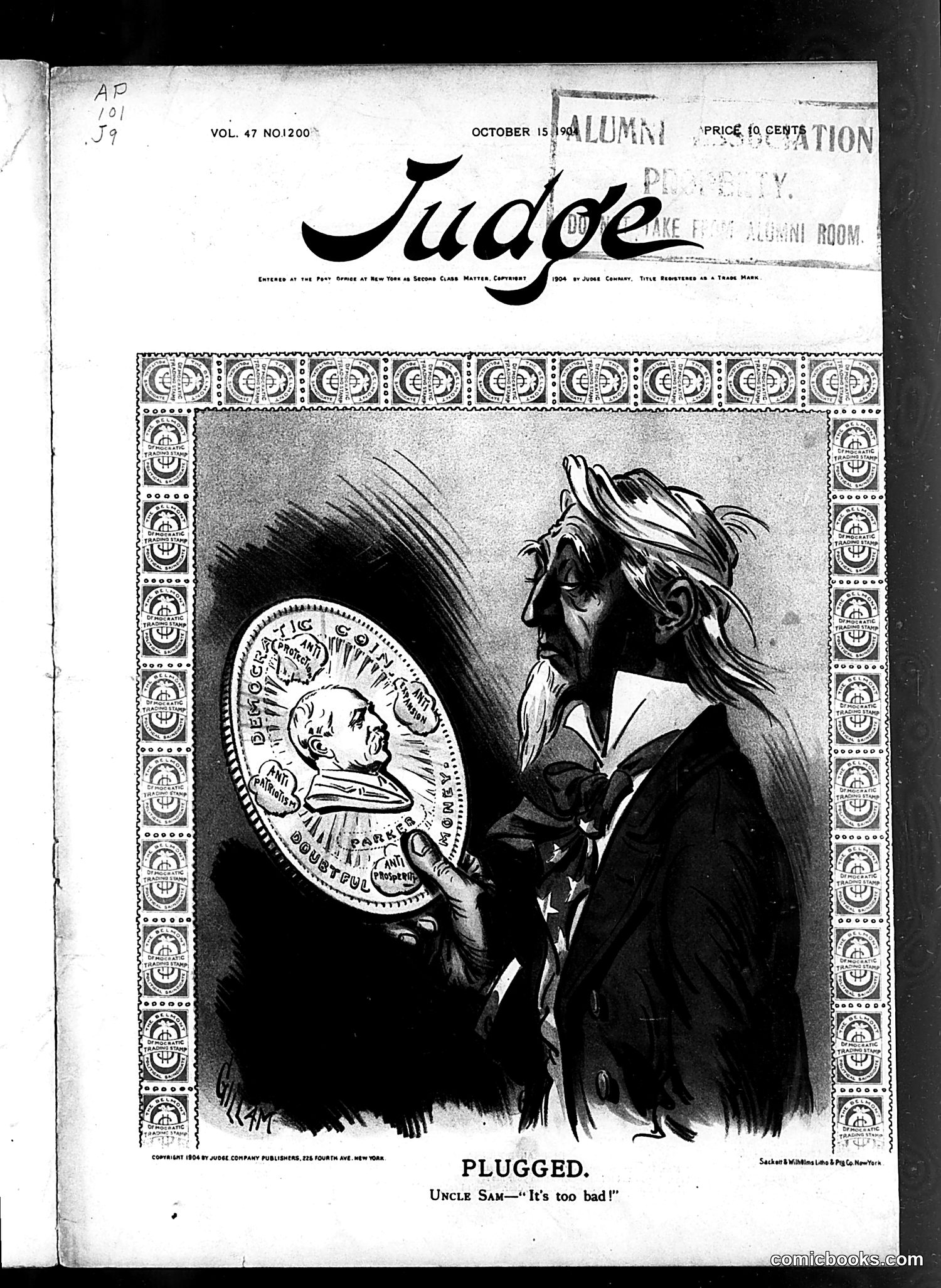
This political cartoon depicts Uncle Sam (identifiable by his characteristic long beard and top hat) examining a large coin or medal bearing a portrait. The caption "It's too bad!" suggests disapproval. The coin appears to show a presidential portrait, likely referencing Theodore Roosevelt or a political opponent from the 1904 election period. The imagery of Uncle Sam inspecting currency or official seals often symbolized American public scrutiny of political figures or policies. Without clearer inscription on the coin itself, the exact target is uncertain, but the overall tone suggests critique of a political figure or controversial policy. The "Plugged" title implies something is counterfeit, fake, or fundamentally flawed—a common Judge metaphor for political dishonesty or failed leadership during this era.
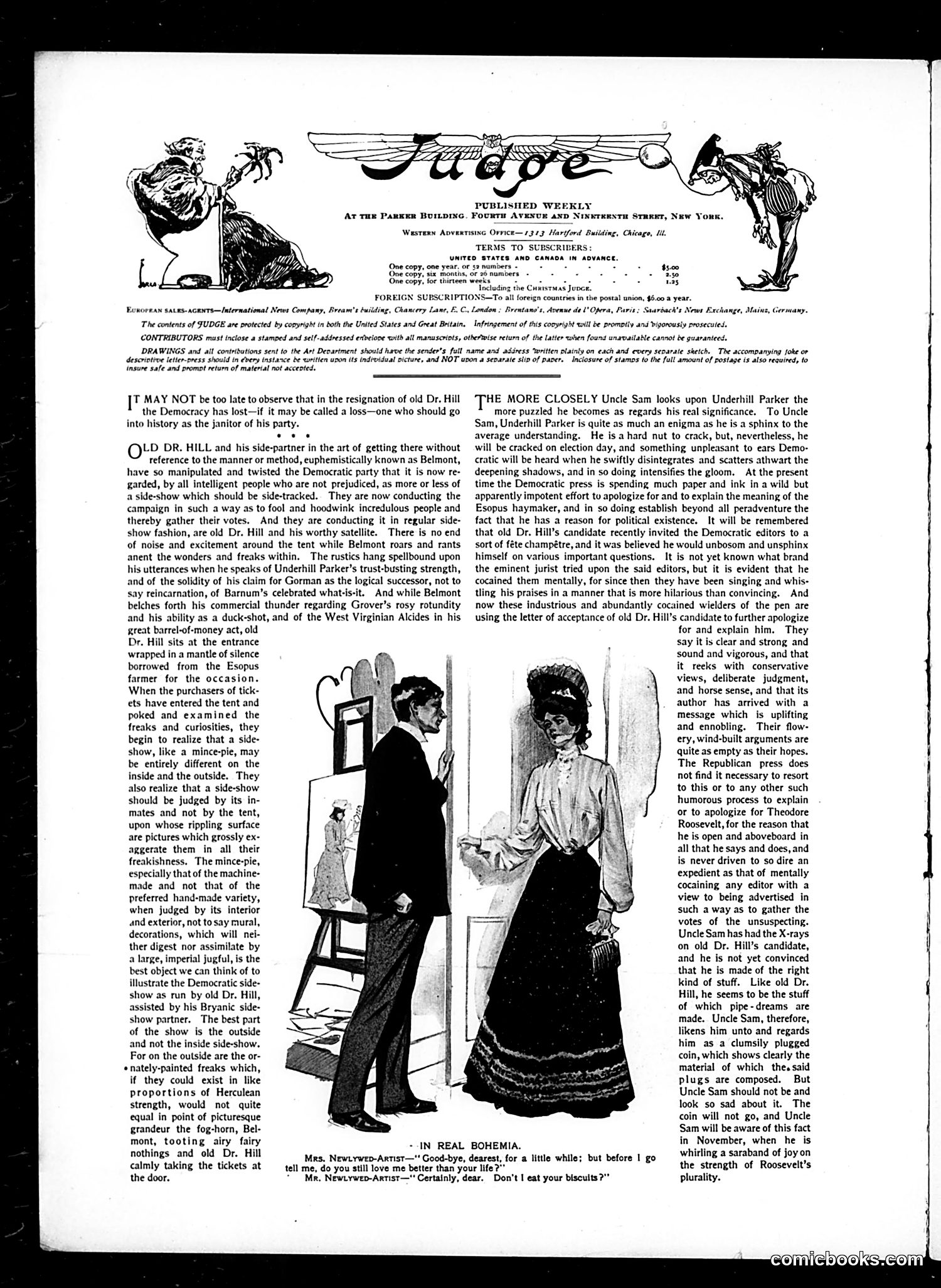
This page satirizes **Dr. Hill**, a Democratic political candidate, through two distinct pieces: **Left column** criticizes Hill's campaign tactics as a "side-show," comparing him to carnival attractions rather than serious political material. The author argues Hill relies on spectacle and trickery rather than substance. **Right column** ("The More Closely Uncle Sam Looks Upon Underhill Parker...") attacks the Democratic press for using character assassination and manufactured scandals against Republican Theodore Roosevelt. The piece defends Roosevelt's integrity, asserting he operates with "sound and vigorous" judgment and "horse sense," contrasting him favorably with Democratic mudslinging tactics. The **central illustration** titled "In Real Bohemia" appears unrelated—a domestic scene between a struggling artist and his wife—likely serving as filler content. The overall message: Republicans (and Judge magazine) position themselves as honest brokers opposing Democratic dirty tactics.
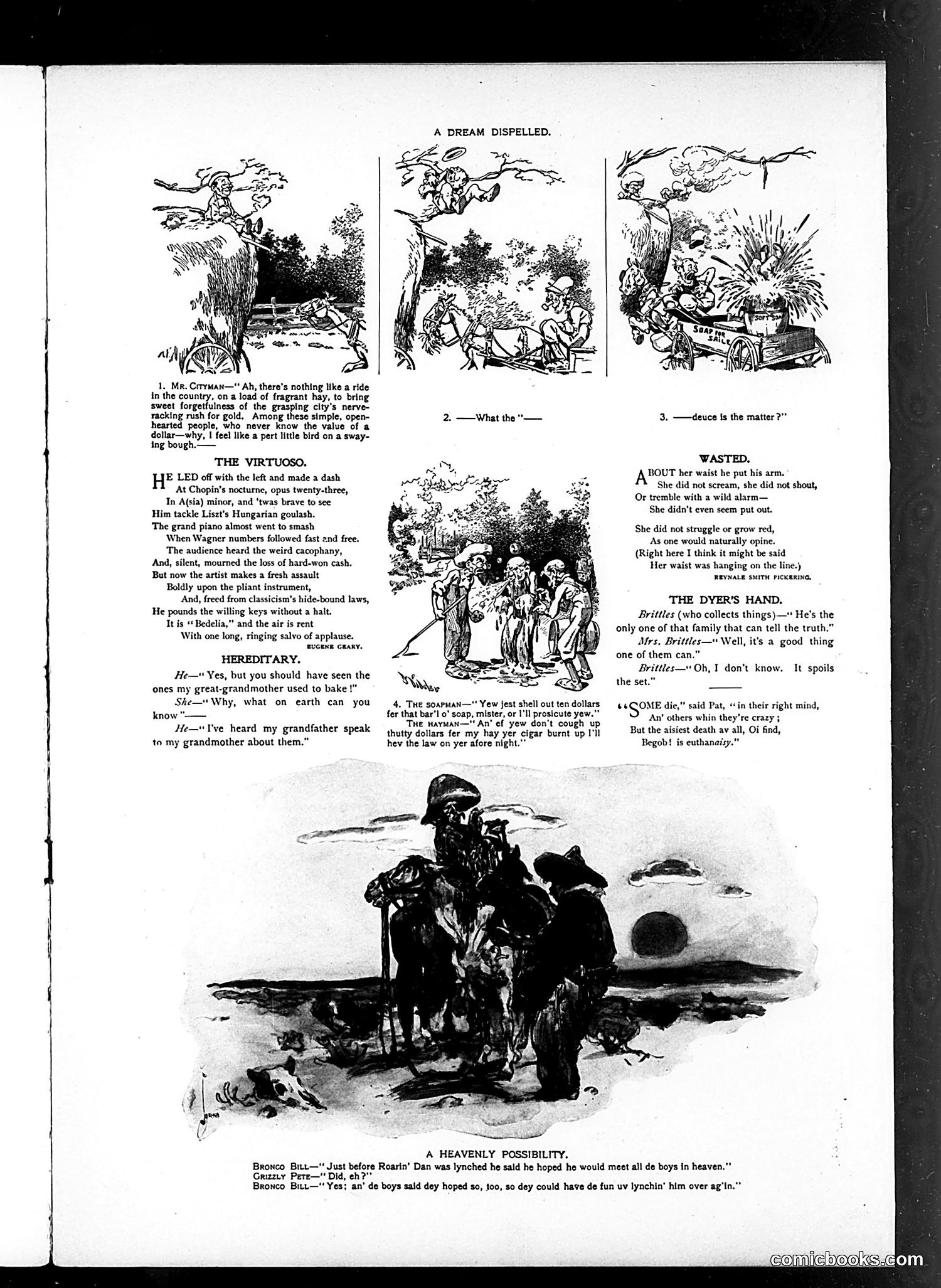
This page contains several humorous pieces typical of late 19th-century American humor magazines: **"A Dream Dispelled"** (top) depicts a countryman's fantasy of a hay wagon ride being disrupted—likely satirizing rural versus urban notions of romance and leisure. **"The Virtuoso"** mocks a horseman displaying excessive theatrical skill, suggesting pretension or showing off. **"Hereditary"** is a brief dialogue joke about inherited traits. **"Wasted"** and **"The Dyer's Hand"** appear to be short comedic pieces about domestic or working-class mishaps. **"A Heavenly Possibility"** (bottom) references the hanging of "Roarin' Dan" and "Bronco Bill," making dark humor about frontier outlaws meeting in heaven—reflecting period fascination with Wild West villainy. The overall tone is genteel Victorian satire targeting rural life, pretension, and frontier stereotypes.
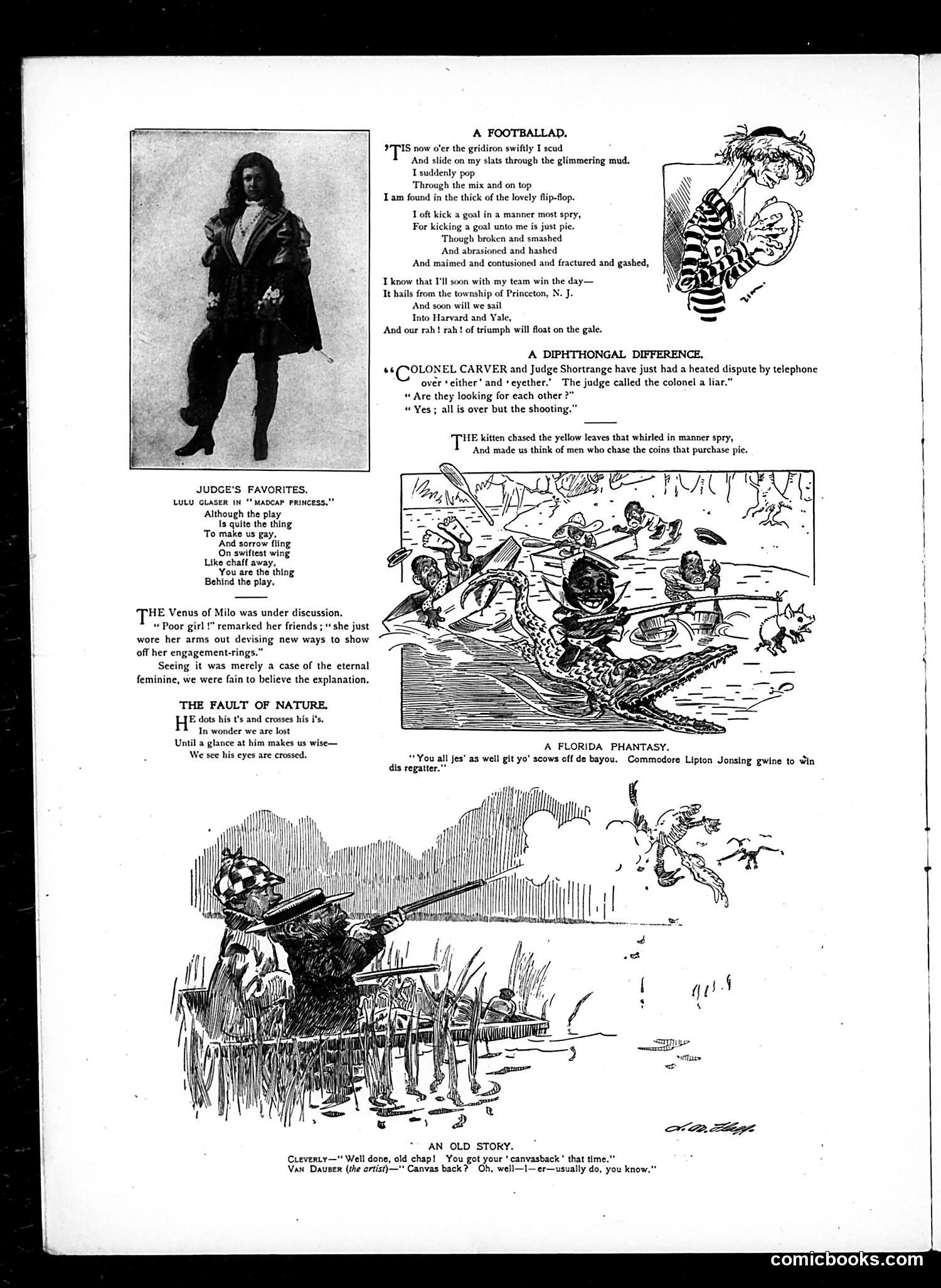
This page contains several humorous pieces typical of early 20th-century satirical magazines: **"A Footballad"** mocks the brutality of college football through exaggerated verse, depicting it as chaotic violence rather than sport—with references to Princeton and Yale suggesting Ivy League football's rough reputation. **"A Diphthongal Difference"** is a brief joke about Colonel Carver and Judge Shortrange disputing pronunciation of "either/or," with the punchline being they're shooting at each other—satirizing pedantic arguments. **"Judge's Favorites"** and other short pieces are light verse about contemporary society and relationships. **"A Florida Phantasy"** depicts hunting/fishing scenes with dialect humor, likely poking fun at Southern rural culture and exaggerated hunting tales. The page is primarily humorous commentary on American social life, sports culture, and regional stereotypes rather than hard political satire.
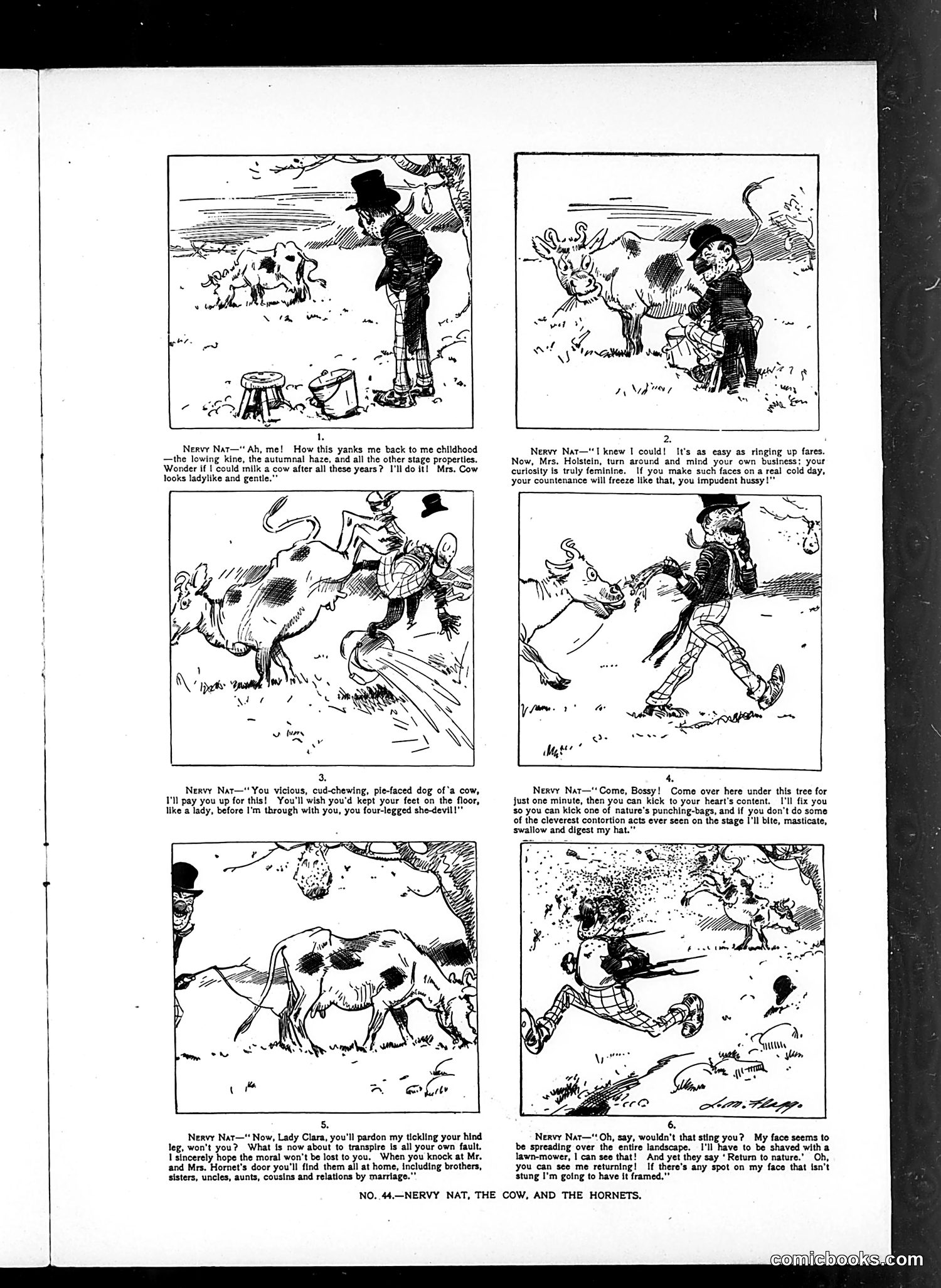
This is a slapstick comic strip following "Nervy Nat," a city character attempting rustic activities with disastrous results. The humor derives from his incompetence and condescension toward rural life. In the first panels, Nat patronizingly tries milking a cow ("Mrs. Holstein"), treating it like a simple task comparable to "ringing up fares" (suggesting he's a streetcar conductor). The cow predictably kicks him. Escalating his foolishness, Nat then harasses a hornet's nest under a tree, getting stung repeatedly across his face, which swells grotesquely. The satire targets urban pretension—Nat's sentimental nostalgia for "childhood" rural simplicity ("lowing kine, autumnal haze") immediately collapses into reality. The joke is that nature isn't genteel or controllable; animals and insects respond with violence to his arrogant interference. This reflects early-20th-century Judge magazine's frequent mockery of city dwellers' romanticized views of country life.
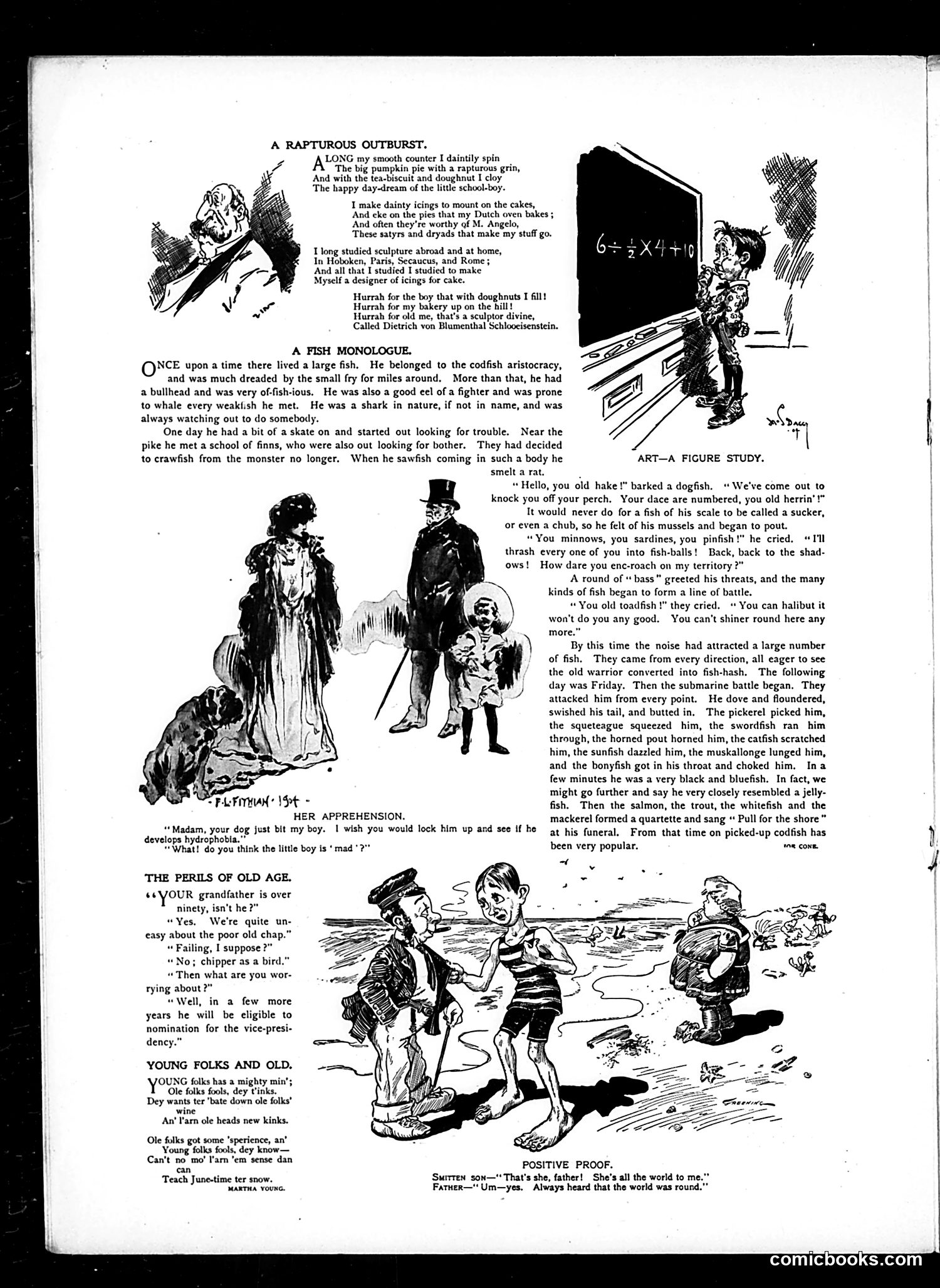
This page contains three humorous pieces typical of Judge's satirical style: **"A Rapturous Outburst"** mocks a baker who pretentiously claims artistic credentials (studying sculpture in Paris, Rome, Hoboken, Secaucus) yet applies them solely to cake decoration. The German-sounding name suggests immigrant pretension. The satire targets working-class affectation and absurd self-importance. **"A Fish Monologue"** is pure wordplay—a battle between fish species using fish-related puns ("hake," "dace," "herrin'," "bass," "toadfish," "halibut"). It's clever linguistic humor with no deeper satirical point beyond demonstrating wit. **"The Perils of Old Age"** jokes darkly about an elderly grandfather: his family fears not his declining health but that his longevity makes him eligible for vice-presidential nomination—implying politicians are senile or incompetent. This likely references contemporary political figures but without clearer context, the specific target is unclear. The illustrations support each piece's comedic intent through exaggerated character drawings typical of early 20th-century humor magazines.
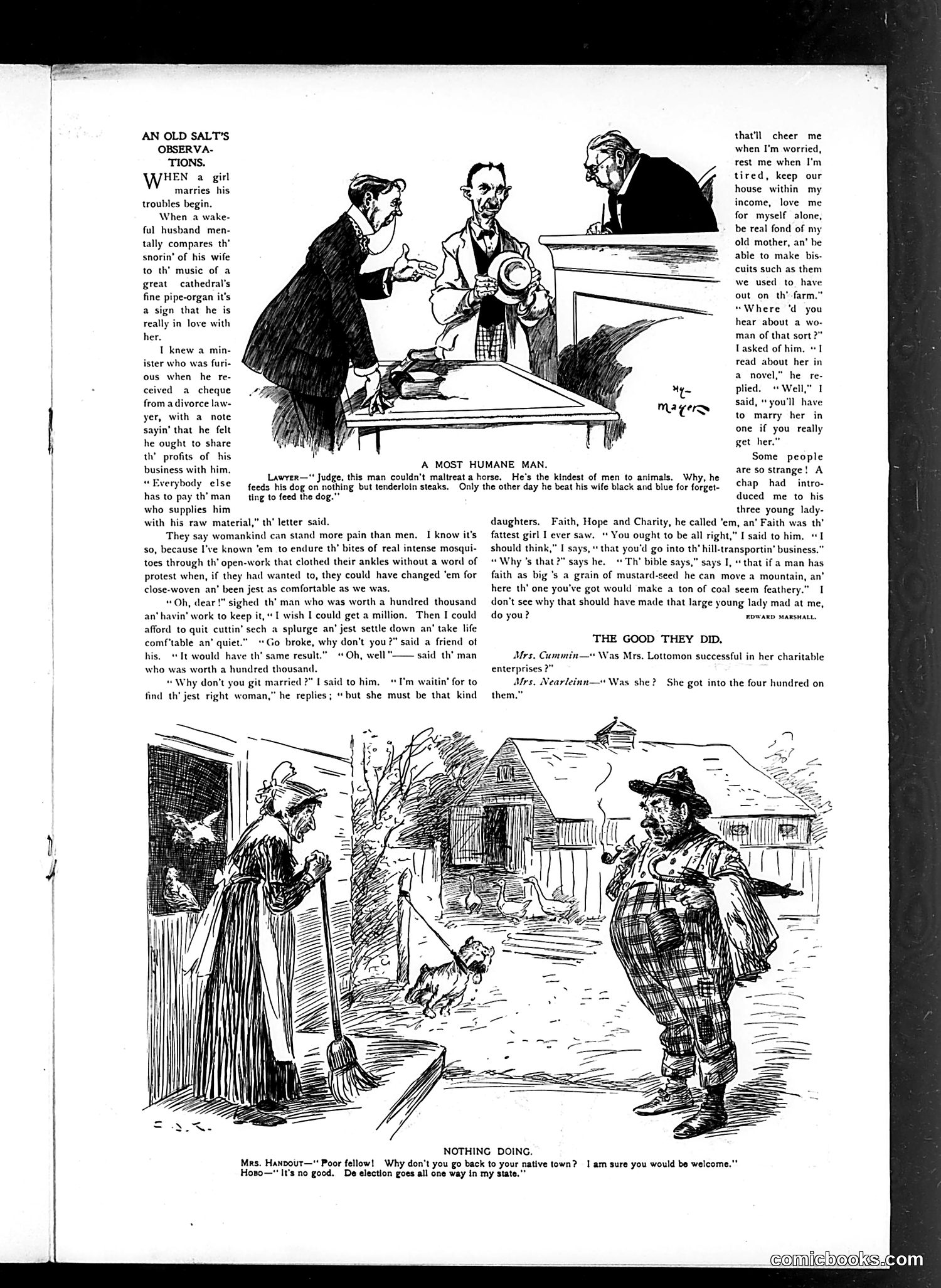
This page contains three separate satirical pieces from Judge magazine, each mocking social conventions of the era: **"An Old Salt's Observations"** presents a cranky old sailor's observations on marriage and gender roles. The humor relies on misogynistic stereotypes—complaining about wives' snoring, praising women who endure mosquito bites without complaint, and mocking a woman seeking qualities (cheerfulness, frugality, domestic skills) that appear impossible to find. **"A Most Humane Man"** ironically praises a wealthy man as an "animal lover" because he feeds his dog expensive tenderloin steaks, yet he brutally beats his wife. The cartoon attacks hypocrisy: society celebrates kindness to animals while tolerating domestic violence. **"Nothing Doing"** depicts a homeless man refusing to return to his native town because "de election goes all one way in my state"—likely satirizing one-party political dominance in certain regions, possibly the post-Reconstruction South, where electoral outcomes were predetermined. The overall tone reflects turn-of-the-century attitudes toward marriage, class, and politics that modern readers would find troublingly casual about violence and inequality.
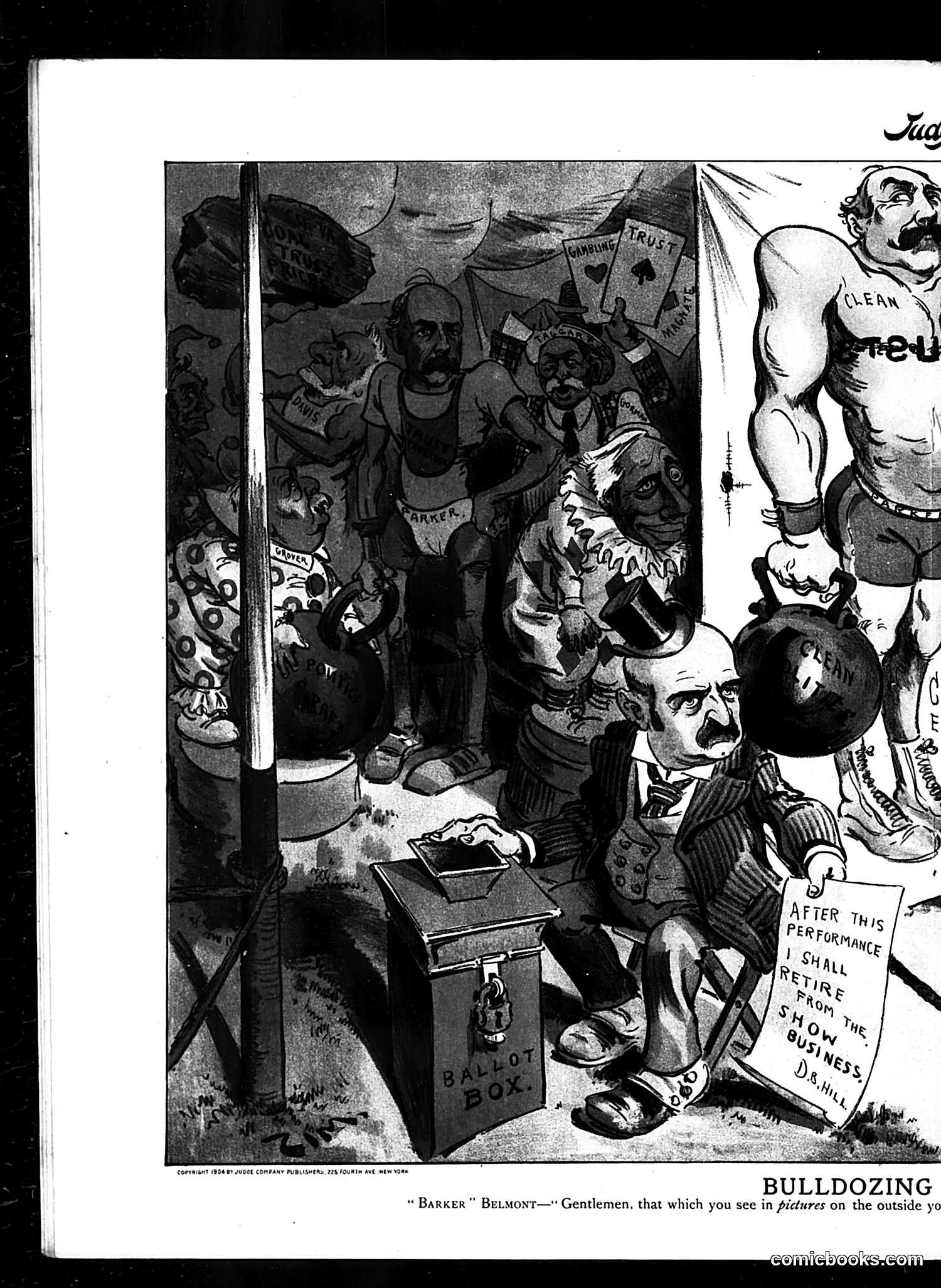
This 1904 Judge cartoon satirizes "Barker" Belmont (likely referring to August Belmont, a prominent financier and horse racing figure). The scene depicts a carnival barker-style showman presenting various figures to an audience, with a ballot box visible—suggesting electoral manipulation or coercion. The cartoon's title "Bulldozing" and the incomplete caption about pictures on the outside reference the intimidation tactics historically associated with post-Reconstruction politics, where powerful figures used threats or pressure to control voting outcomes. The various caricatured figures around Belmont appear to represent different constituencies or political interests being "managed" or coerced. The satire criticizes wealthy elites using their power to manipulate democratic processes, presenting a curated public image while engaging in behind-the-scenes political bullying.
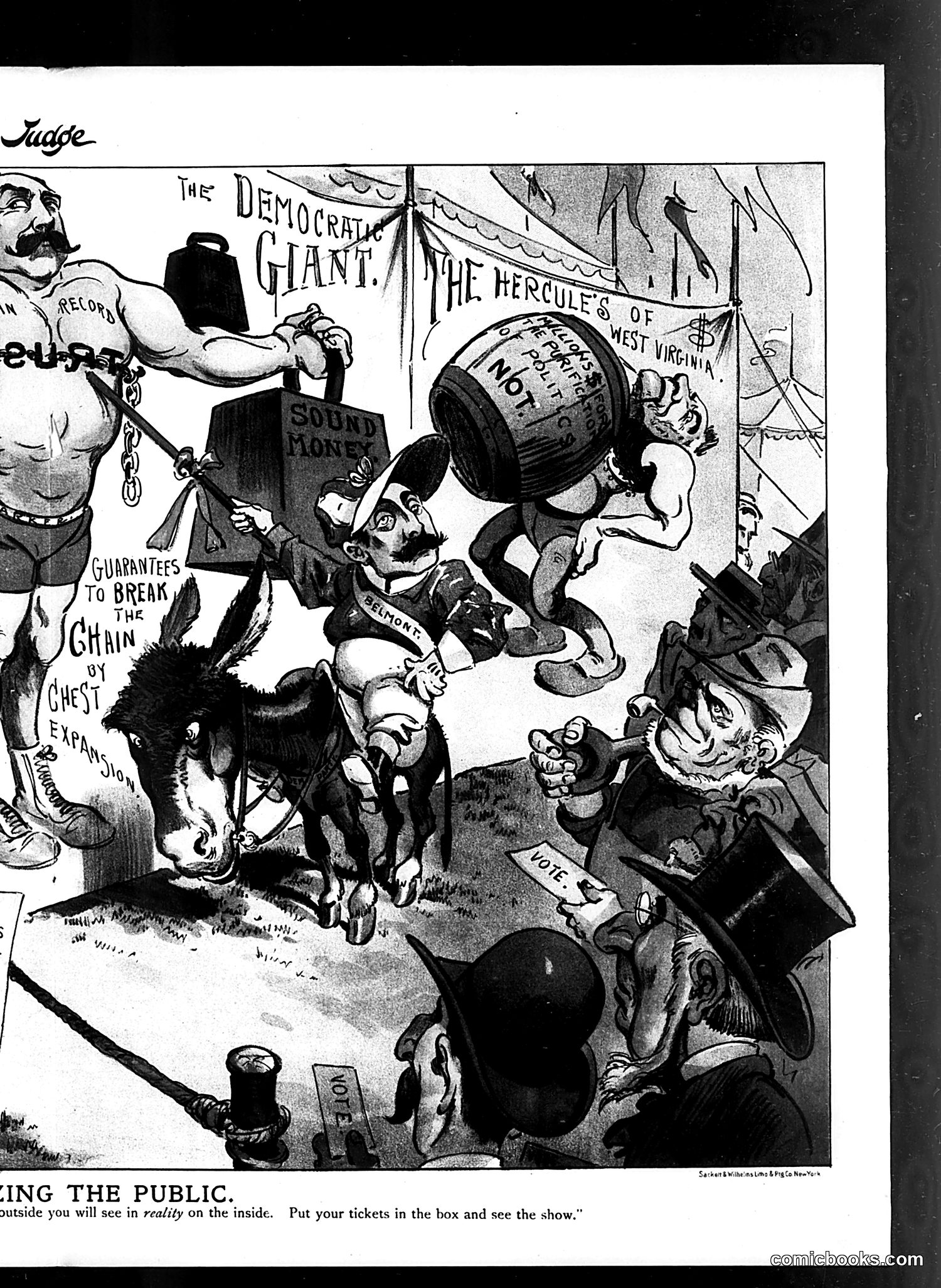
This Judge magazine cartoon depicts a circus or carnival scene satirizing Democratic politics. "The Democratic Giant" appears as a muscular strongman on the left, while "The Hercules of West Virginia" struggles to lift a large barrel labeled with political promises. The satire mocks the Democratic Party's grandiose claims versus disappointing reality. The carnival setting suggests the Democrats are presenting themselves as a spectacle—all show with little substance. The figure straining under the barrel implies Democratic politicians (possibly West Virginia politicians specifically) cannot deliver on their promised "feats of strength" or reforms. The text fragment about putting "tickets in the box and see the show" reinforces the carnival metaphor, suggesting voters are being sold empty political theater rather than genuine results.
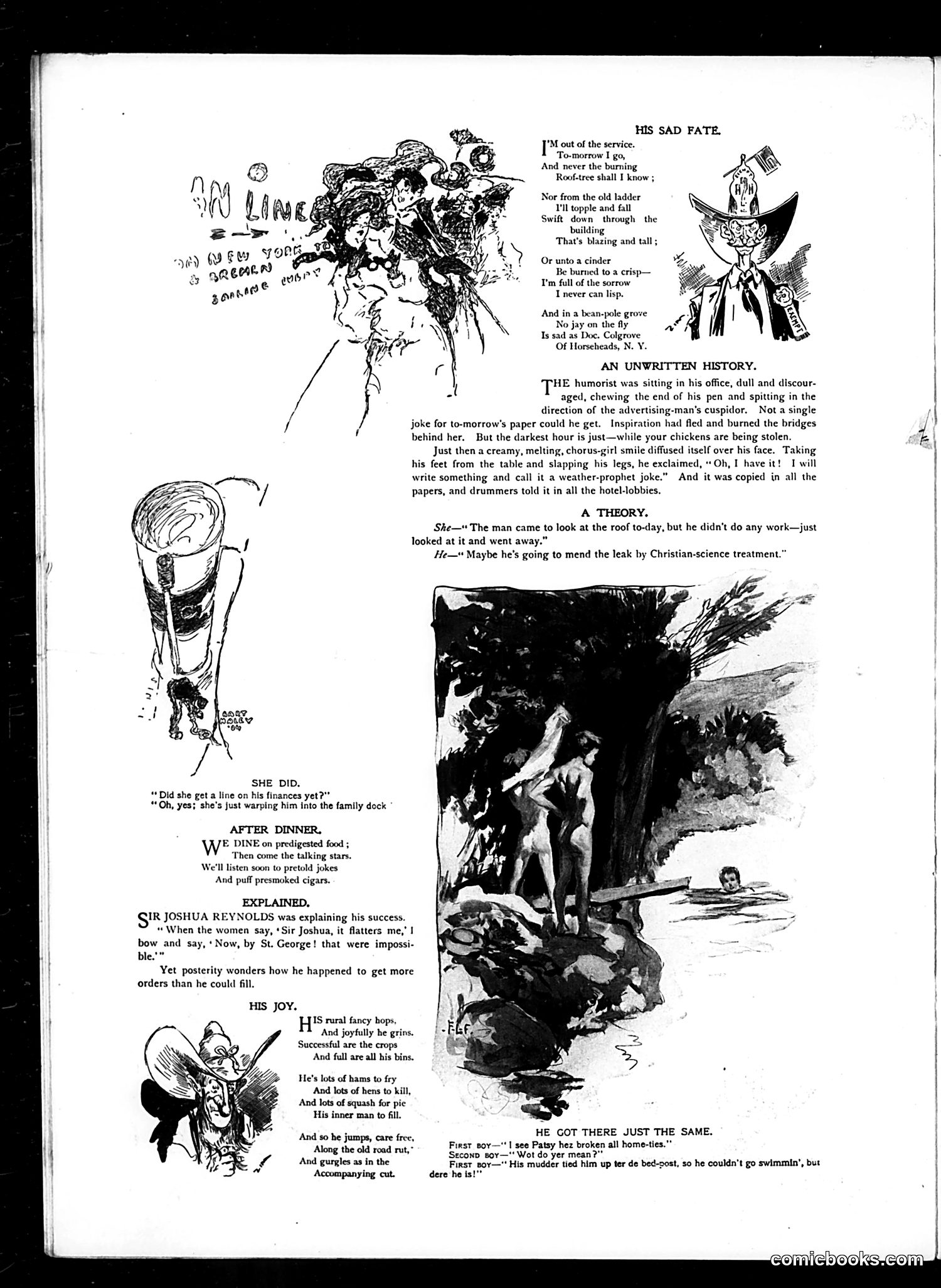
This page contains multiple brief satirical pieces typical of early Judge magazine: **"His Sad Fate"** mocks overly sentimental poetry through a character lamenting he's leaving firefighting service—expressing melodramatic grief about never again burning in blazing buildings or falling from ladders. The satire targets flowery, self-pitying verse. **"An Unwritten History"** jokes about a struggling humorist who invents a "weather-prophet joke" that gets reprinted everywhere—satirizing how mediocre humor spreads through newspapers and hotels despite lacking originality. **"A Theory"** presents a brief comic dialogue mocking Christian Science's healing claims when applied to roof leaks. **"Sir Joshua Reynolds Explained"** references the famous 18th-century portrait painter, sarcastically suggesting his flattery of clients ("impossible to improve your beauty") actually drove his business success—ironic commentary on compliments and vanity. **"His Joy"** celebrates a farmer's successful harvest with crude, rustic enthusiasm. **The final anecdote** humorously describes a boy who escaped parental restraint to go swimming anyway. Throughout, the humor relies on satire of pretension, incompetence, and human folly.
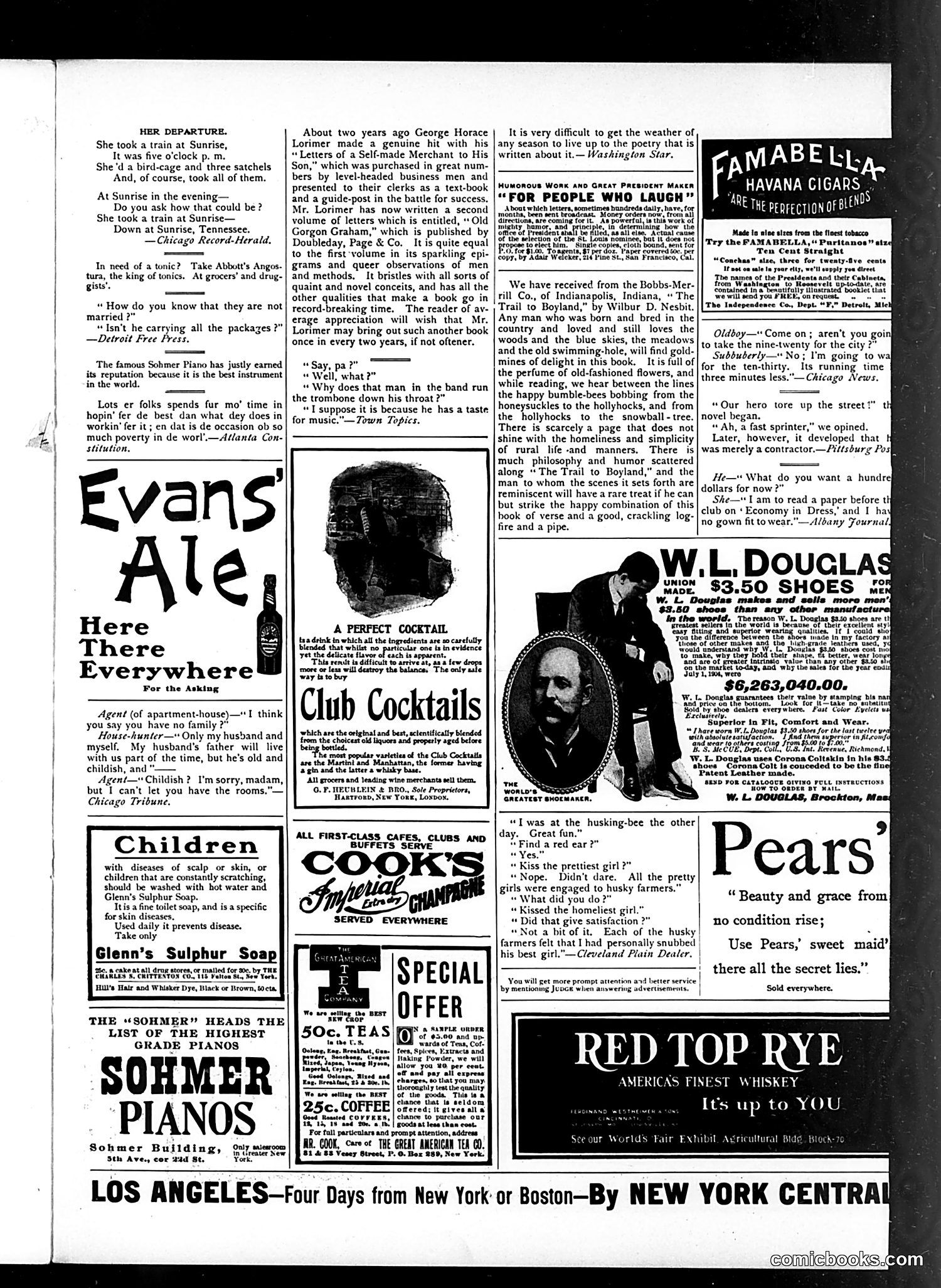
This page is primarily **advertisements and filler content** from Judge magazine, with no coherent political cartoon or satire visible. The content includes: - **Short humorous anecdotes** about everyday situations (a woman leaving on a train, a husband carrying packages, a child asking about a trombone player) — these are generic jokes typical of early-20th-century publications, not political satire. - **Product advertisements**: Sohmer pianos, Glenn's Sulphur Soap, Evans Ale, Club Cocktails, Cooks champagne, W.L. Douglas shoes, Pears soap, and Red Top Rye whiskey dominate the page. - **A brief literary review** of George Horace Lorimer's "Old Gorgon Graham," praising his business-focused writing. The page contains **no identifiable political figures, elections, or current events commentary** — the defining features of Judge's satirical content. This appears to be a typical advertising-heavy issue rather than one showcasing the magazine's satirical mission.
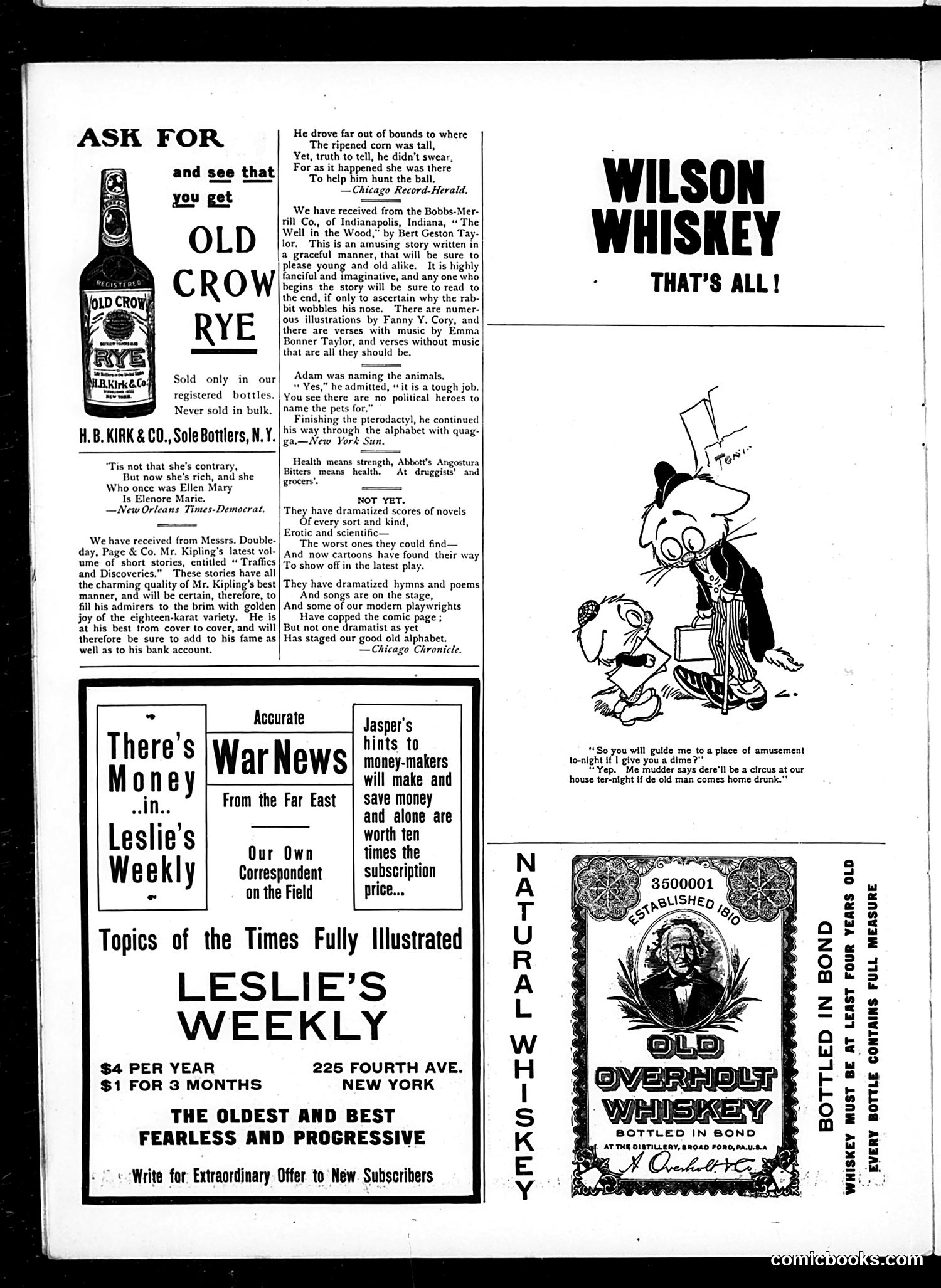
This page is primarily **advertising and book reviews** rather than political satire. The main cartoon depicts two figures—an adult and child in working-class dress—in a humorous exchange about finding "amusement" for the evening. When offered a dime, the child responds that his mother says there'll be a "circus" at their house if his drunk father comes home, implying domestic chaos/fighting. The joke relies on period working-class stereotypes: heavy drinking among laborers and resulting domestic disorder. The cartoon's crude humor targets lower-class households for satirical effect. The page otherwise contains: - Advertisements for Old Crow Rye whiskey and Wilson Whiskey - Book reviews (Kipling's "Traffics and Discoveries," Bert Geston Taylor's "The Well in the Wood") - Promotional content for Leslie's Weekly magazine - Various literary excerpts and verses about naming animals and theatrical adaptations No specific political figures or events are referenced; the content is largely commercial with gentle social humor.
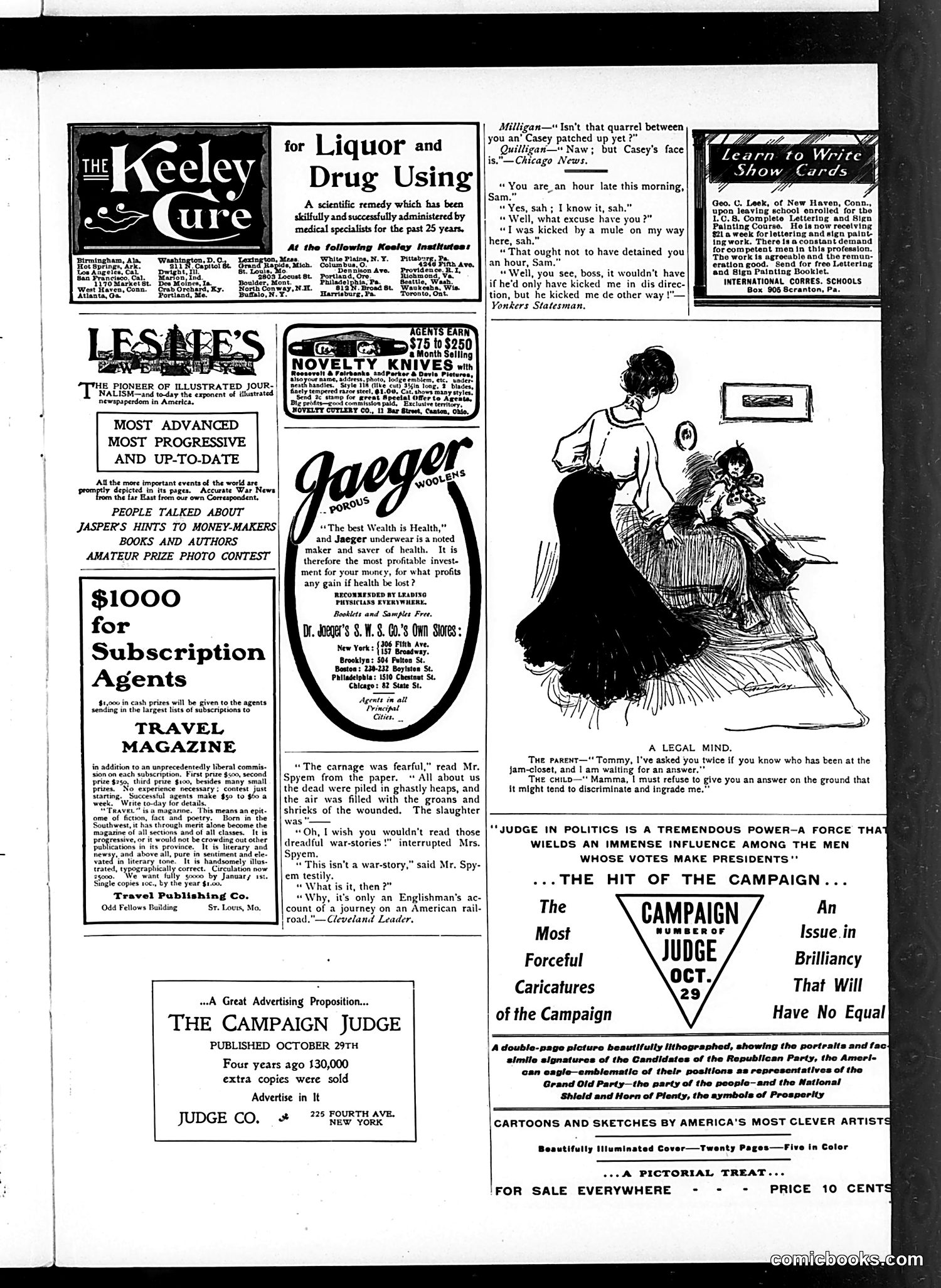
This page is primarily **advertising and promotional content** rather than satirical cartoons. The main elements include: **"A Legal Mind" cartoon**: Shows a father questioning his young son about attending a jamboree, concerned the answer might discriminate against him. It appears to satirize overly-cautious parenting or legalistic thinking in child-rearing. **The "Carriage was fearful" joke**: Mocks English travelers' complaints about American railroads by presenting their account of a train journey using language typically reserved for war atrocities—satirizing Victorian travel writing hyperbole and British attitudes toward American infrastructure. **Advertisements**: Keeley Institutes for substance abuse treatment, Jaeger underwear (marketed as health product), Travel Magazine, correspondence schools, and novelty knives. **The Campaign Judge**: A major promotional feature announcing a special political issue published October 29th, promising "caricatures of the campaign" and candidate portraits—this appears to be the magazine's main editorial offering, likely covering a presidential election (though which election is unclear from this page alone). The page reflects early 20th-century American publishing and advertising conventions.
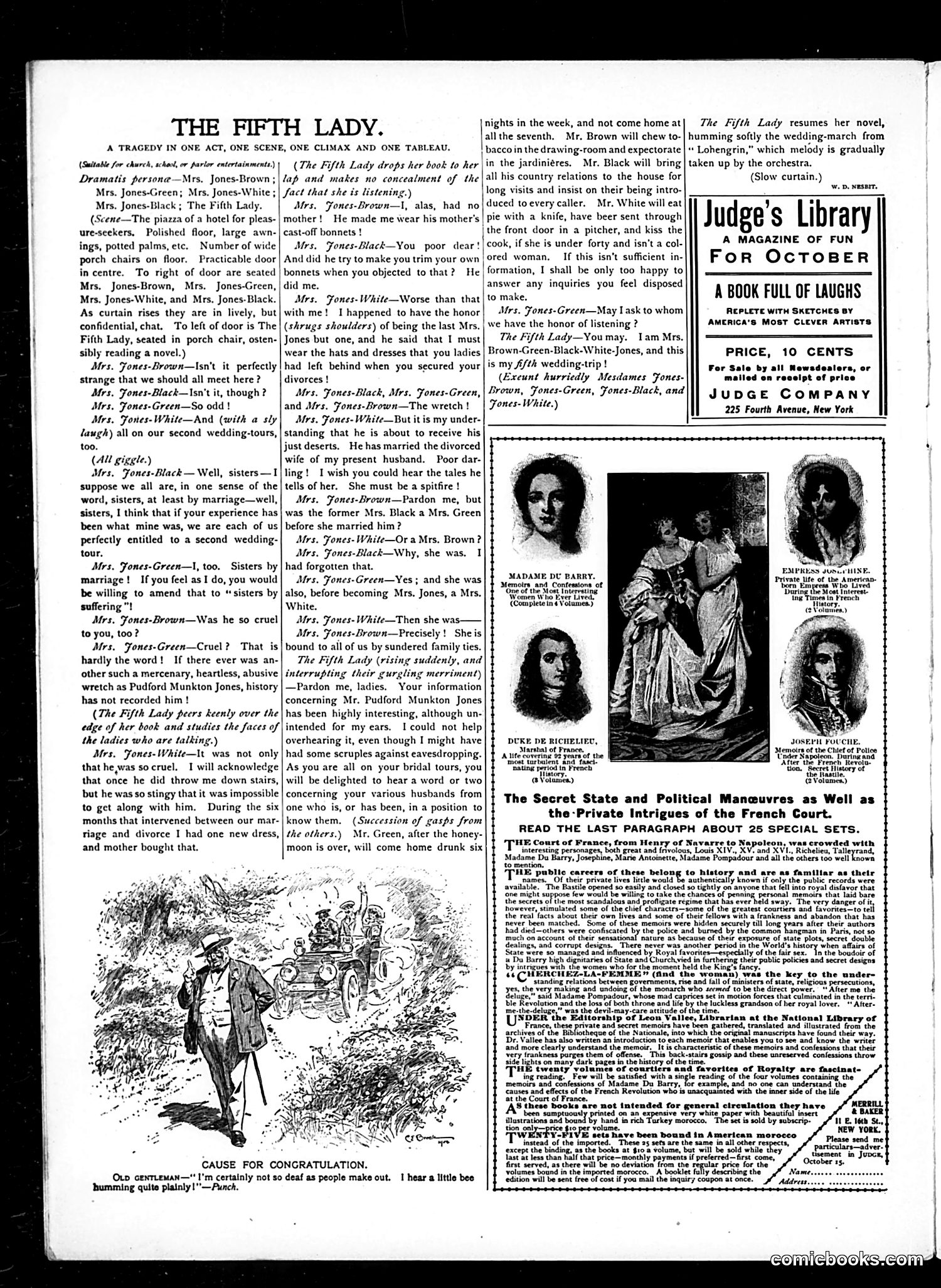
This is a one-act comedic play about four women—Mrs. Jones-Brown, Jones-Green, Jones-White, and Jones-Black—meeting on a hotel piazza. They bond as fellow sufferers, each having been married to and divorced from the same man: Pudford Munkton Jones, who allegedly abused them, threw one down stairs, and was stingy. The joke hinges on a revelation: all four women are actually connected through their shared ex-husband's remarriages. Jones married each of them sequentially, and has now married the ex-wife of one woman's *current* husband—creating an absurd tangle of "sundered family ties." The "Fifth Lady" (seated apart, reading) interrupts with news about Jones, implying she may be yet another wife in this ridiculous cycle. The satire mocks serial divorce and remarriage among the wealthy leisure class—a contemporary scandal—portraying it as farcical and morally confused. It suggests such marital chaos creates unlikely "sisterhood" among wronged women.
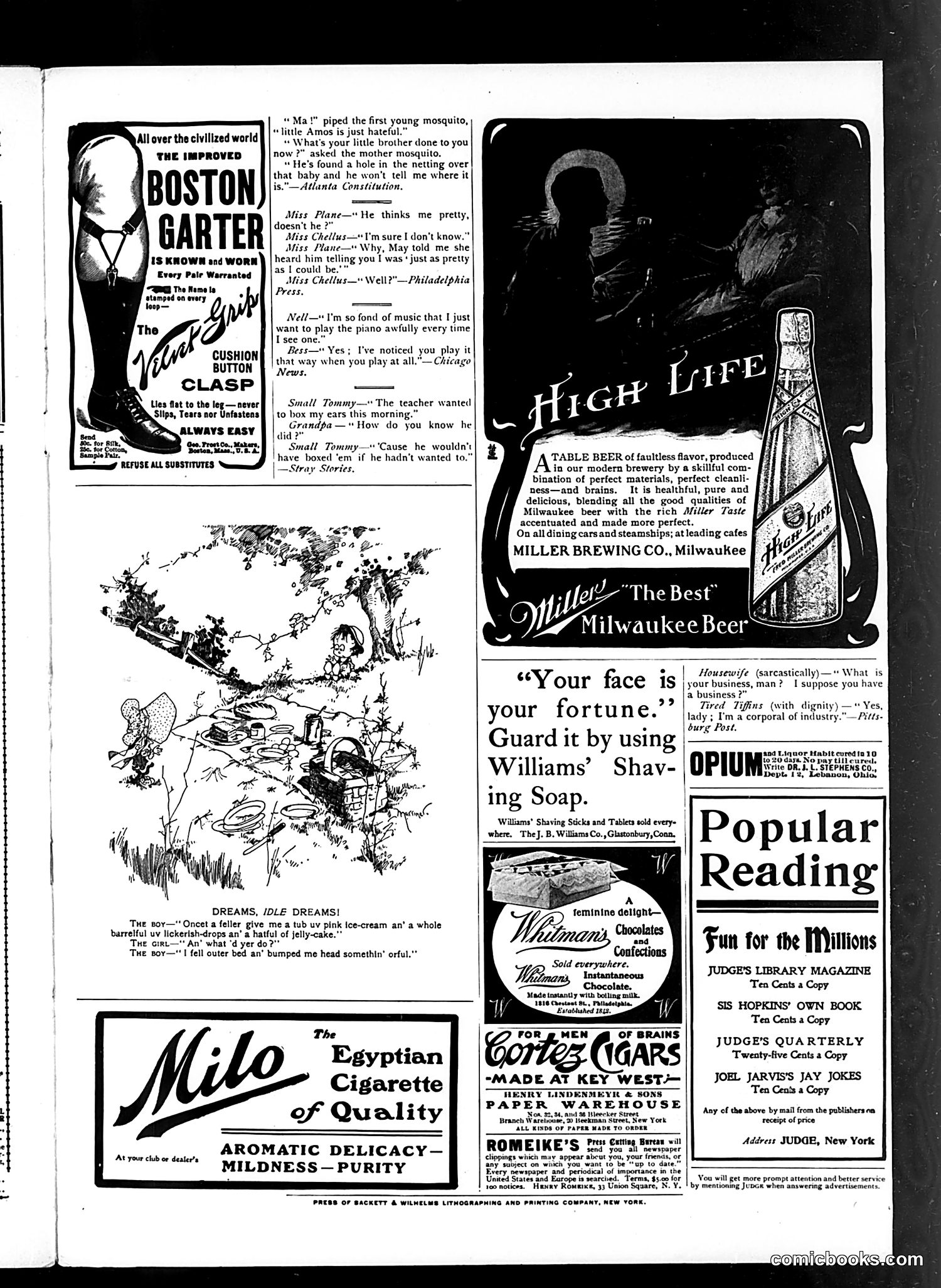
This page from *Judge* magazine consists primarily of **advertisements and brief humorous anecdotes** rather than political satire. The "cartoons" are actually short joke submissions—likely reader contributions—playing on everyday situations: a mosquito brother refusing to share a food source, a woman's vanity being deflated, a child's literal interpretation of teacher's threat, and a boy's dream of candy ending in mishap. These are gentle domestic humor, not political commentary. The bulk of the page advertises consumer products typical of the early 20th century: Boston garters, Miller beer, Williams' shaving soap, Egyptian cigarettes, and patent medicines (notably an opium-based "Liquor Habit" cure). The ads reflect contemporary consumer culture and acceptable marketing practices, including now-dubious health claims. The only potential social observation is the "Housewife" anecdote mocking a unemployed man's pretentious self-description as a "corporal of industry"—light class commentary on economic hardship or pretension.
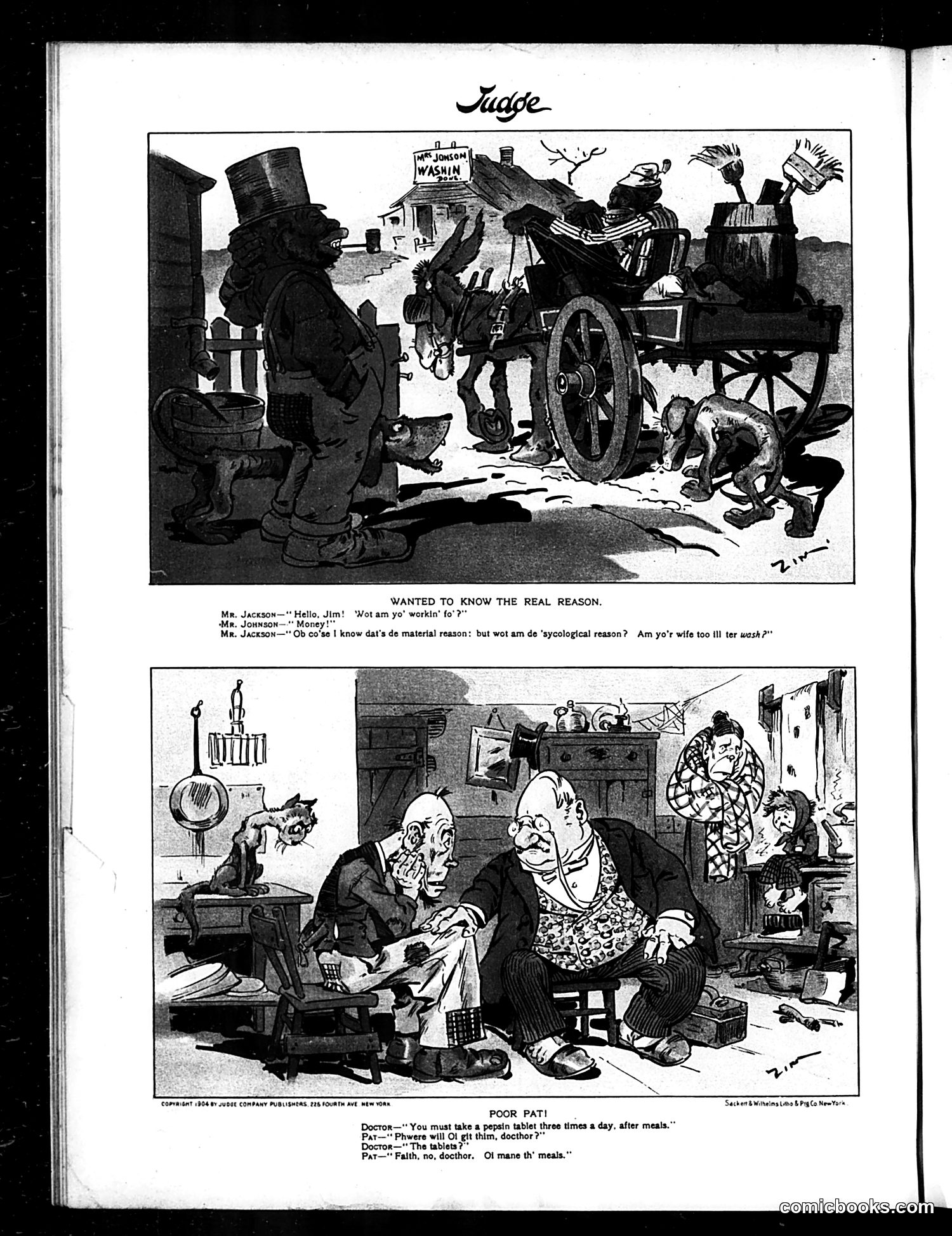
**Top Cartoon: "Wanted to Know the Real Reason"** This depicts African American laborers in dialect-heavy conversation. Mr. Jackson questions Mr. Johnson's work motivation, dismissing "money" as merely material, and instead suggests the *real* reason is that Johnson's wife is too ill to do laundry. The joke relies on racist stereotypes: it assumes Black workers are primarily driven by domestic necessity rather than genuine employment, and mocks their speech patterns through exaggerated dialect spelling. **Bottom Cartoon: "Poor Pat!"** A doctor prescribes pepsin tablets for an Irish patient ("Pat," indicated by the dialect "Phwere" and "Ol"). Pat's punchline—that he cannot afford *meals* to take with the tablets (which must be taken after eating)—satirizes poverty among Irish immigrants. The humor comes from the absurdity of medical advice to someone too poor to afford regular meals. Both cartoons use ethnic caricature and dialect to mock marginalized groups' economic circumstances.