
Judge, 1904-10-15 · page 7 of 16
Judge — October 15, 1904 — page 7: what you’re looking at
What you’re looking at
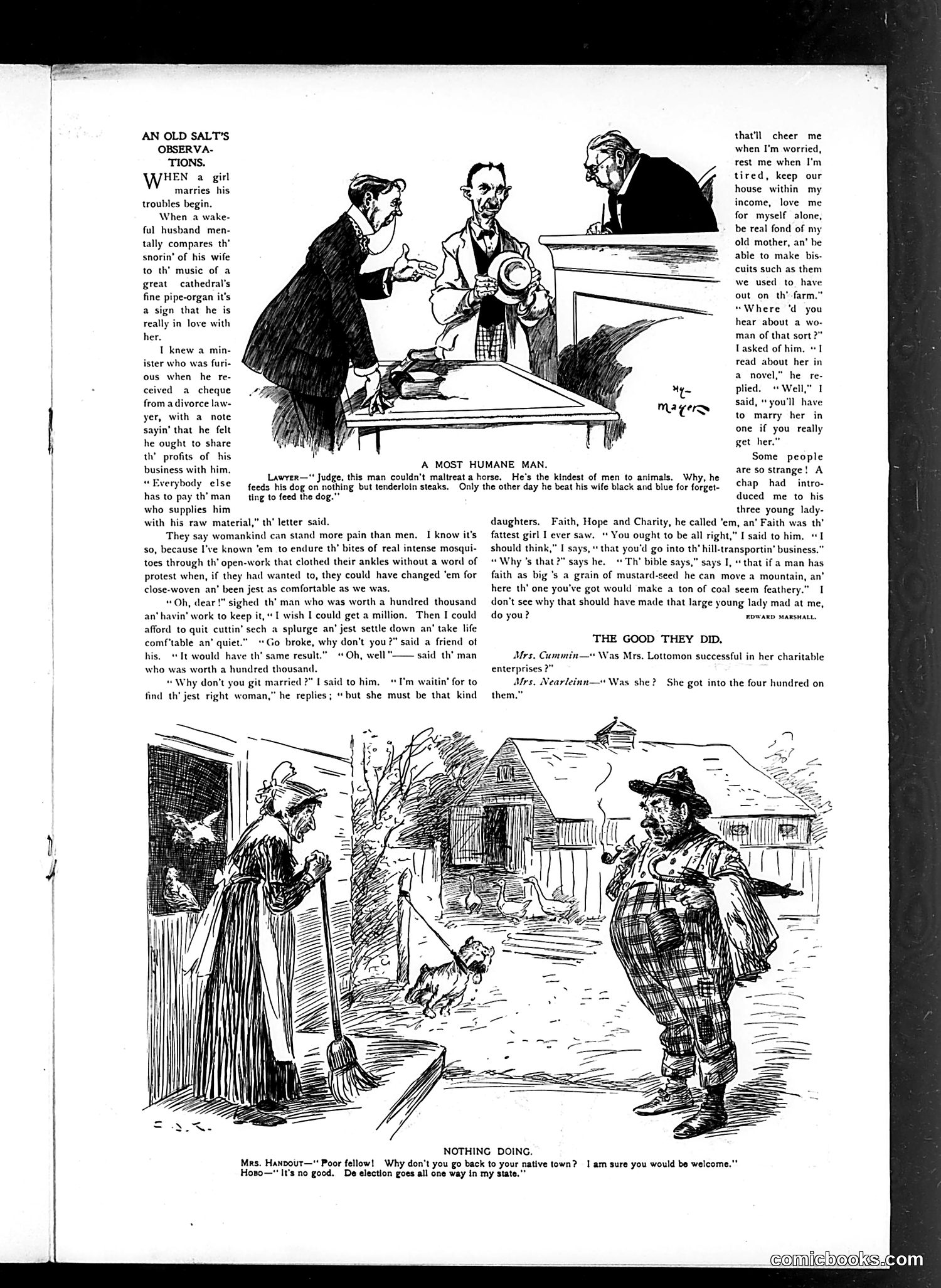
This page contains three separate satirical pieces from Judge magazine, each mocking social conventions of the era: **"An Old Salt's Observations"** presents a cranky old sailor's observations on marriage and gender roles. The humor relies on misogynistic stereotypes—complaining about wives' snoring, praising women who endure mosquito bites without complaint, and mocking a woman seeking qualities (cheerfulness, frugality, domestic skills) that appear impossible to find. **"A Most Humane Man"** ironically praises a wealthy man as an "animal lover" because he feeds his dog expensive tenderloin steaks, yet he brutally beats his wife. The cartoon attacks hypocrisy: society celebrates kindness to animals while tolerating domestic violence. **"Nothing Doing"** depicts a homeless man refusing to return to his native town because "de election goes all one way in my state"—likely satirizing one-party political dominance in certain regions, possibly the post-Reconstruction South, where electoral outcomes were predetermined. The overall tone reflects turn-of-the-century attitudes toward marriage, class, and politics that modern readers would find troublingly casual about violence and inequality.
📄 Transcribed text from this page (OCR, searchable)
Machine-transcribed from the original scan — historical spelling and the odd misread are preserved.
AN OLD SALT’S OBSERVA- TIONS. that'll cheer me when I'm worried, rest me when I'm WHEN a gir marries his tired, keep our house within my troubles begin. When a wake- ful husband men- tally compares th’ snorin’ of his wife income, love me for myself alone, be real fond of my old mother, an’ be able to make bis- to th’ music of a cuits such as them great cathedral's fine pipe-organ a sign that he is really in love with her. we used to have out on th’ -farm.” “Where ‘d you hear about a wo- man of that sort I knew a min- Tasked of him, «1 ister who was fu read about her in ous when he re- ceived a cheque from adivorce law- a novel,” he re- plied, + Well," 1 said, “you'll have yer, with a note sayin’ that he felt he ought to share th’ profits of his business with him. “ Everybody else has to pay th'man ting to feed the dog.”” who supplies him with his raw material,” th’ letter said. They say womankind can stand more pain than men. I know it's so, because I've known ‘em to endure th’ bites of real intense mosqui- toes through th’ open-work that clothed their ankles without a word of protest when, if they had wanted to, they could have changed ‘em for close-woven an’ been jest as comfortable as we was. “Oh, dear!" sighed th’ man who was worth a hundred thousand an‘ havin’ work to keep it, “I wish I could get a million, Then I could afford to quit cuttin’ sech a splurge an’ jest settle down an’ take life comf'table an’ quie ‘0 broke, why don’t you?” said a friend of his. «It would have th’ same result.” “Oh, well"—— said th’ man who was worth a hundred thousand. “Why don’t you git married 2” find th’ jest right woman,” he replies ; said to him, * I'm waitin’ for to “but she must be that kind A MOST HUMANE MAN. Lawver—"“* Judge, this man couldn't maltreat a horse. He's the kindest of men to animals. Why, he feeds his dog on nothing but tenderloin steaks. Only the other day he beat his wife black to marry her in one if you really get her.” Some people are so strange! A chap had intro- duced me to his three young lady- daughters. Faith, Hope and Charity, he called ‘em, an’ Faith was th’ fattest girl I ever saw. “You ought to be alll right,” I said to him. «I should think,” I says, «that you'd go into th’ hill-transportin’ business.” “Why 's that?" says he.“ Th’ bible says,” says I, «that if a man has faith as big 's a grain of mustard-seed he can move a mountain, an’ here th’ one you've got would make a ton of coal seem feathery.” 1 don’t see why that should have made that large young lady mad at me, do you? FOWARD MARSHALL. id blue for forget- THE GOOD THEY DID. Mrs. Cummin—* Was Mrs, Lottomon successful in her charitable enterprises 2” Mrs. Nearleinn—“ Was she? She got into the four hundred on them,” alll NOTHING DOING. Mrs. Hanpout—"' Poor fellow! Why don't you go back to your native town? I am sure you would be welcome."* Hoso—"'It’s no good. De election goes all one way in my state.” comichooks.