
A complete issue · 18 pages · 1904
Judge — June 18, 1904
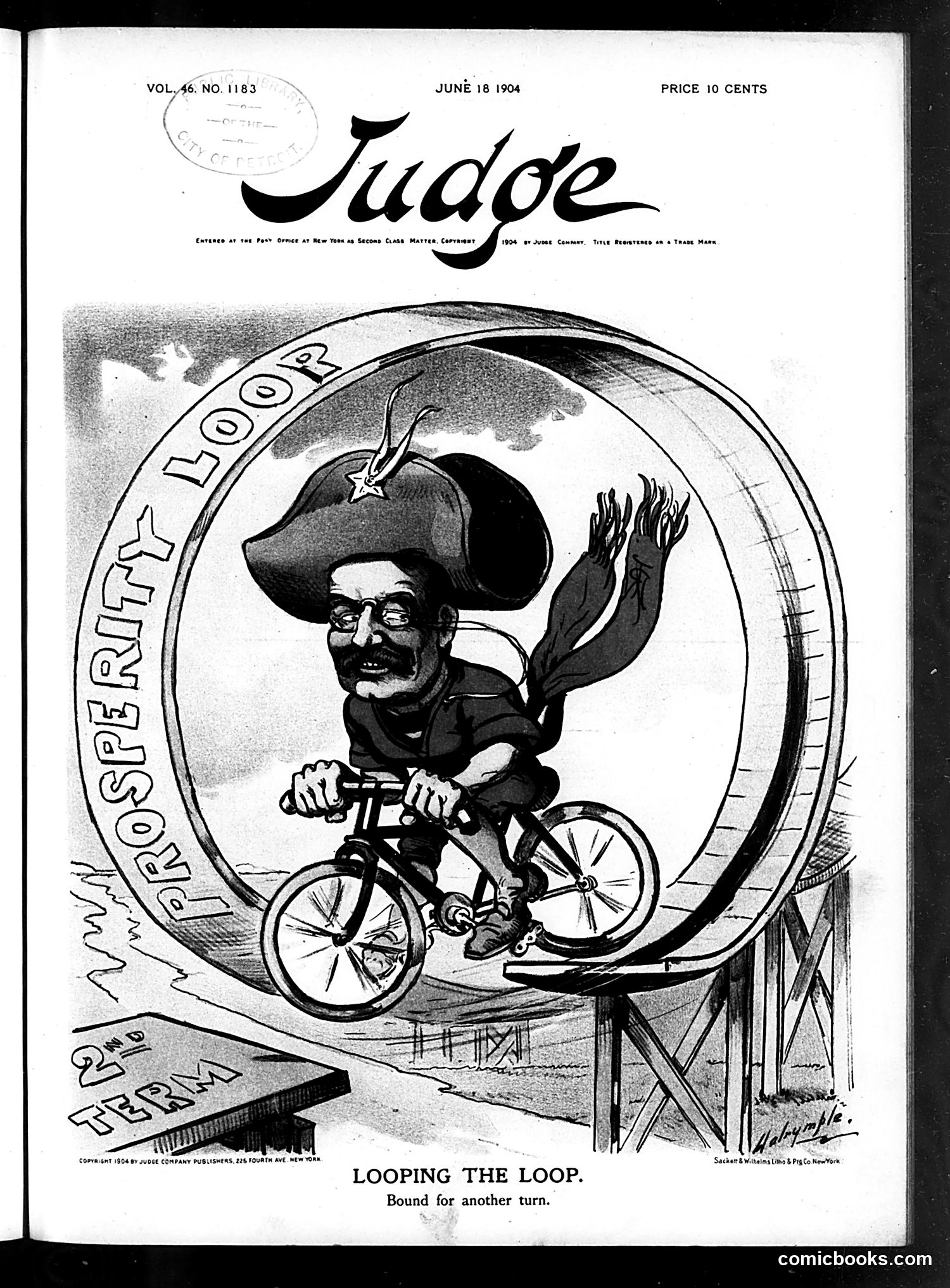
This cover satirizes Theodore Roosevelt's 1904 presidential campaign, titled "Looping the Loop." The caricatured figure—identifiable by the distinctive wide-brimmed hat and prominent mustache characteristic of Roosevelt—rides a bicycle through a large loop labeled "2ND TERM," with text reading "PROSPERITY LOOP" on the barrel. The "looping the loop" reference alludes to a popular circus stunt of the era, suggesting Roosevelt's reelection campaign is a thrilling but precarious performance. The phrase "Bound for another turn" indicates expectations he'll win a second term. The satire likely comments on Roosevelt's aggressive political maneuvering or the perceived riskiness of his policies being packaged as exciting progress—typical Judge magazine critique of political figures through visual metaphor.
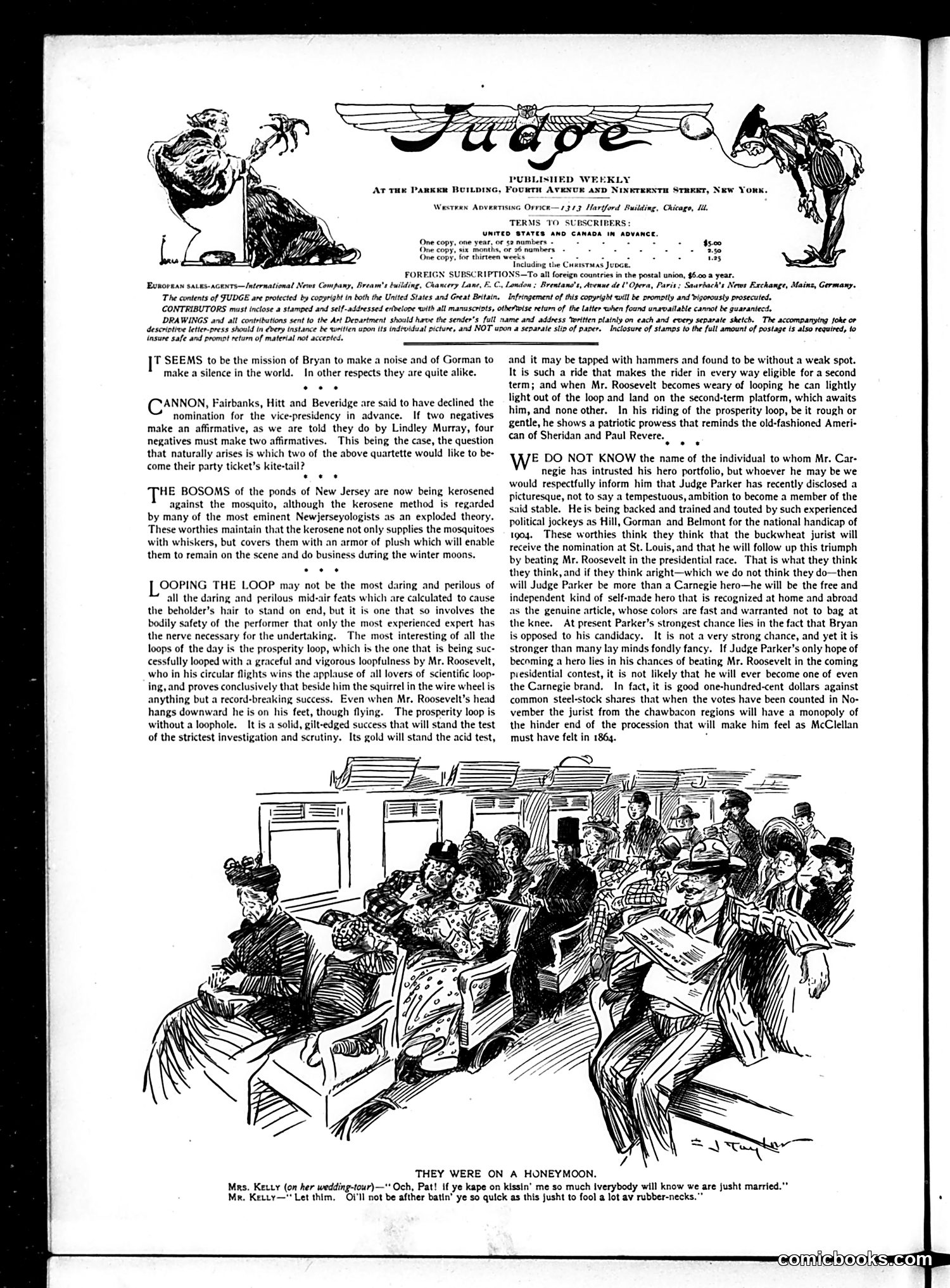
The page contains **political commentary and a captioned cartoon** rather than traditional comics. The upper text discusses **silencing critics** and compares Prussian and German approaches to dissent, suggesting parallels to American political debate. The main cartoon depicts a **crowded passenger train or streetcar** where a newly married couple attempts discretion during their honeymoon. The caption reads: Mrs. Kelly says "Och, Pat! If ye sape on kissin' me so much everybody will know we are jusht married," to which Mr. Kelly responds "Let them. Oi'll not be either bathin' ye so quick as this jusht to fool a lot av rubber-necks." **The satire**: The joke mocks working-class newlyweds' self-consciousness about public displays of affection, while celebrating their refusal to be embarrassed by onlookers' judgment. The ethnic Irish dialect ("Och," "jusht") suggests period stereotyping common to Judge's humor.
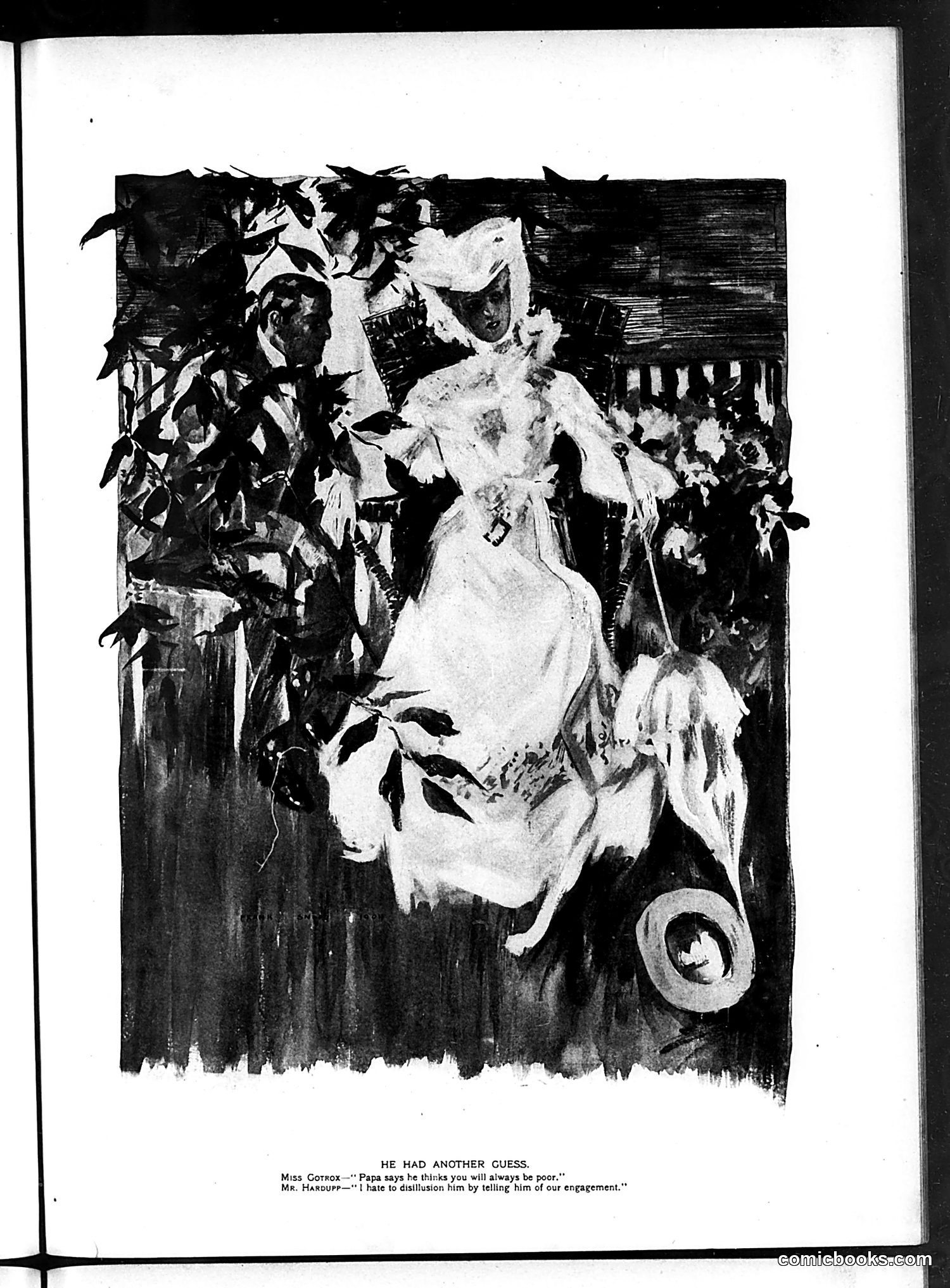
This Judge magazine illustration depicts a social comedy about class expectations and marriage. The caption quotes two characters: **Miss Gorgos**: "Papa says he thinks you will always be poor." **Mr. Hargrave**: "I hate to disillusion him by telling him of our engagement." The satire targets wealthy fathers who disapprove of suitors lacking fortune. Hargrave's confident response suggests he possesses hidden wealth or status the father doesn't know about, making the father's pessimistic assessment laughably wrong. The elaborate Edwardian dress and formal setting emphasize the social stakes of marriage negotiations among the upper classes. The joke relies on the audience appreciating both the pretentiousness of fathers' financial concerns and the ironic reversal where the "poor" suitor actually has resources.
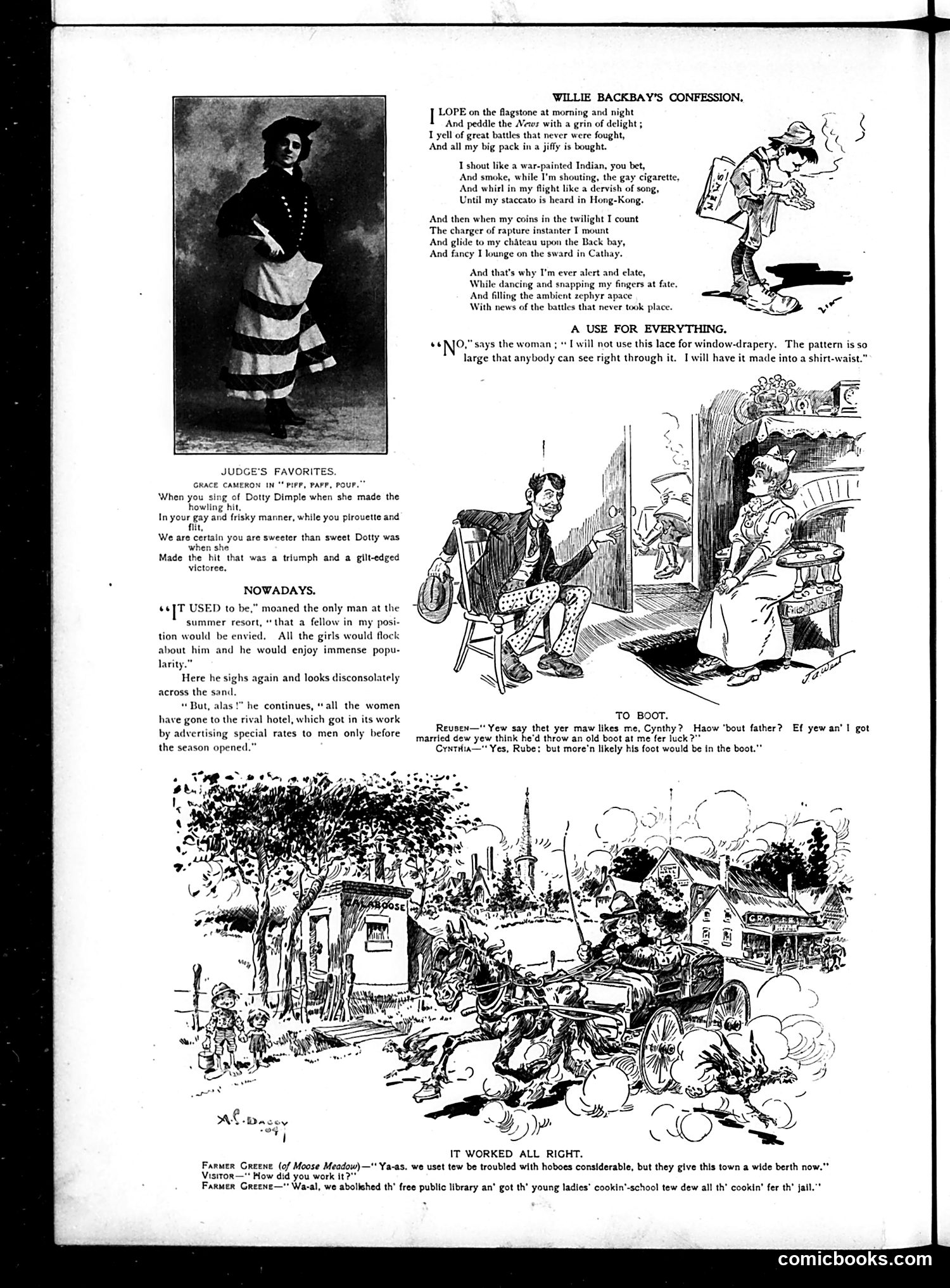
This page contains three satirical pieces from an early 20th-century American magazine: **"Willie Backbay's Confession"** (top): A poem mocking an upper-class young man ("Willie Backbay") who brags about his adventurous travels and romantic escapades while smoking and posturing. The satire targets wealthy idle youth and their pretentious affectations. **"Judge's Favorites"** and **"Nowadays"**: Brief comic sketches poking fun at social changes—one references a woman's dismissal of outdated lace for practical uses, and another satirizes how summer resort dynamics have shifted, with men no longer monopolizing attention at vacation spots. **"To Boot"** and **"It Worked All Right"**: Short humorous dialogues about rural life and the introduction of modern conveniences (the "free public library"), suggesting satirical commentary on rural modernization and changing social customs. The overall tone mocks class pretension, changing gender roles, and rural-urban cultural shifts.
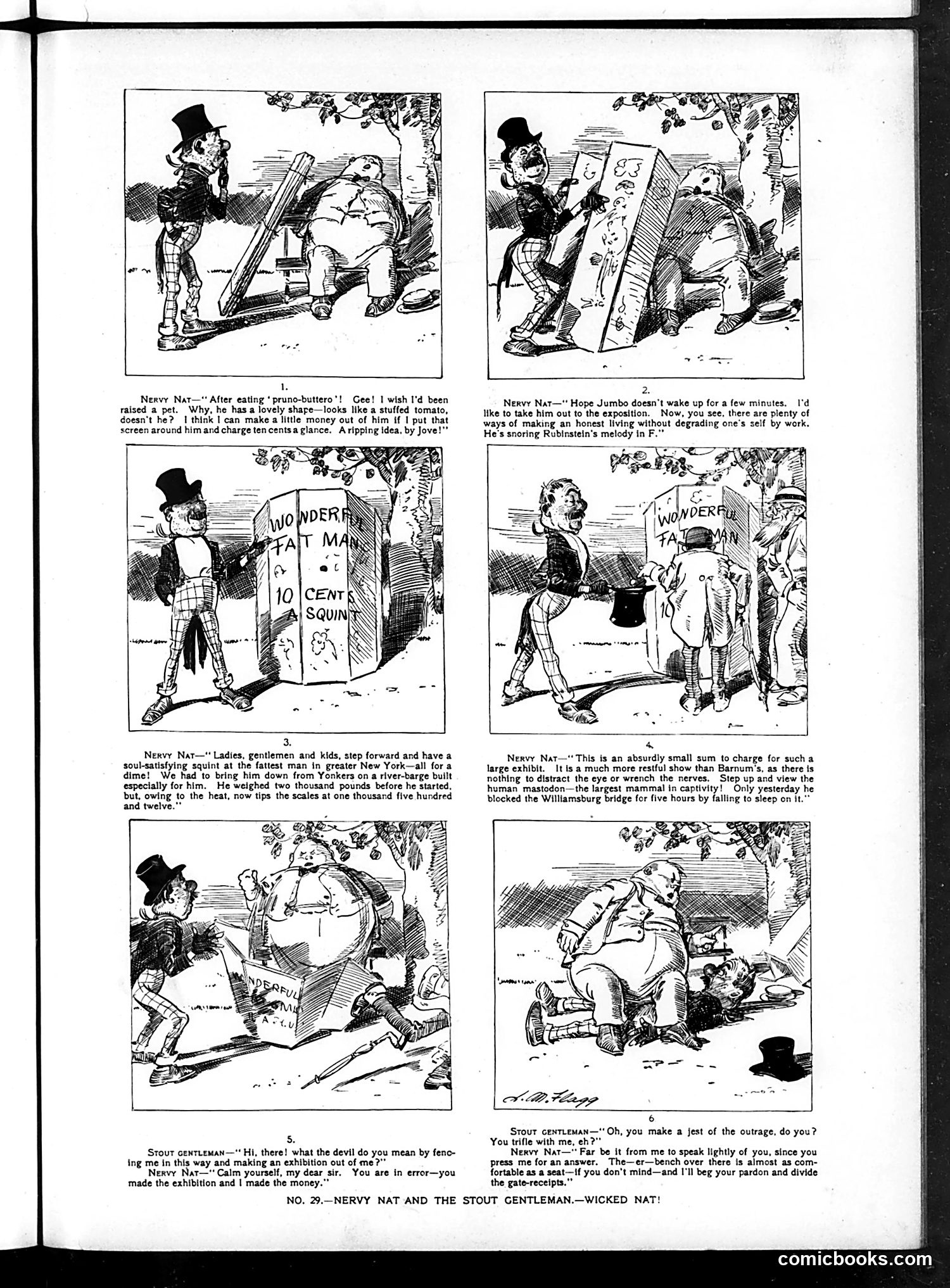
This comic strip satirizes turn-of-the-century sideshow exploitation and hustlerism. "Nervy Nat," a con artist, displays various large men as carnival attractions—comparing them to Barnum's famous exhibits—charging admission to gawk at them. The humor targets both Nat's shameless opportunism and the gullibility of paying audiences. The "Stout Gentleman" eventually confronts Nat, outraged at being exhibited without consent. Nat's response—offering the man a bench and proposing to split gate receipts—mocks the ease with which moral objections dissolve when profit-sharing is offered. The satire critiques American consumer culture's appetite for human spectacle, the blurred ethics of showmanship, and the willingness of even exploited parties to compromise principles for money. It reflects the era's ambivalence about such exhibitions, which were simultaneously popular and increasingly controversial.
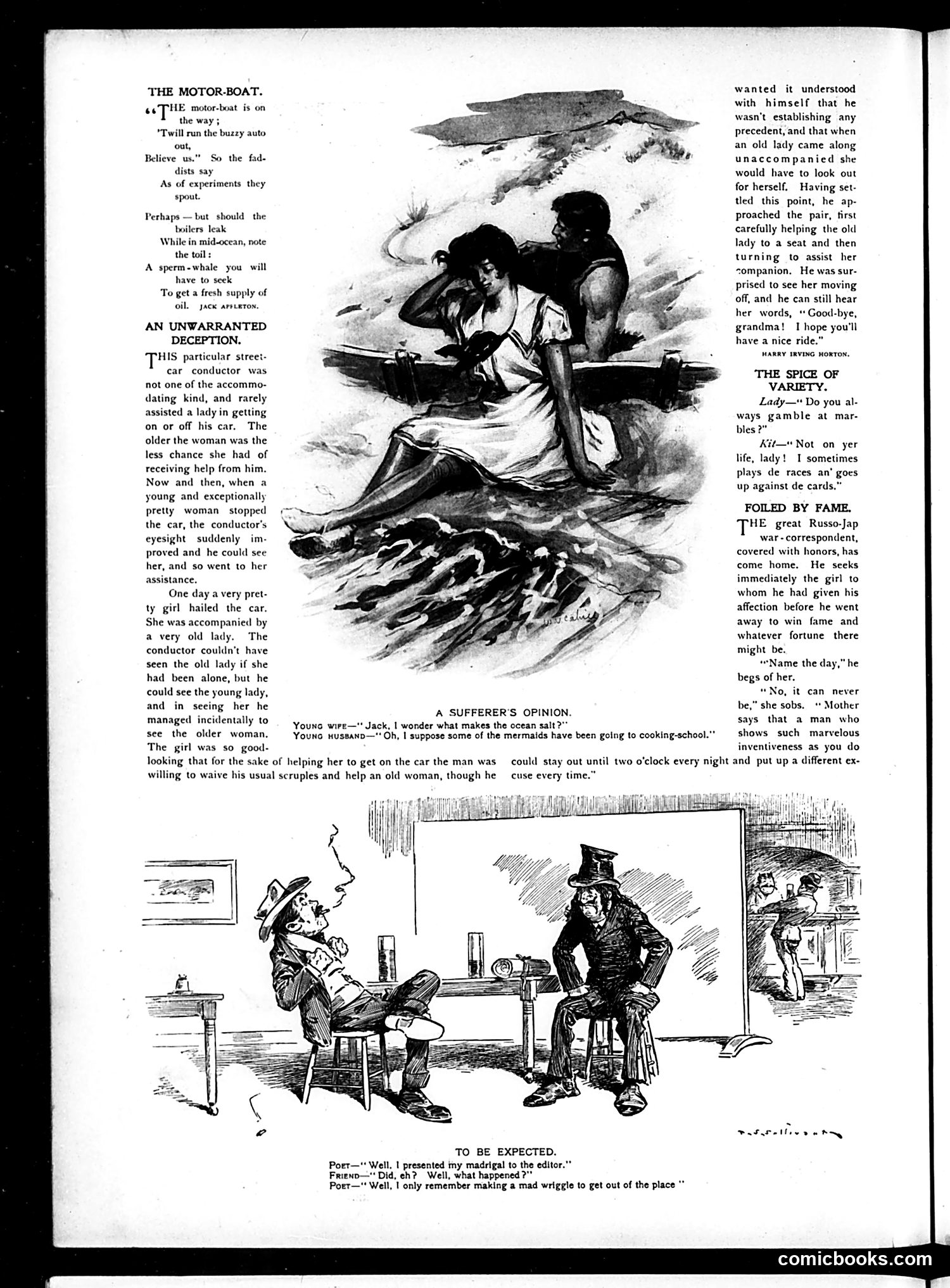
This page contains several satirical pieces typical of early-20th-century American humor: **"The Motor-Boat"** mocks the faddish enthusiasm for new technology (motor-boats), joking that if boilers leak at sea, one would need to hunt a sperm whale for oil—a humorous exaggeration of the practical problems with this emerging technology. **"An Unwarranted Deception"** satirizes a street-car conductor's selective chivalry: he ignores elderly women but eagerly assists young, attractive ones. The joke exposes his hypocrisy when the pretty girl departs, revealing the conductor's "help" was motivated by appearance, not genuine courtesy. The old lady (her grandmother) gets the last laugh. **"To Be Expected"** is a brief joke about a poet's rejection: he makes a "mad wriggle to get out" after presenting his "madrigal" to an editor—a pun suggesting both his hurried escape and the failure of his work. The remaining pieces are lighter social humor about gambling, ocean salt, and a war correspondent's romantic misfortunes. The satire targets social hypocrisy, technological obsession, and romantic vanity.
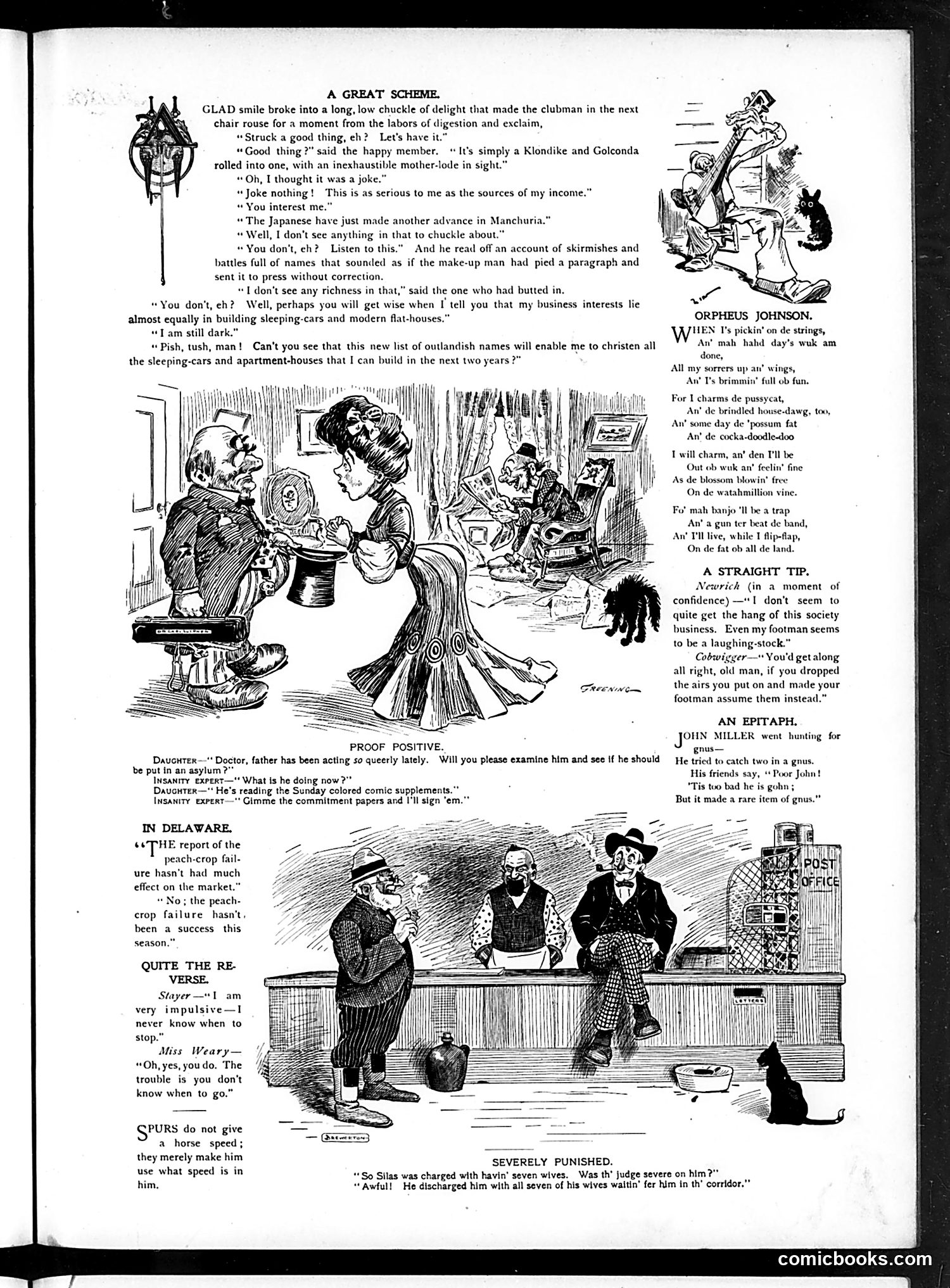
The main cartoon satirizes a businessman who profits from war news. A clubman excitedly explains that Japanese military advances in Manchuria are personally lucrative—he can now name his sleeping cars and apartment buildings with exotic Japanese place names from battle reports, making construction easier to market. The satire targets two things: **war profiteering** (businesses benefiting from international conflict) and **absurd marketing logic** (that novelty names sell real estate). The joke mocks capitalists who treat human suffering as a business opportunity. The subsidiary cartoons mock other targets: the insanity of reading Sunday comic strips; a nouveau-riche man's social pretensions; impulsive behavior; and a terrible pun about hunting "gnus" (wildebeest/news). The final item jokes about a man punished by having seven angry wives wait for him—a crude domestic-discord gag typical of the era. Overall, the page represents Judge's characteristic satirical attacks on materialism, war-profiteering, and bourgeois social climbing circa the Russo-Japanese War era (1904-1905).
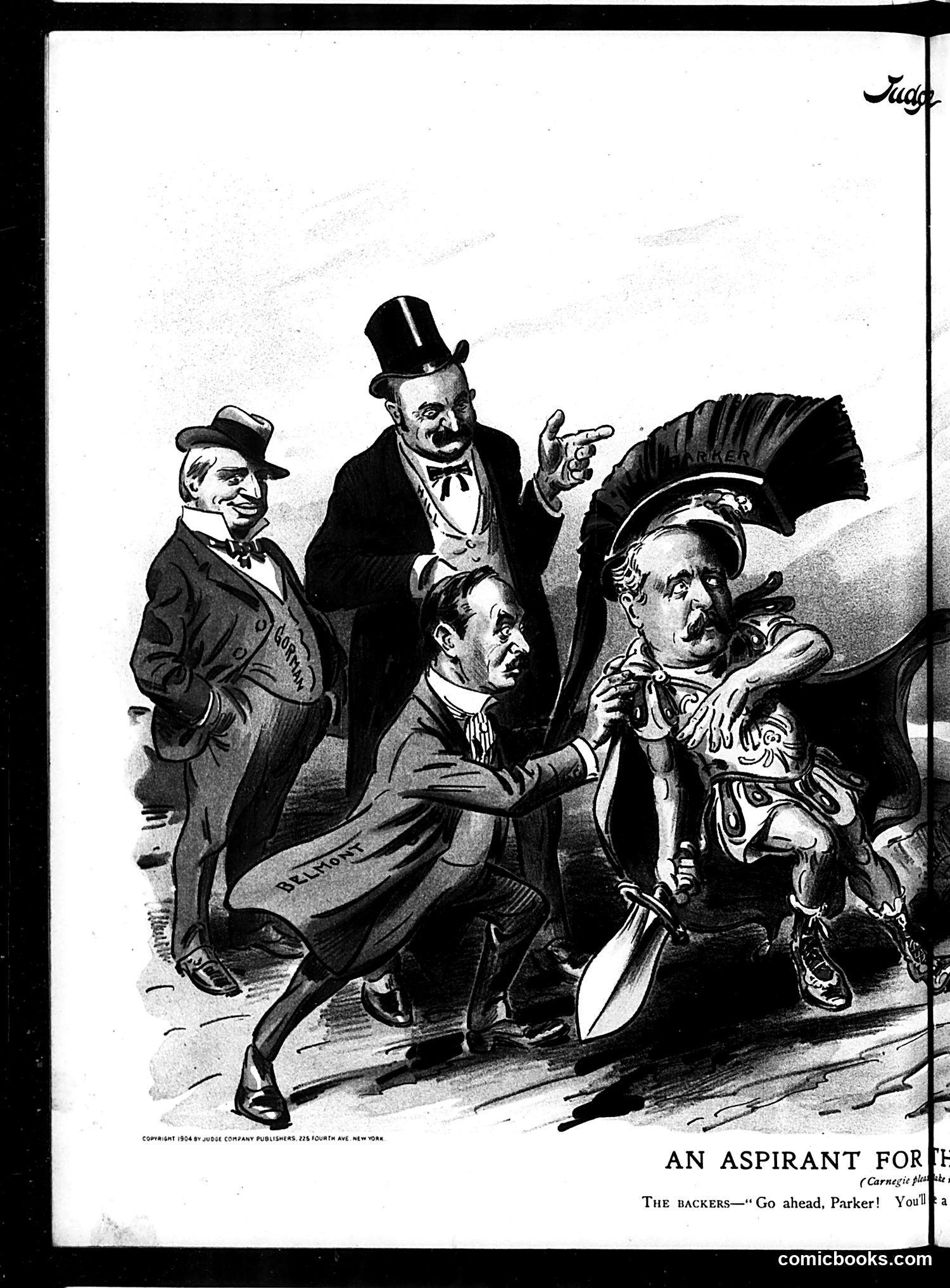
This Judge magazine cartoon titled "An Aspirant for [Office]" appears to satirize a political candidate (likely Parker, based on the text) being pushed forward by wealthy backers. The composition shows five men: two well-dressed figures on the left (the "backers"), one central figure gesticulating encouragement, and two men on the right—one in military/decorated dress appearing reluctant or uncertain. The satire criticizes how wealthy interests manipulate political candidates, using them as puppets. The "Go ahead, Parker! You'll pa[ss]" exhortation suggests backers pressuring an unwilling or weak candidate forward for their own purposes. The Carnegie reference hints at wealthy industrialist involvement in politics. The cartoon mocks both the candidate's apparent lack of genuine conviction and the corrupt system of wealthy patronage controlling political campaigns.
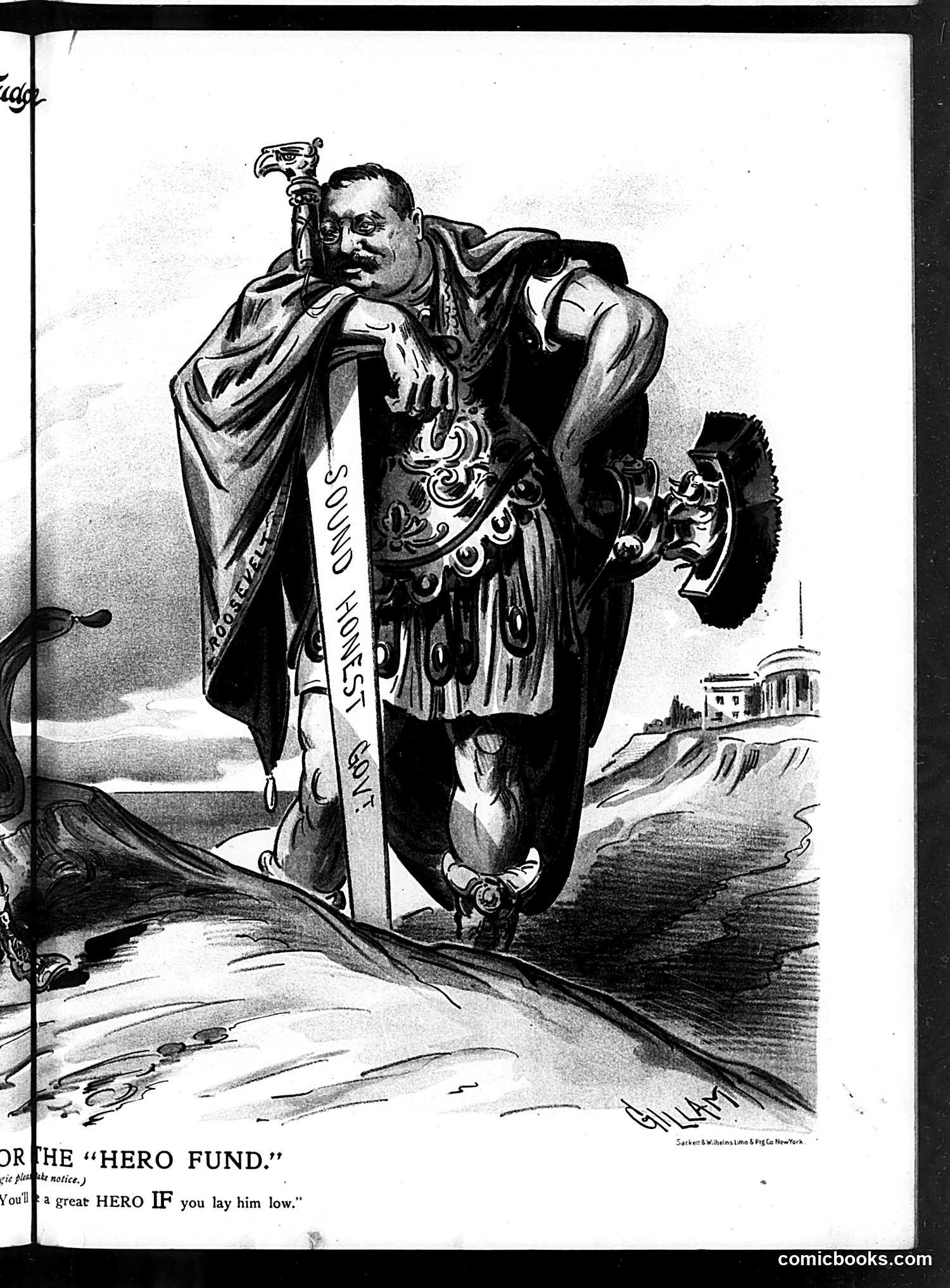
This Judge magazine cartoon satirizes someone's reputation as a "hero" through dramatic irony. The figure, dressed in Roman/classical warrior garb with an eagle-topped staff, strikes a heroic pose. However, the accompanying text—"You're a great HERO IF you lay him low"—suggests this person is actually disliked or despised, and would only be considered heroic if defeated or removed from power. The classical imagery likely mocks the subject's self-aggrandizing pretensions. The landscape showing classical buildings reinforces this pomposity. Without the specific date or clearer identification, the exact target remains unclear, but the cartoon critiques someone who presents themselves as heroic while actually being widely unpopular—implying their fall from power would be celebrated rather than mourned.
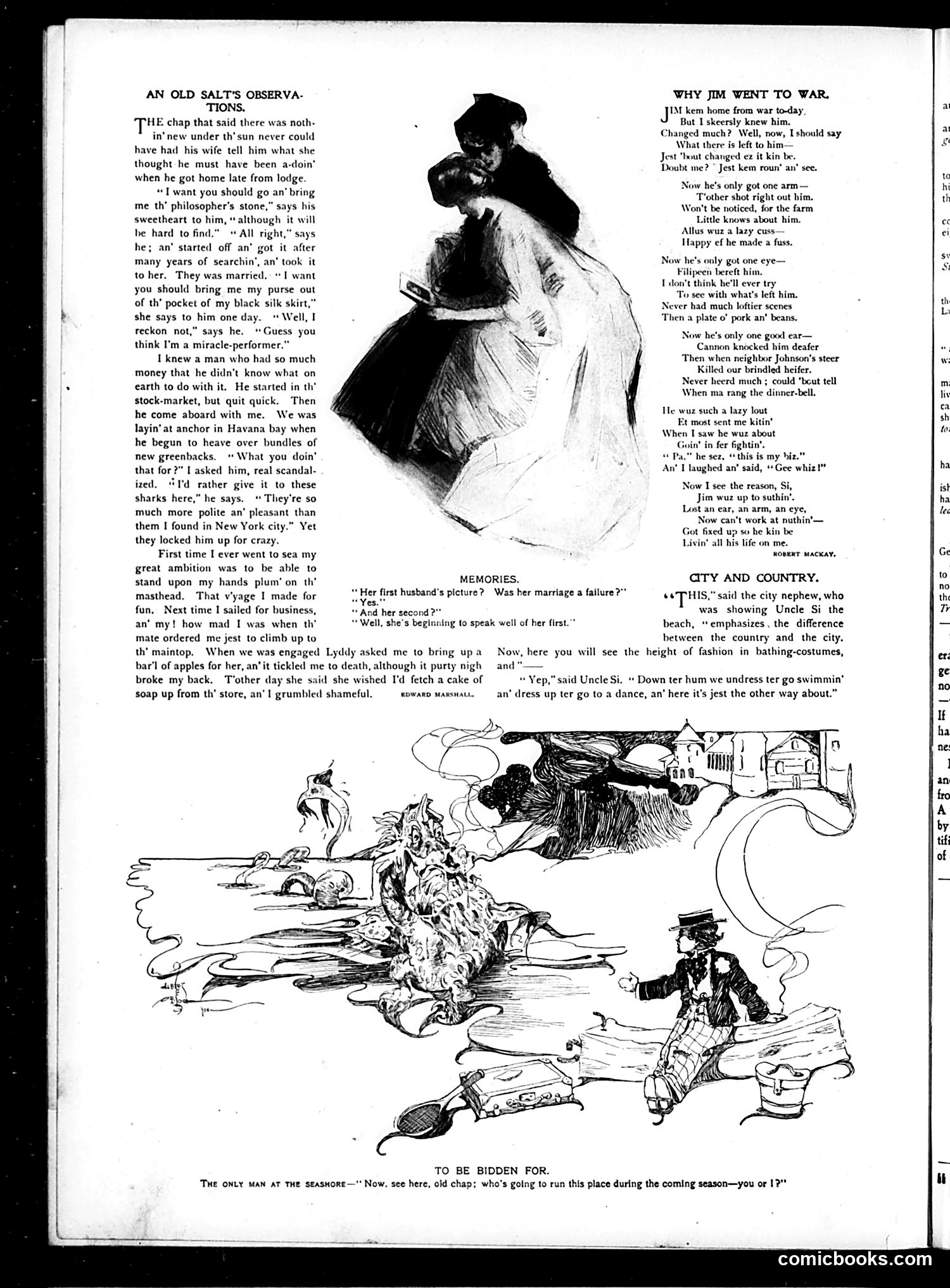
This page contains satirical stories and verses typical of early 20th-century American humor magazines. **"An Old Salt's Observations"** (left column): A sailor narrator tells anecdotes mocking marriage, wealth, and ambition. The jokes target: wives' demanding nature ("fetch a cake of soap"), the absurdity of the ultra-wealthy (a man preferring to give money to sharks rather than New York financiers), and the gap between youthful aspirations and adult reality. The humor relies on working-class vernacular and gendered stereotypes. **"Why Jim Went to War"** (right column): A poem revealing that a lazy man enlisted in the Philippines conflict deliberately to become disabled—thereby entitled to lifelong support from family rather than work. The satire critiques both the man's scheme and, implicitly, disability pension systems. **"City and Country"** (bottom right): A brief exchange where an uncle from the country notes the irony that beachgoers undress for swimming but dress elaborately for dancing—opposite rural practice. Light social satire on urban fashion conventions. The illustrations are period-appropriate sketches supporting each text.
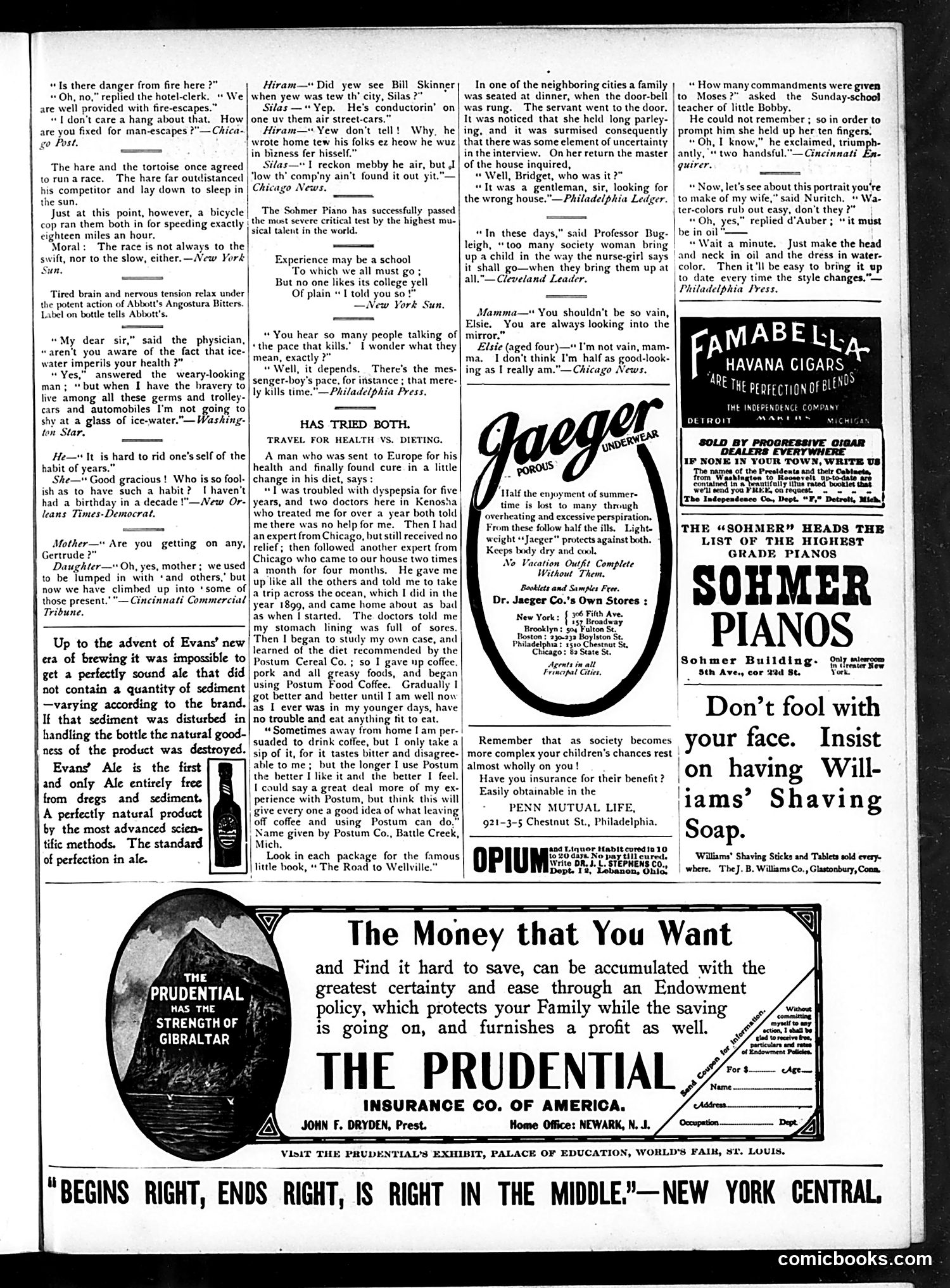
This page contains primarily **humorous anecdotes and advertisements** rather than political cartoons. The jokes reflect early 20th-century American concerns: **Notable humor pieces:** - A hotel clerk's quip about "man-escapes" (concerns about women's safety/propriety in hotels) - A tortoise-and-hare retelling interrupted by a bicycle cop for speeding (modern transportation anxieties) - Rural dialogue where a railroad conductor pretends to be self-employed to appear more respectable - A woman claiming not to have had a birthday in a decade (joking about women's age-consciousness) **Advertisements** dominate the page, including: - **Evans' Ale** (sediment-free brewing innovation) - **Sohmer Pianos** (high-end musical instruments) - **Postum** (caffeine-free coffee alternative, promoted via testimonial about curing dyspepsia) - **Williams' Shaving Soap** and **Prudential Insurance** The content reflects Belle Époque consumer culture and period anxieties about modern life (germs, transportation dangers, dietary health).
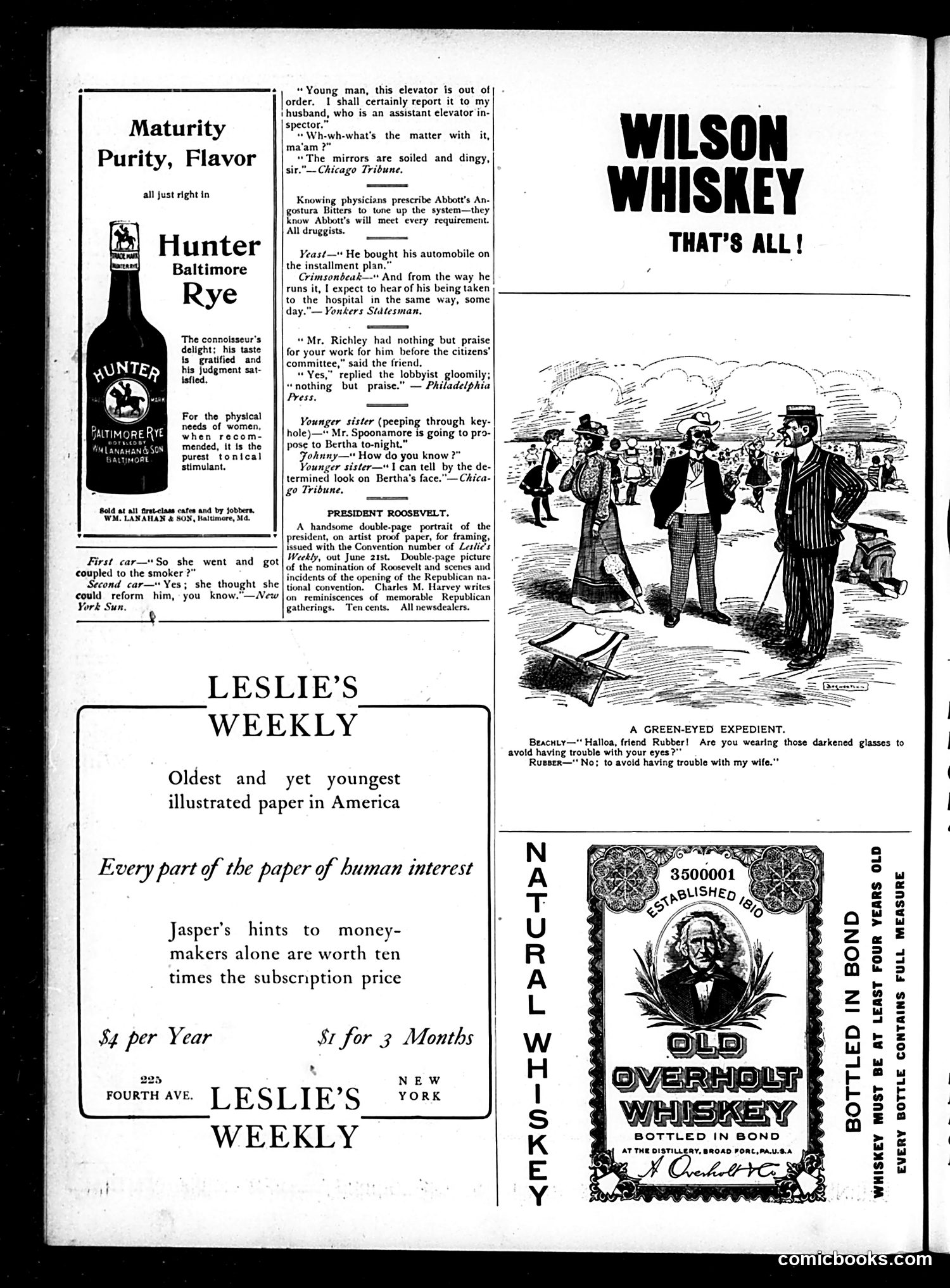
This page contains primarily **advertisements and brief satirical jokes** rather than a political cartoon requiring historical context. The main content includes: 1. **Liquor ads** for Hunter Baltimore Rye and Wilson/Overholt whiskeys—period advertisements claiming medicinal benefits typical of early 1900s marketing. 2. **Short humorous anecdotes** on various topics: a woman complaining about elevator mirror cleanliness, a man buying a car dangerously, a lobbyist's contradictory praise, and a man wearing dark glasses to avoid his wife's scrutiny. 3. **A promotional notice** for Leslie's Weekly featuring a Roosevelt portrait, likely from the 1904 Republican National Convention period. 4. **A cartoon illustration** labeled "A Green-Eyed Expedient" showing a man explaining he wears darkened glasses to avoid marital trouble—a simple joke about domestic conflict and male evasion. The page reflects early 1900s concerns: automobile dangers, domestic tensions, and political conventions. No deep satire or specific political figures beyond Roosevelt are evident.
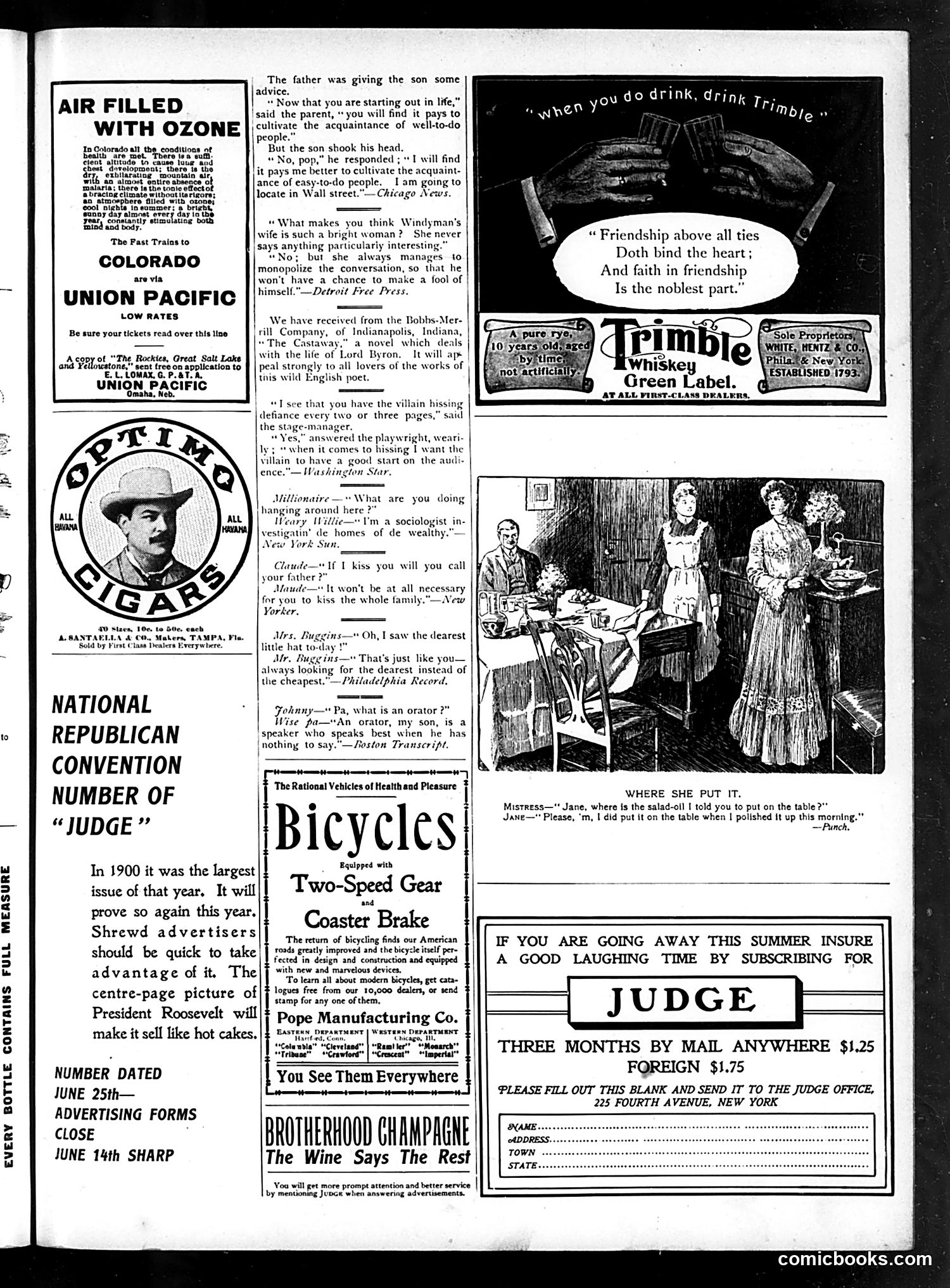
This page from Judge (circa 1900) is primarily **advertising and filler content** rather than political cartoons. The main elements include: **Advertisements:** The page features ads for Union Pacific Railroad (promoting Colorado tourism), Optimo Cigars, bicycles with new "Two-Speed Gear," Trimble Whiskey, and Brotherhood Champagne—typical turn-of-century consumer goods. **Short Humorous Anecdotes:** Several brief jokes target recognizable social types: a young man rejecting his father's advice to befriend the wealthy (preferring "easy-to-do people" on Wall Street); a "Weary Willie" vagabond character; and domestic humor about wives and servants. These reflect common Judge themes mocking social pretension and class dynamics. **Editorial Note:** The announcement that this issue features President Roosevelt's portrait suggests the magazine's conservative Republican orientation and its commercial strategy of leveraging Roosevelt's popularity to boost sales. The page lacks sophisticated political cartooning, instead relying on accessible, light satirical humor and commercial appeal.
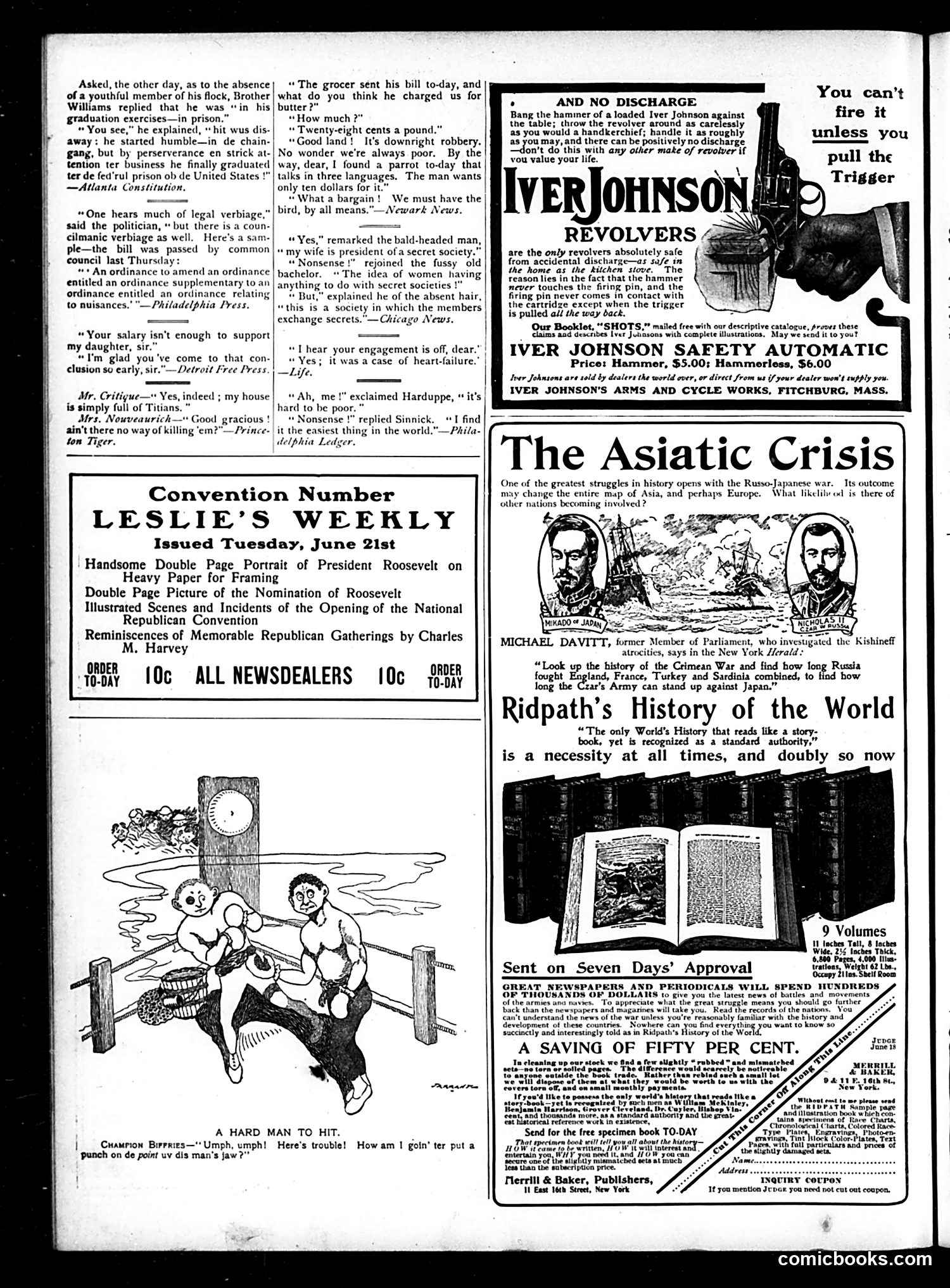
This is primarily a **title/advertisement page** from Leslie's Weekly (June 21st edition), not a political cartoon page. The content is mostly promotional. The one cartoon present—"A Hard Man to Hit"—depicts two boxers in a boxing match. One fighter (labeled "Champion Bitters") struggles to land a punch on his opponent's jaw, illustrated as humor about the difficulty of fighting someone with an effective defensive strategy. The page's main content advertises Leslie's Weekly's upcoming issue featuring President Roosevelt's nomination at the Republican Convention, with double-page portraits and illustrations of convention scenes. The extensive Iver Johnson revolver advertisement emphasizes the gun's safety features—notably that the hammer doesn't touch the firing pin, making accidental discharge impossible. This was a significant marketing angle in early 1900s firearm advertising. A small section discusses the "Asiatic Crisis," referencing the Russo-Japanese War's impact on Asia's geopolitics. The remaining space contains brief humorous anecdotes about everyday life—clergymen, bureaucracy, marriage, and budgeting—typical filler content for satirical magazines of the era.
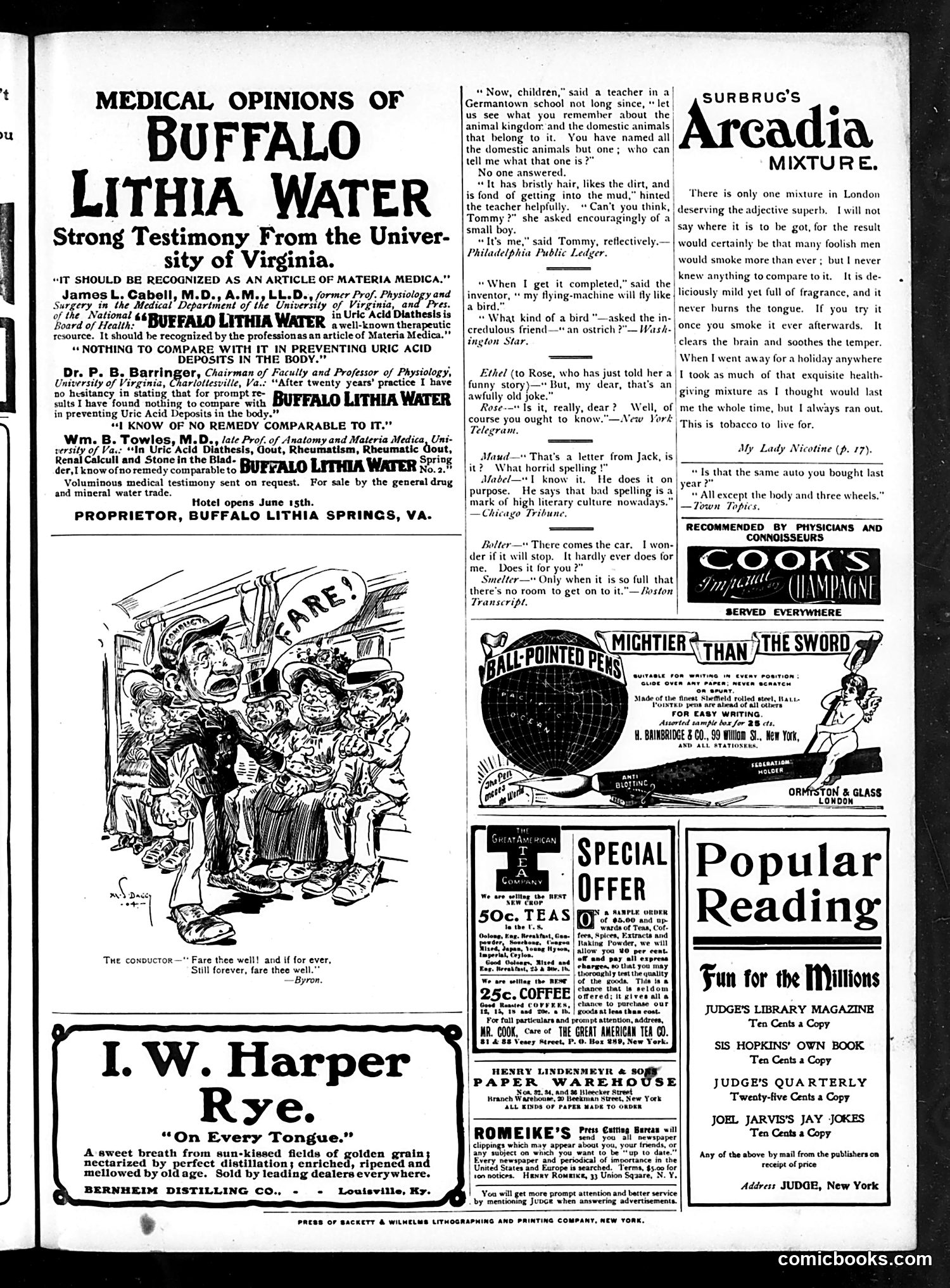
This page primarily contains **medical advertisements and product endorsements** rather than political satire. The main content includes: **Buffalo Lithia Water advertisement**: Features testimonials from University of Virginia medical professors claiming the mineral water treats uric acid deposits, gout, and rheumatism—reflecting late 19th/early 20th-century medical marketing that made dubious health claims about mineral waters. **The cartoon** (lower left) depicts a train conductor saying farewell, illustrating a humorous anecdote about railway life—not political satire. **Other advertisements**: I.W. Harper Rye whiskey and Arcadia tobacco mixture, typical period product promotions. The page represents **Judge magazine's revenue model**—satirical content subsidized by extensive patent medicine and luxury goods advertising, which were common in this era despite often-unproven efficacy claims. No clear political figures or references are visible.
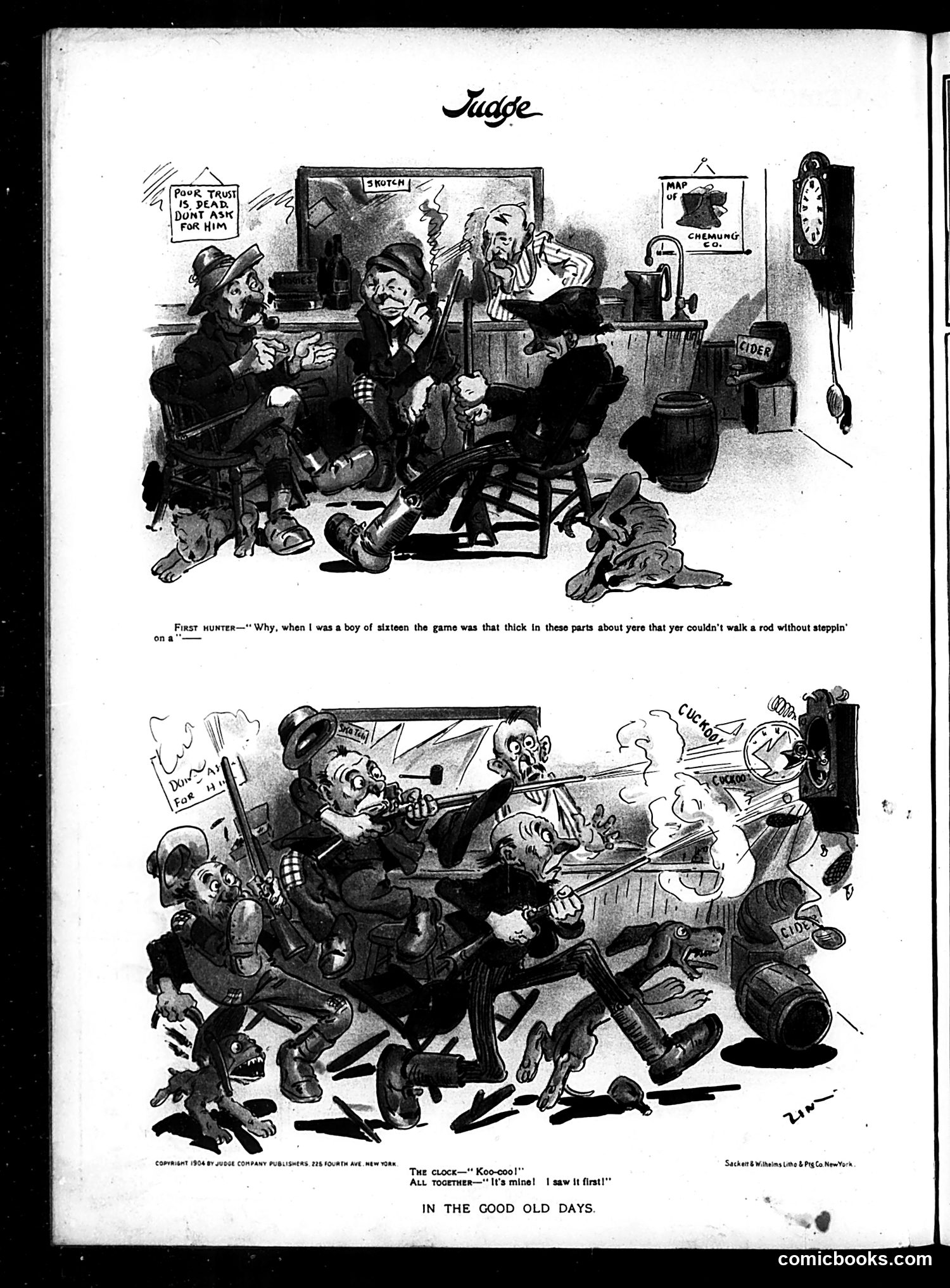
This Judge page contains two satirical cartoons depicting hunting culture in "the good old days." The **top cartoon** shows hunters in a tavern sharing nostalgia about when you could hunt freely without regulation—"you couldn't walk a rod without steppin' on a" (game, implied). The **bottom cartoon** titled "The Clock" mocks the same nostalgic hunters now engaged in chaotic, undignified scrambling over what appears to be game or hunting territory, all shouting "It's mine! I saw it first!" The humor lies in the contrast: their romanticized past versus their present greedy, desperate behavior. The satire critiques how unrestricted hunting depleted wildlife, forcing regulation—yet nostalgic hunters still behave selfishly rather than adapting responsibly to conservation.
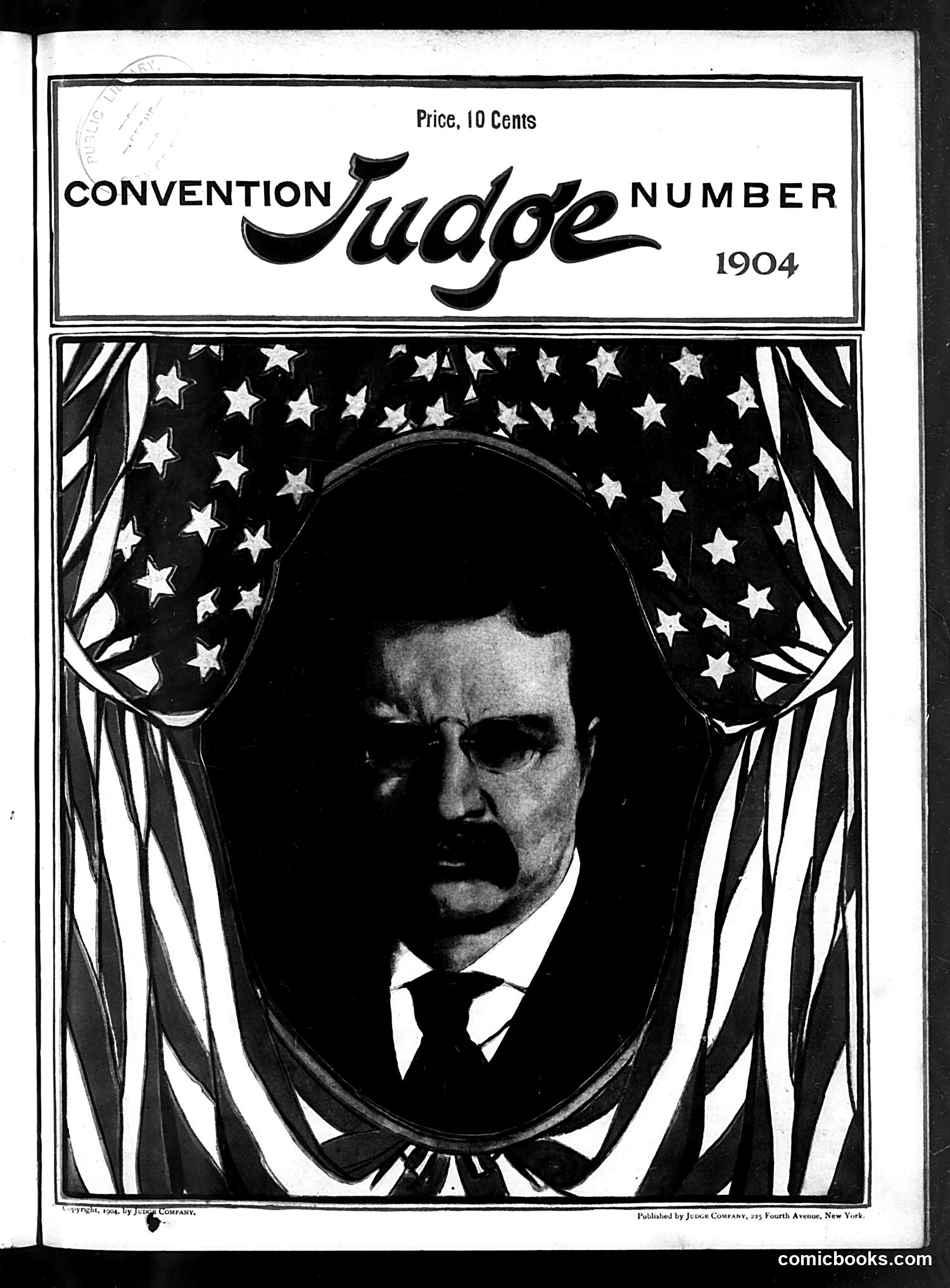
This is a Convention Number cover from Judge magazine, priced at 10 cents. The image shows a formal portrait of a man with a distinctive mustache, framed by American flags and patriotic imagery (stars and stripes). The oval portrait format was typical for political figures of the era. However, the OCR text is too corrupted to identify the specific individual depicted or clarify the satirical point. Based on the "Convention Number" designation and 1904 date, this likely relates to a U.S. political convention (possibly presidential), but without clearer text or caption, I cannot confidently state which figure is caricatured or what the specific satire intended. The patriotic framing suggests commentary on American political leadership.
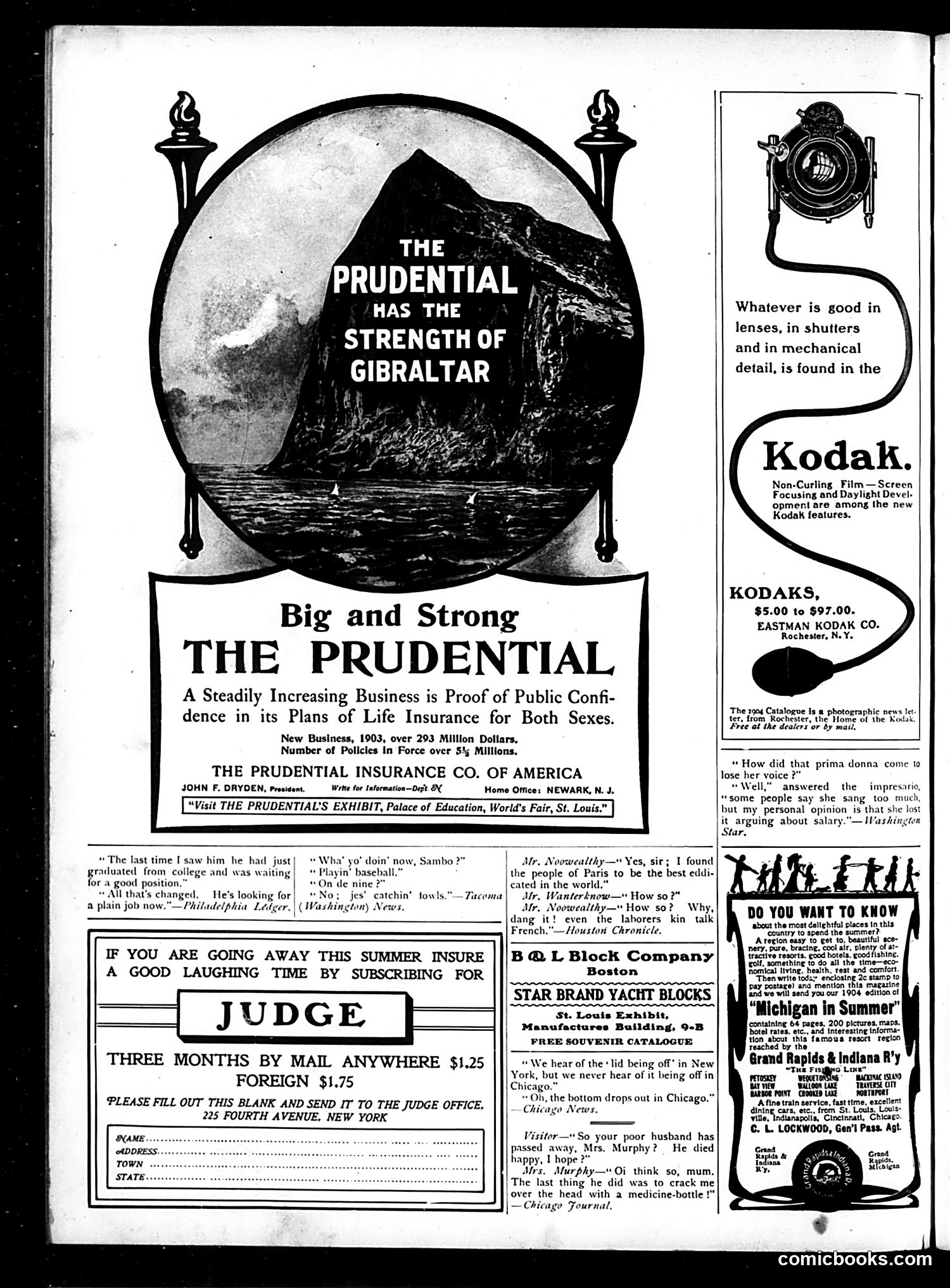
This is primarily a **advertising page** from Judge magazine, circa 1904, with minimal satirical content. The main feature is a large advertisement for **The Prudential Insurance Company**, using the metaphor "The Prudential Has the Strength of Gibraltar"—comparing the insurance company's stability to the famous Rock of Gibraltar. The ad emphasizes public confidence through impressive business statistics (293 million dollars in new business, 545 million policies in force). The page also contains **period humor snippets** typical of Judge's style: brief jokes about employment, classical music singers, baseball, Parisian education, and Chicago's moral corruption ("the lid being off"). Additional advertisements promote **Kodak cameras**, **yacht blocks**, and **Michigan summer tourism**. The subscription offer for Judge itself appears at bottom-left. This reflects early 1900s advertising strategies and casual ethnic humor ("Sambo," stereotypical dialect) that would be considered offensive today. The page demonstrates how such magazines funded themselves through advertising revenue.