
Judge, 1904-06-18 · page 10 of 18
Judge — June 18, 1904 — page 10: what you’re looking at
What you’re looking at
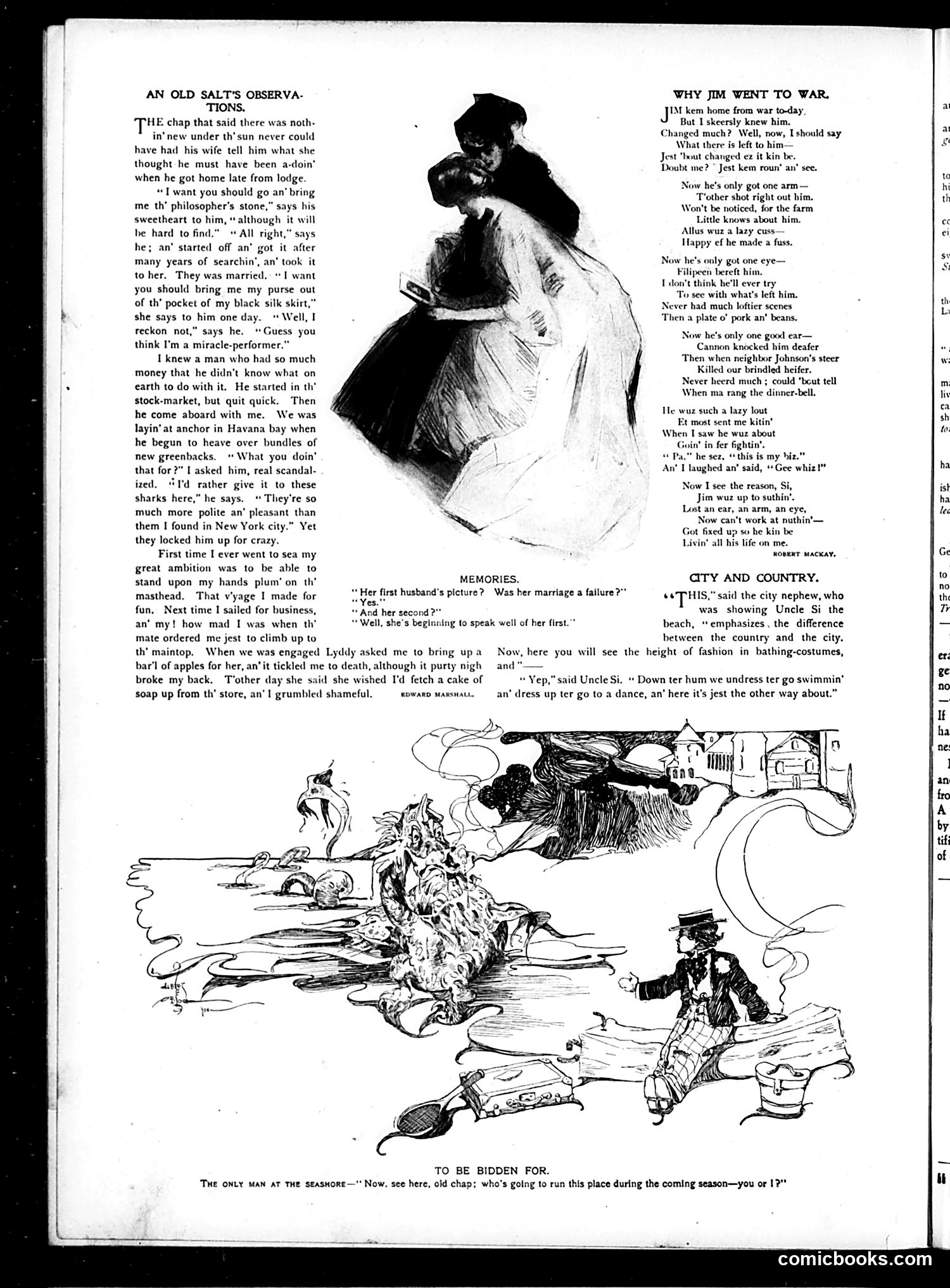
This page contains satirical stories and verses typical of early 20th-century American humor magazines. **"An Old Salt's Observations"** (left column): A sailor narrator tells anecdotes mocking marriage, wealth, and ambition. The jokes target: wives' demanding nature ("fetch a cake of soap"), the absurdity of the ultra-wealthy (a man preferring to give money to sharks rather than New York financiers), and the gap between youthful aspirations and adult reality. The humor relies on working-class vernacular and gendered stereotypes. **"Why Jim Went to War"** (right column): A poem revealing that a lazy man enlisted in the Philippines conflict deliberately to become disabled—thereby entitled to lifelong support from family rather than work. The satire critiques both the man's scheme and, implicitly, disability pension systems. **"City and Country"** (bottom right): A brief exchange where an uncle from the country notes the irony that beachgoers undress for swimming but dress elaborately for dancing—opposite rural practice. Light social satire on urban fashion conventions. The illustrations are period-appropriate sketches supporting each text.
📄 Transcribed text from this page (OCR, searchable)
Machine-transcribed from the original scan — historical spelling and the odd misread are preserved.
AN OLD SALT’S OBSERVA- TIONS. THE chap that said there was noth- in’ new under th’ sun never could have had his wife tell him what she thought he must have been a-doin’ when he got home late from lodge. “want you should go an‘ bring me th’ philosopher's stone,” says his sweetheart to him, “although it will be hard to find.” All ri “says he; an’ started off an’ got it after many years of searchin’, an’ took it to her. They was married. “1 want you should bring me my purse out of th’ pocket of my black silk skirt,” she says to him one day. “Well, I reckon not,” says he. “Guess you think I'm a miracle-performer.” I knew a man who had so much money that he didn’t know what on earth to do with it. He started in th’ stock-market, but quit quick. Then he come aboard with me. We was layin’ at anchor in Havana bay when he begun to heave over bundles of new greenbacks. What you doin’ that for?” I asked him, real scandal- ized. “I'd rather give it to these sharks here,” he says. * They're so much more polite an’ pleasant than them I found in New York city.” Yet they locked him up for crazy. First time I ever went to sea my great ambition was to be able to stand upon my hands plum’ on th’ masthead. That v'yage I made for fun, Next time I sailed for business, an’ my! how mad I was when th’ mate ordered me jest to climb up to th’ maintop. When we was engaged Lyddy asked me to bring upa MEMORIES. “Her first husband's picture? Was her marriage a failure?" “Yes.” “And her second ?"* “Well, she’s beginning to speak well of her first.” bar'l of apples for her, an’ it tickled me to death, although it purty nigh and" broke my back. T'other day she said she wished I'd fetch a cake of soap up from th’ store, an’ grumbled shameful. EDWARD MARSHALL. TO BE BIDDEN FOR. WHY JIM WENT TO WAR. J!8{ Kem home from war to-day But I skeersly knew him. Changed much? Well, now, I should say What there is left to him— Jest "bout changed e2 it kin be. Doubt me? * Jest kem roun’ an’ see. Now he's only got one arm— ther shot right out him. Won't be noticed, for the farm Little knows about him. Allus wuz a lazy cuss Happy ef he made a fuss. Now he’s only got one eye— Filipeen bereft him. T don’t think he'll ever try To see with what's left him. Never had much loftier scenes ‘Then a plate o' pork an’ beans. he's only one good ear— Cannon knocked him deafer ‘Then when neighbor Johnson's steer Killed our brindled heifer. Never heerd much ; could ‘bout tell When ma rang the dinner-bell. He wuz such a lazy lout most sent me kitin’ saw he wuz about Goin’ in fer fightin’, he sez, “this is my An’ I laughed an’ said, “Gee whiz!" Now I see the reason, Si, Jim wuz up to suthin’ Lost an ear, an arm, an eye, Now can’t work at nuthin'— Got fixed up so he kin be Livin’ all his life on me. ROBEXT MACKAY. CITY AND COUNTRY. seTHIS,” said the city nephew, who was showing Uncle Si the beach, “emphasizes, the difference between the country and the city. Now, here you will see the height of fashion in bathing-costumes, “ Yep,” said Uncle Si. Down ter hum we undress ter go swimmin’ an‘ dress up ter go to a dance, an’ here it's jest the other way about.” TWe ONLY MAN AT THE SEASHORE—"" Now, see here, old chap; who's going to run this place during the coming season—you or 1?"" -comicbooks.com