
A complete issue · 16 pages · 1904
Judge — March 5, 1904
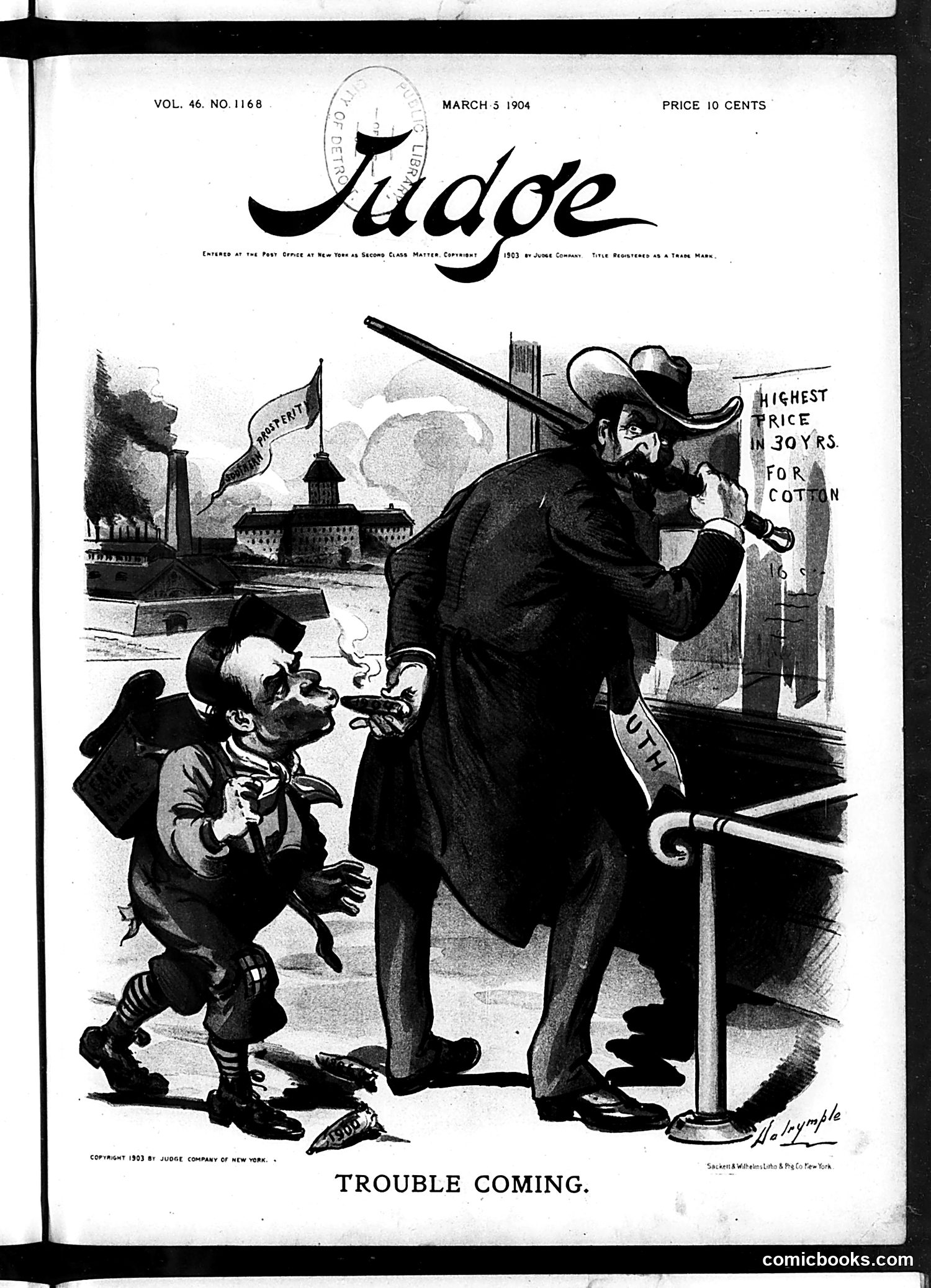
This political cartoon depicts a tall figure (likely representing a powerful nation or leader, possibly Theodore Roosevelt given the 1904 date) confronting a smaller, caricatured figure labeled "DUTCH" (appearing to reference the Dutch or Dutch interests). The tall figure points to a sign reading "HIGHEST PRICE IN 30YRS FOR COTTON," suggesting economic pressure or threat. The Dutch figure appears distressed or defensive, suggesting anxiety about commercial competition or political conflict. The Fort/Post Brit flag visible in the background indicates British colonial interests are involved. The cartoon satirizes emerging international tensions—possibly related to trade disputes, colonial competition, or geopolitical maneuvering of the period. The ominous title "TROUBLE COMING" emphasizes the cartoonist's prediction of conflict.
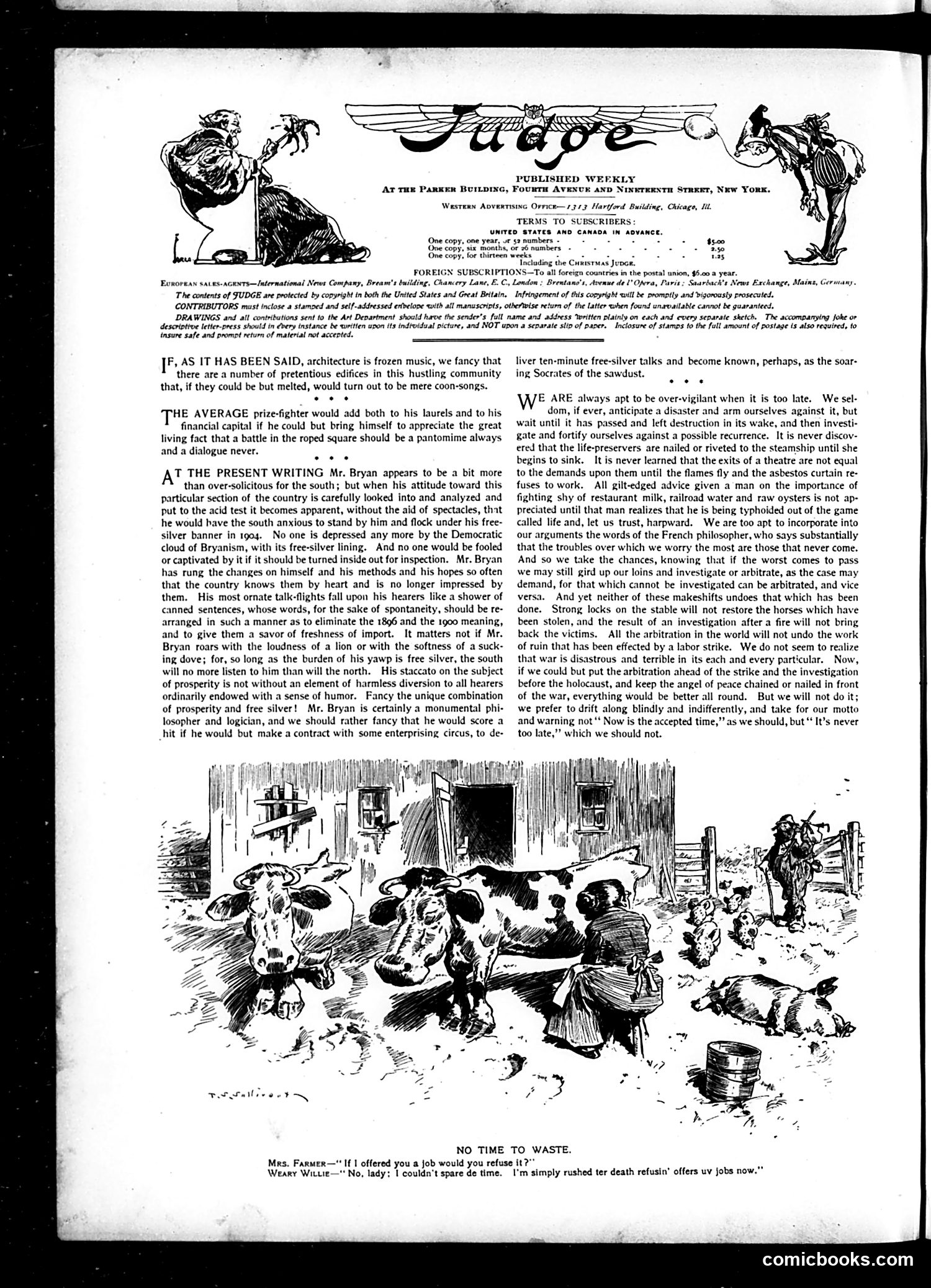
This page contains political commentary and a cartoon titled "No Time to Waste." The main editorial discusses William Jennings Bryan's recent activities and character, criticizing his rhetoric and comparing him unfavorably to prize-fighters and circus performers. The author suggests Bryan's speeches lack substance and that his "silver banner in 1904" represents failed political ambitions. The cartoon below depicts a rural farmyard scene with cattle, chickens, and a farmer. The caption reads: "Mrs. Farmer—'If I offered you a job would you refuse it?' Weary Willie—'No, lady; I couldn't spare the time. I'm simply rushed ter death retain' offers me jobs now.'" This satirizes unemployed workers rejecting job offers, likely commentary on labor conditions or the irony of claiming busyness while jobless. The juxtaposition with Bryan commentary suggests broader criticism of contemporary social and political contradictions.
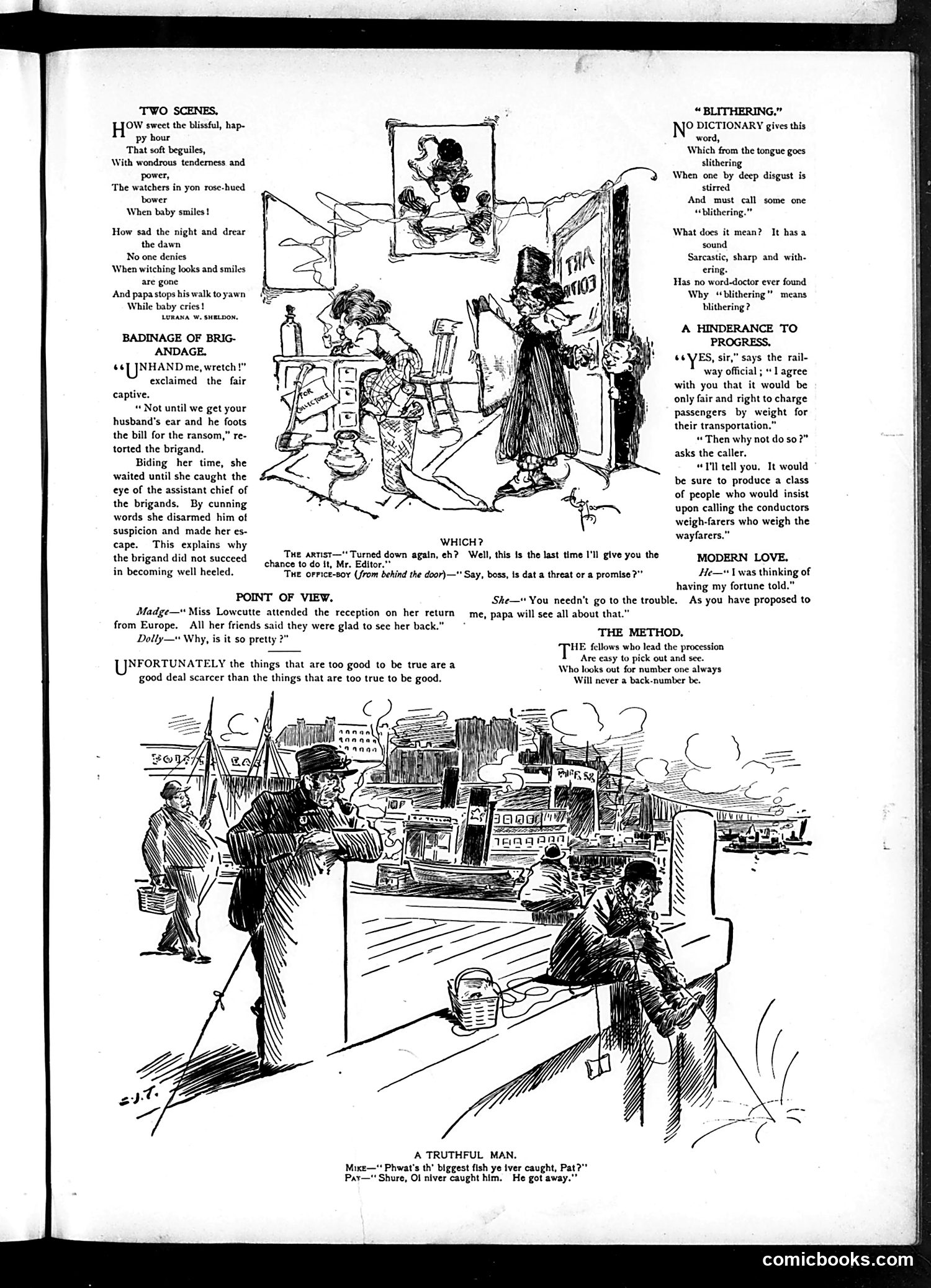
This page contains several satirical pieces typical of Judge magazine's humor: **"Two Scenes"** and **"Blithering"** are poetic commentaries on domestic life and language, likely mocking pretentious vocabulary. **"Badinage of Brigadage"** appears to satirize military bureaucracy, depicting soldiers complaining about an officer's orders regarding transportation charges. **"Point of View"** uses dialogue to mock social pretension, contrasting perspectives on travel and society. **"The Method"** and **"A Hindrance to Progress"** critique railway administration and the treatment of conductors/weighers—suggesting satirical commentary on early 20th-century transportation systems and labor practices. **"A Truthful Man"** (bottom cartoon) is a visual joke about fishing and honesty, showing workers at a dock or harbor. The cartoons employ working-class characters and mundane situations to satirize bureaucracy, social affectation, and labor relations.
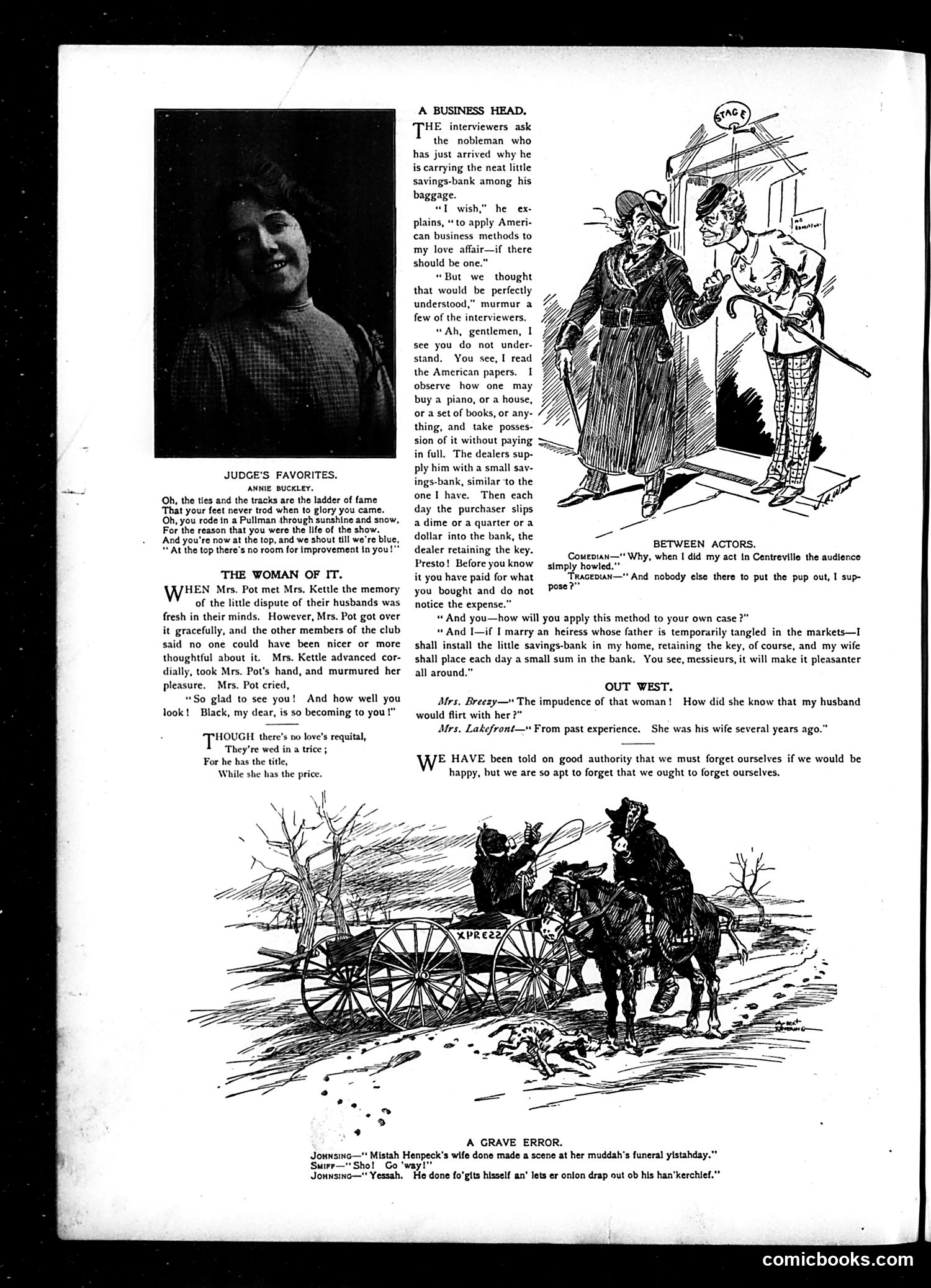
This page contains three separate humor pieces satirizing American society and immigrant experiences. **"A Business Head"** mocks a European nobleman arriving in America who plans to apply "American business methods" to selling items on installment plans—essentially predatory lending via small savings banks. The satire targets both naive immigrants and exploitative consumer credit schemes popular in the era. **"Judge's Favorites"** and **"The Woman of It"** are lighter domestic comedy pieces about marital disputes, without clear political content. **"Between Actors"** is theatrical humor about stage performers. **"Out West"** and **"A Grave Error"** appear to be frontier/rural dialect jokes, mocking rural speech patterns. Overall, the page satirizes immigration, consumer exploitation, and rural American life—typical Judge magazine fare from the early 20th century.
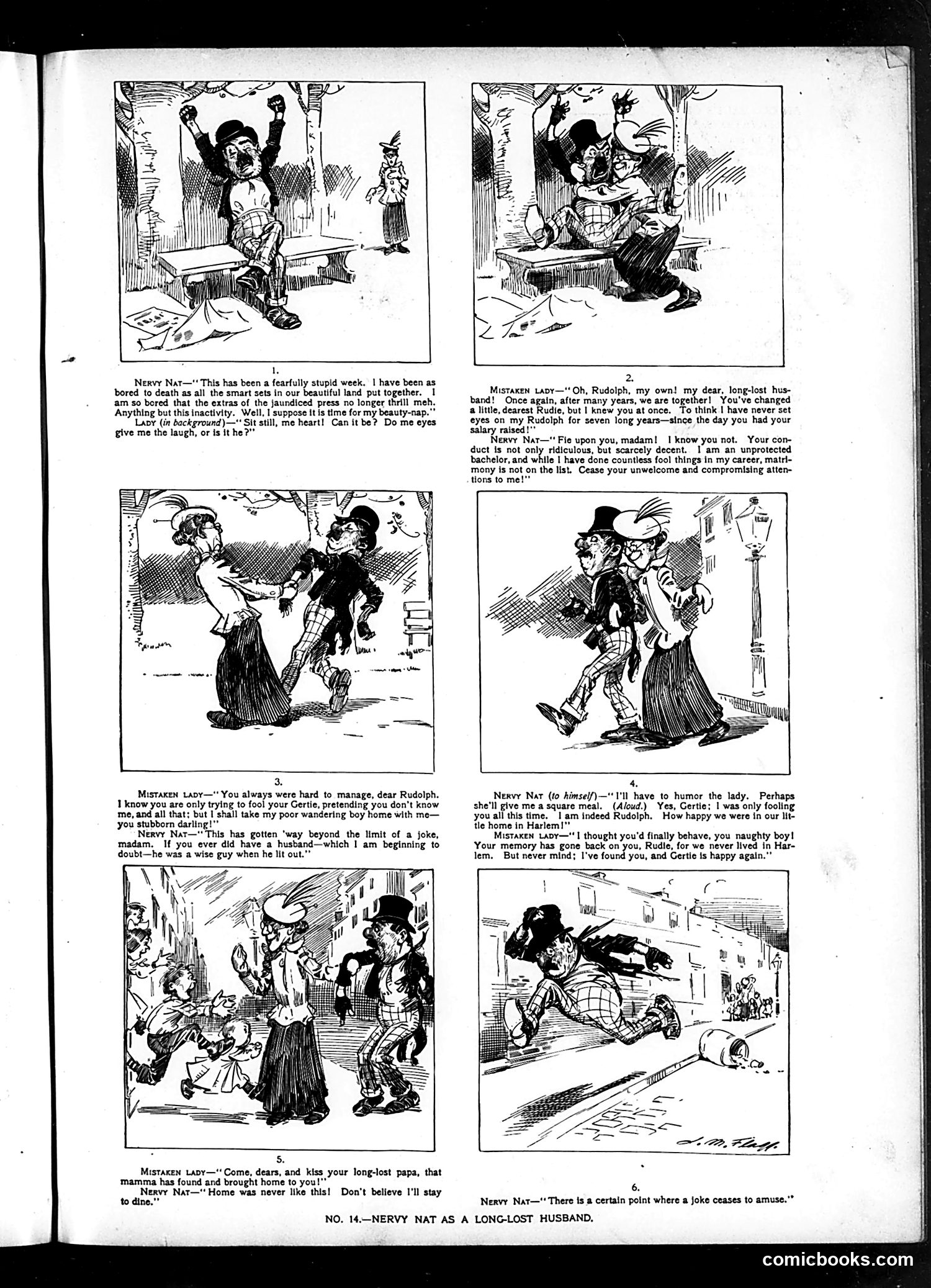
This is a six-panel comic strip satirizing romantic deception and mistaken identity. "Nervy Nat," a wealthy idler bored with society life, is accosted by a woman claiming to be his long-lost wife from Harlem, accompanied by children she says are his. The joke hinges on Nat's predicament: he's clearly a bachelor and stranger, but the woman's persistence—and her implicit threat to expose him as a "husband" to his actual social circle—forces him to play along, fearing social scandal. The satire targets both Nat's shallow upper-class existence and the period's vulnerability to matrimonial fraud schemes. His desperate capitulation ("I'll have to humor the lady") and hasty exit expose the fragility of his social position despite apparent wealth. The "point where a joke ceases to amuse" (panel 6) suggests real consequences lurk beneath comedic circumstance.
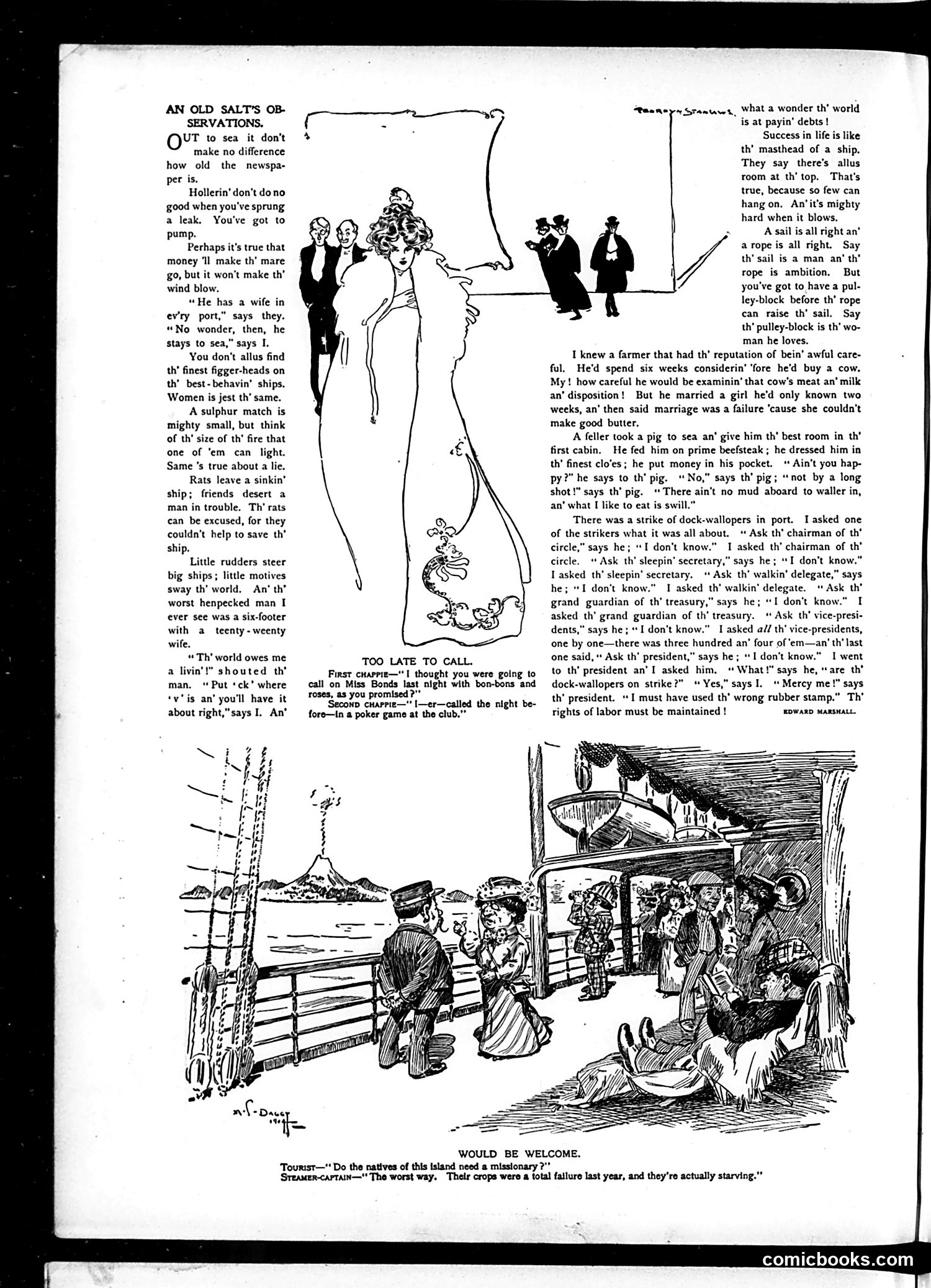
This page contains humorous social commentary through an "Old Salt's Observations" column and several cartoons. **Main content**: A sailor offers folksy wisdom about life, comparing human relationships to nautical concepts. The extended anecdote about dock-wallopers on strike satirizes union leadership's bureaucratic incompetence—the narrator asks strike organizers why workers are striking, but passes through layers of officials (chairman, secretary, delegate, treasurers, vice-presidents) who all claim ignorance, finally reaching a president who admits using the "wrong rubber stamp." This mocks labor unions as disorganized and absurd. **Bottom cartoon**: A tourist asks an island steamer captain if natives need a missionary. The captain replies their crops failed and they're starving—suggesting they need practical aid, not religious conversion. This satirizes ineffectual missionary work. **Overall tone**: Judge criticizes labor bureaucracy and impractical charitable impulses through humor and irony, typical of the magazine's conservative editorial stance.
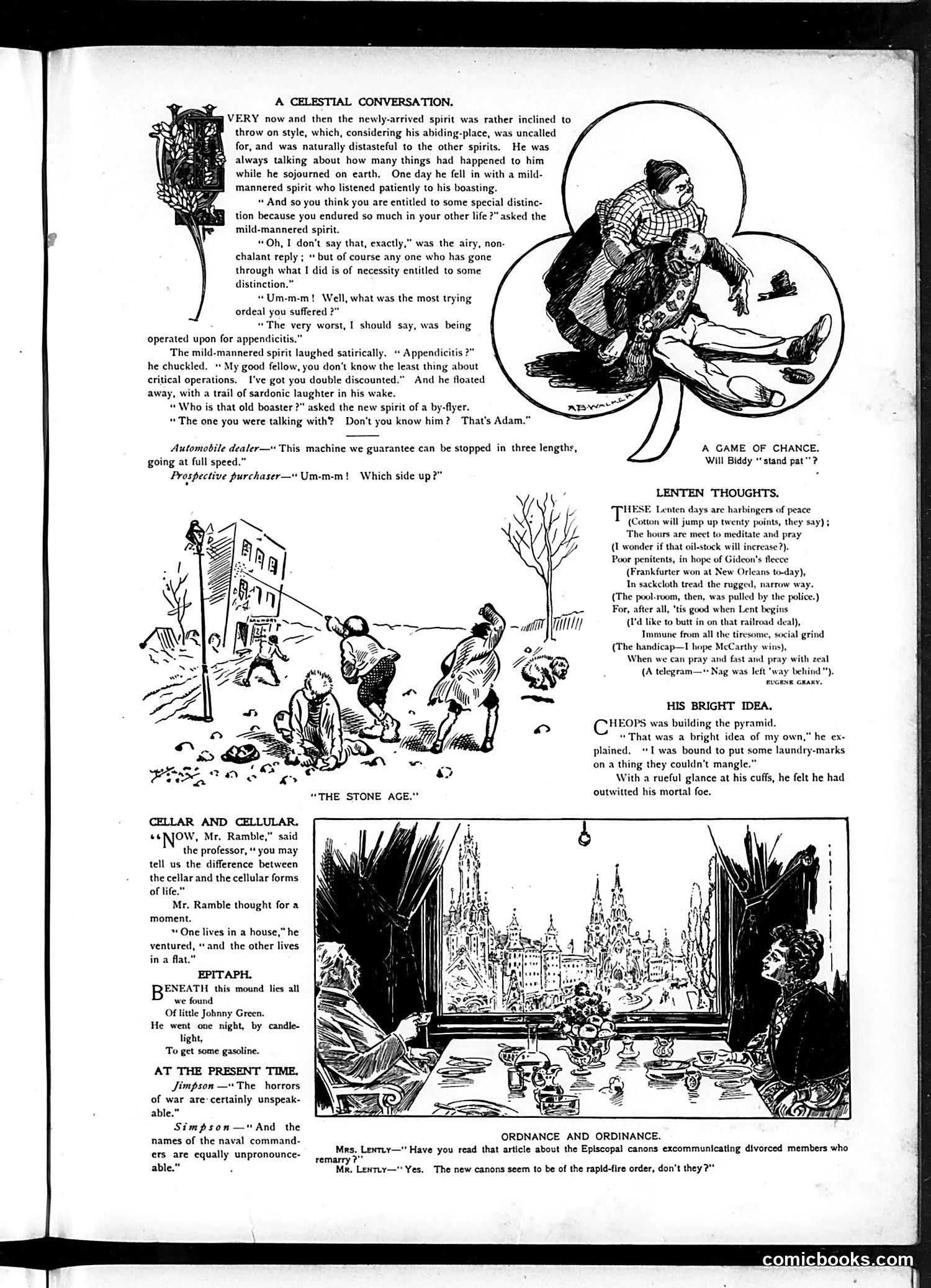
This page contains several satirical pieces typical of early-20th-century American humor: **"A Celestial Conversation"** presents a theological joke: a newly-deceased spirit brags about suffering an appendectomy on earth. An older spirit dismisses this as trivial suffering, revealing himself as Adam—implying that Adam's expulsion from Eden represents humanity's greatest ordeal, making all subsequent complaints seem petty. **"Lenten Thoughts"** satirizes hypocritical religiosity during Lent. While the formal text discusses spiritual preparation, parenthetical asides reveal the speaker's true preoccupations: stock prices, pool halls, horse racing, and business dealings—mocking those who perform piety while remaining entirely worldly. **"His Bright Idea"** jokes about Cheops (Egyptian pharaoh) building the Great Pyramid to prevent laundries from damaging his garments—absurdly comparing ancient engineering to modern domestic frustrations. Additional brief humor pieces mock automobile dealers, unclear etymology ("cellar" vs. "cellular"), and wordplay on "canons" (church law vs. artillery). The page reflects Judge's consistent satirical targets: hypocrisy, materialism, and pretension among middle-class Americans.
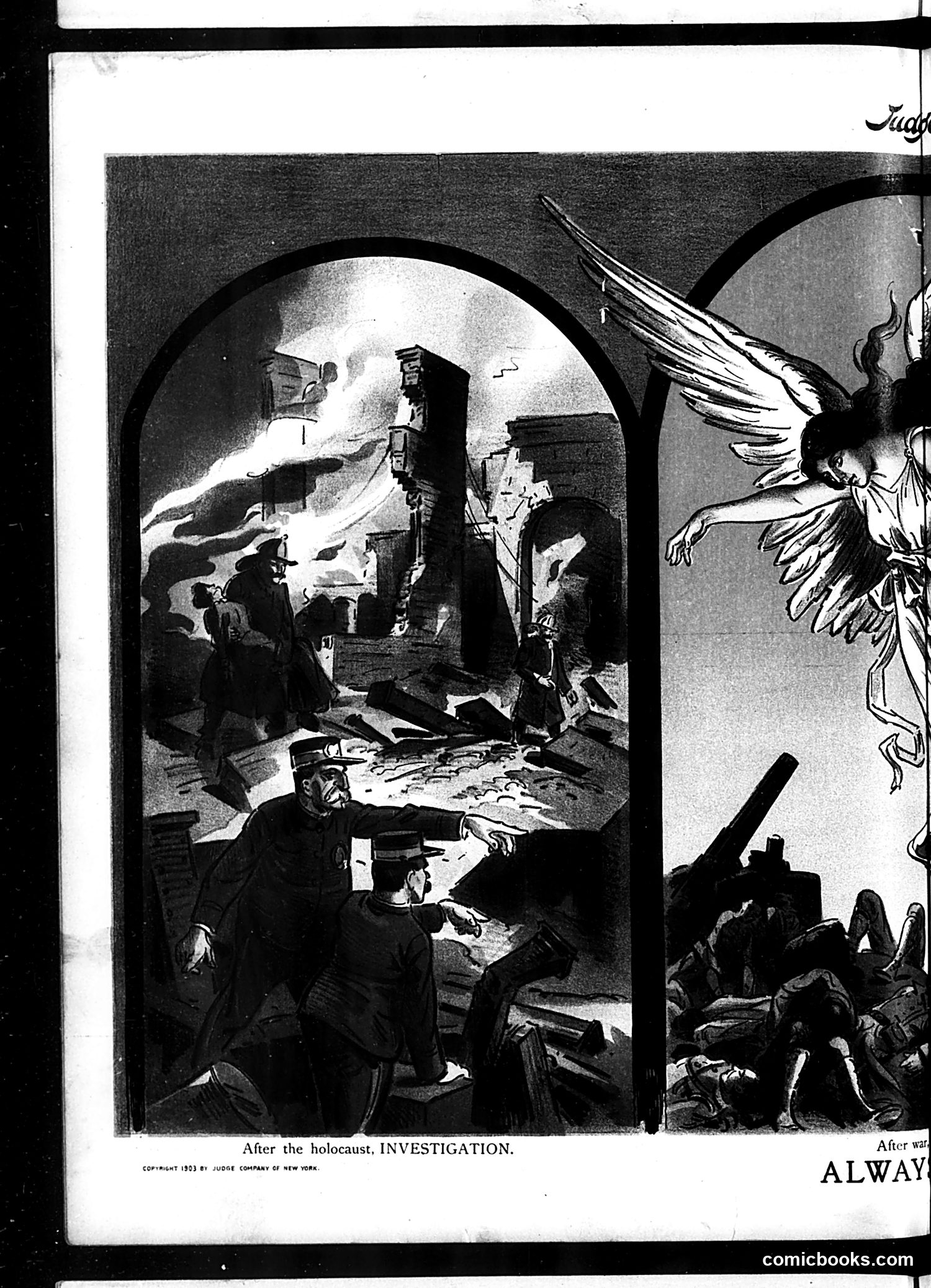
This 1903 Judge magazine cartoon depicts an official investigation into a major disaster ("the holocaust"). The arched frame shows investigators examining a devastated underground or enclosed space with bodies and rubble, while an angelic or allegorical figure hovers above on the right side—likely representing justice or truth seeking. The cartoon criticizes how authorities respond to catastrophes. The "investigation" appears sardonic: officials conduct inspections amid obvious tragedy, suggesting bureaucratic procedures are inadequate or performative when facing large-scale human suffering. The celestial figure watching over implies moral judgment on whether such investigations actually serve justice. Without the magazine's date and context, the specific disaster remains unclear, though major fires and industrial accidents prompted such satirical commentary in early 1900s America.
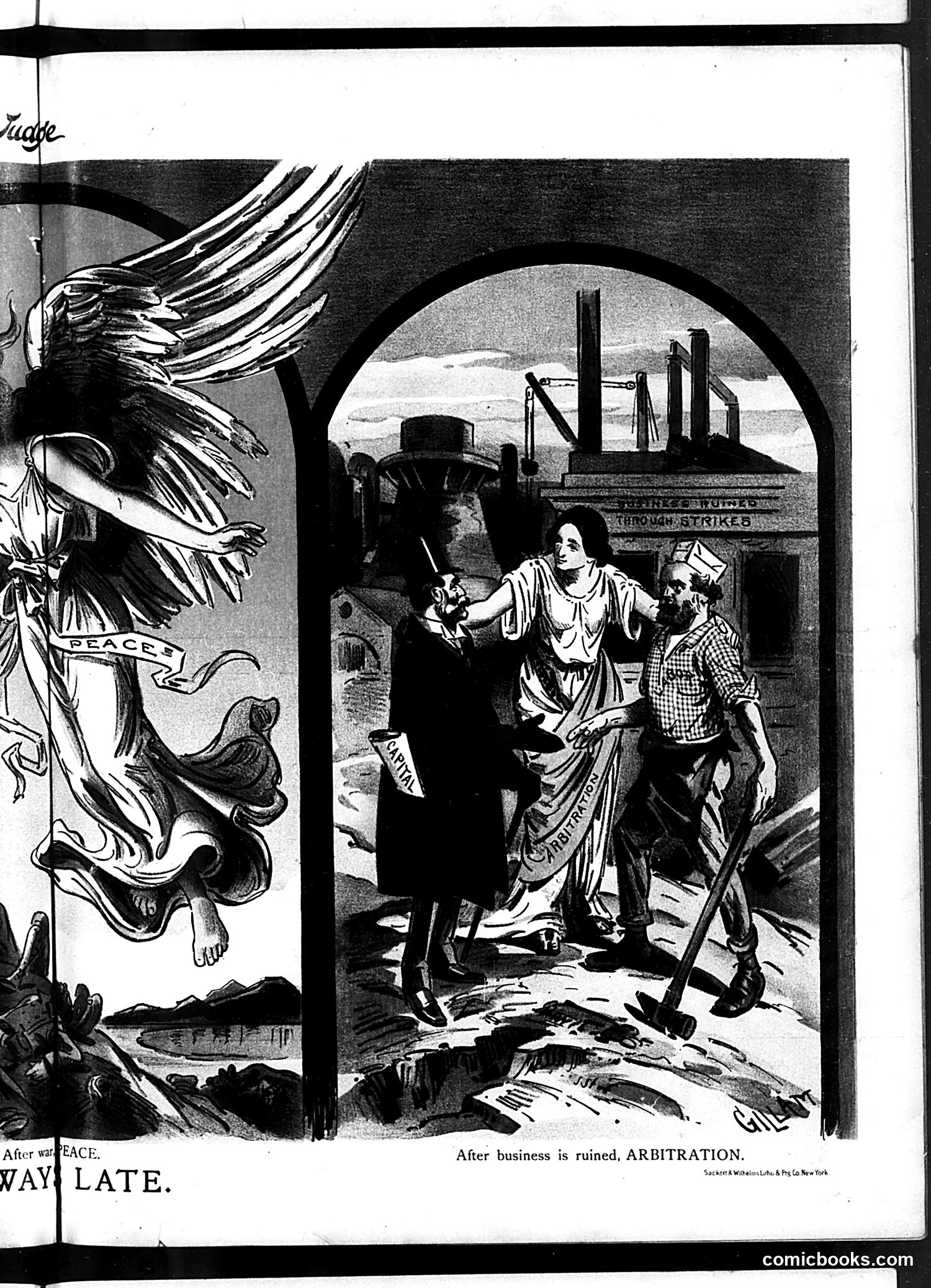
This **Judge** magazine cartoon depicts post-WWI disillusionment through two panels. **Left panel** ("After war PEACE"): Shows a winged Peace figure with a torch, labeled optimistically. **Right panel** ("After business is ruined, ARBITRATION"): Depicts industrial ruins with factory smokestacks in the background. A woman (likely representing Peace or Justice) gestures toward two men examining destroyed property and documents, suggesting they're engaged in arbitration proceedings over war damages. **The satire:** The cartoon critiques the gap between idealistic peace rhetoric and harsh economic reality. While WWI officially ended with talk of peace, the cartoon suggests that arbitration processes—meant to settle disputes fairly—arrive too late. Businesses lay in ruins, industrial capacity is destroyed, and arbitration cannot restore what war has demolished. It's a cynical commentary on the inadequacy of diplomatic solutions to remedy war's economic devastation.
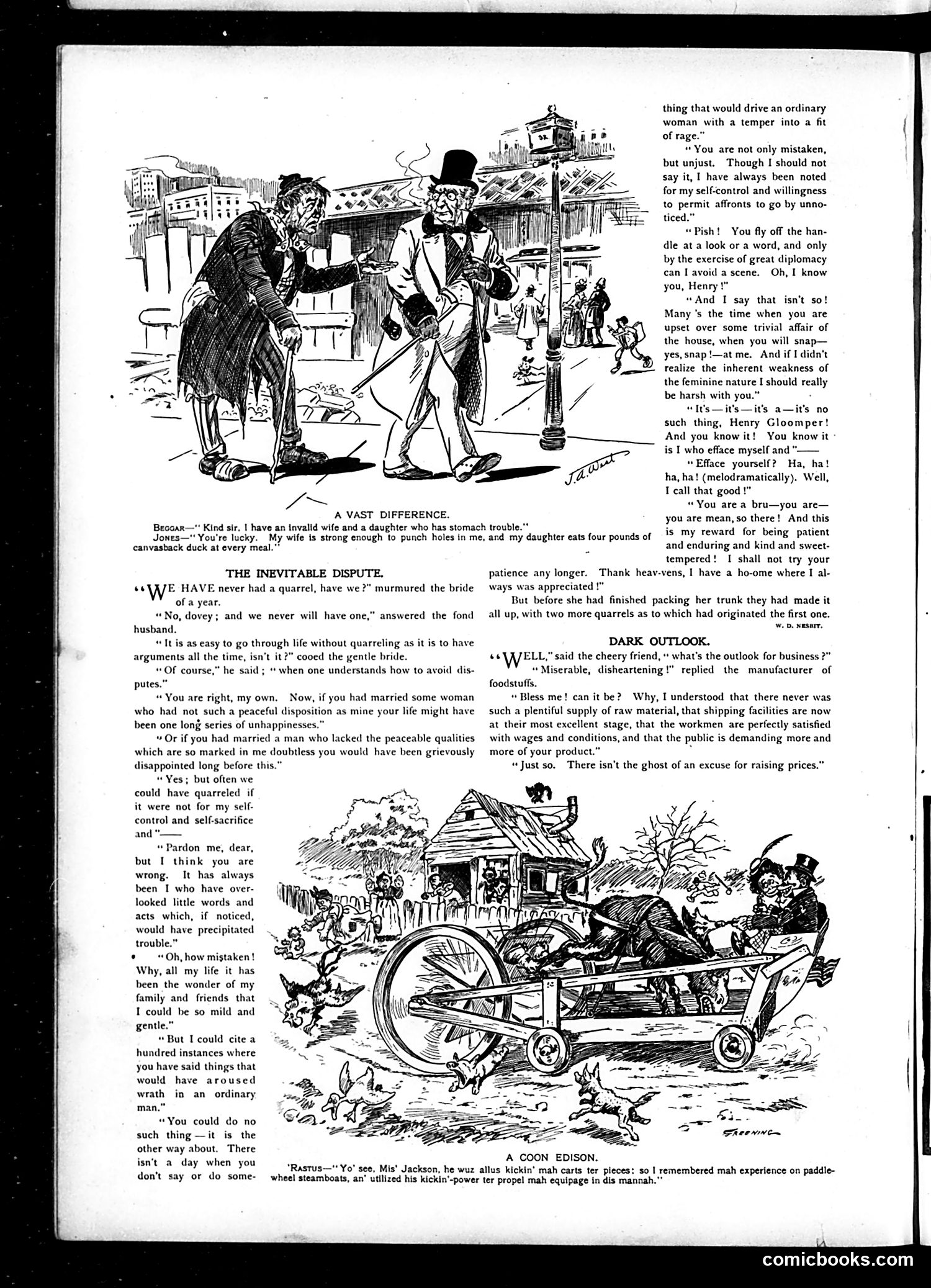
This page contains three satirical pieces typical of early-20th-century American humor: **"The Inevitable Dispute"** mocks newlyweds who claim never to quarrel. The joke is ironic: both husband and wife boast of their own patience and self-sacrifice while blaming the other's irritability, ultimately proving they *do* quarrel—about who caused their first quarrel. **"A Vast Difference"** presents a brief exchange where two men compare their wives' health: one has a sickly wife, the other a robustly aggressive one who "punches holes" in him and whose daughter has an enormous appetite. The humor lies in each man considering his situation fortunate. **"A Coon Edison"** uses period racist dialect to describe a Black man who harnesses his employer's tendency to kick things as propulsion for a cart—a crude pun on Edison and mechanical innovation. This reflects the deeply offensive racial caricature conventions of the era. The page illustrates Judge's mix of domestic satire, class commentary, and the casual racism endemic to turn-of-the-century American popular culture.
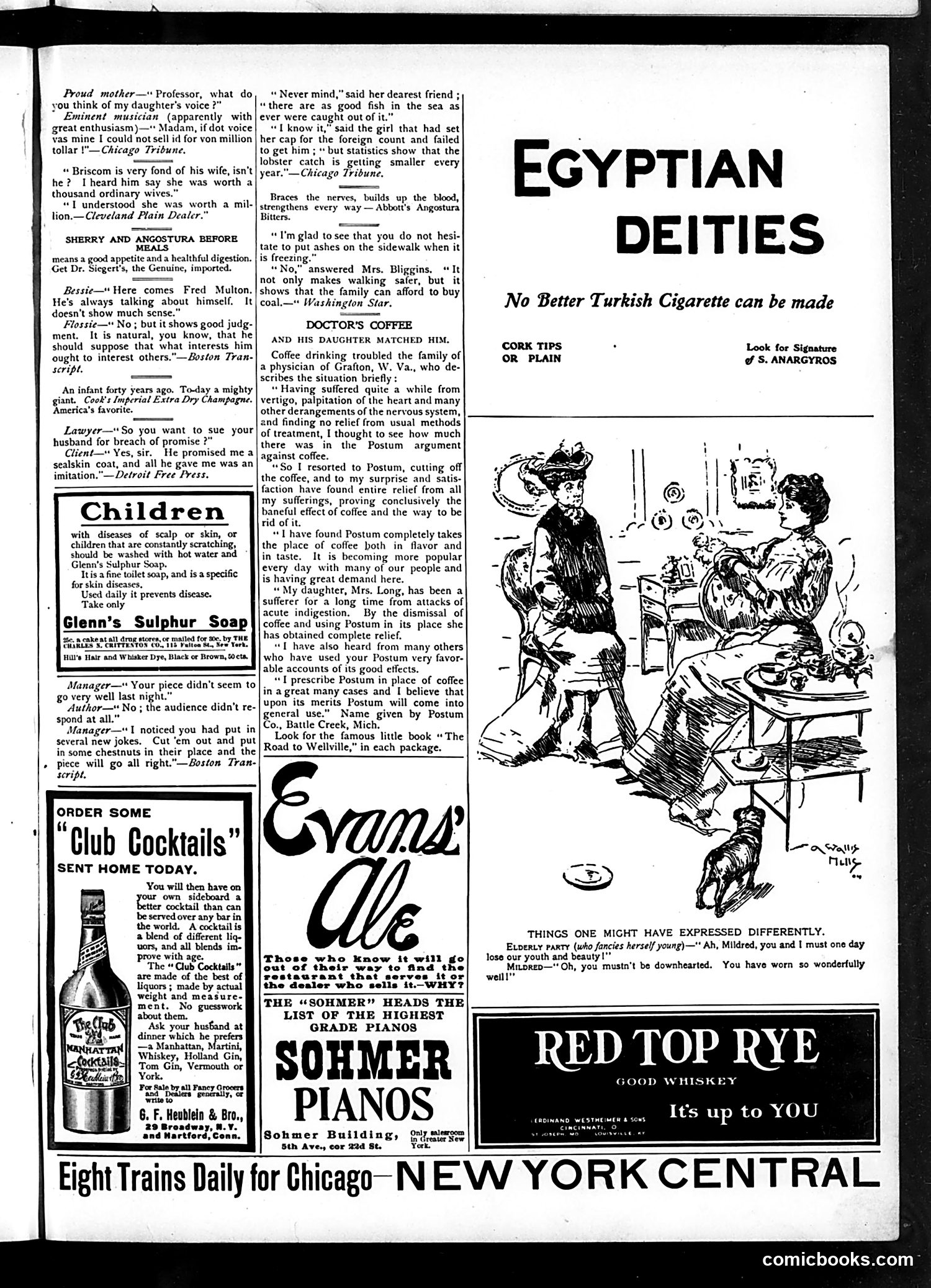
This page is primarily **advertisements with brief joke snippets** rather than political cartoons. The jokes reflect early 20th-century social attitudes: **Key content:** - A "proud mother" joke mocking a woman's belief in her daughter's singing talent - A joke about a wife's monetary "worth" to her husband - A lawyer-client exchange about a woman suing for a broken marriage promise over a fake fur coat (satirizing both dishonesty and materialism) - A manager advising an author to replace new jokes with "chestnuts" (old, tired jokes)—mocking theatrical mediocrity **Social commentary:** The jokes target women's vanity, materialism, and limited economic power, while also satirizing male indifference and failed romance. **Advertisements dominate:** For tonics, soaps, champagne, cocktails, pianos, whiskey, and notably **Postum coffee substitute**—a significant ad suggesting health concerns about caffeine were marketed aggressively in this era. The page reflects early 1900s Judge magazine's mix of mild satirical humor and commercial promotion, with gender dynamics typical of the period.
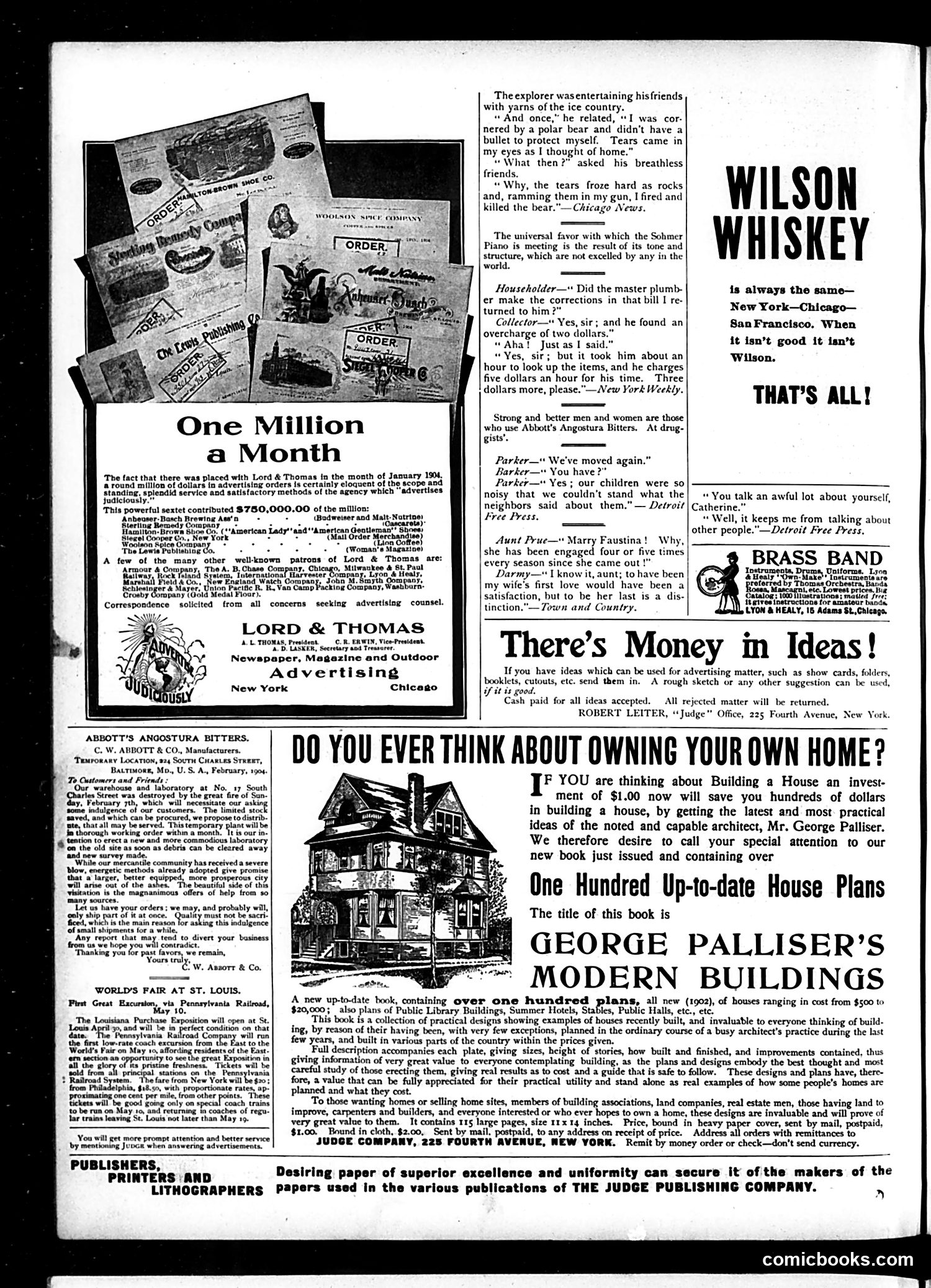
This page is primarily **advertisements and filler content** rather than political satire. The main elements: **Humorous Anecdotes**: Several brief jokes appear, including an explorer's tall tale about freezing tears to use as bullets, and domestic humor about plumbers' inflated bills. These are generic humor pieces typical of early 1900s magazines. **Major Advertising**: The dominant content advertises Lord & Thomas (an advertising agency claiming $750,000 in monthly orders), Abbott's Angostura Bitters, Wilson Whiskey, and George Palliser's Modern Building house plans. **"There's Money in Ideas"**: Judge solicits reader-submitted advertising ideas for payment—a common practice in magazines of this era. **Social Context**: References to exploring polar regions, home ownership, and moving houses reflect early 20th-century American concerns. The bitters advertisement suggests patent medicine was still mainstream. The page lacks coherent political cartoon commentary; it's essentially a magazine's mixed advertising and light entertainment content from 1904.
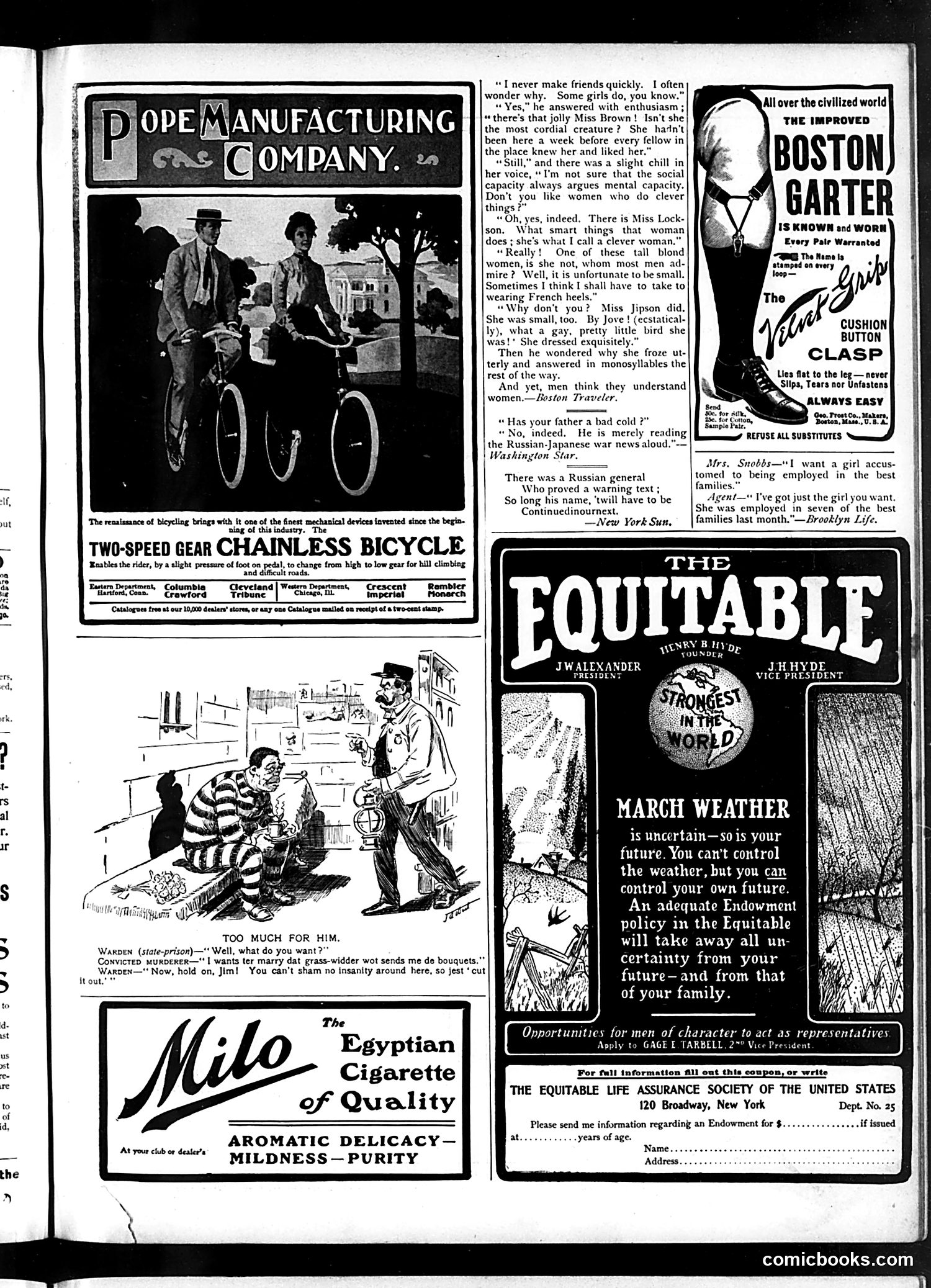
This page is primarily **advertisements and filler content** rather than political satire. The main elements are: **"Too Much for Him"** cartoon: A prison warden rejects a convicted murderer's request to marry a woman, dismissing his plea as a fake insanity claim. The joke relies on the darkly absurd scenario—a death-row inmate seeking marriage—treated as an obvious con. **Dialogue piece** (top right): A man unknowingly offends a woman by praising other women's social charm and attractiveness while criticizing her height. The satire targets male obliviousness to how backhanded compliments affect women, though the characterization of women as either "cordial" or "clever" reflects period gender assumptions. **Remaining content**: Product advertisements (Dope Manufacturing Company bicycles, Milo cigarettes, Boston Garter, Equitable Life Insurance) and minor filler pieces about Russian generals and prison life. The page lacks significant political commentary—it's typical of Judge's mix of humor, social observation, and commercial advertising from this era (appears early 1900s).
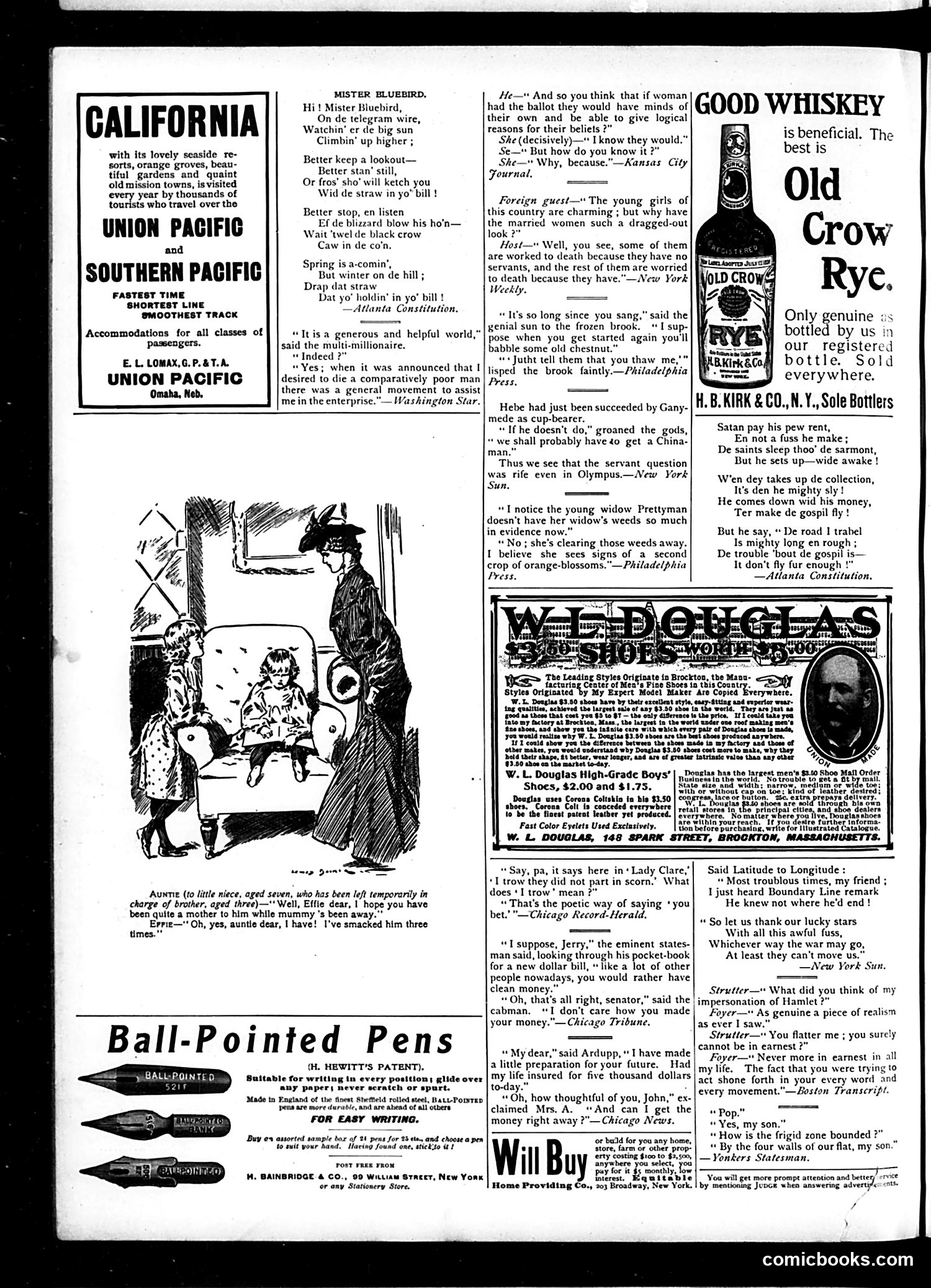
This page contains primarily **advertisements and filler content** rather than coherent political satire. The main illustrated cartoon shows an aunt addressing a young niece, praising her for acting motherly toward her younger brother. The child's response—"I've smacked him three times"—creates humor through the child's misunderstanding of what "mothering" means. This is gentle domestic humor, not political satire. The text snippets labeled "Mister Bluebird" and other titled pieces are **folk-style or dialect verses and short jokes**, touching on mild social observation: women's suffrage, generosity of the wealthy, servants, and marital life. They're humorous observations rather than sharp satire. The remaining space features **period advertisements** for railroad travel (Union Pacific/Southern Pacific to California), ball-pointed pens, Old Crow Rye whiskey, and W.L. Douglas shoes. There are **no identifiable political figures or events** depicted. This appears to be a standard issue of *Judge* magazine filled with light humor and advertising rather than focused satirical content.
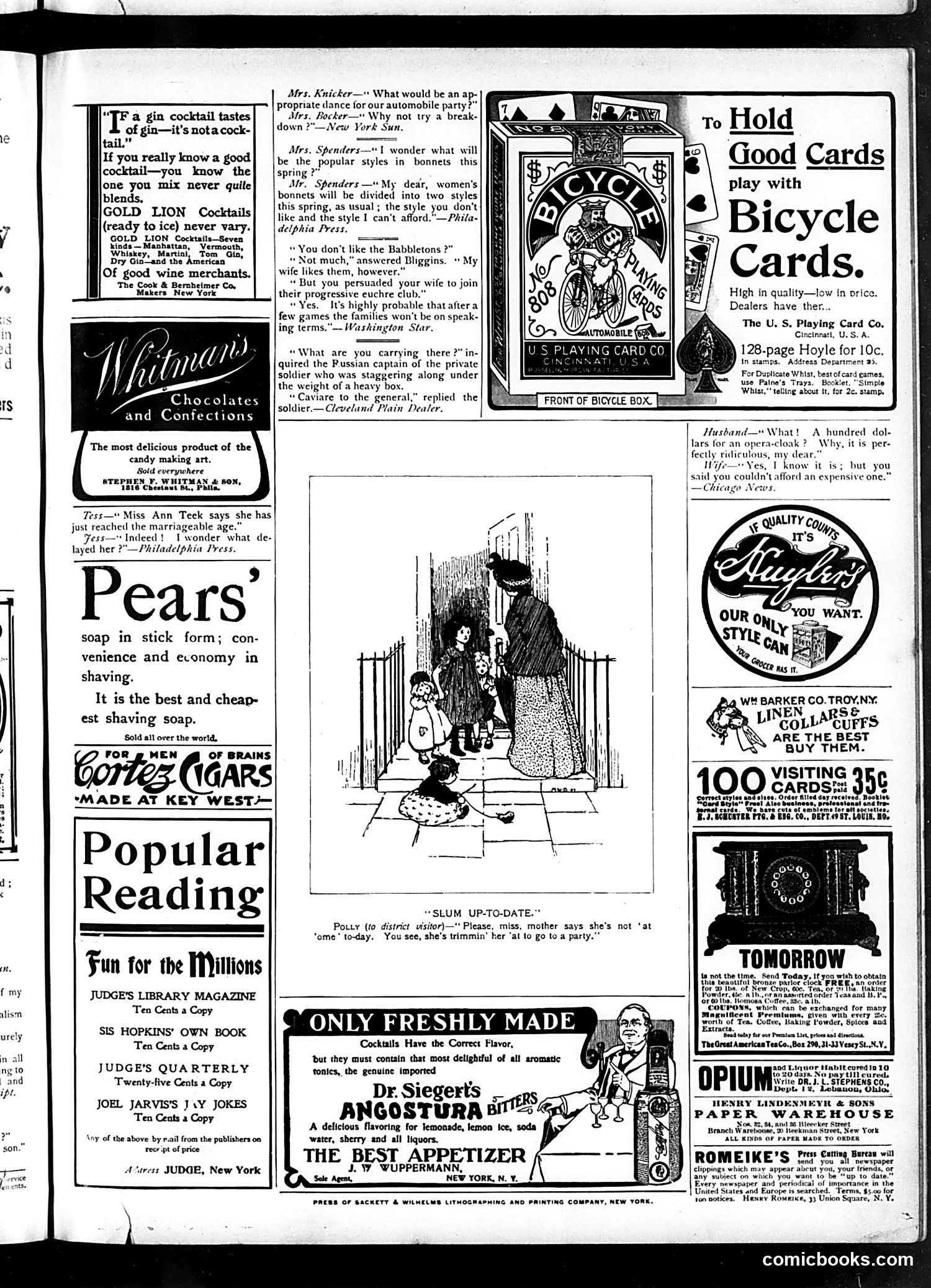
This single-panel cartoon satirizes working-class social climbing and pretension. The image shows a poor family (identifiable by their shabby clothing and humble tenement setting) attempting to host a formal party. A woman in worn dress serves refreshments to guests in what appears to be a cramped, poorly-furnished room. The caption—"Please, miss, mother says she's not 'at home' to-day. You see, she's trimmin' her 'at to go to a party"—reveals the joke: the mother is so eager to attend a social gathering that she's using a transparent excuse (claiming she's "not at home") to avoid receiving a visitor, all while frantically preparing her hat. The satire targets the aspirational behavior of poor urbanites trying to participate in middle-class social conventions they can barely afford. The humor comes from the absurdity of lower-class people adopting the pretenses and mannerisms of their social betters—"slum up-to-date" suggesting their clumsy, outdated mimicry of fashionable society life.
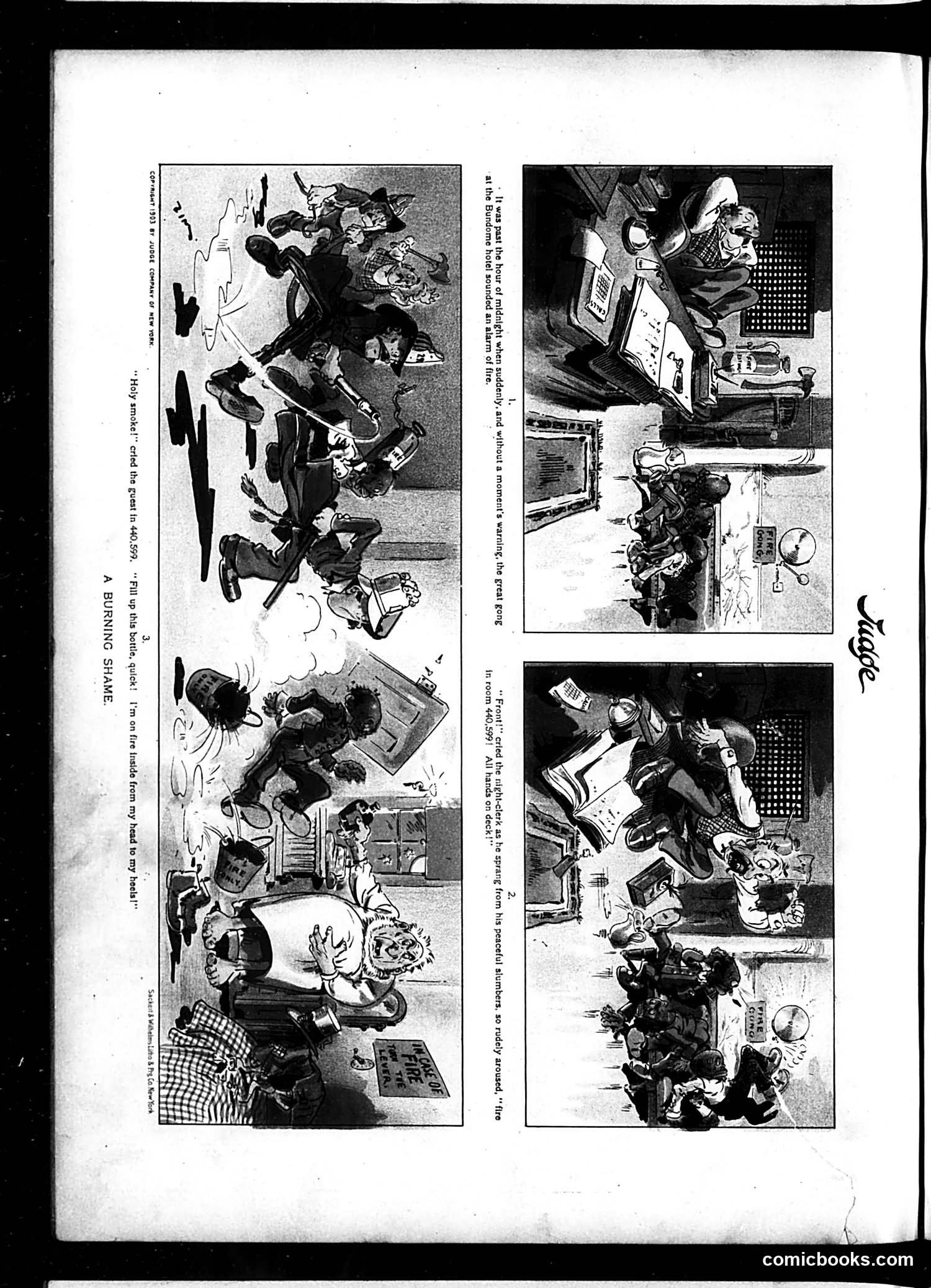
This 1903 comic strip satirizes hotel fire safety procedures through slapstick humor. When a fire alarm sounds at the "Bundome Hotel," chaos erupts as the night clerk mobilizes staff. The joke centers on a guest in room 440,599 who, upon hearing the alarm, misinterprets the emergency—believing he's experiencing internal combustion from alcohol consumption rather than an actual fire. His panicked demand to "fill up this bottle" with water (or presumably a drink) plays on the double meaning of being "on fire." The satire likely mocks both inadequate hotel safety protocols of the era and the intoxicated state of wealthy guests who might ignore genuine danger. "A Burning Shame" references both literal fire and the shameful condition of drunkenness, typical of Judge's moralistic humor criticizing excess and poor public safety standards.