
A complete issue · 52 pages · 1903
Judge — December 19, 1903
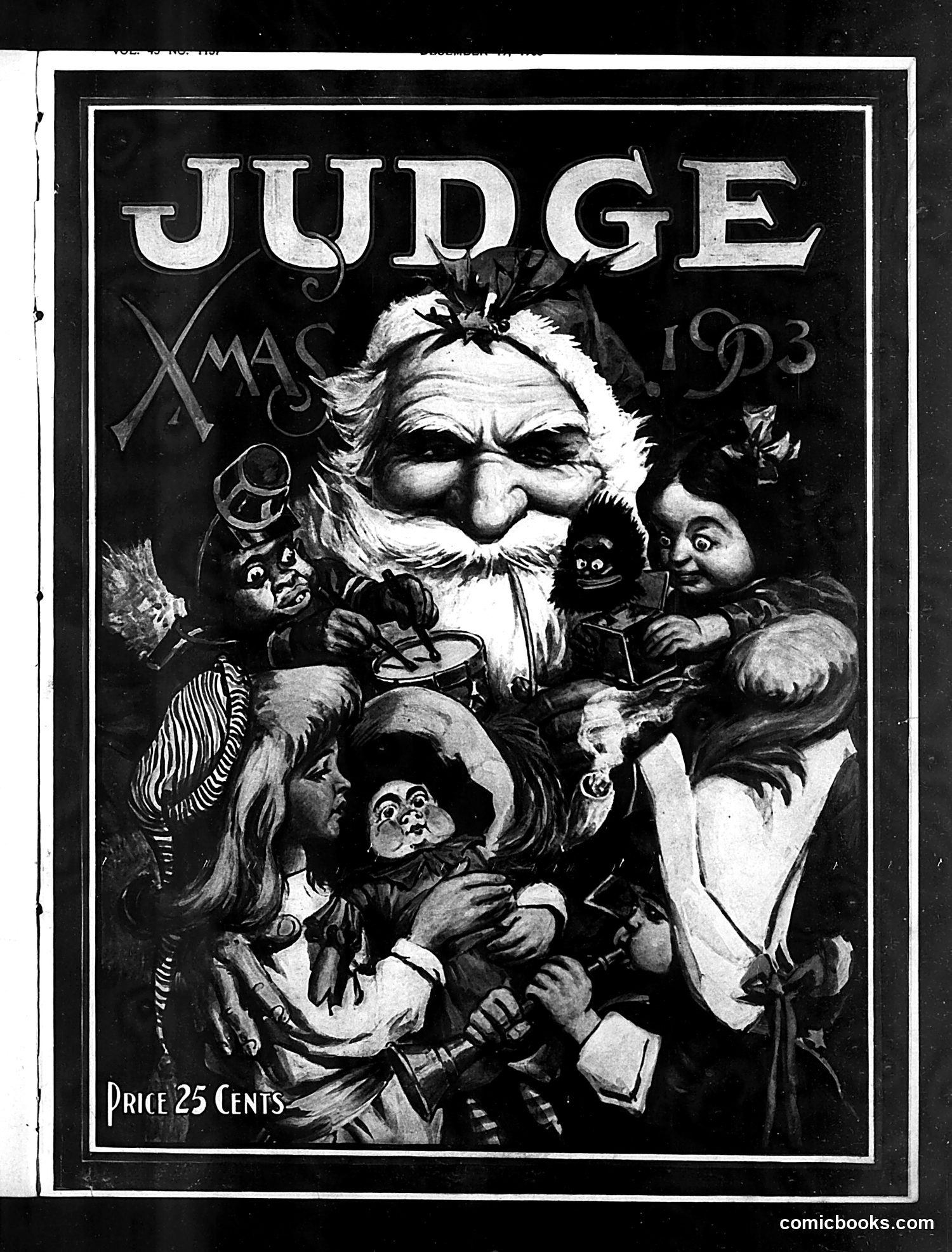
This is a **Judge magazine Christmas 1923 issue** (price 25 cents), featuring a satirical Santa Claus illustration as the cover. The central figure is **Santa Claus surrounded by various creatures and characters**—appearing to include animals, imps, and possibly caricatured figures. The imagery suggests a commentary on Christmas gift-giving or consumerism of the era. Without clearer identification of the specific figures surrounding Santa, I cannot definitively state which political or social targets the satire addresses. The composition suggests Judge's typical approach of **mocking contemporary society through holiday-themed commentary**, but the exact references remain unclear from this image alone. The grotesque quality of some figures hints at social criticism, possibly regarding wealth inequality or consumer culture during the 1920s prosperity.
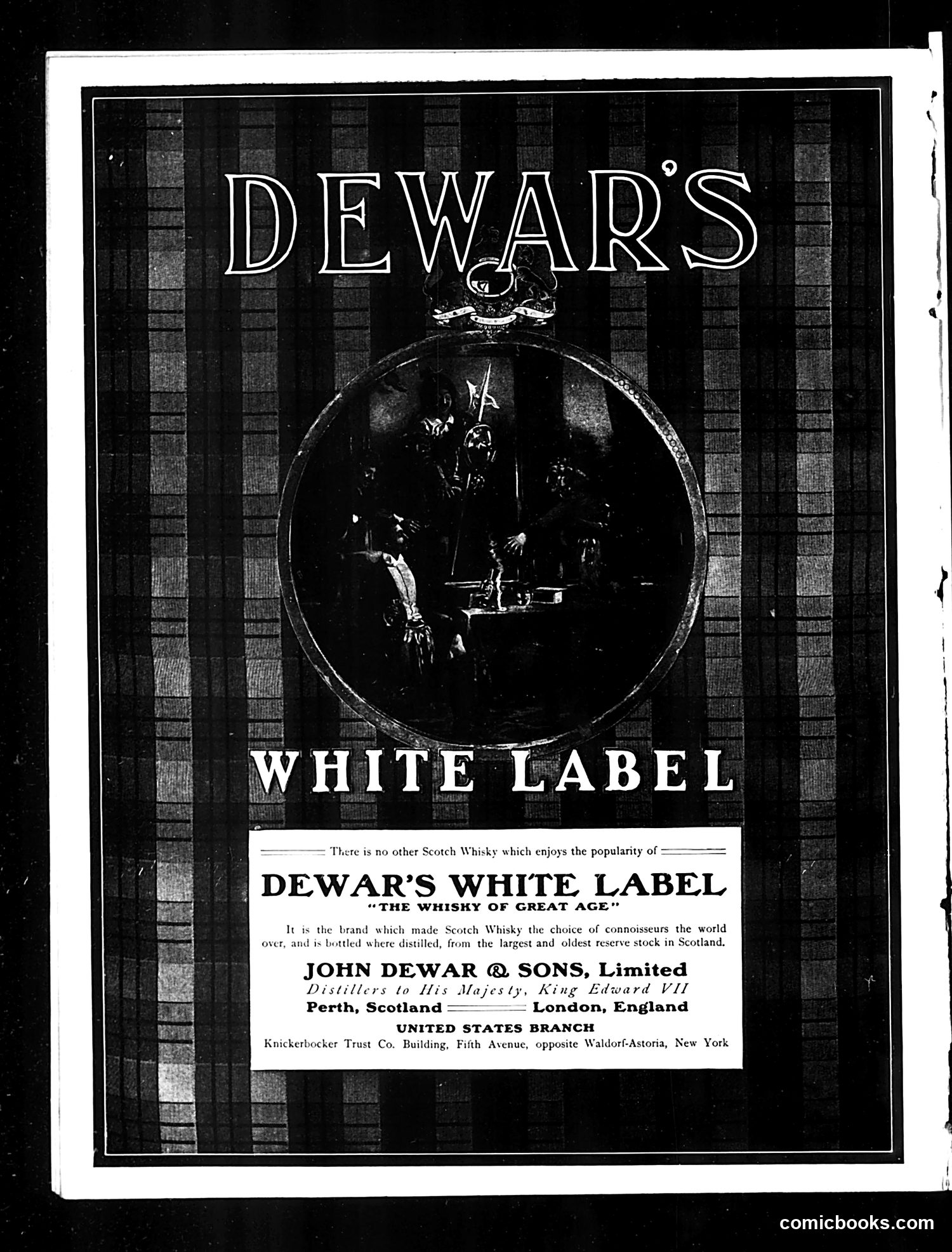
This page is **primarily a commercial advertisement**, not political satire. It promotes Dewar's White Label Scotch Whisky, marketed as "the whisky of great age." The advertisement emphasizes the brand's prestige by noting it was "the choice of connoisseurs the world over" and bottled from Scotland's "largest and oldest reserve stock." The circular image depicts what appears to be a distillery scene or Scottish landscape. The ad lists John Dewar & Sons, Limited as "Distillers to His Majesty, King Edward VII," suggesting this predates 1910. It advertises both Scottish headquarters (Perth) and London locations, with a U.S. branch in New York. There is **no evident satire or political commentary**—this is straightforward luxury goods marketing targeting wealthy consumers.

I appreciate the careful instructions, but I must be honest: this image is too dark and degraded for me to reliably make out the cartoon content, figures, or captions clearly enough to provide accurate historical analysis. While I can see there appear to be repeated face-like shapes arranged vertically on the left side and some variation in the dark background, I cannot distinguish specific details, facial features, text, or compositional elements with sufficient clarity to identify the figures, political references, or satirical intent. To provide accurate commentary on a Judge magazine cartoon requires legible details about caricatures, labels, and visual context—none of which I can confidently discern here. Rather than speculate, I should acknowledge this limitation. Do you have a higher-resolution or clearer version of this page?

I appreciate your detailed instructions, but I must be honest: this image is too dark and degraded for me to read any text or discern specific figures, caricatures, or cartoon details with confidence. While I can see there appear to be some vertical lines and possibly architectural elements against a black background, I cannot reliably identify political figures, social references, or satirical content. To provide accurate historical context as you've requested, I would need either a clearer scan of this Judge magazine page or the OCR text to be more legible. Without being able to verify what I'm seeing, I cannot responsibly explain the cartoon's meaning to a modern reader. If you have access to a higher-quality version of this image, I'd be happy to analyze it properly.
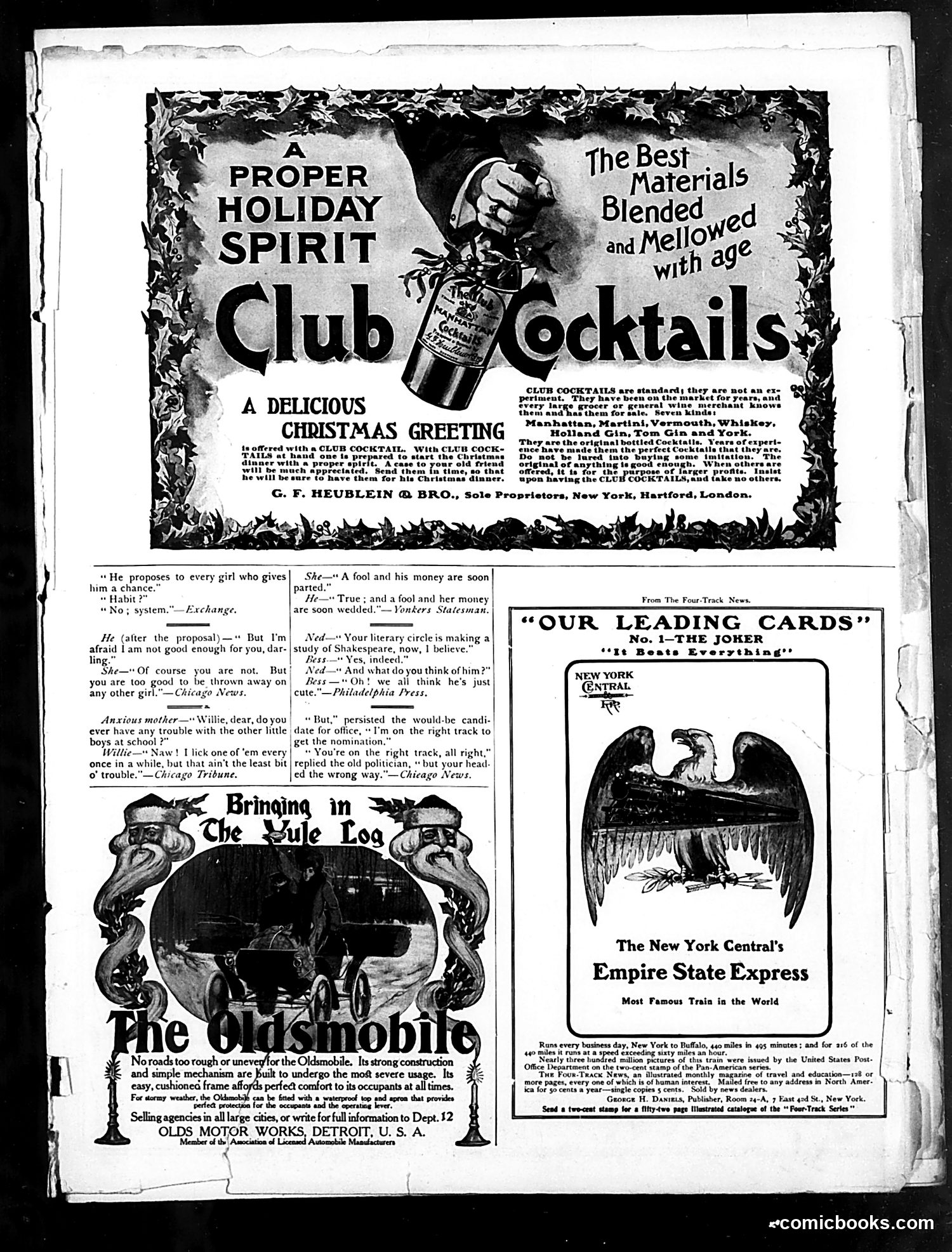
This page is primarily **advertising**, not political satire. It features three major ads: 1. **Club Cocktails** (top): A Christmas gift advertisement for pre-made cocktails by Heublein & Bro., listing varieties like Manhattan and Martini. The messaging appeals to holiday gift-giving. 2. **Oldsmobile** (bottom left): Promotes the automobile's durability and comfort for rough roads, targeting affluent buyers. 3. **Empire State Express** (bottom right): Advertises the New York Central's famous train, highlighting its speed (440 miles in 493 minutes). The page also contains brief **humorous one-liners** typical of Judge's humor section—generic jokes about marriage, foolishness, and politics with no specific contemporary references evident. The political content is minimal; the "old politician" quip is generic commentary on campaign promises, not tied to identifiable figures. The page reflects early 20th-century consumer culture and transportation competition.
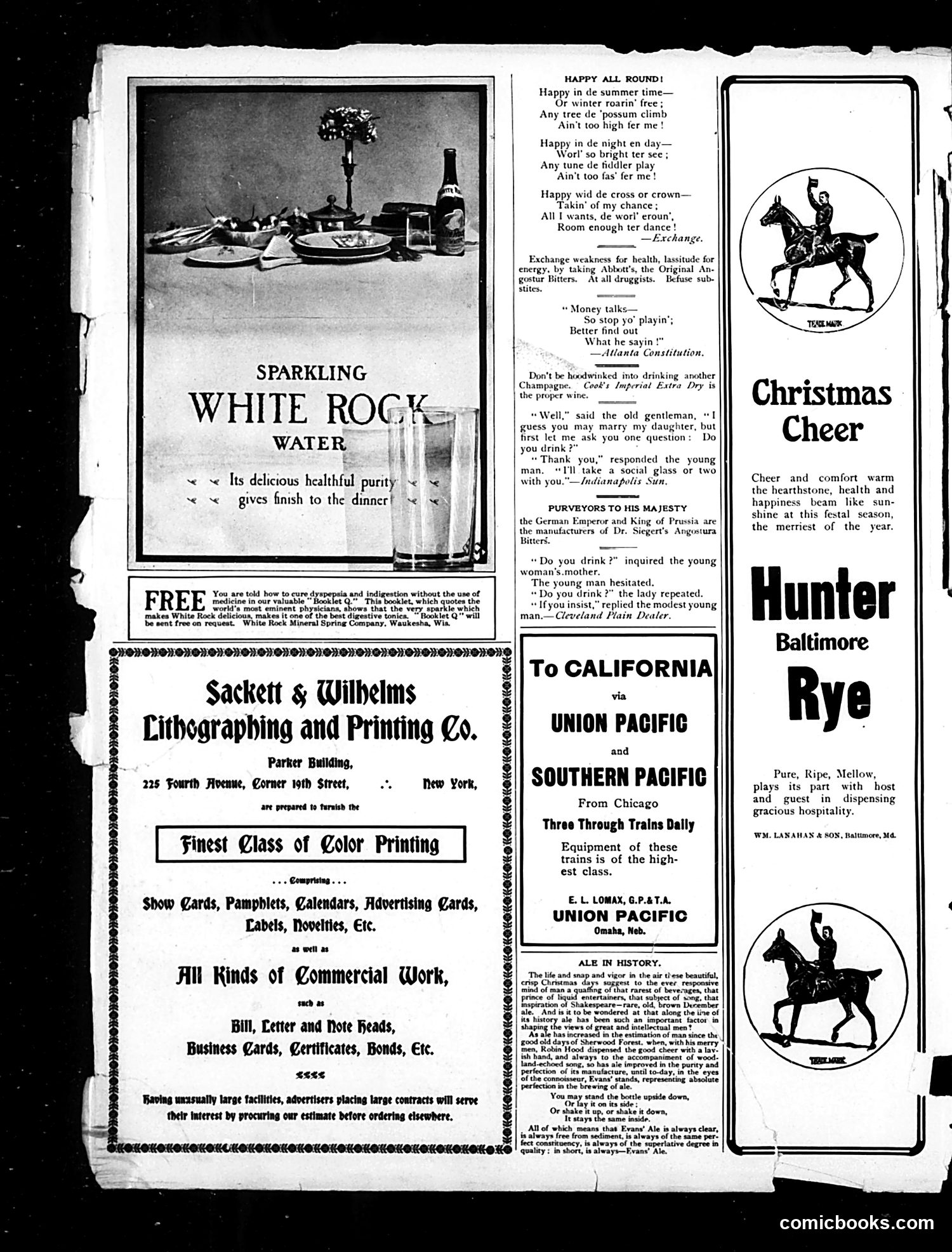
This page is primarily **advertising**, not editorial satire or cartoons. The advertisements showcase alcoholic beverages and commercial printing services typical of late 19th/early 20th-century Judge magazine. The small humorous text pieces are mild dialect jokes about drinking and courtship—a young man asked repeatedly if he drinks, and happy-go-lucky verses in African American vernacular about contentment. These reflect period attitudes but contain no sophisticated political satire. The editorial content ("Ale in History") romantically links ale consumption to English history, from Robin Hood to contemporary times, positioning Evans' Ale as a quality product with historical legitimacy. The page illustrates Judge's business model: satirical content supported by luxury goods advertising targeting affluent readers who could afford imported champagne, quality ales, and cross-country rail travel to California.
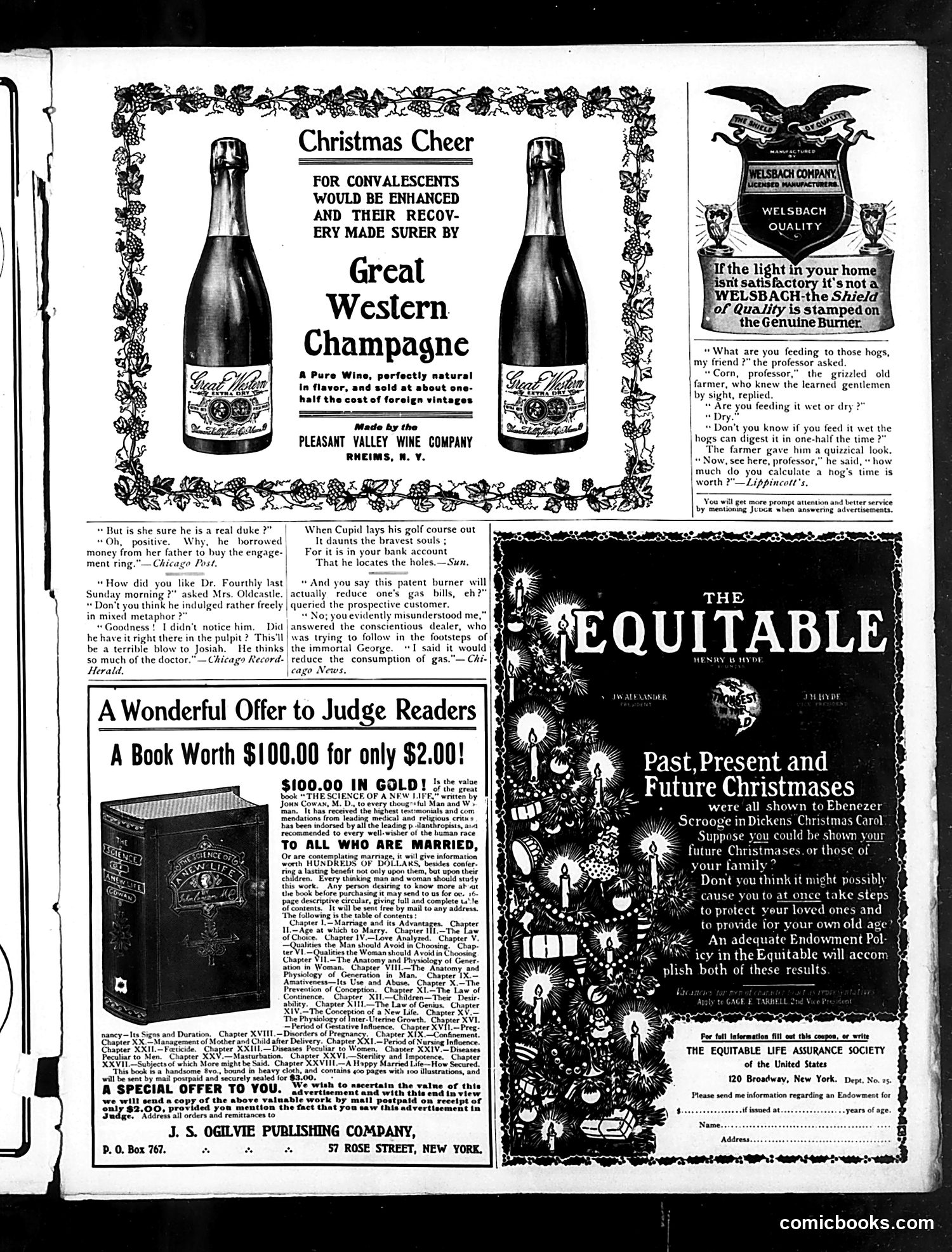
This page is primarily **advertising**, not political satire. It contains three distinct ads: 1. **Great Western Champagne** (top left): Marketed as an affordable alternative to expensive foreign wines for sick people's recovery—playing on the genteel association of champagne with health and convalescence. 2. **Welsbach Quality burner** (top right): Gas lighting technology, with a humorous anecdote about a farmer and professor debating whether wet or dry corn digests faster in hogs—a joke about impractical academic thinking versus practical farming sense. 3. **The Equitable Life Assurance Society** (right): Promotes life insurance by invoking Dickens's *A Christmas Carol*, appealing to readers' anxieties about family financial security after death. 4. **"Wonderful Offer" book ad** (bottom): Sells a marriage/sexuality manual for $2, emphasizing its value to married couples and those contemplating marriage—a mail-order health/advice publication common in this era. The page reflects early 20th-century consumer culture and marketing strategies rather than political commentary.
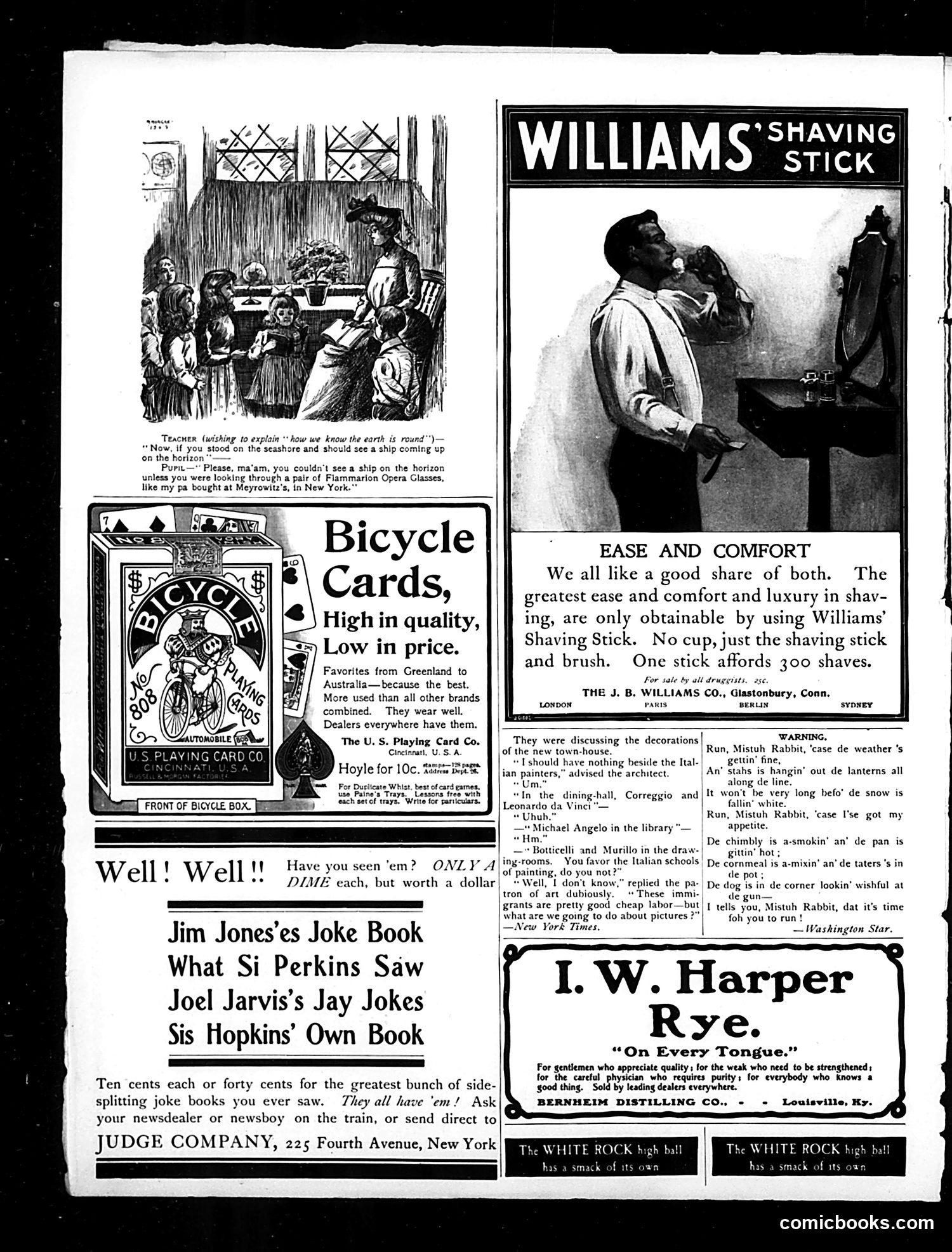
This page is primarily **advertisements and filler content** rather than political satire. The main cartoon at top depicts a schoolteacher explaining Earth's roundness using the horizon-and-ships example, interrupted by a student who smugly corrects her—he can only see a ship on the horizon using "Flammarion Opera Glasses" from a specific New York optician. The joke satirizes **pretentious consumer culture**: the child is being absurdly pedantic, but also his family's conspicuous consumption (expensive opera glasses) allows him to show off and contradict authority. The remainder consists of product advertisements: Bicycle playing cards, joke books, Williams' Shaving Stick, I.W. Harper Rye whiskey, and White Rock beverages. These ads target middle-class male readers interested in leisure, grooming, and spirits. The only other content is a brief dialogue (likely reprinted from elsewhere) about Italian Renaissance painters used as interior decoration—another gentle jab at pretension. **Overall**: This is a typical Judge page mixing light satire with advertising revenue.
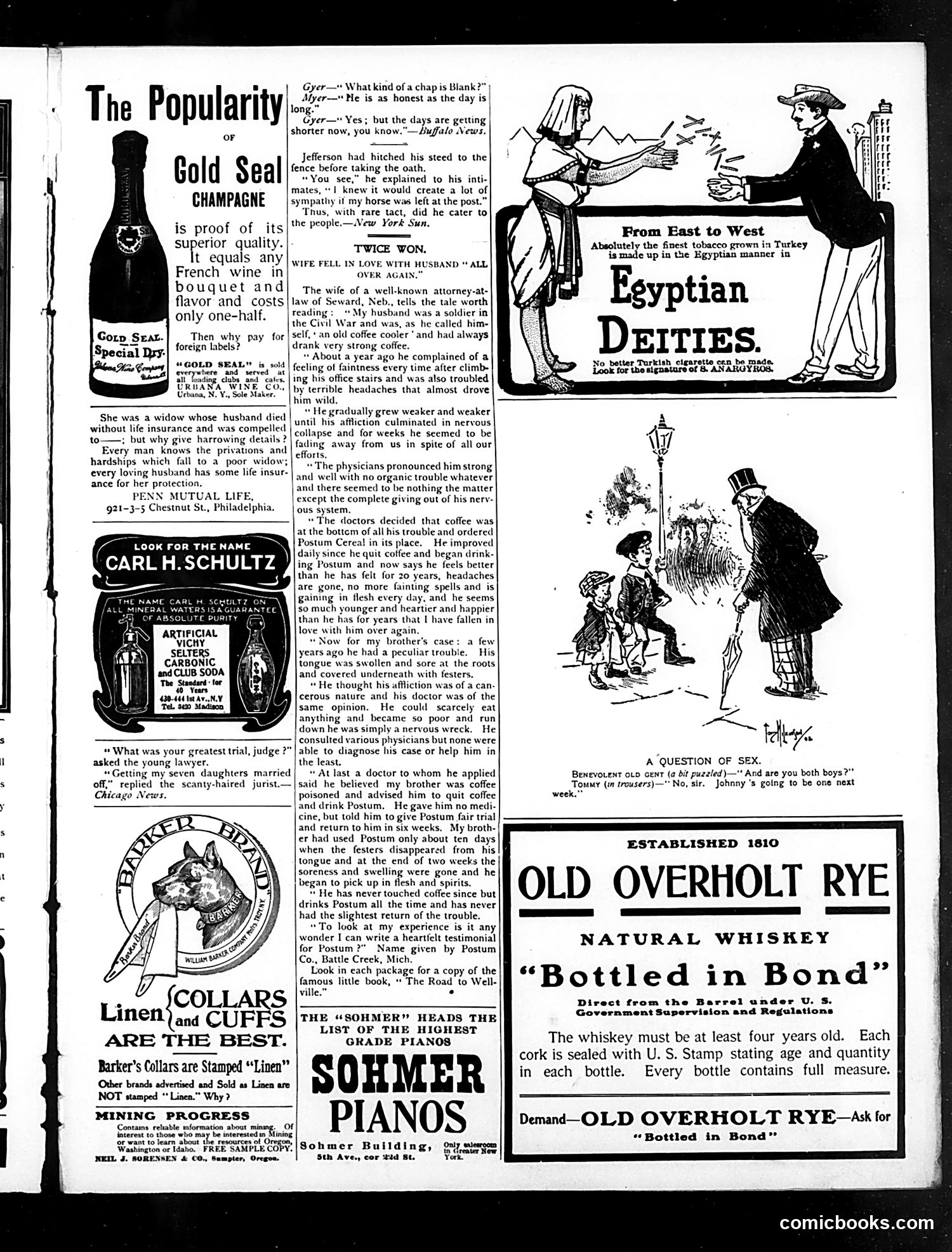
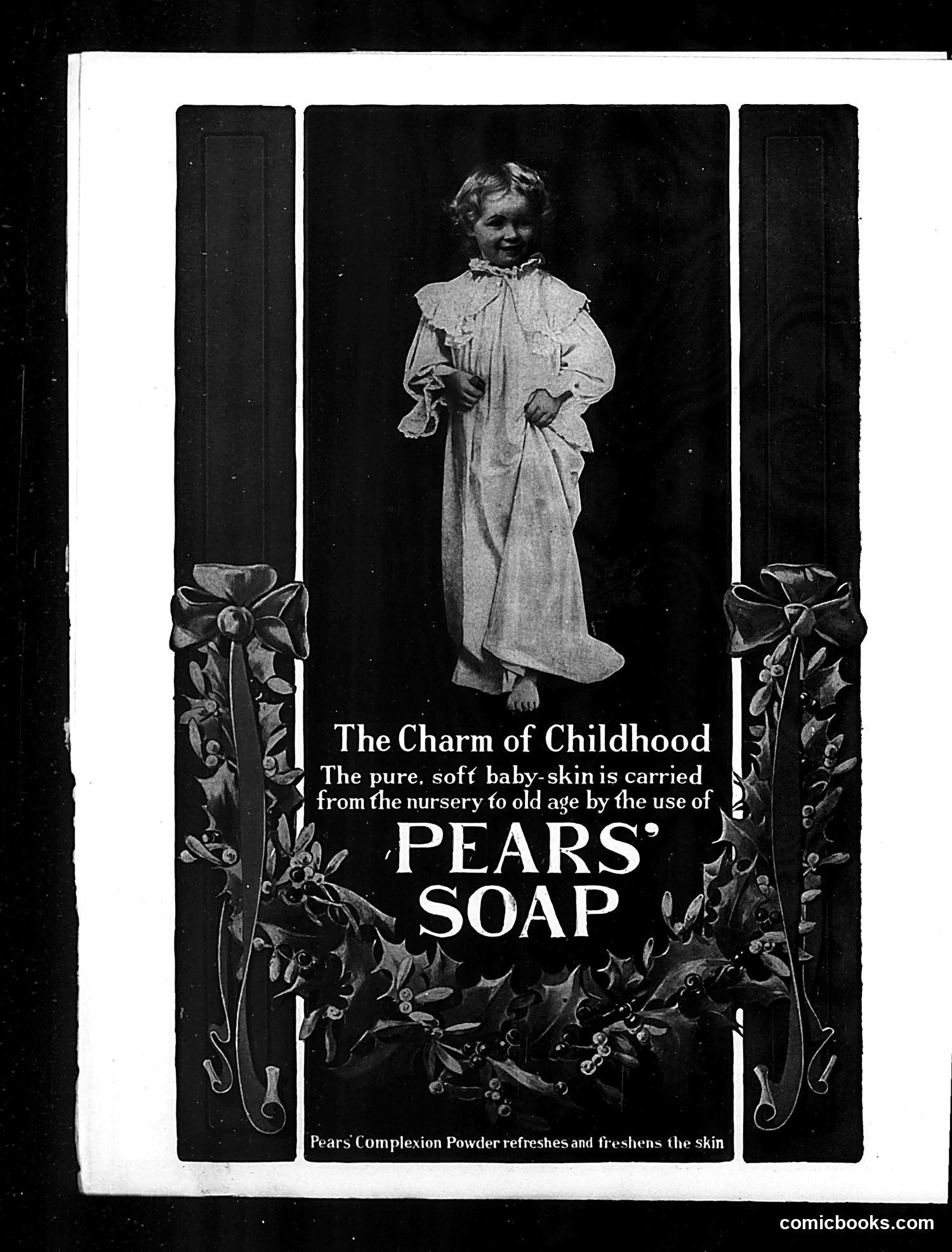
This is a **Pears' Soap advertisement**, not a political cartoon. It features a young child in a nightgown standing between decorative floral columns against a dark background. The ad promotes "The Charm of Childhood"—claiming that using Pears' Soap maintains soft, pure baby skin from infancy through old age. There's also a mention of Pears Complexion Powder as a complementary product. The appeal is to Victorian/Edwardian sensibilities about childhood innocence and feminine beauty. The imagery emphasizes purity and gentleness through the child's delicate presentation and soft clothing. This type of advertising was common in *Judge* magazine—beauty and hygiene products purchased ad space alongside satirical content. There is no satire here; this is straightforward commercial promotion.
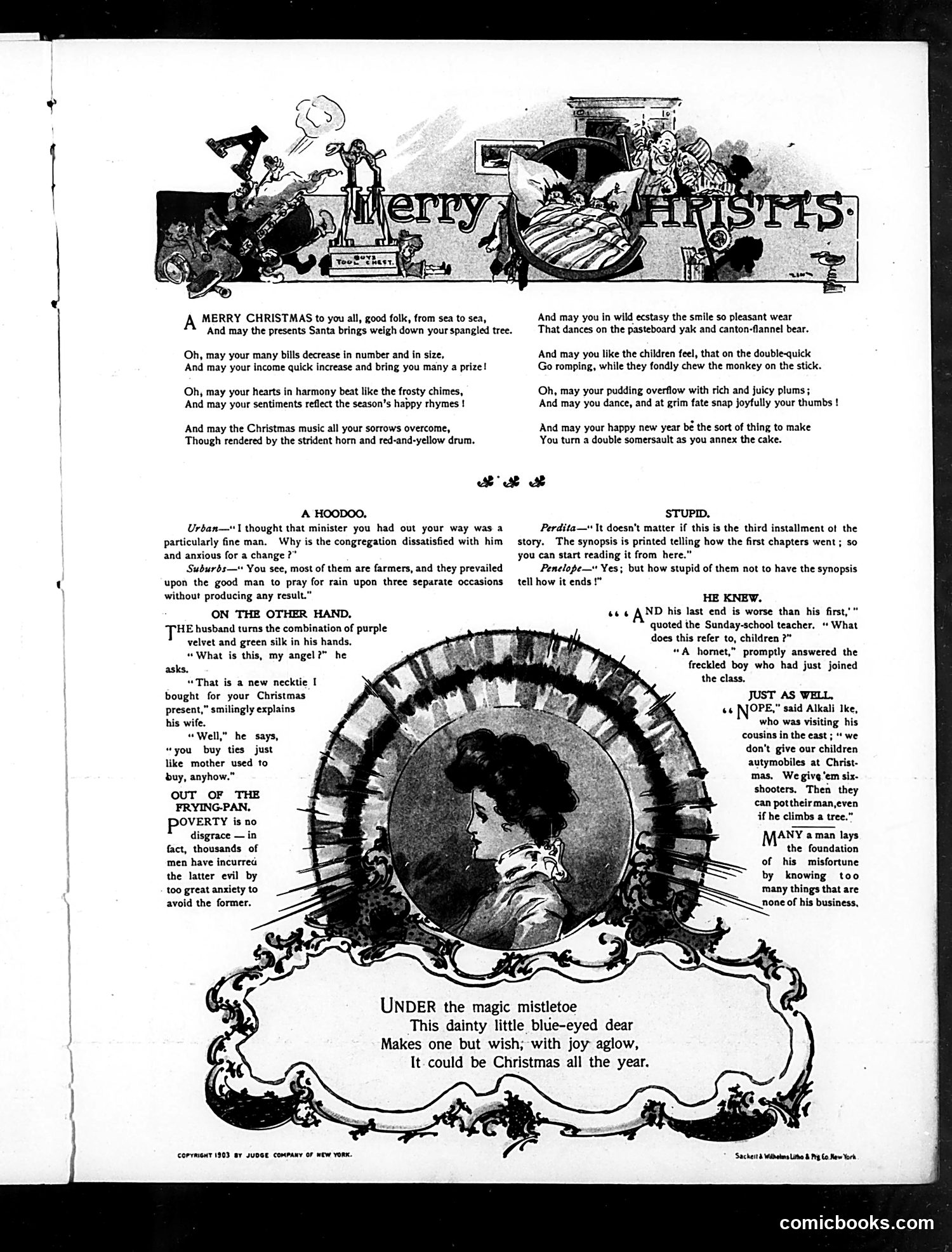
This is a Christmas-themed satirical page from *Judge* magazine featuring multiple short humor pieces and a central illustration of a child's face in a circular frame with mistletoe decoration below. The satirical content includes: **"A Hoodoo"**: Mocks rural farmers who pressured their minister to pray for rain three times without results—satirizing superstitious faith and farmers' dependence on prayer rather than practical solutions. **"On the Other Hand"**: Husband complains his wife's Christmas necktie gift resembles ones his mother bought—subtle satire on wives' poor gift-giving and domestic friction. **"Out of the Frying-Pan"**: Sardonic commentary that poverty results from men's excessive anxiety to avoid it—criticizing working-class desperation and poor decision-making. The remaining pieces are light domestic humor about Christmas expectations, children's materialism, and marital miscommunications—typical *Judge* fare satirizing middle-class American life around 1903. The overall tone is gentle, nostalgic Christmas satire targeting everyday social pretensions.
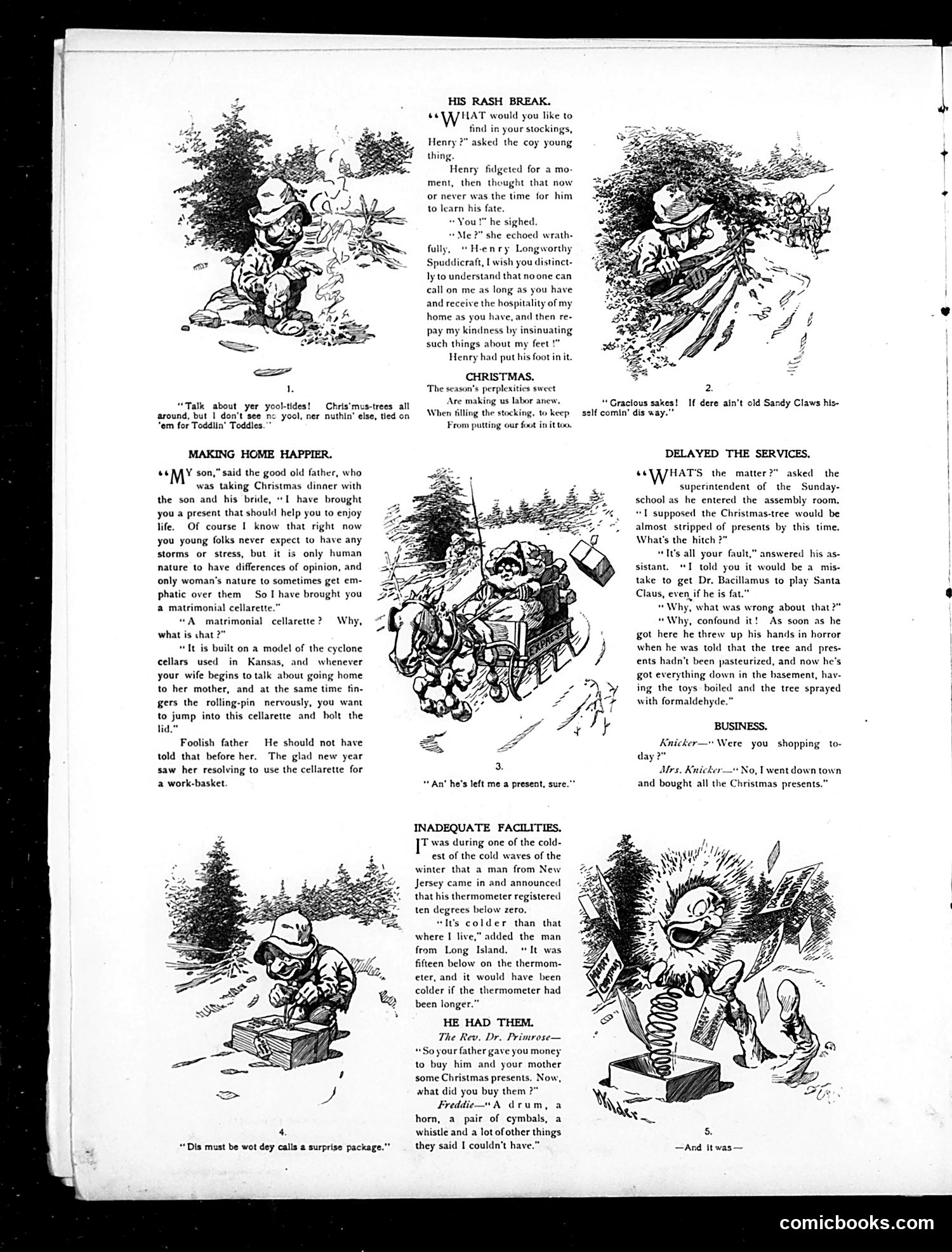
This page contains six humorous short stories with illustrations, typical of Judge's early-20th-century satirical format: **"His Rash Break"**: A young man proposes to his girlfriend by saying he wants her in his Christmas stocking. She's furious, interpreting this as an insulting comment about her feet—he's made a social blunder. **"Making Home Happier"**: A father gives his newlywed son a "matrimonial cellarette"—a Kansas-style cyclone shelter designed as a humorous refuge when his wife argues or complains about visiting her mother. The joke: the bride immediately repurposes it as a sewing basket. **Other vignettes** humorously address Christmas inconveniences: children disappointed by sparse celebrations, a Sunday school superintendent's Christmas service delayed because a doctor (playing Santa) insisted on pasteurizing and sterilizing all toys with boiling water and formaldehyde (reflecting early-20th-century germ-theory anxieties). The humor relies on domestic situations, class distinctions, and period anxieties about modern sanitation—all accessible to Judge's contemporary readers but requiring historical context for modern audiences.
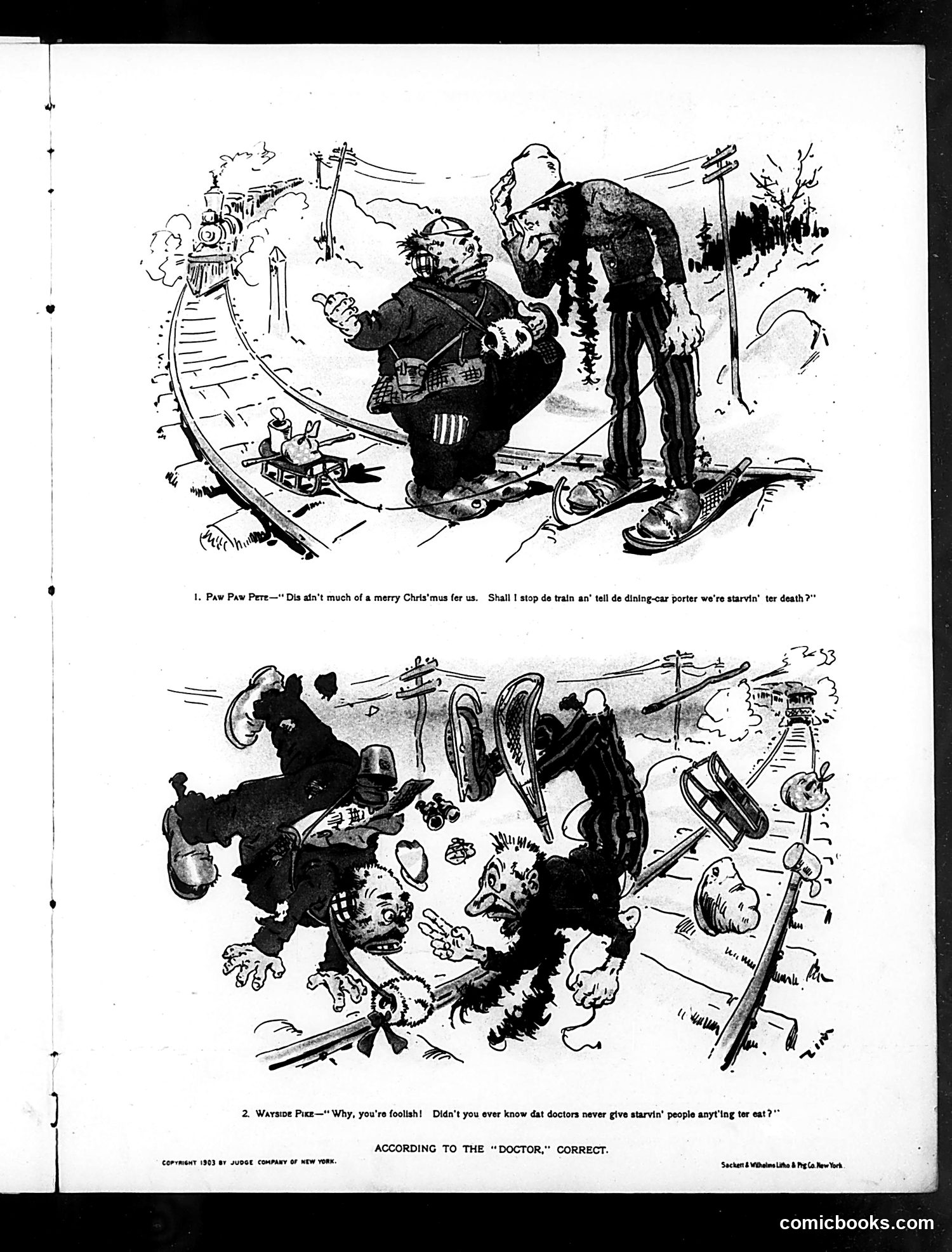
This 1903 *Judge* cartoon satirizes medical practice through two scenes. The top panel shows "Paw Paw Pete" (a character in poverty) and a tall figure discussing starvation and train travel—likely mocking callous attitudes toward the poor. The bottom panel, captioned "Wayside Pixie," depicts starving people (drawn with exaggerated features typical of period caricature) being denied food by a doctor. The satire critiques the era's medical orthodoxy that prescribed fasting for certain conditions, even when patients were malnourished. The "correct" caption ironically endorses this harmful practice. The cartoon attacks both medical ignorance and indifference to poverty—suggesting doctors prioritized doctrine over patients' actual survival needs. The crude caricatures reflect period illustration conventions, though they embody problematic racial/ethnic stereotyping common to early 1900s American humor.
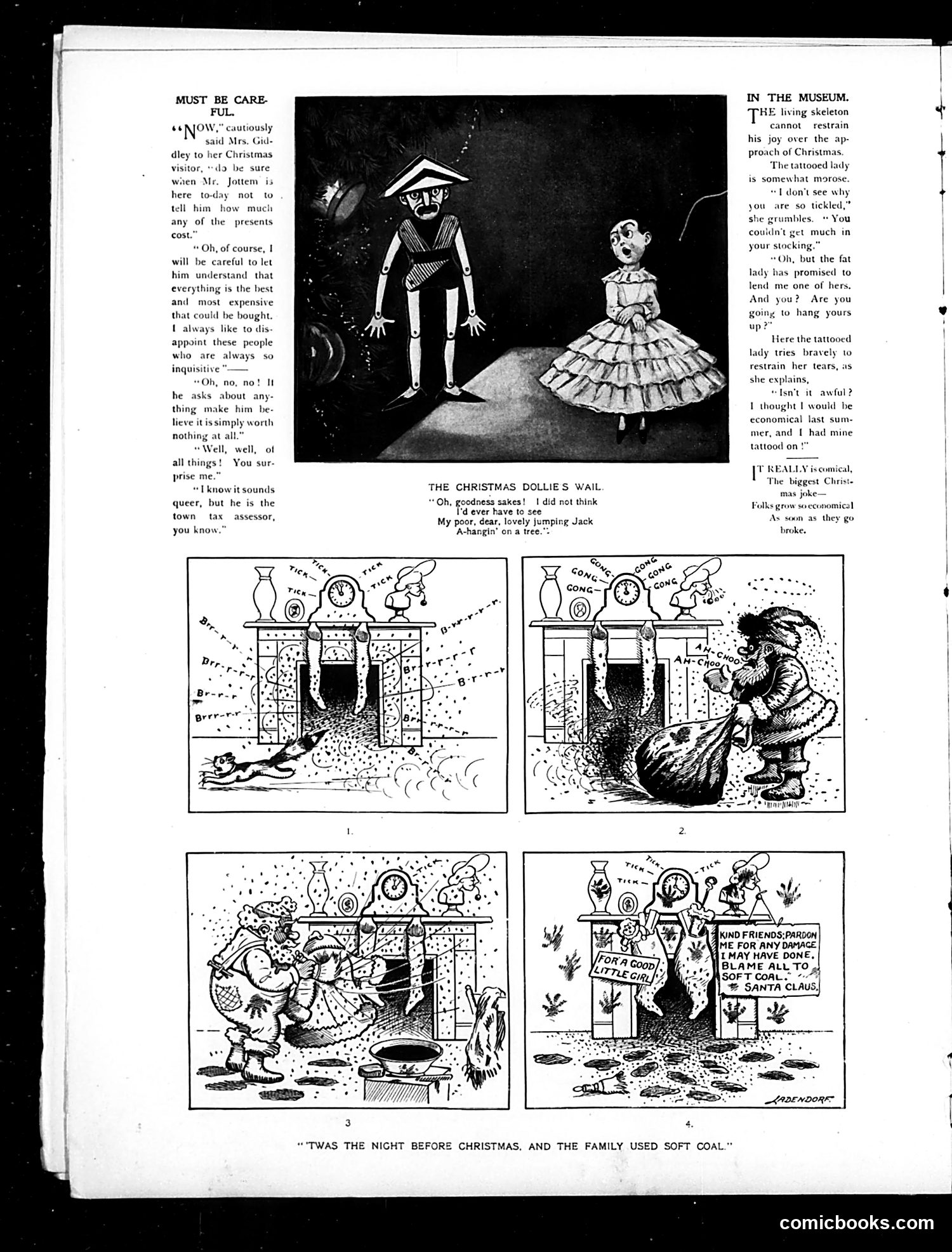
This page satirizes Christmas gift-giving economics during a period of financial constraint (likely early 20th century). The upper illustration mocks wealthy visitors' condescension toward the poor: Mrs. Giddley warns her Christmas guest not to tell the town tax assessor about their gifts, fearing he'll raise their property taxes. The joke exploits class anxiety—even modest charity must be hidden. The four-panel comic strip at bottom parodies how economically struggling families cope with Christmas disappointment. Toys are damaged or worn; gifts are "tattooed on" rather than purchased; children resort to soft coal (inferior fuel) and apologize to Santa for causing damage. The recurring theme: Christmas generosity becomes complicated by poverty and economic surveillance. The tattooed lady's tears and the children's resourcefulness suggest genuine hardship beneath the sardonic humor. The satire targets both class inequality and the gap between Christmas's idealized sentimentality and harsh economic reality for working families.
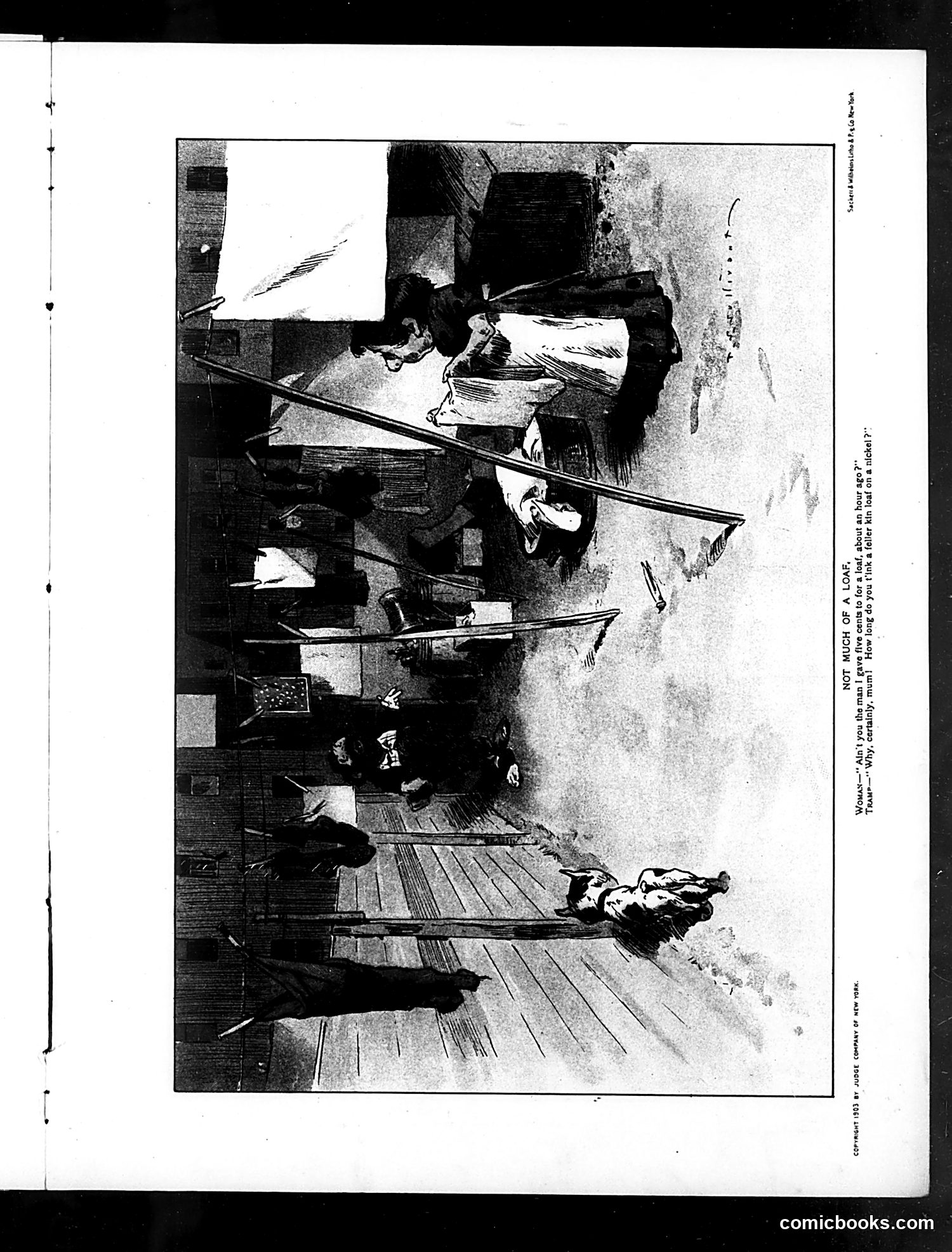
I cannot reliably read the OCR'd text on this page—the transcription appears severely garbled and doesn't form coherent English. The black-and-white photograph itself shows what appears to be an interior domestic scene with multiple figures, but the image quality and orientation make it difficult to identify specific individuals or discern clear satirical intent. Without legible text identifying the figures, the political/social references, or the cartoon's premise, I cannot accurately explain what this Judge magazine page is satirizing. To properly contextualize this for modern readers, I would need either a clearer OCR transcription or additional publication information (date, title, artist) that I cannot make out from what's provided.
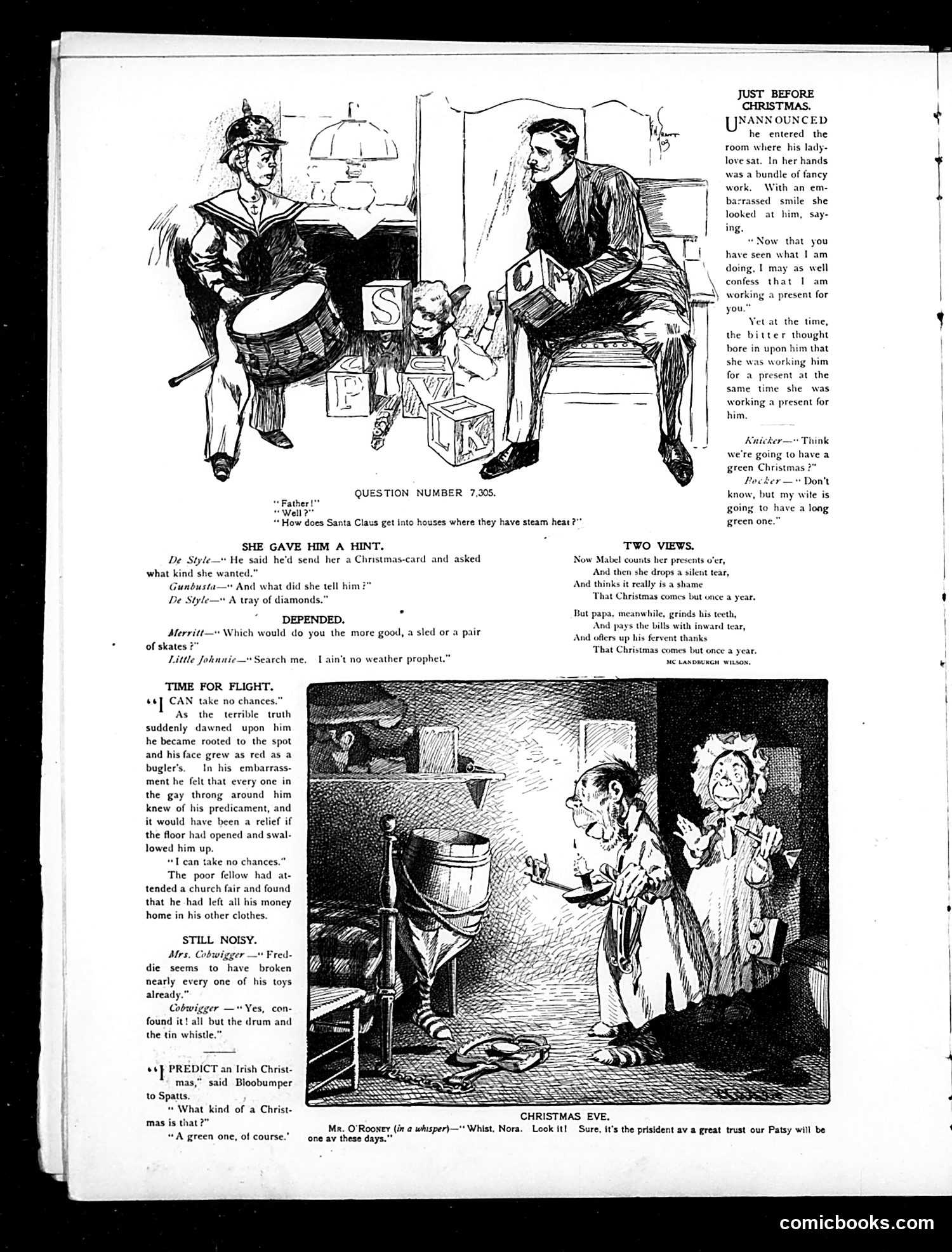
This page contains multiple short comic sketches satirizing Christmas customs and social anxieties circa early 1900s: **Upper cartoon**: A man discovers his girlfriend is making him a gift while he's making her one. The joke's bitter twist: he suspects she's simultaneously "working him" (manipulating him for money/gifts)—a dig at courtship dynamics and male anxiety about female mercenary motives. **Various brief jokes** mock gift-giving expectations: a child requesting practical items (sled vs. skates), Santa's logistics in modern steam-heated homes, and a man's embarrassment at a church fair after realizing he left his money home. **"Two Views" poem**: Contrasts a woman's disappointment at receiving gifts (wanting more) versus a father's financial stress paying for Christmas—satirizing the commercialization of the holiday and gender expectations. **Bottom cartoon**: Irish immigrant dialogue ("Whist, Nora") predicting an "Irish Christmas" (a "green one")—likely a period ethnic stereotype, possibly referencing Irish drinking culture or poverty. The page satirizes Christmas materialism, courtship deception, and social class anxieties.
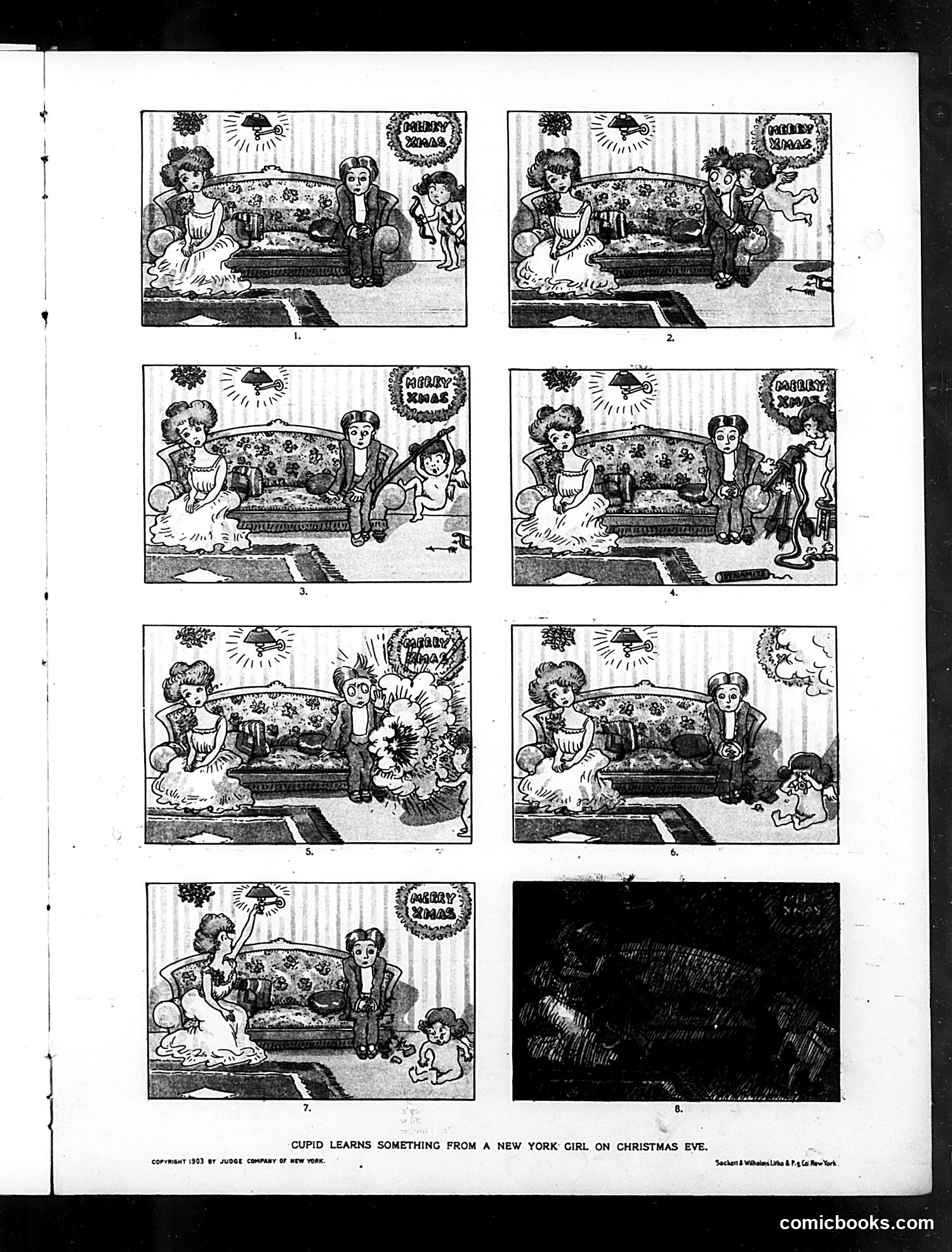
This is a seven-panel sequential comic strip from Judge magazine (1903) titled "Cupid Learns Something from a New York Girl on Christmas Eve." The narrative depicts Cupid (the cherubic figure with wings) interacting with a fashionable young woman on a sofa. The strip appears to be satirizing modern New York femininity and dating customs of the early 1900s. Without being able to read dialogue clearly, the visual progression suggests the woman is teaching or instructing Cupid—likely a reversal of traditional gender dynamics where women, particularly "New York girls," are portrayed as confident, assertive, and in control rather than passive objects of romantic pursuit. The satire likely mocks either the "New Woman" figure gaining independence in that era, or conversely, celebrates her modern assertiveness. Panel 8 appears to be a printer's proof or test print (solid black), possibly indicating production notes.
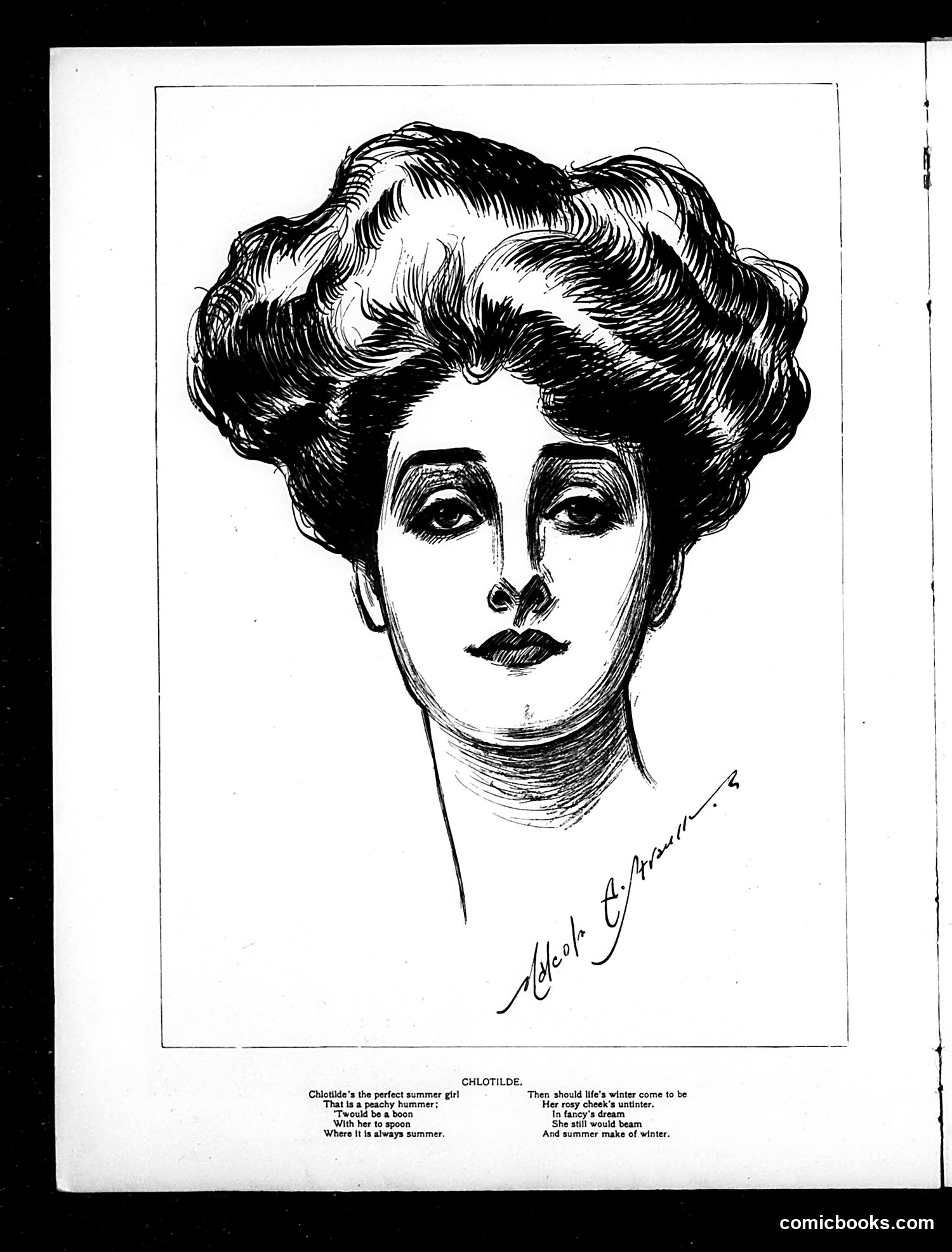
This page features a stylized portrait sketch of a woman titled "Chlotilde," accompanied by romantic verse. The poem describes an idealized "summer girl"—a beautiful woman whose presence supposedly transforms life, making winter feel like summer and keeping her complexion eternally rosy. This appears to be sentimental rather than satirical—a conventional early-20th-century romantic illustration with accompanying poetry. The "perfect summer girl" concept likely reflects period dating culture and male fantasies about ideal feminine beauty and companionship. The sketch's clean lines and the formal presentation suggest this may be a featured portrait or advertisement rather than political satire, which was Judge's typical focus.
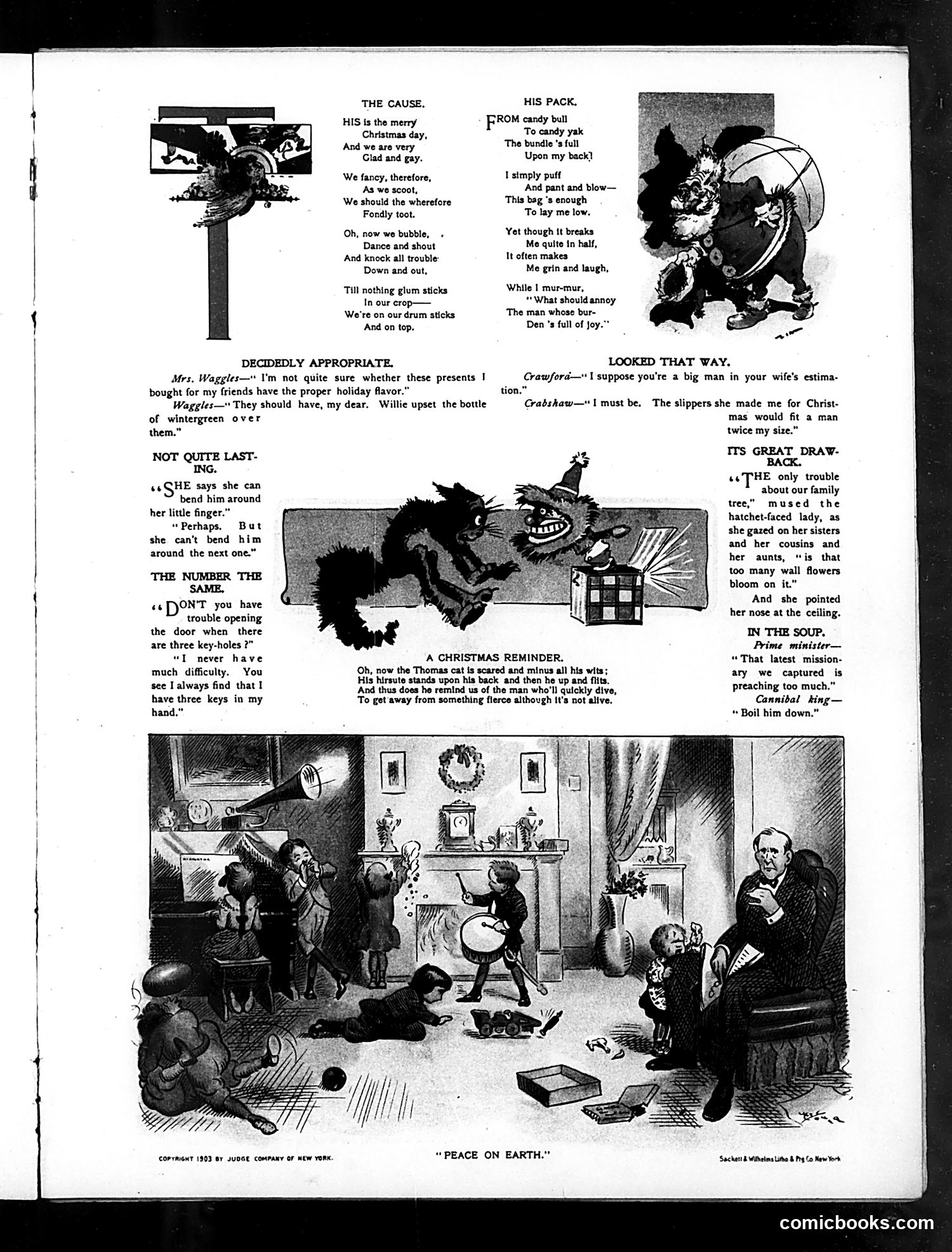
This page from Judge presents multiple brief humorous vignettes typical of early 20th-century satirical magazines. The main cartoon, "Peace on Earth," depicts a chaotic Victorian household where children play wildly while a father sits exhausted—satirizing the contrast between Christmas ideals and domestic reality. Other sketches mock everyday situations: a husband claiming wintergreen gives presents "holiday flavor"; a woman whose family tree has too many "wall flowers" (unmarriageable relatives); marital dynamics where wives control husbands or give ill-fitting gifts. "A Christmas Reminder" compares a frightened cat to a cowardly man fleeing danger, while the final jokes feature dialogue between a Prime Minister and Cannibal King about missionary preaching—referencing colonial-era stereotypes. The poems at top celebrate Santa's burden cheerfully. Overall, the page uses domestic comedy and mild social commentary typical of Judge's humor: poking fun at marriage, family, social pretension, and holiday expectations.
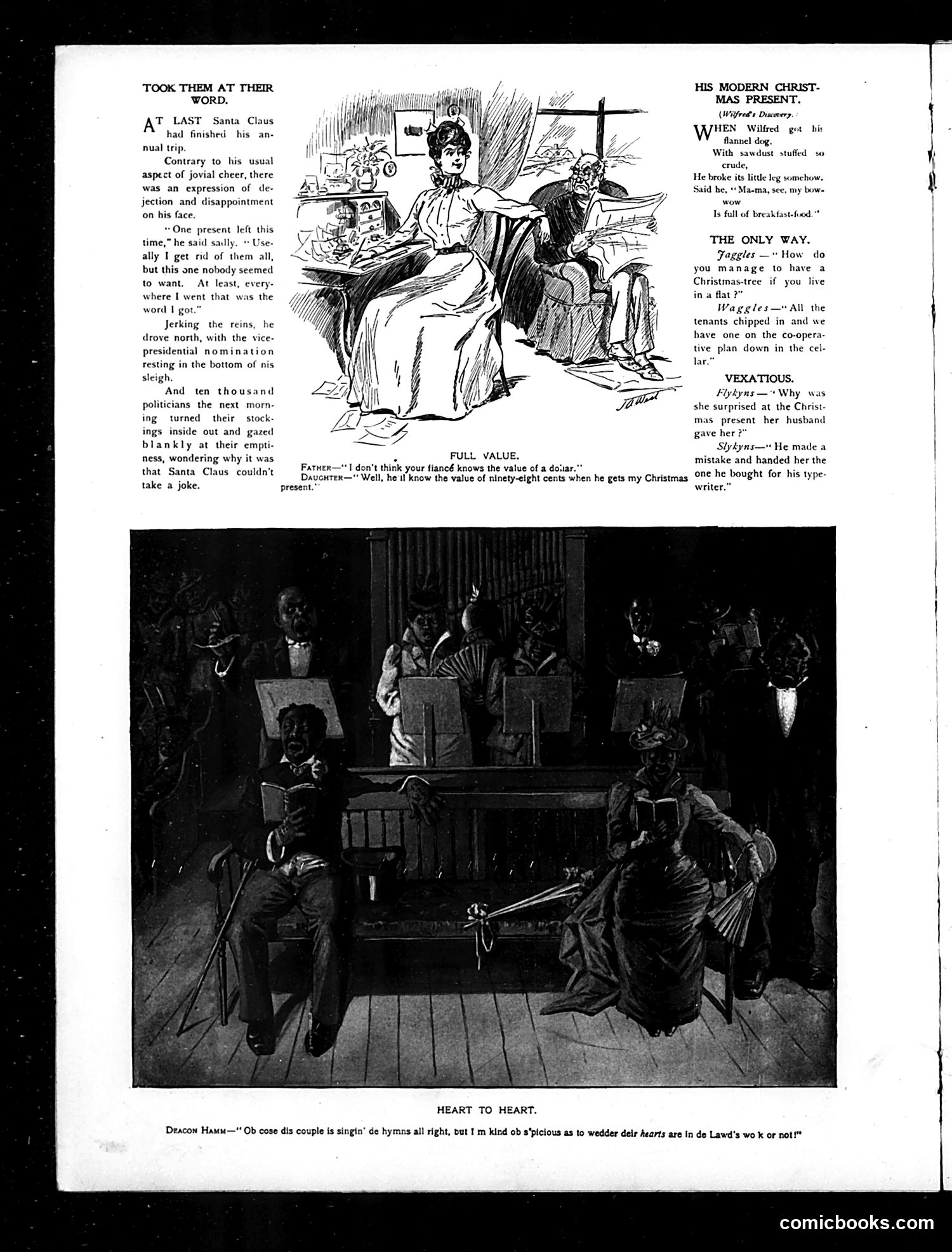
This page contains multiple Christmas-themed satirical pieces from the early 1900s. The main cartoon "Took Them at Their Word" depicts Santa Claus unable to deliver a gift: the **vice-presidential nomination**. Politicians had publicly stated they didn't want it, so Santa takes them literally—the joke being that no one actually wanted the vice presidency, a position considered powerless and undesirable at the time. The other brief satirical jokes mock Christmas gift-giving: a father misunderstands a dollar's value; newlyweds struggle with apartment living; a husband accidentally gives his wife a gift meant for his typewriter; and a deacon questions whether a singing couple's hearts are truly in religious devotion. The bottom photograph shows "Heart to Heart"—a church or wedding scene with performers, illustrating themes of marriage and morality. Overall, the page satirizes American social attitudes toward politics, materialism, and domestic life during the Christmas season.
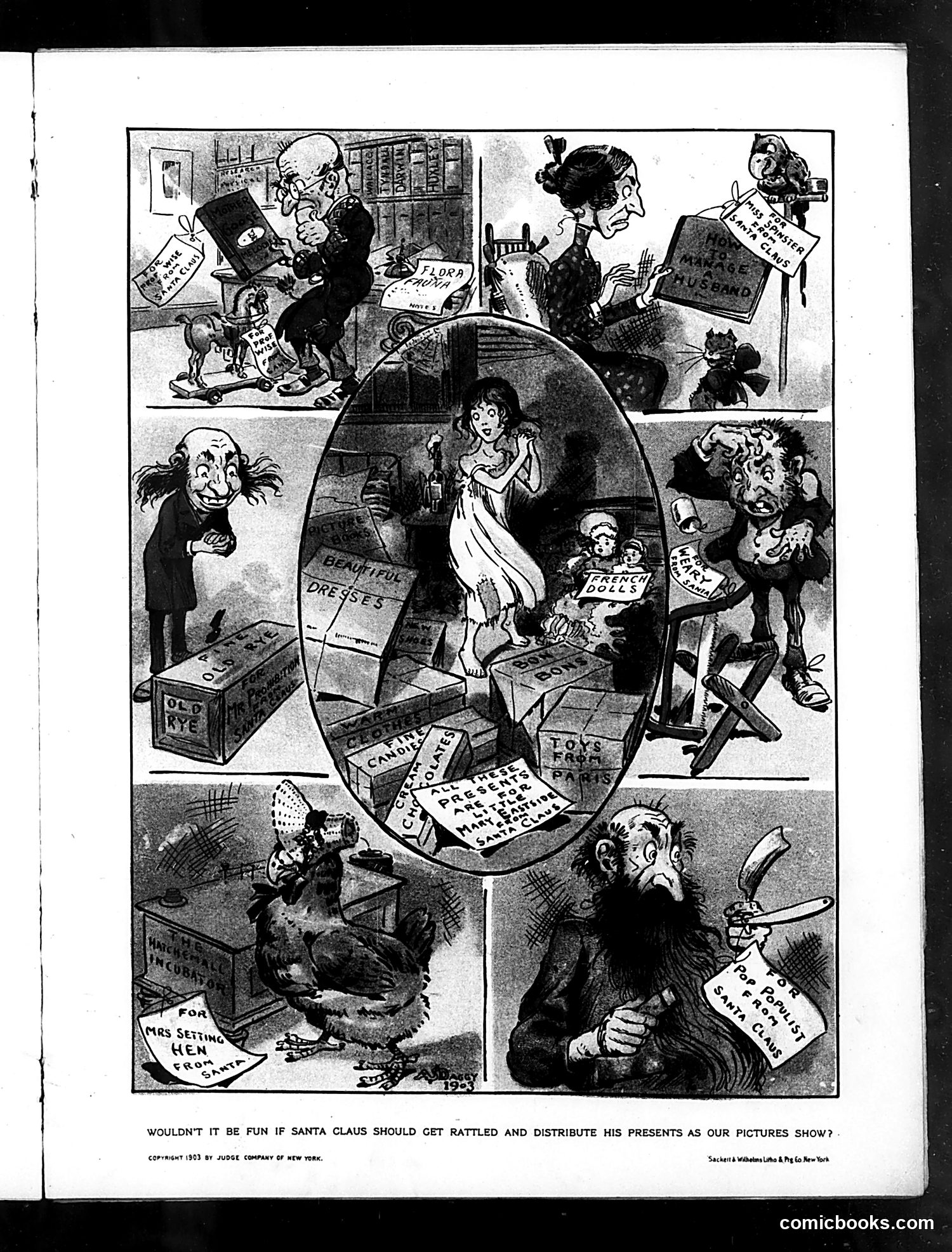
This 1903 Judge cartoon satirizes corrupt gift-giving and favoritism, imagining if Santa Claus distributed presents like contemporary society's corrupt elites. The central image shows a young woman surrounded by caricatured figures—appearing to represent wealthy industrialists, politicians, and social climbers—competing for her attention and gifts. The boxes labeled with items like "Beautiful Dresses," "French Dolls," and "Love Tokens" suggest bribery and transactional relationships. The grotesque caricatures (some with exaggerated features typical of Gilded Age political cartoons) represent greedy, scheming interests vying for favor through material inducements. The cartoon critiques how wealthy, powerful men of the era used gifts and financial incentives to gain social influence and romantic favor, mocking the era's rampant corruption, materialism, and exploitation. The joke invites readers to recognize these unflattering parallels to their own society.
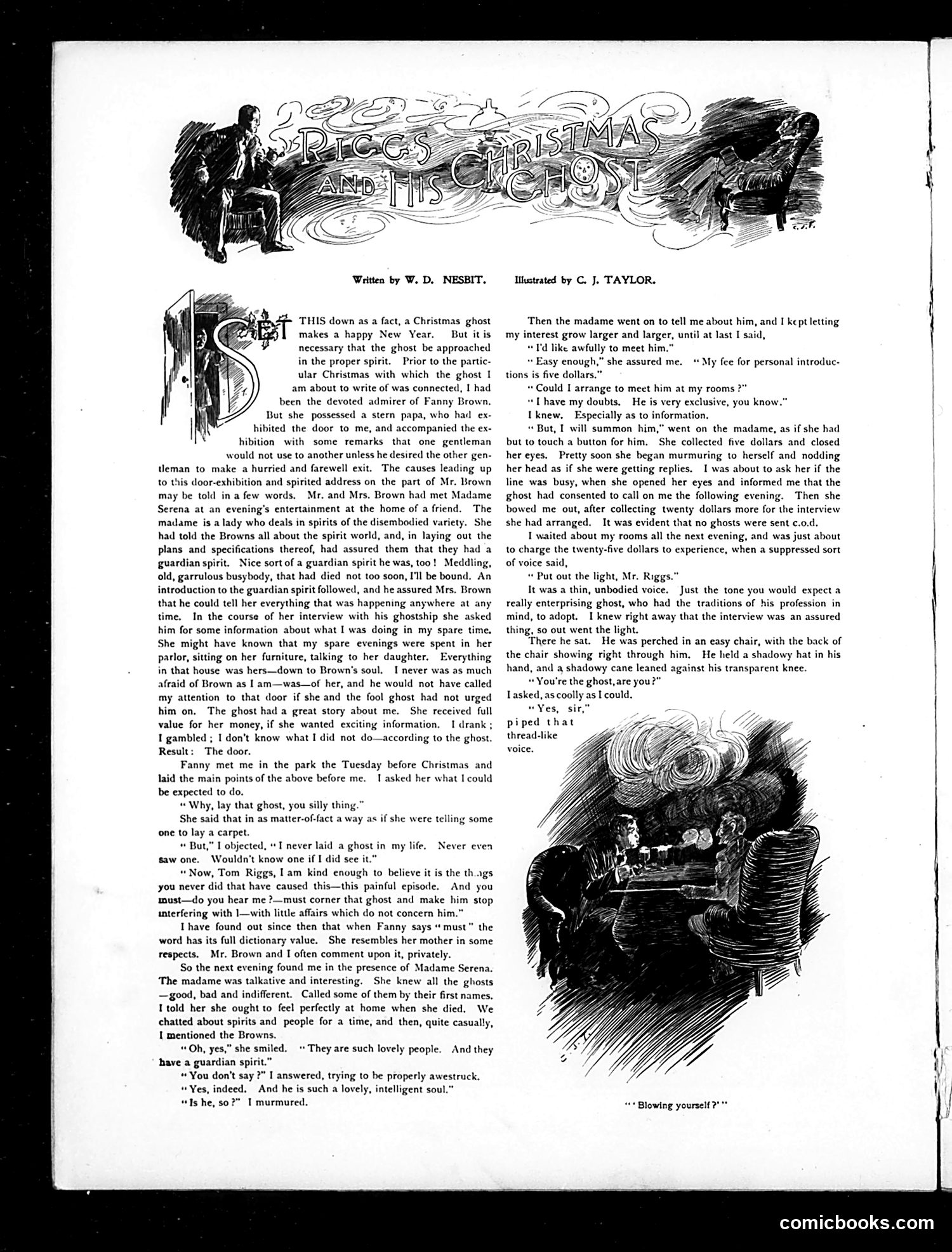
This page presents a humorous short story by W.D. Nesbit illustrated by C.J. Taylor, appearing to be from Judge's Christmas/New Year issue. The narrative mocks the era's fascination with spiritualism and séances. The plot involves Tom Riggs, a young man whose courtship of Fanny Brown is sabotaged when her parents consult a spiritualist medium (Madame Serena) who claims to contact their "guardian spirit." This ghostly informant falsely reports scandalous behavior about Riggs—drinking, gambling—causing Fanny's stern father to literally throw him out. Fanny demands Riggs "lay that ghost" (stop the spirit's interference). The satire targets two contemporary follies: spiritualism's pretensions and the meddling interference of parents and self-proclaimed mediums in young people's romantic lives. The story implies these spiritualists were fraudsters exploiting gullible clients, a common critique of the period. The comedic tension arises from Riggs attempting to debunk supernatural claims he's never encountered before.
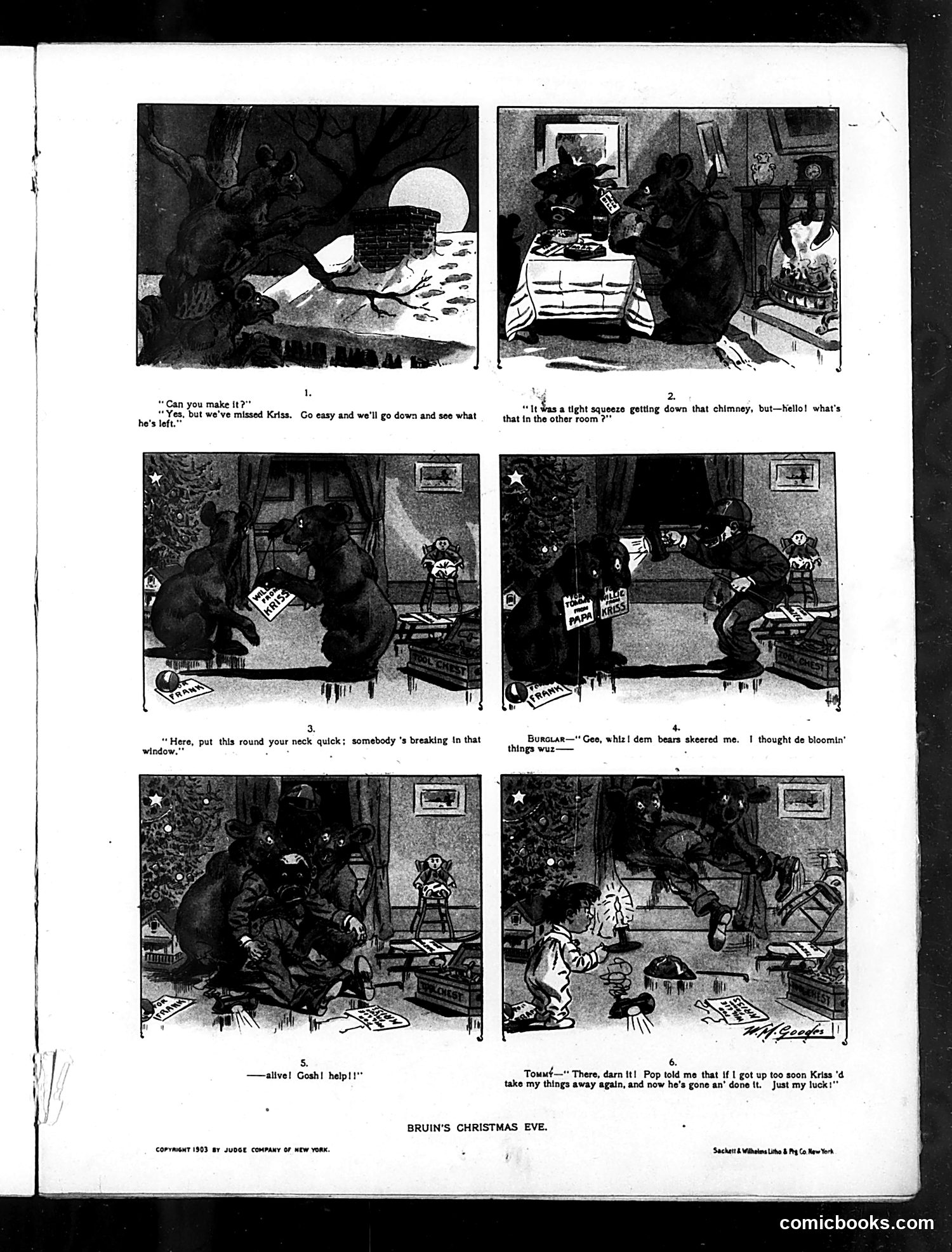
This is a six-panel comic strip anthropomorphizing bears as burglars on Christmas Eve. The narrative follows bear characters attempting a home invasion, humorously paralleling the Santa Claus chimney-entry trope. The satire plays on turn-of-the-century anxieties about home security and burglary—common concerns in early 1900s urban America—by substituting dangerous criminals with animals. The final panels show a child who has stayed awake past bedtime, disrupting the "burglars'" plans and discovering them, creating the joke's ironic reversal: instead of Santa's benign gift-giving, these unwanted visitors represent genuine household threat. The humor relies on the visual comedy of large bears attempting stealth and the child's bratty defiance of parental instructions to sleep. The title and framing as a "Christmas Eve" story suggest satirical commentary on holiday security concerns rather than political allegory.
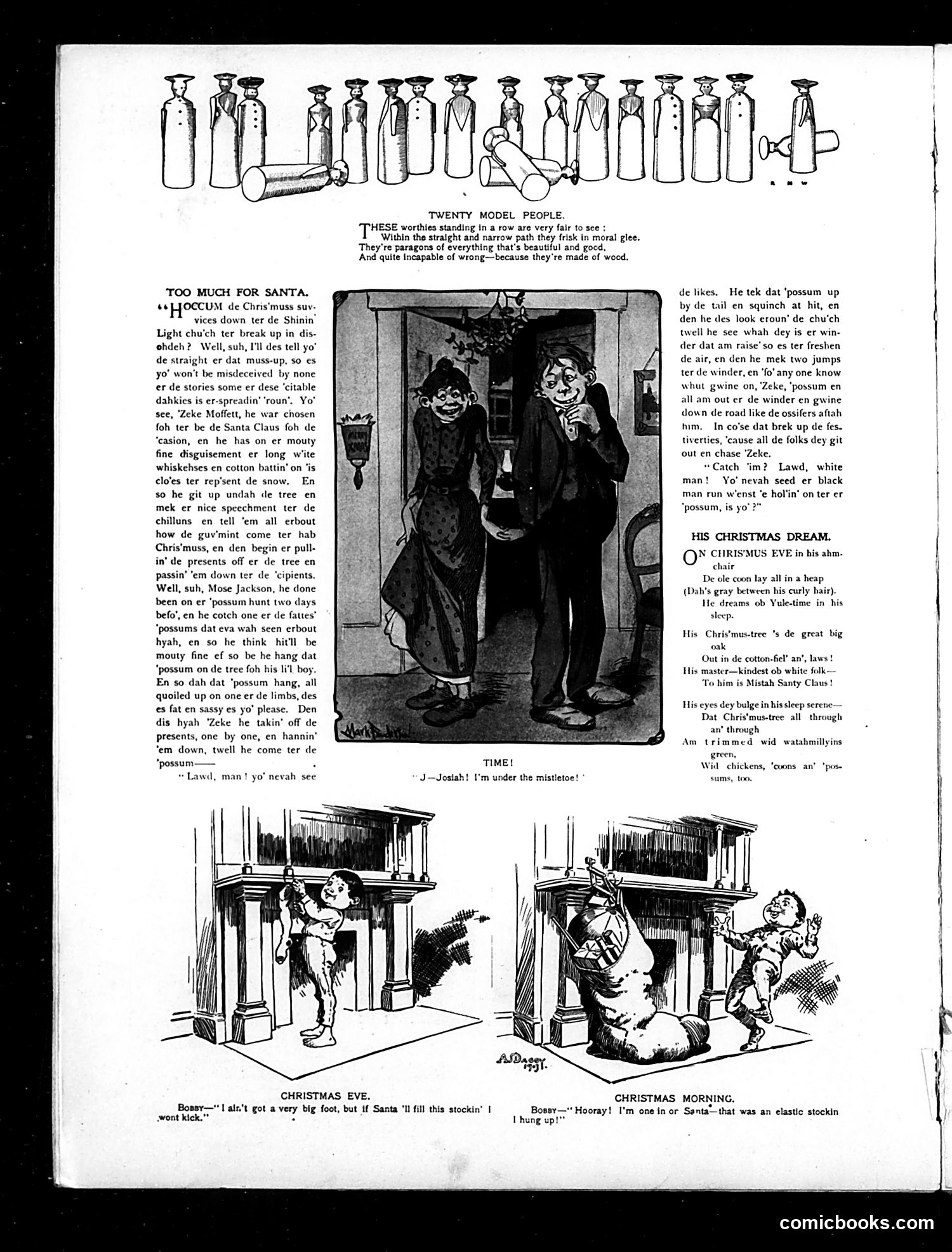
This page contains satirical content employing **racist stereotypes common to late-19th/early-20th century American humor**. **"Twenty Model People"** opens with wooden figures—a visual pun suggesting these "model people" are literally made of wood and incapable of wrongdoing, likely satirizing sanctimonious moral reformers. **"Too Much for Santa"** and related Christmas stories use heavy **dialect caricature** of African American characters ("Zeke Moffett," "Mose Jackson"). The humor derives from depicting Black church celebrations disrupted when a character accidentally releases a possum through a window during gift distribution—framing chaos and incompetence as inherently comic. **"His Christmas Dream"** romanticizes an enslaved or formerly enslaved man's fantasy where his white "master" becomes "Mistah Santy Claus," reinforcing a paternalistic vision of racial hierarchy as benevolent. The cartoons rely entirely on minstrelsy conventions: exaggerated dialect, physical comedy, and the implicit assumption that Black life and aspirations are inherently amusing to white audiences. These represent period attitudes now recognized as deeply offensive.
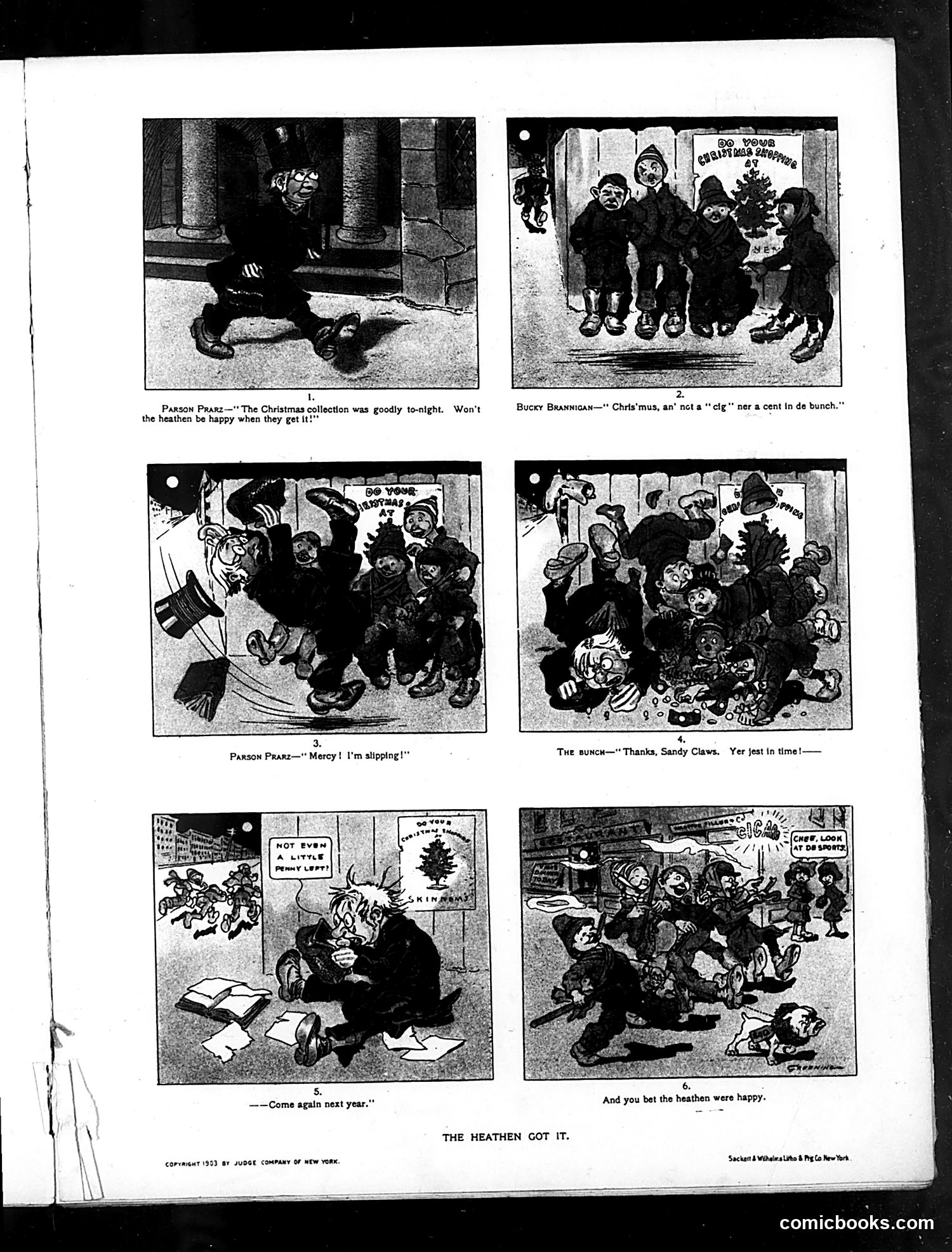
This six-panel comic satirizes the hypocrisy of Christian charity and missionary work. A character identified as "Parson Pratz" collects Christmas donations from his congregation, claiming the money will help "heathen" (non-Christian peoples). However, the panels progressively reveal that Pratz and his associates steal and squander the collection for themselves—eating, drinking, and gambling—rather than forwarding it to missionaries. The satire targets both corrupt clergy who exploit parishioners' charitable impulses and the self-righteousness of organized Christianity. The final caption's dark humor—"the heathen were happy" because they never received the promised help—underscores the joke: the money went to the wrong "heathen" (the corrupt clergymen themselves). This reflects early-20th-century skepticism toward institutional religion and missionary enterprises.
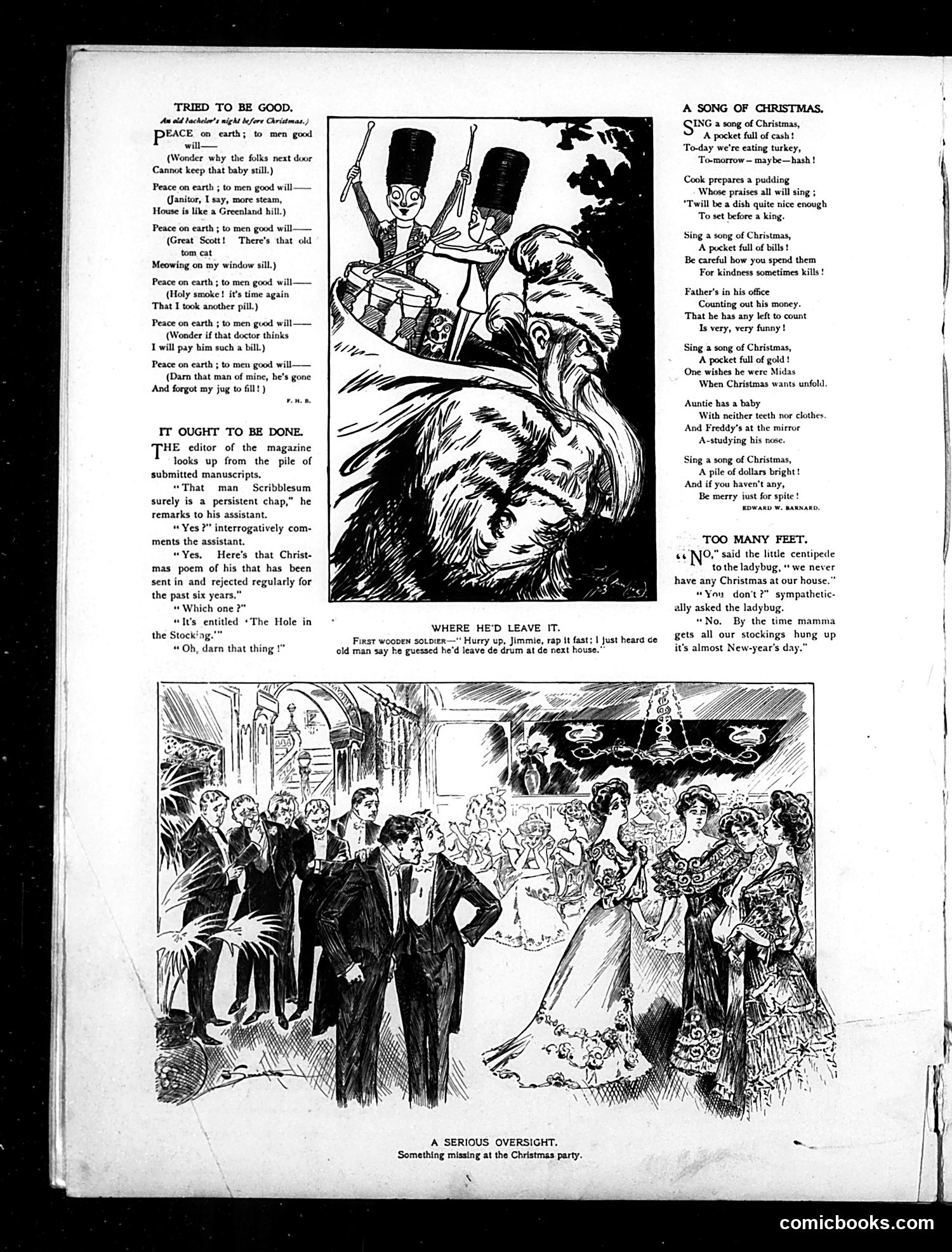
This page contains Christmas-themed humor satirizing turn-of-the-century American life. **"Tried to Be Good"** mocks a bachelor's failed attempts at peaceful contemplation on Christmas Eve—repeatedly interrupted by noisy neighbors, a janitor, a cat, and his own health anxieties. The satire targets urban apartment living and hypochondria. **"It Ought to Be Done"** jokes about a persistent writer submitting the same rejected Christmas poem annually for six years to a magazine editor, satirizing both struggling writers' persistence and editorial frustration. **"A Song of Christmas"** is social commentary on Christmas spending and financial anxiety—celebrating "pockets full of cash/bills/gold" while noting the money quickly vanishes on gifts, food, and expenses. It mocks fathers counting money and the pressure to spend. **"Too Many Feet"** is a light children's joke: a centipede family has no Christmas because by the time the mother hangs stockings for all the children's feet, it's nearly New Year's. **"A Serious Oversight"** caption suggests something's missing from a Christmas party scene, though context is unclear.
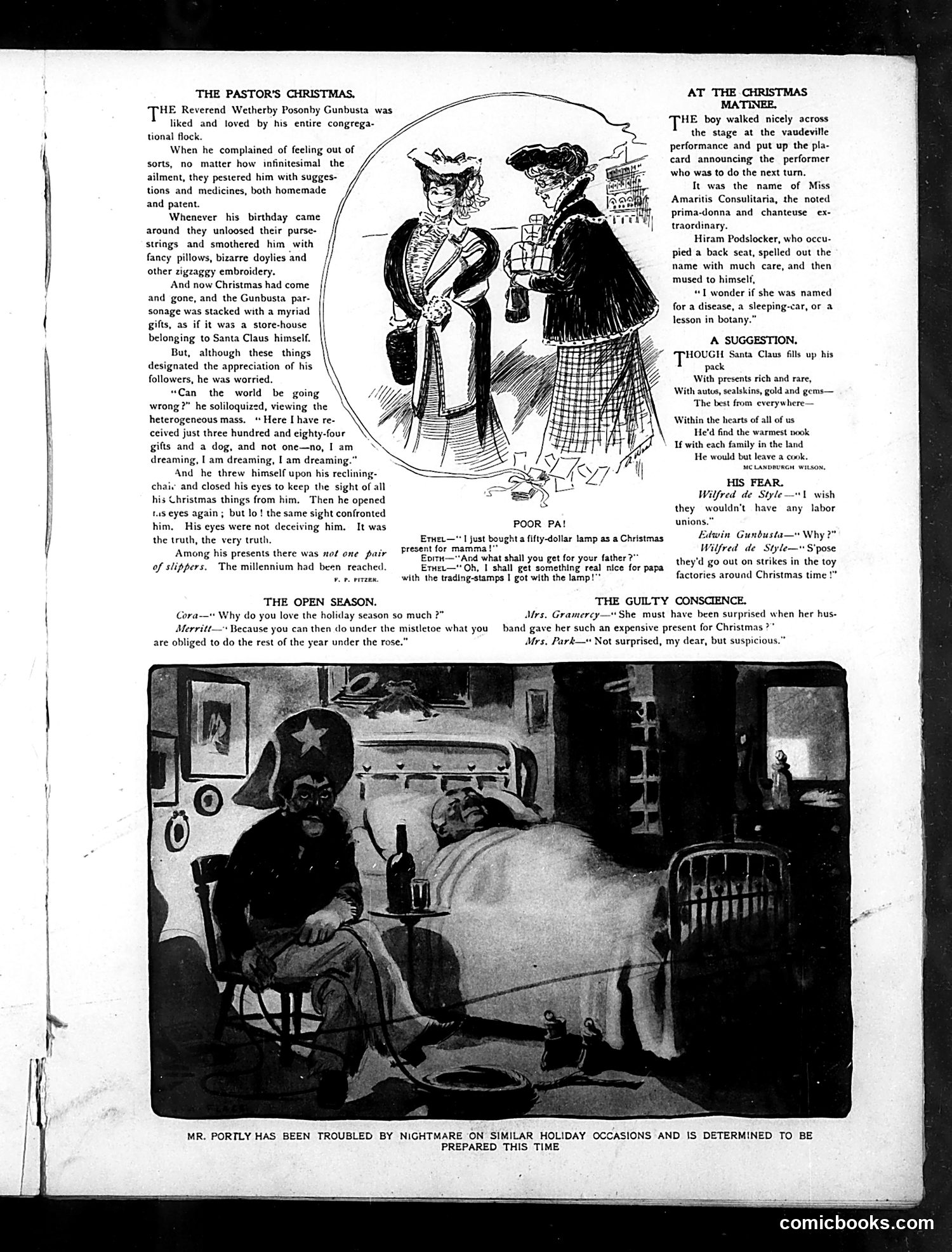
This page from *Judge* magazine contains several satirical vignettes about Christmas: **"The Pastor's Christmas"**: Reverend Gunbusta receives mountains of gifts from his grateful congregation—but notably *no slippers*. The joke plays on the era's custom of giving clergymen practical gifts; the absence of slippers (the expected "safe" present) is treated as a cosmic catastrophe, mocking both the pastor's ingratitude and the congregation's predictability. **"The Open Season"** and **"Poor Pa!"**: Brief quips about holiday excess—one about mistletoe romance, another about a daughter buying her father a cheap lamp then using its trading stamps for his gift. **"At the Christmas Matinee"**: A theatergoer struggles to pronounce a performer's invented name ("Amaritis Consulitaria"), wondering if it's a disease, railroad car, or botany term—satirizing pretentious stage names. **"His Fear"** and **"The Guilty Conscience"**: Comic complaints about labor unions threatening toy factory strikes, and a wife suspicious of an unexpectedly generous Christmas gift. The overall tone mocks middle-class consumption, vanity, and marital dynamics during the holiday season.
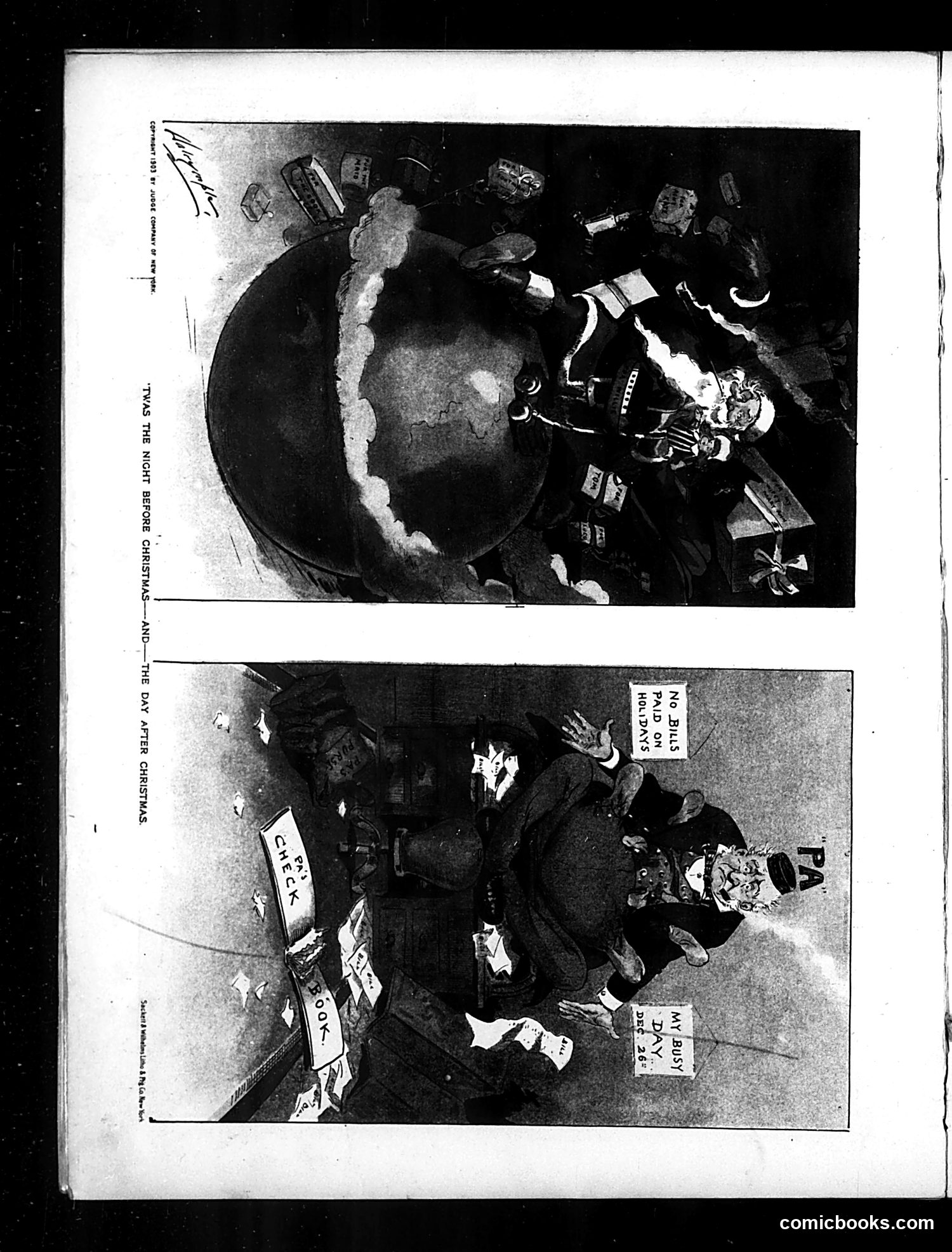
This page from *Judge* magazine contains two cartoons satirizing holiday pay practices. The top image appears to show a globe or world, likely representing broad economic systems or international commerce. The bottom cartoon depicts what seems to be a worker or laborer with a sign reading "NO BIS PAID ON HOLIDAYS" — a clear critique of employers who refused to pay workers extra compensation or bonuses during holiday periods. The figure's posture and presentation suggest frustration or complaint about this labor practice. The satire targets the tension between workers' expectations for fair holiday compensation and employers' reluctance to provide it — a common labor dispute during the early-to-mid 20th century when *Judge* was published. The cartoon likely advocated for workers' rights to holiday pay.
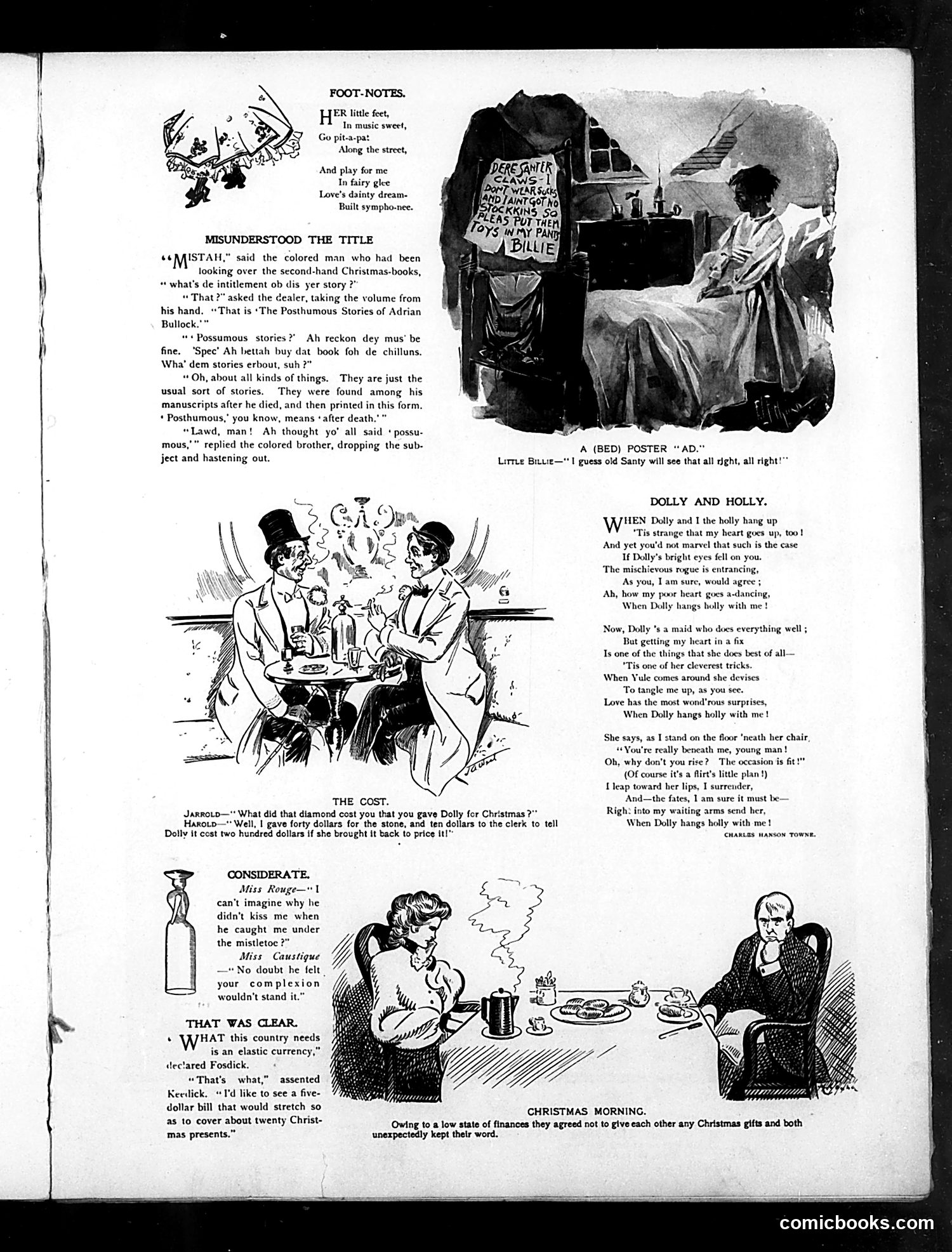
This page contains several humor pieces typical of early 20th-century American satire: **"Misunderstood the Title"** mocks racial dialect humor: a Black man buying "Posthumous Stories of Adrian Bullock" mishears "posthumous" as "possum-ous," assuming it's about possums rather than works published after an author's death. **"The Cost"** jokes about male dishonesty in romance—a man inflates a diamond's price to his girlfriend to seem more generous than he actually is. **"Considerate" and "That Was Clear"** are brief comic exchanges about mistletoe kissing and currency stretch, employing typical period comedic banter. **"Christmas Morning"** depicts a couple who agreed not to exchange gifts, then both kept their word—ironic restraint backfiring. **"Dolly and Holly"** is a sentimental romantic poem about a couple hanging holly decorations, with flirtation under the mistletoe. The page reflects early 1900s humor styles: racial caricature, marital/romantic comedy, and wordplay—now dated or offensive by modern standards.
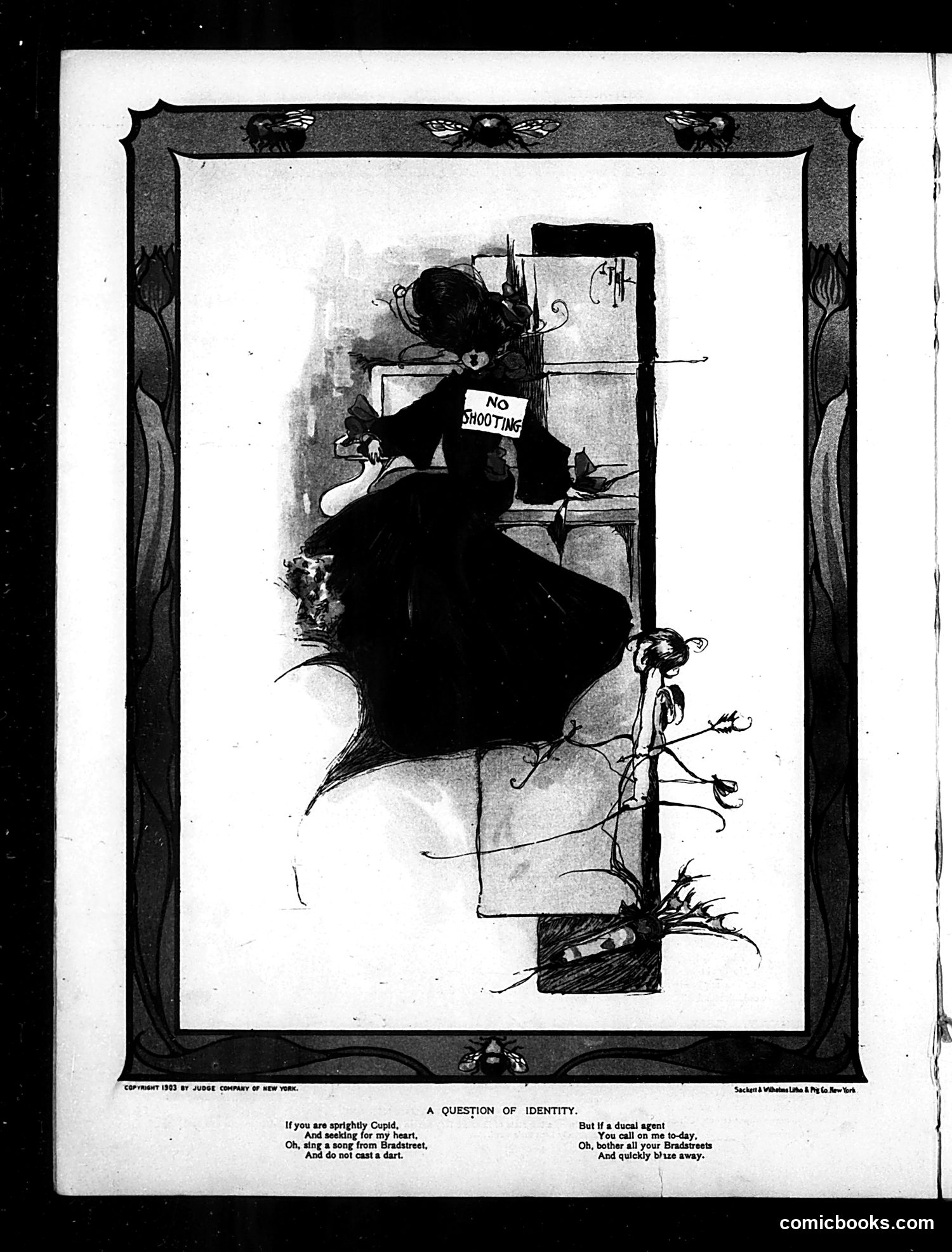
This cartoon satirizes the tension between romantic idealism and practical financial reality. The silhouetted figure depicts a woman at a window confronting two competing suitors: **Cupid** (the romantic lover) is welcomed if he arrives singing of love and emotion—references to "Bradstreet" likely mean sentimental poetry or romantic literature. **A "ducal agent"** (a debt collector or financial representative) is rudely rejected with instructions to "blaze away"—to leave immediately. The joke mocks how women (or people generally) prioritize love over money in theory, but in practice prioritize financial security. The "Bradstreet" reference possibly alludes to Bradstreet's financial rating agency, reinforcing the contrast between romantic sentiment and hard economic facts. The decorative floral border and silhouette style were typical Judge aesthetic choices for humorous social commentary circa 1903.
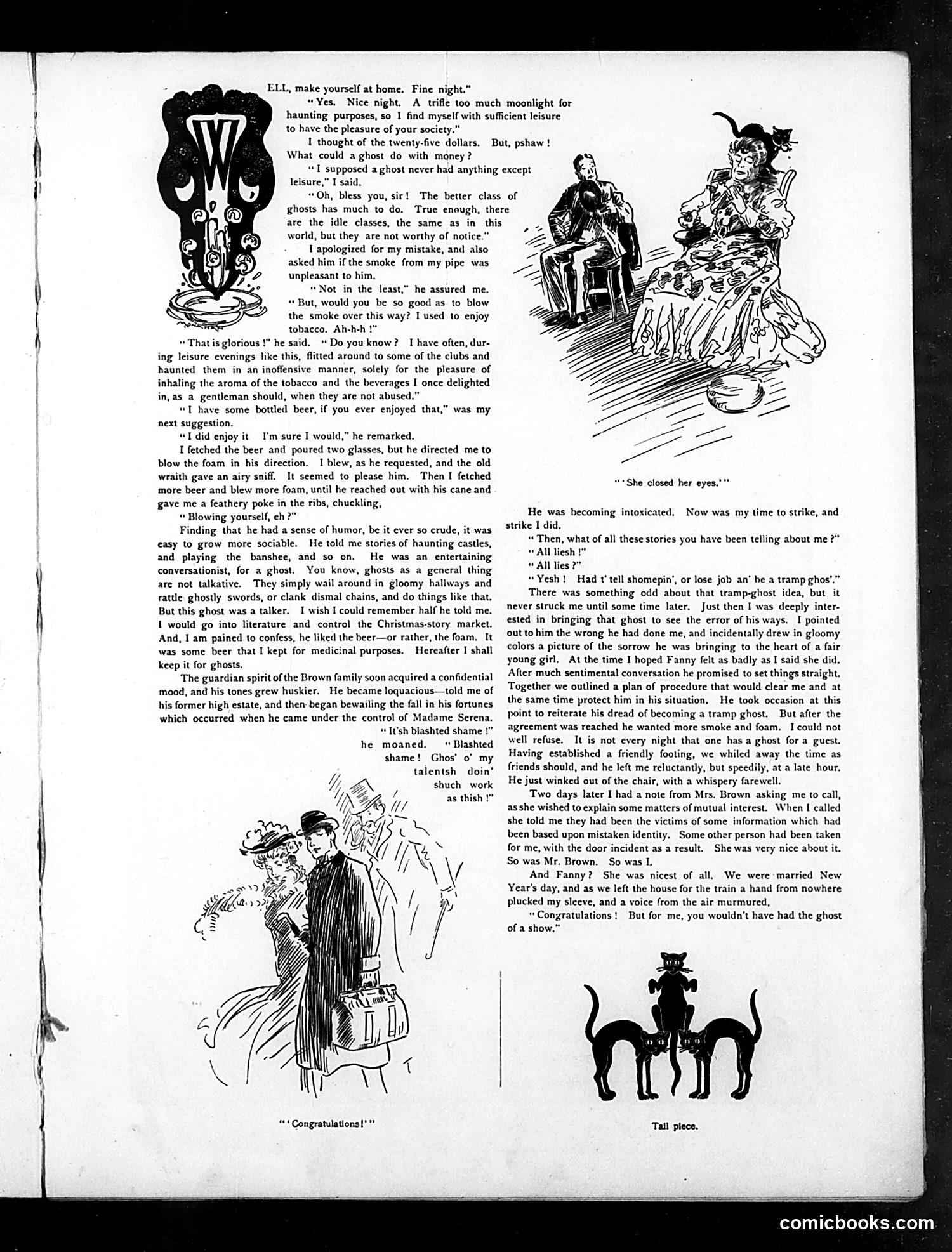
This page from *Judge* magazine presents a satirical ghost story about spiritualism fraud. The narrative mocks the popular Victorian craze for séances and mediums like "Madame Serena" (likely a reference to real spiritualist charlatans of the era). The satire works on multiple levels: A ghost confesses he's a fraud—hired by a medium to fabricate supernatural stories to satisfy paying clients. The ghost becomes intoxicated on beer foam and reveals that all his haunting tales were lies told under employment duress. The narrator uses sentimental manipulation ("a fair young girl") to make the ghost "confess" and help clear his name. The joke targets both spiritualist mediums exploiting gullible wealthy clients AND the narrator's own opportunistic manipulation. The illustrations show the genteel domestic setting where this "séance" occurs, emphasizing how spiritualism infiltrated respectable society. The decorative demon illustration at bottom reinforces the deception theme.
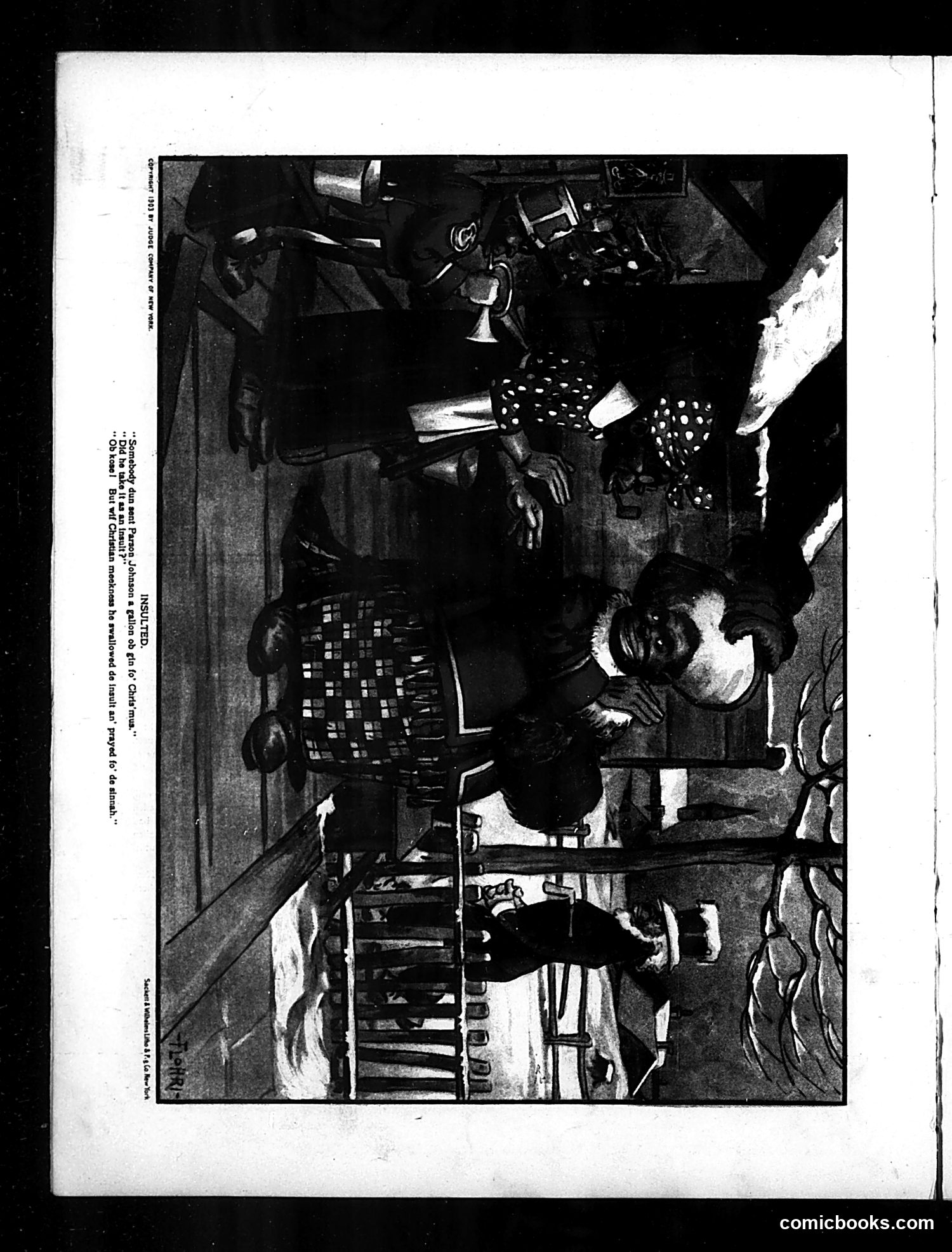
This appears to be a racist caricature from Judge magazine depicting African Americans in dialect. The cartoon shows two figures discussing "Parson Johnson," a Black minister who received a gallon of gin as a Christmas gift. The "joke" relies on offensive stereotypes: portraying Black speech through misspelled dialect ("dun," "ob," "fo'"), and the punchline that the minister hypocritically accepted alcohol (traditionally condemned by clergy) while claiming Christian virtue by "swallowing de insult." The satire targets perceived hypocrisy in Black religious leadership, though it's primarily a vehicle for racial caricature typical of early-20th-century American humor magazines. The joke assumes readers would find Black characters and exaggerated speech inherently comedic.
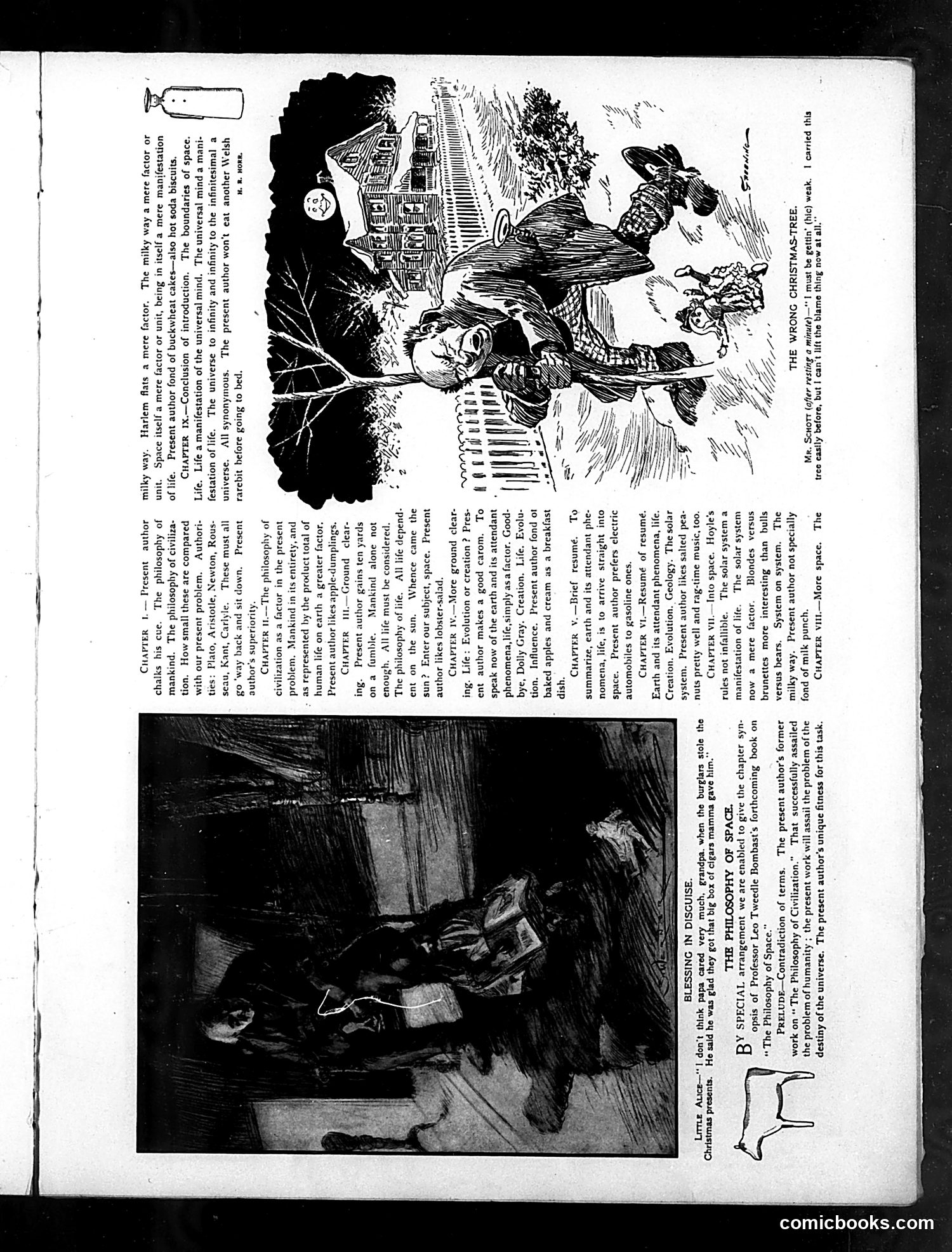
This page contains two illustrations satirizing Christmas commercialism and poverty. The top cartoon depicts a well-dressed figure in an exaggerated top hat walking past impoverished children on a snowy street, titled "The Moric Christmas Street." The satire contrasts wealthy indifference with urban poverty during the holiday season—a critique of how the wealthy ignore destitute conditions while celebrating Christmas. The caricatured top-hatted figure appears to represent affluent society's callous disregard for the poor. The bottom image shows similar street poverty conditions. Together, these works critique the disconnect between Christmas's charitable ideals and the actual neglect of impoverished urban populations, particularly children. This reflects late-19th/early-20th-century Progressive Era concerns about economic inequality and labor conditions in American cities, common themes in Judge's satirical commentary.
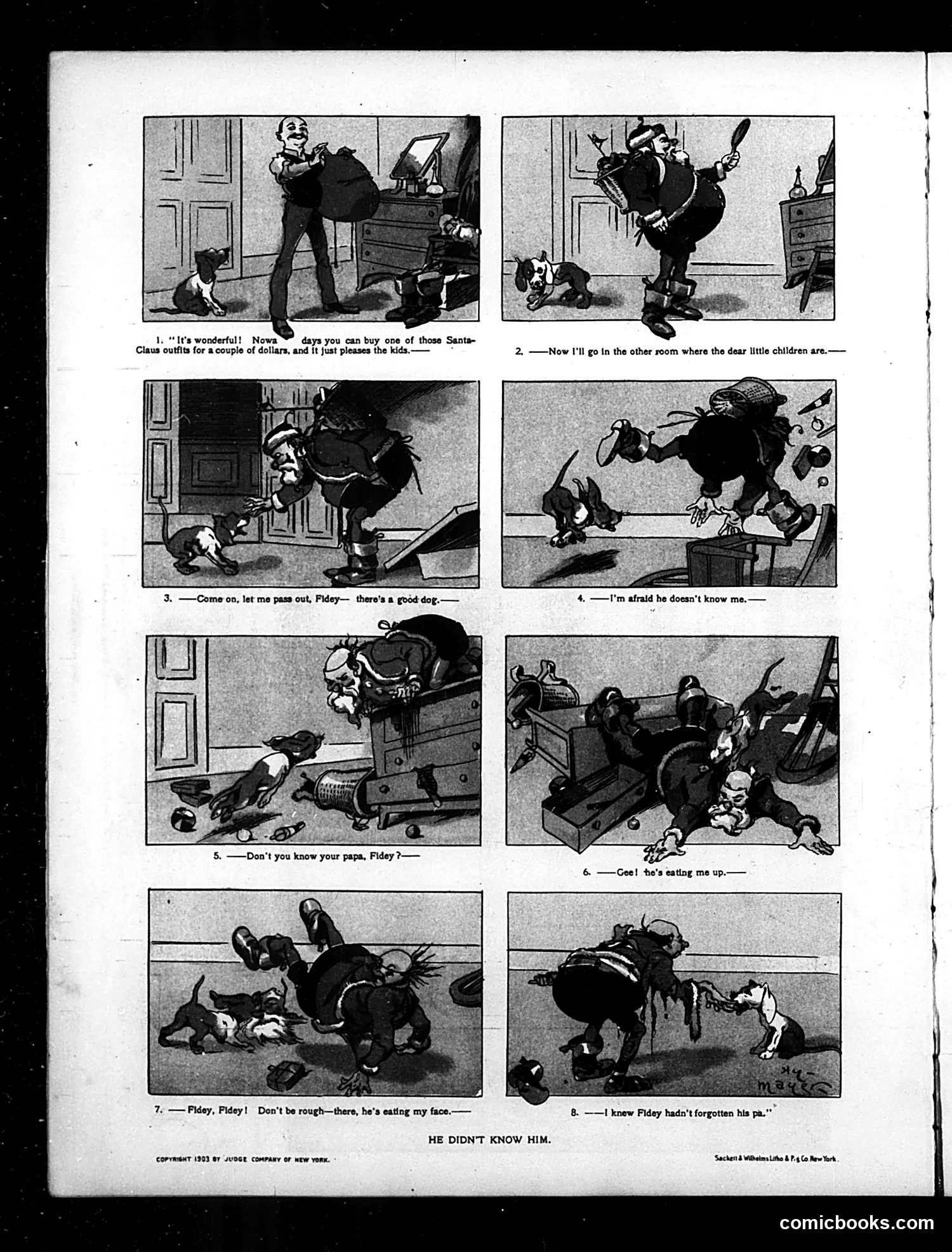
This is a sequential comic strip about a man in a cheap Santa Claus costume (costing "a couple of dollars") visiting his own home. The joke's premise: he's disguised so thoroughly that his own dog doesn't recognize him, attacking him repeatedly throughout the sequence. The humor relies on physical comedy—the dog mauls the unidentified "Santa," the man falls, tumbles into furniture and children's play areas. The final panels show escalating chaos as the dog aggressively defends against this apparent intruder. The satire appears to mock the commercialization of Christmas—the idea that authentic holiday spirit can be reduced to a cheap, store-bought costume. The irony is bitter: the costume meant to please children instead creates havoc, and even the family dog rejects this artificial "Santa" as a stranger/threat. For modern readers, this reflects early-1900s anxieties about commercialized holidays replacing genuine family connection.
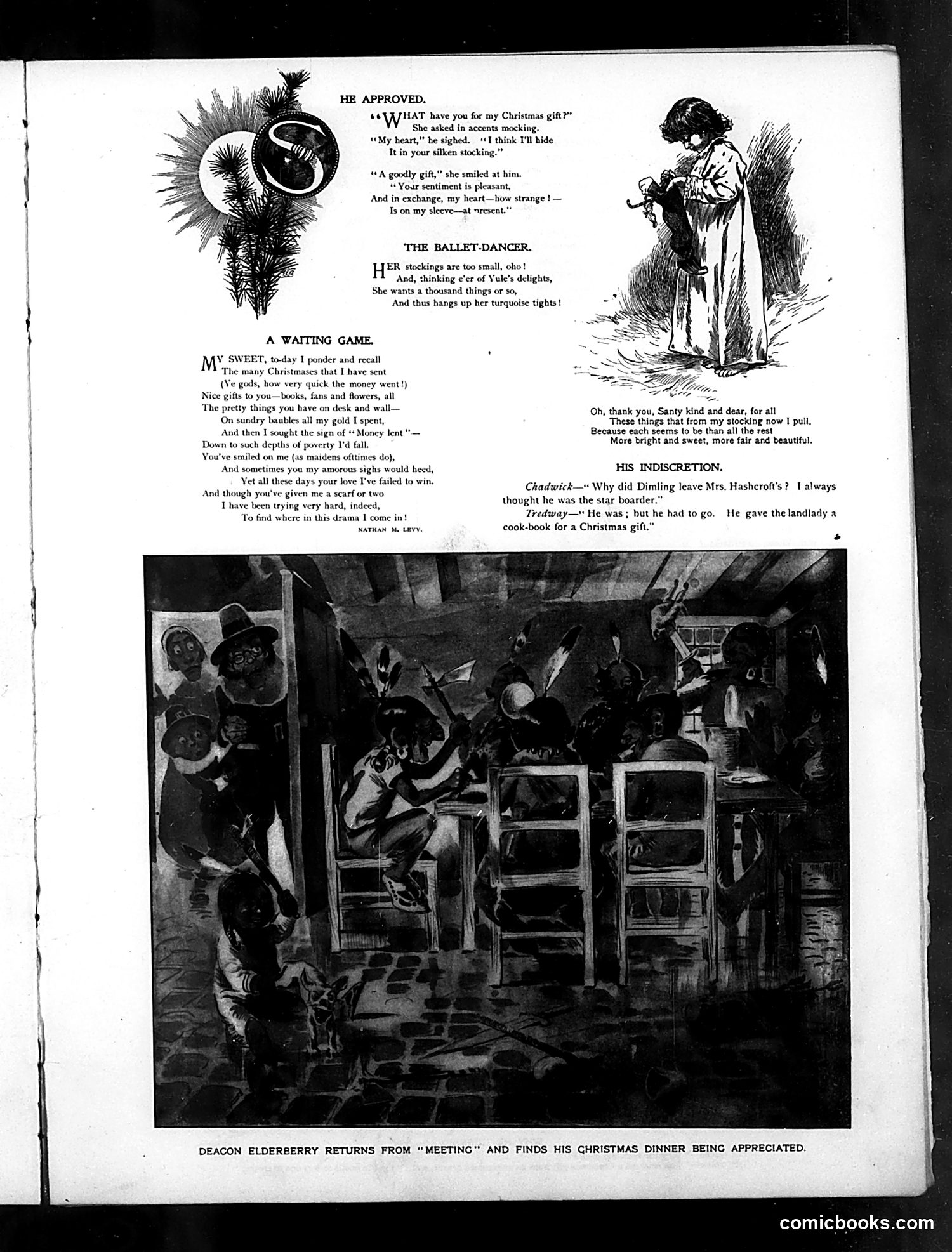
This page contains **Christmas-themed poetry and humor** rather than political cartoons. The content includes: **Poems:** - "A Waiting Game" (by Nathan M. Levy): A man's lament about spending lavishly on gifts for an unresponsive woman while receiving minimal reciprocation—satirizing the expense and emotional imbalance of courtship. - "The Ballet-Dancer": Light verse about a dancer's meager stockings and her Christmas wish list. **Comic Vignettes:** - A romantic exchange where a man offers his heart; she offers hers in return but admits it's "on my sleeve"—suggesting superficial sentiment. - A brief joke about a man who gave his landlady a cookbook as a Christmas gift, prompting his forced departure—implying the gift was insulting or suggested she was a poor cook. **Illustration:** The bottom image shows "Deacon Elderberry" returning home to find others enjoying his Christmas dinner, likely a humorous domestic scene about holiday preparations. The satire targets **romantic disappointment, financial strain from gift-giving, and social awkwardness**—universal themes rather than specific political content.
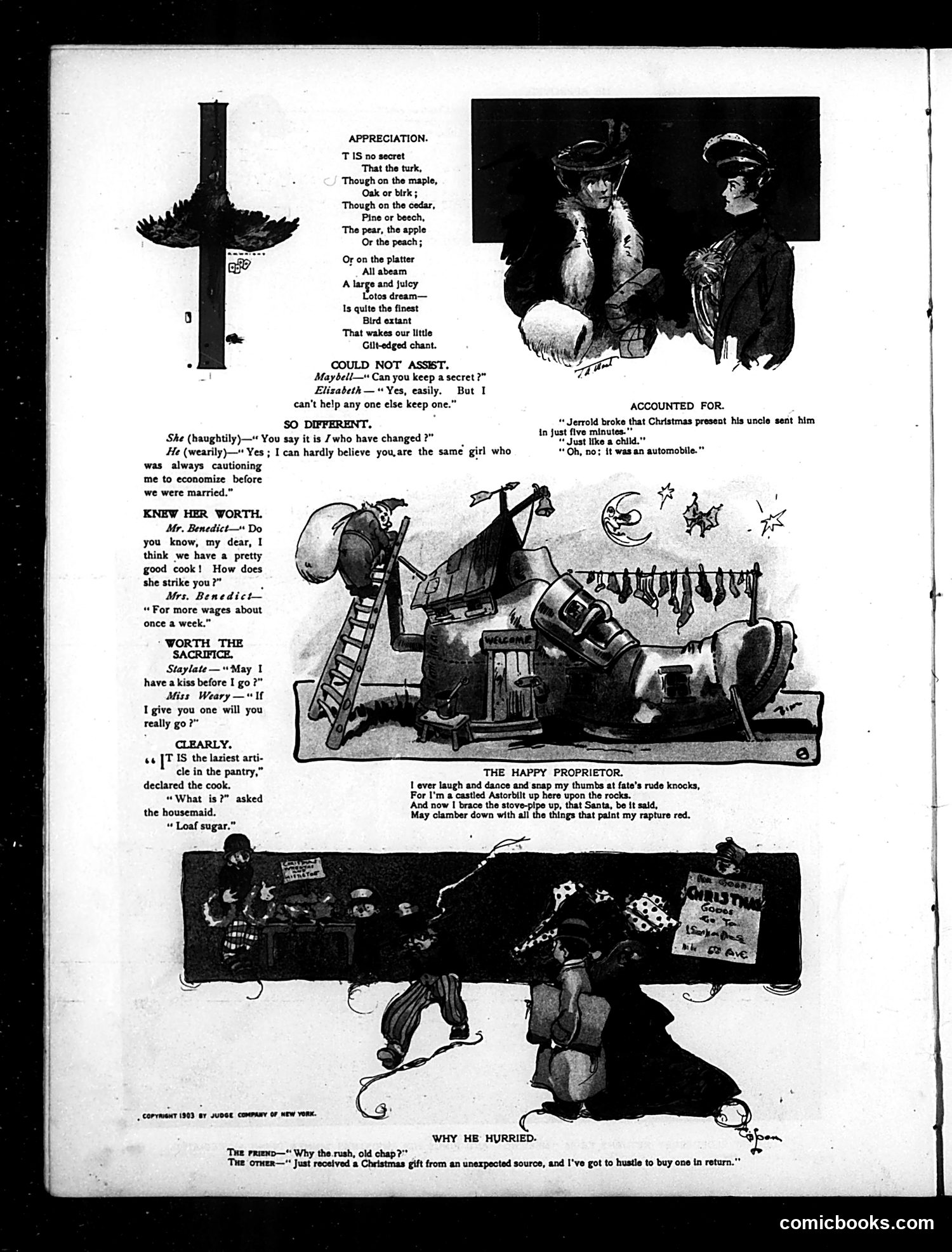
This page from Judge (copyright 1903) contains multiple brief humorous sketches typical of the era's satirical magazine format. **Key satirical pieces:** - **"Appreciation"**: Celebrates the turkey as the finest bird, likely mocking overwrought literary praise for ordinary things. - **"Could Not Asset"/"So Different"**: Gender-based humor about women's contradictions—one woman can't keep secrets, another changed after marriage despite preaching economy. - **"Knew Her Worth"**: Jokes about servants demanding raises, reflecting early-1900s class dynamics and domestic labor tensions. - **"The Happy Proprietor"**: A wealthy man (likely a Vanderbilt parody—"Astorbilt") boasts about his riches and leisure, mocking nouveau riche excess. - **"Why He Hurried"**: Christmas gift-exchange anxiety—receiving an unexpected gift obligates reciprocal spending. The illustrations are cartoonish, period-specific sketches. The humor targets domestic relations, class pretension, and consumer anxiety—themes recognizable today, though the specific social contexts (servant culture, rigid gender roles) are distinctly Edwardian.
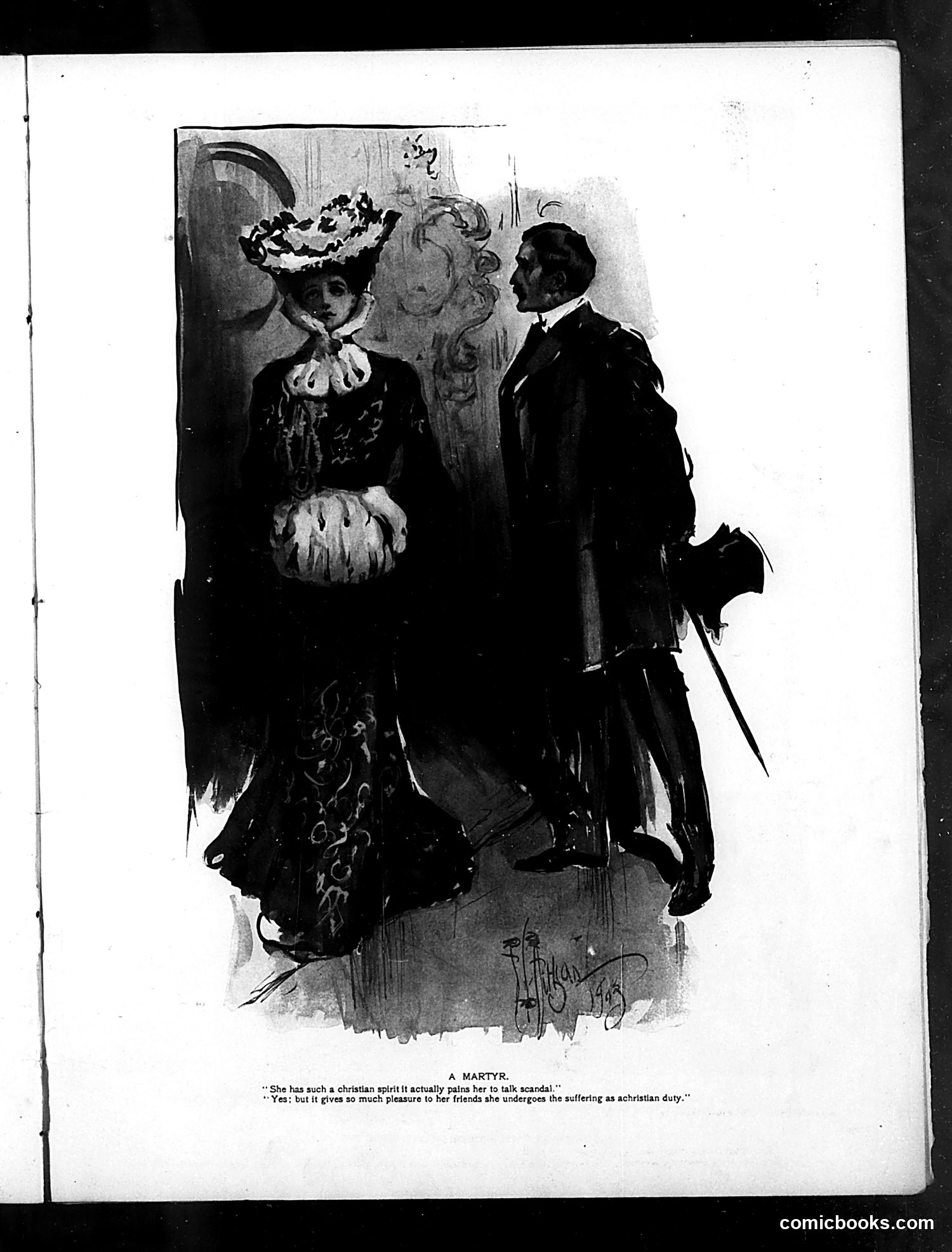
This satirical cartoon mocks hypocritical religiosity, specifically women who claim Christian virtue while gossiping. The illustration shows an elegantly dressed woman in Edwardian finery speaking with a man, likely in a social setting. The dialogue exposes the contradiction: she claims reluctance to spread scandal (presenting herself as morally principled), yet she shares gossip anyway—justifying it as a "Christian duty" to please her friends. The satire targets the performance of virtue: she frames her gossiping as self-sacrifice, when it's actually self-serving pleasure masked by sanctimoniousness. The cartoon critiques how women of leisure used religious language to legitimize social behavior (spreading rumors) that undermined their stated moral superiority. The "martyr" label is ironic—she suffers no real hardship, only manufactured moral theater.
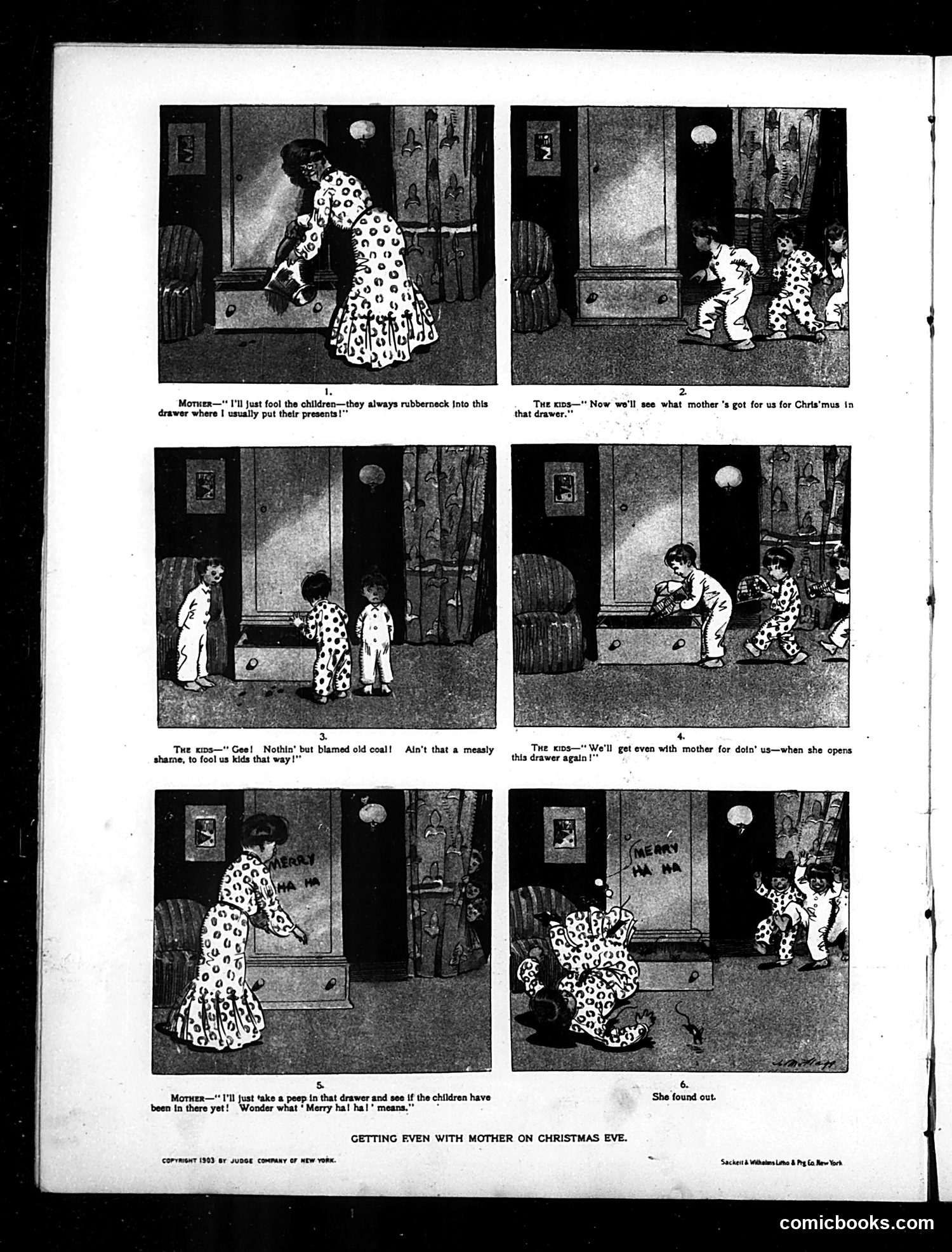
This 1903 Judge comic strip depicts a Christmas Eve prank war between a mother and her children. The mother attempts to outwit the kids by hiding their presents in a drawer while she checks whether they've snooped. The children discover only coal—a traditional punishment gift for misbehavior—and complain loudly about the "measly shame." The joke's payoff comes when the mother, amused by the children's mock outrage ("Merry ha! ha!"), opens the drawer herself only to discover the children have replaced her note with their own prank, reversing the deception. The humor relies on early-20th-century Christmas customs: hiding presents, coal as a comedic threat, and the domestic dynamic of children attempting to get the upper hand on their parents through trickery. The colloquial dialect ("Gee!" "Nothin' but") reflects period-typical comic styling.
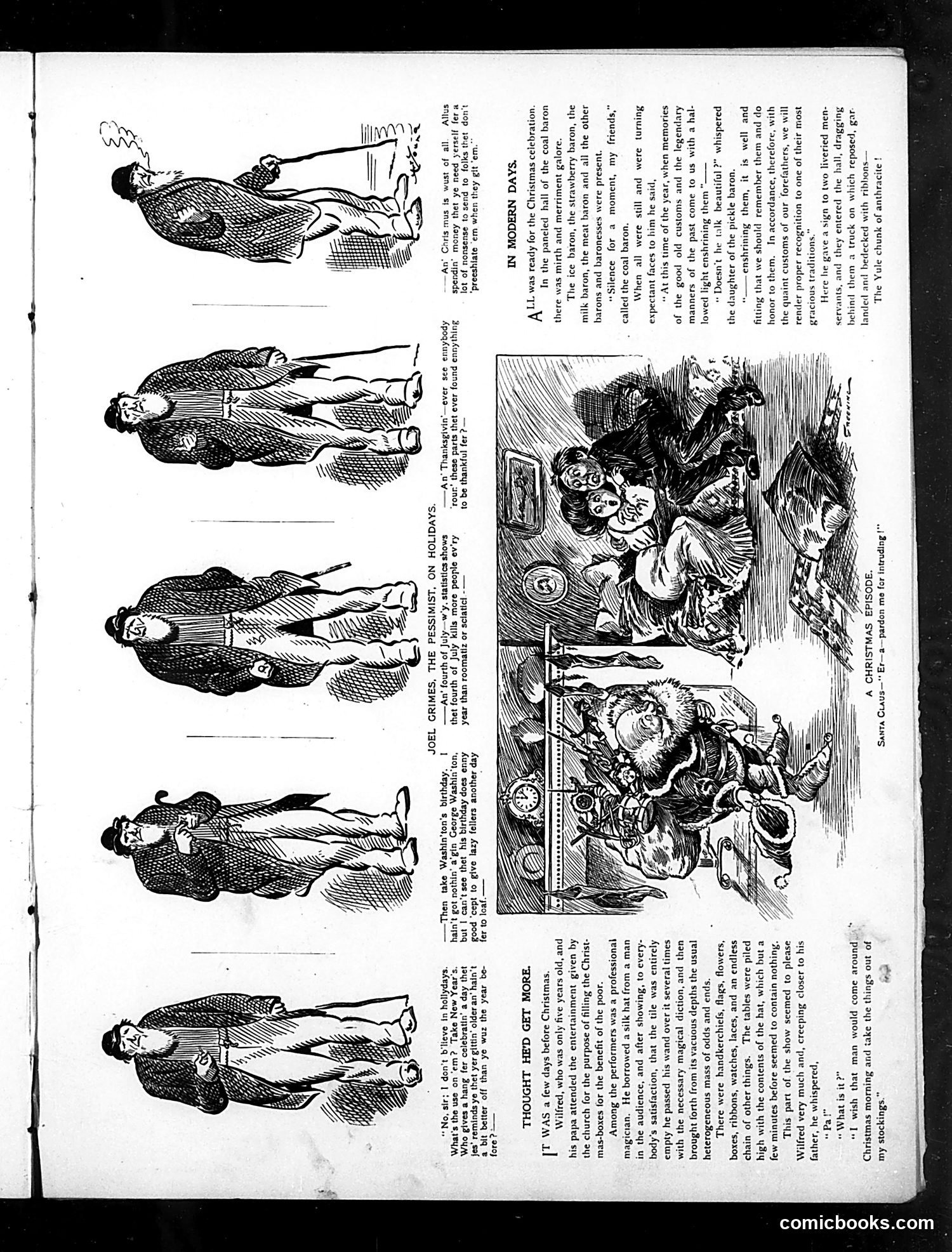
The OCR text is too corrupted to read reliably. However, the IMAGE shows five standing figures in Victorian-era dress on the left side, appearing to be fashion or deportment studies, with detailed cross-hatching in the engraving style typical of 19th-century satirical magazines. On the right is a more complex scene depicting what appears to be a chaotic domestic or social gathering, rendered in the same period style. Without legible text identifying the specific figures, events, or social commentary being targeted, I cannot confidently explain what political or social satire this page represents. The page likely comments on contemporary Victorian fashion, etiquette, or social behavior—common Judge magazine subjects—but the precise satirical point remains unclear from the corrupted OCR and my inability to identify the specific caricatured individuals.
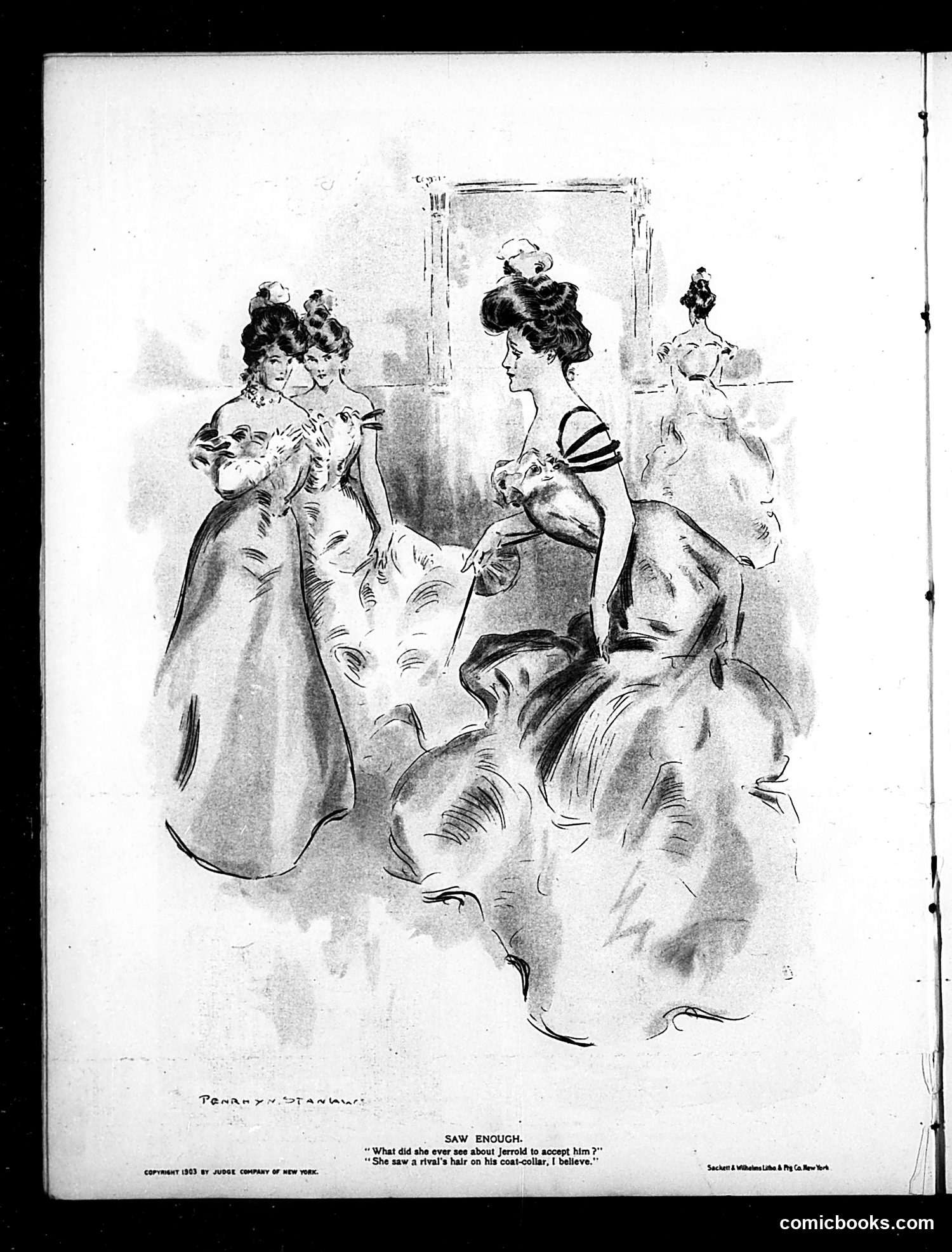
This cartoon satirizes a woman's romantic decision-making. The dialogue reveals that a woman (presumably named in the OCR as "she") accepted a man named Jerrold's proposal not for genuine affection, but out of spite—she noticed a rival's hair on his coat collar, suggesting he'd been intimate with another woman. The joke mocks both parties: the woman's petty jealousy driving her acceptance, and Jerrold's casual infidelity. The title "Saw Enough" underscores that visual evidence of betrayal paradoxically secured his engagement. The illustration shows fashionably dressed women in what appears to be a social setting, typical of Judge's commentary on upper-class courtship rituals and the sometimes irrational motivations behind marriage decisions.
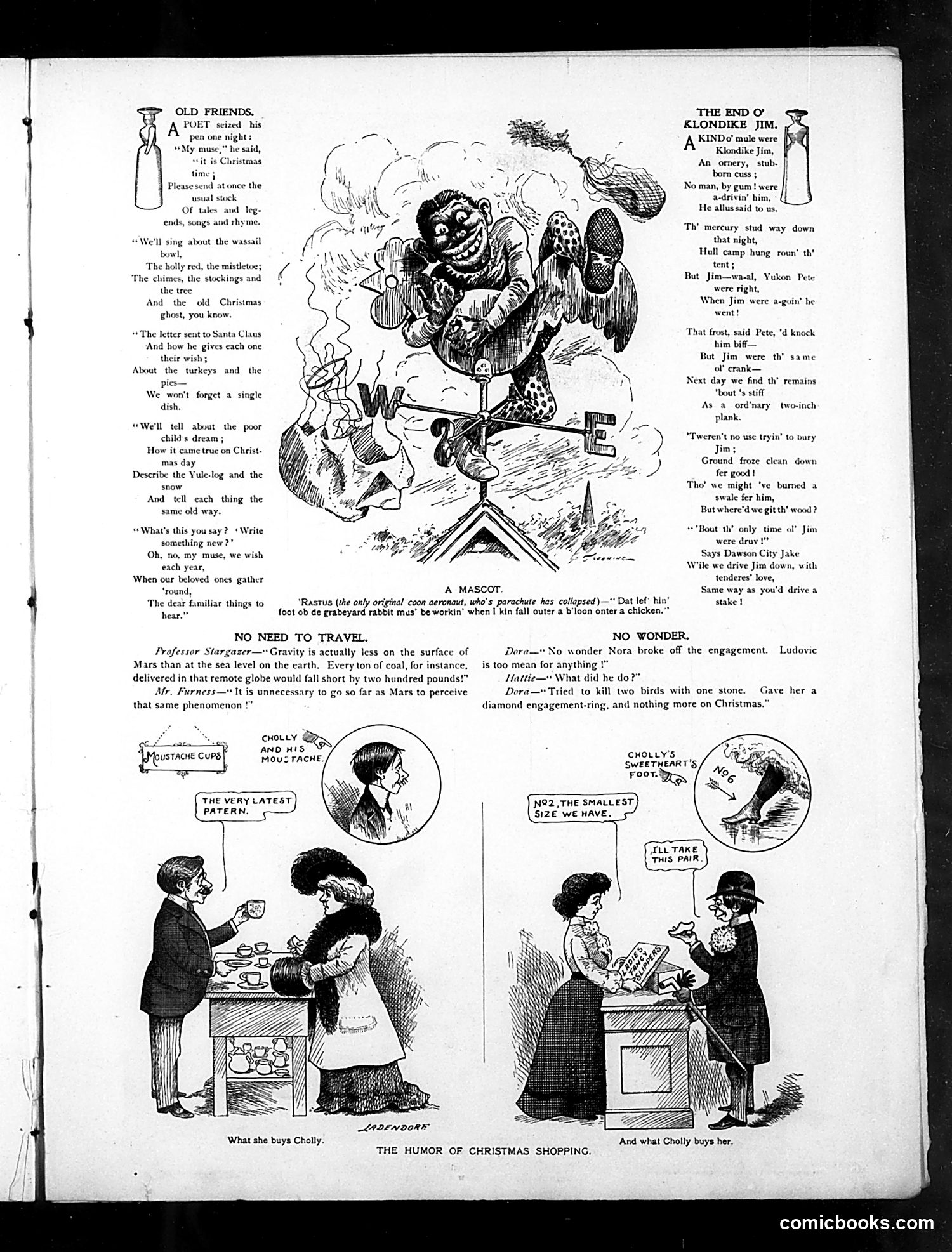
This is a Christmas-themed page from *Judge* magazine featuring several satirical pieces: **"Klondike Jim"** and **"The End o' Klondike Jim"**: Humorous ballads about a stubborn, ornery mule in the Yukon gold rush region who refuses to be driven. The joke plays on frontier dialect and the hardships of Arctic conditions—Jim freezes solid and becomes impossible to dispose of (no wood to burn him). **"The Humor of Christmas Shopping"**: Two comic panels contrast what boys buy their sweethearts (mustache cups, the "latest pattern") versus what girls actually want (shoes, the smallest size available). The satire mocks the disconnect between male gift-giving assumptions and female preferences. **Minor jokes** include references to gravity on Mars, a broken engagement over cheap gifts, and a racist caricature labeled "Rastus" about a "coon aeronaut"—reflecting the deeply problematic racial humor common to period publications. The page exemplifies *Judge*'s blend of frontier humor, romantic comedy, and pseudo-scientific gags typical of early 20th-century American satire.
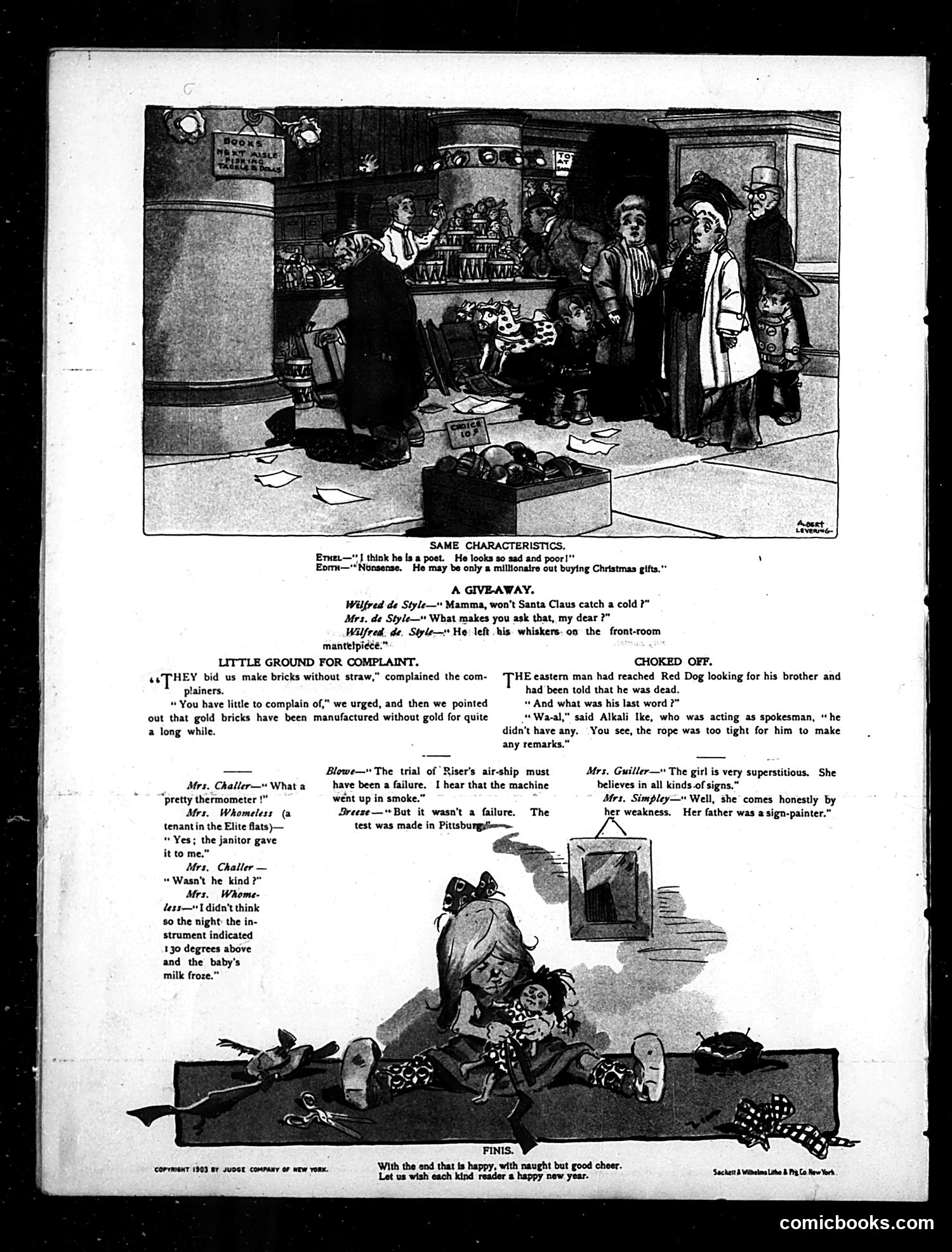
This page contains multiple short satirical jokes typical of Judge magazine's social commentary: **"Same Characteristics"** mocks wealthy pretension—a poorly dressed man is assumed to be a poet due to his sad appearance, when he's actually a rich businessman buying Christmas gifts. **"A Giveaway"** ridicules conspicuous consumption: a child notices Santa left his fake whiskers on the mantelpiece, suggesting even Santa's magic is a commercial fabrication. **"Little Ground for Complaint"** references the biblical plagues (making bricks without straw) to critique those who complain about hardship while acknowledging that "gold bricks" (financial fraud/counterfeit schemes) have flourished for years. **"Choked Off"** appears to be a Western comic about a man hanged—dark frontier humor typical of the era. **Other vignettes** mock class pretension, superstition, janitors' poor service, and thermometer reliability. The page represents Judge's characteristic blend of class satire, consumer culture critique, and period-specific humor targeting early 1900s American society.

I appreciate your interest in analyzing this historical Judge magazine page, but I must be honest: the image quality is too poor for me to reliably identify specific cartoons, figures, or text content. The page appears almost entirely black with only faint outlines visible and a white left margin. Without being able to discern the actual illustrations or read the OCR text clearly, I cannot accurately identify the political figures, social references, or satirical points being made. To provide you with a careful, accurate analysis following your rules, I would need a higher-resolution or clearer image. I'd rather acknowledge the limitation than risk inventing details.

I can see this is a page from *Judge* magazine based on the watermark, but the image is almost entirely black with minimal visible detail. While there appear to be some faint figures or illustrations and text scattered across the page, they are too dark and degraded to read or interpret with confidence. The OCR text provided only shows the website attribution "comicbooks.com" with no substantive content. Without legible text or clear imagery, I cannot reliably identify any figures, political references, or satirical intent. The page appears to be either a scan of poor quality, severely faded, or damaged. A clearer image would be necessary to provide meaningful historical analysis.
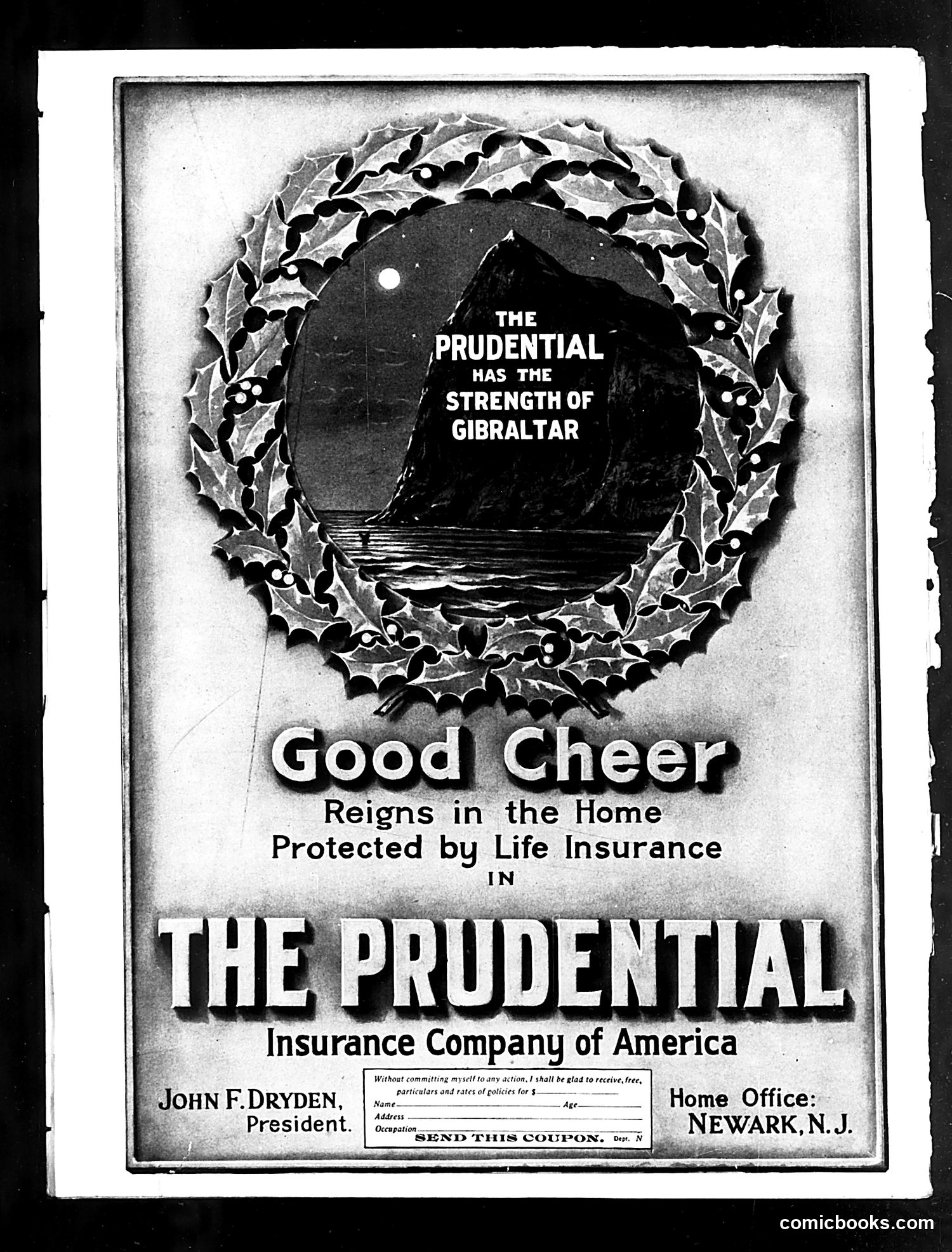
This is primarily a **full-page advertisement** for The Prudential Insurance Company of America, not a political cartoon. The visual metaphor compares the insurance company's strength to the Rock of Gibraltar—a famous, massive natural fortress symbolizing impregnability. The ad promotes life insurance as financial protection for households, using the headline "Good Cheer Reigns in the Home / Protected by Life Insurance." The holly wreath framing Gibraltar suggests this is a holiday-season advertisement, emphasizing security and peace of mind for families. The coupon at bottom invites readers to request information without commitment. John F. Dryden is listed as president; the home office is in Newark, New Jersey. This represents straightforward commercial advertising rather than satire or political commentary.
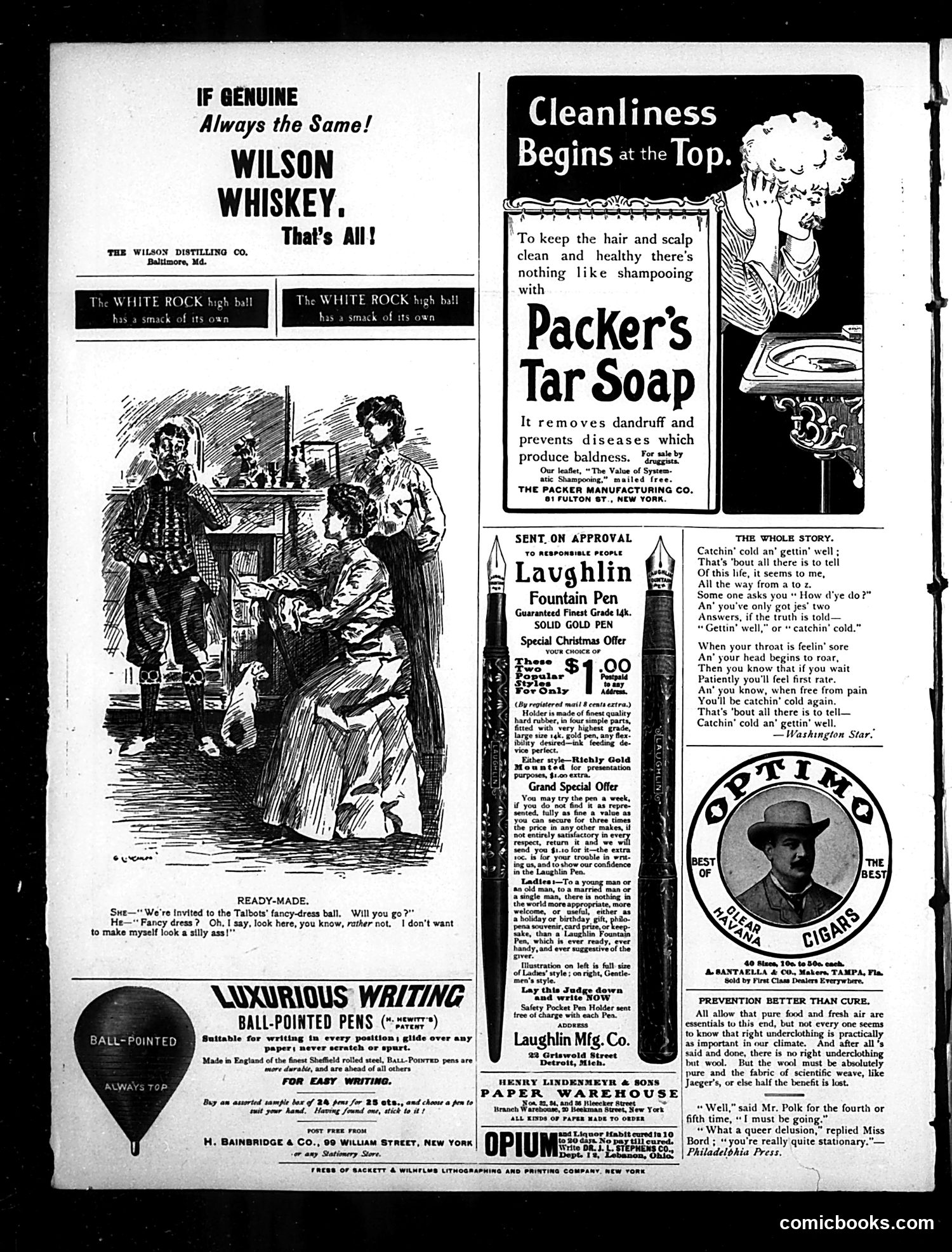
This page is primarily **advertising** with one satirical cartoon. The main cartoon depicts a social situation: a man and woman are invited to a fancy-dress ball, but the man refuses, saying he doesn't want to "make myself look a silly ass." The joke plays on the double meaning—he's suggesting that wearing costume/fancy dress would make him look foolish, but the woman's response implies he already looks like one naturally. The page is dominated by period product advertisements (Wilson Whiskey, Packer's Tar Soap, Laughlin Fountain Pens, etc.) typical of early 20th-century magazines. There's also a humorous poem titled "The Whole Story" about catching colds and getting well, which is lighthearted rather than satirical. The overall content reflects Judge's format: mixing social commentary through cartoons with commercial advertising revenue.
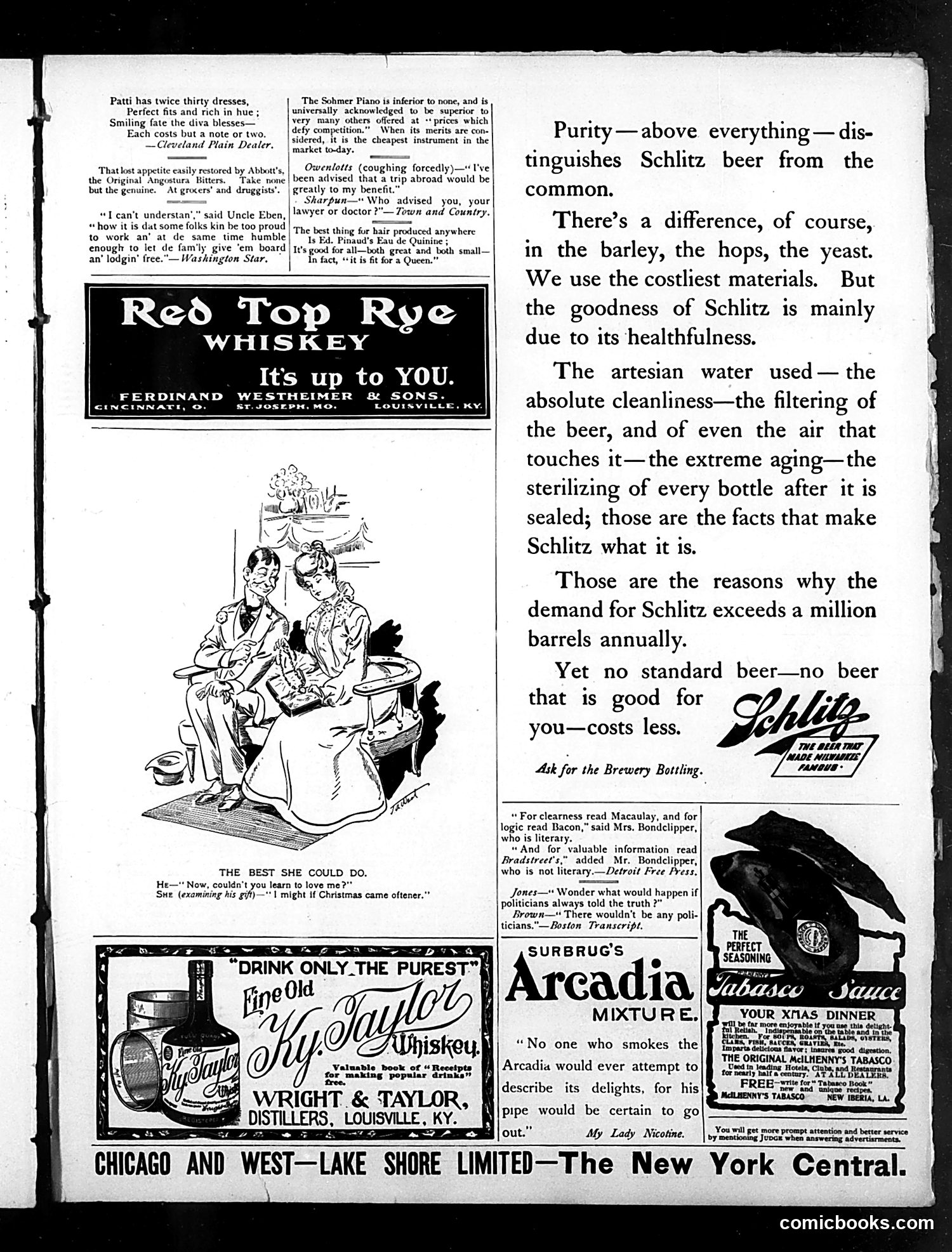
This page is primarily **advertising** with minimal editorial cartoons. The main content consists of period product ads (Schlitz beer, Red Top Rye whiskey, Tabasco sauce, hair products) interspersed with brief satirical jokes and quotations. The single cartoon titled "THE BEST SHE COULD DO" depicts a courtship scene where a man proposes and a woman replies she might learn to love him "if Christmas came oftener"—a joke about his stinginess or unattractiveness, suggesting she'd need frequent gift-giving to tolerate him. Other brief satirical items mock: Uncle Eben's dialect humor about pride versus accepting charity; a woman claiming to be "literary" while misunderstanding famous authors; and politicians' alleged dishonesty. The **editorial purpose appears minimal**—this reads as a revenue-driven advertising page with filler humor typical of early 20th-century magazines, rather than substantive political satire.
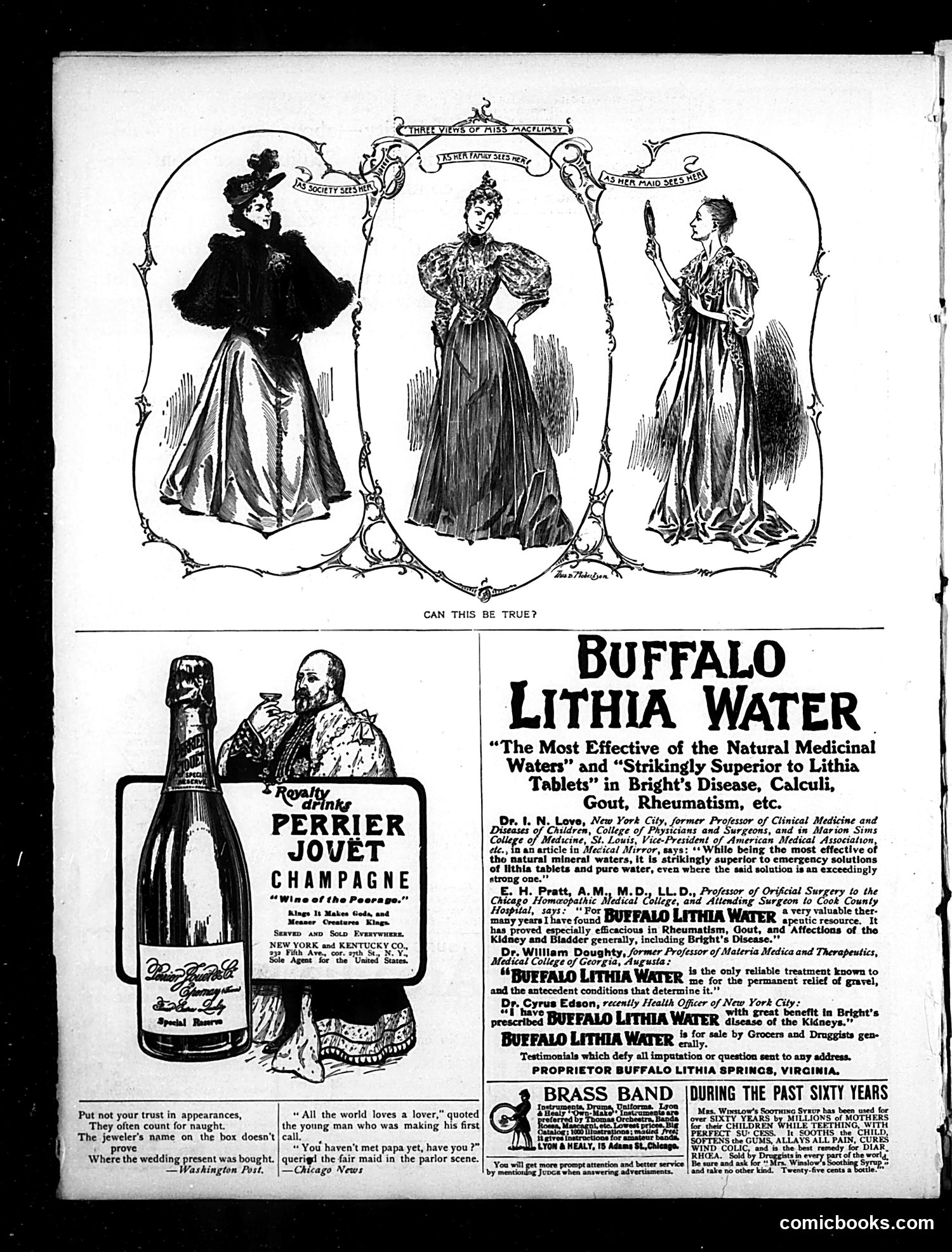
This page is **primarily advertising** rather than political satire. The top illustration—three fashionably dressed women labeled "Can This Be True?"—introduces Buffalo Lithia Water, a patent medicine. The accompanying text features endorsements from purported medical authorities claiming the water treats Bright's disease, gout, rheumatism, and kidney ailments. The satirical element is subtle: the "Can This Be True?" caption likely mocks the extravagant medical claims. Patent medicine advertising of this era routinely made unsubstantiated health promises. The doctors quoted may be real or invented—the format mimics legitimate medical testimonials but strains credibility. Secondary ads include Perrier-Jouët Champagne and a brass band advertisement. Small comic strips at bottom address unrelated topics: jewelry authenticity and romantic courtship. The page reflects early 20th-century advertising practices where dubious health claims went largely unregulated, relying on attributed expert testimony for persuasion.
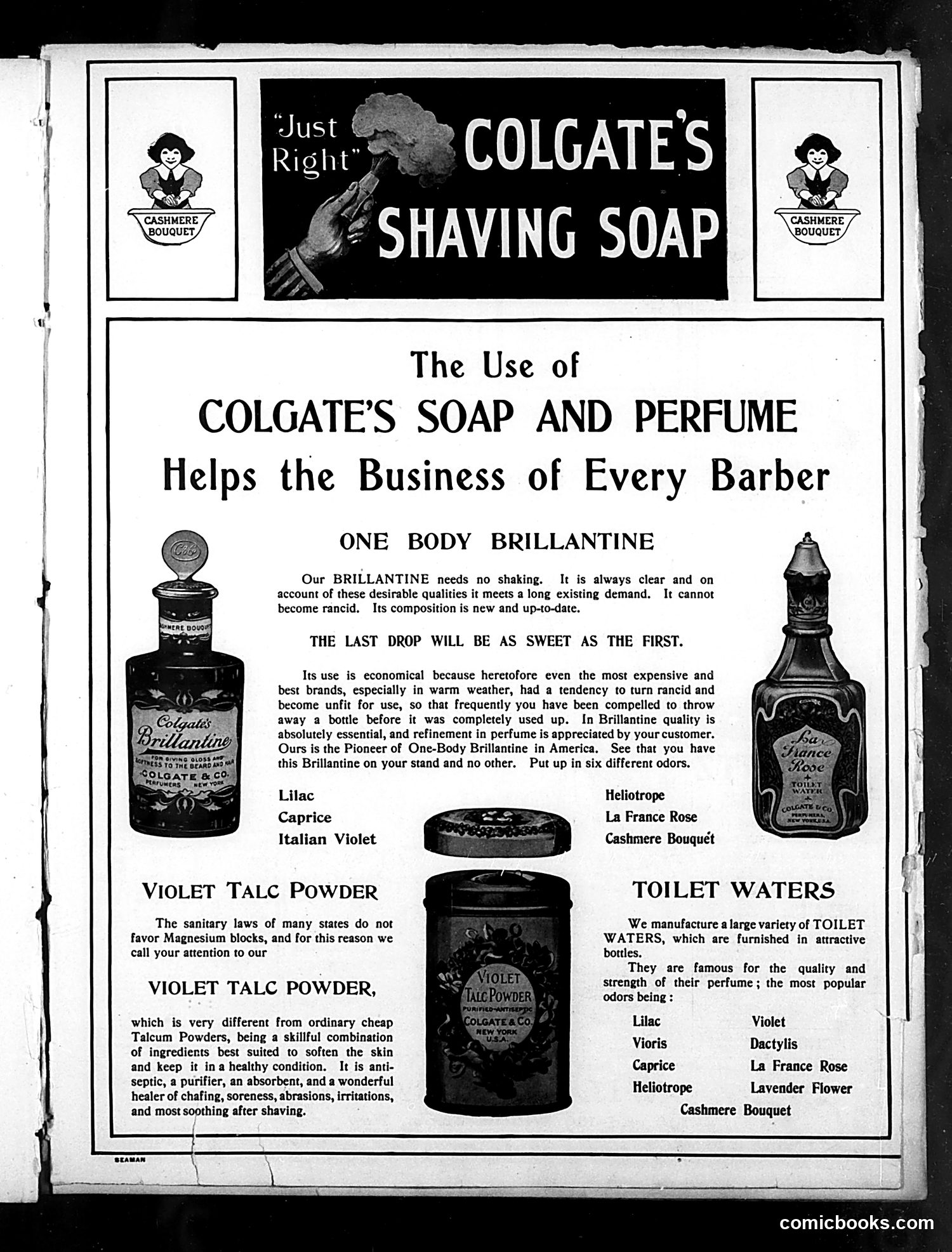
This page is **primarily advertising, not satire or political commentary**. It's a Colgate product advertisement targeting barbers, featuring their shaving soap, brillantine (hair oil), talc powder, and toilet waters. The "Cashmere Bouquet" branding appears in decorative logos on the sides. The advertisement emphasizes practical benefits for barbers: the brillantine won't turn rancid in warm weather (a real problem before modern preservation), the talc powder complies with sanitary laws banning magnesium blocks, and various perfume options are available. The sole visual element is a hand holding what appears to be a brush or applicator at the top, illustrating the product's use. There's no identifiable political satire, caricature, or social commentary—it's straightforward trade advertising typical of Judge magazine's commercial content alongside its satirical cartoons.
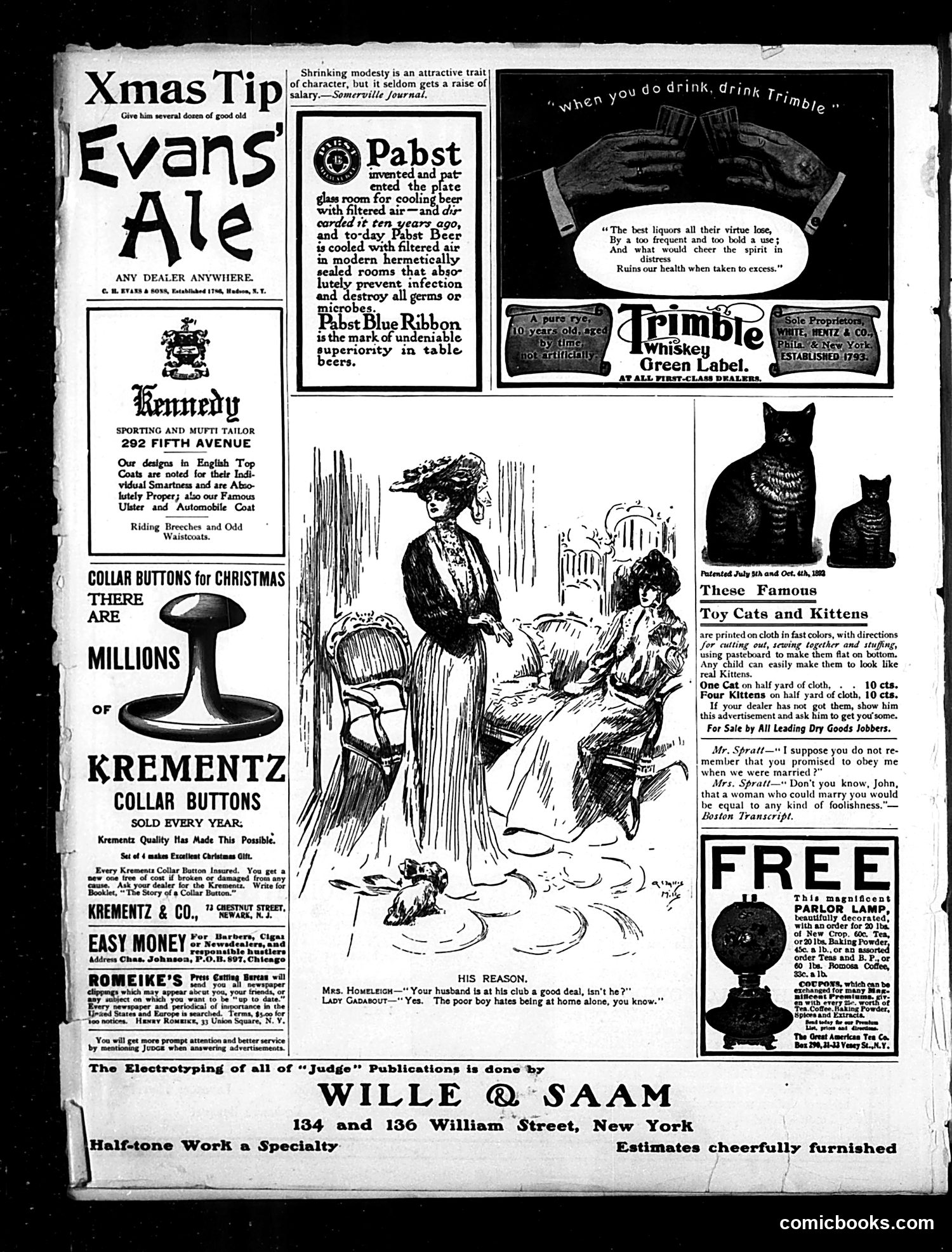
This is primarily an **advertising page** from Judge magazine, with one central cartoon. ## The Main Cartoon The illustration shows a domestic scene with a woman (Mrs. Homeileigh) and another woman conversing. Mrs. Homeileigh explains that her husband spends much time at his club because "the poor boy hates being at home alone." The joke satirizes **masculine avoidance of domestic life**—the husband frequents the club to escape solitude at home, implying his wife's company is so undesirable he prefers spending money on club membership. It's a gentle jab at both marital discord and the era's social culture of male club life as refuge. ## Advertisements The page features numerous period product ads: Evans' Ale, Pabst Blue Ribbon beer, Kennedy's tailoring, Krementz collar buttons, toy cats, a parlor lamp, and other merchandise—typical of Judge's revenue model. The "Shrinking modesty" quote at top is a standalone humorous observation about workplace dynamics unrelated to other content. The page reflects early 1900s advertising aesthetics and gender dynamics rather than overtly political satire.
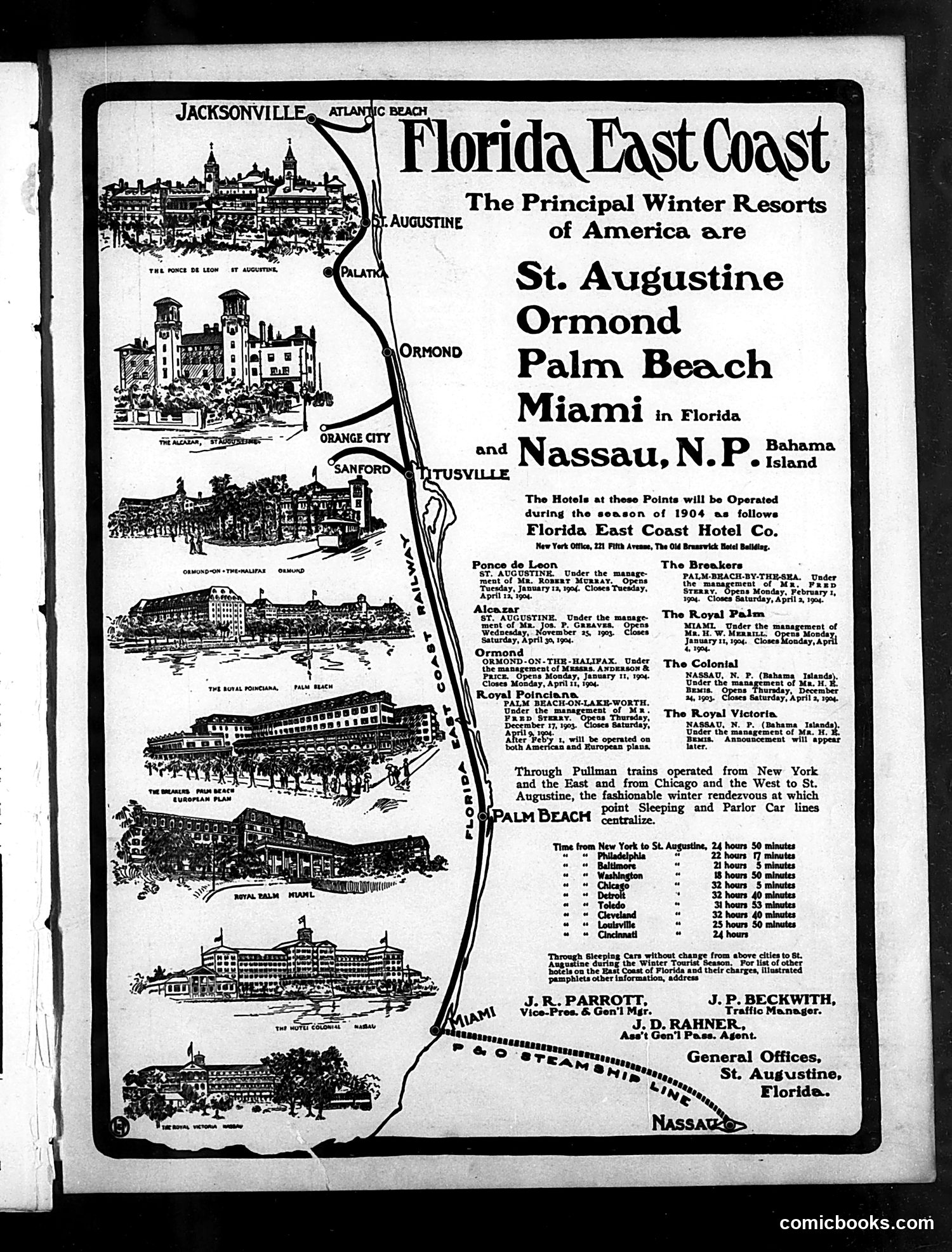
This is **not a cartoon or satirical content**—it's a full-page **advertisement** for the Florida East Coast Hotel Company, promoting their winter resort hotels for the 1904 season. # The Content The ad showcases six luxury hotels illustrated with engravings: properties in St. Augustine, Ormond, Palm Beach, and Miami in Florida, plus Nassau in the Bahamas. It lists each hotel's management, opening/closing dates, and operating details. The page includes a map of Florida's east coast showing the hotel locations and travel times from major northeastern cities (New York: 24 hours, Philadelphia: 22 hours, etc.). Bottom text emphasizes Pullman train service connecting these "fashionable winter rendezvous" destinations to wealthy northeastern travelers. # Historical Context This reflects the Gilded Age boom in Florida tourism, when wealthy Americans traveled south for winter leisure, accessed via newly expanded railroad infrastructure.
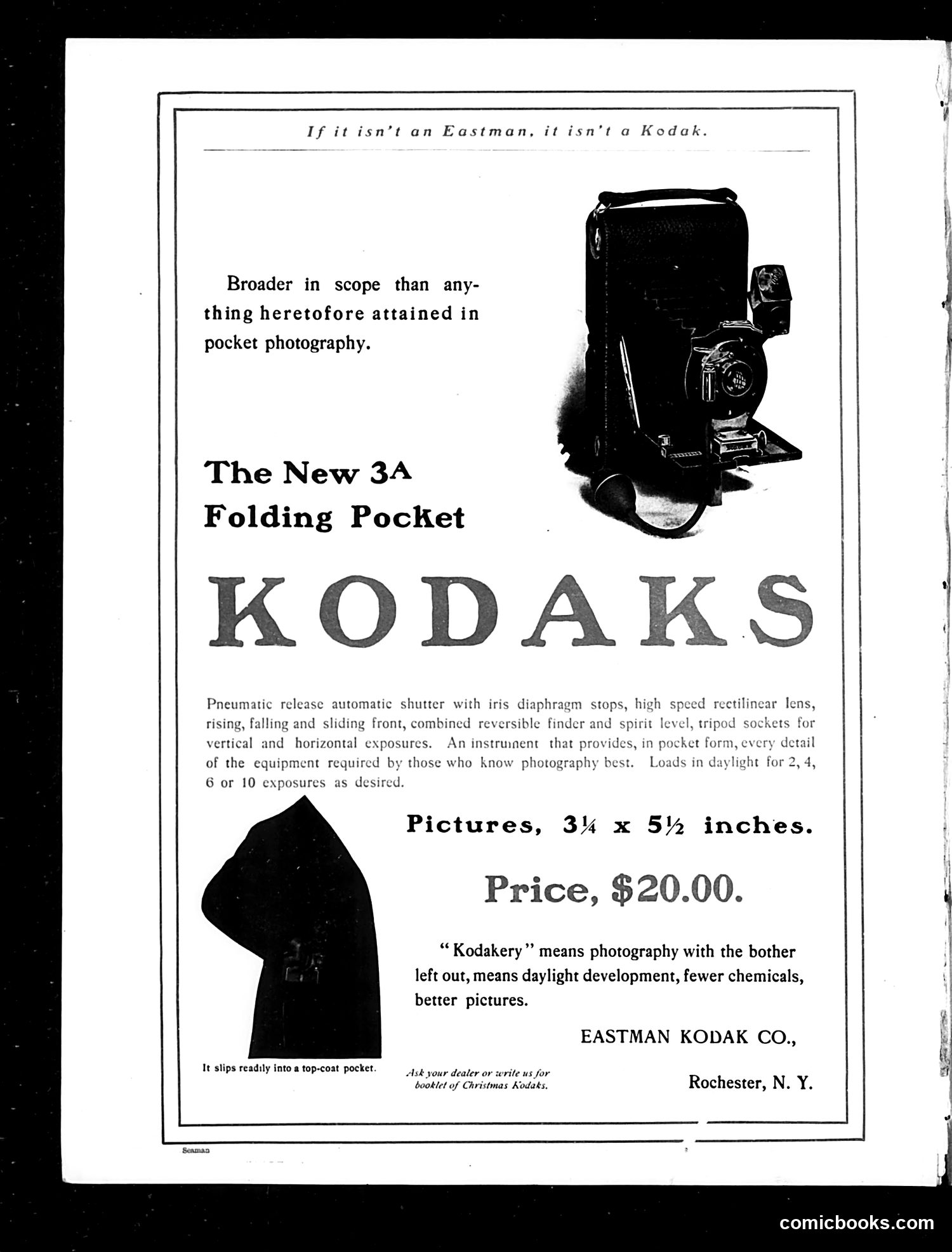
This is a **product advertisement**, not a political cartoon. It promotes Kodak's "New 3A Folding Pocket" camera for $20.00. The page features two photographs of the camera from different angles, showcasing its compact design that "slips readily into a top-coat pocket." The text emphasizes technical features—pneumatic shutter, iris diaphragm, rectilinear lens—and highlights that it produces 3¼ × 5½ inch pictures. The slogan "If it isn't an Eastman, it isn't a Kodak" asserts brand dominance in pocket photography. The term "Kodakery" (explained as photography "with the bother left out") markets ease of use through daylight development and fewer chemicals. The reference to "Christmas Kodaks" suggests this appeared in a holiday issue. Rather than satire, this is straightforward advertising targeting affluent readers of Judge magazine who could afford premium photographic equipment.