
A complete issue · 16 pages · 1903
Judge — September 5, 1903
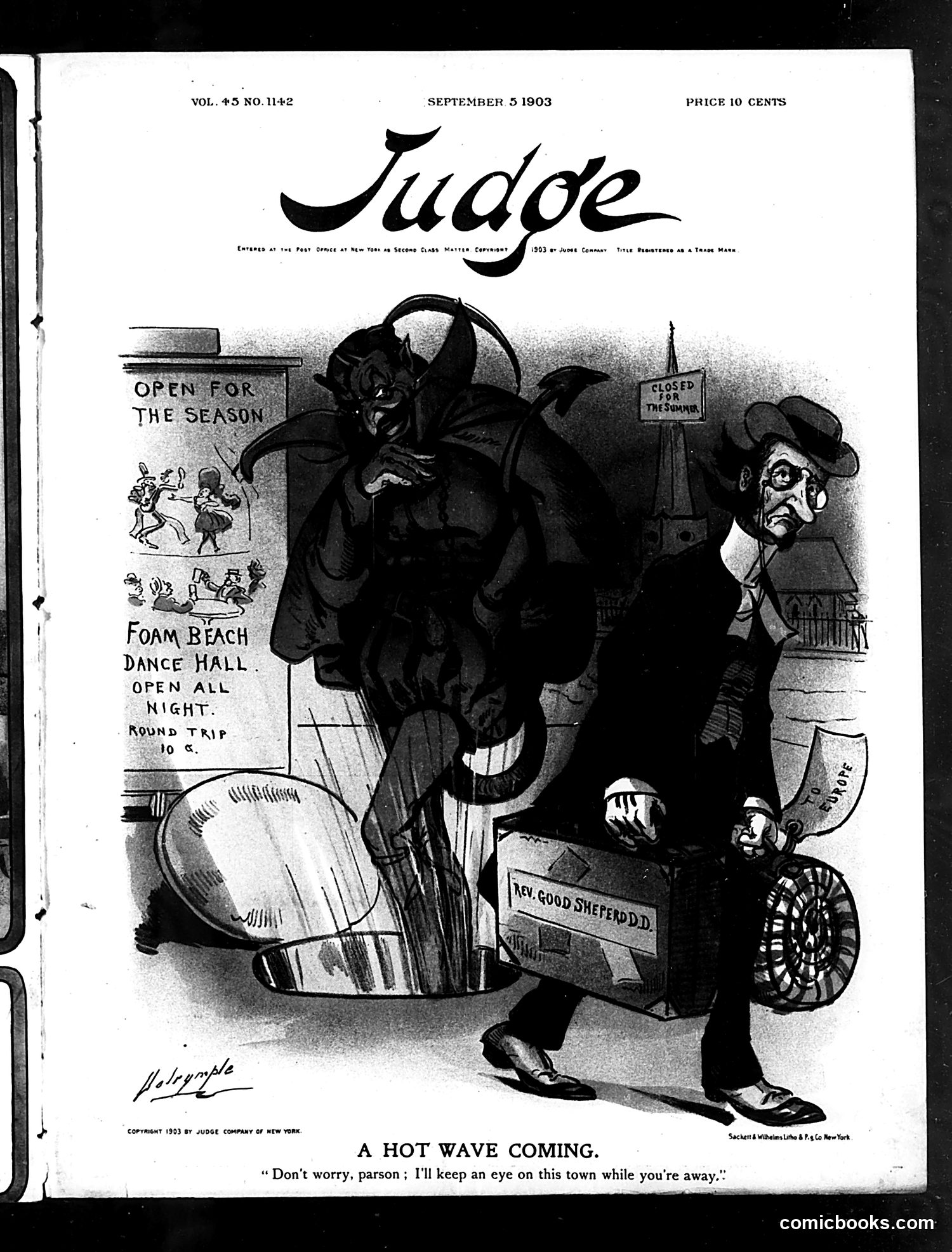
This Judge magazine cover from September 5, 1903 depicts "A Hot Wave Coming." The central figure is a grotesque demon or devil emerging from a cauldron labeled "Rev. Good Shepherd D.D." (a reverend), carrying a thermometer. A small man labeled "parson" stands nearby, saying "Don't worry, parson; I'll keep an eye on this town while you're away." The satire appears to target religious hypocrisy—specifically a corrupt or ineffectual clergyman departing town, leaving behind moral chaos (represented by the demon). The advertisements on the left (Foam Beach Dance Hall, theater closures) suggest concerns about summer vice and entertainment establishments operating unchecked during hot weather when religious oversight is absent. The cartoon cynically implies that without the parson's supervision, the town will descend into debauchery.
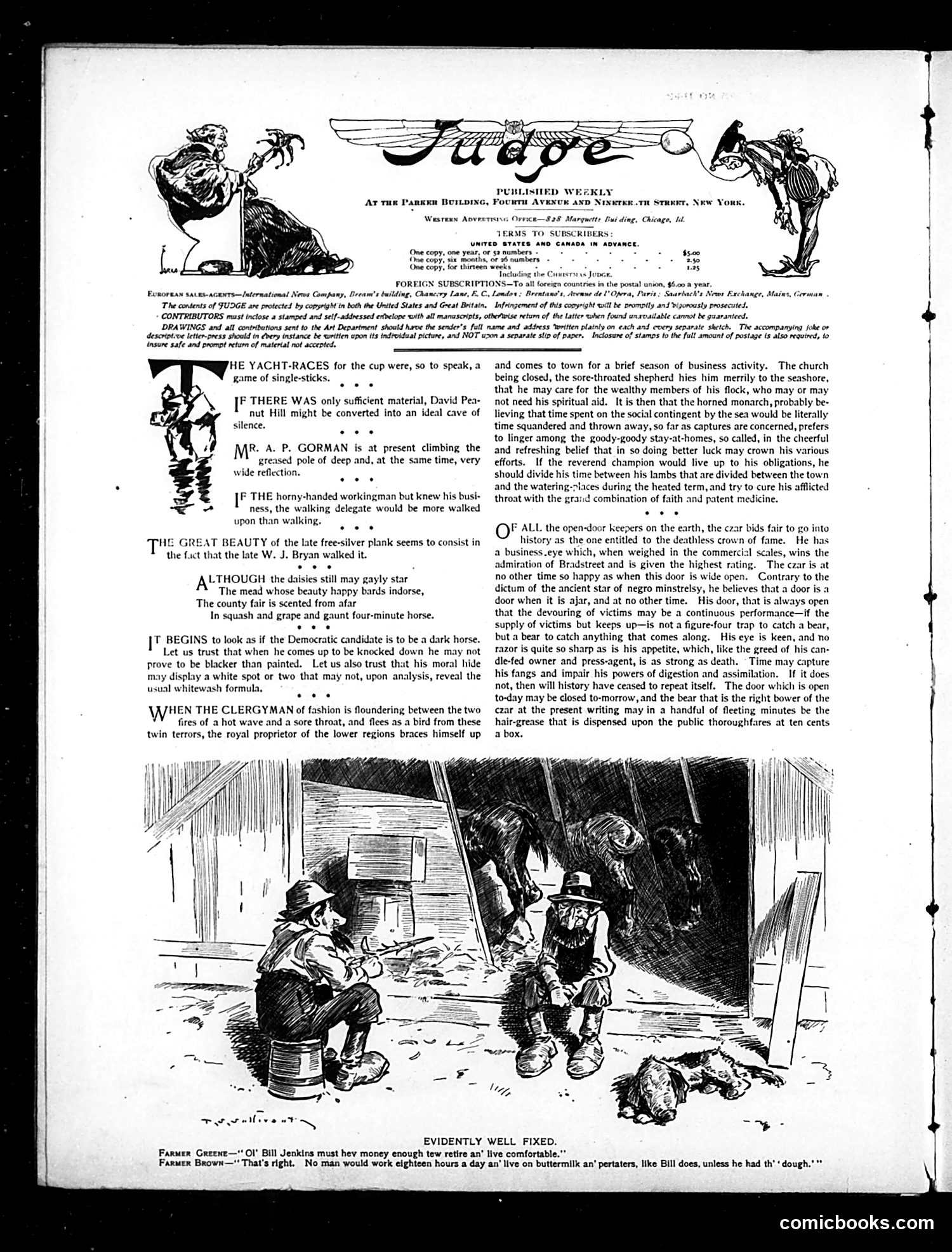
This page contains several satirical pieces typical of Judge's editorial content. The main cartoon, titled "Evidently Well Fixed," depicts two farmers discussing retirement. Farmer Greene mentions Bill Jenkins needing money to retire comfortably, while Farmer Brown replies that no man would work eighteen hours daily on buttermilk and peristers unless he had "dough" (money). The satire targets agricultural labor conditions and economic hardship of farmers during this period. The accompanying editorial commentary discusses various society topics—yacht races, fashion trends among clergy, and social pretension—mocking the wealthy and fashionable classes. The cartoon's humor relies on the contrast between rural poverty and leisure-class indulgence, a recurring Judge theme critiquing economic inequality and the farmer's difficult circumstances.
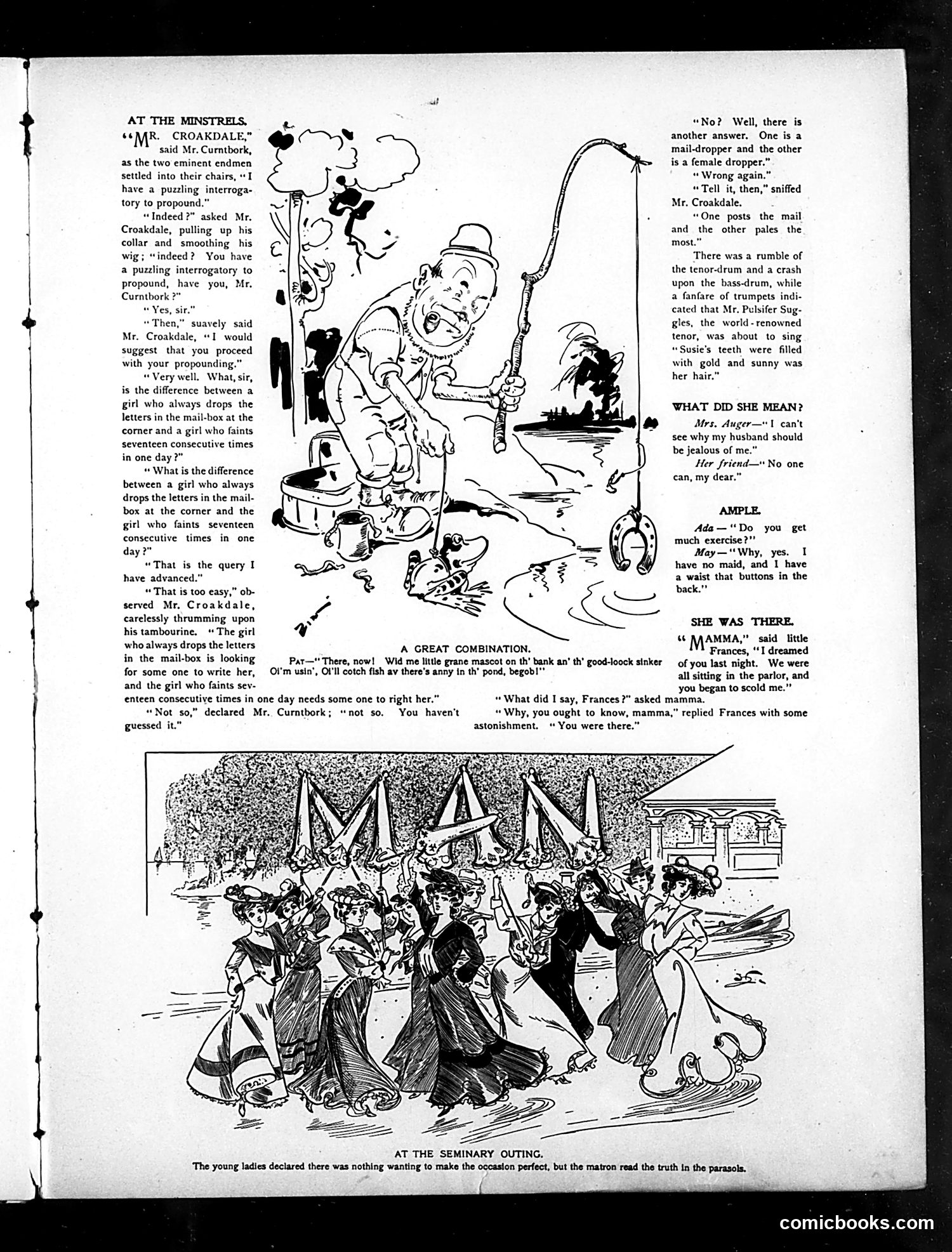
This page contains two distinct pieces of satirical content: **Top Section ("At the Minstrels"):** A dialogue between Mr. Croak dale and Mr. Curnbork about mail carriers. The satire concerns distinguishing between male and female mail-carriers by observing whether they drop mail at corners or in mailboxes. It's a lighthearted jab at postal service inconsistency and perhaps emerging anxieties about women entering the workforce as mail-carriers—a profession traditionally held by men. **Bottom Illustration ("At the Seminary Outing"):** Shows young women at what appears to be a social gathering near water. The caption notes "the matron read the truth in the parasolé"—suggesting the illustration satirizes young ladies' behavior or propriety during supervised outings, likely poking fun at strict Victorian-era oversight of unmarried women. Both segments reflect early-20th-century social attitudes toward gender and workplace change.
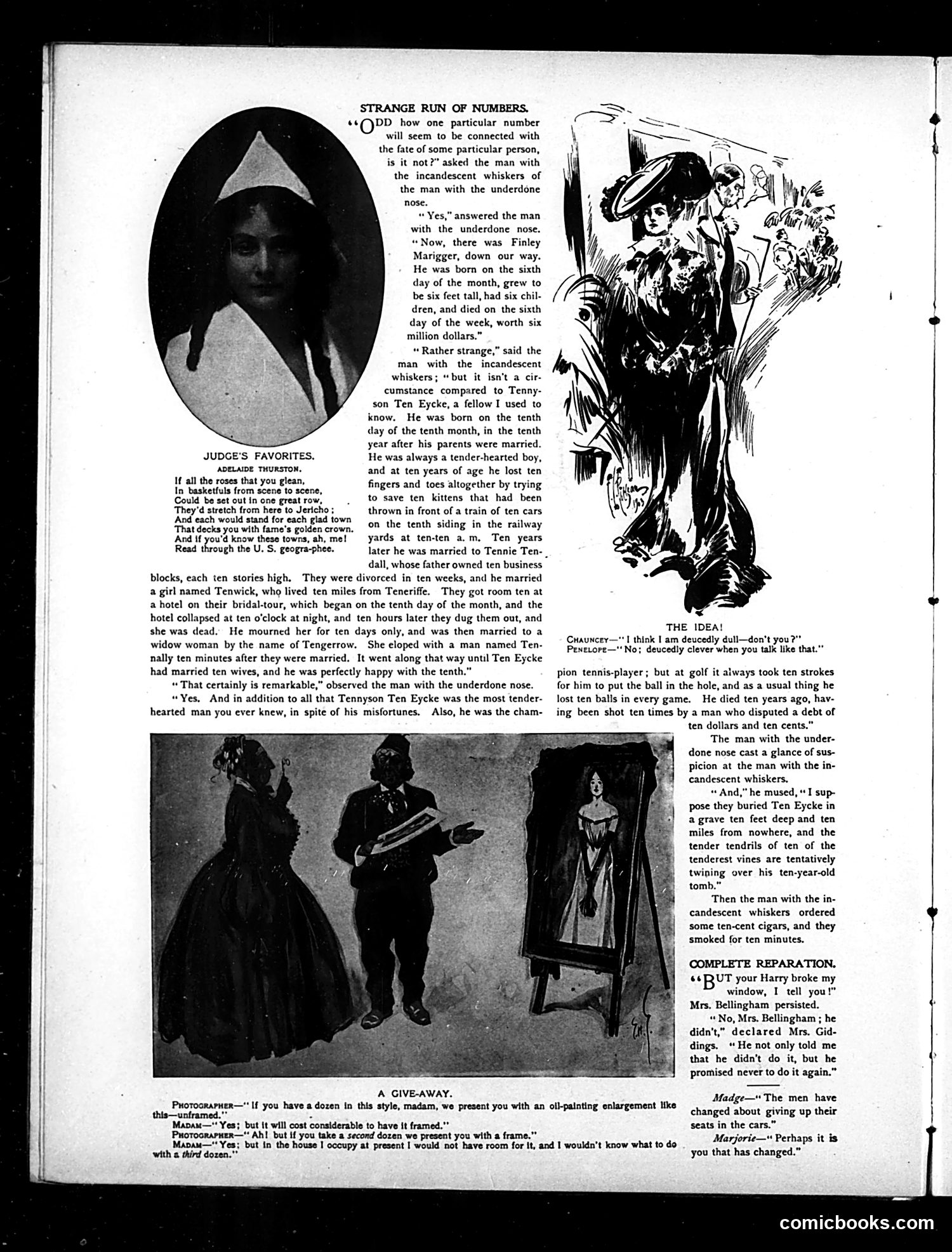
This page contains three distinct pieces: 1. **"Strange Run of Numbers"** (top): A story about numerological coincidences involving people named Finley Marigger and Tennyson Ten Eycke, both born and dying on the 6th/10th of months, both losing digits (fingers/toes and business blocks), both married to women named Tennie. The satire mocks contemporary fascination with numerology and superstitious belief in meaningful coincidences—a popular pseudoscience of the early 20th century. 2. **"Judge's Favorites"** (left): A poem about American towns, likely satirizing regional American peculiarities. 3. **"The Idea!" (right)**: A brief comedic dialogue between Chauncey and Penelope about talking nonsense at golf. The bottom section includes advertisement copy disguised as dialogue about picture framing. This page blends humor, light satire, and advertising typical of Judge magazine's format.
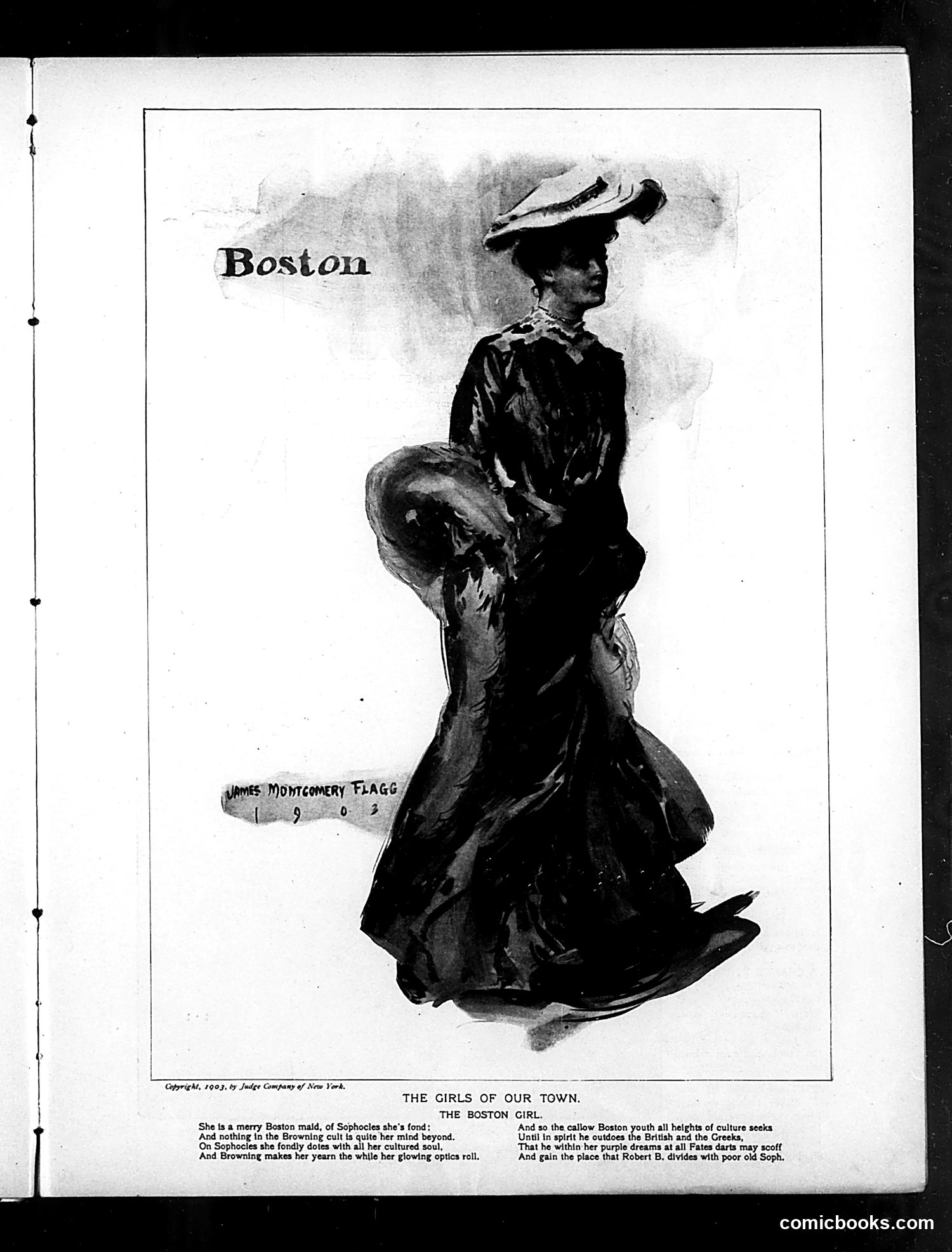
This satirical illustration mocks Boston's intellectual pretensions and courting rituals. The drawing shows an elegant woman in fashionable dress, labeled as "The Boston Girl." The accompanying poem ridicules how Boston women, obsessed with classical literature (Sophocles) and Victorian poet Robert Browning, set impossibly high cultural standards for suitors. Young Boston men must become walking encyclopedias of literature and philosophy to win their affection—they must "outdoes the British and the Greeks" in learning. The satire targets the snobbish intellectualism of Boston's upper class and the performative nature of courtship among the culturally ambitious. It suggests Boston girls weaponize their refined tastes to make romance absurdly competitive and unattainable for ordinary men. The piece is part of Judge's "Girls of Our Town" series, comparing regional American female stereotypes.
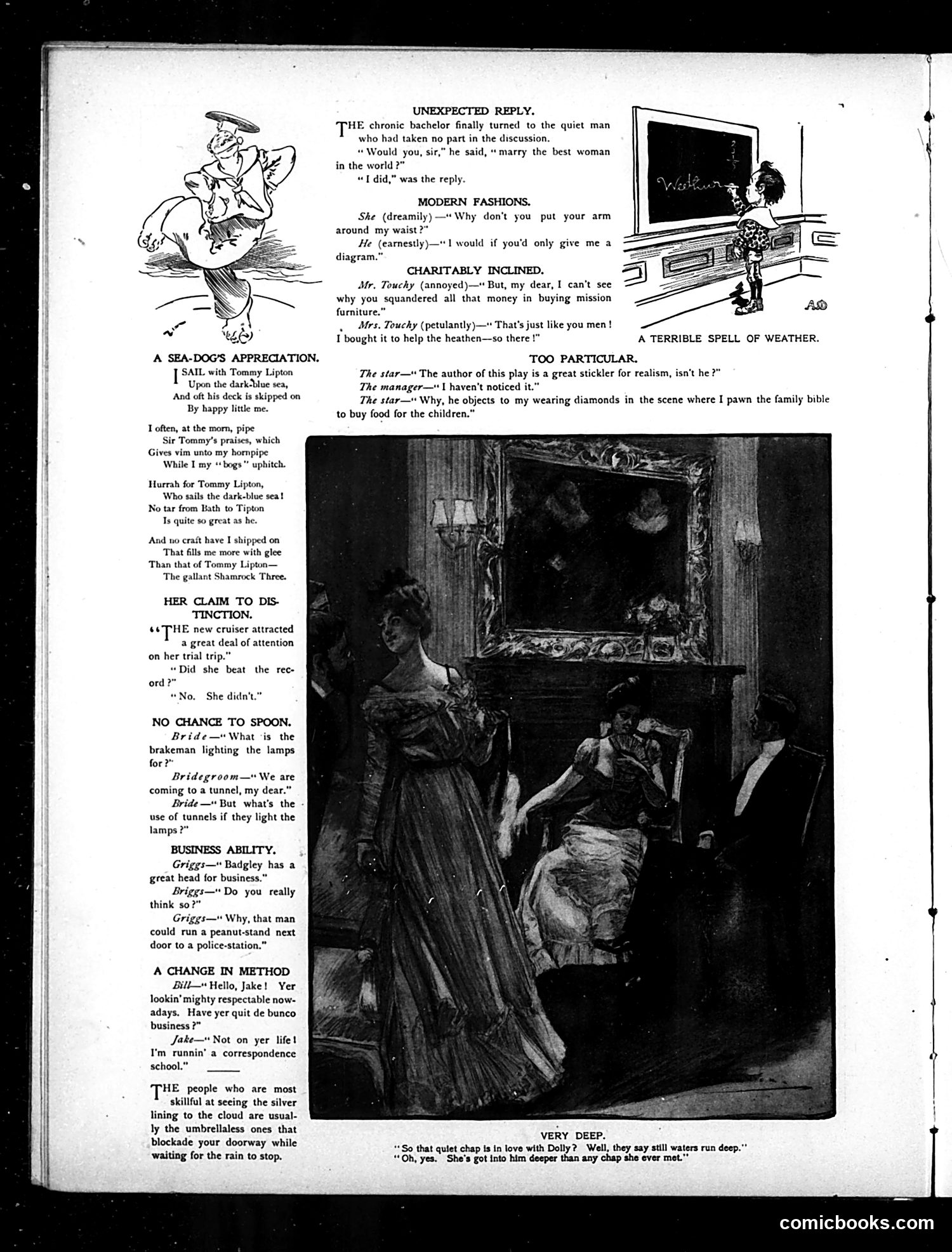
This page from *Judge* contains multiple short humor pieces typical of early 20th-century American satire: **"A Sea-Dog's Appreciation"** celebrates Sir Thomas Lipton, the Irish businessman and yacht racer famous for multiple America's Cup challenges with his yacht *Shamrock III*. The poem humorously praises him as a sailing hero. **"Modern Fashions"** mocks contemporary women's fashion—specifically the difficulty of embracing women wearing restrictive corsets, requiring a "diagram" to navigate properly. **"Charitably Inclined"** satirizes wealthy women purchasing expensive "mission furniture" (cheaply-made rustic pieces) while claiming charitable motives toward "heathens"—poking fun at performative charity and class pretension. **"Too Particular"** jokes about theatrical realism: an actress objects to pawning a Bible for food scenes while wearing diamonds, revealing the absurdity of selective authenticity in theater. The other brief pieces use wordplay and situational humor typical of the era's magazine humor sections.
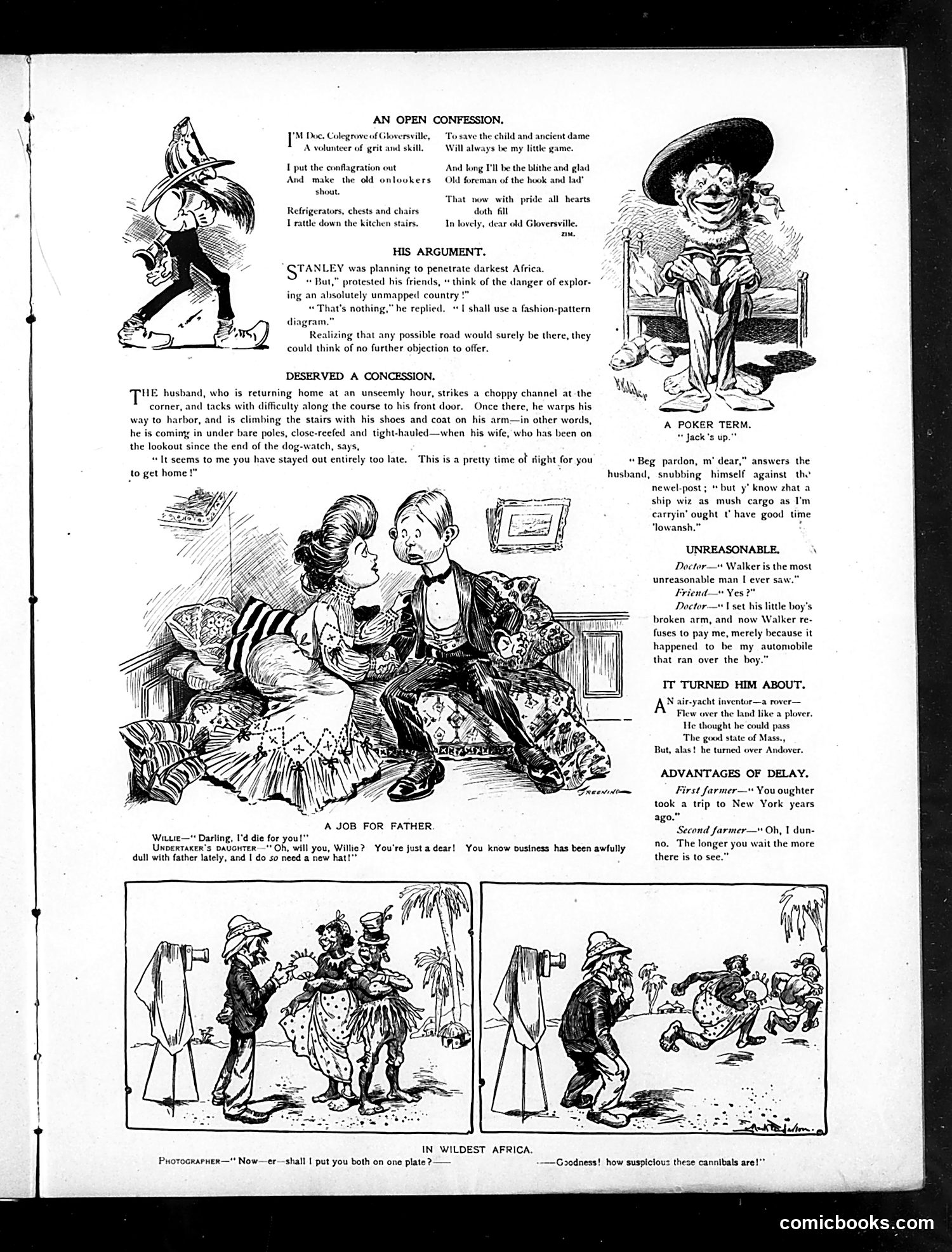
This page contains multiple humorous short pieces typical of early 20th-century Judge magazine: **"An Open Confession"** celebrates a volunteer firefighter from Gloversville, using nautical metaphors to describe domestic life. **"His Argument"** satirizes flawed logic: a man planning African exploration dismisses safety concerns by claiming he'll use a "fashion-pattern diagram" as a map—absurd reasoning that leaves friends speechless. **"Deserved a Concession"** uses maritime language to describe a drunk husband stumbling home late; his wife scolds him, and he defensively explains his "cargo" (drunkenness) required slow travel. **"A Poker Term," "Unreasonable," and "It Turned Him About"** are brief comedic vignettes about marital disputes, a doctor refusing payment after his car hit a patient's son, and an inventor's failed flight over Massachusetts. **"In Wildest Africa"** depicts colonial-era racial caricature—a photographer with indigenous people, using stereotypical "cannibal" imagery common to the period's problematic humor. The page reflects Judge's blend of domestic comedy, maritime humor, and unfortunately, period-typical racial stereotyping.
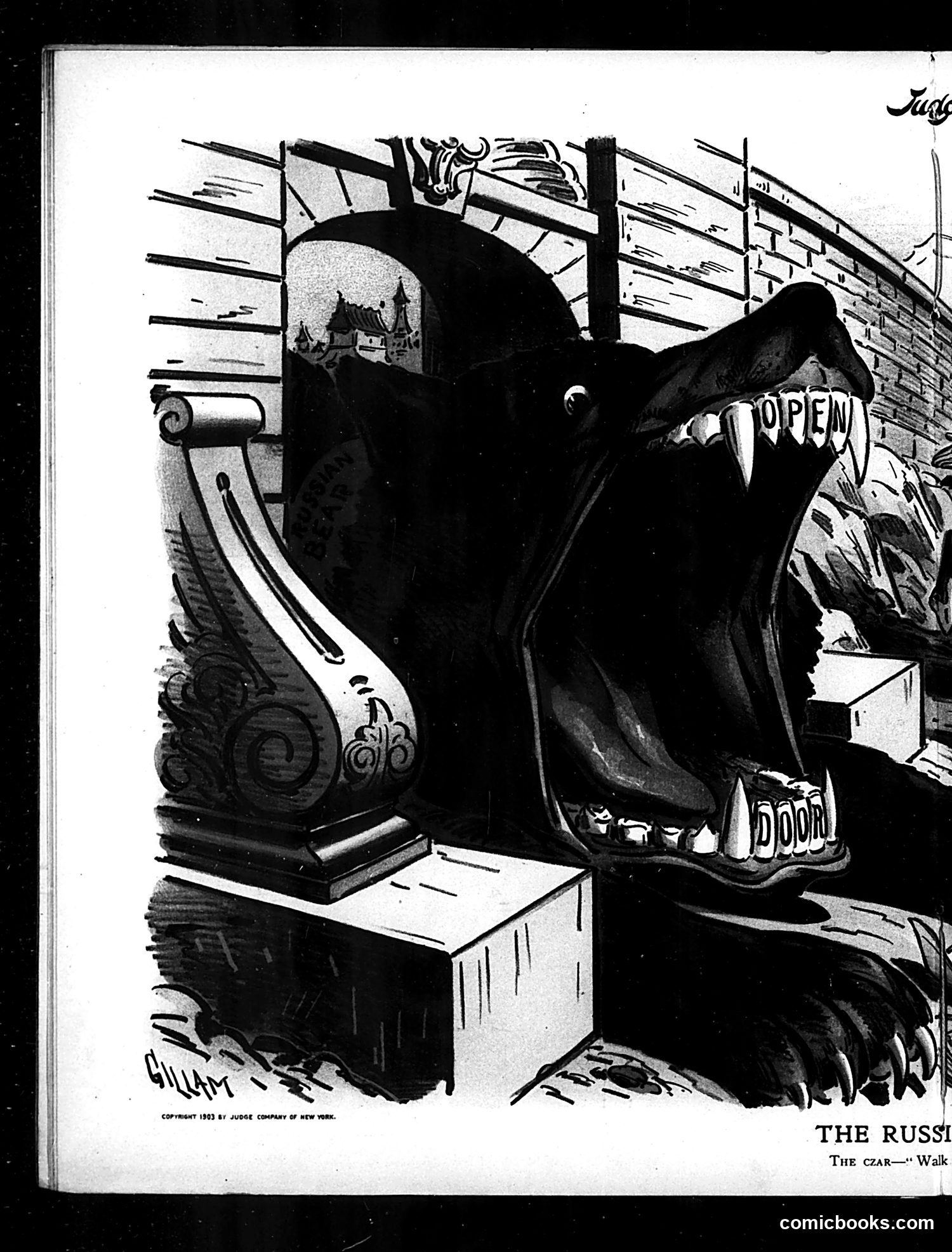
This cartoon from *Judge* magazine appears to depict a large, menacing vampire or bat-like creature labeled "OPEN" emerging from what looks like a Russian architectural setting (visible onion domes in the background). The creature has prominent fangs and an aggressive posture. The title references "THE RUSSI[AN]" and "The Czar," suggesting this is anti-Russian satire. The vampire imagery was a common metaphor in early 20th-century American political cartoons to portray Russia—particularly under czarist rule—as a bloodsucking, threatening force. The "OPEN" label likely refers to Russia's expansionist ambitions or aggressive foreign policy. This reflects period anxieties about Russian imperial power and, possibly, Bolshevism, making Russia appear monstrous and predatory to American audiences.
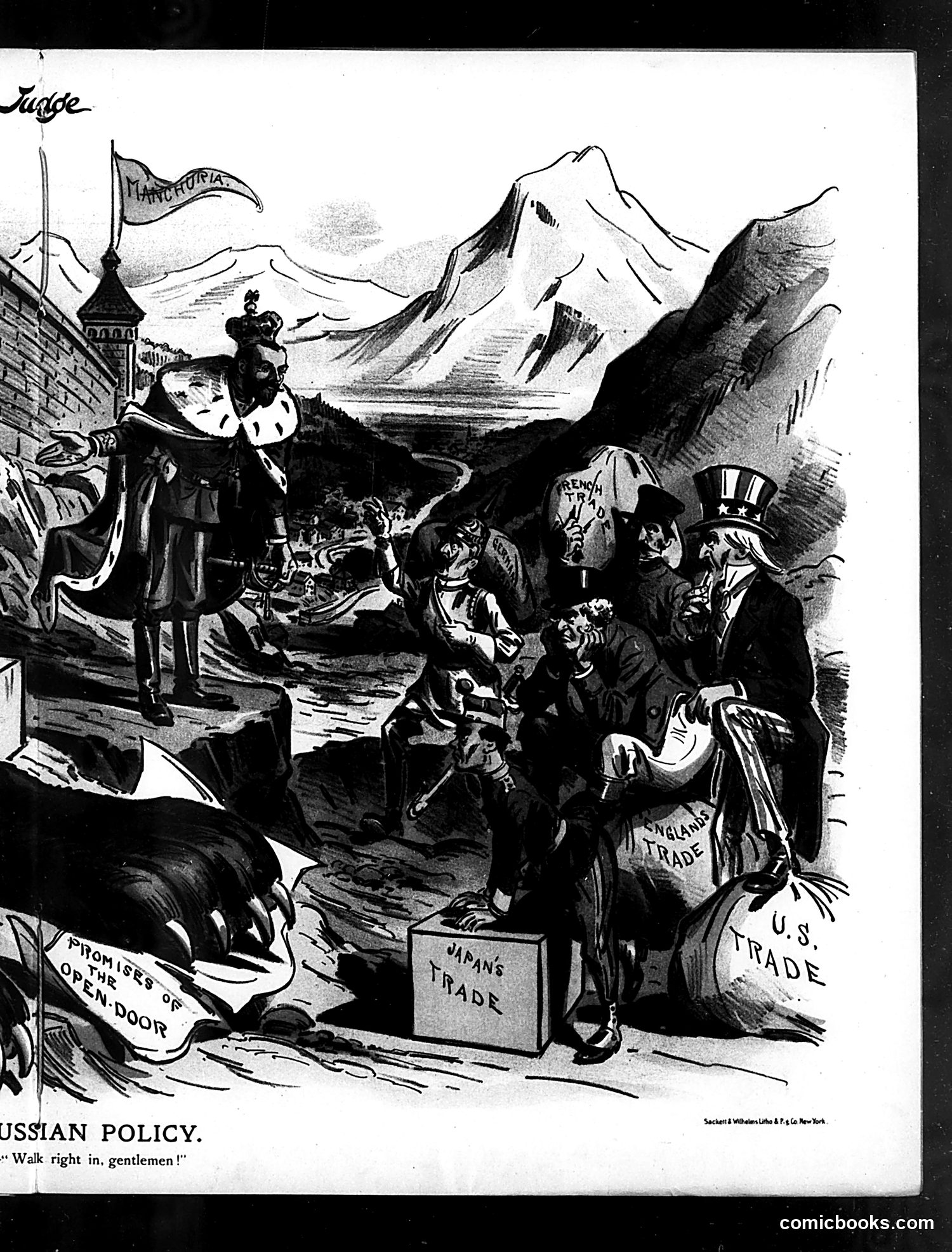
This satirical cartoon depicts Russia (represented by a figure in traditional dress on the left) inviting foreign traders into what appears to be a fortified mountain pass. The visitors represent different nations' trade interests—bags and boxes labeled "Japan's Trade," "U.S. Trade," and "England's Trade" are visible. The caption "Walk right in, gentlemen!" carries ironic menace. The cartoon satirizes Russian expansionist policy in Asia during the late 19th/early 20th century, suggesting Russia welcomes foreign commerce while actually controlling access through mountainous terrain. The "open door" promise ("Promises of Open Door") masks Russian strategic dominance. The figure on horseback at the fortress gate symbolizes Russia's military gatekeeping over Asian trade routes—a critique of Russian imperialism disguised as hospitality.
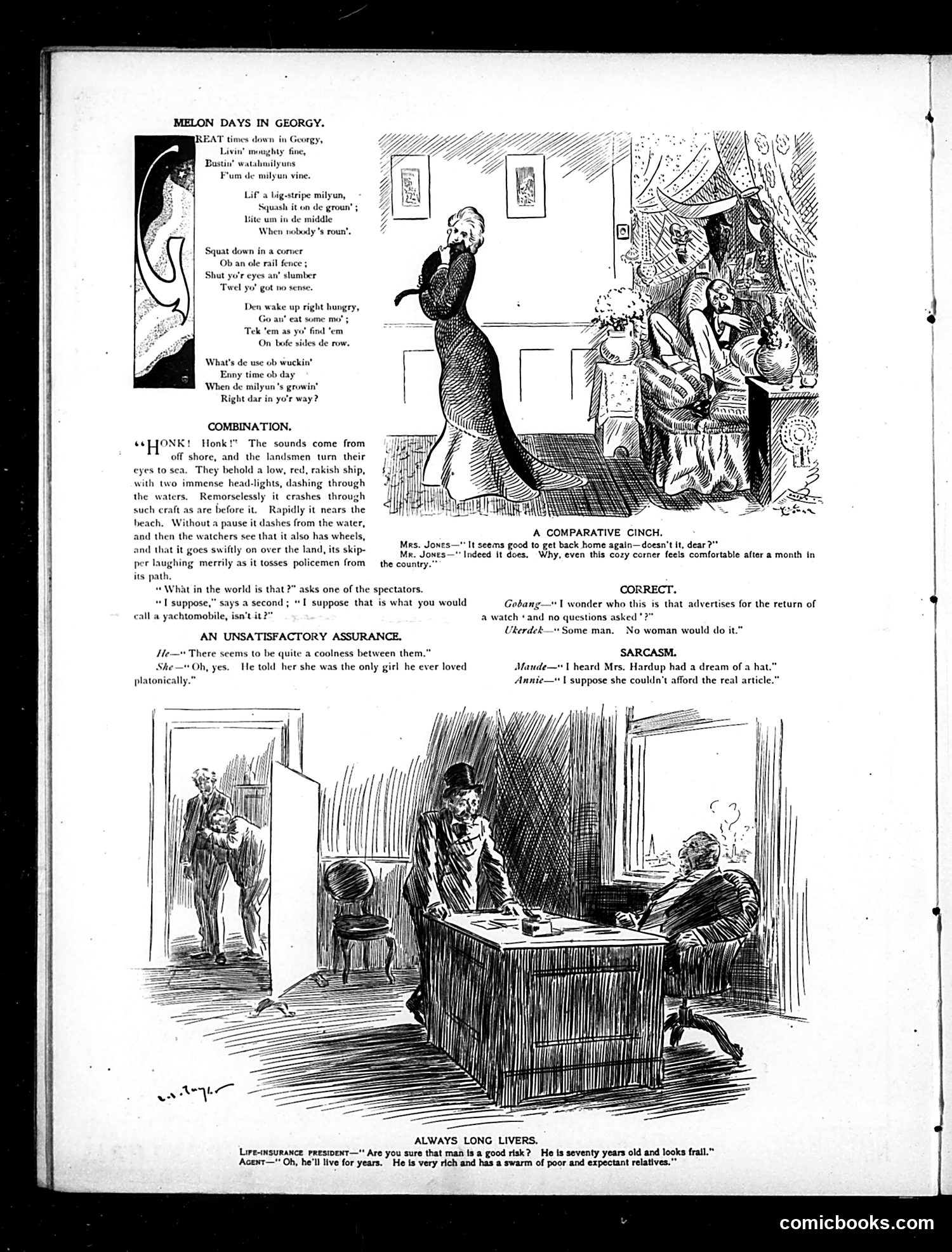
This page contains several satirical cartoons typical of late 19th/early 20th-century American humor: **"Melon Days in Georgia"** (top left): A dialect poem mocking African American speech patterns and rural Southern life—common in this era's "coon songs" tradition, though offensive by modern standards. **"Combination"** (upper right): Satirizes the "yachtomobile"—an early motorized vehicle that functions both on water and land. The joke mocks wealthy sportsmen and law enforcement's inability to control these new contraptions. **"A Comparative Cinch"** & other brief jokes (middle/lower): Light domestic humor about marriage, insurance fraud, and courtship conventions. **"Always Long Livers"** (bottom): A life insurance agent's sardonic observation that elderly wealthy men live longest due to "expectant relatives"—satirizing both class dynamics and family mercenary behavior. The page reflects Judge's typical format: mixing social commentary on modern technology and urban life with genteel domestic humor and period stereotypes. The satire targets the wealthy, pretension, and emerging consumer culture rather than political issues.
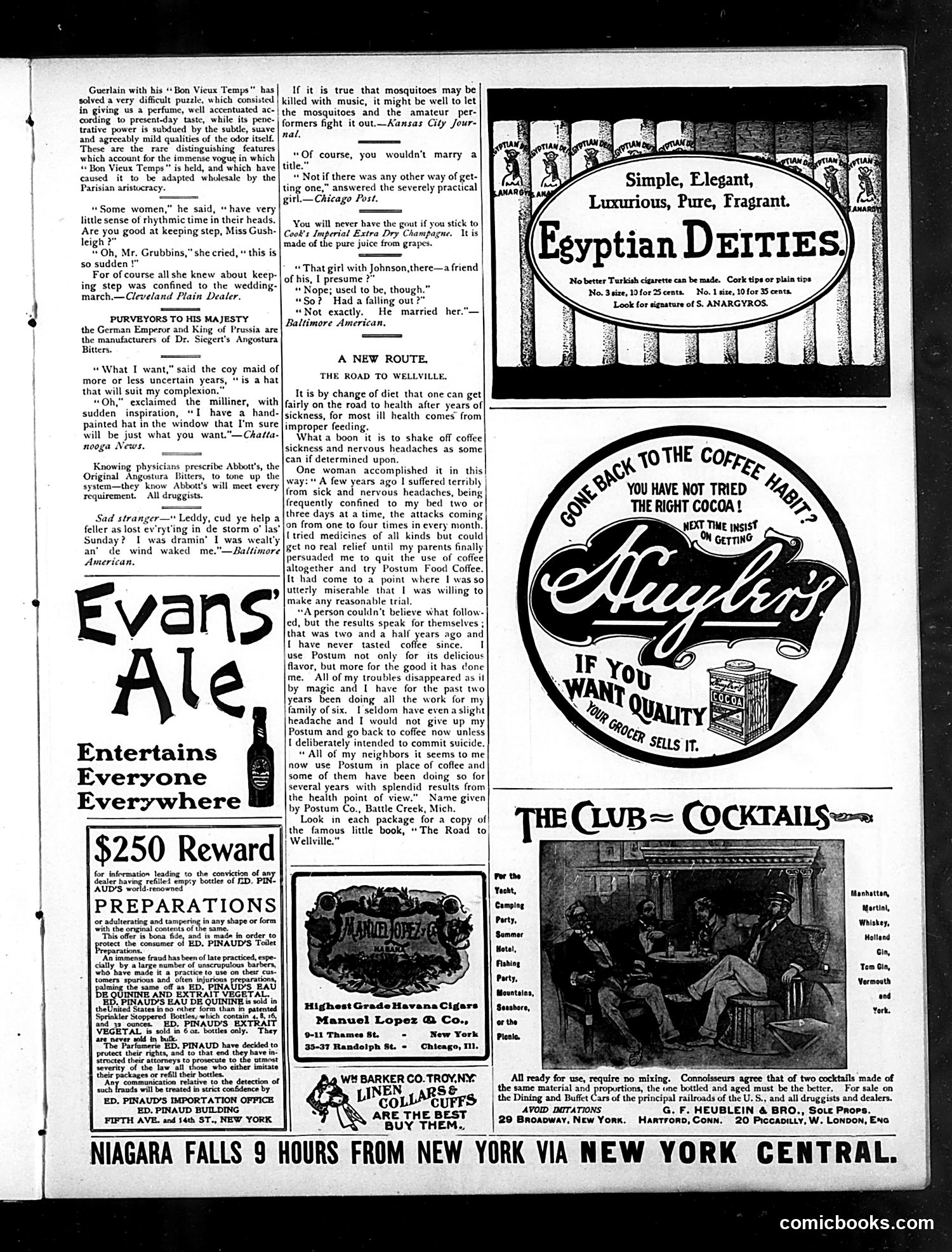
This page is primarily **advertising with comic snippets**, typical of early-20th-century satirical magazines. The main content consists of: **Comic Material**: Brief, unattributed jokes about courtship, marriage, and social awkwardness—standard light humor of the era. One exchanges involves a woman saying a suitor's proposal is "so sudden" after he asks if she can keep step, playing on the double meaning of "keeping step" (marching in time vs. staying together as a couple). **Advertisements**: The page is dominated by product ads—Egyptian Deities cigarettes, Evans Ale, Postum (a coffee substitute), Abbott's Angostura Bitters, ED. Pinaud's toiletries, and others. The Postum ad notably includes testimonial copy about switching from coffee to cure headaches, reflecting early-1900s health-consciousness and competitive marketing. **Notable**: A $250 reward notice warns against counterfeit ED. Pinaud products—indicating widespread product fraud was a real consumer concern of the period. The page reflects Judge's revenue model: satire subsidized by advertising to affluent readers.
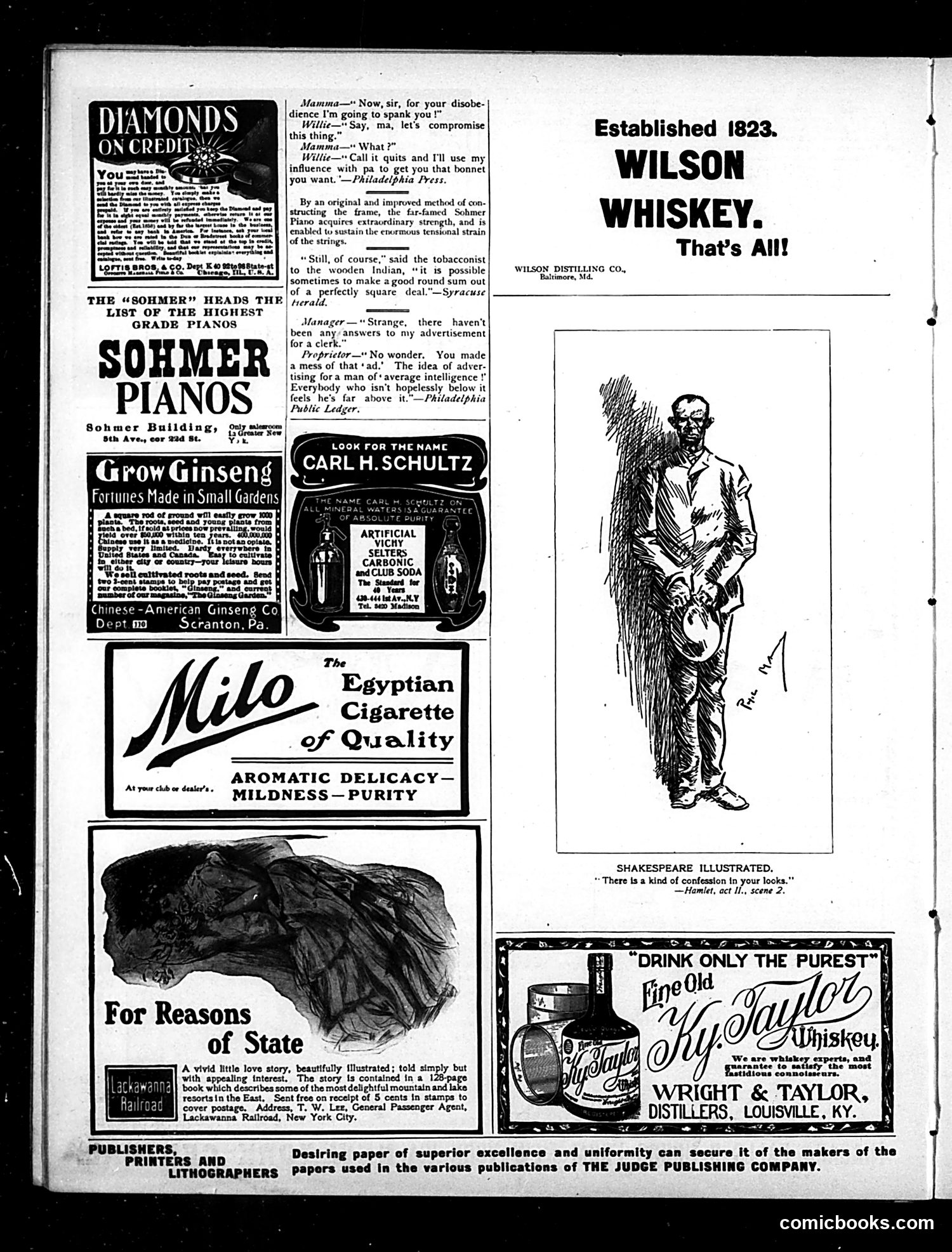
This page is primarily **advertising**, with several brief comic anecdotes interspersed. The main content includes ads for pianos, whiskey, ginseng, cigarettes, and railroad travel. The **cartoons** are short, joke-based pieces rather than political satire: 1. A mother threatens to spank her son; he negotiates a "compromise" by offering to use his influence with his father to get her a bonnet she wants—humor based on a child's manipulation and role-reversal. 2. A tobacconist speaks to a wooden Indian statue about making profit from "a perfectly square deal"—wordplay on the wooden Indian being literally square-shaped. 3. A proprietor complains about no responses to a job advertisement; an associate explains that the ad was poorly written, insulting to intelligent people—workplace satire about incompetent advertising. 4. A Shakespeare illustration accompanies a quote about confession visible in one's appearance. The page reflects early 20th-century American humor: domestic comedy, workplace dynamics, and clever wordplay rather than pointed political commentary.
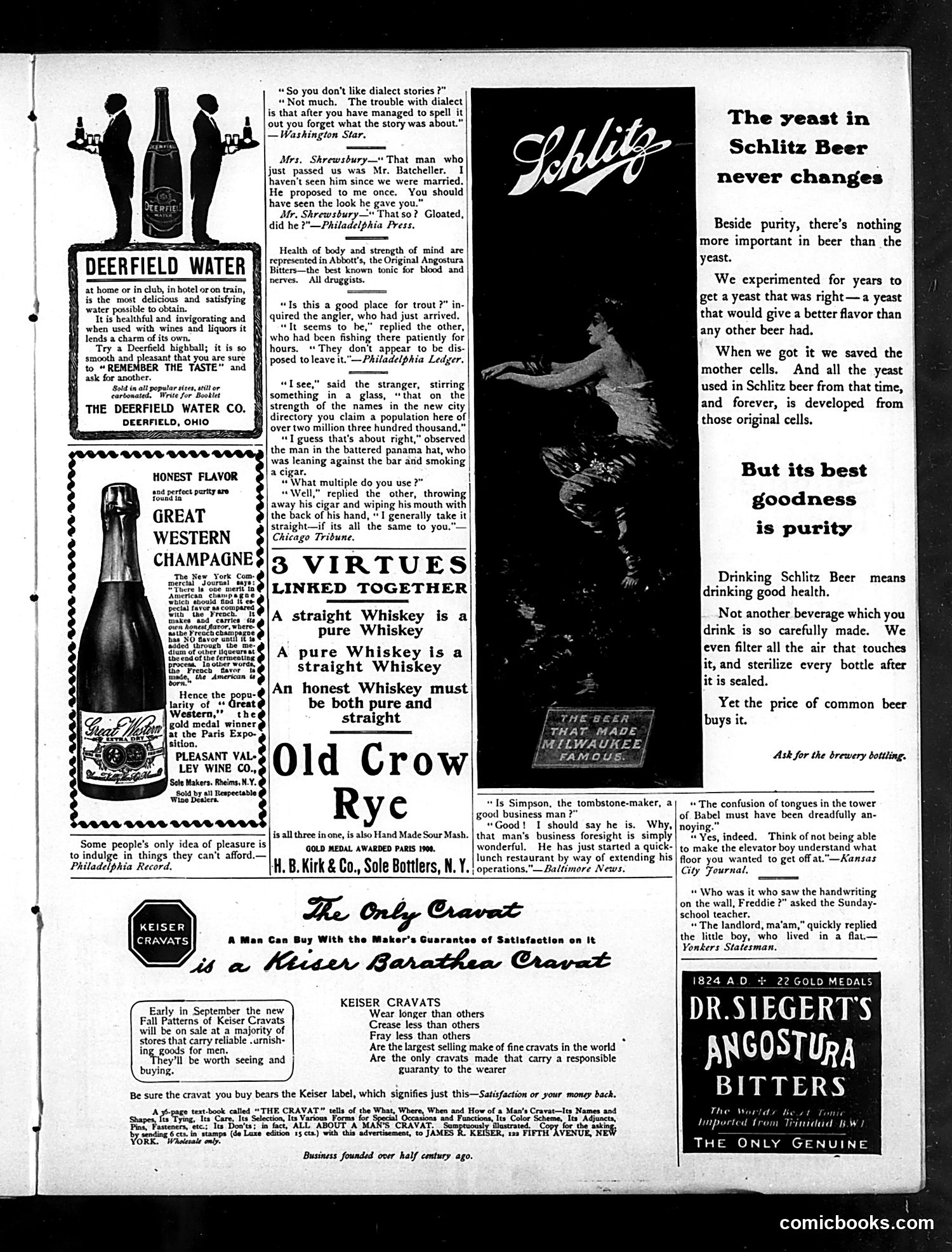
This is primarily an **advertising page** from Judge magazine, featuring several brief jokes and multiple product advertisements rather than political satire. The visible jokes are mild observational humor: - A complaint about "dialect stories" being hard to follow - A woman's ex-suitor appearing smug upon seeing her married - A fishing joke about trout overpopulation - A joke about inflated population statistics solved by drinking whiskey "straight" The advertisements promote **liquor and beverages** (Deerfield Water, Old Crow Rye whiskey, Schlitz Beer, Angostura Bitters) and **men's accessories** (Keiser Cravats), with marketing claims about purity, health benefits, and quality. The Schlitz Beer ad emphasizes "purity" and careful manufacturing—notable given this appears to be from the **Prohibition era or shortly before**, when beer's legitimacy was being defended through health claims rather than pleasure-focused messaging. This page reflects early 20th-century commercial culture more than political commentary.
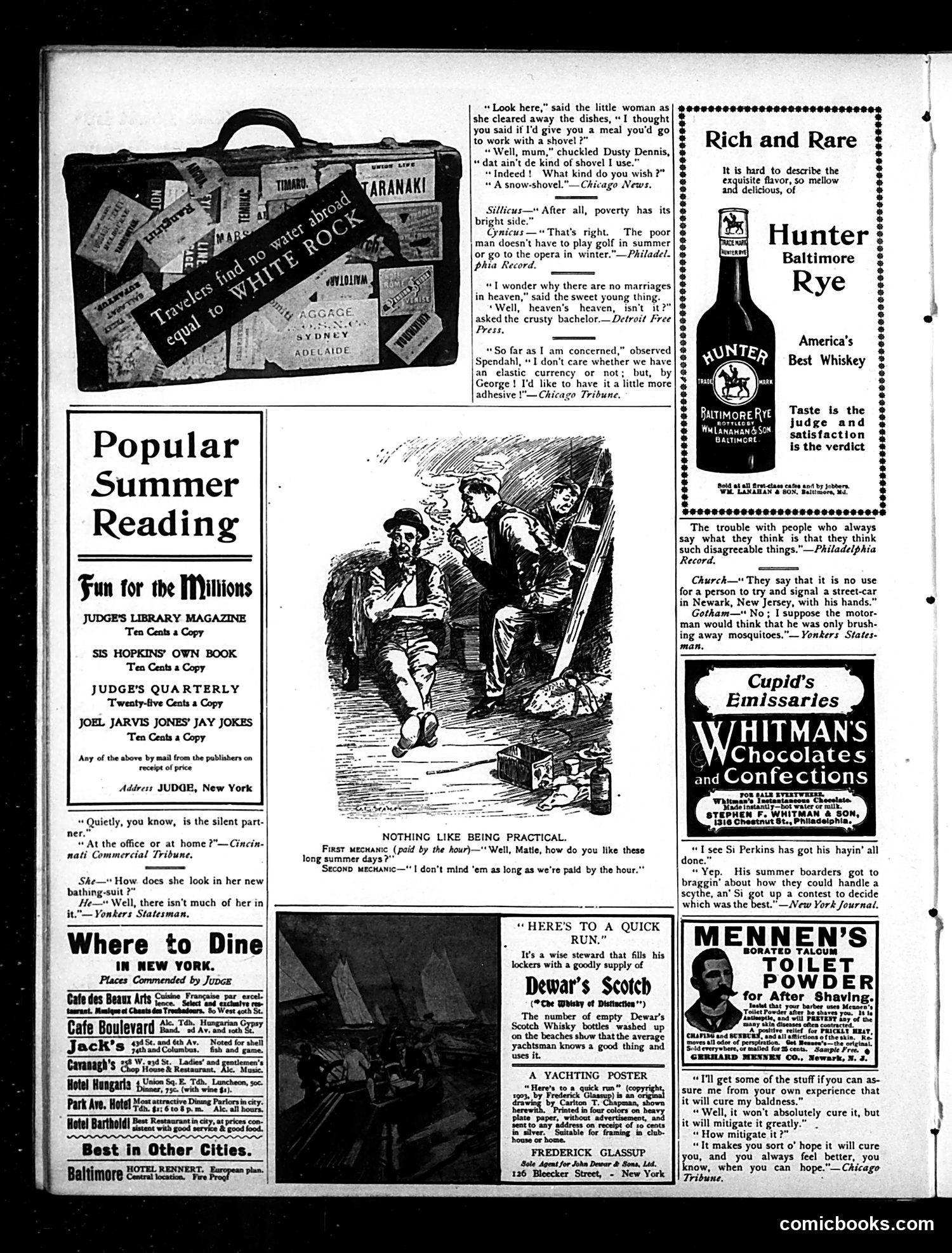
This is primarily an **advertising and humor page** from Judge magazine, not a political cartoon. The content consists of: **The Main Cartoon** (center): Shows two mechanics discussing "long summer days." The joke is that one worker, paid hourly, doesn't mind the extended daylight because it means more billable hours—satirizing workers' focus on wages over enjoying longer daylight itself. **The Humor Snippets** (scattered throughout): Brief jokes on various topics: - A vagrant claiming he uses a "snow-shovel" (implying winter unemployment) - Poor people having fewer expensive leisure obligations (golf, opera) - Currency being "adhesive" (sticky/hard to spend) - A woman in a minimal bathing suit **The Advertisements**: Fill most of the page—whiskey (Dewar's, Hunter Baltimore Rye), chocolate, shaving powder, dining recommendations, and magazines. The satire is gentle, class-conscious humor typical of early 1900s Judge—mocking both the wealthy (their forced leisure activities) and working-class circumstances, while serving as vehicles for product placement.
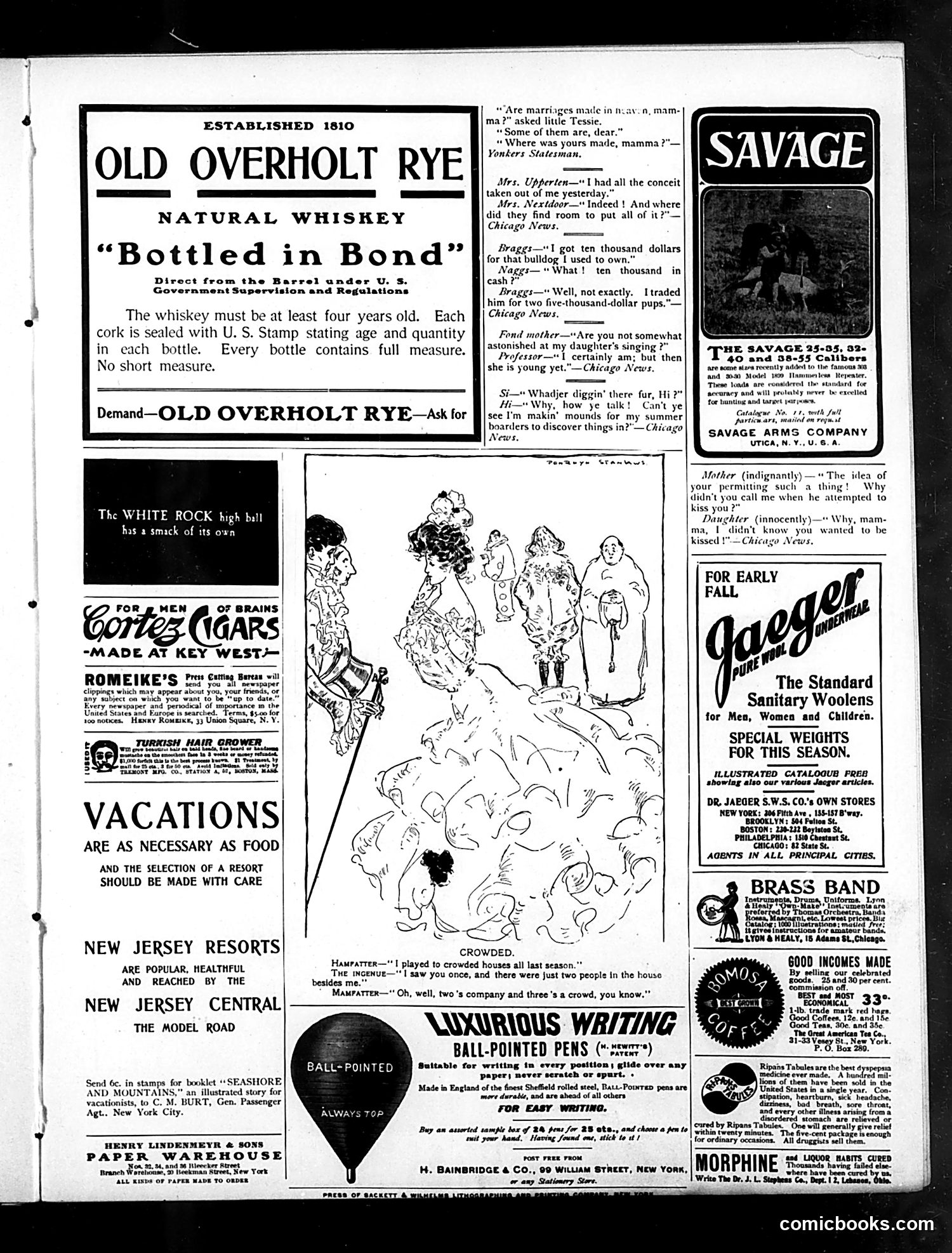
This is primarily an **advertising page** from Judge magazine, with small comedic filler content scattered throughout. The main satirical content consists of brief **jokes** from various newspapers (Chicago News, Yonkers Statesman), exploiting common domestic humor themes: a child innocently asking where her parents' marriage was "made" (implying discord), wives mocking husbands' boasting, a professor astonished at a daughter's terrible singing, and a final joke about a daughter not knowing her mother wanted to be kissed during a boy's attempted kiss. These are **gentle domestic satires** reflecting early 20th-century gender and family dynamics—poking fun at marital pretense, parental pride, and courtship customs without targeting specific political figures or events. The page is dominated by period **product advertisements**: Old Overholt Rye whiskey, Cortez cigars, hair-growth treatments, paper goods, ball-pointed pens, sanitary woolens, and firearms. These ads reflect contemporary consumer culture and available products of the era. **No significant political satire or recognizable caricatures appear on this page.**
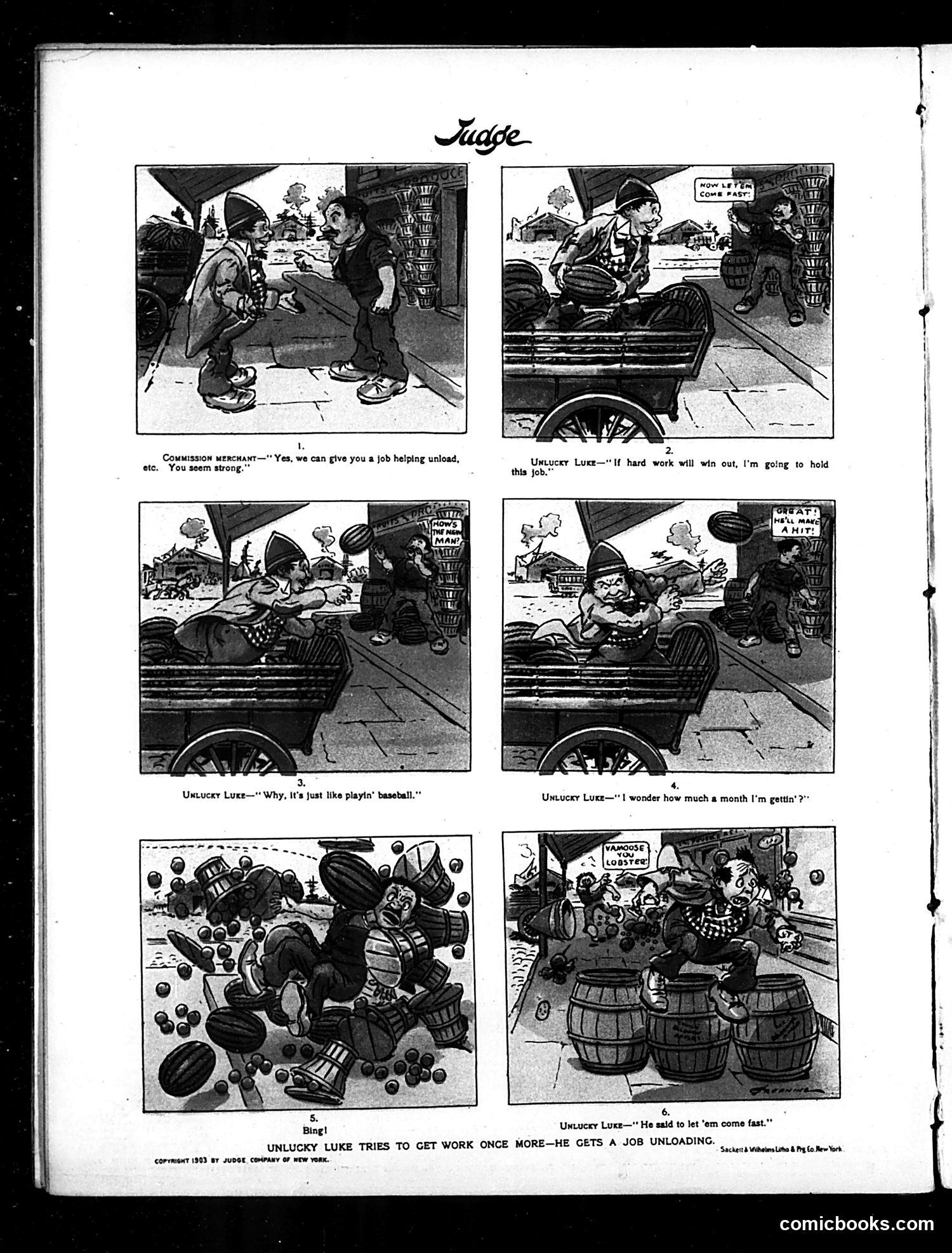
This is a comic strip about a character named "Unlucky Luke" seeking employment as a laborer. A commission merchant offers him work unloading cargo, which Luke accepts with determination ("hard work will win out"). The humor derives from slapstick misfortune: Luke's job unloading barrels goes catastrophically wrong—the cargo spills everywhere in chaotic fashion. The final panel shows him buried amid scattered goods, with the merchant's comment about instructing workers to load "fast" suggesting Luke's mishap was inevitable. The satire reflects early 1900s anxieties about working-class labor conditions and the precarious nature of unskilled employment. Luke's repeated misfortune when attempting honest work plays on period themes of social mobility and the difficulty of maintaining steady employment.