
A complete issue · 16 pages · 1903
Judge — May 2, 1903
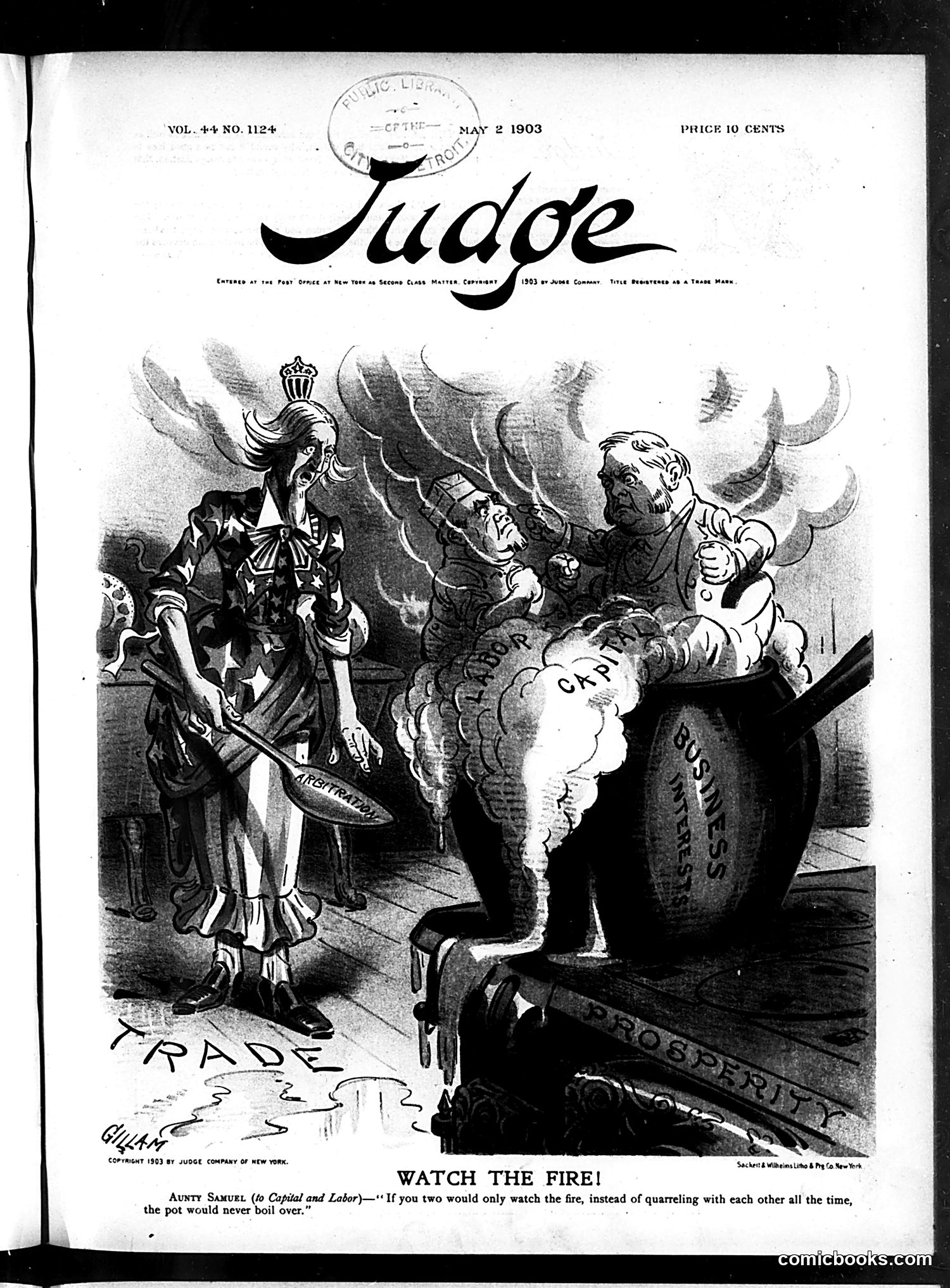
This Judge magazine cover from May 2, 1903 uses the metaphor of a boiling pot to satirize labor-capital relations. The figure labeled "Capital" (left, in formal dress) and "Labor" (right, depicted as a worker) are shown as adversaries positioned above a pot labeled "Business" that's beginning to boil over with flames labeled "Carelessness" and "Prosperity." The caption quotes "Aunty Samuel" (personifying Uncle Sam/the U.S. government): "If you two would only watch the fire, instead of quarreling with each other all the time, the pot would never boil over." The satire criticizes both capital and labor for their constant conflict, warning that their infighting threatens to destabilize the broader economy—represented by the overheating pot.
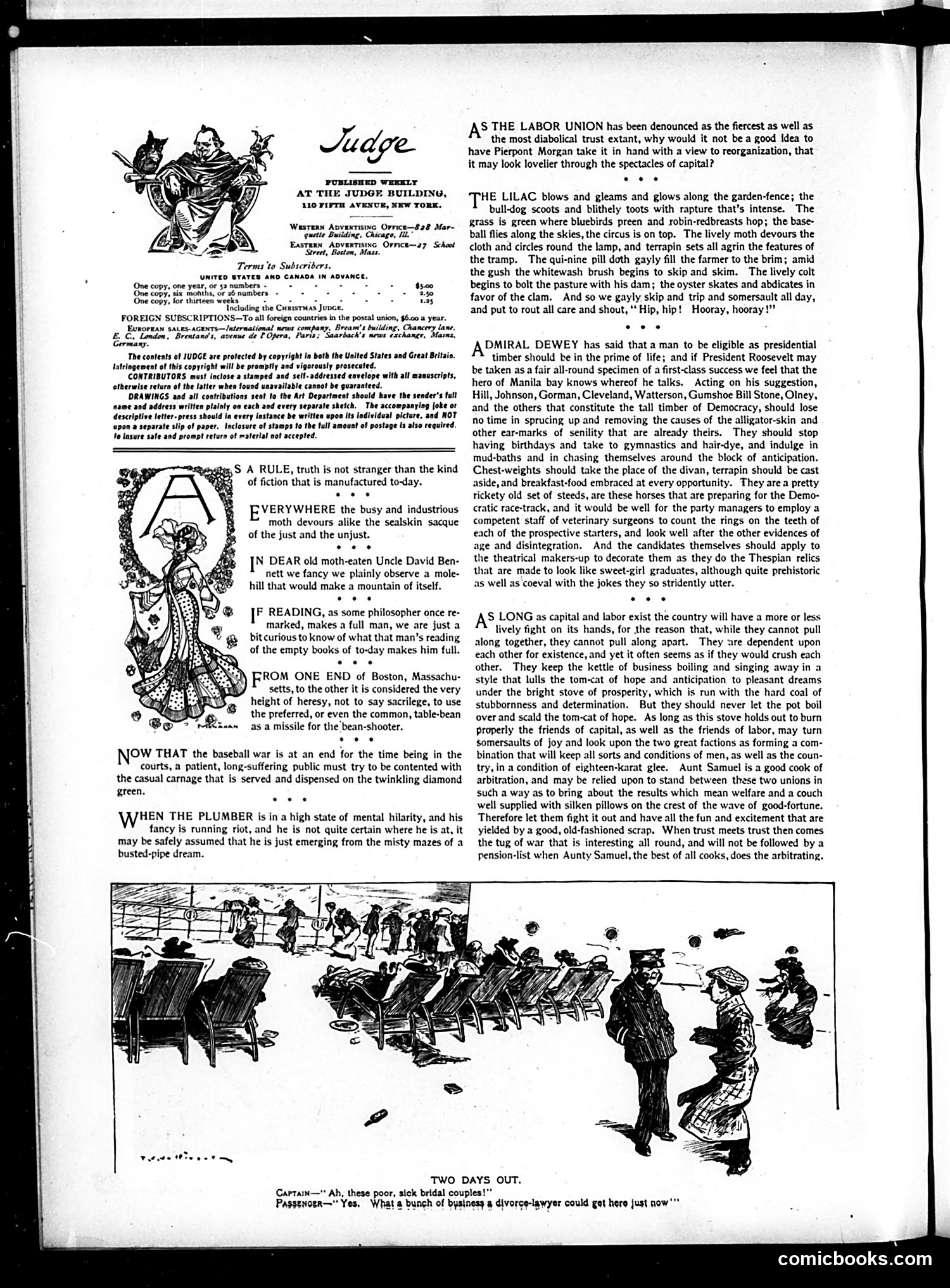
This page contains editorial commentary and a single cartoon titled "Two Days Out," depicting ship passengers in distress. The caption shows a Captain addressing sick bridal couples, with a Passenger responding sarcastically that "a first-class divorce-lawyer could get here just now." The satire targets the high divorce rate among newlyweds, suggesting couples marry impulsively despite incompatibility. The cartoon implies marriages fail almost immediately—even "two days" into a honeymoon voyage. The accompanying editorials discuss broader social issues: labor unions, Democratic presidential candidates (appearing to reference 1904 politics), and concerns about capital versus labor relations. The magazine's tone is conservative, skeptical of unions and sympathetic to business interests, typical of Judge's editorial stance during this era.
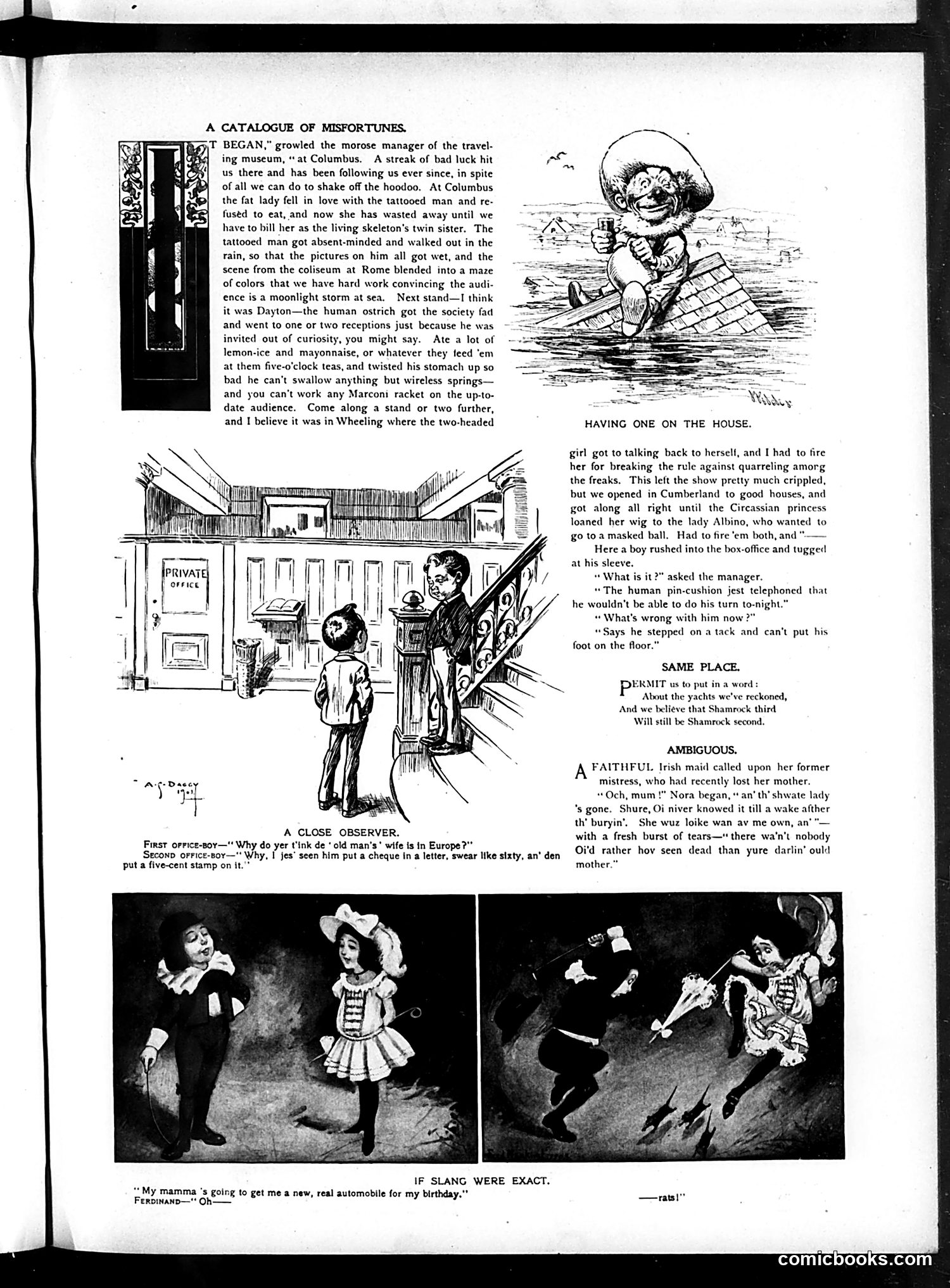
This page contains humorous anecdotes about traveling museum exhibits and theatrical misadventures. The sketches mock the chaos of touring shows: a fat woman falling for a tattooed performer, a human skeleton getting seasick, and a two-headed attraction causing disruptions. The "Close Observer" cartoon satirizes office dynamics—an old man's wife is in Europe while his younger second wife stays home. The joke implies marital discord or infidelity. "If Slang Were Exact" parodies contemporary slang by depicting a child literally asking her mother for "a new, real automobile"—mocking how casual speech obscures serious requests. The cartoons employ exaggerated situations to critique working-class life, show business mishaps, and modern domestic tensions typical of early-20th-century Judge magazine humor.
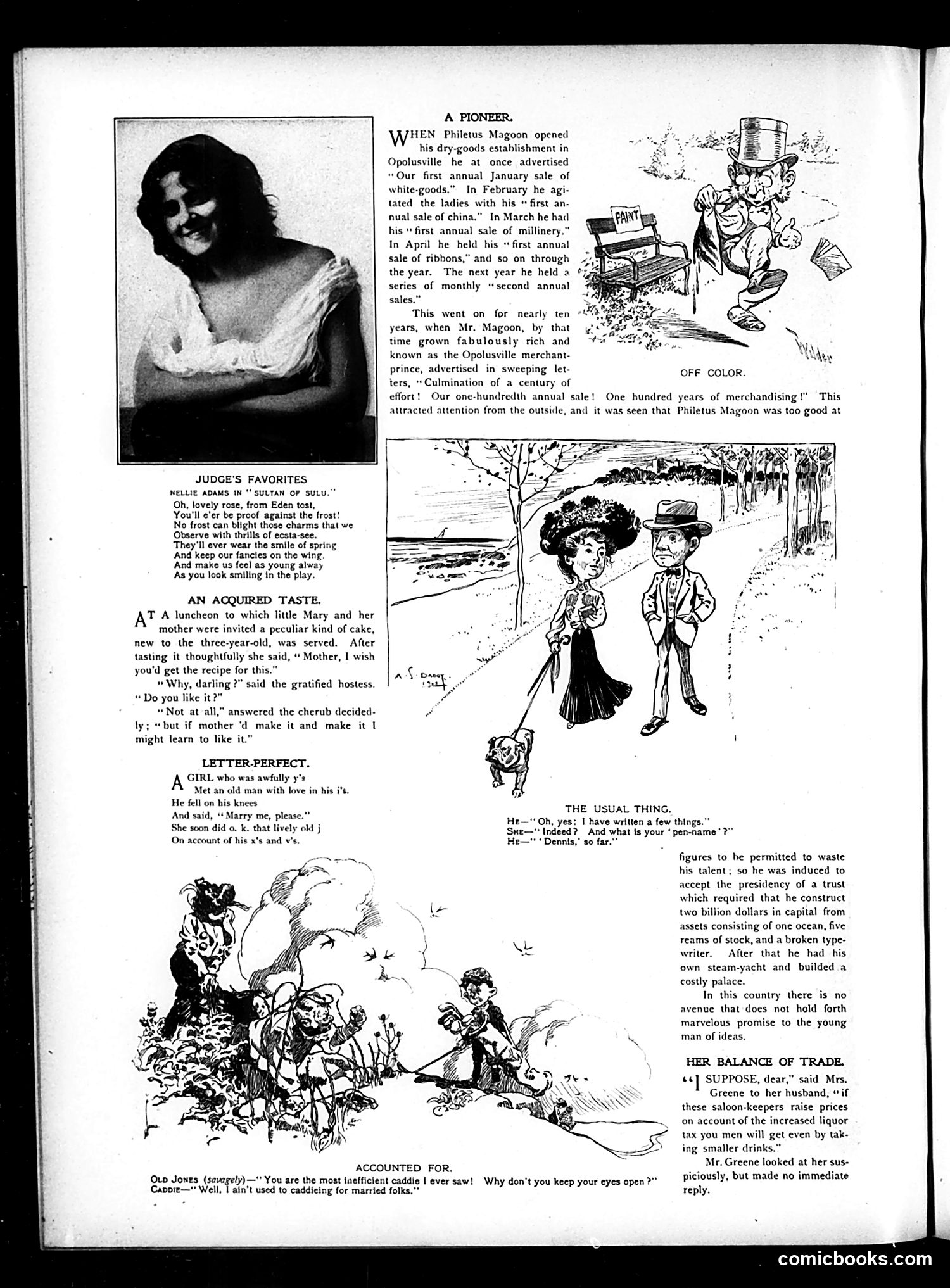
This page combines humorous short pieces with illustrations typical of early 20th-century satirical magazines. **"A Pioneer"** mocks Philetus Magoon, a merchant who built wealth through aggressive annual sales events (white goods, china, millinery, ribbons). The satire criticizes his repetitive marketing strategy and exaggerated self-promotion as a "merchant-prince," suggesting his success comes from relentless salesmanship rather than genuine innovation. **Other sections** ("Judge's Favorites," "An Acquired Taste," "Letter-Perfect," "The Usual Thing," "Accounted For," "Her Balance of Trade") are brief comedic anecdotes and poems about domestic situations, courtship, and social dynamics—common Judge content. The illustrations are whimsical line drawings accompanying these humorous vignettes, not political cartoons. The page reflects Judge's focus on social satire and domestic humor rather than political commentary.
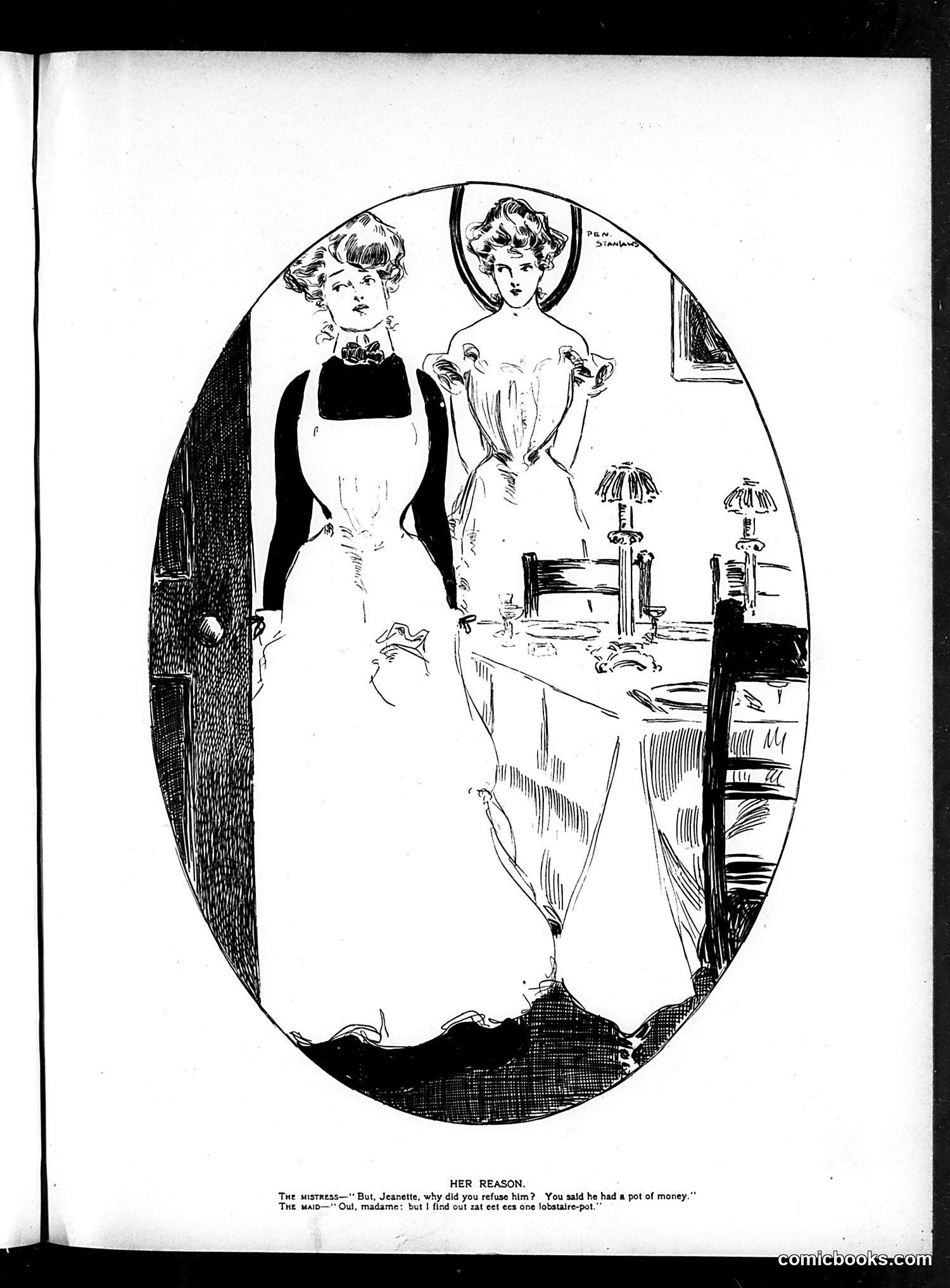
This cartoon satirizes a domestic servant's (Jeanette's) rejection of a suitor. The mistress is surprised that Jeanette refused a wealthy man, since she'd emphasized his money mattered to her. Jeanette's response—delivered in a French accent ("Oul," "zat eet ees")—reveals the man's wealth is illusory: he has only a "lobster pot" rather than actual riches. The humor hinges on the pun between "pot of money" (a fortune) and a literal cooking pot, plus the servant's shrewd pragmatism. The cartoon mocks both the servant's materialistic priorities and the pretensions of a man presenting himself as wealthy when he possesses little of value. The oval framing and elegant interior setting emphasize the domestic comedy.
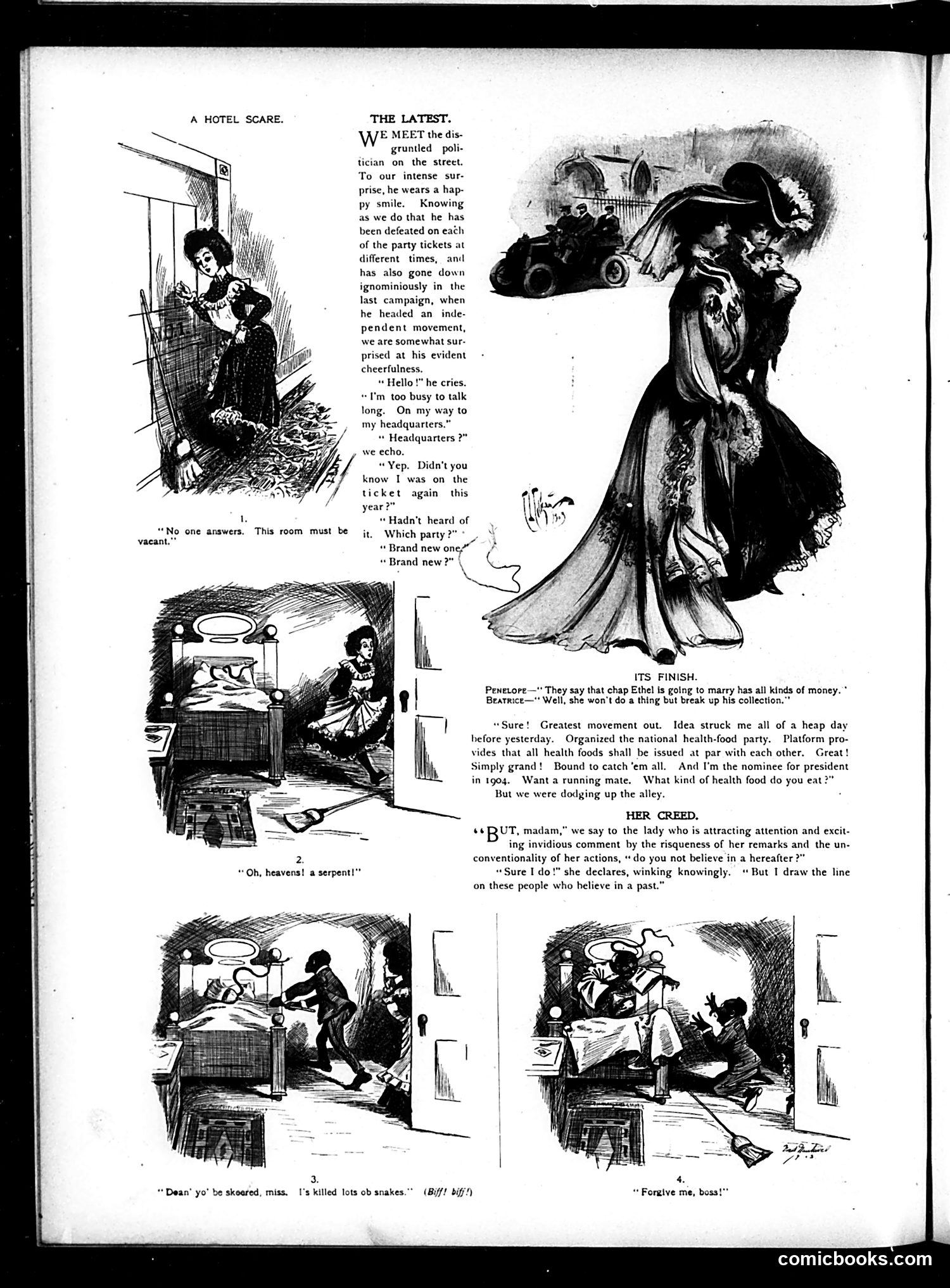
This page contains three separate satirical pieces mocking social pretensions of the early 1900s. **"The Hotel Scare"** ridicules a perpetually failed politician who repeatedly loses elections but remains absurdly optimistic. He's now founded a bizarre "national health-food party" as yet another doomed political venture, treating it with unwarranted seriousness despite his consistent record of humiliating defeats. **"Its Finish"** jokes about wealthy men marrying women who will squander their collections—satirizing both gold-diggers and the materialism of the wealthy. **"Her Creed"** mocks a woman making scandalous public remarks. When challenged about belief in an afterlife, she claims to believe in the future but explicitly rejects the past—a witty jab at her own indecorous behavior and hypocrisy about moral judgment. The bedroom scene illustrations suggest the "scare" involves discovering a serpent in the hotel room, amplifying the absurdity through visual humor.
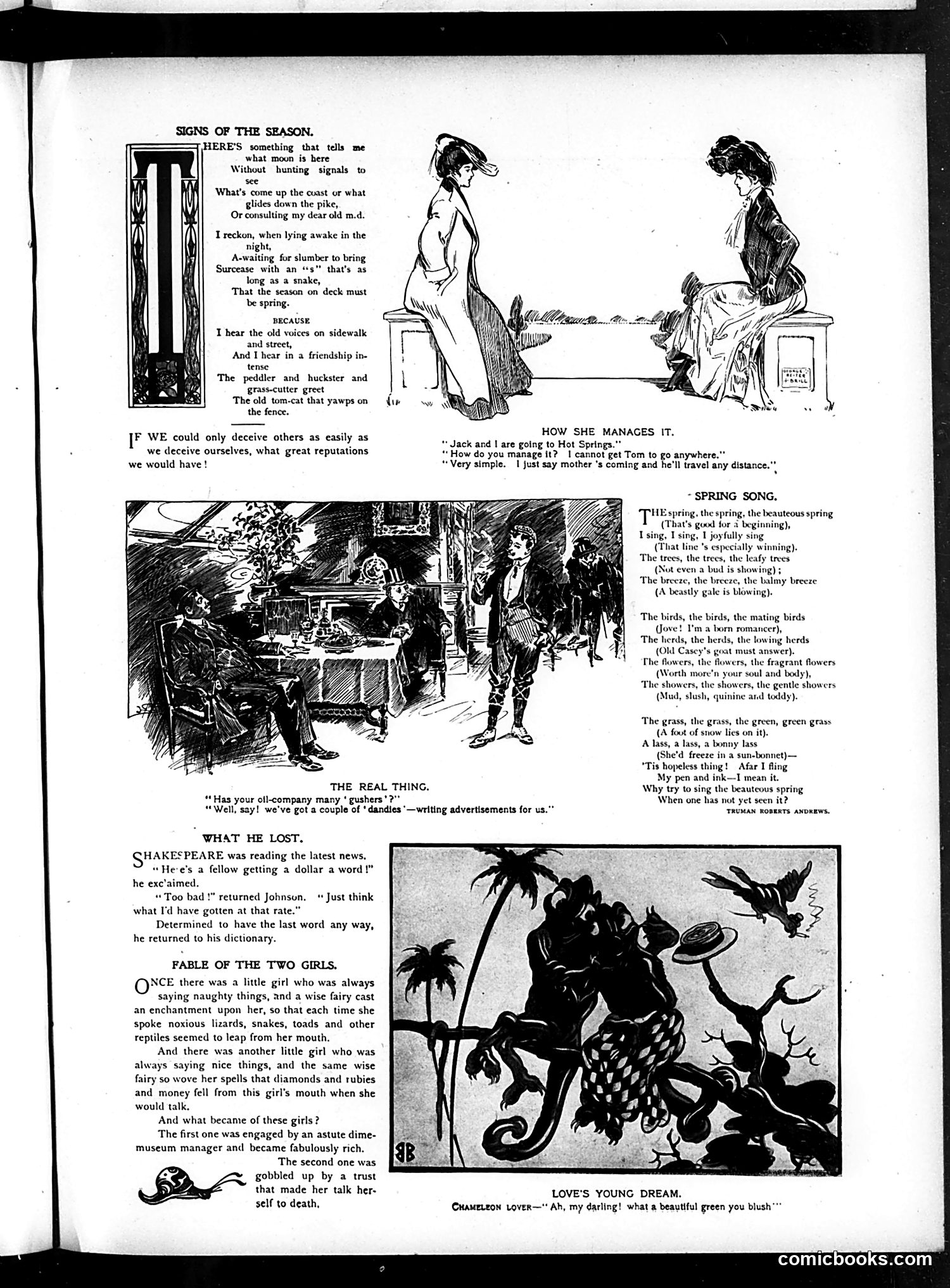
This Judge magazine page contains several satirical pieces mocking spring season clichés and human nature: **"Signs of the Season"** humorously catalogs spring's arrival through urban noise—street vendors, cat fights—rather than romantic signals. **"What He Lost"** jokes about Shakespeare's regret: earning "a dollar a word" now versus historical rates. It's wordplay satirizing how payment standards have (supposedly) improved. **"Fable of the Two Girls"** inverts Cinderella-type morality: the girl whose speech produces reptiles becomes rich (dime-museum attraction), while the virtuous girl producing jewels gets exploited by a monopolistic "trust"—sharp Gilded Age satire about how capitalism rewards spectacle over virtue, and how trusts destroy individuals. **"Spring Song"** parodies romantic spring poetry by contradicting each flowery line with mundane reality (beautiful breeze/actually a gale; green grass/covered in snow). The page generally satirizes empty sentimentality, commercialism, and the gap between idealized versus actual experience in turn-of-the-century America.
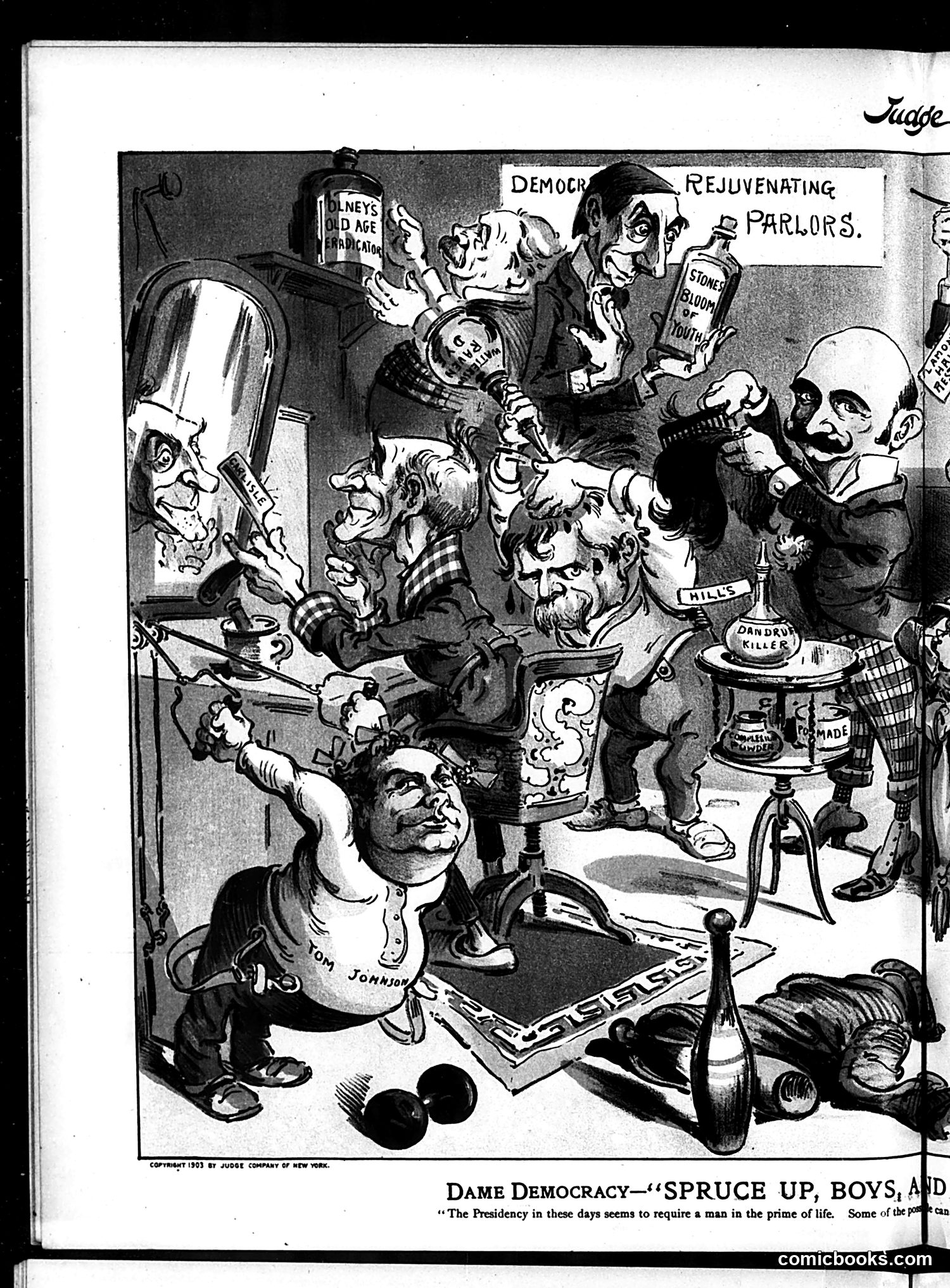
This 1903 Judge cartoon satirizes Democratic Party efforts to rejuvenate itself through cosmetic treatments. The title "Dame Democracy—'Spruce Up, Boys'" depicts Democratic figures in a beauty parlor applying various remedies—bottles labeled "Powder of Truth," "Hills" (likely patent medicines), and "Dandruff Killer"—to restore vitality to an aging "Democracy" character. The satire mocks Democrats as desperate to appear vigorous and relevant, using superficial treatments rather than substantive reform. The caption's incomplete quote about the presidency requiring "a man in the prime of life" suggests the party needs genuine renewal, not cosmetic fixes. The exaggerated caricatures and farcical setting emphasize that these rejuvenation efforts are ridiculous theater—Democrats applying snake-oil remedies to restore credibility after electoral defeats or policy failures.
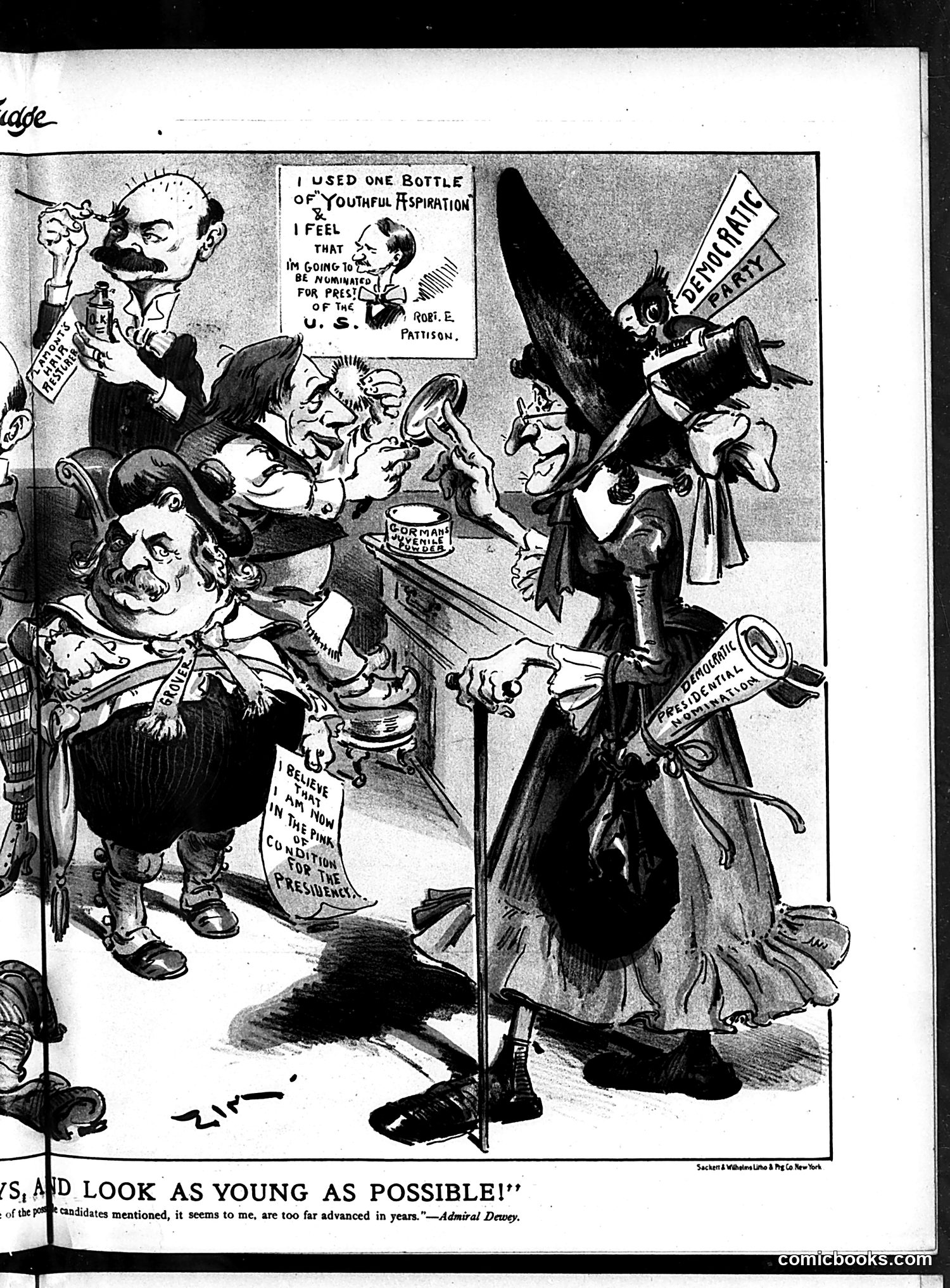
This is a satirical cartoon about aging presidential candidates. Admiral Dewey (referenced in the quote at bottom) criticized that potential 1900 presidential candidates were too old. The cartoon mocks this by showing politicians using "Youthful Aspiration" tonic—a patent medicine—to appear younger for the presidency. The figures appear to be caricatured politicians of the era, depicted as elderly men desperately seeking rejuvenation through bottled remedies. One figure holds a testimonial claiming the product will make him "nominated for President of the U.S." The satire targets both the vanity of aging politicians seeking high office and the era's snake-oil patent medicines promising miraculous results. The exaggerated caricatures and their frantic behavior emphasize how ridiculous the pursuit of youth—and by extension, political viability—had become. The cartoon suggests these candidates are relying on cosmetic fakery rather than genuine fitness for office.
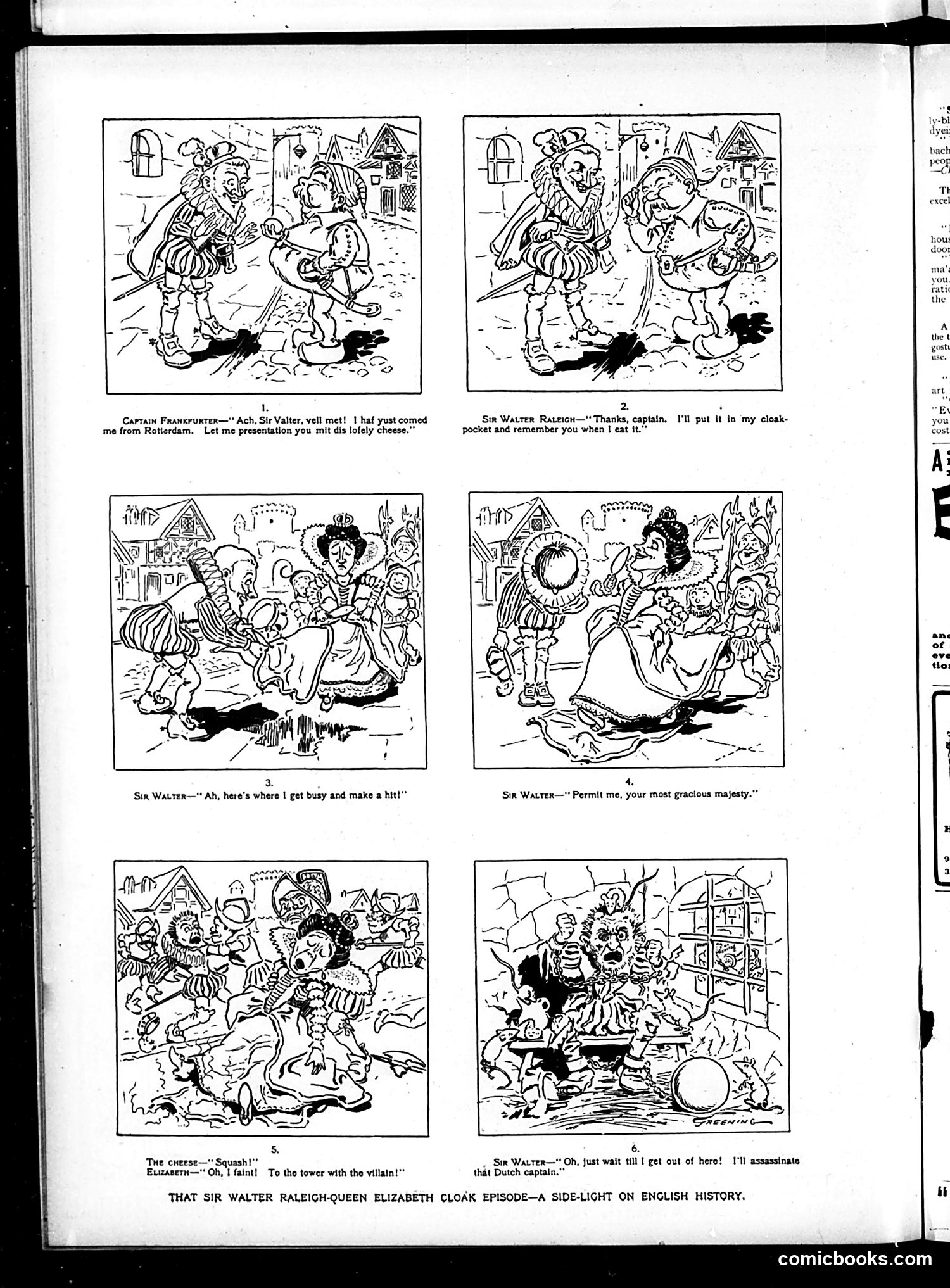
This six-panel comic satirizes the famous legend of Sir Walter Raleigh laying his cloak over a puddle for Queen Elizabeth I. The joke subverts the romantic historical narrative by introducing a Dutch captain who gives Raleigh a cheese instead of receiving credit for the gallant gesture. The humor works on multiple levels: it mocks the idealized version of English history by suggesting Raleigh's chivalry was actually borrowed/stolen. The captain's irritation and threat to "assassinate that Dutch captain" provides absurdist comedy. Queen Elizabeth and her court react with dramatic shock, while the cheese itself becomes a comedic character ("Squash!"). The satire appears aimed at deflating nationalist historical mythology—showing "English history" as less noble and more ridiculous than commonly portrayed. Judge magazine frequently mocked American reverence for European aristocratic traditions.
This page is primarily **advertisements interspersed with brief humorous anecdotes** rather than political cartoons. The satirical content is light and domestic. ## Notable Elements: **The anecdotes** mock everyday life—a woman's concern about hair dye damaging the brain, a bachelor's retort about dyed hair being brainless; a man dealing with cockroaches from neighbors; a waiter remembering a woman's parting words ("Keep the change"). **Political/Social satire** appears in two brief dialogues: - A South American republic's president discussing ongoing revolutions, satirizing chronic political instability in the region - A legislator lamenting that voters expect him to fulfill campaign promises, mocking political hypocrisy **The advertisements** dominate—Evans Ale, Schmer Pianos, Havana cigars, champagne, coffee, undergarments, insurance companies. This reflects Judge's business model. **No specific figures or caricatures** are identified in the cartoons shown. The satire is generic and timeless rather than tied to particular events or people, suggesting this page is more commercial than editorially focused.
This page is primarily **advertising**, not political satire. The central feature is a book advertisement for "Man in the Street" Stories from the New York Times, with an introduction by Chauncey Depew. The ads show this is an **anecdote collection** meant as light reading—specifically, "my refresher every Sunday after the worry and work of the week," per Depew. The book promises "humorous side of life" stories. The page also includes period ads for whiskey (Old Crow Rye), chocolates, travel cruises, and investment companies—typical Judge magazine advertising. **No clear political cartoon is visible.** The small dialogue snippets about drinking and social etiquette are minor filler content, not satire. This appears to be a standard **advertising/promotional page** from an early 1900s magazine rather than satirical editorial content.
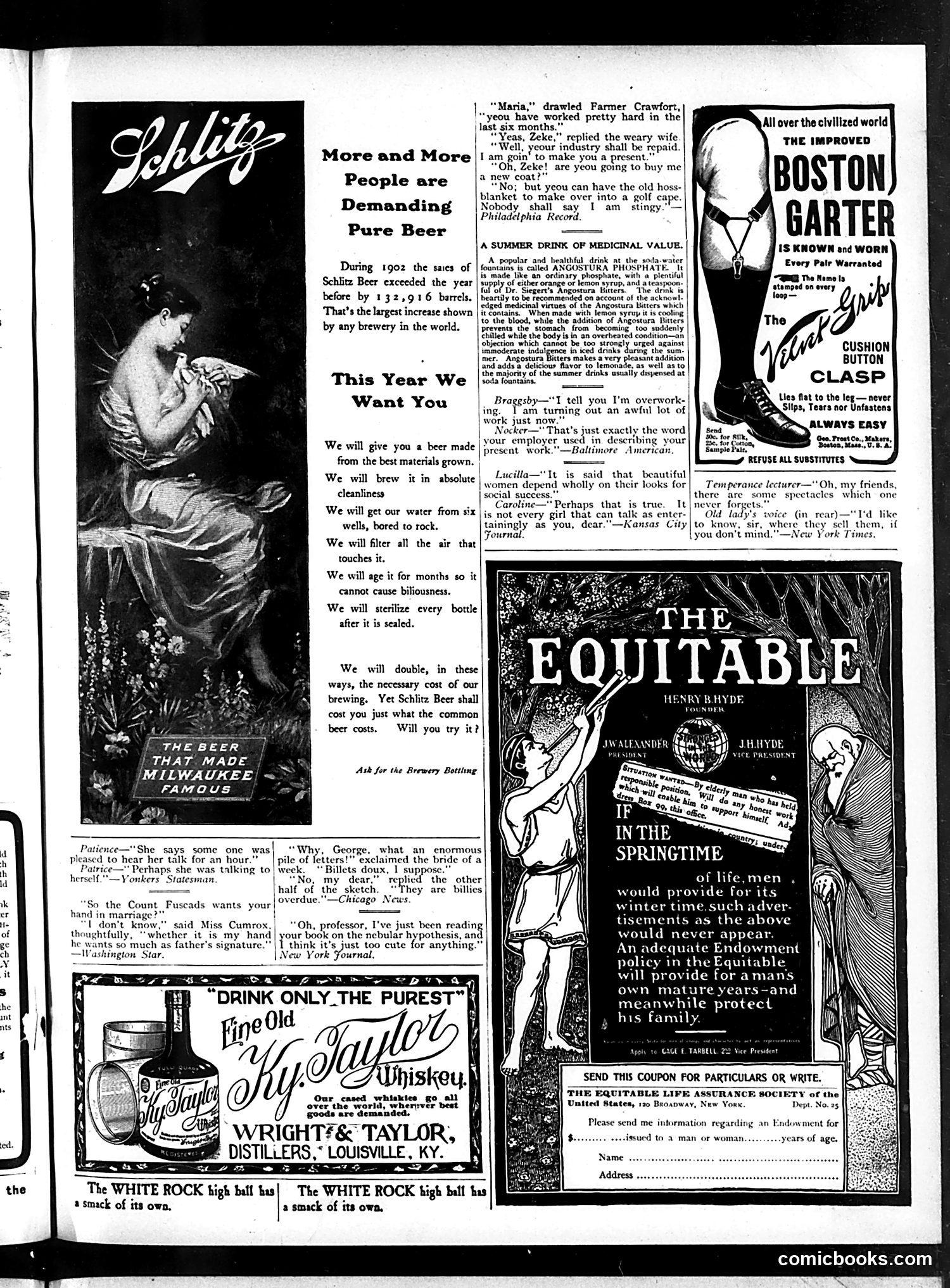
This is primarily an **advertising page** from Judge magazine, dominated by commercial promotions rather than satirical cartoons. The main content features a **Schlitz Beer advertisement** celebrating their 1902 sales surge (132,916 barrels increase). The ad emphasizes purity claims—filtered water from deep wells, sterilization, months of aging—positioning the beer as scientifically superior while maintaining competitive pricing. The page includes scattered **brief humorous anecdotes** in text form (typical Judge filler content): jokes about impatient wives, overdue library books, and misunderstandings about love letters. Additional advertisements include: - **Fine Old Sylvester Whiskey** (Wright & Taylor Distillers) - **Boston Garter** (hosiery clasp) - **Equitable Life Assurance** (with an allegorical illustration) - **Angostura Phosphate** (medicinal summer drink) The page reflects **early 1900s commercial culture**—heavy advertising mixed with light humor, and marketing emphasis on "purity" and "scientific advancement" as selling points during the Progressive Era.
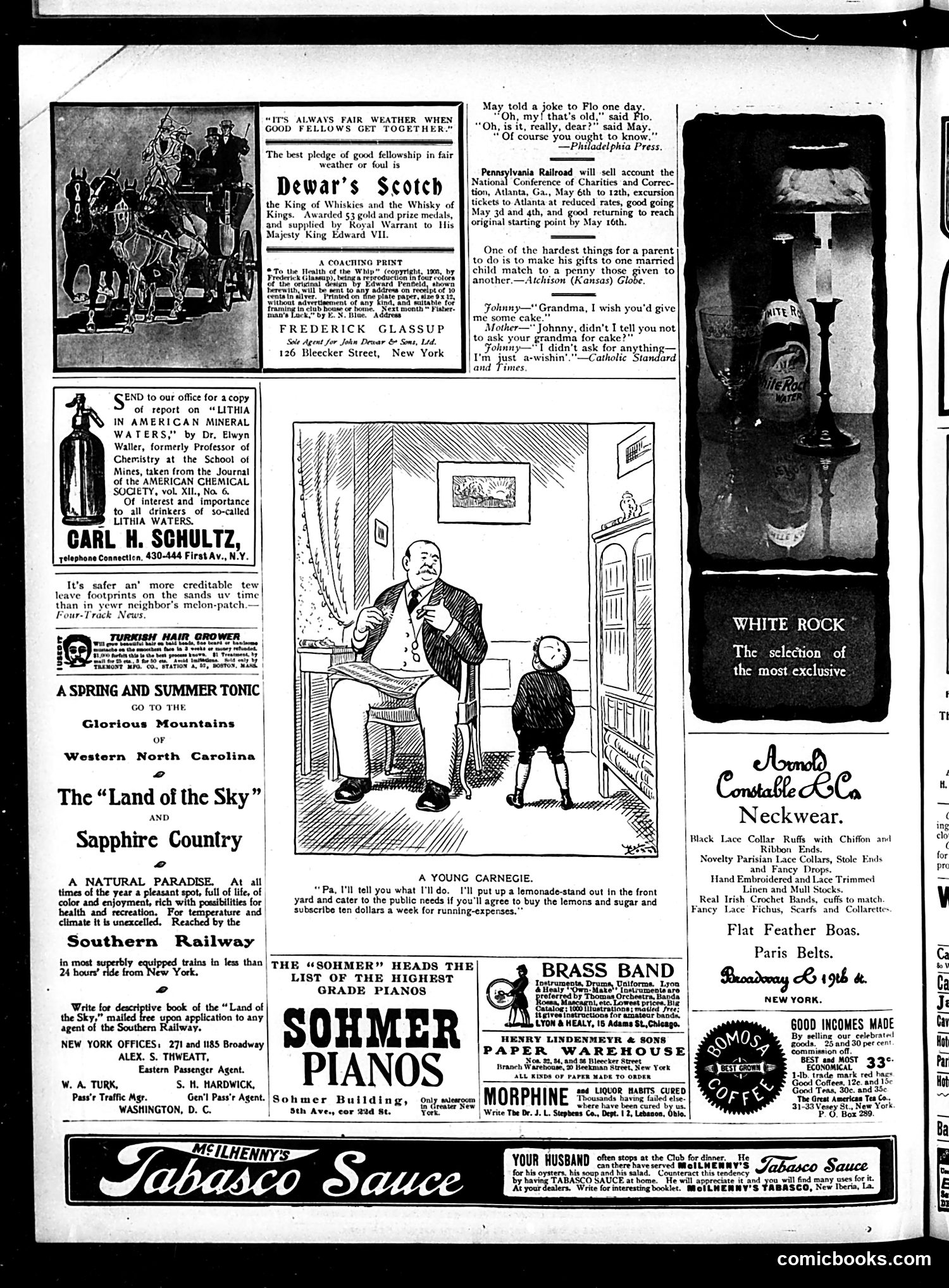
This page is primarily **advertising** with one cartoon. The main satirical content is "A Young Carnegie," a single-panel cartoon depicting a child proposing a lemonade stand business scheme to his father. **The Cartoon's Meaning:** The cartoon references **Andrew Carnegie**, the wealthy industrialist and steel magnate known for his ruthless business practices and later philanthropy. The joke satirizes how even children now emulate Carnegie's entrepreneurial ambition—the boy proposes a lemonade stand but shrewdly negotiates his father's financial backing ("subscribe ten dollars a week"), mimicking corporate capitalism. He's essentially asking his father to fund his venture while he manages it, a miniature version of how wealthy industrialists operated. **Historical Context:** This reflects early 1900s American anxiety about unchecked capitalism and the "robber baron" mentality trickling down to the next generation. Carnegie represented both admirable self-made success and questionable business ethics, making him ideal satirical material. The rest of the page consists of period advertisements for Scotch whisky, pianos, pharmaceuticals, and luxury goods typical of Judge's affluent readership.
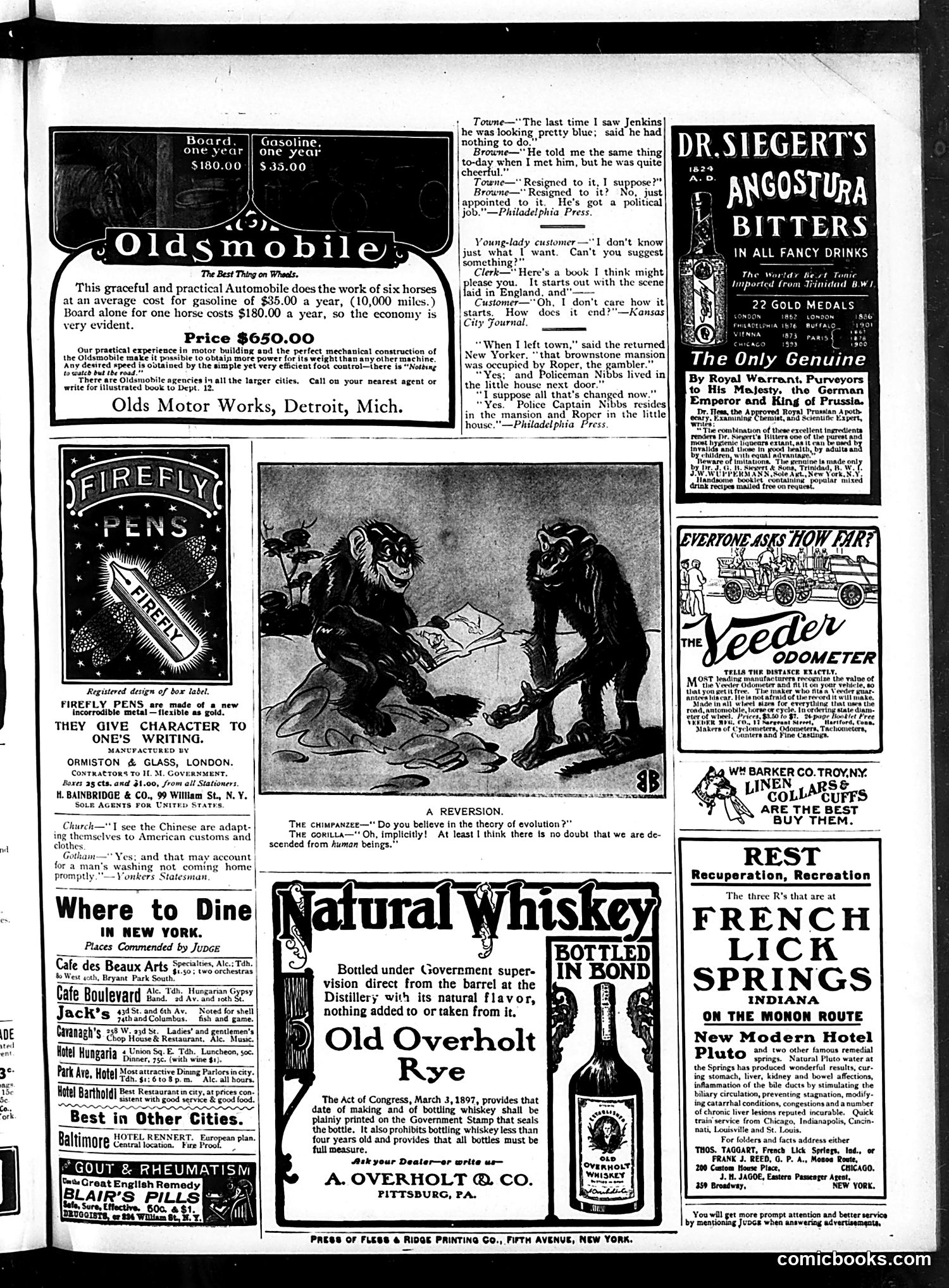
This page contains primarily **advertisements and brief humorous anecdotes** rather than political cartoons. The main illustrated cartoon depicts **two chimpanzees in conversation**, labeled "A Reversion." One chimp asks the other about evolution theory; the other responds that humans must have descended from chimps because chimps behave like humans. This is a **joke about Darwinian evolution**, using the reversal of the expected hierarchy (animals descended from humans, not vice versa) for comic effect. It satirizes both evolutionary theory and human behavior by suggesting humans aren't morally superior to primates. The surrounding content includes small anecdotes mocking political appointments, bureaucratic incompetence, and social pretension—typical Judge magazine humor. The rest consists of **period advertisements** for automobiles, pens, whiskey, and dining establishments, reflecting early 20th-century consumer culture. The page demonstrates Judge's mix of satirical commentary on contemporary society alongside commercial content.
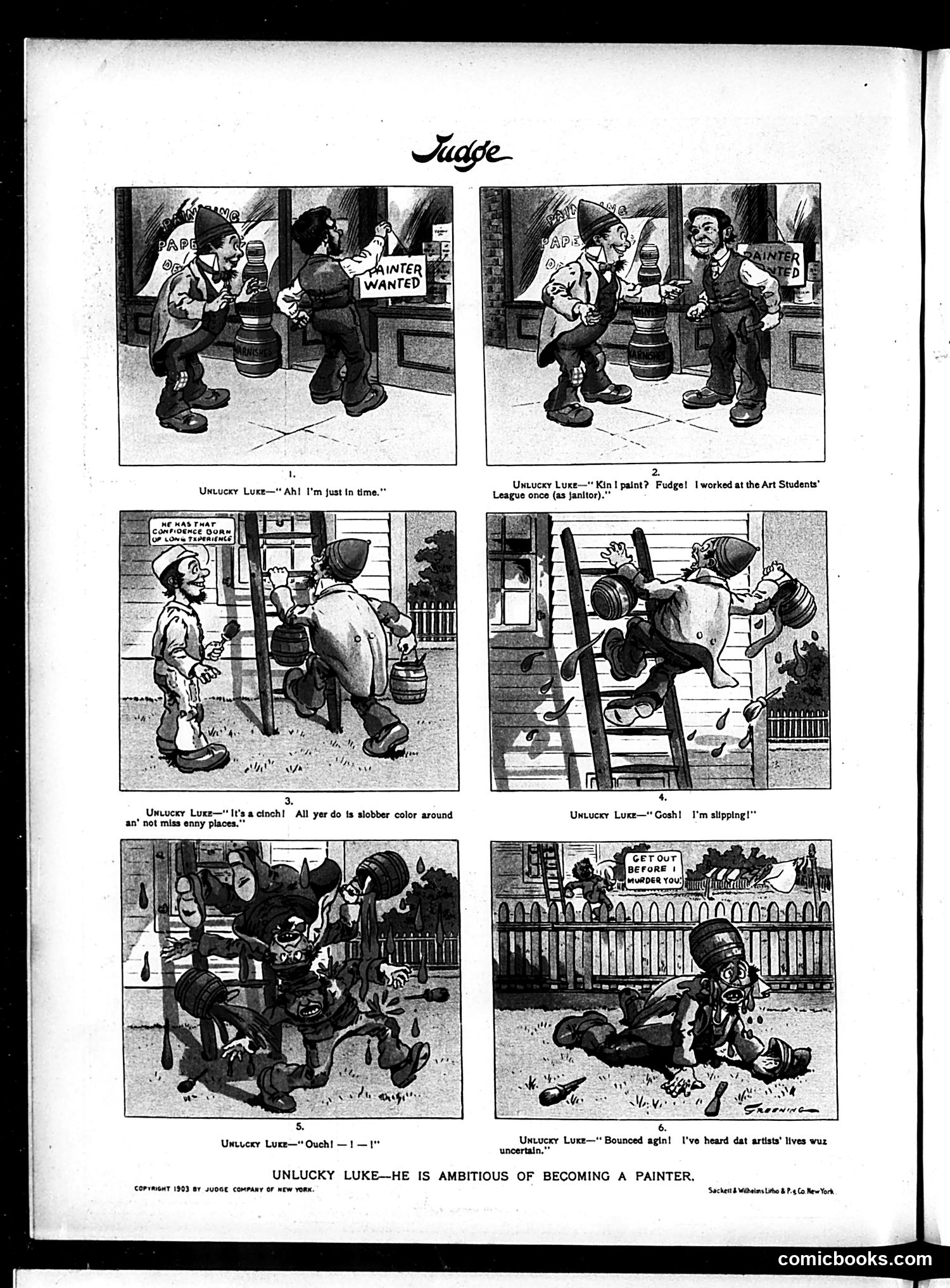
This 1903 Judge comic mocks a working-class character, "Unlucky Luke," who aspires to become a painter despite having no genuine artistic training. The humor derives from his fraudulent credentials: he claims experience at the prestigious Art Students' League, but only worked there as a janitor. The satire targets both Luke's delusional ambition and the broader early-1900s anxiety about social mobility and unqualified people entering professions. Each panel escalates his failures—he misrepresents his credentials, makes a mess of painting work, slips off ladders, and gets repeatedly fired. The implicit joke reflects period class attitudes: working-class individuals lacked the legitimate education to succeed in genteel artistic fields. His repeated humiliations suggest his aspirations are inherently ridiculous, not sympathetic. The cartoon reinforces hierarchies of respectability and "proper" credentials that gatekept professional advancement.