
A complete issue · 16 pages · 1903
Judge — January 17, 1903
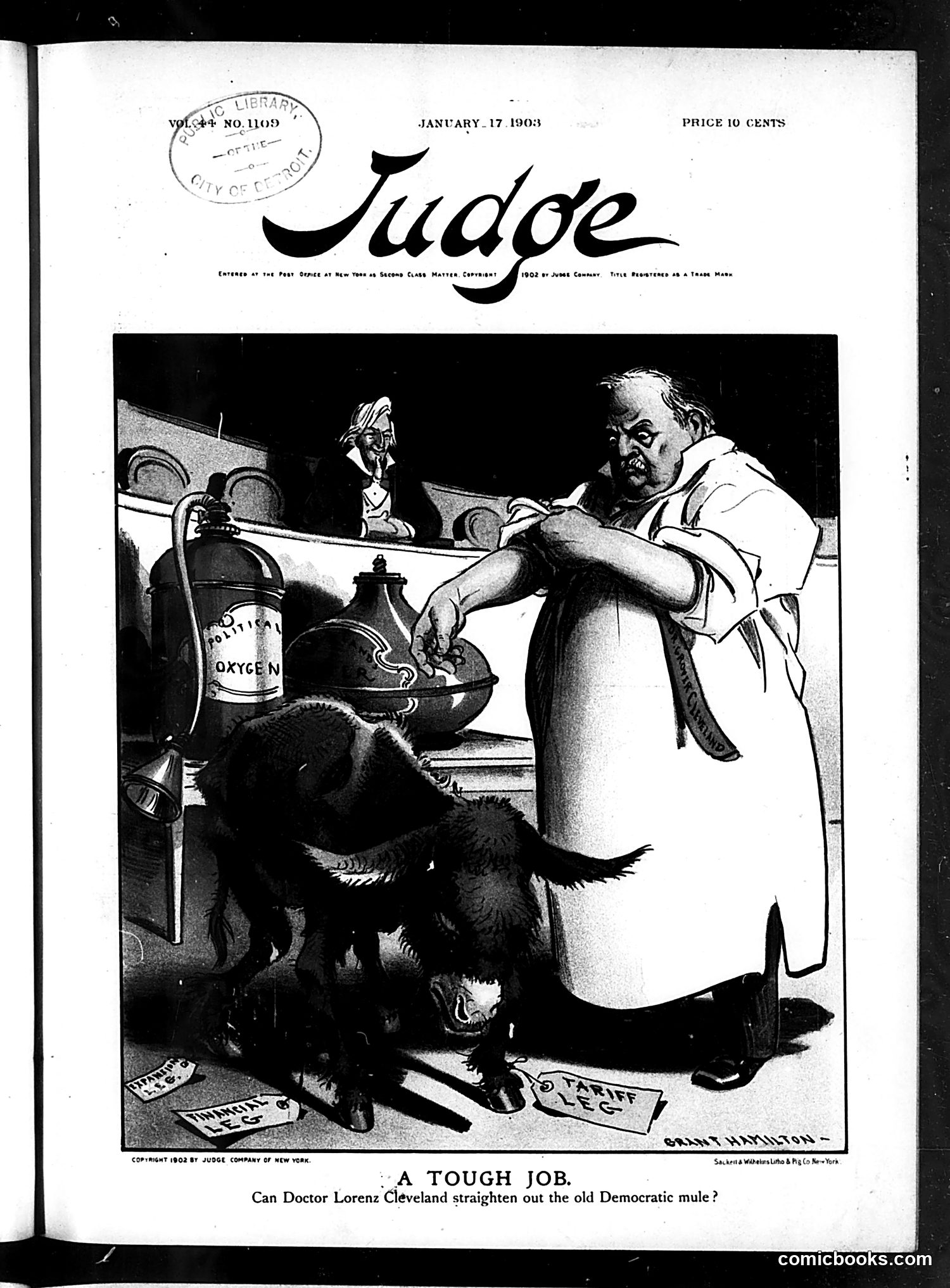
This 1903 Judge cartoon satirizes Doctor Adolf Lorenz, a famous Austrian orthopedic surgeon known for treating severe bone deformities without surgery. The image shows Lorenz attempting to straighten a stubborn Democratic donkey (the party's traditional symbol) using his medical techniques—oxygen tanks and mechanical apparatus visible in the workshop setting. The satire mocks the Democratic Party as fundamentally "bent" or deformed beyond repair, even for a renowned specialist. By depicting the donkey as a "tough job," the cartoon suggests the Democratic Party's problems are so severe that even Lorenz's miraculous medical methods couldn't fix them. This reflects Republican political mockery of Democrats during Theodore Roosevelt's presidency.
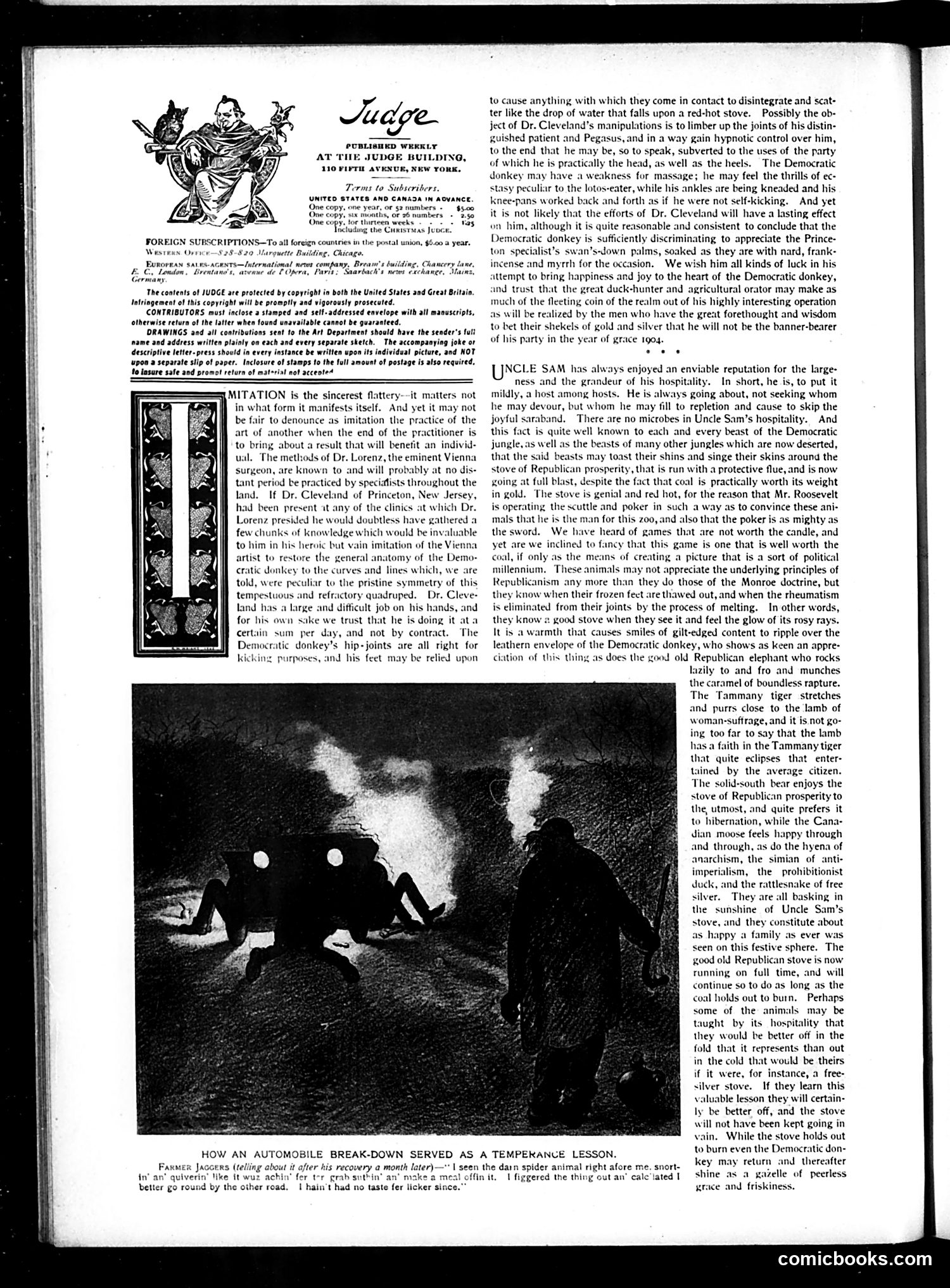
This page contains a satirical article titled "Uncle Sam" and a political cartoon below titled "How an Automobile Break-Down Served as a Temperance Lesson." The main article mocks Dr. Cleveland's Democratic "manipulation" of animals for political purposes, suggesting Republicans use animals (donkeys, tigers, bears, moose) more effectively as political symbols. The satire criticizes Democratic tactics while praising Republican animal symbolism. The bottom cartoon depicts silhouetted figures around a campfire with an automobile, illustrating a farmer's anecdote about a broken-down car serving as a temperance lesson—though the specific moral appears cut off or unclear in this reproduction. The overall tone is pro-Republican partisan satire typical of Judge's editorial stance during the early 20th century.
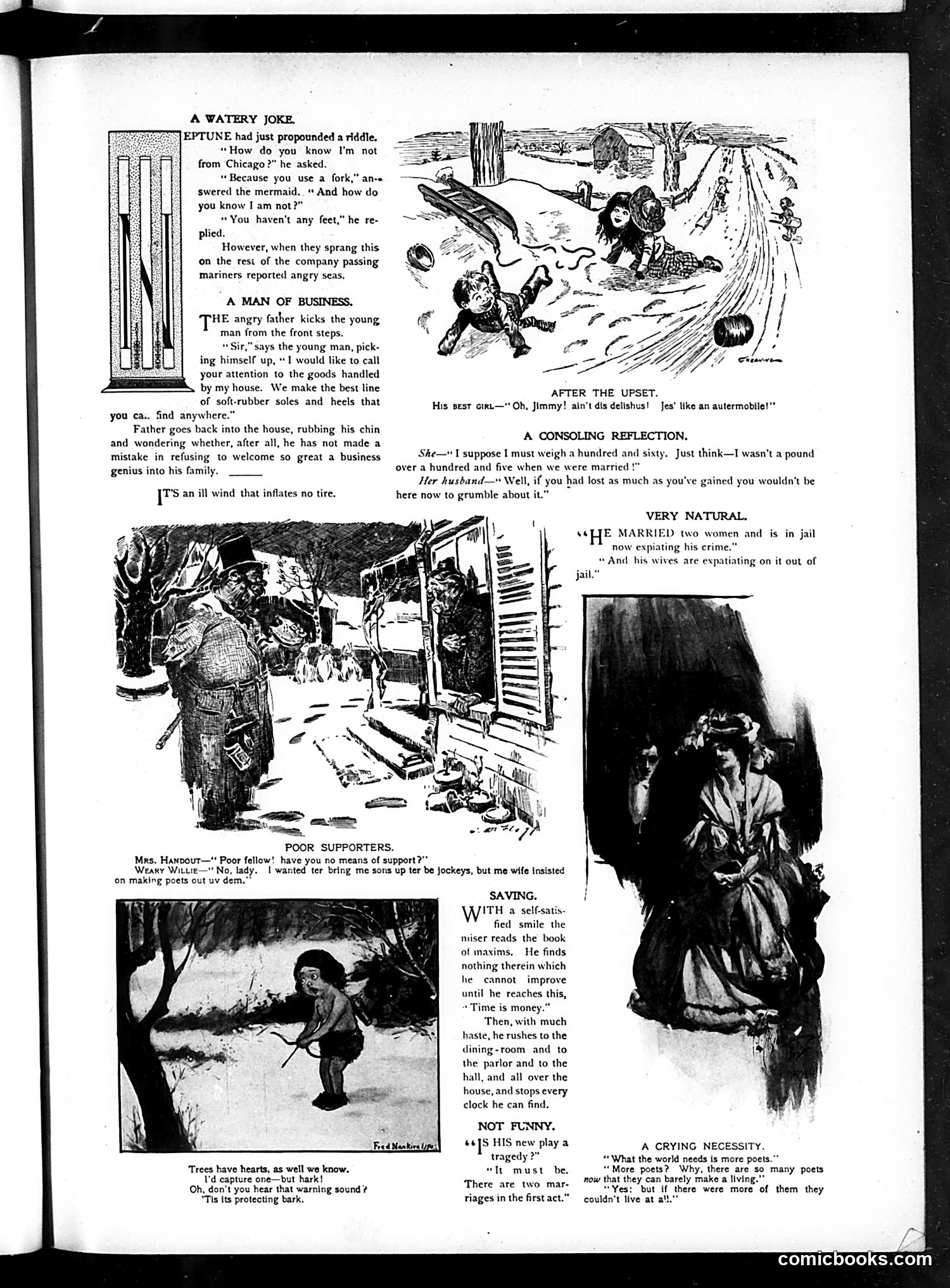
This page contains several unrelated humorous sketches typical of early-to-mid 20th century Judge magazine: **"A Watery Joke"** and **"A Man of Business"** are conversational humor pieces about social situations—one involving fork etiquette, another about a salesman's poor business judgment. **"After the Upset"** shows people in a boating accident, with humor about gender dynamics (a man telling his girlfriend to act "like an automobilist"). **"Poor Supporters"** and other sketches address domestic and class themes common to the era. **"A Crying Necessity"** discusses poets' financial struggles—a recurring satirical target. The page lacks overt political cartoons or caricatures of specific public figures. Instead, it offers genteel social satire aimed at middle-class readers, mocking pretension, marital discord, and economic concerns of the period.
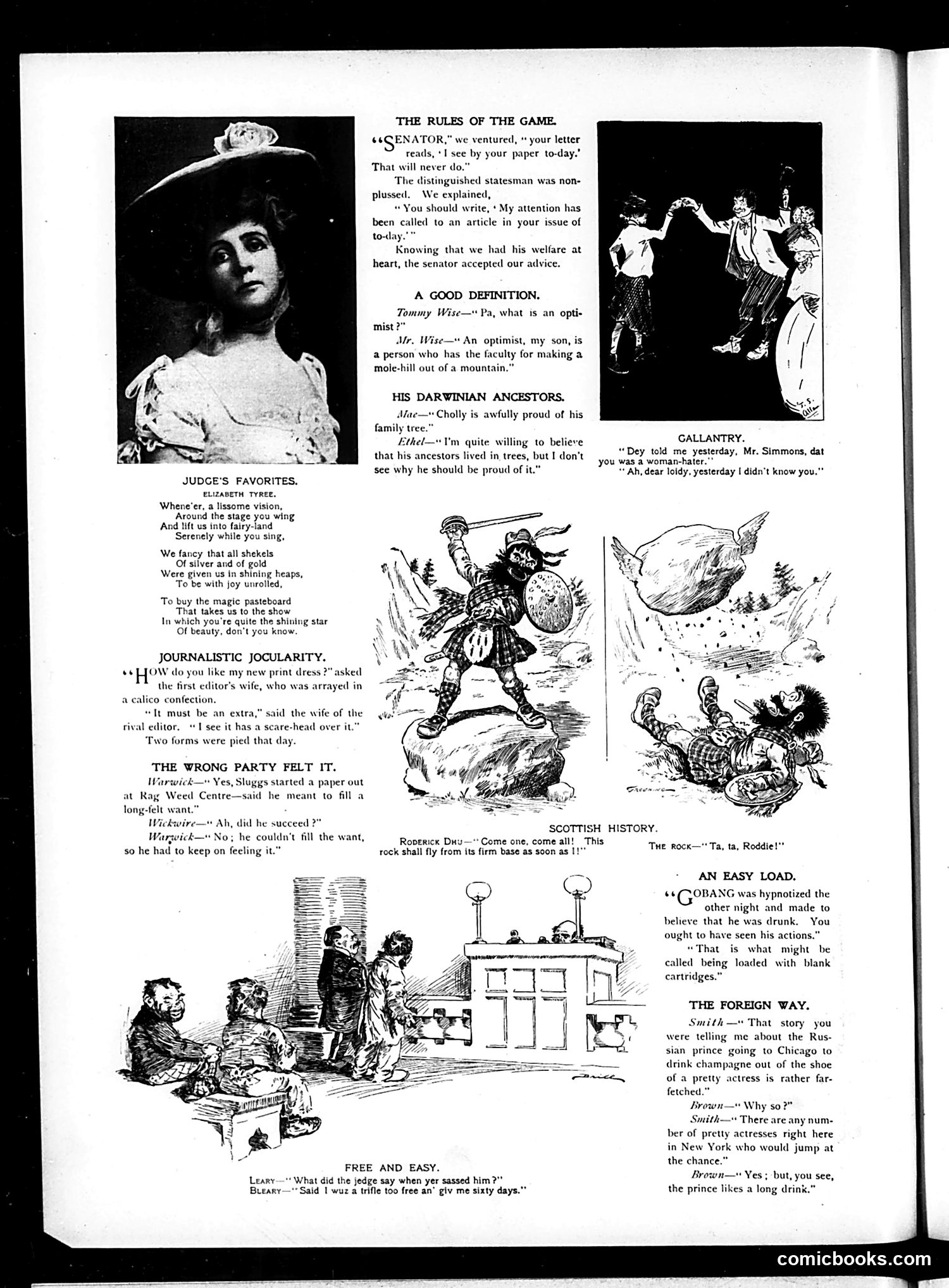
This page contains humorous anecdotes and satirical cartoons typical of Judge magazine's format. The sections include: **"The Rules of the Game"** mocks a senator's reluctance to write for the publication, suggesting he uses excuses about being too busy. **"A Good Definition"** presents wordplay about optimism, while **"His Darwinian Ancestors"** satirizes someone's pride in family genealogy by joking they descended from tree-dwelling ancestors. **"Journalistic Jocularity"** and **"The Wrong Party Felt It"** appear to be light editorial humor about newspaper rivalry and failed schemes. The cartoons throughout depict everyday domestic and social scenes with gentle satirical commentary on human behavior—a hallmark of Judge's accessible humor style. The page lacks overtly partisan political content, instead focusing on universal social foibles and comedic wordplay for general readers.
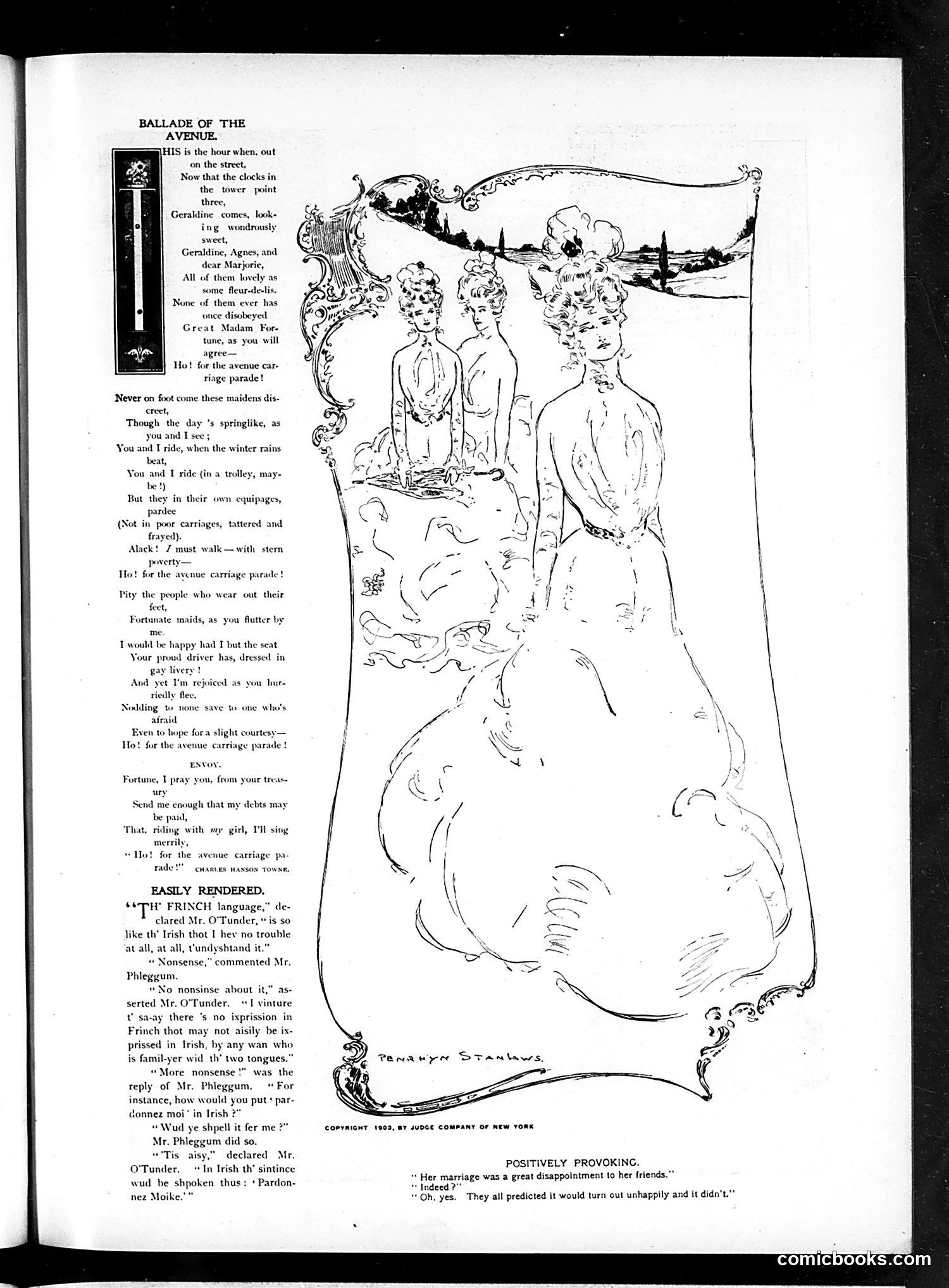
This page contains two distinct pieces from *Judge* magazine: **"Ballade of the Avenue"** (poem with illustration): A romantic poem lamenting class inequality. The speaker admires wealthy young women (Geraldine, Agnes, Marjorie) who ride in fancy carriages down the avenue, while he must walk. The satire targets the conspicuous display of wealth by the upper class and the speaker's own yearning for their lifestyle and romantic attention. **"Easily Rendered"** (dialogue joke): Two Irish-American characters (O'Tunder and Phleggum) debate whether French translates easily to Irish. O'Tunder confidently claims it does, then proves it by "translating" the French phrase *"pardonnez moi"* into Irish as *"Pardonnez Moike"*—essentially just replacing "moi" with an Irish name. The joke mocks Irish immigrants' linguistic pretensions and limited actual language skills. **"Positively Provoking"** (brief joke): A quip about a disappointing marriage—disappointing because friends predicted failure but the couple succeeded.
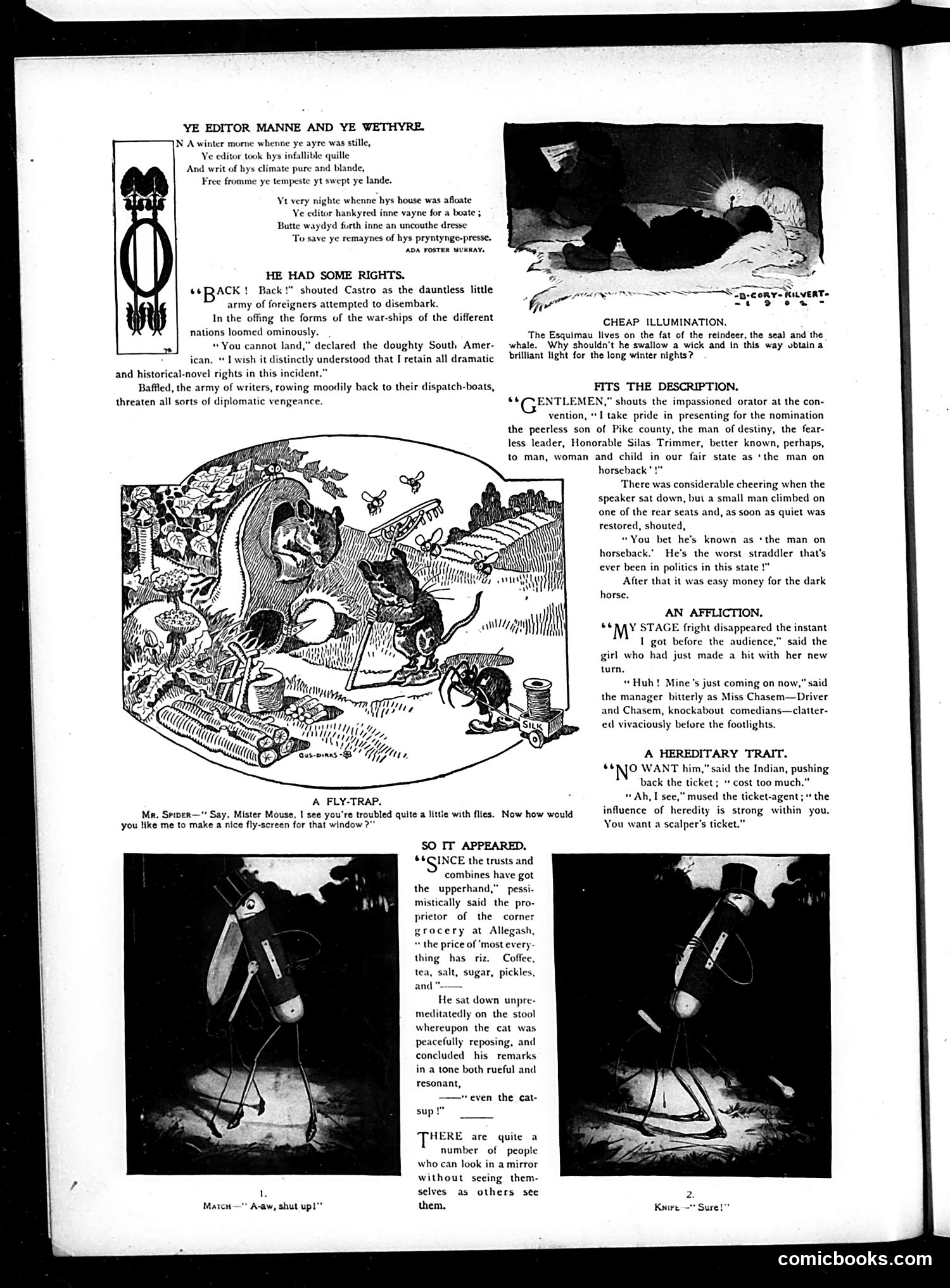
This page contains multiple satirical cartoons and humorous sketches typical of Judge magazine's social and political commentary. **"He Had Some Rights"** mocks a fictional South American leader (Castro) who attempts to prevent foreign journalists from landing, claiming he retains "dramatic and historical-novel rights" to events in his country. The satire critiques both nationalist overreach and the contemporary appetite for sensationalized war reporting. **"Fits the Description"** ridicules a political candidate described as "the man on horseback"—a heckler reveals he's actually a notorious political flip-flopper, not a principled leader. **Other sketches** include light humor about stage fright, hereditary traits (an Indian rejecting expensive tickets), trust-driven inflation (a grocer's cat causes him to exclaim prices have even risen for "cat-sup"), and general absurdist jokes. The page exemplifies Judge's approach: mixing political satire with everyday humor, targeting politicians, social pretension, and contemporary anxieties about monopolies and inflation.
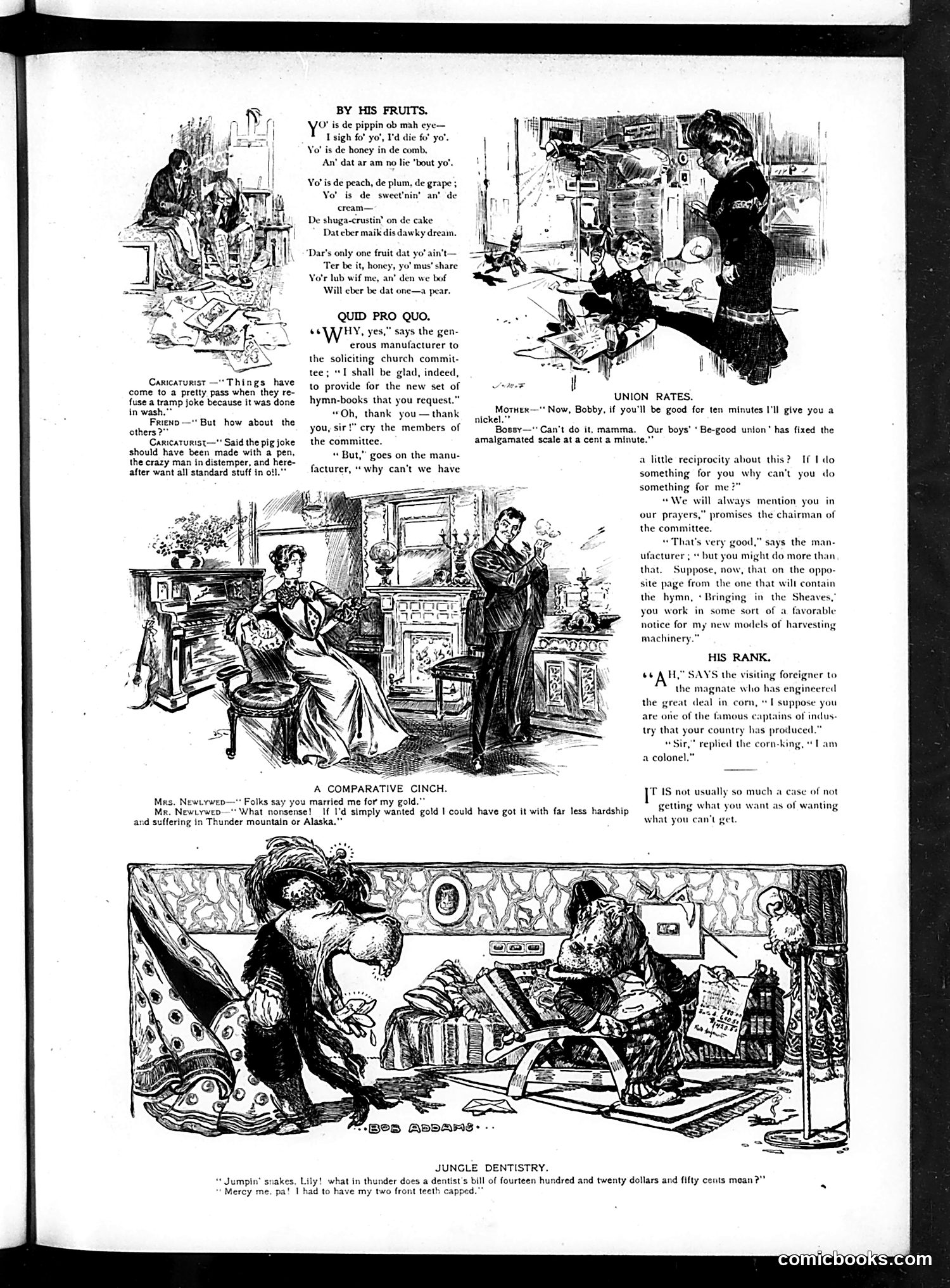
This page contains several satirical pieces targeting American social hypocrisy and commercialism circa early 1900s: **"By His Fruits"** uses dialect verse (stereotypical African American speech) as romantic poetry—likely mocking both sentimental song conventions and racial caricature simultaneously. **"Quid Pro Quo"** satirizes church fundraising: a manufacturer agrees to donate hymn-books only if the church advertises his harvesting machinery in their publications. The satire targets the erosion of religious integrity through commercial interests. **"Union Rates"** jokes about labor organizing gone absurd—a child's mother must negotiate with his "Be-good union" at "a cent a minute," mocking both unionization and childhood commerce. **"His Rank"** ridicules American industrial magnates: a wealthy "corn-king" proudly claims the rank of "colonel" (likely a honorary title), satirizing how business titans adopt aristocratic pretensions. **"Jungle Dentistry"** mocks the shocking cost of dental work ($1,420.50—enormous for the era), framed as primitive barbarism. Throughout, Judge attacks commercialism corrupting American institutions and values.
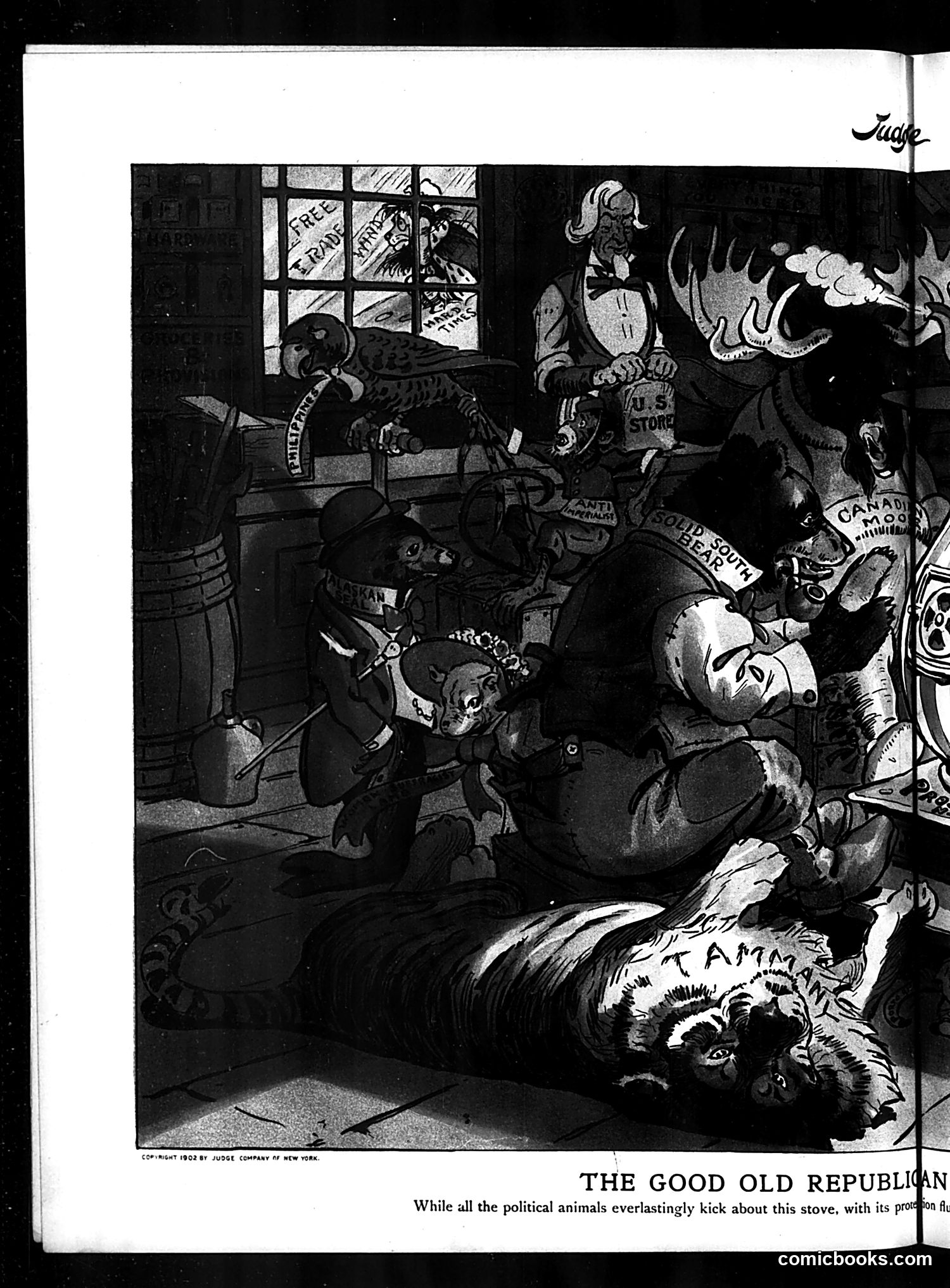
This Judge cartoon satirizes Republican Party infighting. The image shows various political figures—depicted as animals—quarreling around a stove labeled with references to different Republican factions and constituencies (visible labels include "U.S. Store," "Canada," and regional designations). The satire suggests that while these political "animals" constantly bicker and kick about the party's direction and policies (represented by the stove), they're distracted from more pressing matters. The caption's incomplete text hints that something—likely the Republican agenda or governance—continues functioning despite their dysfunction. The cartoon reflects early 20th-century Republican Party divisions between progressive and conservative wings, illustrating the party's internal struggles through animalistic caricature—a Judge magazine staple.
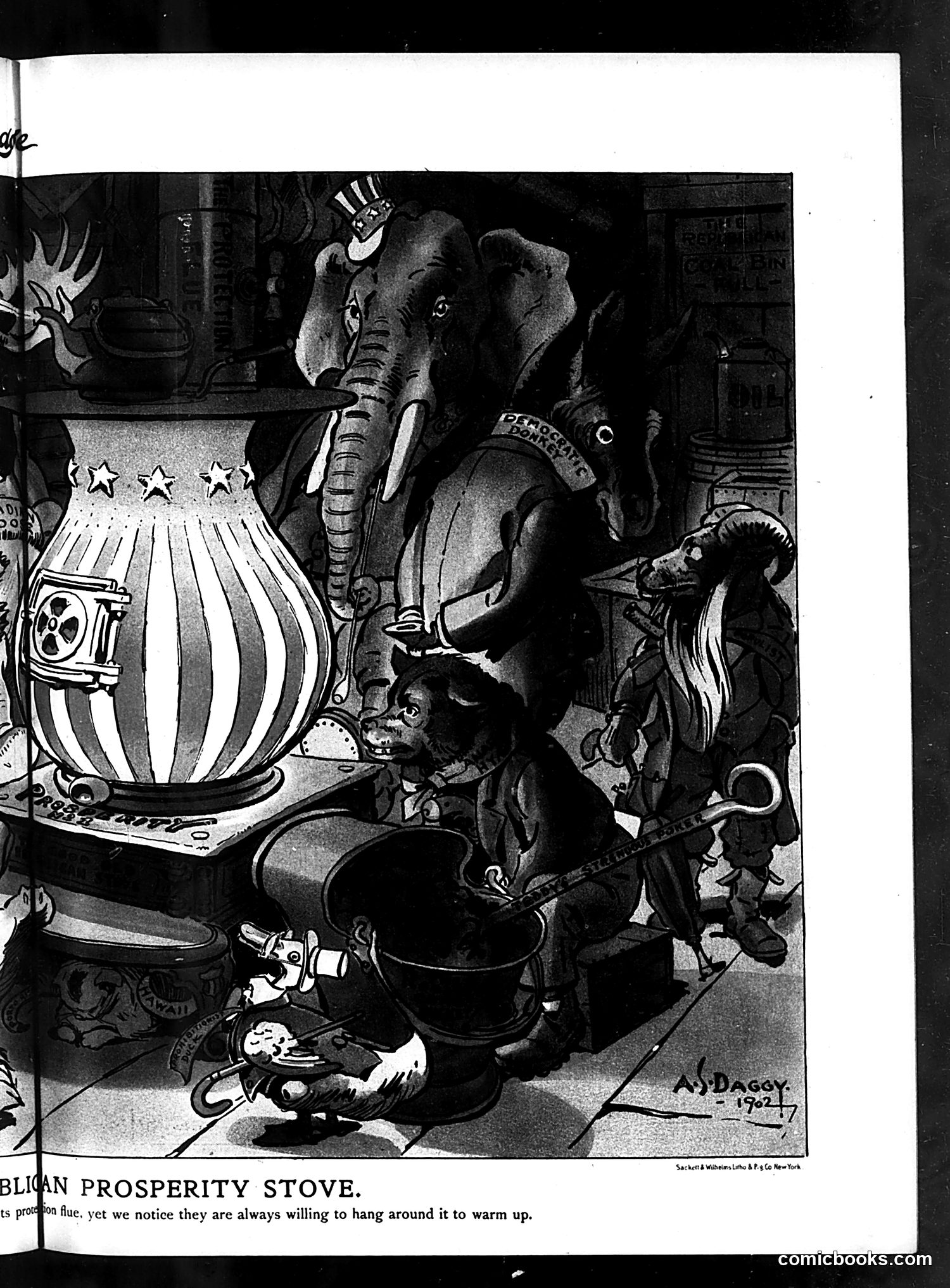
This political cartoon satirizes Republican claims of economic prosperity. The central image shows a large ornate stove decorated with stars (representing the Republican party) labeled as a "Prosperity Stove." Various animal figures—appearing to represent different groups or constituencies—gather around it seeking warmth. The caption's incomplete text suggests these groups are "willing to hang around it to warm up," implying they're attracted to promises of prosperity but the warmth (actual economic benefit) may be illusory or unequally distributed. The cartoon critiques Republican economic messaging as performative—a showy, decorative promise rather than substantive help. The animals' eager but skeptical positioning suggests public doubt about whether the promised prosperity actually reaches ordinary people. The signature appears to read "Cesare" and is dated 1902.
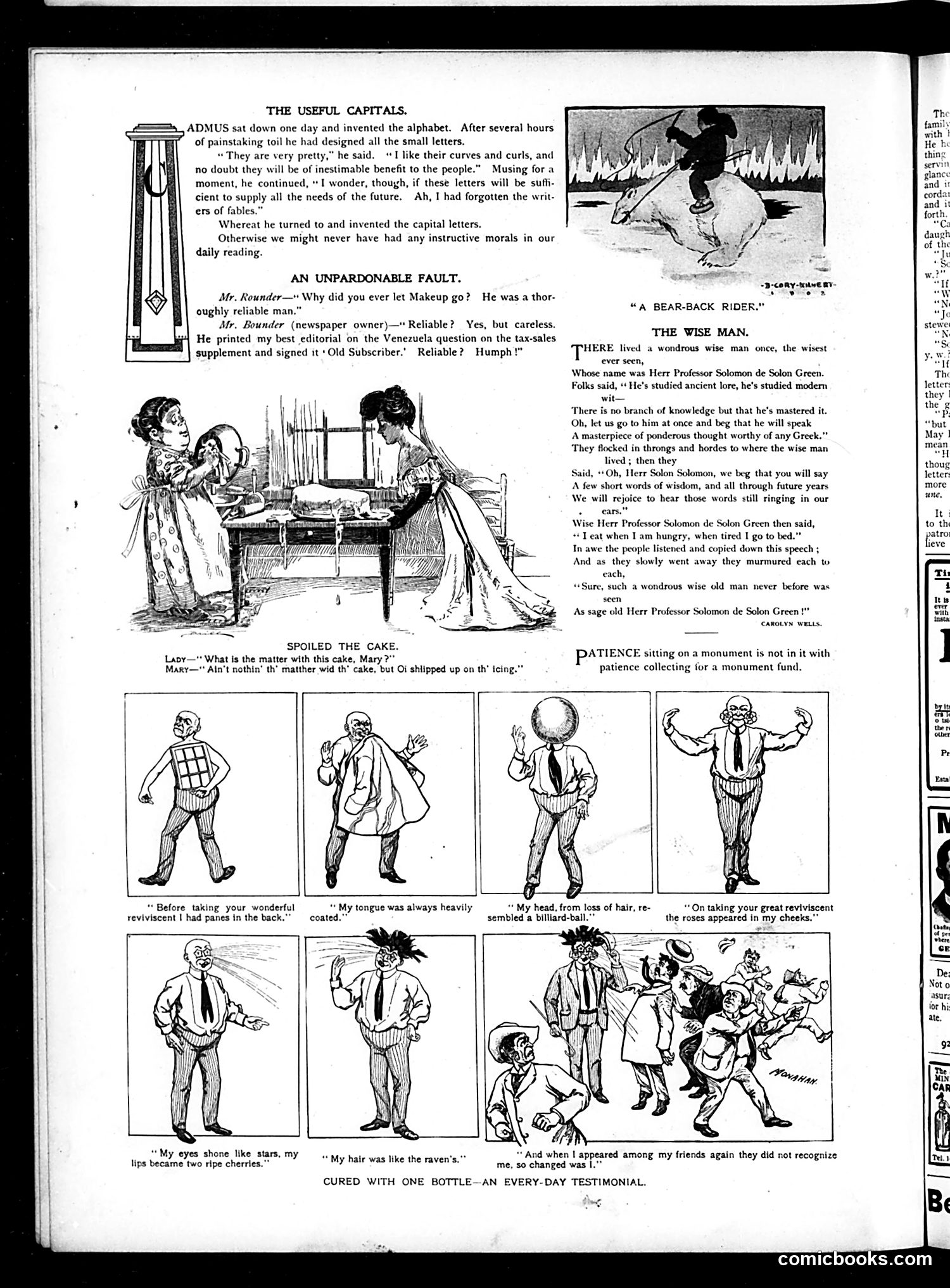
This page contains several distinct pieces: **"The Useful Capitals"** is a fable-like story crediting the invention of capital letters to "Admus" (a play on "Adam"), joking that without capitals, fables would lack their moral lessons—a dig at how people rely on instructive stories. **"An Unpardonable Fault"** mocks a newspaper owner whose editor was unreliable despite claims otherwise—he carelessly printed an important editorial in the wrong section under a fake byline. It's satire about newspaper incompetence. **"The Wise Man"** is a longer story by Carolyn Wells ridiculing pretentious intellectuals. Professor Solomon de Solon Green, celebrated as a genius, offers only banal wisdom: "I eat when hungry, I go to bed when tired." The townspeople treat this obvious nonsense as profound philosophy—satirizing blind reverence for authority figures. **Bottom section**: A comic strip advertising some miraculous tonic or "reviviscent," showing before/after transformations with exaggerated testimonials about curing baldness, poor complexion, etc.—typical patent medicine advertising satire common in Judge magazine.
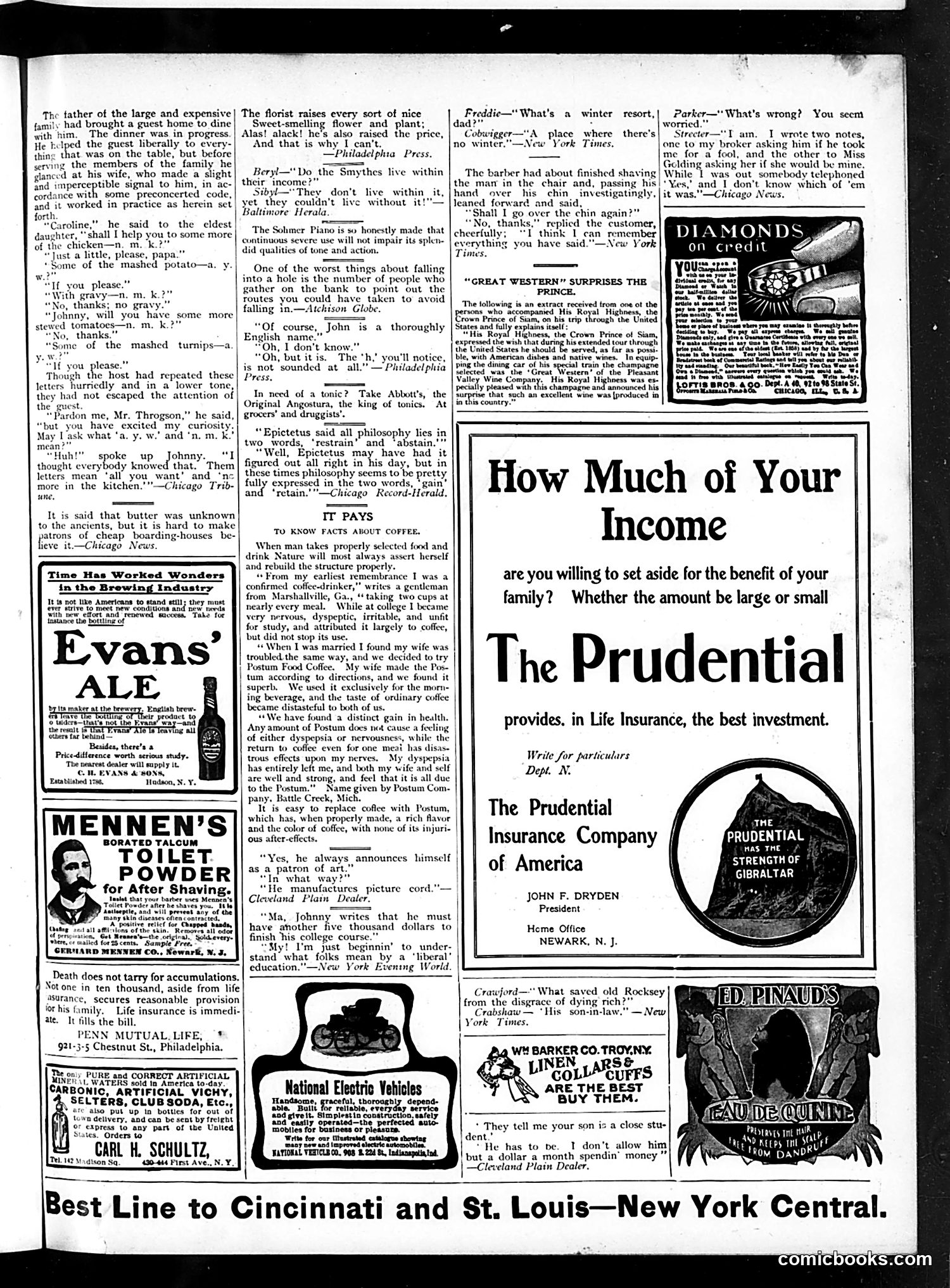
This page is primarily **advertising and filler content** typical of early 20th-century magazines, with minimal political satire. The main humorous piece is a domestic anecdote about a father using coded signals ("a.y.w." and "n.m.k."—"all you want" and "not much, kid") when serving dinner to a guest versus his own family. The joke satirizes **middle-class hypocrisy**: the host pretends generosity toward guests while secretly rationing food for his children, using a prearranged code with his wife to manage scarcity. This reflects **economic anxiety of the era**—struggling families maintaining appearances of prosperity. The remainder consists of contemporary advertisements: Evans' Ale, Mennen's talcum powder, life insurance, automobiles, and mineral water. Brief quoted witticisms mock florists' inflated prices and philosophical pretension. **No identifiable political figures or events appear.** The satire is purely social commentary on domestic economy and class performance.
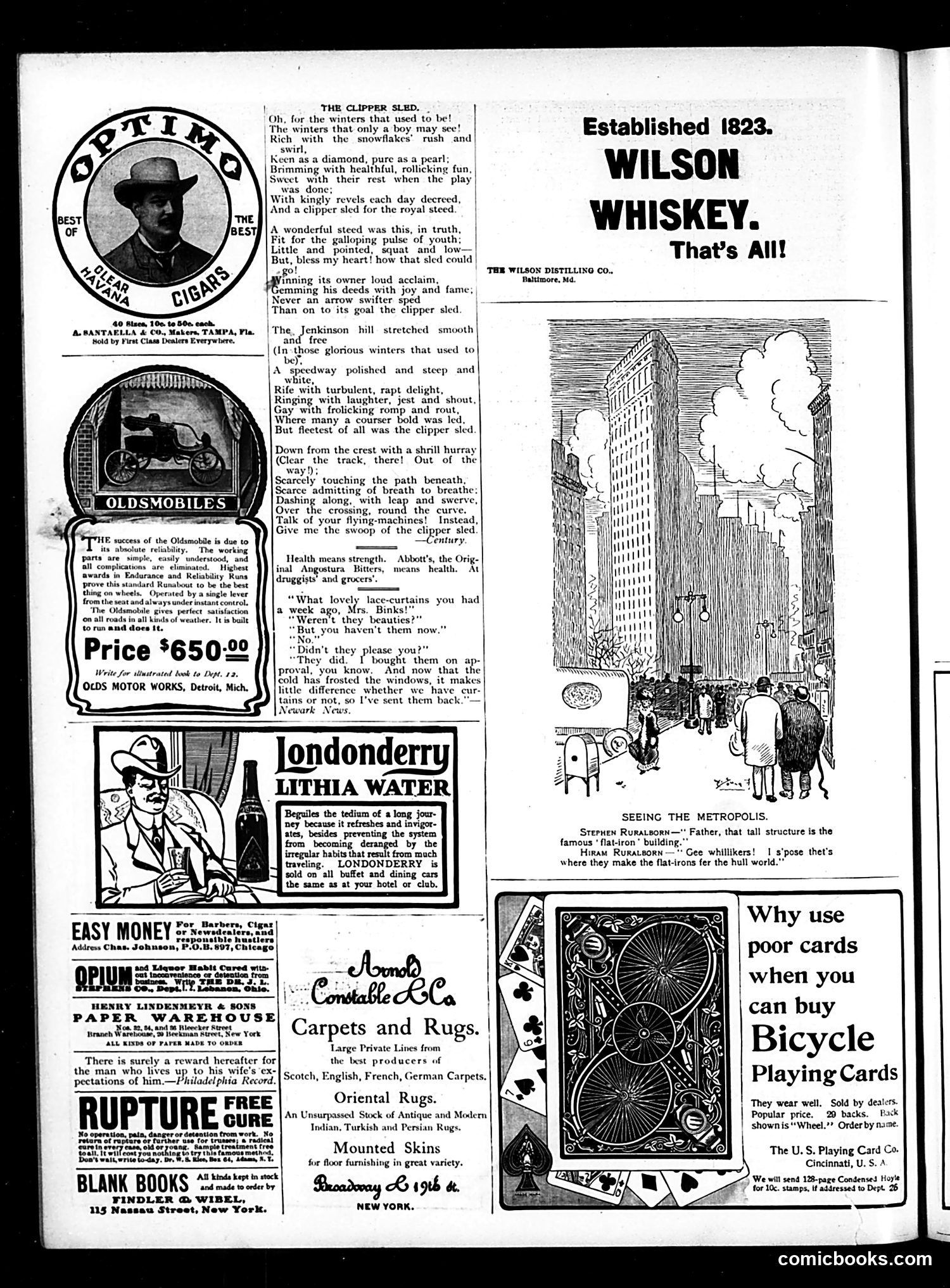
This page is primarily **nostalgic poetry and advertising** rather than political satire. **"The Clipper Sled"** is a sentimental poem idealizing childhood winter sledding—a common Judge theme lamenting lost innocence and simpler times. It romanticizes the speed and freedom of sledding down hills like Jenkinson Hill, comparing the thrill to modern flying machines. The **cartoon at bottom right** shows urban humor: a rural father and son visiting New York City. The son identifies the Flatiron Building (the famous triangular skyscraper completed 1902), but the father misunderstands it as a factory for actual flat-irons, reflecting the contrast between sophisticated city dwellers and naive country visitors—a recurring early-1900s American joke. The rest of the page is **advertisements** for cigars, automobiles, whiskey, carpets, playing cards, and patent medicines—typical Judge magazine filler. No significant political content is evident here.
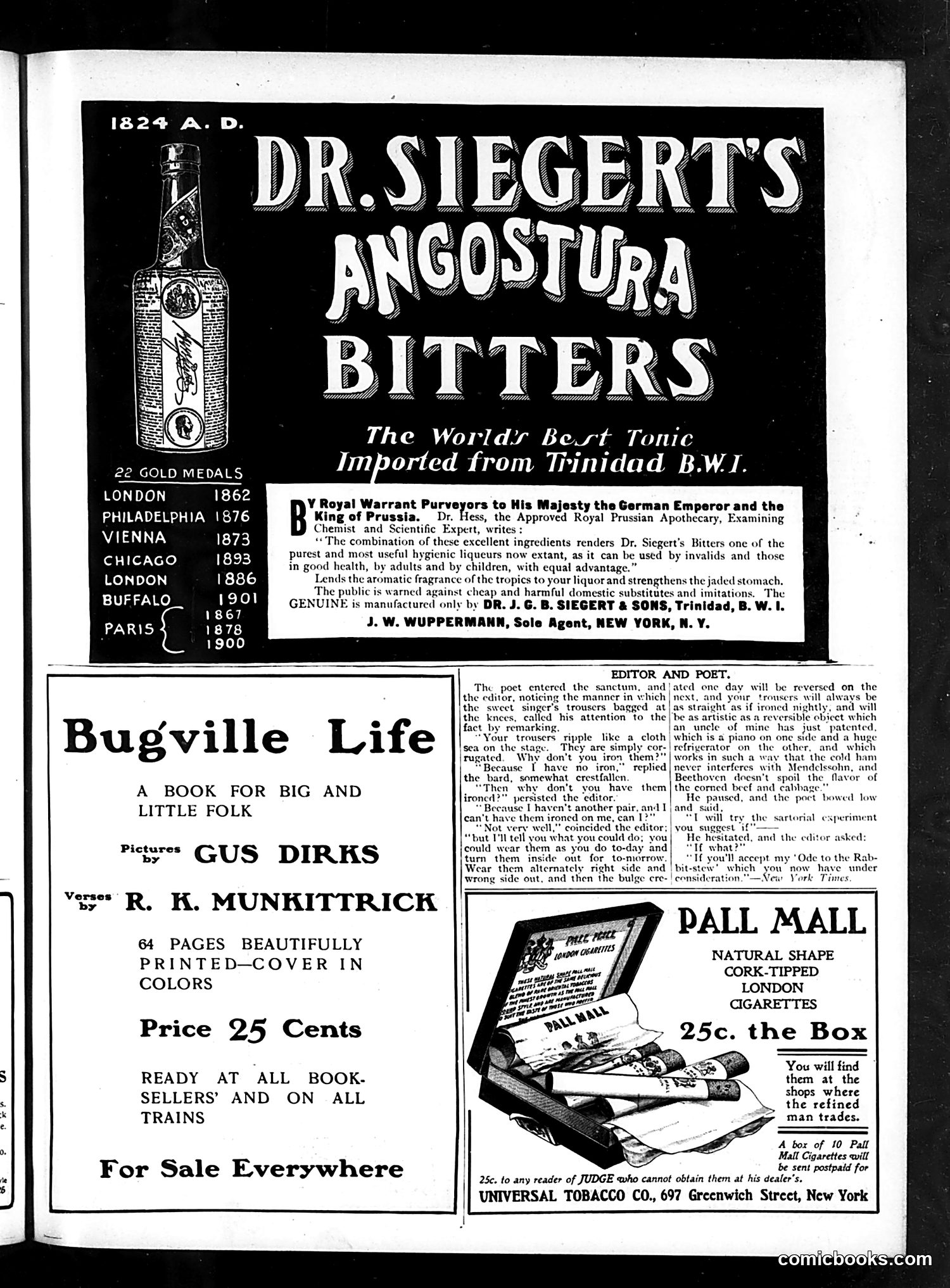
This page is primarily **advertising**, not editorial content or political cartoons. The dominant advertisement promotes **Dr. Siegert's Angostura Bitters**, a medicinal tonic imported from Trinidad. The ad emphasizes its legitimacy through medals won at international expositions (London 1862, Vienna 1873, Chicago 1893, etc.) and a dubious royal endorsement from the "German Emperor and King of Prussia's" official apothecary—likely satirizing patent medicine marketing practices of the era. Below this sits a humorous sketch titled "Editor and Poet" about a struggling writer whose trousers are permanently wrinkled from poverty. The editor suggests reversible trousers as a solution—a joke about both the poet's shabby circumstances and absurd "inventions" touted in the period. The remaining space contains advertisements for *Bugville Life* (a children's book with Gus Dirks illustrations) and **Pall Mall cigarettes**. The page reflects turn-of-the-century consumer culture rather than political satire.
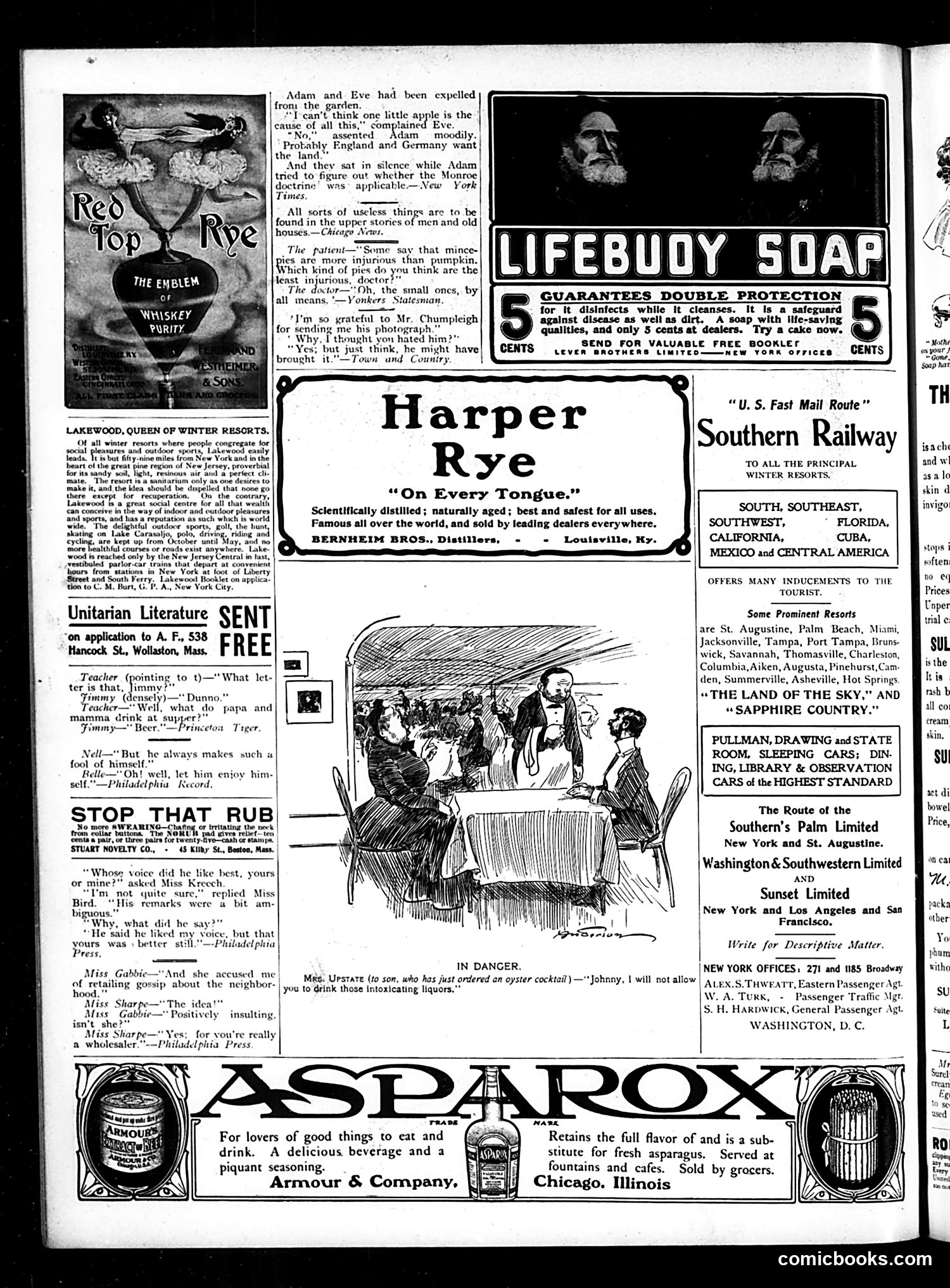
This page contains several distinct satirical pieces: **Main Cartoon (center):** "In Danger" depicts a waiter warning a diner about ordering oyster cocktails, cautioning against "intoxicating liquors." This satirizes Prohibition-era anxieties and the absurdity of legal restrictions on alcohol. **Adam and Eve Commentary (top):** References the biblical expulsion and sardonically connects it to contemporary geopolitical tensions—specifically mentioning England, Germany, and the Monroe Doctrine. The joke suggests human conflicts over territorial ambitions are as old as mankind itself, with the satirist implying these nations' imperial rivalries parallel Adam and Eve's original transgression. **Miscellaneous Jokes:** Include wordplay about doctors recommending "small ones" (pies), a man grateful someone photographed him (so he could appreciate his enemy), and teacher-student exchanges about drinking habits. The page is largely **advertising**—promoting rye whiskey, soap, railroads to Florida resorts, and asparagus—typical of Judge's commercial model. The satire reflects early 20th-century concerns: imperialism, Prohibition, and class leisure culture.
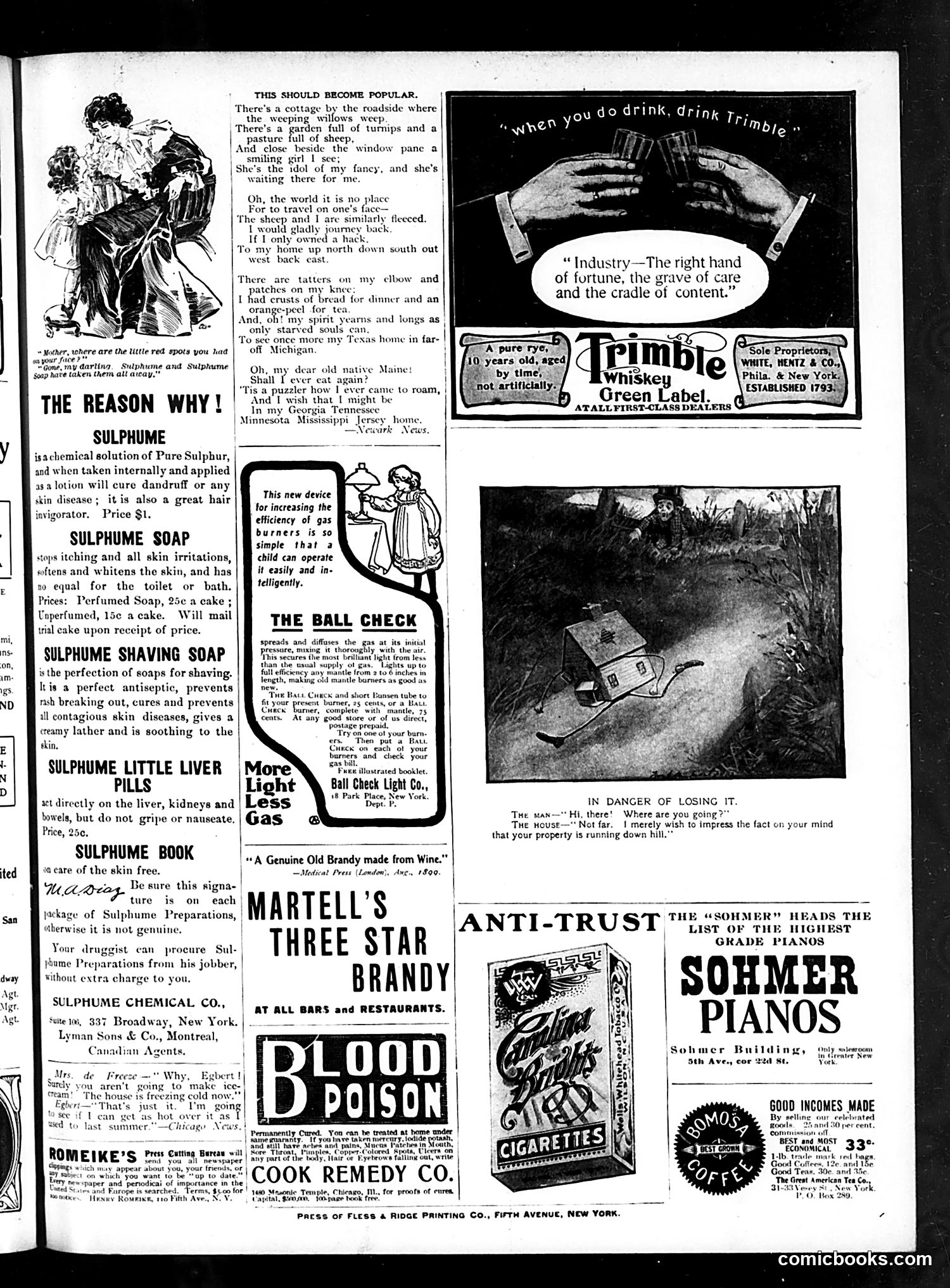
This page is primarily **advertising**, not editorial satire. The main content consists of product ads for various patent medicines and consumer goods typical of this era (circa 1900s). The largest item is a poem titled "The Reason Why I Sulphume"—a **nostalgic jingle advertising Sulphume**, a patent medicine claimed to cure dandruff and skin disease. The poem depicts a poor laborer longing to return home to the South, with "tatters" and "patches"—presumably the skin conditions Sulphume treats. Below appear ads for **The Ball Check** (a gas burner efficiency device), **Martell's Three Star Brandy**, and **Sohmer Pianos**. The only clear cartoon is a small dialogue captioned "In Danger of Losing It," showing two men discussing property deterioration—likely promoting financial caution or investment. The page lacks the satirical punch typical of *Judge* magazine's editorial content; it's essentially a commercial space.
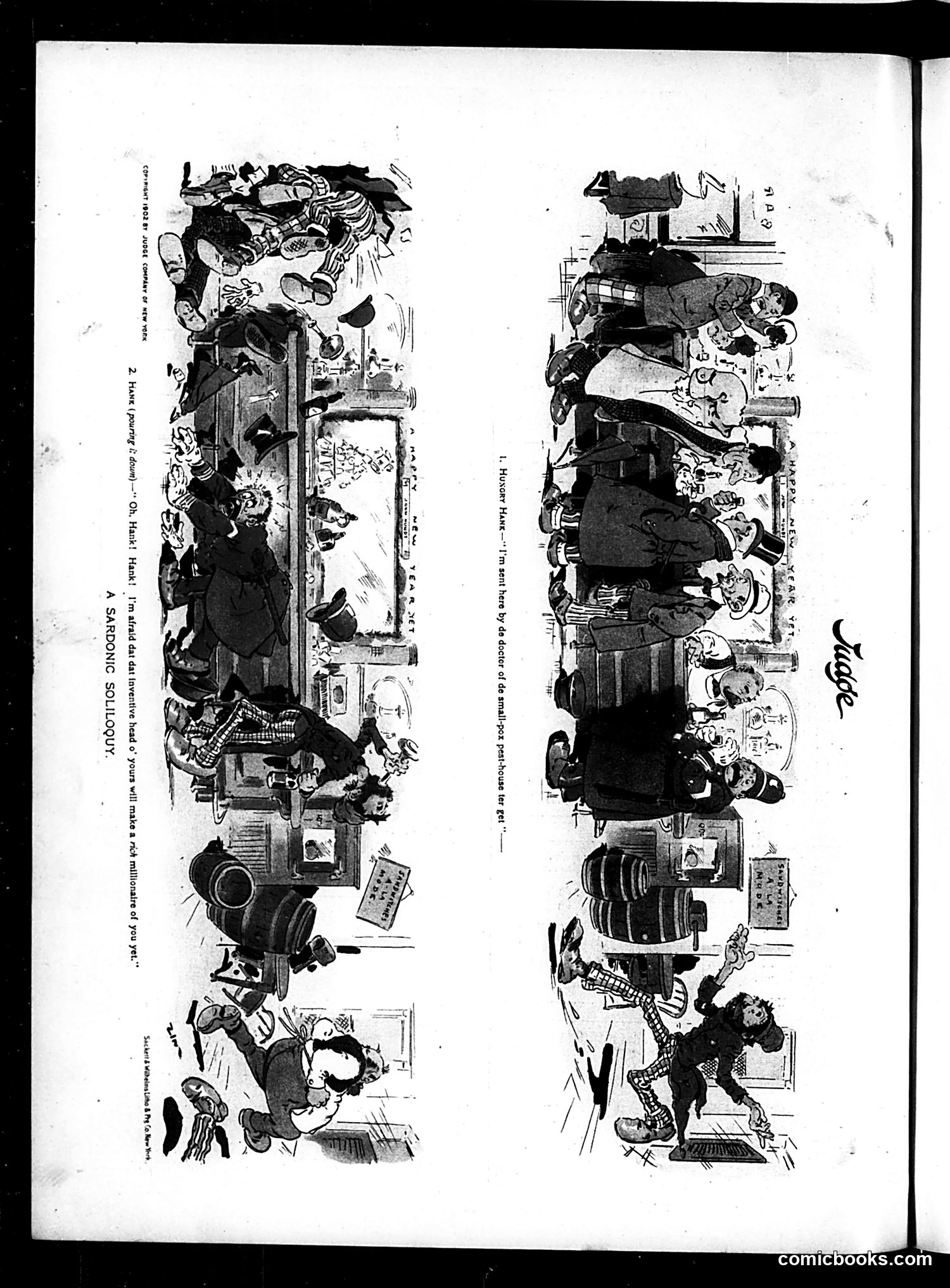
This 1902 *Judge* cartoon satirizes the American obsession with wealth accumulation and technological invention. The left panel shows "Hank" (a working-class figure) with his wife expressing hope that his inventive genius will make him rich. The right panel, titled "A Sardonic Soliloquy," appears to show the darker reality—likely depicting Hank's actual fate after pursuing his inventive ambitions. The satire mocks the American Dream narrative: while wives encourage husbands to invent their way to wealth, the "soliloquy" suggests the actual outcome is disappointment or failure. The cartoon critiques both the false promise of easy riches through invention and the exploitation of inventors during the Gilded Age, when many talented individuals saw their work appropriated or failed to achieve promised fortune.