
Judge, 1903-01-17 · page 3 of 16
Judge — January 17, 1903 — page 3: what you’re looking at
What you’re looking at
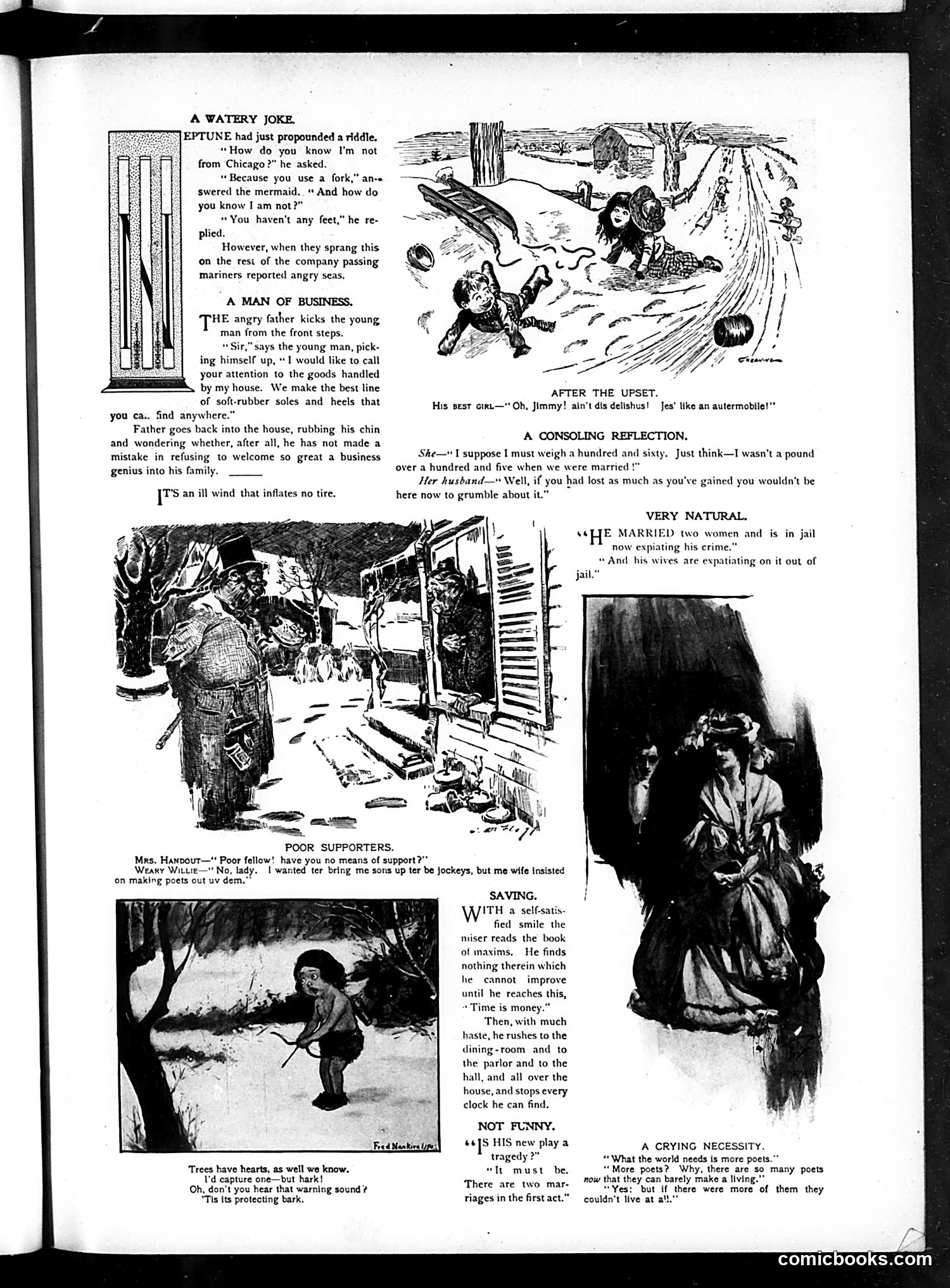
This page contains several unrelated humorous sketches typical of early-to-mid 20th century Judge magazine: **"A Watery Joke"** and **"A Man of Business"** are conversational humor pieces about social situations—one involving fork etiquette, another about a salesman's poor business judgment. **"After the Upset"** shows people in a boating accident, with humor about gender dynamics (a man telling his girlfriend to act "like an automobilist"). **"Poor Supporters"** and other sketches address domestic and class themes common to the era. **"A Crying Necessity"** discusses poets' financial struggles—a recurring satirical target. The page lacks overt political cartoons or caricatures of specific public figures. Instead, it offers genteel social satire aimed at middle-class readers, mocking pretension, marital discord, and economic concerns of the period.
📄 Transcribed text from this page (OCR, searchable)
Machine-transcribed from the original scan — historical spelling and the odd misread are preserved.
A WATERY JOKE. EPTUNE had just propounded a riddle. “How do you know I'm not from Chicago?" he asked. “Because you use a fork," an-e swered the mermaid. “And how do you know Iam not?” “You haven't any feet,” he re- plied. However, when they sprang this on the resi of the company passing mariners reported angry seas, A MAN OF BUSINESS. THE angry father kicks the young man from the front steps. “Sir,” says the young man, pick- ing himself up, “I would like to call your attention to the goods handled by my house. We make the best line of soft-rubber soles and heels that you ca.. find anywhere.” Father goes back into the house, rubbing his chin A CONSOLING REFLECTION. and wondering whether, after all, he has not made a mistake in refusing to welcome so great a business She—" 1 suppose I must weigh a hundred and sixty. Just think—I wasn't a pound genius into his family. over a hundred and five when we were married !* Her husband—« Well, if you had lost as much as you've gained you wouldn't be here now to grumble about it.” AFTER THE UPSET. His sest cir.—" Oh, Jimmy! ain't dis delishus! Jes’ like an autermobile!"* Is an ill wind that inflates no tire. VERY NATURAL. SEHE MARRIED two women and is in jail now expiating his crime.” “And his wives are expatiating on it out of jail.” POOR SUPPORTERS. Mrs. Hanvout—"‘ Poor fellow! have you no means of support ?"* Weary Wittie— No, lady. | wanted ter bring me sons up ter be jockeys, but me wife insisted on making poets out uv dem." fied smile the miser reads the book of maxims. He finds nothing therein which he cannot improve until he reaches this, «Time is money.” Then, with much haste, he rushes to the dining-room and to the parlor and to the hall, and all over the house, and stops every clock he can find. NOT FUNNY. 66 ]S HIS new play a tragedy 2” Trees have hearts, as well we know. “tt ; I'd capture one—but hark! : now that they can barely make a living."” Oh, don’t you hear that warning sound? There! are two: mare “Yes: but if there were more of them they ‘Tis its protecting bark. riages in the firstact.” couldn't live at A CRYING NECESSITY. What the world needs is more poets.”* must be. More poets? Why, there are so many poets comicbooks.com