
A complete issue · 20 pages · 1901
Judge — September 7, 1901
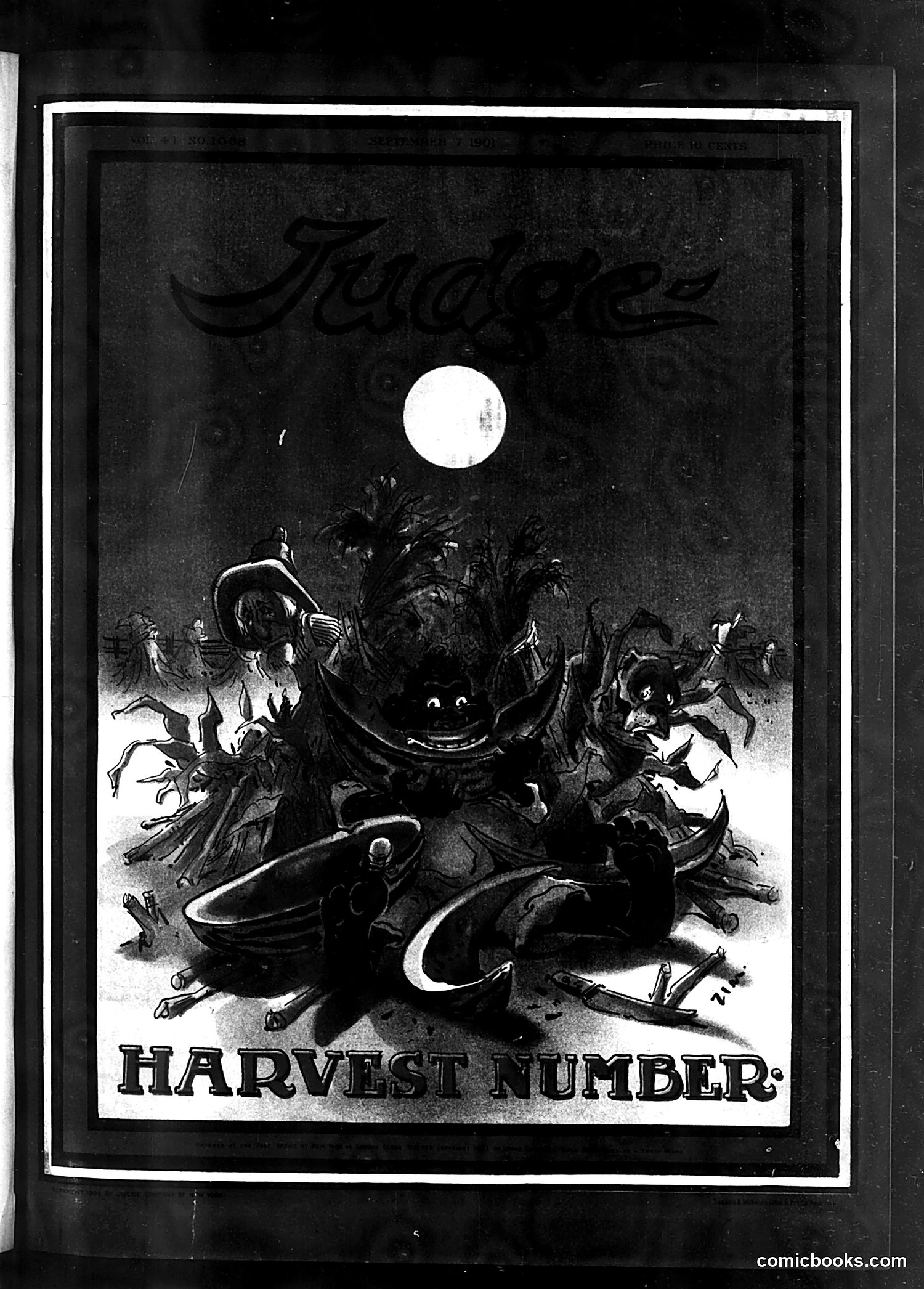
This is a cover for Judge's "Harvest Number" edition. The illustration depicts a demonic or grotesque figure with an exaggerated face surrounded by smaller demon-like creatures, set against a full moon. Various harvest-related implements (scythes, farming tools) are visible. The satire appears to reference anxieties about labor, harvest conditions, or agricultural exploitation during the era when Judge was published. The demonic imagery suggests the "harvest" being satirized is sinister or exploitative rather than wholesome. The specific political target—whether labor practices, economic conditions, or a particular political figure—cannot be determined from the image alone without additional context about Judge's publication date and contemporary events.
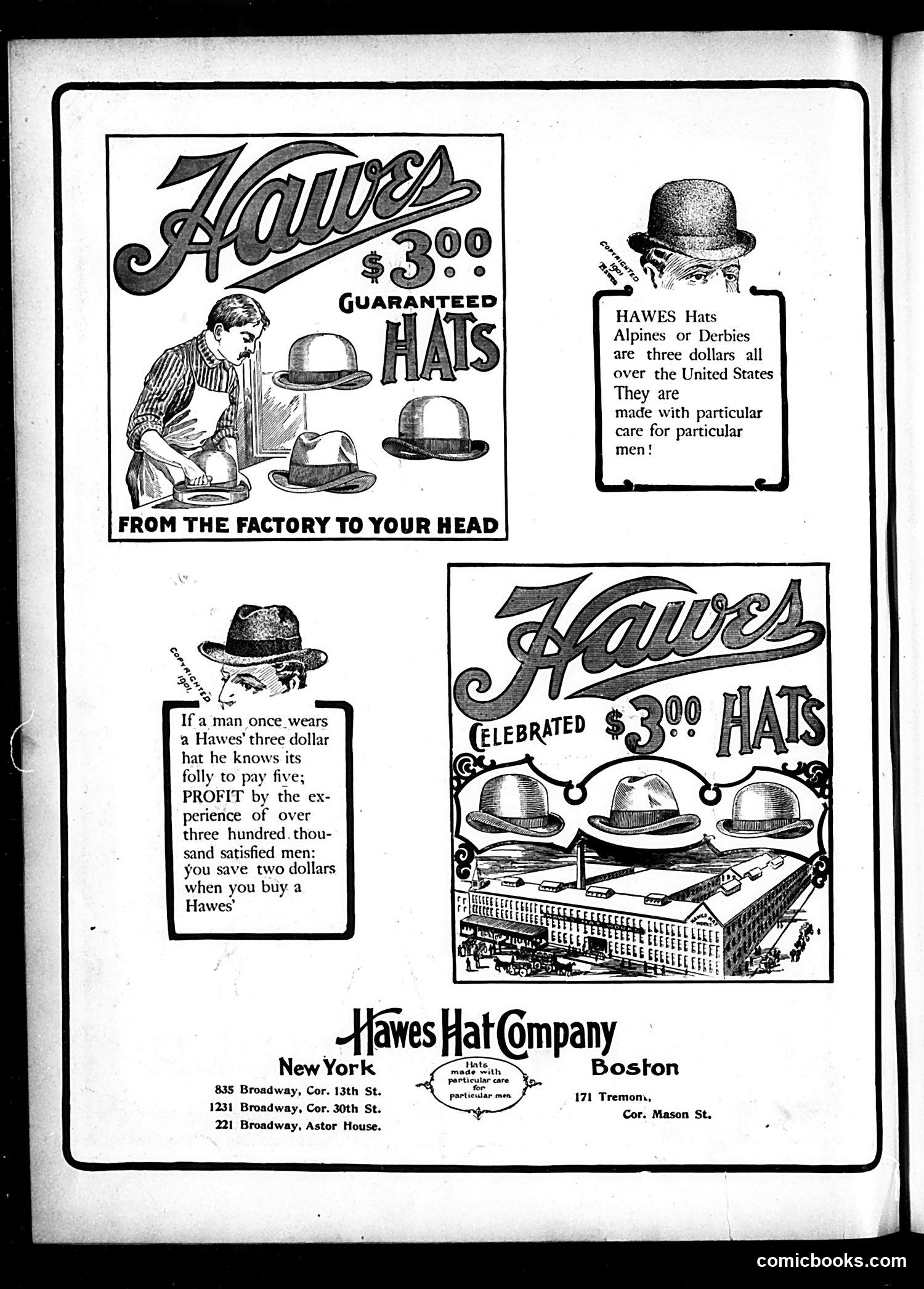
This page is **primarily advertising**, not political satire. It promotes Hawes brand hats ($3.00, guaranteed) sold in New York and Boston locations. The ads emphasize direct factory-to-consumer sales, positioning this as economical—customers "save two dollars" versus retail markup. The repeated messaging about "particular care for particular men" targets male consumers concerned with quality and value. The illustrations show hatmaking processes and finished products (Alpines and Derbies). The testimonial claims that satisfied customers (over 300,000 mentioned) prove the hat's reliability. This represents early 20th-century **direct marketing strategy**: bypassing middlemen to offer cheaper goods while building brand loyalty through claims of superior craftsmanship. The "Judge" placement suggests targeting the magazine's relatively affluent male readership.
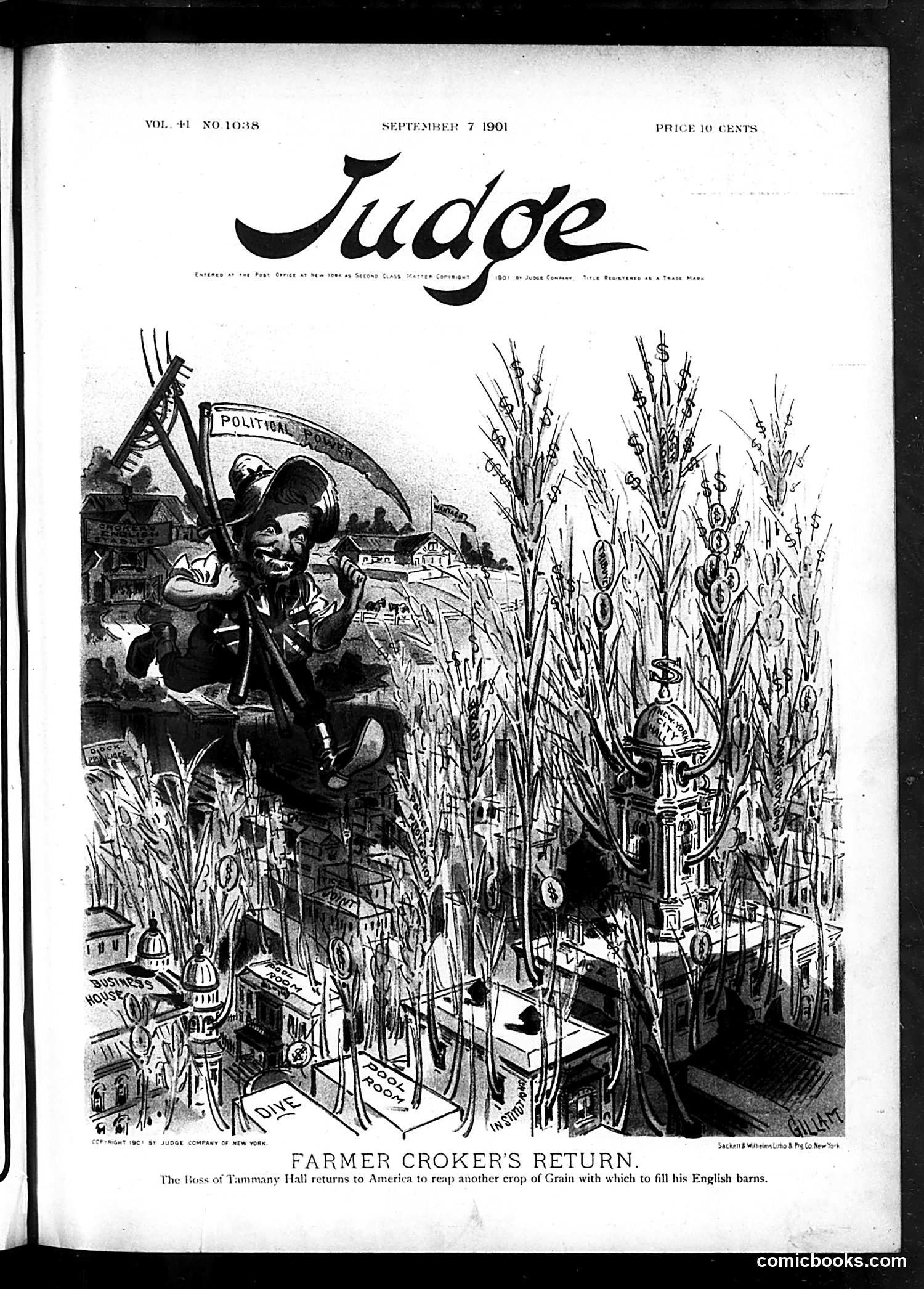
This 1901 Judge cartoon satirizes Richard Croker, the notorious boss of Tammany Hall (New York's Democratic political machine), shown as a grotesque figure returning to America. The caption states he comes "to reap another crop of Grain with which to fill his English barns." The satire operates on multiple levels: Croker, who had recently moved to England, is depicted as a farmer harvesting American wealth and resources to enrich himself abroad. The tall stalks of grain labeled with dollar signs represent money extracted from America through political corruption. The "Political Reaper" banner above suggests Croker exploits the political system itself as his crop. The cartoon criticizes Tammany Hall's endemic corruption and Croker's brazen self-enrichment at public expense.
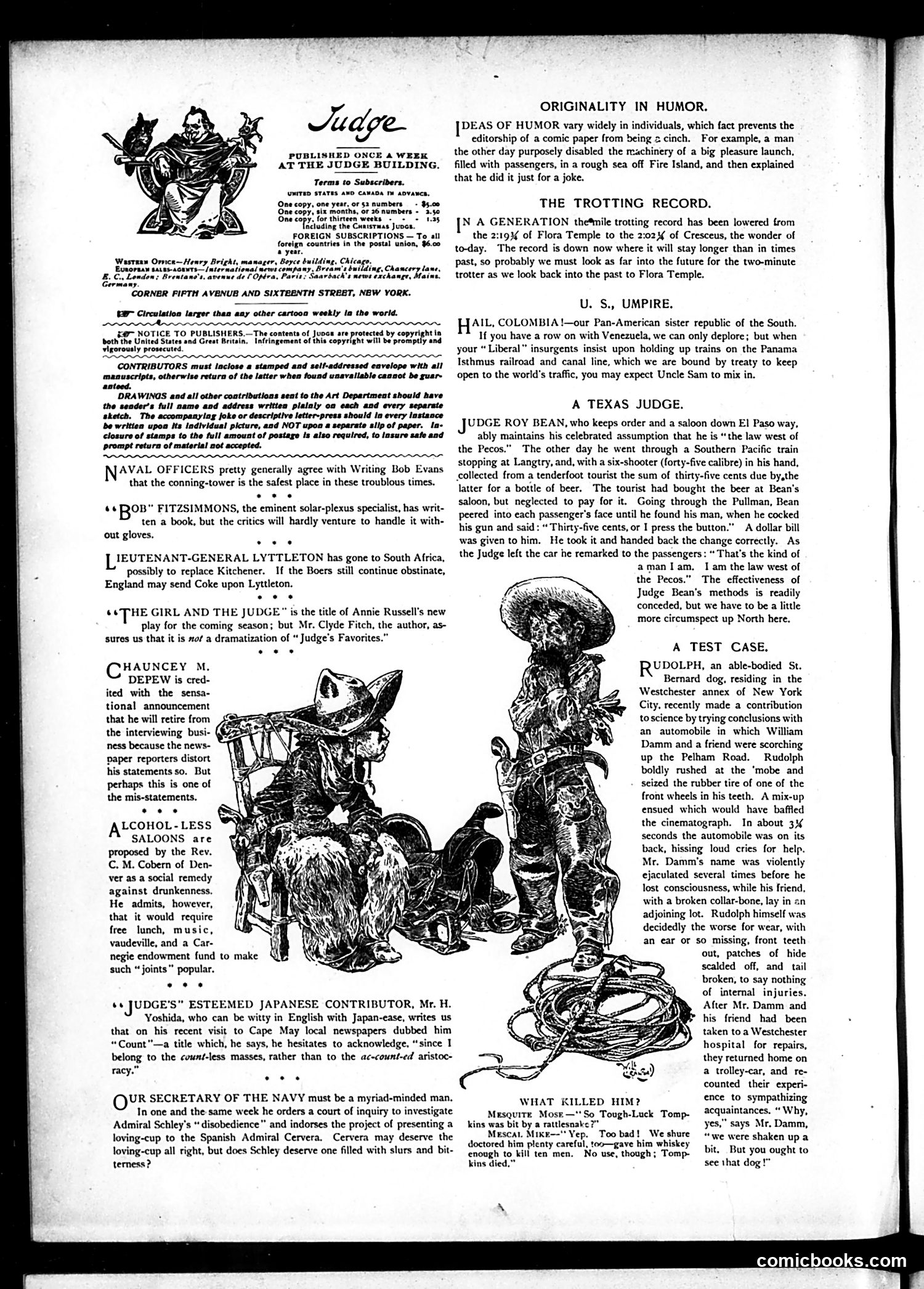
The main cartoon depicts a confrontation between a man and a dog over a automobile tire. According to the accompanying text ("A Test Case"), the dog Rudolph seized a rubber tire from a car wheel and wouldn't release it. When the owner's friend tried retrieving it, Rudolph bit him, causing injuries including a broken collar-bone. The satire concerns legal liability: the text frames this as a "test case," questioning who bears responsibility when a dog damages property and injures a person—the dog owner or the automobile owner? This reflects early 20th-century concerns about emerging automotive technology and unclear liability laws surrounding accidents and property damage. The cartoon humorously illustrates the practical chaos such ambiguity created.
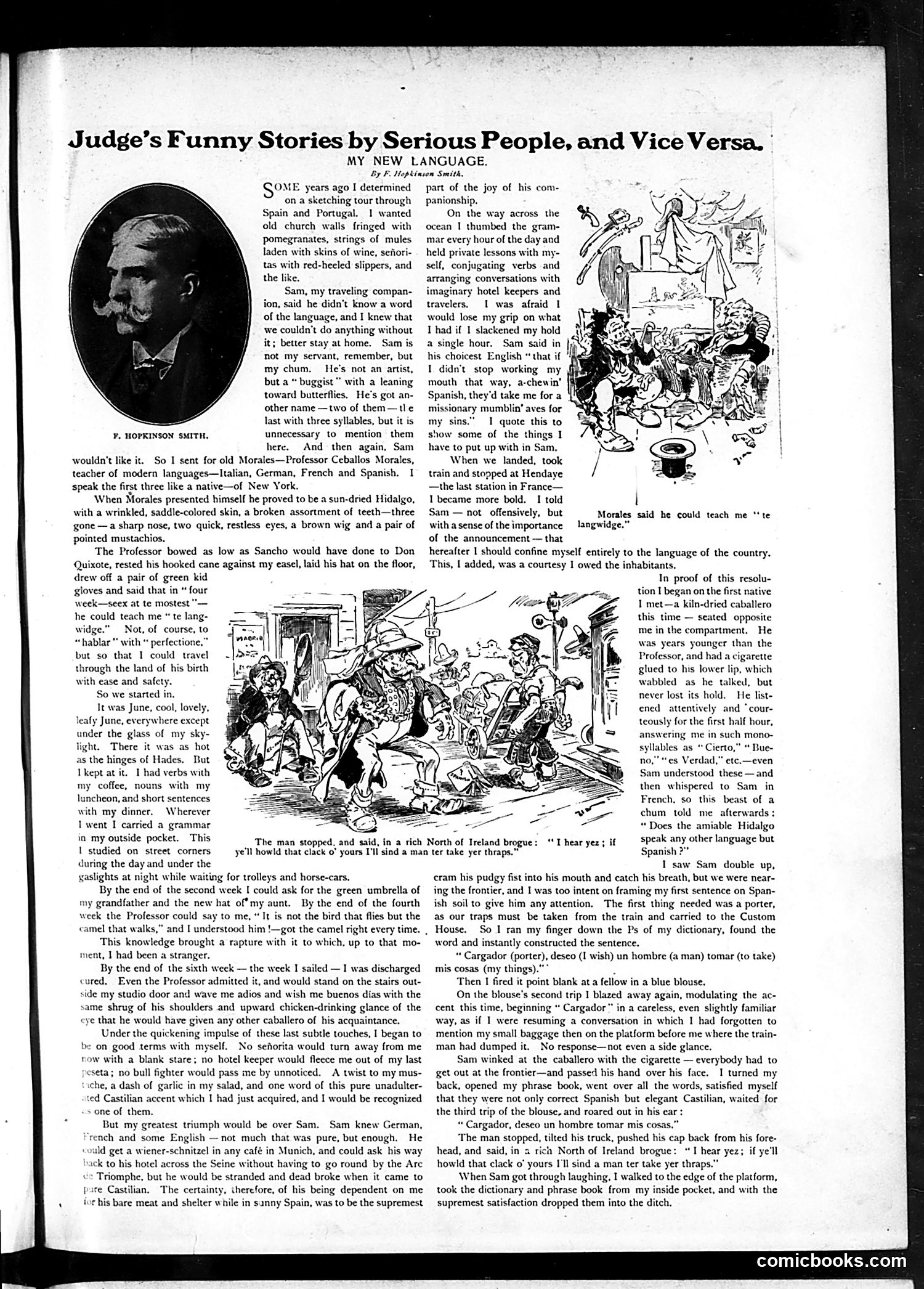
This humorous essay recounts an American artist's attempt to learn Spanish before traveling through Spain and Portugal with his companion Sam, a naturalist ("buggist"). The satire targets the pretensions of rapid language-learning and the false confidence it produces. The narrator hires Professor Morales, a stereotypically impoverished Spanish hidalgo (nobleman), who promises fluency in four to six weeks. The humor lies in the narrator's absurdly limited achievements—after weeks of study, he can only ask for "the green umbrella of grandfather" and understand simple sentences, yet he becomes insufferably proud, imagining himself accepted as a local. The accompanying cartoons (showing period travel scenes) illustrate the comic situations arising from linguistic incompetence abroad. The joke's irony: despite his meager progress, the narrator fantasizes about impressing Sam, who knows multiple languages poorly. The piece mocks both American tourists' linguistic arrogance and the ineffectiveness of cramming grammar rules without genuine fluency.
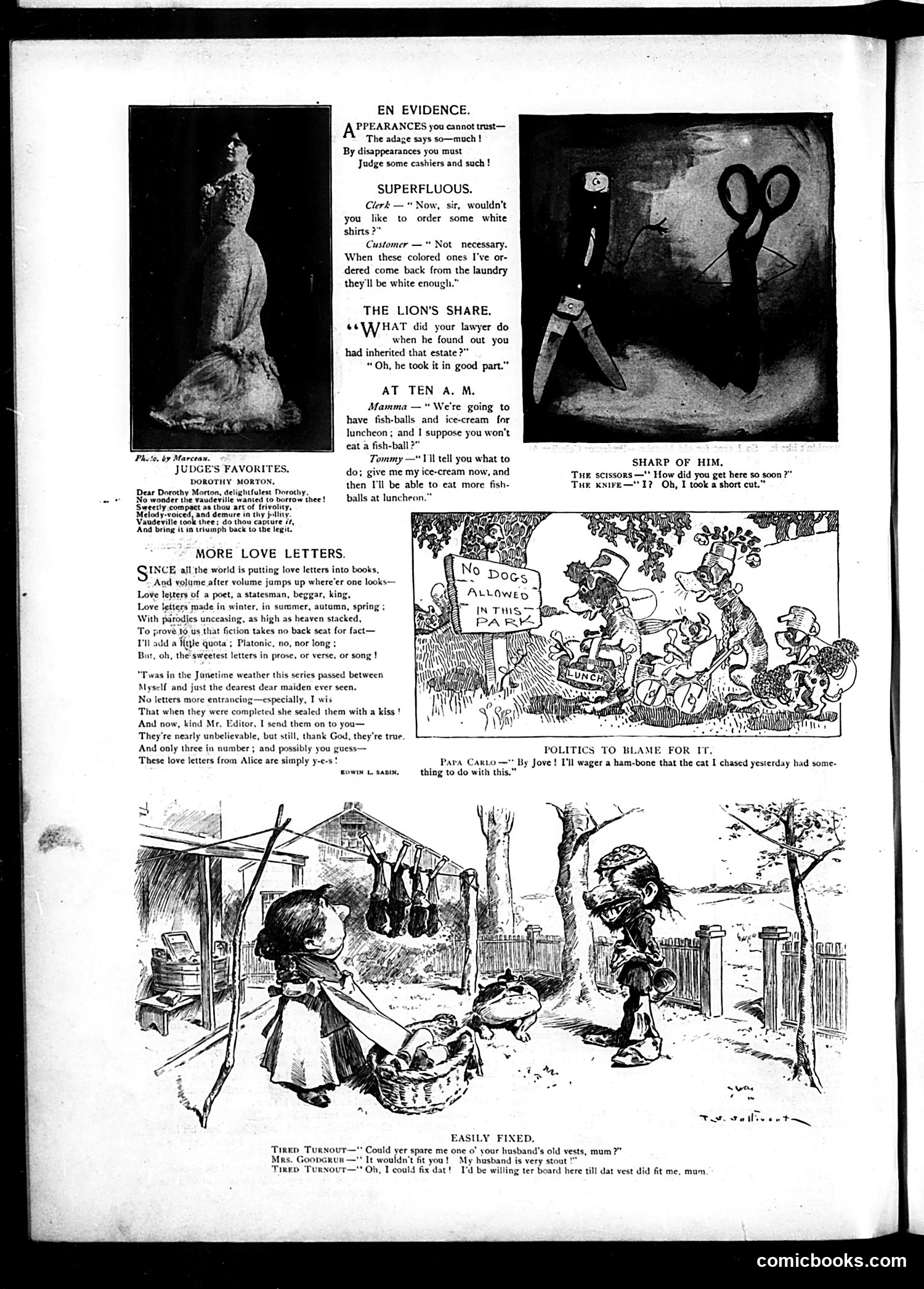
This page contains multiple satirical pieces typical of early 20th-century American humor: **"En Evidence"** and **"Superfluous"** are brief jokes about dishonest cashiers disappearing with money, and a customer's laundry returning so discolored it will eventually turn white anyway. **"The Lion's Share"** jokes that a lawyer eagerly accepted an inheritance case, taking his large fee—the "lion's share." **"Sharp of Him"** is a pun about taking a "short cut" (literally using scissors). **"More Love Letters"** is a sentimental poem praising love letters in literature, presented as the author sharing three letters from "Alice"—likely satirizing the contemporary craze for publishing romantic correspondence. **"Politics to Blame for It"** references a cat chase, blaming politics (unclear context without date). **"Easily Fixed"** depicts a poor person offering to board with a family in exchange for stretching out an oversized vest—dark humor about economic desperation. The page mixes social satire with wordplay and gentle mockery of contemporary fashions and behaviors.
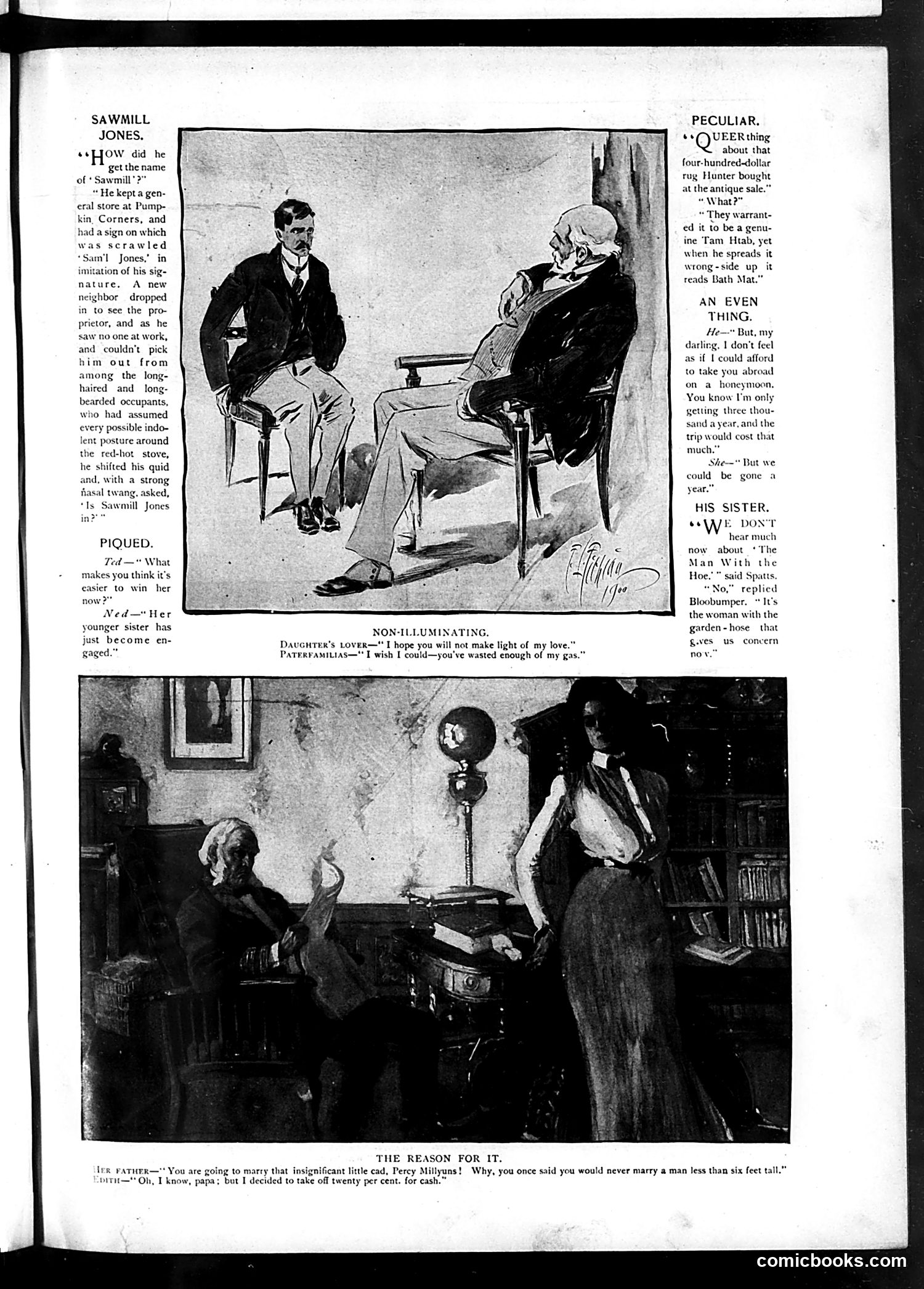
This page contains three separate humor pieces typical of early 20th-century satirical magazine fare: **"Sawmill Jones"**: A joke about how a general store owner in rural "Pumpkin Corners" got his nickname from a poorly written sign reading "Sam'l Jones"—playing on dialect humor and rustic ignorance common to the era. **"Peculiar"**: A brief exchange mocking wealthy consumers who purchase expensive antiques (a four-hundred-dollar rug) only to misidentify them—here, mistaking a "Tam Htab" (likely a play on "Tam" fabric or similar) for a "Bath Mat" when turned over. **"The Reason for It"**: A marriage negotiation joke where a father objects to his daughter marrying a man under six feet tall, but she agrees anyway, claiming she's "taking off twenty per cent. for cash"—implying she's negotiating his height downward like a merchant haggling over price, reducing her standards for financial advantage. The humor relies on class anxiety, commercial transaction mockery, and the period's comfort with both rural caricature and mercenary marriage jokes.
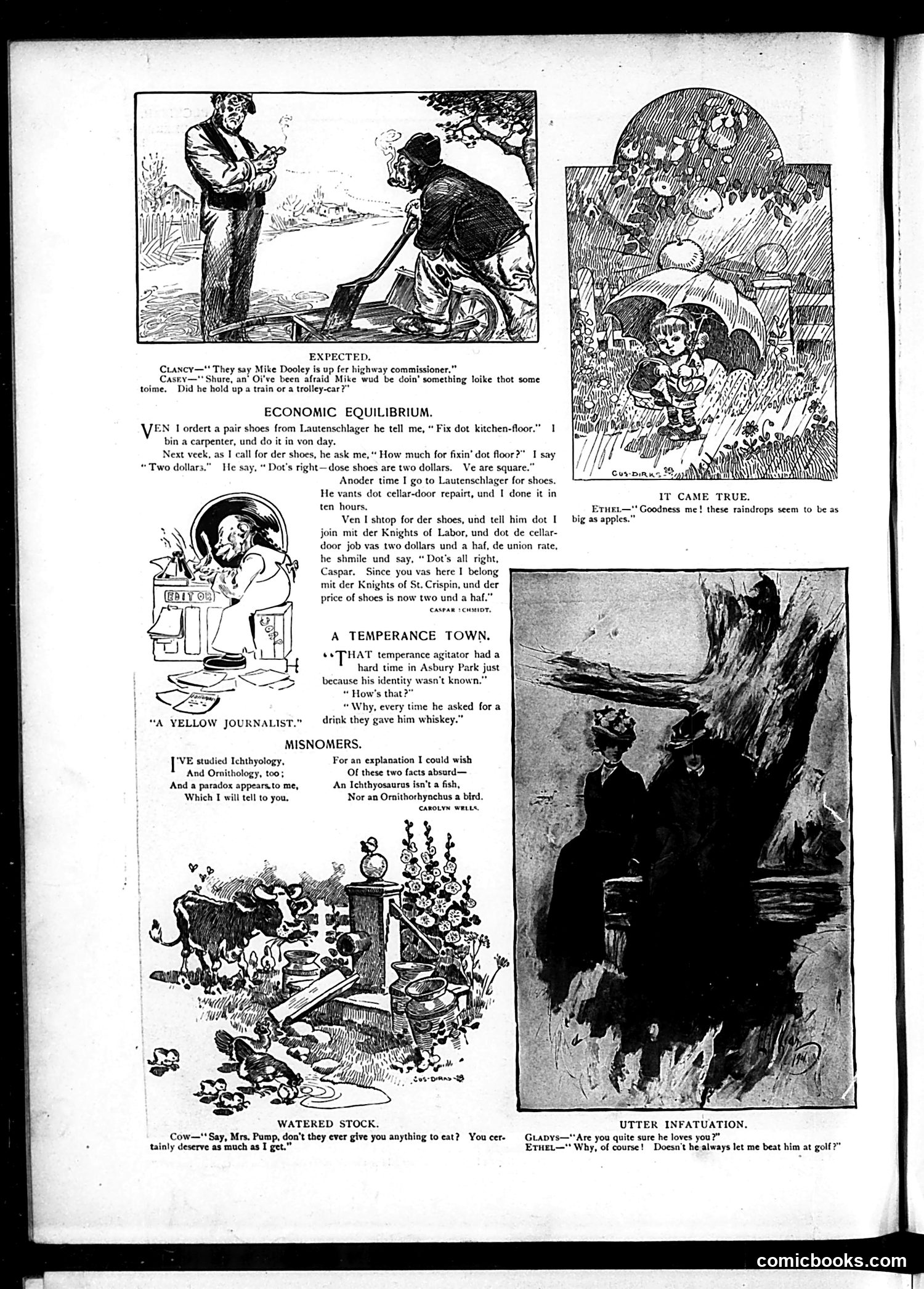
This page contains multiple short satirical pieces typical of early 20th-century American humor: **"Expected"** mocks Irish-American political corruption, with characters discussing Mike Dooley's appointment as highway commissioner while joking he'll commit crimes like train robbery. **"Economic Equilibrium"** depicts a German immigrant shoemaker and carpenter negotiating labor. The satire targets labor unions (Knights of Labor, Knights of St. Crispin): when the carpenter joins a union, shoe prices mysteriously rise, suggesting unions artificially inflate costs. **"A Temperance Town"** satirizes the temperance movement's hypocrisy in Asbury Park—when activists ask for drinks, bartenders deliberately serve them whiskey instead, undermining prohibition efforts. **"Misnomers"** is a science joke about misnamed creatures (ichthyosaurs and platypuses). **"Watered Stock"** and **"Utter Infatuation"** are brief domestic humor pieces about economic inequality and romantic delusion. The page exemplifies Judge's blend of anti-immigrant stereotypes, anti-labor sentiment, and gentle domestic comedy.
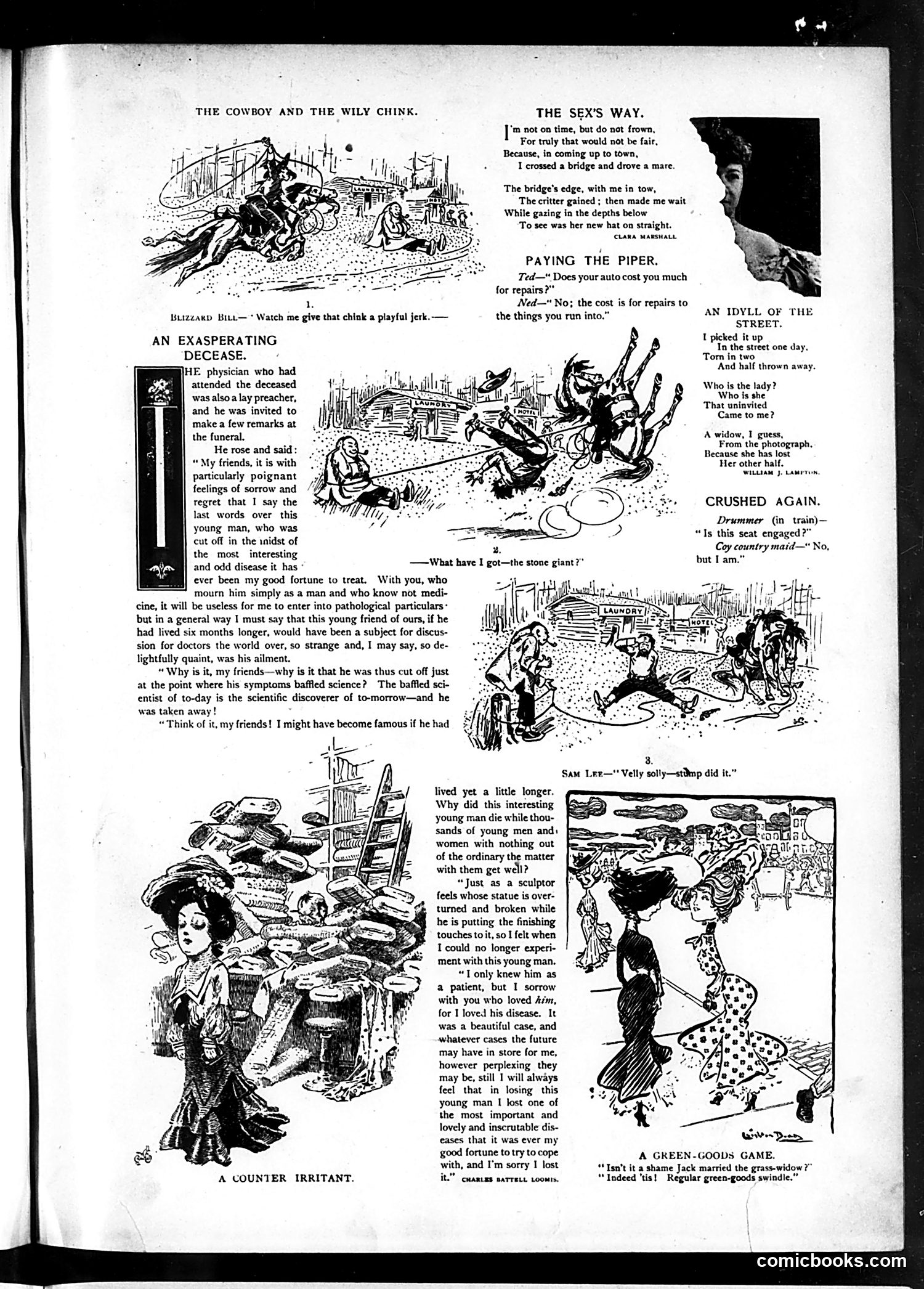
This page contains several short satirical pieces mocking various social situations of the era: **"The Sex's Way"** jokes about a woman's vanity—she delays a carriage ride obsessing over whether her hat sits straight after crossing a bridge. **"Paying the Piper"** is a one-liner about automobile repair costs, suggesting drivers spend more money fixing damage from accidents than on maintenance. **"An Exasperating Decease"** satirizes a physician-preacher's funeral eulogy revealing his true priorities: he mourns losing an interesting medical case study more than the deceased person. The satire targets self-interested professionals who view human suffering as professional opportunity. **"Crushed Again"** presents a railway drummer (traveling salesman) being rejected when asking if a seat is taken—a common rejection scenario. **"A Green-Goods Game"** puns on "grass-widow" (a woman separated from her husband) and "green goods" (counterfeit money), suggesting the marriage was a swindle. The humor relies on wordplay about deception. The cartoons use exaggerated pen-and-ink illustrations typical of Judge's style.
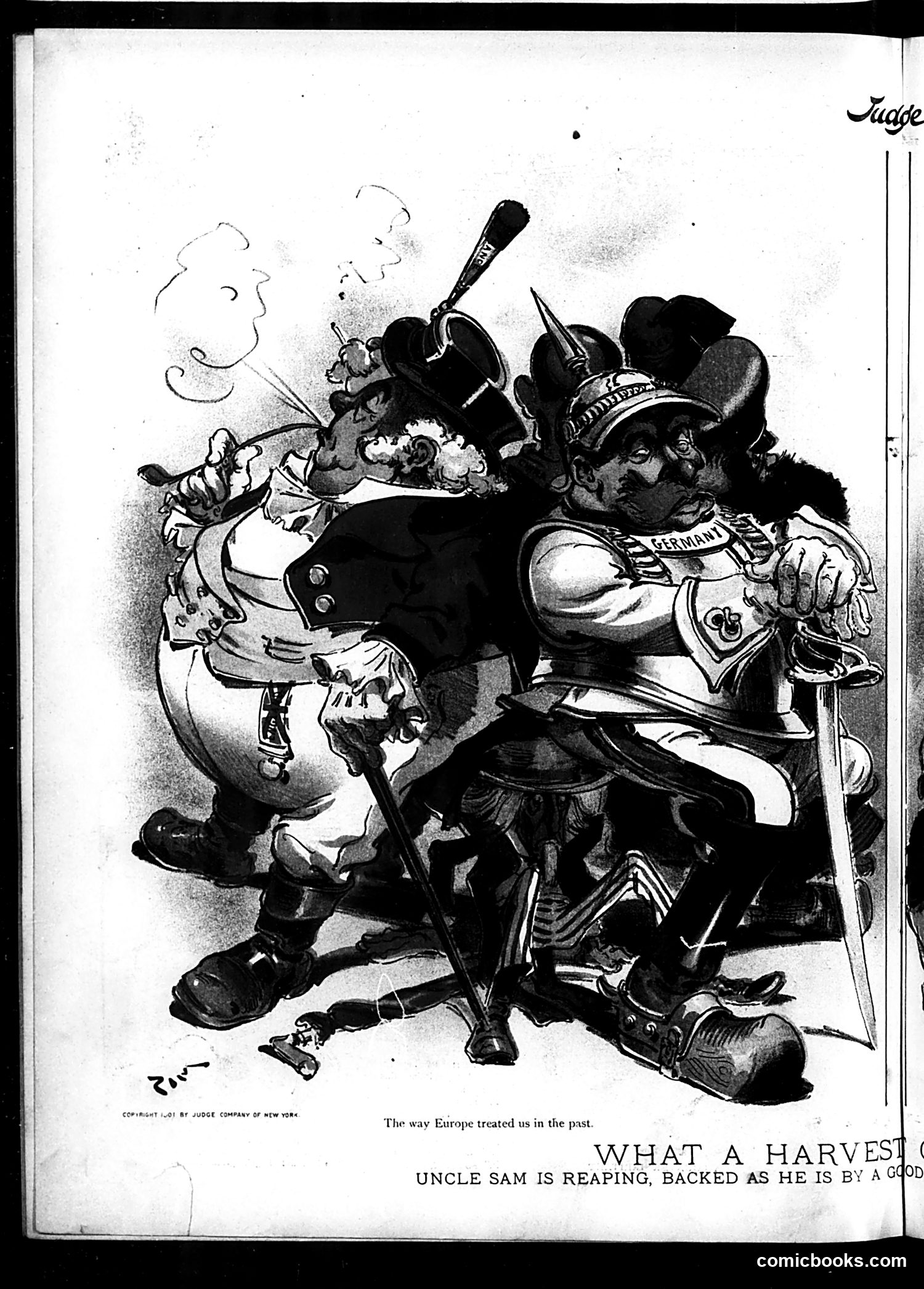
This is a satirical cartoon depicting Uncle Sam (personification of America) as a military figure being attacked by European powers represented as armed soldiers or warriors. The caption "The way Europe treated us in the past" combined with "What a harvest Uncle Sam is reaping, backed as he is by a good [text cut off]" suggests commentary on American-European relations and historical grievances. The heavily armed, aggressive figures attacking Uncle Sam likely represent European nations that previously opposed or exploited American interests. The "harvest" metaphor implies America is now experiencing consequences or retaliation resulting from past European treatment. Without the complete caption or publication date visible, the specific historical moment referenced remains unclear, though this appears critical of European military aggression toward American interests.
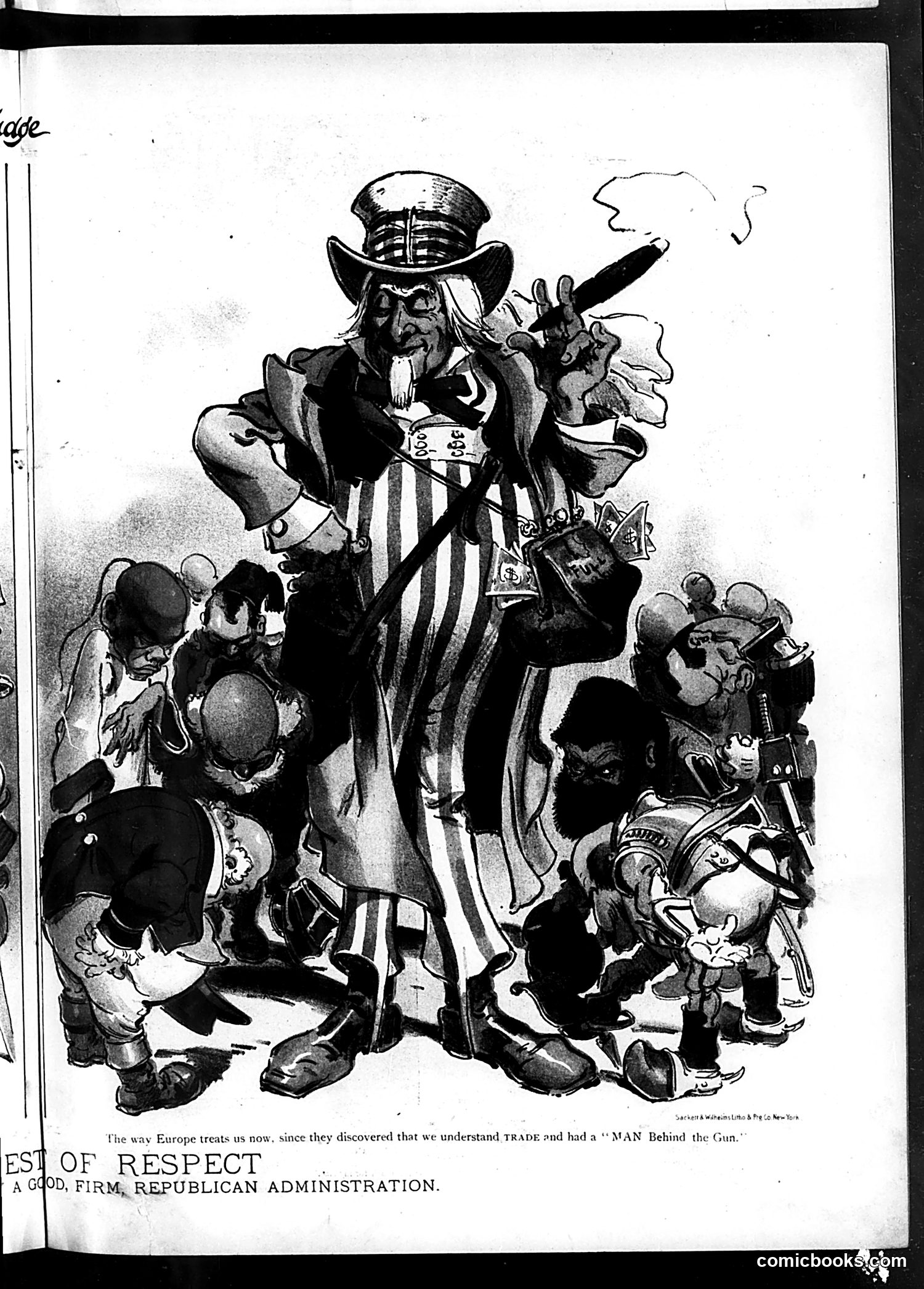
This Judge magazine cartoon depicts Uncle Sam (the tall central figure in striped pants and starred hat) surrounded by smaller caricatured European nations shown as deferential figures. The satire celebrates American economic and military strength during a Republican administration. The caption claims Europe now respects America because Americans understand "TRADE" and have "a MAN Behind the Gun"—likely referencing Republican policies emphasizing commerce and military readiness. The smaller European figures' submissive postures suggest they're forced to acknowledge American superiority. The cartoon's tone is triumphalist, arguing that Republican governance produced respect abroad through capitalist commerce and military strength. This reflects late 19th or early 20th-century American nationalist sentiment when the U.S. was asserting itself as a global power.
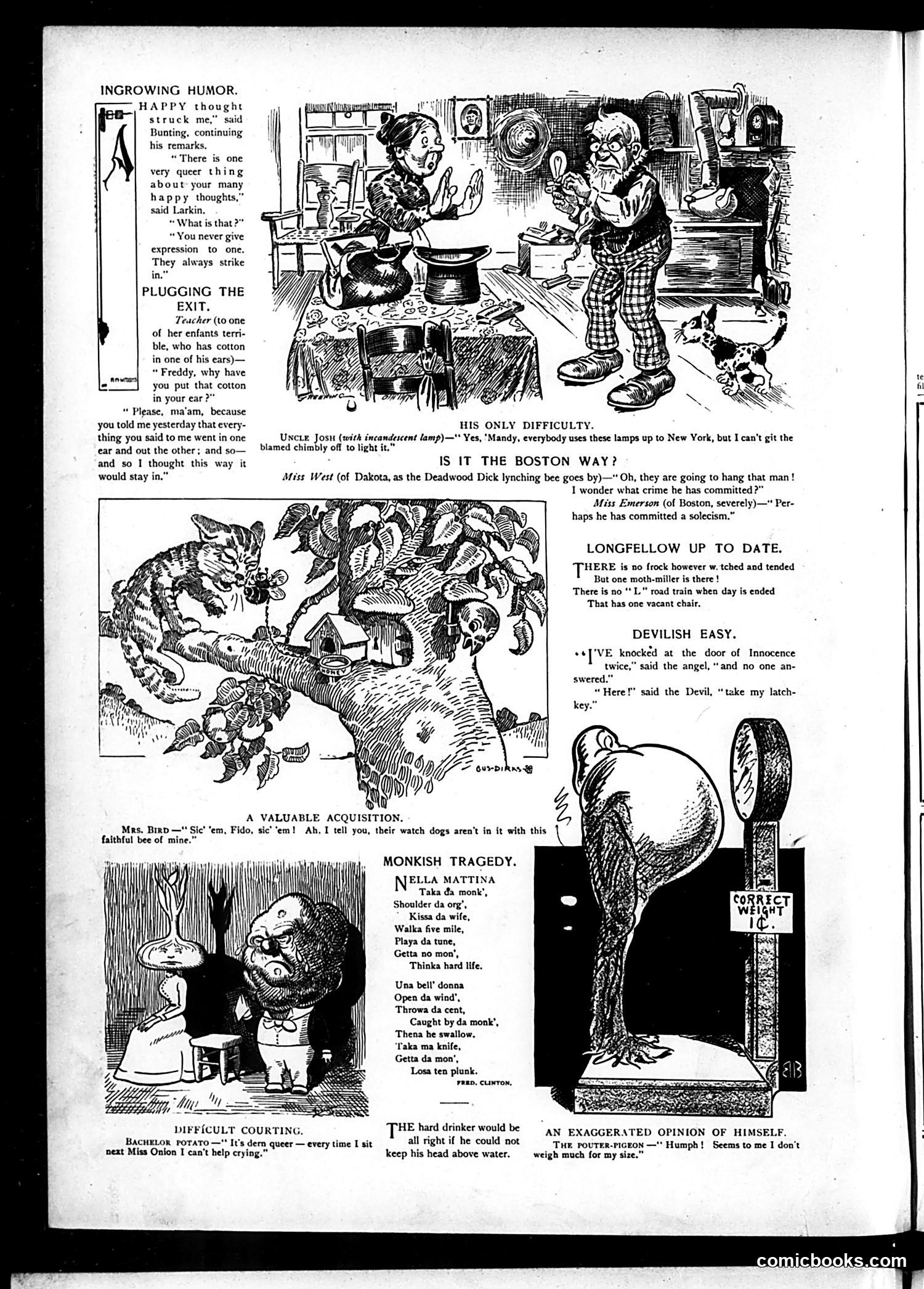
This page collects short humorous items typical of Judge magazine's satirical format: **"Plugging the Exit"** jokes about a teacher whose warning that students don't retain information backfires—a child literally plugs his ear with cotton to prevent knowledge from leaving. **"His Only Difficulty"** presents Uncle Josh (a rural Southern character stereotype) unable to remove an incandescent lamp's chimney—satirizing rural unfamiliarity with modern technology. **"Is It the Boston Way?"** contrasts regional attitudes: a Dakota woman shocked at lynching, a Boston woman unimpressed, suggesting Bostonians' snobbish focus on etiquette ("solecism"—grammatical error) over moral issues. **"Longfellow Up to Date"** parodies Longfellow's sentimental poetry style applied to modern annoyances (moths, train seating). **"Monkish Tragedy"** uses mock-Italian dialect to tell a farcical story of a monk losing earnings to a woman—ethnic humor common to the era. Other items joke about courting, drinking, and vanity. The page reflects Judge's formula: wordplay, ethnic stereotypes, and gentle social satire aimed at educated audiences.
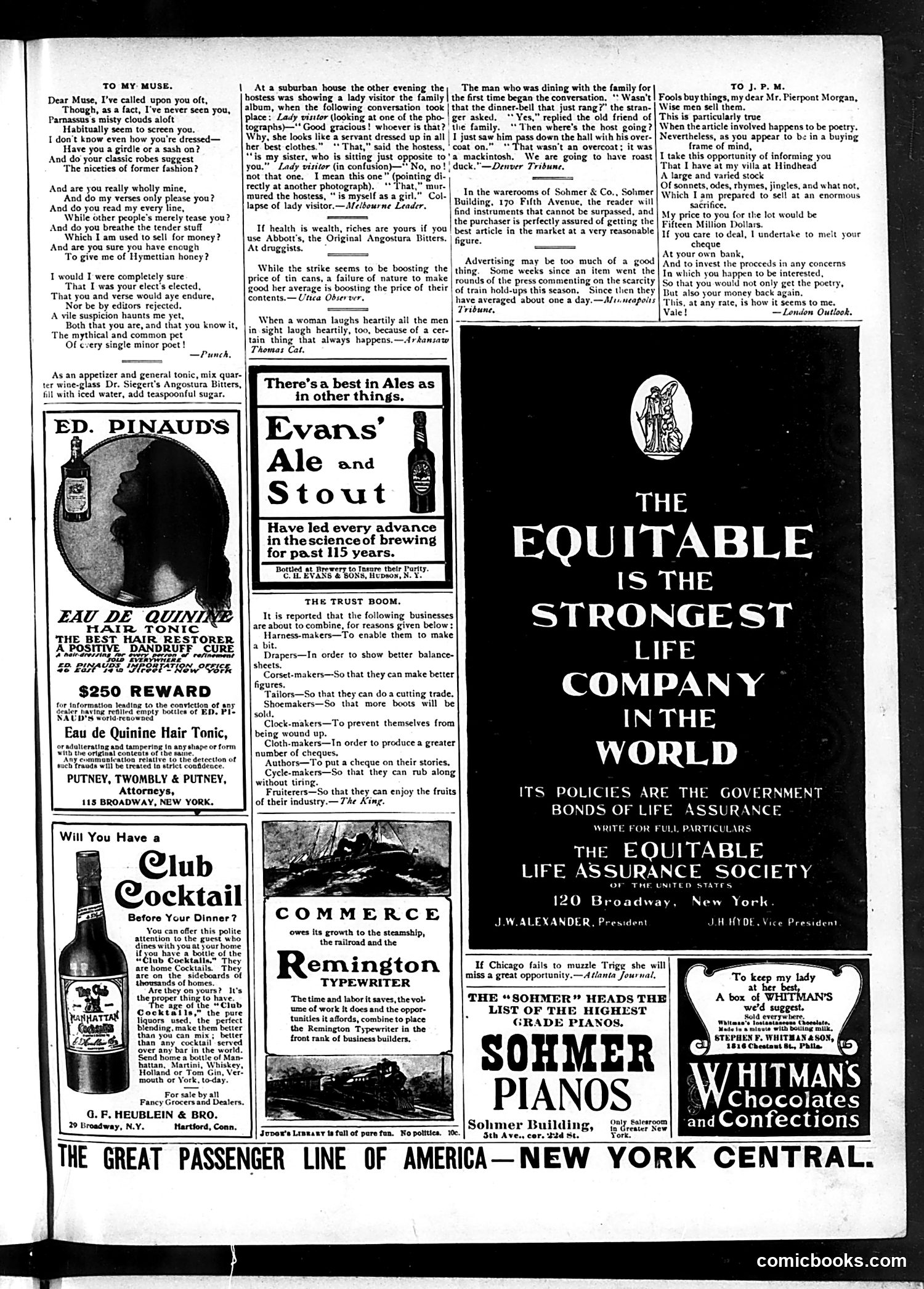
This is primarily an **advertising page** with minimal cartoon content. The page features several prominent ads (Evans' Ale, Equitable Life Assurance, Sohmer Pianos, Whitman's Chocolates) interspersed with short humorous anecdotes and poetry rather than political satire. The few comic pieces include: 1. **"To My Muse"** (left column): A whimsical poem addressing the muse directly, asking whether she reads the author's work and requesting payment in "Hymettian honey" (poetic inspiration). 2. **Brief anecdotes**: Small humor pieces about a woman misidentifying a servant in a photo, a dinner guest's confusion about the host leaving, and observations about strikes and train robberies. These are **light domestic humor and social commentary** rather than political cartoons—typical of Judge's satirical magazine format. The page reflects early 20th-century middle-class anxieties and social conventions, with no apparent references to specific politicians or major events.
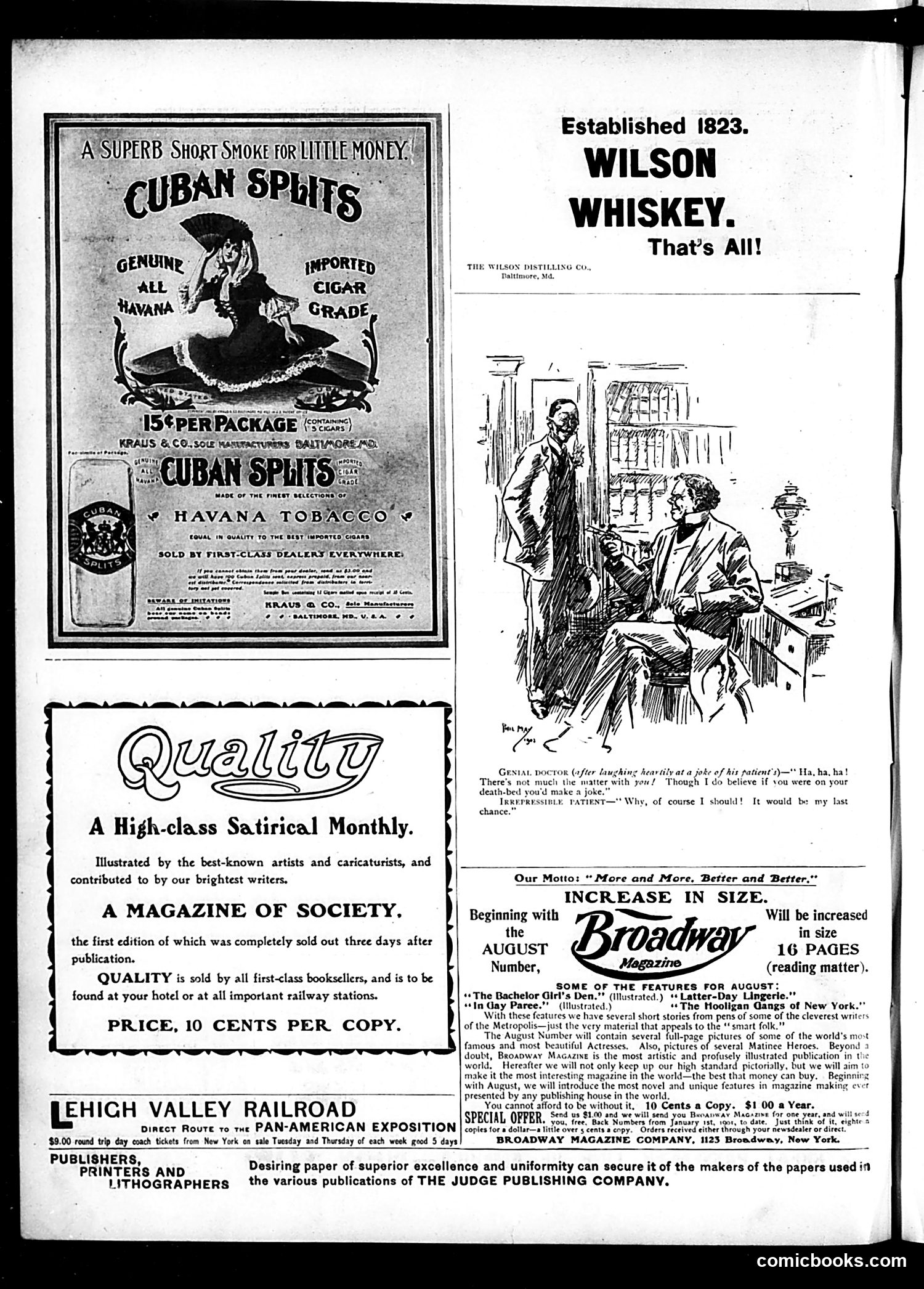
This page is primarily **advertisements and magazine promotion**, not political satire. It contains: 1. **Cuban Splits cigar ad** (top left): A period tobacco advertisement emphasizing "Genuine All Havana" and "Imported Cigar Grade" at 15¢ per package—typical early 1900s marketing. 2. **Wilson Whiskey ad** (top right): A simple brand advertisement established 1823, with minimal copy. 3. **Single cartoon** (center-right): A doctor laughs at his patient's joke, then the patient quips he'd only make jokes "on his death-bed" as a "last chance." This is gentle humor about bedside manner and human nature—not political commentary. 4. **Quality and Broadway Magazine advertisements** dominate the lower half, promoting Judge's sister publications and the Pan-American Exposition railroad route. The page functions as a **commercial vehicle** rather than satirical content. The single cartoon reflects mild social humor about doctor-patient relationships rather than pointed political or social critique.
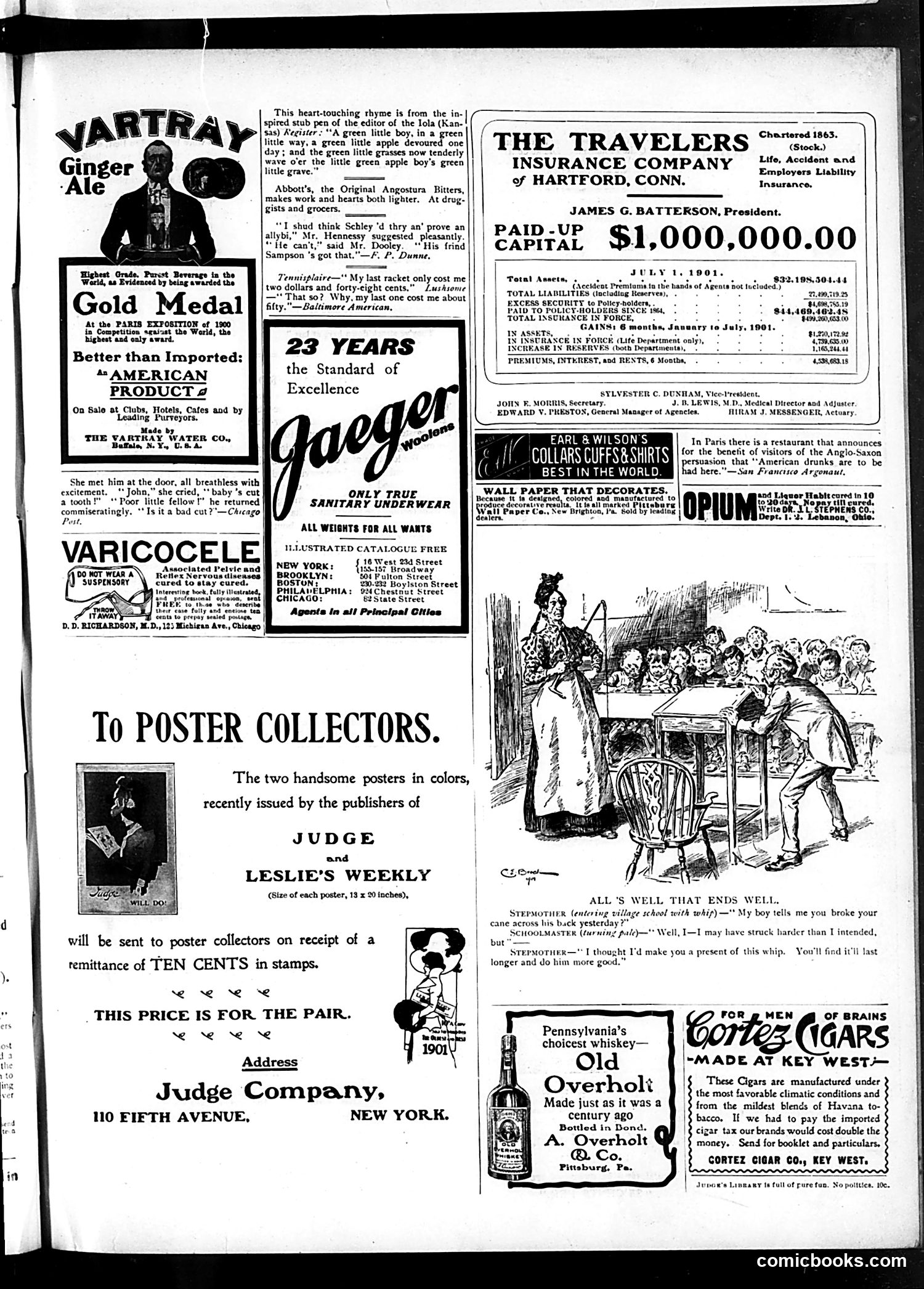
This page is primarily **advertisements and filler content** with one notable cartoon. ## The Main Cartoon: "All's Well That Ends Well" The illustrated scene depicts a schoolmaster being confronted by an angry stepmother who brings him a whip—a dark joke about corporal punishment in schools. The stepmother sarcastically "gifts" the whip after the schoolmaster struck her son, suggesting he use a larger instrument next time. The humor relies on period acceptance of brutal school discipline and the stepmother's bitter sarcasm. ## Context for Modern Readers This reflects **early 1900s attitudes toward education**: physical punishment of students was normalized and expected. The joke would have resonated with readers familiar with harsh classroom conditions. The stepmother's aggressive response satirizes parental indifference or complicity in such practices. ## Surrounding Content The page includes: - Advertising for insurance, patent medicines, cigars, and underwear - Brief comedic quips (Dooley references, tennis anecdotes) - A satirical restaurant notice about "American drunks" in Paris The cartoons and jokes collectively mock contemporary American social practices through exaggeration.
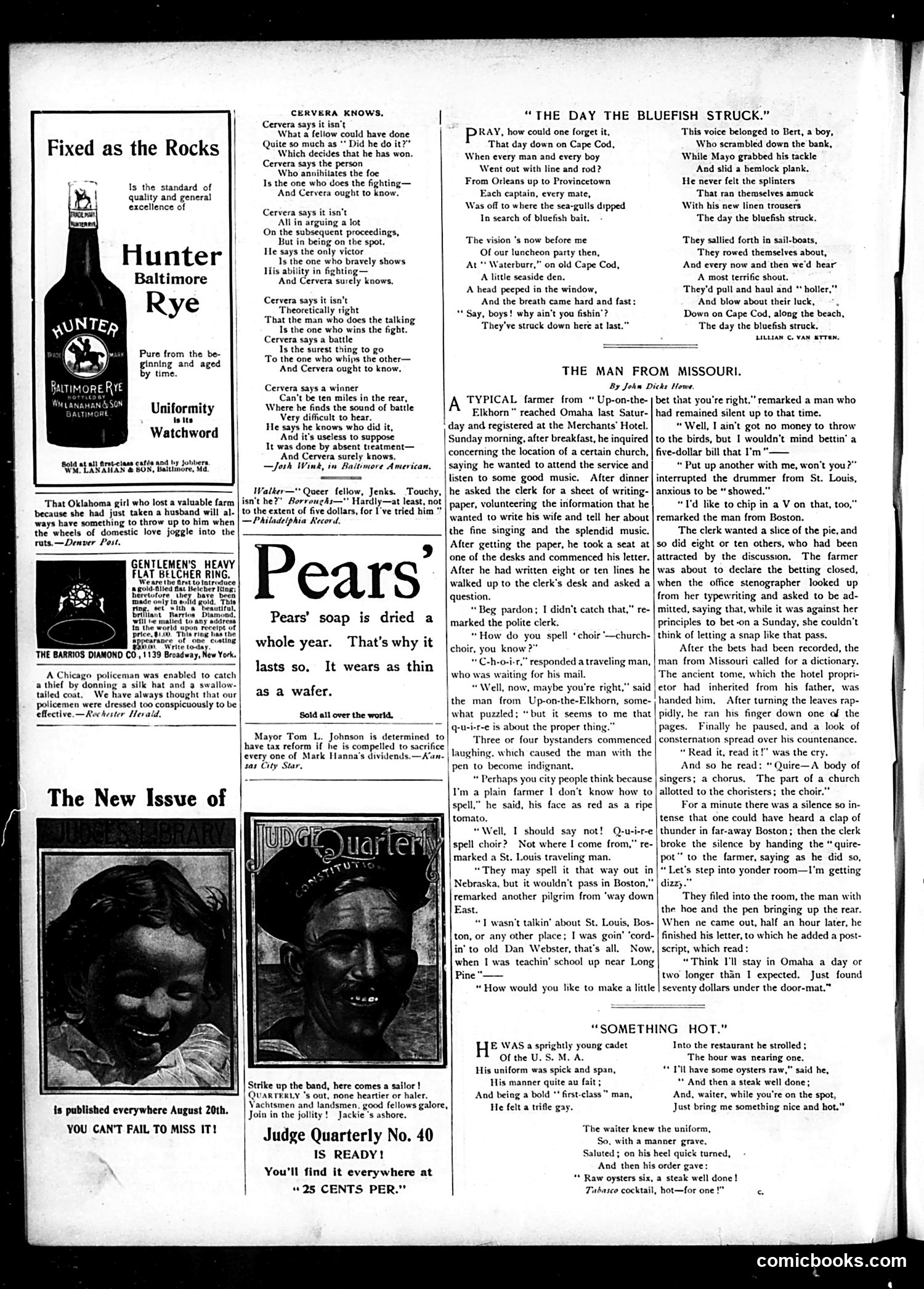
This page from Judge magazine (a satirical publication) contains several distinct elements: **"Cervera Knows" Poem**: A satirical commentary on Spanish Admiral Cervera, likely referencing the Spanish-American War. The poem mocks Cervera's explanations about naval defeat, emphasizing that actions matter more than excuses—"Did he do it?" counts more than what could have been done. This suggests Cervera was blamed for inaction or poor battlefield decisions. **"The Day the Bluefish Struck"**: A humorous fishing story where men are interrupted mid-lunch by news of bluefish appearing, causing them to abandon their meal. **"The Man from Missouri"**: A rural comedy sketch about a naive Nebraska farmer visiting Omaha, who attends church for the music and wants to write his wife about it—apparently treating the religious service primarily as entertainment. The page is primarily **satirical humor and light fiction**, with advertisements for whiskey, soap, and other products interspersed. The satire targets military incompetence, urban sophistication contrasting rural naiveté, and everyday American life.
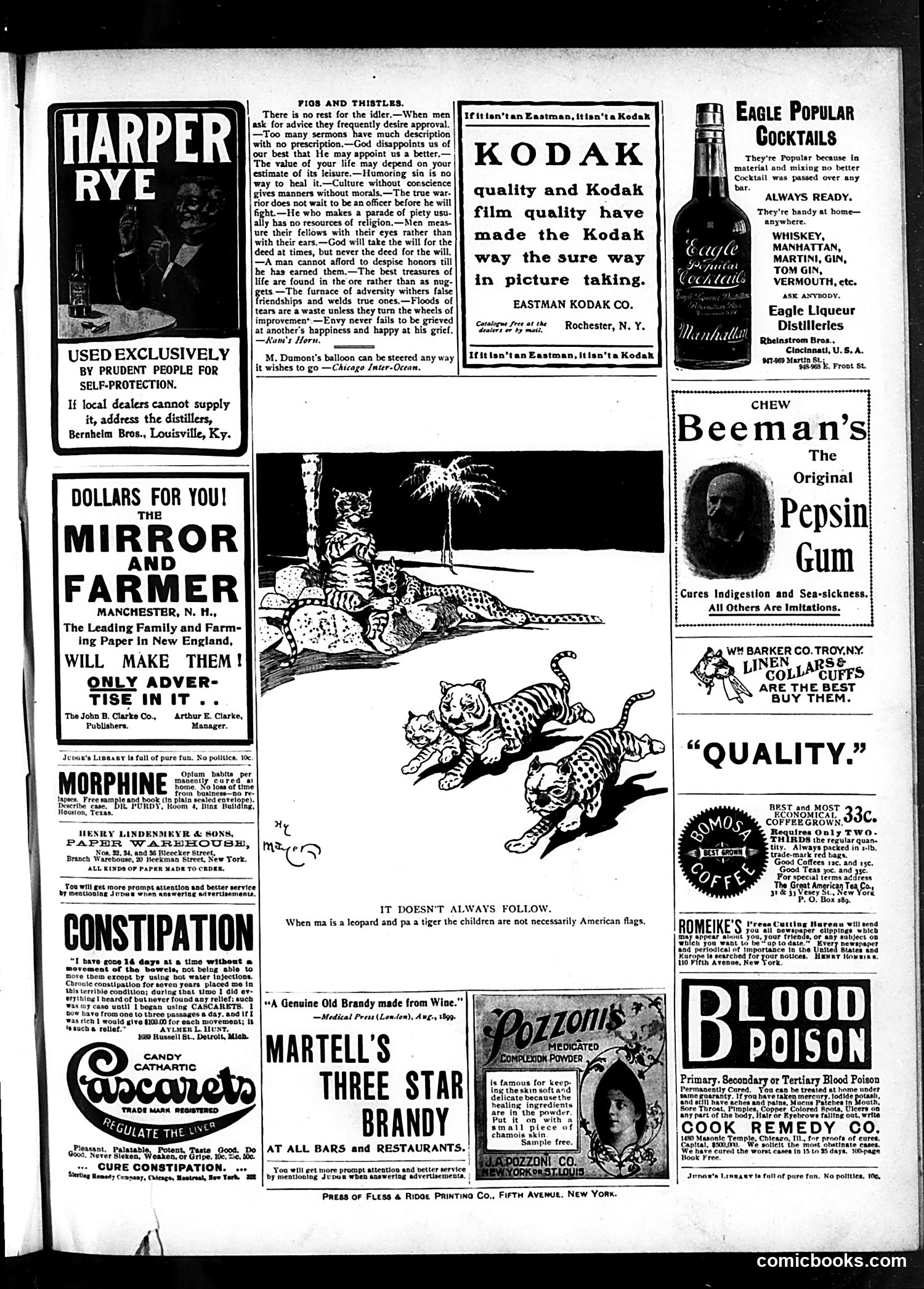
This is primarily an **advertising page** from Judge magazine, with minimal satirical content. The page consists almost entirely of commercial advertisements for patent medicines, alcohol, and consumer goods typical of early 20th-century America. The single cartoon appears midpage: it depicts a leopard and tiger with cubs, accompanying text reading "IT DOESN'T ALWAYS FOLLOW. When ma is a leopard and pa a tiger the children are not necessarily American flags." This is a mild joke playing on **American nationalism and biological inheritance**—suggesting that having foreign-born parents doesn't automatically make children patriotic or "American." The "FIGS AND THISTLES" column at top contains moralistic aphorisms about virtue and character, unrelated to satire. The advertisements reflect the era's attitudes toward substance abuse: morphine cures, brandy tonics, and constipation remedies (often opium-based) are marketed as legitimate health products. This reveals how **unregulated pharmaceutical claims** were before modern FDA standards.
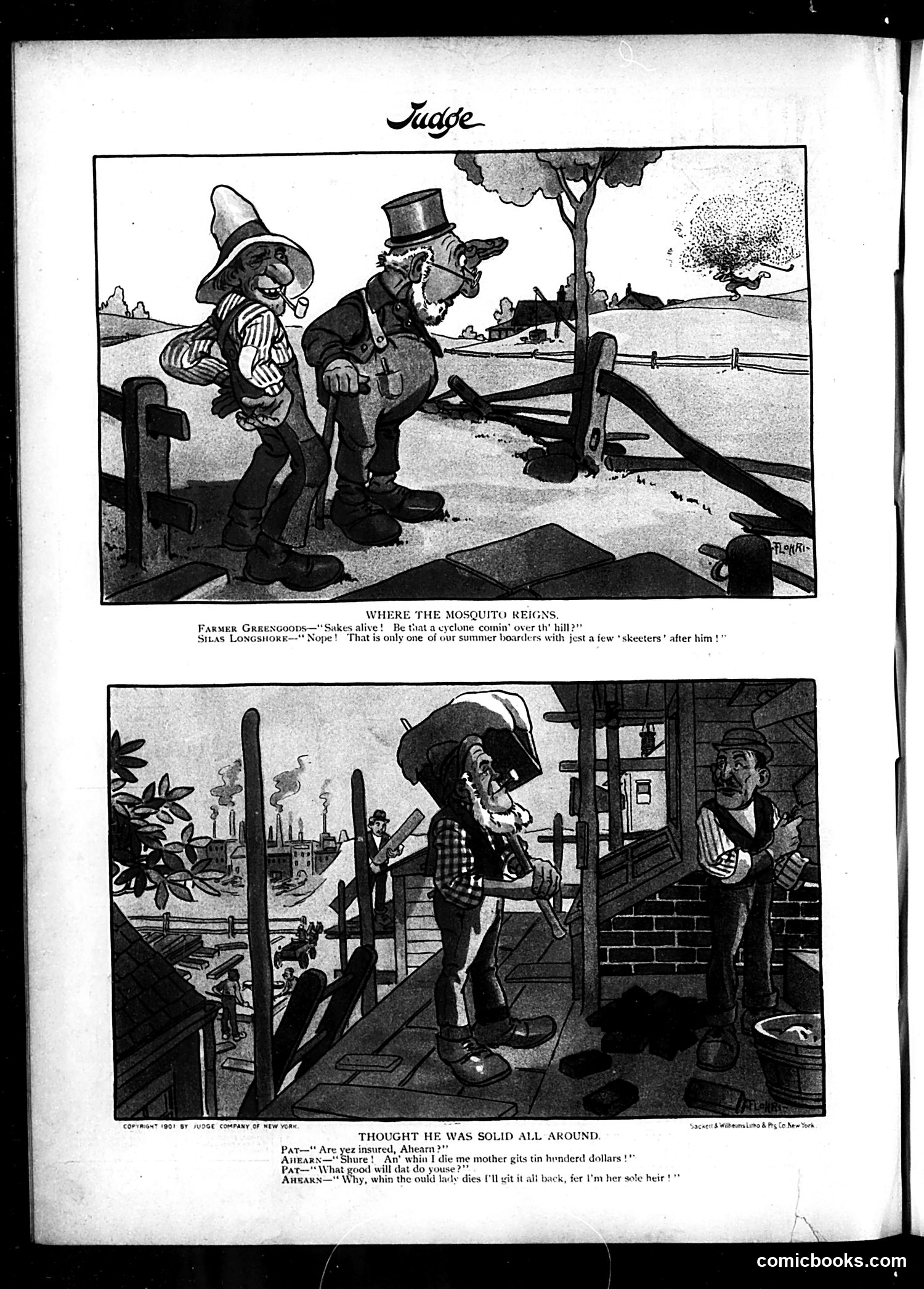
**Top cartoon ("The Mosquito Reign"):** Two rural farmers discuss a cyclone-like dust cloud. One jokes it's not a tornado but rather a summer boarder (a visiting guest) followed by mosquitoes. The satire mocks the summer boarding tradition—wealthy city people renting rural accommodations—by suggesting the accompanying mosquitoes are as disruptive as natural disasters. It's a jab at both the annoying insects endemic to summer and the perceived nuisance of seasonal guests. **Bottom cartoon ("Thought He Was Solid All Around"):** An Irish immigrant named Ahearn discusses life insurance with Pat. Ahearn reveals his mother receives $100 upon his death, but he'll inherit it back when she dies. The joke mocks either insurance fraud or absurd logic—the circular arrangement defeats insurance's purpose. The Irish names and dialect reflect period stereotypes about immigrant communities and their financial practices. Both cartoons use humor to critique social classes and contemporary culture.
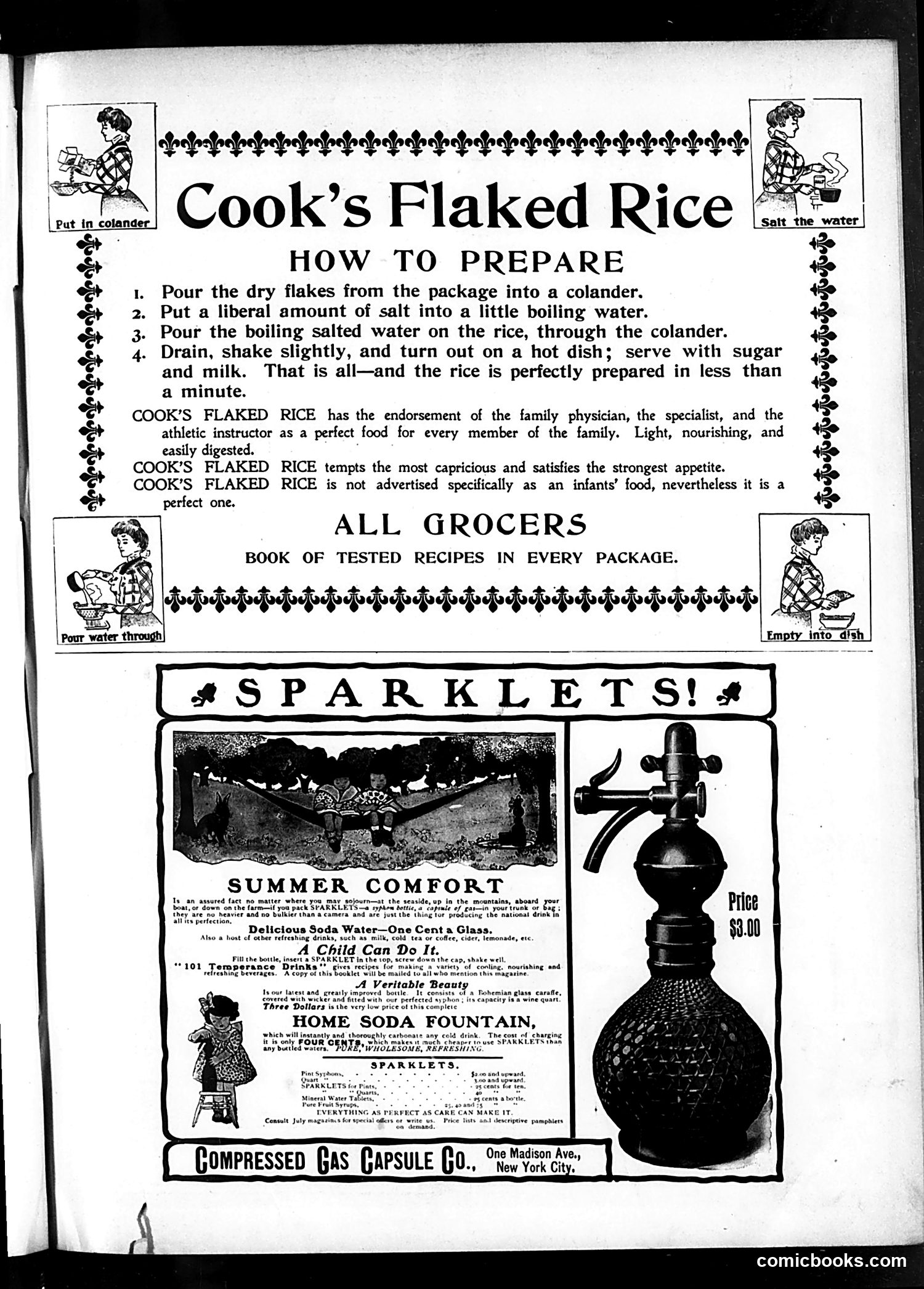
This page is primarily **advertising**, not political satire or cartoon commentary. It contains two product advertisements: 1. **Cook's Flaked Rice** (top): A straightforward food ad promoting quick-cooking rice, endorsed by physicians and athletic instructors as nutritious for "every member of the family." The small illustrated figures show preparation steps (putting rice in colander, salting water, etc.). This reflects early 20th-century marketing that associated packaged foods with scientific nutrition and medical authority. 2. **Sparklets Home Soda Fountain** (bottom): An ad for a home carbonation device priced at $9.00, made by Compressed Gas Capsule Co. It emphasizes "Summer Comfort" and convenience—allowing families to make soda water at home rather than purchasing it. Both ads are typical of Judge magazine's commercial content from this era, showing consumer products marketed through appeals to modernity, health, and domestic convenience. There is no political satire present on this page.
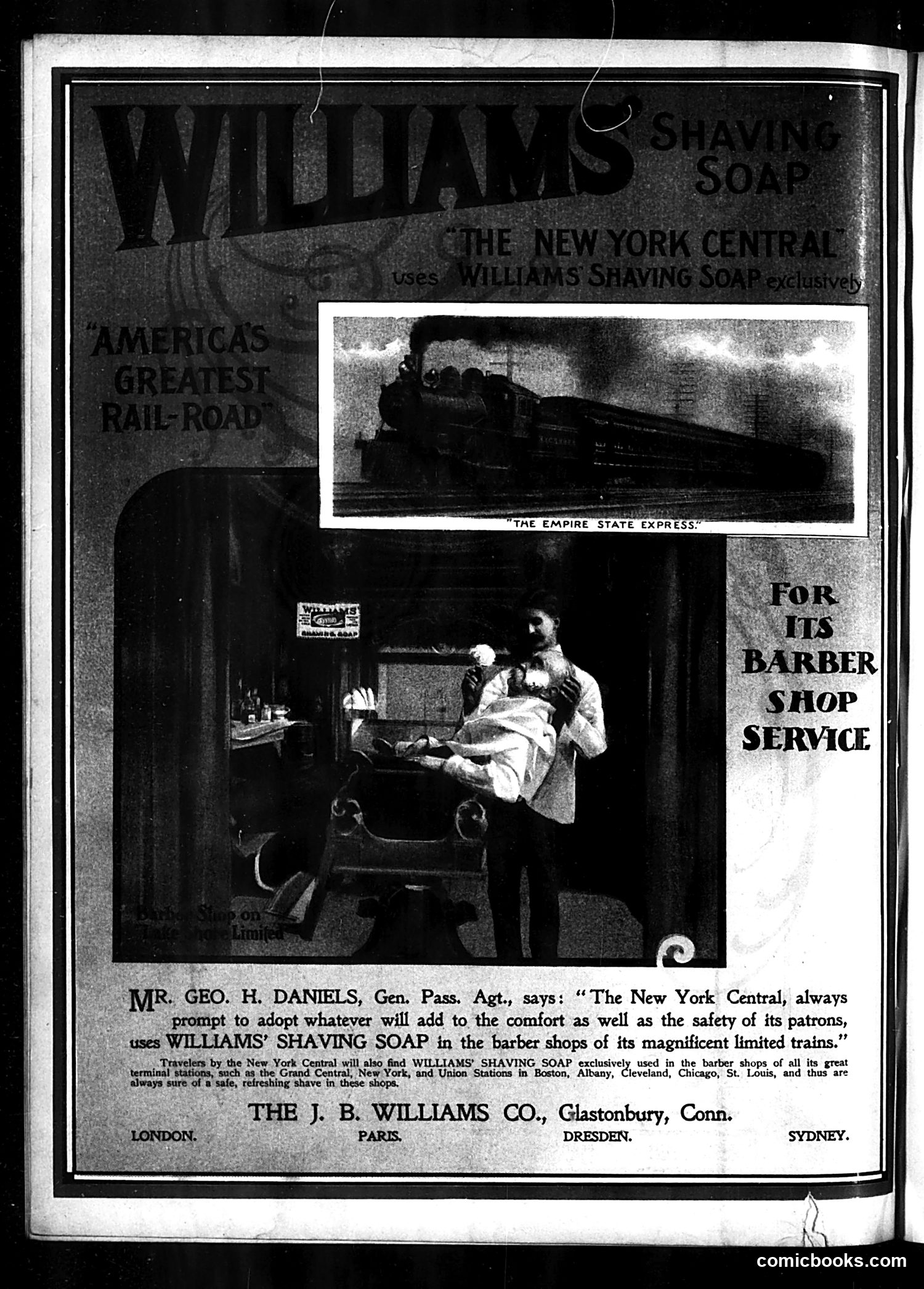
This is **not a cartoon or satire—it's a full-page advertisement** for Williams Shaving Soap in Judge magazine. The ad features a photograph of a barber shaving a customer aboard a New York Central train, with an inset image of "The Empire State Express" locomotive. The copy quotes George H. Daniels, General Passenger Agent of the New York Central Railroad, endorsing Williams Shaving Soap for use in barber shops across the railroad's limited trains and major terminal stations (Grand Central, Boston, Albany, Cleveland, Chicago, St. Louis). The appeal is to **comfort and luxury travel**: the ad suggests that refined passengers expect quality grooming services, and Williams Shaving Soap signals the railroad's commitment to passenger comfort and safety. The J. B. Williams Company, based in Glastonbury, Connecticut, marketed globally (with offices in London, Paris, and Dresden). This represents early 20th-century corporate advertising emphasizing product quality through institutional endorsements.