
Judge, 1901-09-07 · page 16 of 20
Judge — September 7, 1901 — page 16: what you’re looking at
What you’re looking at
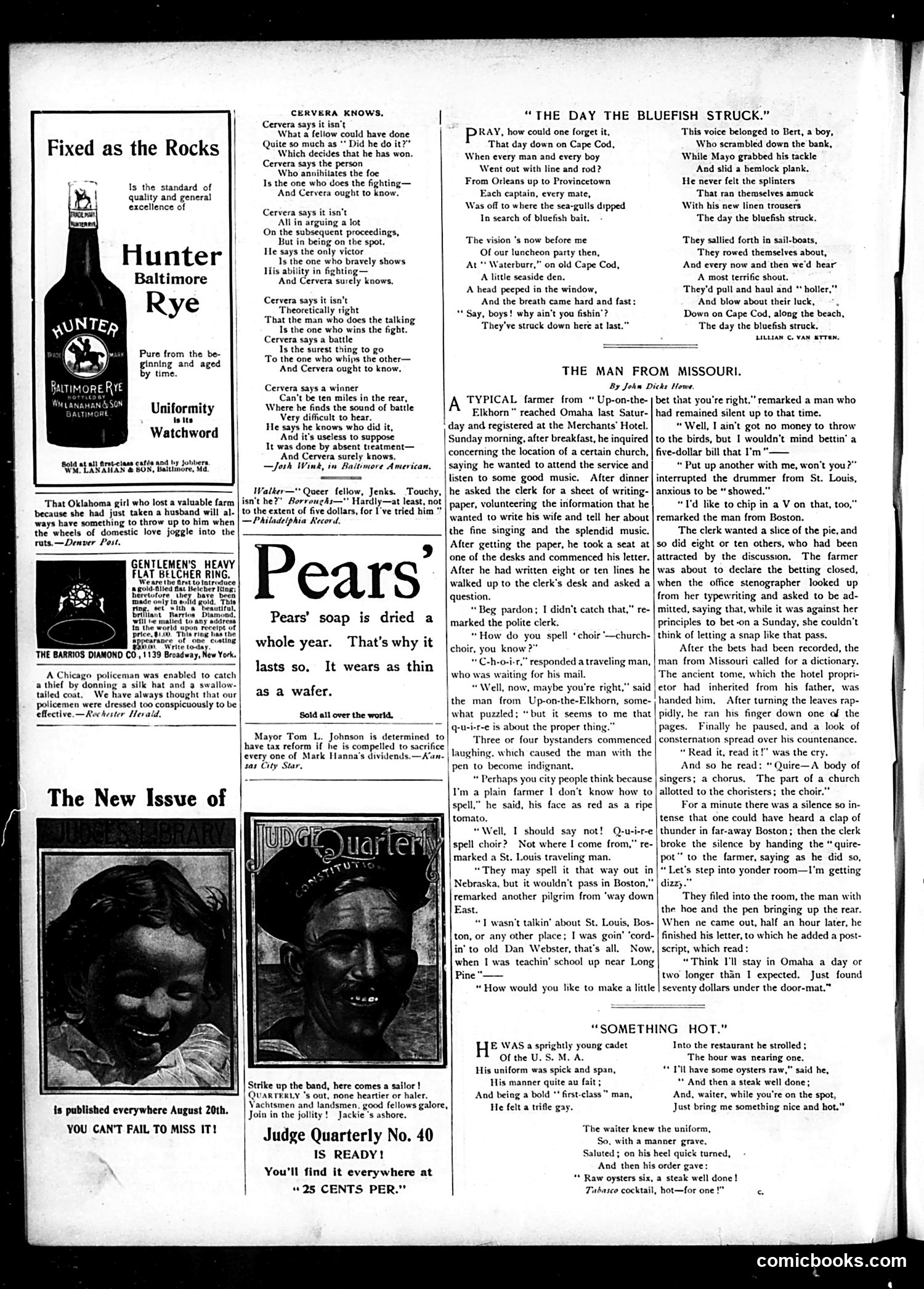
This page from Judge magazine (a satirical publication) contains several distinct elements: **"Cervera Knows" Poem**: A satirical commentary on Spanish Admiral Cervera, likely referencing the Spanish-American War. The poem mocks Cervera's explanations about naval defeat, emphasizing that actions matter more than excuses—"Did he do it?" counts more than what could have been done. This suggests Cervera was blamed for inaction or poor battlefield decisions. **"The Day the Bluefish Struck"**: A humorous fishing story where men are interrupted mid-lunch by news of bluefish appearing, causing them to abandon their meal. **"The Man from Missouri"**: A rural comedy sketch about a naive Nebraska farmer visiting Omaha, who attends church for the music and wants to write his wife about it—apparently treating the religious service primarily as entertainment. The page is primarily **satirical humor and light fiction**, with advertisements for whiskey, soap, and other products interspersed. The satire targets military incompetence, urban sophistication contrasting rural naiveté, and everyday American life.
📄 Transcribed text from this page (OCR, searchable)
Machine-transcribed from the original scan — historical spelling and the odd misread are preserved.
Is the standard of quality and general excellence of Hunter Baltimore Pure from the be- ginning and aged by time. Rattimore RYE tae =: Uniformity tits Watchword taas catte and ty Jobers TANS GUN aluinore, a ‘That Oklahoma girl who lost a valuable farm because she had just taken a husband will ways have something to throw up to him when the wheels of domestic love joggle into the ruts.—Denver Post. EMEN'S HEAVY T BELCHER RING, made only tn sul Ting. set with « beautifal, c ‘Write toxday, ‘THE BARRIOS DIAMOND CO, 1139 Broadway, New York, A Chicago policeman was enabled to catch a thief by donning a silk hat and 9 swallow. tailed coat, We have always thought that our policemen were dressed too conspicuously to be effective. —Rechester Herald, CERVERA KNOWS, Cervera says it isn't What a fellow could have done Quite so much as “* Did he do it?” Which decides that he has won. Cervera says the person Who annihilates the foe Is the one who does the fighting— ‘And Cervera ought to know. Cervera says it isn’t Allin arguing a lot On the subsequent proceedings, But in being on the spot. He says the only victor Is the one who bravely shows His ablity in Sighting — ‘And Cervera surely knows, Cervera says it isn’t ‘Theoretically right That the man who does the talking Is the one who wins the fight. Cervera says a battle Is the surest thing to go To the one who whips the other— And Cervera ought to know, Cervera says a winner Can't be ten miles in the rear, Where he finds the sound of battle Very difficult to hear. He says he knows who did it, And it's useless to suppose It was done by absent treatment— And Cervera surely knows. —Jorh Wink, in Baltimore American, Walker—* Queer fellow, Jenks. Touchy, isn't he?” Borroughs—"* Hardly—at least, not to the extent of five dollars, for I've tried him ” —Philadelphia Record. Pears Pears’ soap is dried a whole year. That's why it lasts so. It wears as thin as a wafer. Sold all over the world. The New Issue of is published everywhere August 20th. YOU CAN'T FAIL TO MISS IT! Mayor Tom L, Johnson is determined to have tax reform if he is compelled to sacrifice every one of Mark Hanna's dividends.—A‘an- sas City Star, Strike up the band, here comes a sailor! QUARTERLY 's out, none heartier or haler. Yachtsmen and landsmen. good fellows galore, Join in the joll Jackie's ashore, Judge Quarterly No. 40 IS READY! You'll find it everywhere at “25 CENTS PER. “THE DAY THE PRAY, how could one forget it, That day down on Cape Cod, When every man and every boy Went out with line and rod? From Orleans up to Provincetown Each captain, every mate, Was off to where the sea-gulls dipped In search of bluefish bait. ‘The vision ‘s now before me Of our luncheon party then, At‘ Waterburr,” on old Cape Cod, A little seaside den, A head peeped in the window, And the breath came hard and fast: ** Say, boys! why ain't you fishin’? ‘They've struck down here at last.” TYPICAL farmer from “ Up-on-the- Elkhorn” reached Omaha last Satur- day and registered at the Merchants’ Hotel. Sunday morning, after breakfast, he inquired concerning the location of a certain church, saying he wanted to attend the service and listen to some good music, After dinner he asked the clerk for a sheet of writing- paper, volunteering the iriformation that he wanted to write his wife and tell her about the fine singing and the splendid music. After getting the paper, he took a seat at ‘one of the desks and commenced his letter. After he had written eight or ten lines he walked up to the clerk's desk and asked a question. “ Beg pardon; I didn’t catch that,” re- marked the polite clerk. “How do you spell ‘choir '—church- choir, you know * Ceh-o-i-r,” responded a traveling man, who was waiting for his mail. i} Vell, now, maybe you're right,” said | the man from Up-on-the-Elkhorn, some- what puzzled; “but it seems to me that qru-i-t-e is about the proper thing.” ‘Three or four bystanders commenced laughing. which caused the man with the pen to become indignant. * Perhaps you city people think because I'm a plain farmer I don't know how to spell,” he said, his face as red as a ripe tomato. “Well, I should say not! Q-u- spell choir? Not where I come from, marked a St. Louis traveling man. “They may spell it that way out in | Nebraska, but it wouldn't pass in Boston,’ remarked another pilgrim from ‘way down East. “| wasn't talkin’ about St. Louis, Bos- ton, or any other place; I was goin’ ‘cord- in’ to old Dan Webster, that’s all. Now, when I was teachin’ school up near Long Pine ™. “ How would you like to make a little HE WAS a sprightly young cadet Of the U.S. M. A. His uniform was spick and span, His manner quite au fait ; And being a bold *' first-class” man, He felt a trifle gay. “ Raw oysters six, a BLUEFISH STRUCK.” ‘This voice belonged to Bert, a boy, Who scrambled down the bank, While Mayo grabbed his tackle And slid a hemlock plank. He never felt the splinters ‘That ran themselves amuck With his new linen trousers ‘The day the bluefish struck. ‘They sallied forth in sail-boats, ‘They rowed themselves about, And every now and then we'd hear A most terrific shout. ‘They'd pall and haul and “holler,” And blow about their luck, Down on Cape Cod, along the beach, ‘The day the bluefish struck. LILLIAN G. VAN ETTEN, THE MAN FROM MISSOURI. By John Dicks Howe bet that you're right.” remarked a man who had remained silent up to that time. Well, I ain't got no money to throw to the birds, but I wouldn't mind bettin’ a five-dollar bill that I'm "—— “ Put up another with me, won't you?” interrupted the drummer from St. Louis, anxious to be “ showed.” “I'd like to chip in a V on that, too,” remarked the man from Boston. The clerk wanted a slice of the pie, and so did eight or ten others, who had been attracted by the discussion, The farmer was about to declare the betting closed, when the office stenographer looked up from her typewriting and asked to be ad- mitted, saying that, while it was against her principles to bet on a Sunday, she couldn't think of letting a snap like that pass. After the bets had been recorded, the man from Missouri called for a dictionary. The ancient tome, which the hotel propri- etor had inherited from his father, was handed him, After turning the leaves rap- pidly, he ran his finger down one af the pages. Finally he paused, and a look of consternation spread over his countenance. “ Read it, read it!” was the cry. And so he read: Quire—A body of singers; a chorus, The part of a church allotted to the choristers; the choir.” For a minute there was a silence so in- tense that one could have heard a clap of thunder in far-away Boston; then the clerk broke the silence by handing the “quire- pot” to the farmer, saying as he did so, * Let's step into yonder room—I'm getting dizzy." They filed into the room, the man with the hoe and the pen bringing up the rear. When ne came out, half an hour later, he finished his letter, to which he added a post- script, which read: “Think I'll stay in Omaha a day or two longer thin I expected. Just found seventy dollars under the door-mat.” “SOMETHING HOT.” Into the restaurant he strolled ; The hour was nearing one. “Til have some oysters raw,” said he, * And then a steak well done; And, waiter, while you're on the spot, Just bring me something nice and hot.” ‘The waiter knew the uniform, So, with a manner grave. Saluted ; on his heel quick turned, And then his order gave: steak well done! Tabasco cocktail, hot—for one !" comicbooks.com