
A complete issue · 22 pages · 1901
Judge — March 9, 1901
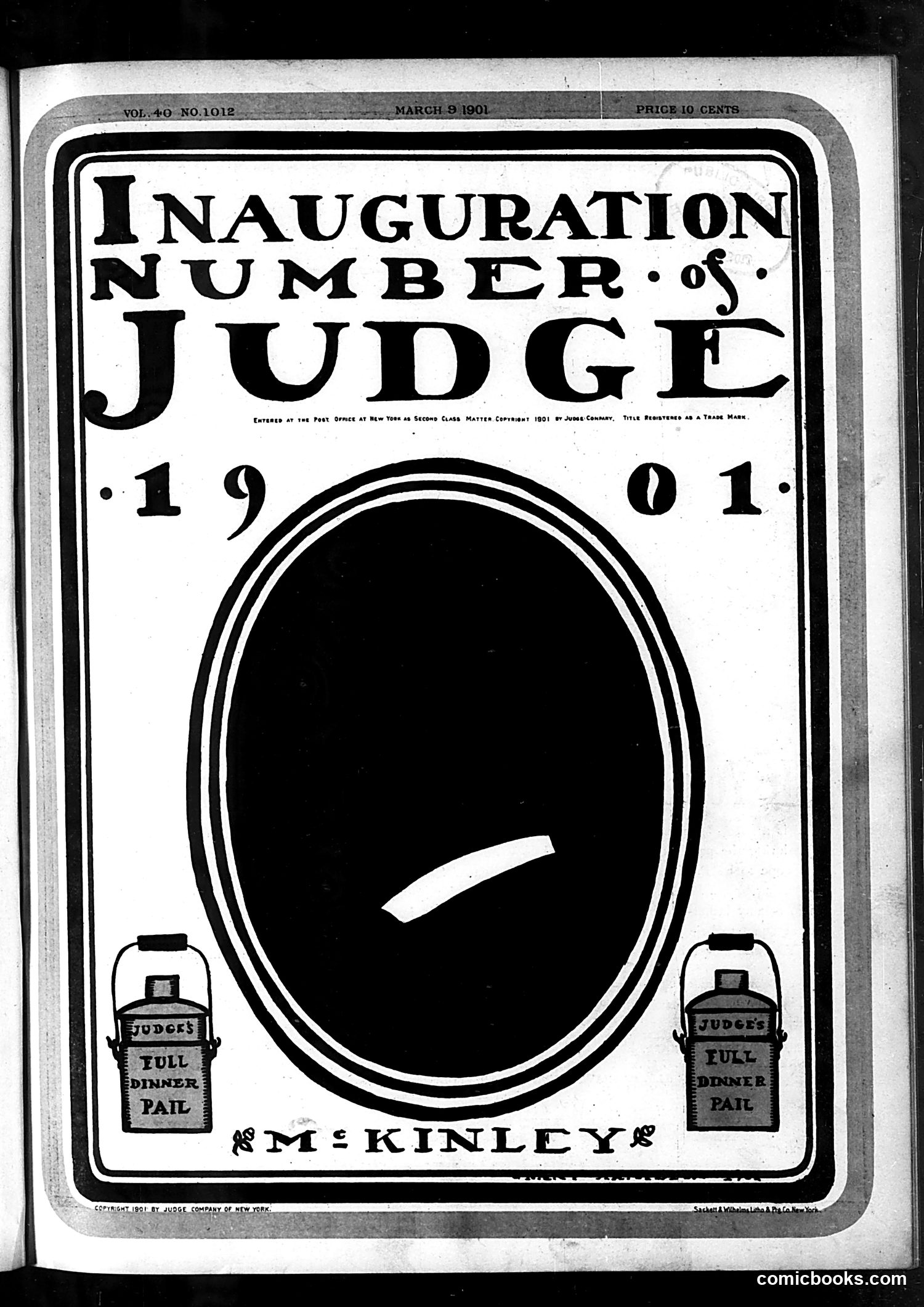
This is the Inauguration Number of *Judge* magazine from March 9, 1901, marking Theodore Roosevelt's assumption of the presidency following William McKinley's assassination in September 1900. The cover features a large empty oval portrait frame dated "1901," with a small white slash visible inside—likely representing Roosevelt's profile or a symbolic reference to his arrival. The two "Judge's Full Dinner Pail" containers flanking the frame reference the Republican campaign slogan promising prosperity to working Americans. The artist (M. Kinley, per the signature) creates anticipation about Roosevelt's presidency by leaving the portrait space dramatically blank, inviting readers to contemplate what this young, energetic president would bring to the office.
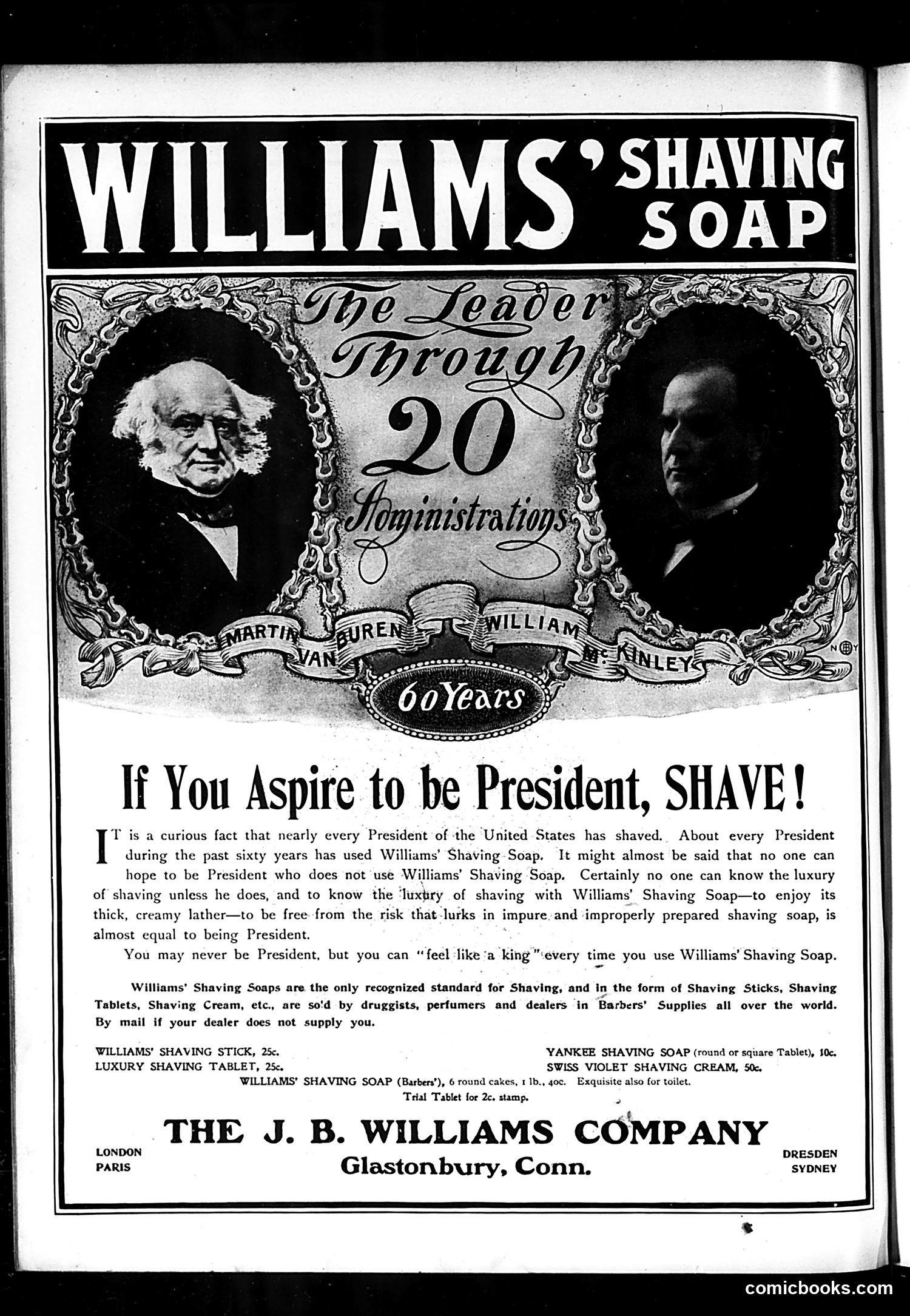
This is primarily a **product advertisement**, not political satire. It uses patriotic imagery to sell shaving soap. The ad features two portrait medallions labeled "Martin Van Buren" (left) and "William Kinley" (right), positioned around text claiming "The Leader Through 20 Administrations" and "60 Years." The headline claims that nearly every U.S. President has used Williams' Shaving Soap, suggesting the product's longevity and prestige. The satirical hook—"If You Aspire to be President, SHAVE!"—humorously implies that proper grooming with their soap is essential to presidential success. This conflates personal hygiene with political ambition, a playful exaggeration typical of period advertising. The company, J.B. Williams, based in Glastonbury, Connecticut, lists various soap products and prices.
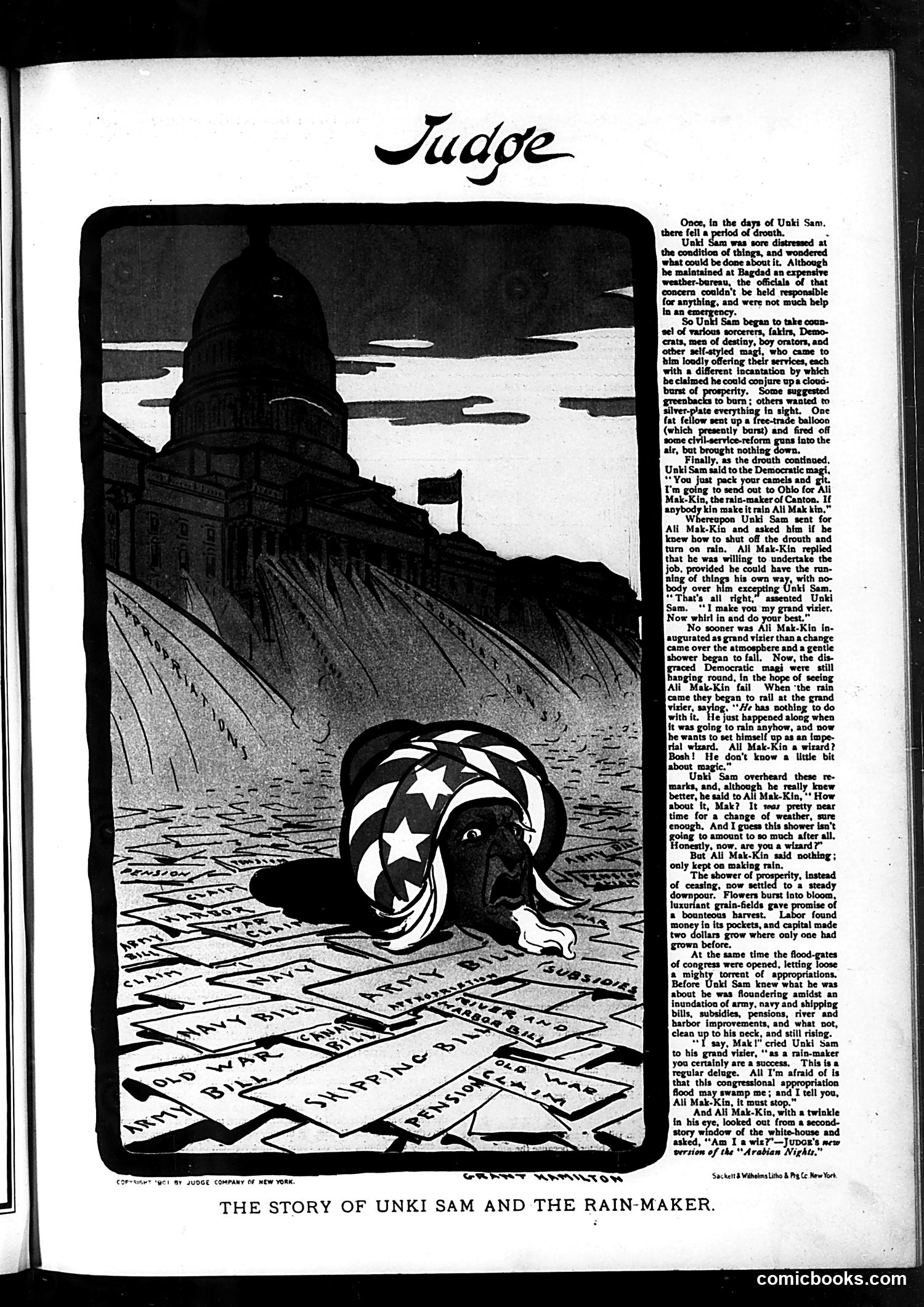
This satirical story uses the character "Unki Sam" (Uncle Sam, representing the United States) experiencing a severe drought. The narrative centers on various individuals—described as "sorcerers, fakirs, Democrats, men of destiny, boy conjurers"—competing to solve the crisis through different methods, each claiming special powers to bring rain. The satire appears to critique American political figures and self-proclaimed experts offering competing solutions to a national problem (likely referencing either an actual drought or metaphorical crisis). The story ridicules their conflicting claims and incompetence, suggesting that various politicians and so-called wizards all fail to deliver meaningful results, leaving Uncle Sam frustrated and uncertain whom to trust.
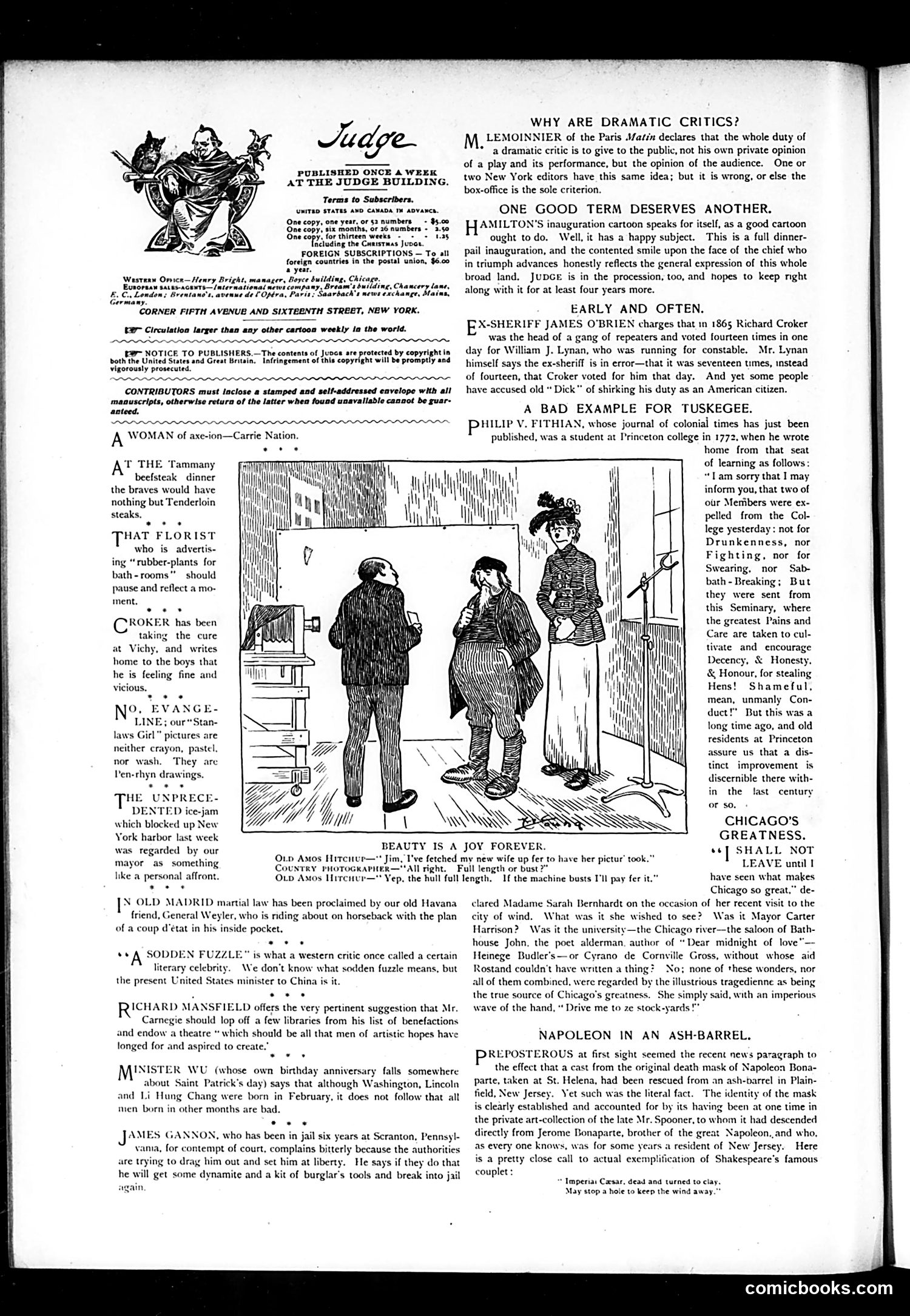
The main cartoon, titled "Beauty Is a Joy Forever," depicts two poorly dressed men examining what appears to be a statue or bust. The caption attributes dialogue to "Old Amos Hitchcock" (a photographer) and "Country Photographer," making crude jokes about the sculpture's proportions and suggesting they'd "pay for it" if it were real. The surrounding text consists of brief satirical commentary on various topics: a florist advertising fake plants, a western critic's term "sudden puzzle," Richard Mansfield's theatrical suggestions, and anecdotes about odd laws and personalities. Without clearer historical context, the specific figures and events referenced are difficult to identify precisely. The humor relies on period-appropriate vulgarity and social commentary typical of 1890s American satirical magazines.
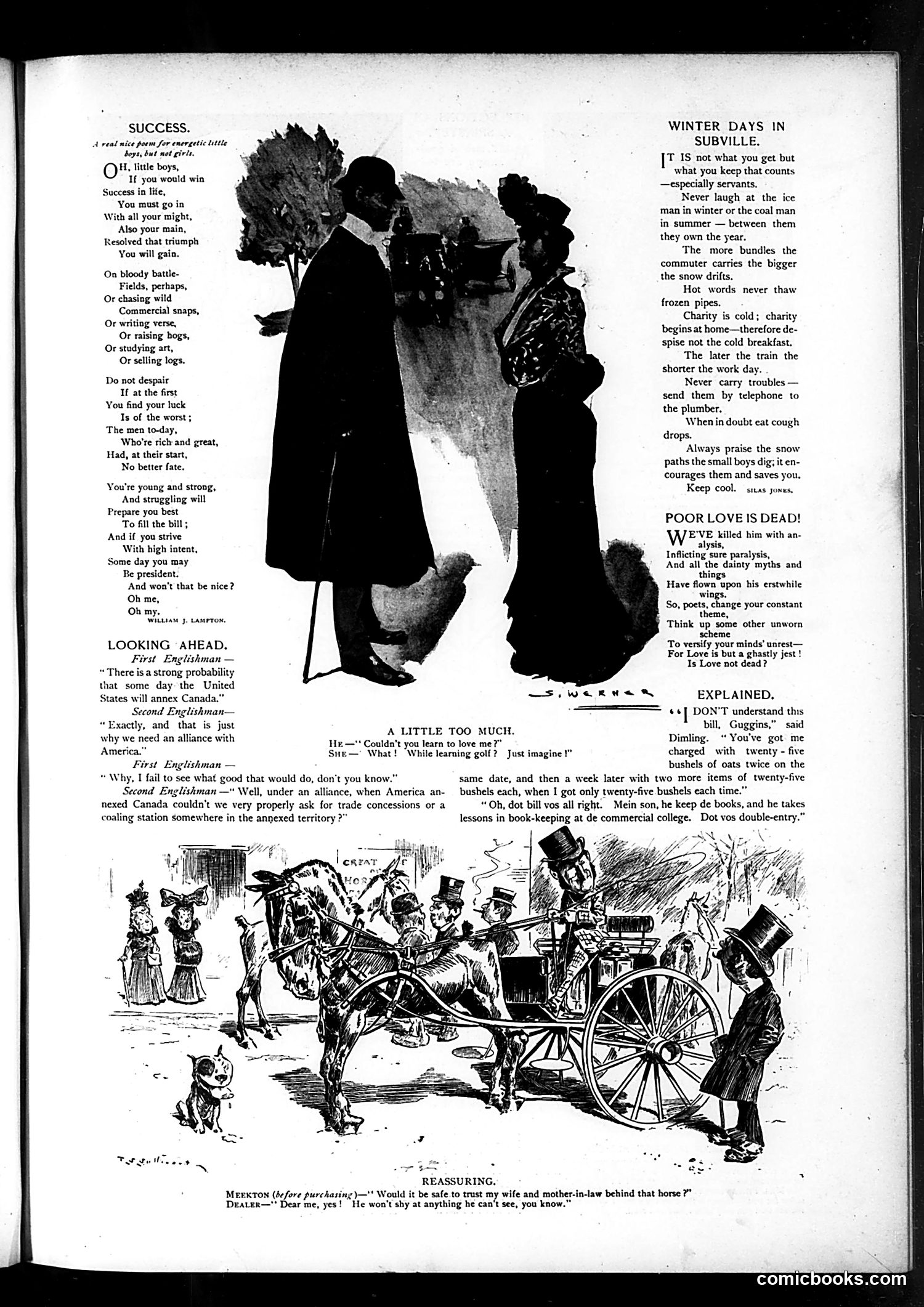
This page contains several distinct pieces of social and political satire: **"Success"** — A poem mocking the American self-made-man myth, presenting an over-earnest prescription for boys to achieve wealth through hard work and determination ("some day you may be president"). **"Looking Ahead"** — British gentlemen discuss American annexation of Canada, with dark humor: the Second Englishman reasons they should ally with America so they can extract trade concessions *when* (not *if*) Canada is annexed. The satire targets both British imperial complacency and American expansionism. **"A Little Too Much"** — A woman prioritizes learning golf over romantic love, satirizing the era's new emphasis on women's leisure activities over traditional courtship. **"Poor Love is Dead"** — Poetic satire claiming Romantic poetry is exhausted; poets should find new subjects since love has been over-analyzed into meaninglessness. **"Explained"** — A humorous tax/bookkeeping dispute where a father proudly notes his son keeps poor records at commercial college, unwittingly admitting incompetence. **"Reassuring"** — A horse dealer reassures a nervous customer about trusting his wife and mother-in-law with an unpredictable horse—the joke being the horse won't shy at things it can't see, implying the women are invisible or insignificant.
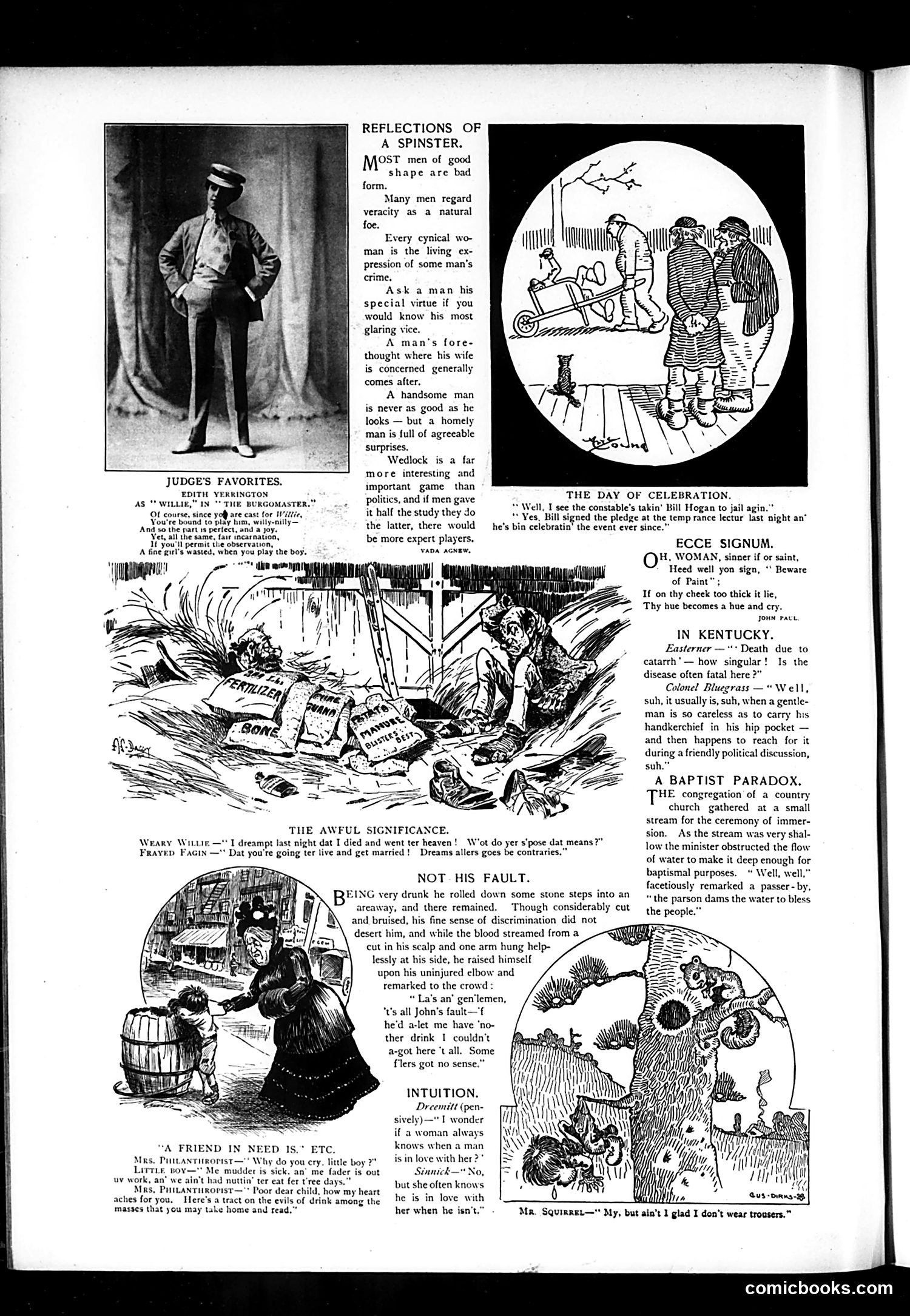
This page from *Judge* (a satirical weekly) contains multiple short humorous pieces targeting social hypocrisy and gender relations circa early 1900s. **"Reflections of a Spinster"** presents cynical observations on men and marriage, suggesting women view matrimony as more serious than politics—a jab at both male frivolity and the "marriage market." **"The Day of Celebration"** mocks temperance reformers: a man signs a pledge at a lecture, then immediately gets arrested for drunkenness, undermining the pledge's credibility. **"In Kentucky"** stereotypes Southern gentlemen as prone to shooting each other during political arguments—a regional caricature suggesting violence masquerades as honor. **"A Baptist Paradox"** satirizes religious ceremony: a minister blocks water flow to create adequate baptismal depth, prompting a bystander's joke about "damning water to bless people"—wordplay on religious contradiction. Other brief pieces mock charity workers offering tracts instead of aid, drunkenness, and gender stereotypes. The overall tone reflects period attitudes toward temperance movements, Southern culture, and social pretense.
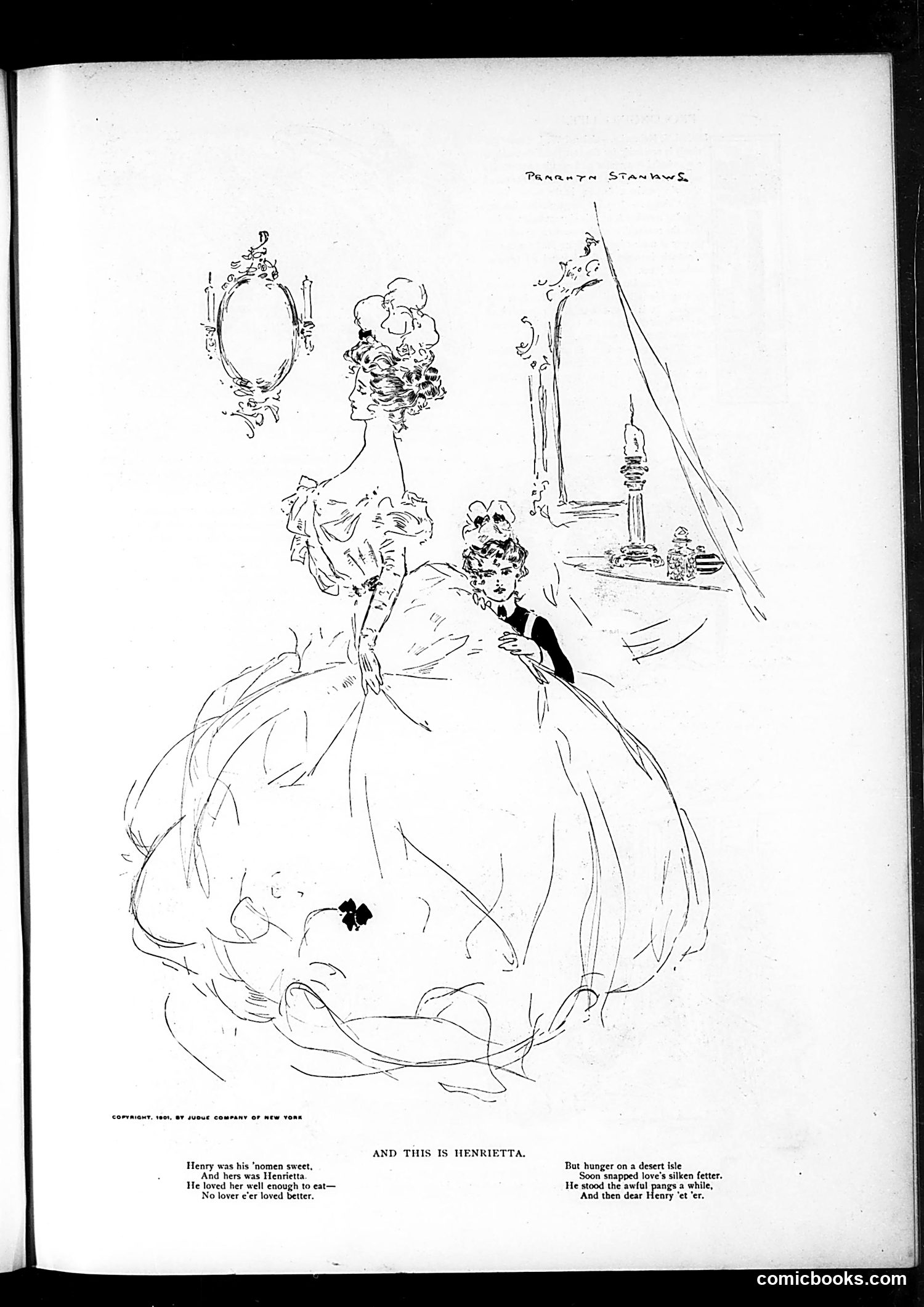
This is a dark humor cartoon satirizing romantic sentimentality. The title "Panama Stairway" appears unrelated to the actual content shown—likely a section header or advertisement. The joke is a macabre pun: the poem establishes "Henry" and "Henrietta" as lovers, with Henry's devotion described as loving her "well enough to eat." The punchline reveals this was literal—stranded on a desert island facing starvation, Henry ate Henrietta, the phrase "dear Henry 'et 'er" being a phonetic play on "ate her." The illustration shows an elegantly dressed woman (Henrietta) admiring herself in an ornate mirror in what appears to be a fancy bedroom, unaware of her dark fate. This juxtaposes civilized luxury with the crude survival cannibalism described in the verse, amplifying the satirical horror-comedy.
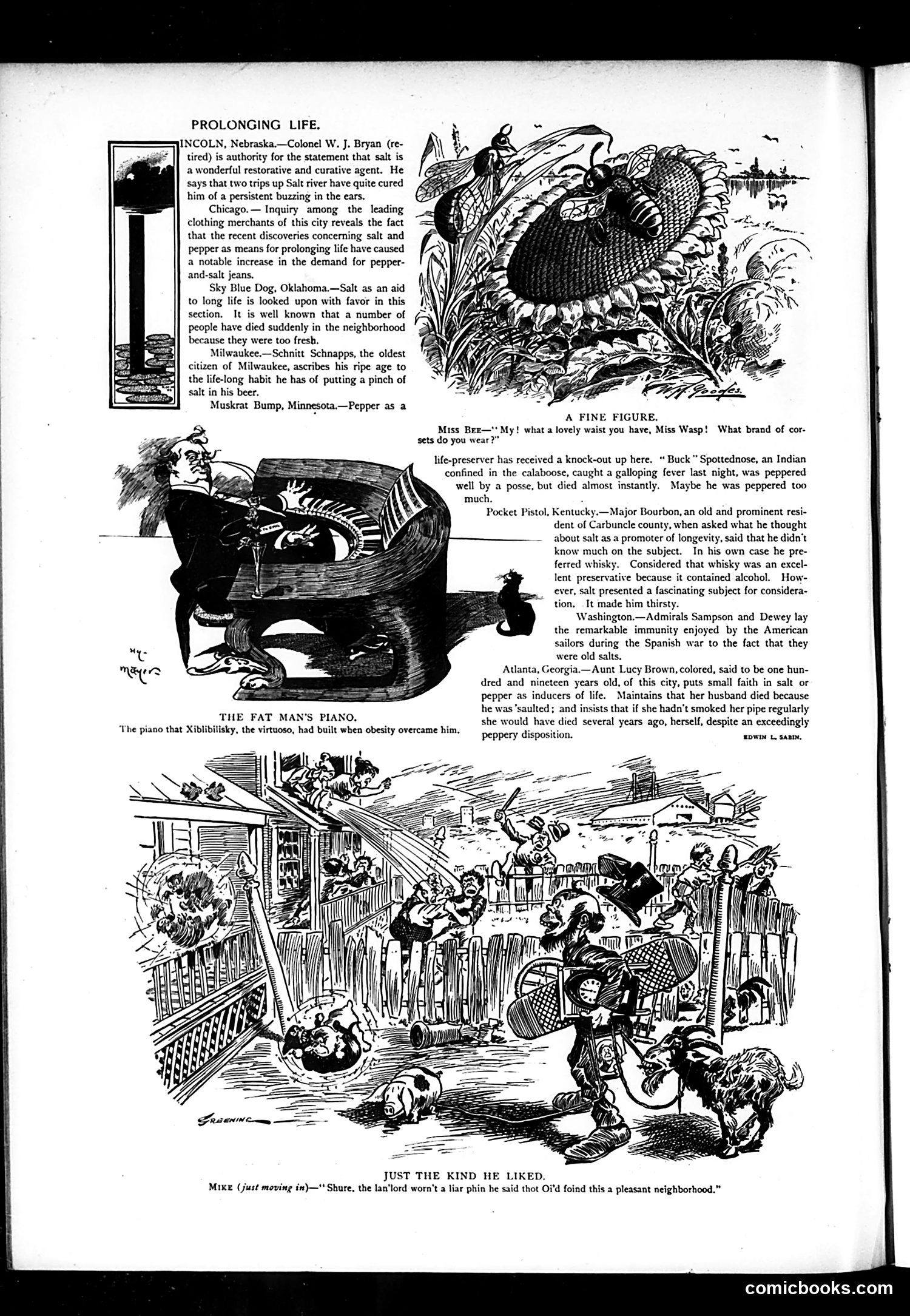
This page satirizes contemporary pseudoscientific claims about salt and pepper extending lifespans. The main section collects mock "reports" from various American towns, each offering absurd anecdotes about salt/pepper preservation—from a Colonel Bryan's ear buzzing "cured" by trips up "Salt river" (a political reference, likely mocking Bryan after an electoral defeat) to whisky-preferring Major Bourbon and freed slave Aunt Lucy Brown crediting pipe-smoking over salt. The humor relies on wordplay ("old salts" referring to sailors) and non-sequiturs (an Indian "peppered" by a posse dies anyway; people died from being "too fresh"). Secondary cartoons mock obesity ("Fat Man's Piano") and include a crudely rendered ethnic stereotype of an Irish immigrant ("Mike"). The satire targets both medical quackery and American gullibility about health fads circulating in the period.
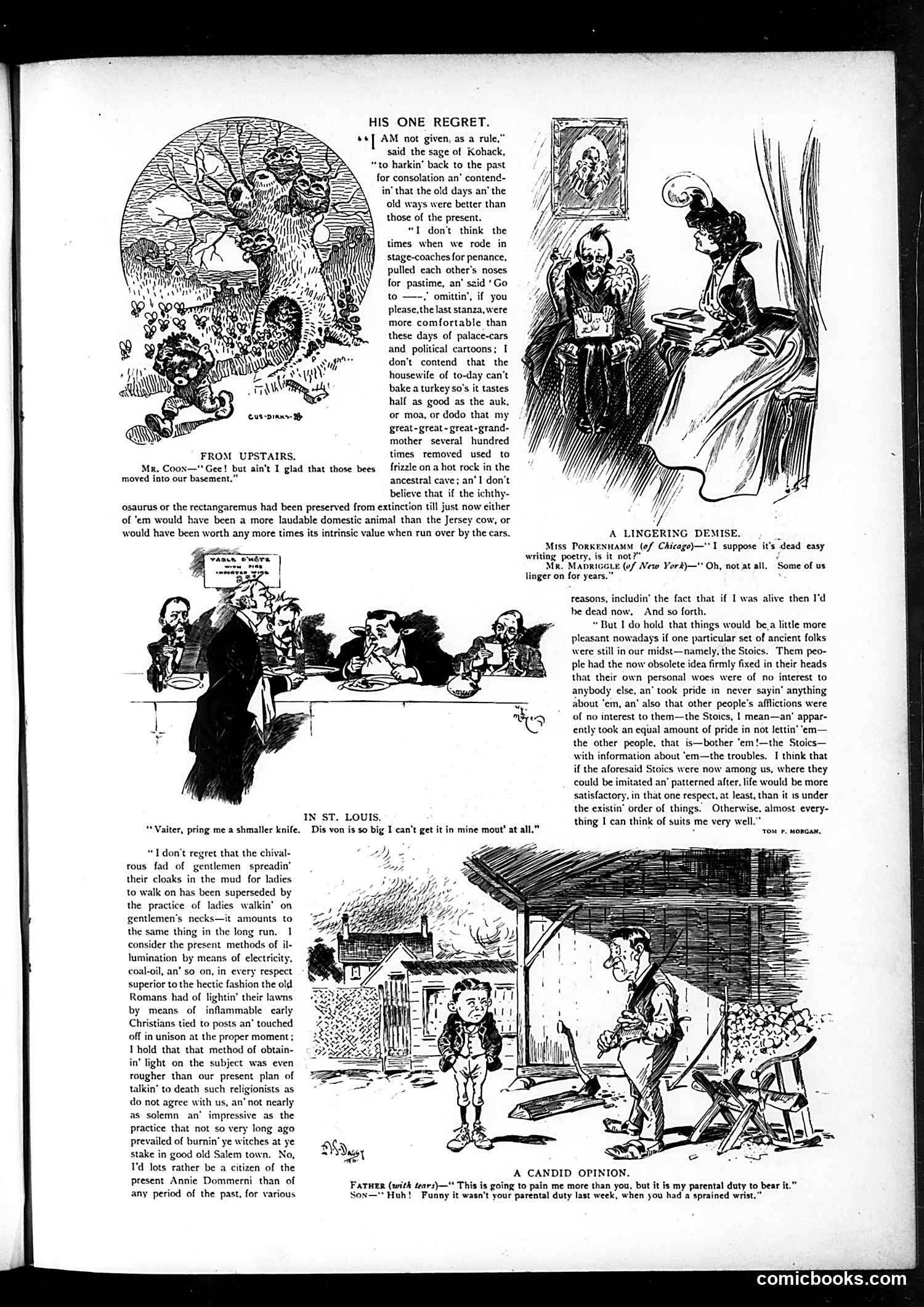
This page contains several satirical vignettes mocking nostalgic romanticism about "the good old days." **"His One Regret"**: A sage argues against idealizing the past, claiming modern conveniences (trains, electricity) and social progress outweigh old hardships. His one concession: he misses the Stoics' philosophy of emotional restraint—implying his contemporaries complain excessively about their troubles. **"From Upstairs"**: A brief domestic joke where Mr. Coon expresses relief that bees moved to the basement rather than remaining upstairs, with text debating whether extinct animals would have been better than modern livestock. **"In St. Louis"**: A German-accented diner asks a waiter for a smaller knife, unable to fit a large one in his mouth—a crude ethnic stereotype joke. **"A Candid Opinion"**: A father prepares to beat his son, claiming parental duty requires it. The son cynically notes the father's convenient absence of "parental duty" the previous week when he had a sprained wrist—exposing parental hypocrisy. The page's theme: deflating pretension and hypocrisy through working-class and domestic humor.
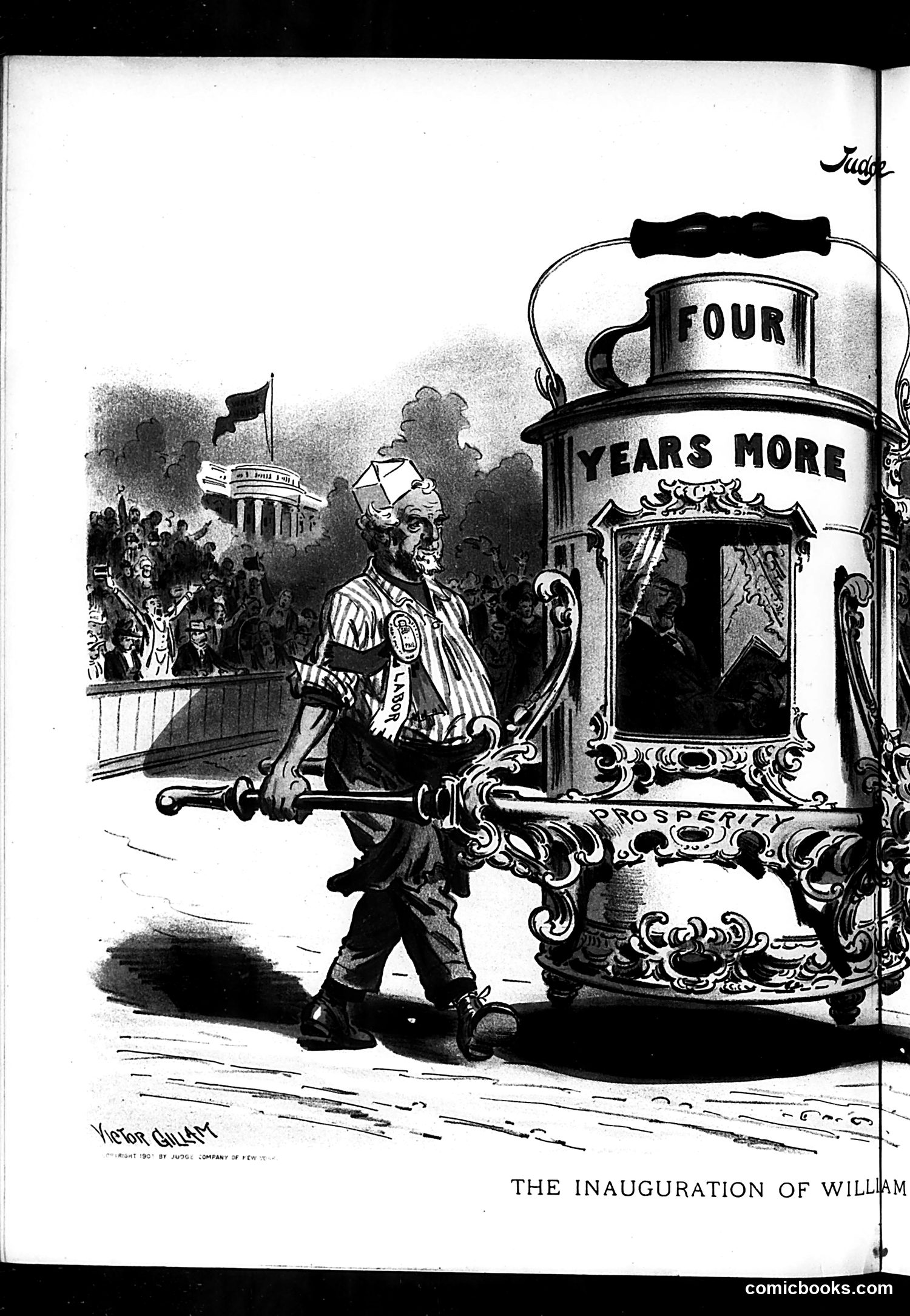
This political cartoon depicts a figure in presidential/ceremonial dress being carried in an ornate "Four Years More" vessel, suggesting his re-election or continuation in office. The crowds and flags in the background indicate a public inauguration ceremony. The satirical point appears to be commentary on a leader's extended tenure or desire to remain in power. However, **I cannot identify which "William" is depicted** without additional context like the publication date (visible as "Judge" magazine, but the specific year isn't fully clear in the OCR). The ornate "prosperity" imagery on the vessel suggests the cartoon may be either praising or mocking promises of economic benefit from continued leadership. The artist's signature appears to be "Victor Gillam," a known Judge cartoonist, but the specific historical inauguration referenced remains unclear from this page alone.
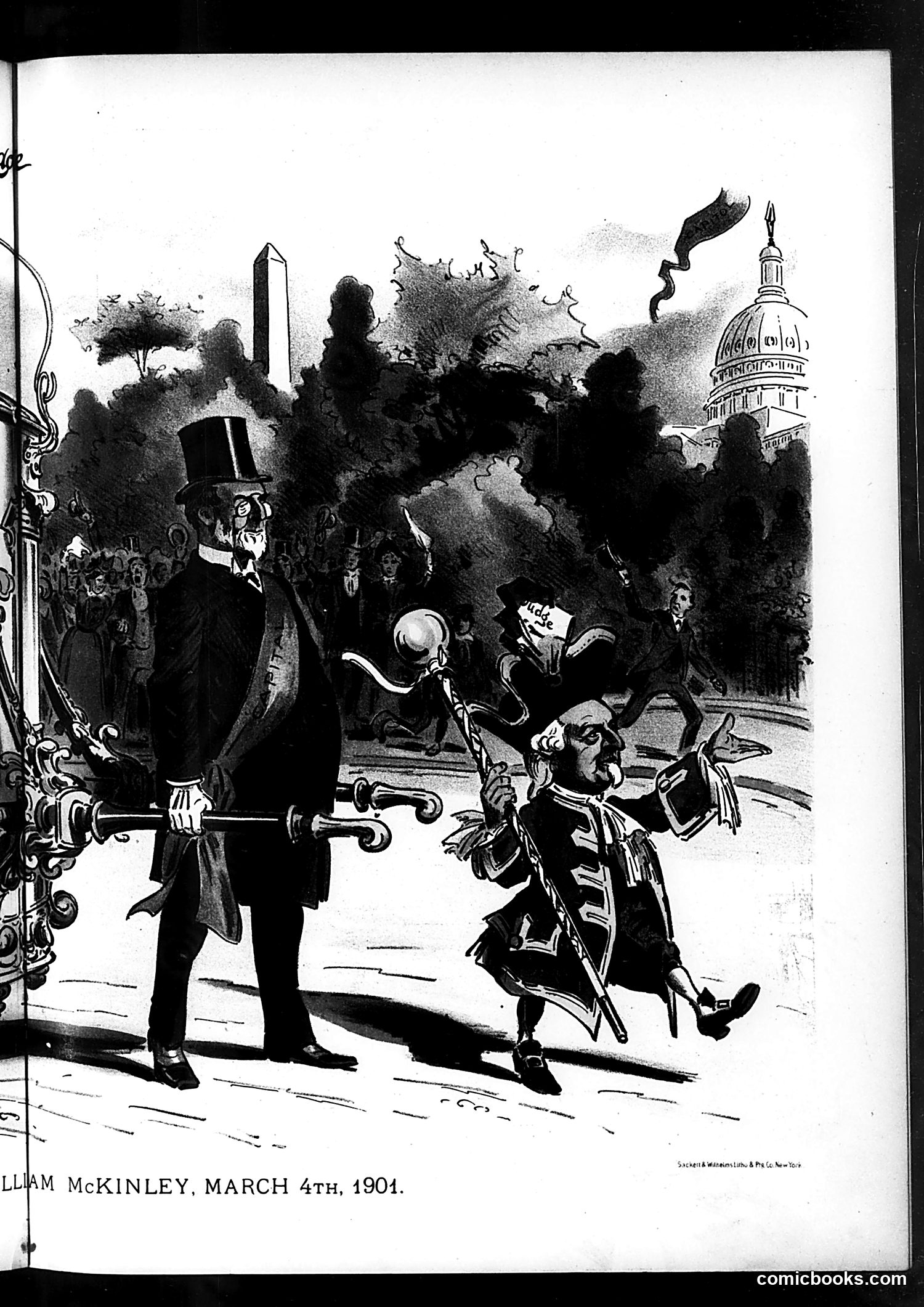
This political cartoon depicts President William McKinley's second inauguration on March 4, 1904. The illustration shows McKinley (left, in top hat) as a tall, commanding figure holding what appears to be a ceremonial staff or baton. He's positioned prominently in front of the U.S. Capitol Building, with crowds and other dignitaries surrounding him. The satire likely comments on McKinley's political power and popularity during his presidency, which included the Spanish-American War and imperial expansion. The formal ceremonial setting emphasizes the grandeur of his political position. The exaggerated scale of McKinley compared to other figures suggests Judge magazine's commentary on his dominance in American politics at that moment.
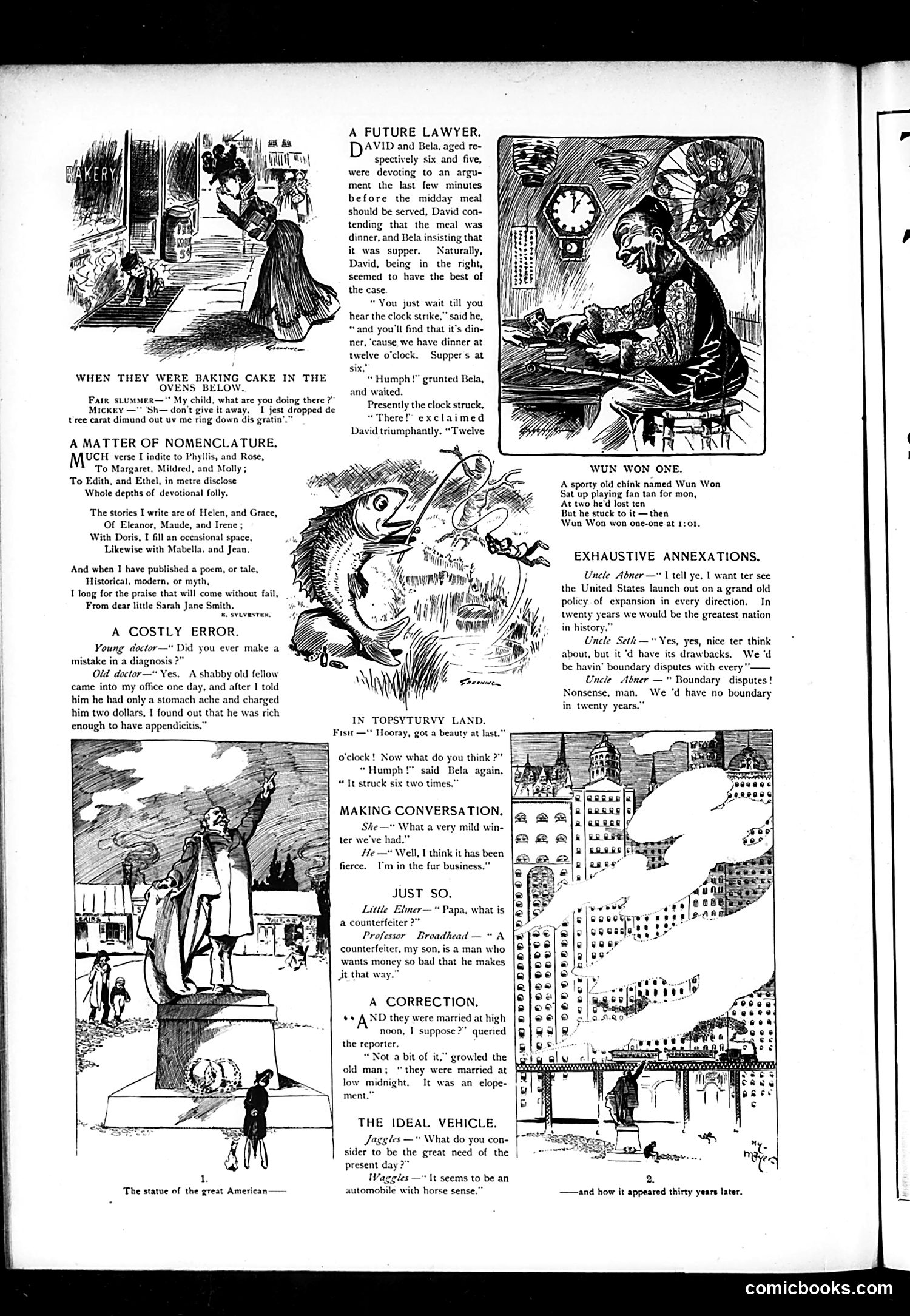
This page contains multiple short humorous pieces typical of early 20th-century American satirical journalism. **Notable items:** "A Future Lawyer" depicts two boys arguing about meal times—a child's debate framed as legal argumentation, satirizing how children mimic adult formal reasoning. "A Costly Error" jokes about a doctor misdiagnosing a wealthy patient's appendicitis as stomach ache, missing the opportunity for a lucrative procedure—satirizing both medical practice and class assumptions. "Exhaustive Annexations" features two characters debating American imperial expansion, with one arguing the U.S. should annex territory until it has "no boundary"—likely referencing contemporary debates about American expansionism and territorial acquisition (relevant to early 1900s U.S. foreign policy). "The Ideal Vehicle" is a quick joke about automobiles needing "horse sense"—playing on the newness of automobiles replacing horses. Other pieces include light domestic humor and wordplay. The page emphasizes comedy through misunderstandings, professional incompetence, and political/social commentary in accessible, joke-based format.
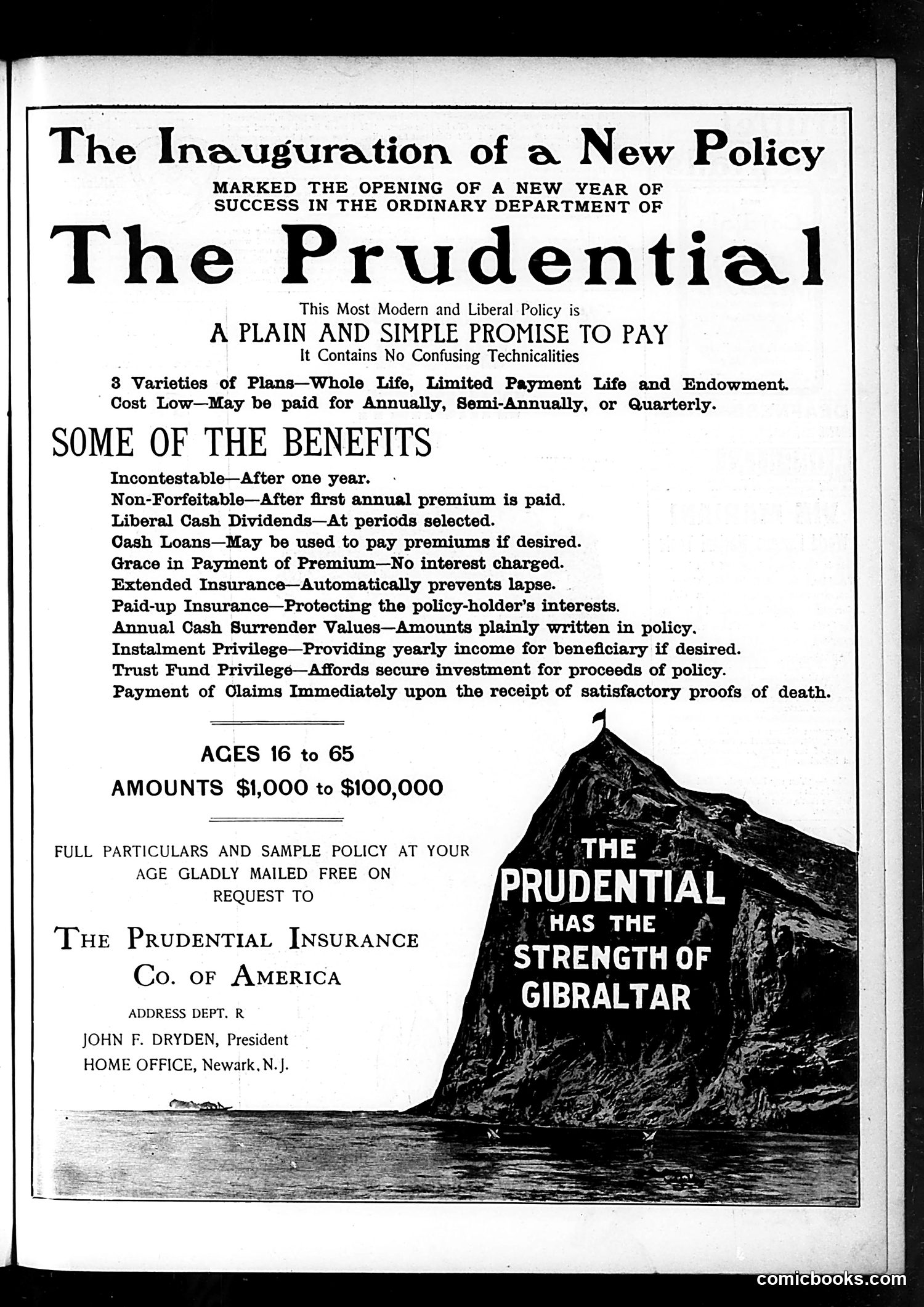
This page is primarily a **Prudential Insurance advertisement** rather than political satire or a cartoon. It announces a new insurance policy format for the Prudential Insurance Co. of America. The phrase "The Inauguration of a New Policy" puns on "inauguration" (typically associated with presidential swearing-in ceremonies), applying it instead to a new insurance product launch. The only visual element is an engraving of the **Rock of Gibraltar**, used metaphorically to suggest strength and stability—a common advertising tactic of the era to convey that Prudential's financial backing is as solid and immovable as Gibraltar. The ad emphasizes accessibility: simple terms, flexible payment options (annual, semi-annual, quarterly), and available ages 16-65. The company president, John F. Dryden, is named. This appears to be from the early 1900s based on typography and advertising style.
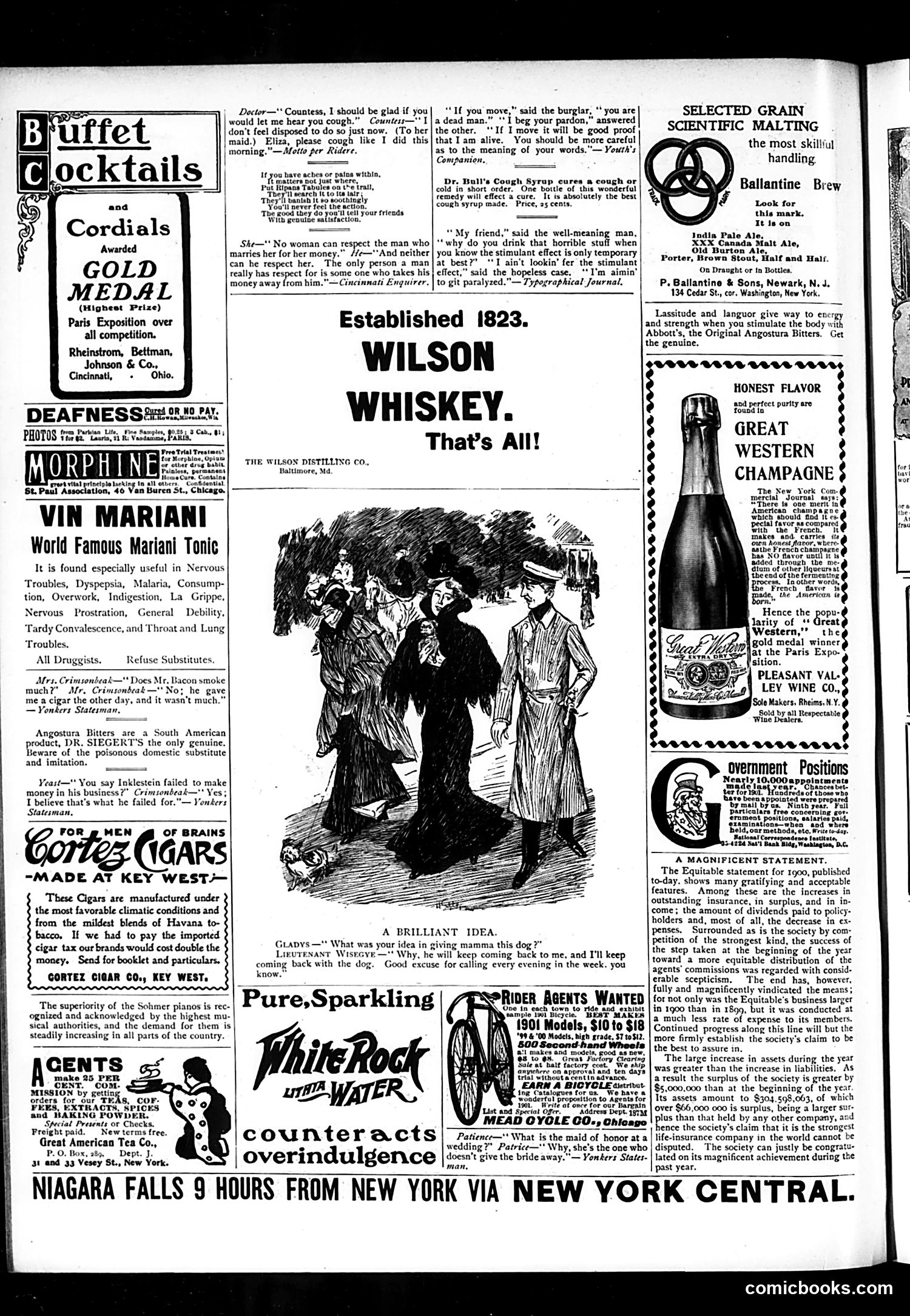
This is primarily an **advertising page** from Judge magazine, with minimal satirical content. The dominant feature is a central cartoon titled "A Brilliant Idea" depicting three figures—a woman and two men in period dress—where a man says he'll "keep coming back" to a woman who will "keep coming" to him, with her responding positively. The page is otherwise filled with patent medicine and product advertisements typical of early 20th-century periodicals: Wilson Whiskey, Vin Mariani (a cocaine-containing tonic), morphine products, and Cortez cigars. A few brief satirical jokes appear in small text, including wordplay about respectability and money. **Context for modern readers:** This reflects an era when Judge mixed serious satire with unregulated advertising for now-illegal substances like cocaine and morphine, presented as legitimate remedies. The central cartoon's humor is mild—essentially a flirtation joke playing on persistence and reciprocal interest.
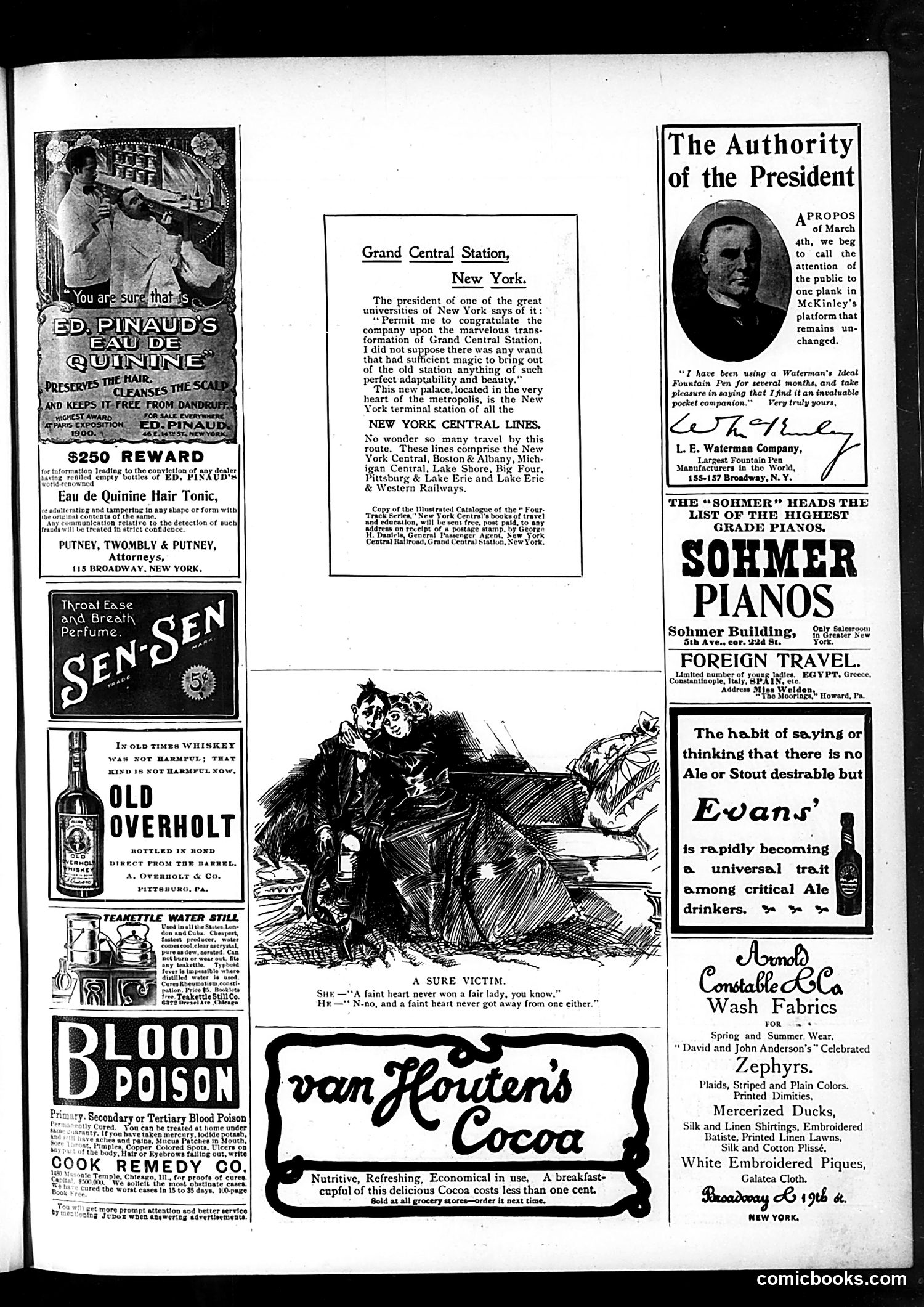
This page from *Judge* magazine contains primarily **advertisements** rather than political satire. However, the notable editorial content is "The Authority of the President," which references **McKinley's platform** (President William McKinley, likely circa 1900-1901 based on the "March 4th" reference to inauguration day). The cartoon titled "A Sure Victim" depicts a romantic conversation between a man and woman—a conventional joke about courtship, unrelated to political satire. The McKinley reference appears to be sardonic commentary suggesting his administration had **failed to implement promised policies**, with only one "plank" remaining "unchanged." Without more context, the specific policy referenced is unclear, but this represents typical *Judge* criticism of political leadership. The remainder of the page consists of period product advertisements for hair tonic, whiskey, cocoa, pianos, and fabrics—standard magazine filler of the era.
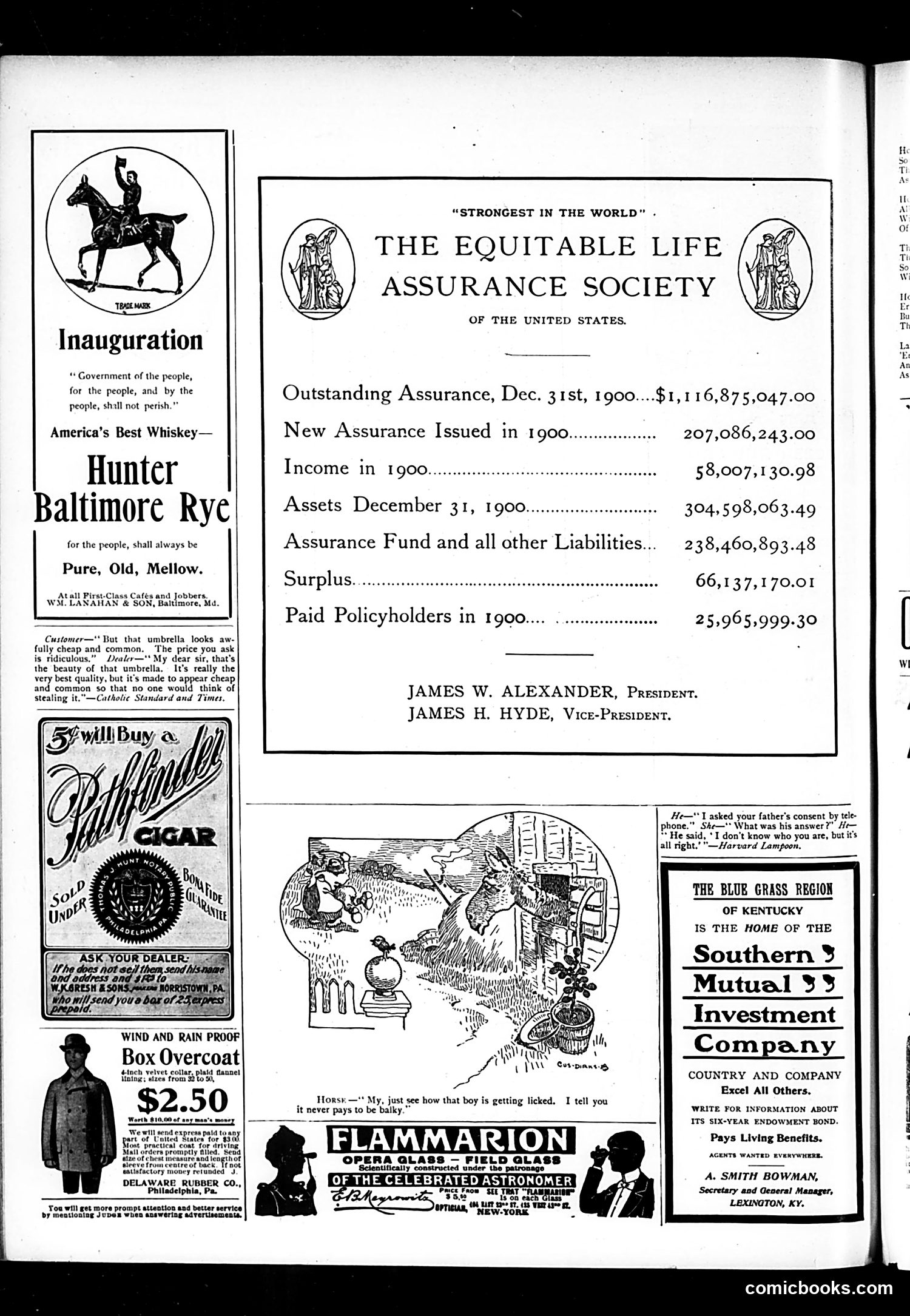
This page is primarily **advertising**, not political satire. It contains several commercial advertisements for products (whiskey, overcoat, umbrella, opera glasses) interspersed with brief humor items. The small cartoons present social humor rather than political commentary: - An **umbrella joke** about quality goods made to look cheap to discourage theft—a commentary on consumer anxieties about value and appearance. - A **horse-whipping cartoon** using a stubborn boy to humorously justify corporal punishment ("it never pays to be balky"). - A **telephone joke** about a father's vague consent to marriage—poking fun at the novelty and awkwardness of telephone communication. The dominant content is the **Equitable Life Assurance Society** announcement showcasing impressive financial figures (over $1 billion in outstanding assurance), positioning it as "strongest in the world." This represents corporate advertising rather than editorial commentary. The page reflects 1900 American consumer culture and early-20th-century attitudes toward technology, class, and social conventions.
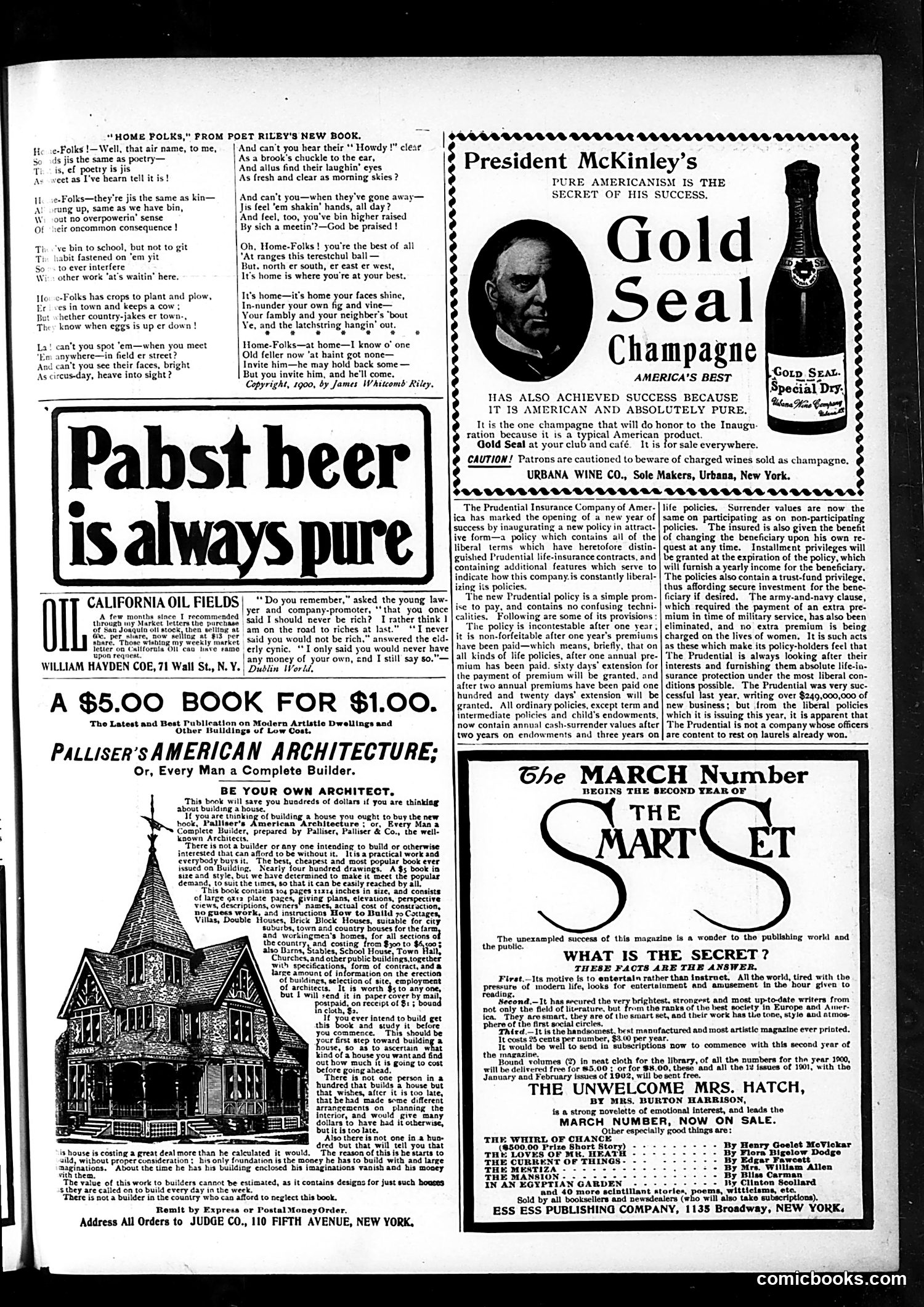
This page is primarily **advertising and literary content** rather than political satire. The main content features **James Whitcomb Riley's poem "Home Folks,"** a sentimental rural American verse celebrating simple country life, family connections, and neighborliness. Riley was a popular Hoosier poet of this era (circa 1900). The advertisements include: - **Pabst Beer** ("always pure") - **Gold Seal Champagne**, oddly endorsed with a portrait labeled "President McKinley's" and text claiming "Pure Americanism is the secret of his success"—an unusual political advertising technique - **California oil stock investment opportunity** - **Palliser's American Architecture book** for aspiring homebuilders The McKinley champagne ad appears to be the only overtly political content, using the president's image to market alcohol, though the satirical point (if any) is unclear from this page alone.
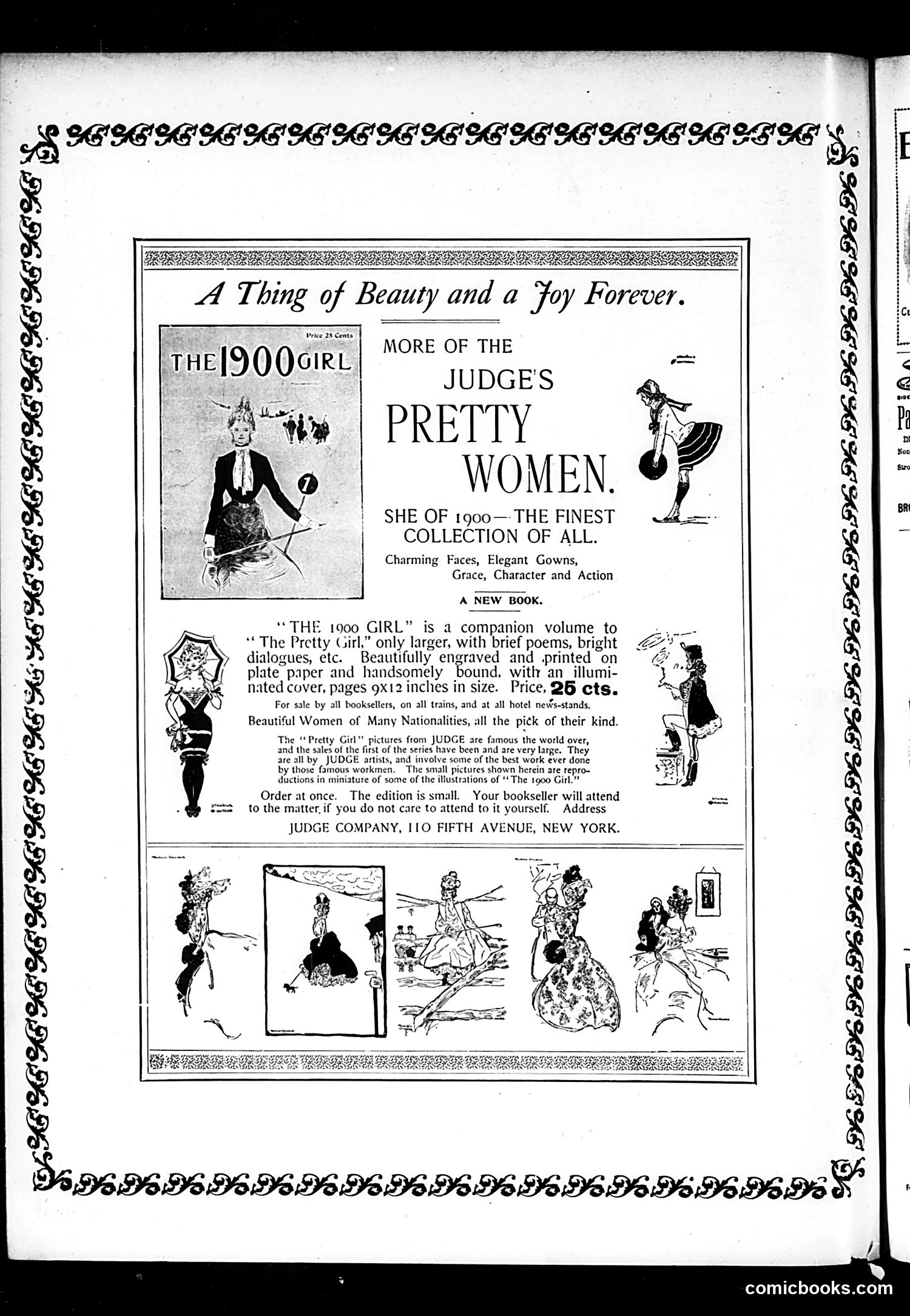
This page is primarily advertising for a new book by Judge magazine. It promotes "The 1900 Girl," a companion volume to their earlier successful "Pretty Girl" series. The advertisement emphasizes that the book features illustrations by Judge's renowned artists, depicting beautiful women of various nationalities in elegant gowns, with charming faces and graceful poses. The page includes sample illustrations showing fashionable women in various poses and activities, reflecting turn-of-the-century aesthetics. The tagline "A Thing of Beauty and a Joy Forever" appeals to readers' desires for attractive imagery. This is primarily commercial content rather than political satire. It reflects Judge magazine's popular illustrated format and their marketing of collectible art books featuring idealized depictions of women—a common commodity in early 1900s periodical culture. The emphasis on "the finest collection" and "women of many nationalities" suggests aspirational consumption of beauty and culture.
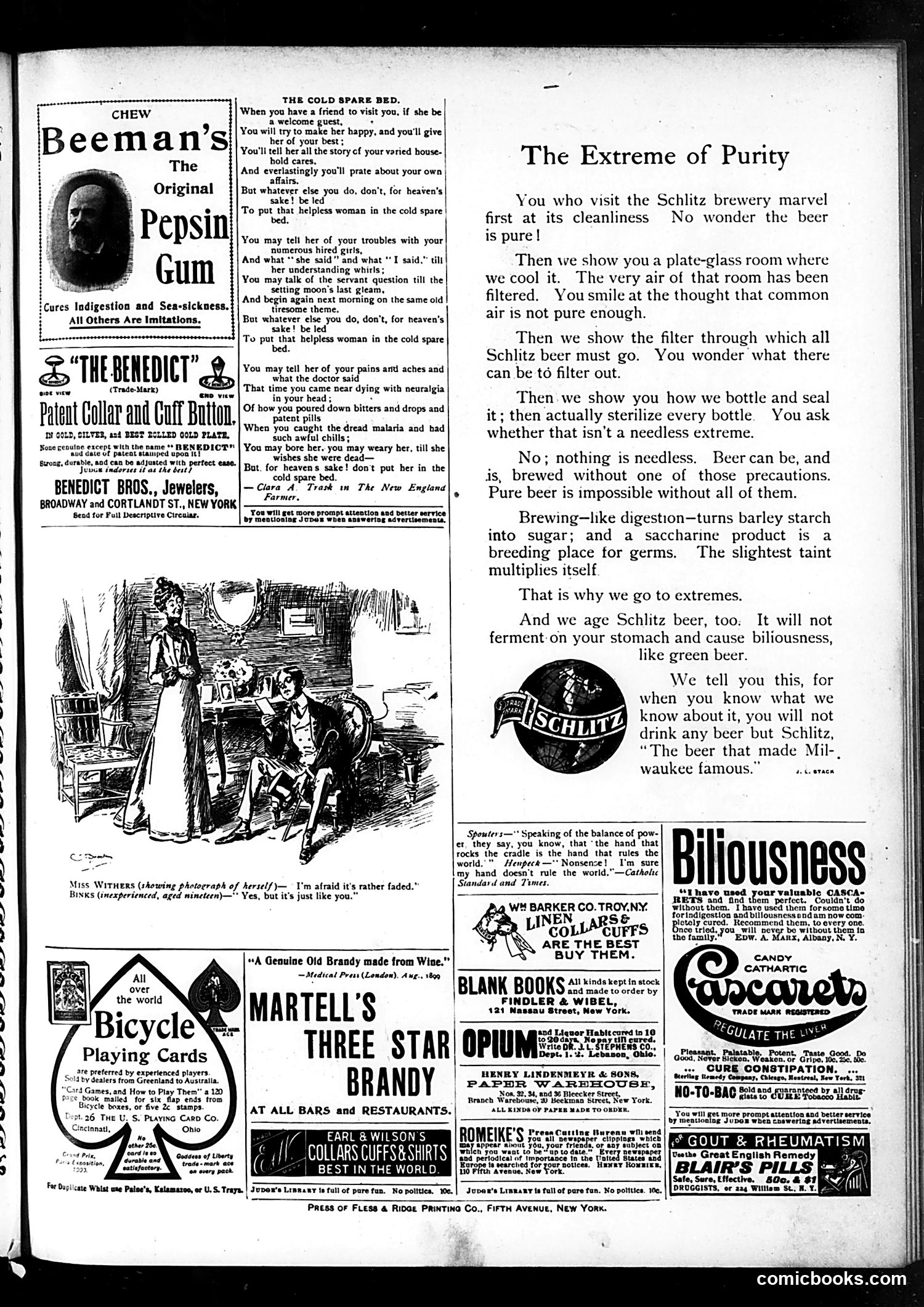
This page is primarily **advertisements and light humor** rather than political satire. The main cartoon depicts a social etiquette joke: a woman shows her photograph to a young man named Binks, who tactlessly remarks it's "faded" but "just like you"—insulting her appearance while attempting flattery. The featured text "The Cold Spare Bed" is a humorous poem warning hosts never to put guests in uncomfortable spare bedrooms, no matter how much you bore them with complaints about servants, health problems, or household troubles. The bulk of the page consists of product ads typical of the era: Beeman's Pepsin Gum (claims to cure indigestion), patent collar buttons, Martell's brandy, Bicycle playing cards, and prominently, **Schlitz beer**, which boasts of its extreme purity measures—filtered air, sterilized bottles, and aging process to prevent stomach upset from "green beer." The content reflects late-19th/early-20th-century consumer anxieties about product quality and sanitation, before modern food safety regulations existed.
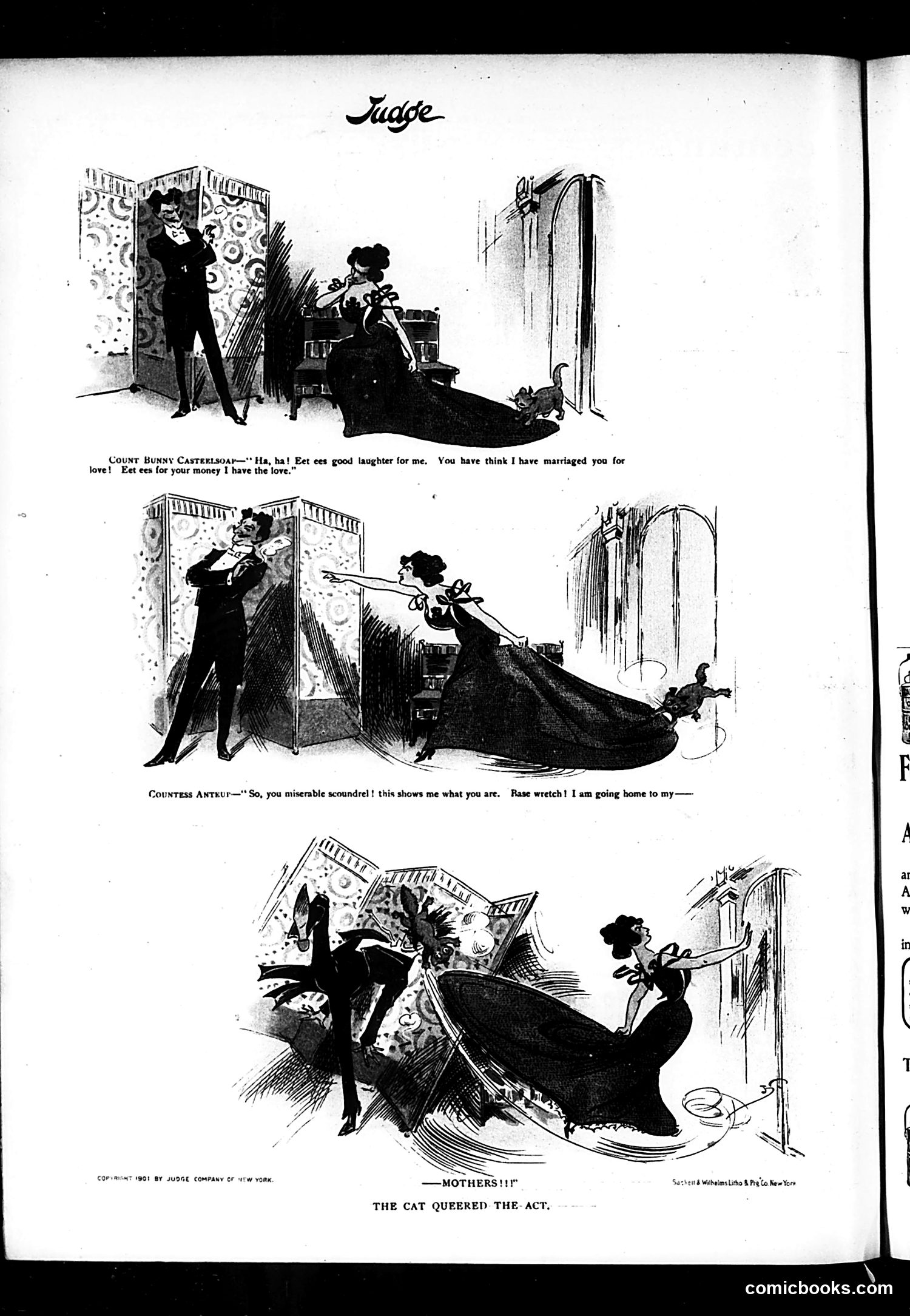
This three-panel comic satirizes a marriage of convenience. "Count Bunny Castersoap" (a satirical name mocking European nobility) initially boasts to his new wife about marrying her purely for money, not love—a cynical admission presented for laughs. The subsequent panels show the couple's domestic chaos escalating, with the wife physically attacking the count with increasing violence. The title's punchline suggests a cat—visible in the final panel—has disrupted their arrangement, "queering" (spoiling) the count's mercenary scheme. The satire targets both the count's arrogant candor about marital fraud and the wife's violent response. It reflects early-1900s anxieties about transatlantic marriages between wealthy American women and impoverished European aristocrats seeking dowries—a common social commentary in period magazines like *Judge*.
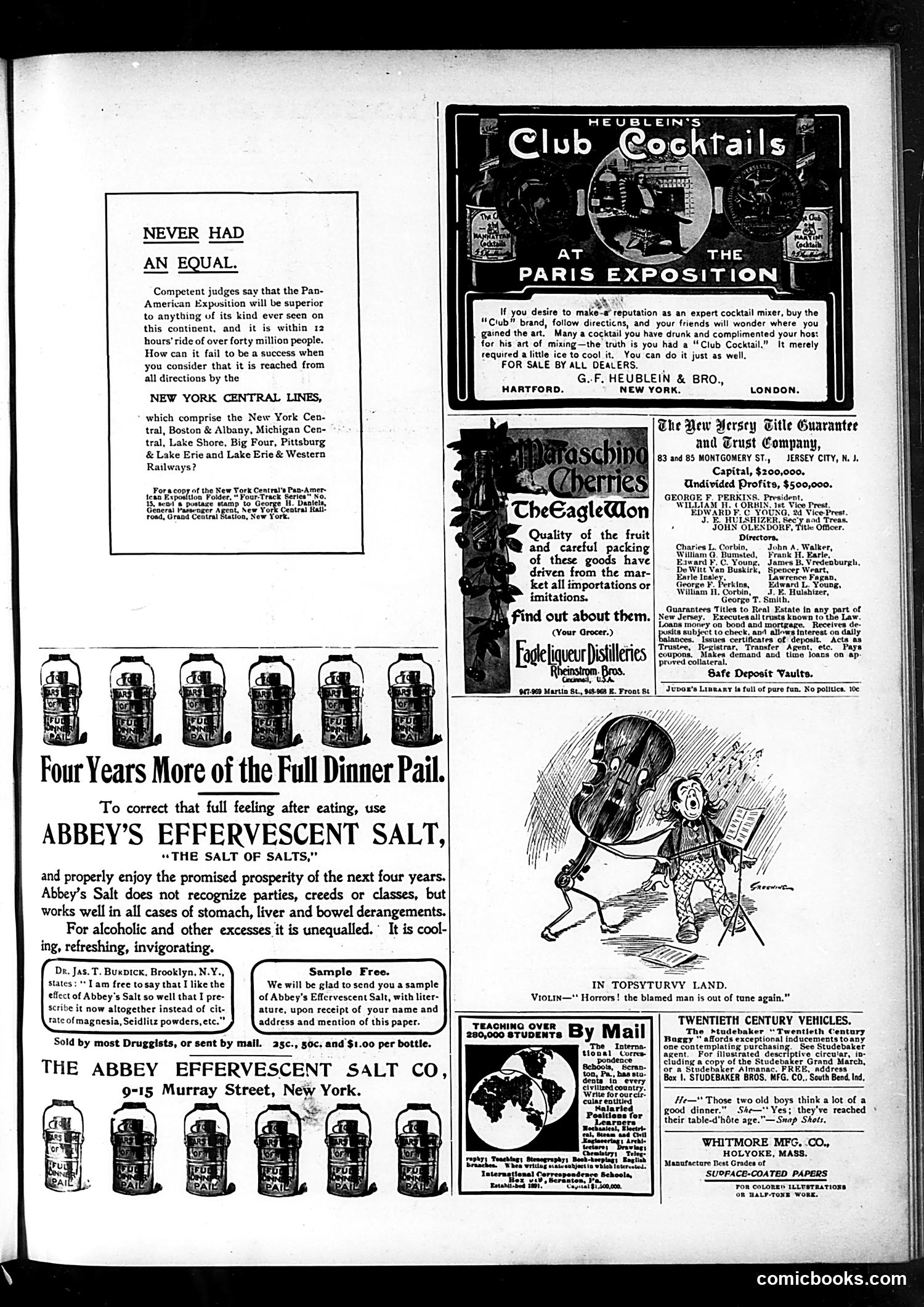
This page is primarily **advertisements** with minimal editorial cartooning. The key content: ## Main Advertisers: - **Heublein's Club Cocktails**: Advertises pre-mixed cocktails as superior to bartender-made versions, claiming expertise is unnecessary - **Abbey's Effervescent Salt**: A digestive aid marketed to relieve indigestion from heavy eating, with the phrase "Full Dinner Pail" (an economic prosperity slogan of the McKinley administration) - **Various other vendors**: Musical instruments, real estate, vehicles ## The One Cartoon: A small sketch labeled "IN TOPSYTURVY LAND" shows a violinist, with the caption: "Horrors! the blamed man is out of tune again." This is mild, surreal humor with no apparent political meaning—simply absurdist comedy about a performer's frustration. **Conclusion**: This is a typical Judge page from the early 1900s, dominated by commercial advertising rather than political satire. The minimal cartoon content contains no discernible political or social commentary.
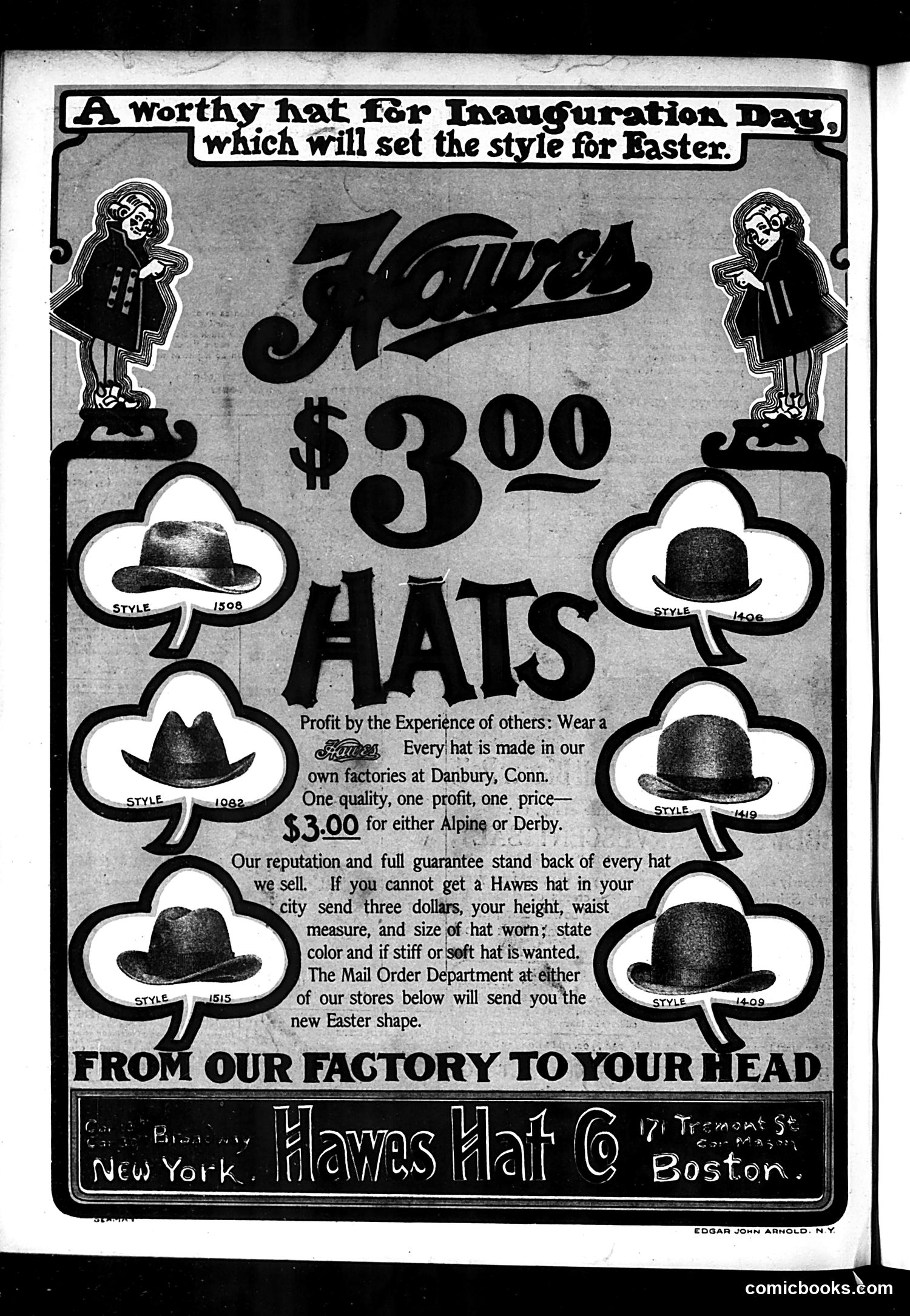
This is primarily a **hat advertisement**, not a political cartoon. It's a Hawes Hat Company ad promoting $3.00 hats for the 1909 Inauguration Day and Easter season. The page contains six illustrated hat styles displayed in cloud-shaped frames, each labeled with style numbers (1508, 1406, 1683, 1419, 1815, 1409). The decorative figures flanking the hats appear to be generic fashionable ladies of the era, not specific caricatures or political figures. The "satire" angle—if any—is the tongue-in-cheek headline suggesting that whatever hat style appears at Inauguration Day will become Easter fashion. This was likely humorous commentary on how Americans copied high-society fashion trends. The ad emphasizes direct factory-to-consumer sales and includes mail-order instructions, typical for early 1900s department store advertising. The page is essentially commercial rather than political content.