
A complete issue · 22 pages · 1900
Judge — 1900
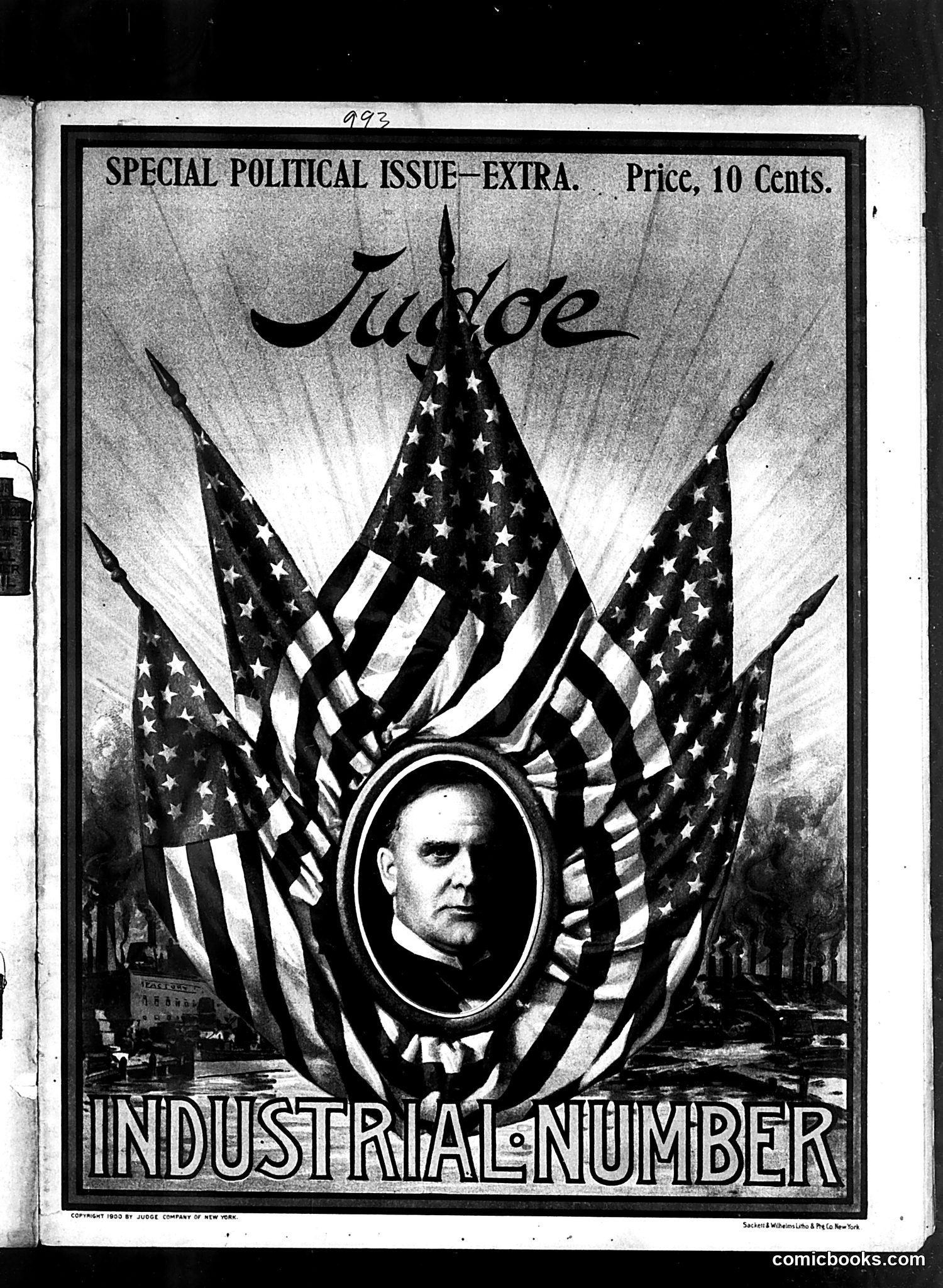
This is a special political issue cover featuring a portrait of an unidentified man in an ornamental oval frame, surrounded by American flags and radiating light—imagery typically reserved for revered political figures or candidates. The title "INDUSTRIAL NUMBER" suggests this issue focused on industrial policy or candidates' positions on industry. The elaborate patriotic staging—multiple flags, ceremonial framing, and rays of light—appears satirical, likely mocking the overwrought glorification of a particular political figure associated with industrial interests. Without identifying the specific person or election year, the satire targets the tendency to treat political candidates with exaggerated reverence, particularly regarding their industrial policy credentials. Published by Judge Company of New York.
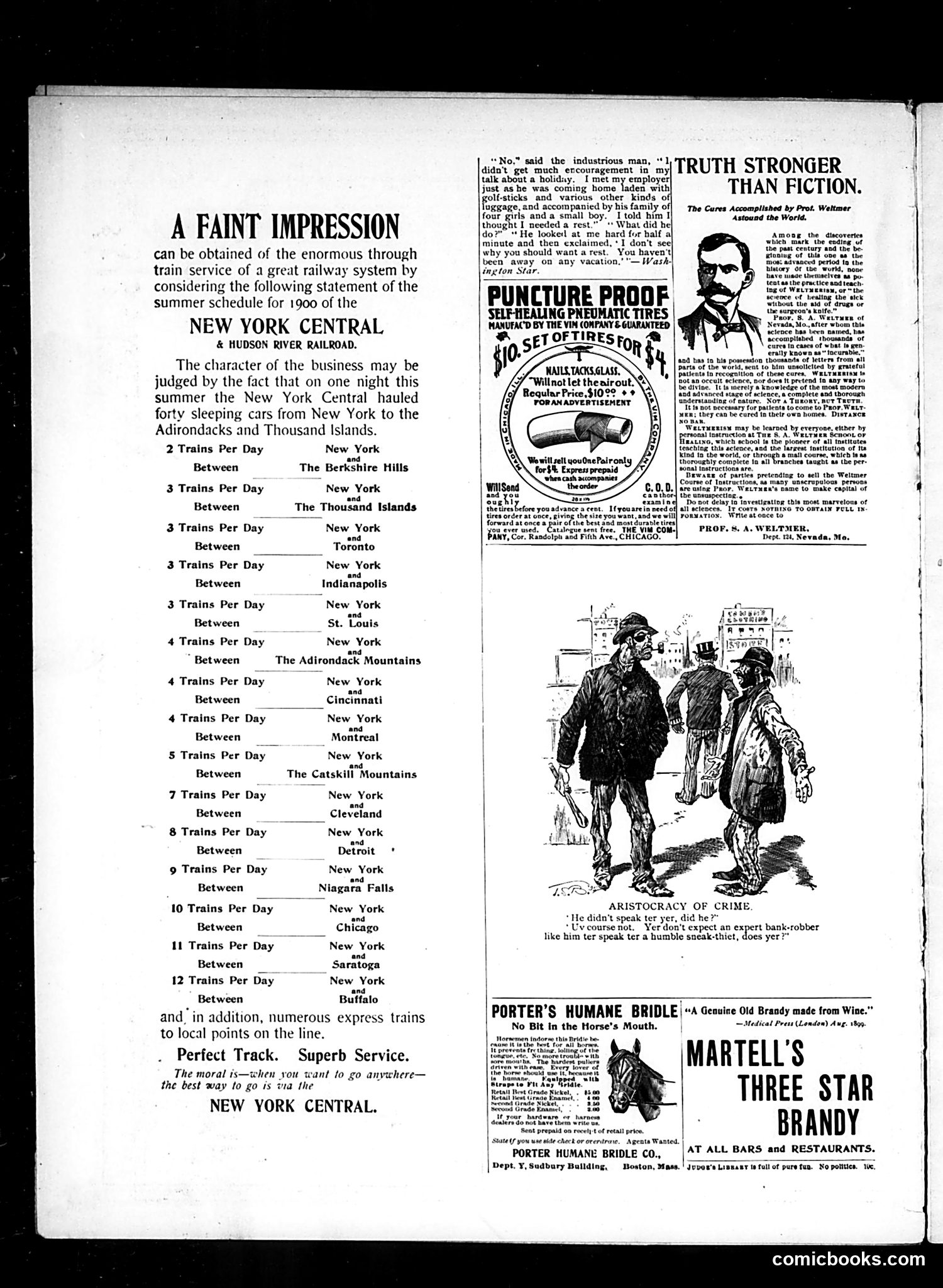
This page is primarily **advertising and railroad promotion** rather than political satire. The left column advertises New York Central & Hudson River Railroad's extensive train service, listing routes from New York to destinations like the Adirondacks, Thousand Islands, Toronto, Indianapolis, St. Louis, Cincinnati, Montreal, the Catskills, Cleveland, Detroit, Niagara Falls, Chicago, and Saratoga Springs. The right side contains separate paid advertisements for pneumatic tires, brandy, and horse bridles—typical period commercial content. The only cartoon is titled **"Aristocracy of Crime,"** depicting three rough-looking men in conversation, with a caption about bankrobbers and their social hierarchy. This is generic humor about criminal social status, not tied to specific contemporary events or figures.
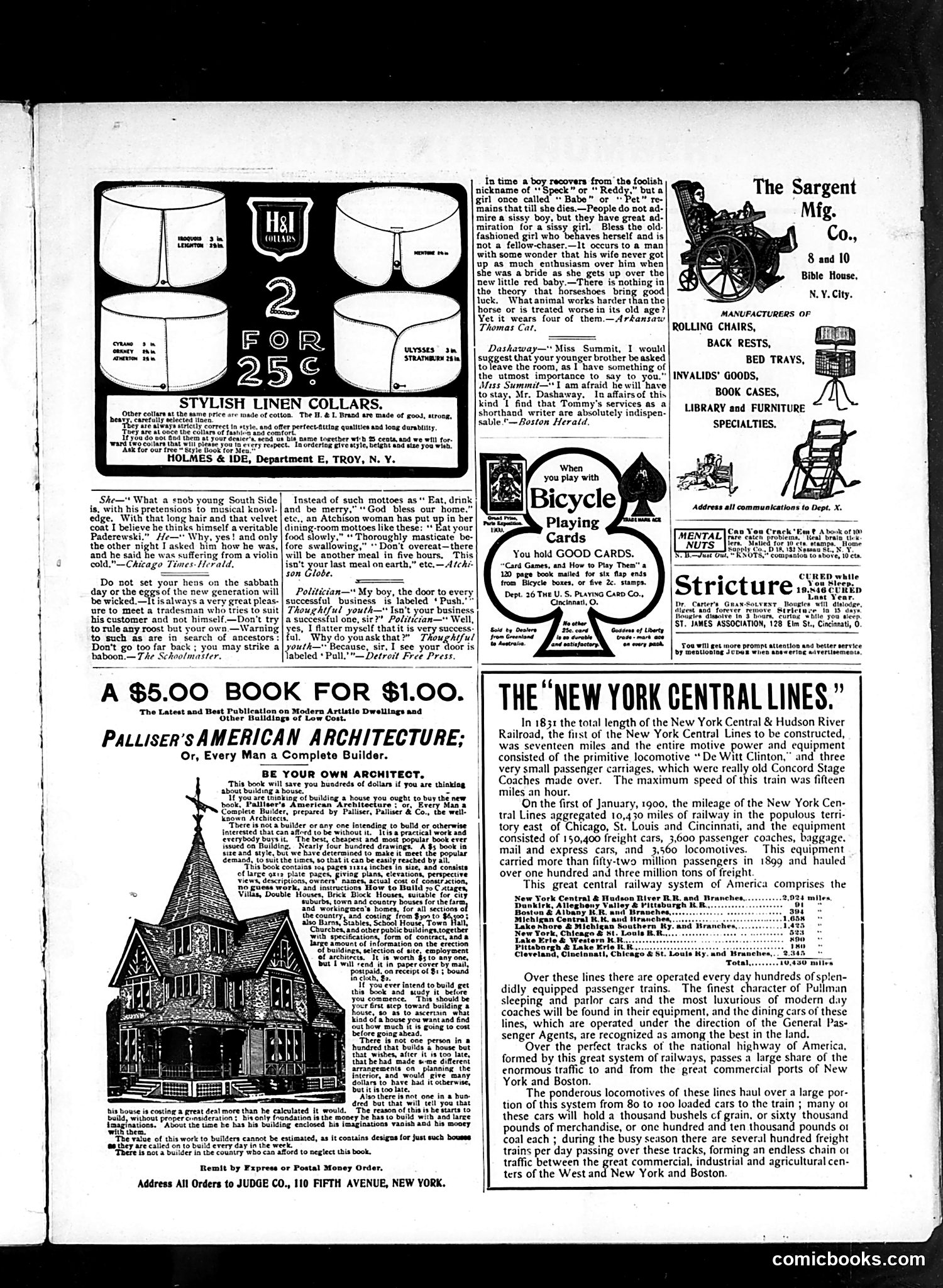
This page is primarily **advertising and miscellaneous content** rather than political satire. The main items include: - **H&I Collars advertisement** (2 for 25¢) featuring stylish linen collar designs - **Bicycle Playing Cards** promotion - **Sargent Mfg. Co.** advertisement for rolling chairs and invalid goods - **Palliser's American Architecture** book offer ($5 book for $1) - **New York Central Lines** article describing the railroad system's expansion and locomotive capabilities The scattered **humor pieces** (about South Side snobs, politicians, etc.) are brief, generic satirical quips unrelated to specific political figures or events. This appears to be a typical early 1900s Judge issue mixing advertisements with lightweight social commentary rather than hard-hitting political cartoons.
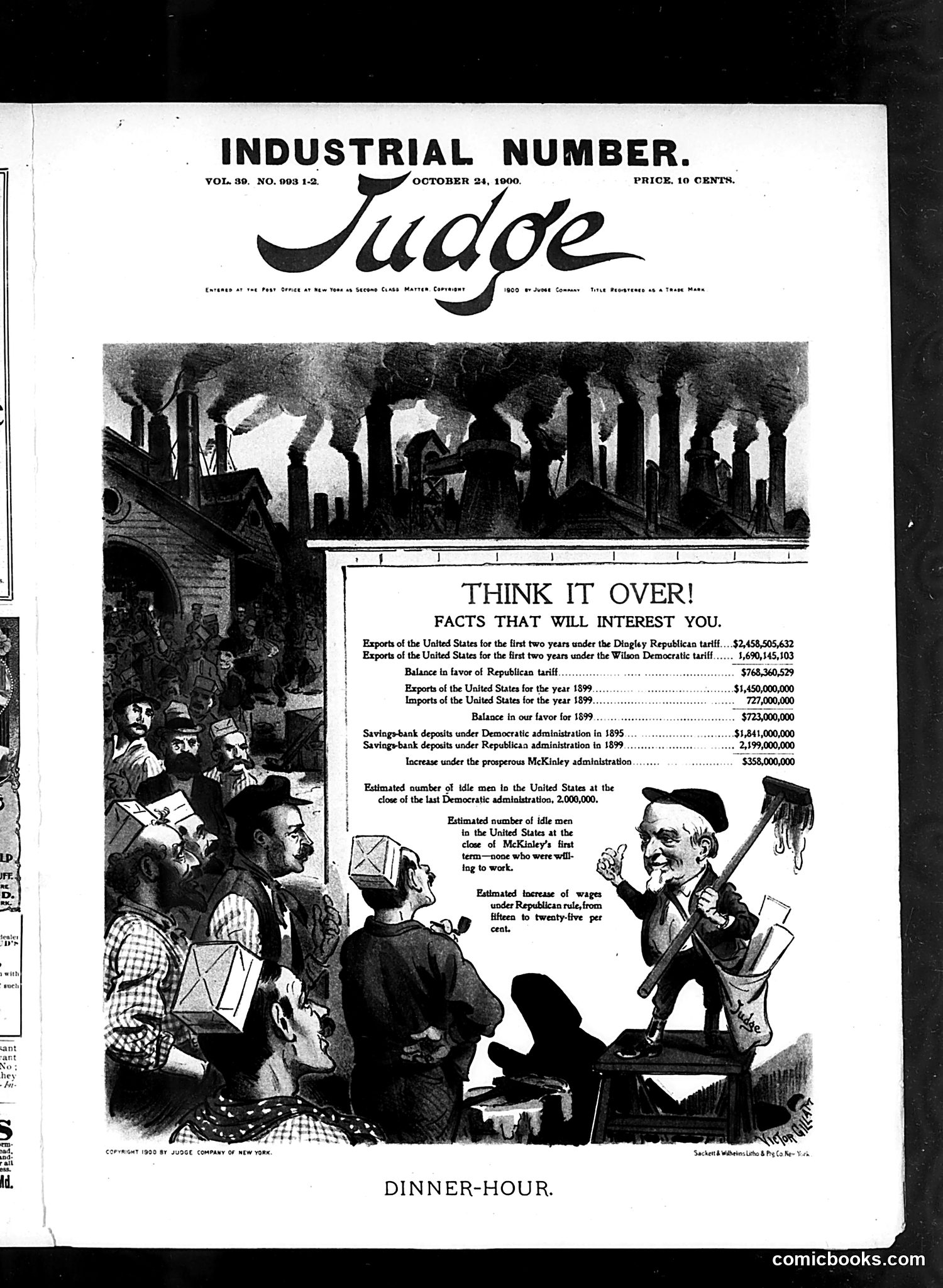
This is Republican campaign propaganda disguised as satire. The "THINK IT OVER!" section presents economic statistics arguing that the Dingley Republican tariff (1897) outperformed the earlier Wilson Democratic tariff in exports and trade balance. It claims McKinley's administration eliminated unemployment ("none who were willing to work") and increased wages. The bottom cartoon, titled "DINNER-HOUR," depicts working-class laborers (carrying lunch boxes marked with crosses) being lectured by a caricatured figure on the right—likely representing a Republican politician or McKinley supporter—who gestures triumphantly while presenting these economic "facts." The industrial skyline at top reinforces the pro-business message. The satire is directed *at* Democrats: the cartoon mocks those skeptical of Republican economic claims, suggesting they should accept the evidence. This publication appeared during the 1900 presidential election, when McKinley ran for re-election against Democrat William Jennings Bryan.
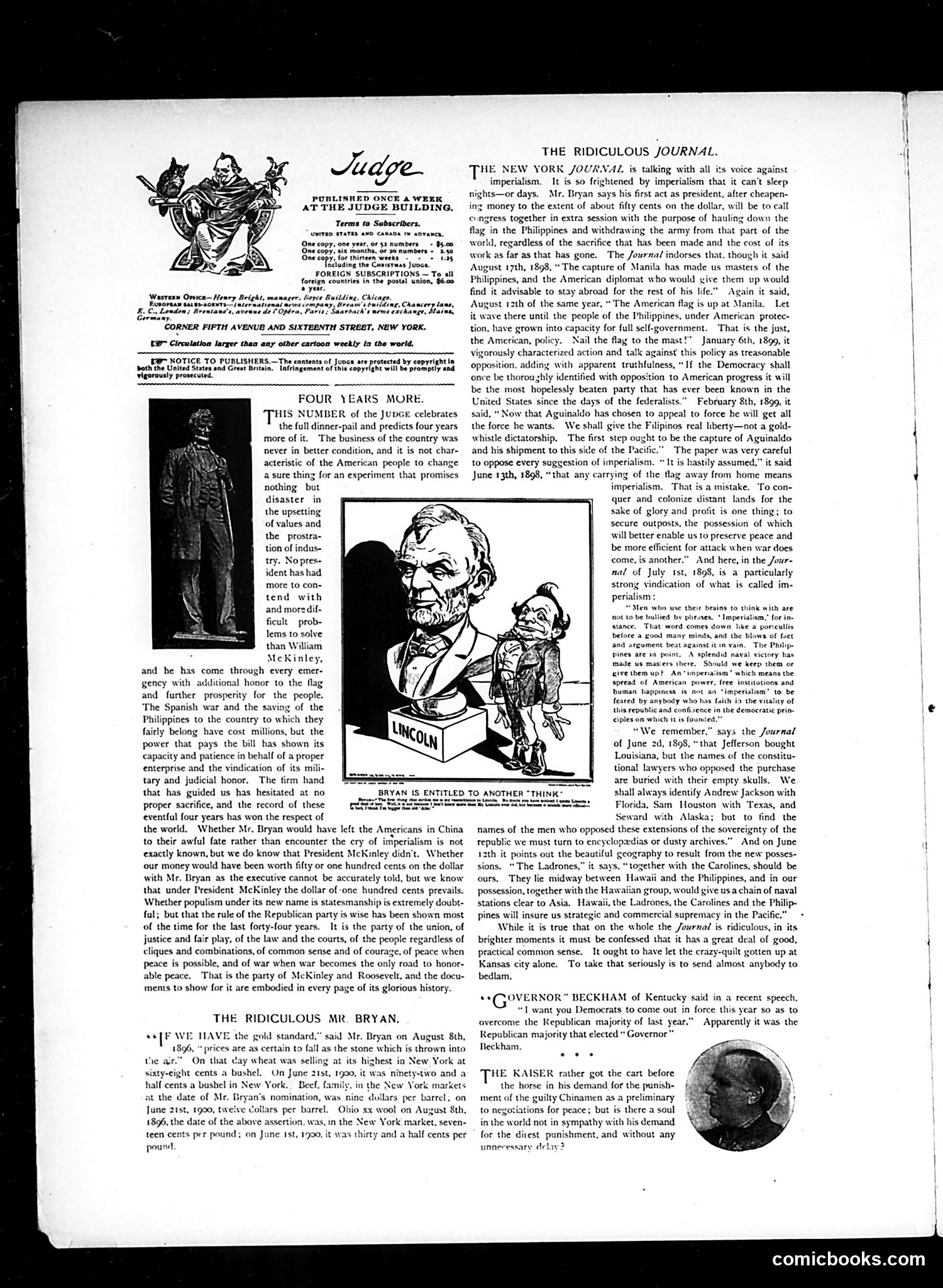
This page celebrates President **William McKinley's** re-election prospects in 1900. The main cartoon depicts **William Jennings Bryan** (labeled "Bryan is Entitled to Another 'Think'") as a small figure beside a large Lincoln bust—mocking Bryan's repeated failed presidential campaigns and his populist economic positions. The text attacks Bryan's famous 1896 prediction that adopting the gold standard would cause prices to collapse. Judge uses commodity prices (wheat, beef, wool) to argue the opposite occurred under McKinley—the economy thrived. The editorial promotes McKinley's handling of the Spanish-American War and Philippine annexation as evidence of strong leadership, contrasting this with skepticism about what Bryan would have done. The satire's core: Bryan was wrong about economic catastrophe, making him ridiculous for running again in 1900. Judge frames Republican governance as pragmatic and successful versus Democratic doom-saying.
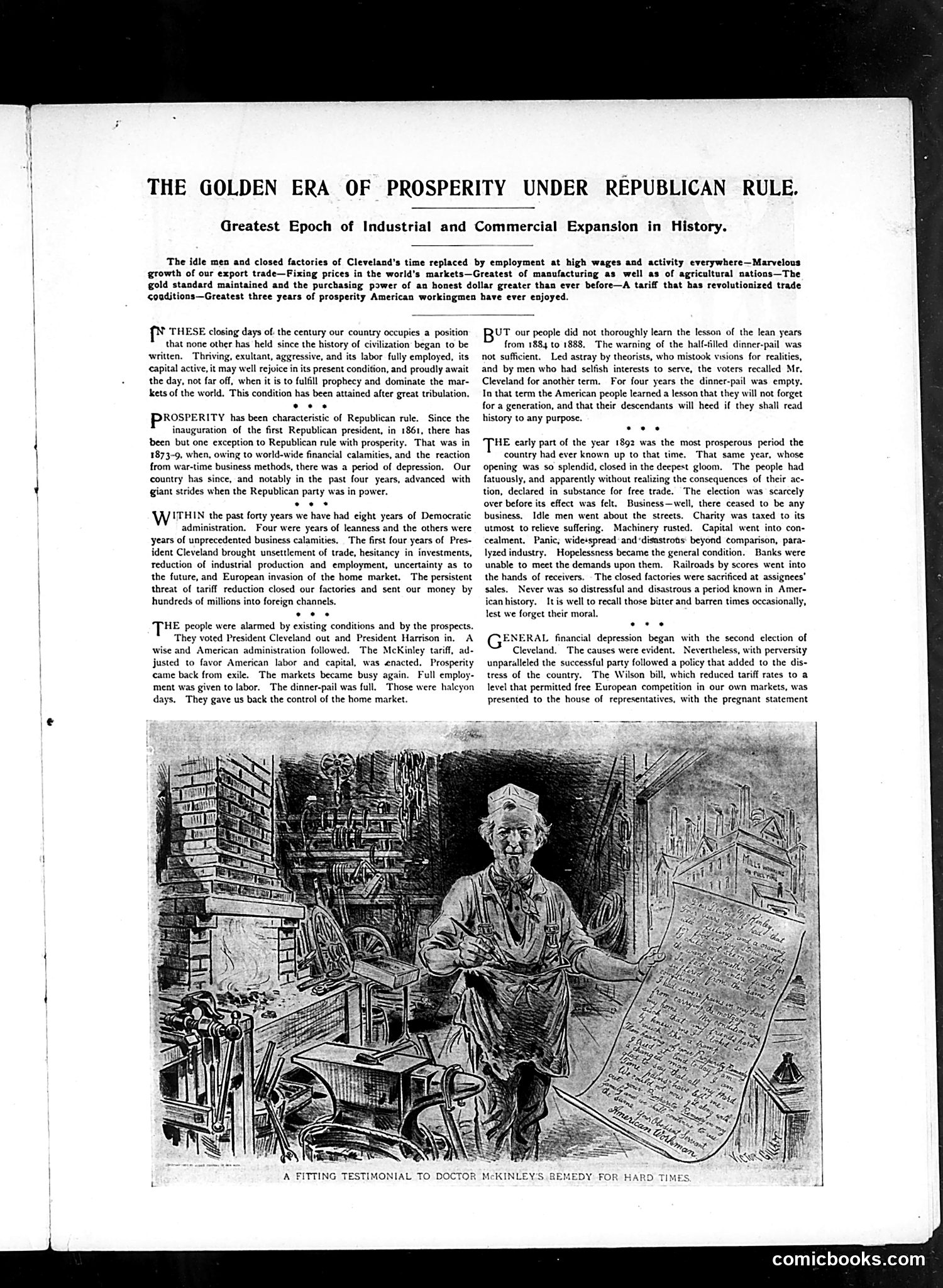
This is Republican Party campaign propaganda from Judge magazine, likely from 1896 or shortly after. The text praises Republican economic policy, particularly McKinley's protective tariff, while blaming Democratic administrations—especially Cleveland's—for economic hardship. The central illustration depicts a working man amid industrial machinery and ledgers, captioned as "A Fitting Testimonial to Doctor McKinley's Remedy for Hard Times." This is pro-McKinley political advertising disguised as editorial content. The satire targets Democratic free-trade policies. The repeated phrase "dinner-pail was full/empty" was contemporary political shorthand for worker prosperity. Republicans claim their tariff protects American labor and factories, while Democratic rule brought unemployment and suffering. The article blames Cleveland's 1892-1896 term for economic depression, crediting McKinley's 1897 tariff with restoration of prosperity—a common Republican talking point, though historical economists debate whether tariffs or other factors drove the recovery. This represents partisan media advocacy common in the Gilded Age.
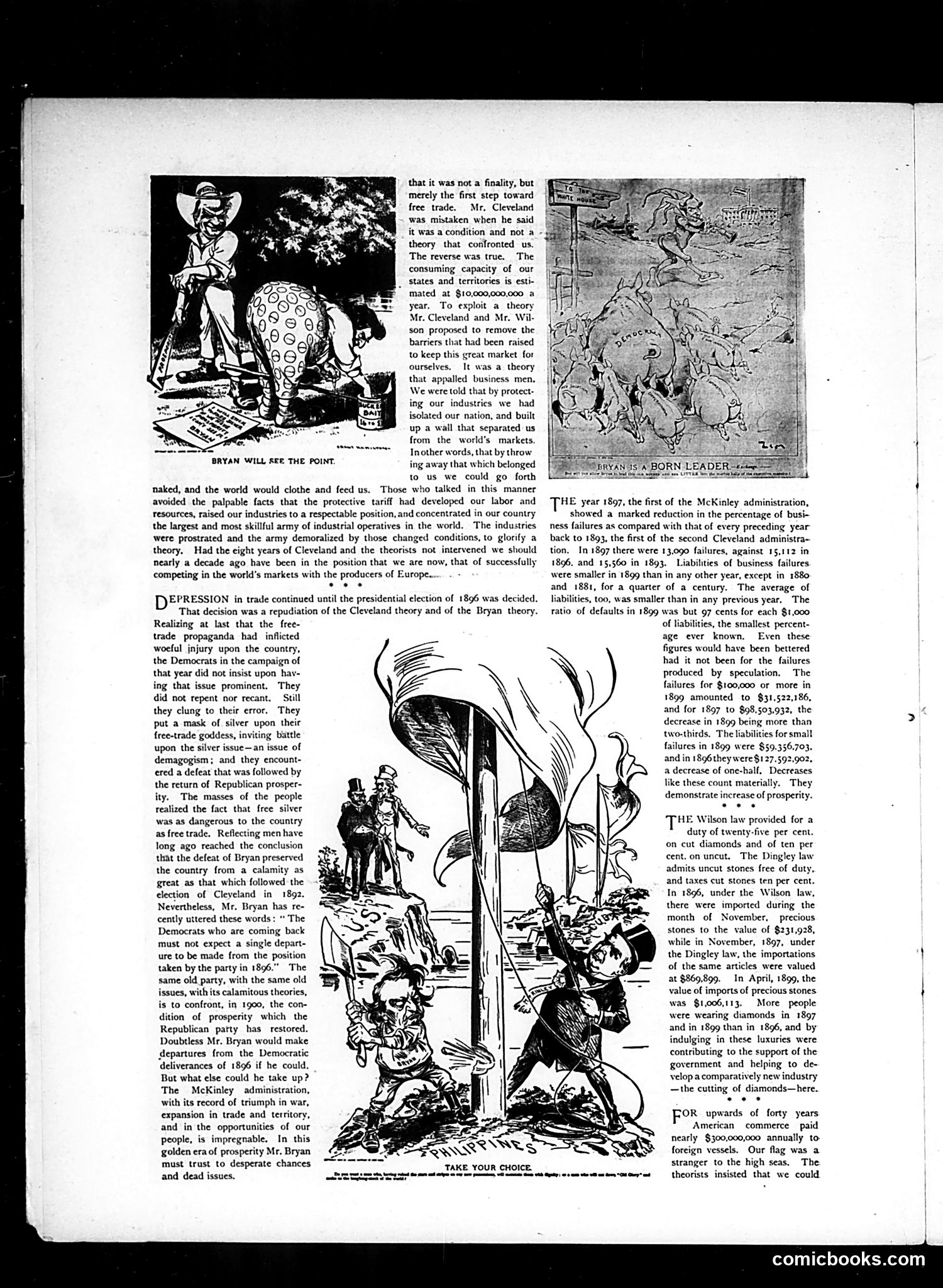
This page critiques the Cleveland and Bryan administrations' free-trade policies. The top-left cartoon, "Bryan Will See the Point," depicts William Jennings Bryan as naive—a figure being led by Lady Liberty toward economic ruin, suggesting his free-trade ideology blindly serves destructive ends. The text argues Cleveland and Bryan's removal of protective tariffs damaged American industry and caused business failures. The opposing cartoon, "Take Your Choice," presents two paths: one leads to prosperity (implicitly under McKinley's protectionist policies), the other to collapse. The right-side statistics support protectionism by showing improved business conditions after McKinley's 1897 election, citing reduced failure rates and smaller liabilities. The page essentially argues that protecting domestic industries—not free trade—built American prosperity and that Bryan's theory-driven approach was economically catastrophic.
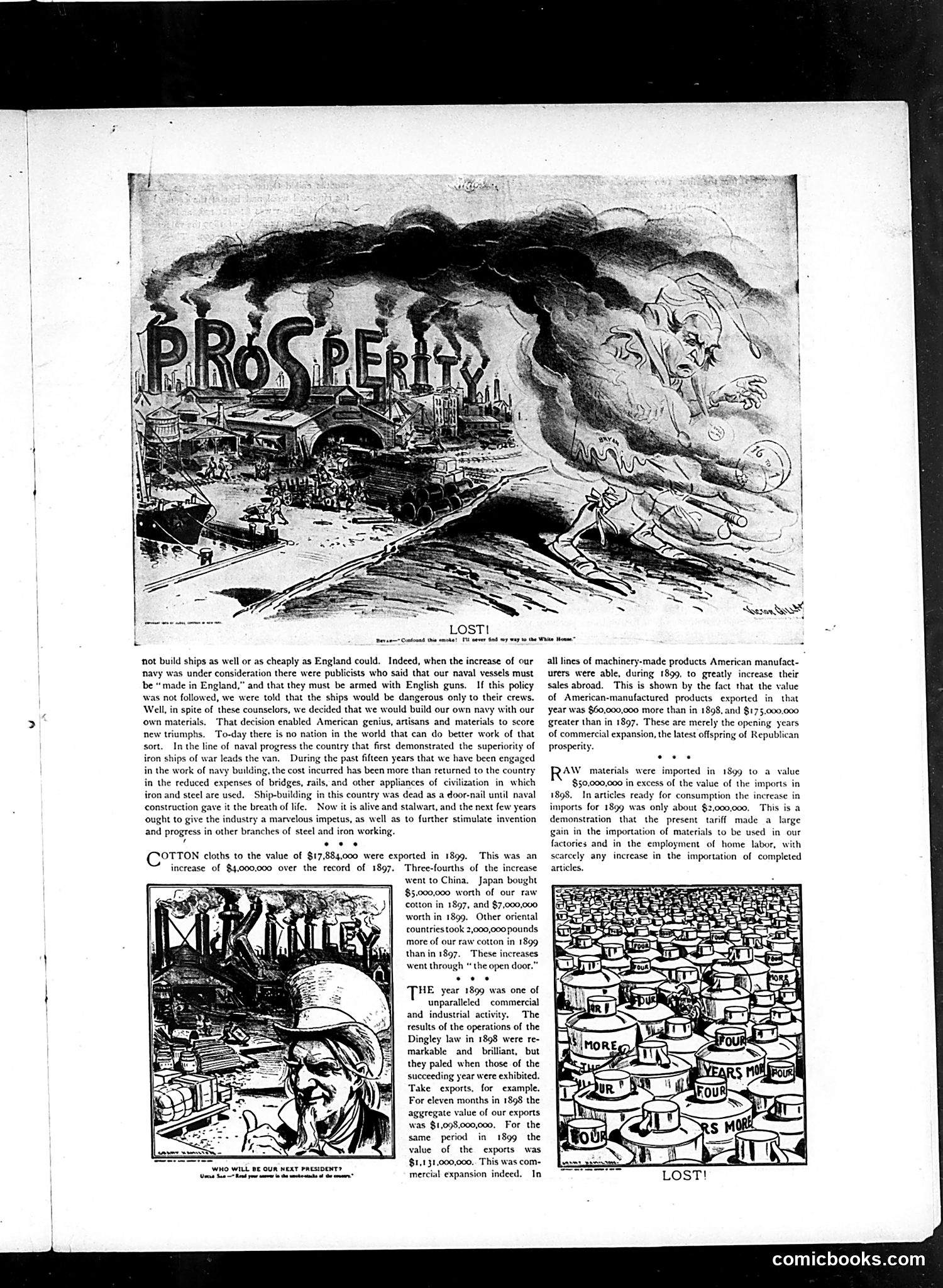
This page celebrates Republican economic policies, specifically the **Dingley Tariff of 1897**. The top cartoon depicts "Prosperity" as a cornucopia figure showering wealth upon an industrial American cityscape, contrasting with a drowning figure labeled "LOST!"—representing the opposing Democratic position. The text boasts of American naval shipbuilding superiority (countering critics who said American-made ships were inferior), cotton exports to China and Japan, and record export values in 1899 ($1.131 billion). The smaller illustrations show a prosperous McKinley-era worker and barrels of goods, emphasizing manufacturing success. The cartoons argue that protective tariffs enabled American industry to flourish domestically while still achieving massive exports—framing this as "Republican prosperity." The "LOST!" imagery suggests Democrats' alternative policies would have been economically ruinous. This is straightforward partisan advocacy celebrating incumbent Republican economic achievements.
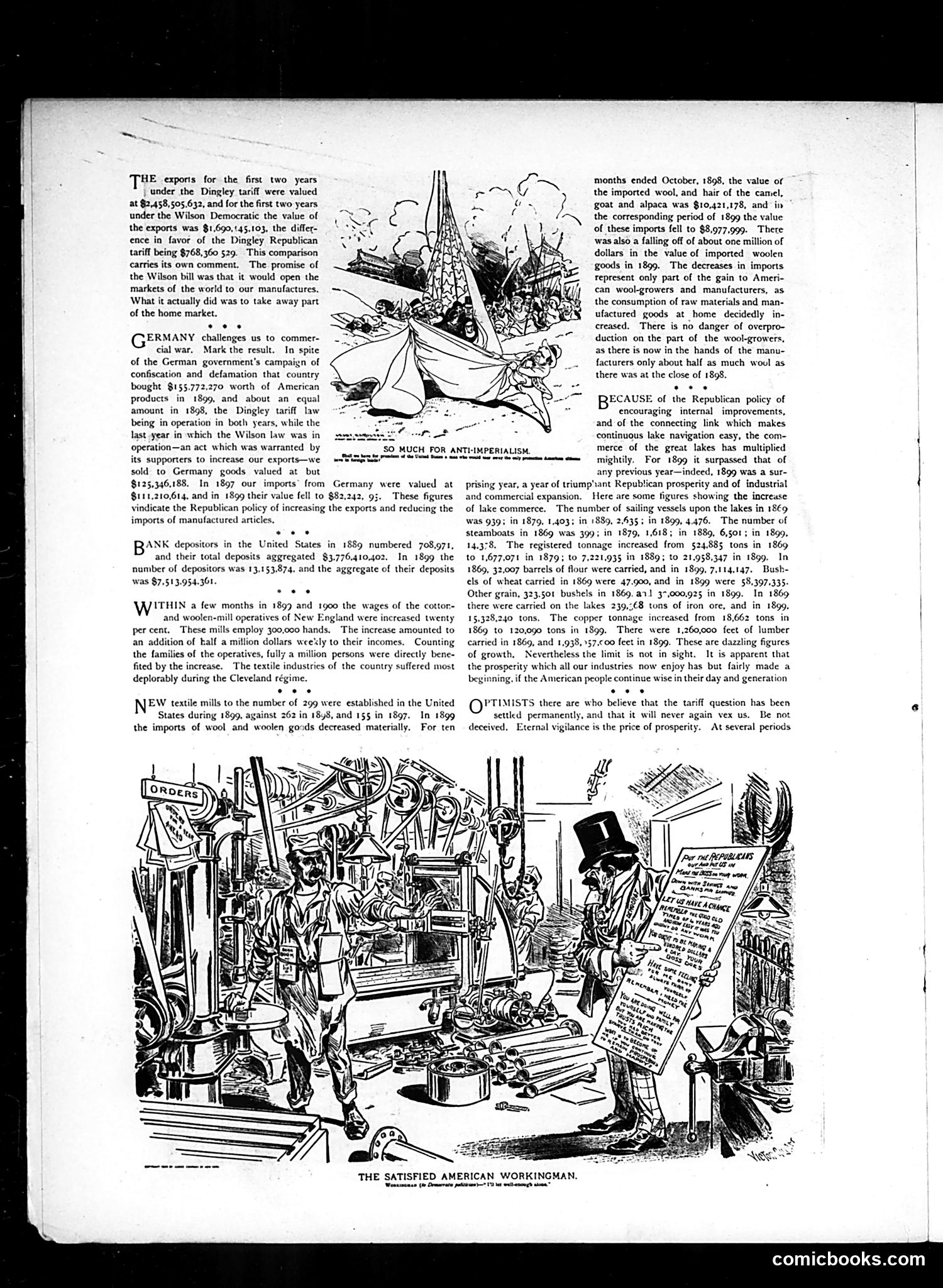
This Judge magazine page celebrates Republican economic policy under the Dingley Tariff (1897) versus the preceding Wilson Democratic tariff. The bottom cartoon depicts a satisfied industrial worker surrounded by prosperity—factory machinery, full order books, and visible contentment. The accompanying text argues the Republican tariff succeeded where Democrats failed: exports under Dingley ($2.458 billion over two years) exceeded Wilson-era exports ($1.690 billion), domestic wages increased 20% for New England textile workers, and 299 new mills opened in 1899. Even German trade and lake commerce expanded despite international tensions. The satire's point: protectionist Republican policies created American prosperity and worker satisfaction, contradicting Democratic promises that lower tariffs would "open world markets." The cartoon celebrates the working class as direct beneficiary of GOP tariff policy—a politically strategic image for the magazine's Republican audience.
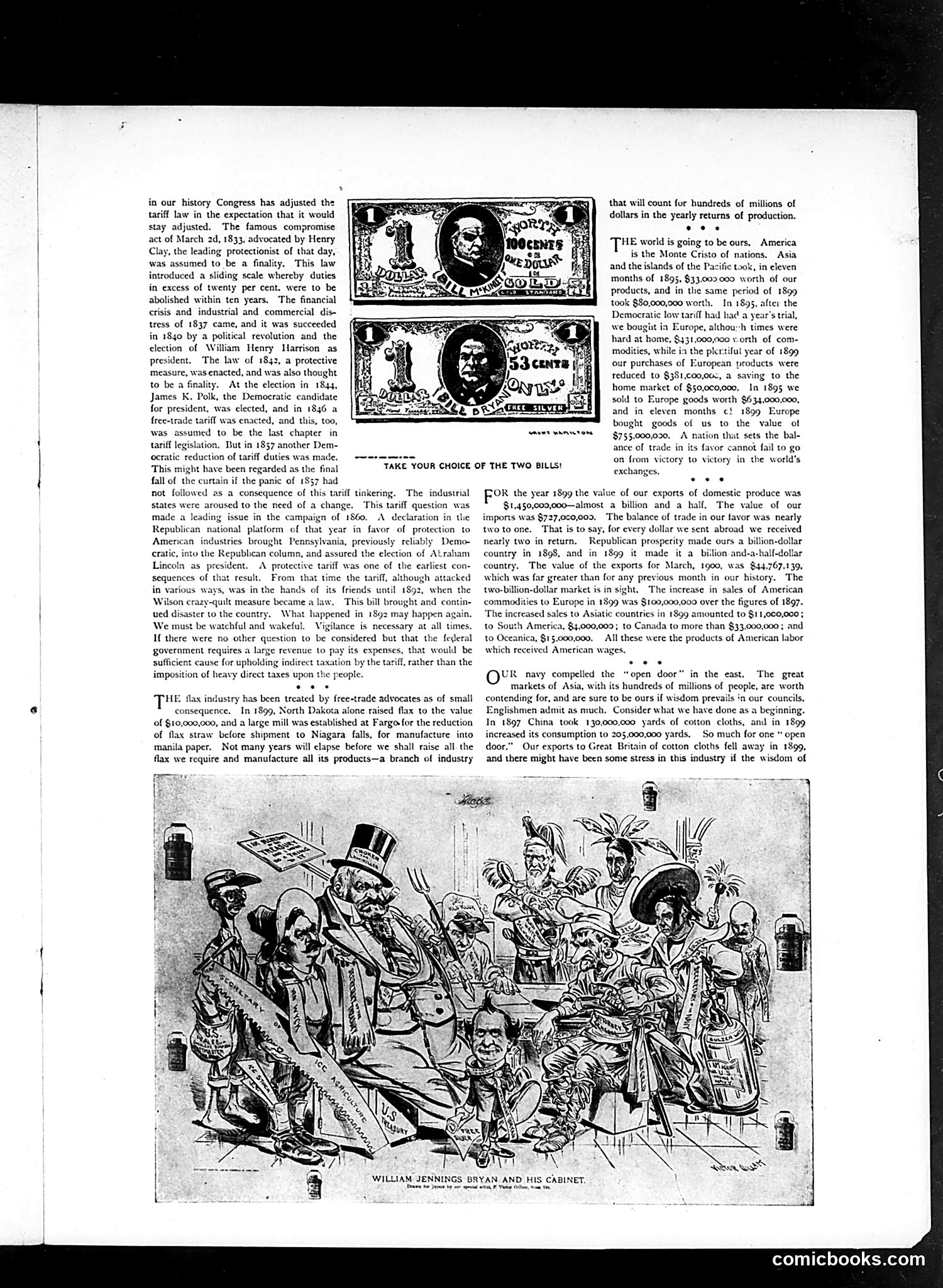
This page argues for **protective tariffs** against free-trade advocates, particularly targeting **William Jennings Bryan**, the Democratic presidential candidate shown caricatured at the bottom with his "Cabinet." The text celebrates America's trade dominance under Republican tariff policies—exports to Asia jumped from $33 million (1895) to $80 million (1899), while a protective tariff allegedly grew exports to $1.45 billion by 1899. The article criticizes the 1892 Wilson tariff (Democratic, low-tariff) as disastrous, contrasting it with Republican "prosperity." The cartoon depicts Bryan surrounded by grotesque, exaggerated international figures—caricatures representing foreign nations or interests—suggesting that Bryan's free-trade position serves foreign, not American, interests. The imagery implies that electing Bryan would surrender American economic advantage. The two currency images at top appear to contrast American strength with alternatives. **Context for modern readers:** This reflects the 1890s-1900 tariff debate between protectionists (Republicans) and free-traders (Democrats), with economic nationalism framed as patriotic prosperity.
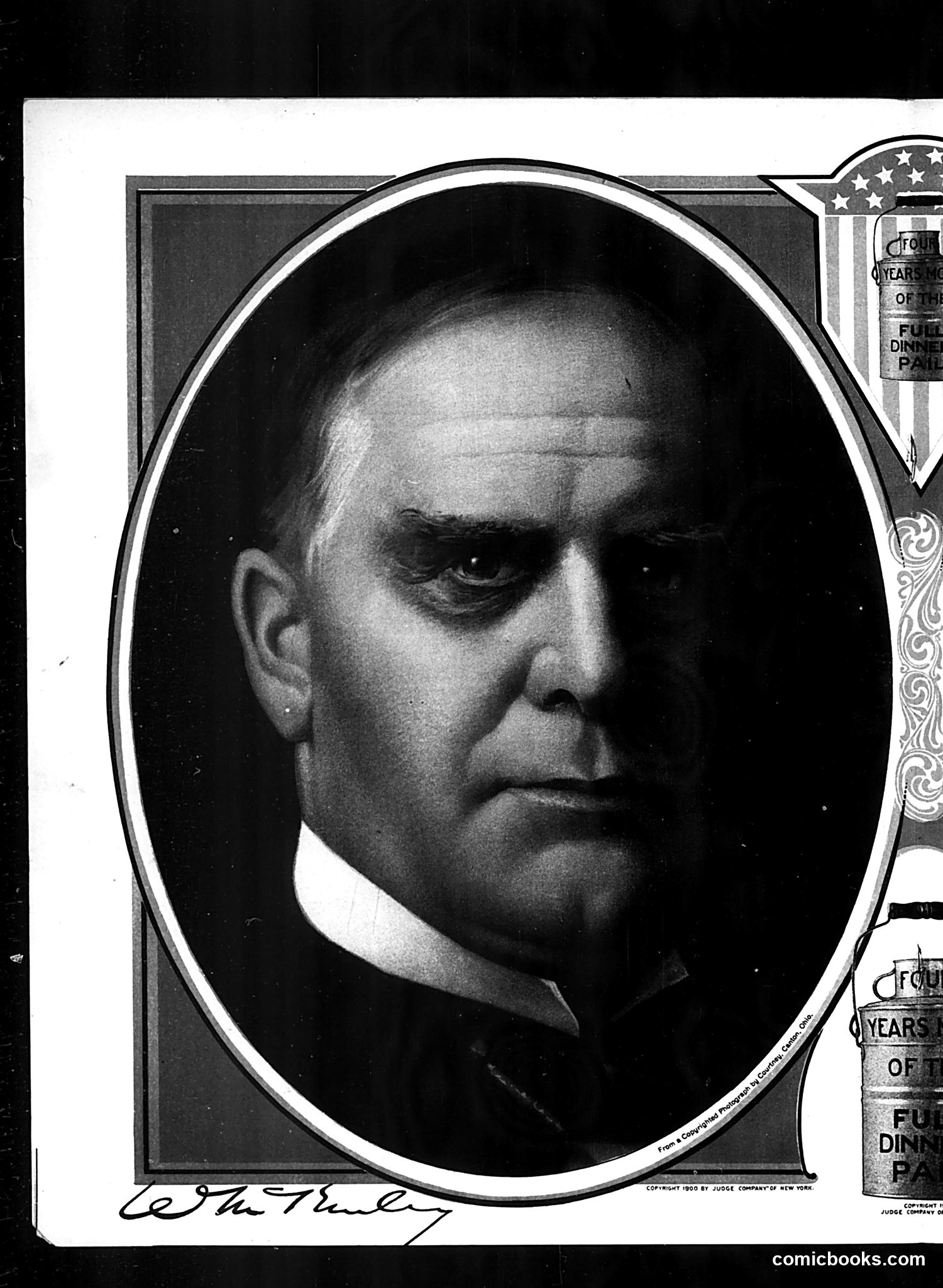
This appears to be a **portrait page from Judge magazine**, likely from the early 1900s (based on the copyright line and photographic style). The oval-framed portrait shows a formal male figure in profile, wearing a white collar and dark suit, looking stern or serious. The signature at the bottom is present but illegible in this reproduction. Without being able to read it clearly or identify the specific individual from facial features alone, I cannot definitively state who this person is or what political/social commentary the page intends. The decorative border and patriotic elements (visible stars) suggest this was a notable public figure worthy of Judge's editorial attention, but the specific satire or point cannot be reliably determined from the image and OCR text provided.
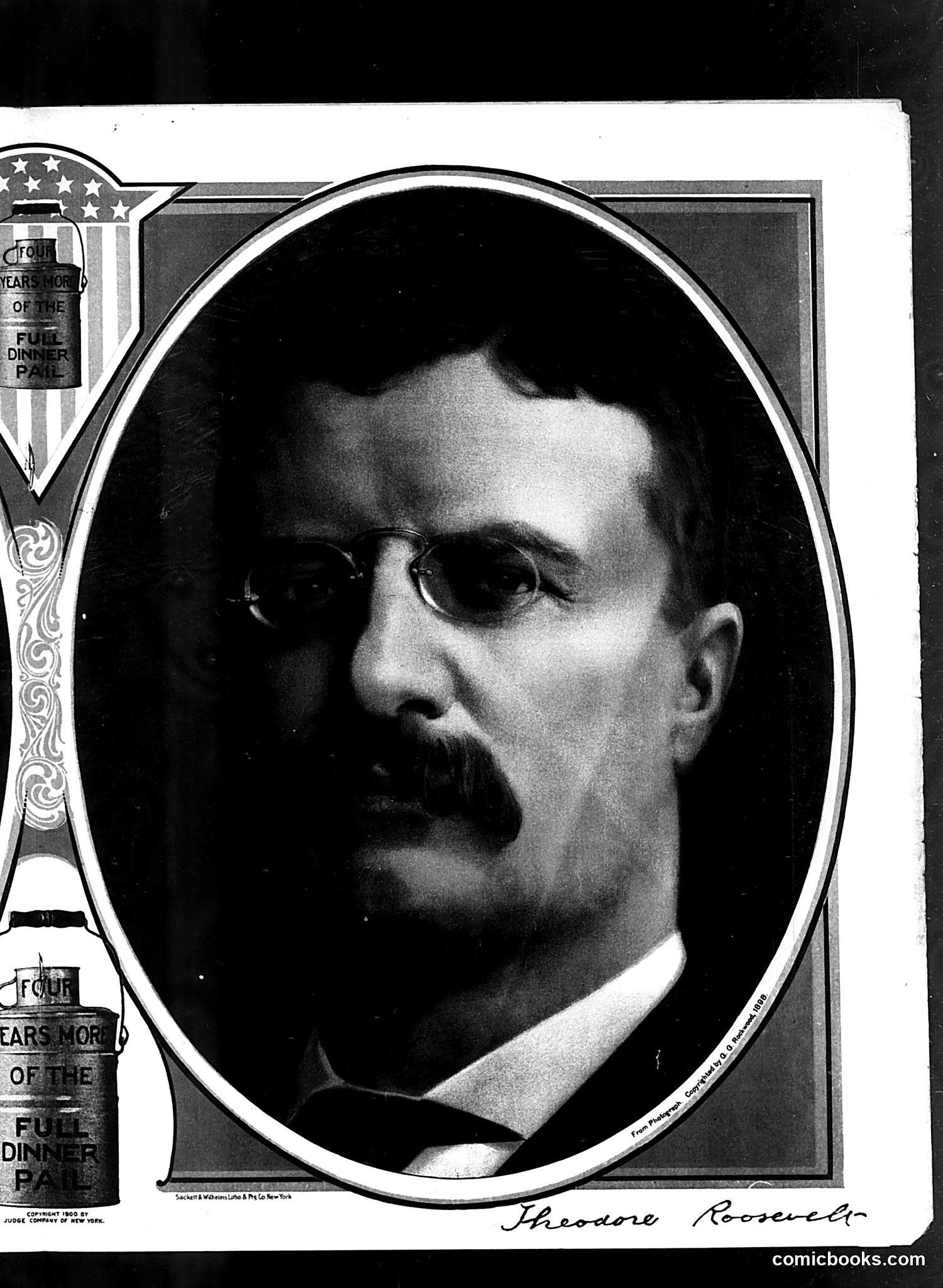
This page from Judge magazine (copyright 1900) features a portrait photograph of **Theodore Roosevelt**, identified by the signature at bottom. The image shows him in profile wearing glasses and formal attire with a distinctive mustache. The left margin includes decorative advertising for "**Full Dinner Pail**" — a Republican campaign slogan from 1900 promising prosperity and employment. This connects Roosevelt to McKinley's re-election campaign, emphasizing economic security for American workers. The "Full Dinner Pail" was a key Republican messaging tool during this era, suggesting that Republican policies ensured workers could feed their families. Roosevelt, then Vice President, became central to this political narrative promoting American economic prosperity and strength.
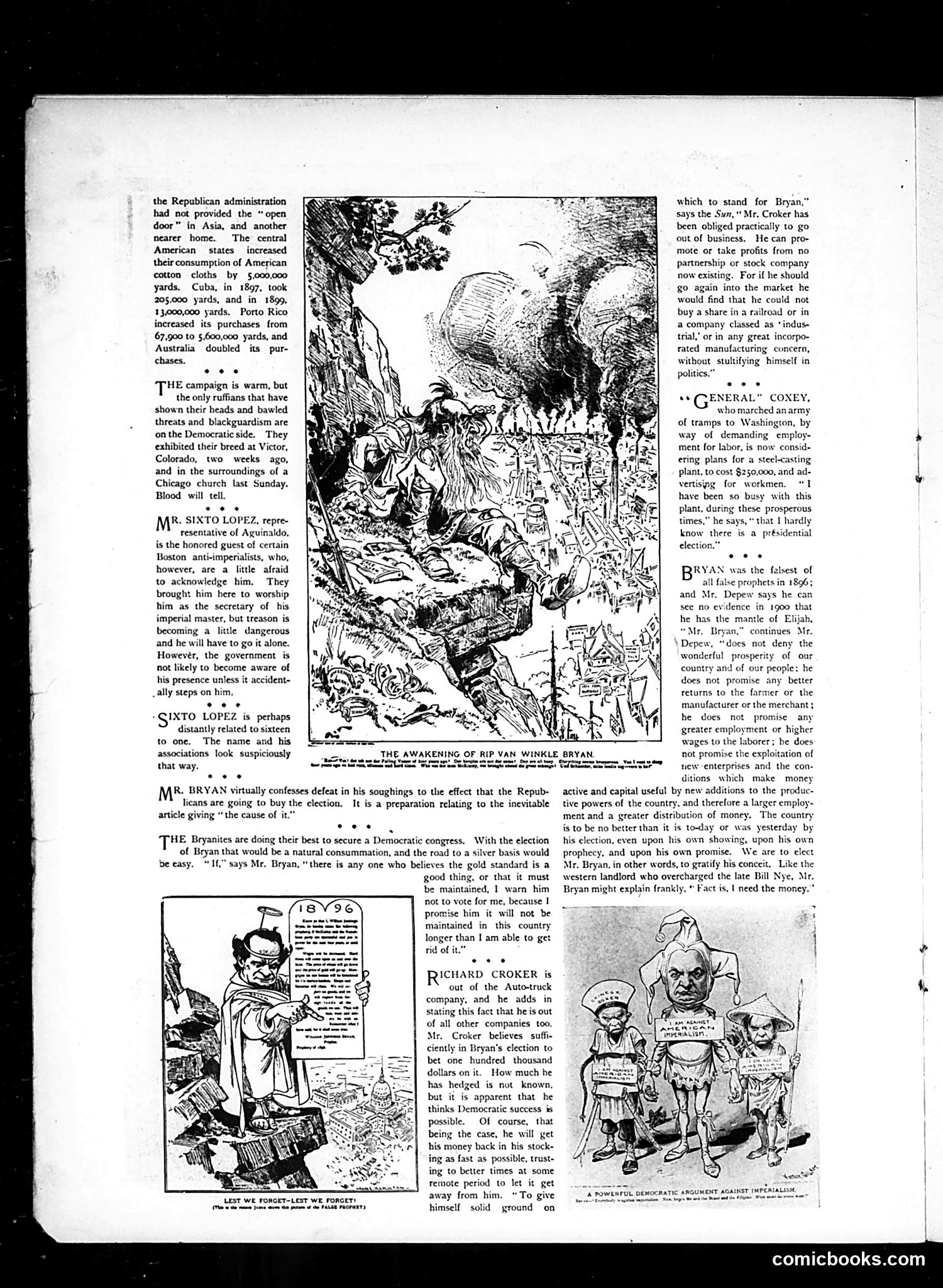
This 1900 page attacks William Jennings Bryan and Democratic candidates through multiple cartoons and commentary. **Main Figures:** - **Bryan** (referenced throughout): Democratic presidential candidate, depicted as "Rip Van Winkle"—sleeping through Republican prosperity - **Richard Croker**: Tammany Hall boss betting on Bryan while supposedly divesting from businesses - **General Coxey**: Former labor activist now running a steel plant, ignoring the election - **Sixto Lopez**: Filipino independence representative welcomed by Boston anti-imperialists (implicitly treasonous) **Key Political Points:** The satire argues Republicans have delivered economic success (increased cotton exports, prosperity) while Democrats resort to "blackguardism." Bryan's warnings about gold standards are mocked as outdated. Croker's large Bryan bet is portrayed as hypocritical—he claims to support Bryan yet remains entangled in capitalist ventures. The cartoons ridicule Democratic pessimism amid Republican prosperity.
This is primarily an **advertising page**, not satirical content. It contains three distinct advertisements: 1. **Johnson's Digestive Tablets** (top left): Promotes a patent medicine for dyspepsia (indigestion) made from papaya extract, claiming doctors use them. 2. **Southern Pacific Railroad** (center-left): Advertises the "Sunset Limited" luxury train service connecting New York to California, Mexico, and international ports, emphasizing comfort and Pullman accommodations. 3. **The Prudential Insurance Company** (right): Lists policy features including cash loans, dividends, paid-up insurance options, and claims that $56 million in ordinary business was written in 1899. Features company president John F. Dryden and Newark headquarters. **No satire is present.** This represents typical Judge magazine content: commercially-oriented advertisements alongside editorial matter. The Prudential ad's emphasis on policyholder protections reflects early insurance industry competition for consumer trust.
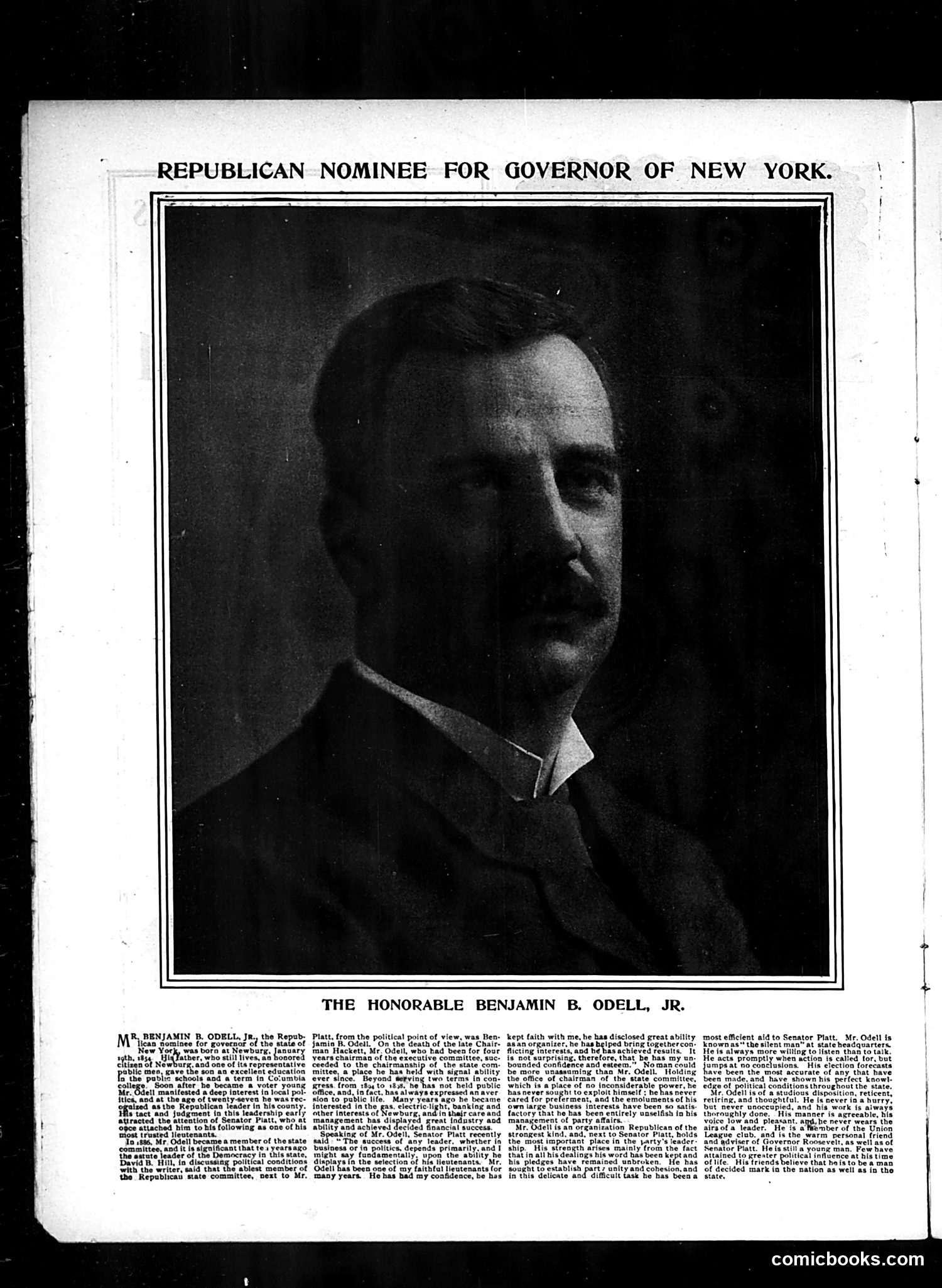
This is a promotional profile page, not a satirical cartoon. It presents Benjamin B. Odell Jr. as the Republican gubernatorial nominee, emphasizing his qualifications through biographical detail and endorsement. **Key figures:** Odell himself (the subject), Senator Platt (Republican party boss who mentored him), and Governor Roosevelt (whom Odell advises). **The pitch:** Odell is portrayed as an effective, humble organizer—a "silent man" who listens more than talks, with proven ability managing party affairs and business interests. The text highlights his loyalty to party leadership and quotes Platt's confidence in him. **Context for modern readers:** This represents the "machine politics" era when party bosses like Platt controlled nominations. Odell's appeal isn't populist charisma but competent backroom management—exactly what a state party apparatus needed. His connection to the popular Roosevelt adds legitimacy.
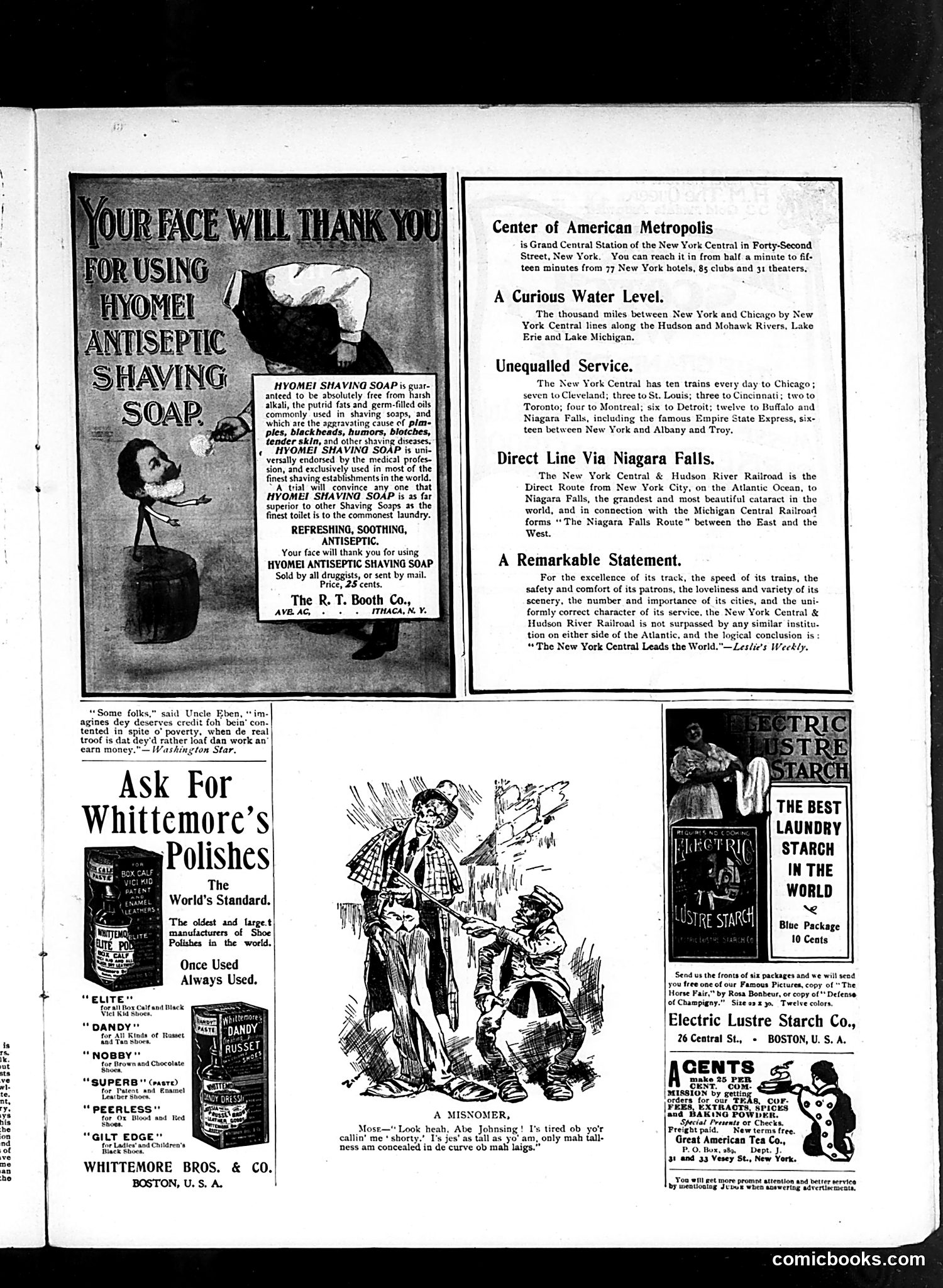
This page is primarily **advertising**, with one cartoon insert. The main content promotes the New York Central Railroad and various consumer products (shaving soap, shoe polish, laundry starch). ## The Cartoon The central illustration depicts a dialogue between two Black figures—one tall and thin, one short. The caption reads: "More—'Look heah, Abe Johnsin'! I's tired ob yo'r callin' me 'shorty.' Is jes' as tall as yo' am, only mah tallness am concealed in de curve ob mah laigs." This uses **racial caricature and dialect** common to the era's "humor." The joke plays on physical differences and employs demeaning stereotypes typical of early-20th-century American publications. For modern readers, this reflects the casual racism embedded in popular media of that period—what would be considered deeply offensive today was presented as lighthearted entertainment. The railroad and product advertisements frame this content, illustrating how such material existed alongside commercial messaging in contemporary periodicals.
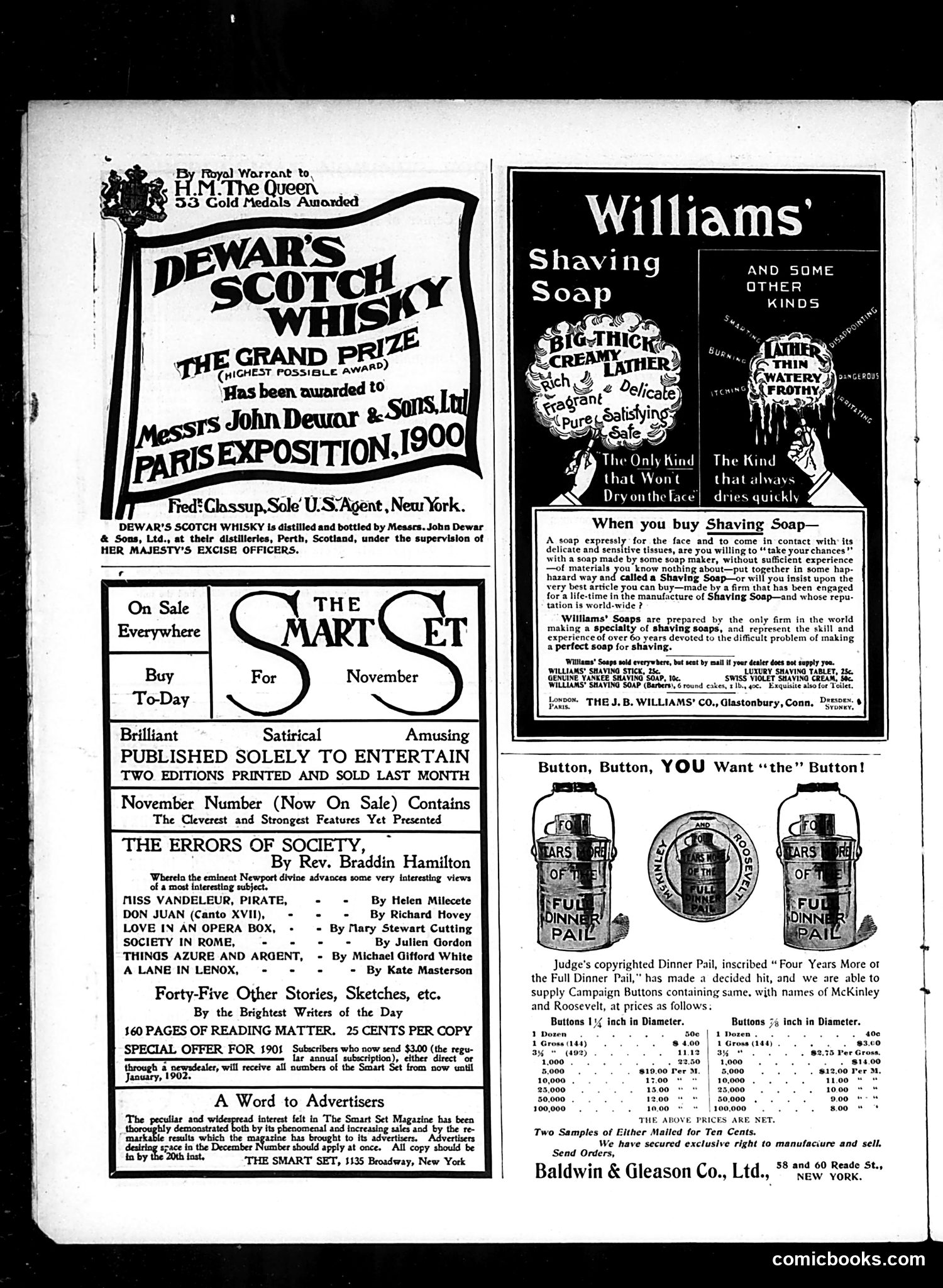
This page is primarily **advertising and promotional content** rather than satirical cartoons. The main content includes: 1. **Dewar's Scotch Whisky ad** — promotes the brand's Grand Prize at the 1900 Paris Exposition, establishing prestige through official recognition. 2. **The Smart Set magazine promotion** — announces the November issue containing stories by notable writers, with a special subscription offer for 1901. 3. **Williams' Shaving Soap ad** — emphasizes the brand's 60-year specialization in shaving products, contrasting their expertise against generic soap makers. 4. **McKinley-Roosevelt Campaign Buttons** — advertises buttons featuring the "Dinner Pail" slogan (representing prosperity under Republican leadership), available in various sizes. This references the 1900 presidential campaign where the "Full Dinner Pail" was a key Republican messaging point. The page reflects early 1900s consumer culture and political advertising rather than satirical commentary. The Roosevelt reference dates this to the 1900 campaign period.
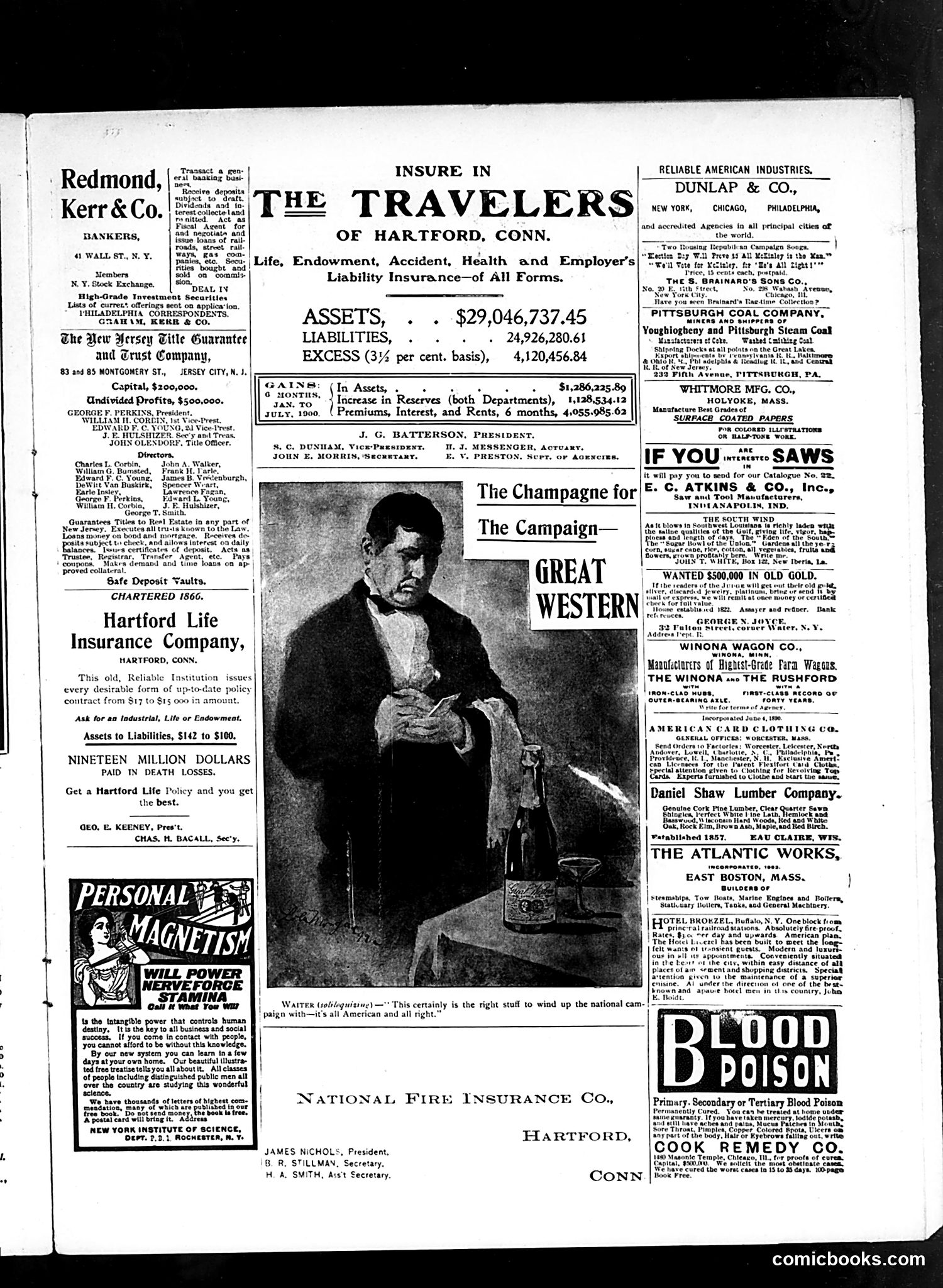
This is primarily an **advertising page** from Judge magazine, not a political cartoon. The page features multiple insurance and industrial company advertisements framing a central image. The central illustration depicts a **waiter in formal attire**, captioned with a soliloquy about winding up "the national campaign"—describing it as "all American and all right." The caption's vague phrasing and the waiter's thoughtful pose suggest gentle satire about American commercialism and nationalism, though the specific campaign being referenced is unclear from the visible text. The surrounding advertisements—for Hartford Life Insurance, The Travelers Insurance, Hartford Fire Insurance, and various manufacturing companies—create an ironic context: while the waiter muses about American values, the page itself is saturated with corporate messaging about profit, assets (nearly $30 million), and commercial enterprise. The overall effect satirizes how American identity and patriotism become intertwined with corporate interests and commerce—a subtle critique disguised within advertisements themselves.
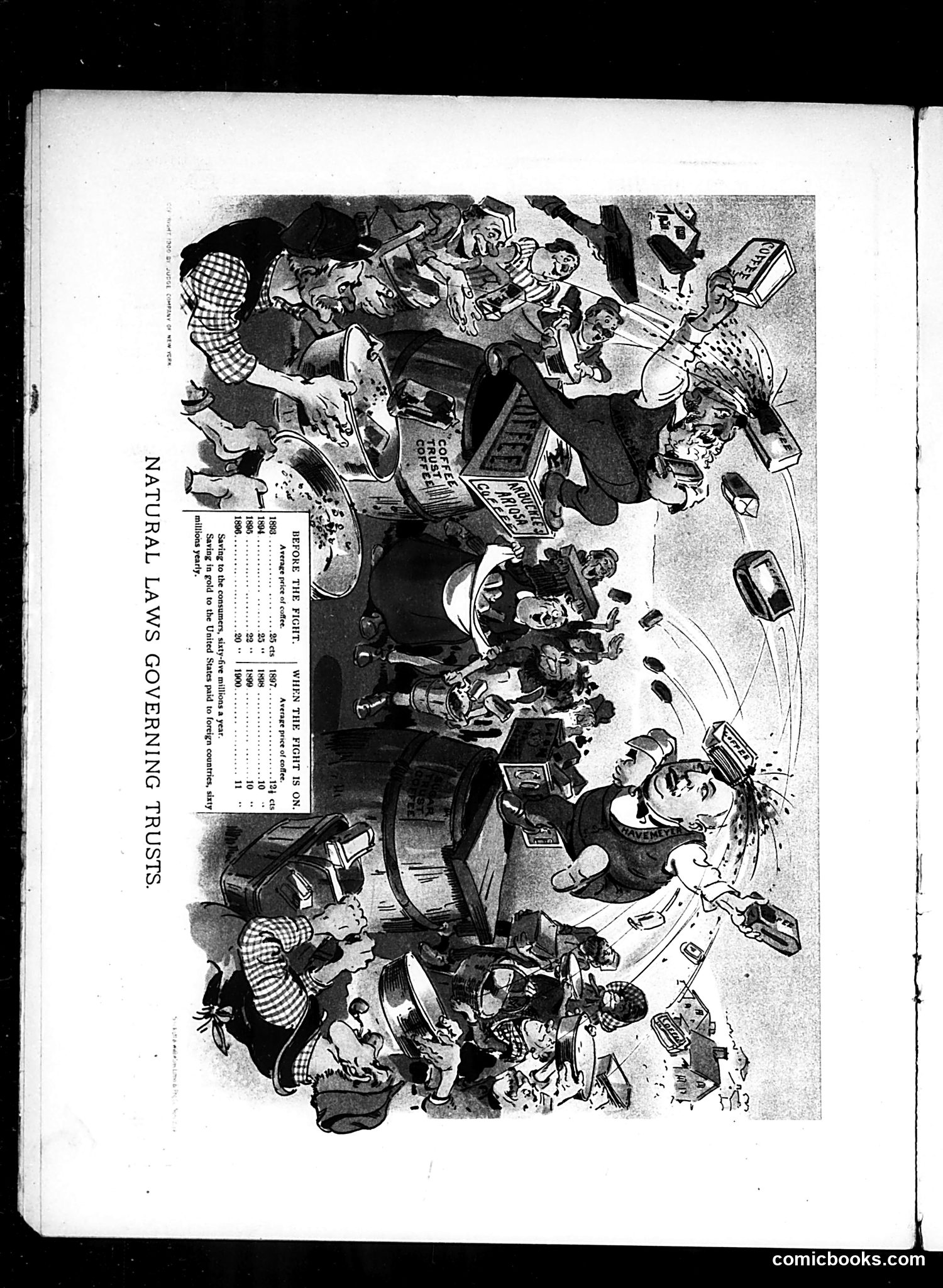
This appears to be a political cartoon satirizing the formation and behavior of business trusts in the late 19th/early 20th century. The image shows multiple figures (likely representing wealthy industrialists or monopolists) clustered together around what appear to be commercial goods or products, suggesting how trusts consolidated competing businesses into unified entities. The title "Natural Laws Governing Trusts" uses ironic language—the cartoon suggests these trusts operated outside natural law, instead following only the greed and self-interest of their leaders. The visual chaos and overcrowding emphasizes how trusts crowded out competition and smaller businesses. Though specific individuals aren't clearly identified in this reproduction, Judge magazine frequently targeted the era's major industrialists and monopolists during the trust-busting progressive era.
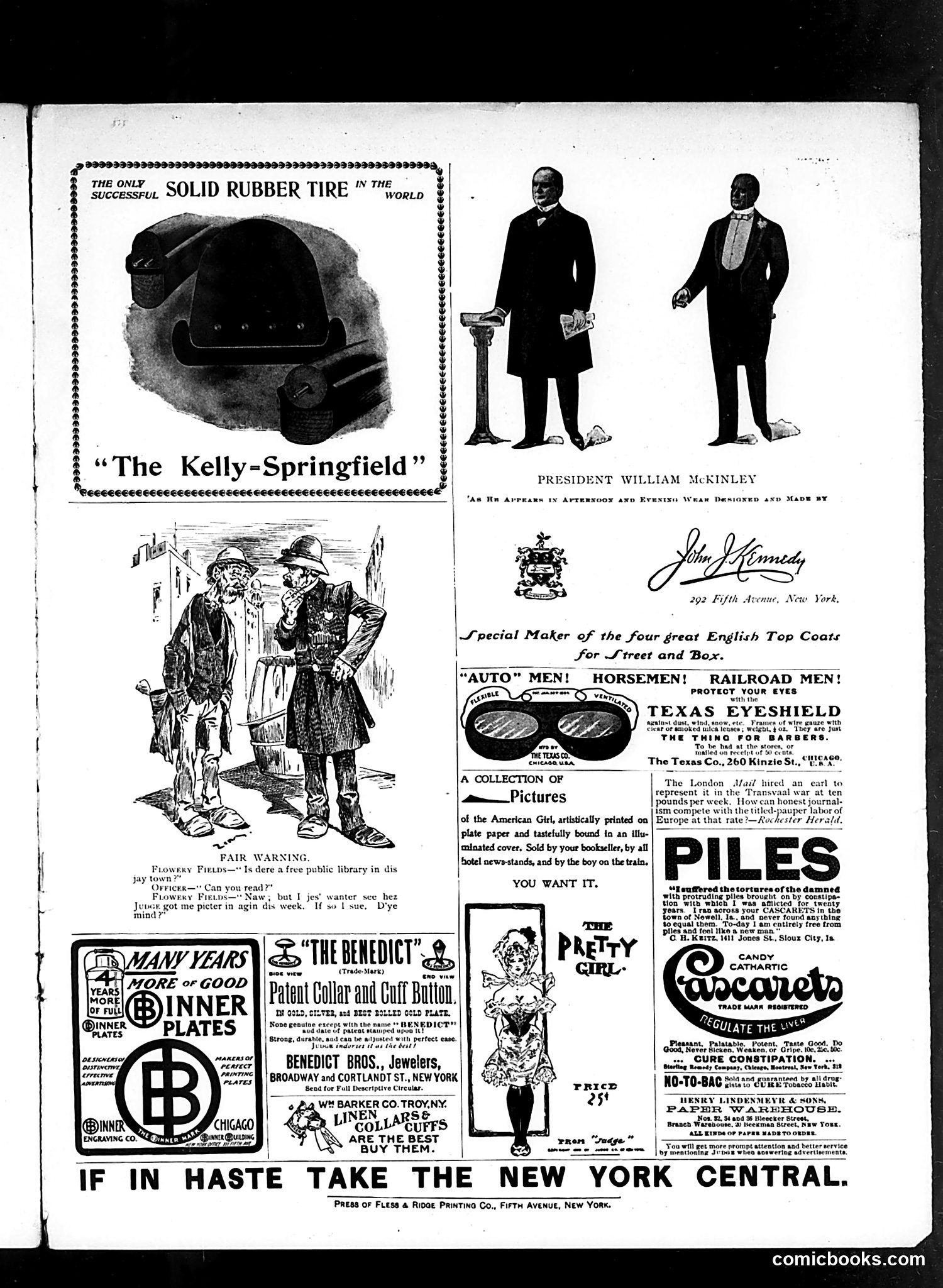
This is primarily an **advertising page** from Judge magazine, not a political cartoon. The dominant content comprises commercial advertisements for various products and services typical of the early 1900s. **Notable elements:** The page features **President William McKinley** in formal dress (top right), likely advertising men's clothing by John J. Kennedy of Fifth Avenue—presented as "Special Maker of the four great English Top Coats." Other advertisements include: - **Kelly-Springfield solid rubber tires** - **Dinner plates** (Benedict Bros.) - **Patent collar and cuff buttons** - **Texas Eyeshield** protective eyewear - **Various patent medicines and consumer goods** **The cartoon** (bottom left, "Fair Warning") depicts two street characters in dialogue—appears to be humor about finding picture collections of American girls, likely satirizing both commercial publishing and working-class entertainment. The page concludes with transit advertising: "If in haste take the New York Central" railroad. This represents Judge's revenue model: mixing light satire with lucrative advertisements targeting middle and upper-class readers.
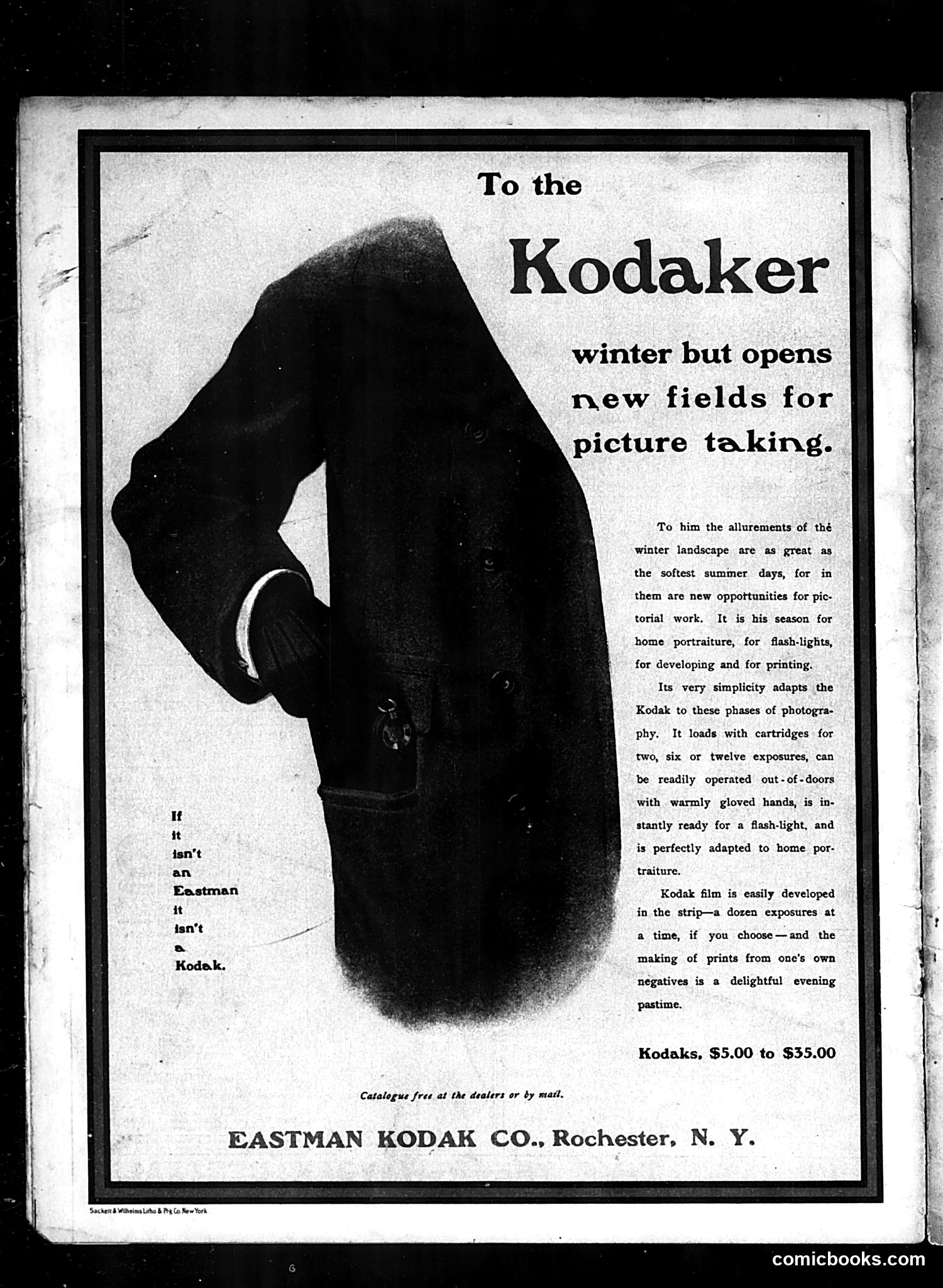
This page is **advertising, not satire or political commentary**. It's a Kodak camera advertisement from Judge magazine promoting Kodak cameras to winter photographers. The image shows a silhouetted figure holding a camera, illustrating the practical use of Kodak equipment in cold weather. The accompanying text emphasizes that winter photography offers unique opportunities—home portraiture, flash photography, and darkroom work—making it an ideal season for camera enthusiasts. The small tagline "If it isn't an Eastman it isn't a Kodak" (visible on the left) is brand messaging, not satire. The advertisement targets amateur photographers by highlighting the camera's ease of use in winter conditions and the appeal of home darkroom development as a hobby. The price range ($5.00 to $35.00) and distribution information ("Catalogue free at the dealers or by mail") are standard advertising copy. This represents early 20th-century Kodak's marketing strategy positioning photography as an accessible leisure activity.