
Judge, 1900 · page 10 of 22
Judge — 1900 — page 10: what you’re looking at
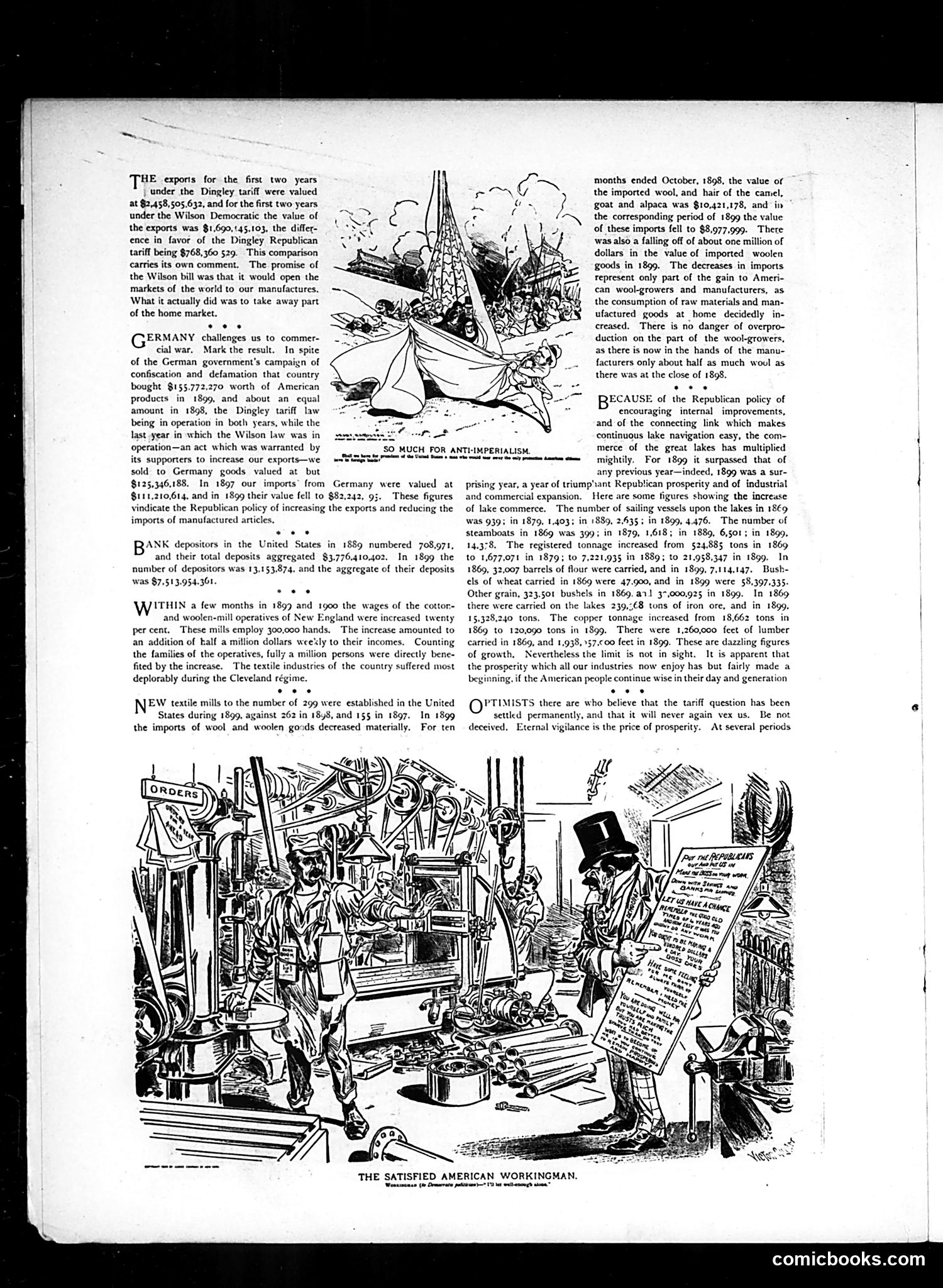
What you’re looking at
This Judge magazine page celebrates Republican economic policy under the Dingley Tariff (1897) versus the preceding Wilson Democratic tariff. The bottom cartoon depicts a satisfied industrial worker surrounded by prosperity—factory machinery, full order books, and visible contentment. The accompanying text argues the Republican tariff succeeded where Democrats failed: exports under Dingley ($2.458 billion over two years) exceeded Wilson-era exports ($1.690 billion), domestic wages increased 20% for New England textile workers, and 299 new mills opened in 1899. Even German trade and lake commerce expanded despite international tensions. The satire's point: protectionist Republican policies created American prosperity and worker satisfaction, contradicting Democratic promises that lower tariffs would "open world markets." The cartoon celebrates the working class as direct beneficiary of GOP tariff policy—a politically strategic image for the magazine's Republican audience.
📄 Transcribed text from this page (OCR, searchable)
Machine-transcribed from the original scan — historical spelling and the odd misread are preserved.
THE exports for the first two years junder the Dingley tariff were valued at $2,458, 505,632, and for the first two years under the Wilson Democratic the value of the exports was $1,690,145,103, the differ- ence in favor of the Dingley Republican tariff being $768,360 529. This comparison carries its own comment. The promise of the Wilson bill was that it would open the markets of the world to our manufactures, What it actually did was to take away part of the home market. soe GERMANY challenges us to commer- cial war, Mark the result. In spite of the German government's campaign of confiscation and defamation that country bought $155.772.270 worth of American products in 1899, and about an equal amount in 1898, the Dingley tariff law being in operation in both years, while the last year in which the Wilson law was in operation—an act which was warranted by so its supporters to increase our exports—we eae tis sold to Germany goods valued at but $125,346,188. In 1897 our imports’ from Germany were valued at $11,210,614, and in 1899 their value fell to $82,242, 93. These figures vindicate the Republican policy of increasing the exports and reducing the imports of manufactured articles, BANK depositors in the United States in 1889 numbered 708,971, and their total deposits aggregated $3.776,410,402. In 1899 the number of depositors was 13,153,874. and the aggregate of their deposits was $7,513.954.361. WITHIN a few months in 1899 and 1900 the wages of the cottor- and woolen-mill operatives of New England were increased twenty per cent, These mills employ 300,000 hands. The increase amounted to an addition of alf a million dollars wee%ly to their incomes. Counting the families of the operatives, fully a million persons were directly bene- fited by the increase. The textile industries of the country suffered most deplorably during the Cleveland régime. eee NEW textile mills to the number of 299 were established in the United States during 1899, against 262 in 18y8, and 155 in 1897. In 1899 the imports of wool and woolen gods decreased materially. For ten MUCH FOR ANTI-IMPERIALISM. ent hee ae a ore ay pre Lenten ene mightily. For 1899 it surpassed that of months ended October, 1898, the value of the imported wool, and hair of the camel, goat and alpaca was $10,421,178, and in the corresponding period of 1899 the value of these imports fell to $8,977,999. There was also a falling off of about one million of dollars in the value of imported woolen goods in 1899. The decreases in imports represent only part of the gain to Ameri- can wool-growers and manufacturers, as the consumption of raw materials and mai ufactured goods at home decidedly i creased. There is no danger of overpro- duction on the part of the wool-growers, as there is now in the hands of the manu- facturers only about half as much wool as there was at the close of 1898. BECAUSE of the Republican policy of encouraging internal improvements, and of the connecting link which makes continuous lake navigation easy, the com- merce of the great lakes has multiplied y previous year—indeed, 1899 was a sur- prising year, a year of triump'iant Republican prosperity and of industrial and commercial expansion. Here are some figures showing the increase of lake commerce. The number of sailing vessels upon the lakes in 1869 was 939; in 1879, 1.403; in 1889, 2,635; in 1899, 4.476. The number of steamboats in 1869 was 399; in 1879, 1,618; in 1889, 6,501; in 1899, 14.378. The registered tonnage increased from 524.885 tons in 1869 to 1,677,071 in 1879; to 7,221,935 in 1889; to 21,958,347 in 1899. In 1869, 32,007 barrels of flour were carried, and in 1899, 7.114.147. Bu els of wheat carried in 1869 were 47.900, and in 1899 were $8,397.335- Other grain, 323.501 bushels in 1869. a1! 3,000,925 in 1899. In 1869 there were carried on the lakes 239,;€8 tons of iron ore, and in 1899, 15,328,240 tons, The copper tonnage increased from 18,662 tons in 1869 to 120,090 tons in 1899. There were 1,260,000 feet of lumber carried in 1869, and 1,938, »57,co0 feet in 1899. These are dazzling figures of growth, Nevertheless the limit is not in sight. It is apparent that the prosperity which all our industries now enjoy has but fairly made a beginning. if the American people continue wise in their day and generation eee OPTIMISTS there are who believe that the tariff question has been settled permanently, and that it will never again vex us, Be not deceived. Eternal vigilance is the price of prosperity. At several periods iC THE SATISFIED AMERICAN WORKINGMAN. ‘Wentiames (t Drmurate pine) "12 het wueneg® se” comicbooks.com